Product Update: ThinOptics Now has Bold Colors, New Magnification

You’ll Always Have These Readers With You.

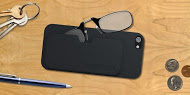
Finally, you can read your cell phone, trail maps and restaurant menus with ease because you can always have these very cool reading glasses with you. And the case snaps onto your Smartphone for ready access. Now isn’t that novel!

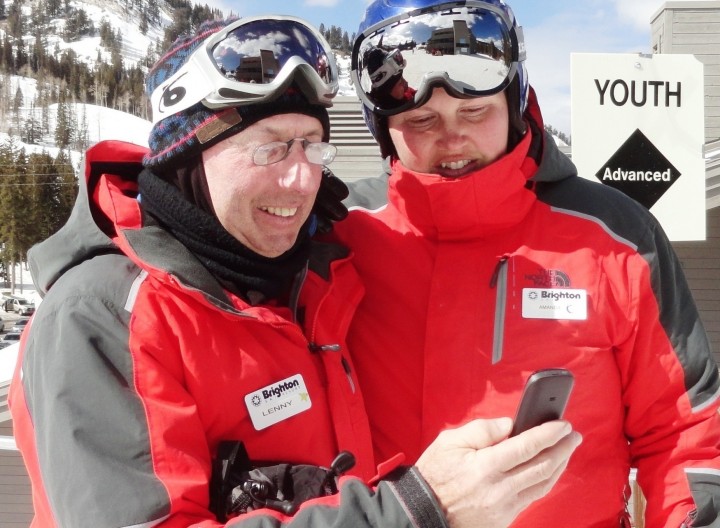
Brighton Resort ski instructors Lenny Bernstein and Amanda Cimini check the phone. Lenny is wearing ThinOptics. Credit: Harriet Wallis

Brighton Resort ski instructors Lenny Bernstein and Amanda Cimini check the phone. Lenny is wearing ThinOptics.
Credit: Harriet Wallis

ThinOptics readers solve the problem that has plagued seniors since Smartphones were invented. The phones are smart, but the info is too small to read. ThinOptics to the rescue. These tiny glasses perch comfortably on your nose then store away on your cell phone. No more fumbling for bulky reading glasses or passing glasses around.

After millions of dollars of research, these virtually indestructible readers were introduced last year, and they rocketed to popularity with seniors. Now they come in vivid frame colors as well as traditional black and clear. In addition. a new magnification level has been added.

Check our original review from October, 2014 here.

Bootfitting 101: TLC For Old “Soles”

Here's a boot fitting pro doing a stance analysis.   Credit: Steve Cohen

Here’s a boot fitting pro doing a stance analysis.
Credit: Steve Cohen

Older people have messed up feet, says Steve Cohen philosophically. Cohen is CEO of Masterfit Enterprises, a company that specializes in training ski shop salespeople to fit boots properly. The company also tests boots, makes insoles and boot fit aids and runs America’s Best Bootfitters, an organization of top bootfitting shops.

“Think how many miles senior feet have trod. They’re like an old car suspension, a little more played out,” he says.

Help is on the way.

“Many people are in boots one size too big for them, some are amazingly even in boots three sizes too big,” says Cohen. “You need snug fitting boots to steer with your ankle, set your edge, and let the ski do its thing with an arc turn. Movement should be minimal to get your ski to turn where you want it.”

The way to test boot size? Remove the liner, slide your foot into the boot until your big toe touches the front. Make sure there is not more than a finger’s to a finger-and-a-half’s width of space between your heel and the shell. That will ensure a snug fit when the liner is reinserted.

Typical foot problems that occur with age are: thinning of the fat pads cushioning the soles, plantar fasciitis (inflammation caused by the stretching of the connective tissue that runs from the front of the heel to the metatarsal heads sole), bunions, and poor circulation.

One recommendation Cohen makes off the bat is to replace the stock insole with an upgraded model that provides support in two key places, the arch and the

Fitting boots may require custom-fit insoles. Credit: MasterFit

Fitting boots properly may require custom-fit insoles.
Credit: MasterFit

heel.

Other pieces of advice:

  • To ease your foot into the boot, spray the spine of the liner with dry silicone spray or use a giant shoehorn, made specifically for ski boots.
  • Remove liners frequently so they can dry out. Your foot sweats and produces moisture. If it sweats a lot, use an underarm anti-perspirant on your feet.
  • Buckle your boots when not in use, to preserve the shape of the plastic.
  • Use thin socks, the liners will provide the necessary insulation.
  • The cuff of the boot should wrap snugly with buckle bails set somewhere near the beginning to middle of the ladders. If you’re near the end of the ladder, the buckles may deform the shell and change the boot’s intended flex pattern.
  • To keep feet warm, start with a warm boot. Use a heated boot bag to keep boots toasty on the way to the slopes or place a microwavable hot pack inside each boot (remove before skiing!). Use Boot Gloves, neoprene insulating covers that Cohen swears by. Or—bootfitters’ trick—put a layer of adhesive aluminum foil underneath the insole (stock or custom) to help reflect heat back to the foot.
  • When shopping for boots, expect to spend several hours. Go when shop personnel are least busy, midweek, midmorning.

“Never buy boots online. In the shop, you’re buying the boot fitter’s knowledge and skills, which is priceless,” says Cohen. “You will get boots that are comfortable and will last you many years. A lot of people buy new boots before their old ones are truly done because they don’t fit or perform well.”

Check out bootfitters that belong to America’s Best Bootfitters. They can help you select a proper fitting ski boot, make modification to enhance fit, comfort, and warmth. Good bootfitters can also stretch or grind shells and liners to relieve pain caused by bunions or other bony prominences.

It’s all good for the senior soles.


The Get Started Basics Of Snowshoeing

Here’s Another Way To Enjoy Winter That Seniors Can Easily Get Into

Snowshoeing, once a practical means of winter travel, is now a winter recreational activity. It provides many folks  an outdoor winter alternative to skiing or X-C. In fact, most ski areas now offer snowshoeing as an option.

If you like walking, you will enjoy getting out on snowshoes. Some tips and a little technique will increase your enjoyment of this growing sport.
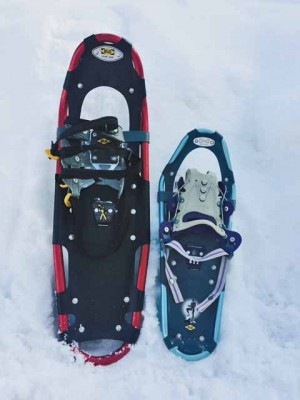
Male (L) and female (R) snowshoes accommodate different sized people. Credit: Connie Phillips

Male (L) and female (R) snowshoes accommodate different sized people.
Credit: Connie Phillips

Dress: Use three layers to keep warm in cold, snowy weather. Wool socks will help keep your feet warm. Mittens are warmer than gloves.

Layer 1: Wicks away perspiration. The base layer, next to your skin, should be wool or synthetic. The most common synthetic is polypropylene.

Layer 2: Insulates you from the cold. Again, wool is very dependable. But the various types of synthetics (aka “fleece”) provide enough warmth. Personally, I’ve never been cold when snowshoeing because of the activity level (exertion) involved.

Layer 3: Protects you from wind, rain and snow and should be waterproof and breathable.

Preparation: Many new enthusiasts are surprised to find that snowshoeing is a very aerobic activity. Exercises like walking, running, cycling and/or swimming are good preparation. Start before winter arrives.  Remember to know your own capabilities before heading out; take your first outing slow and easy.

Equipment:  Snowshoes are your main piece of equipment. The longer and wider a snowshoe, the less you will sink into the snow. Most snowshoe dealers will ask you for your body weight plus your pack weight. Let your dealer help you select the right snowshoe and remember this acronym FACT.

F – Flotation: make sure the length supports both you and your pack weight.
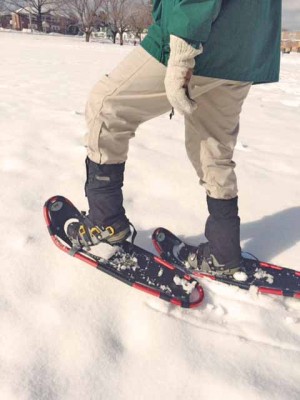
Note toe lift technique when walking on the flat. Credit: Connie Phillips

Note toe lift technique when walking on the flat.
Credit: Connie Phillips

A – Articulation: the snowshoe front should tip up when you raise your foot using a hinge at the forefoot position (See  photo).

C – Comfort: the right snowshoe should not make you spread your legs too wide apart and should keep your hips in a near normal position. Also, the bindings should be easy to use. Most snowshoe brands now make “gender specific” snowshoes. (See photo)

T – Traction: spikes or “crampons” on the bottom of the snowshoe help with traction going up and down hills.

Boots are important too. Most snowshoers will need insulated boots. Boots that lace up (rather than zip up or pull on) are best. Many snowshoe boots have a lip or spur a few inches above the heel which help keep the snowshoe binding strap in place.

Poles are another useful piece of equipment. Many snowshoers prefer the telescoping trekking poles. Large baskets on the end of your poles prevent sinking too far into the snow and help with balance. Gaiters, those nylon tubes that extend from the boot to just below the knee, help keep snow out of your boots.

Technique: A little technique goes a long way. When moving on flat terrain or going uphill, walk by moving your back foot forward with your toe dropped. On the downhill, walk heel to toe like normal.

Start your snowshoeing on broken out trails and not in deep snow. As you gain strength and experience, head into deep snow. Start off by going for time and then go for distance.

hinesHeadshot_1


Steve Hines is a sales associate at REI, Inc. (Steve’ does not necessarily reflect REI’s views). He has been a wilderness guide, a Wilderness First Responder and a volunteer trip leader for the Appalachian Mountain Club.


 

The Art of Cross-Country Skiing: The Basics

Cross country (XC) skiing is a terrific way to enjoy the great outdoors in winter. Is it great for older people that want to stay active? You betcha!

From Roger Lohr, founder and editor at XCSkiResorts.com and prolific writer on cross country skiing

The pleasures of XC skiing can be a wonderful change of pace for winter activities.  Whether you seek the solitude of solo skiing or are spending some quality time with family and friends, it’s relatively inexpensive, accessible and aesthetically pleasing. It’s also a great rhythmic, aerobic activity, enabling you to burn up hundreds of calories per hour without straining joints such as ankles and knees. You’ll get a low-impact workout while enjoying the outdoors, and the scenery sure beats the view at your local health club. Here are some tips:

Boundary Country Trekking x-c skiers in northern MN enjoy some hot chocolate. Credit: Roger Lohr

Boundary Country Trekking x-c skiers in northern MN enjoy some hot chocolate.
Credit: Roger Lohr

Where do you plan to ski? The terrain and location helps determine your equipment choices. XC skiing allows you to choose from a variety of locations. parks, golf courses, hiking trails, or XC ski areas are all good choices. Commercial XC ski areas charge a fee for access, but they offer maintained trails and tracks, signage, and you can get help if you run into trouble out on the trails.

You can rent equipment at your local ski shop or at the ski area. This is often recommended for first-time skiers, and some ski shops will apply the price of rentals toward purchasing new equipment.

Buying used equipment at a ski swap may be a mistake. Be aware that at garage sales and some swaps, you may wind up with gear that is outdated or inappropriate for you. Buy a package deal that offers a discount when you buy skis, boots, bindings, and poles together.

In-track XC skis are used with a traditional kick-and-glide motion on maintained track systems set by special grooming machines. They have minimal sidecut so the skis will stay in the tracks. Sidecut refers to the narrowness of the middle part of the skis in relation to the wider tip and tail.

Off-track XC skis are often used to navigate ungroomed trails and terrain in parks, open fields, and on golf courses. They are wider than in-track XC skis and provide more flotation and stability in fresh snow. Wider and metal-edged backcountry skis are for the more adventurous skier, who experience variable snow conditions.

Some XC skis have waxable bases, on which you put “kick wax” for grip. Other skis have waxless bases, where a pattern in the middle third of the ski base, such as small plastic ridges or scales, provides the grip. Waxless skis have been designed to run beautifully in just about any kind of snow. Your decision will center on whether you want optimal performance by waxing or optimal convenience with waxless skis.

Have the ski bindings professionally installed on the skis. Be aware that the bindings come in different integrated systems so they must be matched to the type

Quebec's Charlevoix region is a wonderful destination for cross-country skiing.  Credit: Tourisme Quebec

Quebec’s Charlevoix region is a wonderful destination for cross-country skiing.
Credit: Tourisme Quebec

of boots that you select. Your boots should feel just like running shoes so try on the boots wearing the socks that you plan to wear when skiing. Consider foot beds or fitted insoles if you have problems with your feet. Because of these various sizing methods, it’s important to try on boots before buying them. The fit should be snug and your heel should remain in place. You should be able to wiggle your toes.

XC ski poles are used to help forward thrust. Skiers plant their poles behind on an angle. If this is your first set of XC gear, any reasonably light pole will be fine. Select poles that fit comfortably under your armpits when you stand on the ground.

Now get going – XC skiing is relatively easy to learn, but first-timers should take a lesson from a qualified instructor at a commercial XC ski area to greatly enhance the experience. As your confidence on the skinny skis grows, you’ll have a life time of nature outdoors, fitness and fun.

A Much Better Way To Boot-Up

Taking The Pull Out Of Pulling On Boots.

Every now and then I come across a product that makes a big difference in the comfort of older skiers. I’ll explain in a minute.

No more wrestling with boots. Ski Boot Horn makes a BIG difference. Credit: Ski Boot Horn

No more wrestling with boots. Ski Boot Horn makes a BIG difference.
Credit: Ski Boot Horn

I always boot-up in the parking lot. The difficulty of that process advances with age. Over the years, I’ve found that using boot warmers on the way to the mountain makes it easier to get boots on — especially on very cold days, when the shells are stiff and resistant. Because I find it easier to be seated, I carry a folding chair in the car.

Recently I learned about the Ski and Snowboard Boot Horn, and, WOW, does it make a difference! This specially-designed sheet of flexible and slippery plastic is placed in the boot and helps your foot slip into place. It is simple, effective, and costs less that $10, when purchased online.

In addition to letting your feet slip in easily, the boot horn helps avoid foot and ankle pain from earlier injuries, while putting on boots. It also protects hand and finger injury and discomfort that can occur in the frustration of trying to get boots on in very cold conditions.

The ski boot horn website features a few useful videos about ways to improve getting your boots on, including useful tips about boot liner care. For reasons I don’t understand, there’s even a video of a group of skiers dropping into Jackson Hole’s iconic Corbet’s Couloir. I checked that one off on a deep powder day almost 25 years ago.

I haven’t tried the boot horn with cowboy boots, fishing waders, skates, etc., but the makers claim it works well for them and for all types of shoes. I’ll try those as the seasons change, but for now, I treat my Ski and Snowboard Boot Horn like I treat my AMEX card. I don’t leave home without it.

Huff Post: Essential Gear Senior Skiers Need To Carry

Huffington Post Features SeniorsSkiing.com’s Co-Founder Jon Weisberg On Necessary Accessories

SeniorsSkiing.com’s co-founder Jon Weisberg has been skiing for 60 years and clearly gotten his equipment kit down pat.  In this Huffington Post Post-50 Blog entry, Jon describes the eight vital pieces of gear seniors will find most useful to put in their cars, packs, or pockets.  What do you think?  Tell us what you find indispensable to carry along and how that became essential for you.

HuffPost3

Lightweight Pakems: Flip Flops for Cold Weather

Clever new “portable” boot makes feet happy.

Pakems CEO Julie Adams shows off high and low models at the Boston Ski and Snowboard Show. Credit: SeniorsSkiing.com

Pakems CEO Julie Adams shows off high and low models at the Boston Ski and Snowboard Show.
Credit: SeniorsSkiing.com

We’ve been padding around SeniorsSkiing.com’s New England office for the past few days wear-testing our new Pakems boots that we picked up at the Boston Ski and Snowboard Show last month. The real trial will come in a couple of weeks on some ski hill in New Hampshire, Vermont, or Maine after the final run of the day. I look forward to the moment when I take off my ski boots, relieving that clamped feeling—[regardless of how comfortable you think your boots are, there is always that clamped feeling]—and slipping on these lightweight, comfortable, warm and water-resistant booties and head off for après ski activities. Ahhh.

Pakems are relaxation machine. Credit: SeniorsSkiing.com

Pakems are relaxation machines.
Credit: SeniorsSkiing.com

Julie Adams, CEO and “Cruise Director” of Pakems, calls her company’s innovative boots, “flip-flops for cold weather.” After a day of skiing, rather than put on another heavy pair of hiking boots, Merrells, Sorrels, or even Bean boots, the solution, according to Pakems, is to slip on these ultra-light comfies for “happy relaxation.” We think it’s a pretty good idea to let your feet be happy after all that hard work.

There are many kinds of Pakems, from low to high cut, in different colors and ruggedness features. You’d probably want the insulated and thicker-soled Extreme model if you were planning to regularly trudge across a slushy parking lot back to your car. For us, the Classic boot is just fine for cruising around the lodge, condo or even heading out to an informal dinner. You can also give your kids or grandkids the chance to design their own boots with a set of fabric pens that come with the Kid’s Bodie model, named after Julie Adams’ eight-year old.

Pakems come in a very clever, squishable tote bag into which you can store the boots, making carrying them around instantly easy and convenient. Put Pakems in a backpack if you’re cross-country skiing , snowshoeing or ice-skating up a frozen river. Oh, and also for non-winter activities like cycling, hiking, fishing or being a tourist in a foreign land. You’ll be glad to have them at the end of the day.

Check the Pakems website for models, dealer locations and ordering information. You can also get them on Amazon.

Huff Post: What Senior Skiers Must Remember

Huffington Post Highlight’s SeniorSkiing’s Co-Founder: Is there something outdated about your equipment?

SeniorsSkiing.com’s Co-Founder Jon Weisberg has a new article on Huffington Post’s Post 50 blog, this time about the potential risks of skiing with old equipment and a lack of reasonable fitness in senior skiers.  Click here for the Huffington Post blog about what seniors should think about before heading downhill with those long, skinny skis, rear-entry boots and untoned muscles. 

Huff2

Chic CP Visor Helmet Replaces Goggles

Hot-Looking Helmet Channels F-15 Pilot Look.

I’ve written previously about the Osbe Proton Senior, a clever helmet with an integral visor which replaces goggles, providing an effective solution to the problem of foggy eyeglasses. Swiss-based CP raises the bar with their Italian-made Camurai, which adds some significant tweaks to the pivoting visor concept.

 Both helmets feature a visor that allows a small, controlled airflow through the inside, which keeps your lenses from fogging. To achieve this flow, the Osbe’s visor does not actually seal against either your face or the helmet. Generally this works very well, but I have found

CP Camurai is a full visor helmet that eliminates googles and makes you look like an F-15 pilot. Credit: Mike Conley

CP Camurai full visor helmet gives you that Top Gun aura.
Credit: Mike Conley

that occasionally fine snow can find its way inside and collect atop the foam “air-dam”. On the other hand, when closed, the CP visor’s foam seal lightly contacts your face and a rubber strip seals against the helmet at the top. Three small vents at the bottom edge of the visor allow air to circulate inside, and this does the trick. After an entire season in varying conditions, I never had the slightest fogging, nor did the smallest snowflake find its way inside. At the end of a long day wearing the Osbe I’ve sometimes felt a bit dry-eyed, perhaps from circulating air, but I have not noticed this happening with the CP.

 Like Osbe, CP offers a range of UV-filtering visors which can be quickly changed, but the CP has no small loose parts to risk losing when you do so. CP will soon be offering a full-range, photochromic visor, which should be nice. They make an extensive line of sunglasses that translates to excellent visor quality. I’ve been using a mirrored yellow visor which is great in flat light. As I’ve done with the Osbe, I stick with that one visor and use my clip-on shades on bright days. Both helmets feature a retainer strap; so, you have to option of leaving the visor off and using goggles.

 The CP is more of a three-season helmet than the Osbe with removable leather-covered ear-pads and far more venting, including 12 slots in front and on top that can be opened or closed with a slider as needed. Another nice extra is a knob in back to fine-tune the fit. The inmolded CP has a higher, domed profile and features a thick Coolmax-covered liner. I prefer the look of the Camurai; I felt the Osbe had a certain “bowling ball” look which brought back painful childhood comparisons to Charlie Brown.

 Both helmets are priced similarly – around $300 – which is reasonable considering the cost of a helmet and goggles purchased separately. The Camurai is available in a pricier carbon-fiber version if your wallet needs slimming. Visit CP/Fashion/At/Sports website  to see the full range of choices.  For a US dealer, try contacting: CP SPORTS NORTH AMERICA365 Sinclair Rd, PO Box 5968, Snowmass Village CO 81615, Phone:+1 970 710 9633

All you need is an aircraft carrier to complete the ensemble.

Who Are You? The Ski Patrol Wants To Know

Carrying Identification Can Help The Ski Patrol Help You.

HIghly trained ski patrollers will be looking for your id. Credit: Deer Valley

Highly trained ski patrollers will be looking for your id.
Credit: Deer Valley

Accidents happen. And when they do, the ski patrol will likely be your savior. But the patrol needs your help. Here’s what you should have with you every time you ski or ride–just in case.

Carry identification. If you’re injured and can’t speak for yourself, the patrol will have to figure out who you are. Chris Erkkila, assistant ski patrol manager at Deer Valley resort in Utah, said: “We’re trained to look for ID and medical necklaces and bracelets.”

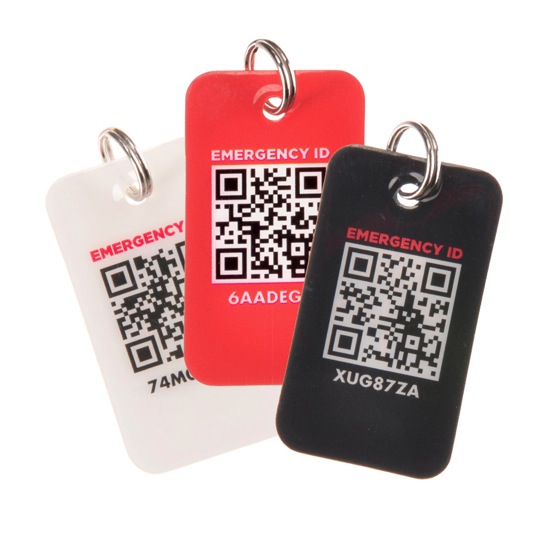
Emergency ID tags from Ecosperformance can be worn as bracelets, plastic tags or as stickers that can be applied to a helmet or even stuck on a phone.

EID Tags contain important profile information in case of emergency. Credit: Ecosperformance

EID Tags contain important profile information in case of emergency.
Credit: Ecosperformance

EIDs store identification, emergency contact and important medical information. When the QR code on the EID is scanned by a Ski Patroller’s smartphone, a skier’s Emergency Profile appears. A seven-digit EID number that can be entered into Ecosperformance website is a backup.

Other times patrollers have to be Sherlock Holmes to find even the most basic information about you—your name. They’ll look for a season pass that carries your name or look for your driver’s license. Sometimes they have to search your cell phone for information. “Often skiers don’t know each other very well, but a ski companion can tell us that the phone is in his injured friend’s right pocket,'” he said.

Carry a list of medications. “Seniors typically take more medications than others,” he said. Based on your condition, it might be vital for the patrol to know what prescriptions you’re taking. Same goes for allergies to medications

“Be sure to carry this information every time you go skiing,” Erkkila said. “Very basic things help us the most.”

And one more thing.

If you’re part of an accident, stay and identify yourself. And then there’s another aspect of accidents, he said. Sometimes there’s a collision between several skiers. Erkkila pointed out that the local city’s ordinance requires you to stay on the scene and identify yourself.  And, “We’re trying to educate the public about this,” he said. For those of us who are veteran skiers, staying on the scene after a collision seems to be common sense courtesy. But it’s also an official part of some resort areas’ regulations.

Seniors See Anywhere: ThinOptics Reading Glasses

Accessible reading glasses, even on a ski lift, make reading fine print do-able again.

You’ll love these reading glasses, because you’ll always have them with you. No more passing glasses around to read the trail map or the menu. You’ll have your very own glasses, and you’ll know exactly where they are—because their case is on your phone. Now that’s the coolest thing since sliced bread.

ThinOptics "cheaters" are handy wherever your phone goes. Credit: ThinOptics

ThinOptics “cheaters” are handy wherever your phone goes.
Credit: ThinOptics

Teddy Shalon, the inventor and CEO of ThinOptics, is a serial entrepreneur who spent many years innovating in the Life Sciences. He’s constantly looking for ways to help people enjoy healthy and active lifestyles.

The “ThinOptics moment” happened on a bike ride with his friend. When they stopped for a break, his friend handed Teddy his iPhone and asked him to read a text message from his son. “Is there something wrong with your son?” Teddy asked.

“No, I just don’t have my reading glasses, and I can’t read the message,” his friend said. That’s when Teddy realized that phones are useless if people don’t have their reading glasses. On the ride back, the idea of ThinOptics was born—glasses that are always with you, right there on your phone.

Here are some of the nitty-gritty details. ThinOptics are powerful, durable and fit virtually every nose. They’re made from thermo-injection molded

ThinOptics super-convenient reading glasses can be stowed with your phone! Credit: ThinOptics

ThinOptics super-convenient reading glasses can be stowed with your phone!
Credit: ThinOptics

optical grade Poly-Carbonate which is shatter-proof and often used in safety and ballistic eyewear. The lenses are made by one of the largest and most advanced optical lens manufacturers in the world. The bridge is made of Nitinol—an alloy of nickel and titanium— which is 10x more elastic than spring steel, and it’s encased in medical grade silicon tubing and anchored in an injection molded Poly-Carbonate frame. ThinOptics readers come in three optic strengths from +1.00 to +3.00 and case sizes that will fit on your phone.

The bottom line: You get all this technology and convenience for under $40. Click for details on ordering. And there’s a great referral program, too.

Still not convinced? Check out ThinOptics’ torture test on this video.


Toast Your Booties: Two Ways To Keep Feet Comfy On Cold Days

No more wrestling with cold, stiff boots on a crowded ski lodge bench.

A few years ago, I indulged in my version of the middle-aged cliche: Instead of a red sports car, I snagged some very nice new skis and a serious pair of custom-fit boots. All was glorious but for one problem—the boots were 120’s, so stiff that by the time I forced my feet into

Plug your boot bag in for pre-ski warm-ups.  Ahhhh. Credit: HotGear

Plug your boot bag in for pre-ski warm-ups. Ahhhh.
Credit: HotGear

them in the ski lodge, I was exhausted, bathed in sweat and ready for a break. To the rescue came the Hot Gear Bag, a thoughtfully-designed, electrically-heated boot bag. Plug it into the condo wall or your car for the ride to the mountain, toast your booties, and you can ease into a deliciously warm and pliable pair of boots. If you have trouble with your back or hands, you will greatly appreciate how rigid ski boots become like slippers and easier to buckle, too. Depending on your boots and the weather, your feet stay warm and comfy for a few hours.

Pair the heated boot bag with  Boot Gloves ($29.95) from DryGuy to retain the heat, and you have a comprehensive warm-foot strategy. The Boot Glove is, well, a

Boot gloves can make a difference on cold, cold days. Credit: DryGuy

Boot gloves can make a difference on cold, cold days.
Credit: DryGuy

neoprene glove for your boot. For more on boot gloves, click here.

Heating feature aside, Hot Gear has a great bag, well-designed and sturdy. Zippered or mesh pockets are everywhere! Carry it with the grab handle or the removable, padded shoulder strap, stowable in a zip side pocket. The other side pocket opens to reveal fleece-lined sleeves for goggles and spare lenses. Another zipper on the back reveals backpack straps for a balanced carry and also an integral cable and lock for security. A bungeed helmet carrier on top zips flat when not needed, and a padded plastic foot pad can be deployed from the underside to provide a clean place to stand.  Now, that’s a clever addition. The connection cords for house or car outlets hide behind their own zippers in front. Sturdy rubber feet protect the bottom of the bag.

The large main compartment is surrounded with an electric heating pad. Select one of three settings, and your boots, gloves and anything else you can fit in are nicely warmed and softened, or, at the end of the day thoroughly dried out. Velcro-ed in place, the heating pad is easily removed for replacement, if necessary. Velcro-tabbed compartments hold extra socks, neck gaiters or base layers, and there’s a generous mesh pocket for all those small doodads. I keep an old hand towel at the bottom of my bag to soak up melting slush at the end of the day. When traveling, besides my boots, I can put my helmet, gloves, and several pairs of socks in the bag, and it fits nicely in the overhead bin on a plane.

There's a variety of heated boot bag models from Hot Gear. Credit: Hot Gear

There’s a variety of heated boot bag models from Hot Gear.
Credit: Hot Gear

I own the Classic 110-volt model ($179). Other models include the somewhat larger Pro ($199), a double-size for two pairs of boots ($249), the smaller Ajax ($149) and the Classic Trolley ($239) with wheels and a telescoping handle, variously available in 110- and 220-volt versions.

I’ve used mine for several years now and consider it an essential piece of equipment. I love the heating feature and am currently working on a recipe for Boot Bag Baked Brownies.

To find a retailers near you, click here.  Not near you?  Click here to buy direct.

Handwarmers Expiration Date

The Truth About Hand Warmers

A hot tip for happy hands.

The fall hunting season can be the best time to stock up on the “shake ’em up” hand warmer packets that we put into our ski gloves and mittens. In my area—Salt Lake City—some big box stores have special deals on the packets in the fall when outdoorsmen are preparing to head to the woods for the deer hunt.

Beware outdated hand warmers. Credit: Harriet Wallis

Beware outdated hand warmers.
Credit: Harriet Wallis

But before you buy a load of special deal packets, examine them for the expiration date. It’s probably embossed or printed into the edge of the foil wrapper. Packets that are close to their expiration date may have lost their oomph.

Last year, my locker room buddies stocked up on hand warmers from a big box store in fall as usual. But then they moaned and groaned all winter about the packets. Many packets heated inconsistently and some never heated at all. On close examination, we found the packets to be nearly outdated, and some were past their expiration date. The store probably had old inventory and stocked the shelves with it first.

On the other hand, I’ve had packets buried in the bottom of my ski bag for several years, and yet they heated well.

The bottom line: To assure warm hands, check the expiration date before you buy. The expiration date should be several years into the future.

What’s your hand warmer story?


Fogless, Wide-Screen View While Wearing Glasses From Osbe Helmet

How To Look Like A Skiing Top Gun

Like many seniors dependent on glasses and contact lens-phobic, I’ve always searched for a way to keep my specs from fogging up while skiing.  I overheat easily and goggles steam up so none of the usual tricks (rubbing dry soap on the lenses, etc.) help for long. I tried different goggles with a tiny built-in fan, but those have other drawbacks. A very good solution is

The Osbe's visor allows a flow of air to evaporate fog. Credit:  Michael Conley

The Osbe’s visor allows a flow of air to evaporate fog.
Credit: Michael Conley

the Osbe Proton Senior, a helmet featuring an integral pivoting visor that covers your face— but not your nose—from the cheeks up. I’ve used mine for a few years now in a variety of conditions, and I’m quite happy with it. There are several advantages to this visored helmet over the traditional helmet/goggle combo.

Most important for me, no fogging of my glasses at all!  The visor doesn’t actually contact your face to form a seal like a typical goggle. There is an “air dam” of foam rubber on the inside lower edge to minimize the gap, but a small amount of air can circulate through the inside of the visor. This is necessary to continually clear away any buildup of humidity, and it works very well. Occasionally on the lift a bit of fogging can occur depending on the wind but never while skiing.  Another important benefit is a greatly increased field of vision. The Osbe visor, unlike goggles, does not make a frame around your face with thick foam that restricts peripheral vision; this helps avoid what I consider the biggest danger on the slopes:  other skiers.

Since the visor does not touch your face there is no pressure to restrict breathing through the nose. Goggles tended to press my glasses into my face, and occasionally I almost pulled my glasses off when removing them. It’s a simple

Admit it.  Navy pilot helmets are cool.  Check that visor. Credit: Andrea Salimbeti

Admit it. Navy pilot helmets are cool. Check that visor.
Credit: Andrea Salimbeti

matter to pivot the well-made, distortion-free visor up or down as needed.  Since the visor is very light, it doesn’t affect the balance of the helmet.

Visors are available in clear, mirrored, smoke and orange and can be easily changed in a few minutes. One minor problem is a small loose part that can fall off in the visor-changing process, so be careful. I just leave the orange visor on at all times and use clip-on shades when needed.

Osbe is an Italian maker of motorcycle helmets with years of experience in helmet design. Maybe being European-designed the sizing seems to run small. I’ve always worn a large in helmets, but the sizing chart on the Osbe website indicated I should wear a medium (my head is about 23-1/2″ around). I ordered a large anyway, and it was definitely too tight, so I ended up with an XL which fits fine.

The Osbe tends to start conversations on the chair—some say it looks odd. I’m 58, and I couldn’t care less at this point in my life if it does. Seeing clearly at all times is key. If I make someone smile, hey, what’s bad about that?

For more information: check Osbe Ski Helmets

What’s your experience been with Osbe?

SeniorsSkiing Contributor Michael Conley re-discovered skiing in his late 40’s when his daughter took up snowboarding. A Brooklyn, NY-based artist and furniture maker, he skis as often as possible (not nearly enough…) in upstate New York and New England, with excursions to Montana where that now grown-up daughter is in college. In warmer weather he kayaks and hikes and bikes with his cold-phobic wife.

Editor’s Curiosity Corner:  According to the NSAA, 77% of skiers 55-64 and 81% of skiers 65 and over wear helmets.  If you do, what’s your rationale?  If you don’t, what’s up?  Let us know.


CADS: How to Add Years to Your Skiing

An ingenious invention extends your ability to ski well on not-so-great knees

On the high side of usefulness for seniors, we find CADS, a remarkable body weight suspension system for skiers and riders that reportedly helps relieve knee pressure by acting as a spring between your butt and your knees.  Instead of

Strut from butt to boot Credit: Dan Leeth

Strut from butt to boot
Credit: Dan Leeth

gravity relentlessly pressing down—using your knees as a fulcrum—CADS is said to relieve the pressure.  Less pressure, less muscle tension, less fatigue and more skiing.

CADS stands for Constant-force Articulated Dynamic Struts—think of your car’s shock absorbers, and you have an analogous idea.  The skier wears a harness around the waist and under ski pants. Thin pole-like struts attach to the waist belt and to a fitting in the back of the ski boot.  The struts are detached on the lift and remounted at the top of the hill.

CADS inventor Walter Dandy said in a January, 2013 Dallas Morning News article, “It’s like sitting on a bedspring.  It pushes down on the ski.  It pushes up on the skier.”  He claims, “You don’t get tired, and your knees don’t hurt.”

“CADs does a novel thing,” said Walter in a SeniorsSkiing phone interview.  “In addition to weight bypass, CADs replicates what the thigh muscles do, so you’re reducing the strength requirements of your own muscles.”  CADS also puts downward pressure on your ski, allowing the ski to be in more continuous contact with the snow.  “That reduces muscle tension and fatigue,” said Walter.  “One senior skier held a tuck position from the top of one Vail ski run to the bottom without burning his thighs.  He said he couldn’t even do that when he was 25!”

Walter said that people whose knees hurt when they are skiing are prime prospects for the CADs system.  “Our customers are typically life-long skiers—engineers, physicists, surgeons, dentists and the like.  These people are self-reliant, knowledgeable, but they have a knee issue that is threatening their skiing experience.  So, instead of quitting, they try CADs.  These are not fashion-sensitive people, and they want to keep skiing.”

Struts and Bands Supply the Force Credit: CADs.com

Struts and Bands Supply the Force
Credit: CADs.com

The CADS website has lots of videos of regular folks skiing with the device.  The hard-data medical research and testimonials collected over the past twenty-four years are impressive.

If you happen to be in Vail, you can get a free on-slope demo from Walter using trial equipment.  If Vail isn’t in your plans, you can order by mail.  Walter will ask you to send your boots and ski pants so he can fit them out before sending you back your new CADS.  Or, you can install the devices yourself.  Walter is also happy to advise prospective buyers curious about the technology and whether it could be potentially helpful for them.

Yes, it looks very different, but according to the testimonials on the CADS website, this really works.  And if you can keep skiing and skiing well, who cares about stares?  “The change in attitude in people from before trying CADs to after is remarkable,” said Walter.

We like the idea of CADs because it gives senior skiers a choice where there wasn’t any before.  We plan to try CADS this season and post a review.

Have you seen or used CADs?  Tell us your story.


We haven’t yet tried CADs and can’t officially endorse it until we do.  But it certainly is worth a look if you are thinking of quitting because of bad knees.  Here’s the official promotional video.

Ski Boots for Seniors: The Apex Innovation

Hey there, Senior Skier:  Time for a moment of honest reflection.  While ski boots have come a long, long way from the old days, comfort-wise, they still suck, right?

But, what if ski boots didn’t hurt after three hours of riding hard pack?  What if you could walk around the lodge or to your car in comfort, without the cadence of a hobbled horse?  What if you could get the damn things on without wrestling, straining, tugging, and grunting?  Well, you can.  That’s the whole idea behind the Apex boot which promises comfort and performance without the feeling of having your feet in a clamp.

ImageImage

The Apex takes its inspiration from ski board riders, who can perform all day on the mountain and then dance to the music in their boots in the lodge.  Basically, the Apex consists of two elements: a walkable support boot that promises a custom fit, and an external carbon-fiber frame—an exoskeleton, if you will—that can be tuned to different flexes.  The boot locks into the frame, and the result, according to Apex, is the Holy Grail of precise edge control and comfort.

We learned of the Apex boot from Senior Skier Billy Kidd, who, at 70, is still very much on the hill. As the 1964 Olympics silver medalist said in an interview with CBS Denver, “At 20 years old, I didn’t care about comfort.  I still need to have control, but the top priority for me now is comfort.”  Now, we at SeniorsSkiing totally endorse Billy’s urgency for comfort; it’s a core philosophy around here.  That’s why the Apex looks so interesting.

The innovative genius behind Apex is none other than Denny Hanson.  In 1970, Denny and his brother Chris rocked ski industry traditionalists with what was then the revolutionary Hanson boot, the first rear-entry design that also featured comfort and easy to get into.  The Hanson boot caught on with racers and freestylers, and what was once considered radical became accepted.

Here’s Denny showing off the Apex.

Couple of things.  Apex boots aren’t cheap.  On the other hand, reviewers are really effusive about praising the performance-comfort benefit.  Also, dealers are spread out pretty thinly.  Check the website for a dealer within a day’s drive.  Or a short plane ride. Or head over to Apex Ski Boots.

Comments on Apex boots?  Anyone? Anyone?

Ten Indispensable Items Every Senior Skier Should Own

Age has its rewards. And you may have noticed the occasional downside.

For the senior skier, a few equipment decisions – some of them surprisingly simple and inexpensive, can improve your overall experience.

Here are ten.  We’d welcome additional suggestions from you.

 Lightweight, folding chair — The civilized way to get boots on and off. Avoid camping chairs that place you too close to the ground. Opt for a full size unit. If the parking lot is messy, use a plastic mat for protection.

Camp Chair

For Parking Lot Booting Up

Small, flat plastic water bottle – It’s one of the most practical items. Wearable hydration systems may be good for backcountry, but overkill for resort skiing. Conventional bottles are bulky. Most camping outfitters carry 12 oz plastic bottles with a nozzle cap. Just a few dollars; fits flat in your parka pocket.

Fat rockers – Reverse camber skis with a soft tip are ideal for getting around most mountains. Unlike other designs they require less effort to turn and tend to float on powder and crud. Their energy efficiency adds hours to the day. The trick is in the reverse camber —  you’re turning a much smaller portion of the ski than with other designs. Don’t take them out on boilerplate, and be patient if you need to negotiate long, flat connector trails, They’re not easy to skate.

Fat Rocker Ski

Fat Rockers Have Captured The Imagination Of Powder Hounds

Glove liners –In addition to warmth, they protect hands when removing gloves. Wear them under a slightly overlarge glove or mitten. Easy to wash. The best cost about $20.

Plug-in boot warmers – Use them in the car on the way to the hill. They make it easier to get boots on and pre-warming is a nice way to start the day. Choose the style that works best with your car’s electrical system.

Custom boots – Pricey, but possibly the best ski investment you make. Custom foot beds. Custom foam liners. If you spend considerable time on the hill, you’ll understand.

Balaclava – Not the pastry, the snug-fitting head and face covering. On a cold day this adds comfort and takes away the sting. Opt for one with a poly— face section. Wash often. A great investment at around $25.

Accessories tote bag – One bag per skier for all small gear – goggles, powder cords, lip balm, gloves, warmers, etc. Choose one with a small zip pocket for your season’s pass(es). Under $50.

Prescription goggles – Glasses and skiing don’t mix. They fog. They break. A goggle that accommodates a prescription insert is a better alternative. Downsides: they tend to be pricey and may fog when you overheat. Contact lenses are a practical alternative.

Emergency Whistle – Most likely you’ll never need to use it, but a loud whistle is almost as good a cell phone if you get into trouble. Under $10.

Emergency Whistle

Piercingly Loud When You Need To Attract Attention

Helmet – Some longtime skiers still rely on knitwear. Helmets are warm, comfortable and protective. Yes, if you hit a tree at 40 mph, nothing will protect. But for the occasional brush with a branch or a slower fall, helmet is the way to go. Make sure it fits properly. Most skiers are happy with air vents and removable ear pieces for warm Spring days.

Full Visor Helmet From Osbe

Full Visor Helmet From Osbe

SweetTarts — Seriously, this roll candy helps overcome dry mouth in an instant.

sweettarts

Email your suggestions, please.