Boomers on Groomers – a lifestyle brand

We are excited to introduce one of our newest advertisers, Boomers on Groomers – a lifestyle brand created and designed by Boomers, for Boomers to celebrate a lifelong passion for skiing. This unique company was born from the shared experiences of two longtime TV cameramen on a ski trip to Steamboat Springs.

Steve, a former Warren Miller cameraman and contributor to about 5 of Warren’s iconic ski films, and Bruce, who spent forty- six years working in the industry are the driving forces behind Boomers on Groomers. Their friends suggested, “Why not celebrate skiers our age?” Inspired by this idea, Steve and Bruce set out to create a brand that reflects the spirit and style of seasoned skiers.

At first, the duo faced a significant obstacle. Steve openly admitted, “I really don’t know anything about designing a website or selling stuff online”. Fortunately, Steve’s millennial daughter, Allison, stepped in to help. Together, they built the Boomers on Groomers website and crafted the logo featured on their shirts and hats. Thanks to Allison’s assistance, the boomersongroomers.com site was launched and thriving.

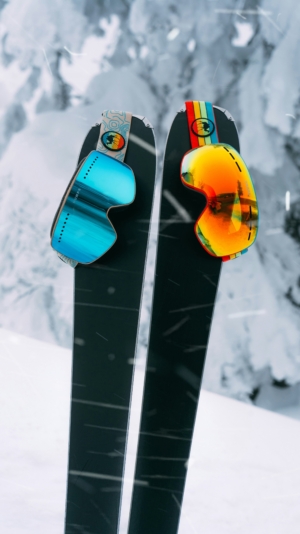
Reflecting on the journey, Bruce remarked that without Allison’s involvement, “Steve and I would still be sitting on that couch in Steamboat Springs saying, “wouldn’t it be nice if we started a website to make available shirts and hats with a cool logo?” Today, Boomers on Groomers offers apparel designed for experienced skiers who appreciate both powder days and perfectly groomed runs. Their hats and shirts combine timeless comfort with a subtle recognition of ski hill skills.

Steve and Bruce embody the Boomer generation of skiers, passionate about carving long turns and pushing their limits. They believe their gear is an excellent way to showcase your slope style with pride. Whether you’re gliding down a blue run or enjoying après-ski at the base, these hats and shirts send a clear message: “Still got it.”

Keep the adventure going by grabbing your own Boomers on Groomers apparel. When you purchase a hat or shirt and send in a photo, Boomers on Groomers will feature your picture on their gallery page, celebrating your love of skiing and community spirit.

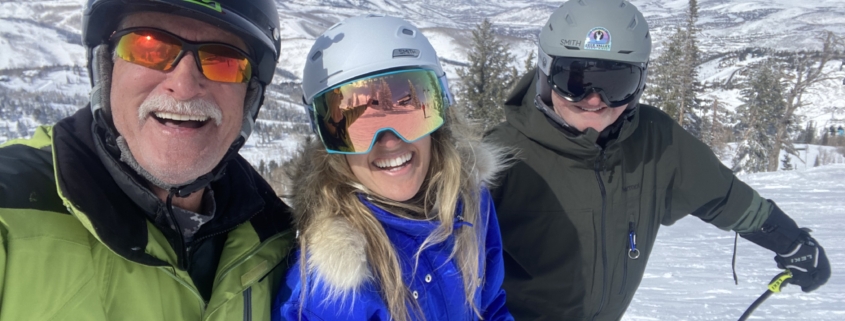
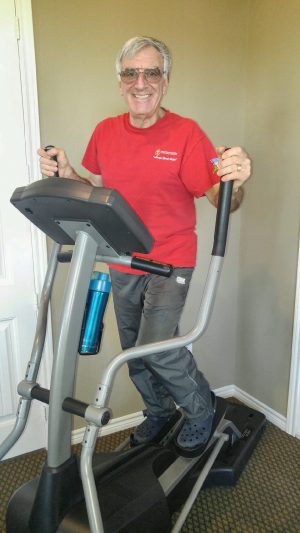
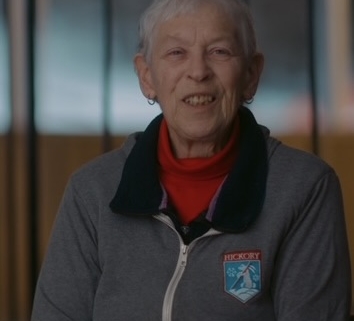
Boomers On Groomers founders from left to right: Steve, Allison and Bruce.

AI is Already Bringing Changes to Ski Resorts

Photo by Igor Omilaev on Unsplash

You may not see it, but AI is already playing a significant role in your skiing experience.

Thanks to the folks at Ski Area Management, I recently attended a Zoom meeting with over 40 resort marcomm and IT specialists. They were discussing how to custom build chatbots, defined as a program designed to simulate conversations with humans, for customer service applications. Ski resorts are utilizing AI to optimize operations, engage customers, and increase profitability.

Let’s investigate how AI is transforming ski resorts today. Here are some applications with real-world examples.

Dynamic Pricing & Revenue Optimization

Aspen Snowmass is using AI-driven pricing models that employ AI-based pricing algorithms to adjust lift ticket costs. Ski resorts maximize revenue by adjusting lift ticket prices in real time based on demand, weather conditions, and booking trends. This maximizes revenue while rewarding skiers who book early with lower prices.

The Benefits

  • Maximizes revenue without deterring customers.
  • Encourages early bookings for better planning.
  • Adjusts for weather conditions to optimize attendance.

Personalized Guest Experiences

Vail Resorts’ EpicMix App uses AI to analyze a guest’s data, such as runs and achievements, and provides personalized recommendations for ideal trails, food stops, and après-ski options tailored to their experience level. Resorts also use AI-driven mobile apps to send real-time alerts about upcoming events and exclusive deals. How does it work? AI tracks skier activity by using RFID lift passes and mobile apps. Data analysis provides customized recommendations based on skiing skill level, past trails used, and in-resort spending habits.

The Benefits

  • Enhances guest satisfaction by offering relevant recommendations.
  • Increases in-resort spending through targeted offers.
  • Improves skier safety by guiding them to suitable terrain.

AI-Powered Snow Forecasting & Management

Alterra Mountain Company uses AI-powered weather forecasting tools to help optimize snow production efficiency, to reduce unnecessary snow production, and to reduce the environmental impact. AI collects real-time weather data and predicts natural snowfall amounts. Resorts use this data to determine where artificial snow is needed, optimizing water and energy use. Smart snow guns adjust automatically based on conditions which helps reduce costs.

The Benefits

  • Reduces environmental impact and energy costs.
  • Ensures better snow conditions throughout the season.
  • Enhances sustainability efforts for eco-conscious travelers.

Ski Lift Efficiency & Crowd Management

Jackson Hole Mountain Resort is using AI-driven cameras and sensors to automatically optimize ski lift operations by analyzing lift line congestion. Resorts adjust lift speeds and open additional lifts based on real-time demand and crowd patterns thereby reducing wait times. Foot traffic around the resort is also monitored to improve operations.

The Benefits

  • Reduced wait times and improved skier experience.
  • Optimizes lift operations, reducing operational costs.
  • Improves overall traffic flow across the resort.

Chatbots & Automated Customer Service

At Whistler Blackcomb, AI-powered chatbots handle customer inquiries about lift tickets, weather, resort services, lift conditions, snowfall reports, booking changes, FAQs, and real-time resort updates. Machine learning enables the chatbot to improve responses based on past interactions. Available 24/7, the need for human staff for common inquiries is reduced.

The Benefits

  • Improved customer service efficiency.
  • Provides instant responses to common questions.
  • Frees up human staff to handle more complex issues.

Computer Vision Provides Safety & Security

In Zermatt, AI-powered surveillance cameras and computer vision help identify accidents, monitor skier behavior, and prevent unauthorized lift access, fraud or lost pass misuse. Skier safety is enhanced by detecting accidents. AI-powered cameras scan ski runs to detect unusual movements that could indicate an accident. When an accident is detected the system sends an automated alert to the ski patrol in real-time.

The Benefits

  • Speeds up ski patrol response time for injuries.
  • Improves skier safety by monitoring risky behavior.
  • Prevents ticket fraud and lift misuse.

Enhanced Marketing & Customer Engagement

Park City Mountain Resort is using AI to analyze guest preferences and past behavior to send targeted promotions and offers. They use AI-driven email marketing to suggest the best ski packages based on user preferences. This helps ski resorts boost revenue through targeted marketing campaigns based on customer behavior. They can even use previous visitor data to predict which guests are likely to return and send personalized emails and promotions for ski packages. AI also up- sells, offering deals on lodging, lessons, rentals, and dining.

The Benefits

  • Increases revenue with targeted promotions.
  • Encourages repeat visits.
  • Provides relevant offers instead of generic ads.

A Brave New World

The AI revolution in the ski industry is in its nascent state yet it’s already optimizing revenue, enhancing guest experiences, improving safety, and increasing sustainability. From personalized recommendations to smart snowmaking and lift management, these innovations are making ski resorts more efficient and customer friendly. Given how AI is likely to accelerate and permeate our lives forever more, I wonder how this new power will transform skiing in the future.

Will the Drought in the Northeast Curtail Snowmaking This Fall/Winter?

It all begins with water availability. Resorts draw water for snowmaking from reservoirs, ponds, rivers, streams, or groundwater. In drought years, those sources may not be “fully charged” ahead of the snowmaking season. In Vermont, resorts have expressed concern that their ponds haven’t recharged fully, and if dry conditions persist, their ability to sustain snowmaking over the season will be strained. Sugarbush Resort has noted its pond levels are currently lower than normal, and its usual source (the Mad River) is too low to allow withdrawal. They have “enough water to cover a few trails … enough for opening day,” but worry about sustaining broader coverage. Further complicating the issue, many resorts are bound by legal and regulatory limits on withdrawals, or environmental regulations that prevent them from drawing water when streamflow drops below thresholds (to protect aquatic ecosystems).

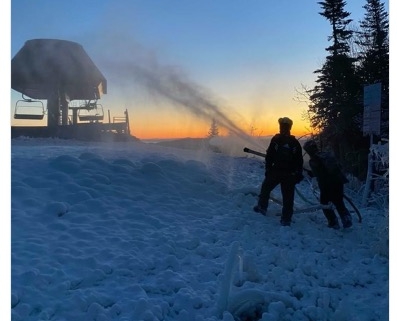
The sun comes up on Alex Phillips of the Sugarbush snowmaking team.

Even with water in hand, making snow requires sufficiently cold, dry conditions. Snowmakers use a crucial measurement that combines the ambient air temperature and humidity called “Wet Bulb”. A lower wet bulb reading means that snow can be produced more efficiently, even at temperatures slightly above freezing.

Advances in snowmaking technology — more efficient guns, better automation, lower-pressure systems — let resorts achieve more snow per unit of water (or per unit of energy) than older systems. In drought years, that becomes more critical. Some resorts are already investing in snow guns with lower water demands to adapt to drier conditions.

Current drought conditions may affect the early season (November/early December). In a “normal” year, resorts might push snow guns aggressively or respond to brief cold snaps. In a drought year, they may have to ration water usage, being more selective about when and where to make snow. The timing of reservoir refill (from late summer and fall rains) is going to be critical. If those refill cycles are weak, reservoir levels may start the snowmaking season below “full” capacity, constraining how early (or how much) water it can divert from streams. Resorts may be able to cover a few critical trails (e.g. base zones, beginner runs) when cold weather arrives but fully covering or “blanketing” entire ski areas early might be tougher if reservoir water is low. They may choose to reserve water for prime cold periods rather than using it broadly on marginal nights.

In the heart of winter, snowmaking is used to maintain and augment snow surfaces (filling thin spots, optimizing coverage). Drought constraints might force a resort to scale back “top-up” snowmaking (the process of supplementing natural snowfall with machine-made snow to ensure optimal surfaces) in less critical zones. If some reservoirs or ponds are drawn down too far, they may not be able to sustain high-volume snowmaking over prolonged cold periods. Resorts might have to scale back snowmaking, maintain minimal coverage, or stop making snow until conditions improve. They may incur extra costs (energy, pumping, infrastructure) or push investments in more efficient snowmaking technology to stretch available water. If reservoir draw is aggressive early, there might not be enough buffer left late in the season if cold spells reappear — meaning a resort could run into resource constraints before season’s end.

The undisputed king of snowmaking in the Northeast is and has long been Killington, VT. Killington is one of the more capable and well-resourced ski areas in the Northeast, if not the country, with substantial snowmaking infrastructure. But it also has regulatory and physical constraints (reservoir levels, permit limits, environmental flow constraints, refill limits, etc.). To provide some perspective on just how colossal their water needs are, and without getting too far into the weeds, here are some facts from publicly available sources:

  1. Killington claims that under ideal conditions, its snowmaking system can deliver 9 million gallons of water per day (on average, that’s 30,000 households per day!) to more than 250 snow guns covering ≈ 45 acres with 12 inches of man-made snow.
  2. Killington has been actively investing in snowmaking upgrades. They plan to deploy 1,000 new high-efficiency snow guns for the 2025/26 season (across Killington & Pico) to reduce water and energy use.
  3. Killington owns and operates infrastructure (including water rights) in its capital planning.
  4. There are historical precedent and regulatory context: for example, Killington has permits concerning the use of its Woodward Reservoir for snowmaking withdrawals.  They may not begin before November 1 each year.
  5. Killington also has upstream influence: it has acquired the ability to pipe water from Killington’s sources to Pico (another Vermont ski area nearby under its ownership) via an interconnect system.

These constraints mean that even if water exists somewhere in the system, Killington cannot necessarily always draw it at full capacity — especially in low-flow/drought conditions. Of course, major, well-resourced resorts like Killington are more likely to navigate the drought with less disruption. Those with large, deep reservoirs or multiple water sources (streams, groundwater) have a buffer. Resorts whose water rights or permits allow more flexible withdrawals will have more leeway. Areas already using state-of-the-art, water-efficient systems will be at an advantage. Resorts at higher elevations, or in colder microclimates, may have longer viable windows for snowmaking and rely somewhat less on aggressive snowmaking.

The quality of snow surfaces in the Northeast this season, and the ability of resorts to open extensive terrain early, will hinge on the amount of rain received this fall and sustained cold weather. Even with adequate rainfall, resorts will still have to deal with an increasingly prevalent and destructive freeze thaw cycles and temps too high to make snow.

It’s shaping up to be a challenging season for resorts in the Northeast. Before you do your snow dance this season, you may want to do your rain dance.

Get ready to make tracks to the ski show! (Free Tickets-Limited Time)

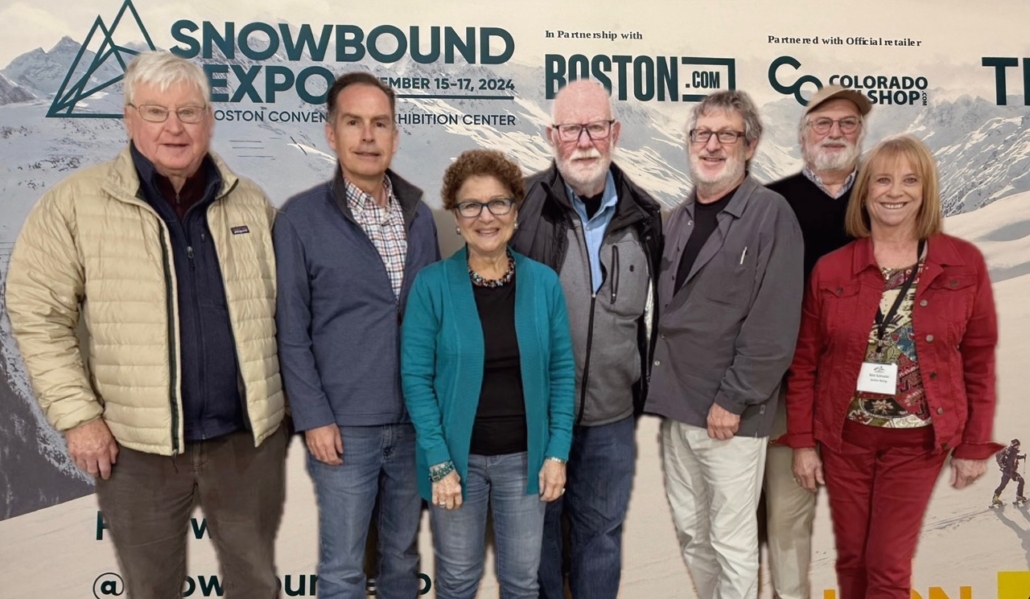
Some of the SeniorsSkiing team at the Snowbound Expo in 2024.

Get ready to make tracks to the ski show!

Our friends at the Snowbound Expo have proven they can produce the finest ski & snowboard show in the Northeast, perhaps the country. People sometimes ask me why I go? For a lot of reasons. Some psychological, some economic.

Psychologically, it’s good to be among so many people who are excited about and anticipating the coming season. It stirs the carve junky in me. I know I’ll be on snow somewhere in just weeks. That motivates me to increase my workouts (you never really know just how much gas is in the tank until the first run!) and prep the gear.

Economically, there’s gold at the show. There are more promotions than you can count. Resorts will update you about their latest improvements to their lodges, lifts, snowmaking and terrain. They’ll be selling gift-cards, ticket packages and season passes at the lowest prices of the year. If you’re lucky, you may win free tickets or passes in a raffle or by spinning a prize wheel. Chachka is everywhere. Stickers, bottle openers, keychains, goggle wipers, lift ticket clips, ski straps, hats, trail maps, water bottles, bandanas and more await you collectors of ski memorabilia.

On the gear side you’ll find close-out deals on last year’s brand-new skis, boots and bindings. It’s an excellent time to add a specialty pair to the quiver. Get that soft snow or ice ski you’ve had your eye on. You’ll also find manufacturer’s promoting their newest equipment. Get up to speed on the latest ski and boot technology designed to make your day on the hill a little easier and a little more fun. You’ll also find great deals on every kind of clothing. It’s the perfect time to update your look or add to your layers. Perhaps most importantly, there’s no better time to outfit the kids!

The show always presents a stellar line-up of guest speakers. This season will feature:

Zeb Powell, the first Black athlete ever to win Gold at the Winter X-Games.

Donny Pelletier is Maine’s finest athlete (just ask him), Donny is a legendary figure in the New England ski scene, known for his fearless style, unmatched confidence, and off-the-cuff commentary on ski culture.

Amie Engerbretson is a professional skier, producer, and host who has built a dynamic career blending adventure and media. From the slopes of Palisades Tahoe to starring in films with Warren Miller Entertainment and Teton Gravity Research, her expertise is unmatched.

Rob Roethler is a Burton Snowboards team rider. He’s known for his effortless rail tricks, bold park spins, and a fearless approach to filming in diverse terrains

Mardi Fuller is a lifelong backcountry adventurer. in January 2021 she became the first known Black person to hike all 48 of New Hampshire’s high peaks in winter.

Lj Henriquez was born in Brooklyn & raised in the Garden State; Lj Henriquez has emerged as one of the top talents coming out of the area. From an early age of 3 Lj discovered his passion for snowboarding, and since then he has been carving his way through the competitive snowboarding scene with dedication and flair.

We’ve been allocated 100 free tickets to be used by September 14th, and you can redeem yours by using the code SRSKIING at checkout on snowboundexpo.com/tickets or via this direct link: https://snowboundexpo.seetickets.com/event/snowbound-expo-2025/menino-convention-exhibition-center/3389718?OfferCode=SRSKIING

If you’re too late, you can get discounted $10 3-day passes and $5 day tickets using the code SRSKIING10 before September 30th here: https://snowboundexpo.seetickets.com/event/snowbound-expo-2025/menino-convention-exhibition-center/3389718?OfferCode=SRSKIING10

Check out the action and whet your appetite for carving, shredding, and floating, whichever works for you. If you want to try out new experiences, you won’t want to miss the indoor mega slope, Gilson rail jam, Ikon Pass Après Ski & Beer Gardens. There is much more to be announced in the lead-up to this huge community meet-up – stay tuned! For a full description of the show and everything happening there please visit https://snowboundexpo.com.

What’s Been Happening in Ski Country Since Mud Season

Credit:Bruno Giuliani

While you’ve been busy the last few months layering on the SPF, firing up the grill and dreaming of snow, you might have missed a bunch of news from ski country. Here’s what’s interesting and important intel since snow season turned into mud season from some of the many sources I follow year-round, to keep you up to date. 

First, congratulations to two winners –

Bode Miller has just been inducted into United States Olympic & Paralympic Hall of Fame. Miller, who grew up skiing and racing in New Hampshire, is a six-time Olympic medalist and five-time World Championships medalist, and has 33 World Cup wins and two overall World Cup titles. Jannik Sinner became the world’s top tennis player when he won at Wimbledon in July.  He was also a champion skier on the youth team where he grew up in the Italian Alps.  Sinner told Powder Magazine how skiing made him a better tennis player.

Ski Jumping World Cup at Lake Placid

Tickets are on sale now for the International Ski and Snowboard (FIS) Ski Jumping World Cup returning to the Lake Placid Olympic Jumping Complex on December 12-14. The event will bring together the world’s top male and female ski jumpers for three days of competition on the HS 128 large hill, with individual events and a mixed team competition. Women’s World Cup ski jumping made its U.S. debut in February last season on the same hill in Lake Placid. The event made further history when a grassroots effort made it possible to award equal prize money for the women’s jumpers, marking a significant step toward gender equality in professional ski jumping. Lake Placid is the only North American stop of the 2025-2026 World Cup season. It’s happening during a break in the Milano Cortina Winter Olympic Games from February 6-22 (ski jumping, Feb. 9-16) in Italy. This marks the fourth consecutive season that Lake Placid has hosted an FIS Ski Jumping World Cup. The men’s tour returned to the Olympic Jumping Complex in Lake Placid in 2023 after a 33-year hiatus and again in 2024, before the historic World Cup in February 2025 that included women. More information or to purchase tickets: Lake Placid Olympic Jumping Complex

Palisades Tahoe New Base Area

The massive planned base area development at Palisades Tahoe looks like it finally will go forward, now that the resort and two Tahoe-area environmental conservation groups agreed to various reductions in scope. The agreement ends a 14-year legal battle that has delayed the project from breaking ground. According to the industry magazine Ski Area Management, which I follow regularly for all its insider intel, the agreement downsizes the plan substantially, including a 40 percent reduction in total bedrooms, a 20 percent reduction in total commercial space and eliminating an indoor waterpark within the village area. The agreement also creates a conservation easement for two lots at the base of Shirley Canyon that were slated for development but will now be forever preserved for trail access and recreation. And, it prevents additional development within the village plan boundary for 25 years.

Small Colorado Town Buys Eldora

The small town of Nederland is purchasing local favorite Eldora from multi-resort operator Powdr, which will continue staffing and operating it for two seasons, to ensure a smooth transition. Part of the agreement is to keep Eldora on the Ikon Pass, which the official Nederland town website  says provides “a stable revenue stream and keeping that as a part of the funding is essential to the financing plan.”

Taos Ski Valley New Lift and New RFID Gates

Lift 7 is being replaced, and the new high-speed version is expected to be open for the new season.  You can own a piece of Taos history – and support the next generation of skiers and boarders – by purchasing a retired chair.  All proceeds support the UPLIFT Youth Fund.  Also new for next season is RFID gates.  No more taking your pass out of your sleeve or from around your neck.  The new system also makes online purchases, including reloading a pass, more efficient. See you on the slopes!  

What’s New Since Mud Season – Part Two

So much has happened at our favorite resorts since the spring meltdown known as mud season and the glorious green summer that we have a two-parter “what’s new” for you.  Here’s what else you need to know beyond Part One –

Solitude’s Ski Patrol Unionizes

It’s a first, and could be the start of a trend.

After more than a year of talks with resort owner Alterra, Utah’s Solitude Ski Patrol Union (SSPU) ratified a contract over the summer for better pay and benefits and improved working conditions.

The agreement is effective for the upcoming 2025/26 and following 2026/27 season and provides a starting wage of $24 per hour, which is 10% more than before the contract.  Full-time patrollers also get a $100 monthly stipend for healthcare and $1,300 a season for equipment.  The contract also includes an increased budget for training.

Alterra purchased Solitude in 2018 and currently owns 12 US resorts, including Steamboat, Mammoth and Palisades Tahoe.  Some observers predict the Solitude contract will inspire patrollers – and perhaps also instructors – to do the same at other Alterra-owned areas.  And perhaps also those owned by Vail. Stay tuned.

Near-Record Season for Utah

Ski Utah – the trade association which represents 15 Utah resorts – reports last season set a near-record, with 6,503,635 skier visits. While that’s down 3.6% from the 2023/24 season, it is the third-highest number of skier visits in state history and a 3.3% increase over Utah’s five-year average.

The numbers reflect the continued strength and resiliency of Utah’s ski industry, even in a year with more variable weather patterns.

“To hit our third-best season ever and generate $2.51 billion for Utah’s economy is a major win,” said Nathan Rafferty, President and CEO of Ski Utah in a press release. “The ski industry in Utah supports approximately 25,000 jobs, and with the 2034 Olympic and Paralympic Winter Games on the horizon, the eyes of the world will be on us once again. We’re excited about the opportunities ahead and grateful to all who helped make this season a success.”

Colorado Resorts Also Reports Near-Record

Colorado Ski Country USA (CSCUSA) – the trade association for 21 Colorado resorts, reports skier visits of 13.8 million for the 2024-25 season. That’s also the 3rd highest for skier visits and highlights ongoing enthusiasm for skiing and snowboarding in Colorado.

The press release we received highlights these upgrades last season –

Eldora opened its new Caribou Lodge, a multi-use facility that now houses Ignite Adaptive Sports, reinforcing the resort’s ongoing support for adaptive snowsports on the Front Range.

Ski Cooper prioritizes value this season, with $45 midweek lift tickets and all non-peak days priced under $100.

Aspen Snowmass hosted the debut of The Snow League, the first professional snowboarding league created by legendary snowboarder Shaun White. 

Arapahoe Basin welcomed the International Freeskiers and Snowboarders Association (IFSA), drawing top freeride athletes to one of Colorado’s most challenging venues.

Copper Mountain hosted the X Games Street Style Pro and the USASA National Championships.

Whiteface Joins Mountain Collective Pass

The New York State Olympic Regional Development Authority (Olympic Authority) announces that Whiteface Mountain in Wilmington, N.Y., has joined the Mountain Collective Pass, as the newest addition to an alliance of 27 destinations across five continents.

The pass provides skiers and snowboarders with two days at each participating resort, plus 50% off all additional days, with no blackout dates, and expands pass reach in the Northeast and adds a destination known for its Olympic legacy and the greatest vertical drop in the East. The Full Season Pass provides unlimited access to Whiteface, Gore, and Belleayre in New York.

Mountain Collective also includes eastern resorts Sunday River and Sugarloaf in Maine, and Le Massif de Charlevoix and Bromont in Quebec. The western U.S. and Canada include Alta, Aspen Snowmass, Banff Sunshine, Big Sky, Grand Targhee, Jackson Hole, Lake Louise, Marmot Basin, Panorama, Revelstoke, Snowbasin, Snowbird, Sugar Bowl, Sun Peaks, Sun Valley and Taos. World travelers can use the pass in the French Alps (Chamonix and Megève), Japan (Niseko United), New Zealand (Coronet Peak & The Remarkables), Australia (Mt Buller) and Chile (Valle Nevado).

Currently priced at $669 USD, the Mountain Collective pass can pay for itself with visits to just two destinations.

See you on the slopes!

Is the “Golden Age” of Skiing Coming to an End?

Credit:Dirk von Mallinckrodt

When I look back to my early days skiing in Connecticut in 1962, I’m amazed at how the sport has progressed. Back then there was little to no snowmaking, no grooming, and no high-speed lifts (and certainly no on mountain WiFi!) These innovations have profoundly changed the quality of the skiing experience overall. But where is the sport going? Today skiing faces the prospect of more monumental changes in its future in the form of climate, operational, and demographic changes. Recently, the sport has suffered a substantial decline in participation, accessibility, and profitability.

As anyone who skis in the east knows, and in Europe for that matter, climate change is real. It’s perhaps the single greatest challenge facing the sport. There’s no denying the season is getting shorter on both ends and rain (childishly called “wet precipitation” by some snow reporters) is a threat at any time during the season. The more frequently occurring freeze-thaw cycle is making it more and more difficult for resorts to provide a quality surface consistently. While many resorts have spent fortunes on snowmaking systems, it comes with environmental and economic costs. It requires vast amounts of water and is energy intensive, raising sustainability concerns.

Climate scientists warn that ski resorts, particularly those at lower elevations, will see a steady decline in natural snowfall. Smaller resorts that lack the financial resources to invest in snowmaking are already struggling to remain operational. While large, well-funded ski resorts have managed to survive through investment and diversification, smaller ski areas are struggling. Many local ski hills have closed in recent decades due to financial difficulties, lack of consistent snowfall, and declining visitor numbers. These smaller ski areas often serve as entry points or “feeder mountains” for new skiers, meaning their disappearance could further accelerate the sport’s decline.

Without affordable, accessible ski areas, fewer young people are introduced to skiing, leading to a shrinking base of future skiers. This creates a cycle where only large, expensive resorts remain, reinforcing the perception that skiing is an exclusive and costly activity.

The rising costs of skiing continue to support that belief. The cost of lift tickets, equipment, accommodation, and travel have risen sharply over the past few decades. The heavy commercialization of major destination resorts has led to significant cost hikes. We’ve all heard the stories about lift tickets exceeding $200 a day. The result is the pricing-out of middle-class families and younger generations. In addition to the cost of lift tickets skiers also find themselves dealing with the cost of equipment rentals or purchase, ski lessons, and winter gear further increasing their financial burden. Travel costs, particularly for those who do not live near ski resorts, add another barrier. The high cost of skiing has led many to seek alternative winter activities that are more affordable, such as snowshoeing, winter hiking, and even indoor skiing experiences.

Changing demographics and lifestyle preferences are also critical factors in skiing’s decline. Baby boomers played a key role in skiing’s popularity from the 1960s to the 1990s. The generation is now aging out of the sport. Younger generations, particularly millennials and Gen Z, still engage in outdoor activities, but their interests are more diverse and often lean towards experiences that are less structured and expensive. Skiing has also struggled for decades to attract diverse participants, again reinforcing the position that skiing is for wealthier, predominantly white demographics. Efforts to make skiing more inclusive have been slow, and many potential newcomers feel unwelcome or excluded from the skiing community.

Despite all the challenges facing skiing, the sport is not doomed to disappear. The decline of skiing is a complex issue driven by environmental, economic, and cultural changes. While skiing faces significant challenges, there are opportunities for adaptation and reinvention.

If the industry embraces sustainability, affordability, and inclusivity, skiing can remain a viable and enjoyable winter sport for future generations. The future of skiing depends on whether it can evolve to meet the demands of a changing world while preserving the essence of the sport that has captivated people for generations.

New Boards

So, I know it is only August, but I pulled the trigger on another new pair of skis for the upcoming season. After looking at some reviews on- line, also from the Stockli rep, and consultation with my friend in Tahoe, I decided on another pair of Stockli Stormrider 88s. I have a quiver of Stockli skis but the 88 under foot is always my go to ski and I was happy to get another pair.

It is interesting that at this time of year, I start to get itchy for the new season. Buying a new pair of skis kind of jump starts you a little bit. I got our passes early, committed to ski trips, and in short- I am ready when the first flakes start to fall.

However………………………..screeeech!!!!!! We still have the wonderful season of fall ahead.

My one friend JR always looks at his watch and sees how long it will take for me to mention skiing on a mountain bike ride. For a guy who lives in Pittsburgh, skis locally, and gets two western trips a year, I get a fair amount of skiing. Not as many days as my friends who live out west, or in New England, but for a local guy- not bad. I always think Janet and I should be living in the mountains. She likes the beach better and alas there is the rub. But we both like Pittsburgh, our friends are here, and we are resolved to ski locally and travel. But that does not temper my enthusiasm for the sport- even in the summer. But again………………….screeeeeeech!!! The nicest time of the year around here is coming soon. But for now, the dog days of summer are to be enjoyed.

One of the good things about the late days of summer riding is that you are in pretty good shape for the shape that you are in. At 70, I am grateful for my health and when we are barreling down the trails on our bikes, I am usually one of the oldest guys. My Garmin Connect says I am 58, but I know better. The chronological advancement is not lost on me, but I try to stay with it. I want to be doing this for as long as possible and when discussing skis with my friend Eric in Tahoe, we both said we need to stay active. We both thank God for good health to enable us to ride and ski for many more years. It’s not like I am riding like I was when I was younger, but I can still ride and ski enjoyably. Eric and I keep each other honest as we both have lost friends. Other friends are slowing down but we try to keep rolling on the rubber wheels and on the slopes. We are starting to feel like the last of the Mohicans, but there are good days ahead………….if we keep at it. Updating equipment like skis and mountain bikes, help with that.

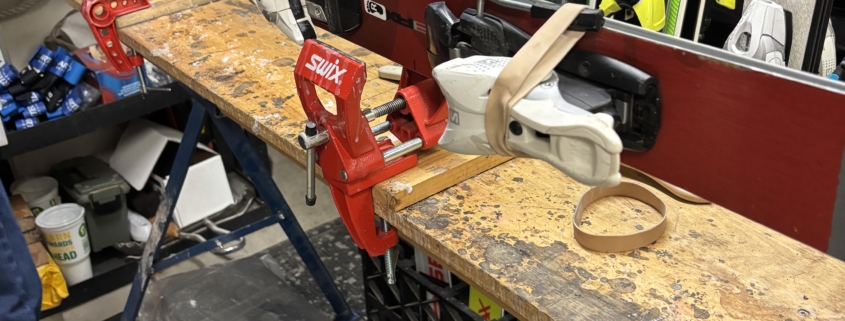
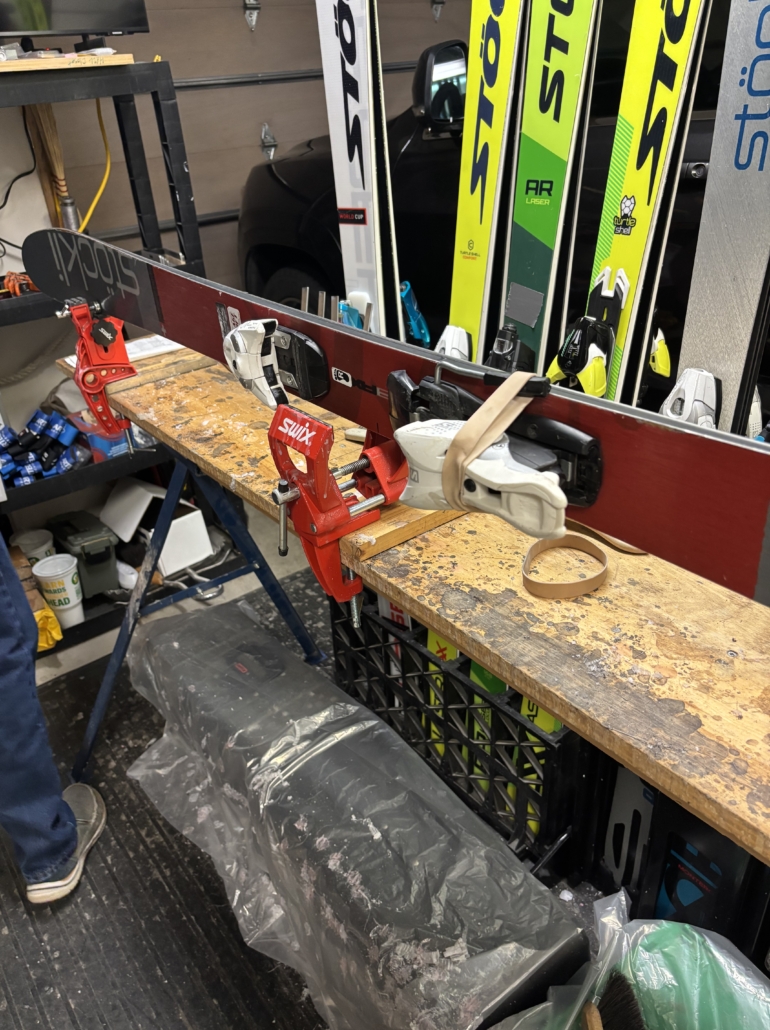
I am even ready for the ski tuning season with new vices from Swix, new files and diamond stones, and new bevels to accurately tune the edges. My friend Eric gave me a tutorial last spring when we were skiing together on tuning in the 21st century. I was still doing it the old way. But the new way with the bevels and getting the skis stone ground to a specific bevel is next level. I am totally prepared.

I mirrored Eric’s set up here in Tahoe.

So, not to rush the season or anything, I am looking forward to fall riding. A bunch of us will be going in September to ride the new Monday Lick trail system in West Virginia and staying at the wonderful Jerico Pre-Civil War cabins there. Jan and I also will be heading to Maine for a fall coastal trip. But I will be looking for the FedEx driver every day to see if the new boards are being delivered. Hey- it’s fun getting excited about things.

Please follow the blog on http://www.chroniclesofmccloskey.com It helps me.

Letter to Editor: Waiting For Snow in the Carolinas

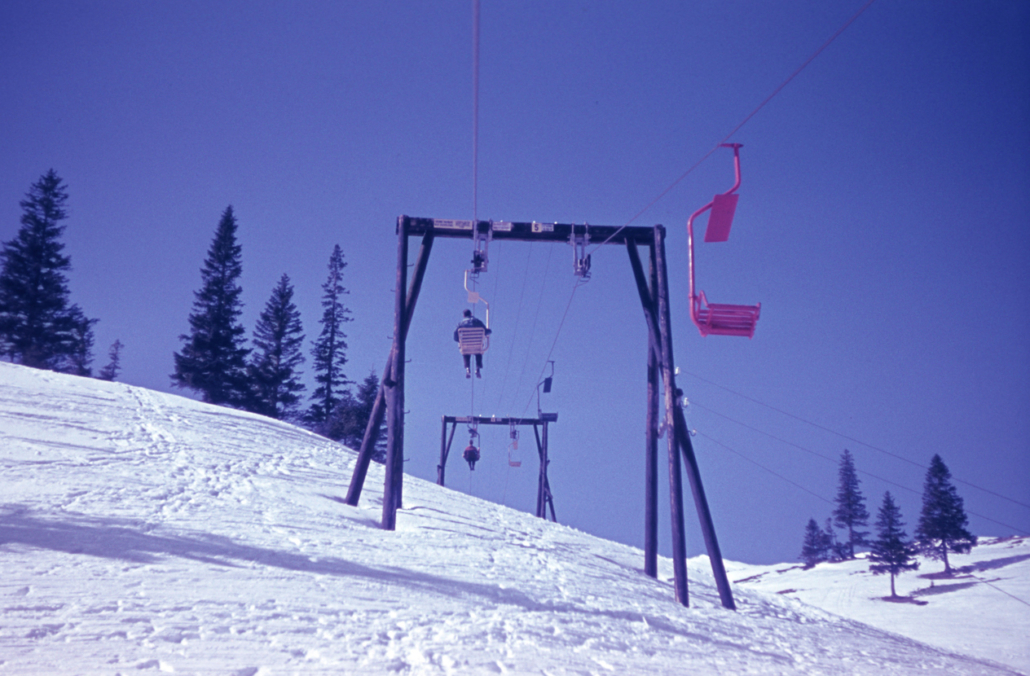
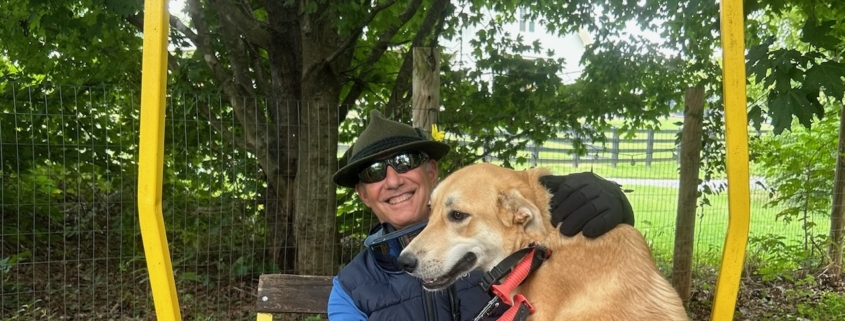
While getting out my ski gear for cleaning and the beginnings of fall workouts, family of course says “dad is crazy!”. It is, after all, August in North Carolina, but at 73 years young, I believe it is never too early to start training and tuning skis and boots. A long time ago I got to work out with members of the U.S. Alpine Ski team {I worked in sales and product development for ThorLo, which was team’s official sock} and workouts with those guys and gals taught you how to be ski fit. And I’m getting ready to help volunteer with area Winter Sports Special Olympics, and teaching cross country and downhill skiing to scouts, so I want to ready. Anyway, my bettor half got some ” ham it up” pictures in the old chairlift she bought for me as a backyard swing…pretty cool.

I hope everyone gets a laugh! Looking forward to the blessings of snow and the hope of peace in the coming Winter Olympics.

Cheers, Mike Shadroui

Tips and Tactics for Spring Skiing

Photo by Michal Janek on Unsplash

The days are longer, the sun is brighter, the temperatures are warmer and the snow is softer.  Ah, yes, spring skiing is special, when you can shed layers enjoy such end-of-season silliness as pond skimming contests and leisurely  sun-soaked apres.

Spring skiing also needs some special attention, both to the condition of the snow and the condition of your equipment.  Here is some sensible advice from a trio of ski and snowboard instructors at Whistler Blackcomb

Understand spring conditions: 
Nights are still cold on the mountain, so the snow can be firm in the mornings. Wait for the sun to soften the snow if you’re looking for that spring slush.  Spring powder conditions can be slower and harder to ride through, depending on how deep it is. This can require making bigger, straighter turns.

Debate beauty sleep vs early bird: 
Spring skiing means relaxed mornings and softer snow in the afternoons, but prime conditions for laps are in the morning.

Adjust your body language:
Make sure your weight is evenly distributed along the downhill ski (or along the inside edge of the snowboard) at the end of the turn. If there is too much weight, too far forward, the back of the downhill ski (or snowboard), can slide out.  Skiers should make sure you don’t have your weight forward at the end of the turn. Instead, what is needed is pressure on all parts of the foot from the toe to the arch, to the heel. This allows the edge to dig in.  Tighten your downhill ankle by rolling inwards to put the ski on more of an edge, and tighten your muscles so you have more control.

In powder and deeper slush, push your feet a bit forward through the end of the turn. In deeper snow, it is common for a skier’s feet to slow down due to the increased friction of the snow. The wetter the snow is, the more likely it is for this to happen. This can result in a skier being thrown forward. To counter this, skiers can push their feet forward through the end of the turn.

It is important to also push their hands forward as well, otherwise, you will be leaning too far back. This puts extra pressure on the quads. When skiing, we always want our shoulders over our knees. Snowboarders can also accomplish this feeling by pushing the front of the board forward if they feel that their board is being slowed down by the deeper, wetter snow.

Get a wax: 
You’ll definitely want your skis or board to be waxed to avoid getting stuck in slush. A good sign that your equipment is running out of wax (besides not gliding properly anymore) is a white cloudy effect on the edges of the base near the metal – this is where the snow is causing friction burn against the p-tex base.

Tree runs and spring conditions don’t mix: 
As the snow melts, obstacles can emerge in forested areas that are hazardous to skiers and riders and damaging to your gear.  Tree wells are also a hazard, so stay away from the trunks of trees, especially if they have low-hanging branches.  And always ski with a buddy.

Dress properly: 
Layer with breathable, quick-drying fabrics, wear sun protection, and pack a small backpack with essentials like water, sunscreen, and extra layers for changing conditions.  The jury is still out on whether goggle tans are considered cool, but there’s no doubt that if you want to avoid a nasty burn, sunscreen is a must. With high altitudes and UV rays reflecting off the snow, it’s easy to get sun damage.  And don’t forget the lip balm with SPF.

Have fun and be safe. See you on the spring slopes!

Why is Watching the US Ski Team on TV so Damn Difficult?

I’ve been an avid alpine racing fan since I was a kid. I grew up in the industry, was a competitor in college and coached on the collegiate level. I’ve been fortunate to attend many FIS World Cup races at iconic venues around the world. I still follow the US team at every opportunity, and therein lies the rub.

Despite the incredible success of US Team members in recent years, being a fan today is as difficult as the courses those racers navigate. Trying to watch is as frustrating as skiing out on the second run. When coverage is available, I watch on NBC Sports and Peacock. NBC Sports only carries marquee events such as the Olympics and World Championships but at least, since they’re on cable, I can use my DVR (in my opinion NBC Sports did a better than average job covering the World Championships in February). Peacock? Where to begin? Simply awful coverage, if you can find it. Live coverage generally originates in Europe when it’s so early in the morning it’s hours before most people are up. Watching after the event presents a lineup of chopped up highlights and old events. When Mikaela Shiffrin returned to competition after her injury at Killington, VT she was gunning for her 100 th win. She got it, but few in the US saw it.

So, I asked myself the leading question above. Why is watching the US Ski Team on TV so damn difficult? The answers are myriad. I know there are licensing issues with the FIS but as I researched the issue, I couldn’t believe what a tangled mess the subject is. Here are the obstacles I learned about:

1. Broadcasting Rights Creating Poor Coverage

Fragmented and inconsistent broadcasting rights are a major hurdle. Unlike other sports, each country controls its own broadcast rights for FIS Alpine Ski Racing, meaning a U.S. viewer might need different platforms to watch races depending on where they are held. NBC, who holds the US rights, has shuffled ski racing coverage around their various platforms. Such inconsistency is the reason fans must subscribe to multiple services.

2. Time Zone Challenges

As previously mentioned, many races occur in the early morning hours in the U.S., often between 3 AM and 9 AM Eastern. This creates a major time zone challenge for American audiences. Some hardcore fans may wake up early to watch races live but there’s little chance to build an audience as casual viewers are unlikely to tune in at such inconvenient hours. Delayed highlights further frustrate fans who want to see the action as it happens. Worse still, delayed coverage can be poorly edited or filled with excessive commercials, detracting from the viewing experience.

3. Limited Mainstream Appeal in the U.S.

Alpine skiing remains to be a niche sport in the U.S. While recent successes by American ski racers have generated interest, ski racing still lacks the widespread appeal needed to justify consistent prime-time coverage. Without a large enough audience, broadcasters have little incentive to make ski racing more accessible. Football, basketball, or even other winter sports like snowboarding and freestyle skiing have a larger fan base. This means networks don’t see Alpine Skiing as a profitable sport to broadcast live.

4. Marketing and Promotion is Lacking

Compared to major American sports leagues, ski racing receives minimal marketing in the U.S. Many potential fans are simply unaware of when or where races are airing because they are not widely promoted. Social media and streaming services have made it easier for fans to track results and highlights, but this does not replace live TV broadcasts. Without effective marketing, ski racing struggles to grow its audience in the U.S., which further discourages networks from investing in better coverage.

5.  European Network Dominance

Coverage is primarily produced by European broadcasters who cater to European audiences, often providing extensive coverage in multiple languages. In contrast, U.S. networks rely on sublicensing agreements, which means they do not have full control over the broadcasts. There isn’t a single, easily accessible platform in theU.S. where fans can consistently watch all FIS Alpine Ski Racing events.

6. Weather Uncertainty

Alpine skiing is not easy to televise. It must cover the course which often means top-to-bottom camera placements on the side of a mountain (in recent years drones have made that a little easier). It’s heavily dependent on weather conditions, which often leads to schedule changes, cancellations, or delays. Unlike sports played in controlled environments, ski races can be postponed or even canceled due to snowstorms, high winds, or unsafe course conditions. Such unpredictability makes it difficult for networks to plan TV coverage. This issue further discourages U.S. networks from committing resources to live alpine ski racing broadcasts.

7. A Rising Stream

While streaming theoretically allows for more flexibility, it’s become more complicated by leading to a fragmented viewing experience. In the past, fans could rely on cable networks like NBCSN, but now, many races are exclusive to Peacock, Ski and Snowboard Live, or other niche platforms. Watching all FIS Alpine Ski World Cup events in the US leads to what has been called “subscription overload”. This makes it expensive and frustrating to follow the full season. Additionally, some races may only be available through international services requiring VPN access, further complicating the process.

8. The Need for an American-Based Production Model

American sports networks invest heavily in high-quality broadcasts with expert analysts, multiple camera angles, and dedicated coverage teams. In contrast, alpine ski racing coverage in the U.S. often relies on European feeds with minimal local production. If an American network were to invest in a dedicated ski racing production team, it could create more engaging broadcasts, attract new fans, and make the sport more accessible. However, given the current lack of financial incentive, such an investment remains unlikely.

Conclusion: No Improvement Soon

For US fans, following our Ski Team will continue to be an uphill battle. It will require determination, multiple subscriptions, and a willingness to navigate inconvenient time zones and unreliable coverage. While streaming services offer potential solutions, they have also fragmented access, making it expensive and confusing to watch a full season of racing.

Until there is a stronger demand for alpine ski racing in the U.S., networks will likely continue to provide inconsistent coverage. The best hope for improvement lies in better streaming options, increased promotion, and American skiers continuing to dominate the sport, which could attract more viewers. For now, dedicated fans like me will continue to rely on niche streaming services, social media updates, and occasional network broadcasts to stay connected to the sport we love.
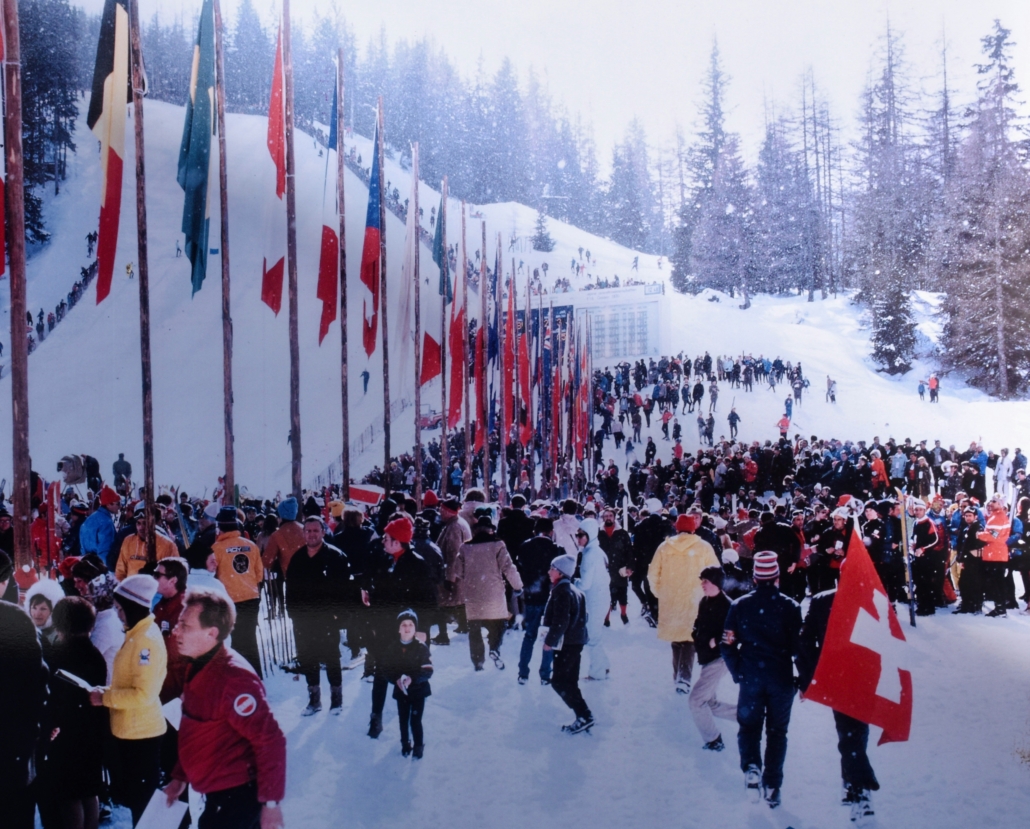
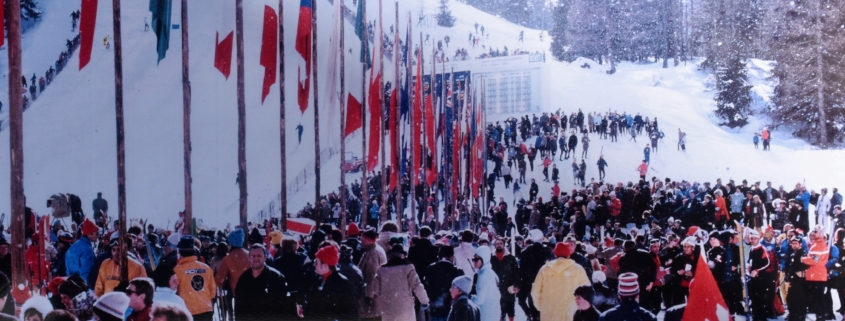
The finish of the female downhill competition at the Ski World Championship held in Val Gardena Garden Südtirol Italy. It’s February 11, 1970. This and other images were on public display to commemorate the 50th anniversary of this event. Photo by Arno Senoner on Unsplash


My Spring Skiing Hat

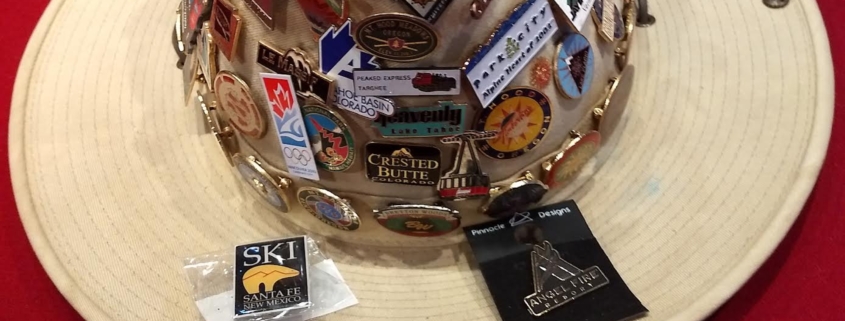
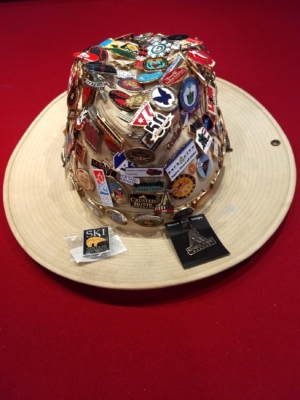
I started my collection of pins and patches from ski areas about 30 years ago, when I began writing about skiing for the Albany Times Union newspaper in New York. It gave me the opportunity to visit many ski areas, and whenever I went to a new ski area, I would purchase a pin and a patch.

Mike Roth’s pin-filled hat

That created a problem – where to put them.

I started by putting them on my ski coat but that became a pain since I wore more than one ski jacket and moving them would have been a nuisance.  Before helmets were even thought of for skiing, I would ski in the spring wearing my hat, but I never thought of putting the pins on it. Until my pin collection started to become voluminous.

So, the hat became the object of consistency, for spring skiing. Everywhere I went, it always attracted comments and questions from fellow skiers.

In airports, prior to TSA and screening, there were no problems at all. Now, my pin-filled hat has to pass through the x-ray machine to see if there are any sharp objects hidden within, besides the actual tiny pins that pins the pins to the hat.

There have been lots of comments – both from other passengers and from TSA personnel – as I would go through the airport and go through security, but no one at security ever stopped me, just lots of conversations.  A few times, people in the plane would approach me and actually give me pins that had meaning for them, like Olympic pins.  Once, in St. Moritz, I was given a pin from 1920’s of the St. Moritz Ski School.

These pins used to poke me in the head until I found a locking device at a motorcycle rally. Now, all these sharp pins have been ground down to being flat and there are no more scratch marks on my balding head.

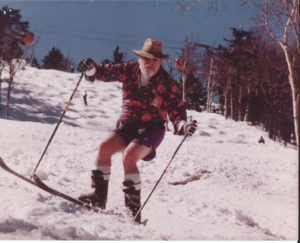
Historic Photo of Mike Roth

Currently, there are about 120 pins plus on my hat. The biggest issue today is that my hat weighs more than ten pounds and is no longer comfy to wear skiing or otherwise, so it is semi-retired at this point.  I’m thinking it should be donated to a ski museum somewhere, including because some of those pins are from areas that have since closed.

I am still missing a few pins from way back when I first started to ski, such as Brodie Mountain, Homestead and Rock Candy Mountain. Most recently added Snowbasin, Diamond Peak and Mount Rose to the collection, but there is no room on the hat. So, I think I am going to have to get a bigger 10-gallon hat to make more room.

But it’s a daunting prospect to remove 120 pins and then reload them, and a new hat still would weigh more than ten pounds.

BTW – the photo is from Killington about 40 years ago. I still have that wind breaker shell, which I purchased on Rush Street in Chicago in the late 60’s. It still fits – because I had to take out the seams and add more girth.  

Short Swings for April

The end of the season is on its way, which means an abundance of pond skimming contests, outdoor music and active SPF for lunch and apres on the deck of wherever you are using your lift ticket.

Speaking of lift tickets – passes for next season are on sale now at the best prices.  See our recent article about Ikon, Epic and Mountain Collective prices and perks for next season.

https://seniorsskiing.com/save-money-buy-passes-now-for-next-season/

There also are many local and regional passes which might fit your needs.

Note that these early bird prices won’t last long.  Expect price increases by Memorial Day, even sooner.

First, though – two good news tidbits about next season –

Snowbasin confirms they will have RFID scanning gates next season, so no more taking out your pass to be hand-scanned at each lift.  Also, they are replacing one of their oldest lifts, Becker, being upgraded to a high-speed quad.  It will get you to the top terminal in six minutes, half the current 12.

Killington confirms it is replacing the sometimes-cranky Superstar Express Quad – which dates from 1987 – with a new high-speed six-pack.  It’s a $12 Million investment scheduled to open in December 2025.

Now for some local and regional season pass choices – note that these early bird prices don’t last long.  Some evaporate at the end of March, others the end of April.

New England Pass

Access to Sunday River, Sugarloaf, and Loon Mountain Resort, offering a total of 388 trails, 2,647 acres, 17 terrain parks, and 47 lifts, and sister resort benefits including to Big Sky and Brighton. Benefits include Buddy tickets, retail, dining and tuning discounts.  There also are discounts for 65+ available for some passes.

Gold New England Pass – The most popular pass with unlimited access to Sunday River, Sugarloaf, Loon, and Pleasant Mountain, plus 3 free days at Big Sky Resort, Brighton, and other western Boyne resorts, 50% off on additional full one-day tickets and 50% off at Mountain Collective resorts.

  • Renewal: $1,389 Adult, $599 Youth
  • New Purchase: $1,449 Adult,$599 Youth
  •  Add an Ikon Base Pass or Loon MTB Plus Pass for $299

Silver New England Pass – Daily access except for 12 blackout dates, plus 50% off full one-day tickets at Pleasant Mountain, Big Sky Resort, Brighton and other western Boyne resorts.

  • Renewal: $999 Adult, $459 Youth
  • New Purchase: $1,039 $489 Youth

Bronze New England Pass – Valid Mondays through Fridays except for blackout dates and expanded weekend access during early and late seasons at select resorts.

  • Renewal Purchase: $679 All Ages
  • New Purchase: $729 All Ages

Afternoon New England Pass – Ski and ride starting at 12:00pm, with no blackout dates, all season long.

  • Renewal Purchase: $599 Adult,  $379 Youth
  • New Purchase: $599 Adult, $379 Youth

Saddleback, Maine

An unrestricted Adult Season Pass, with no “blackout dates” is $1,099. That’s more than for the current season, but includes some new benefits.

Returning Benefits Include:

  • FREE SKIING for the remainder of the 2024-2025 winter season
  • Buddy Tickets: 50% off lift tickets for friends
  • 50% off ski lessons at the Roger Page Ski & Ride School
  • Demo, Tuning and Retail Discounts

New Benefits for 2025-2026 Season Pass Holders:

  • Free UNLIMITED Summer Chairlift Rides
  • Free UNLIMITED Summer Mountain Bike Park Access
  • Summer Retail Discount: 10% off logo wear

https://www.saddlebackmaine.com/season-passes/

 Taos, New Mexico

Taos celebrates its 70th Anniversary next season.  Passes purchased now include lift access for the remainder of the season.

Super Deals  Five-Day and 80+ Ski FREE

  • The best deal – five days of skiing, with limited blackout dates, for $495.
  • Free 80+ and 6 & under season passes are available on Opening Day.

Kachina Pass: 

  • $1475 or $1395 for passholders in the last 5 years, for unrestricted skiing/riding 7 days a week, with no blackout dates
  • $250 credit per season to the base area hotel, The Blake, plus discounts for Ikon and Mountain Collective pass holders.
  • Two unguided days at Silverton Mountain and one free heli-skiing drop in December or January.

Value: 

  • $925 or $875 for passholders in the last 5 years for skiing and riding 7 days a week, with holiday blackouts
  • One unguided day at Silverton Mountain, one free heli-skiing drop in December or January. Starting March 24,

Midweek: 

  • $525 or $495 for passholders in the last 5 years for unlimited skiing and riding Monday-Thursday, with holiday blackouts.

High Noon: 

  • Also $525 or $495 for passholders in the last 5 years, for unlimited skiing after 12 PM, 7 days a week, with holiday blackouts.

Visit www.skitaos.com for more information.

 See you on the slopes!

Comparing Alpine and Nordic Skiing

While comparing Alpine and Nordic skiing does not approach the debate about the best basketball player of all time (Michael Jordan or Lebron James), here is some fodder for the analysis on the snowsport discourse.

RB Lohr at Mt. Tom

During a career in the snow sports industry (mostly XC skiing), I have always avoided speaking negatively about Alpine skiing, (which is also referred to as downhill skiing and includes snowboarding) when comparing it to Nordic skiing (also known as XC skiing or cross country skiing). I’ve preferred to view XC skiing in positive terms, yet there are both similarities and differences between the two segments of snow sports. Another related aspect in the dialogue is to consider why Alpine skiers might want to try XC skiing or vice versa. Full disclosure: My annual outings this winter so far are 85% XC skiing and 15% snowboarding.

Both of these sports on snow provide the respective enthusiasts at any age with an experience outdoors in nature which is a good thing in the winter because we tend to stay indoors too much. It is also good to get into nature outdoors because of its impact on our psychological and spiritual well-being. It would seem that the differences in the two disciplines relate to speed. XC skiing through the forest at a slow pace may very well bathe our souls more fully compared to skiing or riding down a slope at even moderate speed. While I prefer the slow immersion of XC skiing for the smell of the forest and sound of the rolling brook, I concede that Alpine skiing can be equally beneficial for getting outdoors.

FITNESS

XC skiing is known as a leading aerobic exercise and using it to attain fitness is clearly advantageous compared to Alpine skiing. I’m not going to quote scientific aerobic studies or government recommendations about the number of minutes or hours per week necessary for a person to become fit, but this issue is obvious. XC skiing impacts all the body muscle groups and can be used as a successful cross training activity in the winter. I am aware as a snowboarder that there are Alpine skiers who get a great workout (particularly when doing bump runs), but on this issue XC skiing is the clear winner.

OPTIONS

The various options for XC skiers are plentiful. They can ski on groomed and marked trails or in the backcountry. They can classic ski or skate ski. XC skiers can go to commercial ski centers, local trails or parks, the snow covered golf course, even in the backyard or anywhere there is snow cover. Alpine skiers usually require lifts at the ski area. Backcountry skiing, split-boarding, alpine touring, and uphill skiing at ski areas are in the Alpine ski category but they may actually fall into the XC ski category, since the skier is moving uphill and across the terrain. Alpine skiers can enjoy groomed and marked trails but also gladed areas and terrain parks. They can float in the deep fresh powder and maintain excellent control on hard packed snow or bouncing down on moguls. Free style skiing is tantamount to gymnastics on the snow and rarely seen ski ballet dancing may be described as poetry on skis particularly when it is synchronistic and performed by couples.

Both Alpine and XC skiers can choose either easier or more challenging outings. With XC, for example skiers can go at their own pace across flat trail terrain or climb uphill to return on a thrilling run downhill on narrow trails. Alpine skiers can choose easier flatter slopes or more difficult steep slopes with moguls. Equipment for both Alpine and XC has been improved substantially providing better control and performance to make the sports much easier than in years past. XC skiers will cover terrain on the flat areas, up hills, and down hills. Their equipment either helps or hinders this form of transportation depending on the characteristics of the equipment and the terrain it is on. Soft wide steel edged skis are wonderful in untracked snow skiing down a hill but they are too slow providing minimal glide when skiing on a groomed flat trail. Narrow XC skis are great on the tracks or groomed trails but are difficult to control in untracked or broken snow going downhill. Alpine skiers and snowboarders are both able to acquire different equipment for different specialty interests.

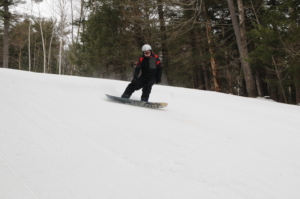
RBL snowboard at King Pine

INJURY SUSCEPTIBILITY

The injury issue is an area of substantial difference between Alpine and XC skiing. I’ve been injured doing both activities. The speed associated with Alpine skiing is a key component to the potential severity of injury. Falling at high speeds even on soft snow can cause twisting, bouncing, and bruising that has bad consequences for the skier. Another big concern is getting hit by another skier who may be out of control. XC skiers who do not ski regularly often complain of muscle soreness on the day following an outing. Many XC skiers get exhausted if they ski too long or too far, but it is very rare for an XC skier to have a crash with another skier. Snowboarders are susceptible to upper body injury (head, neck, wrist, shoulders, rib bruises, etc.) and Alpine skiers can suffer leg issues such as knee and ACL injuries. The possibility of severe injury is more of an Alpine skiing concern compared to XC skiing. The lighter XC ski gear and not being attached to the ski at the heel perhaps make XC skiing somewhat safer, but let’s face it, if you are going fast down a steep hill, bad things can happen if you fall. Crashing into a tree even at slow speeds is unhealthy, no matter what type of equipment you are using.

SOCIABILITY

Both sports have an exceedingly wonderful social component. Alpine skiers strike up conversation as they meet strangers on almost every ride on the lift. XC skiers come upon others on the trails and always smile and say hello. The crowd factor is a difference among the two snow disciplines. Rarely are there too many people among the XC skiers at one place or on one trail, while the liftlines at Alpine ski areas can be notorious for overcrowding requiring crowd control techniques. It is true that experienced Alpine skiers can adjust to take lesser-used lifts on the mountain while the hordes may not be aware of where and when to find these lifts. Additionally, when there are too many skiers on a given slope at an Alpine ski area, there is increased danger for crashes to occur.

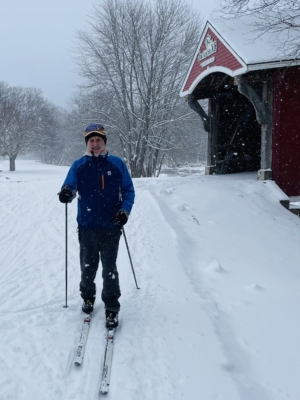
RBL at Jackson XC

COSTS

This brings us to the cost of the ski disciplines. Without getting into specific prices at different locales, it is safe to say that Alpine skiing is substantially more costly. Many skiers are purchasing season passes for skiing at a number of different venues. Daily passes can range from $50 to $300 per day for riding the lifts while XC skiing is either free in the park, or at a commercial XC ski area a trail pass can range from $15 to $30 for a day (or a couple of hours). The season passes are also significantly more costly for Alpine skiing, but we must remember that Alpine skiers can take multiple lift rides up the mountain which is a most incredible value. While the cost of XC ski equipment has increased, it is still substantially lower than Alpine ski gear – a fact which is undeniable and probably includes all categories of quality products and services such as hard goods, clothing, accessories, and services (ski tuning and repair).

THE VERDICT

Taking the above analysis into account, one may think that XC skiing has many advantages and that would be true on many fronts…but the fun factor must also be applied in the comparison. Clearly, the accomplished Alpine skier or snowboarder appears to be having fun (defined as something that provides amusement or joy) and thrills. What’s not to like taking the lift up the mountain and pushing off down the hill to get the rush of wind in your face while maintaining your speed under control…or floating on a snowboard in untracked powder down a narrow path through the trees in a silent glistening forest. Some of the ski areas have great food options in comfortable restaurants situated on top of the world with panoramic views of wintry awe and beauty. Ahhh. But there is something to XC skiing despite the images of Olympic competitors falling at the finish line in complete exhaustion. While it may be difficult to label XC skiers as having fun (most people perceive XC skiing as “too much work”), upon completing an outing on XC skis, one feels a sense of accomplishment. According to scientific evidence there are very positive biological, psychological, and medicinal impacts derived from the activity associated with outdoor activities like XC skiing. The sensory experience of getting outdoors is a kind of eco therapy and a prescription for lowering stress, restoring attention, and boosting mental health and cognitive clarity. Alpine skiing does indeed have similar effects on people, but the slower pace and level of immersion associated with XC skiing may provide an advantage for mental health and associated wellness.

Personally, I love a long glide in the tracks on my XC ski equipment AND a powder run on my snowboard. I call it an even draw.

Senior Women Skiers (Video)

Why You Should Travel with Apple AirTags

Photo by Erwan Hesry on Unsplash

AirTags are brilliant little tracking devices a little bigger than a quarter, which integrate easily with Apple’s Find My App. Every piece of luggage you travel with – including your skis – should have one, to tell you exactly where it has been left behind by an airline, tour bus, forgotten by you, or even stolen. 

Recently, I was on a tour bus in Europe when a fellow passenger screamed out, “Stop, stop. There’s luggage falling out of the bus.” By the time the driver could pull off the highway, my fellow traveler advised that, “You just lost my bag and it’s a half-mile behind us!”  

How did she know? There was an Apple AirTag inside it. The driver, who apparently had not properly secured the latch on one of the luggage bays, ran back to retrieve her bag, surely cursed by drivers who nearly hit it.  Score one for AirTags.

On the way home, due to a missed connection, my own bags didn’t make it onto my flight, and were left behind. How did I know?  Yes, AirTags again.

These efficient little devices can track any item for you, including pets, when within range of any Apple device, even if the AirTag and its owner are thousands of miles apart, even internationally, as mine were.

In fact, the same woman whose bag fell out of the bus said she was also tracking her cat back home in the USA. I tracked the two-day trip my bags took home and delivery to my house.

United Airlines recently became the first major carrier to integrate AirTags into their app. Star Alliance partner Lufthansa has joined them. Customers can now securely share the location of an AirTag or Find My network accessory with customer service agents for faster bag recovery and an even better overall travel experience, the airline stated in a press release.  

United says it expects the integration to drive a “much-improved customer service experience for the fewer than 1% of customers whose bags arrive on a later flight.” By sharing AirTag information, United and partner Lufthansa say they will be able to find delayed bags and reunite them with customers more quickly – including because the AirTag owner can track every movement every moment.

Additional domestic and international airlines are expected to join the AirTag program.

AirTag lithium batteries meet the low threshold airlines require for use in baggage, so no worries about putting them in checked luggage. Each AirTag is powered by a CR2032 coin cell battery, commonly found in many auto key fobs, which is user-replaceable and lasts about a year.  

A four-piece set of Apple AirTags can be found on sale for about $70. It’s a very cost-effective way for individuals to benefit from a reliable tracking solution.  Or, get a secure waterproof AirTag stick-on to attach directly to your skis for under $15, far less than the price of replacing lost or stolen skis.

 However, AirTags are not without flaws. Privacy concerns, limited functionality for non-Apple users, and potential misuse are significant drawbacks that warrant consideration.

There are similar products available for Android devices.

What are your experiences with delayed or lost baggage, especially ski equipment?  We welcome your comments.

Steppe-ing Up in Kazakhstan – Skiing at Shymbulak

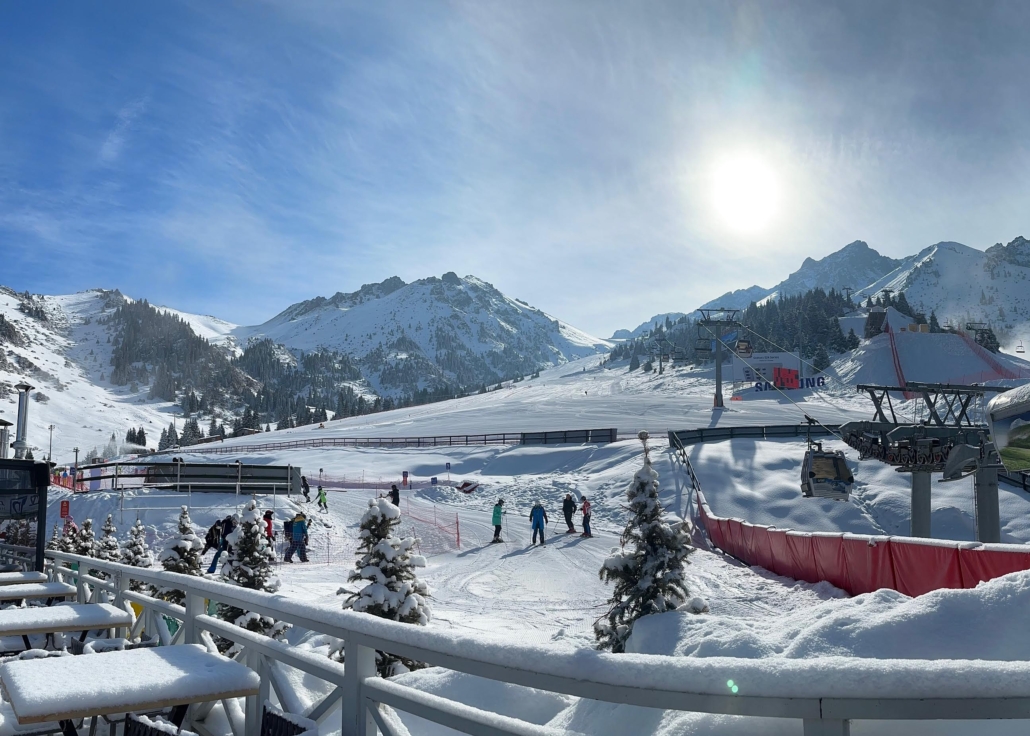
It looks like a typical ski area. Skiers and boarders clamber onto Doppelmayr gondolas and high-speed quads from Leitner and there’s a ski school for learners. I paid 8,000 Tenge ($15) to dress in fox pelts and hold an irritable Golden eagle for a photo op, cafés serve koumis—fermented mare’s milk – the local beer is Karagandinskoye, and a day lift pass is only $35.

Welcome to Shymbulak (SHIM-bu-LAK) Mountain Resort in Kazakhstan, the largest ski area in Central Asia, in a precipitous mountain gorge just 16 miles from Almaty, the country’s largest city. Ask most Americans about Kazakhstan and—if anything at all comes to mind—they’ll mention the satirical Borat films, or stutter something about “steppes.”

But Kazakhstan also has steeps, including the Ile Alatau mountains, portion of a range that stretches for 1,550 miles across Central Asia. Since it was part of the Soviet Union from 1936 to 1991, Shymbulak’s early history is Soviet-tinged. It opened in 1954 and became the Olympic training center for U.S.S.R. skiers.

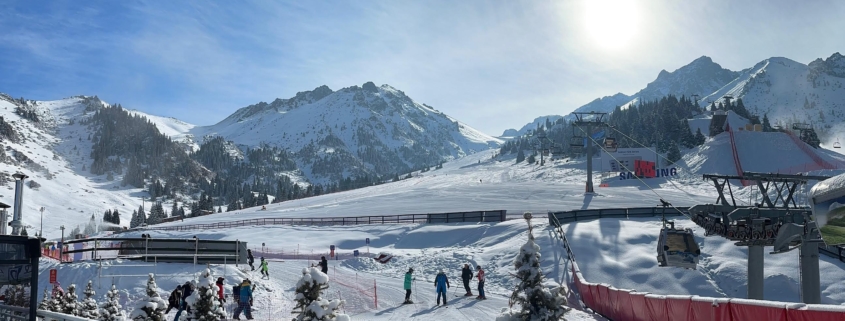
Shymbulak base area credit: Risa Wyatt

Today, skiing is more than a notch-in-your-belt curiosity. It is a World Cup venue: the FIS Freestyle Ski Moguls and Aerials were held here in 2024, and it was a finalist to host the 2022 Winter Olympics.

The resort offers nearly 3,100 feet of vertical and 12 miles of groomed trails. Terrain is a mix of gentle inclines for beginners, wide-open snowfields for intermediates, chutes and moguls for experts. Guides are available for backcountry touring. In addition, it holds the Guinness Record for the world’s highest night-skiing slopes.

Stats are nice, but it’s the scenery that astounds, with razor-sharp peaks that soar above the upper terminal of the gondola, at 10,500 feet and runs are mostly above tree line. On clear days, you can see Almaty below. Other times, foggy inversions sandwich brightness between clouds.  The ski season is December to March, and there are good quality rental shops both in Almaty and at the base area.

Shymbulak’s layout needs explaining. Once you reach Medeu Base Station, you aren’t anywhere yet. It’s a 20-minute gondola ride to the ski area, passing the world’s highest ice rink. The actual base, at 7,400 feet, offers rentals, ski school, and restaurants. Then, ride a two-stage gondola (another 20 minutes) to the summit or head directly to lifts for beginners and terrain parks.

The gondolas make it easy for non-skiers to reach the top. I encountered sightseers (mainly Russians) trudging to overlooks for selfies, creating a bottleneck for down-loading the gondola when the sightseeing tourists hindered the skiers. After missing five cars, I shoved past the chit-chatterers, earning scowls and probably further derailing American/Russian relations.

Speaking of which: You can’t avoid geopolitical reality. One of my travel companions shared a gondola with three Russian draft dodgers avoiding the Ukraine war. Another day, a Kazakh woman overheard me speaking English and came over to discuss her anxiety about a Russian invasion, for its rich oil reserves near its western border with Russia.

Looking ahead, Shymbulak plans an expansion linking it to eight other regional resorts, including Oi Qaragi and Ak-Bulak. New lifts and terrain would double its size, adding nearly 20 miles of trails.

Although Russian is the main language—a Soviet holdover—many locals eagerly try out their English or Google Translate app. Don’t be surprised if they ask, “How old are you?” It allows them to show respect for elders. They giggled when I answered, “70.” Senior skiers are rare here.

 “Meet a guest as God’s messenger,” says an old Kazakh proverb. Traditions were born among nomads living in the harsh steppe, so hospitality to visitors is sacred, and you’ll feel truly welcomed.

 Skiing in Kazakhstan isn’t just about snow. The beauty includes exploring the surrounding area, so add time for Almaty, known for Green Bazaar, a cacophonous market with everything from spices to pig snouts, and the Russian Orthodox church that’s one of the tallest wooden structures in the world.

 When you learn about a new culture, it lives on in you as well.

Pros and Cons of Skiing the New Powder Mountain

Photo by Colin Cassidy on Unsplash

Over the past six years, I have been a happy part of a group of friends skiing Powder Mountain the first week of February. This year was different, because Powder Mountain is different.

We loved skiing there, not because the skiing was free for over 75 ( although that was a plus) but more for the laid back feel of the entire area including its uncrowded slopes. I have called it the friendliest place to ski.

However, since an ownership change things are different.

The 75+ crowd, which used to ski free, now is charged a season ticket of around $1,400. And if you don’t have the season ticket of any kind, you can’t ski there on a weekend in February.

Even with a pass, the allowable area to ski has been reduced, saving the rest for the homeowners who have invested upward of $ 2.5 Million for a lot and God knows how much more for a structure to live in. In addition, each homeowner has the privilege to pay an additional $30,000 to $100,000 per year to ski on their private terrain, but they can also ski on the public side if they choose to ski with us common folk.

So, in sort of a protest, I decided that I would purchase a season pass at Snowbasin across the valley from Powder Mountain for $549. Snowbasin has plenty of skiable terrain – 3000 acres of groomed and ungroomed terrain, plenty of high-speed six-packs and gondolas and about 2000 feet of vertical, comparable to Powder Mountain, including for lift-served terrain, and far better for lodges and other facilities.

The only drawback to Snowbasin is that they are on the Ikon pass and I have never seen more people at any ski area than I saw on Saturday and Sunday while I was there.

So the issue at Powder Mountain, which I no longer consider the friendliest place to ski, is it still might be worth spending the few bucks extra for the peace of mind that you won’t be run over by the crowds.

Will my buddies and I return to Powder Mountain next season?  I don’t know.  Stay tuned.

Age Forces You to Change the Way You Ski

Let’s face it, if you are reading SeniorsSkiing.com, you don’t have the stamina, strength, balance, or flexibility you had when you were younger. 

Over the past 10 years, I have had to change the way I ski and as I approach my 80th birthday, the evolution continues. So, let’s talk about what’s changed.

One, I slowed way down. Way back when, I was a pretty good racer, and my best events were downhill and GS, and was terrible at slalom. I liked skiing fast but at 65, I stopped running gates. Not worth the risk.

Two, I pick and choose the conditions in which I ski. Those that require strength and stamina such as soft, slushy snow, cut-up powder, heavy powder, to plow through are avoided along with glare ice. Flat light is another condition that needs specialized goggles to help see, but to me, flat light is dangerous.

Three, by skiing with my feet slightly apart, I use the outside edge of my uphill ski to increase stability. By being comfortable holding an edge with either ski adds to one’s confidence and stability.

Four, I reduced how many turns I make on each run. Modern skis are easier to turn than the 200 cm skis of the past but making lots and lots of turns (wedeln/short swing) is work. The steeper the slope, the more work it becomes.

Now, rather than make lots of quick turns, I make large, round carved turns through which I control the length of the turn. Holding the turn longer slows me down and lets me ski any terrain.

Five, my energy/stamina is limited and is like a lithium battery. It goes and goes until it runs out of energy, and then it is done. When it quits, there’s no last run unless it is to get to the bottom. 

Remember, energy conservation is the order of the day if you want to ski 25,000 vertical feet a day. I went back to a technique taught children how to go from Mr. or Ms. V to Mr. or Ms. H. See my piece on the Punch Bicycle Turn.

And six, when I skied what trails has also changed. So, in the morning/before lunch, I’m on the steeper runs. Many large areas groom most, if not all their expert runs, so I spend early part of the day yo-yoing up and down those trails. Knowing the mountain helps because you can find a lift without lines serving four or five runs you like several times. Then, in the afternoon, its fewer steep runs and more blues.

The goal every day is 25,000 vertical feet or more. Some days I make it, some I don’t. It just depends on the conditions – snow, light weather, etc.

Remember each run is precious and what’s important is that one is skiing, not how much, how fast, or where!

Historic Hickory Ski Area Becomes Film Subject

Sue Catana, Ski Hickory manager

Ski season is also ski film season, when any number of movies about the sport are released. This may conjure images of Warren Miller, or films about 20-something free skiers who conquer remote mountains or perform evermore challenging and outrageous stunts.

But I recently attended a film that spoke to the history as well as the present of skiing.

“Reviving the Legend” is a half-hour documentary about efforts to bring lift-served skiing back to Ski Hickory, a small area near the Adirondacks’ Gore Mountain.

The enthusiasts who attended the premier of the movie, at an historic theater in Hudson Falls, N.Y., was filled not just with Boomers but some of their parents and grandkids as well – many of them fans and some stockholders in this small resort.

Hickory 16 months ago had a brief viral moment online that led to production of the movie.

It all started when operators of the ski center, notably Manager Sue Catana, took to Facebook saying they needed to raise $38,000 for insurance in order to open for the 2023-24 ski season.
Without that, state lift inspectors wouldn’t come and certify Hickory’s aged poma-lifts and t-bar for operation.

Hickory had been closed since 2016. Without a snowmaking system, there weren’t enough skiable days to make the place profitable. While it is owned by a group of shareholders whose families helped start the area in the 1940s and 50s, Hickory had become something akin to a club.

The Albany Times Union newspaper and several ski-focused social media sites picked up the call for help. Local devotees began contributing and buying season ski passes. (Full disclosure, I am the retired ski writer for the Times Union who wrote the story and am interviewed briefly in the film).

Most notably, operators of the Unofficial Networks ski site and of the Indy Pass multi-mountain pass chipped in more than $30,000 needed to pay Hickory’s insurance bill.

News that Hickory’s lifts would be spinning elicited cheers from the area’s fans, many of whom were descendants of the area’s founders, who live in and around the Southern Adirondack communities of Warrensburg, Glens Falls and Lake George.

That community spirit caught the eye of Kingston-based cinematographer Ian McGrew who started researching Hickory’s history and decided to produce a short documentary. He interviewed players like Catana and others.

McGrew drew on archival footage of the ski resort in better times when it was bustling with weekend visitors from the surrounding  area. He also weaved in photos  and interviews to portray the area past and present.
Hickory in many ways represents the way skiing in the Adirondacks used to be, before the technological revolutions in snowmaking, high speed chairlifts, along with the corporatization and convenience of skiing that characterizes so much of the sport today.

The place is a proud throwback. In addition to the all-natural snow conditions skiers rely on poma lifts and t-bars for uphill travel. In fact segments of the movie, and testimony from longtime skiers after the viewing, pointed how youngsters could, with the proper combination of technique and intestinal fortitude, get “launched” several feet off the ground when riding the poma.

With a 1,200-foot vertical rise, Hickory can also satisfy hardcore skiers as the upper trails are narrow, steep and twisty providing plenty of challenge. The base lodge is simple but inviting with a 60s-era round fireplace in the middle. The spot’s mom-and-pop nature also comes through in the film, with Catana, now 76,  describing how she did everything from taking lift tickets to answering the phone and making vats of chili hours before the lifts opened.

Her father Hans Winbauer helped build the area after WWII. He served in the 10th Mountain Division U.S. Army ski troopers who battled the Axis forces in the war.

After returning home, some of these veterans went on to build what became mega resorts in the U.S. including Vail.

Hickory, though, stayed true to its small-town club-like roots and McGrew’s film depicts families of skiers, with little kids making their first turns at the resort.

He plans to enter “Reviving the Legend” in several outdoor and film genre competitions next year and plans to find an online outlet for it in the near future.

As for Hickory, they were hoping to open in late February, once state inspectors approve their surface lifts.
When they open tickets are free for those 17 and under, $70 for adults and $45 for those 70 and over. Hickory is located on 43 Hickory Hill Road, Warrensburg, N.Y.

Corporate Passes Have Brought “Ikonic” and “Epic” Changes to Skiing

Daily lift ticket prices at a major resort.

There’s no doubt that the introduction of two corporate passes, Vail Resorts Epic Pass and Alterra Mountain Company’s Ikon Pass, have enabled skiers to purchase season-long skiing at an impressive number of resorts for a one-time, up-front price. But one of the most significant consequences has been the astronomical increase in the cost of a daily lift ticket. Changing business models, increased consumer demand and a corporate push to drive season pass sales have all contributed to the issue. It’s clear that walk up, daily ticket prices at the window are intended to discourage day trips and encourage pass purchases. The era of the daily “snow chaser” is long gone.
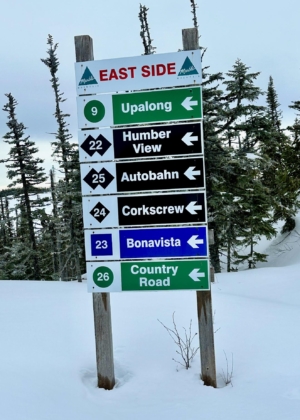
As a former “snow chaser”, part of me laments for the days when I could wake up, check the snow reports and decide where I wanted to ski that day. Even though I couldn’t afford a season pass, whether I chose a mountain close to home or several hours away I knew I could get a relatively fair priced day ticket when I arrived. That’s no longer an option. Walk up to a ticket window today and depending on where you are it will cost you anywhere from $140 to $300.

Earlier this season I was planning a trip to Colorado. Having lived in Evergreen throughout the ‘90s, I made a point of skiing each resort in Summit County and the surrounding areas at least once a season. I was considering which old haunts I would like to ski again. I planned to ski a day or two at Loveland on my Indy Pass and thought it would be nice to add some days at A-Basin, Keystone, Copper, Breckenridge, or Winter Park. I was surprised to learn that even as a senior a day pass was prohibitive. In fact, Winter Park doesn’t even sell a senior daily ticket at any price. What was the area’s solution for me? Buy a senior season pass. But I only wanted to ski there for one day!

Resorts have created a growing divide between passholders and day visitors. They increasingly cater to season passholders, offering them perks like early access, priority lift lines, and discounts on lodging and dining. Day trippers are facing the highest ticket prices in history, making skiing less accessible to those who can’t commit to a season pass. Casual skiers or families who only visit once a year are priced out of the market. This exclusivity continues to underscore the impresssion our sport is “elitist” and “for the wealthy”.

Single-day lift tickets at major ski destinations have exceeded $250 during peak holiday periods. This pricing strategy nudges day visitors toward committing to a season pass or multi-day packages. Resorts benefit from this shift by locking in revenue before the season begins, reducing dependency on weather variability, last-minute consumer decisions or economic downturns. This stability allows resorts to invest in mountain operations, snowmaking, and amenities without the uncertainty of daily ticket sales.

The shift from single-day ticket sales to season pass revenue has led to several operational changes at ski resorts. The increase in pass holders has led to higher visitor numbers, particularly on weekends and holidays. This has raised concerns about overcrowding, longer lift lines, packed lodges, full parking lots and strained resort infrastructure. All of which deteriorates the overall guest experience. Resorts now must manage crowds and encourage more predictable visitation patterns. How will they do that?  Partially by raising daily ticket prices further, using them as a deterrent against last-minute or casual skiers who might otherwise clog the slopes on peak days.

Yet another challenge for the day skier is the implementation of dynamic pricing models. This is how resorts prioritize market factors by fluctuating daily lift ticket prices based on demand, day of the week, and how far in advance they are purchased. With a revenue model that prioritizes season pass holders there’s little incentive for resorts to offer affordable single-day tickets.

The Epic and Ikon passes have undoubtedly made skiing more affordable for frequent visitors. Yet they’ve also led to historic increases and unprecedented daily lift ticket prices, effectively discouraging single-day visits and making it harder for newcomers or occasional skiers to enjoy the mountains without a season-long commitment. The traditional walk-up ticket is nearly extinct. It’s unlikely daily lift ticket prices will decrease. Resorts will continue to push consumers toward season passes and advanced purchase discounts. It’s a business model that works for them for now.

Save Money – Buy Passes Now for Next Season

Photo by Karsten Winegeart on Unsplash

There’s still plenty of time left in this season for downhill turns and apres friendships, but that should not distract you from grabbing one or more of the next-season deals which just went on sale.  Buy now and save money then. 

These early-season prices should be in effect until around Memorial Day, when they have increased in past years, with another price increase around Labor Day.  So – again – the sooner you buy, the more you save.

Indy Pass

We are putting this one first, because the number of annual passes is limited, and when they are gone, they are gone.  It’s a great deal – starting at $299 for the Adult Base Pass for renewals and $349 for new buyers – for smaller, independent mountains.

New for next season are five additional mountains including Burke Mountain, Vermont; Tenney Mountain, New Hampshire; Corralco Mountain Resort, Chile; Rauriser-Hochalmbahnen, Austria; and Pila, Italy.

www.indyskipass.com

2025/26 Epic Pass

Prices are up around 6% for all pass types, including the full Epic Pass, which now costs $1,051, up from the current $982.  It still provides unlimited and blackout-free access to more than a dozen resorts, including Beaver Creek, Park City, Hunter Mountain and Okemo.

Next season’s Epic Local Pass is $783, up about $50 from the current season, with unlimited and blackout-free skiing and riding at resorts including Breckenridge, Crested Butte, Mount Snow and Stevens Pass.

Although no new resorts have signed up for next season, Switzerland’s 4 Vallees is adding access to additional pass types.

Visit the Epic Pass website for more information, including new prices for strictly local and senior passes including the Northeast Value pass and Tahoe Local.

https://www.epicpass.com/passes/epic-pass.aspx

Mountain Collective

New for next season is a bonus third day at the member resort of your choice, which includes Alta, A-Basin, Jackson Hole, Snowbasin, Sun Valley, Taos and Valle Nevado (Chile).  The pass costs $639 USD and $849 CAD for ages 18 and up, for 26 resorts around the world.  There also are 25% discounted day tickets for friends and family.

www.mountaincollective.com

Ikon Pass

There are big changes to this pass next season, with new resorts added, one leaving, and the end of the Base Pass Plus, plus price increases.

Pricing for the full Ikon Pass now starts at $1,329 and $909 for the Ikon Base Pass, up $50-$80 over the current season.  The multi—day Session Pass remains the same, at $259.

Base Pass Plus provided access to premier destinations including Jackson Hole, Deer Valley and Snowbasin.  The end of that pass apparently means those upscale destinations move into the full pass.

Windham Mountain Club is leaving the Ikon Pass at the end of this season, but Jiminy Peak and Cranmore in the Northeast and Wild Mountain and Buck Hill in Minnesota have joined as “bonus” mountains, offering two days each.

Also new is Ischgl, a resort in Austria that borders Switzerland.

 www.ikonpass.com

See you on the slopes!

Ski Safety is a Full-Time Thing

AspenSnowmass Ski Patrol injury

January is promoted as Ski Safety Month, but our attention to safe skiing and riding, and avoiding accidents, should not be limited to one month.  It’s a season-long thing.

These common sense tips from the Aspen-Snowmass Ski Patrol – and from me – will help keep all of us safer on the slopes.

Check Your Equipment

Be sure your equipment functions properly. Don’t let malfunctioning bindings or edges ruin your day. Have a local shop do a function test on your bindings. 

·      When was the last time you had your skis or board waxed and/or sharpened? They should turn like steak knives, not butter knives.

Stay warm and comfortable out on the slopes with goggles, helmet, hat, neck gator, gloves and layers.

·      Use the pockets in your parka with sunscreen, lip balm, water and snacks.

Know The Rules Of The Slopes

The Responsibility Code is printed on every trail map and reads:

Always stay in control and be able to stop or avoid other people or objects. People ahead of you have the right of way (it is your responsibility to avoid them; you must not stop where you obstruct a trail or are not visible from above ‚ whenever starting downhill or merging into a trail, look uphill and yield to others; always use devices to help prevent runaway equipment; observe all posted signs and warnings (keep off closed trails and out of closed areas); and, finally, prior to using any lift, you must have the knowledge and ability to load, ride and unload safely.

Be Aware Of Seasonal Conditions

Patrollers keep areas closed until they are safe for everyone. There are hidden obstacles and holes in terrain during any part of the season; hazards exist that are not marked. Large snow storms and/or wind present potential avalanche hazards.

·      Skiing or riding closed trails could cost you your lift pass – or worse.

Know What To Do When An Accident Happens

Cross skis or place the snowboard above the injured; make note of potential injury type and location of the incident (look for landmarks).

If possible, stay on the scene until patrol arrives. Patrollers are highly trained— most have at least EMT certification at most resorts — and some are paramedics, so you can trust that the care following an accident on the hill is very professional.

Don’t let an injured person ski or ride down.

·      It’s a good idea to load the number of the Ski Patrol on your phone before you get on the first chairlift, gondola or tram of the day.  Just in case, and especially if you are skiing along.

Know Your Limits

One of the most essential safety tips is to stay within your skill and fitness levels. Ski and ride only where you are comfortable and don’t let friends talk you into places that will get you into trouble.

·      Remember, if you’re caught skiing or riding too fast, you could lose your pass, so stay in control and avoid accidents.

Venture Into The Backcountry At Your Own Risk

If you venture beyond ski area boundaries, be educated on backcountry conditions and special equipment for necessary precautions, and some offer classes to prepare you for the special conditions and safety requirements.

Larger resorts offer backcountry guides and equipment including avalanche beacons.

·      Don’t go into the backcountry without the proper gear – or alone

Be safe out there, so we can see you on the slopes the rest of this season and seasons to come.

Marble Mountain Newfoundland

Come From Away – To Ski

Marble Mountain Newfoundland

I had never kissed a cod. Or toasted bannock over a fire. Phrases like Owshegettinonb’y don’t flow off my tongue, and I didn’t know the meaning of mauzy. These experiences were all rites of passage when I skied Marble Mountain in Newfoundland, in eastern Canada.

Bannock is a strip of dough wrapped around a stick that you roast, marshmallow-like, over a bonfire. Owshegettinonb’y translates in the local dialect as “How are you?” and mauzy means muggy.  And that flirtatious cod was part of a “screech-in” ceremony popular at pubs: recite anoath, chug a shot of rum, smooch the fish…. and I became an honorary Newfoundlander.

A land of fjords and barren mountains, Newfoundland is indeed a place apart, an island 11 miles from the Canadian mainland. It didn’t become part of Canada’s confederation until 1949—it had been a British dominion. Even its time zone is quirky, offset from Atlantic Standard Time by 30 minutes instead of the conventional hour.

Marble Mountain Resort rises above the Humber River Valley. Although the mountain has the longest vertical drop (1,700 feet) of any resort in Atlantic Canada, most of its other stats are piddling: just 250 acres and 43 trails. But those ski runs are very, very steep, interspersed with stands of fir, spruce, and birch that pack in powder for tree skiing after a storm. And snow it does: Marble receives an average of 16 feet of snow each year, compared to 12 feet for Mont Tremblant in Quebec.

It feels like a time warp back to what ski resorts were in the 1970s. People leave their regular shoes in cubbies in the airy post-and-beam base lodge and brown-bag it for lunch. Lift ticket prices are also Old School: about $US 40. The resort has been operated by the provincial government since 1988.

Although the vibe is folksy, lifts and grooming are 21st century. Wait lines are rare for the Lightning Express high-speed detachable quad that carries skiers and boarders from the base to the summit of Mount Musgrave. From there, choose black into MacLeod Nine or Deep Bight; blue for Chilliwack, Knute Chute, and a bunch of other cruisers; or green onto Country Road, a three-mile wrap-around trail overlooking the Humber River.

I especially enjoyed the “over the river and through the woods” feel of the intermediate runs. They meander past copses of fir, swoop over dips, and skim ridges overlooking the river. For fast-lane carving, the wide, perfectly pitched Blow Me Down black diamond is almost always groomed. Long-timers still call this trail OMJ—an acronym for “Oh My [fill in the blank]—the reaction of unwitting skiers when they pop over the ridge into the steep descent.

Marble Mountain Newfoundland Signs

Since Marble Mountain is mainly a family ski area, experts can usually suss out untracked powder lines, such as the gladed trees flanking the double-black diamonds of Boomerang and Ugly Stick and the groves along the ski boundary near Tuckamore Tangle.

Nearby Gros Morne National Park, a UNESCO World Heritage Site, offers backcountry skiing, cross-country skiing with 13 miles of groomed trails and snowshoeing. It’s one of the few places where you can actually see the earth’s mantle (middle layer), a stark orangish expanse exposed by 400 million years of weathering.

Deer Lake is the nearest airport.  Air Canada offers flights from Montreal Toronto and other cities.There is base area lodging at Marble Villa.

The kindness with which Newfoundlanders welcome strangers is legendary. After the 9/11World Trade Center attacks in 2001, nearly 7,000 airline passengers were diverted to the island’s Gander International Airport. Residents took stranded travelers into their homes, cooked them meals and shared their wardrobes. Their generosity touched hearts worldwide and inspired the Broadway musical Come from Away.

That friendliness continues on the mountain today. Be prepared to chat a lot on chairlifts. “Where are you from?” locals ask when they’re seated next to an unfamiliar face. That question is almost always followed up by another: “And how do you like it here?”

“A lot,” I answer.

The Punch Bicycle Turn

I first started playing around with this teaching tool when teaching kids to transition from “Mr. (or Ms.) V” which was a stable wedge to “Mr. (or Ms.) H” with the skis parallel. 

Let’s start with your body position on the skis. First, your shins should be pressed hard against the tongues of your boots, and your butt must be forward of your heels, or at least over them. Do NOT bend at the waist because then your rear goes aft. BTW, flexible boots help. 

Hands out in front of you as if they were on the handlebars of a bike (hence part of the name), and your feet shoulder-width apart. From a traverse, plant the pole 10 – 12 inches to the outside of the front tip of the downhill ski. The pole plant can be just a tap or a hard stab. Which you prefer doesn’t matter because this is a timing device to start the turn.

As you plant the pole, press forward and slightly into the hill with your knees, and then relax the forward pressure. This causes you to rise, and as you do, “punch” with your outside, or uphill hand in the direction you want to turn. The up motion unweights the skis and the punch causes your shoulders and most importantly, your hips, knees, and boots to rotate through the fall line. In the beginning, the punching movement needs to be exaggerated, but over time, the movement becomes natural and not aggressive.

Start on gentle slopes and start linking the turns with the mantra, “Plant, down, up, turn the body and down.” 

Coming out of the turn, hold the traverse until you are ready to make the next turn. The longer you hold the turn into the hill, the more you will slow. 

The result of this technique should be round turns. Initially, the turns will be sloppy in that you are skidding the tails of the skis as you come around. However, as you learn to roll your knees into the hill to edge the skis, you will feel this glorious feeling in your legs as the skis carve. The sensation comes from the resistance, i.e., the skis are not sliding down the hill but are making two clean lines in the snow, which if you stop and look back, you can see. Because the skis are on edge, you should be more stable.

You can watch me do this on the racing trail at Crested Butte.

And OBTW, this type of turn works on hard-packed snow and frozen granular because the ski edges will cut into the snow holding you on the line you want to ski.