


Tag Archive for: knee replacement

My Knee Replacement Story

Conditioning Makes A Huge Difference To This Skier’s Post-Op Experience.

A lifetime of abusing my body never really bothered me until it did. Coming down a blue trail five miles long at Park City, UT, one of my all time favorites because of the killer views, suddenly posed a problem.

My knees were killing me. The pain traveled into my hips and the last three miles of the slope seemed to be as long as a trip around the world. It was never going to end. My knees seemed to be grinding into each other.
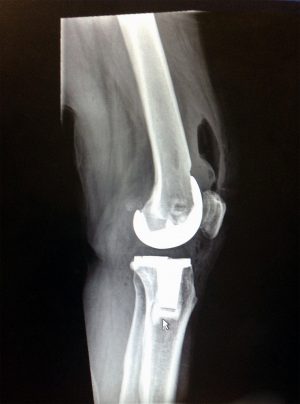
What a new knee looks like when it is all over. Credit: Bob Nesoff

At the base, the skis came off, and I used them as crutches on the way to the lodge. With some help, I made it back to our accommodations and iced my knees. Walking they felt as though the bones were rubbing against each other. Fortunately, this was the last day of the trip, and before the flight home, I called and made an appointment with my orthopedist.

The day after arriving home, he x-rayed my knees and, as I feared, was told my ski season was over. The bones in the joint were actually rubbing against each other and the only realistic course of action was a replacement. The question then became one knee or both at the same time.

The skier’s mind went to work. I’m 80 years old and not getting any younger. The surgery won’t be any easier when I’m 81 and why do one at a time and then have to come back and rehab all over again.

With a recommendation from my doctor, I made an appointment with Dr. Gregg Klein of the Hartzband Center for Hip & Knee Replacement, Paramus, NJ.  Doing due diligence, I looked them up and found out that they arguably do more knees and hips than any other medical facility in the country. That gave me some comfort.

Meeting Dr, Klein for the first time I was pleasantly surprised to learn that he too was a skier and was able to not only answer my questions, but had an understanding of my special desire with regard to skiing.

“Age is not a problem in knee replacement surgery,” Dr. Klein said. As long as the candidate is in relatively good health, there is no adverse problem.

“However,” he said with a smile on his face, “you won’t be doing moguls any more. You’ll be able to ski more comfortably, but stay away from high impact slopes.”

Physical conditioning is one of the most important factors both prior to and following the surgery. Dr. Klein prescribed six weeks of physical therapy, three times weekly, both prior to and following the operation. I added another two days of workout at my home gym. That, I was told later, made the operation and recovery go faster.

Three hours after the surgery I was up, standing and walking. No great distance, but there was far less pain that I anticipated. That, according to the nurses was due to my pre-op workout regimen.

After only two nights in the hospital, I was released and the following week a therapist visited daily for two weeks. He called my recovery “absolutely amazing,” again due to the workout I had done before surgery.

The two weeks at home were followed up by six weeks of outpatient physical therapy three times a week. Here I threatened the life of my therapist when he bent my legs into positions God never intended them to go.

Less than three weeks following surgery, I was walking without a walker. For jaunts outside of the house I used a cane but was able to walk comfortably without one at home. Another couple of weeks and things returned to normal.

There is some debate as to whether holding the prosthesis in place with special cement or using one that adheres to the bone is better for sports such as skiing. The cement holds and heals more quickly. Waiting for the bone to adhere to the replacement will take longer. The opinion appears to be that one is not better than the other.

“If you are a good skier and enjoy the sport,” Dr. Klein commented, “keep on doing it.”

There are a couple of long scars on my knees but they’ll fade with time. I won’t be doing moguls or extreme blacks, but I don’t care. I’m working out on a regular basis and by the time of the first decent snowfall in the fall of 2019, I’ll be waxing my boards and heading for the hills. As a prelude to the ski season, I’m also planning on making a parachute jump this summer. Hey, George H.W. Bush ain’t the only one who can do that kind of stuff.

Ask An Expert: Knee Replacement

Advice From An Orthopedic Physician.

A reader asks:

I need a knee replacement. Is there one implant (Zimmer, Depuy, Stryker, etc.) that is better for returning to skiing?

Here’s the reply from Dr. Peter Schmaus, Orthopedic Spine and Sports, Paramus, NJ:

Thank you for that interesting and timely question. There are nearly 700,000 knee replacements done in the United States annually and that number is increasing. Many  of these adults participate in snow sports and wish to continue skiing. More conservative  orthopedists in the past have advised against skiing with a total knee replacement and especially with a total hip replacement. However there is no clear evidence that  when skiing within limits, a total knee replacement presents a problem. Logically, experienced skiers in good physical condition should fare better.  A novice skier may however present more risk. Reducing impact , perhaps avoiding the bumps and limiting significant knee flexion would be prudent. Cross country skiing should present no problem at all.  Advances in equipment have also contributed to reduced risk.
There is no academic work showing  disproportionate loosening or wear and tear of the prosthesis, and no one brand  of prosthesis to my knowledge is superior to another.
There may be extenuating circumstances in regard to other coexisting orthopedic conditions and participants should asses the risks and benefits with their orthopedist and ideally, work with a physical therapist experienced in snow sports.

Have a question about technique, gear, destinations, travel, or any other aspect of winter sports? Send it to mike@seniorsskiing.com, and we’ll do our best to find an expert to respond.

Knee Replacement—What Do I Do Now? Part 5

If you want to get back to skiing, learn to love your physical therapy.

It took my expert knee replacement surgeon one hour to cut, saw, hammer and install each new knee. It took me a year to rehab them. I was astounded by how long it took.

Correspondent Harriet Wallis works it. The key to recovery is following through with your  physical therapy regimen. Credit: Harriet Wallis

Laurie O’Connor, friend of correspondent Harriet Wallis, works it. The key to recovery is following through with your physical therapy regimen.
Credit: Harriet Wallis

I was in good physical condition before surgery, and I had the mind set that I would bounce right back. I’m strong. I’m tough. I thought that a set of new knees would be something like taking my car in for an oil change. Drive in with old oil. Drive out with new oil and keep on rolling. I was incredibly wrong. The analogy didn’t work. Healing and rehab take time

The good news is: The body is a healing machine.

The bad news is: Lots of people slack off their physical therapy exercises as soon as they can get into the car and do their grocery shopping. They lose their motivation and unfortunately they don’t get full benefit of their new knees. They probably aren’t skiers. We skiers are motivated to get back to the sport we love.

Eight months after surgery I was back on the slopes – starting on the opening day of the season. I skied 93 days that year. EEEhaw! (During the winter before knee replacement, all I could do was skid down a bunny slope.)

Friends asked: “How long did it take to get used to artificial knees?

My response: “About six turns.” My new knees worked wonderfully.

Skiing is good exercise, but it’s not focused physical therapy. Continuing the prescribed exercises was vital. Now, two years later, I still do certain exercises. I believe that maintaining artificial knees is an ongoing process.

My new knees do have some minor disadvantages. I cannot squat with my butt down to my heels. Artificial knees aren’t designed to bend that far. Therefore I sit on a low stool while weeding the garden. And swimming laps confounded me because it took more strokes to get across the pool. I think that’s because metal is heavier than bone, so my legs are lower in the water. I had to find a new balance point for swimming.

The bottom line is this: When the surgeon is done, your work is just beginning. Do your rehab exercises with gusto – and I’ll see you on the slopes.

Note: This is a five-part series in which SeniorsSkiing.com’s correspondent Harriet Wallis describes her knee replacement journey with tips to guide you if you’re anticipating knee replacement. Part 1: Inspired by a ski patroller with artificial knees. Part 2: Research 101 – why and how to do it. Part 3: Interviewing surgeons and questions to ask. Part 4: How I found the right doctor for me. This is Part 5, the final segment of the series.


Knee Replacement—How I Chose My Surgeon: Part 4

How To Identify An Athletically-Empathic Surgeon.

I’m lucky to live in Salt Lake City. There are 10 ski resorts nearby, and there are opportunities for an active lifestyle year-round. Because of that, there are many top surgeons here who put athletes back together when they get injured or need replacement parts.

Correspondent Harriet Wallis chose Dr. Beck for many reasons. Credit: Harriet Wallis

Correspondent Harriet Wallis chose Dr. Beck from Salt Lake City for many reasons that made sense to her.
Credit: Harriet Wallis

But when I needed to have my knees replaced, I wanted to choose the right doctor for me. My list of questions helped me differentiate between the five surgeons I interviewed. Here’s the essence of just three of my questions and how the doctors’ answers focused my decision.

Do my knees need to be replaced? When?

            Doctor X: Yes, they need replaced — when you’re ready.

Doctor Beck: When the quality of your life is gone, and you can’t do the things you want to do, it’s time. Do it while you’re still active enough to get the best outcome and get back to the things you want to do.

What’s your surgery technique?

            Doctor Y said: I do the surgery this way. I do it this way all the time. I never vary from doing it this way.

Doctor Beck said: This is what I plan to do. But when I get into your knee I might find something that doesn’t show up on the x-rays and I’ll have to take care of it — but “I don’t want to hurt you any more than I have to.”

Can I ski?

            Doctor Z said: I wouldn’t ski anymore.

Doctor Beck said: “You’re darn tootin’ you can ski!” Pick good snow days, take some breaks, and you probably should stay out of the moguls.

For many reasons, this was the right surgeon for me.

         Good luck finding the right surgeon for you.

Editor’s Note: This is a 5-part series in which SeniorsSkiing’s correspondent Harriet Wallis describes her knee replacement journey with tips to guide you if you’re anticipating knee replacement. Part 1: Inspired by a ski patroller with artificial knees. Part 2: Research 101 – why and how to do it.  Part 3: Interviewing the docs.  Upcoming Part 5: Rehab and why to love it.

Knee Replacement Isn’t For Sissies: Part 2

Tips to Kick Start Your Research

A Brighton, Utah, ski patroller with two artificial knees assured me there’s definitely life – and skiing – after knee replacement. Her unbounded success motivated me to launch into research. I’m glad I did my homework. What I learned affected the direction I took, the outcome and ultimately my success. Here are some tips to help you get started.

Metal Knee Model: Is there one in your future? Credit:  Harriet Wallis

Metal Knee Model: Is there one in your future?
Credit: Harriet Wallis

Don’t be duped. Learn about the whole knee replacement process. Don’t be duped by a well-meaning friend who says: “I’d go to Doctor Smith. He’s such a nice man.”

That would be as stupid as buying a car because your friend says: “I’d buy a Honda. It’s such a nice car.”

Do your own research

Get on the phone. Call athletes you even vaguely know who might have some insights on artificial body parts, surgery, and rehab. I called several ski instructors, an operating room nurse, and a 75-year-old mogul skier. I picked their brains .

I also plopped down at the table with ski patrollers while they ate breakfast in the lodge. My question to all of them: What should I learn about?         

They’ll all have different angles, so write their answers down or they’ll become scrambled mush in your head.

Knees, glues and cadavers. With clues you gather from the athletes about what’s important, get on the internet. Do not start on the internet. There’s so much information you’ll get overwhelmed and quit.

Read up on bone-to-metal adhesives, quad-sparing technique, risks, new knee limitations and more. Be sure to separate information from marketing hype. If you have the stomach for it, I recommend that you watch a YouTube video of a knee replacement on a cadaver.  Warning: it’s not for the faint of heart.

Find the top docs. Use the internet to review potential surgeons. They’ll all have illustrious credentials, so do some creative screening. Call each one’s office and ask what his/her specialty is. The phone-answerer should be well informed. Listen carefully. If you get mixed vibes or uncertainty as to whether this is truly a knee replacement guru, it should be a red flag.

Get the inside track. Physical therapists work with patients after surgery. They have refined knowledge about which surgeons give the best outcomes. But they might be reluctant to blurt out a doctor’s name. You’ll probably have to phrase it subtly: “Do you think Doctor A’s outcome is better than Doctor B’s?”

Good luck with your research. Check back for the next installment: Questions for surgeons and how to interview them.

 Note: This is a five- part series in which I describe my knee replacement journey with tips to guide you if you’re anticipating knee replacement. Part 1: Inspired by a ski patroller with artificial knees. This is Part 2. Upcoming will be Part 3: Interviewing surgeons and questions to ask. Part 4: How I found the right doctor for me. Part 5: Rehab and why to love it.

Ski Patroller Nancy Pitstick

Is There Life After Knee Replacement? Part I

Inspiration Is The First Step.

There’s a saying: If you can’t run with the big dogs, stay on the porch. I had to stay on the porch. My knees had quit, and I spent ski days mostly on the deck of the ski lodge while everybody else went skiing. I slathered on the sunscreen, drank hot chocolate and chatted with visitors. But I was bored. I wasn’t skiing.

Skiing wasn’t fun any more. I’d tried physical therapy, injections and finally an expensive custom made brace with pads, straps and a happy butterfly design all over it. Nothing helped. My knees balked at skiing. Even though I could bicycle, walk through the grocery store and climb stairs, my knees refused to ski. They reduced me to doing out of control wedge turns on easy slopes. I believed that my ski life was over. I was caught between non-skiing knees and the panicked feeling that I’d have learn to knit.

Ski Patroller Nancy Pitstick's comment started Harriet's journey Credit: Harriet Wallis

Ski Patroller Nancy Pitstick’s comment started Harriet’s journey
Credit: Harriet Wallis

Then Brighton Ski Patroller Nancy Pitstick entered my life. It was New Year’s Day. The sun was shining. The snow was perfect. But 20 minutes after the lifts opened, I was done for the day. One careening snowplow run was all I could do. I hung up my skis and headed for the deck.

“Happy New Year,” a voice said. “How’s your day going?”

I ignored the cheerful patroller.

“Guess you didn’t hear me,” she said. “How’s your day?”

She wouldn’t let me off the hook, so I poured out my knee frustration to her.

She listened carefully. Then she told me that she’d had both knees replaced. Right there in front of me was a healthy, active, vivacious patroller who was skiing and patrolling with two artificial knees. She assured me there can be life after knee replacement.

In true patroller style, she rescued me—not from a crash on the slopes but from my fear. And she inspired me to find a solution so I could return to the sport I love. It was New Year’s Day, and it began a fresh start on life.

Ed. Note:  In upcoming issues, Harriet will describe what she learned on her knee replacement journey, offering helpful advice and insights.  Look for articles on how to do your research homework, unusual tips to help you choose a doctor, questions to ask when interviewing doctors and more.

CADS: How to Add Years to Your Skiing

An ingenious invention extends your ability to ski well on not-so-great knees

On the high side of usefulness for seniors, we find CADS, a remarkable body weight suspension system for skiers and riders that reportedly helps relieve knee pressure by acting as a spring between your butt and your knees.  Instead of

Strut from butt to boot Credit: Dan Leeth

Strut from butt to boot
Credit: Dan Leeth

gravity relentlessly pressing down—using your knees as a fulcrum—CADS is said to relieve the pressure.  Less pressure, less muscle tension, less fatigue and more skiing.

CADS stands for Constant-force Articulated Dynamic Struts—think of your car’s shock absorbers, and you have an analogous idea.  The skier wears a harness around the waist and under ski pants. Thin pole-like struts attach to the waist belt and to a fitting in the back of the ski boot.  The struts are detached on the lift and remounted at the top of the hill.

CADS inventor Walter Dandy said in a January, 2013 Dallas Morning News article, “It’s like sitting on a bedspring.  It pushes down on the ski.  It pushes up on the skier.”  He claims, “You don’t get tired, and your knees don’t hurt.”

“CADs does a novel thing,” said Walter in a SeniorsSkiing phone interview.  “In addition to weight bypass, CADs replicates what the thigh muscles do, so you’re reducing the strength requirements of your own muscles.”  CADS also puts downward pressure on your ski, allowing the ski to be in more continuous contact with the snow.  “That reduces muscle tension and fatigue,” said Walter.  “One senior skier held a tuck position from the top of one Vail ski run to the bottom without burning his thighs.  He said he couldn’t even do that when he was 25!”

Walter said that people whose knees hurt when they are skiing are prime prospects for the CADs system.  “Our customers are typically life-long skiers—engineers, physicists, surgeons, dentists and the like.  These people are self-reliant, knowledgeable, but they have a knee issue that is threatening their skiing experience.  So, instead of quitting, they try CADs.  These are not fashion-sensitive people, and they want to keep skiing.”

Struts and Bands Supply the Force Credit: CADs.com

Struts and Bands Supply the Force
Credit: CADs.com

The CADS website has lots of videos of regular folks skiing with the device.  The hard-data medical research and testimonials collected over the past twenty-four years are impressive.

If you happen to be in Vail, you can get a free on-slope demo from Walter using trial equipment.  If Vail isn’t in your plans, you can order by mail.  Walter will ask you to send your boots and ski pants so he can fit them out before sending you back your new CADS.  Or, you can install the devices yourself.  Walter is also happy to advise prospective buyers curious about the technology and whether it could be potentially helpful for them.

Yes, it looks very different, but according to the testimonials on the CADS website, this really works.  And if you can keep skiing and skiing well, who cares about stares?  “The change in attitude in people from before trying CADs to after is remarkable,” said Walter.

We like the idea of CADs because it gives senior skiers a choice where there wasn’t any before.  We plan to try CADS this season and post a review.

Have you seen or used CADs?  Tell us your story.


We haven’t yet tried CADs and can’t officially endorse it until we do.  But it certainly is worth a look if you are thinking of quitting because of bad knees.  Here’s the official promotional video.