Tag Archive for: Pat McCloskey

Look Back: US Season Wrap

A Wide Lens View Of How Large And Small Resorts Managed To Deal With Restrictions And Constraints.

[Editor Note: Pat McCloskey is a regular contributor to SeniorsSkiing.com.  This article first appeared in Chronicles of McCloskey.]

Ski resorts took COVID compliance seriously, allowing the season to happen. Credit: Pat McCloskey

First, let me say I was glad that we HAD a ski season. From changing my boots in the lot at Laurel Mountain to the Covid 19 security seen above at June Mountain, CA, the theme was always the same: Please comply with the mask and social distance rules so that we can stay open. Wearing a mask is a small price to pay for the knowledge that the areas were doing the best that they can to stay open during the pandemic. The gentleman on the left in the orange jacket said to me that he appreciates all the public was doing this season to help them stay open. He was concerned not only about the skiing but for the welfare of the many employees that operate a ski area. Their livelihoods depended on compliance from the public.

No matter where I went this year, the theme was the same: Please comply for us to stay open. It was interesting to see how things transpired as the season went on. The mask laws were always enforced everywhere. When Jan and I went to Deer Valley in February, they had staff monitoring the lift lines to make sure that people had their masks on and up and over the nose. Signs were everywhere in ski areas this year instructing people to social distance in the lift lines and everywhere on the premises.

The only thing that was hard for lifties to monitor was riding the chair lift. In the beginning of the season, there seemed to be more of a concern for only riding two people per chair—whether it was a triple or a six pack. That seemed to expand the lines significantly. Then there was the polite request from the lift line monitors for people to ride together if comfortable. More and more people rode together which reduced the lines, but face masks were still enforced no matter how many people loaded

Pat and Jan McCloskey at Deer Valley for mid-winter vacation.

the lifts together. Everyone had the option to ride alone. We were at Mt. Rose in Tahoe last Monday, and a guy beside me requested to ride alone. I told him I completely understood, and he was very gracious. I also told him that we were all fully vaccinated, and he said he was too but didn’t trust anybody. He was nice about it but stood firm that he wanted to ride alone and that was fine with us. Generally the line monitors everywhere gave people a chance to ride as they felt comfortable.

All in all, I had the opportunity to get a good read on how the ski areas were doing with initially skiing in the East and then two western ski trips to see how it was being handled in Utah, California, and Nevada. One of the other comments from the ski area personnel was that they knew they were being monitored by the state. And their fear was that if the state saw non-compliance or lack of enforcement on the part of the ski areas, they would shut them down. This was the fear from last summer when there was a lot of speculation about whether the ski areas would open for 2020-2021 and if they would stay open. So far so good. My intel from friends in Colorado and Vermont also confirmed that initially there were issues with chair lift lines but as the season progressed, that seemed to wane a bit. The larger areas had lift line issues but the smaller areas or more remote areas had no issues at all.
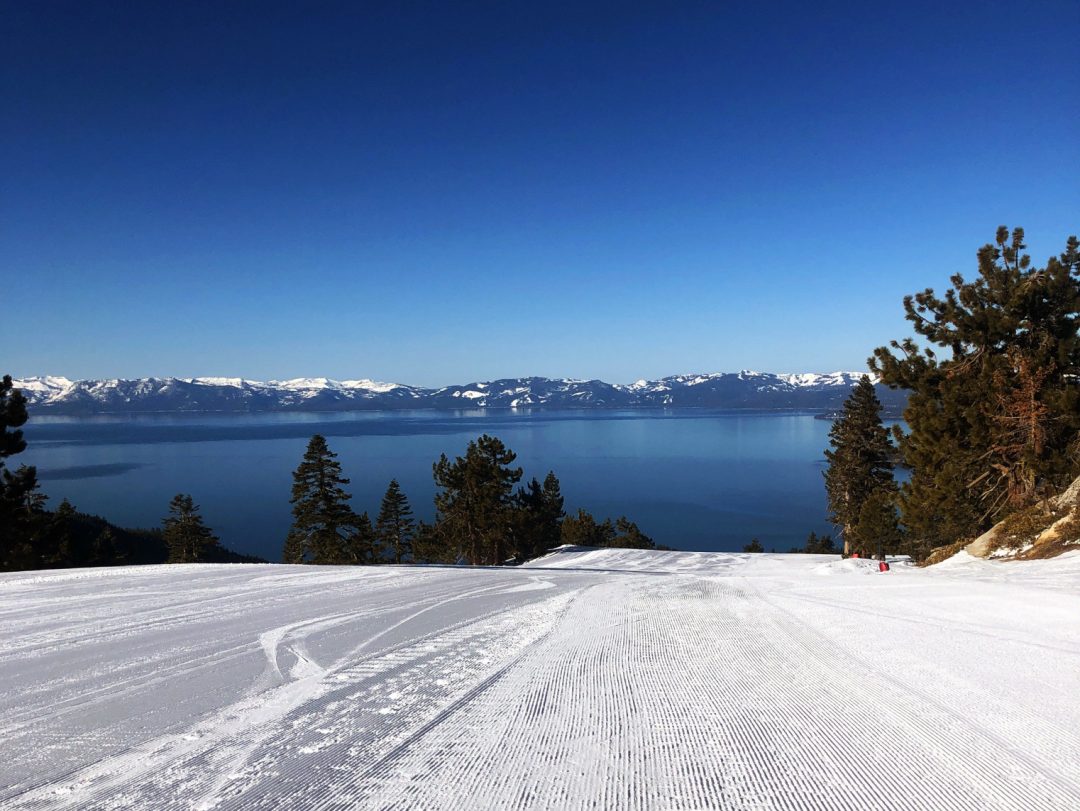
Arcing beautiful groomers at Mt Rose with Tahoe in the background: A memory to carry thru the summer. Credit: Pat McCloskey

So as we wrap up another ski season and as areas slowly start to close, I am again grateful that we had a season in these very trying times. It will be interesting to see how the areas did financially seeing that there was a different scene this year. No big apres ski scenes, restaurants at 5o percent capacity at best with the “Grab and Go” food options being the norm. Most areas got their money up front with the sale of IKON and Epic Passes which is the only way to go considering the price of daily lift tickets. But the food and beverage sales had to take a hit.

I always get a little melancholy with the knowledge that I won’t be on the slopes for another eight months. I thought about that when I was making some nice giant arcs on some great groomers at the end of the day at Mt. Rose. I thought to myself, “Pat, this is what you need to think about this summer when you are getting that ski itch.” I love the feeling of making the skis carve on some great groomers. It brings a smile to your face for sure. Even though the western snow pack was down 50 percent this year, and the really cool stuff was not accessible, it was still fun to rip the groomers and that feeling of making a nice rounded arc turn never gets old. So bring on the spring and summer. They are fun seasons too, but I will be looking forward to another ski season as the leaves start to turn in the fall.

Gratitude

Half-Way Through The Season, Pat McCloskey Takes Stock.

[Please consider supporting SeniorsSkiing.com with a donation. We appreciate your help. Click here.]

My Ski Lodge. Credit: Pat McCloskey

We are halfway through winter, and the groundhog has come out to let us know what he thinks about the rest of the winter. I wonder if he will be masked? In any event, this has been a different ski year with booting up in the parking lot and eating lunch in the car or at a tailgate. The good news is that, for the most part, snow has been really good this winter, and lots of folks are getting out to enjoy the slopes nationwide.

Here in Western Pa, the snow has been plentiful, and all of our ski areas have been operating well. There have been a few glitches along the way but for the most part, I am grateful that the lifts are spinning. The outside fireplaces are roaring, and, when there are only a few people in the lodge, I sneak in early to sit by the fire, one of my favorite things to do.

There’s been snow in western PA. Gratitude. Credit: Pat McCloskey

There have been a lot of changes this year in the operation of skiing. We don’t really know the half of it, but I am sure that operating a ski resort in Western PA is challenging enough let alone in a year with a pandemic. In the fall, there were questions about whether there would be skiing this season.  However, the resorts have made it possible even though their bottom lines are probably not as robust with the lack of bar and restaurant business. Tough to survive on take out and limited indoor seating. But they are doing it, and, for that, I am grateful. When I ride up that old chairlift and look out over the Laurels, I am so thankful that I have the health and the skill to enjoy skiing. And an hour and a half from where I live, I will take it.

Janet and I are headed west in February and I will be going again in March. From what I am hearing from friends out there, the resorts are doing a good job in general. Sure there has been the issues with long lines due to social distancing on the chair lifts, but it seems to have sorted itself out as the season has progressed.  This past week, most of the west has seen a significant snowfall which will hold them in good stead for the rest of the season. Outdoor recreation is essential to all of us if we want to get through this pandemic and nothing better than enjoying the snow in the winter.

As I sit in my folding chair at the beginning of the day and boot up, I look around and think we are much better off than we thought we might be. The weather has been cooperative, and it has led to good times outside for a lot of us. So the next time you see a snowmaker at the resort, any resort, thank them. They work hard in really adverse conditions. When you see the patrol, the ski school, a groomer , restaurant employee, ticket booth personnel, or management at an area, take a moment to thank them all and tell them how much we appreciate their efforts to keep us all going strong this winter. The good news is that no matter what that ground hog says, we have a lot of winter left.


Instructional Advice: Slow Start, Good Turns

Easy Does It And Find The Rhythm.

If you look at Henrik Kristoffersen here in the blue Norwegian National Team uniform doing slow turns, you will see the value of mechanics at a basic level.   

The important thing that I realized in watching Kristoffersen executing basic turn maneuvers at a very slow pace is that we all can work on basics at this speed.  It is important from time to time to practice the basics like this on gentle terrain. 

Another thing about turn speed is that it is a good idea to start each run with a slow series of turns.  When you start out too fast, and the terrain becomes more difficult, the turns are compromised.  It is better to start out slowly and make a series of good turns, then you can develop a rhythm which will take you smoothly through the run and not end up hitting the brakes to find your rhythm. 

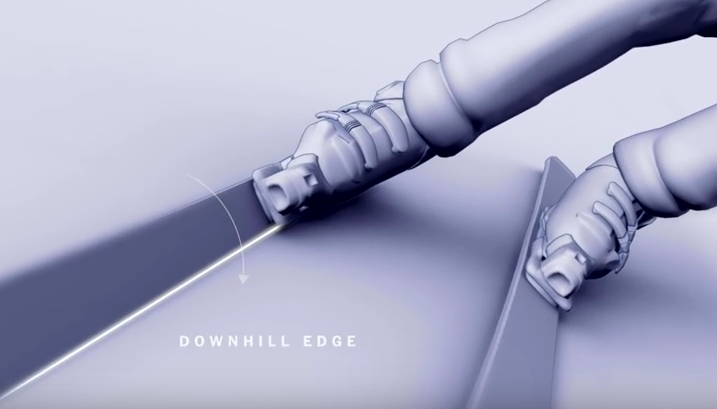
Good smooth carved turns are executed when one starts out a run with deliberate slow turns.   Oftentimes I ski behind my wife and have her start out slowly.  I tell her to concentrate on the uphill edge which will become the downhill edge.   I call out the appropriate edge and she makes nice rounded turns with edge pressure control throughout the radius of her turns.  Try it sometime with someone  whom you are trying to move to the next level. 

Carve Turns On Opening Day

Master Making Those Modern Arcs.

Ski instructor Paul Lorenz has a great instructional series on You Tube showing how to carve on skis.  To properly execute this type of turn, it is important to consider the basics of balance. 

Those of us who have skied for a while know that it is most important to stand on the new downhill ski during a turn and make sure that most of your weight powers that ski through the radius of the turn.  For some of us coming from a traditional background with longer skis, that also meant lifting the inside ski a little  to aid in the execution of the turn and to make sure that most of the weight was on that downhill ski. 

With the advent of the modern ski with shorter lengths and more dramatic side cut, the up-unweighting that we all utilized is not that necessary any more.  Sure there are times when you need to up- unweight ( powder, crud, etc).  But for the most part, the modern turn is executed by moving the center of mass across the skis and towards the next turn.  Think of it as moving your belly button towards the next turn.  This way, the turn is more lateral than vertical. 

Look at the video and you will see a balanced, wider track stance, with lateral movement and flexion to execute the modern turn on groomed conditions.  If you watch the World Cup on the Olympic Channel or NBC Peacock, watch the racers and their stance.  GS turns today are very much like Paul’s.  Lateral movement with very little vertical movement.  Downhill and Super G are similar with the exception being slalom, where sometimes vertical movement is crucial to get the skis in position for a tight turn. 

At the beginning of each season, I try to make my first turns rounded and executed with both feet on the ground throughout the turn.  I make a conscious effort to be flexed, in a lower position (I cut my pole length this season to accommodate), and move across the skis instead of utilizing vertical movement.    We are not skiing on longer skis anymore and to really appreciate the value of the modern ski, we need to study and practice the modern turn.  Try it on your first outing.  Nice rounded turns. 

Transition To Cycling

“Start Slow And Taper Off.”

Keep your distance and take it easy, especially at one your first rides. Credit: Pat McCloskey

The ski season came to a screeching halt as most of us are now staying inside with some socially distanced outings.  As I look back on this shortened season, I can take heart in the fact that I made the most of it before cancelling my last trip.  Skied a lot in the rain locally, dropped some of the Daly Chutes in Deer Valley, and had a great time skiing with my wife and our dear friends out there in Utah.  Skied some great conditions again  locally and was looking forward to another trip with the guys this time and —voila!  Covid -19.  So, for me, I  sharpened and waxed the skis and put them away for another year and look forward to some dry trail time on the mountain bike. 

The good thing about transition time for us seniors is that we can go about it slowly.  We have paid our dues, and those of us who rode over the winter have a good base already on which to build. I have a friend who has a great saying when asked about how he will start his rides.  He smiles and says, “Start slow and taper off”.  We all laugh at this and have made it our motto, but, really, there is some truth to this especially in the spring.  There is no reason to be a world beater when it is still early. Like anything—running, gym work, or any other springtime resolution—if you start too fast or go too hard, you will most likely quit.  Especially if you are new to the sport or perhaps have not done your homework over the winter.  If you approach Spring with the idea that you will start slowly, each day becomes more and more enjoyable as you build your fitness. 

This social distance deal is a bit confining, so it is important to safely get outside and get some fresh air.  You can still build your fitness for the summer in a socially responsible way. For me, I look for trails that I know will not be crowded.  I went out yesterday, for instance, and saw two ladies on horseback—(seniors actually), and a family of hikers.  That was it. 

It was a warm and sunny day, and I felt good getting out under the socially correct protocol.  Eventually, we will be able to regroup with our friends and life will move on. 

For the moment, if you do venture out of your home, avoid the parks, and crowded trails and seek some solace in the more remote places.  A mountain bike is good for that, and, if you take it easy, you will find that you feel good getting out and not killing yourself.  I always say to my friends, “Nobody here is going to the Olympics so slow down.” We will all get through this.  Better times ahead but now is the time to be responsible and “Start slow and taper off.” 

The Daly Chutes At Deer Valley

[Editor Note: SeniorsSkiing.com is asking our readers to contribute to support our online magazine. Yes, we have grown in the number of subscribers and advertisers. But our expenses have also grown. You can help us defray some of these expenses by helping us out with a donation.]

Support SeniorsSkiing.com by clicking here.

______________________________________________________

Want Steep? Chute 4 Has Steep.

Chute 4 from the cornice. You ready? Credit: FeedTheHabit

Deer Valley Resort in Park City, UT has a reputation for catering to its clientele.  Aside from the great food and fabulous customer service, it pampers skiers with groomed perfection and valet service, Yet, the resort is often dismissed by hard core skiers who feel that there is nothing on the mountain that would interest them.   

To those folks I simply say, ”Go to the Daly Chutes off the Empire Express Chair.” Riding the chair, the chutes are visible to your left.  As you exit the chair to your left, you make your way down the Orion Trail until you see the signs for The Daly Bowl and then an upward climb/traverse to the cornice on top of the Daly Chutes area. 

Depending on the weather and the condition of the snow that is blown into the bowl area, the openings can be varied.  Sometimes only a few chutes (which are numbered) are open and you must choose the correct ones as you stand at the top of the windblown and steep cornice. 

Last week I chose Chute 4 twice, and, as I dropped in to the windblown snow, I immediately began a series of steep jump turns down the throat of the chute.  Coming up on an exposed rock section, I veered to the right and finished in a wide open bowl area that was strewn with debris from avalanche blasting the day before. 

After weaving through the large snow chunks and into the trees, the chicane of seldom used tight trails eventually brought me out in plain view of the Empire Lodge. 

The chutes are all skiable and if you can manage the roller coaster trail through the woods on the way over to the bowl area and eventually to the top of the cornice, you will be treated to a selection of some steep but manageable terrain that definitely quiets the naysayers. 

In addition to the challenging terrain of the Daly Bowl and Chute area, if you make your way all the way over to skier’s left of the resort, you can access the Sultan, Wasatch, and Mayflower chairs and experience some fast and steep groomers. 

The signature run is Stein’s Run named after the legendary Stein Eriksen who was the Director of Skiing at Deer Valley for many years and an Olympic and World Championship medalist.  Usually this area is quiet, and you have free rein to rip GS turns to your heart’s content,  another plus for those who think that Deer Valley is not challenging. 

All in all, a word to advanced skiers would be that although the terrain at Deer Valley does not rival Jackson Hole, Alta, or other areas with challenging expert terrain, the Daly Chutes will not bore you, and you definitely have to pay attention on your way down any of the selections. 

Don’t knock it until you have tried it.  Seniors get the benefit of a $125.00 lift ticket on certain days compared to the usual $209.00 tab.  And of course the Ikon Pass is accepted at Deer Valley.  

Check out a video trip down Chute 4 from Deer Valley.

Opening Day Cranmore

First Turn, Icy Snow Advice

Instructor Pat McCloskey Recommends An Approach To Early Days.

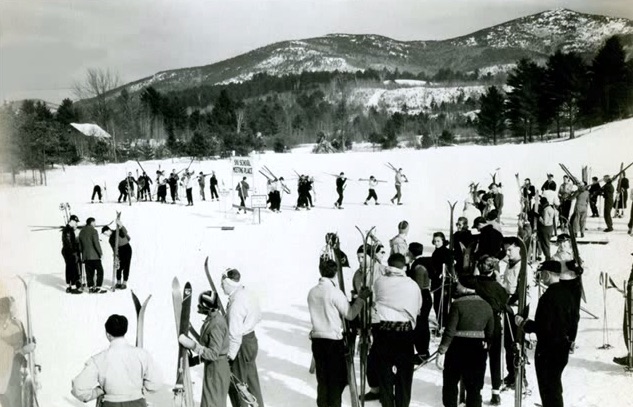
Opening Day, Cranmore, NH, 1938.

I had an interesting discussion with my lift mate this weekend at our local ski area. 

I asked the fellow beside me how his day was going. He remarked, “Well, the hill is fighting me back a little today.”  I chuckled because the guy was a certified PSIA instructor but was feeling a little uneasy with the current conditions.  After all, it is early days for the season, and the snowmaking can bring terrain to life but can also provide less than adequate conditions if you are not prepared.

What did he mean the hill was fighting him back?  As I exited the chair, I began to think about how to tackle ice, scraped snow, and the inevitable sand-like conditions that occur with a big crowd on not so big terrain.  If you started out too fast, you ended up defensive in your stance, and the timing of turns was compromised by too much speed too early, resulting in a skid for life. 

So, my recommendation to anyone starting out on their first run on limited terrain and icy conditions is to begin slowly and finish your turns.  Make a series of turns by finishing them and reducing your speed by the radius of your turn.  Your timing will come back to you and you can eventually increase your speed. 

If you start out slowly and allow the cadence of finished turns to happen at a lower speed, you can eventually ski with a faster cadence once a comfortable series of turns are made.  Be aware of your ankles and make them flex in the bottom of the turn to assist the ski in making a finished, rounded turn. 

I did this for a while and really concentrated on rounded turns and feeling my edges grip the ice.  Then I became more aggressive and said, “Come on Pat, you’ve got this”  and increased my cadence and speed but didn’t compromise my turn.  I was able to do this because of starting the run conservatively and making rounded turns. 

I end up doing this all season long. If you can start slowly and make the first couple of turns correctly and rounded, you can ski any terrain anywhere. 


Familiarity Breeds Confidence

You Can Do It If You’ve Done It Before.

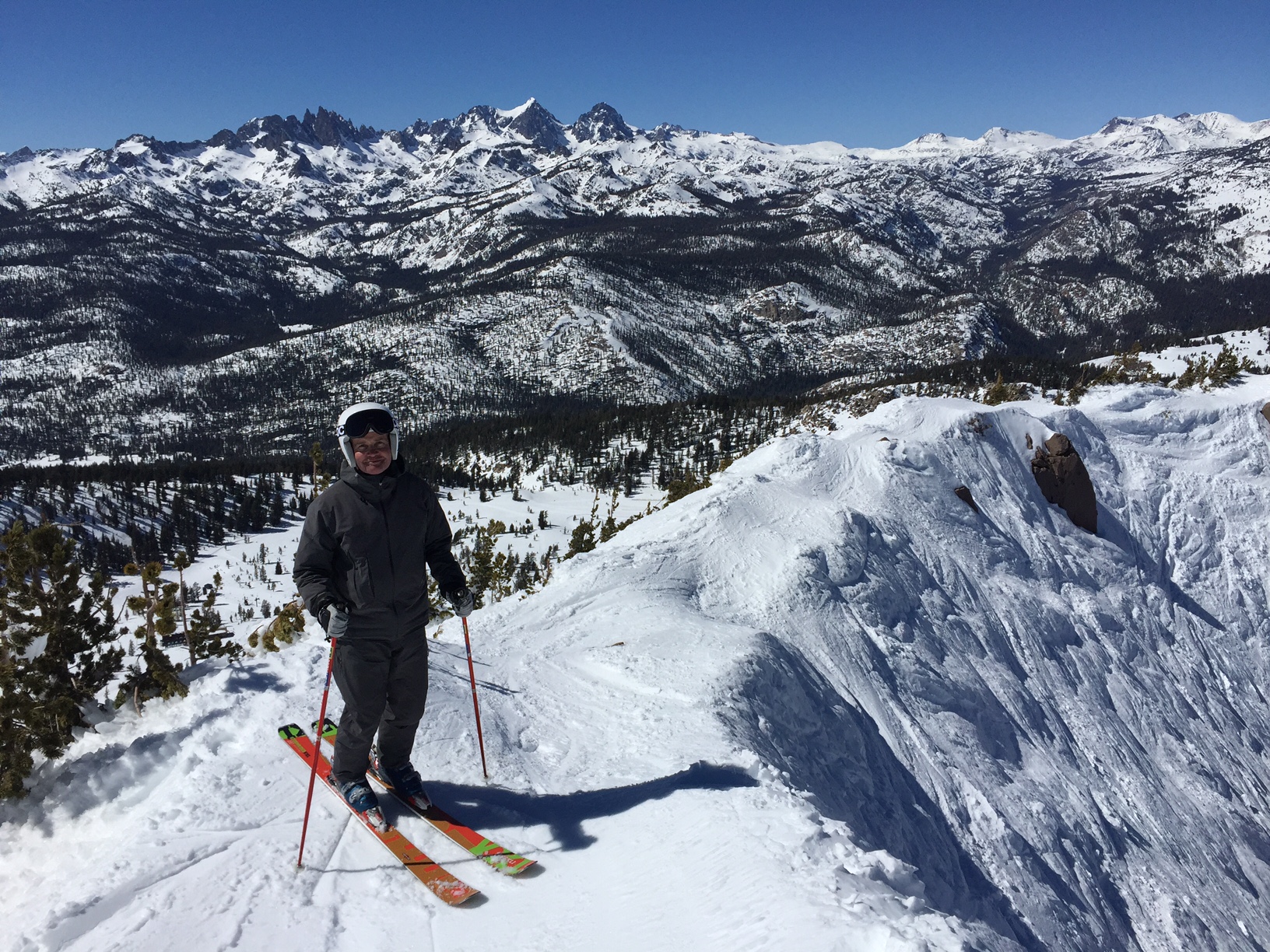
Pat Standing On The Cornice. Not A Problemo.

You know, as you age, little things creep into your mind like, “Can I still ski that?”  “Am I too old to keep trying this pitch?”  But, one of the things that keeps our minds in check is the familiarity with the terrain after years of experience. 

For instance, every year, I travel to Mammoth Mountain, CA. with my posse of friends  All of us have skied that mountain for years.  After exiting the gondola at the top , we ski off the famous pitches and faces up there with confidence.  Why?  Because we know the terrain. 

This last year was no exception. I made several runs down the cat track off the tram relaxed and tucking to the top of Paranoid Flats and skied right off the top with no trepidation.  I have become very familiar with that terrain and know that I can ski it.  Now there are pitches and couloirs there that I have not skied and for me, the consequence factor is too high with the surrounding rock walls that will suck in unsuspecting skiers who have made the error of skiing above their ability. 

I take Coumadin and my doc always says, “Pat, you are the only patient I have who skis and mountain bikes on Coumadin.”  But I have done those sports for years and know my limitations.  And, I know how to ski safely over a familiar cornice, even though I am now 65 years old.

We all do this one way or another.  Confidence occurs because of repetition over certain terrain.  I have a friend who I ski with, who not only skis the same runs all the time at our local area, but he skis the same lines.  He becomes so familiar with the lines that he is confident and tries to make the perfect turn over and over.  I ride my local trails a lot on my mountain bike and am so familiar with the layout of our trail system that I can confidently ride them with speed. 

The flip side of the coin is that if you keep yourself in shape and have the confidence that you can ski or ride most anything within reason, you are not adverse to challenging yourself on new terrain. The more familiar you become, the more confident you are.  This is especially important as a senior skier. 

There is nothing wrong with using a little caution, but for the most part, years of experience on the slopes will give you confidence.  You know how to ski ice, you know how to ski powder and have that centered position and not sit back.  You have seen rain soaked snow before and know that it is consistent.  Why?  Because you have been there before.  When the young dudes see an older guy confidently ski a sketchy line, they are amazed.  But really, we know that confidence and experience rule the day. 

One day, a few years ago, my friend Eric and I saw a guy rocketing GS turns down Strawberry Express at Snowbasin, UT.  His effortless turns goaded us on to stay with him and when we got to the Strawberry Gondola, he took off his helmet and exposed a gray beard with a grizzled, leathery face, and a full shock of gray hair.  I politely asked him how old he was and he said he was 75 years old.  We asked his secret and he stated that he skied or hiked every day, and he is confident in his turns because he keeps himself in shape.  He knows every trail intimately. 

So, the lesson for all of us is stay in shape, keep skiing, and there is nothing wrong with picking lines and sticking to them.  The more confident you are, the more fun you will have. 

You can do it. Remember when you did it? Try.

Slopeside Syrup: Ski Racing And “Golden Delicate”

The Cochran Family Makes Maple Syrup And Ski Racers.

Slopeside Sugar House run by ski racing’s famous Cochran family. Credit: Cochran Family

There are a lot of Vermonters and others in the ski racing world who could tell you a lot more about the famous Cochran Family of Richmond, VT.  I have friends who know them personally and tell the tales of the first rope tow that Mickey Cochran built in his back yard with the vision of a community ski facility.  He and his wife Ginny ultimately had four children who all made the U.S. Ski Team and had outstanding success including a  gold Olympic medal for Barbara Ann and a World Cup GS Title for Marilyn.

World Cup GS Champ Marilyn Cochran helps out at Slopeside. Credit: Vermont Sports Hall Of Fame

My friend Mark Hutchinson remembers the time that Mickey’s jacket caught on fire because of all the oil and engine grease embedded in the fabric as a result of countless hours maintaining the tows at Cochran’s.  Today, Cochran’s is a legendary ski training center for young ski racers all over Vermont with coaching and operational duties falling to the Cochran family, relatives, and grandchildren.  They are currently a non-profit ski area with training and races held each winter.  Donations are gratefully accepted at www.cochranskiarea.com/donate But that is not what the subject of this article is.  I am talking pure Vermont Maple Syrup of which I am a true connoisseur or as my friends say, a “common sewer”.

I have this habit of taking pure Vermont Maple Syrup, heated, in a jar when my wife and son and I  go to breakfast.  They look at me with disdain, but I will not use anything else on my hot cakes, waffles, or oatmeal.  I am always on the hunt for the recently re-named “Golden Delicate” syrup that is elusive.

With the re-naming of the descriptions of different grades of syrup by the Vermont Maple Sugar Makers Association  (www.vermontmaple.org) ,  there has been some confusion as to what is actually the top syrup for consumption.  Personally, I like the lightest syrup currently described as “Golden Delicate”.

Recently, four of the grandchildren—all cousins—of Cochran decent, decided to enter the maple syrup space in Vermont by constructing a timber frame sugar house close to the ski area.  This has expanded since 2010 to an operation of 22,000 taps and PVC collection lines that all feed the operation in the sugar shack.

Maple syrup from Vermont. Hmmmm. Credit: Slopeside

Slopeside Syrup has become the standard bearer for all Vermont syrup, and I am so happy that I found them.  One day, while perusing the Durfee family refrigerator in Lake Tahoe, I came across a bottle of this delectable treat.  I asked Eric Durfee about it as he is a native Vermonter and friend of Marilyn Cochran.  He told me about the operation and how he and Marilyn converse about the old days of ski racing and training to this day.  Turns out that Marilyn helps out occasionally with the syrup operation.  When I ordered several bottles online and told her I was a friend of Eric’s, she wrote me a nice personalized note that she packed in with my order.  That little bit of customer service and kindness will always make me a Slopeside Syrup fan for life.  You should be as well.

Go to www.slopesidesyrup.com, and you will see ordering information as well as some history of the family.  Not often that a World Cup GS Champion will oversee your order.  Take it from me, the “Golden Delicate” is nothing like you have ever tasted before.  Most times when I have ordered the formerly labeled “Grade A Delicate”, I got something less with more of an amber color and traditional taste.  However, the Slopeside Syrup product is truly that elusive grade which I know and love and bring with me to every breakfast.

So treat yourself, buy Slopeside Syrup and support Cochran’s Ski Area for the kids in Vermont.  Not all of them can go to the elite ski academies because of cost. But they can come to Cochran’s, get world class coaching, and immerse themselves in a culture of champions.  Ski racing, and maple syrup.  What a combination.

Cycling And Skiing Similarities

Both Require Looking Down The Trail, Pressurizing To The Outside Of The Turn.

I was out the other night riding with my pals and noticed that I was starting to look at the front of my wheel in sketchy terrain, and my balance was starting to be  compromised. 

Looking down the trail, not over the wheel.

I thought to myself, “Pat,  keep your eyes focused down the trail and not on what is right in front of you.”  I know this.  I always do this skiing: look down the trail three turns or more to allow efficient skiing and don’t look at what is right in front of your ski tips.  Sometimes you lose focus on what you are doing and let the terrain dictate your visual field.  The solution is something that I always tell skiers looking to improve. Don’t let the terrain ski you,  you ski the terrain. And the best way to do that is relax and look down the trail or slope.  When you allow your field of vision to open up by looking ahead, you have much more time to react to the terrain changes that will come before you, often at a rapid pace in skiing or riding a mountain bike. When you focus on your ski tips or your front wheel, that reaction time is severely compromised.  Momentum is your friend and if you look ahead, you can handle any terrain changes much better and in plenty of time to react.  Look at the rider in the picture here.  Looking ahead and down the trail.  He is focused and able to react to the technical challenges ahead. 

Another similarity between skiing and mountain biking is the position of the pedals during a turn.  The picture above shows an extreme example of a sharp turn on a mountain bike.  Look at where the inside leg is allowing full pressure on the outside pedal in the down position. 

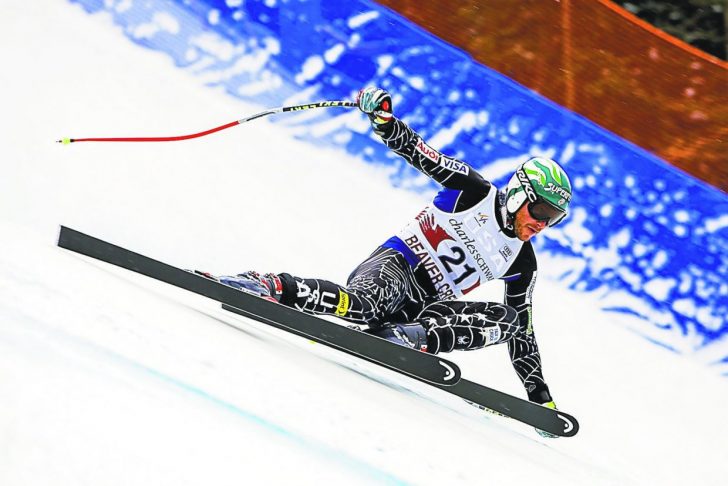
Bode Miller putting weight on outside ski.

If you look at Bode Miller here, you will see a similar leg position in his downhill race  turn at Beaver Creek Birds of Prey World Cup. As soon as his outside ski makes contact, he will have it fully pressurized because of his leg and hip position.  This is very similar to the cyclist who is able to execute a steep turn on his mountain bike by allowing his outside pedal to be fully pressured in the turn.  Oftentimes when I ride, I can even feel a slightly countered position on my bike allowing the outside pedal to be fully under pressure and my inside pedal in the up position and stable in the turn.  I learned how efficient this is when I used to race on my road bike.  Those high speed turns have to be executed with the outside pedal fully under pressure, otherwise you cannot execute a tight high speed turn in the corners of a criterium race.  Racers who could not commit were often off the back or crashed out because of a poorly balanced turn. 

So, if you are longing for skiing during the off season, think about those turns during your bike rides.  Whether on the road or trail, the movements are very similar and can give you the feeling of a ski turn when it is 80 degrees outside.  Enjoy the summer and the riding. 

E-Bike: Makes Sense and Here To Stay

First Fat Bikes, Now E-Bikes. The Cycling World Is Spinning Up Innovation.

If you’ve never seen one, this is an e-bike. There are many, many other designs for different purposes. Credit: Ancheer

An interesting phenomena has started to surface in the cycling industry.  From July of 2016 to July of 2017, there was a 95% jump in sales of E-Bikes in what industry regulars say is currently a $65 million segment of the cycling business.  Sales have been booming and currently all of the major manufacturers have jumped on board with offerings of pedal assist bicycles in both road and off road models. 

Along with increased sales especially among the senior set, there has been increased controversy with opponents concerned about the safety of the bikes as well as the safety of other users on our nation’s trail systems.  Purists have been vocal about how e-bikes should not be allowed on multi-use trails because they are in the category of motorized vehicles which are currently banned.  However, the one thing most people do not understand or admit when criticizing the e-bikes is that one still has to pedal them.  Each pedal stroke starts the electric motor which can be used in econo mode (slower and energy savings on hills), and turbo (governed to no more than 20 mph). There are no throttles on the majority of e-bikes.    But make no mistake about it, e-bikes are here to stay, and there is even a category for e-bike racing in the 2019 World Mountain Bike Championships coming up this fall.  A rainbow jersey will be awarded.  Who would have ever thought?

Bringing it closer to home, I have two friends who are now in their 70s.  Really fit guys who have ridden mountain bikes for a long time.  One guy is slowing down a little bit. So, when the e-bikes came out, he was one of the first to jump on board because it allowed him to keep up with our younger friends and continue to be part of the group rides.  In fact, I kid him when following him up hills.  I tell him he is the “A” Team now being the fastest up the hills.  He smiles and consequently is still part of the rides that he always loved. 

The other guy is a very fit 70 year old who told me, “ Pat, I really got the e-bike for my mountain bike trips out West where I am faced with many miles of uphill fire roads.”  He can cover a lot more ground and can  see a lot more on these scenic Western rides with the pedal assist on long hills.  He also says he can ride more days in a row because the pedal assist reduces the daily fatigue on his legs as he ages.  He rides more days and enjoys the trips even more.

For non-cyclists, an e-bike can be an accessible way to enjoy the trails. Credit: Pat McCloskey

Finally, the picture you see above is my friend Farah.  Her husband is a riding friend of mine, and he is trying to get her to ride a little more. He bought her this Specialized e-bike for use on the many rails to trails around our region.  He says she loves it and it allows her to ride many more miles than she would on a regular bike.  In fact, she is anxious to ride more because the fatigue factor has been eliminated with the e-bike and she has a lot more fun riding than with a regular bicycle.  This is common place now with 94 percent of non-cyclists who purchased an e-bike, reporting that they are riding more daily or weekly because of their new purchase.

As the population ages, e-bikes make sense for those of us who want to still enjoy the trails and roads.  There is a learning curve on how to use the econo mode and the turbo mode and braking is a bit different with pedal assist.  But it is something that is learned with continual use.  Respect on the trails is still required and even the International Mountain Bike Association (IMBA) is re-writing a lot of trail etiquette to address the protocol for riding multi-use trails with e-bikes. 

With the current popularity of cycling as a means of transportation, the e-bike makes sense for road riding as well as commuting.  Even UBER is investigating utilizing e-bikes as a viable means of transportation in their urban transportation platforms.  Backroads Cycling and other adventure cycling organizations are now offering e-bikes to their clients on European cycling journeys with rave reviews.

So, the bottom line is this: Try one.  See if it is something that will encourage you as a senior rider to perhaps ride to the store instead of driving.  Maybe try the trails that you have never ridden before or enjoy your current trail system with a little assist as you age.  We all try to stay fit as seniors but with e-bikes, we can get a little help.  I know one is in my future.

You Never Know…

[Editor Note: As the new year begins, SeniorsSkiing.com is again asking our readers to contribute to support our online magazine. Yes, we have grown in the number of subscribers and advertisers. But our expenses have also grown. You can help us defray some of these expenses by helping us out with a donation.  This year, we have a mix of premiums for different level of donations, including stickers, sew-on patches, our new SeniorsSkiing.com ball cap. All donors will be entered into a drawing for a pair of bamboo Polar Poles to be drawn in late March.  You can donate by clicking here.]

The People You Meet.

I was admiring my handiwork the other day adorning my Yeti water cooler with ski stickers collected from a couple of areas that I frequent.  In my lifetime, I have skied in a lot of different areas with the majority being in the New England area around the time I was preparing for my PSIA Certification Exam many years ago. I met a lot of characters in those days.  PSIA Examiners, coaches, and people like Toni Matt who recounted his famous Inferno Run down the Headwall of Tuckerman Ravine for the New England Ski Hall of Fame. The recording was collected at a PSIA event and dinner and I was fortunate enough to have a chat with the old master himself. In 57 years of skiing, I have been to areas in Canada, Europe and all over North America.  Not boasting – just accompanying the humbling tale I am about to unfold. 

Feeling pretty proud a couple of years ago with all of this, I ran into an older gentleman in the ski lodge at Seven Springs Mountain Resort.  We started chatting casually, and he introduced himself as Ogden Nutting.  The bell immediately went off in my head and I recognized the name as the patriarch of the local newspaper conglomeration The Ogden Newspapers. 

Turns out that ONI, as it is currently known, is the 10th largest newspaper communication entity in the country.  Aside from the ownership of the newspaper giant, Mr. Nutting and his son Bob are the owners of the Pittsburgh Pirates Baseball Club and Seven Springs Mountain Resort which is where I grew up skiing.  He asked if I skied Seven Springs frequently .  I said outside of a stint as a ski instructor in Maine in 1977, I have been a regular at the Springs since 1961.  He was happy and asked if I had skied anywhere else.  I proudly puffed my chest and said, “Well Mr. Nutting , I am proud to say that I have skied in 109 different areas in my lifetime.”  He looked at me with the eyes of a true enthusiast and quickly remarked that he had skied in over 500 different locations in his lifetime, all over the world.  Feeling like an icepick was being shoved into my already inflated chest, I said, “Wow Mr Nutting. That is truly impressive,” to which he replied, “Sonny—you have a long way to go.”  I will never catch that record.  No way no how. 

The point is you never know who you are talking to.  Kind of like when my friend Jan Palmer showed up at a local masters race and asked if he could forerun.  He was interning at WVU Hospital and wanted to have a go at a USSA GS Race in the area.  All the kids in the start area kind of snickered when Jan entered the starting gate with jeans, an old pair of Rossi Stratos, and old Lange Comp boots with the yellow cuffs.  There they were with all their capes and two pair of skis. Old Jan just blistered the course and blew everyone away.  Their eyes widened when they saw the time, and they all asked who that was.  I said, “Never judge a book by its cover, boys and girls.”  You never know who you are speaking to or skiing with.  You see, Jan was on the US Ski Team at one time with Billy Kidd as a 16 year old downhiller.  The fastest guy in the country at the time and gave it all up for medical school.

Humility was the lesson for me in the ski lodge that day with the venerable Mr. Nutting.  And the race kids on the hill that day got schooled by an old pro and a large slice of humble pie was served after Jan rocketed out of the starting gate. 

Technique: The One Team Concept

No Matter What You Are Sliding On, Basic Athletic Principles Apply.

When I was a boy, my dad knew a woman who was a former USGA Senior Amateur Champion from South Carolina named Carol Cudone.  She constantly reminded my dad to finish his golf swing with his “belly button to the ball.” Ultimately she was trying to get my dad not to hit his shot off the back foot.  Or swing in a static position.

When I played a lot of tennis back in the day, I always was reminded by my coaches to finish the stroke on the front foot with my center of mass facing the completed shot.  Again, not off the back foot.

Mikaela Shiffrin says that skiing is not static either.  It is a continuous movement of working the ski from tip to tail in the turn with the center of mass always moving towards the next turn.  Three separate sports with a common theme of moving the body in an efficient manner in order to complete a shot, stroke, or turn. The common movement pattern is getting the center of mass in a position to execute a turn in the direction that you wish to go and to make a shot in the direction that will be successful.  Fluid movement and not static at all.

Recently, there was a commentary in the winter issue of 32 Degrees, the official publication of the Professional Ski Instructors of America, about the “One Team Concept”.  The magazine was doing a series of interviews about “Interski”,  a global summit of international ski instructors with the goal of sharing knowledge and technique.

Forward, not on the back heel. Credit: “32 Degrees”

The United States team is always very popular at these events, and, in recent years, the concept of “One Team” has been a focus. “One Team” is all about representatives of alpine, cross country, telemark, and snowboarding all coming together to discuss the value and similarity of teaching techniques as they relate to how people learn and how to teach different personality types.

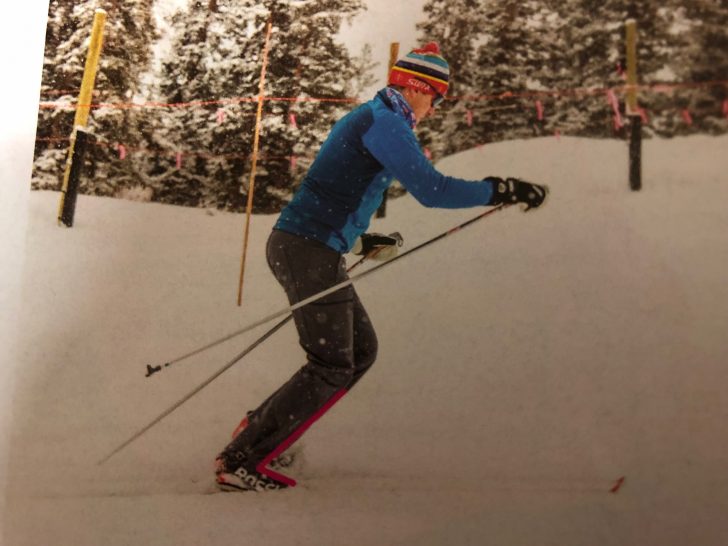
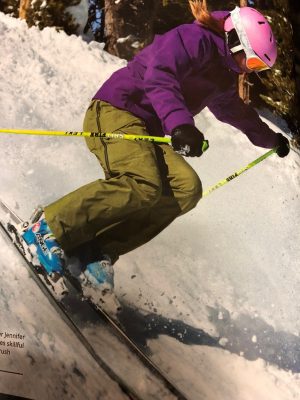
“One Team” also explored how similar movements in different disciplines of sliding on snow create efficiency and effectiveness.  As in the movements of golf and tennis, these four disciplines of snow sports have similar movement patterns.  Not only is the center of mass moving towards the new turn a common goal, but there is also the important role of a flexed ankle.  As you can see from the alpine photo, the flexed ankle manages the pressure of an alpine ski turn against the terrain.  So many people refer to bending the knees but the primary joint critical in the execution of a ski turn is the ankle.


Note forward ankle bend. Credit: “32 Degrees”

If you look at the cross country photo, the key to balanced forward movement in traditional cross country technique requires a flexible ankle to not only initiate the stride, but to keep the center of mass where it should be—forward— and not static-centered which hampers the glide process.  The same technique is required for successful telemark turns with a soft ankle utilized to maintain balance and forward movement.

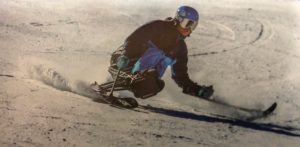
Finally, in the adaptive world, there is a lot of talk about the outriggers being used as legs on an upright skier.  As the adaptive skier moves his center of mass towards the new turn, the outrigger extends on the initiation of the new turn and the other collapses on the inside of the turn. This is much like the flexed soft ankle of the uphill ski in an alpine turn.

As the adaptive skier moves his center of mass towards the new turn, the outrigger extends on the initiation of the new turn and the other collapses on the inside of the turn much like the flexed soft ankle of the uphill ski in an alpine turn. Credit: “32 Degrees”

Alpine, cross country, adaptive, telemark, and snowboarding all have a common balance and ankle platform that really creates a “one team” concept both in the actual instructional technique but also in the philosophy of a united front in teaching and learning techniques.  No matter what you are sliding on, the basic athletic principles apply.  Have you ever pressed your outside foot down and your inside foot up in a bicycle turn to the left?  The same principles apply there as well with the center of mass headed towards the turn along with the long leg, short leg, flexed technique.

As Mikaela says, nothing is static.  A good athlete is fluid and utilizes good body balance, movement, and flexion to execute that shot or turn.  Think about it the next time you do something other than skiing and definitely think about that center of mass movement across the skis towards the next ski turn with your ankles flexed.

Treasure Your Ski Buddies: A Tribute

Skiing Binds Friends Together; Don’t Skip A Trip.

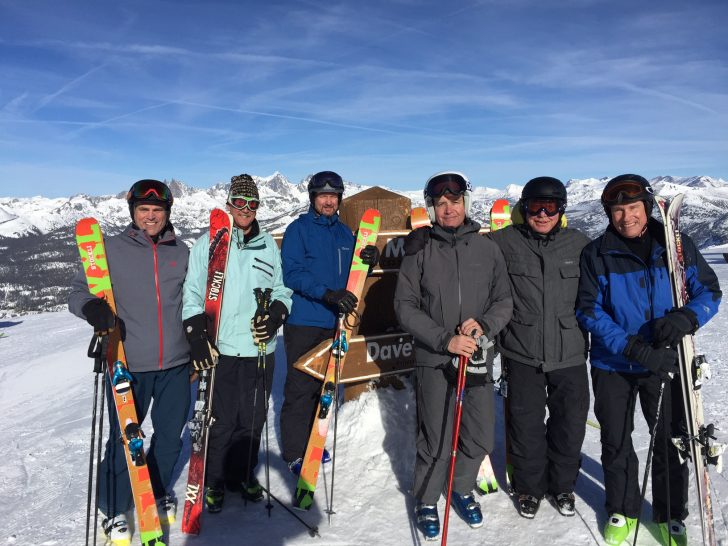
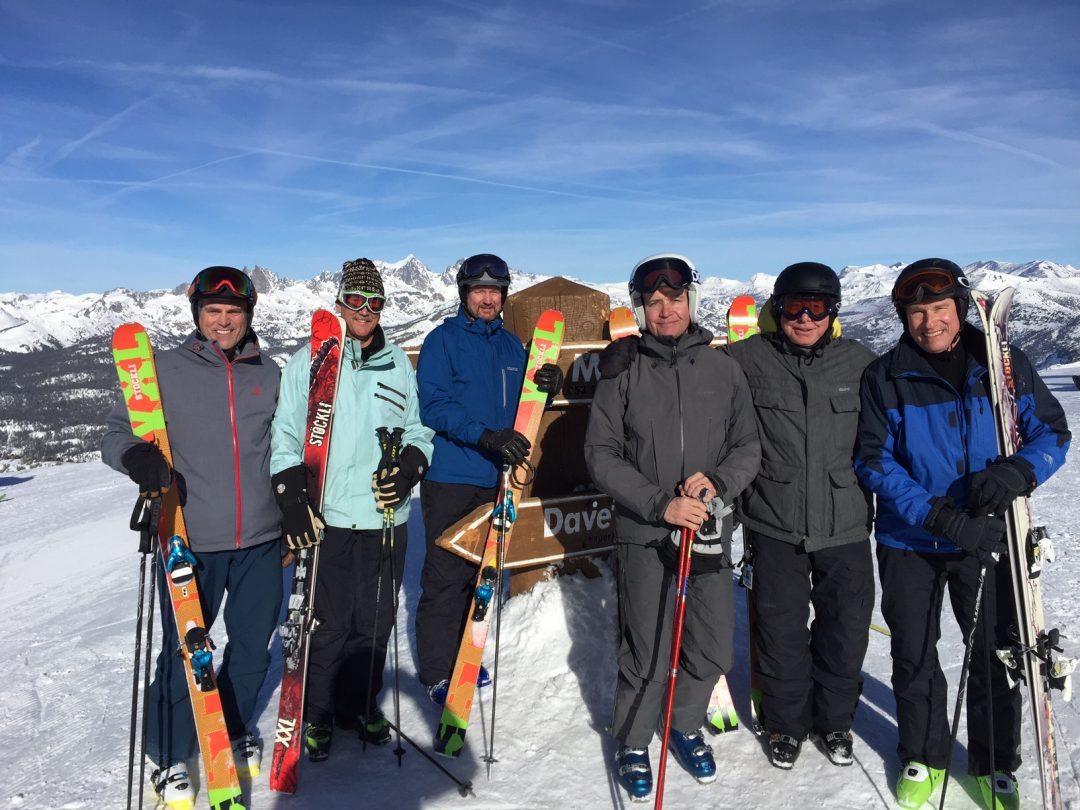
Great friends, great memories. At the top of Mammoth Mountain.  Credit: Pat McCloskey

One of the great things about the sport of skiing is that it is a conduit for friendships.  There is nothing like the anticipation of the weekly get together with friends or the ski trip with pals that you have skied with for over 40 years.  There’s a buzz: the excitement, the snow reports, who has new equipment, and when and where will we all meet.  The guys that I ski with every year on a March ski trip go hard.  They are ex-ski racers and coaches and keep themselves in good shape and we all look forward to the annual trip together coming in to Tahoe from all over the country.

They are cherished friends, and we lost one this summer to an unexpected heart attack.

Proctor Reid was a Dartmouth ski racer back in the day and a highly educated head of a government engineering think tank in DC.  Proctor always impressed me with his big strong GS turns as well as his intellect, and great sense of humor.  It will be a hole for sure in our group this coming March as we toast and ski a run or two for our pal Proctor.  He is pictured on the right in the blue and black jacket with all of us at the top of Mammoth with the great backdrop of the Minarets.  God bless him.  We miss him terribly.

Another guy in this group pictured in the back with the blue jacket is our ring leader and host Eric Durfee from Incline Village, NV.  He recently cut short a trek in Nepal with his wife because of an unfortunate accident.  While spreading the ashes of his in-law at the base camp at Everest, he blacked out and fell eight feet into rocks off the side of the trail.  He was helicoptered to Kathmandu where he and his wife spent a week during extensive tests to determine when and if he could fly home.  Fortunately, everything checked out, and they are on their way back to the states flying first class to Reno from Kathmandu.  He tells us all not to worry.  He will be skiing Mammoth next week.  Tough old bugger.

Not being morose here and hoping to spark a little thought, life is precious.  There are no guarantees and that is why it is so important to get together with friends and no better way than on a ski trip.  Sure, things come up and there are always a million excuses for why we are too busy, it is a bad time, had a flat tire, or some other lame excuse.  But when you make it a priority, skiing binds you all together for memories that last a lifetime.  Same with the groups at your local areas.  Yes, it is cold, the weather might not be optimal here in the East, but drag yourself out and be held accountable to your local group and expect the same results of laughs, great turns together and that cold IPA at the end of the day in the ski lodge.

I just had another birthday and I still ride mountain bikes at night with lights and ski as much as I can during the winter.  I have to keep it going.  I asked Scott Nicol of Ibis Bike fame how long he thought we would be riding and skiing at this level.  He said, “ Pat, don’t even think of it. Don’t let anyone say that you are too old to do anything.”  Like the saying goes, “You don’t quit skiing because you get old.  You get old because you quit skiing.”

Treasure your friends.  Go ski with them.  And always remember—no friends on a powder day.

Fast Freddie

Blind Skier Inspired All Who Knew Him.

Fast Fred Siget on the left with Pat McCloskey, center, and friend at a long ago National Blind Skiing Championships.


The first time I skied with Fred Siget was in Snowshoe, WV, with Larry Walsh of the Pittsburgh Post Gazette. This was my maiden voyage guiding a visually impaired skier. I had Fred, the first blind skier in our area, in front of me. Right turn, left turn, right turn, stay, stay. All of a sudden the only tree around popped up right in front of us as I yelled “Crash,” and Fred sat down as he ran into it.  I felt so bad, but Fred dusted himself off with a smile and said, “Pat, don’t worry about it at all. This will be one of many.” And we continued down the slope. This began a 40-year friendship with the one and only Fast Freddie Siget.
Fred lost his vision as a result of an accident with a high pressure hose when he was a volunteer fireman. As devastating as this injury was, he was undaunted. He became the first visually impaired computer programmer for Koppers Corporation. He continued dancing, and he learned to ski with guys like Larry Walsh, Jim Conley, Lynne (Kravetz) Hartnett, Shorty Leco and Micky Hutchko.

Fred always had ideas on how to make things easier for blind skiers and how to improve guiding techniques. He had a transmitter rig where the guide used a microphone and Freddie had an ear piece which made calling out commands easier and more understandable.

Once I used the transmitter while standing on top of a slope, calling commands to Fred as he skied by himself down to the chairlift. With his “Blind Skier” jacket on, people were shocked viewing his run. In the bar afterwards, we had some fun with Herman Dupre the owner of Seven Springs Mountain Resort. I put the microphone on and guided Fred over in front of Herman and told him to tell Herman how much he admired his red flannel shirt. Herman was stunned and later remarked to me laughing that he was starting to “get hot thinking about all the free passes I gave to Fred and now he is telling me how much he likes my shirt!” Hilarious.

Fred was always anxious to help new guides. He put himself at risk during the training but always felt that it was worth it not only to train guides that could assist him, but to help the other visually impaired skiers who were beginning to show up at BOLD (Blind Outdoor Leisure Development) outings at Seven Springs.

Perhaps the most compelling thing about Fred was his kindness and appreciation for his fellow skiers and guides. He always remembered your birthday and when he called me, he sang, “Happy Birthday to you, Happy Birthday to you, get plastered, you bastard, Happy Birthday to you.”

He was popular for his skiing for sure, but as a person, you could not get a better guy who was always interested in others and never talked much about himself.

We lost Fred this fall at 94 years of age. He had an amazing life, and we will miss him. Fred never let his accident slow him down. He always said that he did more as a visually impaired individual than he ever did before losing his sight. He took a perceived bad thing and turned it into opportunity. Shouldn’t we all learn from that lesson?

Cycling Series: Designed Trails Make A Difference In PA.

Mountain Bikers: These Trails Are Worth The Trek.

Here’s the view from the Alligrippis. Nice summer ride through beautiful mountains in central PA.
Credit: Pat McCloskey

One of the smoothest, most  buttery trail systems in the east is situated in the middle of rural Pennsylvania near a beautiful body of water—Raystown Lake.  The Alligrippis Trails were IMBA( International Mountain Bike Association) designed in conjunction with the Appalachian Regional Commission, the Pennsylvania Department of Conservation and Natural Resources, the U.S. Army Corps of Engineers, and the Huntington County Visitors Bureau.

Check the smiles and the kids on the nice smooth single track.
Credit: Pat McCloskey

These trails are a must for anyone who appreciates flow on a mountain bike with berms and rollers galore.  There is some climbing but for the most part very gradual rollers with perfectly manicured conditions maintained by a robust volunteer system of local mountain bikers.  The Raystown Mountain Bike Association helps to keep these trails in tip, top condition, and if you are looking for a great day on the trails in the central mountains of Pennsylvania, this is your place.

There are 24 trails each stacked to provide loops that can be intertwined and lots of available bail out points.  Thirty miles of trails are available with hours of non-repetitive riding available.  Lots of riders make this a day trip when visiting State College to ride Rothrock State Forest trails which are another type of riding with more rocky challenging terrain.  The combo of each type of riding can provide a visitor to the central mountains of Pennsylvania enough variety to satisfy any level of rider.

Access to the trail system:

  • Seven Points Road Entrance in Raystown Lake Recreation Area
  • Bakers Hollow Road
  • Susquehanna Campground Entrance
  • Bicycle Shop Support- equipment, clothing, rentals, guide services and maps

Gear, Repairs, Supplies

Don’t miss eats:

  • Smitty’s Eats and Treats (Hesston, PA) Smitty’s pork bar-b-que is not to be missed prepared with meats from a local farm. Delicious!!!!! 

Oh, forgot to mention. Smitty’s also has ice cream.
Credit: Pat McCloskey


How Can You Tell You’ve Had A Good Ski Lesson?

A Good Lesson Is One Where The Student Comes Away With A Positive Feeling.

[Editor Note: Pat McCloskey is a Level III PSIA Instructor and a wicked, good skier and teacher, according to his friends.  This article is his response to last week’s Taking A Lesson At 72.” Fun Fact: A past subscriber survey revealed that almost 40% of seniors intended to take a lesson during the ski season.  What has your experience been?]

Have you ever taken a private or group ski lesson and come away disillusioned at best, or disappointed and dejected at worst?  Many people who do shell out their hard earned cash only to be the student of a ski teacher who is ill prepared to guide the client to success.  As I ride the chairlift at many ski areas during a season, I see students off to the side of the trail with the instructor pontificating and often I see the same group still standing there on the next chair ride.  The comments I hear are focusing on what the student or students are doing wrong in the eyes of the instructor instead of focusing in on an exercise that will allow the student or client to be successful.  An experienced teacher will see how a student skis, research by listening how they learn, and then create an environment for success by guiding them to a discovery that allows for improvement. Instead of intimidating feedback which puts the student on defense, a visual explanation of the benefits of a wider stance has more merit.
Frequent correspondent Pat McCloskey with Lake Tahoe this winter.
Credit: Pat McCloskey

A good lesson is one where the student/client comes away with a positive feeling that they have learned something, and the instructor was in tune with their particular needs by way of good feedback and encouragement.  A good instructor can immediately see opportunities for improvement that can be remedied via a bag of tricks in the repertoire of a seasoned instructor.  For instance, I had a friend recently who wanted to learn how to carve a turn.  He asked, “What am I doing wrong?”  Rather than telling him that he was rushing the turn by rotating,  and shoving his heels out in a skid to complete the turn, I focused on asking him to try to engage the new downhill edge early with ankle pressure.  I told him think about rolling onto  the new edge and gradually flex the associated ankle with the new edge.  Think of it as a fulcrum where complete flex is 10 and upright is 1.  Then gradually flex 1-10 and focus with your mind on that new edge.  Voila!!!  The lightbulb went off.  I said, don’t be in a hurry to complete the turn in the old skid defense manner, rather take your time, ride it out, and let the downhill edge engage early, pressure it, and finish the turn with the tips rolling uphill to control speed. A pressured ski in reverse camber will turn itself. The inside ski basically goes along for the ride with the center of mass following the turn shape. The radius of the turn controls the speed. I gently explain, I show them, then I ski behind them and coach them. They get it. They smile. The lesson is a success because of the focus on the positive instead of the negative.

SeniorsSkiing Guide: Saving Laurel Mountain From Obscurity

Western PA Pioneer Area Comes Back To Full Operation.

Fun Fact: Legendary Hannes Schneider designed the trails at Laurel at around the same time he created Cranmore.
Credit: Laurel Mountain

There has been a lot written about the lost ski areas.  For one reason or another, ski areas sometimes are unable to meet the financial or operational requirements and end up closing the lifts.  They fall into disrepair and end up on a list of lost ski areas forever.  But, there is an exception whose light is burning bright this winter.  Laurel Mountain in the Laurel  Highlands of Western  Pennsylvania will once again be spinning the lifts thanks to a grant from the State of Pennsylvania and the financial and operational input of the major ski area in the region—Seven Springs Mountain Resort.

Laurel’s origins date back to 1939 when Pittsburgh financier Richard King Mellon began to plan a ski area for the enjoyment of the members of the  prestigious Rolling Rock Club.  In alliance with Harvey Gibson who was chairman of Manufacturer’s Trust Company and owner of Cranmore Mountain in New Hampshire, they began building the ski area on the western flank of the Laurel Ridge near Ligonier, Pa.  The design of the mountain was created by the world famous Hannes Schneider who was the inventor of the Arlberg method of ski teaching which is the basis of modern alpine technique.  Schneider was brought to the U.S. by Harvey Gibson and the legendary Austrian ski instructor hiked the Laurel Ridge and designed the trails and the signature Wildcat run which is the steepest run in Pennsylvania.

Soon after World War II, the private resort was opened to the public.  “Ski tow” tickets were $1.25 per day to ride the surface lifts.  Private lessons were $5.00 per hour with instructors trained by the famous mountaineer  Ralph “Doc” DesRoches, a veteran of the 10th Mountain Division and eventual major patron of the US Ski Team. Laurel grew with the post war boom and in 1947, a new lodge was built at the mountain summit. Laurel was soon the home of the Pennsylvania State Ski Championship founded by Edna and Max Dercum of Penn State University where Max was a professor of forestry.

In 1955, a new lift, perhaps the only one of its kind—a Constam T-bar— became the first top to bottom lift eliminating the need for three rope tows to get to the summit.  In 1956, Laurel was among the first ski resorts to install large scale snowmaking.  In 1963, R.K. Mellon and his sister Sarah Scaife gave the ski area to the State of Pennsylvania which began a new era with Poma lifts replacing rope tows and lights for night skiing.  The first chairlift at Laurel was installed in 1968.  After a number of years of state ownership and mounting competition from Seven Springs and Hidden Valley, Laurel fell to financial troubles and had many years of start/stop operation.  In 2004, Seven Springs entered into an agreement to run Laurel Mountain, but, with many improvements deemed necessary, the resort was once again closed.

Seven Springs eventually purchased the assets of Laurel Mountain and soon began to chart a course for operation once again with SE Group as the primary consultant.  With revitalized snowmaking by HKD, reconstruction of the lodge in 2015-2016, and official groundbreaking for a new quad chairlift, the plan for opening for the 2016-2017 ski season was finally a reality.

Laurel is a gem to the local community. The 1000+ members of the web-based group Friends of Laurel Mountain had a lot of influence in the progress of the construction. It is with great pride that the residents of Ligonier and the ski community in general in Western Pennsylvania welcome the historic Laurel Mountain back to the list of operating ski areas in the U.S

Location:

US 30 East, just outside of historic Ligonier, Pa.  Approximately a one and a half-hour drive east of Pittsburgh.

Trail Map: Click here.

Hours of Operation and Ticket Prices:

Sunday –Wednesday- 9:00 AM to 4:00 PM  Tickets $38.00

Thursday-Sunday- 9:00 AM to 9:00 PM – Tickets $53.00

Holidays- $58.00

Preferred Lodging:

Ligonier Country Inn

Call for reservations: 800-916-4339

Dining:

There are many dining establishments in the town of Ligonier including the Ligonier Tavern, my favorite,  just off the town square.

Pre-Season Advice: Carving The Modern Ski Turn For Seniors

A Ski Instructor Reviews How To Turn On Shaped Skis.

You don't have to ski hard over like Ligety, but look how he bends those skis into the turn. Credit: New York Times

You don’t have to ski hard over like Ligety, but look how he bends those skis into the turn. See how those ankles flex? From the New York Times tutorial on Ligety’s approach.
Credit: New York Times

[Editor Note: Our Spring Survey 2016 revealed an interesting statistic. About 30 percent of seniors take one or more lessons during a ski season. For those of us who are still skidding around turns and wondering how other skiers make those clear, sharp, carved ski tracks, PSIA ski instructor Pat McCloskey has some advice. But, it’s one thing to read about and even see a video of carving turns, it’s another to perform on a hill.  Our advice: Take a lesson and learn how to really navigate on those new skis.]

Remember when we had to up-unweight to make a pair of skis turn?  In the old days, the skis were longer and had minimal side cut so the only way to release the gripping edges at the end of a turn was to literally up-unweight, rotate the tips downhill and finish the turn.

As skis developed more sidecut, the up-unweighting became more subtle and edge engagement was easier facilitating more of a carved turn.  The modern ski turn is aided by shorter skis with radical sidecuts that virtually eliminate up-unweighting. The movement is more lateral across the skis where the skiers center of mass seeks the next turn.  I call it belly button to the next turn.

Ted Ligety, US Ski Team star GS racer, says that the reason he is faster than the competition is that he starts his turns earlier than most competitors by getting on a high edge early in the turn.  He then pressurizes the ski with a good ankle flex, finishes the rounded turn across the fall line and then releases the pressurized skis which actually slingshots him into the next turn.

Key moment in Ligety's carved turn, engaging the uphill ski earlier. Flexing the ankle puts pressure on the edge. Credit: NY Times

Key moment in Ligety’s carved turn, engaging the uphill ski earlier. Flexing the ankle puts pressure on the edge.
Credit: NY Times

If we slow that down for the mortal senior skier, the key is to engage the new edges early in the turn by getting that belly button to face towards the next turn.  Then as the turn progresses, the ankles flex in the boots to hold the pressurized edges and the skier can finish his or her turn controlling the skis with a carved turn instead of a skid.

There is an element of trust in what the modern ski can do when you engage it early.  But if you are patient and trusting, allow the edges to grip and carve; you can use your ankles to micro manage turn shape which controls speed.  One of the keys to success here is to make sure you have a ski than can easily flex and a pair of boots that can also flex.  A race boot is sometimes not the best choice for a senior skier.  Make sure you can flex your ski boots which is critical during the progress of a modern ski turn.  You especially need that flex at the end of the turn to pressurize the skis to make a strong, across the fall line, rounded turn.  Just like Ted.

Check out his carving in this video clip below.  For a more complete explanation of Ligety’s approach to the turn, click here for a tutorial from the New York Times and clips from the 2015 Sochi Olympics. 

Cycling Series: Black Diamond Mountain Biking In WV

Correspondent Pat McCloskey Rides With Cycling Pro Over Technical Trails.

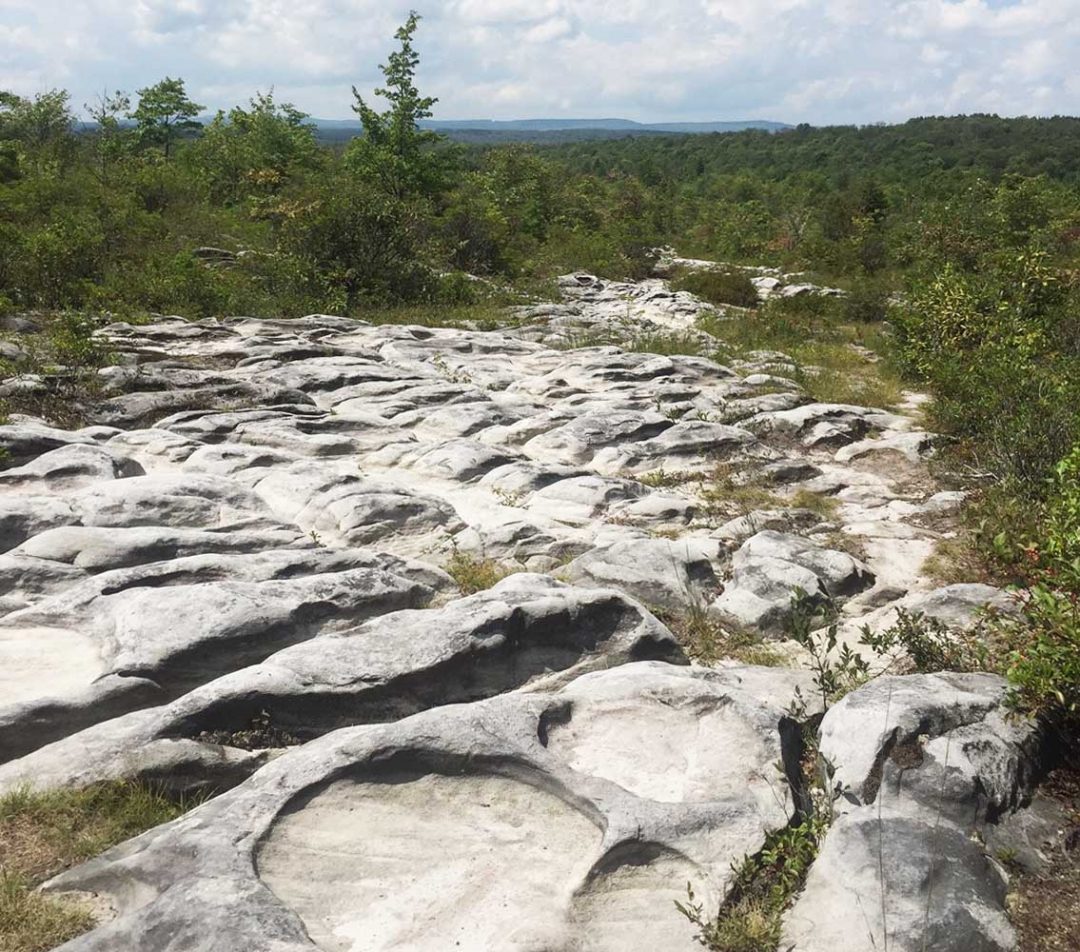
Not easy these WV rock pots. But that's why correspondent Pat McCloskey and his senior cyclist pals took them on. Credit: Pat McCloskey

Not easy these WV rock pots. That’s why correspondent Pat McCloskey and his senior cyclist pals took them on.
Credit: Pat McCloskey

What in the world is an ex-World Cup mountain bike racer doing leading a bunch of old guys around the rock strewn trails of West Virginia?  Well, that is exactly what happened when Sue Haywood graciously agreed to lead our group of aging warriors around some of the most challenging trails you can ever ride.

Davis, WV, is a sleepy little town in the Monongahela National Forest which has been host to the grueling 24 Hours of Canaan back in the days of all-day and all-night team mountain bike racing.  It is also a beautiful destination area for other reasons beyond challenging mountain biking.  There is world class fly fishing in the area as well as the famous Blackwater Falls.  Hiking is superb, and there are a lot of quaint little shops and cafes that have sprung up in Davis and nearby Thomas, West Virginia.

Here's correspondent Pat McCloskey with cycling pro Sue Hayward. Credit: Pat McLoskey

Here’s correspondent Pat McCloskey with cycling pro Sue Haywood.
Credit: Pat McLoskey

But back to the mountain biking.  The trails here are challenging and to have a guide like Sue with her background lead us was a real treat. She was NORBA (National Off Road Bicycling Association) Short Track Champion in mountain bike racing and has many NORBA wins to her credit as well as 24 Hour Solo records and wins in China, Costa Rica, and all over the U.S.  She makes her business in Davis, WV, and if you ever want to take part in her many clinics and workshops, look up information on her website. 

To compliment your visit to Davis, check out Blackwater Bicycles for any assistance that you may need. Rob Stull, the owner is a friendly and very helpful guy who will rent mountain bike equipment and also has all the clothing, bikes and accessories that you may need to take on the Moon Rocks and other challenging trails in the region.  The pizza at Sirianni’s Café is a “must stop” location along with Hellbender’s Burritos.  Lots of nice places to bunk down for the night or weekend including the Bright Morning Inn with its charming rooms and delicious and sumptuous breakfasts.

After several long rides on the world famous trails, we took in the Brew Skies Festival  which hosts really talented local and nationally famous bands with a country rock flavor.  Coupling a mountain bike weekend with the Brew Skies Festival is a great way to spend some time in the Canaan Valley.

As followers of www.seniorsskiing.com it is worthy to note that the Canaan Valley is also well known for Nordic skiing, and a visit to the White Grass Touring Center is a must for any visits to this area in the winter.  The Whitegrass Café which is associated with the touring center also has wonderful cuisine which is comprised of healthy choices of local meats, fish and vegetables and fruit.  Get their cookbook when you visit.  Very user friendly and great recipes.

 The Canaan Valley, the Monongahela National Forest and Davis, WV, should be on any outdoor enthusiast’s bucket list.  If you come to ride the world famous trails, bring your “A” game.  In skier lingo, the trails here are black diamond plus, but you will never forget the experience and the beauty of the area.

Editor’s Note:  This is the last Cycling Series article for the non-snow season. We publish these because our surveys tell us cycling is a popular off-season sport for our readers.  If anyone has places and experiences that are noteworthy, please let us know. Thanks to all who contributed this year.

Senior cyclists made the trip to the rock-strewn trails of West Virginia and found "Black Diamond" biking. Credit: Pat McCloskey

Senior cyclists made the trip to the rock-strewn trails of West Virginia and found “Black Diamond” biking.
Credit: Pat McCloskey

Cycling Series: The Laguna Wilderness

Miles Of Mountain Trails On The OC Coast.

Ride down to the ocean after you ride up from the beach. Credit: Pat McCloskey

Ride down to the ocean after you ride up from the beach.
Credit: Pat McCloskey

My wife Janet was a flight attendant for US Air for many years, and she always referred to some crew members as “slam clickers.”  They go to their hotel, slam the door and click the lock and don’t go out to visit any of the local sights. Too bad, especially since there is so much to see in this country; especially when you have an opportunity to get out there on company business.  Every time I travel out West, I am taking my skis or my mountain bike and getting some enjoyment while I am there for business.  I am not a slam clicker by any stretch of the imagination, even now in my “senior” years.

And, oh, there are mountain lions. Keep your eyes open. Credit: Pat McCloskey

And, oh, there are mountain lions. Keep your eyes open.
Credit: Pat McCloskey

One of my favorite places to go is Laguna Beach, California.  Not many people realize that Laguna is a fantastic place to ride a mountain bike up in the Laguna Wilderness trails above the town.  There are several options, but the easiest access is via Crystal Cove State Park right on the Pacific Coast Highway.  Parking there is spacious and for $13—basically a donation to the upkeep of the park—you can have access to wonderful trails with extensive and breathtaking views of the Pacific Ocean.  Be prepared for climbing right out of the gate because the coastal mountains rise sharply from sea level.  But once you are at the top, there are many options for trails that traverse the Laguna Wilderness and also downhill back to the State Park or Laguna Beach proper.  A couple of things to note: if there has been significant rain, the State Park system will shut down the trails because of the fragile ecosystem.  Once you ride there, you will see why—the sandy soil which is subject to major erosion.

If you need assistance with bike rental or accessories, trail maps, etc. there is one stop you must make The Laguna Beach Cyclery on Thalia Street. This shop is not only a high-end bike shop with every bit of eye candy you could ever imagine in road and mountain bikes, but the shop owner and personnel are knowledgeable and willing to help with all requests.  You can access the trails from their shop by climbing Thalia Street to Temple Hills Drive and on to Park Avenue to the “Top of the World” entrance to the park system.  Because the Laguna Wilderness is so extensive, there are many options for riding that are available and easily viewed on the park map available at the State Park office or at the bike shop.  One good thing for senior riders is that there are many bail out points to return to town via neighborhood roads.

Once your ride is over, do not miss the Stand Natural Food restaurant right next to the bike shop. This place is amazing with fresh guacamole, fresh vegan sandwiches and homemade breads, with huge smoothies and other natural delights.  A great way to refuel after a beautiful ride on the California coast.

Trail Access: Pacific Coast Highway entrance to Crystal Cove State Park.   Camping available via www.ocparks.com or many bed and breakfast options in Laguna Beach.

Rentals and Service: Check Laguna Beach Cyclery and ask for Christian who will set you up with whatever you need.  The Laguna Wilderness Map is a must purchase or www.mtbproject.com

Apres-CycleStand Natural Food and many other boutique restaurants and bars all along the PCH running through the middle of Laguna Beach.

Here's the trail head and entrance into the Laguna Wilderness.

Here’s the trail head and entrance into the Laguna Wilderness.

Editor Note: As of July, 2016, the Laguna Wilderness is closed for fire recovery.  Check before you go.

This Week In SeniorsSkiing.com (July 8)

Murder Mystery, Departure Of A Legend, Cycling With A Legend, Kayaking The Legendary Maine Island Trail.

Svenwiik

Sven Wiik, cross-country pioneer, passed away this week at 95.

Hope you had a pleasant and safe Independence Day in the US, and a “nice” Canada Day, too.  This short week has us exploring some summer themes and remembering a departed skiing hero.

First, we’ve just discovered an old-fashioned murder mystery by Wendy Clinch, our friend The Ski Diva.  Double Black is all about murder in ski country, quirky characters and page-turning cliff-hangers.  What more could you ask for in summer reading?

We also pay respects to Sven Wiik, a legendary cross-country skiing pioneer who as one of the early promoters of the sport in North America.  He passed away this week in Steamboat Springs, CO, where his Scandinavian Lodge was a long-time presence on the mountain.  He was 95.

Tamsin Venn, the publisher of The Atlantic Coast Kayaker, offers a snapshot of the Maine Island Trail, a pathway through the off-shore and coastal islands that threads its way from Casco Bay to Eastport.  If you have any interest at all in kayaking, it is worth checking out.

The coast of Maine has hundreds of beautiful islands that can be visited by kayak. MITA can tell you where and how to do it. Credit: Tamsin Venn

The coast of Maine has hundreds of beautiful islands that can be visited by kayak. MITA can tell you where and how to do it.
Credit: Tamsin Venn

Finally, our Cycling Series continues with report from Pat McCloskey about riding with Scot Nicol, the founder of Ibis bikes and an early mountain bike pioneer.  We know many of our readers spend time on bikes over the summer.  Pat has been wonderful about pointing out some interesting rides around the country.  Stay tuned for more.

Promotive Discounts Are Still Available

Our recent poll (in the right side bar, scroll down if you can’t see it) asks about our Promotive discount.  We are surprised to see that only about 25 percent of our readers have taken advantage of this free discount opportunity.  When you subscribed to Seniorsskiing.com, you should have received some information about signing up.  You get access to big discounts from top-brands, gear and clothing.  Probably the easiest way to get Promotive instructions is to, gulp, unsubscribe and then sign up again. You will get information about registering on Promotive with your confirmation email. It’s free, folks.  Try that and see what happens.

Thanks so much for your continued interest in SeniorsSkiing.com.  Remember, there are more of us every day, and we aren’t going away.


Cycling Series: Riding With A Mountain Biking Legend

Scot Nicol, A Founder Of Mountain Biking, Is A Heck Of A Rider In His 60s.

Scot Nicols keeps "just keeps riding", a great lesson for seniors. Credit: Pat McCloskey

Scot Nicol “just keeps riding”, a great lesson for seniors.
Credit: Pat McCloskey

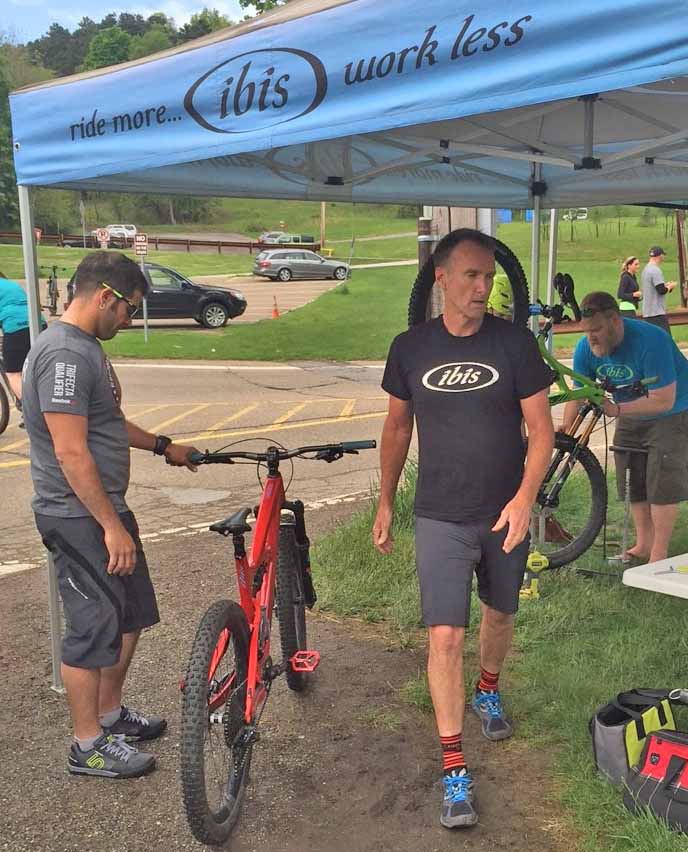
Dirt Fest is an annual event that is presented by Dirt Rag Magazine and always takes place in May at Raystown Lake, Pa. The nationally known Alligrippis Trails are there, and it is an opportunity for 5,000-plus people to attend, ride the trails, and intermingle with industry types who set up shop with demo equipment.  One of the exhibitors is Ibis Bicycles of Santa Cruz, California headed up by their founder Scot Nicol.  Scot is an icon in the world of mountain biking and at 61 years old, one heck of a good rider.  One of the stops on their way from Santa Cruz is always in Pittsburgh, Pa to North Park which is a county park north of the city that has 42 miles of very enjoyable trails.  An added attraction is the OTB Café which is situated in the boat house on North Park Lake.  A great meeting place with great food and fellowship with the active set.  The scene was set for an enjoyable stop and demo on the way to Dirt Fest by the Ibis crew.

Fast forward to the ride. It was quite a vision to see the trails filled with about 30 riders on Ibis Ripleys, MojoHD3, and other new versions of dual suspension and hard tail design.  The local trails did not disappoint, and the riders eventually split into separate groups but riding with Scot was a priority for me since we were both senior riders of the same age.  Interestingly, we were the elder statesmen of the ride by a good 20-plus years, but, as an industry icon and a guy who takes his fitness seriously, Scot has the ability to ride a great line on trails with which he is not familiar.  The younger set were amazed as Scot and his California crew rode at the front of the group. As we descended the final trail, I was at my limit with a fast and furious pace driven by a guy who is a very talented senior rider.

Now most people our age would consider flying over the rocks and the roots of Eastern single-track impossible.  Many of them would even scoff at why we would even be interested in “punishing” ourselves rather than kicking back and enjoying our older years.  When I discussed this on the road back with Scot, he looked at me with that California cool and said, “Just keep riding and don’t even think about it.”  Validation for me for what I think is a healthy lifestyle that I would like to continue for a long time.

Every year you have benchmarks where you can compare and test yourself.  Skiing the chutes and the black and double black diamonds are always a benchmark test for me and other  senior skiers.  Riding with Scot Nicol and the younger set of our mountain bike group is always another benchmark test.  “Just keep riding.”  So true for all of us in so many ways.

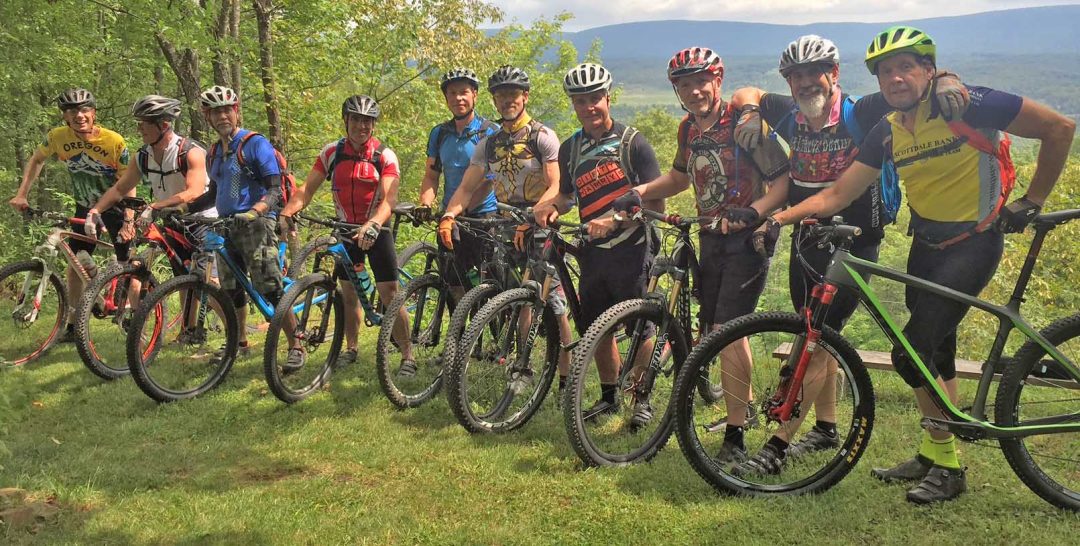
Dirt Fest Riders on the Alligrippis Trails in Raystown Lake, PA. Dirt Fest is an annual event sponsored by Dirt Rag magazine. Credit: Pat McCloskey

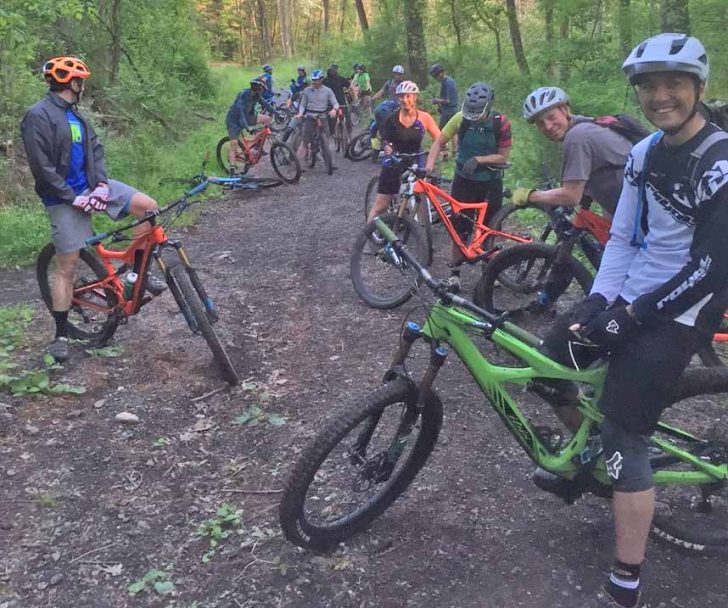
Bike Riders in North Park, PA, a warren of 42 miles of trails just north of Pittsburgh. 
Credit: Pat McCloskey

Cycling Series: Join A Charity Ride This Summer

Cycling With A Champion On A Charity Ride: Priceless.

SeniorsSkiing.com correspondent Pat McCloskey with cycling great Greg LeMond. Credit: Pat McCloskey

SeniorsSkiing.com correspondent Pat McCloskey with cycling great Greg LeMond.
Credit: Pat McCloskey

One of the more enjoyable events in cycling are those which support a charitable cause.  Throughout the country there are road rides where participants receive donations per mile or flat donations to support different organizations.  These are usually marked with support from the local motorcycle club escorts, food vendors and volunteers at the rest stops, and colleges or other venues that provide camping or room facilities with showers and dining hall options.  Sometimes these are one-day rides of 25- to 50-miles.  Others are multi-day events culminating with a large sponsored finish line party.   The events are well organized and many of the event organizers are well known non-profits like the Juvenile Diabetes Research Foundation , the Leukemia and Lymphoma Society , and the National Multiple Sclerosis Society .  All of these organizations have local and national events.  America’s Most Beautiful Bike Ride around Lake Tahoe is a MS sponsored event and I had the privilege of riding in that one a few years back, and it definitely deserves the moniker.  Gorgeous views of the lake and the surrounding mountains.

One of the more interesting rides that I have participated in recently was an event put on by an organization called 1in6.  This organization provides support to men who were abused as children.  The honorary chair person for the ride was none other than our three-time Tour De France Champion Greg LeMond.  The event is called the Catoctin Challenge held annually in Maryland.  The compelling thing about riding with a Tour de France Champion like LeMond is how affable and easily approachable he is.  Surrounded by people all the time, LeMond tirelessly signed autographs late into the evening and was willing to answer any question that anybody had at the event.  With his wife Kathy at his side, he is surely the poster child of any charitable bicycle ride and I was fortunate enough to be with him for two years running.

The amazing thing to me was the fact that most people on the ride preferred to ride by themselves or ride with their friends.  There were only 6 of us who rode both days of the weekend with LeMond including our host Scott Weiner of MHW Corporation.  Being a former road racer, I was kind of in awe about this opportunity because I have been a big fan of LeMond for decades.  He is a little slower now, thankfully, which allowed me to ask him many questions.  What was Sean Kelly like?  How did you get on with Fignon?  How about the psychological battles with Hinault?  I peppered the guy and he was gracious in all of his responses including some of the issues with the recently defrocked seven time TDF Champion.  In all, it was a true pleasure to ride with him in two events in recent years and I can’t say enough about the guy with his entrepreneurial spirit ( He developed the aero bar, Giro Helmets, and many other cycling accessories along with his own bicycle brand.)  Truly a gracious champion and all around good guy.  Great sense of humor, too, in that one guy in our group kept trying to hammer him, and LeMond got ahead of us and hid in the bushes until the guy rode by.  We all laughed at our buddy trying to kill himself looking for LeMond in the distance.

If you ever get the chance to participate in a charity bicycle event, do it.  As the saying goes ”a great cause and riding the miles for smiles.”

Tour de France winner Greg LeMond snapping pics on charity ride with Pat McCloskey.

Tour de France winner Greg LeMond snapping pics on charity ride with Pat McCloskey.

Cycling Series: Finding And Riding The Lost Coast Trail

Senior Skiers Shift To Mountain Bikes To Ride Coast Of California.

Cycling By The Sea, the Lost Coast Trail has spectacular scenery. Credit: Pat McCloskey

Cycling By The Sea, the Lost Coast Trail has spectacular scenery.
Credit: Pat McCloskey

So, my ski buddy Eric says to me, “Patrick, let’s ride the Lost Coast of California”.  The next thing I know I am winging westward to Sacramento with my mountain bike packed securely in my bike box and looking forward to a week of “van camping” with my good friend from Tahoe.  Now when I say van, the vehicle is really a Sportsmobile—a van conversion that is an amazing off road vehicle equipped with everything including a pop up compartment on the roof which was my room for the week. We have used this vehicle for skiing, but it also serves to house two old guys wandering around the Lost Coast which is about 160 miles north of San Francisco.

Fast forward: We have our RV spot right on the ocean in Fort Bragg, CA., and are ready to ride 150 miles of single and double track which is easily accessed from the camp site.  Most of the trails are in the Jackson Demonstration State Forest, Woodlands State Park, and Big River State Park.  We were amazed at the variety of trails which are loamy and smooth and give you a great appreciation for Redwood trees which are ever present and ancient.  You can even ride through an old Redwood which is called “The Drive Through Tree,” a fun diversion from the standard mountain bike trail.

SeniorsSkiing.com correspondent Pat McCloskey switched a mountain bike for his skis and headed out up the Lost Coast Trail. Credit: Pat McCloskey

SeniorsSkiing.com correspondent Pat McCloskey switched a mountain bike for his skis and headed out up the Lost Coast Trail.
Credit: Pat McCloskey

The amazing thing about riding in this area is the lack of riders and general feeling of remoteness.  The only riders we encountered were the original designers of the trail and are the current trail stewards.  They are all in the late 60s and 70s—amazing senior mountain bike riders.  Jack Columbe, a 74-year-old ex fireman and World Senior Games champion and Roo Harris have mapped out, carved out, and maintained this 150 mile network of trails that stretch from Mendocino to Ft. Bragg.  At 48,652 acres, Jackson State Demonstration Forest is one of California’s crown jewels and is maintained by CalFire (California Department of Forestry and Fire Protection).  In speaking with Pam Linstedt, a 24-year veteran of CalFire, we learned that although tourism is replacing some of jobs lost after the 2002 closing of the GP lumber mill in Ft. Bragg, research and logging are still first and foremost priority in the California forests.  With the efforts of the senior cycling community under the guidance of Jack and Roo, mountain biking is becoming an attraction which they hope will once again put Ft. Bragg and Mendocino on the map for riders all over the world.

The amazing advantage of riding in this area is that you have access to the coastal mountains but you can camp or stay right on the ocean in Ft. Bragg or Mendocino.  Lots of available bed and breakfast options as well as an abundance of RV parks which seems to be the preferred way for Californians to see the coast inexpensively.

As we made our way northward, we rode a trail called Paradise Royale near the Lost Cove area in Humboldt County.  The trail is filled with berms and features and one wonders who maintains this nationally known trail literally in the middle of nowhere.  After finishing our time in Lost Cove, we drove our way through the Redwood National Forest which was truly a visual cornucopia of thousand year old gigantic trees.  Camping out under those behemoths really make you understand that you are only passing through life in a very short time period.  These giants have been around for over a thousand years and still flourish today under the California sunshine and coastal mists.

Lot to Trails

From any campsite or Bed and Breakfast on the coast, the access is available by bike in only a matter of a few miles. We rode to the McDonald’s for breakfast in Ft. Bragg and were on the trails in less than 15 minutes.

Terrain

None of the trails in this area are overly technical.  I would rate them intermediate with the exception of the Paradise Royale trail which had a killer of a climb stretching over 4 miles of vertical ascent.

For More Information

Fort Bragg Cyclery (707-964-3509) can provide rentals and accessories like complete maps to the area.  Most of the rides are currently on MTBProject.com

Also, Mendocino Bike Sprite can provide tours at a nominal fee.  707-962-4602.  Ask for Amy.

Not too often can a couple of 62 year olds van camp and ride trails as pristine as these, and the only guys we ran into were older than us.  Senior riders rule!

Remote and beautiful, the Lost Coast Trail had few other cyclists. Credit: Pat McCloskey

Remote and beautiful, the Lost Coast Trail had few other cyclists.
Credit: Pat McCloskey