Tag Archive for: x-c skiing

Yellowstone’s Winter Magic

SOURCE: YELLOWSTONE EXPEDITIONS

In 1991, while guiding a small group in Yellowstone National Park, I tried to describe walking outside as the sun rose one February morning near Old Faithful:

Morning light pours over the hills, reflecting off the frost in a blinding cloud of diamonds. Elk and bison shake snow off their backs, stirring after a long night’s chill. Duck and geese stretch and preen. Billows of geyser steam hover and settle, creating dense, lacy patterns on bowed pine branches. Yellowstone tastes of winter magic.”

Summer and Winter

To me, Yellowstone isn’t a great treat in summer. Yes, the combination of animal and geothermal activity is unique – but this year there were close to three million visitors, June to August. That’s too many vehicles and frowning faces jammed along narrow roads.

Winter is totally different. First, there’s almost no traffic (no bears either, although they may peep out of their dens in January). The only road that’s kept plowed runs east from Mammoth in the northwest to Cooke City, where it dead ends. All other roads are snow-covered and accessible by snowmobile, snowcoach (enclosed and heated tracked vehicles), or on skis or snowshoes.

Yellowstone’s winter is created for superlatives. No other place in the world has such an inspiring combination of wildlife and wild geology. It’s rich in history; has spectacular mountain scenery; and the park’s 2.2 million acres are yours without crowds or pollution.

Getting There

Yellowstone is located in the northwest corner of Wyoming, with little extensions north into Montana and west into Idaho.

To enter the park, you can travel north from Jackson Hole; west from Cody, Wyoming; or east from West Yellowstone, Montana. My favorite (fourth) route is east from Bozeman to Livingston; south through the Paradise Valley; pass through the sleepy town of Gardiner; and drive up to Mammoth Hot Springs, where you can overnight at the venerable Mammoth Hot Springs Hotel, with elk grazing outside the ground floor windows.

Using Mammoth as a base, you can drive toward Cooke City, with a lot of photos stops for wildlife in the Lamar Valley, and then backtrack.

Heading South

From Mammoth you can get to Old Faithful by snowcoach or snowmobile, sight-seeing, skiing, and snowshoeing along the way. Norris Geyser Basin and the jaw-dropping Canyon of the Yellowstone River, with ice-laden and thunderous falls, are natural stops.

The center of the park is a volcanic crater, 40 miles across, with the world’s greatest concentration of geothermal features: geysers and fumaroles, mud pots and hot pools. One of my favorite Yellowstone memories is a morning ski on a snow-covered wooden boardwalk, watching a bison standing above a steam vent, basking in the warm air billowing around his belly.

Snowpack around Mammoth can be thin, but Old Faithful has reliable conditions and all kinds of good trails. You’re guaranteed to see lots of elk and bison, maybe coyotes, possibly wolves.
SOURCE: YELLOWSTONE NATIONAL PARK LODGES

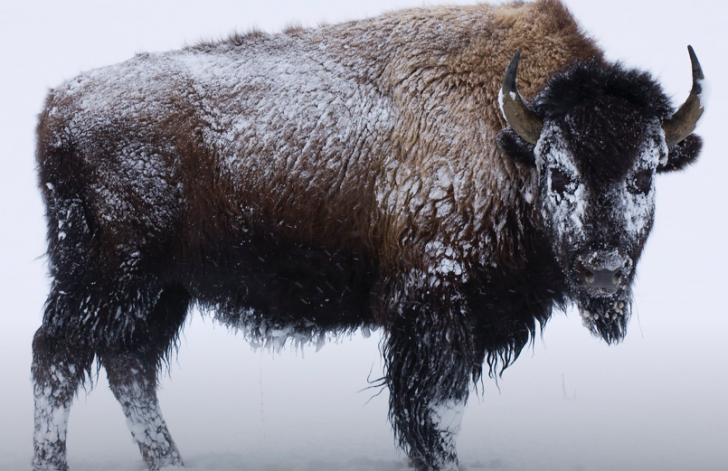
In winter, bison are relatively indifferent to humans, since they’re intent on scarce forage and surviving sometimes bitter cold, but it’s not something to count on. I’ve skied within feet of a bison, on a narrow trail with a cliff to one side and sheer drop on the other. We came around a corner and there they were. We carefully didn’t make eye contact with the cows and calves that plodded toward us, and I could hear muttered prayers from the other skiers (my teeth were chattering too hard to enunciate).

Of all the times I’ve visited Old Faithful, the most indelible and endearing memory isn’t a glorious streamside tour, two feet of light fresh snow, or being mock-charged by a bull elk. It’s the smiles on three kids’ faces as one cold morning they dropped tablets of food coloring in glasses of hot water, ran outside the Snow Lodge, and threw them in the air! It was a cold morning, and the droplets turned into rainbows of frozen mist – blue, red, green – that slowly drifted in the breeze and disappeared. So a half-dozen of us adults did the same thing.

Now, that’s magic.

Resources

The Mammoth Hotel and the Old Faithful Snow Lodge provide Yellowstone’s only winter accommodations and dining other than yurt village/guide service Yellowstone Expeditions (https://yellowstoneexpeditions.com/). They typically open for the season mid-December 20th through early March.

You can book accommodations by contacting Yellowstone National Park Lodges (https://www.yellowstonenationalparklodges.com/). For a snowcoach tour, I’d recommend Yellowstone Alpen Guides in West Yellowstone (https://seeyellowstone.com/), especially if you want skiing or snowshoeing.


Lessons From Folk Tale: X-C Ski Adventure

[Editor Note: As the new year begins, SeniorsSkiing.com is again asking our readers to contribute to support our online magazine. Yes, we have grown in the number of subscribers and advertisers. But our expenses have also grown. You can help us defray some of these expenses by helping us out with a donation.  This year, we have a mix of premiums for different level of donations, including stickers, sew-on patches, our new SeniorsSkiing.com ball cap. All donors will be entered into a drawing for a pair of bamboo Polar Poles to be drawn in late March.  You can donate by clicking here.]

Finnish Folk Tale Ingenuity Saves The Day.

Many years ago my wife and I had a small weekend cottage in southeastern Vermont. One Saturday I stopped by the West Brattleboro Library and checked out a book of Finnish folk tales by General Kurt M. Wallenius.

The tale I liked best told of two young fishermen who skied north for a few days ice fishing in winter. They separated one day, agreeing to meet up early evening at camp. One of the fellows snagged a good haul of fish, put them in a sack, and headed back to base. As he was skiing along, he realized he was being stalked by a wolf. He skied faster, but the wolf was closing on him. So, he skied up a small incline, turned abruptly, and skied at the wolf. The wolf leaped to attack him. At the same time, the fisherman leaped, pointing his skis at the oncoming beast. He stabbed it with both skis, killing it but breaking his equipment. So, he sat down, built a fire out of the broken skis, and waited. Sure enough, an hour or so later, his companion saw the firelight and found him. They knew exactly what to do. The fisherman with two good skis gave one to his friend, and they skied back to camp that way, pushing with one leg, skiing on the other. And they brought back all the fish and the wolf’s skin as well.

Not long after I read this story my wife and I were out cross country skiing on a primitive trail. We went fairly far from our cottage when the wet snow started to adhere to the base  of her waxless skis, impeding her progress. I had old-fashioned wax skis and was not having a problem. It started to get late and my wife, making very slow progress, got spooked. She told me to go on without her. She told me that if she did not get back, I had to remember to buy our two boys new shoes every six months, since they were growing quickly.

Remembering General Wallenius’ story, I traded one of my wax skis for one of her useless, waxless skis. Fortunately, we used the same bindings back then. The trick worked. We pushed with the waxless ski, glided on the wax ski, and got back home safely. For many years afterward I made sure we had the same bindings.


This Is What You Told Us You Want

A few months ago, we reported on the key finding from our Spring reader survey:


  • Grandparents are a significant influence getting grandkids into the sport. Once the kids have been introduced, almost 95% stay with it.

Another significant finding is that 56% of respondents reported they spent between $1000 and $5000 per person last season on skiing, boarding, and related activities. More than 10% spent $5000 or more, per person.

The survey also produced robust responses to the open-ended question about how we’re doing and how we could improve. The congratulatory messages gave us a nice feeling. The critical ones focused primarily on technical issues. The majority expressed what you, our readers, want to see covered in SeniorsSkiing.com. Those suggestions fall into six categories, which, when you think about it, reflect the general interests of older snow sports enthusiasts.

Here they are:

Travel/Resort Reviews/Ski Clubs

Readers want to know more about ski resorts outside of where they live, as well as in Canada and Europe. Many of you inquired about organized ski trips. In response, we’ll be increasing our coverage of ski clubs, and I’ll report on a variety of unusual ski programs from the Italian Alps.

Discounts and Free Skiing

These are important reader interests. This season, we’re expanding our list of resorts where seniors ski free (or virtually free) to include Canada.

Finding Other Older Skiers

So many of you want to meet up with your skiing contemporaries. The ski club system is a great way to accomplish that. Many clubs don’t require local membership to participate in their trips. For more information on ski clubs: http://skifederation.org. And the 70+ Ski Club has many regional and international offerings. When traveling in the US, look for a local chapter of the Over-The-Hill-Gang. They give free mountain tours for older skiers.

Health/Conditioning/Recovery

Readers facing joint replacement or recovering from other health issues want more guidance from those who already have been through the experience. How to prepare, how to recover, how to stay fit for the coming season. We have a good selection of those articles and welcome more. If interested, click “HEALTH” on the home page menu bar and start exploring.

Equipment and Technique

Readers want information about ski school programs with special senior offerings. We’ll report on them as we learn about them. Please let us know of your favorites. In terms of equipment, we work closely with realskiers.com to present the best ski selections for seniors and with America’s Best Bootfitters for the best boot choices.

General Editorial

Your suggestions include more articles profiling interesting older skiers. More on snow predictions and snow science. More on X-C (cross-country veteran, Roger Lohr, was recently named X-C and Snowshoe Editor). More on backcountry, snow biking, and Ebikes. Adapting to our age. Identifying good retirement places for older skiers.

Your input gives us direction and lifts us in moments of doubt. We’ll continue to do our best to inform you, to create a community of older skiers/boarders, and to heighten awareness of the importance of the older population to the sport.


Cross-Country: Tracks vs Touring

Groomed XC Trails Are Becoming More Prevalent; Does That Ruin The Aesthetics Of The Sport?

The “natural” experience, just like it was meant to be…Or…

For the past 50 years or so, there’s been a generally amicable debate whether cross-country skiing on machine-groomed trails is preferable to making your own way over the fields and through the woods. The argument has a lot of angles, including “Free vs. Fee” and “Pristine, Silent, and Serene vs. Speedy, Social, Service-based, and Secure”.

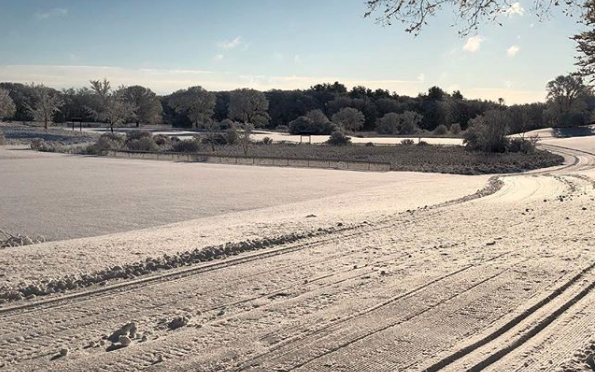
…Groomed trails at Appleton Farms, Ipswich, MA, easier and less tiring.
Credit: NS Nordic Assn

Clearly, you don’t have to choose one over the other – they’re both delights (and the world’s best exercise), in somewhat different ways. The thing is, as my increasingly complaining bones and joints frequently announce, groomed trails for classic and skate techniques have more and more going for them.

One huge differentiator is that if you want to take up the sport, you’ll be smart to start with one or two lessons from a professional instructor at a cross-country ski area, learning and practicing efficient movement. Undesirable options are learning by yourself off-track (I know someone who tried to do that while consulting a printed manual – results weren’t pretty) or getting often-incoherent suggestions from a friend while floundering in unpacked snow (‘nuff said).

Whether you’re a long-time practitioner or a newcomer, groomed trails make things easier, faster. For classic style, you’re riding on a consistent, packed surface, with your skis guided forward in compressed tracks. (It takes some effort to get lost that way too; whereas I’ve been known to ski in circles in fresh snow, totally convinced I was moving in linear fashion.) Gotta love it, especially if you have balance or vision issues, as I do.

Almost as important, your pole tips are digging into packed snow and no further; while breaking your own trail, the entire basket may sink, throwing off your balance and helping you to get up close and personal to the snowpack. And as many of us have discovered, getting up in deep snow is challenging.

Skate skiers need a packed surface even more than diagonal striders. Two or three inches of fresh snow even on a groomed trail are enough to grab an edge. It’s nearly impossible to skate in ungroomed snow except for spring crust-cruising (not the same as skiing on ice – you can set your edges), which is a joy – crust lets you go almost anywhere, speedily zipping along. Euphoria!

One of the delights of cross-country is that you can evolve from a groomed trail skier to a tourer, if you wish. You’ve developed good classic technique in the tracks; you know how to make your legs do the work and your arms help out – now you can apply those skills in a quieter setting, with shorter strides but still good balance.

Cross-country areas have services – anything from plowed parking to lodges with food and drink, heated bathrooms (also heaven on a brisk day!), rental, retail, even overnight accommodations. Also, groomed trails may have signs, maps, possibly ski patrol, probably snowshoeing – and if you’re wild for something different, increasingly there’s fat biking available.

If you’re taken by the charms of overnight tours, there may be Forest Service cabins in your area (bring your own food, clothing, sleeping bag…). (Editor Note: See Steve Hines’ article on skiing to the AMC Little Lyford Pond Camp in Maine.) And finally, for true adventure, there’s snow camping (bring your own stove, too). Touring with a pack in fresh snow is truly character-building (been there, done that, I happily leave it to today’s kids).


Senior Skiers: Take Care in the Sun!

Advice From a Dermatologist Nordic Skier.

The sun is by far and away the most common cause of both (1) skin cancer and (2) skin aging.

More than two million cases of skin cancer are diagnosed annually in the USA. Caught early, most skin cancers can be removed, leaving a cosmetically acceptable scar. In more advanced cases, valued anatomic parts such as noses and ears can be partially or completely lost. Unfortunately, ten thousand deaths occur yearly in the US from skin cancers.

Many Nordic skiers, blithely dedicate ourselves to going outside as much as we can whether skiing in the winter or running, biking, and hiking during snowless times. My recommendations to preserve skin health while frolicking out of doors:

  • Exercise early in the morning (before 10) or later in the after- noon (after 4) when the sun is less damaging.
  • Wear clothing that covers or shades the skin (e.g., a broad- brimmed hat is better than a visor).
  • Apply a “broad-spectrum” (protects against UV-A and UV-B) reasonably thickly with an SPF of at least 30. If downhill skiing or hiking all day, consider re-applying at lunch
  • Consult a dermatologist periodically, especially if you’re over 50, have a non-healing sore/bump, or have a changing or new brown or black spot.