Snow In Literature: Interlude

By Linda Pastan

Credit: MD Maginn

We are waiting for snow
the way we might wait for a train
to arrive with its cold cargo—
it is late already, but surely
it will come.
We are waiting for snow
the way we might wait
for permission
to breathe again.

For only the snow
will release us, only the snow
will be a letting go, a blind falling
towards the body of earth
and towards each other.

And while we wait at this window
whose sheer transparency
is clouded already
with our mutual breath,

it is as if our whole lives depended
on the freezing color
of the sky, on the white
soon to be fractured

Excerpted from Queen of a Rainy Country by Linda Pastan. Copyright © by Linda Pastan. Used with permission of the publisher, W. W. Norton & Company, Inc. All rights reserved. Buy Now.


Ski World Art

Don Burch Produces A Stunning Portfolio Of Images From Snow Country.

Many of these images are really beautiful,  frame-worthy.  Thanks Don for this. Please let him know what your reaction is in Leave A Reply below.

Growing Up Norwegian-American on Skis

A classic ski poster shows a blonde baby in a quaint wooden cradle, one outstretched hand holding ski poles, with a pair of skis protruding from the other side. The caption is “Norway. The Cradle of  Ski-ing.” This poster reminds me of my roots.

Jan Brunvand, age 3

I was on skis from before I can remember. An undated snapshot in the family album proves this. I appear to be about three years old.

I suspect that my parents posed me on adult skis, as those boards are super long, even for the late ‘30s. ( I was born in 1933.) My mother surely knit that hat, while those fancy mittens were from Norway. I’m holding one long ski pole, but I don’t seem to be going anywhere.

In a second childhood photo I’m posing with my brother Tor in what could be about my seventh year. Tor was born in 1935, and we had matching ski jackets. The snow sticking to my pants hints that I must have fallen on the run before the shutter clicked.

Jan and brother, Tor

My parents came from Kristiansand, Norway. They were married in 1929 in Windsor, Canada, then moved to Northern Michigan. I was born in Cadillac. By the time Tor arrived we had moved to Lansing.

I have one slightly damaged photo of my dad on a ski trip in the old country, captioned “Easter 1925.” He’s on the right with his hand on the railing. Check out those vintage skis!

Jan’s father

As Tor and I grew up Dad would take us to parks or golf courses to climb up and slide down on skis. Before we gained some proficiency with “snow plow” and “stem” turns he would hold his poles out horizontally for us to cling to for balance as we schussed the gentle slopes. 

We climbed either by traversing and kick-turning, or using the herringbone method. When our skis got sticky, we rubbed on a mix of graphite and paraffin.

In 1948 realtor Rollie Stebbins convened a group of skiers to form the Lansing Ski Club with my dad as a charter member. A portable rope tow in Stebbins’ backyard was my first experience with motorized uphill ski travel. After the club bought rural property and installed a real rope tow we enjoyed many days there working on our turns. We also made occasional trips north to ski Caberfae near Cadillac.

In photos of me in those days I am usually wearing  a dark blue or red V-neck ski-jumper’s sweater sent to me by my maternal grandfather in Norway.

My Dad carved a graceful Telemark turn, and Tor soon got the hang of it. I never mastered Telemarking, but instead worked on my stem-Christies and eventually achieved a more-or-less full Christiania turn. It was gratifying to learn that both these turns were named from places in Norway. Never mind that the Christie was part of the Austrian-inspired Arlberg system.

Starting college at in 1951 I joined the Michigan State Ski Club and entered a new world of skiing with friends who had actually taken lessons and learned from pros. This led to further trips to Caberfae, and eventually to skiing in the Rockies..

At college I met my non-Norwegian non-skiing future wife and converted her to the sport after a disastrous first experience.

To be continued . . .  

Finally! A Ski Boot For Older Feet

I recently had an online boot-fitting session with Dahu, the remarkable Swiss ski boot that advertises with SeniorsSkiing.com.

Before sending a pair of loaners, the company asked for my street shoe size. I could have used their App to determine foot volume but didn’t go through that short step. As it turned out, the boots they sent were the correct size.

Why is this Swiss-designed ski boot remarkable? This is not the same-old prettified with a new buckle or a different color. Dahu was conceived and developed to be fitted more easily, minimize ski boot discomfort, and maximize skier performance.

Although I have not yet skied Dahu, I am convinced it is the ideal boot for older skiers.

Here’s why: The boot has a comfortable, insulated leather inner boot with a patented grooved rubber sole that interfaces strategically with grooves in the shell. This interlocking interface enhances the boot’s torsional stiffness, thus maximizing energy transfer from skier to ski. 

Worn separately from the shell, the inner boot delivers traction in all conditions. Good looking, too.

Dahu’s shell is made of Grilamid polyamide composite, a Swiss product combining lightness and durability and consistent flex at all temperatures.

The shell features a hinged tongue with two micro-adjustable buckles and a hinged, releasable rear, incorporating the patented aluminum Powerbeam spine. Similar to the inner boot that interfaces with the shell, the Powerbeam helps transfer body energy to the ski. It also contributes to each skier’s ideal stance. 

Like another Swiss product – Swiss cheese – the shell is filled with holes. This feature eliminates the vexing hotspots on most skiers’ feet. Those of you who’ve engaged skilled boot fitters to reshape conventional boots using hair dryers and other tools will know what I’m talking about. By analyzing the common hot spots on most skiers’ feet and removing those sections of shell, Dahu has overcome that issue – extremely important for skiers whose feet have changed with age.

I haven’t skied them yet, but my 40-minute Zoom fitting session assured me it will be a good on-hill experience.

Words don’t do this boot justice. I strongly recommend visiting Dahu’s website to get a more visual picture of the way this unique product works.

One additional thing:  Dahu named its shell, Corsair, after the aircraft carrier fighter planes. I’m sure it’s a lot easier to slip foot into liner and liner into shell than it is to land on an aircrat carrier. 

Students of Naval history will recall that corsairs also were pirate ships operating hundreds of years ago. Based on ease of fit, comfort and performance, I think Dahu’s Corsair shell and that super comfortable liner will be plundering attention and sales from the rest of the industry.

This Week In SeniorsSkiing.com (Jan. 8)

Happy New Year, It’s January. The Year Has Flipped.

There’s a groomed trail, but lots of folks just went their own way across the pasture at Appleton Farms. Credit: A. Maginn

We launch into 2021 with the notion that positive change is just over the horizon, on the other side of the hill, beyond that copse of trees, around the next turn, and down the road.  The vaccine is coming, and, eventually, we will get out from the shadow of this miserable virus. That’s the good news.

The other side of the coin is that there is no timetable for lifting the restrictions and precautions put in place. Chances are, the entire North American ski season will be under COVID rules, perhaps loosening up in late spring when and if the cases go down.  Who knows? We don’t even have a schedule for when shots are coming our way. It’s early days, and we are hung up between the optimism of the vaccine and the uncertainty of how implementation will work.

Because of the uncertainty and changes in ski area operations due to virus restrictions, many readers have said they are putting their Alpine ambitions away for a while, taking up skinny skis and making the most of winter that way.

In any case, if you are an outdoor winter lover of snow and cold, you’ve probably already thought of making some snow shoe or cross-country tracks whenever the snow flies. We’ve been promoting the benefits of these other ways of enjoying the snow in our season long series Make More Tracks, highlighting cross-country and snow shoe stories from our correspondents.

Just the other day after a 15 inch snow fall–the first major one of the year—, a contractor came over to look at a leak in our roof. Wrapping up his visit, he looked across the road to Appleton Farms where he could see people XC skiing through the trees.  Lots of people.  “That looks like fun,” he said.  “Easy to do and inexpensive to get into,” says I. “And it’s good for you. Aerobic, full body workout. Kids can do it. Try it.” “Maybe I will,” he said getting into his truck.

Never tried it, probably will. That’s the theme this year when it comes to snow sports.  Yes, there are those devotees who will ski at their local resort, others who will venture to destination resorts, some will head to back country (be careful) and a whole bunch of people who will be trying cross-country, snow shoeing and fat biking for the first time. In fact, last week’s big snowfall here in the Boston area brought the biggest crowd we’ve even seen skiing in Appleton Farms, the 900-acre Trustees of Reservations land we are lucky to live across the road from. Cars were overflowing the regular parking lots and parked on side roads. Our local volunteer non-profit North Shore Nordic Association prepared the trails the night before, grooming with their snowmobile, creating a corduroy skating tracks as well as tracks for classic striders. It was encouraging to see so many people coming out.

Have you Made More Tracks this season? Tell us.

This Week

Reminders are everywhere. Credit: Evelyn Kanter

Correspondent Evelyn Kanter made a pre-holiday visit to Aspen and she reports on how a big destination resort is implementing its COVID plans.  Check out her “report card” here.

One of our frequent correspondents Marc Liebman has been contemplating how he will get to those big destination resorts in lieu of flying. He can’t wait to get back to skiing after a long convalescence, and he has his doubts about getting on an airplane. Here’s his story.

Back country skiing is one of the alternatives to resort based skiing that is seeing a huge surge of interest.  Correspondent Tamsin Venn overviews some resources for educating yourself about keeping out of trouble in remote areas. This is an important article to read if you have any interest in going “under the ropes” or farther afield. Read this important article here.

We have a poem for January that fits the mood.  Here’s Wallace Steven’s The Snow Man. Let us know what you think.

Ski the TOA. Race? Fun? Both? Up to you. Credit: Anchorage Daily News

Correspondent Don Burch has been producing some great videos this season. Here’s one that proves a you-are-there experience of skiing the classic New England trails at Killington, Okemo, Mt. Snow. Western skiers, this is Eastern Skiing at it’s best.  Thanks Don.

Our Question For You this week pings off Evelyn Kantor’s report card on how well COVID precautions are being implement in a big destination resort.  How say you?  Are resorts delivering on the plans they made to keep visitors and staff safe? Tell us your experience.

The next article in our Make More Tracks series tells correspondent Jonathan Wiesel’s story of his Tour of Anchorage XC race. Ill-prepared, slightly out of shape, jet-lagged, he signed up for the 50km because it seemed like a good idea at the time.  Find out what happened when his favorite candy bar saved the day.

Thanks for reading SeniorsSkiing.com.  Tell your friends and remember, there are more of us every day, and we aren’t going away.


Boldog

Short Swings!

My deadline for wishing people Happy New Year is getting shorter.

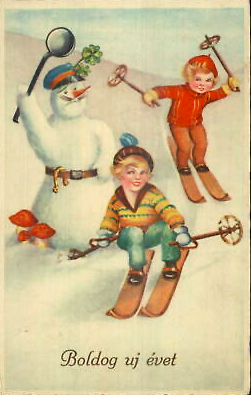
Boldog új évet is Happy New Year in Hungarian. Numerous postcard artists in the 1920s/30s incorporated kids on skis.

Centuries ago, when I worked in an office (remember when people worked in offices?), it seemed like New Year’s greetings extended through at least the first week of the year. You’d bump into a colleague and offer the obligatory phrase. Once, many weeks after the New Year, I said “Happy New Year” to a co-worker. That prompted a discussion about time-limited greetings.  We decided that, unlike birthdays, anniversaries, weddings and deaths, New Year’s greetings should be limited to a few days. That said, and the fact that this is reaching you about a week after this year’s not-so-sparkling event, let me bend that rule and wish you Many Happy and Healthy Turns in 2021!


“When” by John O’Donnell

Award-winning Irish poet John O’Donnell lives in Dublin. His work is widely published. His poem, When,  was published last week in The Irish Times. It’s a good read for this New Year.

And when this ends we will emerge, shyly
and then all at once, dazed, longhaired as we embrace
loved ones the shadow spared, and weep for those
it gathered in its shroud. A kind of rapture, this longed-for
laying on of hands, high cries as we nuzzle, leaning in
to kiss, and whisper that now things will be different,
although a time will come when we’ll forget
the curve’s approaching wave, the hiss and sigh
of ventilators, the crowded, makeshift morgues;
a time when we may even miss the old-world
arm’s-length courtesy, small kindnesses left on doorsteps,
the drifting, idle days, and nights when we flung open
all the windows to arias in the darkness, our voices
reaching out, holding each other till this passes.

Six Word Challenge Winners

Over the past month several readers submitted six words summarizing the current situation in their ski lives. Two winners were selected. Their entries are below. They’ll each receive The Bootster ski boot shoe horn. 

Boots in car. Pee In Woods

Norm Reynolds, Golden, Colorado

Mask, balaclava, gaiter, helmet, goggles. Breathe? 

Susan Zangrilli, Sandy, Utah

Thanks to all who sent in their creations!

Western Snow Magnets

Alyeska Resort  (AK): 336”. Stevens Pass (WA): 221”. Jackson Hole (WY): 212”.  Whistler Blackcomb (BC): 201″.

Austria Closes Schools and Stores; Not Ski Areas

Covid closures have affected virtually every aspect of public life for Austrians, except ski areas, which continue to function. News reports describe intense crowding in lift lines and elsewhere. Last season, Ischgl, near St. Anton, which attracts big numbers for it’s apres ski scene, was linked to the spread of the virus throughout Europe. Ski area operators lobbied hard for their facilities to remain open during lockdown. Swiss areas also remain open. However both countries have imposed quarantines for those crossing their borders, effectively making the hills off-limits to those living elsewhere.

Superyacht Heli-Skiing

La Datcha, the first ice-breaker superyacht, is available for heli-skiing adventures this season in Russia’s remote Kuril Islands and Kamchatka Peninsula. The cruise will focus on first descents. The 252’ superyacht carries a staff of 25, two helicopters in a below deck hangar, and a 3-person submersible. Cost for 7-days start about $1,225,000 for up to 12 guests and include heli-skiing, guides, equipment, meals, beer/wine, and use of the submersible. Website: https://www.eaheliskiing.com.

First Wood RFID Pass

Source: Skidata

SKIDATA, which produces tech associated with paperless lift tickets, has a new pass made of wood. It’s being used by Austria’s Kitzbühel Bergbahn.

14 Year Old Skiing Wunderkind

At 14, Jackson Hole‘s Kai Jones may be the youngest ski pro. When he was 11, his amazingly graceful form and derring-do helped him win the International Freeskiers Association’s North American championship for skiers younger than 12. The New York Times recently featured his skiing career: click here to read. Click on the video to see Kai in action. Wowee!!!!

Skiing Weatherman: Ch-Ch-Ch-Changes

For the title of this piece I chose a line from David Bowie’s classic song. The jet stream pattern that ultimately determines the snowfall haves and the have-nots is undergoing change and, ultimately, it will be dramatic.

As a lifelong skier and weather nerd, my step gets a little lighter and I tend to have a song in my mind when the weather pattern is soon to become more favorable for cold and snow.  I’m an Easterner and guilty of a provincial bias. So far, the East is at the short end of the weather stick. Other regions (i.e. Southwest, Wasatch, and Tahoe) also are struggling to attract snow. But much of the East remains significantly below typical trail counts for early January, largely due to the massive Christmas rainstorm.  

In my last report, filed a week before Christmas, it looked like the holiday storm could be a major snow producer.  Alas, there wasn’t enough cold air available to make that happen, and that has been the case much of the time since.  Pacific air has been flowing across the country, leading to heavy snow in the Pacific Northwest, with lighter, but still significant amounts across the northern Rockies.  Further downstream, plenty of disturbances have tracked through the Midwest and East, but without cold air from Canada, those disturbances have produced mixed precip events. 

So, what is going to change?  It’s the jet stream, the hand that moves the pieces on the weather chess board.  Here is picture of the current set up… 

The red blob over northeastern Canada is a blocking ridge slowly migrating west.  It will end up over far northwestern Canada by mid-month, where it will tap a growing supply of cold air.  The blue area over the Southeast is a trough that is delivering a late week snowfall to the southern Appalachians.  That storm is suppressed by the ridge to the north and until it the ridge moves northwestward, it will be tough for any storm to turn the corner into the Northeast.  But I do think that will happen within the next week, and likely several times in the following weeks.  Also of note, if you look over the eastern Pacific and follow the lines from west to east, you can see that the prime source of air masses is the Pacific, not the Arctic.  

Now take a look at a jet stream forecast for the 18th, one that I agree with.


The changes are substantial.  The ridge is stretched out across the far northern latitudes, with an extension over the northeast Pacific.  The clockwise circulation around the ridge will help access cold in the Yukon.  A deep trough over eastern North America is poised to receive the cold and spawn surface storms.  

Better times are ahead for skiers and boarders east of the Mississippi.  At the same time, rather quiet weather will develop out West.  This pattern, once established, will persist into February.                  

Regional details…         

Northwest U.S./Western Canada:  Occasional Pacific systems will bring snow next week…slowing down after,  as western ridge builds.  

Sierra:  Storm track to the north for the foreseeable future.  

Rockies:  Moderate snow events across the north in the next week…weaker systems fight through the ridge after that.  Central and southern Rockies pick up occasional light snowfalls.       

Midwest:  Cold starts pushing late next week, Alberta Clippers and lake effect snows will become frequent events for the second half of the month…and beyond.

Mid Atlantic/Southeast:   Fresh snow in NC mountains late this week.  Entire region in line for mountain snows and great snowmaking as the cold air deepens after mid-month.     

Northeast/QB:  Cold, but with suppressed storm track through next week.  Extended cold, snowy pattern develops thereafter.    

The How-Do-I-Get-There Conundrum

What If Driving Is An Undesirable Or A Non-Option?

Some planes are full; others are half empty. Credit: Picture Alliance

The world’s COVID hangover is going to continue well into 2021 so obviously ongoing precautions are needed to keep from contracting the disease. For those who live within three to four hours by car of a ski area, you’ve got options. Your car becomes your transportation bubble and then while skiing, just stay away from people and wear a mask under your scarf.

However, for those of us who live a long way from a ski area, getting to a ski area is, at best, a one day trek each way. So three days of skiing turn into five, five days of skiing, needs seven, etc.

Ski Apache is the closest to my place in Texas, 560 miles straight west and an eight or nine-hour drive.

Taos is 650 miles from my front door. Plan on 10 hours. I’ve made the drive in eight, but….

Ski Durango, a.k.a. Purgatory and one of my all-time favorite places to ski, is 860 miles away. Plan on 13 hours in a car unless you want a ticket or two.

Conditions are already very good in the Rockies and Sierra Nevada. I can feel the slopes beckoning. So, how do you get to a ski area if you don’t like driving long distance?

If you own a plane or can afford to charter one you can fly in your own bubble. For the rest of us, unless you can take a train or bus, the only other practical way is sitting in an airline seat with 150 or more of ‘your closest friends.’ The airlines have done a yeoman’s job of sanitizing the planes, updating the cabin filtration systems as well as trying to convince the traveling public that sitting in one of their aluminum tubes won’t lead to becoming infected. I’m not convinced.

The risk doesn’t come from just the plane ride. There are the people in the terminals and who knows if they’ve been exposed. Throughout the trip, you touch all kinds of things so latex gloves become the order to the day. Net net, the CDC says the risk of catching COVID is increased if you travel by plane.

When you actually receive the COVID vaccine should be factored into the decision to go skiing. For example, I’m in category 1B (over 75, compromised immune system) which means early this year, I should have the first dose injected. Second dose comes, depending on which flavor you receive, about a month later. Full efficacy of the vaccine occurs about a month after the second injection.

The vaccine gives me choices. There are non-stop flights from DFW Airport to airports a short drive from almost any ski area in the country. In a COIVD-vaccinated world, flying on airlines again becomes the best option for those of us who don’t live near a ski area.

So here’s the timeline that’s rattling around in my head. Mid-January, first dose. Mid-February, second does. Mid-March, full efficacy. That’s when I am going skiing!

Snow In Literature: The Snow Man

By Wallace Stevens

One must have a mind of winter
To regard the frost and the boughs
Of the pine-trees crusted with snow;

And have been cold a long time
To behold the junipers shagged with ice,
The spruces rough in the distant glitter

Of the January sun; and not to think
Of any misery in the sound of the wind,
In the sound of a few leaves,

Which is the sound of the land
Full of the same wind
That is blowing in the same bare place

For the listener, who listens in the snow,
And, nothing himself, beholds
Nothing that is not there and the nothing that is.

Call Of The Mountains

A Lyrical Look At Classic Eastern Ski Trails.

Killington, Okemo, Mt. Snow. See what you’re missing, Western Skiers?

Thanks to SeniorsSkiing.com correspondent Don Burch for another great, feels-like-you’re-there video.

How Aspen/ Snowmass/ Highlands is Coping with Covid

A Major US Destination Resort Implements Its Virus Plan. Here’s An Early Report Card.

Line up for the Silver Queen gondola at Aspen. Credit: Evelyn Kanter

The biggest challenge ski/snowboard resorts face this season just may be lunch.

Covid-19 restrictions limit lifts to 50 percent capacity, but indoor dining restrictions are even less.  That means many skiers will not be able to find a place to sit to eat, even if they are brown-bagging PBJ sandwiches.

My recent pre-holiday visit to Aspen/ Snowmass/ Highlands showed compliance to social distancing requirements often did not make sense.

Some water fountains were wrapped in plastic and not available.  At others, the fountain part was shut off but the bottle refill part was operational, and at others, both parts worked fine.  Bathrooms can be immediately adjacent to an entrance door, or require walking through the entire lodge.

“Quonset”-like hut provides a place to go “inside”. Credit: Evelyn Kanter

At Aspen, the large, modern and wonderful Sundeck lodge at the top of the Silver Queen Gondola has added a large Quonset hut for the overflow.  But even that can accommodate only about 30 people at a time.  50-ish in the lodge, 30 in the hut, another 50-ish at outdoor tables – that’s enough for a 10am hot chocolate break, but not for the lunch crowd. 

At Snowmass, Ullrhof also added a large Quonset-like hut, also for only 30 people at a time.  Luckily it has a large outdoor deck area, as does Elk Camp, which has not added a heated hut.   So we’re talking about 100-or-so lunchers at a time at either spot.  That’s just not adequate.

At Highlands, Merry-Go-Round at the top of the main Exhibition lift from the base doesn’t even have an additional hut, which means about 50-ish people at a time inside.

None of the outdoor areas had heaters when I visited in mid-December.  That’s okay for a sunny day, even a cloudy one, with temperatures in the 30s but not for a frosty zero-degree day.

The four-mountain resort has been moving visitors to online touchless ordering, which has accelerated this season.  But it also is spotty.

If you have an Ikon Pass and account, or have the patience to input your credit card information on the resort app, you can pre-order food for a specific time and for pick-up at a special window. The problem is when the restaurant is at its limited capacity, and a burly security guard prevents you from entering, even to pick up the food you ordered online and already paid for online.

Limited capacity inside the “Quonset” hut. Credit: Evelyn Kanter

At Aspen, that meant waiting on line at the take-out bar, while a clearly over-worked solo employee was taking new lunch orders, handing out electronic buzzers to alert when orders were ready, and mixing drinks including Bloody Marys and Margharitas.  Not the most efficient way to handle a line of hungry and thirsty skiers and riders. 

My group waited nearly 20 minutes for our orders, tying up limited tables and chairs.  Our soups, chilis and mac-and-cheese orders were all barely warm at pick-up, but nobody asked for a reheat, which might take another 20 minutes.

And when I traded the buzzer for my lukewarm food, the staffer simply staked it on a spindle, without sanitizing it.  Maybe the stack was sanitized after I went to my table with my food.  Maybe not.

By comparison, at Highlands, I was texted when my order—a grilled cheese sandwich with tomato and bacon—was ready, within five minutes of my requested pick-up time, and it was piping hot. It was the best mid-day meal I had at four lodges on three mountains (I did not ski Buttermilk, so I can’t tell you about lunch or lift lines).

Yes – spotty.  Maybe they’ll fix it during the season. Maybe not.  Maybe it’s better at other mountain resorts.  Maybe not.

From my brief experience, it’s clear that resorts need to expand grab-and-go sandwiches, snacks, bottled drinks and outdoor seating with heaters.  The option of making a meal out of a couple of granola bars, trail mix and chocolate squirreled away in our jacket pockets and consumed while going uphill is okay occasionally, but not as a steady diet.  We’ve all done it to avoid long lift lines.  Now we’ll do it because a chairlift or gondola is the only place we can find to sit down, until après, of course.

As for lift lines, the rule is you can go up with your friends or family, ride alone, or ride with a stranger from the singles line. 

On my pre-holiday trip, lift lines ranged from 20 minutes for the Aspen gondola to ski right into the quad or six-pack. That’s pretty much standard for a non-holiday weekday, when there are normally fewer skiers wrestling for seats.  It seemed to balance out—fewer skiers and riders overall because of the pandemic filling fewer available chairlift and gondola seats.

The primary job of lift attendants this season just may be to remind everybody to cover their mouths and faces. I’m one of those who lowers my neck gator on a nice day to ski with my nose and mouth exposed for easier breathing.  So every time I came into the lift line there was a new additional step of pulling up my neckie.

This season, my hotel requires reservations for the pool, hot tub and gym, to manage social distancing.  That was less an issue than the lack of housekeeping.  At my hotel, staff enters only before check-in, to change the sheets and sanitize everything.  If you request fresh towels or more coffee during your stay, housekeeping leaves a bundle outside your door.   

For me, the issue was this new policy was not mentioned when I made the reservation, no discount was offered for the reduction in service, not even the offer of a few “points” on my loyalty membership program with the hotel brand.  Over the years, several hotel chains have offered courtesy points if you opt to skip a linen change during your stay.   

You can be sure that before my next ski trip anywhere that I ask about the housekeeping policy—if it’s not on the website—and will negotiate for either a small discount or some loyalty membership points.  And so should you.

We skiers and riders always adapt—to the weather, to conditions, to the speed and expertise of those in our group—and adapting to the new reality of Covid-19 rules is no different.

EDITOR NOTE – Pritkin County, where Aspen/ Snowmass/ Highland/ Buttermilk is located, now requires a recent negative Coronavirus test for out-of-state visitors.  Details here on the Pritkin County website

Reminders are everywhere. Credit: Evelyn Kanter

Make More Tracks: Nutter Butters And The Tour Of Anchorage

Joining A Race Without Training? Hey, It Could Be Fun.

Ski the TOA. Race? Fun? Both? Up to you. Credit: Anchorage Daily News

In this strangest of times, I think back to the great and diverse and sometimes unorthodox adventures I’ve had cross-country skiing. And although I haven’t competed often, there was this one time, some years ago…

As I understand it, you’re supposed to train for a major race. Seems sensible, right? But sometimes it just doesn’t work out that way.

Chalk it up to an uninspiring winter in the Rockies or maybe just a lazy streak, but I didn’t bother to prepare for the Tour of Anchorage. Didn’t train, hardly skied, ate too well; then flew up to Alaska at the end of February, did a little track skiing. Lay awake the night before the race, thinking: “Hey, my first marathon! I’ve never done anything longer than 25 kilometers. I’ve skied three times since prepping skis. What am I doing?”

As it turned out, what I did was have the time of my life. First, you can’t help but love Anchorage—150 km of groomed trails, maybe a quarter lit, eight mountain ranges visible on a good day, and incredible hospitality. There’s a large and dedicated racing community, from kids to Masters, represented by the Nordic Skiing Association of Anchorage is one of the most active XC clubs in North America. Their Alaska Ski for Women (held on Super Bowl Sunday) is the most popular all-women XC event in North America.

The Tour of Anchorage rings the city with a choice of distances.

The Tour of Anchorage is actually four point-to-point races, 25 km classical and 25 km, 40 km, or 50 km freestyle. The longer distances begin on one side of the city and go through the center of town—strange and wonderful to pass through birch and spruce forest, over roads streaming with traffic, and along the ice floes of Cook Inlet.

I chose the 50 km (don’t ask). Luckily the day was perfect, starting off cool with great snow, air crystalline, so we had great views of Denali.

I was saved by four things. First, at home I lived at 8,500 feet, so Anchorage’s altitude was an oxygen-rich dream. (Highest point on the trails is around 1,000 feet, lowest is four feet below sea level.) I got tired enough to do several face plants in the last 15 km, usually at conspicuous spots (why does that happen?), but never ran out of breath.

Second, friends who’d skied the race said to take it easy on the first ten kilometers because that’s where the hills are. Right! They’re not very prolonged, but a lot of up and down. You finish the Tour with a longish uphill in Kincaid Park (weirdly wonderful to see moose on these trails and jets flying low overhead).

Racing fuel.

Third, I carried several packages of Nutter Butters. They tasted good from the beginning, better as I got more tired. 

And last, people made all the difference between dropping out (which was a definite possibility) and finishing—not graceful but grinning. Race volunteers kept us hydrated and full of cookies and enthusiasm; spectators yelled us on; other skiers were inspirational, like the guy who broke a pole in the first series of hills and just kept going. (We passed one another at least a half-dozen times; I stuck around the finish area to give him an exhausted cheer.)

Best of all, I talked with two people who’d skied the Tour before, and they slowed down to give me an emotional lift. Without that, they’d probably have finished in the middle of the pack instead of waaay back. (My time was 4:04:20.6, 276th out of 292 male finishers. My pre-race fantasy had been 3:45.)

So what do you do when you’ve finished a 50 km, are staggering around beaming groggily, and one of your kind hosts takes you back to your hotel? I’d hoped to attend the awards banquet but slept through it; grabbed a late dinner; headed back to bed, and flew home the next morning, stiff but not hurting.

I’d love to ski the Tour again, with a few changes. Like about two consecutive months on skis, distance training, a much higher general fitness level, and hotter skis. But there’ll still be Nutter Butters.     

Anchorage Convention & Visitors Bureau is a great resource on the region. My favorite place to stay is Copper Whale Inn, a snowball’s throw from the Tony Knowles Coastal Trail and with 80 mile views over Cook Inlet.

The Tour of Anchorage is scheduled to be held on Sunday, March 7, 2021.  Plenty of time to train.

Choice of 25, 40, and 50 km and classic or skate races at the TOA. Credit: Anchorage Daily News

Get Smart About Back Country Skiing

It’s Socially Distanced For Sure. And Could Be Dangerous.

If you go under the rope, you have to know what you are doing. Credit: Tamsin Venn

The number of skiers and split boarders heading into the backcountry is skyrocketing as we search for ways to avoid ski areas’ confusing restrictions on lift capacity and parking plus social distance. Sales of skis, boots, skins, probes, and shovels are up (137 percent in the past three years). Trailheads are packed.

Those in the search and rescue fields are understandably concerned about our—and their—well being.

In-person avalanche safety courses, the norm, are full with waiting lists. The good news is that there is a ton of great online free education content out there. That could be a good entry point for those of us wanting to give skinning and skiing a try, now that gear, clothing, and navigation technology have improved so much.

BRASS Foundation offers a 90-minute intro webinair from certified avalanche safety instructors. It includes a harrowing 13-minute video Off Piste about two up-and-coming U.S. Ski Team members Ronnie Berlack, 21, and Bryce Astle, 20, killed in an avalanche in Soelden, Austria, when caught in a massive slide in January 2015. Ronnie’s Dad Steve Berlack spearheaded BRASS to raise awareness about what he felt was a preventable accident with the right knowledge.

The Utah Avalanche Center created Know Before You Go (KBYG), a free hour-long online course with five simple modules: Get the Gear, Get the Training, Get the Forecast, and while out in the snow, Get the Picture, Get Out of Harm’s Way. UAC Director Mark Staples says once out there you are your own avalanche forecaster and first aid provider. “You gotta take the classes,” he says.

The legacy of heli-skiing operations in the Canadian Rockies has generated much online guidance. Matthew Smith, a Whistler ski patroller and flight paramedic, stresses four things to do to prep: Take an avalanche safety course. Take a wilderness first aid course for your specific activity from a professional with real-world paramedic experience. Learn technical knowledge such as weather and gear. Practice Leave No Trace.

Avalanche Canada posts weather and avalanche reports and offers a free intro online tutorial. AC is partially funded by federal funds. Prime minister Justin Trudeau’s younger brother Michel Trudeau died in an avalanche in 1998 in British Columbia.

Meanwhile, the Canadian Avalanche Assn. supports guides with professional training and info exchange but also offers recreational courses for non-guides.

Across the U.S., find help from two dozen regional avalanche forecast centers that provide “geo-targeted” reports on snow conditions through local authorities and U.S. Forest experts.

Recognizing the rise in backcountry sales, Nick Sargent, president and CEO of Snowsports Industries America (SIA) points out that SIA now provides a “one-stop shop” of resources for backcountry safety.

The American Avalanche Institute offers an avalanche fundamentals course (cost $30) covering all the basics.

Mark Smiley’s Mountain Sense has produced “A Comprehensive Guide to Avalanche Safety” (cost $249) available online. Smiley is a Certified Mountain Guide with the Swiss-based IFMGA (International Federation of Mountain Guides Associations).

“Take the risks but get the training,” sums up patroller Matt Smith.