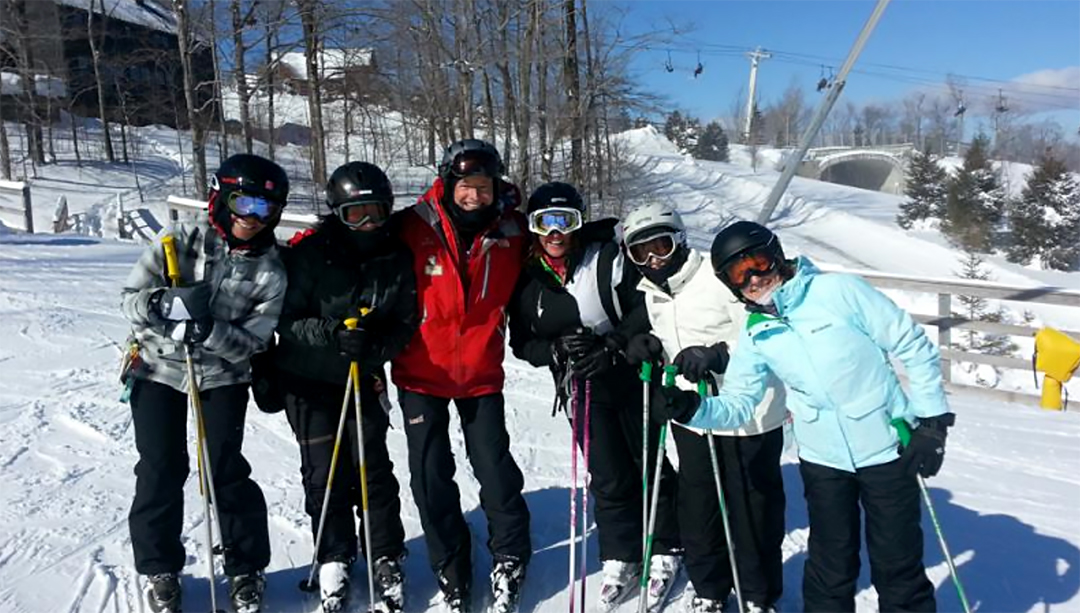
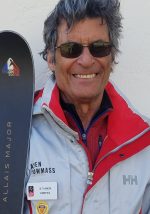
Over 11 seasons I’ve probably taught 500-600 kids and adults as a part-time instructor at Stratton/VT & Butternut/MA. “Never-evers”, experts, 4-yr olds to 80-yr olds. Me: flipping through trail names like a deck of cards, choosing the best run for the task at hand and my eager, anxious learner.
Here’s the huge thing I’ve learned:
Anyone can become a better skier, if the skier has both a desire and determination to improve…simply by taking a few ski lessons at the outset of ski season.
Why at the beginning?
Because each season, starting out, we’re all squirming and thinking, trying to put our skiing back together again.So instead of once again reinforcing some of the “bad” habits carried over from last season, you can trade them for one or two new/better ideas that will help you ski with more skill.
But wait, there’s more: any improvement in your skiing proficiency ALWAYS leads to enjoying skiing more!(Shoot me your questions at the end and I’ll reply.)
As an instructor, I’m lucky.In early December we do OUR training.We take refresher lessons with the best instructor “trainers” at our resorts.We’re brushing up on our skills.It helps me a lot.But it took me a while to accept the fact I still needed to be in “learning” mode.
This season try this… either by yourself or with a friend who’s at a similar ability level.Sign up for a private lesson of 2-3 hours on your second day of the season. On the first day, ski around and get a feeling for what’s working and… what’s not.Think about what you’d like to change, what’s confusing or difficult, what you’d like to ask questions about, then write it down.Now you’re ready for that lesson on Day 2.Because now you’re engaged in being an “active learner”. Real progress as a skier doesn’t just “happen” to you.It comes as a result of efforts you make to change what’s not working, in favor of more useful approaches.
I witnessed this approach in action, in Utah, last March.One of my best friends, with whom I’ve skied for 40 years, took a short program of four group lessons at Alta.Called “Intermediate Breakthrough” it seeks skiers who truly desire improvement.My friend wanted to improve, and was ready to do what it took.He explained what he wanted from the lessons, and he worked hard to use the skill tips offered by his instructor.
And he not only improved…he made a quantum leap in his overall skiing proficiency, and in his ability to ski more challenging terrain while enjoying it.It was remarkable to see, and it was the result of only four lessons, but four lessons in which both student and instructor were invested in producing real results.Alta’s “Intermediate Breakthrough” is awesome.
Believe me, you can do it too… It’s totally worth it.
https://seniorsskiing.com/wp-content/uploads/2021/09/John-Gelb-and-group.jpg6131080John Gelb/wp-content/uploads/2014/04/Seniors-Skiing-since2013-Logo@2x-300x68.pngJohn Gelb2021-09-30 12:01:422024-08-21 09:48:43Secrets for Your Best Ski Season Ever
Welcome back, fellow Senior Skiers!!! This is the first issue of SeniorsSkiing.com for the 2021-22 season. As usual, there’s a lot of original content.
Ski instructor and contributor John Gelb offers excellent advice about taking lessons at the beginning of the season. Day 1: ski around and take notes on what you want to strengthen or improve. Day 2: Have your instructor focus on what you observed in Day 1.
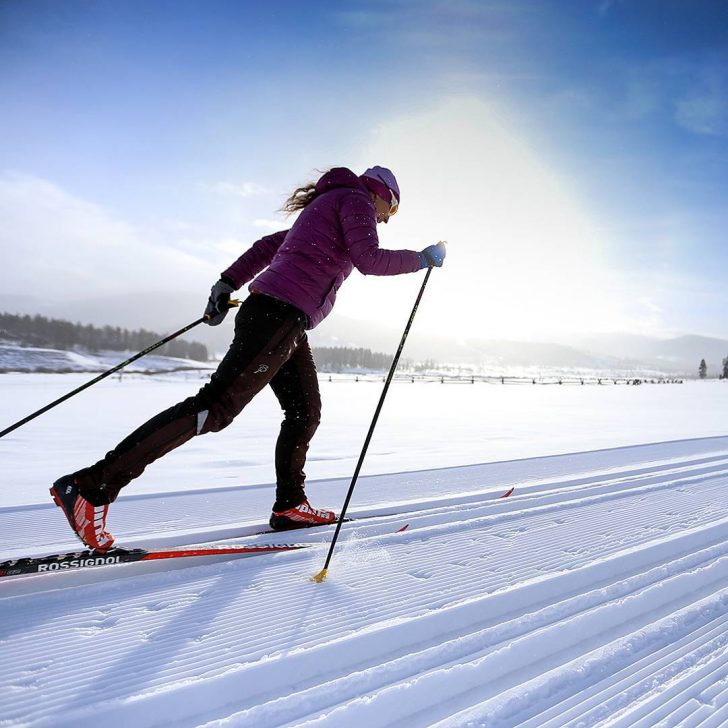
Planning a X-C ski holiday? Jonathan Weisel, longtime writer, X-C area designer, and area operator, explains what to look for and where to go for the best X-C skiing vacation.
If you’re looking for an exotic Alpine skiing experience, consider the skifields of New Zealand. New contributor, Gary Henderson is a member of the Tukino Ski Club on Mt Ruapehu, where prices are reasonable, getting there takes some effort, and everyone pitches in with the chores. It sounds delightfully anachronistic.
In the August Reader Survey, 37%+ of the 3000+ respondents, indicated they intended to purchase skis in the next two years. There are some great choices for older skiers and some excellent information on what to look for in a ski that will perform well without tiring the skier.
Credit: Don Burch
Many of you have commented on Don Burch’s ski art and artistic ski videos. Don’s delightful video recap of his 2020-21 season may whet your appetite for the coming season.
Test Your Skiing Knowledge sources images and objects from ski museums and asks readers to submit their best guesses. It’s our way of promoting membership and visitation to ski museums. We’ll purchase a one-year membership to the New England Ski Museum for the first person to identify the man pictured in the feature.
Skiing History magazine: Sept-Oct 2021
The Fall issue of Skiing History magazine is summarized by contributor and SeniorsSkiing.com Advisory Council member, Seth Masia. Skiing History is a must-read for anyone interested in the subject. The new issue features an article on ski songs going back to the 19th Century, complete with YouTube links to actual performances!
As usual, Jon’s Short Swings! column is filled with interesting tidbits from around the industry. There’s a weird video compilation of modern individual flying machines – maybe they’ll eventually replace ski lifts.
Signs of hope for a productive season: It’s been snowing at higher elevations in the West, and ice has formed at the top of New Hampshire’s Mount Washington.
This is to thank the 3000+ of you who completed our August reader survey. We learned that on average, those of you who did not take last season off skied an average of 26 days. That’s down from a few seasons back when the average was more than 33 days. But, when you figure that the national average is 6.5 skier/boarder days, you quickly realize that we’re the ones using the resorts…especially midweek.
We seniors are a very luck lot, doing what we love, when we want to.
Like many of you, I missed last season. That was a first since I started at age 10. Now I’m psyched about getting back on the hill. Skiing brings me immense pleasure. Each of you feels this in your own way. Whether it’s snaking slowly through a mogul field, cruising down a well-groomed slope or floating through thigh-deep powder, you understand.
Ski often enough and you’ll experience a great mix of conditions. Although I haven’t done so in several years, I’ve found pleasure skiing in a blizzard. Very cold days bring their own form of bliss. Warm, bluebird days are a form of skiers’ nirvana.
It is wonderful to age and ski and to be outside in the snow. It doesn’t matter the size of the mountain or the number of runs. It’s simply being there and skiing that brings joy.
This is the first issue of SeniorsSkiing.com for the 2021-22 season. We’ll be posting new articles each week and emailing them to you as a package every other Friday. As a heads up, we’lloccasionally email advertisements. Each of these ads has been vetted to be relevant to your skiing interests.
I hope you continue to enjoy SeniorsSkiing.com. Best wishes for a great 2021-22 season!
Patagonia Offering Store Credits for Trade-Ins
With the goal of keeping its stuff out of landfill and improving the environment, Patagonia has introduced a program that gives credit for old and worn Patagonia products. The credits can be used in its retail and online stores. Click here for details about the program and the amount of credit offered.
Will This Replace Day Lodge Burgers and Fries?
A new eatery — Oxygène Café — in the French ski resort, Tignes, specializes in vegan, vegetarian and gluten free food. Started by Oxygène, the French Alps based ski school specializing in English speaking ski and snowboard lessons. The company is partnering with Caffè Vergnano, a socially and environmentally friendly Italian coffee brand.
Snowbasin to Add Base Village and Club Med
Source: The Salt Lake Tribune
Snowbasin, the vast ski area north of Salt Lake City, near the city of Ogden, was the site of the 2002 Olympic Downhill events. The place offers terrain for every ability. What it hasn’t offered is a place to stay at the mountain. All of that is about to change as Club Med builds a 300 room facility (projected opening: December 2024) and as plans develop for a base village with restaurants, shops and lodging (project to start in 2025).
Sundance Mountain Resort: New Owners Make Changes
Sundance
Founded by Robert Redford in 1969, Sundance changed hands last December. Over the summer, the new owners installed two new lifts and upgraded snowmaking services, among other changes. A high-speed detachable quad will access the mid-mountain summit. The second lift will provide expanded terrain choices to guests returning from the back mountain. Sundance is a Utah gem. Off the beaten path, it’s not far from Salt Lake City, Park City and Provo and rarely has crowded slopes. Lodging is primarily in the form of condos and it has always been a foodie destination. Most importantly, there’s a range of excellent terrain.
Squaw Valley’s New Name: Palisades Tahoe
According to a news release issued by Alterra, the company that owns the resort, the “…name change was an important initiative for our company. At the end of the day, “squaw” is a hurtful word, and we are not hurtful people. It was a change that needed to be made for us to continue to hold our heads high as a leader in our industry and community. We have a well-earned reputation as a progressive resort at the forefront of ski culture, and progress can’t happen without change.”
Deep Discount on Stocking Stuffer Ski Books
Arcadia Publishing has a roster of 27 books covering localized skiing history. They paperback books are loaded with vintage photos and have titles such as Skiing in the Mad River Valley, New Hampshire on Skis, and North Carolina Ski Resorts. Part of the series explores “lost ski areas,” those that existed years ago but no more. Among them, Lost Ski Areas of the Berkshires, Lost Ski Areas of Southern Vermont, Lost Ski Areas of Tahoe and Donner, and Lost Ski Areas of Colorado’s Front Range and Northern Mountains. Arcadia is offering SeniorsSkiing.com subscribers a 30% discount on all of its skiing titles. Click hereto shop the books and enter the code, SENIORSSKI, when checking out. The offer is good from October 7 to November 7.
The Perfect Gift for Older Skiers
Bootster is a clever, compact device that makes it easy to get into a ski boot – even when it’s cold. It has a super slippery surface that helps the foot slide in effortlessly. And unlike shoehorns, sprays, etc., Bootster is compact and easily carried in a parka pocket (click on the video above). If you or an older skier you know likes to shed boots during lunch, getting them back on with Bootster is a breeze. It is pretty much indestructible, making it ideal to pass on to the next generation of skiers. At $25 (+ shipping) the price is right. Looking for something to give your favorite older skier? Bootster will be appreciated for years to come.
Boston and Denver Ski Shows Cancelled
This is second year in a row. The cause? Covid.
It’s a Bird?
People have been dreaming about being able to fly without a plane for years. Technology is finally making it possible, as shown in this video compilation of several different approaches from around the world. Who knows? At one point, some version of these flying machines may eliminate the need for ski lifts. About 16 minutes.
Even though we are just a few days past the first day of astronomical summer, I find myself already taking a peek at the northern Rockies when I am working on forecasts for my golf course clients. Why? The skier/weather nerd in me comes out as I look for the first weather station reporting snow in the air. Like you, I am already starting to anticipate the coming winter sports season, so here are my early thoughts on the weather for the upcoming season.
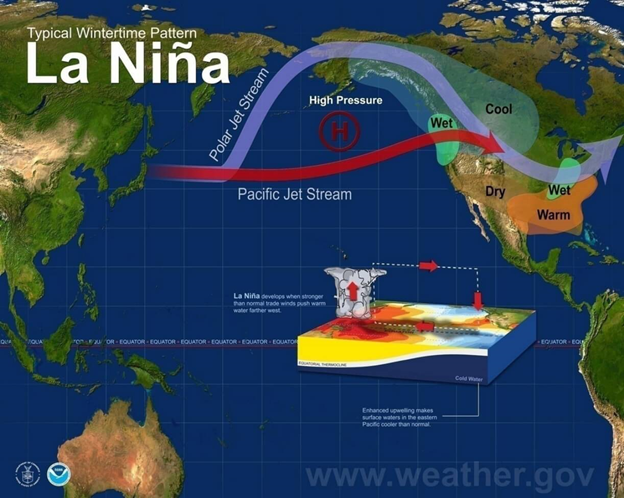
As always, the first thing I do in putting together a long range outlook is to check the status of ENSO…El Nino Southern Oscillation. ENSO is a measurement of the surface water temperature anomalies in the equatorial regions of the Pacific Ocean. When those waters are warmer than the long term average, we have an El Nino. When they are cooler than average, La Nina is present. Last winter we had a La Nina, and another round of La Nina is in storm for us this winter. The following map shows the cooler than normal anomalies already in place in the Pacific basin.
Computer model forecasts designed to focus on ENSO suggest that the La Nina will strengthen in the coming months, as illustrated by this summary of those models. The thick red line is the consensus of the models, and as you can see, that line drops slightly below the -.0.5 Centigrade threshold that indicates La Nina for several months, suggesting that this episode of La Nina will be a weak one, in a fashion similar to last winter.
So, what does that all mean? Well, because the oceans contain 1,000 times the energy that is contained in the atmosphere, the state of the ocean’s water temperature distribution exerts a major influence on what the overlying jet stream looks like. Here is a graphic that shows you the most common jet stream configuration during a La Nina Winter…
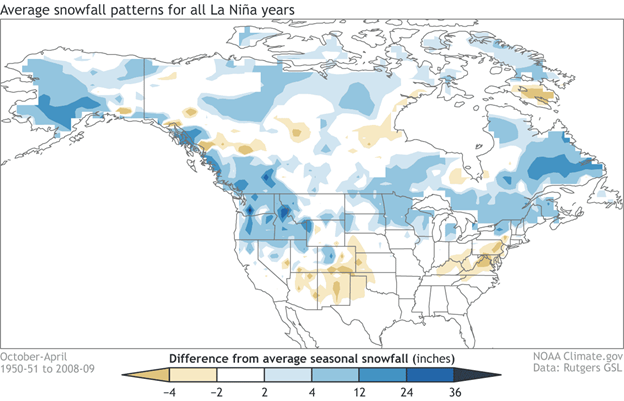
The first thing to note is the confluence of the Polar and Pacific branches of the jet over the northwestern corner of U.S. as well as western Canada. These are two areas that typically have a solid to spectacular season of snowfall in La Nina. The combined jet stream delivers cold air and carves out a trough much of the time across the Great Lakes and Northeast and these two regions also usually benefit from a cool Pacific setup. Across roughly the southern half of the country, La Nina winters can be more of a challenge. That doesn’t mean that the Pacific jet can’t deliver storms to the Southwest…it can, and will…but the more common jet pattern will favor resorts across the northern half of the West. The region that finds a La Nina least desirable is the Southeast. Here, an upper level ridge is more favored, and that leads to milder than normal temps more often than not. Snowmaking will likely be king in the southern Appalachians this season. The final graphic I would like to share with you summarizes snowfall anomalies during La Ninas…
https://seniorsskiing.com/wp-content/uploads/2021/09/Seniorski3.png498624Herb Stevens/wp-content/uploads/2014/04/Seniors-Skiing-since2013-Logo@2x-300x68.pngHerb Stevens2021-09-29 11:30:282021-09-30 15:39:26Skiing Weatherman: 2021-22 Outlook
When it comes to skis, buying without trying can be confusing. I prefer demo days or demo-ing from shops at or near the mountain. Reading how a ski performs can provide helpful guidance in your selection process but using those skis – especially on familiar terrain – really helps in deciding how to make the best purchase.
That said, we’ve posted the annual list of skis recommended for older skiers. They include models from Atomic, Blizzard, Dynastar, Fischer, Head, K2, Kastle, Nordica, Rossignol, Salomon, Stockli, and Volkl.
Most of the recommended skis have relatively soft flex, allowing the ski’s sidecut to engage with snow with minimal exertion. This ski design component requires less physical effort to turn and, regardless of your physical condition, reduces loss of stamina.
The recommendations come from data assembled during last Spring’s ski tests conducted by RealSkiers.com, the go-to site for in-depth ski equipment evaluations. The 45 recommended skis are organized by ski width categories, which correspond to types of terrain and snow conditions, factors considered in their design and engineering.
While many consider skis to be unisex, some women prefer skis with weight and flex more suitable to their size and physique. The list identifies 10 women’s skis.
What’s the best way to use the information on the list? First, identify the ski category you want to add to your quiver. Then work with a quality ski shop. And, as mentioned at the start of this article, if possible, demo the selections to compare before making your purchase.
BTW, SeniorsSkiers.com subscribers enjoy a 50% discount off subscriptions to realskiers.com subscriptions. Use Code SS21.
https://seniorsskiing.com/wp-content/uploads/2021/09/bluebird-day-510x287-1.jpg287510Jon Weisberg/wp-content/uploads/2014/04/Seniors-Skiing-since2013-Logo@2x-300x68.pngJon Weisberg2021-09-29 11:15:252021-09-30 16:48:07Older Skier? Here’s a list of the Best Skis for You
Let’s say you’ve decided to take a cross country ski vacation. That’s a great idea because it’s a wonderful way to escape city stress.
But there are a lot of other good reasons. You can ski your brains out or veg out, get a tan, see new country, ski but avoid midwinter cold, eat incredible meals, enjoy a romantic interlude, or savor a family vacation.
If you’re looking to combine sport with comfort, there are hundreds of places to choose from in North America: inns, lodges, guest ranches, wonderful old hotels, B&Bs, downhill ski resorts, National Parks, and more. The variety is almost a little intimidating. So here’s how to get a handle on choosing your vacation destination.
Systems
Any way you go about it, there’s the problem of selecting from this excess of riches. So here’s a method that helps establish priorities; then you can comb through those resources to choose when and where to go.
The three primary categories are budget; amount of time available; and ambiance. Should you plan on spending $100 a day, or $250? Is a January week (can be cold, perhaps more times indoors) less desirable than a long weekend in February (may be crowded)? Are you looking for a family atmosphere, a second-honeymoon spot, or a place where you’re comfortable as a single person?
Other considerations may include the practical (altitude) and aesthetics (mountain or forest setting, Spartan or luxurious accommodations, fine or simple dining, an intimate experience or one shared with several dozen people…).
Range of activities is another factor. A lot of vacationers are cross country devotees; others enjoy the sport but want some daily relief. You might be intrigued by downhill skiing conveniently nearby; guided snowshoe tours; dog sledding, sleigh rides, riding horseback through the snow, overnighting in a yurt, ballooning, ice climbing, even fly fishing and snowmobiling! Then there are the on-site amenities like hot tubs, saunas, entertainment, and massage.
To provide an example of the screening process, let’s assume you’re an adventurous type who wants to stay for five days at a classy establishment with outstanding food and excellent skiing, all for a reasonable price – so look to lodges in the upper Midwest, or inns in northern New England. If you’re a downhill skier, think about winter ranches in the Rockies, where you have tracks outside your cabin door, then can hit the slopes at world-famous resorts like Steamboat Springs and Big Sky.
Tips
If you want to hone technique, consider places where instruction is part of a lodging/meal package.
If you’re staying at one location, you may want to try a couple of new routes every day. As a rule of thumb, multiply 5 kilometers per day (double that if you’re an experienced, vigorous skier) by the number of days you have free to figure how large the trail system should be. You may also want to check by phone to see how much of a trail network is suited to your ability and ambition.
In general, the further north you head or the higher the elevation, the longer the season and the more powdery the snow. Less predictably, I believe that the Midwest has the finest terrain for any level of skier; the Northeast has the most skiing history; and the Sierras’ and Rockies’s altitude may give you a headache. (I’ve lived in Montana, Colorado, and Wyoming, so clearly the skiing is worth the pain!)
https://seniorsskiing.com/wp-content/uploads/2021/09/xc-ski-group.jpg5661080Jonathan Wiesel/wp-content/uploads/2014/04/Seniors-Skiing-since2013-Logo@2x-300x68.pngJonathan Wiesel2021-09-29 10:03:112024-08-21 09:49:25Planning Your XC Ski Vacation
Don Burch is a frequent contributor of interesting ski pictures and videos. He put together this 2-minute video of highlights from his 2020-21 season. If you want to stoke your imagination for the coming season, click here and enjoy!
https://seniorsskiing.com/wp-content/uploads/2021/09/season-review.jpg287510Don Burch/wp-content/uploads/2014/04/Seniors-Skiing-since2013-Logo@2x-300x68.pngDon Burch2021-09-29 08:00:212021-09-30 15:41:07Last Season
Each issue of SeniorsSkiing.com will have a picture to help you test your skiing knowledge. The pictures are from collections in a variety of participating ski museums, which we encourage you to visit and to support.
This image was submitted by The New England Ski Museum, a non-profit based in New Hampshire with locations at the base of the Cannon Mountain Tramway and in downtown North Conway. In addition to an extensive collection of objects, the museum issues a substantial publication with articles on ski history and content from museum exhibits. More about the museum and its most wonderful shop at www.newenglandskimuseum.org,
The man in the picture is known to each of us but not in the context of skiing. If you can identify him, send me a note (jon@seniorsskiing.com). For the person sending the first correct answer, we’ll purchase a membership in The New England Ski Museum. The correct answer and the name of the winner will appear in the next issue of SeniorsSkiing.com.
https://seniorsskiing.com/wp-content/uploads/2021/09/ACD.jpg9361060seniorsskiing/wp-content/uploads/2014/04/Seniors-Skiing-since2013-Logo@2x-300x68.pngseniorsskiing2021-09-29 07:04:272021-09-30 15:41:31Test Your Skiing Knowledge
Tukino Skifield (www.tukino.org) is a Club-operated field (“skifield” is the down-under term for ski slope) on the eastern slopes of Mt Ruapehu (9175 ft/2797 m), a live volcano and the highest mountain on the North Island of New Zealand. It is located within Tongariro National Park, a World Heritage Area, encompassing two other large volcanic cones (Ngauruhoe and Tongariro) plus numerous smaller ones.
The first known and documented skiing on Mt Ruapehu was in July 1913, soon after which the Ruapehu Ski Club was formed, making it one of the oldest outside Europe.
The field is on scoria ash with many boulders, so skiing is rarely possible before the end of June. The core season is usually August-September and the annual snowfall averages about 70”. Tukino, like other nearby skifields, has a mix of green, blue and black terrain.
Tukino’s fixed lift served vertical is 1115’. A portable tow and cat can extend it to almost 2000’, conditions permitting. Neighboring Whakapapa, New Zealand’s largest ski area, has a 2300’ vertical.
Skiing at Tukino is open to the public, but Club members (annual adult membership: $70) enjoy substantial discounts for accommodations and lift-passes. Most maintenance and skifield work is done by volunteers, with a small core of alpine-qualified staff. There are three fully-equipped lodges, each taking up to 32 guests; these are operated by their respective Club owners.
Tukino and the access road are operated and maintained by a coalition of local ski clubs. The upper part of the road requires 4WD.
The Tukino field has two fixed “nutcracker” rope-tows (so-called because the device attached to your tow-belt, used for clamping onto the tow-rope, resembles the traditional implement for opening walnuts etc!) plus a portable rope-tow. Conditions permitting, cat skiing also is available.
Skiing Tukino is a bit old-fashioned and takes some effort (and 4WD) to get there. Staying over requires a sleeping bag and pitching in with meals, cleaning, etc. Accommodation prices at each of the three clubs are reasonable and include meals. The entire area is off-grid, so getting online is possible but challenging. But who needs Internet when conversation and games with other club members and guests make the experience memorable.
Visit club websites for more information on each of the three options: Aorangi Ski Club (www.aorangi.org); Desert Alpine Club (www.desertalpine.club), Tukino Alpine Sports Club (http://tukinoalpinesportsclub.org.nz ).
Skiing History magazine, a project of the International Skiing History Association (ISHA), is published six times a year. Its collection of articles is always interesting. Click on ISHA’s “Take A Run With Us!” advertisement and register for a free digital issue. Better yet, support skiing history and ISHA by becoming a member! Membership is a terrific gift for any older skier.
Skiing History magazine: Sept-Oct 2021
The first fall issue of Skiing History magazine (September-October 2021) kicks off with a spectacular three-part history of skiing music and song by long-time contributor Charlie Sanders. Most of us remember when skiers gathered around the fireplace with guitars and gluhwein in hand, singing along to “Super Skier,” “90 Pounds of Rucksack” and “Two Boards Upon Cold Powder Snow.” Charlie has reconstructed ski-related songs back to the 19th century – and the full-length series, posted on the website skiinghistory.org, contains 200 links to actual musical performances on YouTube.
This issue’s featured athlete is the amazing Olympic freestyle gold medalist Kari Traa. With three medals in four Olympiads, four world championships and four overall World Cup titles, Traa remains the most-decorated mogul skier in history. Today she’s raising kids and running a $70 million athletic-wear company – but has time to compete in formation skydiving events. Our new contributor, widely published sportswriter Aimee Berg, interviewed Traa at length.
For several generations, until aluminum replaced hickory as the choice material for jumping and downhill racing skis, Northland was the world’s premier ski brand. Owner Christian Lund promoted the idea that he founded the company. But the truth is far more complicated. As authors Greg Fangel and Paul Hooge explain, Lund shrewdly took advantage of several factory fires to acquire control of the company, and the market.
Remember when ski instructors yelled at us to “down-UP!” to start each turn? Ron LeMaster reviews the use of up-unweighting in the old Arlberg technique and its de-emphasis in modern skiing. We still use it sometimes in heavy powder.
The Bonne Bell Ski Team didn’t race – they sold cosmetics. Jeff Blumenfeld recounts the story of Jess Bell’s wholesome, athletic skiing glamor girls.