Adventures In Cycling Series: Happy Valley (PA) Cycle

Serious Cycling For This Senior Who Hangs With A Younger Crowd.

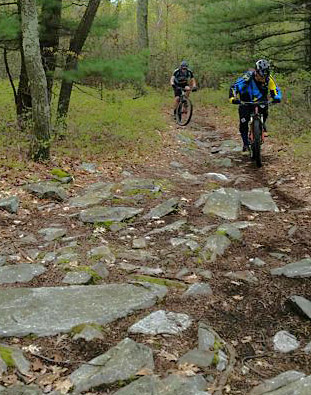
Trails at Rothrock require some technical skills.
Credit: Pat McCloskey

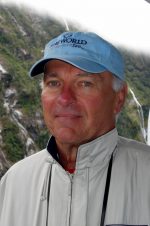
Nothing like a road trip with 23 of your mountain biking friends to State College, Pa. aka “Happy Valley”.  Our merry band of warriors converged on the Hilton Garden Inn and prepared for three days of riding the challenging terrain of the Rothrock State Forest.  As one of two “senior riders”, I was a little hesitant seeing that it was early spring, and my conditioning was not quite there yet.  But as the first climbs of the first day ensued, it was eat or be eaten with this group of very accomplished riders.  Rothrock has many ride options for different skill levels including gentle fire road climbs, but it also has some of the most challenging terrain in the east.

Our first day was spent near the Tussey Mountain Ski Area with a climb that led to the Tussey Mountain Trail which gave us great vistas looking over “Happy Valley” and the remote mountainsides of Central Pennsylvania.  The rocks and boulders along the trail kept the full suspension bikes busy; most of the riders have gone with the new technology of mid-fat 3-inch wide tires with loads of suspension.  Many of the riders used fat bikes to help absorb the punishing grind of the rocky terrain.

Only two seniors in this group of mountain bikers for this early season rally.
Credit: Pat McCloskey

The second day was spent with our guide Craig Matthews, at the Coopers Gap area which is directly over the mountain from where we rode on Friday.  This area is remote, but the trails are superbly maintained by the local hiking and mountain bike clubs of the State College area.  One of the highlights of Day Two was the “Beautiful Trail” which lived up to its moniker with rhododendrons in bloom lining the relatively level ridge top terrain.

Our last day was back at the Tussey Trails with a side trip to Lemont, PA to hike Mt. Nittany.  A beautiful early morning hike that was welcomed by a smaller contingent of the group with a stop at the quaint and peaceful Café Lemont. Here you can rest on a relaxing outdoor patio or beautifully appointed living room with a freshly brewed coffee of your choice accompanied by homemade pastries and granola cereals.

As the “senior guy”, I made it through and am looking forward to another trip in October where the leaves will be ablaze and the Central Mountains of Pennsylvania will be vibrant with the fall colors.  Just have to maintain the fitness level for that one over the summer.

If you go, the Hilton Garden Inn in State College is very accommodating to mountain bikers.

Ride Support is available from two very good bike shops:

Freeze Thaw Cycles: Rentals and all mountain bike related clothing and accessories available.

The Bicycle Shop: Specialized dealer with rentals and all bike related clothing, and accessories.

Buy the Purple Lizard Map of the local trails.  Available at both shops.  And ask the shop guys for a ride or rides that fit your needs.

From the top of Mt. Nittany, Penn State’s namesake.
Credit: Pat McCloskey
Suzie In The Selkirks

Run After Run Of Perfect Powder For Five Straight Days. Snowcat Skiing At Its Best.

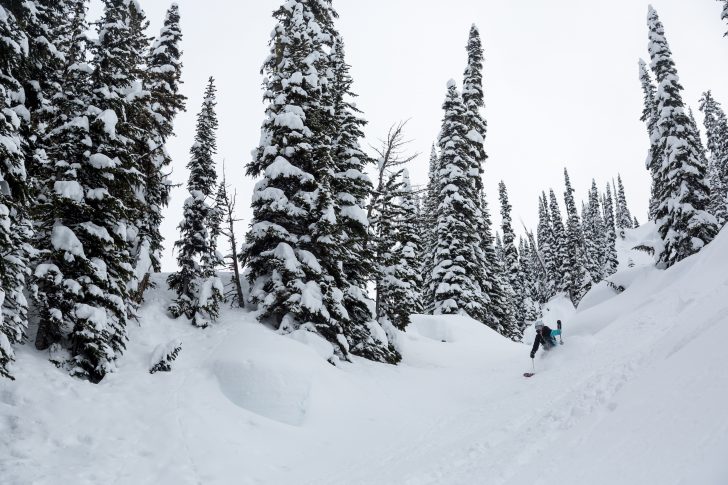
Correspondent Suzie Winthrop found fresh powder every day. Can you see the smile on her face?
Credit: Steve Shannon

Do you dream of skiing in untracked powder?  Of course! We all do!  And most of us get one or two runs at resorts that offer “fresh tracks” early in the morning before the snow cats groom the trails. But soon you’re plowing through broken snow and by noon those freshies are a distant memory.

Snowcat skiing is a unique, albeit pricey experience with fresh powder every day.
Credit: Selkirk Snowcat

How about skiing run after run of perfect powder for five straight days? Run after run of power up to your knees, day after day. Impossible, you say. Well, this past March a group of us found Nirvana in the Selkirk Mountains of British Columbia.

It snowed every night.  In the morning, our tracks from the previous day were nowhere to be seen. We accessed the terrain by snowcats which accommodated 12 skiers plus two guides.  The powerful machines were cozy, comfortable and allowed for good conversation as we chugged up the mountains.  The pace was just right; we had time to catch our breath between the ten or eleven runs we took each day.  Fifteen to eighteen thousand vertical feet of downhill per day was more than enough to send us back to the comfortable lodge exhausted and happy.  After a soak in the hot tub, a drink at the bar, a delicious homestyle dinner and a few rounds of “Grunge” at the pool table, it was time to call it a night. After all, we would be awakened at 6:30 a.m., stagger in to our 7:00 yoga/stretch class before enjoying our hearty breakfast and then head out to yet another day of perfect powder skiing.

Selkirk Snowcat Skiing is located in Meadow Creek in the SE corner of British Columbia, 60 miles north of Nelson.  We flew to Spokane, rented vans and drove to Nelson where we spent the night at the Hume Hotel (“Antique, Chic, Boutique”).  While in Nelson, we checked out Whitewater Ski Resort which offers a Super Senior ticket (75+ ski free) and looked like a great place to get your ski legs.

[Editor Note: Rates for 2017-18 range from $2,000-$6,000 per guest. If you’re interested, better check for availability.  Repeat visitors book early.]

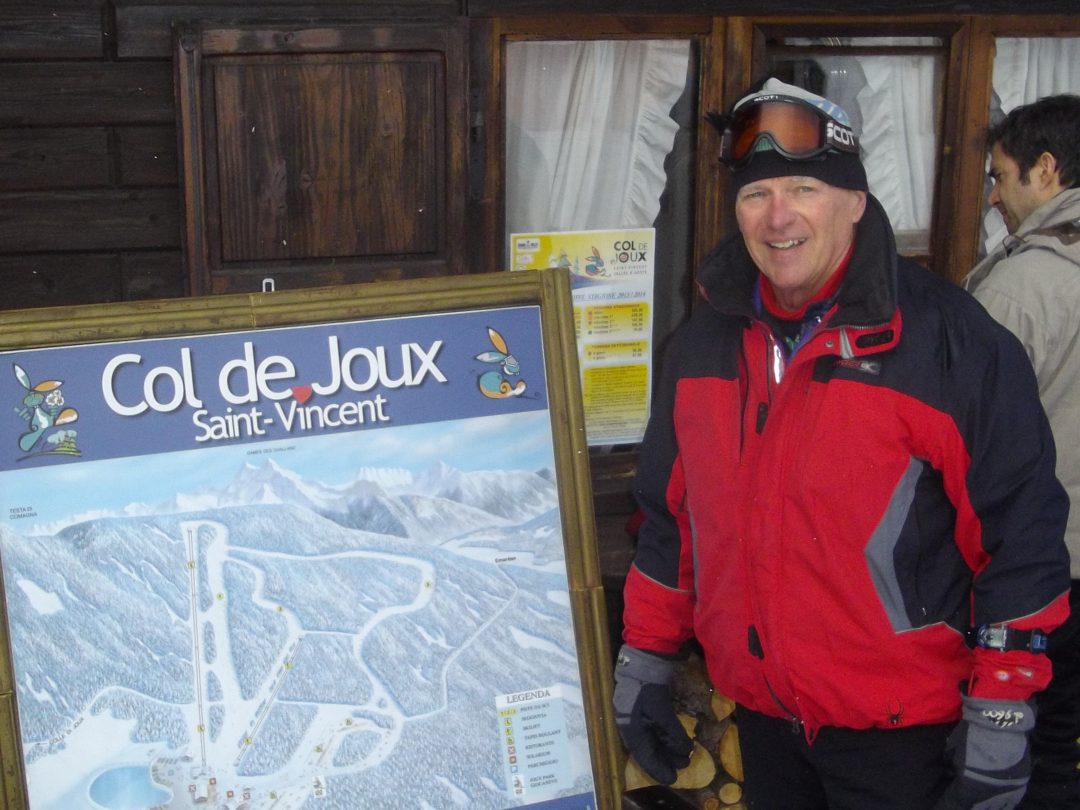
SCol de Joux ski area

Skiing 1,241 Ski Areas Around the World

Everywhere There’s Snow. (And Some Places Where There Isn’t.)

Reader Richard Pazara has skied almost everywhere on the globe, and he’s still going.
Credit: Richard Pazara

You can’t have a favorite place until you’ve seen them all. That seemed reasonable to me, so when I started skiing back in 1973, I wanted to favor new locations over ones that I had already skied. My general plan is to fly somewhere, rent a car and stay in a centrally located non-resort town and drive for less than hour to different ski hills. Definitely not ski-in ski-out.

Since retiring in 1994, I’ve had the time to accelerate that effort.  At the end of this season, I have a total of 1,241 different ski areas in 31 countries which includes 432 in North America, 560 in Europe, 203 in Japan and 30 in the Southern Hemisphere.  The experience differs greatly based on local culture, ski area marketing philosophy and, of course, topography and climate.

How does lunch in the French Alps compare to the cafeteria line at your local resort? You kidding?
Credit: Richard Pazara

Truth be told, in terms of sheer numbers such as vertical drop, number of lifts, on-mountain restaurants and miles of runs, the Alps come out way ahead over North American resorts. In the Alps, an area with 1,500-2,000 foot vertical and five-seven lifts will have a day price of $35-40.

For example, Trois Vallees in France with a 7,000 foot vertical with 375 miles of runs is serviced by 143 lifts and has a $65 day ticket price. Add the incredible views of the Alps and excellent food and wine, and it’s really an memorable experience. And yet, most North American skiers I have spoken are totally surprised by these numbers.

Outside the Alps, European skiing becomes much more moderate with hundreds of small T-Bar areas in Germany, for example.

Scandinavian skiing reflects the hardiness of Scandinavians. Go to Salen, Sweden and see pop-up campers in the parking lot in 5 degree F temps. Or go night skiing  at 9:00 am at Levi in Kittila, Finland  (in January there is no day) when it’s -4 degrees F and be told it’s better than last January when it was -60 degrees F.

Ski Dubai is an indoor experience. And cool (17 degrees F)
Credit: Richard Pazara

Japan had the most ski areas of any nation, but the total has been in steady decline for several years. Skiing in Japan which boasts heavy snowfall and some significant mountain complexes is still mainly a social phenomenon.  Not uncommon to arrive on the weekend to a totally full parking lot and see no lift lines as a large portion of the young snowboarders are there to see and be seen, not to make a lot of runs.

The infrastructure is Japan is also different.  In the southern part of the main island Honshu, ski areas have ice plants installed on the mountain. That’s right; it’s too warm to make snow with air and water, so ice is made and crushed to cover the slope. I skied one spring on a 1,500 foot vertical snow cone. Japanese lift people are almost always older men who bow as you exit the lift every time. When it’s snowing, the chairs are always swept clean before you sit down. And there will be an air compressor by the lodge to blow off any snow before you put them away. The Gala Yuzawa lodge has a gondola entry at one end and the bullet train station (from Tokyo 115 miles and 100 minutes away) at the other end.

There are also ski areas in unsuspected places. Morocco has Oukaimeden in the High Atlas (14,000 feet) where I was offered a donkey ride to the lift by a local boy. Dubai has an indoor ski area in a mall. It is kind of odd to be quite cold after a two-hour session in a thin rental ski suit at Ski Dubai where it’s 17 degrees F inside and 107 degrees F outside.

Skiing in the Southern Hemisphere is a joy. Driving a circle route in Chile and Argentina was quite an adventure with some wonderful skiing. Australia has Theadbo and Perisher Blue among other resorts which are quite nice with some very unique twists. I think of Eucalyptus trees as tropical but the Snow Gum tree is a hearty winter variety.  Seeing them and wombats and kangaroos on the drive to the hill is still amazing to me.   New Zealand has some real mountains, and the chance to ski the Tasman glacier on the spur of the moment was a thrill.

So I have enjoyed a lot of different places in all conditions, from unbelievably good to unbelievably bad. I have some places I prefer, but I’m not done yet, so I can’t have a favorite place until I’ve seen them all.


How Do Ski Trails Get Their Names?

Themes That Pick Up The Resort Name Can Be Catchy And Easy To Remember.

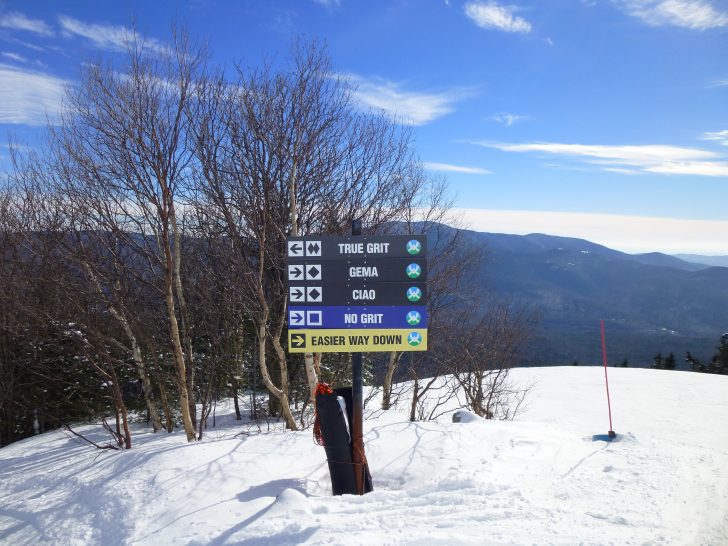
What’s in a name? A few resorts create a theme for trail names. Memorable. Cutesy. Provocative (?) Here’s a trail sign from Waterville Valley Resort.
Credit: Don Burch

Sometimes trail names are descriptive (Easy Mile at Suicide Six), sometimes they are a tribute (Thanks Walt at Mt Snow for its founder Walter Schoenknecht), sometimes they’re humorous (True Grit and No Grit at Waterville Valley), sometimes sensational (Widowmaker at Sugarloaf and Snowshoe) and at several mountains they follow themes. What follows are ski areas where some or all of the trails are themed-named. (This article sourced some of these factiods from a Boston Globe article, What’s The Most Popular Ski Trail Name In New England?)

Gore’s trails are named after Adirondack local sites. The 46er trail is named after the 46 high peaks in the Adirondacks, and the Tahawas trail is named after a ghost town in the area.

Guess where? Wildcat, of course.
Credit: Don Burch

At Wildcat, trails have feline names like Wild Kitten, Polecat and Hairball.

Pat’s Peak trails have names related to types of wind including Tornado, Backdraft, Squall Line and Vortex.

Camden Ski Bowl, within five miles of the ocean, has nautical themed trail names such as Spinnaker, Crow’s Nest, Scrimshaw, Mainsail Glade and Clipper.

Mt Abram’s trails are named after the Rocky and Bullwinkle Show. These include Dudley-Do-Right, Boris Badenov, Snidley Whiplash, Fractured Fairytales and Frostbite Falls. Wonder how that happened?

Whaleback has trails named Leviathan, Fluke, Blow Hole, Blubber and Harpoon.

Many of Saddleback’s trails are fly-fishing themed. Examples are Jitterbug, Wooly Bugger, Gnat, Nymph, Tight Line and Warden’s Worry.

King Pine’s trails are, of course, related to pine trees and their products. Pokey Pine, Pine Board and Knotty Pine are examples.

Many of Loon’s trails are terms from the logging industry; Flume, Ripsaw, Crosscut and Walking Boss.

Oz Peak at Sunday River has trails named Flying Monkey, Tin Woodsman, Emerald City and Poppy Fields.

Gunstock has trails named Trigger, Ramrod, Flintlock, Recoil and Pistol.

Magic Mountain has trails named Magician, Hocus Pocus, Wand, Up Your Sleeve and Wizard.

What’s your most notable trail name?

Alta’s GM Onno Wieringa Retires

He’s Loved And Will Be Missed.

Credit: Harriet Wallis

Onno Wieringa has a passion for snow and for the soul of Alta. They have been his love and his career for 45 years.

He arrived at Alta Ski Area in 1972 and landed a job as ski patroller. That was his day job. At night, he was a bartender at Rustler Lodge.

After five years on patrol, Onno was promoted to snow safety director and served under Alta’s second GM, Chic Morton. In 1988 Chic was ready to retire and called on Onno to take the reins. Onno leaves a legacy for Alta to emulate for years to come.

Click for videos of Alta and Onno. http://www.alta.com/snow-and#

To read more from Harriet click here for her stories on SkiUtah.

The Case For The Local Ski Area

So It’s Not The Rockies.  But What Makes Mom-And-Pop Special?

Ski Butternut in the Berkshires: All you need for a fun day with friends at a typical local area.
Credit: Ski Butternut

[Editor Note: As we are seeing in a month of startling industry news, the ski business is rapidly consolidating.  Big corporations are buying portfolios of resorts.  Vail has added Stowe to its collection. Aspen and its private equity investors, KLS Capital Partners are plucking up Stratton and Mt. Tremblant, among others. Other consortia have been formed or are forming. Where does this leave the mom-and-pop local area, probably closer to home, less exciting facilities, average food, but nicely discounted mid-week tickets for seniors? This is an important question in an industry that is moving away from smallness.] 

Support your local ski area. You know the place. It’s likely the place you learned to ski at and/or where you brought your children to teach them. If you have grandchildren, its the place you are bringing them to ski. It’s likely the ski area is privately owned and supports the surrounding area by employing local workers. Simply put, we go to local ski areas to ski. We don’t go to see others or to be seen. We don’t go for après ski activities or plush lodging.

Small is better? Accessible, economical, family-friendly, local ski areas have a community feeling.
Credit: Ski Sundown

We need to support our local ski areas by skiing at them. Increasingly smaller mountains are being bought by corporations or going out of business. Local ski areas are by definition closer to home, they are less crowded and have less expensive lift tickets. Midweek skiing at one of my favorite areas, Ski Butternut, in Western Massachusetts, is $25 for all skiers! Every season, I make it a point to ski at Butternut and several of my other local ski areas, and each time it’s a wonderful experience.

Aesthetically my local ski areas fit into their surroundings rather than dominate them.

When I go to my local ski area, I don’t race there. I know I’ll park close to the lodge, I won’t have to wait in line for tickets or in lines to get on the lifts. The entire day is more relaxing. I know I’ll get plenty of great skiing, and I don’t have to jockey to get a place in line or compete for a table to have lunch at. I do less racing down the mountain (though I can do that if I want) and spend more time stopping, looking at the scenery or talking to people. I feel safer skiing at my local area because there are few, if any, rude or aggressive skiers. While skiing, I don’t have to keep looking over my shoulder to make sure I’m not going to get run over.

It’s a more relaxing day, because everything feels manageable. First time visitors are not going to be confused about where to park, how to get to the lodge or what trails go where. At the end of the day, families don’t have to worry about finding their children because everyone ends up in the same place. Since local ski areas are less overwhelming and feel safer, parents are more likely to give children the freedom to ski on their own. As a child, one of my favorite memories was being allowed to ski with my friends and explore the mountain without our parents.

Because I skied these areas as a child, I get the added benefit of a wonderful sense of nostalgia. When traveling, I’ve also had great fun skiing at independently owned mountains that I’d never been to before.

Spend a day or so exploring a local ski area and experience the charm and fun they have to offer. Just take a look at a small sample of season pass senior deals for next season:

Ski Butternut, Western MA: $175 (70+)

Ski Sundown, Northwestern CT: $109 (70+)

Catamount: Eastern NY: FREE (80+), before 6/1 $150, before 9/1 $155 (70-79)

What’s your local area? How are the deals shaping up for seniors?


Master’s Week At Big White: Senior Focused Lessons And Activities

Big White Found The Right Formula To Attract Seniors For A Special Week Just For Them.

Ski lift with view of condos. Credit: Big White Ski Resort.

Like so many things of yesteryear, ski weeks are making a comeback.

And not surprisingly, they’re aimed at the same folks who went ski trips back during the ski week heyday in the 1970s and early ‘80s—the Boomers.

The original ski week hit when the baby boomers were yesterday’s millennials. They had money, they were skiing, they wanted a fun social experience.

Then boomers started having families and taking an entire week no longer worked. So short, specific clinics (racing, bumps, women’s) that lasted only a long weekend, took over.

But why have ski weeks returned?

Women in Big White Ski Resort Masters ski program show off their green hair helmet decorations. The program runs a week with lessons in the morning and social programs at night. Kelowna, BC.
Credit: Yvette Cardozo

Because the kids have grown up, the money is available and so is the option of taking a week. Plus, it’s, well, your own age group. No trying to keep up with someone 30 years younger.

“It started as 50 Plus in 2011,” said Katie Balkwill, regional sales manager for Big White Ski Resort. “We ran it that way with very small numbers until 2013. Then we changed the name to Seniors Ski Club—and no one came the following week.

“So we changed the name to Masters Monday and had 30 participants the next week. We average 45 people every Monday for most of the season now.

“It truly is all in a name.”

As for Masters Week, it has grown steadily from 23 participants the first year (19 of whom have returned) to 59, then 109, then last year, 229 split between into two weeks, and after the second session, a third was added for the end of the season.

 And so, I signed up. We would ski together each morning and have a variety of social programs in the afternoons or evenings.

Since we had all filled out forms suggesting our ski level, we separated into skill groups the first morning ranging from novice to expert. After a bit of shuffling, we were set for the week.

Instructor at Big White ski resort shows an exaggerated proper stance for skiing.
Credit: Yvette Cardozo

Our group, Level 4 of 6, was perfecting its stance, getting more aggressive on our turns, and playing a bit in the year’s epic powder.

Anthony, our instructor, tailored exercises to each of the five in our class.

For Sandy, it was ski down holding poles horizontally in her hands which, Anthony said, helps you lead the turn with your lower body. Her upper body was turning into the hill, which throws you off balance.

For Norm, it was a “prayer stance” holding his hands together in front of his chest. This balances you and helps you lead with your legs, rather than your upper body.

For me, it was making sure I looked downhill when turning, not to the side—again, helping with balance.

And for all of us, there was a maddening exercise where we dragged our downhill pole along the snow, which truly is not intuitive. This gets you onto your downhill ski throughout the turn, Anthony insisted.

And, well, it did.

It snowed every day but on two mornings, fog settled in.

We all gulped, shrugged, and took off for lessons on how to deal with a whiteout.

We headed for the Black Forest chair whose medium width trails were lined with trees heavily frosted in Christmas card snow.

Ski along the trees, Andrew said. And sure enough, there magically was definition in the snow at our feet.

Don’t look at your skis, he added. Yes, it’s scary to peer into the white void, but find something ahead—another skier, a line of trees, a pole, a lift, and keep your eyes on that.

It absolutely helps avoid vertigo and, of course, falls.

I had truly hoped that last day we could find some steep cruisers along one of the outlying chairs and some untracked powder but the fog and near blizzard conditions squelched that.

Instead, I took the lessons home where, yes, it all made a huge difference.

Information

Big White Ski Resort’s Masters Week is actually five days, Monday through Friday. There are on-slope lessons each morning, then social activities in afternoon or evenings.

For 2018, Big White is planning at least two Masters ski week programs, Jan. 29 – Feb. 2 and Feb. 26 – Mar. 2, plus possibly a third at the end of the season.

Price for the week (lessons, clinics and most social activities) will be $278 Canadian. Canadian dollars have run about .75 per US dollar for a few years meaning $278 CDN works out to about $208 US.

There are also Masters Monday classes, held each Monday morning, for people who don’t want to commit to an entire week.

Early morning view of Big White Ski Resort village ski runout on a sunny day. Credit: Yvette Cardozo

Master’s Week At Big White: The Social Side For Seniors

There’s More Than Ski Clinics For Seniors That Make Big White’s Master’s Week Unique.

Sleigh ride at Big White Ski Resort. One of many non ski winter activities.
Credit: Big White Ski Resort

[Editor Note: Correspondent Yvette Cardozo also reported on Big White’s Master’s Week focusing on the ski instruction elements.  Here, she shows us the social side which really looks like a lot of fun.]

The social part of the Big White Ski Resort Masters Week is what made the experience different.

Those of a certain age who skied in the ‘70s and ‘80s will remember the original ski weeks. Some were run like summer camp and at least one (Gray Rocks in Quebec) came off like a cruise ship.

Jolly time at Masters Week apres ski party at Big White Ski Resort. The Masters program is aimed at skiers of all levels over the age of 50.
Credit: Yvette Cardozo

You skied together, you ate together, you made long term friends.

And now, the old fashioned ski week is back and aimed squarely at the folks who made it a success decades ago—the Boomers.

Okay, the ski weeks I remember from yesterday had us on the slope ALL day with a brief break for lunch. My knees are long past that.

 Instead, the Big White Ski Resort (Kelowna, BC) Master’s Week has on-slope work in the morning, then social stuff in the afternoons or evenings. There is also a Masters Monday, aimed more at locals but also including folks who don’t want to commit for an entire week.

And this certainly has hit a chord with people

The first day of my week, when we were joined by the Monday only groups, the resort was expecting perhaps 130 for lunch. Nearly 200 came (many signing up just that morning). There was quite a scramble for food, but nobody went hungry.

Dizzy of Dizzy’s boot fitting shop at Big White ski resort shows off an early 1970s ski boot that boasted fantastic ski technology that, sadly, was ahead of the boot’s ability to support it. The boots famously would come apart during skiing.
Credit: Yvette Cardozo

This reflected what has been happening with the five-day ski weeks, which grew from 23 people a few years ago to 229 last year spread across two sessions before adding a third session at the end of the season.

Each day after class, there was something—a clinic, apres ski, a sleigh ride.

One night, we met for beer and pizza at Dizzy’s Ski & Board Shop where Lindsay Bennett (aka Dizzy) talked about ski gear.

Along shelves in the shop sat hundreds of old boots, some from the 1940s, each representing a tech breakthrough. His fav is an early 1970s orange Scott boot that was truly revolutionary … and fell apart when the plastic couldn’t keep up with tech.

 Boots are, Dizzy said, the single most important piece of equipment you can own. A decent boot will last for 200 days of skiing. And custom foot beds are perhaps the most important thing you can have in a boot, he added.

No one knows that better than me. Slower than most to catch on, I spent a decade trying to figure out how to turn at all. Then someone noticed my board flat feet. I splurged on custom footbeds, headed for a lift and in the space of 30 seconds went from struggling novice to solid intermediate. I had been making the right moves all along but my feet weren’t connecting with the boots.

 A few tips—get ski socks. They’re a blend that keeps you warm without being too bulky. Don’t pull the liner out of your boot each night. Electric boot dryers will do a better job. And park your boots up high for the night (where air in your room is warmer).

 I went into the shop the next day and an added thin innersole and heel lifts helped my aging boots fit snug again with the added benefit of tipping me forward just a bit more.

The next night, my friend Kay and I went on the dinner sleigh ride, riding in a large sled pulled by two beautiful Clydesdale horses through a magic scene of snowy trees and swirling flakes. Dinner was both gourmet and rustic—chicken cassoulet and bison ribs. We bonded with our seat mates, who produced bottles of good red wine and topped it all off with mini cheesecakes.

 Our final gathering was apres ski at an Irish pub with good munchies, great beer and wonderful memories.

Information

Big White Ski Resort’s Masters Week is actually five days, Monday through Friday. There are on-slope lessons each morning, then social activities in afternoon or evenings.

For 2018, Big White is planning at least two Masters ski week programs, Jan. 29 – Feb. 2 and Feb. 26 – Mar. 2, plus possibly a third at the end of the season.

Price for the week (lessons, clinics and most social activities) will be $278 Canadian. Canadian dollars have run about .75 per US dollar for a few years meaning $278 Cdn works out to about $208 US.

There are also Masters Monday classes, held each Monday morning, for people who don’t want to commit to an entire week.

Big White ski resort base village.
Credit: Big White Ski Resort

Snow Pack In California: This Says It All

Lots And Lots And Lots Of Snow.

PBS posted a Plant Labs video comparing the snow cover from 2015 to 2017.

And we understand there is more snow coming this weekend to the High Sierra.  It’s April, folks.


Ski Areas Versus Ski Resorts

There Is A Clear And Distinct Difference. Which Is For You?

Hangmans at Mammoth. Pat calls the big mountain a hybrid between corporate and local.
Credit: Pat McCloskey

Just returned from my annual ski adventure with my group of guys from all over the country.  We all converge on our friend in Tahoe and enjoy the Tahoe areas and then head to Mammoth to end the week.  Have to tell you folks, there is a lot of snow left out in the Sierra.  Most likely skiing at least until Memorial Day for many Tahoe areas and Mammoth is reputed to be skiing well into July.  We had a lot of interesting conversations on the lift about our experiences at the corporate ski areas (Northstar at Tahoe), the local community supported ski areas( Mt. Rose, Nevada), and the hybrid – Mammoth Mountain, which has the feel of a ski area even though it has a large village which has that corporate resort feel.

No doubt about it. Snowpack in the Sierra is 160% of normal.
Credit: Pat McCloskey

We love Mt. Rose.  It is definitely the local area for the skiers of Reno and they take pride in the fact that it is there primarily to service the day skier.  Where else do you get 25% discount on food if you are a season pass holder?  They have specials on daily lift tickets like “Two fer Tuesdays”—two lift tickets for the price of one.  Ladies day is Thursday, and they also offer a discounted ticket if you show up the day you flew in.  I came in from Denver and was on the chair by 11:30 with a $59.00 ticket.  Pretty reasonable.  Good skiers at Rose, and most of them are either local Reno skiers, retired folks who ski there regularly, and visitors who stop to ski there on the way to Tahoe’s other areas.  The Chutes are pretty special, too, with challenging runs serviced by a chair that brings you back to the main Slide area.

When you ski Northstar at Tahoe,  you can definitely sense that corporate-ish Vail feeling.  Very chic, lots of shops and restaurants in the base village which is surrounded by well developed condo complexes. Bring your wallet because most things like food, lift tickets, and lessons, are pretty pricey as per the corporate ski resort theme.  There is a lot to be said for the ambiance created by Vail and the logistical expertise to bring good food, grooming, and snowmaking to a mountain for all to enjoy.  But a different feel altogether.

Finally, Mammoth is what I call a hybrid.  My friend always parks early in the lot by Chair 2, where we change into our boots. My father in law would call us “trunk slammers” –like the guys changing their golf shoes in the parking lot. Heading up to McCoy Station and ultimately to the Summit, we avoid most of the village rush by parking in this removed location. Most of the people are regulars.  Like Mt. Rose, there are enthusiastic Mammoth loyalists who ride the gondola all day long reveling in the epic conditions.  Again, more of a locals area than the more corporate resort areas.  People drive five hours plus from the LA area and also from the Bay Area to get there.  Ticket deals and lodging are best located on line. A little tip if you go, we ate at Giovanni’s Pizza in the Timber Ridge Resorts property—437 Old Mammoth Road.  Really good Italian food and reasonably priced.  We liked it so much, we ate there every night.  Typical senior skier behavior.

So, all in all, when visiting the Sierra as a senior skier, you have a lot of choices.  But we tend to like the ones that cater to the skier rather than the resort dweller.  But that is just us.  Go and enjoy it.

Pat (second left) and his mates who take an annual trek to the Sierra. This year they found big snow.
Credit: Pat McCloskey

Haystack MT Hermitage ski area

Private Ski Area: A Warm Visit to the Hermitage Club on a Frigid Day

What’s It Like To Visit A Members-Only Resort? Find Out How You Can Do It.

Well-tended trails, bubble chair and low traffic trails are benefits of Hermitage, a private ski resort in VT.
Credit: Hermitage

On March 12 — zero degrees, wind whipping — my ski companion who had never ridden a bubble covered, heated-seats six-pack commented, “This lift is a spoiler.” Anita doesn’t do well in the cold, but thanks to the Barnstormer these two seniors skied for two hours before heading in for Mimosas and lunch in the Hermitage Clubhouse at Haystack Mountain, VT.

No, we didn’t pay the $85,000 joining fee and $8,500 annual dues to ski what she called “best conditions I’ve skied this winter.”

We were guests of Hermitage. Anyone can enjoy this delightful private ski area as a guest of a member of the Hermitage Club. You also have access by booking a room at one of the Hermitage properties in the Deerfield Valley area — White House Inn, Wilmington; Inn at Sawmill Farm or Hermitage Inn, in West Dover; Snow Goose Inn, Dover; Brook Bound Inn or Vermont House in Wilmington.

There’s a limit of one ski-guest package a year so think about snow conditions and check out these lodgings.  Consider a two-four day ski-and-stay for a unique experience — un-crowded slopes, no lift lines, and VIP treatment. (You can also be a guest by considering membership.)

Delightful Day, Warm Experience

Base lodge at Hermitage features great food, comfortable and space.
Credit: Peter Hines

As we arrived, I was directed to guest parking from whence a shuttle van ferried us up to the Clubhouse. We booted up in a carpeted guest area with cubbies for our boot bags, picked up our skis from the rack, and boarded the Barnstormer.

This Doppelmayr express lift accesses the summit in six protected-from-the-wind minutes. By the way, even though a sticker says, “open the bubble before the station”, you don’t have to lift a finger — bubble and footrest go up automatically at the unload platform! Talk about senior heaven!

We found packed powder on Upper and Flying Dutchman and side trails, Ventura Highway (a green roller coaster), and my blue favorite of the day Last Chance.

While the Witches Triple, which accesses some wide steeps, was running, I didn’t revisit my favorite trails there because we needed the warm Barnstormer lift — our experiment of not pulling down the bubble didn’t last too long — viva la difference!

Hermitage Club inhabits the Haystack Mt. as seen across the Deerfield Valley, VT.
Credit: Hermitage

We sampled a fabulous brunch spread of lunch and breakfast items — waffles, omelets, raw bar, salads, meats, potatoes, etcetera. We topped fresh berries with real whipped cream for a great dessert — yum.

After another run we skied the Tunnels Trail to the learning area below the lodge. What fun to see little kids safely learning on wide trails away from the schussboomers!

“The vast majority of our members are families with children; they love skiing, and they love skiing together. They are comfortable that their kids are safe on the mountain and appreciate the sense of community and a feeling of going to a second home,” explained Brendan McGrail, director of communications for The Hermitage Club.

With 46 trails, 194 skiable acres, 5 chairlifts, handle tow, separate beginner-area, 1,400-foot vertical, magnificent Clubhouse, valet service and more, it’s easy to see why families love this special area, and, if you have the swag, it’s worth checking out! Learn more at hermitageclub.com and bring the grandkids!

Club house, aka Base Lodge, at night. Note corduroy.
Credit: Hermitage

New England Ski Industry And Climate Change

The Facts Are Tough To Face, But The Ski Season In New England Is Getting Shorter.

Spring Skiing 2016, somewhere in New England.
Credit: Mike Maginn

This story comes via the New England News Collaborative, and was first published by Maine PublicIt aired on WBUR Boston, March 15, 2017.

Two years ago during the infamous 2014-15 season, there was enough snow, it seemed, in New England to cover Mt. Washington many times over.  The 2015-16 season was the opposite; we were lucky to get a string of decent days and many resorts closed early.  This season, it was on-again, off-again, with an on-again storm at the beginning of March that will definitely extend the season.

This up-down trend is part of a bigger picture that is reported here in a WBUR Boston NPR Radio segment that we are passing along.  Although the tone is frank and a bit foreboding, the entrepreneurial spirit of mountain business people is encouraging, especially when they talk about plans for the dealing with what’s coming.

CLICK HERE TO LISTEN TO THE SEGMENT OR TO READ THE TRANSCIPT.  It’s about five and a half minutes long, or you can read a transcript in the link.

What do you think? Will summer activities on mountains run by ski resorts be viable business alternative and money maker?

SeniorsSkiing Guide: Bogus Basin Not Your Usual Local Ski Hill

This Non-Profit Ski Area Is Community Owned And Prices Reflect It.

View from the top at Bogus Basin, the ski resort outside Boise, ID
Credit: Yvette Cardozo

Bogus Basin outside Boise, ID, is the local ski hill. But it’s not your usual tiny, rustic, over run local hill.

“What you get here is destination skiing at local prices,” said General Manager Brad Wilson. “Our lift tickets are $59, our ski rental package $30, our burgers are $7. We’re able to do that because we are non-profit. It’s community owned.”

Skiing couple takes a selfie at Bogus Basin outside Boise, ID.
Credit: Yvette Cardozo

Indeed, the size might make it a destination hill in many places. It is second largest in Idaho after Schweitzer. But the vibe is definitely local, families doing box lunches, school buses loaded with local kids, night skiing seven days a week.

“We see people from Texas, from Florida but this is not our focus because we have so many local people to draw from.

“The quality of our skiing is equal to destination areas but there’s no granite in the bathrooms, and our chefs aren’t wearing tall hats.” Wilson added.

Why, then ski Bogus as a visitor?  Because it’s 40 minutes from Boise. If you are flying in to ski elsewhere, say, Brundage and Tamarack near McCall, or Sun Valley, odds are you come through Boise, a vibrant, fresh new city. So it makes sense to spend a day or two, and also perhaps a day skiing Bogus.

Snow, Terrain And More

Location: Bogus Basin is 16 miles north of Boise, ID, which is towards the southwest end of the state. It’s about a 40 minute drive from downtown. The city is in the midst of a construction boom with 800 new hotel rooms expected by next summer. The ski area draws from the entire “Treasure Valley,” some 700,000 people from Boise and surrounding towns.

Snowfall: 200 – 250 inches a year.  Four “fan guns” fill in where snow is sparse in early season.

Terrain, lifts: Three detatchable high-speed quads, a triple chair and three doubles, along with  a conveyer belt for beginners, serve the 2,600 skiable acres. There are 78 named runs. Eighteen percent are easiest, 42 percent intermediate, 40 percent expert. Free mountain tours are offered weekends at 10:30am and 1:30pm.

Vertical: 5,800 feet at the base, 7,582 at the top, resulting in just shy of an 1,800 foot vertical drop.

Nordic & more: 37 km of groomed Nordic trails for day skiing, 7 km for night, 12 km for winter fat bikes and snowshoes. Frontier Point Nordic Lodge has a gas fireplace, equipment rental, ticketing office and waxing bench.

Lot to Lift Access:  Seven parking lots with ski in-ski out access, more with shuttle service.

Public transportation: Roundtrip buses with stops in Caldwell, Nampa, Middleton, Star, Eagle, Meridian, Boise State and various Boise locations through bogusbasin.org or Caldwell Transportation Co. (208) 459-6612

Accommodations: No on slope lodging.

Culture:

The Vibe: This is a local hill on steroids. Not wild and crazy but, rather, casual, friendly, but much larger than you expect. Since most skiers here are locals, they ski well and know the mountain. Ride a lift with one, and he/she will give you tips on getting good snow.

Dining: Of the three lodges, two have grills, bars or some sort of food. These include the J.R. Simplot Lodge at the base and Pioneer Lodge on the upper mountain.

Mountain Life: Snow, snow and more snow. Alpine and nordic skiing, fat tire cycling. You don’t come here to lounge in front of a fireplace in expensive duds. You get out and go, then come in to rest, then get out and go some more.

Trail Map click here

Webcam and Conditions click here

SeniorsSkiing Guide:Tamarack’s Cruising Ground Is Wide Open

Almost Down And Out, This Resurrected Resort Returns As A Bargain For Senior Skiers.

The base at Tamarack Resort with sports and cafe domes and a snow rainbow.
Credit: Tamarack Resort

Tamarack is the original comeback kid.

It opened in 2004 to great fanfare and serious celebrity cred, the first new ski resort in the US since Beaver Creek in 1980. With tennis star Andre Agassi and wife Steffi Graf at their publicity helm, the idea was to focus on real estate. 
And for four years, this worked.

Skiing powder at Tamarack, Donnelly, ID., near McCall.
Credit:Tamarack Resort

Then came the recession; the resort was forced to close for a year and one ski lift was repossessed (a helicopter actually carried it away). 
  It took years to sort out the financial problems, which finally, were laid to rest in 2014.

And now, the homeowners have taken over, the lifts are running, the grooming could be mistaken for Deer Valley manicuring, and you can ski on a budget ($69 adult, $44 senior) while feeling like the place belongs to you and you alone.

Today, the resort remains in a somewhat half finished state. The original village was never completed (you can see uncovered Tyvek on the side of the unfinished lodge), and the base lodge consists of “temporary” domes covering the sports shop and restaurants.

And while powder hounds are not disappointed, what truly makes this place shine is cruising that will never, ever, put you to sleep. No straight down the fall line, yawn stuff, the cruisers here twist and turn, drop over unexpected humps, sift through widely spaced trees and, heck, are adrenaline fun.


Snow, Terrain and More

Location: Tamarack is in Tamarack, ID, close to Donnelly, ID, about 20 miles south of McCall, and 100 miles north of Boise, in west central Idaho.

Snowfall: 300 inches average.

Terrain, lifts: 42 runs and 6 lifts, including 2 high-speed quads across 1,000 acres of lift- served terrain. 17 percent novice, 45 percent intermediate, 38 percent advanced terrain. Ski season is usually early December to early April. 25 percent of terrain is covered by snowmaking.

Vertical: 2800 feet, top at 7,700 feet, base at 4,900 feet.

Skiing powder at Tamarack Resort.
Credit: Tamarack Resort.

Nordic and more: The Tamarack Nordic Trail system offers a variety of trails that wind through open meadows and forested paths. Choose your own adventure through the groves of Aspen, fir, pine and Tamarack trees on classic or skate skis, fat tire bike or snowshoes.

Lot to lift access: One main parking lot about 100 feet from the Sports Dome that serves as Tamarack’s base lodge. On the rare occasion this fills, there’s a second lot near the unfinished village along the main entrance road. You can also easily walk to the lifts from this lot.

Public transportation: None. You really need a rental car.

Accomodations: Options at Tamarack Resort are numerous and reasonably priced. Hotel rooms during regular season this year were running $150 a night and a four bedroom chalet could be had for $309 (though fees and taxes are extra). These run from the Lodge at Osprey Meadows to cottages, chalets, town homes and estate homes, all located in the resort. For lodging, click here.

Culture

The vibe: Do you want a resort with killer slopes, grooming and powder all to yourself? This IS the place. Sometimes, it’s a bit lonely out there. But, except on school ski days, you don’t have to worry if some out of control boarder is going to take out your shoulder blades. While the “temporary” domes give the place an incongruously rough and ready feel, the service, the food and, yes, the accommodations, are closer to Deer Valley than Bogus Basin.

Dining: Five options for dining running the gamut from burgers and pizza at Canoe Grill to a nice selection at Seven Devil’s Pub at the resort base (don’t miss the stuffed chicken breast).

Mountain life: As with other area ski resorts from Brundage in McCall to Bogus Basin in Boise, you don’t come here to lounge around a fireplace. It’s snow. More snow. Even more snow. You ski downhill. You ski nordic. You snowshoe. You fat tire bike. You don’t sit.

Trail Map click here

Webcam and Conditions click here


SeniorsSkiing Guide: At Steamboat Let Mountain Masters Be Your Guide

Popular Program For Seniors Offers Guided Skiing All Day. For Free.

Mountain Master Guide Steve Cozette (red jacket) herds his charges down Two O’Clock.
Credit: Tamsin Venn

On one of those perfect bluebird Colorado days, I rode up the Gondola at Steamboat (www.Steamboat.com) with a group of women from the Indianapolis Ski Club (www.indyskiclub.org), who thought I was one of them. All us skiers look alike in our goggles and helmets.

They were spending a week here and were on their way to join Mountain Masters, a program at Steamboat for skiers and riders 50 years and over that meets daily at 9 a.m. and 12:30 p.m. right outside Thunderhead Lodge at the top of the Gondola. Mountain Masters replaced the long-standing Over the Hill Gang when Steamboat wished to consolidate senior programs.

Mountain Masters is the only program of its kind in the U.S. that offers free all-day, guided skiing for seniors, according to one guide. You just need to sign a waiver, then head out and join a group: The “mellows” ski intermediate groomed runs, the middle group, the groomed blues and blacks, and the top group, bumps and powder. My new friends, Janet and Marilyn, with whom I buddied up, had been skiing groomed blue all week and wanted to up their game with someone leading the way.

Guide Steve Cozette briefs his charges before a run.
Credit: Tamsin Venn

For fledgling Steamboaters, Mountain Masters takes the guesswork out of where to ski on this mountain with 168 trails and 16 lifts spread over nearly 3,000 acres. But the program is also very popular with locals and many vacationers actually return to Steamboat because of it.

Take Anne Keddie from Dundee, Scotland. Each year, she and her husband spend four weeks at Steamboat, in part because of the program. He snowboards on the gnarly tree runs like Closets and Shadows, while she likes to rip down the groomed blacks.

Why is this so wildly popular?

As one participant said, no one wants to ski alone. Whether you’ve skied the mountain before or haven’t, it’s nice to have someone lead you to the uncrowded spots according to the day’s traffic, plus follow the grooming and sun across the mountain.

And the anecdotes and tips are fun and useful. Don’t try to outrun a moose you see on the trail (“Moose Don’t Shoo”). A bear hibernates off the Hurricane trail. Here’s where the champagne powder is stashed. Get up speed for the connector ahead. Use the Burgess Creek lift when Storm Peak Express is too crowded. Head for the Pony Express first thing in the morning to rip the groomed blacks, or else sunny Sunshine Peak. The north facing Norther keeps good snow on its bumps. Cyclone is the easiest black on the mountain. Four Points has the best food. For luck, touch the shoulder of Buddy Werner’s bust before jetting down Buddy’s Run. That is all invaluable for the first time and regular Steamboat skier alike.

Steve Cozette is our guide today, a very personable, experienced, and knowledgeable skier. He leads our large group with the assurance of a cowboy taking his herd to pasture.

No reservations needed. Just show up. You should be able to comfortably ski blue runs. Group size varies from one or two people to eight or more. Rest breaks for hot chocolate and stops to enjoy the scenery, or to perhaps hear a little local history, are all part of the experience.

Mountain Stats

Base: 6,900 feet

Mt. Werner Elevation: 10,568 feet
Vertical Rise: 3,668 feet

Permitted Acres: 2,965 acres
Trails: 165 named trails
Trail Classification: 14% Beginner 42% Intermediate 44% Advanced
Total Lifts: 16

Annual Snowfall: 349
Snowmaking: 375 acres

Trail Map: Click Here

Web Cams: Click Here

Indie Ski Club members get ready to ski Mountain Masters: left to right:
Anne Kelvin, Laryn Peterson, Marilyn Rader, Janet Zusman, Sue Johnson
Credit: Tamsin Venn


Ski Idaho – Snowmobile To Hot Springs

Idaho has the most usable hot springs in the entire US: 130 springs out of the state’s 340 are “soakable.”

Yes, it’s warm down there underground. The state apparently sits above a massive hot spot that fuels not only this but the springs and geysers of Yellowstone National Park.

So, locals have their pick from rustic pools that are run like swimming holes of the 1950s to private (sneak in spots) to elaborate places that have been visited for well over a century.

In winter, many rent a snowmobile and thrash their way around … something that could be risky if you don’t know where you’re going or how to get there.

Snowmobiling to Burgdorf Hot Springs near McCall, ID. Photo: Mark Schneider.

A new option is the guided snowmobile trek out of Brundage Mountain ski resort through Brundage Snowmobile Adventures ($295 per person per day).

My friends and I met our guide, climbed aboard 800 cc Skidoos and took off.

That machine could climb a wall. It took a bit to figure it out, but soon enough, we were motoring along, cutting into a forest thick with pine, fir and Tamarack.

It was snowing lightly, giving the landscape an ethereal glow. We traveling through a Christmas card during the snowiest winter in 30 years.

The trail took us up foothills, where we stopped at an overlook, then down, finally, to an old pioneer trail. I got my machine up to 50mph on an open stretch, but kept wondering what would happen if I got bounced off.

Thirty-five miles after leaving Brundage, we turned into Burgdorf Hot Springs.

This place is a legend, owned by a local family and operating since 1865. It’s rustic, but has amenities. You can rent a cabin overnight for $40 per person, and there’s a simple cafe for food.

In winter,  Burgdorf Hot Springs looks like a Hallmark scene. Rustic cabins sit picturesquely scattered around the rolling property and in the middle is the spring … a large, rectangular pool with gravel bottom and two smaller, VERY hot pools.

Inside the main building, caretaker Caroline Huntley chatted about the springs’ history… how Fred Burgdorf built a simple hotel in the l800s and people would come by horseback to stay and soak.

In summer, you arrive by car, but in winter, the only way in is by snowmobile.

We removed our travel duds and hit the water.

Main pool at Burgdorf Hot Springs during a light snowfall.

The main pool is a soothing 100 degrees. The two small pools at the end hit 108 degrees or so; good for maybe five minutes while peering through icicles at the snowy landscape.

Lose as a noodle, we climbed back into our snowmobile suits, took off and returned to Brundage.

As one last adventure on the final stretch of road, four skiers and a snowboarder came freefalling down the mountainside, cutting between trees through powder and entered the road before us.

We waved as we sped past. A few minutes later we were back at the resort’s main lodge.


JacksonXCcoveredbridge

Art And Nordic Happenings In Jackson, NH, XC Capitol Of The East

Up To The Minute Trip Report From Roger Lohr, Publisher Of XCSkiResorts.com.

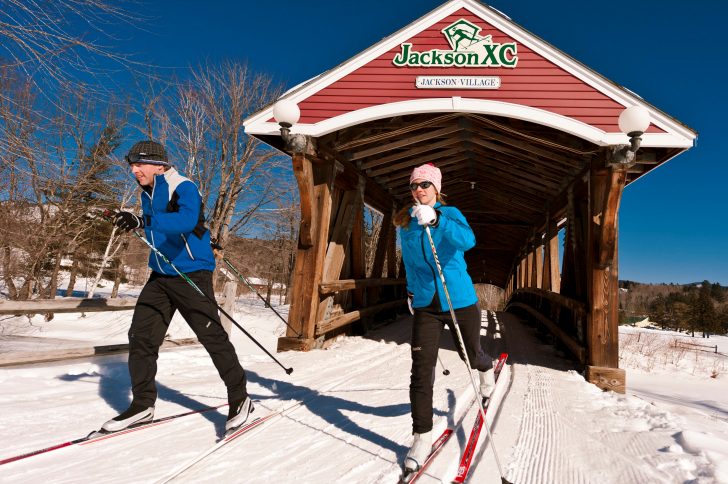
Jackson’s famous covered bridge, a symbol of this charming New England town.
Credit: Jackson Ski Touring Foundation.

[Editor Note: SeniorsSkiing.com thanks Roger Lohr for this update.  XCSkiResorts.com is the premium resource for nordic ski vacation and resort information in North America.]

We excitedly planned a weekend trip to Jackson, N.H., because it is a true Mecca for Nordic skiers. This is the quintessential New England Nordic (XC) skiing experience with a covered bridge, white steepled church, brookside trails, and the accompanying village with all of the trappings.

Many of the trails lead right to the doors of local inns, shops, and restaurants. It’s no wonder that Jackson Ski Touring Foundation has been rated the top cross country ski area in the United States by America’s Best Online and is recognized in numerous polls as a favorite destination.

Abstract art in the woods, a natural gallery creating an unusual setting for art appreciation.
Credit: Roger Lohr

The Foundation is a non-profit organization chartered to maintain XC ski trails in and about the village of Jackson. There are about 76 landowners that allow trails to cross their property. Country inns are spaced throughout the region, and the base lodge is a golf country club located on the village loop. This full service ski center has its own parking area and houses the ski school, rental equipment, and a retail shop run by Gorham Bike & Ski with XC ski equipment, clothing, and accessories. The center has a fireplace with couches and tables and seating. Snacks and drinks are available in the lodge, too.

The Cocoa Cabin is a warming hut serving hot cocoa on the weekend, located three km from the center on the gentle Ellis River Trail. This is a popular trail often with many cautious yet courteous skiers. Snowshoers can take a rustic narrow marked snowshoe trail from the center to reach the Cocoa Cabin, and this trail avoids the ski trail.

Our accommodations were at the Christmas Farm Inn & Spa, which is set on a hillside overlooking Jackson Village. It has the personal touches of a country inn with the amenities of an upscale modern resort. The inn has a full service spa, restaurant and pub, fitness room, indoor pool, family rooms, spacious suites, and handcrafted cottages. We had breakfast there during our visit and scheduled massages at the Inn’s Aveda Spa for some earned relaxation after skiing. After skiing and some massaging, we dined at the Christmas Farm Inn for a scrumptious dinner and dessert.

The next morning, we skied down to town, stopped by the Jackson Ski Touring Center and heard about the Art Along the Trails exhibit staged on trees behind the lodge near the Jackson covered bridge. The lodge was bustling, and we passed hundreds of skiers and snowshoers along the Jackson trails, who were friendly and saying hello as they passed. The art exhibit featured two local abstract painters in a their works displayed with nature. Instead of a white walled art gallery, in its place were “walls” made from snow, hemlocks, and birch, all places for paintings to hang from, and the beneficiaries were on snowshoes and cross country skis.

During the four-hour show, Art Along the Trails was enjoyed by hundreds of cross country skiers and snowshoers, who were instilled with the energy of culture experiencing the avant-garde gallery in nature that included more than two dozen paintings installed on tree trunks and limbs. Prices of the different paintings (some as big as three-by-four feet) ranged from $125 to $2,900. The exhibit had titles such as “Illuminated Icefalls” and “Cosmic Wash”.

We lunched on soup and salad at the Wildcat Inn Tavern in downtown Jackson and stayed for some live music and libations. The tavern walls display classic ski posters and some antique gear such as snowshoes and a pair of red Jarvinen XC skis. The seats in one of the rooms were built to look like double chairlifts, and there were soccer jerseys from around the world pinned to the ceiling.

We browsed at some local retail establishments in Jackson including Flossie’s General Store & Gift Emporium, which has a potpourri of gifts, candy, and local keepsakes.

The Jackson Ski Touring Foundation maintains 154 km of varied and breathtaking XC ski and snowshoe trails and is about two hours north of Boston. Foundation trails connect with A.M.C. trails in Pinkham Notch and White Mountain National Forest backcountry adventure trails.

Here’s a New England classic.  Christmas Farm Inn has a warm, welcoming old-school ambiance as well as many modern touches.  
Credit: Roger Lohr


Something Different For The Grandkids: Idaho Elk Feed

When It’s Time For A Diversion Excursion, Visit The Elk Herd.

Sleigh pulled by Percheron horses takes people out to help feed elk in Donnelly, ID, near McCall. Light snowfall speckles the scene. The Points family has been feeding wild elk on their land to help them survive winter for three generations.
Credit: Yvette Cardozo

Yes, Idaho has some delicious skiing. Yes, some people want to do something else. In winter. In the snow.

And so, in the McCall area, there’s the elk feeding trip.

Back in 1983, Lyle Points’ pop, Vernon, started to worry about the elk on his land. These were wild animals. And in harsh winters, they were doing badly.

“No elk is going to starve on my place,” he declared.

Why not give them a bit of help?

Hungry elk come in to eat from hay bales on a sled which takes people out to watch the elk feeding.
Credit: Yvette Cardozo

So he started dragging bags of hay out, sometimes breaking trail through five feet of snow, to give the elk a bit more food when food was REALLY hard to find.

Thus started a family legacy which has now stretched to three generations.

These days, the public helps. For $20 (less for kids) you climb into a sleigh, sit on bales of hay and go out to the nearby woods where the herd of Rocky Mountain Elk are patiently waiting.

They, meaning the elk, not Lyle, have worked out a system. They actually take turns, some coming to nibble the hay from right under your rump, others sitting a few yards away until the next sleigh comes along.

Sometimes, it’s three sleigh loads a day. Sometimes only one. Sometimes none. But they still don’t go hungry because, as Lyle explained, “This is just the appetizer. Later, I will go out with more bales, cut them into chunks and drop them in a line.”

Like crumbs on the floor.

This winter was the snowiest, the coldest, the harshest in 30 years. Food was even harder to find than normal. And there are the wolves.

“I figure giving the elk some extra food is an extra bit of help to survive,” Lyle explained.

As it is, the herd is down to 180 elk from previous years when it could sometimes reach 300.

And so, my friends and I climbed into Lyle’s sleigh, pulled by his two handsome, coal black Percheron horses and headed for the nearby woods.

We all sat on fresh bales of hay and it didn’t take long for the elk to come over.

It’s the cows (females) and young males with tiny antlers that nudge in. There ARE bulls, some with seven point antlers (yes, that’s a LARGE rack). But the bulls just sit there, keeping watch.

Okay, it is truly a bit strange to have a large wild animal nibble eagerly at something your rump is resting on. You can actually feel them chew. And certainly hear them as they crunch.

There’s a temptation to reach out and pet their furry heads, maybe stroke the small antlers of “teenage” males. But don’t.

Lyle has rules. You don’t touch. You don’t get up. You certainly don’t feed them if you brought snacks for the kids.

Meanwhile, during the ride, Lyle talked about elk, about how they eat and digest in their four-part stomach, what they eat on their own (any plant they can find), how many bales he takes out a day (16 – 20) and how his family got into the elk feeding thing because, well, they couldn’t bear so see such beautiful animals suffer.

We were out there for more than an hour. Plenty of time for everyone to take a LOT of pictures and videos.

Click here for the website.  Or call 208-325-8783. It’s $20 for adults, less for children. This is strictly winter. You ride out on a sleigh, sitting on hay bales. Grandkids LOVE it.

Visitors sit on hay bales while elk come in to feed on the hay. Kids know Lyle’s rule: Don’t touch.
Credit: Yvette Cardozo

SeniorsSkiing Guide: Burke Mtn, VT—Basic And Friendly

A Swanky New Hotel On The Mountain Is A Magnet For Those Who Love The Basics.

New hotel offers ski-out access to uncrowded trails.
Credit: Burke Mountain

“Burke is what skiing used to be. It’s back to the basics. We’re just happy here,” says Barb Mader who with husband, Don, ski 80 days a year at this laid-back mountain high in the Northeast Kingdom of Vermont. They stretch the season at Jay Peak, a 45-minute drive to the north.

Barb and Don Mader ski Burke 80 days a season. Barb came back to skiing after a 33 year hiatus.
Credit: Tamsin Venn

Burke Mountain is a place, she notes, where skier etiquette prevails, trails are uncrowded, the ski patrol is laid back, the views are inspirational, everyone is friendly and congregates après-ski at Mid Burke for live music. It’s a place where her three grandchildren learned to ski in the Explorers Program and, “All are great skiers now,” says Barb.

Groomed intermediate cruisers like Willoughby and Dipper are popular as is the winding Deer Run, and the rolling East Bowl. Power Line and The Ledges provide expert skiing, Sherburne Express beginner terrain. Plus Burke has some of the best glade skiing in Vermont—with wide spacing on Caveman and Marshland.

Unfortunately, Burke Mountain has had a rocky few years. The resort, until recently called QBurke, for owner Ariel Quiros, is now under federal receivership. An encouraging step, the managers opened the swanky, on-mountain 116-room Burke Hotel and Conference Center last September. It welcomed the first skiers this winter. It’s a real gem, with easy in and out access, nice units overlooking the slopes or the scenic Willoughby gap, an outdoor heated pool and hot tub, locker room, a ski tuning room for the young racers, and four eateries including the popular Bear Den. Burke’s loyalists hope the resort will find a new owner soon.

Barb Mader, 73, started skiing in the late 1960s, joining the racing Eastern Veterans league. She raced at different areas, lured by the $8 race fee plus a rest-of-day lift ticket. She competed in the famous Burke Mountain Stampede, with a group start of eight to ten racers taking off down Deer Run, onto Dipper, and straight down to Mid Lodge, trying to just to stay in the game, and “getting annihilated” by the Burke Mountain Academy kids. A great party followed at Mid Lodge.

Barb stopped skiing in the 1970s and started again in 2003, despite one replaced shoulder. A year later she and Don, 78, bought a condo at Burke, in one of the mountain’s financial downturns, demonstrating it is never too late to take up an old sport again.

Recently, the Maders have enjoyed the offseason on what some call the best mountain biking network in the country. Kingdom Trails has more than 100 miles of trails, through the woods and across the pastures, by the good graces of more than 50 landowners and businesses.

Burke’s Nordic Center has access to many miles of Kingdom Trails.
Credit: Tamsin Venn

The Facts:

Lift tickets:

Senior (65 plus) $47

Silver Streakers (55 plus): $35 Tuesdays & Thursdays (non-holiday) Judge Pass (70 plus), season pass at Jay Peak and Burke: $279 (if bought by July), no blackout dates.

X-C: Burke Nordic Center, $15; ask about a senior rate.

Vertical: 2,011 feet

Average snowfall: 217 inches

Snowmaking: 70 percent

6 lifts

36 trails and 14 glades

178 skiable acres

Trail Map: Click here


Sierra Nevada Blowout Version 2.0

And The Snow Just Keeps Piling Up!

Credit: Homewood Mountain Resort

A month ago I wrote that, barring a barrage of rainstorms, 2016–17 would be going down as an epic ski season in the Sierra Nevada.

What’s a word that’s greater than “epic”?! Stupendous? Mammoth? Ginormous?

Credit: Squaw Valley Alpine Meadows

All apply to the Sierra’s burgeoning snowpack that just keeps growing, thanks to another string of snowstorms in February. This last Wednesday ski resort operators could stick their heads out the window for the first time in weeks and not see snow falling. The respite will last only until the weekend, however, when another storm is forecast to hit the mountain range. In the meantime, resorts will have a couple of days to dig out buried chairlifts and clear the decks before it starts snowing again.


Like the snow itself, snowfall records across the Sierra keep falling.

To get an idea of just how, uh, stupendous this season has been, consider the snowfall statistics to date at Squaw Valley Alpine Meadows. As of Wednesday, the resort has surpassed its annual average snowfall of 450 inches by an additional 115 inches—and this a week before March! Since last Friday, more than seven

Credit: Mammoth Mountain Resort

FEET of snow have fallen on top of the already prodigious snowpack, bringing the season’s total snowfall to the aforementioned 565 inches. As of today, the base clocks in at 138 inches (11.5 feet) and the top of the mountain has 243 inches (20 feet).

The statistics are no less impressive across the Sierra. In the past week, most resorts around the Tahoe basin have received six to seven feet of new snow and have already gone past their snowfall averages for the entire season. Even Homewood Mountain Resort, which sits on the western shore of weather-moderating Lake Tahoe, accumulated five-and-a-half feet of snow in the last week and now has an impressive 95 inches at its base and 201 inches on top. In the central Sierra, Dodge Ridge

Credit: Homewood Mountain Resort

added another five feet of snow to its pack in the last week and now has 83 inches at its base and 132 inches on the summit. Most importantly, temperatures have stayed low, so fluffy light powder is currently ruling the day throughout the Sierra.

Ski and snowboard until the Fourth of July!

Although many Sierra resorts have yet to post a closing date (Easter weekend, this year April 15–16, is usually when most resorts wrap things up), a few have already extended their mountain operations well past that. Squaw Valley Alpine Meadows, for instance, plans to stay open well into June and then crank up the lifts on July 4th, conditions permitting. Mammoth Mountain, which currently has 200 inches at its base and 350 inches on top, plans to stay open through the 4th of July weekend and beyond, if possible. As of today, Heavenly

Credit: Sugar Bowl Ski Resort

and Northstar plan to extend their operations one week past the Easter weekend. As long as temperatures stay cool through the spring, other resorts will likely join the ranks of resorts remaining open beyond Easter. For Northern California skiers and riders, who have suffered through a five-year string of utterly abysmal ski seasons, this record-breaking season has been a long-overdue gift from the heavens.

Now, if there was only a way to save snow!

Credit: Northstar California

SeniorsSkiing Guide: Brundage Cuteness

Central Idaho Resort Has A “Come As You Are” Vibe.

Skiing fresh powder at Brundage Mountain. Credit: Brundage Mountain.

Brundage Mountain in McCall, ID, is one of those places that truly “skis bigger” than it is.

“You get to the parking lot and say, ‘How cute,’ but when you go up the chair, you start to see just how much terrain there is,” says Communication Director April Whitney.

Okay, 1,500 acres isn’t huge. But there’s plenty to ski including some nice, yummy cruising and great upper intermediate trails with a bit of pitch and challenge that are also often groomed.

The crowd limiting factor here is the parking lot, and even then, a super busy holiday crowd is maybe 3,000 people though the mountain could hold three times that many. As a result, people grouse about “long lines” if the wait hits 10 minutes.

Snow, Terrain and More

Ski patroller helps put finishing touches on snow train in preparation for Winter Carnival in McCall.
Credit: Yvette Cardozo

Location: In McCall, Idaho, 107 miles north of Boise in west central Idaho.

Snowfall: 300 – 350 inches average but it can hit 440 on a good year. Locals claim it’s the best snow in Idaho because it sits where the two main weather cycles, southern and northern, meet. The snow here is a bit colder and drier. In the far west, day old snow becomes concrete as it picks up moisture. “Our powder has the moisture sucked out of it, and it’s actually drier the second day,” said Whitney.

Terrain, lifts: 46 named runs – 20 percent beginner, 50 percent intermediate, 30 percent expert across 1500 skiable acres. One high speed quad, four triple chairs. Best cruising is to the far right looking up the mountain. The gnarly stuff is more to the far, far left including another 420 acres of lift accessed back country. Locals who can ski well say the real magic is what’s between the named runs—”wild” powder with unofficial names like Mexico, Switzerland, Naughty Girl. The season typically runs early December to mid April though after that, Brundage is open weekends until the snow is gone.

Vertical: Vertical drop of 1,921 feet from a top at 7,803 feet to the base at 5882 feet.

Lot to lift access: What you see from the base is what there is. It’s an easy walk to the lodge and lift. There are, however, stairs—four levels worth and no elevator for handicap access. However, if the mountain is called in advance, there is a way to get handicapped people to the lodge upper level and the ski slope.

Public transportation: Brundage Mountain Resort has partnered with Mountain Community Transit to provide a free shuttle service to Brundage Mountain Ski Area. The shuttle will start at the Brundage Adventure Center (BAC) with a stop at Lardo’s Restaurant ten minutes after the BAC stop. Transportation to and from the mountain is FREE for everyone.

Accommodations: Nothing on mountain. Plenty of lodging in nearby McCall.

Culture

The vibe: This is definitely a “come as you are” mountain. The important thing is folks here LOVE skiing. And you can find anything in the way of duds, from hunting bibs and camo rain gear to, um, Carhart. It’s not exactly a Sun Valley, Bogner kind of place. You won’t get a sideways glance at your gear as long as you can link your turns. Preferably well. And there’s a good kids’ center for the grandkids.

Dining: An assortment of simple eateries from sit down Smoky’s Bar and Grill to the Main Street Market & Eatery cafeteria to an adults-only bar plus the weekend-only mid-mountain Bear’s Den.

Mountain life: People come to live and play in McCall for its outdoor activities. In winter, it’s snow, snow and more snow. As someone elsewhere once said, “We do not come to look, we come to SKI!” Or snowshoe, or cross country, or snow hike, or fat tire bike or downhill tube or whatever else you can think of outdoors in winter.

Trail Map click here

Webcam click here

View from the top of Brundage Mountain. Credit: Yvette Cardozo

Lifts And Shuttles For Cross-Country Skiers

Getting Uphill Is Easier With A Lift Or A Ride. Then Gravity Takes Over.

[Editor Note: XCSkiResorts.com Publisher Roger Lohr provided this article from his publication on where you can get a lift or shuttle ride to cross-country ski.]  

Great Glen Snowcoach shuttle drops skiers at the trail head.
Credit: XCSKiResorts.com

When it comes to cross country (XC) skiing, the theory of what goes up must come down may be going out of style. Nowadays, many people really enjoy the fun of just going downhill on XC skis, but they’d prefer avoiding the need to laboriously trudge uphill to earn that fun. Ski areas that provide lifts and shuttles can help older cross country skiers go further, stay outdoors longer, and save their energy.

Lifts

At Bretton Woods in New Hampshire’s White Mountains there is a $31 High Country lift ticket that gets you up near the summit to the Mountain Road by way of a chair lift, for a seven kilometer ski back down. The trail is easy enough and skiers can ski in the groomed tracks or on the flat skate lane.

New for 2013-14 season: 3-5km Nordic Terrain on Mt. Stickney

The Bretton Woods lift ticket provides one ride on the high speed detachable quad (which slows down upon egress) and unlimited use of a T-bar, just down the trail. The T-bar provides access to upper elevations of Mount Stickney and the Stickney Cabin, which has snacks, beverages and a place to hang out with indoor seating or outside by a stone fireplace. Skiing back to the Mountain Road offers some choices including a groomed trail or skiing through the glades (trees) with options for different levels of difficulty. The Mountain Road is one of the most fun trails to be had on XC skis in New England!

At 49 Degrees North Mountain Resort, WA,  there is a lift-served XC ski trail that is accessed near the top of Chewelah Peak. It descends and winds around the mountain for 12 km. On a clear day one can see all the way to Montana.

Other XC ski trails that are accessed by chair lifts can be found at Giants Ridge ,MN, with a free lift ride when you purchase a trail pass. Boyne Mountain, MI, has the Cold Springs Downhill trail. Royal Gorge, CA, has two surface ski lifts for practicing downhill turns and also having accelerated fun.

Shuttles

At Garnet Hill Lodge, North River, NY, there’s a shuttle ride from the bottom of a long downhill back to the lodge that has been offered since the early eighties. It originated when the lodge owner picked up skiers in his car and was then upgraded to a van and now it’s a mini-bus.  Shuttles are offered daily and three to five times a day on weekends and holidays.

The Great Glen Trails Outdoor Center, Gorham, NH, is adjacent to the Mt. Washington Auto Road and offers an uphill ride to achieve “treeline status” in the SnowCoach, a tracked van. The comfortable heated tour takes folks to the 4,000 foot elevation up Mount Washington where the views are breathtaking. Intermediate and advanced skiers can handle skiing down this road, a thrilling four mile decent back to the base lodge. There are various price options for the SnowCoach.

Craftsbury Outdoor Center, VT, has a free shuttle on the weekends that delivers skiers to the Highland Lodge for a 20 km return trek. There’s a net drop of about 300 meters on the groomed trail, which traverses hill top pastures, farmsteads, and quaint Vermont villages. A shorter five km shuttled ride brings skiers back to the lodge from Craftsbury Village at the general store and deli.

At Lone Mountain Ranch, Big Sky, MT, there’s the Upper Trail Shuttle that takes you a couple of miles away from the facility and leaves you with a mostly downhill ski back to the lodge for about 10 km.

Rustic Elegance with Fairy Tale Flair In Stowe

It’s More Than “Just Right” Just One Mile From Stowe Resort.

Tucked in the woods, this is a cozy cabin. No bears, too!
Credit: Homeaway

In Stowe, Vermont, a stone’s throw from world class downhill and cross country skiing sits quintessentially rustic Goldilock’s Cottage, welcoming overnight guests. When Jill Evarts purchased the cabin and four acres of land about twelve years ago, she didn’t need to do a lot of work on it. She had helped the previous owner, a friend and colleague, decorate it with fine fabrics and purchases from flea markets and antique shops all over the northeast. The cottage is clean and tidy with many amenities that appeal to eye and requirement for comfort.

I found the cottage warm and inviting far beyond the “just right” of the fairy tale. The kitchen is well equipped, and I was able to easily prepare a pasta primavera for dinner. It has the right pots and pans and cooking implements for cooking lots of delicious meals. There is even a small spice rack above the stove. The kitchen/dining area was immaculate and comfortable.

The kitchen has everything you need, bring our own porridge.
Credit: Booking.com

The living area of the open concept cottage was equally welcoming with a wood burning stove in the center. Plenty of seasoned firewood makes using the wood stove quick and easy. The cottage has one bathroom which is also decorated in the theme of the rest of the cottage and I found it clean and complete with all the towels you’ll need.

The Master bedroom, complete with a sitting area and sleep sofa, also have an interior decorator’s touch. . The cottage has a spacious deck off the bedroom and a deck accessible from the dining room complete with Adirondack chairs and a gas grill. Those details make the cottage appealing year round.

A large sleeping loft lies above the kitchen/dining area is decorated in lighter colors to take advantage of the skylights. Jill’s remarks from her cottage fact sheet demonstrate the features that makes Goldilock’s so attractive;

Bears can’t climb ladders to the loft.
Credit: Steve Hines

“For those staying in the loft: open the skylight before you go to bed, and be sure to let the fire burn down so. You won’t be hot. Some guests like to turn the heat down at night and use the space heater to supplement in the bedroom to keep the temperature in the loft cool”

Everything you may want or need seems to be taken care of. Jill agrees that this attention to detail makes her place perfect for active seniors who want a winter (or any other season) getaway. The area does come alive in winter however because of the outdoor sports, great restaurants and shopping.

The cottage is close to Stowe and the location makes it easy to get to the Alpine and Nordic skiing. The rest of the year the Mount Mansfield locale has great hiking, cycling, mountain biking. The many fine restaurants in and near Stowe make dining out a pleasure as well.

While I’m not a fan of grading accommodations, you might like to know I give Goldilocks’s cottage an A+. For more details about dates, rates, and availability, visit the cottage’s web site here.   Ski season rates start at $250 per night (March) and $270 (Feb). Holidays are more.  The cabin can accommodate up to five folks in one bedroom, a sleeping loft and a pull-out couch.

Here’s the Master Bedroom, ultimate cozy.
Credit: Steve Hines


SeniorsSkiing Guide: Schweitzer Mountain Resort

Northern Idaho’s “Little Secret” Steps Up Dining Amenities.

Much of the skiing at Schweitzer Mountain has great views of Lake Pend Oreille and the surrounding mountains.
Credit: John Nelson

Pat Rotchford, 76, sat in The Nest, the new top-of-the-mountain restaurant at Schweitzer Mountain Resort, looking very happy.

He was drinking red wine by the fireplace with his friend, Debbie Stanley, eating prime rib sliders and Vietnamese spring rolls—not your typical mountain fare.

Pat Rotchford and Debbie Stanley enjoy a glass of wine in The Nest inside the new Sky House lodge at Schweitzer.
Credit: John Nelson

“Everything we’ve had here has been excellent,” said Rotchford, who has been skiing for 70 years, many of those at Schweitzer.

Sufficiently refreshed, Rotchford and Stanley geared up and hit the slopes for more afternoon skiing at this exceptional mountain in North Idaho.

Schweitzer has always been a mountain with great terrain and few skiers (“It’s our little secret,” Stanley says). Now, with the just-opened Sky House lodge on Schweitzer’s summit, the resort has taken a step up to match the amenities of great resorts around the country.

The beautiful $3.8 million, 9,000-square-foot facility houses two restaurants with 360 degree views of the Selkirk and Cabinet Mountains and Lake Pend Oreille. Besides the upscale bar-restaurant Nest, the Red Hawk Cafe offers hearty, cafeteria-style mountain fare.

Executive chef Pete Tobin designed the menu at the Sky House lodge at Schweitzer Mountain.
Credit: John Nelson

The Nest has a creative menu of small plates, none more expensive than $13, designed by executive chef Pete Tobin.

“It gives people a chance to have a quick bite and then head back to the slopes,” Tobin said.

Snow, terrain and more

  • Location: Schweitzer is about 15 miles from the resort town of Sandpoint on the shores of Lake Pend Oreille. Coeur d’Alene, Idaho, is about 45 minutes away, and Spokane, Wash., with its international airport, is about 90 minutes drive. For those traveling by train, Amtrak stops in Sandpoint.
  • Snowfall: 300 inches fall annually, keeping the slopes covered from December to April most years.
  • Terrain, lifts: With 2,900 acres of terrain on its front and back sides, Schweitzer is the biggest resort in North Idaho and the state of Washington next door. One high-speed six-pack and two high-speed quads do most of the people-moving, along with one triple and three double chairlifts. About 50 percent of the terrain is rated beginning or intermediate; 50 percent is advanced or expert. Outside the resort’s boundaries, advanced side-country skiing abounds.
  • Vertical: 2,400 feet from a summit (6,400 feet) to the back-side base. The main village is at 4,700 feet.

Lot to lift access

  • Parking: Schweitzer has two large parking lots on the mountain with unloading zones and also has a large parking lot on the valley floor served by a shuttle bus.
  • Public transportation: Several companies offer service from Sandpoint to the resort.
  • Accommodations: The Selkirk Lodge and White Pine Lodge are excellent choices at the village base; on-mountain condominiums also are available, as well as lodging in all price-ranges in nearby Sandpoint.

Culture

  • The vibe: With its empty slopes on the weekdays, Schweitzer feels like a well-kept secret; friendly locals from Sandpoint, Coeur d’Alene and Spokane are happy to show you the ropes.
  • Dining: Besides the Sky House restaurants, the resort offers a back-side lodge called The Outback Inn and a large base lodge restaurant. In the village, there are several restaurants, including Pucci’s Pub, the place to go for a post-shred beer.
  • Mountain life: Beyond the lift-skiing, Schweitzer has cat skiing, snowmobiling, tubing and excellent Nordic trails.

Bottom line

  • The new Sky House summit lodge, which will remain open this summer for weddings and special events, helps elevate Schweitzer to a top-tier resort.
  • Affordable package deals, ample snowfall and empty midweek skiing make Schweitzer an enticing destination for a multiday vacation. Single day senior tickets are $69.30 online.
  • Vast terrain gives skiers a lot to explore at one of the Northwest’s best resorts.

Webcam Click Here

Trail Maps Click Here

The upper-mountain Lakeview Triple delivers skiers to mostly advanced terrain.
Credit: John Nelson


Mirror Lake Inn: A Peaceful Haven In Lake Placid

Activities, Elegance, Extraordinary Service In The Heart Of The Adirondacks.

Mirror Lake Inn has been recognized with AAA Four Diamond Award of Excellence for 32 years in  a row.
Credit: Joan Wallen

I entered the Mirror Lake Inn in Lake Placid through a back door, walked right past the front desk without noticing it, and down the wide staircase. When I ended up at the entrance to the spa, looking somewhat confused, an employee asked if he could help. When I told him I was looking for the registration desk he didn’t just point me in the right direction (which would have been easy to do), he walked me there. This “taking the extra step” set the tone for my stay and proved to be typical of all the Inn employees I encountered. Everyone from the front desk staff, to the bartenders, dining and housekeeping staff had a friendly smile, helpful attitude and genuine interest in my comfort and well-being during my stay. The Inn itself exudes ambiance with its spacious common areas, fireplaces, comfortable furniture and numerous more intimate spaces for reading, relaxing or quiet conversation, all with an Adirondack décor. Tea, coffee and homemade cookies are served daily from 3:30 to 4:30 in the living room so guests can mingle and relax after a day on the slopes, trails, lake or visiting the many Olympic venues throughout the area.

After a $4-million renovation, rooms are looking fantastic.
Credit: Joan Wallen

The Main building houses guest rooms, the spa, fitness center and indoor pool as well as two of the resort’s restaurants – Taste Bistro, casual yet upscale, and The View, Lake Placid’s only four diamond AAA rated restaurant. The Terrace and Mountainview buildings, also housing guest rooms, as well as the Adirondack Conference Center are all connected to the Main building by indoor walkways. The guest rooms are spacious and comfortable with seating areas facing the lake. Their décor reflects the Adirondack theme of the public spaces. The Colonial House and the Lake Cottage are across the road on the water and have more elaborate rooms as well as one and two bedroom suites. Though in general the clientele may be more mature, the suites are well suited for families. One of the unique features of the resort is that all guest rooms face Mirror Lake and therefore offer fantastic views through floor to ceiling windows and sliders. The Cottage Café, also on the lake, serves casual fare for lunch and supper and is a gathering spot for the apres ski crowd.

The Inn has recently completed a $1 million makeover of its renowned spa. With rooms for massage, facial and body treatments, the women’s and men’s sanctuaries include spaces for relaxing and revitalizing, a eucalyptus steam room, sauna, whirlpool, indoor pool, fitness facility and a full service salon. Its reputation as the number one spa in Lake Placid is well deserved.

Mirror Lake itself, only steps from the Inn, offers activities just outside your front door. A groomed ice skating lane follows the perimeter of the lake, a three mile smooth pathway for relaxed skating or vigorous exercise. The Inn maintains a couple of small rinks just in front of the Café while the town has cleared a much larger area across the lake for hockey tournaments and free skating. I encountered cross country skiers and other snowshoers on my trek across the lake, as well as folks just out walking their dogs. A couple of concessionaires offer dogsled rides and a toboggan chute is nearing completion and will open soon. Snowshoes are available for Inn guests use if you don’t have your own.

A short walk brings you to the main street of Lake Placid where you’ll find many shops, from jewelry to outdoor fashion to Adirondack furniture and gourmet goodies. The bar scene is lively and the restaurants in town offer a wide variety of menus. Also located downtown at the Olympic Center are the Olympic Museum and the speed skating oval where you might watch hopefuls practicing or do some skating yourself during public skating hours. And of course, there’s world class alpine and cross country skiing just minutes away at the Olympic venues of Whiteface and Mt. Van Hoevenberg.

Last June the Mirror Lake Inn Resort and Spa accepted the AAA Four Diamond Award of Excellence in lodging for the 32nd year in a row. The View received the same award for fine dining for the ninth consecutive year. The resort’s owners, Ed and Lisa Weibrecht, parents of Olympian Andrew Weibrecht, credit their exceptional staff for these honors. “We have a secret weapon. The secret weapon is all of you, our staff”, Weibrecht told the group assembled at the presentation. I certainly found this to be true. A cheery “hello”, a smiling “how are you this morning”, a helpful “do you need anything”, a warm “what can I get you” greeted me in the parking lot, in the lobby, hallways and restaurants throughout the property. In sum, the Mirror Lake Inn Resort and Spa offers casual elegance in a relaxing atmosphere with enough to do on and off the property to entertain both the most athletic guests and those looking for just a tranquil retreat.

Mirror Lake Inn has an assortment of room choices and package pricing starting at $186 (December 10-March 19) and $137 (March 20-End of Season).  Check the website for the accommodation options.

Mirror Lake Inn is a tasteful and modest spot to relax and enjoy winter sports activities.
Credit: Joan Wallen