SeniorsSkiing Guide: Japan’s Hakuba Valley

A Senior’s Introduction To Some Of The Best Skiing In Japan.

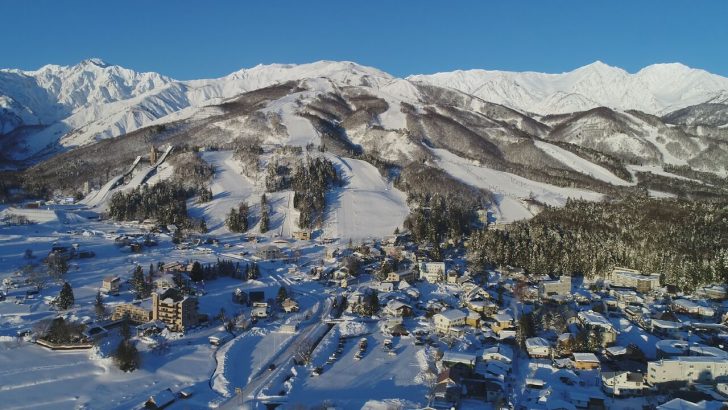
Happo One is the largest resort in the Hakuba Valley with four base areas serving the mountain. Credit: Hakuba.com

The Hakuba Valley sits three hours west of downtown Tokyo and boasts some of the best skiing in all of Asia. Host to the 1998 Winter Olympics, Hakuba offers a unique combination of diverse terrain spread out over 11 resorts, 12 meters of annual snowfall, world class facilities, and amazing Japanese cultural experiences: think sushi, hot springs, and thousand year old temples. The entire valley has been added to the 2018/19 Epic Pass allowing pass holders five days of free riding across all of the resorts.

Access

From downtown Tokyo you will take the famous Japanese bullet train one and a half hours to Nagano Station where you will need to transfer to a bus for the last one hour of the journey. The entire is just 3 hours and costs ¥10,000. ($85.00)

Two Outstanding Resorts In The Valley

Happo-One

The largest and most central resort in the valley is Happo-One (pronounced On Ay), spreading across 220 hectares. The highest run is 2,696 m and spreads to four base areas providing everything advanced skiers could want: steep runs, high vertical drops, and powder runs. There are opportunities for beginners as well but this resort is best suited for intermediate and advanced skiers.

Adult Lift Ticket: ¥5,200 ($46.00)

Senior Lift Ticket: ¥4,700 ($41.00)

Cortina

Cortina has become synonymous with powder skiing for Hakuba enthusiasts. The resort receives the highest and driest snowfall in the valley and usually gets nearly twice as much snow as neighboring resorts. The snow patrol at Cortina are quite relaxed, and off-piste skiing is not an issue.

Adult Lift Ticket 1 Day ¥4,000 ($35.00)

Senior Lift Ticket 1 Day ¥3,200 ($28.00)

Alternatively, visitors can buy the Hakuba All Valley Pass which gives pass holders access to all 11 resorts.

Lessons

The Evergreen Outdoor Center is the largest international ski school in Hakuba and offers English language lessons with certified instructors on Happo-One.

Gear

You can get all your rental gear at Central Snow Sports. They have several locations throughout Hakuba and have very knowledgeable and friendly English speaking staff.

Basic Ski Rental Package: Approximately ¥4,000 per day ($35.00)

Where to stay?

Happo Village has everything you need for a comfortable stay in Hakuba: proximity to the resorts, best restaurants, hot springs, and public transportation.

Marillen Hotel

Only in Japan: Marillen is an Austrian-themed hotel in the heart of the Hakuba Valley. Credit: Hakuba.com

The Austrian-themed Marillen Hotel sits on the Nakiyama slope and is one of the few true ski-in-ski out hotels in the Hakuba Valley. The Austrian theme stretches  to the food with schnitzel and pretzels served while a fire roars and live musical acts perform in the après bar. Nakiyama even offers night skiing if you find the energy for a few extra runs after dinner.

Onsen

Soaking in a Japanese hot spring after a long day on the slopes is a terrific way to relax. Be advised,  it’s customary to bathe in the nude. It may feel daunting to walk into a public onsen at first but the experience is well worth any initial awkwardness. There are multiple onsens within Happo-Village, and they cost approximately ¥600 ($5.50) per visit.

Off the Slopes

Join a day tour and soak in the rich Japanese culture and visit the world famous snow monkeys. This full day tour takes you from Hakuba to Nagano City where you’ll stop at Zenkoji, an eighth century Buddhist temple. Many believe the first Buddhist sculpture ever brought to Japan remains within this sacred building. After touring the temple, you’ll be taken to the snow monkey park where you’ll be able to see the only monkeys in the world known to bathe in hot springs.

For more information, click here for the Hakuba Valley site.

The Cortina resort offers lots of snow and powder opportunities. Credit: Hakuba.com

 

Chile 2018 Ski Season Wrap Up

Finding Good Days In A Disappointing Snow Season In The Southern Hemisphere.

The 2018 season started on time in June, after a serious drought, but sputtered out before it ever really got going. The Chilean Central Zone ended with a 54 percent precipitation deficit, despite ENSO-neutral conditions. For a ski area in Chile not to get to the Sept 18 National holidays is shameful. Which is not to say there were no good days, just that they were few and far between.

Being relatively free to select those good days, I can share a couple of snaps that are deceivingly good.

The Las Vegas lift out of the La Parva village on a cold day in July. Helps to know where the rocks aren’t.

La Parva. Credit: Casey Earle

The conditions were not sufficiently good to ski other Central Zone ski areas, where I am not so intimately familiar with their thin base rock gardens.  So in September we headed 560 miles to the south where Mother Nature was more accommodating.

The Hotel Puyehue. Credit: Casey Earle

Our first lodging was the venerable and grandiose “Termas Puyehue Wellness & SPA Resort”, formerly the Gran Hotel Puyehue, founded in 1907. Back then, guests arrived by steam boat across the Lago Puyehue to enjoy its charming hot springs. The hotel is very well located at the entrance to the Parque Nacional Puyehue, established in 1941, and the lovely Antillanca ski area, tucked up in a volcanic cirque 18 km away. This is reached at the end of a good dirt road that winds through temperate rainforest and lagoons. The snowpack was 6-10 feet, from the mid station up, as it had rained hard at the base.

Here it can rain six feet a year, so when that falls as snow, it adds up, and 10-15 ft bases are not uncommon.

I seized an unusually brilliant sunny day and headed up. Nary a rock to be seen, and superb spring snow.

Heading down back off the crater towards the ski area, with the Puyehue Lake in the distance.

La Parva. Credit: Casey Earle

After the traditional September 18 mega-BBQ at a friend’s place in Puerto Varas, on the Llanquihue Lake, we drove back north 200 miles to Corralco ski area, on the Lonquimay Volcano.

This time we chose a cozy cabin in Malalcahuello, a nearby up-and-coming mountain town nestled in a group of volcanos. Monkey puzzle trees greet you as you wind up through the forest to the barren eastern bowl of the volcano.

Again, no rocks here, even at the end of September.

Credit: Casey Earle

While the American ski team trained on the far right side of the ski area, those venturing into the bowl to the south got fresh tracks

Corralco closed at the end of October, by far the latest closing for any ski area in Chile this year.

If you liked this 2018 summary, and want to drill down to the nearly daily detail of how it panned out, try reading a bit of my 276-entry collaborative thread on the Teton Gravity Research website. Click here for my Ski Chile comments.

Trail Name Series: California

Consider The Name Of A Trail. You Will Often Find Uniqueness And Whimsy.

High Voltage, Squaw Valley. Credit: Patrick Saffarian

Peruse a few resort maps, and you’re sure to come upon some great trail names. Doing so with California resorts was no exception. Training Wheels at Mammoth is a wonderfully apropos name for a beginner trail. Amusement Park at Big Bear is fitting for a trail designed for park skiing and riding and Bone Yard at Dodge Ridge is a trail calling for respect.

Top honors also go to Secret Spot at Mammoth (there is also a trail named Secret Spot at Michigan’s Alpine Valley), Chute That Seldom Slides at Alpine Meadow, Lost in the Woods at Mammoth, Mambo Playground at June Mountain and Hogwild at Summit at Snoqualmie. Rounding out the top of the list are Ewe Turn and No Name Trail at Mt. Waterman (there is also a No Name Trail at Michigan’s Big Snow and New York’s Labrador Mountain), Ditch of Doom and Trench of Terror at Kirkwood and His and Yours at Boreal Mountain.

Honorable mentions go to:

High Voltage                        Squaw Valley

Elevator Shaft                      Kirkwood

Snowsnake Gully                 Kirkwood

Hornets’ Nest                        Northstar

Cop out                                   China Peak

While viewing trail names at California resorts a few unexpected patterns emerged. First, several had the word stump in them. There is a Stump Alley at both Mammoth and Northstar, Stump Farm at Crystal Mountain and Stump Run at Kirkwood.

Two resorts have named trails after a traditional samurai practice. These are Hari-Kari Gully at Sugarbowl and Hari Kari Gate at Bear Valley.

Several trails are named after animal anatomy. At Squaw Valley there are Mule’s Ear and Red Dog Face.  At Northstar.  there’s Cat’s Face. At Sugarbowl, you will find Crow’s Face, and at Sierra-at-Tahoe there is Horsetail.

Do you have a favorite trail name that’s been overlooked? Please let us know in the comments section below.

ReaderReport: Mt. Snow Opens Before Halloween

We Love Reader Submissions. Please Send Us Reports From Out There To Info@SeniorsSkiing.com.

From Reader Alyce Perez: In the 41 years that I have skied, it is the first time I have ever skied in October. Mount Snow’s earliest opening day in 64 years. Another first to add to my bucket list.

Ice Fishing Time Coming Up

Other Things To Do In Winter For Seniors.

Ice fishing on Heffley Lake near Sun Peaks Resort with Elevated Fishing Adventures. Here, the guide and guest try their hand at outdoors holes. Credit: Yvette Cardozo

Some folks fish for sport. Some for relaxation. Some to “just get away.”

I fish to eat. If I can’t eventually put it in a fry pan, I’m not really interested.

So enter Elevated Fishing Adventures, near Sun Peaks Resort in British Columbia, Canada, where you get all three. Especially the eating part.

“Probably half the people who come out with us cook their fish that night,” said owner/guide Campbell Bryk.

Owner/guide Campbell Bryk picked my friend, Nancy Slye, and me up at 7 am and we drove out to nearby Heffley Lake, which at this point in the year, was covered with 20 inches of ice.

The lake is stocked with rainbow trout, a mild fish that makes great eating. The red glow is sunlight coming through the red canvas tent. Credit: Yvette Cardozo

A few hundred yards out, Campbell set up his fishing tent, got a portable heater going and re-drilled three of his fishing holes. Then he baited our hooks with natural looking lures that not only wriggle, they glow in the dark water below the ice.

This is really popular with families that have kids. “As soon as  you see fish down there, you can get kids to sit for hours,” Campbell said.

And anybody …really ANYbody…can catch a fish, he insisted, describing one morning where a mom was breast feeding her infant with one hand and hooking fish with the other.

“Her three-year-old caught a 24-inch fish,” he added.

The BC government each year stocks Heffley with 5,000 rainbow trout, a fish that Campbell claims, “Anybody can cook and virtually everybody likes because it’s so mild tasting.”

The best fishing, he explained, is just before Christmas. The most any group has caught in a day is 36, though folks are limited to keeping only five per person. And the largest fish anyone’s ever caught was 30 inches, big enough to feed six people.

The lake has both wild and stocked fish. The wild ones are dark red and green, the stocked ones are shiny but they both taste the same, so we were told

As for us, we were pushing the end of the season. And the fish were nowhere to be found. Have any groups ever come up completely dry?

Only two out of 50 trips. Campbell invited them to come back the next day, free of charge.

Okay, we were running out of time.

And then, with maybe 15 minutes before we had to pack up, something nibbled Nancy’s line. She set the hook and reeled it in. It was cute. It was tiny. It was too small to keep.

So we went back to fishing and now, with merely five minutes to go, Nancy got another one (I was busy taking pictures). Again she hooked it. Again she reeled. Again it came up.

And this time it was over a foot long, one of the stocked fish, holding a good pound of edible meat. A keeper. Campbell filleted the fish and delivered it to us later that day.

As for the cooking part, we removed what tiny bones remained, cut the fish so it lay flat, tossed it into a frying pan with lots of butter, garlic, a bit of salt and a splash of lime juice.

Even I, someone who joyfully eats but doesn’t necessarily cook fish, did a yummy job.

Next year, Campbell said, he will have a permit to fish on Paul Lake, which is stocked with landlocked sockeye salmon, called Kokanee in these parts. He’ll be making salmon sashimi for those who want it and cooking lunch.

Nancy and I WILL be back.

Click for more about Elevated Ice Fishing at Sun Peaks Resort.

After cleaning, there is about a pound of rainbow trout, perfect for two for dinner. Credit: Yvette Cardozo

How Deer Valley Prepares For Worst Case Scenario: Wildfire

Laying pipe with heavy equipment. A hot engine can quickly spark a blaze. Credit: Deer Valley

Fires continue to rage throughout the western states. It’s an annual phenomenon: drought, dry grass, tinder-dry forests killed by bark beetles. Lightning strikes. Human carelessness. Just one spark can set an entire mountain ablaze.

For Deer Valley, it’s a normal summer. Hikers and mountain bikers enjoy the trails, and they dine outdoors on the patios. Aspen leaves ripple in the cool mountain breezes. Everything is right.

But the threat of wildfire is always there. And Deer Valley is prepared to fight back.

The resort keeps its extensive snowmaking system operational and ready throughout the entire off-season. Water for the system comes from the 20 million gallon reservoir high up on the mountain, and gravity feeds the network of snowmaking pipes that span the vast resort.

In addition, every mountain vehicle carries fire-suppression equipment. An errant spark from construction, maintenance or welding could start a catastrophic blaze.

Deer Valley is prepared to be its own first line of defense.

“But we’re not trained or prepared for a full wildfire battle. We’re back up for the professionals,” said Steve Graff, Deer Valley’s Director of Mountain Operations.

“We work closely with the Park City Fire Department. They have access to the mountain, they know the gate codes, and they know water is available for their attack,” he said.

Being ready to squelch a fire sounds straight forward, but there are intricacies.

If snow melt doesn’t fill the 20 million gallon reservoir, water is pumped uphill to fill it so it’s ready.

“And, every summer we work on the snowmaking system,” said Graff. “We make capital improvements, we repair hydrants, and we systematically replace pipes. That means some pipes are drained and temporarily out of service. Crucial weekly staff meetings inform everyone where water is available that week and where it is not—just in case.

Winter comes once a year, but “We start working on next season the day we close,” said Graff, and that includes preparing for the worst case scenario: wildfire.

He added: All ski areas do so much work behind the scenes and during the off-season that skiers never know about and never see. But it’s a testament to the dedication and hard work of everyone in the ski industry.

To read more from Harriet click here for her stories on SkiUtah.

Dreaming of Skiing the Alps? Follow Warren Miller’s Advice: Don’t Delay.

Warren Miller has been gone for less than a year, and his wisdom about not postponing your next ski adventure has been on my mind.

There’s one experience in particular that beckons. It is based in the beautiful ancient village of Saint Vincent in the Aosta Valley in the western Alps, close to Mont Blanc, Zermatt, and Monte Rosa.

Organized by Alpskitour, clients stay in their choice of five- and three-star hotels. The village serves as hub, and every day, they join their guide and a few other people to explore trails and slopes on the highest peaks in the Alps, crisscrossing between Italy, France and Switzerland.

The groups are mostly European-based intermediate and advanced skiers, with the occasional American, Canadian, New Zealander, or Australian. The guide and group ski together for five days, always riding different lifts and exploring new terrain.

They stop at quaint mountain refugios for lunch. Forget burgers and fries. This is on-mountain dining in beautiful settings.

The landscape is incredible. Dramatic peaks. Trails snaking through magnificent rock formations. Slopes that descend through scenic hamlets.

The dreamlike experience is what I remember from the Warren Miller films of my youth and from ski trips to the Alps in the 60s and 70s.

Then, wrapped up in family and career, I skied closer to home, exploring Colorado, Utah, New Mexico, Wyoming, Idaho, Montana, and British Columbia.

The skiing has been great, but the dream of the Alps was always there.  My wife and I booked with Alpskitour for mid-March, 2019. We’re looking forward to returning to the roots of modern skiing, enjoying its history and culture; its  exceptional beauty, and hospitality.

Alpskitour has been advertising with SeniorsSkiing.com since last season. Their website explains the group’s unique concept and is filled with wonderful images of what to expect. I’ve been emailing with Gerry Walsh, a Brit who has booked with Alpskitour for several family ski holidays. He wrote glowingly about the guides, the hotels, the scenery, and the outstanding hospitality.
I know that the exchange rate isn’t optimal. We could wait until it is. And the flight to Milan will be a few hours longer than if I were traveling in the U.S. And committing this early has some risk regarding snow levels.

But forecasters tell us this will be an El Nino year with higher moisture and warmer temperatures and southerly snowfall.  And wherever you go, lodging and skiing tend to add up.

I’ll ski a few weeks in the West this season. Might even catch some warm corn days in New England. But come March, we’ll be in the Aosta Valley with Alpskitour.

Warren Miller had it right. Don’t put it off. If you love skiing, try something different. This will be my 65th consecutive ski season. We’ll be celebrating in the Alps.

SeniorsSkiing Guide: Portillo, Chile

Ride The “Va et Vient” Lift Up The Steeps, Ski With Ski Teams, Enjoy The Vistas Of Remote Mountains. There Is Only One Portillo.

Editor Note:  Casey Earle has written several articles for SeniorsSkiing.com, introducing Norte Americanos to skiing in the Southern Hemisphere. Also click here for advice for neophytes . Portillo hosts international ski teams in training during the summer months, and it boasts amazing runs, unique lifts, and a curious sense of remoteness with luxury amenities. Here’s his Resort Review.

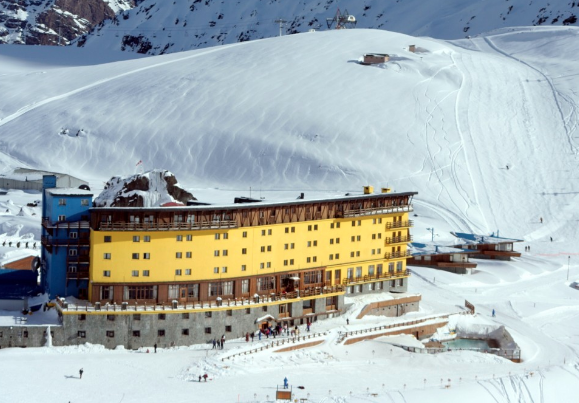
Filled with amenities Hotel Portillo is the only place to stay at the resort. Credit: ChileSki.com

Portillo should be on every skiers bucket list. It’s a beguiling combination of big mountains, a sense of remoteness, old world charm, and wild skiing. Known for intense suntans from its brutal sun, young whippersnappers pumping adrenaline to the limits, a heated pool with a lake view to make even jaded travelers swoon, fine formal dining, and great après ski, you can´t go wrong.

Riding the Roca Jack “Va et Vient” with the US Ski Team. Credit: Casey Earle

Located near the Chile-Argentina border two hours north east of Santiago, 14 miles from the Western Hemisphere’s highest mountain (the Aconcagua at 23,000ft), the area is accessed by the only paved highway to Argentina for over 400 miles. Founded in 1949, the ski area was bought in 1961 by two Americans, Bob Purcell and Dick Aldrich and is still run by the Purcell family. The original hotel has been preserved and remodeled to modern standards.

The area has five chairlifts, four pomas, and four “Va et Vient”. While most are short lifts, several will provide you with about 1,000 vertical feet on the aprons of 14,000 ft mountains, or in combination, more. The “Va et Vient” are specially designed for steep slopes, with only one tower at the bottom, and two bull wheels suspended from the rock above, giving the lift a triangular form. Four or five people load up to the platters hanging from a crossbar, and when ready, the lift starts up and whisks them up the mountain. One can release before or after the lift stops at the top, but be careful getting off on the steep slope, you do not want to fall there!

While there are several good groomed runs, notably Juncalillo and Plateau, much of Portillo’s attraction comes from skiing those steep, ungroomed runs. Famous challenges for skiers are the Garganta (throat), the Lake Run, and the Roca Jack. The most ambitious hike over two hours up takes you to the “Super C”, a lengthy couloir for extreme skiers only. Also, some great heli skiing for intermediate and advanced skiers can be had on the surrounding mountains. All the while, you will be surrounded by a united nations of skiers, and some of the world’s top racers in training.

Taking on the Lake run. Credit: Casey Earle

The only lodging available within 90 minutes of Portillo is the Hotel Portillo. With a variety of options from US$1,150 to $3,950 for a week, meals included, there is something for everyone. A range of activities are available, including a gym, game room, and a full court for sports such as basketball. For lunch, there is no better venue than Tio Bobs, at the top of the Plateau chair, where you can gaze down at the Laguna del Inca and up at the surrounding Andes, while feasting on BBQ’s, fish, salads, and of course a potent Chilean pisco sour!

For more information, click here. For a trail map, click here. 


Worse case scenario, you can always just kick back in the pool, get a massage, or hang out in the bar. Credit: SkiPortillo.com

Trail map gives an orientation to Portillo. Click here for more detail.

Coasting Most Of The Way

Senior Cyclists Love Gravity And Vice Versa.

Franconia Falls offer a cooling off spot. Bring your bathing suit! Credit: Tamsin Venn

Pedaling up and down hills on a mountain bike has its rewards, but we prefer trails that have an emphasis on the downhill. We suggest three great places in the White Mountains of New Hampshire at or near ski areas to do just that. Important: We use suspension mountain bikes that absorb the bouncing over roots and rocks.

The Lincoln Woods Trail off the Kancamagus Highway (Route 112) just west of Lincoln, N.H., is one good trip. You cross the suspension bridge over the East Branch of the Pemigewasset River and follow it on a gradual climb 2.8-mile bed of an old logging railroad (https://www.fs.usda.gov/recarea/whitemountain/recarea/?recid=74669). At the next bridge, you turn left up the trail to Franconia Falls, which is spectacular with a natural water slide. Go ahead, jump in and cool off. The return trip is a screaming downhill all the way back to the parking lot. You dodge some of the old ties and rails still visible. Total trip 6.5 miles up and back.

Another good coaster is The Franconia Notch Recreation Path (https://www.traillink.com/trail/franconia-notch-recreation-path/). The asphalt path runs the length of the Franconia Notch State Park, following the Pemigewasset River for nine miles, ending at the Flume Gorge, then merging onto Route 3 for the last five miles back into Lincoln. The first leg is a bit of a climb up to Cannon Mountain, then the path drops, tempting you to whiz down the hills after you’ve crawled your way up, but there is a 20 mph speed limit (!)

The path passes Echo Lake, the Cannon Mountain Aerial Tram, The Old Man of the Mountain Historic Site, where you can use a brilliant visual gizmo to recreate the old stone face above you (the Old Man tumbled down in 2003). You also pass Lafayette campground (ice cream anyone?), The Basin (icy water cool down?), and finally the Flume Gorge. Bring a lock for your bikes. This trip is eminently doable thanks to Rodgers Ski & Sport (http://rodgersskiandsport.com/) which will shuttle you from its store in Lincoln to the path’s start for $10 a person.

Remember the Old Man? Here’s a unique tool to bring him back, sort of. Credit: Tamsin Venn

Next day, we zipped south to Waterville Valley Resort via I-93. The extensive well-maintained cross-country ski trail system is a blast for biking. You cut through the woods and explore a variety of trails for all abilities through the National Forest. Everything from meandering dirt fire roads to gnarly single-track is available, plus lift access to biking trails on Snow’s Mountain, the first ski trails in Waterville Valley. (http://www.waterville.com/adventure-center/).

Our favorite run is to take the Snow’s Mountain Chair ($9 single ride and $21 all day pass) and zoom down the wide Livermore Road back into town, crossing babbling brooks and wood bridges, in an Eden-like setting. We branch off onto Swan’s Way, a single track, which leads you back to the Town Center. More scenic is to follow the Connector past the Mad River. Then relax outside with live music and cold drinks, even if you didn’t necessarily break a sweat.

Trail junctures post YOU ARE HERE maps (a good printed map is also available), graded beginner, intermediate, expert in XC ratings, so you always know where you’re going.

Do you have a coasting trip you could recommend? We’re open to suggestions.

At the top of Snow Mountain Chair at Waterville Valley. Credit: Tamsin Venn.

Summer Adventures At Mammoth Mountain

Non-Snow Activities Make Mammoth A Family Summer Vacation Stop.

Climbing the Via Ferrata at Mammoth Mountain Ski Area.Credit: Peter Morning, Mammoth Mountain Ski Area.

Ok, picture yourself, flat on your belly in “Superman” position, hurtling in the air down a mountain at 60 mph.

No wonder Mammoth Mountain Ski Resort calls this the Mega-Zip. It’s billed as the “most vertical in the USA” (some 2,100 feet from the top of the ski resort at 11,053 feet) to the bottom.

Definitely not for the faint of heart. Adrenalin junkies, line up here.

The mountain is aiming to open the zipline by late summer, before all these non-snow goodies have to close for the winter season (and skiing!). And it’s got three more adventures, one in the works and two others already operating. The “taste of climbing” wall called Via Feratta is being built. The ropes course for kids 12 and under (gotta grab ‘em early) is already open, as is the Woolly’s Mining Co, a gem mining adventure for kids.

The zipline starts at Mammoth’s top, 11,053 feet and plunges over what some locals call “Oh S*%t Cliffs,” heading down at speeds billed at “over 55mph.” The run is more than a mile long from top of mountain to the base, and you will be able to descend side by side with other folks on parallel cables.

The whole ride is actually in two stages, starting from the very top and going on a somewhat sideways path to the mountain’s Chair One, where people exit and get on a second line all the way to the bottom.

Mammoth hopes to open it by early September, which would give about a month before winter snows start.

The Via Ferrata, which translates to “Iron Path” is a mid mountain mostly horizontal traverse along a cliff face. Rebar is being secured into the cliff face and the adventure will include ladders, suspended bridges and iron rungs, among other things. There will be six different routes that progress in difficulty.

“We think of it as an intro to climbing,” said Justin Romero of the mountain’s marketing department. “The idea is to give people who have never thought of climbing an idea of what it’s like.”

You go with a guide, he added, you are clipped in at all times and the total vertical is about 180 feet as you follow a set trail for 300 feet more or less horizontally across the rock.

The website says “perfect for families, groups or individuals. No previous climbing experience required.”

Photos of what it might look like show folks in full climbing gear … helmet, harness and the rest.

Kids’ Ropes Course at Mammoth Mountain Ski Area. Credit: Peter Morning, Mammoth Mountain Ski Area.

Then, for those kids you found climbing the kitchen cabinets while still in diapers, there’s the kids ropes course for children 12 and under. The site says, “Climb, stretch, balance and crawl your way through 10 different elements that include a climbing net, log walk, planks, swings and more before you rappel back to the ground to finish.”

But for the parents, it’s nice to see all this isn’t THAT high off the ground, and the final rappel drops a fairly tame 15 feet.

A lot of these improvements come courtesy of Alterra Mountain Co., which now has interest in a dozen ski destinations, including CMH (heli skiing). The company, which recently merged with Intrawest, pumped serious money into Mammoth. Some $10 million is being used this summer on the zipline, the cliff climb and both children’s adventures along with improvements to Canyon Lodge.

Besides the zip and climbing route, folks in summer can mountain bike, hike, just ride the gondola for the view and in the greater Mammoth Lakes area, fish, kayak and more.

Summer season is usually early June through end of September when the snows arrive.

For more information: https://www.mammothmountain.com/

People enjoy and photograph the view of lakes from the top of the gondola at Mammoth Mountain Ski Area. This viewpoint is a short hike from the gondola top. Credit: Yvette Cardozo

More Ski Chile: What To Expect From A Chilean Ski Trip

Some Adjustments Necessary To Ski The Legendary Mountains Of Chile.

For many, a typical Chilean ski trip will seem a bit like traveling back in time to the USA 30 or 40 years ago. Some of the lifts date back even further than that! While the ski areas around Santiago are progressively upgrading their infrastructure, snow making, grooming, and security, the ones further south remain, in a word, funky.

Most Chileans do not speak English, but those in ski schools, tourism, and management positions generally do. If you have no Spanish, you should still get by just fine, as people are mostly helpful and warm. The Chilean peso converts at 630 to the dollar.

Expect a lot of surface lifts, mainly t-bars and platters, but also the infamous “va et vient” lifts at Portillo (more on that later). On the plus side, these lifts are usually fast, run in windy weather (which is frequent), and you can bail out easily enough if they stop for whatever reason. Some of the chairlifts are second hand from Europe or the USA, and only one high speed quad exists, in Valle Nevado. Lifts open at 9:00 and close at 17:00, with most skiers coming out at around 11:00. Lunch runs from 12:00 to 15:00.

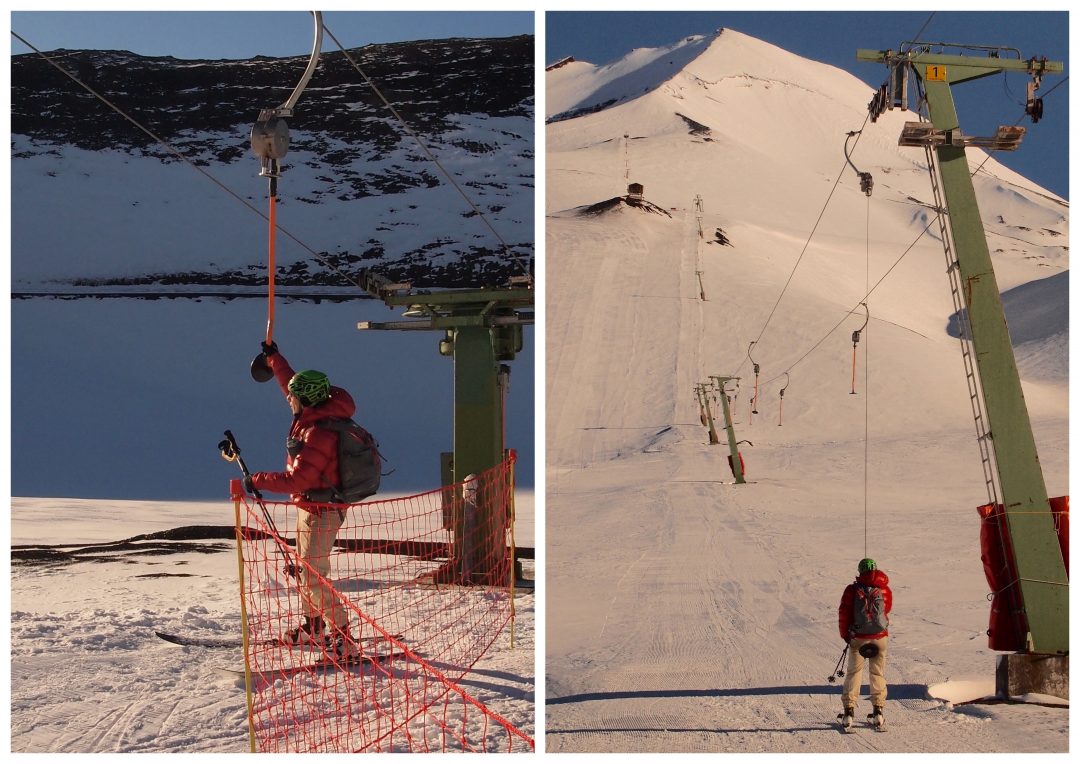
A lonely ride at Corralco. Remember those Poma lifts? Credit: Casey Earle

Don´t expect to get good snow conditions information from the ski area websites, often it is outdated, wrong, or simply non-existent. Portillo is very reliable, but for other ski areas you may have to resort to analyzing webcams or scouring their Facebook pages.

The weather and snow conditions in the Central zone are generally very good. With few but furious snow storms, and occasional extremely light, dry snowfalls, most days will be sunny, fine-packed powder skiing. Off-piste is often limitless, with the southern exposures accumulating triple the amount of the northern ones. With both the sun beating down, and the storm winds roaring in from the north, only in exceptional years can the true north faces be skied, and thus almost all runs are south facing. The season normally runs from mid-June to the end of September.

Casey grabs some pow at La Parva. Credit: Casey Earle

You have to go at least 400 km south from Santiago to the next ski area, Nevados de Chillan, the beginning of the southern climate zone. Here the storms are more frequent and wetter, and the mountains are lower, with skiing starting near or at the tree line. Most people consider skiing in this area more towards spring, when the weather improves. Packed base data is often referred to in meters, reaching up to 5 meters in places. The season in the south often starts late June, and extends into October, with backcountry excursions (on the volcanoes) going into November.

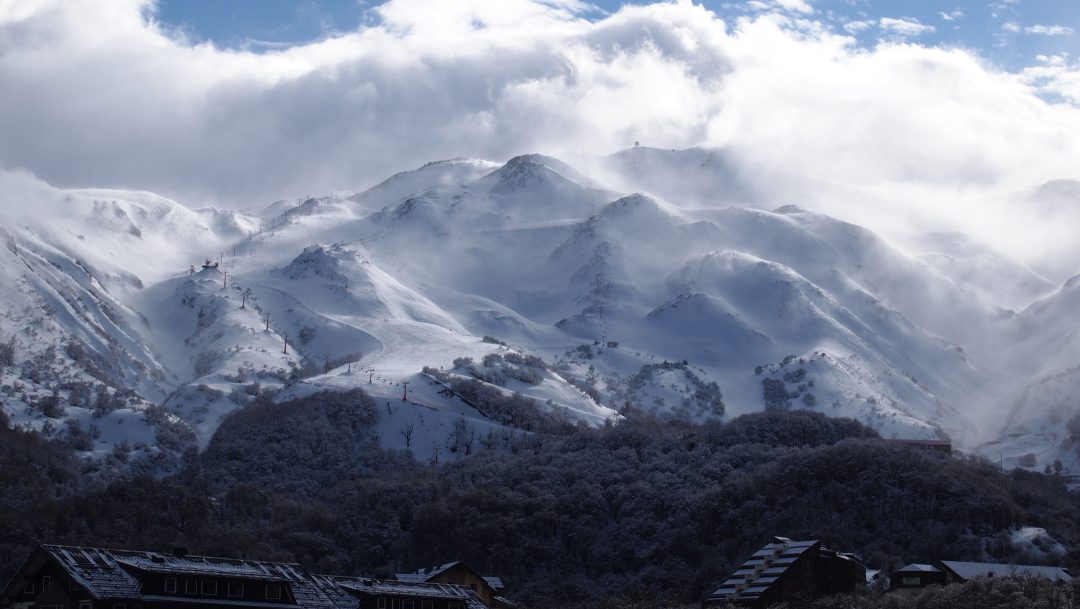
Nevados de Chillan on a windy day. Credit: Casey Earle.

Large hotels are few, at best one per area. La Parva has no hotels, large or small. Aside from Portillo, most people go for the day, or lodge in cabins, small hotels, hostels, or property rentals near the ski areas. Airbnb, Booking.com and other websites have a wide variety of lodging available. In general, what you see is what you get. Chilean food is quite palatable for American tastes, with lots of familiar (and some very unfamiliar) dishes, all accompanied by great local wine and beer.

Lift ticket pricing is based on high and low season, and age group. Avoid the two middle weeks of July, which is the kids winter holiday, as it is quite expensive and crowded. “High season” prices go from July to early/mid August in general, then just weekends, except for Sept 17-19 (National Independence holidays). Seniors start at 65, with about a 20-30% discount on normal adult prices, which run around US$70 in high season and $50 in low. La Parva has a class of seniors from 60-65, and then “super-seniors” as 66+, which only pays US$18 anytime!

Next up is a review of Portillo!

Ski Chile: An Introduction For Neophytes

Chase The Snow To Summer’s Skiing Headquarters In The Southern Hemisphere.

Come May, you have probably set your skis into hibernation and begun patiently waiting for the snow to fly next fall. But you really don´t have to wait!  Southern America’s greatest mountain range starts getting snowed on in May, and by June the ski areas are normally in full swing.

In Chile the resorts are sprinkled just east of the Pan Am highway along the 700 mile stretch from Santiago south, at roughly the equivalent latitude of central California. With an 80 year tradition of skiing, you will find a whole new world of winter adventure, lasting into October on good years.

Santiago and the Andean foothills, after a rare low altitude snowfall. Credit: Casey Earle

Visitors will be happy to know that within a two hour drive of the airport in the capital, Santiago, there are four good ski areas, and upwards of 70 percent of winter days are sunny. Closest are the Three Valleys, which hang above Santiago on the western slopes of the Andes. At night, you can see the snocats grooming trails from this metropolis of seven million!

The La Parva, Valle Nevado, and El Colorado ski areas are interconnected, and it is possible to enjoy a total of 40 lifts and dozens of groomed runs, with multiple options for lodging and dining. Skiing here starts at 8,000 to 9,000 feet, reaching up to 12,000 feet, and is entirely above the treeline. The sunsets are extraordinary.

Casey looks out from El Colorado ski area towards the upper Valle Nevado and La Parva lifts. The 18,000 foot El Plomo mountain looms in the background. Credit: Casey Earle.

Two hours north of Santiago is the world-renowned Portillo hotel and ski area, smack in the middle of some of the highest mountains in the Western Hemisphere. The hotel sits looking north over the mysterious and beautiful Laguna del Inca lake and boasts a long tradition of great service and entertainment. Here you can rub shoulders with racers and ski fanatics from all around the globe.

Portillo and the Plateau chairlift (spot it!), with the Laguna del Inca. Credit: Casey Earle.

Further south, the ski area infrastructure and access may leave a bit to be desired, but I love it nonetheless. All of the ski areas are situated on volcanoes which have varying levels of activity. They are also surrounded by gorgeous temperate rainforests, lakes, rivers, and hot springs. The main ski areas are Nevados de Chillan, Corralco, Villarrica, and Antillanca. The first three have adjacent towns within a 30 minute drive with plenty of lodging and other touristic services. All but Villarrica have a good hotel at the ski area base.

Villarrica ski area, note the smoking volcano. Credit: Casey Earle.

My recommendation for potential visitors is to contact one of the tour companies operating in Chile, or book directly with one of the on-hill hotels such as Portillo. You will have one of the best and most unusual ski trips of your life. Most of the tour operators

Las Araucarias ski area, west side Volcan Llaima. Credit: Casey Earle

in Chile are mainly for younger, adventurous skiers, such as Casa Tours or Powder Quest. However, for the +50 crowd, I can recommend DreamSki Adventures which offers group guided resort based tours in Chile and Argentina for the 45-70+ skier. Their guides are seasoned ski instructors trained in the CSIA (Canadian Ski Instructor Alliance) and offer a high degree of customer service on and off the snow.

Come on down!

For the latest in conditions in Chile from Casey Earle, click here.

Here are the resorts mentioned.

Cycling Efficiency For Seniors

Bottom Line: Knoweth Thy Limits, Wise One.

Ride with younger guys? Then ride wise and slow down. Credit: Pat McCloskey

As I  was pounding the rocks of  Laurel Mountain on the mountain bike with  a group of younger riders here in Pennsylvania’s beautiful Laurel Highlands, I was thinking strategy.  At 63 years old, I am still in pretty good shape but the older I get, I start thinking about the old adage “age and treachery will beat youth and skill”.  Not really applicable in most cases but at least I can try – right?  So the first thing I think of is: don’t push the anaerobic limit to be the first up the hills and over the rocks.  Let the young guns deal with that and I will just keep them in sight.

I have learned to ride within myself and only exert myself enough to keep a visual on the group, especially with a longer three hour + ride.  A more scientific approach is the below which is done with a heart rate monitor:

  • Zone 1: 60 to 70 %; very comfortable effort; use this for warmup and cool down
  • Zone 2: 70 to 80 %; comfortable enough to hold a conversation; most training is done here
  • Zone 3: 81 to 93%; “comfortably hard” effort; you may be able to say short, broken sentences.
  • Zone 4: 94 to 100%; hard effort; the pace is sustainable, but conversation is a few words at a time.

Author Pat McCloskey ponders whether to go around a big section to get back to the parking lot.

Basically the zones are dictated by two theories.  The original theory is dictated by the target maximum heart rate of 220 minus your age. Then you can calculate with a heart rate monitor which zone you can ride in.  This calculation is not quite accurate because it does account for conditioning.  A better way to use the zones is to calculate what is called Heart Rate Reserve which is your max heart rate minus your resting heart rate. Find out what your real max heart rate is by exerting yourself in Zone 4 with a monitor and then in the morning at rest, calculate your true resting heart rate.  This allows for conditioning and the zones can be used according to that calculation on a heart rate monitor.  All in all, I use a monitor on rides to tell me when I am exerting myself above my perceived rate of exertion which will lead to fatigue on a long ride if I am not careful. Use the monitor and slow down accordingly.  As long as I keep the group in sight and can be in the Zone 2 area, I am a happy rider.

Another strategy is not to ride every section but take a breather and bypass a section and/or coast to the next meeting area.  Sometimes that means taking a fire road instead of a technical trail..  I like to challenge myself and take the technical sections but I know if I take them all, I will not be able to keep up or complete the ride.  Ride to ride another day is my motto, and I am not out to prove anything.

Lastly, know your limits and know when you are finished.  You don’t want to get hurt and if you are too fatigued, it can happen easily on a mountain bike.  Sometimes you have to cut out and take the fire road back to the parking area for a head start on the post ride beer.  Hey, you had a good ride, with younger, stronger riders, but for a guy who is older, this is the way to stay involved without compromising your ride or theirs.

Riding season is upon us, and there is no reason not to challenge yourself within limits.  Go for it.  Have fun but as Harry Callaghan once said, “ A man has to know his limitations.”

Cross or divert? Use your noggin and your heart rate monitor to decide. Credit: Par McCloskey

Grazing cows

Summer Trail Prep: How It’s Done

What Happens When the Snow Disappears Along With The Crowds?

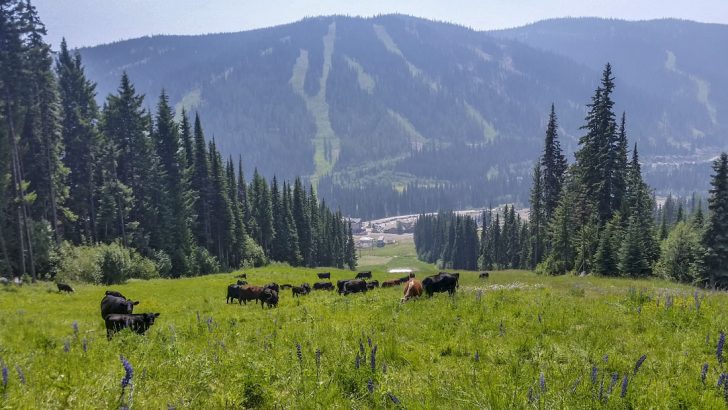
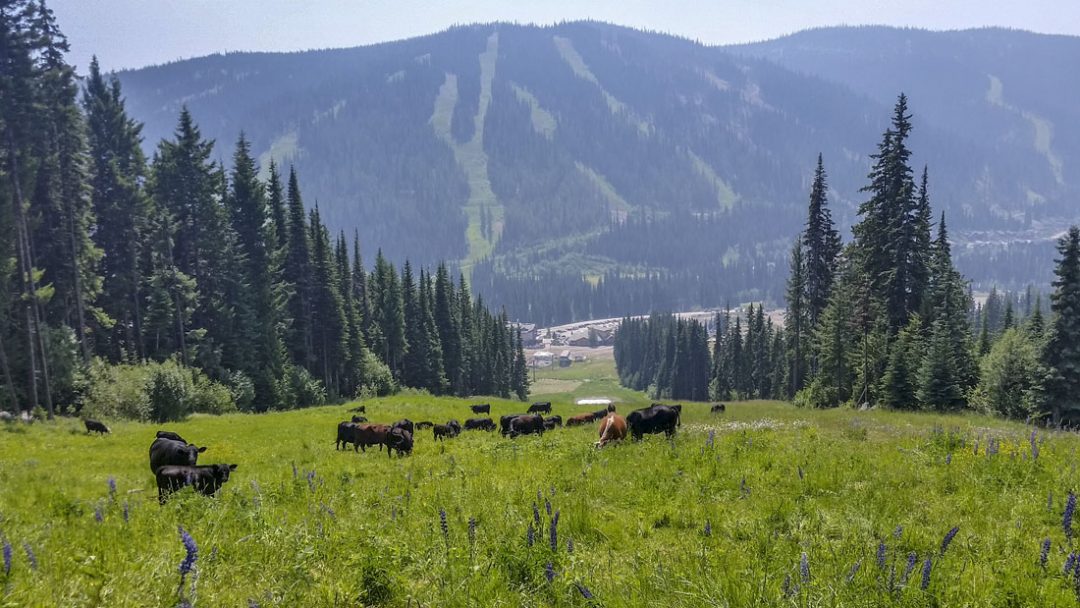
Grazing cows in summer help cut grass on ski runs. Part of summer prep. Credit: Sun Peaks Resort.

Bet you’ve never thought about how your favorite ski runs get cared for when there’s no snow on the ground.

Yes, they have to be prepped each summer.

Seth Worthen, slopes manager at Sun Peaks Resort in British Columbia, Canada, explained how his 11 person trail crew works. And it’s a seven-day-a-week job.

Willow and alder trees, for instance, can grow four to six feet over the summer—the height of an average person. You might think of willows as bushes, but if left alone, they can become 20-foot trees, fast.

“We use a flail mower,” said Worthen. “It practically makes the willow into chips. Even the larger ones can be laid down flat.”

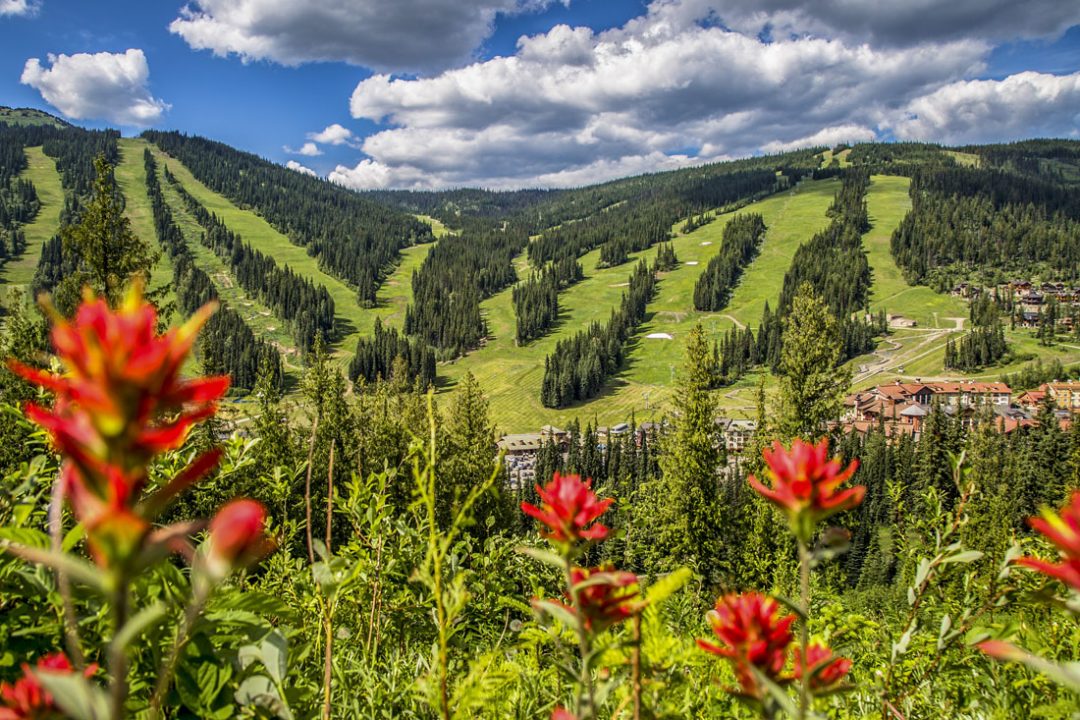
Summer flowers and hiking at Sun Peaks Resort. Summer prep of ski runs will include cutting the grass after the flower bloom. Credit: Sun Peaks Resort.

The crew starts low on the ski mountain in May as soon as the snow clears. But they often can’t get to the tops of runs until July because of lingering snow.

Early grooming years at Sun Peaks Resort were spent removing stumps and rocks. So now, most runs are just grass.

“We mow ‘em with an off road mowing machine, making stripes up and down. Sundance almost looks like a golf course. When you mow two or three feet of grass growth, it lies down and insulates the ground so we need only 25 – 30 cm (about a foot) of snow to open.”

And then, there are the cattle.

Four farms in the area have grazing rights on Crown recreation land. That means the nice, smooth, grassy ski slopes get help with grass cutting from the bovines. Some years, it’s only a few hundred cattle, but it theoretically could be thousands.

So another job here is setting up electric fences to keep the cattle out of the core village. There are gates so people can access hiking trails.

Among the other jobs, there’s cutting some trees along the edges of existing trails each summer to widen them a bit. Also choosing and marking winch cat trees. These are the trees the grooming cats attach cables to so they can manicure steep ski runs in winter.

“We bore into the trees to make sure there’s no decay,” said Worthen.

That’s a smart move when you are expecting to have a cable on a tree keep an eight ton snow cat from sliding uncontrollably down the mountain.

Summer prep is not exactly a hazard free job. One recent summer, one worker was herding a bull (yes, there are bulls among the grazing cattle) when she stepped wrong off a log and broke her ankle. We know she healed just fine because this winter, she was helping run dogsled tours.

At least a third of the runs are prepped each summer, though there are north facing runs on Mt. Morrisey that get more water so the willows grow faster and have to be dealt with yearly.

Thanks to the fact most runs are now just grassy trails that are skiable with a fairly thin layer of snow and are helped by snow making on major green runs, the resort is usually ready to open for skiing each year by the second week of November.

https://www.sunpeaksresort.com/

Summer flowers and hiking at Sun Peaks Resort. Summer prep of ski runs will include cutting the grass after the flower bloom. Credit: Sun Peaks Resort.

XC Skiing In The Spring Is The BEST!

Even In Mid-April You Can XC Ski; You Just Have To Find The Snow.

Spring cross country skiing can be found in high country and xc resorts. Credit: Mike Maginn

As the cross country (XC) ski season winds down, most XC ski areas close because of lack of skiers rather than lack of snow on the trails. The sun comes out, the temperature rises, and the XC skiers quit. Why? Are we infected with winter fatigue? Is the lure of spring time recreation too strong to ignore?

XCSkiResorts.com spoke with some ski area operators around the nation to get their take on spring skiing. Many areas host springtime season pass holder parties and offer big discounts for purchasers of season passes for next year. Lapland Lake in Northville, NY, commented that their trails are compacted on a daily basis so the snow does not disappear like in the city or open areas in suburbia. Lapland’s Kathy Zahray encourages skiers and snowshoers to “get out and enjoy this weather and these great spring conditions!”

Zahray admits that “the reality is that in the spring it costs more for grooming and staffing than the amount of income earned from the diminishing number of skiing patrons, however this is one of the most fun times of the year to enjoy the outdoors. The milder temperatures and discounted rates are terrific for everyone, and it is fun to ski in shorts and t-shirts.” Lapland Lake is offering special lodging prices through March.

Carters XC Ski Centers  in Bethel and Orford, ME, have been very busy this spring renting cabins and selling equipment. Carter’s hosted the Burger, Beer & Bike Festival for their patrons to try fat bikes and enjoy the area.

In Minnesota at Maplelag Resort, proprietor Jay Richards concurs “that people want to get on the snow early but get tired of winter and ready for warm spring days.” He feels that “skiers in the Midwest are conditioned to colder and drier snow compared to skiers in other regions who are more accustomed to a wider variety of snow conditions.”

At Cross Country Ski Headquarters in Roscommon, MI, they run spring events on machine-made snow such as the Hawaiian Barbecue where they have locally raised pork hocks, along with island style veggies and of course fresh grilled pineapple. Proprietor Lynne Frye invites everyone to celebrate all that is great about spring: long, sunny days of great cross country skiing in MI!

Skier Brenda Winkler, who is a regular at Izaak Walton Inn said, “There is nothing like skiing on Piston Bully groomed trails at Izaak Walton Inn. I skied yesterday and then enjoyed the best Buffalo burger in the restaurant. Izaak Walton Inn has had great grooming all season and there is a lot of winter left at the Inn!”

The Breckenridge Nordic Center  in CO has skiers who are enjoying the patio and lounging around with a glass of beer or wine. They’ve held some well-attended fundraising events this spring and expect to remain open through April 22. Owner Josh Dayton said “We’re having really warm days but our snow holds up very well.”

The folks at Methow Trails in Winthrop, WA, stated, “This season has been another fantastic snow year!   We have no shortage of snow but people stop skiing in the spring which is really too bad because we often find the best skiing of the season comes in the spring. The trails are well packed, and the days are lighter and warmer making it much more comfortable to ski. We’re seeing that in the Methow right now there’s some of the best ski conditions we’ve had all year!

Ridin’ With The Cats

What’s It Like To Groom Trails At Night?

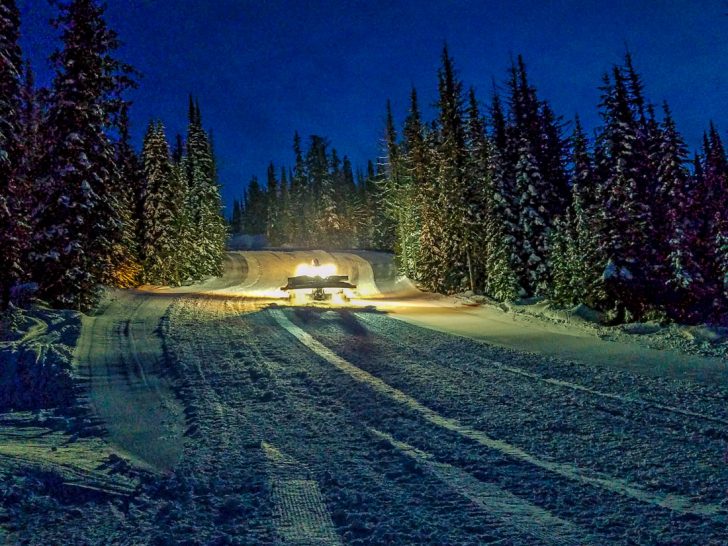
Snow cat groomer making the ski run smooth for skiers the next day. Sun Peaks Resort, BC.

They come out at night and do their job. You can see their lights progressing across the ski slope and occasionally hear their roar. And the next morning, they’ve left this delicious set of corduroy tracks across the ski hill.

I’d always wanted to go on-slope with a snowcat groomer. And so, at Sun Peaks Resort in British Columbia, Canada, I did. And it’s a tour anyone can sign up for.

Snow cat groomer makes its way down a ski slope at Sun Peaks Resort, BC.

It’s astonishing how much damage skiers can do to a run in a single day. If the snow is soft, bumps form, and the middle gets dug out because that’s where folks prefer to ski.

Enter the snowcat groomers. These are powerful cabs—Piston Bully 400s with 320 hp diesel engines— atop tank treads with a blade on front and a tiller on the back. The blade knocks down bumps and that nasty looking tiller, which rotates at over 1,000 rpm, can turn even ice into something resembling powder, which is then smoothed flat into that hero corduroy.

Of Sun Peaks’ 24 operators, two are women.

“Honestly, the women do a better job. They are more detail oriented,” admitted my guide for the night, Leo.

It takes three years for a groomer to really learn how to do this well, he added.

It was one of the women running the winch cat that night. Picture eight tons of growling machine attached by a line to a tree to keep from sliding downslope uncontrollably. This is how the really steep runs get groomed. Back in the day, these runs got so bumped and carved out, they were barely skiable.

It takes three years to become an expert groomer. Sun Peaks, BC.

Rob Gayman, grooming manager at Mt. Hood Meadows resort in Oregon, once described operating a winch cat this way: “It’s somewhat like dropping off a cliff. At the top break-over as the machine teeters above the brink, your heart starts to palpitate, and your natural survival instinct pushes you back into your seat.

“As the machine creeps forward and the operator adjusts the winch tension, the cat tilts forward into the darkness. The cat’s lights don’t shine down low enough; you can’t see what lies below. It tilts more and more. You start to fall forward out of your seat. Now you’re standing on the floor; surely this can’t be right? But then the cat finishes its forward tilt and the ground below you comes back into sight. It wasn’t a cliff after all. Snow rolls and tumbles down in front of the cat as the operator blades and tills his way downhill.”

For me, as dusk fell, the whole scene took on a surreal feel. Our headlights shining on the ridges of snow, leaving them glowing with weird shadows, along with the blinding headlights of an oncoming behemoth.

On an average night, more than a third of Sun Peaks Resort’s ski runs will be groomed. But among those, will be every green (beginner) trail.

And if you are lucky, your favorite black run will have been groomed early, then covered with ankle deep powder overnight, making for a run that feels, well, like skiing a glacier.

There are two women groomers at Sun Peak, BC, said to be more detail-oriented than the men.

Grand Targhee: Deep Powder and a Friendly Vibe

It had been snowing three days when I arrived at Grand Targhee. By morning the new snow total was 55″.

A guy from Denver suggested signing up for Early Tracks. For $89 members of the ski school guide you at 8AM, an hour head start on the public.

Next morning, I skied 1 1/2 hours on untracked terrain, guided by B-Rad, Wall Street derivatives trader turned ski instructor. The snow was mid-thigh. Grand Targhee is known for its deep, natural snow, and the day I was there, the resort lived up to its reputation.

Like many other skiers, my previous experience with the area was taking a day trip from Jackson Hole, the mega resort about 25 miles away. Grand Targhee’s 2,600 acres sit in the Teton mountain range, its 2270′ of vertical served by five chairs.

Parking lot at Grand Targhee

At 7851′, the base can present a breathing challenge to flatlanders. But it’s worth the short time to acclimate. On clear days, you can almost reach across the valley and touch Grand Teton Mountain in its 13,770′ glory.

Lodges, restaurants, retail, pool and hot tub cluster at the base; each a short walk from the other. The lot is an easy walk to the lifts and decent restrooms are located at the top of each chair.

From past visits, I know that super-steep is not part of Grand Targhee’s DNA. This time, two hours of early morning super-deep left me wiped out. The rest of my day was at the bottom.

There are three places to eat and a small general store. The first evening I ate at Branding Iron Grill, the resort’s fine dining option. A nice space, with good food, and a generous pour. Powder morning I chose something light and delicious at Snorkels, the breakfast and lunch eatery. That afternoon I sat in the very full Trap Bar and Grill, sipping a beer and enjoying friendly conversation against a background of live bluegrass.

Grand Targhee’s senior pass pricing starts at age 65 and is humane. Lodging at the resort also is reasonable: a slope-side room, midweek next February is less than $200 per night. Other options are available in nearby Alta, Wyoming and in Driggs and Victor, Idaho.

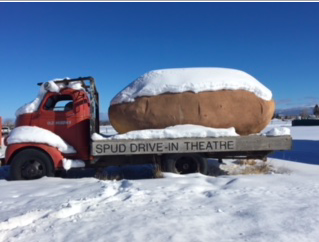
Grand Targhee is located high above Idaho potato country

The vibe is friendly, with friends and strangers of all ages in easy conversation. Older locals refer to themselves as Targeezers.

The mountain, reliable snow, and reasonable prices keep people returning season after season. One couple I met was visiting from Hawaii for the second time in a few months. The guy from Denver was on his second trip of the year. A couple from Australia had driven over from Jackson for the day. Next time they plan to spend to use Targhee as their base.

Leaving Grand Targhee, Teton Range in background

At one point the clouds lifted and Idaho’s flat potato fields came into view. Access to this area of Wyoming is through Idaho. B-Rad pointed out some of the distant ranges while I caught my breath. Then our attention focused on what was in our immediate future: a long expanse of light, untouched deep powder waiting quietly for us to leave our lines.


Spring Is The Time To Play Games

Try This New Game: It’s A Cross Between Where’s Waldo And A Scavenger Hunt.

Find the Bear. Credit: Harriet Wallis

I was skiing at Deer Valley, and I was taking photos. I’m always taking photos. It’s what I do. I never know when I’ll need a certain shot to illustrate a story.

Find the flamingo (?!) Credit: Harriet Wallis

The next time I skied Deer Valley, I was with a friend. I showed her eight photos including the carved bear skiing on a roof, a flamingo wearing a white cross outside one of the ski patrol buildings, and a bronze Native American sculpture. I challenged her to find the real things as we skied around the mountain.

We covered a lot of trails that day. Deer Valley has more than 2,000 acres of skiing, six bowls and 101 ski runs. The hunt forced us to ski a trail once, so she could look for an item, and then move on rather than sticking to one trail over and over. It was a whole new angle on having fun.

Bingo! She found everything shown in my photos. And we were thoroughly tuckered out.

Find the mountain goat. Credit: Harriet Wallis

How To Play

If you are used to taking photos only at scenic spots, try snapping photos of things you see around your favorite mountain, such as a certain trail sign or an unusual weathered tree. Then show the photos to your friends (if they’re whacky enough) or to your grandkids. Challenge them to find those things. You can even offer rewards.

If the springtime slopes start to become ho hum, silliness will add new zest.

To read more from Harriet click here for her stories on SkiUtah.


Find the warrior. Credit: Harriet Wallis

XC Skiing In Spring Is The Best

XC Ski In Shorts And T-Shirts This Spring: A Peak Experience!

Appleton Farms, Ipswich, MA

As the cross country (XC) ski season winds down most XC ski areas close because of lack of skiers rather than lack of snow on the trails. The sun comes out, the temperature rises, and the XC skiers quit. Why? Are we infected with winter fatigue? Is the lure of spring time recreation too strong to ignore?

Lapland Lake, NY, has plenty of snow

XCSkiResorts.com spoke with some xc ski area operators around the nation to get their take on spring skiing. Many areas host springtime season pass holder parties and offer big discounts for purchasers of season passes for next year. Lapland Lake in Northville, NY, commented that their trails are compacted on a daily basis so the snow does not disappear like in the city or open areas in suburbia. Lapland’s Kathy Zahray encourages skiers and snowshoers to “get out and enjoy this weather and these great spring conditions!”

Zahray admits, “The reality is that in the spring it costs more for grooming and staffing than the amount of income earned from the diminishing number of skiing patrons. However, this is one of the most fun times of the year to enjoy the outdoors. The milder temperatures and discounted rates are terrific for everyone, and it is fun to ski in shorts and t-shirts.” Lapland Lake is offering special lodging prices through March.

Carters XC Ski Centers  in Bethel and Orford, ME have been very busy this spring renting cabins and selling equipment. Carter’s hosted the Burger, Beer & Bike Festival for their patrons to try fat bikes and enjoy the area.

In Minnesota at Maplelag Resort, proprietor Jay Richards concurs, “People want to get on the snow early but get tired of winter and ready for warm spring days.” He feels that “skiers in the Midwest are conditioned to colder and drier snow compared to skiers in other regions who are more accustomed to a wider variety of snow conditions.”

At Cross Country Ski Headquarters in Roscommon, MI, they run spring events on machine-made snow such as the Hawaiian Barbecue where they have locally raised pork hocks, along with island style veggies, and, of course, fresh grilled pineapple. Proprietor Lynne Frye invites everyone to celebrate all that is great about spring: long, sunny days of great cross country skiing in MI!

Skier Brenda Winkler, who is a regular at Izaak Walton Inn said, “There is nothing like skiing on Piston Bully groomed trails at Izaak Walton Inn. I skied yesterday and then enjoyed the best Buffalo burger in the restaurant. Izaak Walton Inn has had great grooming all season and there is a lot of winter left at the Inn!”

Breckenridge Nordic Center

The Breckenridge Nordic Center, CO, has skiers who are enjoying the patio and lounging around with a glass of beer or wine. They’ve held some well-attended fundraising events this spring and expect to remain open through April 22. Owner Josh Dayton said “We’re having really warm days but our snow holds up very well.”

The folks at Methow Trails, Winthrop, WA, stated, “This season has been another fantastic snow year!  We have no shortage of snow but people stop skiing in the spring which is really too bad because we often find the best skiing of the season comes in the spring. The trails are well packed, and the days are lighter and warmer making it much more comfortable to ski. We’re seeing that in the Methow right now there’s some of the best ski conditions we’ve had all year!

Big Sky: Unpretentious. Uncrowded. Unbelievably Great Skiing.

Big Sky is not ritzy. It is not pretentious. It is not crowded.

And, as one of country’s greatest ski destinations, it is not to be missed.

Big Sky is big…really BIG!

With 4350′ of vertical and 5,800 acres, Big Sky justifiably calls itself “The Biggest Skiing in America.”

The last time I skied there was before the acquisition of Moonlight Basin, a smaller adjacent area I always assumed was for beginners.

That assumption was wrong.

A tour of what had been Moonlight revealed a world of interesting black diamonds off Lookout Ridge. I explored a few of them before heading toward Mountain Village, the resort’s commercial heart and onto the blue and black terrain on Andesite and Flatiron Mountains.

At day’s end, gear stashed with ski valet, I walked to Huntley Lodge, one of four hotels a short distance from the lifts.

Named for NBC news anchor Chet Huntley, it was bustling with people there for conferences and skiing. My room was clean and pleasant, and, like me, showing some age. The night before, following check-in, I had walked across the plaza to a well-populated bar and enjoyed a few beers and a surprisingly good meal. This night, I drove six miles to Town Center, where the Lotus Pad‘s curry was excellent and its vibe, big city.

Big Sky is attracting a lot of visitors and permanent residents. The place is booming. In Town Center, construction cranes and hard hats are everywhere. Winter is part of the equation. Other times of year fishing, golfing, mountain biking, hiking, and nearby Yellowstone National Park contribute to the draw. There’s a beautiful new high school and, especially important for seniors, the new Bozeman Health Big Sky Medical Center.

Next morning, following the Huntley’s substantial breakfast buffet, I returned to the lifts with the goal of reaching 11,166′ Lone Peak before the clouds rolled in. On the way I took Powder Seeker, the resort’s high-speed six-pack with blue bubble and heated seats. It’s then a short run to the base of Lone Peak Tram, the canister transporting 15 at a time. Depending on what awaits you at the top, the wait at the bottom may or may not be worth it.
By the time I reached the peak, it was socked-in, and I felt my way down a black bowl until visibility improved. Entering Bavarian Forest, an area of beautiful glades on manageable black terrain, I saw no one until reaching the bottom of the Dakota triple chair.

Big Sky has few on-hill amenities. There’s one permanent upscale restaurant recommending reservations, an over-sized yurt serving brats, burgers, and beers, and two limited-menu food trucks.

Toilets are equally scarce. PortaPotties next to the yurt, required an overly high step onto a slippery floor. They need to take care of that for skiers of any age. The trail map is a good one and will help you know before you need to go.

In the near distance, contiguous to Big Sky but not accessible to the rest of us, is Yellowstone Club, the famed, private resort. An instructor I met pointed out Bill and Melinda Gates’ home.

Seniors (70+) get a break on day passes (5-day advance purchase is best). Season pass options vary and have two senior categories, one 65-79, the other 80+. Big Sky participates in IKON and Mountain Collective.

Numerous direct flights to Bozeman, an hour from Big Sky.

There are a surprising number of non-stop flights from most major cities to Bozeman, about an hour away.

Depending on your skiing preferences, Big Sky is either a very good place to visit or a must place to visit. Its size, scope, and reliable snowfall make it a resort where senior skiers simply can’t go wrong.


It’s Birthday Party Time at Alta.

Hip, Hip, Hooray! Skier Bob Turns 94!

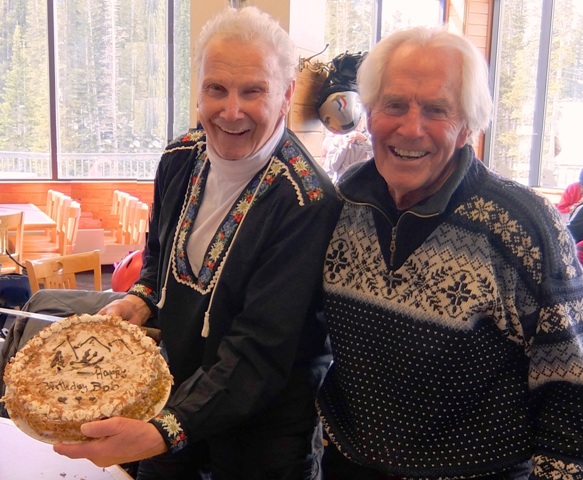
Bob Murdoch celebrates his 94th on skis at Alta. Credit: Harriet Wallis

You might say that 94-year-old Bob Murdoch is a “senior’s senior” skier. He represents many skiers across the country who are skiing into their 90s and enjoying their mountain friendships as much as the slopes.

Ski friends matter. Skiers gave Bob a birthday card that said: Count your age in how many friends you have, not in years.

Bob’s pal, Nick Looser, baked two special cakes
for the party at Alta. Credit: Harriet Wallis

At Alta, Bob is following in the footsteps—in the ski tracks—of 100 year old George Jedenoff who celebrated his milestone birthday on skis in July. Alta’s snow had melted by July, but its neighbor, Snowbird, gathered enough snow to groom a long swath so George could ski on his 100th birthday.

Next to George, Bob is the oldest skiing member of Alta’s senior group, the Wild Old Bunch—and the Wild Old Bunch threw an on-mountain party to honor him. And what a party it was!

Age has its rewards.

Bob, a retired hydro engineer, skis with his good friend Nick Looser, a retired culinary artist, who baked two specialty cakes for the event. He knew there would be a big crowd to celebrate Bob’s 94th birthday.

Bob currently skis three days every week, and his love affair with Alta goes back a long way. He skied the mountain in the 1930s before it was a resort and before it had lifts. He hiked up to ski down.

Skiing has changed a lot since the days of ungroomed snow and long uphill hikes, but we’re lucky we can celebrate with those hardy, early skiers, and we hope we can grow up to be like them.

To read more from Harriet click here for her stories on SkiUtah.

My Sun Valley Serenade

A few rides on the lift can say a lot about an area. At Idaho’s Sun Valley I was reminded of its friendly vibe and older population of very good skiers.

Sun Valley with Ketchum and Baldy in the background

Anyone reading this knows Sun Valley is one of America’s oldest and most celebrated resorts. In the late 30s to the 60s/70s, Sun Valley helped establish the glamor of skiing by attracting celebs like Ernest Hemingway, Gary Cooper, Clark Gable, and Ingrid Bergman. The 1941 romantic comedy, “Sun Valley Serenade” starring Olympic skater Sonya Henie; actor, John Payne, and bandleader, Glenn Miller (“Chattanooga Choo Choo” was one of its songs), is played 24/7 on a resort TV channel.

All of that might be lost on Millennials, but as part of the SeniorsSkiing.com demographic, the importance of Sun Valley should not be lost on you.

It’s the location of the world’s first chairlift. It’s where Warren Miller spent his post-WWII years, and it was and continues to be home town for Olympic champions such as Gretchen Fraser and Picabo Street.

Sun Valley is the resort community adjacent to the town of Ketchum. There are two places to ski: Bald Mountain, in Ketchum, tops out at 9,150′ and has 2,054 acres of almost every type of terrain. At a lower elevation (6,638′), Dollar Mountain mixes terrain parks with blues and greens.

The day of my visit, I got an early start; parking at the River Run lot and taking a short, downhill stroll to the lodge. At the drop-off area there’s a fleet of fat tire wagons to carry equipment the short distance to base lodge. For the most part, Sun Valley’s day lodges are posh and serve excellent food. Restrooms are as nice as in a fine hotel; well-maintained, private stalls, and high-end fixtures. One minor downside is that typically they’re at the bottom of a flight of stairs.

The gondola goes to mid-mountain, where you have access to the rest. From there, I chose a chair that got me close to the top of Warm Springs, the face with more than 3000′ vertical.

About 6″ had fallen overnight and the run, first on black, then blue, was a great way to start. Back at the top, I headed down a ridge where sun-exposed snow was starting to firm. Several chairs and runs later, I stopped in Seattle Ridge Day Lodge to rehydrate and enjoy the great views.

Baldy is about to expand by 380 acres. Cold Springs Canyon, a steep pitch adjacent to Seattle Ridge, is expected to open next season with a new detachable quad.

The cost of skiing Sun Valley is a mixed bag. Seniors (65+) can purchase lift tickets in advance for $89 a day, significantly less than $135 for the youngsters. But there are no senior discounts for season passes. Sun Valley is a Mountain Collective participant. That pass includes two day passes and 50% off the price of subsequent days. If I planned to ski there five or six days, I’d probably use Mountain Collective, currently selling for $409.

I stayed at the newly remodeled Sun Valley Inn. My room was large and tastefully decorated. Off the lobby is the beautiful and understated Ram Restaurant. The menu is diverse, the room has a casual elegance, and the service is excellent. Hemingway could still be perched at the bar.

The Pioneer Saloon

In Ketchum, about a mile down the road, is The Pioneer Saloon, the classic bar and meatery that has been attracting locals and visitors for decades. One evening I met friends at Sawtooth Brewery for first-rate pub food and beer.

Delta, Alaska Airlines, and United have daily direct flights to nearby Hailey from Chicago, Denver, Seattle, Portland, LA, San Francisco, and Salt Lake City.


Sun Valley, America’s first destination ski resort, is a classic. I know it’s on a lot of bucket lists. But, like Warren used to say, “Why wait another year? You’ll only be that much older.”

Kingdom-Trails-Fatbike

Kingdom Trails: Vermont’s Fat Bike Mecca

A New Sport Bridges Snow and Non-Snow Seasons: Fad Or Here To Stay?

On the Kingdom Trails in Lyndonville, VT. Credit: Herb Swanson

[Editor Note:  SeniorsSkiing.com is interested in bringing new activities to our reader.  In this story originally published on XCSkiResorts.com on biking with fat, balloon tires, publisher Roger Lohr does an explainer and reports the adventures of a group of neophytes on Kingdom Trails in Northeastern Vermont.]

Fat bikes, dubbed the “Hummers of the two-wheelers’ world” are proliferating with more than 150 cross country (XC) ski areas in North America that welcome fat bikes on their snow covered trails. These specially-made bicycles accommodate ultra-wide tires that can be run at very low pressure 4-8 pounds of pressure, allowing fat bikes to roll over soft, slippery surfaces like snow. XC ski areas and regional pockets across the nation from Vermont to Michigan and Arizona to California and Washington now have fat bike trails with single track groomed and signed trails, rental bikes, and special events.

Snow Sport journalists head off on a fat bike familiarization tour. Credit: Roger Lohr

A small group of North American Snowsports Journalist Association members were recently introduced to fat biking by the welcoming folks at Kingdom Trails in Lyndonville, VT. The group found the bikes easy to balance and maneuver. Similar to XC skiing, the fat bikes provide exercise when going on flat terrain with more effort required up hills, earning thrills on the downhills.

An industry source at QBP, manufacturers of fat bike brands Surleybikes and Salsacycles, boots, gloves, accessories and apparel recently reported that 150,000-200,000 fat bikes that have been sold since 2010. These bikes provide a great way for avid cyclists to stay in shape during the winter season, and they provide different recreational fun for people who are active or love the outdoors.

Fat biking at Kingdom Trails in northeastern Vermont is no small matter. It is the foremost mountain bike destination in the east with more than 40,000 day passes sold in 2017 (20 percent increase from the previous year), and they’ve quickly parlayed this notoriety into becoming a mecca for fat bikers in the winter. Kingdom Trails has 100 miles of bike trails, 30 of which are used in winter for XC skiing, snowshoeing and fat biking, and works with 80 different land owners. Kingdom Trails also hosts Winterbike, which is the biggest fat bike festival in the east. The organization conducted a survey of bikers showing that they are generally aged 45-60 and reportedly attract $8-10 million of business to the region!

At Darling Hill Road in Lyndonville, the Village Sport Shop has a trailside facility adjacent to the Kingdom Trails Nordic Adventure Center renting fat bikes for $55 a day and sells the bikes ranging from $1,800 to $2,800. Fat bike products include softgoods, accessories, and bikes available from companies such as Liv Bikes, Giant, and Pivot among others.

Bike in winter? Fatties make snow country accessible.
Credit: Herb Swanson

Another option for those who would like an introduction to fat biking is to have a guide at Kingdom Experiences take care of all the details. They’ve got certified instructors and want to help cyclists have an experience catered specifically to rider skill and ability levels offering kids camps, women’s clinics and getaways and more.

Kingdom Trails employs three paid groomers, who pack and maintain about 30 miles of trails. Day membership prices (day pass for trail access) are $15 a day for those aged 16-69 and $7 for youth aged 8-15. There are also year-round memberships available with an annual family membership priced at $150. Memberships and rules of fat bike etiquette can be found at the Kingdom Trails Welcome Center in East Burke or the Kingdom Trails Nordic Adventure Center on Darling Hill Road in Lyndonville.

New Legends In The Making

Ski Museum Of Maine Holds First Annual Seniors Race.

Medaling were left to right: Leigh Breidenbach (Turner). Ginny Bousum (Kingfield), Paul Rogers (Camden), Jill Gray (Farmington), Michael Becker (Winthrop), Tip Kimball (Cumberland Center)
Credit: David Eden

Just when the afternoon light was at its best, the Ski Museum of Maine hosted its first Legends of Maine GS Race at Sunday River. The goal was to benefit the growing museum based in Kingfield as well as to show racing for seniors is both doable and fun.

Off and running. Credit: David Eden

Twenty skiers, 50 to 80 somethings, were assigned decade-appropriate heats. Younger competitors presumably most able to handle the ruts went last. Everyone enjoyed a well pitched course, groomed to perfection by Sunday River officials on Monday Morning off Barker Mountain.

Many racers were veterans of Sunday River’s Wednesday race group clubs, but for some it was a step up from the usual NASTAR course.

Tip Kimball, the only male to enter the 50-59 category, was fastest overall. Maybe youth does still have some advantages. Greg Sweetser, Executive Director of Ski Maine, was only 5.34 seconds behind in the 60-69 division, not bad for an older guy.

Leigh Breidenbach of Turner and a manager for Sport Thoma ski shops, took first in the 60 plus category. She says she raced because, 1) she is a board member and 2) she was the director of the Ski Industries Program at UMaine, Farmington for many years under Doc DesRoches, so she supports the industry any way she can. Her husband, Bede Wellford, 64, was gamely racing “on a new hip.”


Beth Hodgkins in the 60 plus group.
Credit: David Eden

Wende Gray of Bethel and President of the Ski Museum of Maine, also took part. The last time she entered a race was in 1988 at Lost Valley for a ski association event. Her words of triumph after this race: “I did not crash, and I finished.” She took the gates wide to stay out of the ruts, enough to earn a bronze medal.

Top woman finisher in the 70 plus category was Virginia Bousum, 77, of Kingfield, and 13th overall.

Virginia was nervous despite her freshly tuned Dynastar GS skis, her “visualization” prep of Michaela Schiffrin running GS on YouTube, and not listening to the other “guys” warning each other about the tricky gates ahead. Her pre-race training had gotten sidetracked by teaching six-year-olds over the busy school vacation week at Sugarloaf. For moral support, she brought along her granddaughter who had taken the day off from school.

Ultimately though, “It was fun, just ski down, nothing tricky. It was a nice course. They set it up really well,” she says.

For the record, her last major race was a Bonne Bell suntan lotion sponsored race back in the 70s at Sugarloaf.

Bill Hayes, 82, placed third in the 70 plus category on his G9 GS skis. He continues to train at Sunday River with the kids from Gould Academy, where he used to coach. No slouch, he was also on the UNH ski team and coached the U.S. Ski Team. A downhill specialist, he came close to the 1955 Olympics in Cortina but an injured leg kept him out.

How was the race?

“Great, but I gave it too much room. What else am I going to do, sit at home?”

An awards ceremony following at the Barker Bar, with food and drink and Gray’s presentation of medals, plus two trophies, Centrum, ski wax, and Bandaids.

Going forward, plans are to move the race around to other Maine ski areas to spread the word. With any luck the race will take place at Sugarloaf next year with more legends in the making.

Hey, Hey, Ho, Ho, This Is Maine, It’s Gonna Snow

The Half Moon Band Delivers Truth About Living In New England.

It’s been snowing a lot around New England this March. Three Nor’easters in less than two weeks delivered plenty of snow and have basically rescued the spring skiing season for most resorts from Pennsylvania to Maine. But, there are people who think that snow is just frozen water that blocks them from getting to their flight to Aruba. Grousing brings a negative force field.  Embracing the reality of New England weather is healthy.  Proof?  Just watch this ditty by Bangor Daily News journalist Troy R. Bennett and performed by The Half Moon band. Relax, forget those power outages; it’s gonna snow.