Trapp Family Lodge: Some Favorite Nordic Things

[Editor Note: SeniorsSkiing.com is asking our readers to contribute to support our online magazine. Yes, we have grown in the number of subscribers and advertisers. But our expenses have also grown. You can help us defray some of these expenses by helping us out with a donation.]

Support SeniorsSkiing.com by clicking here.

______________________________________________________

A Ski Tour At The Legendary Resort Winds Up With Craft Beer.

Northern VT mountain-scape on the way to the Slayton Pasture Cabin. Credit: Tamsin Venn

One of our favorite things to do at the Trapp Family Lodge in Stowe, VT, is to ski up to Slayton Pasture Cabin, a three-mile steady climb.

The rewards are a screaming yippee-inducing downhill and a cozy cabin with a roaring fire, friendly fellow skiers, and hot chocolate, soup, and sandwiches.

The pasture is named after the farming family that once owned this hill-top acreage, a corner of the gorgeous 2,600 acres of rolling hills and meadows owned by the Trapp Family Lodge.

On a recent crisp mid-February day with new snowfall, nature presented a perfect Vermont day, sun shining through the trees, and impeccably groomed tracks. Every senior who likes to Nordic ski should do this trip.

Sam von Trapp, scion of the famous singing family, leads the tour up to Slayton Pasture Cabin. Credit: Tamsin Venn

Our guide was Sam von Trapp, son of Johannes, youngest of the singing family’s siblings. Sam exudes enthusiasm—for the trails, his family’s business, land, guests, Nordic guides, and epic ski races. He actually waited for us to catch up, then told entertaining stories while we caught our breath.

It was Johannes armed with a masters’ degree from the Yale Forestry School and, with the aide of a Norwegian XC director from Oslo who cut the lovely rolling loops through the woods and fields, created the first commercial Nordic center in the country in 1968.

We reached the cabin via Yerrick’s Yodel to the newly named Hissy Fit trail to Chris’ Run. The sign that marks the half way point to the cabin has been removed for motivational reasons. The official record time from the Outdoor Center to the cabin is 17 minutes 11 seconds, according to von Trapp.

On the way down, follow Haul Road, Chute Bypass, Triple Bypass, cross Luce Hill Road, to Luce Trail, to Lager Lane, and you have arrived. At the Bierhall!

Here the spacious setting offers Austrian fare for lunch and dinner. Dishes like the chicken schnitzel and the Johannesburger, made from the Trapps’ own grass-fed beef await. We sampled the new Berliner Weissbier “test batch,” just out of the brewery. It’s going to market later this month.

Sam and Johannes at the brewery. Beer and XC skiing make a natural combo. Credit: Tamsin Venn

Ever the visionary, Johannes started the brewery in 2010, when the craft beer movement was gaining froth. The goal was to brew crisp, clean craft lagers like the ones the family tasted on trips back to Austria. First opened in a retro-fitted bakery on the property, the brand new 36,000-square-foot brewery that you see today followed, so positive was the response.

A shuttle will take you back to the Outdoor Center. Just ask the host at the Bierhall to request the ride. If you still have some energy left snowshoe the red trail up to the Stone Chapel that Werner von Trapp built. Snowshoeing is increasingly popular here with dedicated trails, another favorite thing.

The facts: 100 km of XC, snowshoe, and backcountry trails on more than 2,500 acres. 36 miles are groomed,

Passes: Senior day $20. Senior Ski Season (65 plus) $185. Senior couples $300.

If you energy to spare, snow shoe over to the Stone Chapel, built by Werner von Trapp. Credit: Tamsin Venn


The Daly Chutes At Deer Valley

[Editor Note: SeniorsSkiing.com is asking our readers to contribute to support our online magazine. Yes, we have grown in the number of subscribers and advertisers. But our expenses have also grown. You can help us defray some of these expenses by helping us out with a donation.]

Support SeniorsSkiing.com by clicking here.

______________________________________________________

Want Steep? Chute 4 Has Steep.

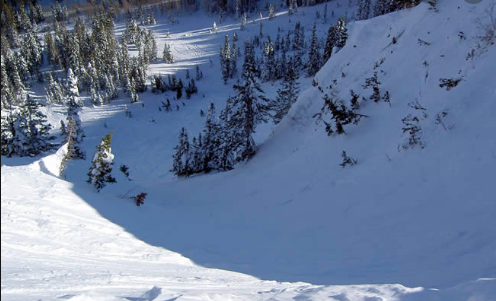
Chute 4 from the cornice. You ready? Credit: FeedTheHabit

Deer Valley Resort in Park City, UT has a reputation for catering to its clientele.  Aside from the great food and fabulous customer service, it pampers skiers with groomed perfection and valet service, Yet, the resort is often dismissed by hard core skiers who feel that there is nothing on the mountain that would interest them.   

To those folks I simply say, ”Go to the Daly Chutes off the Empire Express Chair.” Riding the chair, the chutes are visible to your left.  As you exit the chair to your left, you make your way down the Orion Trail until you see the signs for The Daly Bowl and then an upward climb/traverse to the cornice on top of the Daly Chutes area. 

Depending on the weather and the condition of the snow that is blown into the bowl area, the openings can be varied.  Sometimes only a few chutes (which are numbered) are open and you must choose the correct ones as you stand at the top of the windblown and steep cornice. 

Last week I chose Chute 4 twice, and, as I dropped in to the windblown snow, I immediately began a series of steep jump turns down the throat of the chute.  Coming up on an exposed rock section, I veered to the right and finished in a wide open bowl area that was strewn with debris from avalanche blasting the day before. 

After weaving through the large snow chunks and into the trees, the chicane of seldom used tight trails eventually brought me out in plain view of the Empire Lodge. 

The chutes are all skiable and if you can manage the roller coaster trail through the woods on the way over to the bowl area and eventually to the top of the cornice, you will be treated to a selection of some steep but manageable terrain that definitely quiets the naysayers. 

In addition to the challenging terrain of the Daly Bowl and Chute area, if you make your way all the way over to skier’s left of the resort, you can access the Sultan, Wasatch, and Mayflower chairs and experience some fast and steep groomers. 

The signature run is Stein’s Run named after the legendary Stein Eriksen who was the Director of Skiing at Deer Valley for many years and an Olympic and World Championship medalist.  Usually this area is quiet, and you have free rein to rip GS turns to your heart’s content,  another plus for those who think that Deer Valley is not challenging. 

All in all, a word to advanced skiers would be that although the terrain at Deer Valley does not rival Jackson Hole, Alta, or other areas with challenging expert terrain, the Daly Chutes will not bore you, and you definitely have to pay attention on your way down any of the selections. 

Don’t knock it until you have tried it.  Seniors get the benefit of a $125.00 lift ticket on certain days compared to the usual $209.00 tab.  And of course the Ikon Pass is accepted at Deer Valley.  

Check out a video trip down Chute 4 from Deer Valley.

Jack Frost Geezers Flock To Senior Ski Program

[Editor Note: SeniorsSkiing.com is asking our readers to contribute to support our online magazine. Yes, we have grown in the number of subscribers and advertisers. But our expenses have also grown. You can help us defray some of these expenses by helping us out with a donation.]

Support SeniorsSkiing.com by clicking here.

______________________________________________________

Jack Frost Created A Program For Seniors 20 Years Ago And It Is Still Going. 

Jack Frost Geezers line up for a Wednesday program.

Editor Note: About 20 years ago several Jack Frost PA ski area skiers put their heads together and decided that they should have a brand name. A vote was taken and “Jack Frost Geezers” was the winner.  Every Wednesday from January through early March the Geezers get together and spend the better part of the morning with several pros and review the latest techniques.  The following article was written by Jennifer Learn-Andes of the Wilkes Barre Times Leader. She discovered that Jack Frost offers free lessons to skiers of all abilities from novice through expert and decided that she will join us one Wednesday morning to discover the joy of being in the outdoors in the winter, enjoying the freedom that skiing will add to winter time fun.  Thanks to Bill Runner for bringing this story to SeniorsSkiing.com

Mountain Top resident Felix Rushinski had a post-workout glow last week after participating in a skiing program for older adults sponsored by Jack Frost Mountain and the Luzerne/Wyoming Counties Area Agency on Aging.

“You’re out in the fresh air and get to meet people,” the 74-year-old said. “It’s very relaxing.”

Geared for anyone over 50, the program at Jack Frost on Route 940 near Blakeslee provides free lessons for those new to skiing and tips and pointers for the more experienced.

Aside from bringing or renting skis, participants must purchase a lift ticket, but it costs a discounted $25 instead of the usual $40 or $55, depending on age.

The program is at 10 a.m. on Wednesdays through March 4. Participants sign up at the Jack Frost ski school desk around 9:45 a.m.

A Nanticoke resident, Yozviak said the program draws many regulars seeking outdoor winter fun and exercise.

“You don’t mind the cold if you are properly dressed because of all the activity,” Yozviak said.

Hazleton resident John Hidock, 56, said he participates every Wednesday.

Hidock taught skiing at the complex until 2014 and said he embraces the opportunity to socialize and keep up his skills on the slope.

The sport is great for both physical and mental health, he said.

“It’s wonderful. It can be exhilarating and a thrill to be outdoors and enjoying the scenery this place has to offer,” he said.

Agency on Aging representatives brought lunch for participants last week and spoke about healthy eating and programs offered at active adult centers. The agency is a sponsor and it promotes the program, Yozviak said.

“You guys really rock,” Harley Bobby, the Aging Agency’s senior center services director and health and wellness coordinator, told the group at the luncheon.

Bobby said she was impressed with their skiing and pleased a program is available for make the sport financially accessible for seniors.

“I think it’s amazing that they stay so active,” Bobby said.

Shavertown resident Bill Runner has provided skiing instruction for years and said the program started about 20 years ago.

He stopped to chat with participant Jacki Olsen, 77, of Pocono Lake. Beaming with rosy cheeks, she said she only hits the expert slopes.

“I’m skiing better than ever. This program makes it more affordable and nice to ski with others,” Olsen said.

Rushinski said he has been skiing for 40 years and started regularly attending the Wednesday sessions about five years ago.

Like Olsen, he sticks to expert slopes but said he continues to pick up pointers for improving his technique.

He encourages novices to give it a try. Jack Frost is accessible from the Wyoming Valley via Route 115, the Pennsylvania Turnpike and Interstate 80, he said.

“It’s really in our backyard,” Rushinski said.

SeniorsSkiing Guide: Ragged Mountain

[Editor Note: SeniorsSkiing.com is asking our readers to contribute to support our online magazine. Yes, we have grown in the number of subscribers and advertisers. But our expenses have also grown. You can help us defray some of these expenses by helping us out with a donation.]

Support SeniorsSkiing.com by clicking here.

______________________________________________________

Ragged Has All The Features Seniors Love: Great Trails, Low Crowds, Modest Prices.

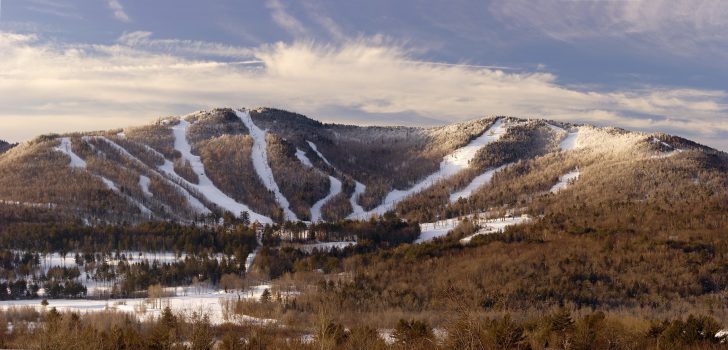
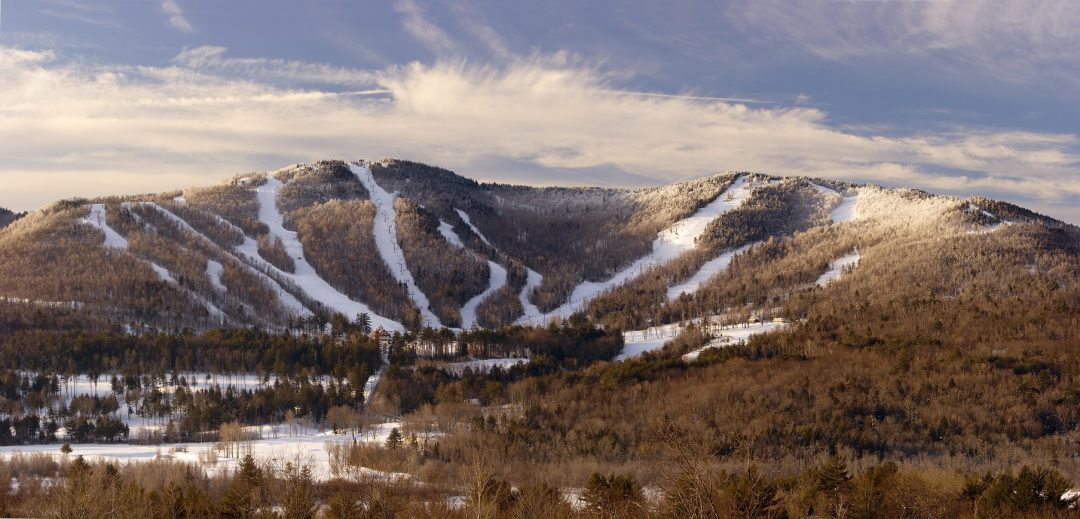
Ragged Mtn, Danbury, NH, has two peaks. Credit: Ragged Mtn.

Located less than two hours from Boston, Ragged Mountain in Danbury, NH offers skiers and boarders a wide variety of terrain from a perfect learning area for beginners to some challenging glades for the expert. It’s truly a family mountain as all trails lead back to the quintessential New England base area.

Ragged’s beginner terrain is ideal for learning. There are two carpet lifts serving very gentle terrain that provides a slope that will not threaten or frighten new skiers. From there they can progress to the Barnyard Triple serving a slope perfect for working on turns and building confidence. The whole beginner area is located off to the side of the main mountain, keeping it separate from the better, faster skiers coming off the summit.

Magic Carpet ride for beginners. Credit: Ragged Mtn.

Two high speed lifts serve the area’s two main peaks. A detachable, high speed six passenger chair, New Hampshire’s only sixpack, whisks skiers and riders to the summit of Ragged Mountain in about five minutes. A detachable quad takes about the same amount of time to reach the Spear Mountain summit. From the Ragged peak a variety of trails from easy green to black diamond wind their down. Skiers and riders are able to navigate from the summit to base on all green or all blue trails or a combination of the two. There are some shorter black diamonds on the upper mountain and a couple of top to bottom ones as well. Several steep glades connect Ragged summit to the trails on Spear. Spear Mountain has three main trails down with one called Cardigan being the easiest and longest way down. Flying Yankee is sometimes closed for racing but when open is a nice intermediate cruiser. Showboat, under the lift, is a steeper pitch and is great for what its name implies. There are half a dozen black glades on Spear, open only with natural snow but great fun when the cover is good. There are three terrain parks, including a small introductory one in the Barnyard learning area.

The area first opened in 1965 and being an older mountain, the trails are interesting and varied, from wide and open to narrow and twisting. Their grooming crew does an excellent job. Even in a challenging winter like this one all open trails have been in great shape.

The Learning Center offers the unique Bebe Wood Free Learn-to-Ski or Ride Program for beginners of all ages to be introduced to snow sports without risk to their wallet. This program – it really is free! – offers three two-hour lessons, with rental equipment and a lower mountain lift ticket for no charge. Following graduation from the program students can purchase discounted equipment and seasons passes. It’s named after long time Ragged employee Bebe Wood who worked there until she was in her nineties.

The attractive and well thought out base area is easy to navigate. There you’ll find the Elmwood Lodge, the Meetinghouse Lodge and the Guest Services building all designed with skiers in mind. The Elmwood Lodge, with its attached Red Barn, houses three restaurants. Birches features table service and an upscale menu of classic American cuisine and lovely mountain views of Ragged’s slopes. If you’re there to watch one of the races held on the Main Street trail and don’t want to stand outside, this is the spot to be. The Stone Hearth Bar, located in the Red Barn, serves up lunches and snacks as well as thirst quenching adult beverages including some new and delightful beers brewed at the Flying Goose in nearby New London. Check out the newest one—Rags to Riches. A huge stone fireplace and weekend entertainment complete the picture here. The Harvest Café is great for a quick lunch or snack with soups, sandwiches, items from the grill and more. There’s plenty of table space in the lodge and the bar’s stone fireplace extends to two floors and provides a cheerful spot to warm up.

The Meetinghouse Lodge houses the Learning Center, the rental shop and more gathering space for changing and picnic lunches.

Although a little off the beaten path, Ragged is accessible either via Interstate 89 or 93 followed by a 20- to 30-minute drive on lightly traveled secondary roads. While not the largest of mountains, its 1250’ of vertical, short lift lines and uncrowded trails reward skiers and riders with plenty of time on the hill in a relaxed atmosphere. It is well worth the trip!

Tickets And Passes

Lift Tickets: Seniors (65+-79) $62 Weekend/Holiday, $52 Midweek,  $51 Four Hour Weekend/Holiday, $45 Four-Hour Midweek, 80+ Free

Season Passes: From $349-519, All ages. Purchase of a season pass provides access to four additional resorts: Jay Peak, Pats Peak, Ski Butternut, Whaleback

Click Here For Ragged Mountain Trail Map

Click Here For Ragged Mountain Web Cam

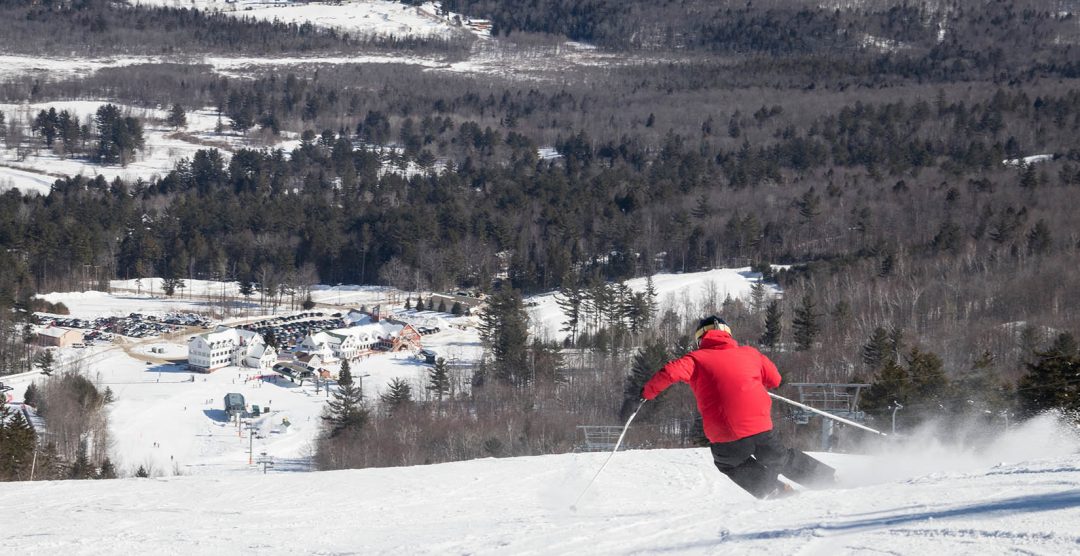
There’s the base lodge down there. Credit: Ragged Mtn.


Powder Mountain

Uncrowded Powder Mountain

[Editor Note: SeniorsSkiing.com is asking our readers to contribute to support our online magazine. Yes, we have grown in the number of subscribers and advertisers. But our expenses have also grown. You can help us defray some of these expenses by helping us out with a donation.]

Support SeniorsSkiing.com by clicking here.

______________________________________________________

500 Inches Of Snow, 8,000+ Acres, And No Crowds.

Uncrowded on a holiday weekend. Powder has plenty of room. Credit: Harriet Wallis

A Mountain Host greeted us with memorable words. “The snow here is all natural. Mother Nature makes all of it,” she said. “And it’s GMO-free,” she quipped.

We skied Powder Mountain during a recent holiday weekend when other resorts near Salt Lake City were packed to the gills, “PowMow’s” trails were not only uncrowded, they were sometimes absolutely empty. It was wonderfully relaxing. I didn’t need eyes in the back of my head. Nobody was going to run over me. And there was still patches of untracked snow from a storm nearly a week earlier.

To ensure a good experience, the mountain caps adult season passes at 3,000 and daily lift tickets to 1,500. It doesn’t accept the Ikon or other multi-resort passes. Do the math. At max capacity, every skier gets about 2 acres.

Seniors 75 and older get a free lift ticket or a season pass for $20. 

Good snow, uncrowded slopes and affordable senior prices  are just part of the equation. Powder Mountain is old school. It doesn’t do glitz. That’s it’s charm. There’s even an old fashioned blackboard where the list of upcoming bands to play in the Powder Keg bar are written in colored chalk.

Powder base lodge is unpretentious. Credit: Harriet Wallis

The day lodge is modest, the bathrooms are adequate, the cafeteria tables are set in long rows so everyone eats family style and gets acquainted with whoever sits down next to them. The lodge on the summit is similar, just smaller.

Six chairlifts serve 8,464 acres that include white knuckle slopes, aspen forests, and treeless snowfields. And in old school style, there’s a Poma. It hauls skiers up a short pitch that’s a gateway to vast terrain. Riding a Poma is a skill that older skiers remember well but younger skiers struggle to learn. After a few they get to experience what the good old days of skiing were like.

We chanced to meet Bob Leaverton, a veteran ski patroller, who has skied Powder Mountain for 35+ years. His three favorite things are: “the road, the people, and the snow.”

The last several miles up to the resort are steep, and that climb often deters visitors, he said. The people are friendly, and the snow is wonderful. Take it from a local.

For adrenaline junkies, Powder Mountain offers specialty adventures: in- and out-of bounds backcountry skiing, skin & ski, snowcat, and heli-skiing.

Historically, Frederick Cobabe accumulated the vast acreage as range for his herd of sheep. His son eventually purchased the livestock company and the land and turned it into a ski resort in 1972.

It’s currently owned by private investors who are developing an upscale community of Bauhaus-style homes set in the far reaches of the resort and linked by a network of trails and lifts that sprawl across that rolling, not steep, terrain. It can take most of the day to ski a circuit all around the resort.

But if its a powder day, do what the mountain resort is named for: Ski the powder.

Yes, that’s the lift line. Where is everyone? Credit: Harriet Wallis

Have You Been Drinking? It’s Time To Start!

Hydration and Stretching: Two Things You Must NEVER forget to do before you hit the slopes.

If you’ve taken to heart the advice in a previous seniorssking.com article of Paul Petersen, president of Bear Valley Cross-Country in California, on the best way for seniors to get in shape for skiing, you’ve developed and faithfully followed a fitness regimen focusing on balance, strength, flexibility, and cardio. But the 56-year-old certified alpine and cross-

Bear Valley Cross Country's Paul Petersen swigs water, something we should all remember to do. Credit: Paul Petersen

Bear Valley Cross Country’s Paul Petersen swigs water, something we should all remember to do.
Credit: Paul Petersen

country ski instructor will quickly tell you that this is not enough. What you do in the days before and right up to the minute that you put ski or board to snow is just as important as all the pre-season conditioning you’ve done.

One of the most overlooked factors in preparing for a day on the slopes is hydration. When your body is well-hydrated, your body temperature and heart rate are more stable, your joints and muscles function better, and you have more stamina. Conversely, if you’re dehydrated, which can happen more quickly at elevations above 5,000 feet—especially to flatlanders, you won’t be able to perform well for any length of time, you’ll tire more easily, and you may experience dizziness, headaches, or shortness of breath. Says Petersen, “When it comes to hydration, you have to think ahead. You can’t properly hydrate for athletic activities the day before; you need to begin several days beforehand. Remember, you’re not trying to hydrate your stomach, but rather your joints and muscles and that takes a while.”

If you’re a typical skier, before you head out for the slopes, you probably have a cup of piping hot coffee or tea in the lodge (this may be in addition to the glass or two of wine you had at dinner the night before). This is a total recipe for dehydration! “Any liquids with caffeine or sugar, including sodas,” says Petersen, “are NOT a net positive in the hydration department!” For every cup of coffee or other caffeinated beverage you drink in the morning or while on the mountain, Petersen insists that you drink an equivalent amount of water.

Noting that senior wintersports participants schedule longer trips and thus ski more consecutive days than the average skier, Petersen emphasizes the importance of recovery for seniors after a day on the slats and boards. “Right after you’re done on the slopes and before you hit the bar, hit the protein bar,” he strongly advises. “For me, the magic bullet is protein powder in water. Either helps you recover from that day and helps your body get ready for the next day.”

An equally important factor in ensuring a safe, fun day on the slopes is adequately stretching your muscles right before you start out. We’ve all done those cursory arms over our heads while stretching our waists and quick calf stretches, right? Not good enough per Petersen! “You can’t just touch your toes, grab your ankles, stretch your thighs, and then walk out the door,” he warns. “The night before, put aside a few minutes to stretch your hips, calves, and thighs, and again the next morning before you put your boots on, either in the parking lot or at your locker.”

In sum, make “water, stretch, go” your wintersports mantra if a perfect day “doin’ it” is what you’re after!

Deer Valley: Win-Win For Two Generations

Convincing Reasons Why Two Generations Love Deer Valley.

Blue skies, top of the world at Deer Valley. Credit: Tamsin Venn

We recently returned from our annual January family trip to Utah, with our 20-somethings joining us. Utah is currently experiencing record snowfall with more than 300 inches and more on the way. Aside from snow, here are reasons why two generations love Deer Valley, ranked consistently as one of the top ten resorts in the country.

  • Utah powder gets dried out and fluffed up on its way over from the Pacific Ocean, so it’s easy turning for both old and young knees.
  • Free valets greet you and put your skis in ski racks, more energy for powder skiing.
  • Free overnight boot and ski check, less schlepping, even more energy saved for skiing.
  • The number of feet you have to walk from a base lodge door to a lift might be written into the area’s mission statement. See previous energy statements.
  • Truly varied and sophisticated food, always with a few extra special ingredients for the piece de resistance, fosters lingering, providing rare commodity of uninterrupted family time. WiFi is available.
  • The Rossignol High Performance Test Center located next to the Empire Canyon Lodge gives you two hours of free ski trials, as many as you want. Match your boards to conditions and try out new Rossignol technology. Both old and young stretch comfort zones in moguls and powder.
  • At the posted trail maps, very upbeat, green-uniformed hosts tell “guests” where they are and where to go. You never have to be lost on the area’s six mountains, six bowls, and 2,000 acres

Young, really young, and seniors love the DV. Credit: Tamsin Venn

  • Stein’s Way, a black diamond off Bald Mountain’s right shoulder, overlooks Jordanelle Reservoir and is a popular first run groomer with the senior set. And the 20-year-olds, who will do a couple of warm-up runs on Stein’s then switch to the more gnarly Mayflower Bowl.
  • The less expensive IKON base pass gives you five days at DV, plenty of time to play out the equation between willing spirit but flagging body. If you still have vacay time, the IKON base pass lets you ski five days at Alta/Snowbird, five at Brighton and unlimited at Solitude. Blackout dates apply.
  • No snowboarders. Yup, even the 20-something-year-olds who ski with us do not like the sound of a thundering snowboarder coming up from behind. That rule does preclude skiing with some of our favorite people.
  • The sharing economy. Our AirBnB in Park City was roomy and tucked away, but just steps from a stop on the free town bus system. Millennials support public transportation.
  • Ski instructors are everywhere leading their charges, often in semi private lessons. Eavesdrop to pick up a few pointers on powder days.
  • Limited ticket sales —7,500 a day—ensure quick moving lift lines, enhanced by 21 chairlifts (12 are high speed detachable quads,) and one gondola.
  • A well protected, well staffed learning area with magic carpets helps make DV one of the best places for the little guys, generation 3 TK.

Why go anywhere else?

Lift Ticket Rates: Senior (65 plus) Daily Lift Ticket Rates start at $120 when prepaid online. Senior Season Pass: $1,236. IKON pass no longer available for 2019-20:  Check prices here. https://www.deervalley.com/plan-your-trip/tickets-and-passes

Find Out More: Click Here For the Deer Valley website

Trail Map: Click here

Web Cams: Click Here

So far this season, the snow has been abundant.
Credit: Tamsin Venn


SeniorsSkiing Guide: Windham—A Gem In The Catskills

A Mid-Week Senior Program Includes Clinics, Group Lunch, Yoga, Plus.

Windham is 2 1/2 hours from NYC and has something for everyone.

Driving from New Hampshire through Vermont to Windham Mountain in the Catskills of New York on a recent weekend I felt some trepidation as to what I would find. There had been rain, lots of it, and temperatures reaching 60 degrees over the course of the weekend. Arriving at the mountain on Monday mornin,g it was not looking promising – lots of bare ground and brown spots. But everyone in our group was game to try it out so we booted up and headed for the lift.

And what a pleasant surprise was in store for us! There had been a small window of snowmaking temperatures Sunday night,, and the mountain crew made full use of it. While it didn’t allow any new trails to be opened, it did a wonderful job of patching and spot resurfacing. The groomers smoothed out the surfaces, and, though only a small percentage of the trails were open, those skied very nicely on softish, granular sugar snow.

Snowmaking is robust and widespread at Windham.

Windham is a sizable mountain with a 1600’ vertical. To me, it feels like a much bigger mountain. There are 54 trails, ranging in length from 300 to over 12,000 feet, serviced by a total of 11 lifts including a high speed six pack and two high speed quads. Snowmaking covers 97 percent of its trails and slopes.  Much of that is fully automated, making it very responsive to changing weather conditions. There were several trails open off the Westside Six, the six-pack going to the West Peak summit, and the Wonderama Express Quad.  We found enough good skiing to keep us entertained over the course of a day and a half. An Express Quad took us up to East Peak where we found a couple of good runs including Wanderer, a long, easy cruiser that sweeps along the ridge at the edge of the resort and eventually winds its way to the base. All were in agreement that the mountain ops crew did a fantastic job in recovering from the “R” event prior to our arrival.

The modern, airy base lodge houses a spacious cafeteria on the ground floor and a table service restaurant with an upscale menu upstairs. Also on the upper level is a private club with its own food service and lounge areas.

The resort has spent more than $12 million in the last two years to elevate the guest experience, and it is quite apparent from snowmaking to grooming to base area and resort amenities.

Midweek Program Just For Seniors

Windham boasts an active 50+ Midweek program which runs for eight Tuesdays from early January to early March. There’s an optional yoga program at the beginning of each day followed by on snow clinics with the instructors then a group lunch. During lunch, there are presentations on snowmaking, product reviews, what’s happening at Windham, and various other topics of general interest. The program currently has more than 70 participants who come from New York City and its environs as well as the local area. The Midweek program costs $250, pass not included.

You can ski the big race courses on the simulator. Credit: Joan Wallen

The Adaptive Sports Foundation has partnered with the mountain to bring in the Ski and Ride Simulator which provides real skiing and riding in virtual reality. Used by the race teams for training, it is also available to the public for a fee. Skiers and riders of all ages can test themselves on virtual race courses from around the globe simulating real World Cup and Olympic courses. From grandparents to grandkids, it can an enjoyable challenging to all. A portion of the proceeds help support the Adaptive Sports Foundation.

The Alpine Spa, kids snowmobiling, snow tubing and ice skating will keep everyone – kids to parents to grandparents – busy when not on the slopes.

While we didn’t get to ski all of Windham, what we experienced was great and certainly whetted the appetite making us eager to return when the mountain is fully operational to explore what is truly big mountain skiing just 2 ½ hours from New York City.

Tickets And Passes

Day tickets for 65-74 are $76; 75+ is $70. Windham also offers a four-hour Flex Ticket good for any four consecutive hours. 65-74, $52; 75+, $35.

Season Passes, 65-74, $659; 75+, $229. A Sunday-Friday mid-week pass is $549 for all ages.

Click here for Windham Mountain Web Cam.

Click here for Windham Mountain Trail Map

The base area is the hub of activity with lifts radiating out.


Eat Your Way To Fitness

Cross Country Ski and Snowshoe Food Events Offer Exercise And Gourmet Food.

Nordic Nibbles are happening across the country. Eat and lose weight.

[Editor Note: This article first appeared in XCSkiResorts.com, published by Roger Lohr.]

Want a guilt-free way to indulge yourself with food while exercising? Cross country (XC) skiing and snowshoeing are some of the best forms of aerobic exercise, but if you go on a “Gourmet Ski Tour” on your XC skis or snowshoes, you may very well eat your way to fitness at a number of trailside food stops. What a grand time so go ahead, eat, ski, and be merry—appetizers, wine, champagne, fondue, entrees, desserts, and more.

Here’s a cross section of the culinary XC ski events that are planned this winter across the country with a varied menu of fun and fine cuisine.

East

Smugglers Notch, VT has the Snowshoe Adventure Dinner at the mountain summit on Tuesdays. The Maple Experience is on Tuesdays on a tour to learn about maple sugaring and get to take home a sample. The Sugar on the Snow snowshoe tour is on Wednesdays. The Hot Chocolate Warm Up is daily at 3:30 PM with a bonfire.

Notchview Reservation,  Windsor, MA hosts the the Breakfast Ski Club with a short tour followed by beverages, pastry and fruit (9 – 11:00 AM on Jan 18, Feb 1 and 15).

The Chocolate Festival at Mt. Washington Valley Ski & Snowshoe Center, Intervale, NH on Sunday, February 23 is an inn-to-inn affair at about 12 stops to experience your chocolate fantasies including moose and fondue. Go on a tour of any length and actually gain calories, even if you ski as far as 20 kilometers. A shuttle is also available for those that have overindulged at the event dubbed the “Sweetest Day on the Trails.”

Check out those goodies, then burn cals.

Central

Treetops Resort, Gaylord, MI has the Skiable Feast Getaway Package that features a winter gourmet adventure with five buffet food stations along six km of trails. It is offered at 8 AM – 2 PM on seven dates on Saturdays during January-March. Also the Wilderness Sleigh Ride Dinner is on Saturdays at 5-9:30 PM on a tour to the cabin for a culinary adventure.

Cross Country Ski Headquarters, Roscommon, MI has the “Around the World Wine & Ski Tour” is a new event with XC skiing, and Ribs & Blues food music event, and the Gourmet Chili Bard. Look for the Fill at the Grill and Fire on the Mountain food events.

The Upper Peninsula of Michigan in Ironwood features cuisine from local restaurants that can be purchased at a nominal fee for a food court with local restaurants at the Taste of the Trails on the ABR trails on March 14.

Mountains

Just Desserts Eat & Ski in the Enchanted Forest, Red River, NM on February 22 features goodies from 20 different local restaurants at three trailside stations with up to 100 desserts within a four kilometer loop. Their motto is, “It’s not a race, just a gorge fest.” Additionally, on Feb 14 there is a Yurt Dinner Party for Valentine’s Day.

Look to the Galena Lodge, Ketchum, ID for the Full Moon Dinners on nights with the full moon, whereby you can go ski or snowshoe ($5 snowshoe rental offered) and then return to lodge for a four-course dinner at $40 or half-price for kids under 12. There are also special Wine Dinners, Holiday Dinners, and Valentine’s Day Dinner scheduled from mid-December to mid-March.

At Devil’s Thumb Ranch Resort & Spa, Tabernash, CO,  the Ski, Sip & Spa is an all day event that includes lunch and wine & cheese is scheduled for Feb 9, 2020. Also, set for Jan 25 is the Stagecoach Classic Race & Tour starting at Devil’s Thumb into the town of Winter Park followed by an event with a beer garden and hosted by multiple food vendors.

The Rendezvous Trails, West Yellowstone, MT, features cuisine that is homemade and from local restaurants that can be found along a designated route on the trails at the Taste of the Trails on Feb 16. Pay in advance at West Yellowstone retailer Free Heel & Wheel.

Frisco Nordic Center  in Colorado has the Ski, Eat and Be Merry event on Feb 1 from 6:00 – 10:00 PM with a progressive dinner along the trails featuring food, drink, 3 bonfires and luminaries on a 2 km loop.

West

Bear Valley Adventures, in California,  hosts the Wine Tasting in the Meadow in late November to sample local wineries with appetizers.

Tahoe XC, Tahoe City, CA, has the Fish Taco Night is a fundraiser on Jan 29 at the Sunnyside Restaurant & Bar in Tahoe City.

Cypress Mountain, outside Vancouver, BC has Fondue Dinner Snowshoe Tour, S’Mores Tour, and Cheese & Chocolate Fondue Tour all scheduled with a snowshoe trek to the Hollyburn Lodge Building to start in January. These programs include rental equipment, trail access, and guides/instructors.

Apres Ski: Artisanal Cocktails At Silver Star

Smoky Cocktail Better Than A Beer And Chips?

Bar Supervisor Tom Falland creating his signature Smoked Old Fashioned drink at the Den Bar and Bistro in Silver Star Mountain, BC. Credit: Yvette Cardozo

The food and beverage manager over at the Den calls it classic cocktails “with a twist.”

And, indeed, these are not your usual Old Fashioneds or mojitos in the Den & Bar Bistro at Silver Star Mountain in British Columbia, Canada.

Downstairs in the basement, below Coffee+ cafe, along Silver Star’s main street, the Den is doing its own thing with alcohol.

Manager Mark Lehmann has turned his bar supervisor, Tom Falland, loose.

What resulted, among others, was the Smoked Old Fashioned. Yes, it’s a show. Yes, it’s delish. 

“Sometimes less is more,” Lehmann said. “I think gone are the days of sweet hyper-colored drinks, saturated with artificial flavors and so much sugar. In the Den, we have taken to infusing our own tinctures and flavorings using all natural ingredients to develop a unique taste and profile. We have also found in doing so we are using some older style spirits that have been collecting dust for an age. Aperitifs are heavily used in our lineup, as are spirits like Campari, Aperol and gin.”

So, of course, I wanted to watch Tom make his Smoked Old Fashioned.

Infusing the glass with wood chip smoke while making the Smoked Old Fashioned. Credit: Yvette Cardozo

Originally, they used a smoker, trapping smoke in a huge beaker, then pouring it into the drink. But the smoker is now broken, so Tom torches wood chips.  Honestly, a better show.

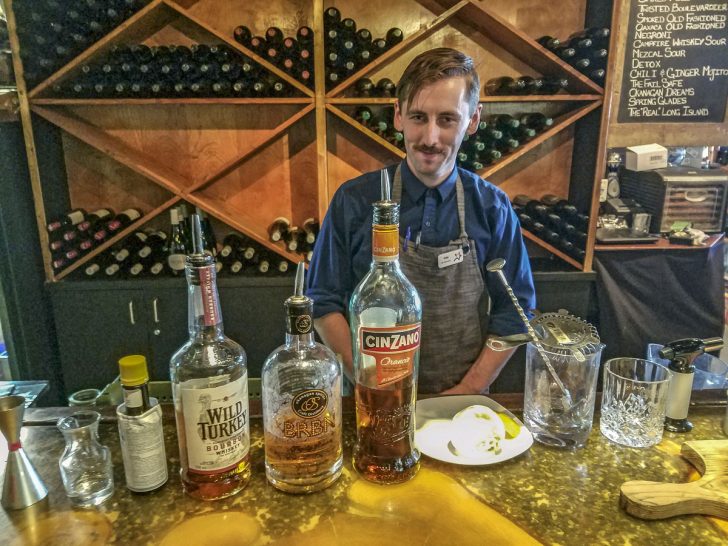
First, he lined up his ingredients along the bar: a couple of bourbons, vermouth, bitters, a ball of ice in a glass, orange rind, cherry wood chips, and a beaker with a strainer.

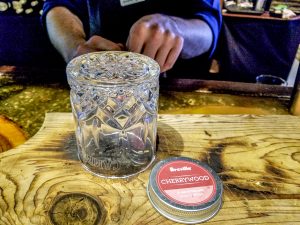
Then, he torched the wood chips on a cutting board, and, when the smoke got going, set an upside down glass over the smoke. This lets the smoke flavor adhere to the sides of the glass.

Next he mixed the alcohols, bitters and sugar syrup. All this was shaken with ice cubes. He put the ice ball into the smoke infused glass, then poured the alcohol mix (minus the cubes) over the ice ball in the glass, finally adding a slice of orange rind. The ice ball, rather than cubes, keeps the drink cold without melting and diluting it, he explained.

 The result is a smooth taste that rolls gently around your tongue. There’s a hint of whiskey, a hint of orange, and the barest hint of smoke.

Ok, if this isn’t smoky enough, Tom has his Campfire Sour. It’s made with two bourbons and a single malt Scotch whiskey Laphroaig, then topped with frothed egg whites, a slice of dehydrated lemon and two charred cinnamon sticks. All this is to make it look like a campfire. The cinnamon plays the charred logs.

Be warned, though, Laphroaig is a very special taste. It’s a single malt whisky from Scotland infused with enough peat smoke flavor to bring tears to your eyes. I once hiked a multi-day coastal trail in Canada and after a week, everything I owned including my skin smelled of campfire smoke. This drink is that campfire smoke on steroids.

My favorite drink at the Den, honestly, was Tom’s Chili & Ginger Mojito. This is more than your usual by-the-pool mojito. It has the lime taste, to be sure, but there’s also ginger and, to wake you up, red chillies. A mojito with a kick. Perfect after a day of skiing and before you tuck into the Den’s BBQ ribs. 

Enjoying drinks at Den Bar and Bistro, Silver Star, BC. Credit: Den Bar and Bistro.


SeniorsSkiing Guide: Snowshoe Mountain

The Longest White Winters South of the Mason-Dixon Line.

Start at the top at Snowshoe Mountain Resort, WV, Credit: Snowshoe Mountain

Most ski resorts have their hotels and restaurants in a valley. Some resorts have hotels at the bottom of the slope and some restaurants at the top. But Snowshoe Mountain Ski resort has everything at the top of the hill. People call it “an upside-down ski resort”. Imagine a cherry on top of the mountain cake, decorated by snow and a picturesque lake. While Snowshoe is located less than a five-hour ride from the Washington, D.C. metro area, it is indeed as “wild and wonderful” as the rest of West Virginia.

The elevation of the resort is 4,848 ft, the second-highest point in the state. That is quite high by Mid-Atlantic standards. The location and the weather combined with modern snowmaking equipment gives Snowshoe a reason to guarantee “more open terrain than any other resort in the region.”

The resorts looks compact, cute, and cozy. The restaurants, bars, and stores are located in the pedestrian area. By the way, tap water here is clean and tastes better than many types of bottled water. The layout of the condos and hotels is designed to protect you and your car from snow and wind.

The resort has three ski areas: Snowshoe Basin, Western Territory, and Silver Creek. The majority of the slopes are senior skier friendly. One local Ski Patroller has noted that certain guests who have limited experience on small Southern hills, challenge each other on the black slopes of Snowshoe. The black slopes are not as wild as in the Rockies, but are still challenging for the beginners and enjoyable for experienced skiers.

According to one of the Slope Safety Volunteers, more than half of the resort volunteers are retirees residing here. One day I noticed a snowboarder with a big stick and decided that it was just another selfie maniac. Later I got a chance to talk to this 60+ year old ski and snowboard veteran. He uses a monopod (photography tool) to maneuver on flat areas and around the ski lifts. He skied for decades, but recently decided to switch to snowboarding because of joint pain. He found that his knees felt better on a snowboard than on skis.

In case you need a break from skiing, go visit The Green Bank Science Center, which is only 20 min away. The resort is active in summertime. Besides riding on bicycles, the guests enjoy golfing, boating, and hiking.

Useful facts:

Snowshoe offers an 800 ft vertical drop, 60 trails, 13 lifts, 250 acres of slopes, and 180 inches of natural snow annually.

An adult daily pass is $79 on a weekday and $109 on a weekend, and for people over 75 years old, it is $39 on any day of the season. A seasonal pass for those older than 70 costs $499 in 2019-2020. The resort is part of the IKON ski pass system.

For a Snowshoe Mountain Trail Map, click here.

For live web cams, click here.

Book Review: Southern Snow Explores Skiing; Other Outdoor Winter Activities in the South

We all have preconceived notions about skiing.

There’s no ski resort in Mexico. Actually, there is one: Bosques de Monterreal and when there’s no snow, people use a dry, bristle surface.

There’s no place to ski in South Africa: There is. It’s called Tiffindell and it receives ample natural snow.

The American South doesn’t have much to offer when it comes to skiing. WRONG. WRONG. WRONG.

I’ve been reading Southern Snow: The New Guide to Winter Sports from Maryland to the Southern Appalachians, (472 pps; UNC Press) and it’s fascinating! There are 23 ski areas south of the Mason-Dixon line, most of which are in the Appalachian Mountains, the same range that provides elevation and vertical drop for skiers in Vermont, New Hampshire and Maine. But down South, the mountains are higher than their northern cousins, and because of geography and weather patterns they attract a surprising amount of natural snow, supplemented, of course, by snow-making.

The author, Randy Johnson, published the first edition in 1986 and did a thorough update for this 2019 edition by The University of North Carolina Press. His articles and photographs are widely published and, for most of two decades, he was editor of HemispheresUnited Airlines’ inflight magazine.

Johnson does a thorough exploration of his subject. He explains the geography and the weather systems that deliver cold and snow to the region. I found the history particularly interesting, especially the region’s pro-Union role during the Civil War, and how these higher elevations became summer playgrounds for residents of Washington, Roanoke, Baltimore and other flat-land cities. 

The book presents the development of the southern ski industry. The SCWDC (Ski Club of Washington D.C.) organized early winter forays into the mountains, cleared trails, and installed rope tows. More sophisticated lifts were in place by the late 1940s. Howard Head developed the first metal ski in Baltimore. 

Each of the Southern ski areas is categorized by state; the most extensive areas are in West Virginia and North Carolina where vertical drops are as high as 1,500’ (Snowshoe, WV) and 1,200’ (Sugar Mountain, NC). This section includes places to stay and dine. While that information is kept current on the Internet, it’s helpful to have the author’s preferences.

The last part of the book details places for cross-country skiing, winter hiking and winter mountaineering. These cover, among others, state parks, national forests, Blue Ridge Parkway, and Great Smoky Mountains National Park.

The book is infused with personal accounts and points of view. The author is a booster for the region he loves, often comparing conditions there to those on New England and, a few times, to those in the West.

Southern Snow immerses the reader in a general understanding and appeal of winter in the southern Appalachians. In this comprehensive and interesting read, Randy Johnson shares his love of the Southern highlands. Now I feel the need to add some of these resorts to my life list. If only there were world enough and time….

Can You Do This?

Another Caption Contest.

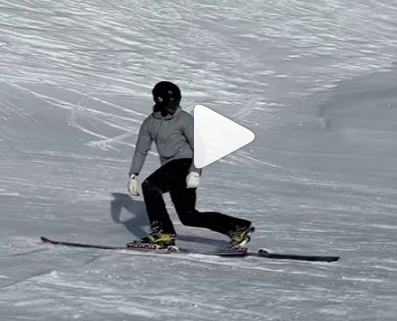
This is Tobi Heinle, ski guide, Voekyl-Marker-Dalbello pro athlete, doing his thing on Zugspitze Mountain, Garmisch-Partenkirchen. More on Tobi, click here.

Click on arrow to see video. And try to caption it. Write your entry below.

[Editor Note: Thanks to Snowbrains.com for originally posting this.]

https://www.instagram.com/p/B5Vri8QFra2/?utm_source=ig_web_button_share_sheet

Canadian Cuisine? Sun Peaks, BC, Has Poutine Plus

Poutine Is A Huge Comfort Food. Add That To A Mighty Bloody Mary And You Have Dinner At A Cozy BC Resort.

Yes, poutine is one of those things that requires an excuse to eat.

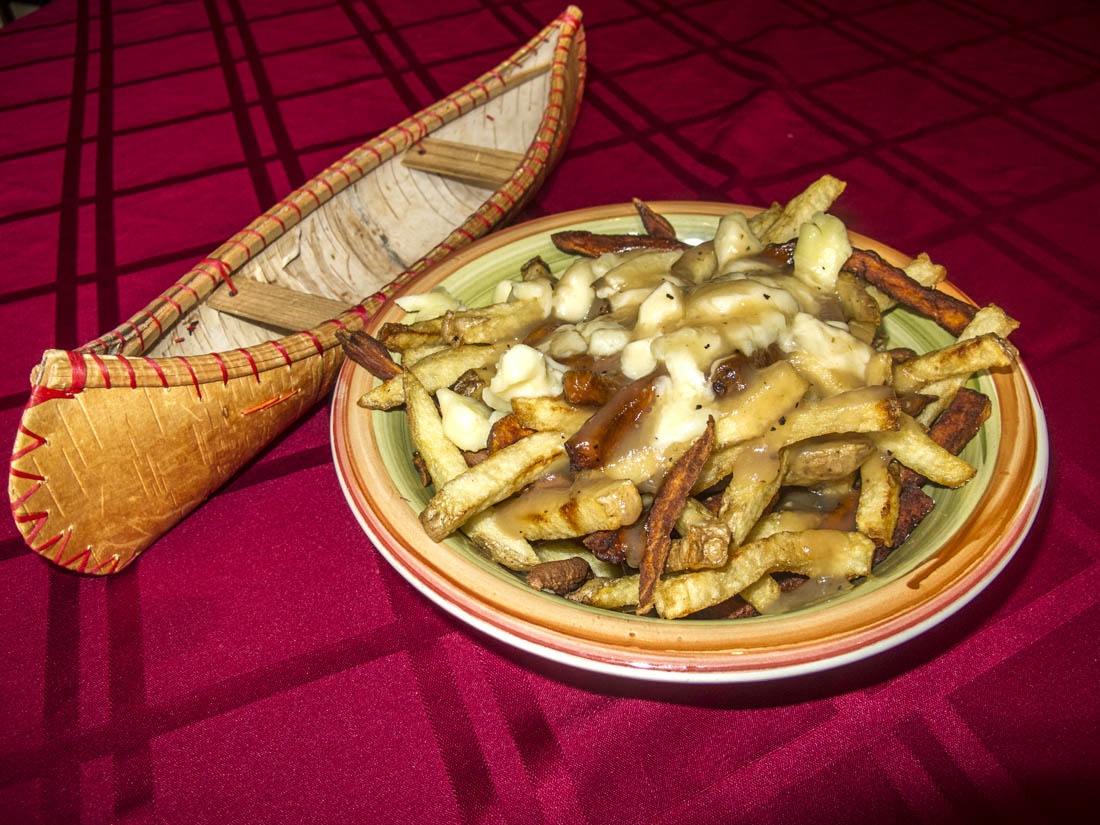
Poutine, a Frency Canadian comfort food dish. French fries are covered in tasty gravy and cheese curds. Next to the dish is a model of an historic birch bark canoe. Served in the Voyageur Bistro at Sun Peaks Resort, BC, Canada

We’re talking the massively popular comfort food that is Canada’s answer to Mac and Cheese. There isn’t an easy way to rationalize a dish that includes french fries, gravy, and cheese curds.

Unless, maybe, you’ve been skiing all day.

Bear in mind, poutine comes from Quebec, a scarf-culture place that has yet to embrace the idea of full face covering against the cold, a place where minus 30 degree temperatures in winter are a way of life. You NEED fuel in those conditions. Or anyplace else with that kind of weather.

So, enter Voyageur Bistro at Sun Peaks Resort in British Columbia, Canada. It’s a tiny cafe with hardly a dozen tables but if  you’re looking to bolster your inner heat lamp when it’s freezing outside, you can hardly do better.

A former river rafting guide, owner Kevin Tessier started adding authentic Voyageur cuisine to his tours. It was all based on what folks ate during fur trading days (bison, berries, cedar plank salmon, lots of maple syrup). His meals were wildly popular, and this whole concept found a home in his restaurant, which he co-owns with his wife Diane Larsen.

There’s Elk Wellington, Bison Burgers and, in the past, a Mac and Cheese that included Tenderloin Steak.

As for poutine, one often-cited tale is that of Fernand Lachance, from Warwick, Quebec, which claims poutine was invented there in 1957. Lachance is said to have exclaimed, ” Ça va faire une maudite poutine” (“It will make a damn mess” in French slang), hence the name. The sauce was allegedly added later to keep the fries warm longer. Over time, the dish’s popularity spread across the province and later throughout Canada.

Well, of course, then, I had to try Kevin and Diane’s poutine, which is made with real (they stressed that point) locally made cheese curds and fries, topped with their own special gravy which includes drippings from beef, pork and turkey. The secret ingredient is apple cider vinaigrette.

The final extra yummy product—mind you, I had skied 25,000 vertical feet that day and was truly READY—was a mouth wateringly hearty dish, rich with a hint of sweet from vinaigrette and interspersed with chewy, tangy cheese.

I was forking my way through when a local sat down on the bar stool next to me.

“Caesar,” he said, ordering from Diane, the bar keep.

 I started to pay attention when the drink took its final form and immediately ordered one for myself.

Canada’s classic Caesar drink. This is an upscale version made with salmon infused vodka, the usual tabasco, and Worcestershire sauces and Clamato juice.Cheese curds, salmon and pickled vegetables are included. Served in the Voyageur Bistro at Sun Peaks Resort, BC, Canada

A Caesar is basically a bloody Mary with an attitude but Voyageur’s Caesar is something very special: first into a tall glass rimmed with celery salt, the barman put the ice, then two shots of smoked salmon-infused vodka (“We don’t skimp,” Diane added about the vodka they make themselves), followed by squirts of tabasco sauce, Worcestershire sauce, a touch of horseradish and finally Clamato juice. This is topped with a skewer of assorted pickled or roasted vegetables, a chunk of First Nations-caught sockeye salmon, sometimes a chunk of cheese curd and maybe bison or elk sausage.

Yes, this was dinner.

Boston Ski and Snowboard Expo Highlights

Didn’t Make It This year? Here’s A Snapshot Of The Show.

Correspondent Don Burch covered the recent Boston Ski & Snowboard Expo at the World Trade Center. It’s the last year the show will be held at this venue and it’s also the last year it will be produced by Bernie Weichsel and BEWI. Next year, SIA takes over.

Skiing Off Piste: Lessons Learned The Hard Way

He’s Skied New Hampshire’s 48; He’s Pick Up Insightful Tips About The Backcountry.

Editor Note: Ben White skied the 48 4000 feet plus mountains in New Hampshire in a single year as a teenager. We thought the readers of SeniorsSkiing.com would benefit from some of his hard core lessons.

Ben White currently runs White Cloud Adventures in Utah.

As a young whipper-snapper, I had the incredible privilege and opportunity to ski each one of the New Hampshire 48 in a single ski season before I graduated high school. Like any seventeen year old, I had plenty of my own ideas about how the world worked and how to ski in the backcountry, only to learn the hard way that there were better options.

Bring A Really Good Headlamp

Standing in a light drizzle on top of Bondcliff with Alan and Cathy getting ready to ski and hike out nine miles to Lincoln Woods while the sun set was a great learning moment. Instead of complaining about the rain, I knew that I simply had to do the next thing: Toss on a layer to stay dry and get a head lamp out. Being in high school, I brought along whatever means of light I had. In this case, a mountain biking head lamp my aunt gave me for my birthday a year prior. It was a small, lightweight bulb and housing with a long power cord to a robust battery back, and the special clip to attach it to a helmet that was left at home. Holding the light steady in one hand would make using ski poles and blocking branches funny. So, since it would not attach to my helmet, I held light with my teeth the entire time. After skating out the last four miles of the Lincoln Woods trail, I was soaked, tired, and had a really sore jaw. I have since considered it critical to have a well-functioning headlamp with me at all times when skiing in the backcountry, even for an hour at lunch.

It Is Not All Powder

The main motivation to skiing in the backcountry were visions of untouched powder for miles. Without people or groomers, the snow would have to be untouched, except by animals, and therefore soft everywhere. I can distinctly remember that 46 out of The 48 were not powder skiing. Part of the joy of skiing in the backcountry has been the challenge of putting all of the puzzle pieces together, especially the weather and snow conditions forecasting. My goal was to ski The 48, though, not ski powder every day. When Alan and I skied Middle and North Tripyramid, in the White Mountains, we made turns, but they were on some of the most bulletproof snow I can ever remember skiing. Count on it.

Skiing In The Backcountry Is A Team Sport, Especially In New England

The idea that the backcountry is a place to find solace and fresh tracks away from people is in the right direction, but not on the right track. The backcountry is largely free of unknown skiers clogging up lift lines and skiing recklessly, but learning to ski in the backcountry is very much a team sport. At any point in time, team members can contribute to the success of the group as a whole. This teamwork starts with pre-trip planning, encompasses breaking trail and pulling water bottles out of backpacks, and ends with a short discussion about how the day went when the ski boots are off at the car. Everybody brings a different perspective to the table, and somebody just starting to venture out into the backcountry can ask some very thought-provoking questions of a more seasoned backcountry skier. It pays to listen.

Layering: Every Body is Different

Winter is cold and the threat of frost-bite and hypothermia is very real. Just like any other day of skiing, I would put on a certain amount of fleece before I buckled my boots, then head off for some smiles. Hiking uphill with skis on generates a lot more heat than taking a chairlift and, in turn, sweat. After figuring out that I was so slow moving due to heat management problems, a single 39 year old woman I met on the trail, who was way out of my league, told me that I needed to wear less clothing. After some trial and error, I have found that nothing but a polyester t-shirt, shorts, and shell ski pants is all that I ever want to wear while on the skin track. My friends all wear something else, because they run at different temperatures than I do. Gloves are important to layer as well.

There are more lessons, too. Stay tuned for advice and tips in coming months.

If you have a question about getting started in backcountry skiing or if you want to share your experience, just comment in the box below.

Alta’s Wild Flowers in Full Bloom


Alta’s slopes are blooming! Credit: Judy Calhoun

Any one living in or visiting Salt Lake City can escape the heat and enjoy the remarkable wildflowers at Alta. Contributor Harriet Wllis reports that the Alta’s wildflowers are blooming like crazy right now. The meadows and slopes are like Persian carpets — covered with color!

Non-Snow Activities: Senior Divin’

Something Else That’s Cool For Seniors.

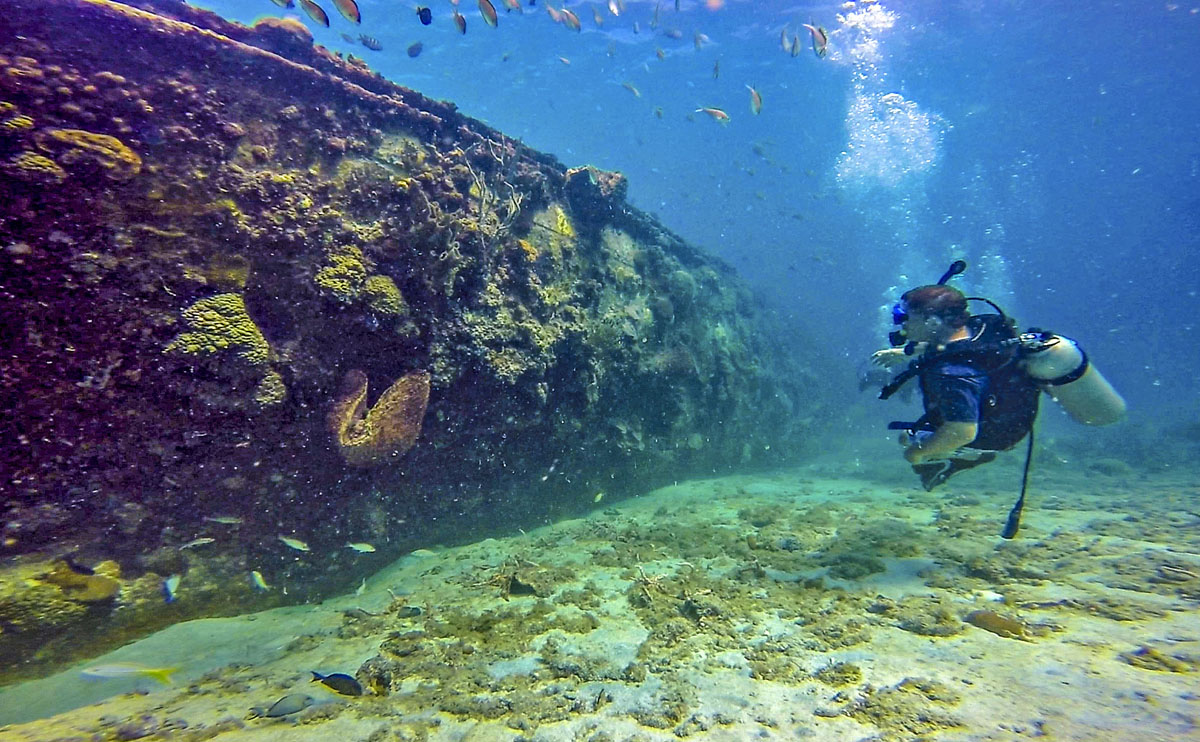
Coral and sponge life growing on the side of the Ellion in Carlisle Bay. Credit: Kiera Bloom.

Are you ever too old to dive? What concessions might you make?

I’ve been diving since I was in college, back in the 60s. On the concession front, these days I am happy to cavern dive. My days of dragging reels and half a dozen lights into the bowels of a cave are behind me, as are dry suits. I’m glad I did Antarctica when I had a chance. And if some cute, buff dive guide wants to carry my gear—have at it, I say. Gladly.

I like warm water. I realized along the way that shallow (say 60 feet or so) dives not only give you more time but usually have better life to see.

So, when I went recently to Barbados, I talked to a couple of dive operators about “elder” divers.

“You find those divers, the older ones, are the most competent,” said Troy Barthelmy, Aqua Center manager for Sandals on Barbados

Looking out from inside the Bajan Queen wreck with fish and diver in view. Credit: Andrew Western.

His oldest divers are in their 80s. Most of them, he added, are physically fit and, “more than anyone else, they know their limits.”

“They don’t require much attention beyond maybe needing help up the ladder. Removing the weight belt, tank, and fins in the water also helps.”

Physical fitness is important, he added. Basically, if you can’t do a couple of flights of stairs without becoming breathless, there may be a problem.

But these days, there are also concerns about safety and liability.

All of the dive shops on Barbados I contacted had some sort of medical form for divers to fill out. They are not all identical but do appear to hit more or less the same long list of possible medical issues.

They range from the expected—do you smoke, history of heart disease or diabetes, to the surprising—hay fever, frequent colds, prone to sea sickness. 

Hawksbill turtle chews on sponge algae atop the Eillon, one of six shipwrecks in Carlisle Bay. Credit: David Noyes.

Sandals Resort, a high-end Barbados beach vacation spot, makes sure guests who plan to dive get this form well before their trip. And if they answer yes to ANY of the questions, they need a certificate from a doctor saying they are OK to dive. Should they say yes and arrive without the certification, the dive shop will call a local doctor; the fee is $160 US. 

Many dive shops use a standard medical form that can be found on the PADI website. The form is required for all divers, not just those who are older.

For people who are anxious, Troy says the diver can do a test dive in the pool to get more comfortable with the Sandals gear.

Peter Grannum of Dive West Side Scuba echoed what Troy said, adding that he finds older divers prefer more shallow dives. 

Which brings us to Carlisle Bay, one of the finest novice/easy dives I’ve experienced.

Carlisle Bay, a protected marine park, is a crescent shaped bay on Barbados’ sheltered west side. 

There are six boat wrecks all practically within sight of each other and some with tops as shallow as 11 feet, with much of the diving at the 30 and 40 foot level. 

Local women of Barbados in colonial dress. Credit: Yvette Cardozo

Each wreck has history. The Bajan Queen, a former party boat, was sunk here to become an artificial reef in 2002. Now schools of grunts, squirrelfish, and jacks swim beneath the hull. At the Ellion, a hawksbill turtle calmly chewed on sponge algae on the stern. This boat was used by drug smugglers, who were caught, and went to prison. 

The Berwind, a French tug during WWI, was deliberately sunk by its crew, which didn’t want to go home. It’s the oldest wreck in the bay. Cornwallis was a Canadian freighter sunk in WWII by a German U-boat and moved to the bay in 2000. Plus the Ce-Trek sunk in 1986. And a barge, sunk in 2000.

It’s possible to do most of these bits and pieces on a single dive or two and a couple of the wrecks can be penetrated. My only regret is we didn’t do both dives on this site. 

Barbados Info

Barbados is in the Lesser Antilles, south of the usual hurricane tracks,

Barbados is 75 – 85 degrees year round. June through October is the rainy season and also hurricane season in the Caribbean. And while Barbados usually escapes major storms, gateway cities such as Miami may be affected. For Barbados Information, Click Here

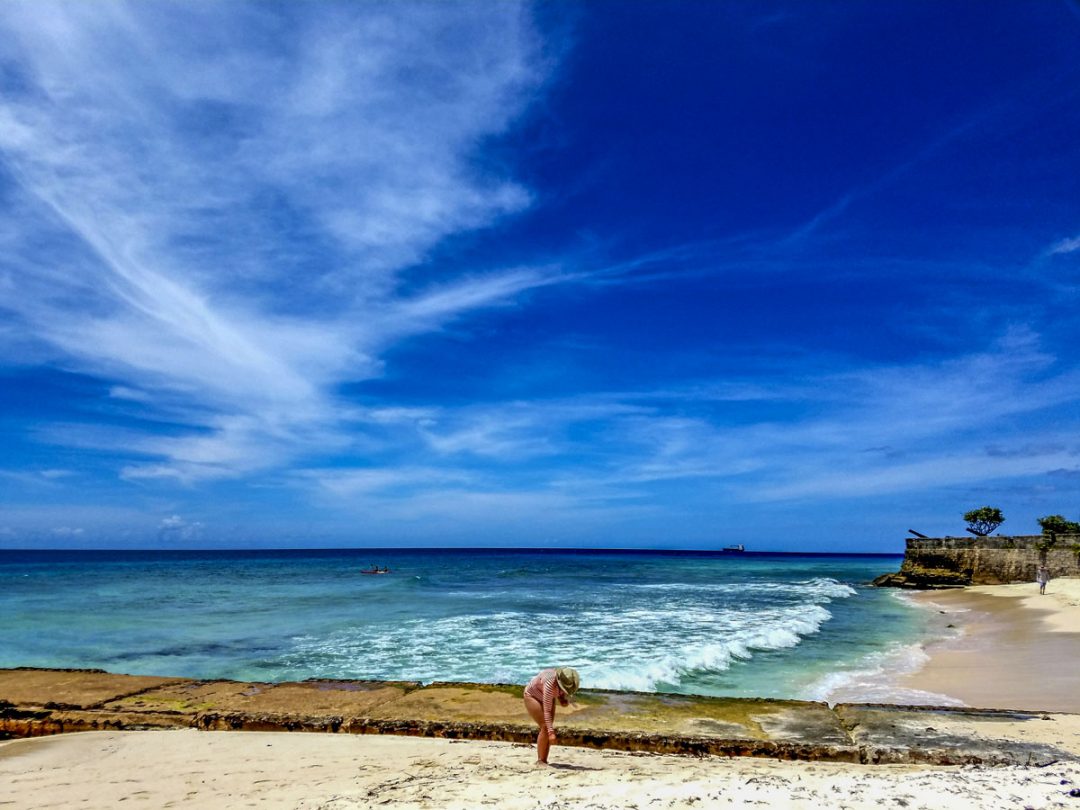
Looking for shells, early morning on the beach at the Hilton Barbados in the Lesser Antilles, Caribbean. The garrison with canon can be seen in the background. Credit: Yvette Cardozo

My DIY Dolomite Ski Adventure


With 450+ lifts, the Dolomiti in northern Italy is the largest ski region on the planet. This UNESCO World Heritage site is beautiful, historically and culturally interesting and overall, outstanding.

DOLOMITI SUPERSKI represents the area’s twelve regions, some quite famous (A portion of the 2026 Winter Olympics will be held in Cortina d’Ampezzo), others individually unique. Best of all they can be accessed using a single RFID pass, which includes use of an expansive network of regional buses. Seniors (those born before November 30, 1954) get discounts on already low ticket pricesClick here for 2019-2020 ticket prices.

Climate Change now requires illogical and calculated guesses when planning long ski trips from ‘down-under’.  Mine began mid-February with 2 flights, a bus, a train, another train, and finally the local bus from Bolzano to the Val Gardena region – a tiring 27-hour journey.

My goal was to ski the famed Sellaronda ski circuit covering four Dolomite passes around the Sella massif. I would be there for three weeks, and during that time, I chose to change lodging only three times. It was a good plan created with the help of the local tourist office and one that easily can be followed by others. 

I started in the northern Dolomites. St. Cristina and Selva are ideal base locations offering plenty of lodging and dining options and providing easy access to skiing throughout Val Gardena. My first lodging was Garni Cir, a small BnB in St. Cristina. The next morning I caught a bus to the base area where I purchased my Dolomiti Superski Pass and took the Saslong gondola. The majority of slopes in the St. Cristina–Selva area are steepish and perfectly groomed; more relaxing intermediate slopes are on the Alpe Di Siusi slopes above Ortisei. 

My ski week in Val Gardena included first tracks on the World Cup slopes above St. Cristina and Selva, plunging down the steep skiers’ left off the Plan De Gralba cable car, and non-stop skiing the Saslong’s slick and bumpy pitch late one afternoon.

After 6 perfect days it was time to move from Val Gardena to the Val Di Fassa region. 

I took a local bus back to Bolzano, where I checked my luggage at the train station and visited the museum housing Oetzi, the world’s oldest “wet” mummy. This is a must-see for anyone visiting the region.

Reconstruction: Alfons & Adrie Kennis © South Tyrol Museum Archaeology/Ochsenreiter

After a stroll through this lovely small city, I caught the regional bus to Campitello, where I checked into the Tobia Hotel-Restaurant-Bar on the village piazza. Campitello is a rustic village with easy access to the slopes above Canazei-Alba and the off-piste steeps around Arabba. On route, I met two university students coincidentally staying at the same place. Both, I soon discovered, were excellent skiers and fun companions.

The next several days, we skied Canazei, Alba, Arabba, Marmolada and the Pozza di Fassa region. It was exhilarating and exhausting!

My next stop, a bus ride from Campitello, was San Martino Di Castrozza. On the way we crossed the beautiful Passo Rolle Pass before descending steep switchbacks into the town. I honestly think San Marino Di Castrozza is one of the world’s most beautiful mountain resorts. Surrounded by seriously steep peaks, it is a gateway to several ski areas. On this, the last leg of my Dolomiti journey, I stayed at Albergo BnB, a pretty place within walking distance of the new Ces gondola.

The mountains above San Martino Di Castrozza. Credit Murray Sandman

When I was there the snow was hard and fast, especially off the Tognola peaks and the Coston and Direttissima chairs. Many off-piste slopes are tree-covered and look like they’d be fantastic on a powder day.

It was the end of my three-week do-it-yourself Dolomite ski experience. Accessing my online DOLOMITI SUPERSKI Performance Check, I saw that in 15 days I skied 65,143 downhill meters over 357 kilometres of trials using 130 different lifts. On top of this let me say that the food was fantastic and the skies bright, bright blue. Another great ski trip!

moon rocks

Summer Cycling: Riding The Moon Rocks

Riding mountain bikes in the “Mountain State” of West Virginia is nothing short of challenging.  My wife asked me, after my recent trip,  how it went and I said, “tougher every year, dear.” 

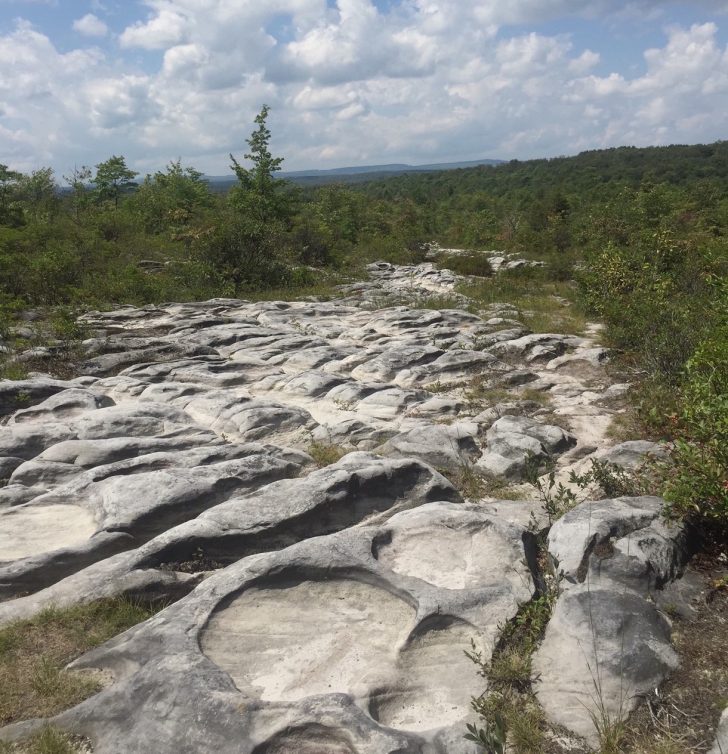
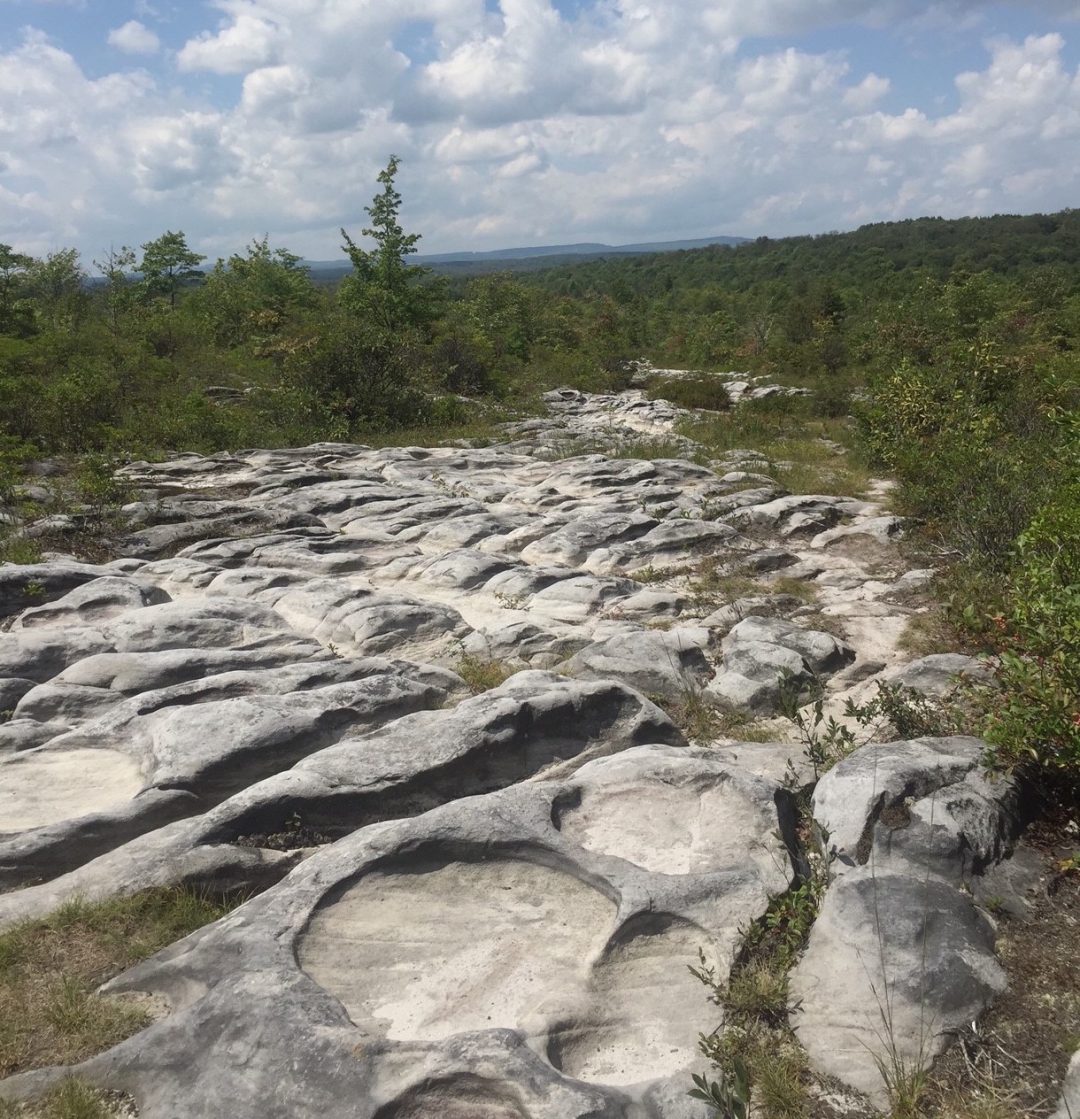
The famous Moon Rocks at Davis, WV, put the “technical” in single-track. Not related to the rocks brought back by Apollo 11, but close. Credit: Pat McCloskey

Riding in Davis, WV, is always fun but you better bring your “A” game because currently there are mostly expert black diamond and double black diamond trails that are well marked and give you plenty of notice.  Not to mention that it rained six inches the night before we got there, according to local legend and mountain bike instructor Sue Haywood.

Davis is making an effort— along with the neighboring town of Thomas—to provide some entry level trails to boost tourism, but the folks who come to Davis know exactly what they are getting. 

If you go to MTB Project and look up :Moon Rocks” and “Hoo Doo Rocks”, you will be led to a post and a map that can guide you from the back end of the Shop N Save in town.  Also a wise move to perhaps check with the guys at Blackwater Bikes.  They can provide sales and service because you will surely need service on your bike if you ride in Davis.  

One of the more interesting places that you  will see if you ride the suggested route is the Moon Rocks.  This outcropping of 480 million year old sandstone is both scenic, unusual, and has sprung up out of the local bogs to provide a challenge to hikers, mountain bikers, and motorcycle enthusiasts. 

The Moon Rocks were included in the Blackwater 100—a classic motorcycle enduro race— and the 24 Hours of Canaan Mountain Bike Race created by Davis resident Laird Knight.  I can remember competing in the second 24 Hours of Canaan back in ’94 and doing my night lap at 4:00 AM. 

The Moon Rocks were not only a challenge but an eerie sight under the moonlight of the West Virginia skies.  In any event, after all these years, I was riding behind a younger guy this past weekend and after I told him I had socks older than him and that I was applying for Medicare this year, he asked me about the old days and how the trails measured up today.  I told him it was still the same challenging track that I always remembered and with the wet roots, deep mud puddles and rivers of water in the ditches that made up some of the trail system, it was still the usual challenging West Virginia riding.  Memories are often embellished, too, as I regaled him with tales of the race thinking to myself, “the older I get, the better I was.” 

It is never a true trip to the Mountain State if you don’t take in some genuine bluegrass music. Our band of aging warriors made our way to the Purple Fiddle to see a band from North Carolina called MIPSO.  After snarfing home made veggie burgers and quaffing local craft beers, we listened to MIPSO and enjoyed some of the mountain music that makes this area of the country so special. 

I don’t mean to scare you away from visiting Davis and the other local attractions like Blackwater Falls State Park and Canaan Valley Resort and Conference Center. There are nice cross country ski trails nearby as well as alpine skiing at Canaan Valley Ski Area located adjacent to the conference center.  Tourism is king in this area and there are many sights and places to see, but if you want to mountain bike, and you are a good rider, these are some of the most scenic and challenging trails you will ever ride.

  Check out the video below for a Moon Rocks reveal.

https://vimeo.com/7285630
Ride the Moon Rocks with this video from Blackwater Bikes.

Non-Snow Activities: Dude Ranchin’

From Yodeling To Yippee-ing, Yvette Rides The Range.

Riding the foothills of the Tucson Range. Credit: White Stallion Ranch

 I’m not sure if skiing gets you into shape for horseback riding or vice versa, but, yes, a lot of the same muscles are at play. 

Either way, both take strong legs.

I confirmed all of this at White Stallion Ranch just outside Tucson, AZ at the end of last ski season. 

I packed my schedule full because I wanted to do EVERYthing. 

So on my first day, I went on the slow mountain horseback ride. We left the main ranch compound and sauntered leisurely across the valley, following a well worn path through the cactus.

Fast ride. Credit: White Stallion Ranch

At the foot of the volcanic, granite hills of the Tucson Range, we headed up via a rocky trail, passed the tall fingers of saguaro cactus and all sorts of blooming brush: yellow, purple, violet flowers. All in all, a great intro to the ranch rides.

There are also breakfast rides, wine and cheese rides, and a beer and Cheetos ride. Yum.

Such is life at one of the two remaining guest (aka dude) ranches in the Tucson area. Not that many years ago there were a hundred but population growth and development swallowed them one by one.

The White Stallion Ranch has been around since the turn of the 20th Century, first as a cattle ranch, and later home to 30,000 chickens.  In 1945, it became a guest ranch. The True family bought it in 1965, and. when they saw that the area guest ranches had already dwindled to about 30, they started buying land and adding rooms. Today, the 3,000 acre ranch has 43 rooms, a five bedroom hacienda, 160 horses, 120 cows, and wranglers on hand to lead rides, teach, tend to the livestock, cook and all the rest.

 For me, it wasn’t all riding. A couple of mornings I went shooting. I’ve only touched a gun once before in my life, but Bob and Sharon Callan will talk you through everything, how to aim, how to cock the guns, how not to accidentally blow your head off.

They’ve run the firearms training program for the Tucson police department, so they’re used to teaching.

You get to use a six shooter and a rifle, and there’s a set of steel plate targets.

“Consider all guns loaded and don’t point at anything you don’t want to shoot,” Sharon said. And added, “You can shoot the pistol one handed, but if you want to hit something, use two.”

All those cowboy movies where folks at a gallop shooting one-handed pick off the bad guys? Not on your life.

Western star Loop Rawlins does rope tricks during evening entertainment at White Stallion Ranch. Credit: Yvette Cardozo

I also did the movie tour by van. 

The ranch has been a popular site for movies since the 1930s. And for good reason. It’s literally around the corner from Tucson. You leave the ranch, climb a low hill and there, on the other side are the outskirts of the city. Talk about convenient.

Marty Freese, the ranch’s history guy, took us to all the popular sites where dozens of movies, TV shows, and commercials have been filmed,  including High Chaparral, a Lone Ranger movie and enough others to fill a two-page list.

 Each night there an activity. Bill Ganz sang cowboy songs by a campfire. Phil and Hector brought tarantulas and scorpions and a bearded dragon named Stumpy that attached itself to Phil’s chest like velcro, along with a Burmese python so long, it took nine kids to hold it. 

But the star of the week was Loop Rawlins who is an artist with gun and rope. He kept the Spring Break crowd of kids spellbound as he twirled guns, flipping them into his holster, skipped rope with his lariat and did a finale that involved a flaming, twirling lasso. 

On one of my last days, the ranch held its once-a-week rodeo. It’s sort of Rodeo 101, which is great if you’re like me and have never been to one. Russell True, who was five when his folks bought the place and now pretty much runs it, explained barrel racing, bulldogging, where you ride alongside a steer and jump astride it to bring it down (as bone rattling and dusty as you imagine) and team roping which Russell says he calls “cowboy judo” and is even more frenetic than bulldogging.

I also took a horse riding lesson and discovered all the things I was doing wrong. 

So maybe next time, I can actually get my horse to canter.

For more information on the White Stallion Ranch, click here.

Guests leave the breakfast corral on horseback during a breakfast ride. Blooming hedgehog cactus in foreground. Credit: Yvette Cardozo

SeniorsSkiing Guide: La Parva, Chile

La Parva Is A GS Cruiser’s Heaven.

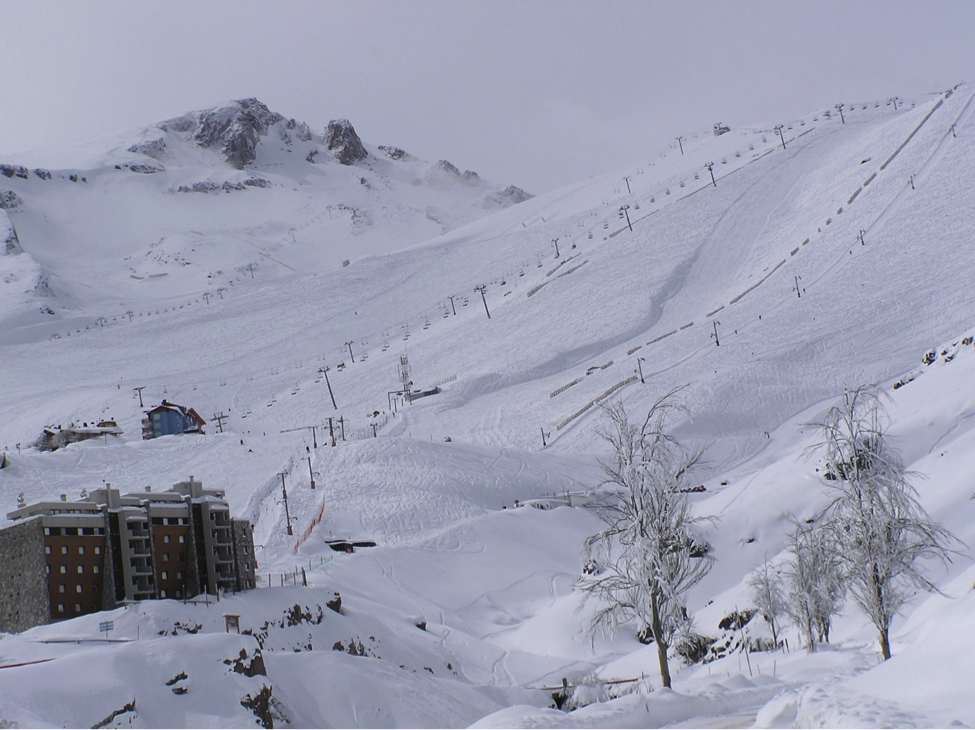
As a first installment on the Three Valleys of ski fame in Chile, I’ll write about La Parva. One hour and a half from the Santiago airport, La Parva is perched up at 8,700 ft on the front side of the Andes, and overlooks the city. The road up involves 40 switchbacks and a vertical rise of 7,000ft.  I do not recommend tackling it during a storm!

The furthest north of the three ski areas, the village rests at the base of the La Parva peak (13,000ft), which itself is a sub-peak of the El Plomo Massif (18,000ft). Stretching for a width of three miles across several watershed— all connected with skiable cat tracks— the area faces mostly west, with the north sides of the valleys collecting the most snow. While this western orientation exposes it to the sun and north wind, often leaving bare ridge lines, it also means snow accumulates in those multiple bowls where the snow is blown, and the sun hardly shines.

On a good year such as this, even the north faces are skiable.

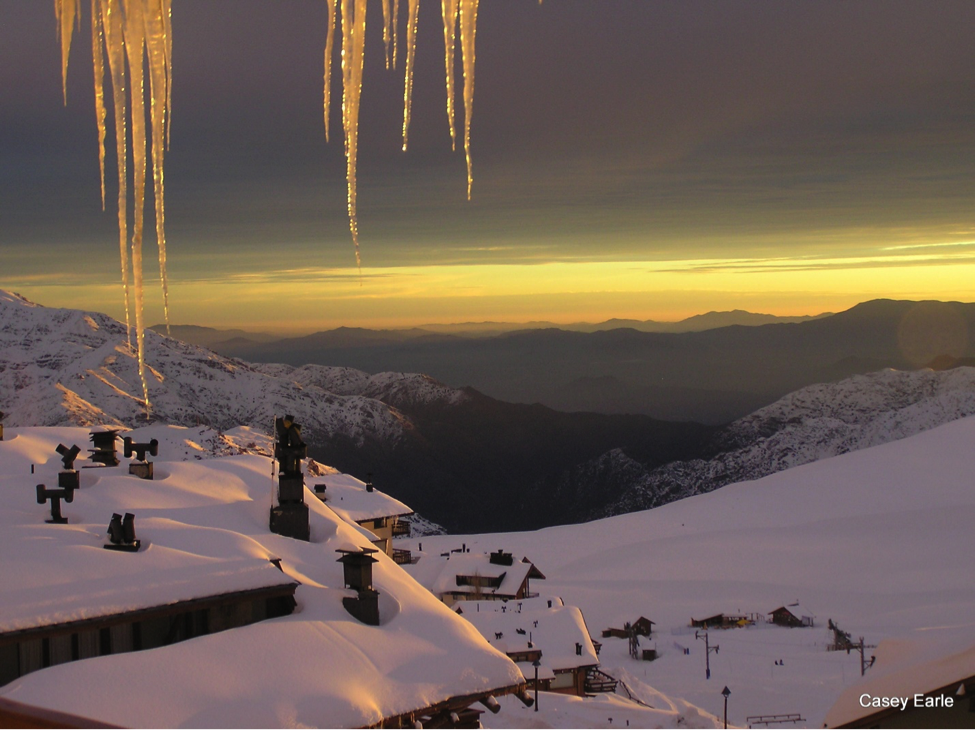
As a bonus, the sunsets over Santiago are wildly beautiful.

To get you up the hill, there are four chairlifts, each serving different terrain, and seven good surface lifts (platters, thank god). In windy weather, the platters are safest, as you can bail out wherever you want. But, with 80% of the days being sunny, and often with no wind, the weather is generally not an issue. Grooming is excellent with no mogul bashing required, ever, but add in 70% of the runs being intermediate level, and this is a GS cruisers heaven. The entire vertical rise of 3,000 ft can be skied in one go, so get the long boards out boys!

The village itself is like a classy suburb of Santiago with no hotels, but several restaurants. Most of the 2,000 or so beds are ski in-out apartments, and the family-oriented atmosphere is manifest in the hoards of little racers out at 9 am sharp every weekend. Racing is the name of the game in La Parva, and while often fun to watch, it does take up some of the best runs, especially when the international teams arrive in August. Fortunately, there is a lot of room in the ski area, especially when the off-piste is in good shape.

Casey finds a lonely route down to the Las Aguilas chair, and the small restaurant at its base.

For lodging, there many private apartments, and a few houses on Airbnb or Booking.com. The village has three restaurants, a bar/disco, and a small grocery store. On the hill, aside from the three restaurants mentioned (all accessible on skis) there are two mid-station restaurants, and a small, occasional, open-air one at 11,400 ft. Careful with the pisco sours, it is a long way down…

For La Parva Trail Map, click here

For La Parva Webcams, click here

Check out the La Parva website here.

Slopeside Syrup: Ski Racing And “Golden Delicate”

The Cochran Family Makes Maple Syrup And Ski Racers.

Slopeside Sugar House run by ski racing’s famous Cochran family. Credit: Cochran Family

There are a lot of Vermonters and others in the ski racing world who could tell you a lot more about the famous Cochran Family of Richmond, VT.  I have friends who know them personally and tell the tales of the first rope tow that Mickey Cochran built in his back yard with the vision of a community ski facility.  He and his wife Ginny ultimately had four children who all made the U.S. Ski Team and had outstanding success including a  gold Olympic medal for Barbara Ann and a World Cup GS Title for Marilyn.

World Cup GS Champ Marilyn Cochran helps out at Slopeside. Credit: Vermont Sports Hall Of Fame

My friend Mark Hutchinson remembers the time that Mickey’s jacket caught on fire because of all the oil and engine grease embedded in the fabric as a result of countless hours maintaining the tows at Cochran’s.  Today, Cochran’s is a legendary ski training center for young ski racers all over Vermont with coaching and operational duties falling to the Cochran family, relatives, and grandchildren.  They are currently a non-profit ski area with training and races held each winter.  Donations are gratefully accepted at www.cochranskiarea.com/donate But that is not what the subject of this article is.  I am talking pure Vermont Maple Syrup of which I am a true connoisseur or as my friends say, a “common sewer”.

I have this habit of taking pure Vermont Maple Syrup, heated, in a jar when my wife and son and I  go to breakfast.  They look at me with disdain, but I will not use anything else on my hot cakes, waffles, or oatmeal.  I am always on the hunt for the recently re-named “Golden Delicate” syrup that is elusive.

With the re-naming of the descriptions of different grades of syrup by the Vermont Maple Sugar Makers Association  (www.vermontmaple.org) ,  there has been some confusion as to what is actually the top syrup for consumption.  Personally, I like the lightest syrup currently described as “Golden Delicate”.

Recently, four of the grandchildren—all cousins—of Cochran decent, decided to enter the maple syrup space in Vermont by constructing a timber frame sugar house close to the ski area.  This has expanded since 2010 to an operation of 22,000 taps and PVC collection lines that all feed the operation in the sugar shack.

Maple syrup from Vermont. Hmmmm. Credit: Slopeside

Slopeside Syrup has become the standard bearer for all Vermont syrup, and I am so happy that I found them.  One day, while perusing the Durfee family refrigerator in Lake Tahoe, I came across a bottle of this delectable treat.  I asked Eric Durfee about it as he is a native Vermonter and friend of Marilyn Cochran.  He told me about the operation and how he and Marilyn converse about the old days of ski racing and training to this day.  Turns out that Marilyn helps out occasionally with the syrup operation.  When I ordered several bottles online and told her I was a friend of Eric’s, she wrote me a nice personalized note that she packed in with my order.  That little bit of customer service and kindness will always make me a Slopeside Syrup fan for life.  You should be as well.

Go to www.slopesidesyrup.com, and you will see ordering information as well as some history of the family.  Not often that a World Cup GS Champion will oversee your order.  Take it from me, the “Golden Delicate” is nothing like you have ever tasted before.  Most times when I have ordered the formerly labeled “Grade A Delicate”, I got something less with more of an amber color and traditional taste.  However, the Slopeside Syrup product is truly that elusive grade which I know and love and bring with me to every breakfast.

So treat yourself, buy Slopeside Syrup and support Cochran’s Ski Area for the kids in Vermont.  Not all of them can go to the elite ski academies because of cost. But they can come to Cochran’s, get world class coaching, and immerse themselves in a culture of champions.  Ski racing, and maple syrup.  What a combination.

Ötzi the Ice Man: Three Millennia Older Than Mel Brooks


Reconstruction: Alfons & Adrie Kennis © South Tyrol Museum Archaeology/Ochsenreiter

He may not be the world’s oldest skier, but at more than 5000 years, he is the world’s oldest and best-preserved wet mummy. Given his advancing years, Ötzi is in particularly good shape. 

Named for where he was found in 1991 by two hikers on the Italian-Austrian border, Ötzi now resides in the South Tyrol Museum of Archaeology in the lovely small Northern Italian city of Bolzano. If you find yourself in the general vicinity, I strongly recommend paying him a visit.

© South Tyrol Museum of Archaeology

One of the many effects of global warming is the discovery of ancient things thawing their way out of the ice: thousand year old skis in Oppland County, Norway; a 500-year-old girl with perfectly preserved hands found in the Andes; an almost intact wooly mammoth found in Russia’s Arctic Lyakhovsky Islands. To learn more watch this brief “Secrets of the Ice” video.

But Ötzi stands apart, for his age, his superb condition, and the extensive science applied to understanding who he was. His genome has been mapped, his stomach contents carefully analyzed, and his belongings extensively interpreted. 

He is thought to have been a traveling shaman dispensing medical treatments. Evidence for that is in the form of fungi with antibiotic properties found in a sack. He also had dots and lines tattooed on either side of his lower spine at known acupuncture pain relief sites. Interestingly, even today, similarly located tattoos are found on people from primitive cultures.

Ötzi also had no hand callouses and underdeveloped upper body musculature, suggesting he was not engaged in agriculture or other physically demanding activities. Indeed, his animal skin clothing was finely put together and his axe decorative and showing little wear, possible signs of status and respect.

But respected or not, Ötzi was murdered. A 21st Century police detective examining the evidence concluded he was murdered a day or two following a violent fight. A cut on one of his hands suggests he had defended himself during the recent altercation. An arrowhead found in his body had severed an artery and caused his death. Detective work showed it was shot from a distance of about 100’. Because he was found with all his belongings, the possibility of theft has been ruled out.

© South Tyrol Museum of Archaeology/Ochsenreitr

Visitors to the museum view Ötzi’s gnarled flesh and twisted frame through a window in the freezer room where he’s on display. 

A reconstruction based on everything known about him stands in an adjacent gallery, created with the help of police forensics. 

Some of you may remember that long before Ötzi came out of the ice, Mel Brooks was considered to be the world’s oldest man. He and Carl Reiner drew upon his longevity in their classic comedy routine.

The South Tyrol Museum isn’t large, but it is one of the most fascinating places I’ve seen. If you’re planning a trip to the Dolomites, it’s a place you’ll want to visit along the way.

Snowbasin Goes Epic

Uncrowded, Beautiful Views, Variety Of Terrain, No Hotels.

Most of the trails at Snowbasin wind up at the Needles Gondola. Credit: Tamsin Venn

Older skiers would really like Snowbasin outside Ogden, UT. You have nearly 3,000 acres in which to avoid other skiers and 3,000 vertical feet to get some rhythm going. A remotish location keeps lines short midweek. Lifts whisk you up to the top of six scenic, craggy peaks: two high-speed gondolas, three high-speed chairlifts. You can dine on really good food at a choice of three swank lodges, all glass and timber, wall-to-wall carpeting, stone fireplaces, and chandeliers. Locals think about skiing elsewhere, but why bother?

“You ski on a Tuesday here, even on the biggest powder day, and you’re looking for somebody to ride the lift with,” says new General Manager Davy Ratchford, quoted in Powder Magazine.

The layout is easy to follow. Most of the 106 tree-dotted trails end up at the base of the Needles Gondola. The mostly intermediate and expert trails include a fun variety: wide groomed boulevards, low angle chutes to dip into, hikes to cirques and chutes close to lifts, such as the popular Lone Tree. Typically the area gets 300 inches of snow a year.

Stop at the top to view four states: Utah, Wyoming, Colorado, Nevada. At the Strawberry Gondola, take the longest Elk Ridge trail at 3.5 miles. Flat light can be a problem up top on weather days, but low visibility markers lead you back to the base area.

Snowbasin hosted the downhill at the 2002 Olympics. You can hurl down the course if you like. Credit: Tamsin Venn

Snowbasin hosted the men’s and women’s downhill in the 2002 Olympics. Take the 15-passenger tram up to Allen Peak (9,465 feet), stare in awe over the precipice looking down at Ogden’s grid and Great Salt Lake. Then heart in throat, hurl yourself down The Grizzly, start of the men’s downhill. The less ambitious can take the tram back down to the newly widened and graded Mt. Ogden Bowl Road, a lower-angled return.

Snowbasin is not new. About 50 minutes north of Salt Lake City, it opened in 1939, and is one of the oldest continually operating ski resorts in the U.S. Utah native Earl Holding (of Sun Valley) bought it in 1984, made a large investment in lifts and snowmaking over the years, then pulled out all the stops for the 2002 Winter Olympics.

Snowbasin has no lodging. In nearby Huntsville, the newly opened Compass Rose Lodge, run by skiers Jeff and Bonnie Hyde has 15 bedrooms and its own observatory to take advantage of nearby North Fork dark-sky park. Grab a beer and burger at the No Name Saloon, oldest bar in Utah.

Or stay in Ogden, 30 minutes away, once a key stop on the transcontinental railroad. It has historic hotels like The Roosevelt, many ethnic restaurants, craft beer breweries like Roosters Brewing Company, and Social Axe where you can throw axes with your friends for fun. UTA public buses run up Ogden Canyon to Snowbasin and nearby Powder Mountain.

The Facts

Snowbasin has gone Epic. The 2019-20 Epic Pass provides seven days of skiing each at Snowbasin and Sun Valley, no blackout dates, and 50 percent off lift tickets once days are used.

Day pass senior at window (65-74) $89. 75 plus is $45. Midweek season pass (all ages) $439. 75 plus is $49. Snowbasin will close this year on April 21.

Click here for Snowbasin Trail Map.

Click here for Snowbasin Webcam.

Not too crowded big mountain skiing at Snowbasin. Credit: Tamsin Venn