Yellowstone’s Winter Magic

SOURCE: YELLOWSTONE EXPEDITIONS

In 1991, while guiding a small group in Yellowstone National Park, I tried to describe walking outside as the sun rose one February morning near Old Faithful:

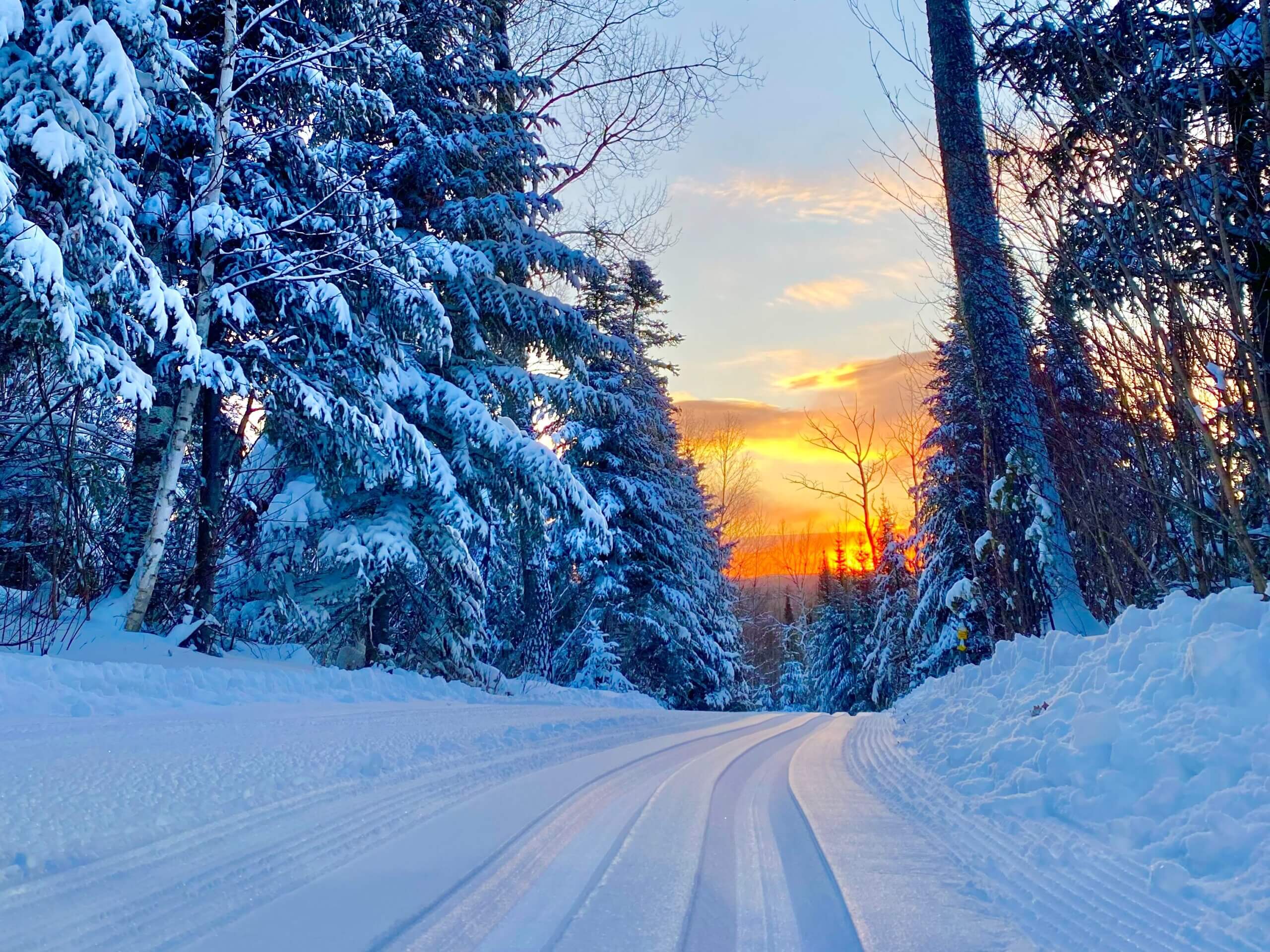
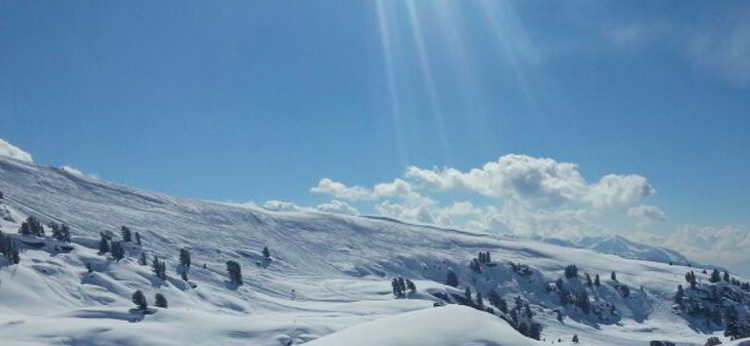
Morning light pours over the hills, reflecting off the frost in a blinding cloud of diamonds. Elk and bison shake snow off their backs, stirring after a long night’s chill. Duck and geese stretch and preen. Billows of geyser steam hover and settle, creating dense, lacy patterns on bowed pine branches. Yellowstone tastes of winter magic.”

Summer and Winter

To me, Yellowstone isn’t a great treat in summer. Yes, the combination of animal and geothermal activity is unique – but this year there were close to three million visitors, June to August. That’s too many vehicles and frowning faces jammed along narrow roads.

Winter is totally different. First, there’s almost no traffic (no bears either, although they may peep out of their dens in January). The only road that’s kept plowed runs east from Mammoth in the northwest to Cooke City, where it dead ends. All other roads are snow-covered and accessible by snowmobile, snowcoach (enclosed and heated tracked vehicles), or on skis or snowshoes.

Yellowstone’s winter is created for superlatives. No other place in the world has such an inspiring combination of wildlife and wild geology. It’s rich in history; has spectacular mountain scenery; and the park’s 2.2 million acres are yours without crowds or pollution.

Getting There

Yellowstone is located in the northwest corner of Wyoming, with little extensions north into Montana and west into Idaho.

To enter the park, you can travel north from Jackson Hole; west from Cody, Wyoming; or east from West Yellowstone, Montana. My favorite (fourth) route is east from Bozeman to Livingston; south through the Paradise Valley; pass through the sleepy town of Gardiner; and drive up to Mammoth Hot Springs, where you can overnight at the venerable Mammoth Hot Springs Hotel, with elk grazing outside the ground floor windows.

Using Mammoth as a base, you can drive toward Cooke City, with a lot of photos stops for wildlife in the Lamar Valley, and then backtrack.

Heading South

From Mammoth you can get to Old Faithful by snowcoach or snowmobile, sight-seeing, skiing, and snowshoeing along the way. Norris Geyser Basin and the jaw-dropping Canyon of the Yellowstone River, with ice-laden and thunderous falls, are natural stops.

The center of the park is a volcanic crater, 40 miles across, with the world’s greatest concentration of geothermal features: geysers and fumaroles, mud pots and hot pools. One of my favorite Yellowstone memories is a morning ski on a snow-covered wooden boardwalk, watching a bison standing above a steam vent, basking in the warm air billowing around his belly.

Snowpack around Mammoth can be thin, but Old Faithful has reliable conditions and all kinds of good trails. You’re guaranteed to see lots of elk and bison, maybe coyotes, possibly wolves.
SOURCE: YELLOWSTONE NATIONAL PARK LODGES

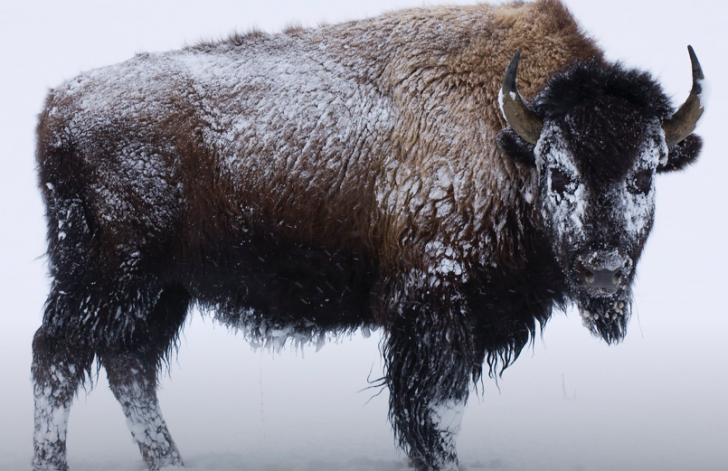
In winter, bison are relatively indifferent to humans, since they’re intent on scarce forage and surviving sometimes bitter cold, but it’s not something to count on. I’ve skied within feet of a bison, on a narrow trail with a cliff to one side and sheer drop on the other. We came around a corner and there they were. We carefully didn’t make eye contact with the cows and calves that plodded toward us, and I could hear muttered prayers from the other skiers (my teeth were chattering too hard to enunciate).

Of all the times I’ve visited Old Faithful, the most indelible and endearing memory isn’t a glorious streamside tour, two feet of light fresh snow, or being mock-charged by a bull elk. It’s the smiles on three kids’ faces as one cold morning they dropped tablets of food coloring in glasses of hot water, ran outside the Snow Lodge, and threw them in the air! It was a cold morning, and the droplets turned into rainbows of frozen mist – blue, red, green – that slowly drifted in the breeze and disappeared. So a half-dozen of us adults did the same thing.

Now, that’s magic.

Resources

The Mammoth Hotel and the Old Faithful Snow Lodge provide Yellowstone’s only winter accommodations and dining other than yurt village/guide service Yellowstone Expeditions (https://yellowstoneexpeditions.com/). They typically open for the season mid-December 20th through early March.

You can book accommodations by contacting Yellowstone National Park Lodges (https://www.yellowstonenationalparklodges.com/). For a snowcoach tour, I’d recommend Yellowstone Alpen Guides in West Yellowstone (https://seeyellowstone.com/), especially if you want skiing or snowshoeing.

Tukino ski field

Tukino Skifield, Mt Ruapehu, Aotearoa/New Zealand

Tukino Skifield (www.tukino.org) is a Club-operated field (“skifield” is the down-under term for ski slope) on the eastern slopes of Mt Ruapehu (9175 ft/2797 m), a live volcano and the highest mountain on the North Island of New Zealand. It is located within Tongariro National Park, a World Heritage Area, encompassing two other large volcanic cones (Ngauruhoe and Tongariro) plus numerous smaller ones.

The first known and documented skiing on Mt Ruapehu was in July 1913, soon after which the Ruapehu Ski Club was formed, making it one of the oldest outside Europe.

The field is on scoria ash with many boulders, so skiing is rarely possible before the end of June. The core season is usually August-September and the annual snowfall averages about 70”. Tukino, like other nearby skifields, has a mix of green, blue and black terrain.

Tukino’s fixed lift served vertical is 1115’. A portable tow and cat can extend it to almost 2000’, conditions permitting. Neighboring Whakapapa, New Zealand’s largest ski area, has a 2300’ vertical.
Skiing at Tukino is open to the public, but Club members (annual adult membership: $70) enjoy substantial discounts for accommodations and lift-passes. Most maintenance and skifield work is done by volunteers, with a small core of alpine-qualified staff. There are three fully-equipped lodges, each taking up to 32 guests; these are operated by their respective Club owners.

Tukino and the access road are operated and maintained by a coalition of local ski clubs. The upper part of the road requires 4WD.

The Tukino field has two fixed “nutcracker” rope-tows (so-called because the device attached to your tow-belt, used for clamping onto the tow-rope, resembles the traditional implement for opening walnuts etc!) plus a portable rope-tow. Conditions permitting, cat skiing also is available.

Skiing Tukino is a bit old-fashioned and takes some effort (and 4WD) to get there. Staying over requires a sleeping bag and pitching in with meals, cleaning, etc. Accommodation prices at each of the three clubs are reasonable and include meals. The entire area is off-grid, so getting online is possible but challenging. But who needs Internet when conversation and games with other club members and guests make the experience memorable.
Visit club websites for more information on each of the three options: Aorangi Ski Club (www.aorangi.org); Desert Alpine Club (www.desertalpine.club), Tukino Alpine Sports Club (http://tukinoalpinesportsclub.org.nz ).

Tukino ski field

Photo courtesy of tukino.org

Sunday River

Look Back: Sunday River

Smooth sailing on Risky Business. Photo by Tamsin Venn.

For the record, early morning skiing was just the best at Sunday River, Maine.

We skied this reliable, late-season spot over Easter weekend with two gorgeous sunny days, happy the travel restrictions into Maine had eased for us at last. Better late than never.

Everyone wore masks. Photo by Tamsin Venn.

Count SR’s season-long commitment to snowmaking (90 percent coverage) as the insurance that makes the late season possible, especially with paltry late-season snowfall. Also, a three-mile-long ridge of eight peaks gives skiers and boarders varied snow conditions at different exposures. You can always find something holding up well. Big vert lets you stay on upper slopes in afternoon to avoid lower-elevation slush. Good grooming helps put things right the next day in New England’s freeze and thaw cycle: 8 a.m. crispy corduroy.

All good.

The crowds were the biggest challenge. At the popular Barker Chair, social distancing was a little ragged, but everyone was wearing masks. People in the lift line were polite, waiting their turn, and no grumbling heard for riding alone. Slopes were busy, but most people knew what they were doing, including the rug rats, probably mostly passholders. (Note to senior self – the later in the season, the safer you are.) The one exception was the young, helmetless dude on the snowboard straight-lining White Heat.

There were a few surprises. We agreed to meet for Easter lunch at the sunny deck at North Peak Lodge, but only the bar was open. So we drank instead and ate chocolate bunnies. One closed trail we wanted to ski suddenly opened. The top of White Heat is nothing but a granite ledge with snow on top of it (you don’t realize that mid-winter). The schlep across a dry parking lot is not so bad.

I checked in with the millennials with me on what they liked at Sunday River and what they hope will be carried over into next year.

On the way over to the next peak. Photo by Tamsin Venn

Increased RFID use and access? Already there. Food trucks? Already had them. Outdoor dining? Great, unless it’s a blizzard. They can’t wait to get back to booting up in the lodge and more places to eat. They plan to renew their Ikon passes.

As for changes going forward, Sunday River says while plans for next year aren’t finalized, it will likely continue to encourage online advanced ticket sales, offer online food ordering at certain eateries, and hopes to expand takeout options.

Kelly Pawlak, President of the National Ski Areas Assn., noted successes that will likely be carried over into next year at most ski areas. Those include advanced ticket sales (ski areas like to know how many skiers will show up); reconfigured indoor spaces that open up space within lodges; increased use of ticket kiosks; outdoor living fixtures like fire pits, chairs, food trucks, outside food windows; and for employees, daily wellness checks, staying home if sick, plus sick pay for seasonal workers.

Summary of the 20-21 ski season? Like many, with the skis now hung up, I was very grateful there was one to begin with, and Sunday River made for a very rewarding finale.

Park City

Top To Bottom: Park City Last Day 2021

Three Costumed Spring Skiing Characters Put A Cap On The Season.

Fun run down to the Tombstone lift at Park City on closing day. Enjoy the silly fun.

Our Vicarious Vacation series winds up in Park City, UT, on April 12 this year, the last day of the season. Our three characters head down from Cloud Dine to the Tombstone Lift on the “canyon side.”

We’ve never skied Park City, but this run follows trails which look remarkably like classic New England. Kind of narrow, through trees, past condos.  Heading under numerous overpasses is a bit unique. Credit goes to RV Dummy for this video and the merry band of spring celebrants.

This wraps this season’s Vicarious Vacations.  We hope you enjoyed taking top to bottom runs on some wonderful resorts, some of which may be totally new to you.  Now you know.

Look Ahead: Report From Australia

The Virus Is Contained, Resorts Anticipate Regular Openings.

Mt Hotham in mid-season. This year, the resort awaits eager visitors after closing in 2020.

We, the skiing public here in Oz, are quietly excited about the prospect of finally skiing again after a year off. While we wait for government decisions and confirm opening dates at Mt Hotham, Falls Creek and Mt Buller here in Victoria and similarly for the resorts in NSW at Perisher and Thredbo. There is a very good indication that with virus levels in Australia at zero the official opening date of Friday June 11 will happen. The ski resorts are all hiring this year.

Opening, that is, except for only a couple of people in quarantine.  There are no cases in the general community. Yes, you read that correctly. Through management (and I use the term loosely), Australia, with a little diligence, has reduced Corvid to literally just a few cases. So, our various state governments figured out, finally, that hotels and strict quarantine for returning travelers has stemmed the transmission.

Contrast this with 2020, and the disaster that unfolded then for the ski industry. By July 9, 2020, it was confirmed that two popular Victorian ski resorts had closed effective immediately due to the corvid virus in the state. They made the difficult decision to suspend operations at Mt Hotham and Falls Creek, “effective Thursday July 9 through to at least August 19,” Vail Resorts, the US company which owns the ski fields, stated. NSW followed quickly with the same decision.

Perisher in NSW is the largest ski resort in the Southern Hemisphere, opening in mid-June

We were in a bad space last year after devastating wildfires in January and February and yet the announcement about the then coming season was all rosy. “Mt Hotham welcomes the State Government’s announcement that the 2020 snow season can commence with a delayed start in late June, just in time for the Victorian school holidays.” said an official. Further adding, “Mt Hotham has experienced some fantastic early snowfalls, so we’ve been eagerly awaiting news on whether the winter 2020 season would proceed,” said Amber Gardner, CEO, Mt Hotham Alpine Resort Management Board. “We are excited about the Premier’s announcement yesterday and look forward to celebrating the season opening with our mountain community at the end of June.”

The excitement continued. Queen’s Birthday Long Weekend traditionally marks the start of the snow season in Australia, but last year it was to be a low-key affair, as Mt Hotham continued to plan for scaling-up in June in accordance with Victorian public health guidelines. The usual explainer of carrying snow chains, resort entry fees, etc. was also confirmed. During this period, the ski field would be closed to downhill skiing and snowboarding. But the resort’s cross-country trails will be open in alignment with recreational trails around Victoria, albeit under a reduced grooming regime and with limited Ski Patrol support. A limited intra-village transport service would also be available. And yes, Mt Hotham board spokesman said staff had been inundated with calls. “Please keep in mind that our staff may not be in a position to immediately answer your questions,” he said.
Here’s an interesting fact about the extent of the snow area in Australia in winter, a fact I find hard to comprehend: Australia has more snow than Switzerland. And, according to the Australian Ski Areas Association (ASAA), ski resort visits in Victoria had a $1,076 million impact on gross state product in 2018. So, you can understand how devastating another closure will have on this industry in 2021. A spokesman stated that, “People in the mountains and surrounds in Victoria continue to progress programmed summer projects ready to greet their first guests this the coming 2021 Winter.”

We wait. I am quietly confident that an opening will happen. We are seeing larger groups allowed with some isolating for crowds at sporting events still. But with vaccinations ramping up across all the states, confidence may be restored. Could I be sliding down a snow-covered slope at my favorite ski hill soon? Since skiing in Canada last year in January and February, I am yet to put on the planks. A La Nina has visited us in the Pacific and unusually large rain events have occurred across the Eastern States. But we are long in the knowledge that rain alone will not increase the snow levels. It maybe cold and wet, but I will be happy enough to just be amongst the snow guns again, real snow or not.

Mt.Hotham before the virus closed her down. Credit: Dave Chambers

Look Ahead: Despite Challenges, Chilean Resorts Are Preparing

Areas’ Marketing Campaigns Are In Full Swing, But Will The Weather Cooperate?

La Parva, Chile, sunset through the icicles. Credit: Casey Earle

For 2020, the ski season revolved around the multiple ills Chile has been suffering, including the ongoing drought that affected the skiing. This year would seem to be a continuation of those ills, including social and political unrest, economic suffering, and plague. In spite of all that, last year a few ski areas opened late in August, and the skiing was quite good. These were La Parva, El Colorado, and Corralco. Backcountry access was difficult due to covid restrictions.

Up until a few weeks ago, some optimism was brewing. Chile’s vaccination program had taken off strongly, Santiago had avoided a second wave, the elections for the constituents of the constitutional assembly were on for April 11, and rain had come to the central zone in January. Now, it would seem the Brazilian variant is ravaging the country, 90 percent of the inhabitants are in quarantine, hospitals are overflowing, and the elections are being postponed for a month. Riots flare up periodically, and the slow burn insurgency in Araucanía continues. Hard to be optimistic in this environment, but I will try.

Marketing announcing discounts for this season at La Parva. Credit: Casey Earle

The ski areas are certainly running their marketing campaigns like this season will actually happen with a semblance of normalcy.

La Parva touts their continuing commitment to opening the ski area, as they have done with their bike park during the summer.

Other areas are chomping at the bit to get the season going too, like Antillanca.

The dark spot is Valle Nevado, which is in arrears on a wide variety of debts, and recently initiated a chapter 11-type restructure of their obligations through to 2026, with large additional short term injections to keep the lifts turning. They cite the drought and covid as contributing factors to their woes.

In the weather department, the Chilean weather service just published their predictions for the fall (April, May, June).  Click here for details.

In summary, with rising subsurface temps in the central Pacific, the Niña has ended, and a neutral period begun (“La Nada”), but rainfall deficits are still expected. These will be most intense in the central zone, with the far south receiving excess rainfall. A El Niño event could occur late in 2021, if the warmer waters surge through to the southeastern Pacific, but that is highly unpredictable.

What really matters though is what sort of rainfall will happen from June on when most of the snow falls. I would not dare a prediction as drought has been the norm and is most likely to continue, but one (or god permitting, two) atmospheric rivers could change everything, as happened in late June 2020 under lockdown.

If you are thinking about a trip down this winter, it is probably unwise to plan just yet. That said, if the vaccination effort goes well, and those pesky variants calm down, possibilities for August are not out of the question.

Crossing our fingers!

Riding the Roca Jack “Va et Vient” with the US Ski Team. several seasons ago. Credit: Casey Earle

Top To Bottom: Telluride

Here’s A View Of A Quad-Busting Run At A High-Altitude Colorado Classic.

Telluride has trails for everyone from beginners to expert. And it is certainly less crowded than the resort that starts with V.

Our Vicarious Vacation series heads west to the major destination resort with a Victorian mining town heritage and lots of mountain to ski. At 8,750, the town sits at the base of mountains that range to 11,000 feet, making some of the highest, longest ski runs in North America.

This video was produced in 2019 with some helpful annotations pointing out lift names, mountain ranges, and…Jerry, whoever he is. In any case, the twinky music ends in a couple of minutes, thankfully, and you can just listen to skis hissing through the snow all the way to the bottom. Credit goes to RealEstateTelluride. Click image below. Have fun.

Spring Skiing At Killington

Here’s Another Don Burch Video Capturing A Blue Bird Day At The Big K.

Snapshot of perfect conditions on a beautiful day.

Ski Club Work Weekend In Oz

Before The Snow Flies, Members Gather For Work Party And Find A Reason To Talk Skiing.

Heiner’s Bakery’s curry pies are in demand in Myrtleford on the road to Mt. Hotham, Victoria, Australia.

My road trip from Melbourne in my Skoda AWD has been a pleasant morning drive. With two and half hours peeling away quickly, the freeways were unusually devoid of cars today on this Friday in March. My mate Terry phones to ask me, “Is it Heiner’s Bakery, just off the main street, where they sell those fantastic curry pies?” “Yes. Remember you always get the last one available,”

We meet at Heiner’s Bakery, where the stars have aligned; they have baked more curry pies, maybe sensing our visit. Arriving in Myrtleford, the large alpine service town on the edge of the two main Victorian snowfields, is an occasion. The large trees in the wide streets are yet untouched by autumn’s cold fingers. Summer is only a week or two passed. La Nina in the Pacific has blown moisture laden winds across our state; the rain makes for benign and balmy heat levels. The previous year, devastating wildfires lit up the whole state. Every paddock and forest seemed to be on fire. It’s a stark memory still, but not this year. It’s been a year of growth and recovery in the forest and the mountains. The fields in these alpine valleys are green and nearby mountains creep up with eucalyptus trees to their summits. Summits that in a few short months will be snow covered.

Our ski club requires us to work a weekend each year. My friend Terry, an electrician, offers his services to the work party. He has missed the easy banter and mateship above the snow line since retirement. Retirement is an itch that is uncomfortable at times for him, he is someone used to being busy. He is offered work credits towards accommodation at the ski lodge. He is happy to work for no reward; it is his nature to help out.

Early snow at Gravbot Ski Club welcomes work party in Mt. Hotham. Credit: Dave Chambers

We arrive at Gravbrot Ski Lodge, Mt. Hotham, and bump in to Dave, a fellow member, here for the work party. he is somewhat surprisingly dressed in lycra and bike shoes.

“Dave, that is interesting dress for a work weekend.” I say. “Don’t you own work boots.”

Dave replies, “I have just ridden down and back from Omeo, this afternoon.”

Now to be kind to Dave, his best days and youth are well behind him.  I am very impressed. These are what we call mountains in Australia, and, while they aren’t as lofty as Aspen, they are mountains that rise to over 6,000 ft.  Dave has not only ridden down but has returned back up to the top in the thin mountain air. This fitness becomes more useful when we have to remove forty bags of cement that someone stored under the lodge five years ago. Advice to anyone contemplating this, don’t. The cool moist mountain air and cement are easy bedfellows. And the product of this union is a very large heavy brick.

We light the fire to warm the frigid air. A warming glow will greet the next couple of work party participants. Our gum trees are the scourge of summer when the temperature rises above 100F. Wild fires are all too common place now in Australia. The sap in eucalyptus trees explodes at extreme heat levels fueling the wild fire fronts. But now more benign the dry branches gathered from the base of Snowgums around the ski lodge make great fire starters. A warm glow fills the lodge quickly as we remove the corks from some very fine Cabernet Sauvignon. A cheese platter offers some aged gouda and vintage cheddar to accompany the fine red wine from Black Cat Winery, in the Yarra Valley, Victoria. Others amble in over the following two hours. A busy weekend is planned, says the Works Leader, and we need volunteers to remove forty bags of cement to the truck for disposal.

“Hey, Dave did you bring work gloves,” I call out.

Terry and I contemplate and recall stories about life above the snow line and experiences over a couple of decades of skiing Australia and the world. We make some new friends. We chat into the night, all of us hoping that 2021, this year, we will get a start to the ski season now just a few months away.

March brings autumn in Australia and an early snow in the mountains. Credit: Dave Chambers

Beech Mtn

Top To Bottom: Beech Mountain

North Carolina Has The Highest Ski Resort In Eastern North America. Have You Been?

Beech Mountain has 17 slopes and 8 lifts. The longest run is one mile. It might be short but it is indeed sweet.

The next stop in our Vicarious Vacation series is a hop down to North Carolina’s Beech Mountain. Located in the western mountains of the state, Beech Mountain has a summit elevation of 5,506 feet, making it the highest ski resort on the East Coast. The mountain is a mecca for mid-Atlantic skiers.

Here’s a run from top to bottom. We found the sound track a bit irritating, so we muted our sound while we watched.  We love cruising blues, and this run does it. Easy-peasy. See what southern skiing is like. No, it’s not the Rockies or the Alps, but it is fun for all.  It’s from pre-COVID times, so no masks, etc.


Pat1

Make More Tracks: “When All Else Fails, We Still Have Trails”

A Network Of Trails Run By Community Foundation Offers Multi-Use Recreational Activities.

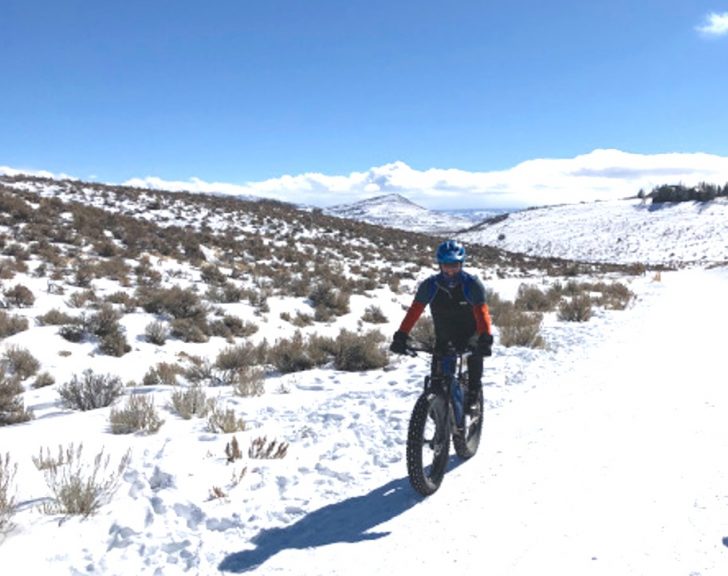
Pat rides tubby tires, taking a break from skis. Round Valley, UT, has 25 km of trails for XC, biking, hiking. Summer activities include trail running, horse riding, mountain biking in the Park City area. Credit: Pat McCloskey

The motto above is the moniker of one of the most interesting trail systems I have seen to date. Round Valley, near Park City, UT, is a paradise for cross country skiers, fat bikers, hikers, and dog walkers. The well groomed trails encourage multi- use and 25 kilometres is groomed for traditional cross country skiing and freestyle XC over 700 acres of preserve.

This preserve was once slated for development until some of the townspeople thought better and put together a foundation to encourage an alternate use for the land. Click here to read about the Mountain Trails Foundation. They were successful, and today, it is a very popular place for recreation. Well marked, and used for many pursuits, it shows how forward thinkers can offer an alternative to the rabid development of available land for housing or commercial pursuits. Especially in a town where recreation is king.

Not only are the trails well marked and groomed, but there is a sense of pride that you can feel there with all the activity. Some of the different things that I noticed was the general health and shape of the people who regularly use the system. At altitude, it is impressive to see older people skating up a steep hill on freestyle XC skis. With a big smile on their face they greeted us as they hammered up the hill to the summit which has a breathtaking view of the surrounding Wasatch Mountains. You could see fat bikers off in the distance climbing on miles of trails and the traditional cross country skiers making good use out of the track setting. Gliding along they smiled and said hello as their dogs followed in hot pursuit.

Lots of dogs play with their humans along the way. Credit: Pat McCloskey

Speaking of dogs, I was amazed at how many of them were along with the hikers, skiers, and riders . At no time did they interfere with activity and they seemed to know to get to the side when going downhill so as not to impede the progress of their owners. All off leash, they seemed to have a sense of how to move with the flow of traffic and at no time did they seem like a menace to anyone on the trails.  Even the dogs are welcomed to get into shape and never avoid a hill for fitness. But their sense of the trail layout and the difficulty of some trails and the gentle grade of others showed me that man’s best friends are more aware than I thought.

I always say when I venture west how impressed I am with the fitness of people out there. Even “older” folks seem to be in great shape and don’t let their advancing age hinder their pursuit for outdoor activities and the great visuals of the Wasatch. I suppose if you have over 300 days of sunshine, world class skiing, water sports, and multi use trail systems like Round Valley, you really have no excuse not to take advantage of the great outdoors. They have a great life out there.

For more information on a really well thought out recreation area, check out Mountain Trails and see for yourself how active people can make a difference to better their lives and other lives as well.

Dawn at Round Vally from the grooming team. Credit: Mountain Trails


Spring Comes to Wildcat

Long And Winding Runs. Great Views.

Getting ready for spring skiing at Tuckerman. Credit: Tamsin Venn

It was serendipity to arrive at Wildcat in the northern Presidential Mountains of New Hampshire the first week in March and find spring skiing. Many of us missed that part of the ski season last year in the pandemic shut-downs.

Due to its north facing slopes and deep snowpack, Wildcat usually is the last ski area to close in New Hampshire. This year it’s April 18.

While there, temps shot up to 66 degrees. Wildcat is not always so hospitable. It sits across the street from weather magnet Mt. Washington, tallest peak in the Northeast at 6,288 feet, and highest recorded wind speed 231 mph.

Away we go down Upper Catapult. Credit: Tamsin Venn

This year we were on the lookout for non-crowded midweek slopes, a friendly local atmosphere, and no state travel restrictions for us. Wildcat fit the bill.

The L-shaped parking area minimizes the schlep to the main lodge. Boot up from your tail gate, tiptoe across the icy parking lot, hike past four new, neon-colored porta-potties, get your RFID card zapped, and hop onto the Wildcat Express Quad. Seven minutes later, in one of the swiftest trips in skidom, you have reached the summit.

For several hours I lapped the Express Quad, zipping up-down-up, alternating from the left to the right flank on long, winding trails of 2,100 vertical feet. The trails draw you down as the head and shoulders of Mt. Washington rise. It’s like being in a movie… with good lighting.

Snow was corn, sweet, smooth. My left-foot steering was working as well as my right, always a good sign. Around 11, soft conditions required maneuvering into skied-off slots to save on thigh burn. Clearly early-morning skiing is best for spring skiing, even at a north facing mountain. But when I left early afternoonish, the parking lot was jammed. Spring fever had hit.

Although it has a reputation as an expert’s mountain, Wildcat has beginner terrain (20 percent)—Pole Cat is a 2.5 mile beginner trail, longest in New Hampshire—(see video article in this issue)— intermediate terrain (47 percent)—Lynx is a sweet roller with fun intermediate pitches—and expert terrain (33 percent)— famed black bump runs under the lift line. Midweek, you’ve got your turns to yourself and stress-free trail junctions.

The “cans” are display only. Credit: Tamsin Venn

Looking across to the top of Mt. Washington and thinking of spring skiing Tuckerman Ravine, you will always be grateful for the Express Quad that whips you to the area top at 4,028 feet. No hiking required. On wind holds, the Tomcat Triple gives you the bottom three-quarters.

When Vail Resorts bought Wildcat two years ago to add to its Epic mix, it took many by surprise. Wildcat is loved for its no-frills amenities and boot-scarred lodge, not exactly a Vail kind of place.

But a modern mega-resort corporation can’t erase the memories. My neighbor asked me:

“Does Wildcat still have those cold gondolas? When skiing there circa 1950s, the cable jammed [and] we near froze in the can in the hour it took to get them moving.  When people did emerge at the top, all the men ran for the bushes!  Anyway, it was exciting to ski there.”

It still is.


Click here for Wildcat Trail Map

Click Here for Wildcat Tickets

Click Here for Uphill Access

Click Here for Mountain Cams


Make More Tracks: Favorite Nordic Centers In Colorado

Small Ranch Resorts And Large Scale Nordic Centers Span The State.

[Editor Note: This article by Pete Wilson first appeared in The Nordic Approach.] 

In this state of mile-high life, opportunities to elevate your outdoor activities abound. Taking a page from the book of their Alpine resort neighbors, these cross-country ski areas center their offerings around the spectacular peaks of the southern Rockies—though in a slightly different way than downhill does it. Rolling and widely varied terrain lets Nordic skiers, fat-bikers and snowshoers work their way up and around some of the countries most magnificent slopes, giving them access to exclusive vistas, and breathtaking drops on the way back down. A combination of small ranch-resorts and larger scale Nordic Centers, the ski venues surveyed here span the breadth of Colorado’s natural bounty and the various adventures it has in store. For explorers of every age and inclination, if you’re Colo-ready, Colorado awaits!

ASPEN SNOWMASS NORDIC CENTER

Recognizing that Nordic skiing is something so incredible that everyone should have access to it, the volunteer board which oversees Aspen Snowmass works hard to maintain it as one of the largest free trail networks in the country. This awesome array of routes connects three towns—Aspen, Snowmass, and Basalt—and their respective trail networks into one massive adventure waiting to be had. Start from any of the towns, or from either of the two Nordic centers (yes, two!), and perhaps go check out the view from Buttermilk Ski Area, or continue on the trail for lunch in Aspen village, or simply cruise to your heart’s content. Plan your outing here!

GOLD RUN NORDIC CENTER

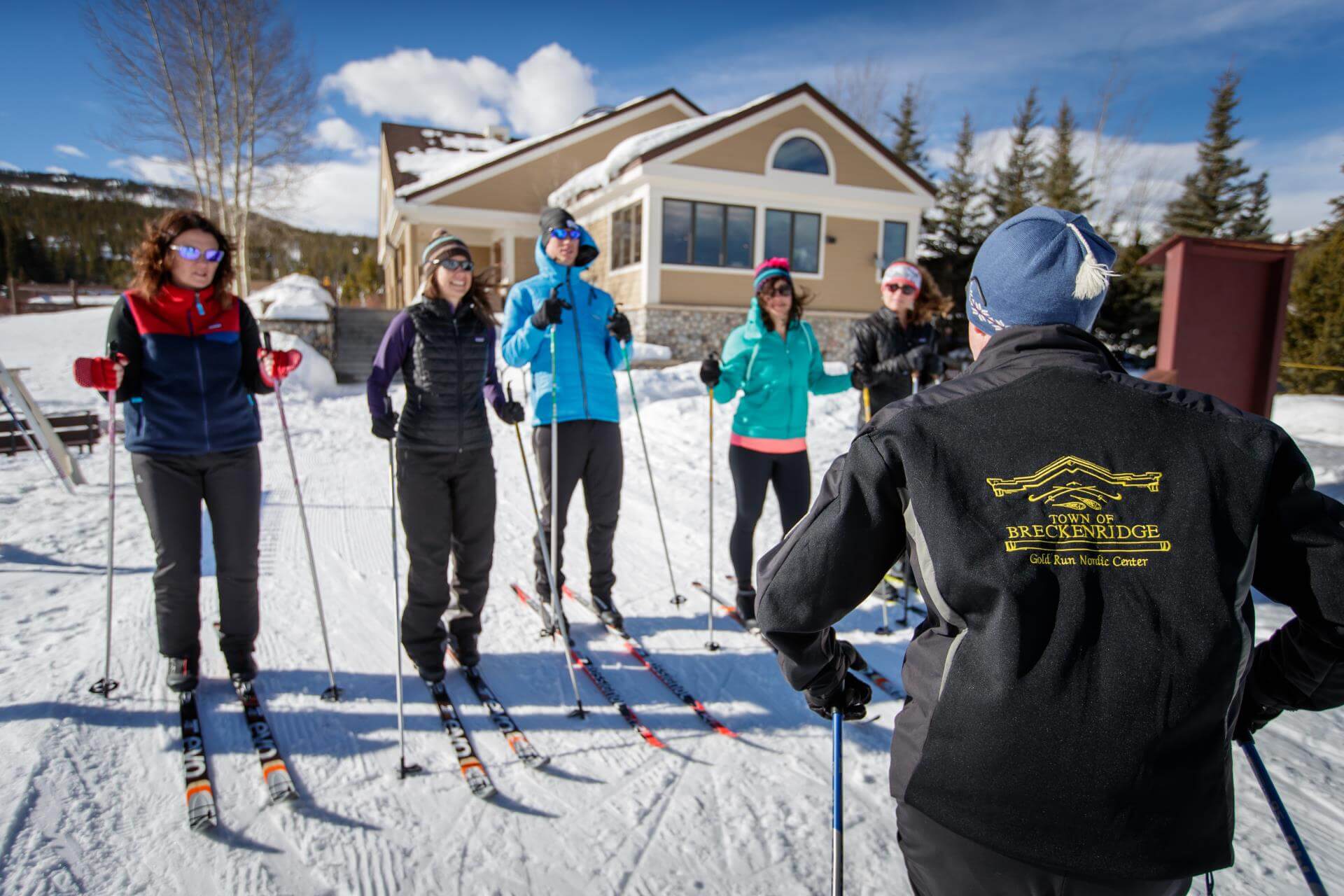
As its name suggests, this Breckenridge destination really is a gold mine for fun-seeking families. The skiing is excellent—30 km of beautifully groomed trails for both skate and classic skiing. Beyond that though, this nugget of a Nordic center boasts 15 km of dedicated snowshoe trails, a full fleet of fat bikes for rental, sleigh rides and more! Learn more about all of Gold Run’s golden opportunities, along with its punch pass system and ticket deals here!

KEYSTONE NORDIC CENTER

Just outside of Frisco, this humble Nordic Center promises memorable experiences for the whole family. For the seasoned skier, Keystone’s nine miles of trails combined with the adjoining White River State Park’s 35 miles offer thrillingly hilly fun. For dedicated snowshoers, the Perimeter Snowshoe Trail gives a wholly different perspective of area, taking you deep into the Keystone backcountry. And for the littler ones, a safe-yet-stimulating tubing hill is just a short walk from the lodge, where kids can do loops sledding down and hiking up for days. For the grown-ups, be sure to wind up back at the Nordic Center bar for some après-ski sips after your outing. Read about all of Keystone’s excellent amenities here!

VISTA VERDE GUEST RANCH

A smaller trail system of predominantly meadowy and gently hilly terrain, Vista Verde is geared towards getting their guests out on snow for their first times. And for this purpose, the place is perfect. A dedicated staff of Nordic pros will outfit Ranch guests with well-fitting, complementary equipment, and then give careful instruction, gentle advice or guided ski tours as you require. Trails loop across sprawling fields, over babbling brooks, through the aspen stands, and all the way back to the Ranch—where, it might go without saying, excellent lodging and fine-dining fare are to be readily found. Learn more, and book your trip, here!

HOWELSEN HILL

Owned and operated by the city of Steamboat Springs, Howelsen Hill is renowned as America’s oldest operating ski area—and though its most famous for its Alpine creds, this little mountain has some serious Nordic terrain. With 21 km of widely varying trails, ranging from flats to fairly intense climbs and drops, Howelsen’s adds a bevy of possible activities to your next Steamboat trip. Learn more here!

BRECKENRIDGE NORDIC CENTER

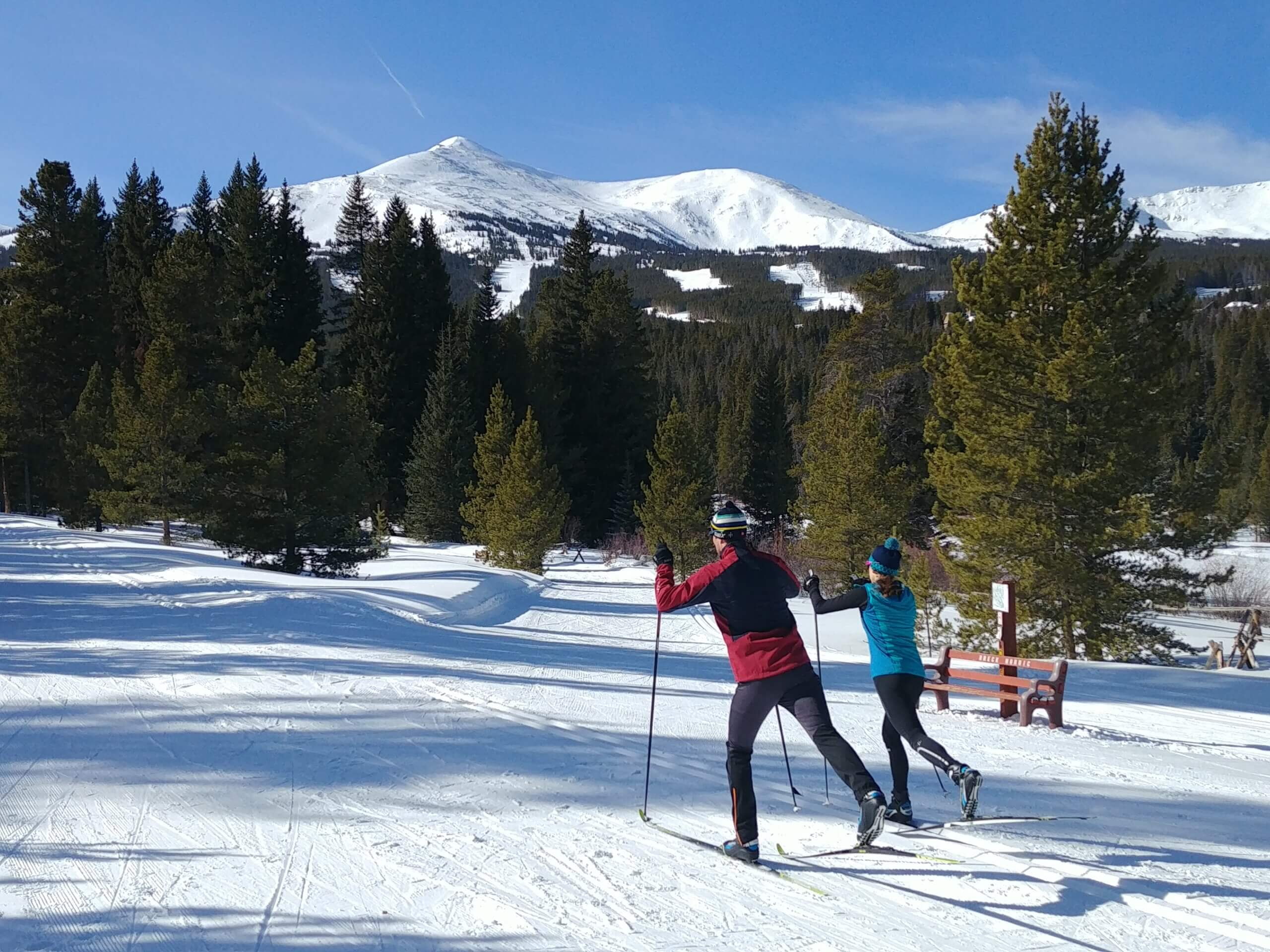
Just a few minutes’ drive from downtown Breckenridge, this family-oriented Nordic center has been granting visitors access to thousands of acres of the area’s most picturesque terrain for almost half a century. Not only do 30 km of well-cared-for trails wind their way up to above 10,000 feet elevation, stopping at two hand-hewn “destination huts,” but the Center offers group tours of the same terrain from the warm comfort of glass-enclosed snowcats. After you’ve made it up to the continental divide and had a little break in one of the warming huts, be sure to circle back to the Lodge for happy hour and a hearty bowl of soup! Learn more about this unique Breckenridge destination here.

FRISCO NORDIC CENTER 

Conveniently located just outside downtown Frisco, this high-altitude Nordic Center has something for every skier. Work your way up to the summit’s panoramic views of the Breckenridge region, or tootle around with the kids on the flatter, but no less fun, beginner’s loop. Plus, for even more kid-friendly activities, just down the road is the Frisco tubing hill and beginner’s ski hill. With 27 km of crisply groomed trails though, there’s more than enough adventure on the Center’s spacious land. Learn more here!

CRESTED BUTTE NORDIC CENTER

A gem of Colorado Nordic skiing, the Crested Butte Nordic Center’s super-convenient downtown location lets users hop on the trails without any driving—just walk from your home, hotel, or VRBO! In minutes you can be geared up and out on over 50 km of world class terrain. While skiing in Crested Butte, be sure to stop in at the trailside Magic Mountain Yurt for a chef-chosen dinner menu. The mile route to the yurt is lit by solar lights, so you can easily ski or snowshoe out for an exquisite and absolutely memorable meal. See why some call Crested Butte the Nordic Capital of Colorado here!

DEVIL’S THUMB RANCH

Ranked the #1 Cross-Country Ski Resort in the country for two years running by USA Today, this luxury Ranch’s Nordic terrain is a sight to behold. With 120 km of expertly maintained trails winding their way through the foothills of the continental divide, there is something to wow skiers of every skill level. The resort’s in-house outfitter, Zach’s Mercantile, offers a full range of skate and classic Nordic equipment for rental or purchase. Plus, a team of world-class Nordic instructors stand ready to give visitors and guests all the instruction you need to have the best possible ski experience. Check out this wondrous Colorado destination here!

SNOW MOUNTAIN RANCH

Tucked well up in the Rockies, a ways West of Denver, Snow Mountain Ranch cares for over 5,000 acres of pristine Colorado ski terrain. At 9,000 feet in elevation, it’s not called Snow Mountain for nothing—averaging around 200 inches per winter, which bring dependably fantastic conditions to all of the Ranch’s 120 km of trails. If you’re not too busy exploring the endless ski adventures, be sure to check out the tubing hill and the ice rink—and to grab a yummy bite at the Skinny Ski Café! Whatever you decide to do, you can’t go wrong in this unique winter wonderland. Learn more here.

LATIGO RANCH

Continuing the proud Colorado tradition of guest Ranches with excellent cross-country ski terrain, Latigo Ranch has centered their winter programming on their stellar backcountry and Nordic terrain. And with 50 km of beautiful trails, meticulously groomed for both skate and classic, plus another 200 square miles of deep powder perfectly suited for backcountry skiing, its easy to see why. Luckily for us, these wonderful trails are open to the public. If you do go for a day trip, consider booking a lunch or dinner reservation at Latigo’s elegant-Western restaurant. You can find more information about this secluded ski destination here!

TELLURIDE NORDIC ASSOCIATION

Bringing together the impeccable ski terrain of six different areas, the Telluride Nordic Association (TNA) maintains and gives users free (though donations are encouraged) access miles upon miles of gorgeous cross country trails. Ranging from the dog-friendly hills of Priest Lake to the classic-skiing-only River Trail, perfect for the Nordic tourer, TNA has something for everyone. Their Nordic Center in downtown Telluride also offers top of the line rental equipment, tuning services, and lessons. You can even ask about multiday rentals, to keep you going during your whole stay in Telluride! Learn more here.

ELDORA NORDIC CENTER

Branching off to the left of Eldora Mountain’s alpine trails, the Nordic Center’s 40 km of wide, well-groomed thoroughfares show off all that the mountain has to offer, albeit from a different perspective than the chairlift-accessed terrain. Winding through old-growth forests, alpine meadows and alongside big-mountain viewpoints, these trails are sure to get your blood pumping and your senses stimulated. With the added amenities of Eldora’s on-mountain restaurant, bar and smoke shack, you can easily make any outing on these excellent trails extra memorable. Plan your adventure here!

TENNESSEE PASS NORDIC CENTER

A dedicated Nordic ski hub, Tennessee Pass takes a classic Alpine ski lodge approach to cross country. 30 km of trails extend out from a central building furnished with all the Nordic and Nordic-related equipment you could want available for rental and purchase, a bar and restaurant, and a spacious sunny deck on which to relax. The trails themselves are excellently maintained and vary in difficulty from beginner flats to expert climbs. Just to add to the magic of this place, Tennessee Pass has a collection of off-the-grid sleeping yurts available for group or individual rental.

ASHCROFT SKI TOURING

A bit of an oddity in the ski world, Ashcroft Ski Touring is a ski center that doubles as the Pine Creek Cookhouse restaurant. At Ashcroft, you can peruse the 35 kilometers of stunning Aspen wilderness by day, and by night peruse the mouthwatering entrees that the locally-sourced, chef-driven restaurant has to offer. In addition to the Cookhouse, this wondrous trail network also makes stops at three different warming huts along its gorgeous loops. Be sure to check out their especially awesome all-inclusive tours—which cover trail fees, rentals and a delicious meal. Learn more about this wonderful aberration here!

The Big K’s Ambassador Program

Ambassadors Help Create A Congenial Climate At Killington.

Here are the 2019-20 Killington Ambassadors saying hello. Volunteers commit to 21 days of service during the season. Credit: Killington Mountain Resort

As a huge ski area with several base areas and mountain peaks, finding one’s way around Killington can be a challenge. That’s where the green-jacketed Ambassadors come in, often saving the day by showing guests how to get where they want to go—or in some cases—avoid a too difficult or too flat a trail.

This year the COVID-19 pandemic has made the Ambassadors duties extra special as so much has changed—from getting a lift ticket to the necessity of wearing masks.

Ambassadors are dedicated volunteers who enjoy skiing or snowboarding so much that they commit to 21 days wearing the green to help guests have fun. Ambassador Program Manager Pete Duffy notes, “They are passionate about the mountain, the sport, and they want to help people.”

Hard to miss the Ambassadors in the green jackets. Credit: Karen Lorentz

To do that, Ambassadors attend morning briefings before the lifts open so they are up to date on conditions, lifts operating, and anything else pertinent to that day. They answer questions as they greet people mornings at the base areas and later help them find their way back to starting points at the end of the day.

Throughout the day, they ski around assigned mountain areas and answer questions just as their bright green jackets invite.

They also help reunite parties that get separated. Seeing a small boy reunited with his parents was “priceless,” Roger Halye said of a best memory.

Another joy Ambassadors cite is assisting with marriage proposals—whether it’s writing a “will you marry me” on the snow under a lift or taking a photo of a proposal at the peak.

They also assist other departments as needed. The sweet perk is skiing until it’s time to help the ski patrol with the end-of-the-day sweep or man various end-of-day stations. Duffy notes, they do all these tasks in all kinds of weather, including extreme cold, wind, snow, and rain.

In a normal season, Ambassadors also give free Meet the Mountains Tours, offer tips on events, take photos of people, greet bus groups, and staff the hotel and events, all of which went by the boards due to state COVID-19 related guidelines this year.

They ARE smiling. Green jacket Ambassadors Mike Cahill, Pete Duffy, Susan Cummins, Keith Murphy guard new ticket booth. Credit: Karen Lorentz

Recently I had the great fun of being shown around by Ambassadors Susan Cummins and Mike “Mickey” Cahill. Cummins prides herself on being “a friendly face willing to help and guide.” Like others, she also praises the social aspects of being an Ambassador, noting, “Through the program, I have generated some wonderful friendships; some so close they have come to my family events like weddings and holidays.”

Retired State Trooper Mike Cahill briefly dips his mask at the new automated ticket kiosk. Credit: Karen Lorentz

Noting he loves skiing Killington and helping people enjoy the mountain. Cahill said becoming an Ambassador helped him fill a void in his life after he retired from being a New York state trooper at the mandatory age of 60. “I enjoy the camaraderie within the group of outstanding people who share the same goals,” he added.

Bobby G has given tours for 20-plus years and counts many special moments, including people who return year after year for another tour, which leads to great friendships. One friendship has taken him to England several times. Another repeat guest is a clinical psychologist, causing Giordano to “sometimes wonder if it’s just the friendship or if I’m a ‘research subject’ that needs to be carefully watched.”

When fierce winds were buffeting a petite beginner who kept falling, Noreen McGill used her own body to shield her from the gusts, and together they managed to slip and side step to the shelter of trees. There McGill applauded the woman’s tenacity and thanked her for “sharing her struggle and strength” with her.

Riding a lift, Ambassador Louise Young met a guest from Toms River, NJ.  “I mentioned Toms River made the news years ago (1998) by winning the Little League World Series. Turns out he was one of the coaches!!”

Joe Schorle had a guest ask him “what he could do about boots causing his feet to hurt. I started to recommend a shop for adjustment but then looked down and realized his boots were on the wrong feet!”

Marc Pileggi recalled a “most unusual thing that happened was having to call a transport for a group of 12 who decided to go to the top of Ramshead at 3:45 with no ability to ski down.”

Questions People Ask

“How do you get to the main lodge? They usually mean the lodge where they started from,” notes Louise Young.

“What’s the easiest black diamond trail?”

When he’s stationed at the top of Killington Peak on a cloud-free day, people ask Robert Ide to identify the other visible ski areas.  The mountain they wish to have identified most is Mt. Washington, he said.

Questions Anthony Russo hears include: “Can you take our photo (asked prior to COVID)?” “Where’s the restrooms?” “What time does the lift close (usually asked at 4 p.m.)?  Where are the beginner slopes? Where is a good place to eat? Can you recommend other things to do besides skiing? Is there an easier way down from here?”

In late March and April, Phil Lipari is often asked, “Why does the mountain close at 4:00 when there is still a lot of day light? In January and February, why there is no night skiing?”

“What do you do with all the man-made snow in the summer?” Noreen McGill overheard a woman ask an Ambassador. “We store it in all the silos on the farms,” elicited an “Oh” as she contentedly walked away.

Pete Duffy said he was greeting people when a woman holding a glass bowl asked where she could leave her pet turtle while she skied. Since pets were not allowed inside a lodge, he never did find out what she did with it.


Top To Bottom: Vail

Take A Vicarious Vacation On A Beautiful Blue Run.

A ticket-free run for our readers down the front side of Vail all the way to the bottom. Credit: Glenn Robbins

Here’s a long (15 minute) run down the front side of Vail on a really nice blue. For those who haven’t been there, seeing wide, groomed slopes at Vail may be different from the mental model you’ve had of what it’s like at the fabled resort.  This is not the Back Bowls, but still very nice and, for those of us on the lesser side of the risk scale, most do-able.

Curious, we notice the skier Glenn Robbins, isn’t using his ski straps. (See 1:44 and following.) Is this a thing?

Sapporo Ice Festival

Question For You: Ski In Japan?

If You’ve Been, Tell Us So We Can Have A Vicarious Vacation.

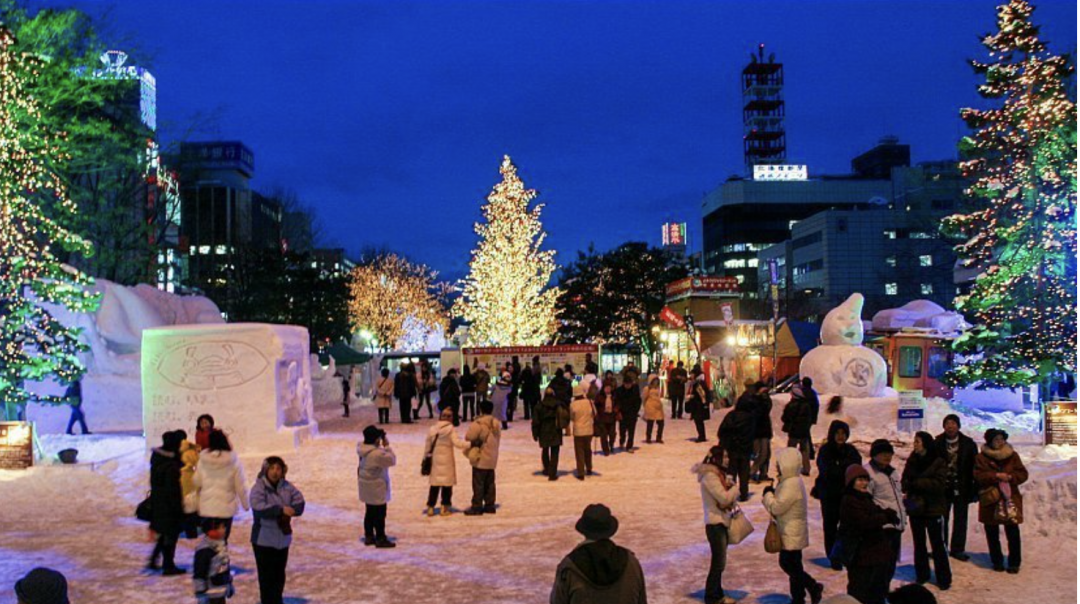
Sapporo Ice Festival: Snow is in abundance in northern Japan.

We have an interesting article this week from Dave Chambers, the “Traveling Australian.” He takes us to Appi Kogen, a resort in the north of Honshu, the big island of Japan. He spent a week skiing powder in the back end of the resort in perfect conditions he had never seen anywhere in his travels.

Rusutsu, Hokkaido, Japan

His article stimulated this week’s Question For You. After all, by North American standards, Japan is an exotic ski destination. The ryokans (inns), the onsens (hot springs baths), the food, the culture, all represent a distinctly different experience than a vacation in Canada, the US, or even Europe.

Many years ago, we spent a winter in northern Japan and experienced monster snowfalls and cold, cold temperatures. We visited the Sapporo Ice Festival and were amazed how the city had adapted to serious winter conditions: above ground train tracks were covered, streets were swept from snow by seawater hydrants, and ice and snow were celebrated.

Question For You: Have you skied Japan? What was it like? How was the snow? The resorts you visited? What did you love? What was not so great? Would you go back or was once enough? Please let us know.

The rest of us will have a brief, imaginary, vicarious vacation based on the comments from those who have been there.

Please reply in Leave A Comment below.

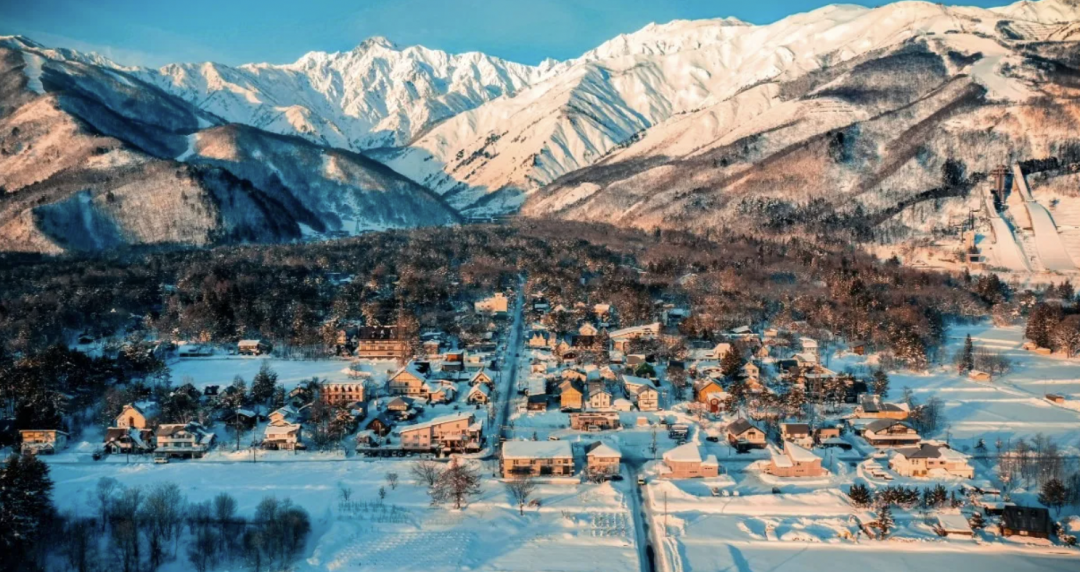
Popular Hakuba Valley. Japan has very snowy winters every year.


Ski Japan: Happy Appi Kogen

Untracked Deep Powder For A Week.

Appi Kogen is a self-contained resort in northern Honshu.

Casting aside the duvet and, with a flourish, we spread the curtains wide to greet a new day, a new location, a place of considerable legend.

Here the tall Japanese Black Pines punctuate the landscape between the tall buildings of our hotel in this place almost three quarters of the way up the island of Honshu.

Appi Kogen is one of Japan’s best ski resorts. The resort’s tagline: “Be Happy in Appi”, of course.

We have arrived by road to Appi Kogen, almost taking a whole day to do so. This road trip was tedious, attributed to a slow traffic jam and, paradoxically, the most exciting bus trip we could ever conceive.  Our bus driver, growing weary and ever more frustrated by the constant traffic jam, decided a different route was needed. The existence of a little used forest track was discovered—a forest track at times covered in deep virgin powder snow.

Our driver revealed quite a level of skill when required to navigate slippery and often poorly delineated tracks through the forest. Our driver and his co-driver were engaged in constant discussion as to how to proceed when fast acceleration was required. It was best alpine driving we are ever likely to witness. Although I well remember being in a taxi going up a hill from St. Anton to Lech in Austria where our driver exclaimed in strong language his scorn for the slippery steep slope and the driver of a Mercedes that halted his progress. Then, sliding backwards down a considerable slope completely at ease with his dilemma, he just reversed to a lower slope where he could gain some traction and move forward back up the steep narrow slope.

Back to Japan. Our trip, a long, long ten-hour drive by bus, one we hired  at Lodge Scolé at Zao Onsen Ski Resort to take us to Appi Kogen. Zao was a place of big tree runs and Snow Monsters. Traveling plans were adjusted for what we thought would be just a four-hour trip up the main island of Honshu.

A huge snowstorm of cold air from across the Sea of Japan unloaded across the north.  Our movement down the road now so slow at one point we left the bus to obey a nature call at a rest stop. We visited said rest stop and purchased takeaway lunch before returning to find the bus only 80 meters further down the road.

Appi Kogen is not far from the East Coast where those winter winds suck up the moisture from Sea of Japan and dump when they hit the land mass around Appi. Indeed this is often the case along the whole coastline particularly in the North where we are now.

It is another skiing day, a day not quite like we have experienced before above the snow line. Although I recall a day in Lech where we skied in snow so deep the only reveal of me deep in this fine dry powder is the top of my ski helmet.

Appi Kogen is very similar to this as is much of Japan in winter where it will often snow down to the beach and cover the sand.

Light fog at the top of the gondola leads to fields of deep powder.

After a couple of runs down medium steep slopes on the front side, we decide to venture as far out as we can to the most outer edge of the ski resort. We are at the topmost point on a black run now with powder so deep and almost un-skied, the day still early. We set an easy pace to get some rhythm in to our legs and balance in the fine powder. The visibility is ok but a little foggy. Japan is like this in winter because the cold is only -2 C (28 F) or at most -8 C (18 F), this knowledge gathered over many previous visits.

As we proceed down the slope, it is obvious the area has not been skied today or even possibly this last week. The slope is lined with trees mostly beech, so definition of the journey down is easy in the slight fog. As we near the end of this trail, the skiing gets flatter and, after 900 meters, we arrive at the gondola. It will surprise you to discover we skied all day down that one slope in fresh powder. Would you be further surprised to learn we skied that same slope for a whole week with no change to the perfect powder? Well, it amazed us to discover that many Japanese don’t like ungroomed snow. When you learn to ski in Australia. the quality of snow is mostly hard pack ice. There, the day temperature around -1C  (30 F) to 1C (34 F) and then freezing overnight: result, ice. So we are very lucky in Oz if we ever experience powder. At Appi Kogen, we have never experienced such perfect conditions for skiing for one whole week .

Be adventurous if you dare. Take a trip soon you will find the country very rewarding in so many ways.

Appi K: 70 percent of runs are intermediate or “easy”.

For a more extensive report in Appi Kogen, click here.

First Timers Tips For Skiing Europe

The Straight Story On The Continental Skiing Scene For Seniors.

I have coached in pretty well all of the European skiing countries. SeniorsSkiing asked me could I recommend resorts to suit mature American skiers, especially first time visitors to the Continent. Here goes.

The range of possibilities is vast. France plasters its slopes with lifts, Italy takes a more environmental view and installs fewer but longer lifts up valleys, offering equally long descents. Gressoney St Jean in the Aosta region (about an hour from Turin) is a classic example, it also links to Champoluc and Alagna.

Other Examples

Waidring: 10 lifts, 16 trails, intermediate-beginner, gemutlichkeit.

A friend went to Waidring in Austria every year for ten years. Great people, great snow, warm welcomes. They have a tradition called gemutlichkeit – geniality or friendliness. It is tiny – 10 lifts,16 trails all told, half of them intermediate, half of them beginner.

Val Thorens: 163 lifts, 373 miles of trails, ski to Courchevel

Compare that to Val Thorens-Meribel-Courchevel – 163 lifts, 373 miles of trails, 192,000 feet of vertical descent. Start in Val Thorens, ski to Courchevel, and you may not have time to get back. Hugely popular with Brits (far too popular for me, I hate lift queues)

What’s On Offer?

Different resorts in every country target different types of skiers – though they hope to get everybody.

Take the Chamonix Valley for instance, steeped in mountaineering history. Each of its resorts offers a spread of challenge but with a bias.

The lowest resort, Les Houches: charming, easier, all trails are in wooded areas, amply supplied with atmospheric mountain restaurants.

Almost an hour’s ski bus ride from Les Houches – is Le Tour. Almost treeless, big sweeping terrain, as well as plenty of intermediate trails it offers some easily accessible off-piste.

In between you have Le Brevent – high, steep, not easy; or Argentiere, home of the “hard men”, some of the blues would classify red (black) in other places.

When conditions permit, from Chamonix centre a telecabine takes you to the 22 km Vallee Blanche in the high mountains, and you only need to be intermediate, but you’ll need a professional guide: don’t try it on your own.

So How To Choose?

The internet is full of “the three best French ski resorts”; or “the ten best Austrian ones”; it’s endless.

What we need is a selection process. How does this seem:

Kitzbuehel: €€€€€

  • How pricey is it? There are big differences. If you select Kitzbuhel (fashionable) everything is more expensive than Kirchberg which is just a few miles up the road and accesses the same trails. Some resorts are designed around high net worth folk seeking luxury.
  • What duration is the connection time between your airport and the resort. It can be up to four hours or as little as only one. Does it matter to you?
  • Many European resorts are inter-connected, ask them what standard of skiing do they mostly offer. They’ll tell you they have everything, but insist on knowing what they mostly offer.
  • Within the connected areas ask them the approximate skiing times to get from one resort to another, and back: it can seriously affect your day – and how tiring it might be.
  • Ask them if skiing guides available who can show you early in your visit the general shape of the place. Many of the chalet owners and hotels offer this service – not teaching, just showing you around.
  • When are the school holidays? In France they go on for weeks. Lift queues can be horrendous. Outside of them, you can often just walk on. And remember, in some European countries lift queue etiquette and politeness is conspicuous by its absence; France is one of them.
  • Consider less popular countries that don’t have inter-connected valleys – Slovenia (home of Elan skis) has some nice small resorts; Bulgaria has more than you might think and inexpensive.

Kirchburg: €€ and just down the road from Kitzbuehel

My personal favorite? Baqueira in the Spanish Pyrenees. Two hour connection from Toulouse airport. Nicest folk you’ll ever meet (I go to the Hotel Tuc Blanc, and I’m not paid to say so). Watch out for school holidays though, it’s just across the border from France, but the Catalans queue politely.

Baqueira, the author’s favorite.

One Last Tip.

Never do “the last run down”! Everyone wants to get one more “last run” in. They do it on the return to the valley.

Don’t. They’re all tired; they’re skiing at their worst; there are crowds of them; the trails down lower are worn out or slushy. If you want “one last run” stay higher (the areas they’ve just left!) have better snow, fewer people, quieter mountains, and go down to the valley on the lift.

Hotel Tuc Blanc, author’s fav hotel in Baqueria.


GiantsRidge_OldSawMedia-9369

Make More Tracks: Top Nordic Centers In The Midwest

Here Are Five At The Top Of The List.

[Editor Note: This article by Pete Wilson first appeared in The Nordic Approach, the site of the Cross Country Ski Area Association.]

Midwest terrain is ideal for cross-country skiing.

Generally speaking, the midwestern states make up an overlooked bit of the country—literally, the fly-over states. And sadly, this wild misjudgment often extends to the world of outdoor activities. It’s easy to think of the old woods of the East and the vast mountains of the West as focal points for things like Nordic skiing; in truth, the Midwest is chock full of world-class country ski terrain and culture. Between the region’s breathtaking plains and dense rolling woods, working fields and forgotten valleys, it offers ample opportunity for amazing winter exploration. Below are some of our favorite Nordic centers in the Midwest, all of which combine a warm plains-state hospitality with unique and visit-worthy trails into your next ski destination.

ABR TRAILS

Tucked on the Western edge of Michigan’s Upper peninsula, almost in Wisconsin, the family owned and operated ABR Trails (Active Backwoods Retreat) takes full advantage of the Lake Superior Snowbelt in which it sits. Over 60 km of expertly groomed trails climb, drop and meander along the nearby Montreal river, reaching the heights of Blueberry Bluffs and the Hautanen Highlands and the lows of Coyote Canyon. In order for every skier to easily find the perfect route, trails are divided into loops that each offer a different level of difficulty. ABR’s professional staff (whose grooming skills are so honed they host clinics on Nordic trail building and grooming) stand ready to set you up with gear, advice, warm beverages, and whatever else you may need to keep exploring their nearly endless terrain.

ABR
GIANTS RIDGE

Originally designed as a training facility for Olympic skiers, it is no surprise that Giants Ridge towers today as a pillar of world class skiing. With over sixty kilometers of meticulously maintained trails expanding in broad loops over the hills that stretch out westward from Lakes Wynne and Sabin, memorable skis are guaranteed. Combine their epic terrain with the reliably snowy Northwoods winters, and it is quickly clear why Giant’s Ridge remains such a prized destination. Backed by the indulgent amenities of a large resort, Giant’s has a near endless array of activities, lodgings, and meal options ready to make create a unique ski getaway for every guest.

MAPLELAG RESORT

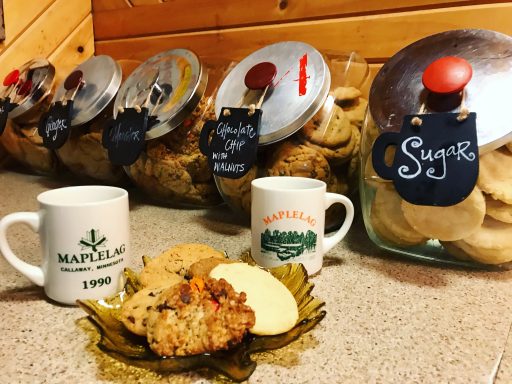
It is not often you strike upon a resort that places cross country skiing at the heart of its guest experience. Originally a maple sugaring operation, Maplelag has converted their 600 acres to pristine ski terrain, while the various buildings on the property now accommodate upwards of 200 guests. Boasting 64 km of trails flanking the frostily picturesque Little Sugarbush Lake, two onsite saunas, and a half a dozen uniquely comfortable lodging options, this erstwhile outpost updates the best Nordic traditions with Minnesotan hospitality and North American grandeur. The last chunk of forest before the Rockies, Maplelag is well worth a stop on your next trip to the Northern Midwest.

 
SOLBAKKEN RESORT

Nestled along the north shore of Lake Superior, midway between the winter sport hot spots of Lutsen and Grand Marais, Solbakken Resort’s sprawling, snowy playground awaits skiers, snowmobilers, and fat bikers alike. Consisting of 58 km of their own excellent trails, plus several hundred miles of connected trails this northerly play area promises endless adventure and a bottomless supply of what the Norwegians call Hygge—“well being.” With lodgings that run the gamut from motels to luxurious lakeside cabins, there are comfortable accommodations fit for individual skiers, fun-loving families, and couples looking for a romantic retreat alike.

GOLDEN EAGLE RESORT

Sitting both smack dab on the stunning Flour Lake and alongside the famous Gunflint Trail, Golden Eagle Resort is a well-situated gem buried deep in the wilds of Superior National Forest. The Resort’s real claim to fame, though,is its part ownership of the Central Gunflint Ski Trail System. This behemoth network of over 70 km of excellently groomed trails offers climbs to some of Minnesota’s loftiest peaks, and the spectacular views to match. Golden Eagle also maintains a small lighted loop for skiing after dark—on which, if you’re lucky, you might see the northern lights dancing in the night sky.

How Is It At Park City And Deer Valley?

Visitors To These Destination Resorts Send First Hand Report.

[Editor Note: This article first appeared in The Chronicles of McCloskey, March 1, 2021.]

How is the skiing experience in different areas around the country you might ask? We all have heard about the long lines in Colorado and Tahoe and even locally the lines have been robust. I am thinking that the Pandemic has encouraged people to get outside and also the snowy, cold winter around the Easrt has brought about a renewed enthusiasm for skiing. It has also been a good winter around the country. My friends have reported huge snows in the Pacific Northwest and some longer lines in several other western areas.

Last week my wife and I ventured to Utah at the invitation of some very good friends who live there. They have been careful with social distancing and so have we, so our only unknown was the airport and plane. We were careful but the airports were reasonable and allowed for distancing. Even the planes were sanitized, and we were fortunate to not have anyone in the middle seat. We wore our masks, sanitized the seats and tray tables and also our headrests. All was well and we made our way to ski at Deer Valley, our first stop.

The Empire Canyon Area at Deer Valley.

One of the first things we noticed was that Deer Valley was not really that crowded despite what we had heard about neighboring Park City Resort. They limit the lift tickets and since I had an IKON Pass, I was able to ski without a reservation and my wife was able to get a buddy pass at the ticket window each day without issue. In typical Deer Valley protocol, the slopes were impeccably groomed much to my wife’s delight, and the sun shone brightly every day, even though there were cold temperatures . I noticed that the indoor dining was restricted and a reservation system was in place for all the ski lodges. You could get “Grab and Go” meals either by ordering on the Deer Valley App or ordering at the window. Eating outside was encouraged. But there was very little indoor warming encouraged.

In the lift lines, signage was plentiful regarding social distancing and all Deer Valley employees were on alert to instruct anyone who had their face masks down to pull them up. Even on the exit ramps on the chairlifts, there were signs to use your mask when unloading. Instructors had masks on when teaching, and all of the employees had masks for every function in the area.

Main Street in Park City was still pretty crowded and even though there were protocols for social distancing, the amount of people made it so that we did not shop or eat on Main Street. We dined with our friends in their beautiful home and did take out one night.

Best View in Park City

So, even though there are consistent similarities in Covid protocol in all ski areas this season, the West is doing a good job with the amount of locals skiing and also visitors who now are a little more comfortable traveling. Like the McCloskeys. The atmosphere seems a bit subdued out there as the apres and dining scene are affected by restrictions. You could actually feel it when walking around. Something was definitely different. All bets were off at the No Name Saloon as it seemed to be a haven for the ” cabin fever” crowd. We stayed away for now. I will see what Mammoth Mountain is doing at the end of this month, but if I have the experience that we had in Deer Valley, I will be comfortable and again grateful to be skiing. Thanks for reading.

Les Deux Alpes: Top-To-Bottom

One Heck Of A Long Run.

Amazing vistas on a long, long at Les Deux Alpes

We’re getting hooked on these top-to-bottom videos.  For one thing, they are showing us ski resorts we have not visited. That alone is interesting in a vicarious vacation kind of way.  For us New England-oriented skiers, this video of the French Alps resort of Les Deux Alpes opens up a whole new world of skiing. Open piste, fantastic views, webs of lifts coming and going. Truly different from the narrow, twisty, pine and hemlock lined ice tracks we have become used to. So interesting. Although, one wonders where one should go if and when the fog and clouds descend.

For another thing, we are seeing, in this case, a run that goes from an altitude of 3600 meters to 1600 meters, roughly a mile of vertical. And it takes 13 minutes without a stop.  Tell that to your quads.

We hope you enjoy these “vacations”. You can read a view of Les Deux Alpes (or L2A, as it is called) here from SeniorsSkiing.com’s collection of resort reviews.

Thanks to Alexandru Comsa for posting this video. (Note: this video is 13 minutes long. You may have an ad pop-up at the 1o-minute mark. Just click “Skip Ad” to get back to the run.”

Obsessing Over Gelati In Milano

After Your Ski Trip, Do This, Especially When In Italy.

Duomo di Milano where we indulged in our initial Gelati. Credit: Medium.com

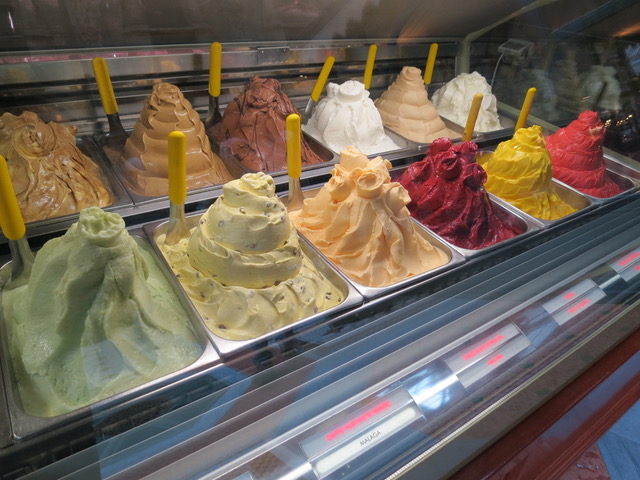
It is the 8th March 2013, the day is cool but sunny. It is still winter here in Milano, Italy. Food and Italians go together like toast and marmalade on Isle of Wight. The clever people that they are they gathered the recipe from Marco Polo and created ice cream. Gelati to the Italians, and not simply ice cream as we know it.

We have skied some legendary powder. Morzine, Avoriaz, Courmayeur, and the slopes of high Switzerland. Now all behind us. The mishap that was Marg’s on the slopes of Morzine Ski Resort where her hip parted company with her femur. It’s done and sorted. She by now languishing in a hospital back in Australia. Ahead of her months and months of exercises by physical therapists. Our remaining group of skiing tourists head to downtown Milano for some creature comforts and good European hot chocolate and to search for that legendary Gelati.

Forget your bucket list, it’s so yesterday; just visit Italy. Don’t dally, this place is cool. Built by people that know a thing or two about how to construct a medieval village. It has everything you never realized you needed. But now know where your life experiences can be fulfilled.

In Italy, they have Gelati; it’s everywhere. In Italy, it helps to be passionate and quite obsessive about food. You fit the culture better. The medieval diet is a thing. The food here makes your heart sing. I am a man of simple taste, I like a Lou Reed riff, Italian Gelati, fresh snow, Uva di Troia, blue sky, powder snow, porcini mushrooms, wasabi pear paste, Nutella Pizza, Italian hot chocolate, and cats. Italy has nine out of the above, that’s plenty to make a trip of a lifetime.

Tack it on to the end or start of your next skiing trip.

Anyhow, Gelati is our focus. We decided, as you do in Italy, to search for that Zen moment. Or nirvana when food passes your lips and mere seconds later you are taken to another place.

Gelati in the presence of Il Duomo di Milano. Perfect. Credit: Dave Chambers.

Day One Milano. We sit in the hugely dominating presence of the massive cathedral that almost blankets the whole square. The Duomo di Milano, 600 years and still standing, all 135 gargoyles of it. Seated at an open-air restaurant, we eat yet another excellent pasta. Porcini mushrooms grow wild in the forest here. Collected from the forest and scattered with a slip of black truffle across a fresh house made pasta. Simple yet sublime. Accompanied by a very good Montepulciano.

The conversation turns to Gelati, and, I kid you not, within twenty quick paces we find a purveyor of fine Gelati . We ordered enough scoops to satisfy a platoon.  All your typical flavors. Our excitement was rewarded with explosions of flavor.

Could it get better than this. We didn’t think so.

Day Two. Now down to just two of us, the other tourists having skipped and flown home. We are just getting a feel for Italian lifestyle. Our concentration heightened now we are tuned in to the local food scene. Feeling switched on. We trawl through the piazzas. We circle and wander the streets looking for shops that mysteriously stay hidden for almost two hours looking for snow wear retail stuff. My mate has a tired ski jacket in need of replacement. Suddenly we blunder upon the old bohemian quarter, exclusive and designer expensive. The luxury within these narrowed walkways is revealed. By chance or divine intervention, our next serve of designer Gelati is nigh. Imagine Mango, so smooth, the deepest orange in color and very glossy with smooth mouthfeel. This mango Gelati has the most intense sweet flavor and equal first place to yesterday’s I decide. Sacrilegious, I know, but folded within a wispy thin, crepe.

Simply the best: cioccolata italiana milano.

Last day. We lunch under the brooding gargoyles of the Duomo di Milano, now grey with mist and rain.  Within our shallow bowl, pasta. The waitress recommends a very fine local red wine. I ask her about Gelati. “Oh yes,” she says encouragingly, “You should visit Cioccolata Italiana,” further adding, “It is the best in Milano.” We are excited. I demand four flavors.  It’s a bucket but a small one. Of flavors chosen, I can’t remember because my tastebuds had hard wired to my brain. Endorphins now in overdrive. The Cioccolata Italiana Chocolate conjured angels. Those angels started dancing on my tongue, the intensity of chocolate, the smoothness as it melted around your taste buds, all balanced with a not too sweet finish, a deep dark chocolate that lingered long after the first taste. The heavens had opened just then for a tiny glimpse of ice cream nirvana. This is not just any Gelati, this is alchemy for the tastebuds and simple the best Gelati I have ever experienced. The ancient Romans may have brought you the amphitheatre, sewers, and concrete, but I am thanking them for their wonderful Gelati and the Medicis for Marco Polo.

Chocolate, please. Credit: Dave Chambers


All the way down

Aspen Top To Bottom

Take A Virtual Vacation And A Long Run On Us.

All the way down. Thanks James Beatty.

Ok, so no Aspen for you this year.  But here’s a video of a run from the top of Aspen Mountain all the way to the bottom.  Sounds like scratchy snow, and, come to think of it, where is everyone?

Last season, SkiCo topped 1.5 million visits to Aspen Mountain and Aspen Highlights.  This year, visitors are going to need a negative COVID test within 72 hours of arriving or quarantine for 10 days. Not surprisingly, arrivals at the tiny Aspen airport are down 50 percent, and occupancy data from the Aspen Chamber Resort Association reflects the drop in visitors. In December, occupancy rates at lodges were down 34 percent from the year prior in Aspen, and 16 percent in Snowmass.

Result: You can enjoy a vicarious run without much people-traffic. And your quads don’t have to suffer!

Thanks to Jack Beatty for posting his Feb. 5, 2021 run for all on Youtube.


Women Played Integral Role at One of Nation’s Oldest Ski Areas

[Please consider supporting SeniorsSkiing.com with a donation. We appreciate your help. Click here.]

Janet Davis Mead, June Aker, Verlene Belden All Kept Pico Going And Growing, Despite Obstacles and Challenges.

Janet and Brad Mead started Pico in 1937.

Vermont’s Pico Mountain survived a war, two owners’ deaths, and a neighbor called Killington to become one of the 30 oldest continually operating ski areas in the country.

It’s a feat that was largely driven by women in its first 30 years, a time when the ski industry was known to be “a man’s world.”

Women also played major roles in Pico operations since that time, continuing the strong family influence that began with co-founder Janet Davis Mead.

A feisty woman given to exaggeration, Janet Davis told Brad Mead she had skied at the Lake Placid Club, so he invited her to go skiing.

“I had to follow him down what looked to me then like Mount Everest. I made it, but without poles,” she would write years later, explaining she had thrown them in the bushes, not knowing what they were for.

Her bravado paid off; they married and researched building a ski area.

Envisioning a year-round resort with mountainside homes, aerial tram, swimming pools, ice rinks, and tennis courts, the Meads leased Pico Mountain and opened Thanksgiving Day 1937 on Little Pico with a 1,200-foot rope tow and a rough-cut, 2.5-mile Sunset Schuss skiers could ‘skin up’ to the summit.

The Meads hired Swiss racer Karl Acker to run the ski school, added two tows, widened Sunset Schuss — renowned for downhill racing and the Pico Derby — and installed the first U.S. Constam T-Bar to the top of Little Pico.

After Brad died in a boating accident in 1942, Janet carried on with support from skiers, the Otter Ski Club, and Otter Patrol. When workers including Acker left for World War II, she kept Pico open despite hardships of rationing and shortages that caused many areas to close. Using her marketing skills, charisma, and tenacity, she gave special rates to schoolchildren and servicemen who visited on furlough weekends.

Karl and June Acker took over from Janet and continued to expand the resort.

Having survived wartime, Janet bought the mountain (1947) as Acker returned to teach and help operate Pico. (He coached daughter Andrea Mead, first American to win two Golds in the 1952 Olympics, bringing acclaim to Pico’s strong racing tradition.) As the first woman to own and run a U.S. ski area still operating, Janet survived four lean snow years, weak finances, and growing competition by lowering ticket rates and offering summer rides on chairs hung on the T- Bar (1950). With the ski boom on and her children not interested in running Pico, she sold to Karl and June Acker in 1954.

Karl added trails, a T-Bar, and a J-Bar. “The lack of access to funding caused him to do too much of the work himself; the long hours and the stress of the new J-Bar which he couldn’t get to work quite right contributed to his fatal heart attack” in May 1958, June told me in 2007.

“The three banks that had lent us money to purchase Pico had insisted on a life insurance policy on Karl. Because I was a woman they needed to know I could repay the loan if he died,” June said of becoming Pico’s owner at age 30.

She added trails, replaced a lift, and obtained financing for Pico’s first chairlift, a Stadeli double that went halfway to the top ($110,000 in 1962).

“Pico needed lift service to the summit to compete and survive.  Being a woman contributed to the banks’ reluctance to provide more loans,” June said, of her decision to sell to Bruce and Verlene Belden (1964) in hopes they would carry on a family-oriented mountain.

Bruce had helped build Mount Snow (1955-1964), while Verlene ran their 30-guest ski lodge and raised four children. With former guests investing, they became majority owners with Verlene as office manager. Her business acumen coupled with their strong family orientation and expansion of the mountain enabled Pico to survive the trying 1970s when all but five major Vermont ski areas changed owners, and most surface lift areas closed. Vermont had 81 areas in 1966 but just 39 by 1988.

When they retired in 1987, Pico had a reputation as the “friendly mountain” with strong racing and instruction programs and new base village engendering a loyal following.

Women played significant roles in achieving that reputation. “They taught youngsters to ski and race and were instrumental in the Pico Ski Club. They also ran various departments from ski shop to ski school, tickets to childcare. They contributed to the skier loyalty that saw kids who grew up at Pico return as instructors or coaches and bring their own families to the mountain,” noted former GM Frank Heald.

Current Pico Director of Operations Rich McCoy added, “Pico staff make people feel at home and welcome. That’s a legacy that women through their leadership roles have contributed to throughout Pico’s long history and still do today.”

Sunset Schuss: Had to skin up in the old days.

Vicarious Ski Run In The Swiss Alps: Fun Or Foolish?

Here’s A Top-To-Bottom Video Of A Run At Nax.

[Please consider supporting SeniorsSkiing.com with a donation. We appreciate your help. Click here.]

This is a Go-Pro video we found on YouTube.  It’s shot at Nax ski resort in Switzerland, a charming ski village in Valais, overlooking Val de Herens. It’s an intermediate-type area with moderate runs, one of the many small-ish areas found throughout Europe.

The video is eight and a half minutes long. From the top of the lift to the bottom.

What do you think? Is the skier making any turns here? Does this look like a safe run? What do you think of the terrain? The snow conditions?  Do you come away from this video with a good feeling?

Please leave comments below in Leave A Reply.