My Skiing in College

Our First Ski Date Didn’t Go Well.

[Please consider supporting SeniorsSkiing.com with a donation. We appreciate your help. Click here.]

Growing up Norwegian-American in Lansing, MI, I was introduced early to skiing and became fairly proficient by my teens. When I entered college in 1951, I was ready to improve. I joined the Ski Cub at Michigan State College (not University then), and I took part eagerly in their activities.

I hoped to qualify for the racing team, but guys with Norwegian names like Snilsberg and Iverson were way beyond me. Besides, I was still using those heavy U.S. Army war surplus skis my brother Tor and I acquired through our Boy Scout troop. Schussing was OK; turning was challenging

At spring break 1954 I joined the MSC club trip to Aspen. We went five in a car, split the gas costs, drove day and night, lived cheaply, and managed to get in a week at Aspen and a day at A Basin.

The length of the runs, the snow, and the scenery blew my mind. My memory may be faulty, but I think we paid $21 for a week lift pass.

I can’t remember where we stayed, but I know we had facilities to make breakfast and pack lunch. We ate dinner at the Red Onion where the “Skier Special” fit our budgets. In this photo, I’m the middle one wearing the striped Norwegian cardigan.

For 1955 spring break, Tor and I organized our own Aspen trek. We enlisted three other guys and drove Tor’s 1950 Chevy. I took this shot of the others when we crossed into Colorado. Tor is on the right wearing a cap. I think we paid about $5 a night each for bunks in a small cabin next to a boarding house where we could use the kitchen and bathroom. Again, dinners were at the Red Onion.

We had a big dump of powder during this trip. Our technique was to ski straight down until we fell, then get up and start over. 

Back at college, which became MSU in June, I met my future wife in a summer class. To impress her, I mentioned that I had been twice to Aspen. She asked, “What’s Aspen?” Then Judy tried to wow me by mentioning that she had gone by train in 1954 with other Spartan boosters to watch Michigan State play in the Rose Bowl.  I think I was dumb enough to ask, “Who won?”   (For the record, MSC beat UCLA 28-20.)

Judy had never skied. So in January 1956 I took her to northern Michigan to try it. The last thing her mother said as we left was “Don’t break your leg!”  Naturally, she broke her leg, and worse, I was responsible for the accident.

Her rental skis with cable bindings and a bear-trap front clip kept falling off. Instead of doing the right thing and having the shop adjust them, I found a length of leather lacing and tied them on. Bad idea!


 Judy was game enough later on to come to the Lansing Ski Club on crutches and pose with me on skis. And she stuck with the idea of marrying me. I had a Fulbright to Norway, so off we went in June on an ocean liner to Oslo for a year of studies, travel, meeting my relatives, and, of course, skiing.

To be continued  . . 

My One Morning Career As A Ski Instructor

A Ski Patrolman Rises To The Challenge.

Dave had to teach a group of local women, and he never even had a lesson himself.

Before I ever had a ski lesson, I had become a ski patrol director, certified (the highest level) by both the National Ski Patrol and the Professional Ski Patrol Association. One morning while working at a small ski area (240 feet of vertical), I was called into the base lodge by the woman who scheduled the ski school programs. This tiny area actually within the city limits ran a number of programs mid week, mostly for housewives, and this morning they had a couple of no shows among their instructor corps.

After numerous phone calls to no avail, it was decided that I would have to teach one of the classes. I asked what level they were as skiers and was told level B, or it might have been C. Neither told me anything. I didn’t know an A from an E. I later learned that A were true beginners, never-evers. Fortunately, these ladies could ski enough to get down the hill. On this second week of their once-a-week program, they got the pro patrolman.

In front of the lodge the ski school director introduced me to the four ladies before he headed off to also teach a class. Having no idea what to say, I simply stated, “I hope you ladies have a good sense of humor. We’re all going to learn together today. Not only have I never taught a lesson, I have never even had one!” One of the ladies laughed while the other three gave me strange looks.

I took them up the lift and watched as they skied down to the top of a broad low intermediate slope. I explained that I needed to see what they had worked on the previous week so I skied part way down and asked them to demonstrate as best they could the turns they had worked on last week.

As each one stopped by me, I complimented them on what they had just done. As they were just breaking into parallel, I decided we would work on a combination of up unweighting and pole plant. I demonstrated the way I thought a real ski instructor might, planting the pole and rising up to ski around it. It seemed to make sense to them so we worked our way back to the lift.   We spent the rest of the time skiing around the area, and I made it a point to ride the lift with each one so we could talk about their progress. I also took them on a longer flatter run which circumscribed the area so they could let the skis run and feel how much easier it was to turn with a little speed. Mostly I listened and passed out tips and compliments.

When the lesson ended, I thanked the ladies for their patience and told them I hoped they had as much fun as I had. Later I talked with Shirley who had recruited me for the lesson, and she told me that two of the ladies asked if they could have me the next week. Unfortunately, that was the end of my career as a ski instructor. The following week, they got Bruce Fenn, one of the PSIA gurus who had been in on the beginning of that organization, and knew everything there was to know about teaching skiing. Thanks to Bruce, and his clinics, that small ski area had close to a 100 percent pass rate on PSIA certification exams. And skiing with him and the instructors at those final form clinics were the closest I came to ski instruction at that time.

Growing Up Norwegian-American on Skis

A classic ski poster shows a blonde baby in a quaint wooden cradle, one outstretched hand holding ski poles, with a pair of skis protruding from the other side. The caption is “Norway. The Cradle of  Ski-ing.” This poster reminds me of my roots.

Jan Brunvand, age 3

I was on skis from before I can remember. An undated snapshot in the family album proves this. I appear to be about three years old.

I suspect that my parents posed me on adult skis, as those boards are super long, even for the late ‘30s. ( I was born in 1933.) My mother surely knit that hat, while those fancy mittens were from Norway. I’m holding one long ski pole, but I don’t seem to be going anywhere.

In a second childhood photo I’m posing with my brother Tor in what could be about my seventh year. Tor was born in 1935, and we had matching ski jackets. The snow sticking to my pants hints that I must have fallen on the run before the shutter clicked.

Jan and brother, Tor

My parents came from Kristiansand, Norway. They were married in 1929 in Windsor, Canada, then moved to Northern Michigan. I was born in Cadillac. By the time Tor arrived we had moved to Lansing.

I have one slightly damaged photo of my dad on a ski trip in the old country, captioned “Easter 1925.” He’s on the right with his hand on the railing. Check out those vintage skis!

Jan’s father

As Tor and I grew up Dad would take us to parks or golf courses to climb up and slide down on skis. Before we gained some proficiency with “snow plow” and “stem” turns he would hold his poles out horizontally for us to cling to for balance as we schussed the gentle slopes. 

We climbed either by traversing and kick-turning, or using the herringbone method. When our skis got sticky, we rubbed on a mix of graphite and paraffin.

In 1948 realtor Rollie Stebbins convened a group of skiers to form the Lansing Ski Club with my dad as a charter member. A portable rope tow in Stebbins’ backyard was my first experience with motorized uphill ski travel. After the club bought rural property and installed a real rope tow we enjoyed many days there working on our turns. We also made occasional trips north to ski Caberfae near Cadillac.

In photos of me in those days I am usually wearing  a dark blue or red V-neck ski-jumper’s sweater sent to me by my maternal grandfather in Norway.

My Dad carved a graceful Telemark turn, and Tor soon got the hang of it. I never mastered Telemarking, but instead worked on my stem-Christies and eventually achieved a more-or-less full Christiania turn. It was gratifying to learn that both these turns were named from places in Norway. Never mind that the Christie was part of the Austrian-inspired Arlberg system.

Starting college at in 1951 I joined the Michigan State Ski Club and entered a new world of skiing with friends who had actually taken lessons and learned from pros. This led to further trips to Caberfae, and eventually to skiing in the Rockies..

At college I met my non-Norwegian non-skiing future wife and converted her to the sport after a disastrous first experience.

To be continued . . .  

Mystery Glimpse: Multiverse of Santas

Santa Santa Santa

Where are we? What’s special about what’s going on?

Last Week

Clearly, there are some fantastic ski history buffs in among our readership. We had some spot-on descriptions of this old hotel last week.

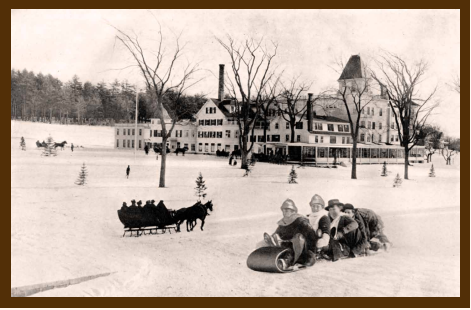
This is the Poland Springs House in Poland Springs, ME. Here’s a bit of this famous landmark’s story from Glenn Parkinson, the historian at the Ski Museum of Maine. He writes:

Hiram Ricker expanded his family’s inn at Poland Spring in 1876 by building a hotel with 350 guest rooms. The resort was marketed as a “country getaway with recreational activities and having water with health benefits,” according to the official history. The hotel became popular for the country’s social elite and the basic design was used to develop other resorts such as the Samoset and the Mt Kineo House.

“Recreational activities included one of the first golf courses in the state and of course a variety of winter activities. In some ways the Poland Spring resort was Maine’s first winter resort. Activities such as horse drawn sleigh rides, snowshoeing and skiing were popular. A toboggan slide ran all the way down to the lake. There was even winter harness racing on the ice of the lake. Photos of the time show lots of people wearing big fur coats watching a few people on skis or snowshoes. Into the 1920’s skiing was so new to most people that it was more of a spectator event than an activity.

“Well into the 1920s the Poland Spring Resort was one of Maine’s most popular places for winter sport and recreation.”

There are some fascinating photos of ski history in Maine at the museum site.  Thanks to the Ski Museum of Maine for allowing us to use this picture.

mystery glimpse

Mystery Glimpse: The Old Hotel

Where? When? What?

This week’s Mystery Glimpse is a challenge. Major hint: The identity of the magnificent hotel can be found on the website of the Maine Ski and Snowboard Museum. Spend some time there browsing around and consider supporting the Museum and its mission. If you know where, when and what this is a picture of—or when you find the answer—comment below in Leave A Reply.

Last Week

Some astute SeniorsSkiing.com readers really know their skiing history.  There were many correct comments.
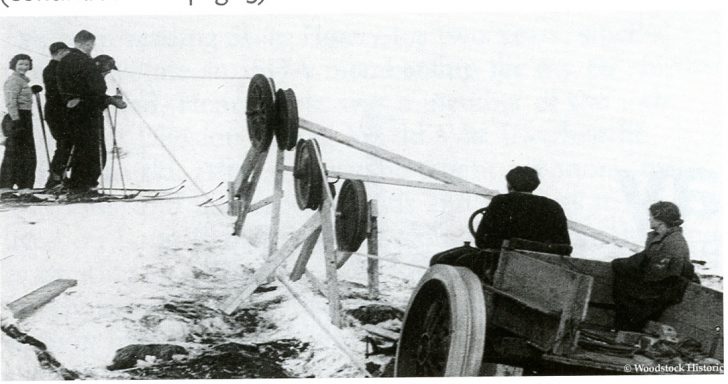
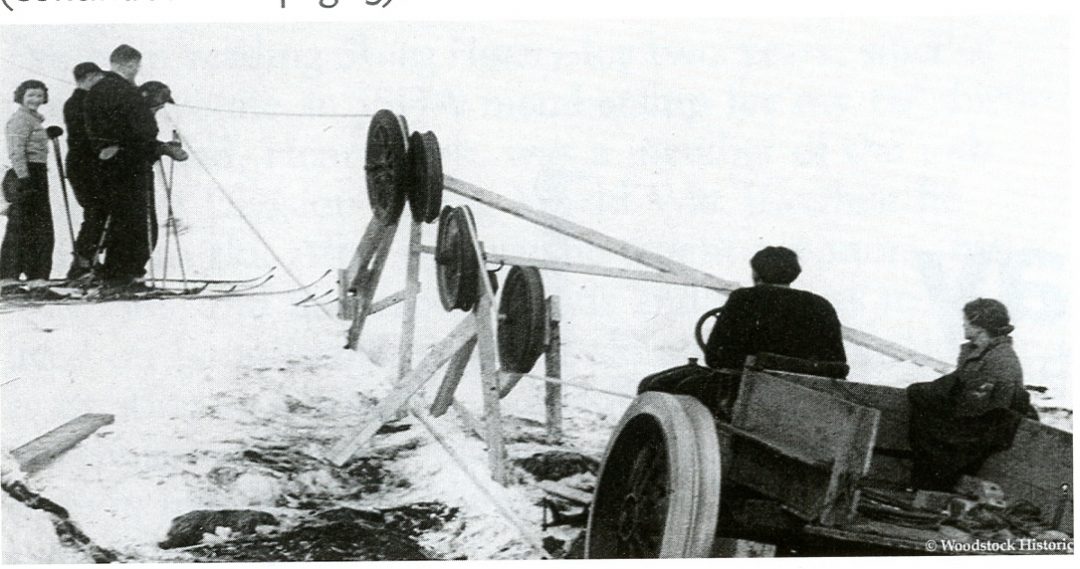
This is indeed, the famous first rope tow in the US erected in 1934 on the Gilbert dairy farm in Woodstock, VT. That’s a Model T Ford providing the uphill energy. The 900-foot tow was copied from the rope tow erected a year earlier in Quebec. The Model T had enough power to haul five skiers at a time.  The rope tow was a feature of the White Cupboard Inn for guests and locals.  Eventually the tow became the Woodstock Ski Tow and charged $1 a day for tickets. It closed in 1952, operating for 18 winters.

Two land trusts were collaborating with new landowners to maintain an easement to the historic ski hill and re-establish part of the old ski run, renovate the still standing warming hut, and cut hiking trails linking to the Appalachian Trail. Ski people love nostalgia.

We’d like to thank Skiing History Magazine and the International Ski History Association for allowing us to use these photos. 

The old Model T can be seen at the head of the lift line. Credit: Ski History.


Mystery Glimpse: Where And When?

This Is An Oldie.

Can you identify where this rope tow was and when? If you can, write your comment in Leave A Reply below.

Many thanks to Ski History magazine for this picture. Ski History magazine is the publication of the International Ski History Association. Find out more about ISHA by clicking here.

Last Week

Bjorn before the start of an American Birkebeiner, 2009. Credit: FastSkier.com

In keeping with last week’s Make More Tracks theme, we posted a picture of the GOAT of Nordic racing.

And he is Bjorn Daehlie, the Norwegian Nordic skier who has won more total Olympic and gold medals than any other cross-country skier, making him the greatest Nordic competitor of all time. 

Bjorn is reported to have one of the highest VO2 max scores for endurance athletes in all sports. The maximum rate of Oxygen (O2) consumption by the body during exercise is the criterion measure of aerobic endurance fitness. Dahlie’s VO2 max has been recorded as high 96 ml/kg/min in the 1990s.  That’s more than twice the VO2 max for his most likely competitors, 20-29 year old males in excellent condition. 

A back injury forced Dahlie into retirement in 2001.  Since then, he has become a successful businessman in real estate and fashion. Dæhlie also invented the Salomon Nordic System Pilot Bindings.  His ski clothing is offered in a variety of outlets. Click here for the Bjorn Dahlie line at REI.

What’s curious is Bjorn is a national hero in Norway, an astronomic legend in cross-country circles, yet virtually unknown to North American skiers. 

Bjorn Dahlie showing his stride.

Mystery Glimpse: XC Dominator

Perhaps The Greatest XC Competitor Of All Time?

This week’s challenge might be very difficult for some, easy for others.  Why? Because not as many people follow the fortunes of cross-country competitors compared to their Alpine counterparts. Everyone knows Karli Schranz, Jean-Claude Killy, Bode Miller, and the rest.  But how about Sverre Stenersen, who consistently won medals in the Olympics and World Championships through the 50s? Remember what Jessica Diggins and Kikkan Randall did just a few years ago in the team sprint at the PyeongChang Olympics? Curious? Check it out here. 

This week we are presenting a photo of an xc racer who some have called the very best.  If you know who he is, comment in Leave A Reply below.

Okay, that’s a nice pic, but hard to identify the person.  How about this one?

Last Week

This is ski jumper Anders Haugen wearing his 1924 Chamonix Olympics coat. Norwegian-born Haugen came to the States in 1909 and started ski jumping with his brothers in the Milwaukee area. Between 1910 and 1920, Anders and his brothers won the US Championship 11 times. As captain of the US team at the inaugural Winter Games, Haugen wound up placing fourth behind three Norwegians.
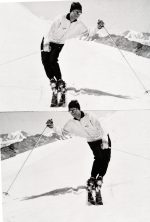
However, in 1974, a sports statistician noticed that Haugen’s score was incorrectly calculated. After verification by the International Olympic Committee, Anders Haugen, at 85 years old, was awarded a bronze medal. Thus, he became the first American Winter Olympics medalist and the only US athlete to win an Olympic medal in ski jumping.

As for this fantastic coat, it was created for the US team by the Hudson Bay Co. of Canada and is called a Capote.

The 1924 Olympic capote is made of felted, twill-weave wool. It is white or natural color with printed bold stripes in black, yellow, red and green-blue. There is fringe along the top of the shoulders and sleeves and along the top front opening of the coat made of the same wool fabric, along with a tall, pointed hood.

Anders Haugen’s “Capote” from 1924 Olympics. Credit: Colorado Snowsports Museum


Mystery Glimpse: Flashy Coat

What The Heck Is He Wearing?

Who is this person? There must be a story behind that coat. Something to do with the Olympics?  This might be a tough one. Please reply in Leave A Comment below.

Thanks to the Colorado SnowSports Museum for contributing this picture.  Did you realize there snow sports museums all across North America? Many are small, locally-funded non-profits. Consider visiting and supporting them as each serves a vital role in preserving the history of all snow sports.

Last Week.

Yes, that’s Doug Pfieffer, long-time ski celebrity, innovative ski instructor, and journalist. Ty Rice, one of our observant readers, noticed this comma position is actually the same picture, flopped over.

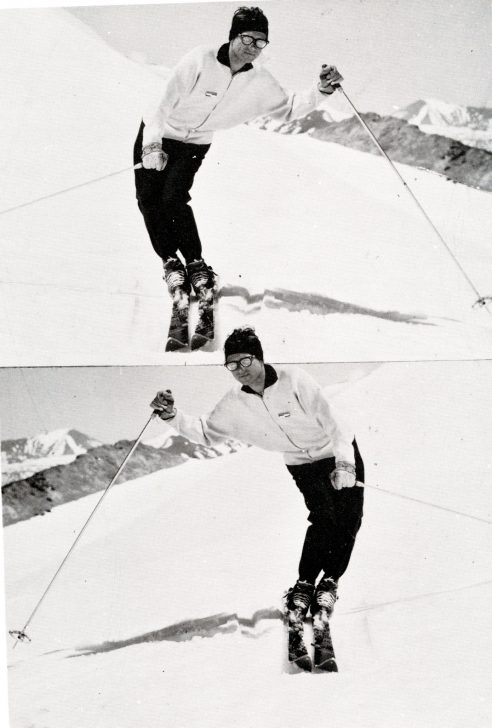
This photo was taken from my personal, autographed copy of the 1958 Skiing With Pfeiffer. Doug inscribed, “A collector’s item for Mike Maginn.” Well, it is now.

Doug is one of the founders of the Professional Ski Instructors of America (PSIA), long-time editor of SKIING magazine, promoter of skiing in film and television, and, along the way, invented freestyle skiing.  He was inducted into the US Ski and Snowboard Hall of Fame in 1987.  You can read more about his career by clicking here. 

Doug was my boss at SKIING back in the early 70s.  It was terrific to work with him in so many ways, especially since we shared the same birthday.  Happy Birthday, Doug! Here’s both of us at the 2017 Hall of Fame Induction Ceremony.

And here’s the cover of Skiing With Pfeiffer, a book which helped start the careers of many a ski instructor.

Mystery Glimpse: Instructor Comma

Famous Instructor And Ski Celebrity.

Here’s a picture of one of skiing’s most famous instructors, demonstrating the equally famous comma position.  This might be an easy one for many readers who have been around skiing for a while, like since the early 60s. Heavy hint: He just had a birthday.

Last Week

Yes, it’s the famous Air Car, a sui generis tram that operated at Mt. Snow, VT, from around the mid-60s to the mid-70s. It “flew” directly over Fountain Mountain, connecting the Snow Lake Lodge to the ski area. Legend has it that Mt. Snow developer Walt Schoenknecht had back problems and didn’t like taking off his skis.  So the Air Car, along with the Bubble Chairlift, accommodated him and, we bet, lots of other skiers.  Skis-on “gondolas” were an innovation, and Walt was a leader in coming up with ideas like the Air Car and Bubble Chair that made Mt. Snow unique.

Here’s another view of the Air Car in operation. Do any readers remembers taking the Car? What was it like?

Mystery Glimpse: Air Ride

Not A Flying Saucer.

Close, though. It certainly looks like it might be from…um…elsewhere. And that’s a giveaway to what was going on in that particular era. Is it an amusement park ride? Prop from a space movie? No, but at what stylish resort did this car-ish “gondola” appear? How about when? Does anyone know the history? We thank Jamie Storrs of Vail Resorts for opening his archive of historical photos for us.


Last Week

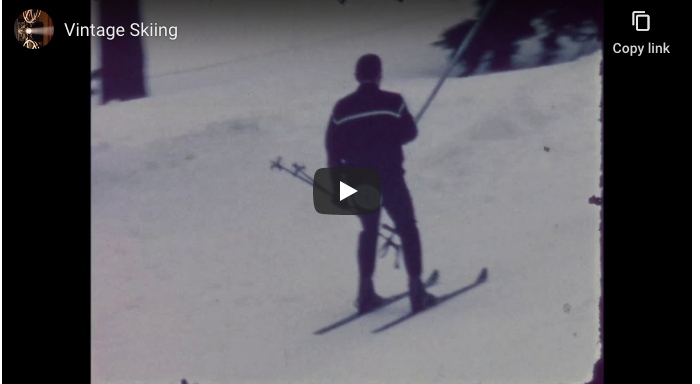
We have few answers as to the details of the video of vintage home movies curated by correspondent Don Burch. Clearly, some 50s and 60s footage. Don reports the first segment is from the Ostego Ski Club skiing at Hidden Valley, PA. The second is labelled 1961, and no data for the last segment. Fun, though, to see that world again.

Here it is in case you missed it last week.


Mystery Glimpse: Home Movies

Vintage Scenes Of Skiing.

Here’s a different Mystery Glimpse challenge.  Correspondent Don Burch has uncovered some old home movies from an online video archive.  Can you spot where this footage might have been taken? Are there clues in these different videos that might reveal when these were taken? Even if you can’t identify the locations, check out that equipment and the bota bag. Just click on the image below. Does anyone use a bota bag these days? Anyway, have fun with these memories. 

Last Week

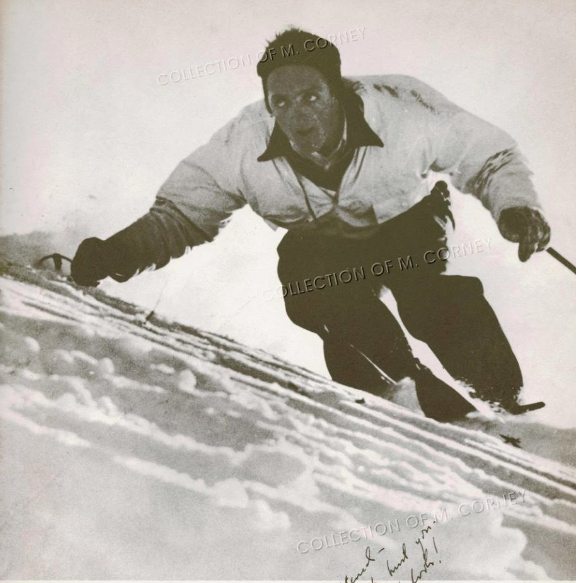
Here’s the photo with Durrance’s autograph. Credit: Ski History

This photo of Dartmouth’s Dick Durrance with an intense “look” comes from a book published by Friedl Pfeiffer in 1939.  The Sun Valley Ski Book was a pictorial ski instruction book, containing action shots of celebrity skiers of the day.  We discovered this photo in an article in Ski History Magazine, the publication of the International Ski History Association. The specific book this was taken from was discovered in bookstore by long-time skier Marc Corney. Not only does it contain a collection of spectacular photos, each photo has an autograph of the subject.  There’s also four pages of autographs from various people who apparently were invited to sign the book which most like belonged to none other than the author Friedl Pfieffer.  You can read the whole fascinating story by clicking here. There are lots more pictures, too. And please consider supporting the International Ski History Association while you are at it.

Autograph: “Don’t be frightened. He’s too small to hurt you even with that look!” Credit: Ski History


Mystery Glimpse: Those Eyes

The Face Of Intensity.

Here’s the first of our Mystery Glimpse feature for this new season. We post a picture from snowsport’s past and you guess who the person, place, or thing is. Write your response in the Leave A Reply box below.  If you know any details about the photo or the situation, let us know.

Here’s a racer whose name you should be familiar.

Credit: Ski History Magazine


Stein Shows The Way

Remember Classic Skiing?

Those sweaters, that hair, those baggy pants. Stein was a one-of-a-kind.

Here’s a really great tribute video from Outside TV on Stein Eriksen’s role in creating the world of modern skiing. From extreme skiing to blue cruising, Stein has had a deep and lasting impact on the sport.  Who hasn’t tried to ski with knees locked together in a comma position just like him?

Click below to watch real wedlen and gelandesprungen in action. He sure makes it look easy.


Mystery Glimpse: Yes, It Was Buddy

Buddy Werner, Movie Star

Many readers identified this Bogner-clad high-flyer as Buddy Werner, the celebrated ski racer. And yes, there is a strong resemblance to Jean-Claude Killy in this pic. Many thanks to Steamboat’s Tread Of Pioneers Museum for contributing this photo.

Just three weeks after the 1964 Innsbruck Olympics, Buddy Werner was in Switzerland to film a movie produced by Willy Bogner. According to Wikipedia, Werner and German racer (and Olympic medalist) Barbi Henneberger, age 23, were caught in an avalanche on the Trais Fleur slope, near St. Moritz. Both skied out of the first avalanche, but were caught up in another; their bodies were found hours later.

Bogner, 22, and Henneberger were to be engaged that summer;  he was tried by a Swiss court for homicide by negligence. He was initially acquitted, but the prosecution later won a conviction on appeal, of manslaughter by negligence, and Bogner received a two-month suspended sentence.

After a memorial service in Denver, Werner’s funeral in Steamboat Springs overflowed the United Methodist Church,and he was buried at the city cemetery at the base of Howelson Hill. Coach Bob Beattie and teammates from the U.S. Ski Team were pallbearers. 

Kudos to reader Bruce Boeder for following the hints and connecting the dots. In case you missed it, here’s his entry: “Went to the Internet Movie Database and find that Buddy Werner did appear in a movie called SkiFascination made by Willy Bogner (Werner and Bogner’s fiancée were killed in an avalanche while making the movie—but people subscribed to this website well remember Buddy Werner). Accordingly, piecing together the clues—photo from the Steamboat museum, Head Comps with long thongs, and Scott poles— it may be Buddy dressed in the Bogner finest?!” Elementary, my dear Bruce.

Here’s a preview of SkiFaszination, released in 1966. Bogner skiwear galore.

Thanks To The Ski Museums Who Contributed To This Series

Our Mystery Glimpse series would not be possible for the many ski museums who allowed us to use photographs and artwork from their archives and collections.

These museums are scattered across the country, all mostly staffed by dedicated volunteers and a few paid employees. If you’ve never visited a ski museum, you have a treat ahead. Please consider a visit—virtually, or in person (when the virus lifts), stop at the museum’s gift shop, make a donation, and marvel at the care taken to curate the history of snow sports.

The ski museums which have contributed paintings and artwork this year:

And many thanks to our insightful readers for their many guesses, comments, memories, and contributions to our trip through snow sports nostalgia.


Mystery Glimpse: Movie Star

Who’s This?

This is a still from a movie this celebrity ski racer was in. Many thanks to the Tread Of Pioneers Museum in Steamboat Springs, CO, for this photo.

Last Week

Credit: Journal New England Ski Museum

From the Journal Of The New England Ski Museum:

“Pete Seibert worked as a ski patroller in Aspen just after the war, then in 1950 attended L’Ecole Hoteliere de Lausanne in Switzerland, learning the art of hotel management on the G.I. Bill. Returning to Colorado, he became manager of Loveland Pass ski area, then moved to Aspen Highlands in 1957.  By then, Earl Eaton had taken Seibert on a March climb up the mountain just west of Vail Pass that Seibert decided he would spend his life developing.”

The video below tells the story of that seminal hike into the hinterlands which would become the Vail resort.


https://www.youtube.com/watch?v=zP4vzekpwjg

Mystery Glimpse: Cool Sun Glasses

A Founder

Another easy one.  Let’s hear from you. Do you have any stories about this person?

Credit: Journal New England Ski Museum

Last Week

Credit: Dorothy Crossley, New England Ski Museum

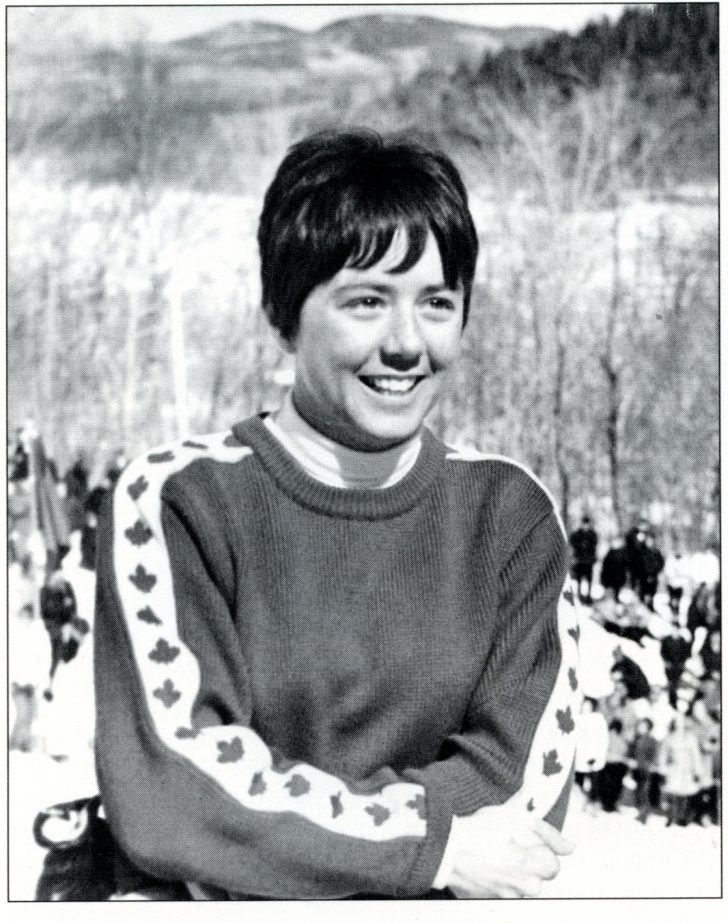
Nancy Greene-Raine, skiing’s girl next door. Not only was she a successful ski racer for Canada, she became a senator for British Columbia in 2009 until her mandatory retirement in 2018. She has a long list of ski industry related accomplishments, including racing, ski area development, fundraising, as well as awards.  She is a recipient of the Order of Canada, the country’s highest civilian honor. She was instrumental in developing Sun Peaks in BC where she regularly skis with visitors.

Here’s a comment from Steve Threndyle, a reader who recently skied with Nancy.

“That’s Nancy Greene-Raine (note ‘e’ in Greene and hyphenated last name). Canada’s Female Athlete of the Half Century (wasn’t even close). Two time overall World Cup winner. Canada’s Sweetheart (well, more like, “Tiger”, her nickname). Gold and Silver Olympic Medalist, in 1968 Grenoble. Served in the Canadian Senate until mandatory retirement at age 75 three years ago. Authored legislation to ban sugary/unhealthy food and instituted Canadian Fitness Day each June.

Skied with her for a couple of hours two weeks ago. She and Al are wonderful people. Sun Peaks is a fantastic place!”

Here’s a picture Steve provided with a smiling Nancy.

Nancy still skiing at Sun Peaks. Credit: Steve Threndyle

Here’s a short video of Nancy speaking about her 1968 Grenoble Olympics gold medal win.

Mystery Glimpse: Young Racer

Who Is This Racer?

Major hint: O, Canada! This one should be easy. This week, we all need an easy one. Can you tell us about her history? Her extraordinary career? Thanks to the New England Ski Museum for this picture.

Credit: Dorothy Crossley, New England Ski Museum

Last Week

This photo was taken at Crested Butte Mountain Resort in 1963, showing off the installation of their new Carlevaro-Savio, Silver Queen Gondola.
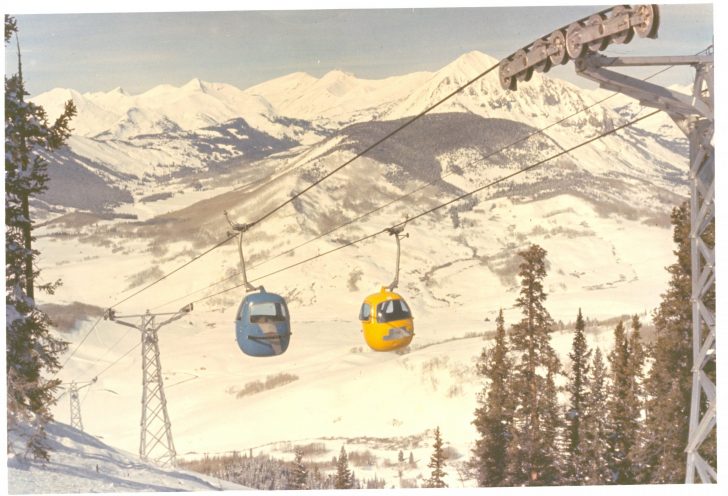
Crested Butte Mountain Resort opened in 1960 when two men—Fred Rice and Dick Eflin—purchased a ranch on Mt. Crested Butte. An operating permit enabling the resort to be built was approved by the United States Forest Service the following year.

In 1963, Crested Butte constructed a top-to-bottom gondola from the base area to near where the bottom of the High Lift is today. The resort was the second resort to open a gondola in Colorado, after Vail Ski Resort opened theirs in 1962. Constructed by Carlevaro-Savio, the three-person Silver Queen Gondola was notorious for being cramped, and the cabins were known to have frequent collisions. The gondola lasted until 1972, when a bubble double chairlift replaced it.

Special thanks—again—to Dana Mathios, curator and Director of Collections, at the Colorado Snowsports Museum, located in Vail, CO.

Mystery Glimpse: Bumpin’ Gonds

What Ski Area Is This?

And what’s the story behind these yellow and blue gondolas?

Special thanks to Dana Mathios, curator of the Colorado Snowsports Museum, for providing this week’s photo.

Last Week

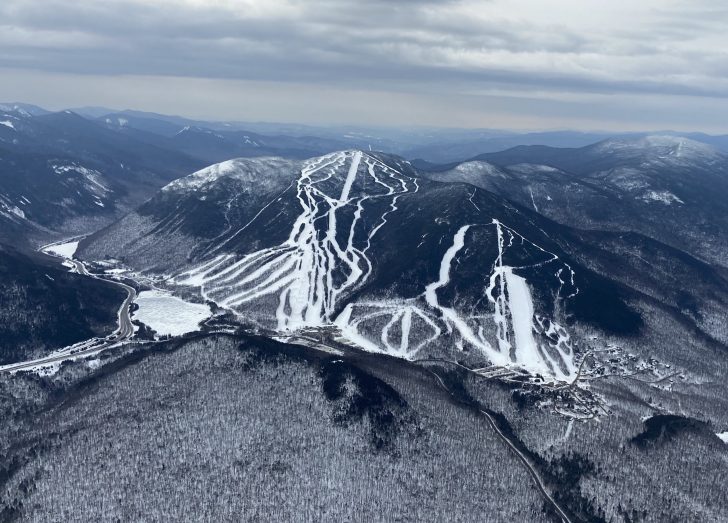
This is a photo of Cannon Mountain, Franconia, NH, home of America’s first aerial tramway which began operation in 1938 and was renovated in the 80s. Taken from the air by a passing friendly aviator, the resort has a reputation as one comment pointed out for being “too cold and too fast”.  Regardless, one feature of Cannon that endears the state-owned resort to SeniorsSkiing.com is that seniors 65-plus ski for free. That is, if you are a New Hampshire resident.  Still, that’s a gift.

That wide swath you see on the right side of the mountain is the training hill for myriad ski teams. At the very base is the Mittersill Alpine Resort.  A reader reports the training hill was closed for 40 years, but it’s clearly back in operation, accessible from the base by a t-bar.  Quaint, no?

Here’s a short video showing the ride up the tram.


Mystery Glimpse: From The Air

What Are We Looking At?

Thanks to a friendly aviator, we have this magnificent, recent (last week) view of a most formidable mountain resort.  How’s your pattern recognition?  Can tell us where it is? Major hint: That wide trail to the right is used for racing team practice.

Last Week

Yes, Lucille Ball visiting the Mittersill Alpine Resort in Franconia, NH, probably in the early-mid 60s. The man on the left is Gary Morton, her second husband, not her “I Love Lucy” husband-partner Desi Arnaz.

She and Desi can be credited with creating the sitcom format. Among her many other achievements was becoming the first female head of a major television-film production company, Desilu Productions. Her biography doesn’t reveal her attraction to snow country, however.

We can only guess she was a guest of Baron Hubert von Pantz, Mittersill’s founder and aristocratic host.

Desi, Jr., down in front looks like he could use a hot chocolate.

This photo is currently on display in the lobby of the Mittersill Alpine Resort along with other momentos of the hotel’s history.  Among those is a page from the hotel registry featuring the signature of Princess Elizabeth, soon to be Queen, on a stop over trip during her tour of Canada.


Mystery Glimpse: Celeb In NH

[Editor Note: SeniorsSkiing.com is asking our readers to contribute to support our online magazine. Yes, we have grown in the number of subscribers and advertisers. But our expenses have also grown. You can help us defray some of these expenses by helping us out with a donation.]

Support SeniorsSkiing.com by clicking here.

______________________________________________________

All The Way From Television Land.

Was she a skier?

Here’s a famous television celebrity you should know if you grew up in the 50s. We took this from a picture displayed in the lobby of the venerable Mittersill Alpine Resort, Franconia, NH. We think the famous person was visiting the Baron von Pantz and his family, who built the resort in the mid-40s, modeled after his “castle” in Austria.  Enough clues.

Last Week

This is iconic Tuckerman Ravine, located across from Wildcat Ski Area in NH. There were many interesting guesses as to the artist.  We can see a little Wyeth in there.  However, this watercolor is by G. Lewis Hodgkins (1906-1972), an architect who lived in nearby North Conway. Hodgkins eventually became keeper of Ye Coach and Four Inn on Oak Street. He gave daily painting lessons that were quite popular.
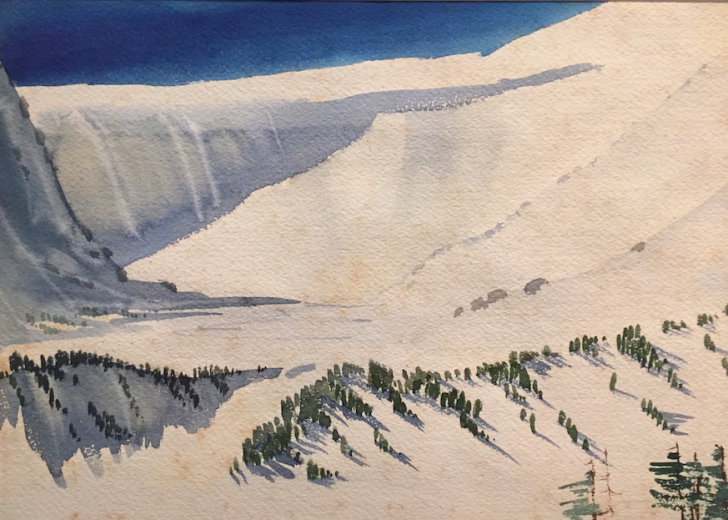
He is known for his bold strokes and his ability to interpret his subjects simply and impressionistically. This water color was most like done en plein air. 

Curiously, as an architect, Hodgkins designed homes and buildings in and around the area, including the North Conway Community Center which eventually became the North Conway branch of the New England Ski Museum where this work is currently displayed.

Many thanks to the New England Ski Museum for permission to use this photo.


George and Jon

Skiing With a 103-Year-Old Legend

[Editor Note: SeniorsSkiing.com is asking our readers to contribute to support our online magazine. Yes, we have grown in the number of subscribers and advertisers. But our expenses have also grown. You can help us defray some of these expenses by helping us out with a donation.]

Support SeniorsSkiing.com by clicking here.

______________________________________________________

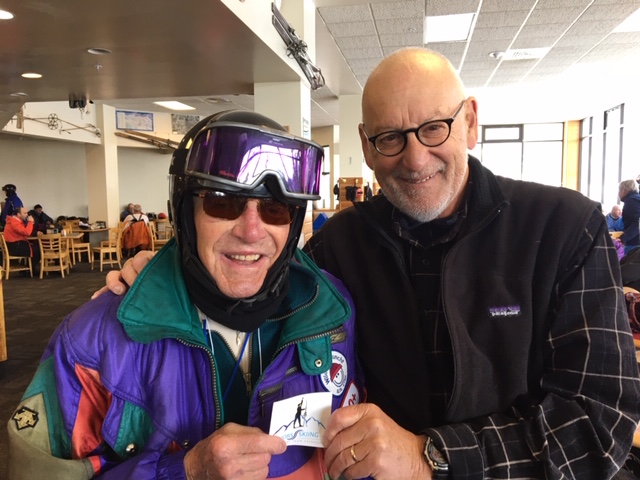
This week, I had the privilege of taking a few runs with George Jedenoff, the 103-year old Californian who enjoys skiing at Alta.

He was there with the 70+ Ski Club, one of 160 people on its annual Utah trip.

George and Jon at Alta.

I had arranged to meet Richard Lambert, the capable proprietor of the 70+ Ski Club, and learned that George would be there as well. 

We were in Alf’s, the day lodge near the Supreme and Sugarloaf lifts. George entered, all smiles, shaking many hands.

We sat and chatted. I had looked at his autobiography on Amazon and knew a bit of his story. Parents fled the Russian Revolution when he was a toddler. Arriving in the US in 1923. Working as a miner in California for 50¢ an hour. Graduating with honors from Stanford University. Serving the US in WWII. Entering the steel industry, eventually rising to president of Kaiser Steel.

Quite the impressive story.

In the lodge, young and old asked to have their pictures taken with George, a symbol of skiing’s possibilities.

Frequent SeniorsSkiing.com contributor, Harriet Wallis, was there. She, Richard Lambert, and I met George and his son outside. We followed him down some Sunnyside trails. His turns were smooth and graceful. A few times, he entered chopped powder on the side of the trail for more turns.

The Alta photographer took some shots for Alta’s Photo of the Day.

George and his son had taken several runs before we met at Alf’s. Now, we were taking several more. 

The sun was shining. The air was brisk. The snow was great. George didn’t want to stop skiing.

Mystery Glimpse: Water Color With Snow

[Editor Note: SeniorsSkiing.com is asking our readers to contribute to support our online magazine. Yes, we have grown in the number of subscribers and advertisers. But our expenses have also grown. You can help us defray some of these expenses by helping us out with a donation.]

Support SeniorsSkiing.com by clicking here.

______________________________________________________

You Can Probably Guess Where, But Who’s The Artist?

Many thanks to the New England Ski Museum, North Conway Branch, and Executive Director Jeff Leich for letting SeniorsSkiing.com use this beautiful water color.

Last Week

Credit: Thad Quimby, Peak Resorts

Yes, Suzy “Chapstick” Chaffee.  And the location is Fountain Mountain, Mt. Snow, VT., probably during a photo shoot.

A major skiing celebrity,  Suzy is a former Olympic alpine ski racer and actress. Following her racing career, she modeled in New York with Ford Models and then became the pre-eminent freestyle ballet skier of the early 1970s. She is perhaps best known by the nickname, Suzy Chapstick, from the 1970s, when she was a spokesperson for ChapStick lip balm.

She was inducted into the National Ski Hall of Fame in 1988.

As a social activist, Chaffee championed Title IX legislation (equal opportunity for women in school sports). She was the first woman to serve on the board of the U.S. Olympic Committee, and has been a member of the President’s Council on Physical Fitness under four U.S. presidents. She was a co-founder in 1996 of the Native Voices Foundation, an organization that seeks to develop Olympians from among Native American tribe.

Suzy combined two great skills: Ballet and Skiing,  becoming a key player in the free-style movement back in the 1970s. She also was a pioneer in the fitness craze, writing a book about fitness, and remaining committed to athletics and exercise long into her career.

Suzy embraced skiing and ballet to provide a foundation for freestyle.


Snow In Literature: Hemingway In The Voralberg, 1920-30s

[Editor Note: SeniorsSkiing.com is asking our readers to contribute to support our online magazine. Yes, we have grown in the number of subscribers and advertisers. But our expenses have also grown. You can help us defray some of these expenses by helping us out with a donation.]

Support SeniorsSkiing.com by clicking here.

______________________________________________________

Esquire Magazine Published “The Snows Of Kilimanjaro” 84 Years Ago. We Celebrate With An Excerpt.

In Ernest Hemingway’s story, “The Snows Of Kilimanjaro”, the main character, Harry, a writer on safari with his rich wife, lies dying on a cot, his leg gangrenous from a thorn cut he neglected to treat. He reflects on his writing and his wasted talent, dissolute lifestyle and the few incidents in his life that could have redeemed him from failure.  Several times he drifts into an internal monologue where he writes in his mind what he could have written, but never did.  Here is Harry’s remembrance of skiing in Austria after the war. These scenes are considered autobiographical, reflecting Hemingway’s own excursions and experience of skiing in the 20s and 30s in the Voralberg region. You can read the whole story by clicking here.

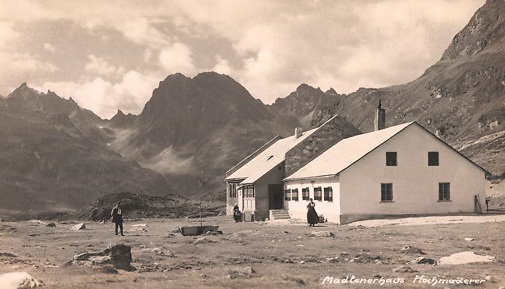
Madlern Haus in the Austrian Alps, circa 1930s

Madlern Haus in the Austrian Alps, circa 1930s

From “The Snows Of Kilimanjaro”

iHemi

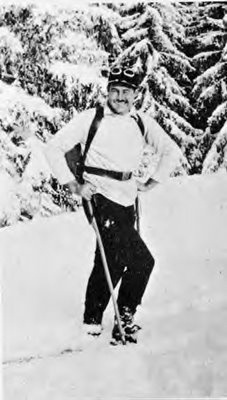
Ernest Hemingway skiing in the 1920s.

In Schrunz, on Christmas day, the snow was so bright it hurt your eyes when you looked out from the Weinstube and saw every one coming home from church. That was where they walked up the sleigh-smoothed urine-yellowed road along the river with the steep pine hills, skis heavy on the shoulder, and where they ran down the glacier above the Madlenerhaus, the snow as smooth to see as cake frosting and as light as powder and he remembered the noiseless rush the speed made as you dropped down like a bird.

They were snow-bound a week in the Madlenerhaus that time in the blizzard playing cards in the smoke by the lantern light and the stakes were higher all the time as Herr Lent lost more. Finally he lost it all. Everything, the Skischule money and all the season’s profit and then his capital. He could see him with his long nose, picking up the cards and then opening, “Sans Voir.” There was always gambling then. When there was no snow you gambled and when there was too much you gambled. He thought of all the time in his life he had spent gambling.

But he had never written a line of that, nor of that cold, bright Christmas day with the mountains showing across the plain that Barker had flown across the lines to bomb the Austrian officers’ leave train, machine-gunning them as they scattered and ran. He remembered Barker afterwards coming into the mess and starting to tell about it. And how quiet it got and then somebody saying, ”You bloody murderous bastard.”

Those were the same Austrians they killed then that he skied with later. No not the same. Hans, that he skied with all that year, had been in the Kaiser Jagers and when they went hunting hares together up the little valley above the saw-mill they had talked of the fighting on Pasubio and of the attack on Perticara and Asalone and he had never written a word of that. Nor of Monte Corona, nor the Sette Communi, nor of Arsiero.

Alpine town Bludenz, long a skiing and hiking center in the Voralberg.

Alpine town Bludenz, long a skiing and hiking center in the Voralberg.

How many winters had he lived in the Voralberg and the Arlberg? It was four and then he remembered the man who had the fox to sell when they had walked into Bludenz, that time to buy presents, and the cherry-pit taste of good kirsch, the fast-slipping rush of running powder-snow on crust, singing ”Hi! Ho! said Rolly!’ ‘ as you ran down the last stretch to the steep drop, taking it straight, then running the orchard in three turns and out across the ditch and onto the icy road behind the inn. Knocking your bindings loose, kicking the skis free and leaning them up against the wooden wall of the inn, the lamplight coming from the window, where inside, in the smoky, new-wine smelling warmth, they were playing the accordion.


Voralberg region, Austrian Alps, was visited by Hemingway and friends.

Voralberg region, Austrian Alps, was visited by Hemingway and friends.

Mystery Glimpse: Fast Lady

[Editor Note: SeniorsSkiing.com is asking our readers to contribute to support our online magazine. Yes, we have grown in the number of subscribers and advertisers. But our expenses have also grown. You can help us defray some of these expenses by helping us out with a donation.]

Support SeniorsSkiing.com by clicking here.

______________________________________________________

Nice Sweater, But Who Is She?

Looks like a balmy day on the snow with this speeding skier, sans cap and a big sweater.  And hmmm, that flag.  This week’s pic comes from Jamie Storrs at Peak Resorts who has opened their archives for SeniorsSkiing.com.

Credit: Thad Quimby, Peak Resorts

Last Week

Thanks again to Dana Mathios, Curator and Director of Collections, Colorado Snowsports Museum, for the description. This photo shows the 1972 U.S. Alpine Ski Team. Colorado heroes include Hank Kashiwa, Rick Chaffee, and Whit Sterling.

Hank Kashiwa was a member of the U.S. National Team from 1967 to 1972. He won the 1969 US National Championships and competed in the 1970 World Championships in Val Gardena, Italy. After racing in the 1972 Olympics in Japan, he starred in the Pro Circuit from 1972 to 1981 and won the World Pro title in 1975. He later served as President of the Volant Ski Corporation, a Boulder-based ski manufacturer. Hank was inducted into the Colorado Snowsports Hall of Fame in 1994.

Other 1972 US Alpine Ski Team members included Bob Cochran, David Currier, Terry Palmer, Tyler Palmer, Karen Budge, Marilyn Cochran, Susan Corrock (placed third in Downhill), Barbara Cochran (who won the Slalom), Sandy Poulsen , and Patty Boydstun.

John Fry (1930-2020)

Journalist, Historian, Innovator, Hall of Fame Member Passes On.

[This article first appeared in Ski History Magazine. We thank the International Ski History Association for permission to reprint this memory of a ski industry legend.)

John Fry. Credit: SKI Magazine

John Fry, the dean of North American ski journalists, died suddenly but peacefully on January 24, two days after celebrating his 90th birthday

Fry was in apparent good health. According to his wife, Marlies Fry, he suffered a probable stroke while floating quietly in shallow water off a beach on Vieques Island, Puerto Rico.

Over a 60-year career devoted to ski journalism, Fry served on the staffs of the magazines SKI LIFE, SKI, Snow Country and Skiing Heritage (now Skiing History). He was editor-in-chief of SKI, founding editor of Snow Country, and served as president and then chairman of the International Skiing History Association.

“John’s love of skiing, combined with his talent for in-depth reporting and crystal writing style, set the standard for ski journalism not only in English but world-wide,” said Seth Masia, who went to work for Fry in 1974 and is today president of the International Skiing History Association. “Those of us who had the good fortune to work for him loved his wit, warmth and mentorship. He was the heart and soul of each magazine he edited and was more productive and inspiring than ever during his final years with us.”

Kathleen James, editor of Skiing History, had this to say: “In 1994, John Fry gave me my first big-time magazine job as an associate editor at Snow Country. Over the years, working for him there and later at Skiing History, he taught me how to hold every issue of every magazine to the very highest standards: to examine story ideas with a critical eye, ask authors the right questions, and artfully present the finished article on the page. At the age of 90, his comments on stories, his suggestions, and his headlines — succinct, funny, compelling — were always the very best. He was my mentor, my friend and a second father who always pushed me to be better. To my occasional frustration and eternal gratitude, he was (almost) always right.”

Fry edited America’s Ski Book, revised edition (1973), co-authored with Phil and Steve Mahre their autobiography No Hill Too Fast (1985), and authored the award-winning book The Story of Modern Skiing (2006) and a work of Canadian history, A Mind at Sea: Henry Fry and the glorious era of Quebec-built giant sailing ships (2016).

In addition to his writing, as editor-in-chief at SKI Fry created the Nations Cup of alpine skiing, ranking the worlds’ national ski teams based on World Cup points; and NASTAR (National Standard Racing), the nationwide recreational alpine racing series now owned and operated by the U.S. Ski and Snowboard Association.

Born January 22, 1930 in Montreal, Canada, Fry first donned skis at age six. After a few years he was able to ride the world’s first rope tow, which had been built at Shawbridge, Quebec in 1932.  For high school, he attended Lower Canada College (class of 1947), and was a member of its championship ski team. At McGill University he raced for the Red Birds Ski Club and earned a bachelor of arts degree in 1951.

Fry emigrated to New York City in 1957 to join the daily trade paper American Metal Market, where, in 1960, he was named managing editor. Meanwhile, he freelanced as contributing editor of Ski Life, a national magazine launched in 1959, soon to be merged with SKI Magazine. In 1963 he joined the staff of SKI as executive editor, and editor of its sister publication Ski Business. In 1964 he was named editor-in-chief of SKI, and in 1969 became editorial director of SKI and Golf Magazines. After the Times Mirror Company acquired the titles in 1972, he served as editorial director of Outdoor LifeSKI and GOLF, with circulations ranging from 350,000 to 1.8 million. During this period, he created two new publications: Action Vacations and Cross-Country Ski. In 1965 he married Marlies Strillinger.

In the summer of 1987, the New York Times Co. retained Fry to create a new magazine, Snow Country. When the magazine debuted in January 1988, he became the full-time editor-in-chief. Snow Country attained a circulation of 450,000.

In 1996, the New York Times Sports/Leisure Group appointed Fry as editor of new magazine development. In this role he launched Golf Course Living Magazine. He retired from the New York Times Co. in 1999 and returned to SKI as a contributing editor. He remained an active contributor at Skiing History magazine until his death. 

Fry was elected to the U.S. Ski and Snowboard Hall of Fame (1995), to the Laurentian Ski Hall of Fame (2016), and to the Canadian Ski Hall of Fame (2018). A founding member of the International Skiing History Association, he first served as its president in 2001, and from 2014 until his death was the association’s chairman. He also served as a director at the environmental organizations Riverkeeper (1992-2000), Pinchot Institute for Conservation (1994-1999), and Beaver Dam Sanctuary (1995 until his death). In 1997 he was honored by the International Ski Federation (FIS) with its Journalism Award.

Fry is survived by his wife of 55 years, Marlies; their daughter Nicole Fry; his children by Ann Lyons, the sculptor Leslie Fry and William Fry; and grandchildren Sarah and Emily Fry.

A memorial will be planned later.