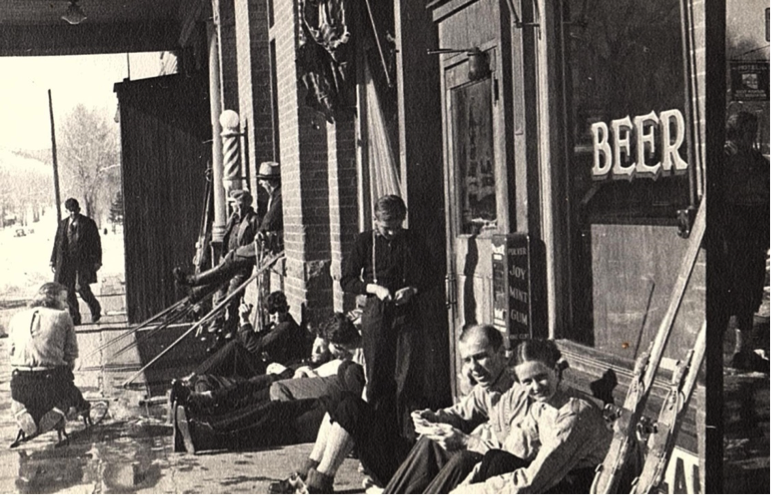
Well, last week’s photo was a challenge. Not one guess. Thanks again to Dana Mathios of the Colorado Snowsports Museum for this description.
This photo was taken at The Hotel Jerome in Aspen. The photo is believed to have been taken in 1948, but some indications from the scrapbook this photo came from indicate a date as early as New Years 1939. The Jerome was built in 1889 and is often described as one of the city’s major landmarks. In 1986 it was listed on the National Register of Historic Places. During Prohibition a celebrated spiked drink, the Aspen Crud, was invented at “J-Bar”. Later, the drink and the bar became popular with members of the 10th Mountain Division while they trained in the area. After the war, Aspen and its new ski resort became a popular destination. Celebrities vacationed in Aspen like Gary Cooper, John Wayne, and Hunter S. Thompson.
The Hotel Jerome: If the walls could talk…Credit: Amuse
https://seniorsskiing.com/wp-content/uploads/2020/01/2006.20.5-crop-scaled-e1580135363567.jpg938728mikemaginn/wp-content/uploads/2014/04/Seniors-Skiing-since2013-Logo@2x-300x68.pngmikemaginn2020-01-27 09:46:432020-01-27 09:46:43Mystery Glimpse: Name That Team
We received several comments and emails about the identification of the woman in this recent Mystery Glimpse. The photo was provided by the Tread of Pioneers Museum, Steamboat Springs, was mis-labelled as Barb Ferries. Our observant readers saw the error and correctly identified her as Linda Meyers who also skied with Buddy Werner on the 1964 US Ski Team. One of those who corrected us was none other than Chuck Ferries, Barb’s brother. We notified the curator at the Tread of Pioneers Museum which is taking corrective action. Thanks readers.
Where Is This Hotel?
Thanks to the Colorado Snowsports Museum for this picture.
Last Week
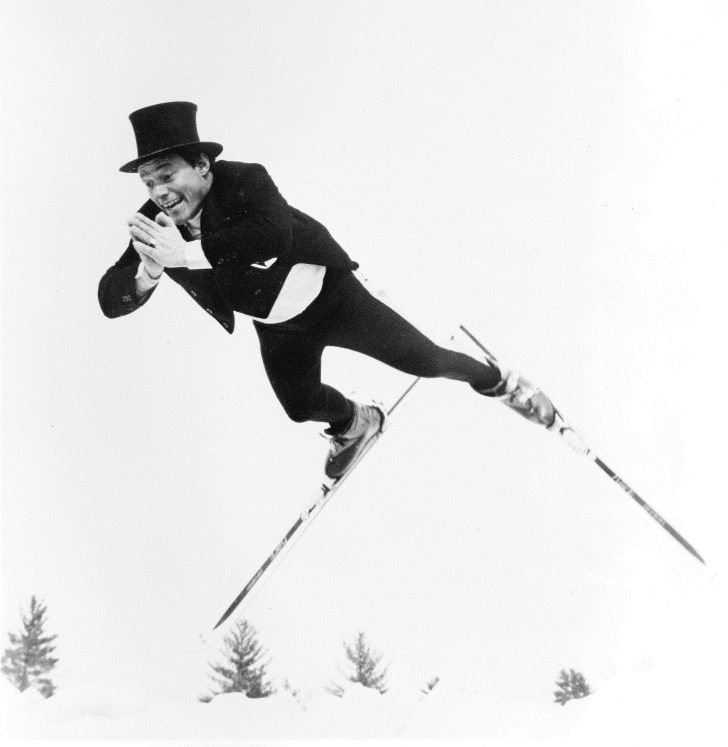
Rudi Wyrsch was the self proclaimed Pied Piper of skiing and taught children not only how to ski but how to have fun on and off the snow. From Piperville, his name for the Mt. Snow pee-wee playground/ski school, to his 12 foot stilts, Rudi was a master at engaging children with entertainment. Once a member of the Swiss national team and coach of the British, Australian, and New Zealand ski teams, Rudi worked at Mount Snow in the 60’s – 70’s. After wowing the kiddies on the hill, Rudi entertained adults back in the lodge with joke-telling, magic tricks, and juggling.
Rudi’s approach to teaching kids at Piperville revolved around three principles: 1) Balance, 2) How to turn, and 3) Self-confidence.
Rudi conducted trick skiing stunts across New England. Here he is performing at Pleasant Mountain, ME, home of a nascent freestyle program under Rudi. He later open a restaurant at Taos, NM. We have heard, but could not confirm, that he was killed in a “ski accident” in Switzerland. If anyone knows that part of the story, please share it with us.
Who owns a hat for 50 years? Well, if it’s a Moriarty hat, perhaps you understand why.
Getting ready to shovel the driveway one cold morning last winter, I reached to the top shelf of the hall closet for a hat. My fingers felt the double-thick headband of my old Moriarty hat tucked up out of sight. I pulled it over my ears and went a-shoveling. Working the shovel in knee-deep in snow, a thought occurred to me. Wait a minute. I bought that hat from Mrs. Moriarty’s shop on the Stowe Mountain Road in 1964. That made it fifty years old. My hat was fifty. It has been with me in trunks, suitcases, boxes and dresser drawers in moves from New York to California to Japan back to California and then to Massachusetts. Been with me at Mammoth Mountain, cross-country in Appleton Farms, MA, going to class in Syracuse, sailing the Gulf of Maine, walking to work from North Station in downtown Boston. Fifty years is a long time to own a hat. Of course, I had other hats, but my Moriarty kept popping into my hand from time to time from the top shelf. How did this happen?
Back in the 60s and 70s, Moriarty hats were iconic. The Preppy Handbook lampooned them as an essential part of the spoiled college kid outfit. Almost everyone I skied with at Song Mountain, Tully, NY, had one. The three points on the top were like a rooster’s cockscomb, distinctive and bold. You wore your hat down tight over your ears with your goggles wrapped around your head. No helmets in those days. It was a “look” that even the most tentative skiers could exhibit.
Mrs. Moriarty founded a cottage industry around weaving those hats. Soon outpaced by the volume of orders, Mrs. M. enlisted an army of fifty weavers in Stowe village, producing as many as 40,000 in 1965. At its height, the Moriarty hat was as ubiquitous a symbol of skiing as Head skis and Marker turntable bindings. An ad in SKI was bold enough to say, “The people of Vermont make great maple syrup, great cheddar cheese and the best ski hats in the world.” As I said, icon status.
You can buy a vintage Moriarty hat on eBay or from the Vermont Ski and Snowboard Museum that somehow has a stock of left over inventory from the later days of the company. The Moriarty family got out of the business in the 80s.
Mrs. Moriarty was told by skiers that “they skied better” with her hat on. Credit: SKI January, 1965
Don’t ask why I never sent my hat off to the Salvation Army. Despite the odd moth hole, it has simply always been part of my kit along with a handful of books, a banjo, a lighter from my Navy destroyer, and other small remainders of the past. Things that travel through life with you have value. When you pick them up again after many years, memories start to emerge in layers. Even after many years. Even a ski hat. That’s why I love my Moriarty hat.
https://seniorsskiing.com/wp-content/uploads/2014/07/BlueMoriartyHat.jpg32643879mikemaginn/wp-content/uploads/2014/04/Seniors-Skiing-since2013-Logo@2x-300x68.pngmikemaginn2020-01-21 18:45:332020-01-22 16:53:41This Old Moriarty Hat
This is Linda Meyers and Buddy Werner in April, 1963. Linda competed at the 1960 and 1964 Winter Olympics. In 1960 she tumbled in the downhill event, but completed the descent and placed 33rd; she failed to finish the giant slalom. In 1964 she placed 12th in the slalom and 30th in the giant slalom.
Meyers grew up in Bishop, California, near Mammoth Mountain, and took up skiing following Jill Kinmont Boothe. Besides Olympics she competed at the 1958 and 1962 World Championships and finished fifth in the combined event in 1962. After retiring from competitions she coached skiers in Colorado.
Buddy Werner was a top US ski racer, retiring from racing after the 1964 games. He was killed in an avalanche while filming a ski movie in the Swiss Alps later that year.
[Note: This Mystery Glimpse was updated, correcting the identity of the woman skier.]
https://seniorsskiing.com/wp-content/uploads/2020/01/Rudi_Wyrsch_Pied_Piper_of_Skiing-e1578934746894.jpg747728mikemaginn/wp-content/uploads/2014/04/Seniors-Skiing-since2013-Logo@2x-300x68.pngmikemaginn2020-01-15 10:07:522020-01-20 12:16:27Mystery Glimpse: Top Hat
[Editor Note: A big hug and salute to Harriet Wallis, snow sports journalist, who has written dozens of interesting and useful articles of these pages since SeniorsSkiing.com began in 2014. Happy Birthday, Harriet. Many more and have a great year ahead!]
Harriet’s daughter bought her a cupcake helmet cover. Seriously, there are such things. Credit: Alta
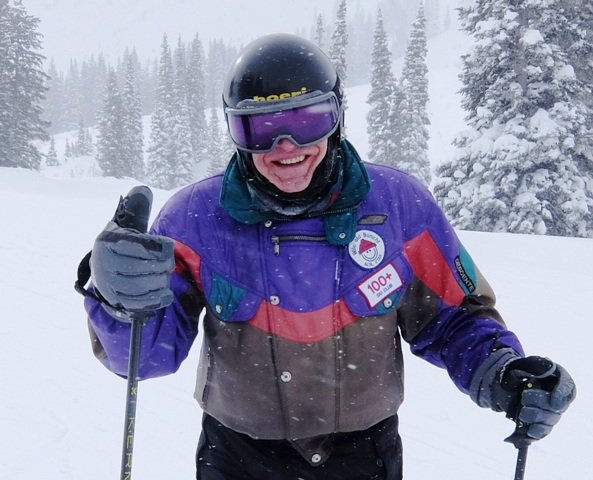
I planned to celebrate my landmark 80th birthday by taking cookies to my aerobics class. Instead, I skied with a cupcake on my head and a ribboned badge with “80” in big numbers. It was a hoot. Here’s some insight in case you’ll turn 80 soon.
The pink cupcake helmet cover came with a flashing LED candle on top. My daughter gave it to me, so I couldn’t say no. I timidly stretched the cupcake over my helmet, turned on the candle, pinned on the 80 badge, and braced to look absolutely silly on the slopes.
My get-up drew attention, and everyone laughed at lot. A pack of skiers burst into singing Happy Birthday, and Alta sent a photographer to capture the event. I was skiing with my son and daughter and they enjoyed seeing their mom have a big day. It was a lot more fun than taking cookies to my aerobics class.
Skiers’ reactions were surprising.
To younger skiers, I’m a fossil, and they insisted on taking selfies with me. They had never seen anyone “that old” still skiing.
However, skiers in their 80s and 90s—skiers I’ve never met—gave me a hug and welcomed me to the vintage group. To them, I’m just a youngster.
I Want To Share The Fun.
When I went to the party store, I found their birthday badges only went up to 60 years. Dang. I decided that with some office white out and a marker I could turn 60 into 80. It worked. My doctored-up badge is unique.
Harriet will pass this badge on to someone turning 80 before April. Credit: Harriet Wallis
If you’re turning 80 before April and want to ski wearing the badge on your birthday, please post a comment to this article.
Please say where you’ll be skiing and a little bit about why you’d like to have the badge. Unfortunately, I have only one badge, so I’ll chose someone at random, contact you for your address, and mail the badge to you. Then you can pass it on.
But I’m keeping the pink cupcake to wear on my birthday next year!
https://seniorsskiing.com/wp-content/uploads/2020/01/cupcake-in-lodge-for-SS-e1578927291674.jpg552728Harriet Wallis/wp-content/uploads/2014/04/Seniors-Skiing-since2013-Logo@2x-300x68.pngHarriet Wallis2020-01-13 09:59:532020-01-13 10:04:48Hip Hip Hooray! I Turned 80 Today!
One Very Young, The Other A Successful Competitor.
Many thanks to the Tread Of Pioneers Museum, Steamboat Springs, for this photo. Visit their online collection by clicking here.
Last Week
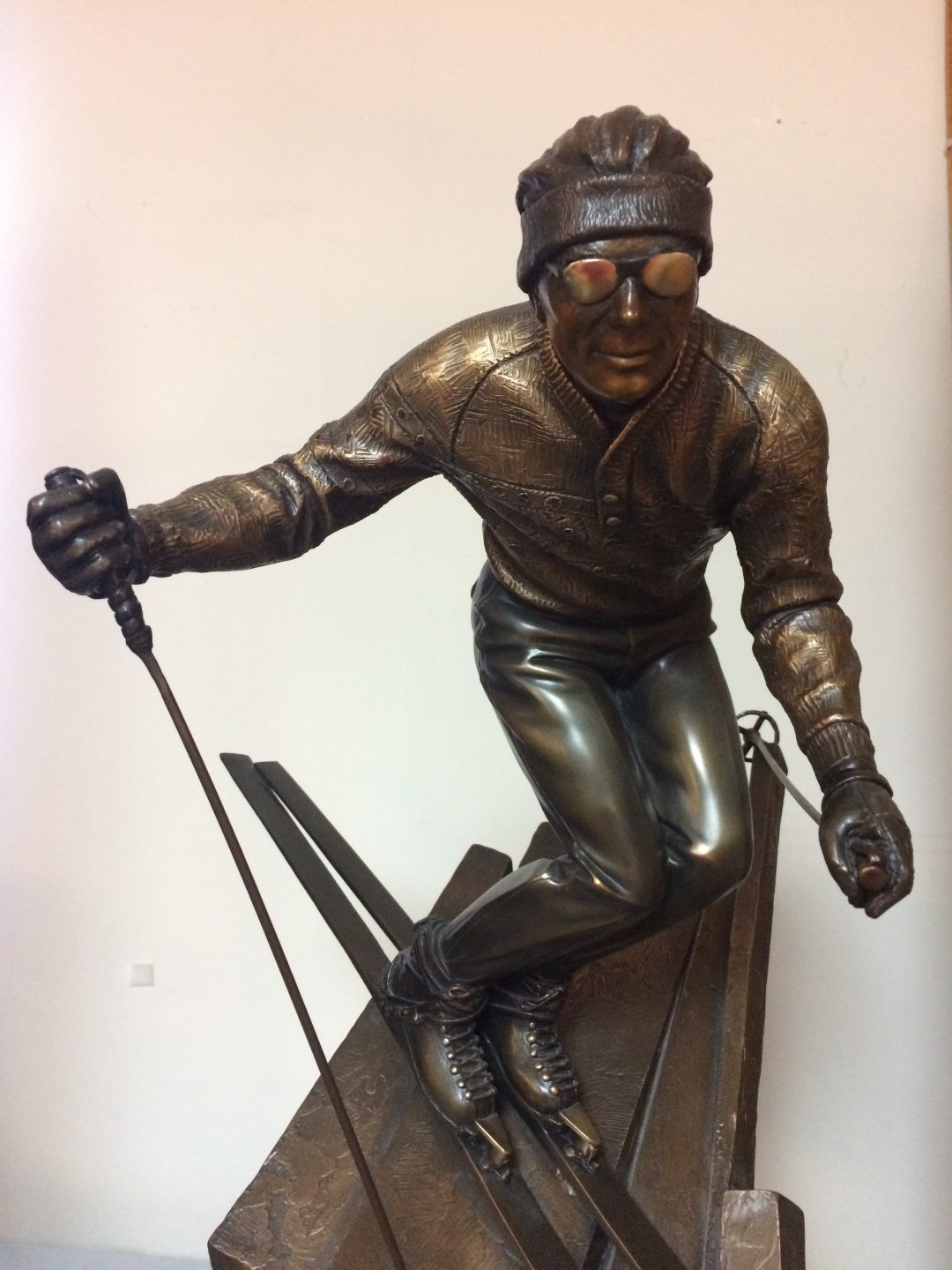
This is George Lundeen’s bronze statue, The End of An Era, circa 1960. Why is it significant? Here’s what Dana Mathios, Curator and Director of Collections, Colorado Snowsports Museum, has to say:
This sculpture depicts a sport poised at a turning point on the edge of change. Soon, metal and synthetics would become standard in ski construction in place of wood that had been in use for more than 4,000 years. Pioneering skiers used a single wooden pole. By the early 1900s, two poles were in fashion. The shafts were often made from bamboo until superior poles of a light metal alloy were developed. Higher, plastic ski boots featuring buckles marked the passing of lace-up leather boots.
Also depicted in the sculpture is an early version of a safety binding designed to release the toe of the boot in a fall. A leather thong anchored the heel to the ski. More advanced safety bindings that released both the toe and the heel of the boot followed.
Early in the development of Colorado’s ski industry, the Pikes Peak region offered a number of small ski areas. Nearby slopes at The Broadmoor Hotel and others on Pikes Peak at Glen Cove, Elk Park, and Holiday Hills were popular. The region also included Tenderfoot Hill at Cripple Creek and the Edlowe ski jumping hill at Divide. In time, large corporate-managed ski areas further to the West replaced the small, locally owned ski facilities in the region.
Many thanks to curator Dana Mathios and the Colorado Snowsports Museum for their many contributions to SeniorsSkiing.com’s Mystery Glimpse feature. Visit the museum’s website to browse its collection and do consider making an audition.
https://seniorsskiing.com/wp-content/uploads/2020/01/Screen-Shot-2020-01-06-at-9.44.29-AM.png232302mikemaginn/wp-content/uploads/2014/04/Seniors-Skiing-since2013-Logo@2x-300x68.pngmikemaginn2020-01-09 09:06:122020-01-20 12:10:16Mystery Glimpse: Two Racers
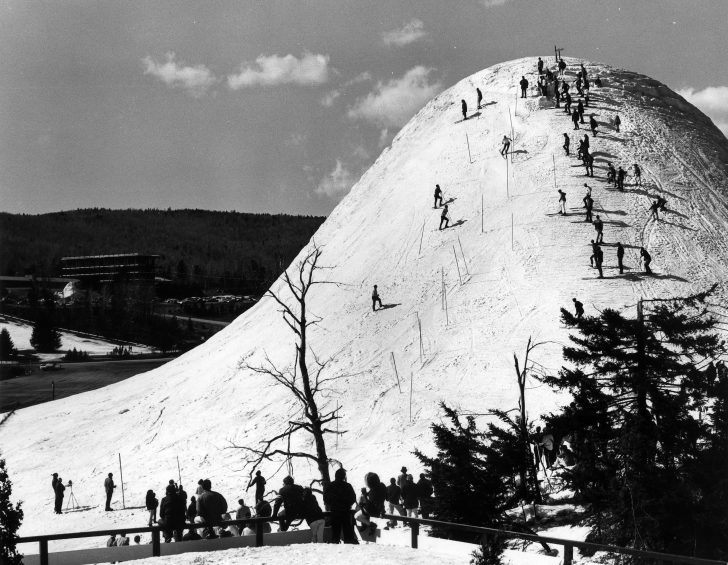
The Fountain Mountain at Mt. Snow, VT was the subject of last week’s mystery. According to Mt. Snow’s Jamie Storrs, the Fountain was switched on for the first time on January 18, 1965
When Mount Snow’s founder, Walt Schoenknecht, saw something he simply must have, he built it. In this case, it was the fountain that shoots out of Lake Geneva in Switzerland. From that seed, Fountain Mountain is born.
Fountain Mountain, a 350-foot geyser out of Snow Lake, is powered by twin Westinghouse 600-horsepower pumps that shoot 3,000 gallons of water per minute straight up through three Worthington centrifugal pumps. It was said to be the largest man-made geyser ever built. Back in the day, Governor Phil Hoff was on hand to launch Fountain Mountain.
During the winter, Fountain Mountain erupts 24/7 and as the water freezes, a giant ski hill is formed. The hill is large enough to hold races; a rope tow transports skiers to the top. Fountain Mountain lasts into the summer months and, since 1969, is the site for summer race camps in June.
Alas, the Fountain Mountain was shut down when the energy crisis of the early 70s drove the costs of running it out of sight.
Swimming at the foot of Fountain Mountain, circa 1964. Credit: Mt. Snow
https://seniorsskiing.com/wp-content/uploads/2019/12/IMG_4830-scaled-e1577804325670.jpg971728mikemaginn/wp-content/uploads/2014/04/Seniors-Skiing-since2013-Logo@2x-300x68.pngmikemaginn2020-01-02 08:17:582024-08-21 10:41:20Mystery Glimpse: Turning Point
If you’ve skied this…structure, tell us your story. Where, why?
Last Week
Feb 1941. Ski Jumpers.
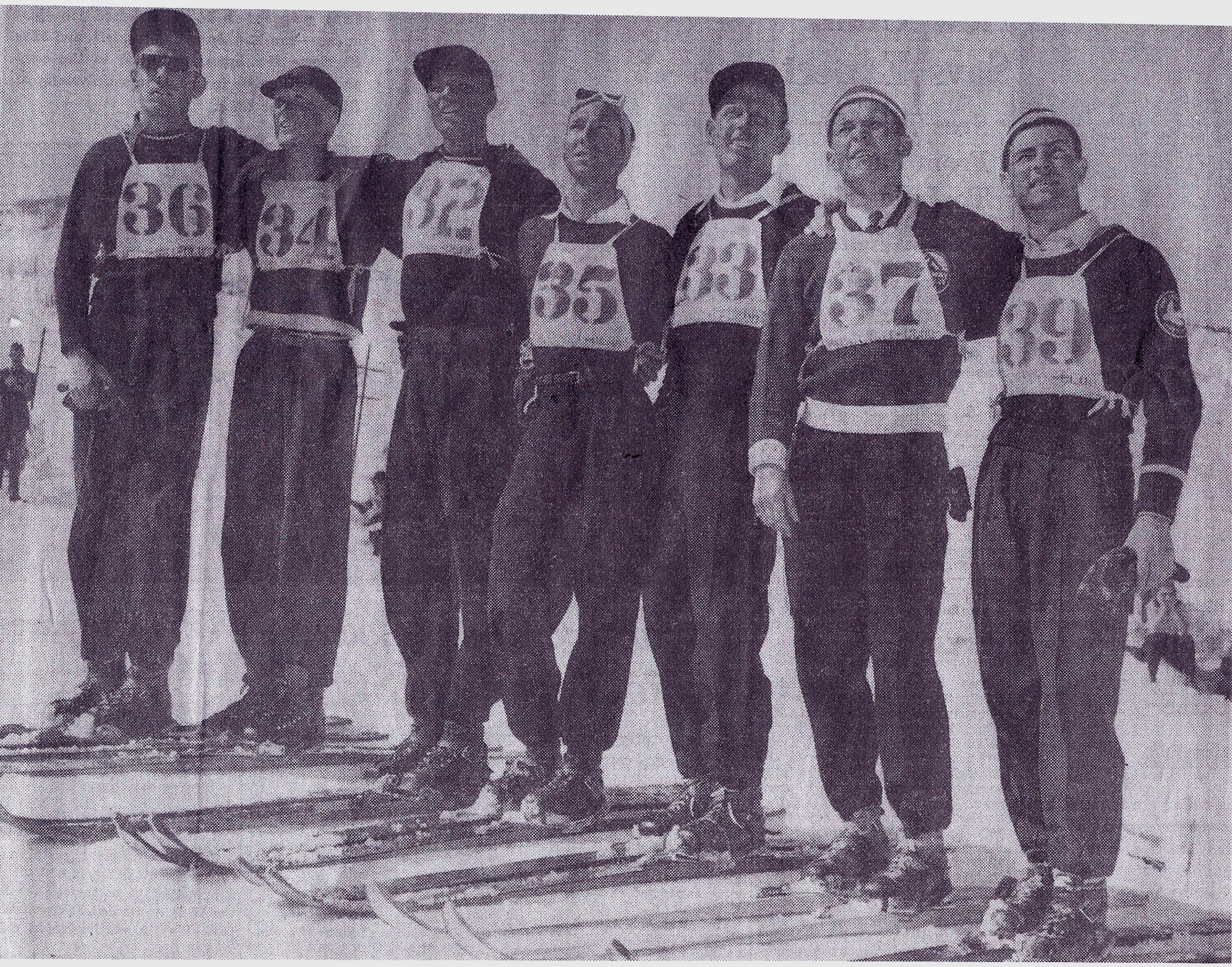
This iconic image is of seven great ski champions from the past. All have been inducted into the U.S. Ski and Snowboard Hall of Fame and are regarded as SkiSport Legends. The image comes from a early 1940s clipping Alan Engen included in his donated ski history, four volume scrapbook series, The Engen Skiing Dynasty. The books currently reside in the University of Utah J.Willard Marriott Library Utah Ski Archives.
The photo was taken in Sun Valley, ID at the base of the old Ruud Mountain Ski Jumping Hill in February 1941. In the photo are, left to right: Corey Engen, Barney McClean, Sverre Engen, Gordon Wren, Alf Engen, Torger Tokle, and Art Devlin. Not long after this photo was taken, the great ski jumper, Torger Tokle, went into the military service, joining the 10th Mountain Division at Camp Hale and ultimately lost his life in combat during WWII. Torger and Alf father were two of the greatest U.S. ski jumpers of that time period.
https://seniorsskiing.com/wp-content/uploads/2019/12/MysteryGlimpse_-scaled-e1577805080568.jpg565728mikemaginn/wp-content/uploads/2014/04/Seniors-Skiing-since2013-Logo@2x-300x68.pngmikemaginn2019-12-16 09:08:142019-12-16 09:08:14Mystery Glimpse: Ski The Cone
All Inducted In US Ski and Snowboard Hall of Fame.
Hints: Photo from Feb. 1941, Sun Valley. One of these men later enlisted in the 10th Mountain Division and was killed in action. Can you name them all?
Thanks to Alan Engen for contributing this photo from his four-volume scrapbook series, The Engen Skiing Dynasty, currently at the University of Utah, J. Willard Marriott Library Ski Archives.
Last Week
Yes, Rip McManus. We were surprised to see so many correct entries, and even anecdotes from commentators about his colorful, but much too short career in the ski business and sport.
We remember meeting Rip at an SIA Ski Industry Trade Show, back in 1970 or so. He was a smiling, fun-loving guy with a lot of energy who left a positive impression with everyone he met.
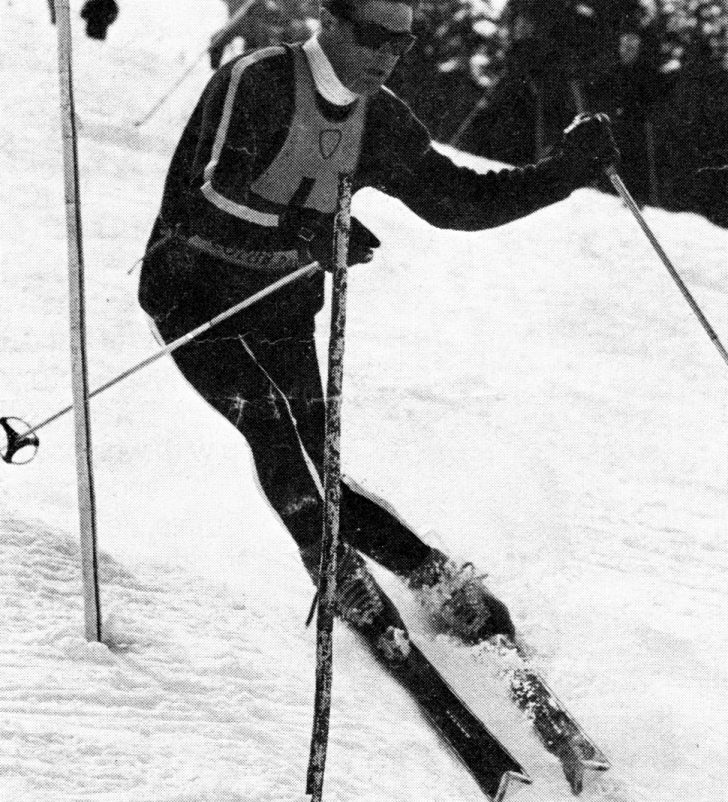
Rip was born in Boston, raised in Connecticut, and raced in the East until he went to Denver University. In 1964, we was a member of Bob Beattie’s US Olympic team. He was a three-event racer who captured North American and Canadian GS and downhill titles. At one time, he ranked 11th in the world in FIS points.
Rip left racing in 1965 and joined the Head Ski Co. as product manager and director of racing. He later moved to Lange as director of the boot division. He also consulted in marketing, ski testing, racing and product development with the Olin Ski Company.
Rip (r) in his role as TV sports commentator in Downhill Racer.
You may remember Ripper as a commentator and technical advisor to ABC-TV for the 1968 Winter Olympics, also covering the 1970 World Alpine Ski Championships for NBC-TV. He was an associate editor of Ski Racing magazine. What most people probably don’t realize is that Rip did the downhill racing sequences for the Robert Redford classic, Downhill Racer. He also played an onscreen role as a TV commentator.
He was clearly a unique character, coming up through the ranks of ski racing with few connections, little money, working on the trail crew at Stowe to earn entry fees and lift money. He did it all by himself.
Rip McManus’ life so full of potential was cut short by a traffic accident in 1982. As veteran journalist John Henry Auran wrote in a 1965 profile of McManus, “He’ll be remembered because he may be the last of his kind.”
[Note: This article was adapted from January, 1983 SKI magazine]
https://seniorsskiing.com/wp-content/uploads/2019/12/MysteryGlimpse.jpg15641992mikemaginn/wp-content/uploads/2014/04/Seniors-Skiing-since2013-Logo@2x-300x68.pngmikemaginn2019-12-10 11:15:352019-12-10 11:15:37Mystery Glimpse: Seven Great Champs
He was on Bob Beattie’s 1964 US Ski Team. He later worked for Head Ski and Lange Boots. Do you know who he is? Put your guess in the comment box below.
Last Week
Thanks to ski correspondent Dave Irons for supplying last week’s picture and this description:
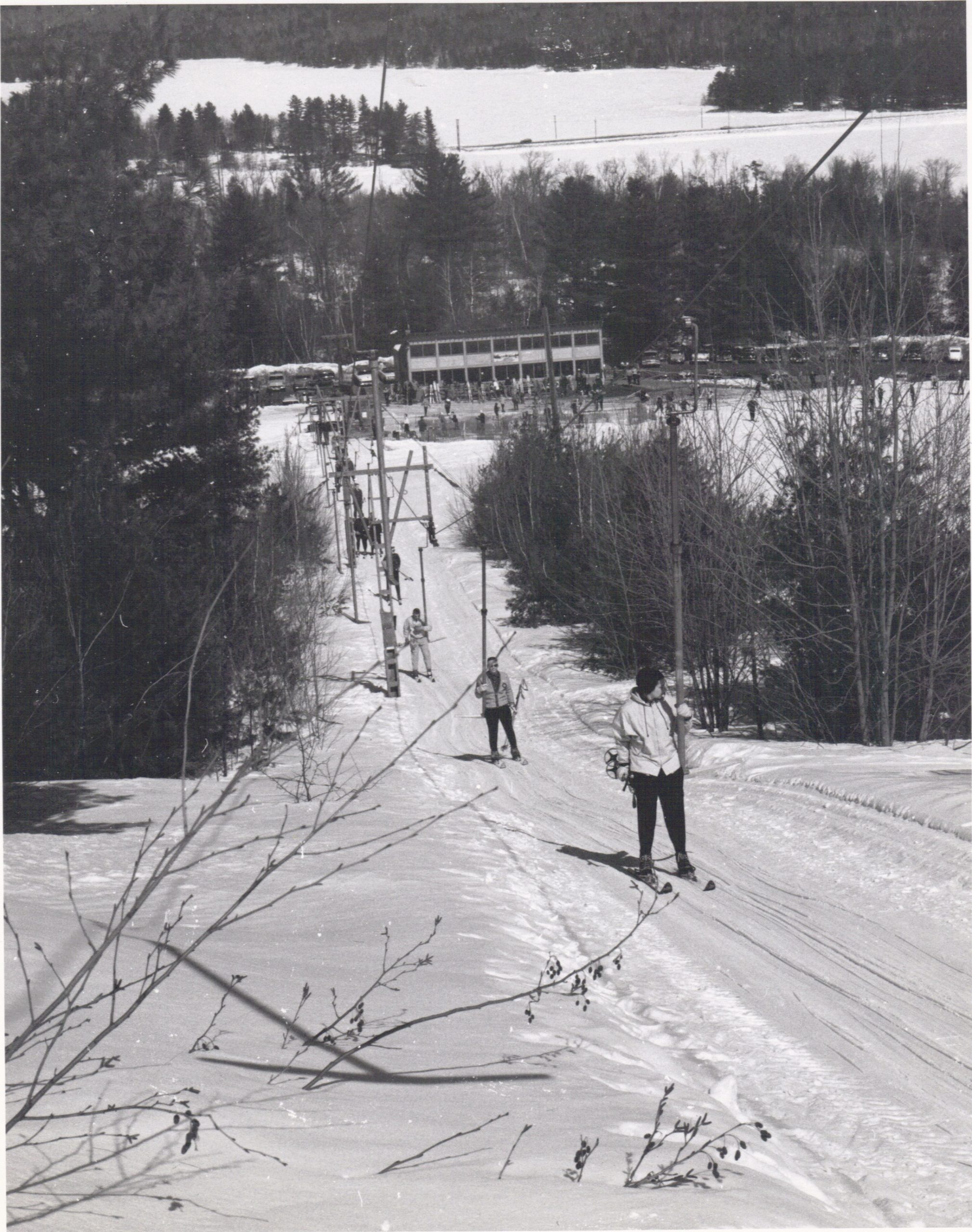
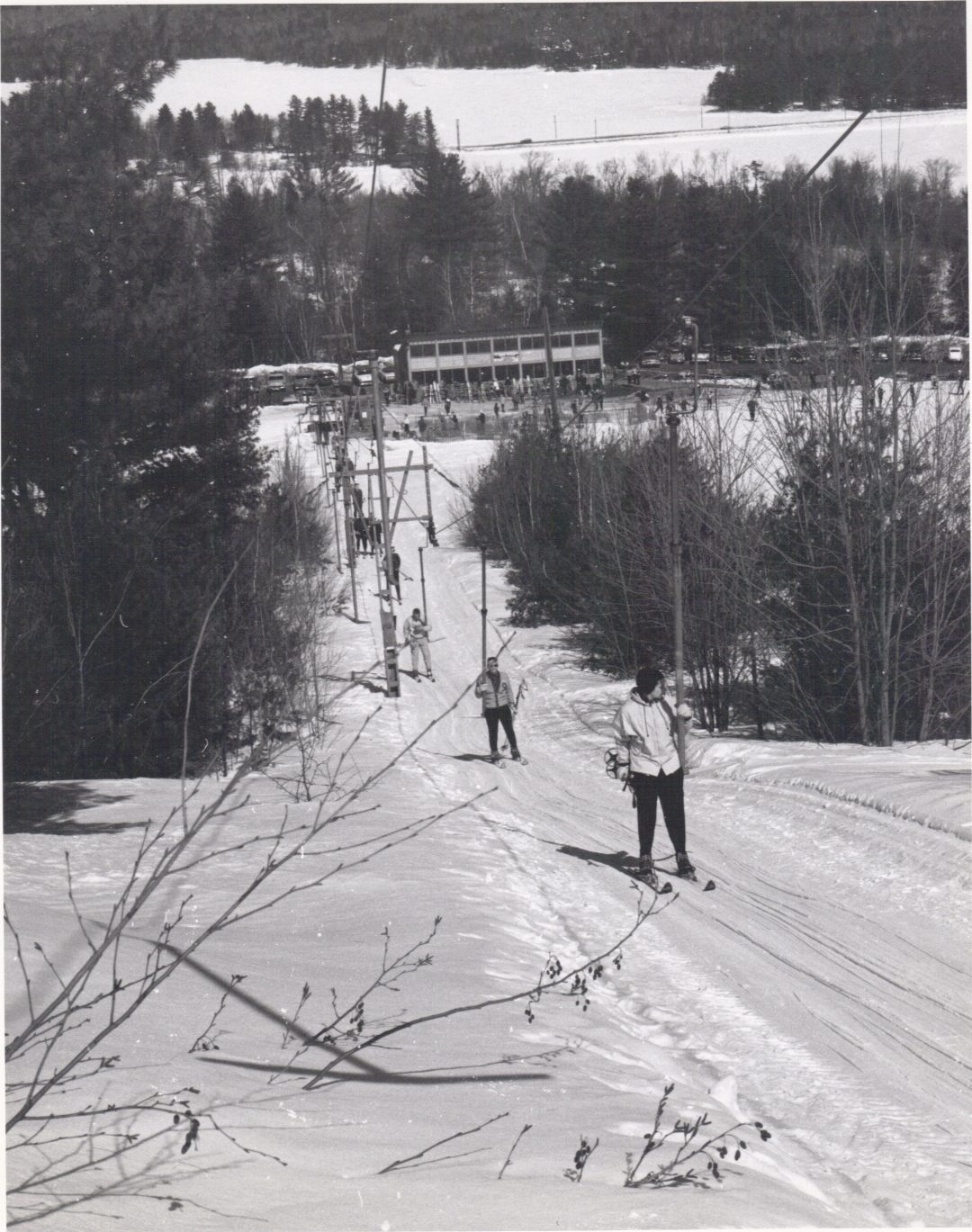
“John and Joe Luc Roy Jr. got it right away. Pleasant Mountain in Bridgton (now Shawnee Peak) is Maine’s oldest continuously operated ski area starting with rope tows in 1938. In 1951 they built Maine’s first T-bar which is in the picture. The T-bar is long gone, but you can still ski the lift line, a narrow run lined by trees. The base lodge has expanded and is more than triple the original size. The lake in the picture is the real give away. Moose Pond is 13 miles long and provides the area with unlimited water for snowmaking, something many areas envy.
Sorry Marilyn, although my association with Sunday River is well known, we skied Pleasant Mountain in the fifties before Sunday River opened in 1959. We switched to Sunday River because as we were living in South Paris it was an easier drive, and Pleasant Mountain had become known for lift lines. That’s no longer the case, with two top to bottom triples, a quad and another triple for beginners. For more on the area, my book, Shawnee Peak at Pleasant Mountain is available on Amazon, and at Shawnee Peak. How’s that for a shameless plug? I’ll try to answer any questions about the area.”
https://seniorsskiing.com/wp-content/uploads/2019/12/Mystery12_6_760-e1576089327122.jpg802728mikemaginn/wp-content/uploads/2014/04/Seniors-Skiing-since2013-Logo@2x-300x68.pngmikemaginn2019-12-04 10:41:292019-12-04 10:41:31Mystery Glimpse: Racer R.
Whose woods these are I think I know. His house is in the village though; He will not see me stopping here To watch his woods fill up with snow.
My little horse must think it queer To stop without a farmhouse near Between the woods and frozen lake The darkest evening of the year.
He gives his harness bells a shake To ask if there is some mistake. The only other sound’s the sweep Of easy wind and downy flake.
The woods are lovely, dark and deep. But I have promises to keep, And miles to go before I sleep, And miles to go before I sleep.\\
https://seniorsskiing.com/wp-content/uploads/2019/12/Screen-Shot-2019-12-02-at-8.55.08-AM.png605493seniorsskiing/wp-content/uploads/2014/04/Seniors-Skiing-since2013-Logo@2x-300x68.pngseniorsskiing2019-12-02 09:09:212019-12-02 09:09:23Snow In Literature: Stopping By Woods On A Snowy Evening
Can You Name The State And The Ski Area Where This First T-bar In The State Appeared?
Hint: It’s 1951.
Thanks to veteran ski journalist Dave Irons for contributing this photograph. That should be another hint for those who know Dave.
Last Week
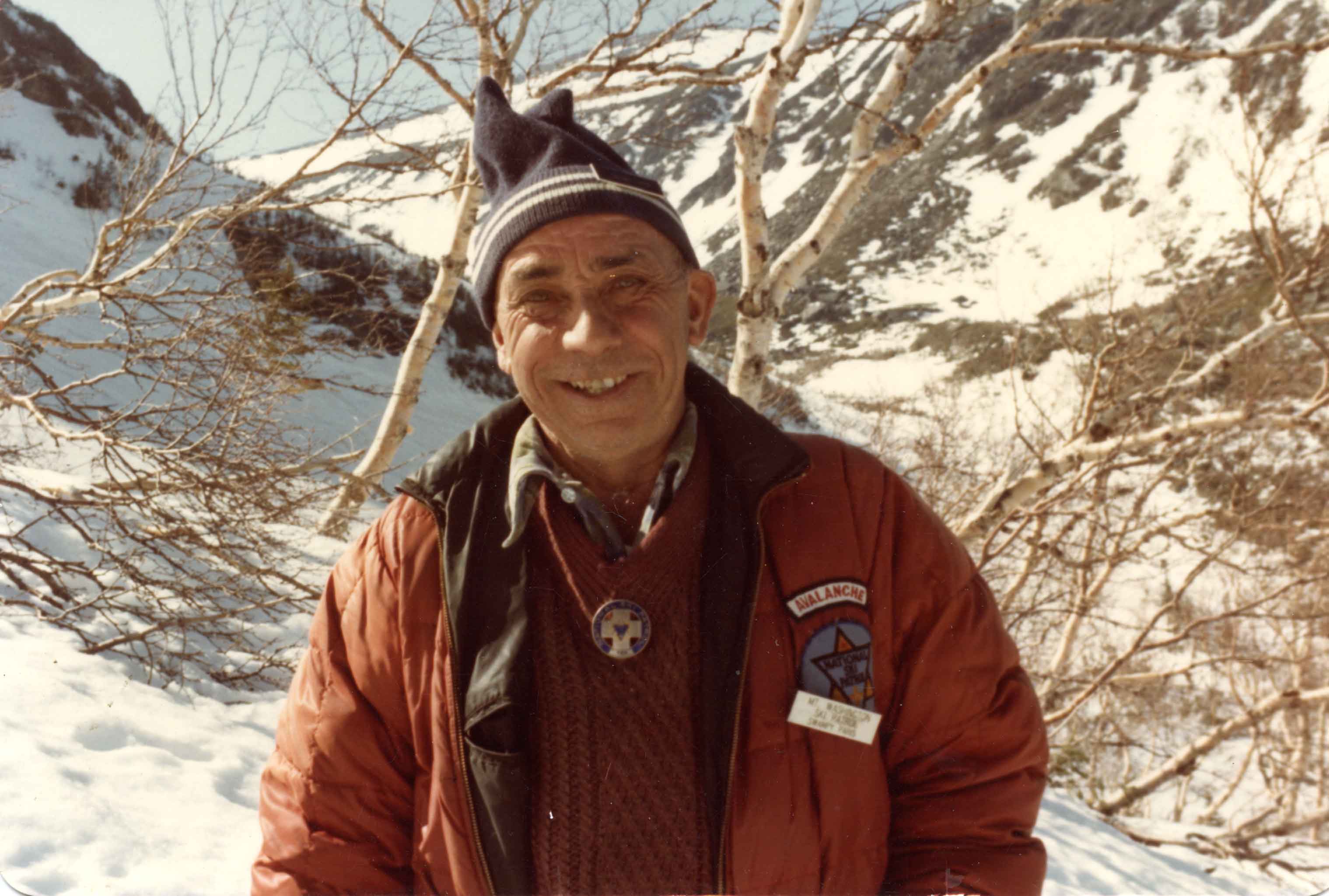
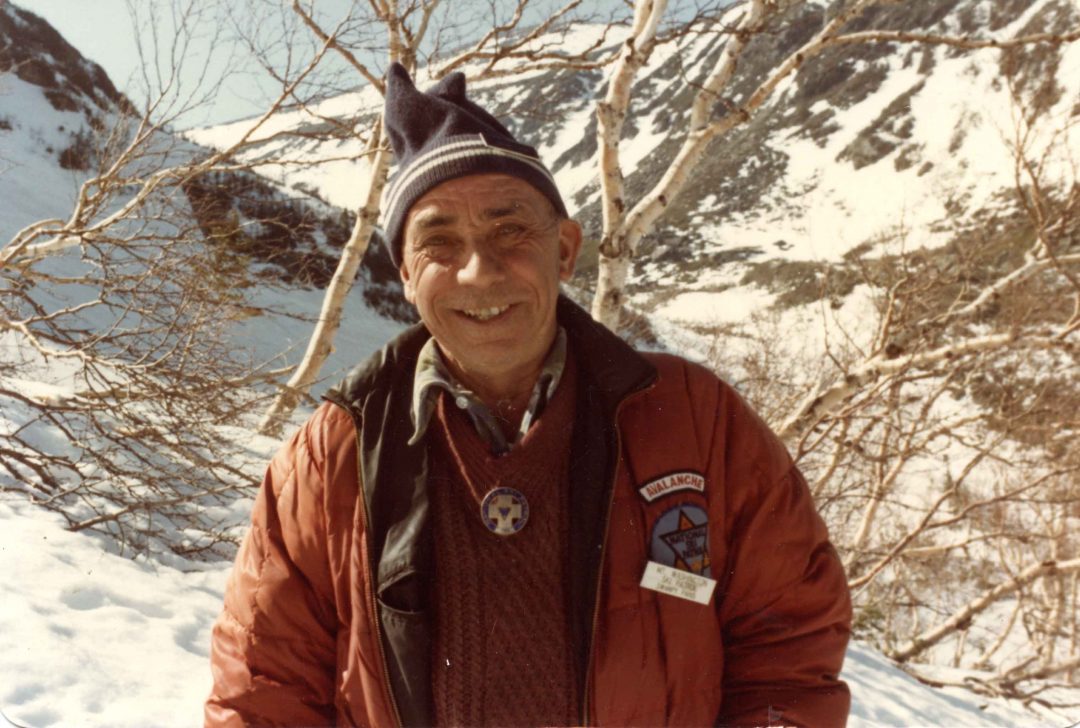
The National Ski Patrol expanded rapidly after its 1938 organization. One well-known and famously crusty patroller from Massachusetts was Henry “Swampy” Paris of Woburn. He and William Putnam organized the Mount Washington Volunteer Ski Patrol in 1948, and for decades Swampy was the ubiquitous patrol director in Tuckerman Ravine during spring ski season.
We had one successful contribution from Dr. Gretchen Rous Besser who nailed it, calling Swampy a “legend in his time.”
Special thanks to Jeff Leich, Executive Director of The New England Ski Museum for suggesting this photograph.
https://seniorsskiing.com/wp-content/uploads/2019/11/First-T-Bar-scaled.jpg25602020mikemaginn/wp-content/uploads/2014/04/Seniors-Skiing-since2013-Logo@2x-300x68.pngmikemaginn2019-11-19 09:04:522024-08-21 10:47:00Mystery Glimpse: First T-Bar
Who is this guy? Sure looks like he knows the snows. Photo courtesy of the New England Ski Museum and executive director Jeff Leich. Worth visiting their online gift shop by the way if you’re looking for skier/snow sport presents. The New England Ski Museum now has two locations: Franconia and North Conway, NH.
Last Week
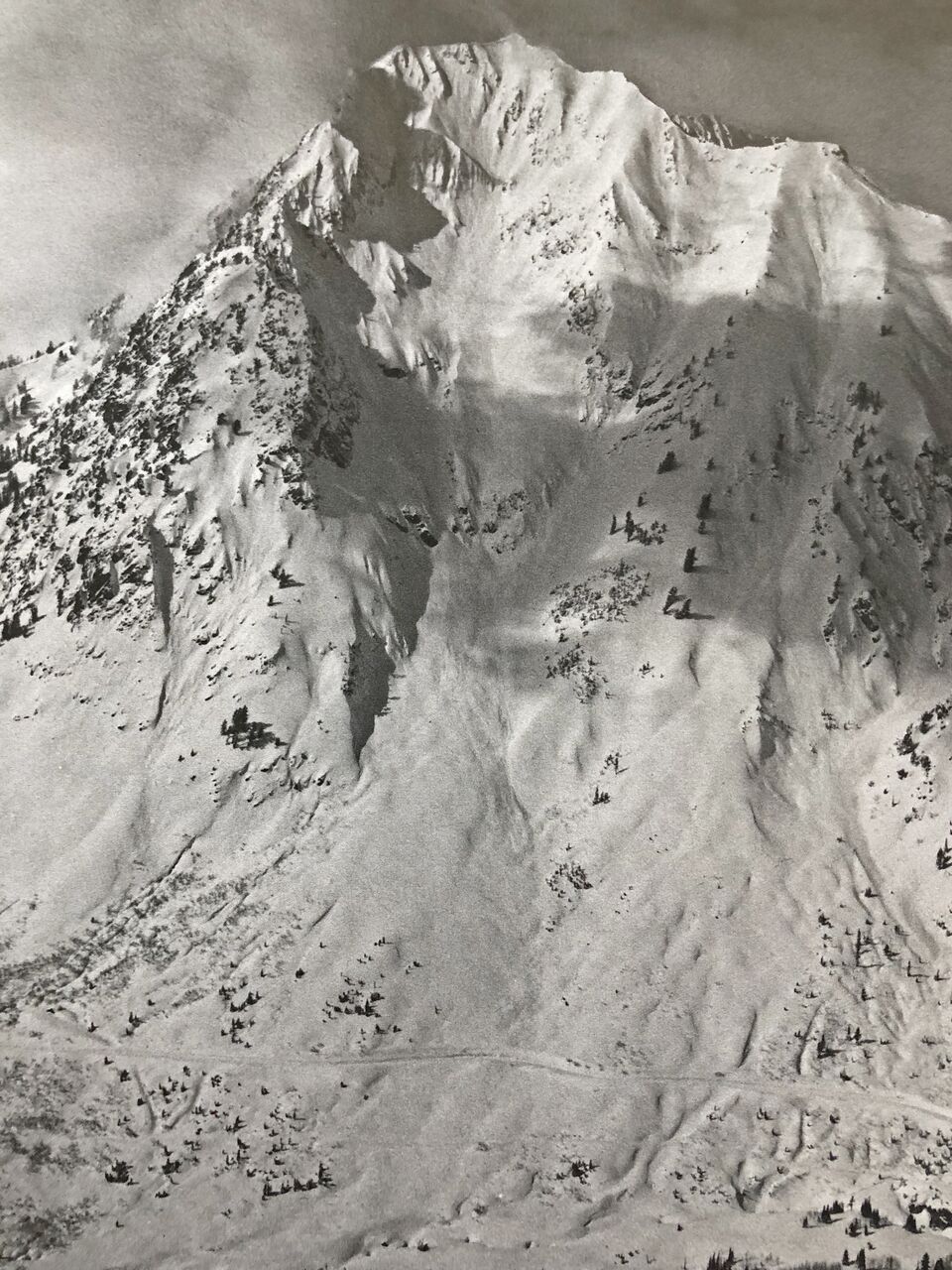
Yes, Mount Superior. Here’s a wonderful description from Alan Engen, recent winner of the S.J. Quinney Award from the Utah Ski Archives, honoring his life time achievements in the snow sports world. Thanks to Alan and the Alf Engen Ski Museum for contributing these photos.
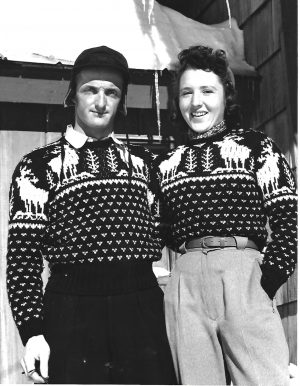
“The photo was taken by the legendary early ski pioneer/legend, Dick Durrance in 1940. He was living at Alta at the time with his new wife, Miggs Durrance. Here’s a good photo of both of them on the deck of the old Alta Lodge, which Dick helped to initially build.
“The “Pointy Peak” photo shown is of Mount Superior and was taken not far from the top of Alta Ski Area’s current Wildcat Lift location. It is an impressive shot. Both Dick and his wife, Miggs, were excellent photographers.”
Dick and Miggs Durrance at Alta circa early 1940s
In the book The Man on the Medal, about the life of Dick and Miggs Durrance, written by John Jerome (1995), the following information was provided on their coming to Alta.
Dick and Miggs first came to Alta in the spring of 1940 to attend the wedding of Friedl Pfeiffer and a Salt Lake City girl (name not identified in the book). So recorded, they both “fell in love with the place.” They were married shortly after on June 9, 1940. In the fall of that year, Dick made contact with the Salt Lake Winter Sports Association (who ran the Alta ski area operation) and expressed interest in coming to Alta and helping to build the fledgling area with one chairlift and a lodge which at that time was only half finished. The Alta group welcomed Dick’s proposal with “open arms.”
It was through Dick’s efforts that he made contact with a friend named James “J” Laughlin and invited him to come and see the area he was involved with. Laughlin did come, and quickly fell in love with the beauty of Alta and ended up purchasing the Alta Lodge from the Salt Lake Winter Sports Association. The lodge had been started through a $25,000.00 gift to Salt Lake Winter Sports by the Rio Grande Railroad. The gift had been authorized by one of the trustees of the railroad, Wilson McCarthy. Laughlin agreed to finance completion of the Alta Lodge in return for interest in the lodge and the lift operation which the Salt Lake Winter sports Association agreed to do.
Laughlin, in turn, quickly hired Durrance to oversee the lodge completion and general lodge operations. This was in addition to running the ski school operation (which he had been granted through Forest Service approval). Dick’s ski school staff consisted of his wife, Miggs, Gordy Wren (who would become one of America’s finest Olympic ski jumpers), and Si Brand, a racer from California. The Durrance Ski School at Alta was based on the stem turn, “Which Mathias Zdarsky had advocated shortly before the turn of the century in Lilienfeld, Austria.”
Dick and Miggs first lived at Alta in one of the small mining buildings, below the Alta Lodge, left over from the mining era. Unfortunately, the old mining shack burned down and some of Durrance’s valuable competition awards were lost in the fire.
The Durrances lived at Alta for the first two years of their married life and left Alta after completion of the 1941-42 ski season.
In reflection, Alta has had a number of skiing legends who have, at one time or another, called that place at the top of Little Cottonwood Canyon, home. For certain, the Durrances fit that category and both contributed in helping to develop Alta into a world class ski resort.
Miggs passed away at the age of 83 on November 11, 2002. Dick passed away at age 89 on June 13, 2004.
https://seniorsskiing.com/wp-content/uploads/2019/11/30-2012-093-126.jpg20493038mikemaginn/wp-content/uploads/2014/04/Seniors-Skiing-since2013-Logo@2x-300x68.pngmikemaginn2019-11-12 12:40:022019-11-12 12:40:05Mystery Glimpse: On Patrol
“Dancing With The Mountains” Ode To The Lure of Skiing.
John Denver singing and dancing down and with the mountains.
“Dancing With The Mountains”
Everybody’s got the dancing fever, everybody loves to rock and roll. Play it louder baby, play is faster, funky music’s gotta stretch your soul. Just relax and let the rhythm take you, don’t you be afraid to lose control. If your heart has found some empty spaces, Dancing’s just the thing to make you whole.
I am one who dances with the mountains. I am one who dances in the wind. I am one who dances on the ocean, my partner’s more than pieces, more than friends.
Were you there the night they lost the lightning? Were you there the day the earth stood still? Did you see the famous and the fighting? Did you hear the prophet tell his tale?
We are one when dancing with the mountains. We are one when singing in the wind. We are one when thinking of each other More than partner’s, more than pieces, more than friends.
https://seniorsskiing.com/wp-content/uploads/2019/10/Screen-Shot-2019-10-15-at-3.51.47-PM.png390604seniorsskiing/wp-content/uploads/2014/04/Seniors-Skiing-since2013-Logo@2x-300x68.pngseniorsskiing2019-10-17 11:04:192024-08-21 10:49:50John Denver Ski Music Video
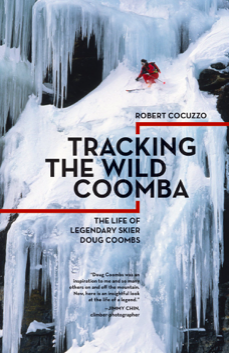
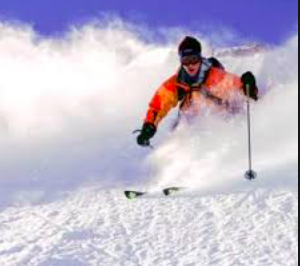
Doug Coombs was one of the most celebrated steep and deep skiers of the ‘80s, 90s, and 00s. Many of you will remember his film exploits and his steep skiing camps at Jackson Hole and in Tinges and elsewhere in Europe. He died in La Grave France in 2006, when he slipped off a cliff on skis trying to find and help a fellow skier.
I found “Tracking the Wild Coomba” in a used bookstore on Cape Cod. Authored by Robert Cocuzzo, it was published in 2016. Handwritten on the title page is this note from the author: “Sebastian, The inspiration to write this book came when I first read The Perfect Storm. Your words drove me to become a writer. Thank you.” An unexpected find.
Coombs grew up in a skiing family in Bedford, Masachusetts. From the beginning he was a risk-taker, performing crazy stunts and showing off for friends. When he was 17 at Waterville Valley, New Hampshire, he crash-landed. Dazed, he went to the clinic at the base of the hill. No one was there. He went back up the hill and continued to ski. When he got home, his mother took him to the hospital where he was diagnosed with several broken neck vertebrae. His muscular neck had saved his life. He was wheelchair-confined for months, with a stabilization device screwed into his head. Doctors informed him that he would die if he fell again.
Over the ensuing years Coombs established himself as one of the world’s preeminent steep skiers. In telling his story, the author also tells us about the evolution of steep skiing and introduces us to many of the sport’s more prominent personalities. He takes us to numerous places where Doug hung out. These include Valdez, Alaska, where he and his wife, Emily, lived in a trailer, purchased cheap helicopter rides, and specialized in skiing first descents of previously unnamed steeps in the Chugach Range. Before long he was attracting a robust clientele to his heli-ski guide service.
We learn how he and Emily started the Steep Skiing Camps at Jackson Hole and how he became the area’s public face. But trouble was brewing. As a key member of the underground Jackson Hole Air Force – a cadre of highly skilled, hard core rope-duckers – he is pursued by the Jackson Ski Patrol. It is Les Miserables on skis. He’s caught and banned from Jackson. Soon after, he and his wife set up shop in the French Alps.
Once there, he integrates well with top-ranked skier/climber/guides, eventually earning their respect and becoming a fully credentialed guide.
Throughout the book, the author paints Coombs as a remarkably caring and congenial person, always there to help others.
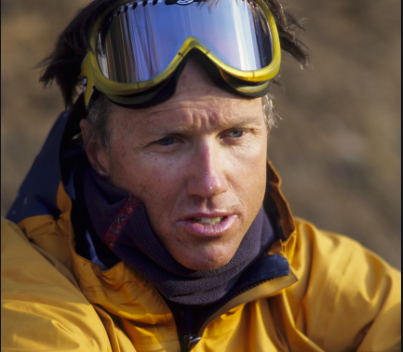
Doug Coombs
On April 6, 2006 in La Graves, he was skiing with three friends, including Chad VanderHam, a young American who had attended multiple Steep Skiing Camps and worked with Coombs in France. The last run was through some couloirs they had skied before. VanderHam skied down and went out of sight. Coombs skied to the edge of a cliff and called down to him. The other two heard Coombs call for a rope. One skied part way down but before reaching him, Coombs, on skis, had slipped off the cliff.
Chad VanderHam was declared dead by the time his copter reached the hospital. Doug Coombs, warned at 17 that his next fall would be his last, died from a broken neck. He was 48.
The book weaves Coombs’ story with Cocuzzo’s travels to document it. He follows Coombs’ path, interviewing and skiing with the people who knew him.
The author finds his stride not too far into the book. It becomes an absorbing read.
Tracking The Wild Coomba: The Life of Legendary Skier Doug Coombs. Copyright 2016 by Robert Cocuzzo. Mountaineer’s Books. Available online from $3.44.
https://seniorsskiing.com/wp-content/uploads/2019/10/Screen-Shot-2019-10-10-at-5.00.50-PM.png353230Jon Weisberg/wp-content/uploads/2014/04/Seniors-Skiing-since2013-Logo@2x-300x68.pngJon Weisberg2019-10-10 17:22:042019-10-21 09:21:41Tracking The Wild Cooba: An Appreciation
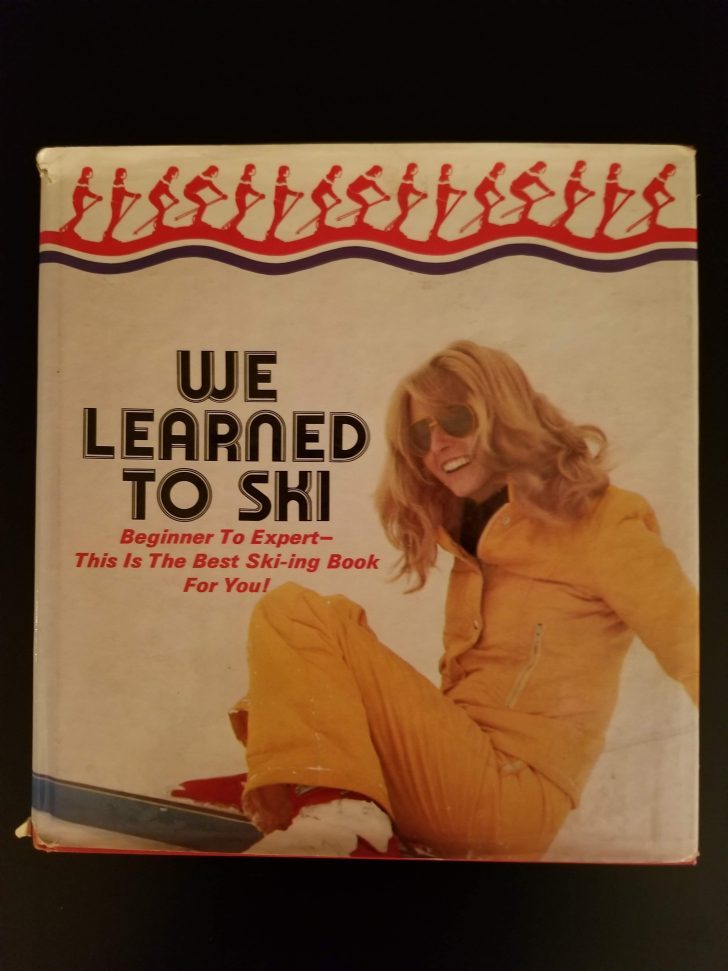
There’s a lot of skiing literature from the past, some of which still has relevance. If you have a favorite that you’d like to share with other SeniorsSkiing.com readers, please write an appreciation and send it in. Our goal is a maximum of 500 words. Thank you, Susan Zangrilli, for this nice account of We Learned to Ski.
Although equipment and ski teaching has changed since the 70s, We Learned to Ski, produced by writers and artists of The Sunday Times of London, remains one of my personal ski library favorites.
The not-quite-coffee-table 10” by 13” format is filled with photos, illustrations, easy to read headings and text, and covers everything about skiing from choosing a resort, equipment, and lessons starting from day one on snow, to getting fit for the sport.
Authors Harold Evans, Brian Jackman and Mark Ottaway write “their main impetus is a conviction about the teaching of ski movements.” They explain that the book addresses those mainly unbitten by the ski bug and recreational skiers with less than three years experience.
In Chapter 1, Where to Go, the authors illustrate “Goodalp” and “Badalp.” Lift access in the “Goodalp” allows skiers to ski the upper slopes without having to return to the bottom at the end of each run. A “Badalp” forces many of the skiers do just the opposite, creating bottlenecks at the base.
Lessons for Beginners, Stopping and Going Slow, mentions using a “half-plough,” when there may not be room for a wide basic snowplough. One ski stays flat in the fall line, the other has an open tail, is set on its inside edge, and acts as a brake. This might come in handy for me this winter.
Large illustrations in Chapter 25, Ski Craft, compare the descent of a “crafty skier” and a “snarled-up skier”; how to navigate a narrow, icy catwalk, and the best path through a mogul-filled gully.
It’s fun to read about older ski techniques in Section 6, Lessons for the Advanced Skier: the “jet turn,” with its “sit-back style,” classical and braking wedel turns, and the avalement turn to master moguls.
https://seniorsskiing.com/wp-content/uploads/2019/10/20190928_232132-1-e1571156050998.jpg971728Susan Zangrilli/wp-content/uploads/2014/04/Seniors-Skiing-since2013-Logo@2x-300x68.pngSusan Zangrilli2019-10-10 09:50:102024-08-21 10:51:171974’s We Learned to Ski: Still Fun to Read
It’s A Thriller, A History, A Love Story And More. Read It Free On Your Computer.
George Jedenoff never gives up. Credit: Harriet Wallis
George skis with enthusiasm. He cruises steep trails and shouts with glee when he jumps into powder. That’s George!
Skiers at Alta flock to him for inspiration. “Age is just a number,” he says. “Don’t let it be a barrier.” His motto is: “Never give up.” His positive outlook is a cornerstone of his life.
George’s autobiography, My Centenarian Odyssey, chronicles his life and adventures starting with his family’s flight from the Russian Revolution when he was just a toddler, coming to America, and later working as a young man in a California magnesite mine for 50 cents an hour. He graduated with honors from Stanford, served in World War II then worked his way up in the steel industry to become president of Kaiser Steel, a premier supplier of shipbuilding steel.
Along the way he learned to ski, and he’s passionate about snow and the beauty of the world around him.
Read his autobiography free on Apple Books. Or you can download it free onto your computer. Be patient as downloading takes several minutes. Click to Download
George Jedendoff is out and about. Not bad for 102. But age is just a number, right? Credit: Harriet Wallis
https://seniorsskiing.com/wp-content/uploads/2019/10/alg-2-crop.jpg480593Harriet Wallis/wp-content/uploads/2014/04/Seniors-Skiing-since2013-Logo@2x-300x68.pngHarriet Wallis2019-10-09 09:28:372024-08-21 10:51:45102-Year Old Skier George Jedenoff’s Autobiography Published On Apple Books
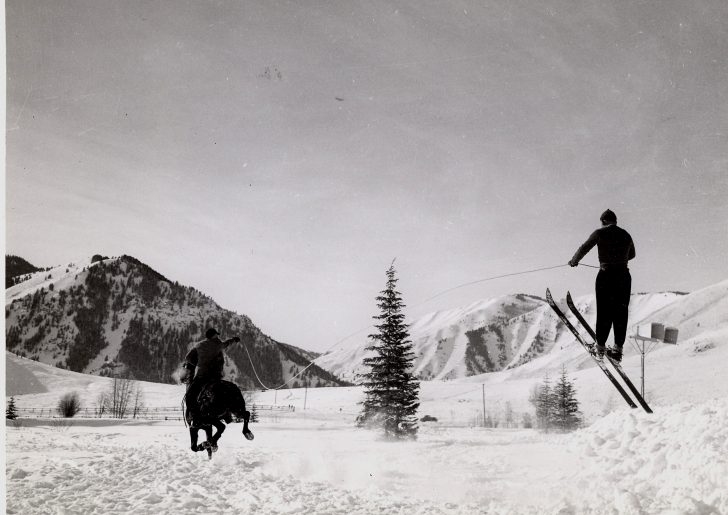
This is an Engen family photo, depicting Alf Engen himself ski-joring over a mini-ski jump behind a cantering horse. According to Jon Green, from the Alf Engen Museum, Alf participated in ski-joring quite often in Jackson Hole and Sun Valley in the mid- to late-30s, While he was most known as a ski jumper, having won the national championship title 16 times , Alf excelled at just about anything that involved skis. This is evidenced by the fact that in 1940 he became the only person to win the National Four-Way Skiing Championship (downhill, slalom, jumping and cross-country). It would seem ski-joring was just one more ski-related activity that Alf enjoyed.
Since last October, SeniorsSking.com has published 23 Mystery Glimpse photos for our readers to identify. These came from the wonderful and important collections of artifacts and photos from ski museums across the country. These museums, all supported by ski history enthusiasts like our readers, range from tiny to substantial, mostly volunteer, all non-profit, all dependent on your support. We encourage our readers to visit them online and in person. They are all carry the history of snowsports in their collections, a history that can’t be found in as much detail anywhere else.
Yes, skijoring. But where, who, when? Anyone ever skijor? What’s it like?
Credit: Alf Engen Museum
Many thanks to the Alf Engen Museum, Park City, UT, for contributing this spirited photo of skijoring in (hint, hint) the West.
The Alf Engen Ski Museum Foundationwas established in 1989 with a mission to preserve the rich history of skiing in the Intermountain Region. It strives to provide a world-class facility which highlights the many contributions made in ski area development, athletic competition, snow safety, ski innovation and ski teaching methods.
Last Week
Yes, indeed. This is the venerable Cannon Mountain Aerial Tramway. The following was adapted from the Journal of the New England Ski Museum (Winter, 2019).:
The Aerial Tramway was the first such conveyance in North America and opened for business in Summer 1938. In its first summer and fall, it carried 100,000 passengers up Cannon Mt.
That year, Hannes Schneider also arrived in North Conway to begin his stellar career as a ski instructor and innovator. Between the new tramway, the advent of Schneider, and the robust support of Harvey Dow Gibson, a North Conway-born New York financier, New Hampshire was poised to become a mecca for skiing.
Thanks again to the wonderful New England Ski Museum, now with two locations, a new gallery and archive in North Conway, and at the base of this aerial tramway at Cannon.
https://seniorsskiing.com/wp-content/uploads/2019/04/MysteryGlimpse-e1555525561720.jpg515728mikemaginn/wp-content/uploads/2014/04/Seniors-Skiing-since2013-Logo@2x-300x68.pngmikemaginn2019-04-17 14:32:512019-04-17 14:32:51Mystery Glimpse: Up, Up And Giddy-Up
One of the most enthusiastic English Victorian tourists who made a ski trip to Norway was Mrs. Alec Tweedie, author of A Winter Jaunt to Norway (1893). Not only did she sketch a vivid picture of Norwegian skiing equipment, technique, and terrain, but she also reported on the second-ever Holmenkollen Day events.
Mrs. Tweedie, then a young widow, travelled with her sister to Christiania (now Oslo) where they were met by her brother and a friend, then joined by “Herr Schmelck, one of the best skiløbers in Norway.”
Never having skied before, she decided to try it. As it turned out she loved skiing, which she described as “one of the most exhilarating and enchanting sports in the world . . . [which] bids fair to become a fashionable winter amusement for English people.”
Her description of the gear used at the time:
“An ordinary-sized man’s ski are eight or nine feet long. They are about four and a half inches wide and an inch at the thickest part, immediately under the foot, but towards either end they taper to half this thickness. . . . In the middle the toes are fastened by a leather strap. Another strap goes round the heel in a sort of loop fashion, securing the foot, but at the same time giving the heel full play. “
Although Mrs. Tweedie’s description of her “ski costume” included “short skirts, reaching but little below the knee . . .[worn over] thickly lined black knickerbockers,” the commercial photo used as a frontispiece in the book shows her skirt going right down to the ankles. The photo also reveals that the skiers used just one pole for control and balance.
Their first attempt at skiing was frustrating:
“We struggled on to the incline of the hill. Hardly had we arrived there, when off started the ski, taking us unexpectedly along on them. The pace increased each yard of the way, until over we went, dejected bundles, into several feet of snow. Was ever anything so vexatious?”
As the English tourists gained more confidence, they took a ski tour to a saeter [mountain pasture], staying in a log cabin, and working on their form, assuring the reader that “No amount of tumbling in Norwegian snow would ever give as much as a bruise. It is like falling into sand or flour, and one has only to have a shake to be as dry as if nothing had happened.”
On their last day in the mountains the determined Brits even organized races:
“We tried who could steer most equally between two given posts with only a few inches to spare on either side of the ski. Then we raced in couples, which nearly always ended in some frantic spill. Oh, how we fell over, and how we laughed and enjoyed ourselves, while the way we improved was marvelous!”
Herr Schmelck remarked, “Why, there is nothing you English ladies will not dare,” a kind observation considering that the local expert had surely seen many Norwegian ladies expertly skiing since their childhood.
https://seniorsskiing.com/wp-content/uploads/2019/04/Mrs.Tweedie.jpg16461205Jan Brunvand/wp-content/uploads/2014/04/Seniors-Skiing-since2013-Logo@2x-300x68.pngJan Brunvand2019-04-01 11:46:392019-04-03 10:07:56Miss Tweedie Goes Skiing In Norway
Hints: New Hampshire. She went to Smith. Her husband’s last name was the name of the creation.
Credit: New England Ski Museum archive
Many thanks to the New England Ski Museum, now with an Eastern Slope branch in North Conway, NH, in addition to their home base at the foot of the Cannon Mountain gondola, Franconia.
Last Week
Lots of clues here. Who’s in the speed suit?
Yes, Buddy Werner is the skier on the cover of the January 27, 1964 edition of Sports Illustrated, harkening the Winter Olympics, held that year in Innsbruck, Austria. At the time, Werner was a vibrant, new personality in the ski world, a Steamboat native, and a persistent competitor. Werner, as many senior snow sports people know, went to the 1964 Winter Olympics with Billy Kidd and Jimmie Heuga, but never placed. It was just after the Olympics that Buddy joined other athletes filming a movie in Switzerland, produced by Willy Bogner, the fashion designer. He and German racer Barbi Henneberger were lost in an avalanche during the production. He was only 28.
What makes this photo so interesting to me is that I had a similar photo tacked above my desk at SKIING Magazine, One Park Avenue, NY, NY. That was in 1970. The photo which you can see below, you have to agree, is pretty dramatic, an airborne downhill racer coming full on, in helmet and speed suit. There was no identification on the print as to who it was or when it was taken. I always wondered.
Last week’s photograph from the Tread of Pioneers Museum archive, triggered a response. I rifled through several old files, and there it was. That old picture matched the cover shot of Sports Illustrated, but obviously a different frame from the shoot. It been taken at the same on-hill session as the cover photo, and somehow a print made its way to SKIING magazine’s offices, where I commandeered it, and pinned it to the wall. When I went on to other things, I took it with me, and it’s been around ever since. And here it is.
After almost 50 years, we now know this is Buddy Werner.
https://seniorsskiing.com/wp-content/uploads/2019/03/8-2012-031-111-e1553009985633.jpg728515mikemaginn/wp-content/uploads/2014/04/Seniors-Skiing-since2013-Logo@2x-300x68.pngmikemaginn2019-03-19 11:48:362019-03-22 16:54:25Mystery Glimpse: This Lady Created The First…
Celebrating Hannes Schneider, A Pioneer Of Alpine Skiing In North America.
Jubilation at the vintage fashion show at the Hannes Schneider Meister Cup. Credit: Tamsin Venn
Every year, the Hannes Schneider Meister Cup Race, sponsored by the New England Ski Museum and Cranmore Mountain, NH, celebrates the legacy of the venerable Austrian ski instructor. For 23 years, the Cup has drawn people to Cranmore from all over to race or just cruise on this low angle dual slalom course on the Alley, where the old Skimobile ran up.
Schneider and his wife arrive via train at North Conway, greeted by his new employer banker Henry Gibson, owner of Cranmore. Credit: NE Ski Museum
This year’s March event poignantly marked the 80th anniversary of Schneider’s arrival via the Eastern Slope Express 7 a.m. Feb. 11, 1939 at the railroad station that still sits in downtown North Conway.
Any major ski resort in the US would have been thrilled to hire Schneider as ski school director, but he chose to make Cranmore his home. His family followed him into the ski business and now four generations of Schneiders are part of the family narrative.
At the recent festivities, great grandson Hannes Schneider dedicated a plaque to his grandfather, Herbert Schneider (Hannes senior’s son), who served in the 10th Mountain Division and also owned Cranmore from 1963-84. His goal had been to make sure every kid in the valley had a chance to learn to ski.
Instructors from Army’s Mountain Warfare School stand to attention at beginning of festivities. Credit: David Eden
The organizers went all out. The weekend started with a reception and hearty dinner at Zip’s (Hannes’ nickname) Pub & Grill and torchlight parade. It continued Saturday morning at Cranmore’s base with dedication ceremonies, a vintage ski fashion show (one winner rifled through her mother’s closet for an award-winning outfit), silent auction, awards ceremony, bratwurst and beer, all serenaded nonstop by the oompah music of the Bavarian Brothers Band. One felt quite transferred to Austria, instead of a quaint North Conway. All proceeds went the New England Museum, the goal being to preserve the rich ski history in this region.
Schneider’s story is an intersection of politics and skiing. Here’s the short version.
Hannes Schneider ran a ski school in St. Anton Austria, where he promoted the new Arlberg technique and helped bring important tourism business to the region. As a high-profile critic of Hitler, he drew ire from the Nazi party who threw him into prison. With the intervention of a German skier friend who was also an attorney, and Harvey Gibson, an influential American banker, Hannes eventually found refuge in the US where Gibson set him up as ski school director at the new snow-train-served resort Gibson opened in North Conway.
For competing in the Ski Meister Cup, or any ski race, here’s general advice for seniors. If it’s a fundraiser for a worthy cause, it’s easier to justify having more youthful competitors heartlessly whiz by you on a parallel GS course.
In North Conway, visit the Eastern Slope Branch of the New England Ski Museum, opened only a year ago, a companion to the one in Franconia.
[Editor Note: SeniorsSkiing.com is again asking our readers to contribute to support our online magazine. Yes, we have grown in the number of subscribers and advertisers. But our expenses have also grown. You can help us defray some of these expenses by helping us out with a donation. This year, we have a mix of premiums for different level of donations, including stickers, sew-on patches, our new SeniorsSkiing.com ball cap. All donors will be entered into a drawing for a pair of bamboo Polar Poles to be drawn in late March. You can donate by clicking here.]
How Did A Then-Revolutionary Sport Become Mainstream? Hint: Epic Parties.
[Editor Note: Roger Lohr is the publisher of XCSkiResorts.com and SeniorsSkiing.com’s cross-country editor.]
The book Snowboarding in Southern Vermont: From Burton to the U.S. Open” by Brian Knight on History Press is a snapshot of the 1980s and 1990s during the early days of snowboard lore. The book is a fine encapsulation of snowboard history with an amazing collection of photos of those early days at the region’s ski areas Stratton, Bromley, Magic Mountain, and Snow Valley.
The book traces Jake Burton Carpenter’s life through Londonderry, Manchester, and Stratton Mountain, VT, as he became the proprietor of Burton Snowboards. He shared the spotlight with Donna Carpenter, a woman he met whom he eventually married. She is cited in the book for “heavy lifting” in the early development of Burton Snowboards which was to become a significant force in the sport. Jake’s infectious enthusiasm and the lengths he went through to get Burton Snowboard started required visionary decision-making and resulted in a very influential company in the snowsports world.
There are hundreds of names that are weaved into the Southern Vermont story such as Paul Johnston the Stratton mountain manager, who had an open mind about snowboarding in the beginning; Lyle Blaisdell, the backhoe operator with the half pipe-carving Midas touch; and other snowboard dignitaries such as Tom Sims, Chuck Barfoot, the Hayes brothers, Neil Korn, Lindsey Jacobellis, Mark Heingartner, Craig Kelly, Dave Schmidt, Terje Haakonsen, Tricia Byrnes, Ross Powers, and Shaun Palmer.
The book’s vibe of the times is also expressed with tales of epic parties and Burton home-grown spirit. The competition parties perhaps far-out shined the half pipe competition. Spectators at the U.S. Open experience left the event site littered with beer cans and booze bottles, enjoying debauchery and mayhem at “snowboarder residences” throughout the region. The parties hosted by Burton and other purveyors of every imaginable snowboard-oriented product were often topped by the Hayes’ brother infamous gatherings.
The early days were rife with teenage posse behavior both on and off the slopes and age antagonism as skiers fought back to reject the newcomers at the ski areas. The book outlines the certification concept which was a test that snowboarders took to earn the right to get access to the slopes at Stratton. There were many nights when sneaking snowboarders walked up the ski area slopes to make some runs.
The U.S. Open was established as an institution before snowboarding got any television coverage. The time when the Olympics gobbled up snowboarding as a prime time hook for viewers was still in the distant future. During the sunrise of snowboarding, the camaraderie between participants was more important than winning the Open. But the event declined as limits were continually pushed with profanity, violence, and even death when two guys snow caving in the parking lot were crushed in a very sad mishap.
The road to the Olympics was very bumpy for snowboarders coming out of Southern Vermont. Jake Carpenter called the Nagano Olympics, which was the first of the quadrennial competitions to feature snowboarding, “kind of a disaster.” The U.S. Open grew each year and eventually mainstreamed with the elimination of alcohol, superior rider athleticism, and a send off to Stratton’s Sun Bowl so it was not in the main area.
Southern Vermont in the late 80s may have been the epicenter of snowboard culture and the U.S. Open was the crown jewel of snowboard contests. By 2012, that sub-culture had run its course, and it was the end of the era. The event was moved to Vail. The book states “The Vermont brand can launch a business but rarely can sustain it.” For years, coverage of snowboarding was invariably about the jargon, the fashion, and the rebelliousness rather than the joy of floating in powder, dodging trees after a snowstorm, or twisting in the air. “Snowboarding in Southern Vermont” is a quick read that establishes the record of snowboarding’s early days there, and we should be thankful that this record is now public for all.
[Editor Note: As the new year begins, SeniorsSkiing.com is again asking our readers to contribute to support our online magazine. Yes, we have grown in the number of subscribers and advertisers. But our expenses have also grown. You can help us defray some of these expenses by helping us out with a donation. This year, we have a mix of premiums for different level of donations, including stickers, sew-on patches, our new SeniorsSkiing.com ball cap. All donors will be entered into a drawing for a pair of bamboo Polar Poles to be drawn in late March. You can donate by clicking here.]
While We’re On Ski Jumping…
Two jumpers? Looks like a long time ago.
Last week, a few readers who know their ski history, nailed the Mystery Glimpse Big Jump as the Big Nansen Jump in Berlin, NH (see below). Let’s see if anyone can identify what is happening here and where. Hint: Not New Hampshire.
Last Week
The Big Jump is Big Nansen, the venerable jump in Berlin, NH. Some highly knowledgeable SeniorsSkiing.com commentators got the facts exactly right. Built circa late-1930s, Big Nansen dominated US ski jumping for many decades. Here is an excerpt about the jump published in the Journal of the New England Ski Museum (Winter, 2018):.
“Built on steep trusses and towering 171 feet high, the Nansen jump was at the time the largest ski jumping tower in the world. In 1938, the jump’s inaugural winter, the Nansen hosted the Olympic trials. Over the next several decades, it would be the site of the myriad jumping competitions, from Winter Carnival events to four U.S. Ski Jumping National Championships in 1940, 1957,1965, and 1972 before falling into relative obscurity.”
The last competition was held there in 1985. A severe accident to a college-age ski jumper in 1977 had brought a lawsuit to the US Ski Association, the Nansen Ski Club, and others that added to the jump’s decline. However, in recent years, the Friends of Nansen Ski Jump was formed to revive the jump and the sport in Berlin. Red Bull, the energy drink folks, happened to be working on a documentary about US Ski Team Jumper Sarah Hendrickson, and became interested in restoring the jump. In 2017, Hendrickson took off from Big Nansen, the first jump from the structure since 1985. She went on to compete in the Pyeongchang Olympic games.
The Friends Of Nansen are planning to use the site as a training ground for young jumpers.
SeniorsSkiing.com highly recommends exploring The New England Ski Museum and its well-researched Journal. The Museum has two locations in New Hampshire, one at the base of Cannon Mountain’s gondola in Franconia Notch, and a newly opened Eastern Slope Branch in North Conway. For more information, consider visiting online and in person.
Sarah Hendrickson’s jump from a restored Big Nansen in 2017. Credit: Red Bull
https://seniorsskiing.com/wp-content/uploads/2019/02/Screen-Shot-2019-02-19-at-12.28.25-PM.png431308mikemaginn/wp-content/uploads/2014/04/Seniors-Skiing-since2013-Logo@2x-300x68.pngmikemaginn2019-02-20 09:05:402019-02-21 11:00:06Mystery Glimpse: More Ski Jumping
[Editor Note: As the new year begins, SeniorsSkiing.com is again asking our readers to contribute to support our online magazine. Yes, we have grown in the number of subscribers and advertisers. But our expenses have also grown. You can help us defray some of these expenses by helping us out with a donation. This year, we have a mix of premiums for different level of donations, including stickers, sew-on patches, our new SeniorsSkiing.com ball cap. All donors will be entered into a drawing for a pair of bamboo Polar Poles to be drawn in late March. You can donate by clicking here.]
He inspires with fitness and wisdom.
George at 101. Credit: Harriet Wallis
For George Jedenoff, skiing is a way of life. He skis Alta’s slopes every day when he’s in Utah. He charges down steep groomed slopes, but he loves to tear up powder.
He can do it at 101 years of age because he keeps himself
fit. He does a 45 minute workout every day before breakfast.
“I know I’ve got to stay in shape or I won’t be able to
ski,” he says. Staying fit for life is a lesson we all might learn from him.
George was 43 when he learned to ski — not exactly a spring
chicken. He was athletic, so he decided to try skiing after he came to Utah to
be the general manager of the Geneva Steel Plant, the largest steel plant west
of the Mississippi.
He learned from the best: Alta’s legendary Alf Engen, ski
pioneer Junior Bonous, and Earl Miller, the granddaddy of release bindings.
“While buying my first pair of skis in Orem, I ran into Earl
Miller who offered to teach me how to ski. Of course I used Miller bindings –
the only safe bindings available at that time. We used the rope tow at Alta
Lodge for my first lesson,” he said.
Miller promoted his bindings with photos of himself in wild
falls showing how the bindings released. “One day Earl paid me quite a
compliment: ‘You know, George, you’ve made some falls I’ve never seen
before!'”
But George learned quickly, and he fell in love with the
sport, the scenery, the fresh mountain air, and especially the powder.
When he was transferred away, community leaders gave him a
gift to lure him back — a Lifetime Season Pass to Alta. He’s still using it!
He bursts with enthusiasm for snow and for life. I
recently rode the chairlift with George, and I asked for his advice.
George Jedenoff, 101 year old Patriarch Of The Powder. Credit: Harriet Walls
“You don’t have to be good, you just have to live
long enough,” he quipped.
Then he offered serious wisdom. “Always be kind to others. Count your blessings, and don’t let life’s problems overshadow the good in life. And above all, never give up.”
We can learn a lot from this patriarch of the powder. He’s a
role model for skiers or all ages.
Ski Utah makes a video of George every year when he returns to ski. Click here to view last year’s video of George when he was 100.




 This photo was taken at The Hotel Jerome in Aspen. The photo is believed to have been taken in 1948, but some indications from the scrapbook this photo came from indicate a date as early as New Years 1939. The Jerome was built in 1889 and is often described as one of the city’s major landmarks. In 1986 it was listed on the National Register of Historic Places. During Prohibition a celebrated spiked drink, the Aspen Crud, was invented at “J-Bar”. Later, the drink and the bar became popular with members of the 10th Mountain Division while they trained in the area. After the war, Aspen and its new ski resort became a popular destination. Celebrities vacationed in Aspen like Gary Cooper, John Wayne, and Hunter S. Thompson.

 Rudi Wyrsch was the self proclaimed Pied Piper of skiing and taught children not only how to ski but how to have fun on and off the snow. From Piperville, his name for the Mt. Snow pee-wee playground/ski school, to his 12 foot stilts, Rudi was a master at engaging children with entertainment. Once a member of the Swiss national team and coach of the British, Australian, and New Zealand ski teams, Rudi worked at Mount Snow in the 60’s – 70’s. After wowing the kiddies on the hill, Rudi entertained adults back in the lodge with joke-telling, magic tricks, and juggling.




 This sculpture depicts a sport poised at a turning point on the edge of change. Soon, metal and synthetics would become standard in ski construction in place of wood that had been in use for more than 4,000 years. Pioneering skiers used a single wooden pole. By the early 1900s, two poles were in fashion. The shafts were often made from bamboo until superior poles of a light metal alloy were developed. Higher, plastic ski boots featuring buckles marked the passing of lace-up leather boots.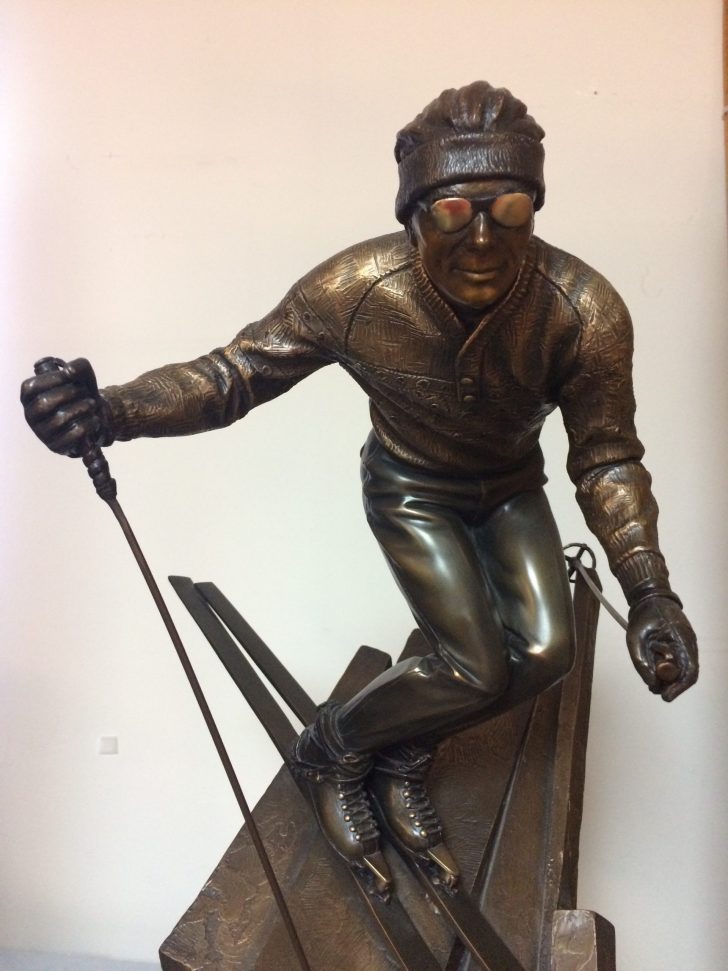
 The Fountain Mountain at Mt. Snow, VT was the subject of last week’s mystery. According to Mt. Snow’s Jamie Storrs, the Fountain was switched on for the first time on January 18, 1965












 Yes, indeed. This is the venerable Cannon Mountain Aerial Tramway. The following was adapted from the Journal of the New England Ski Museum (Winter, 2019).:




 The book Snowboarding in Southern Vermont: From Burton to the U.S. Open” by Brian Knight on History Press is a snapshot of the 1980s and 1990s during the early days of snowboard lore. The book is a fine encapsulation of snowboard history with an amazing collection of photos of those early days at the region’s ski areas Stratton, Bromley, Magic Mountain, and Snow Valley.
 The Big Jump is Big Nansen, the venerable jump in Berlin, NH. Some highly knowledgeable SeniorsSkiing.com commentators got the facts exactly right. Built circa late-1930s, Big Nansen dominated US ski jumping for many decades. Here is an excerpt about the jump published in the

