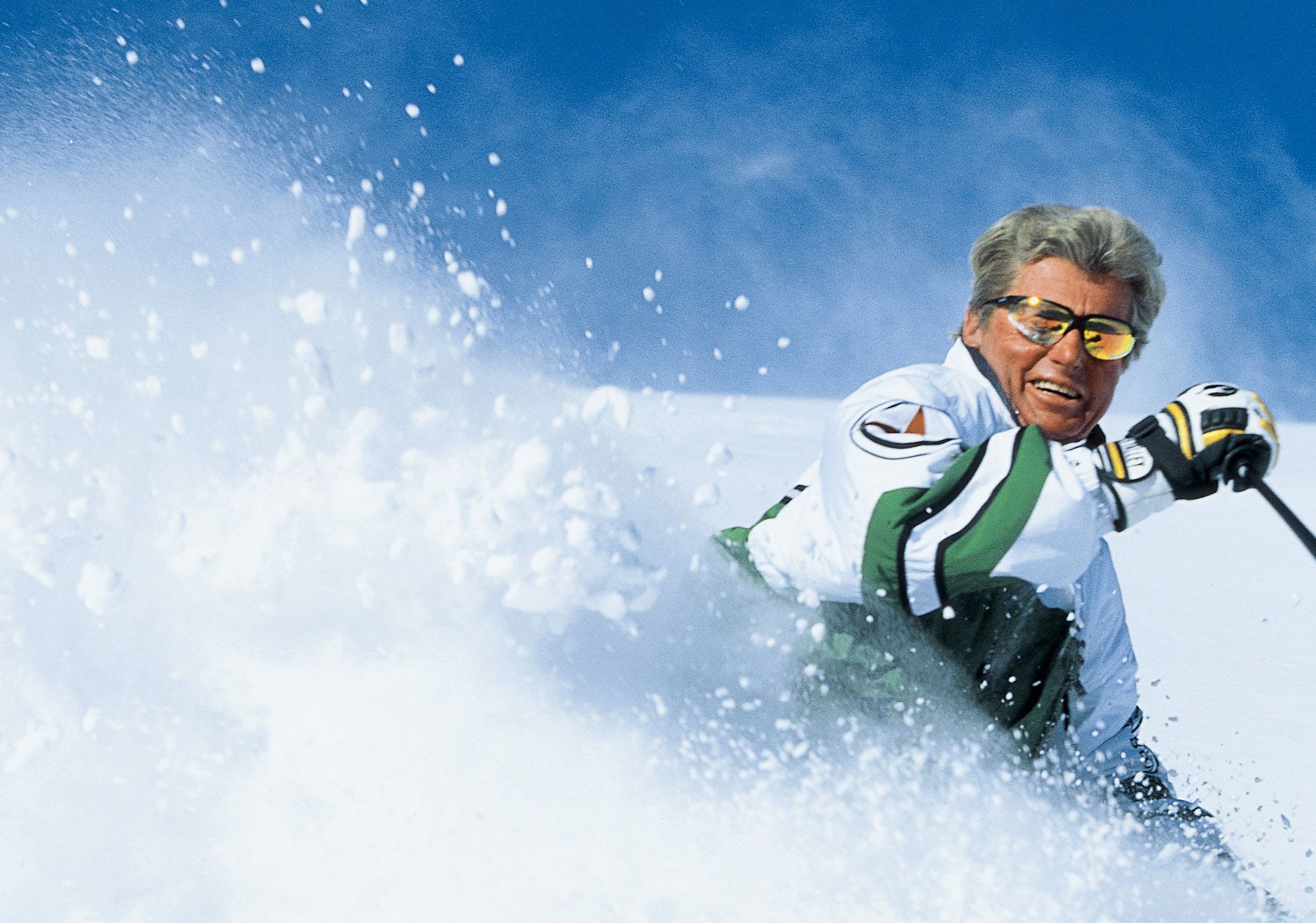

Stein Eriksen, 1927-2015
A Legend Moves To The Other Side Of The Mountain.
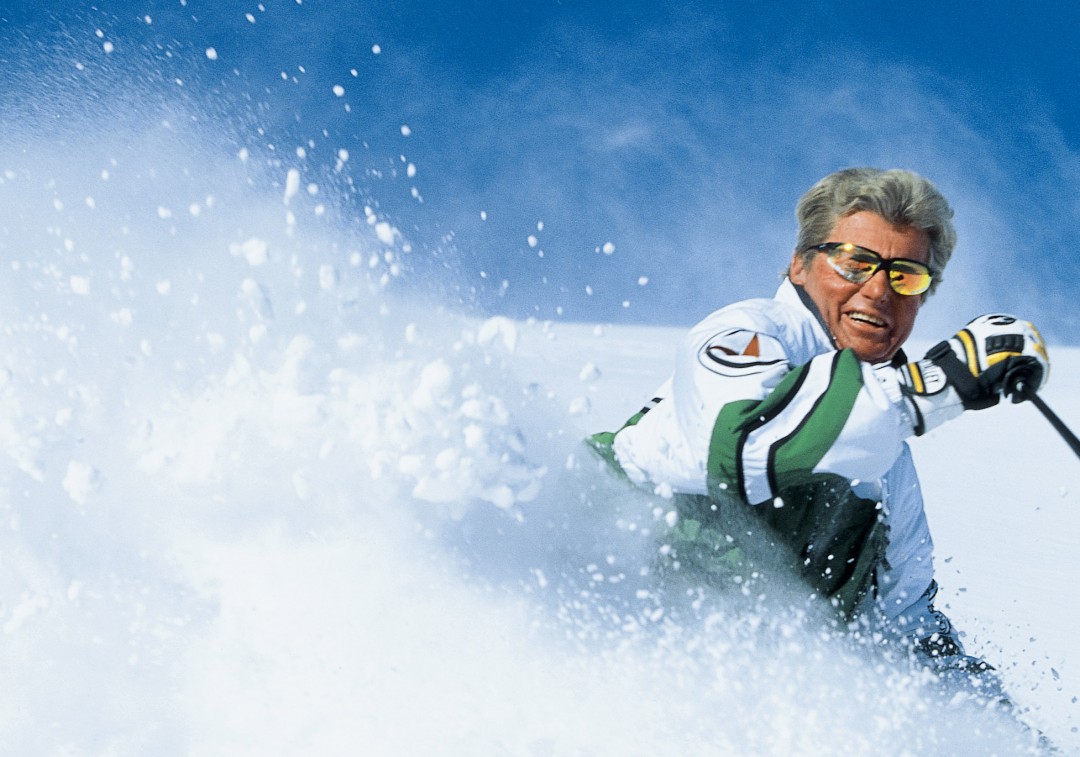
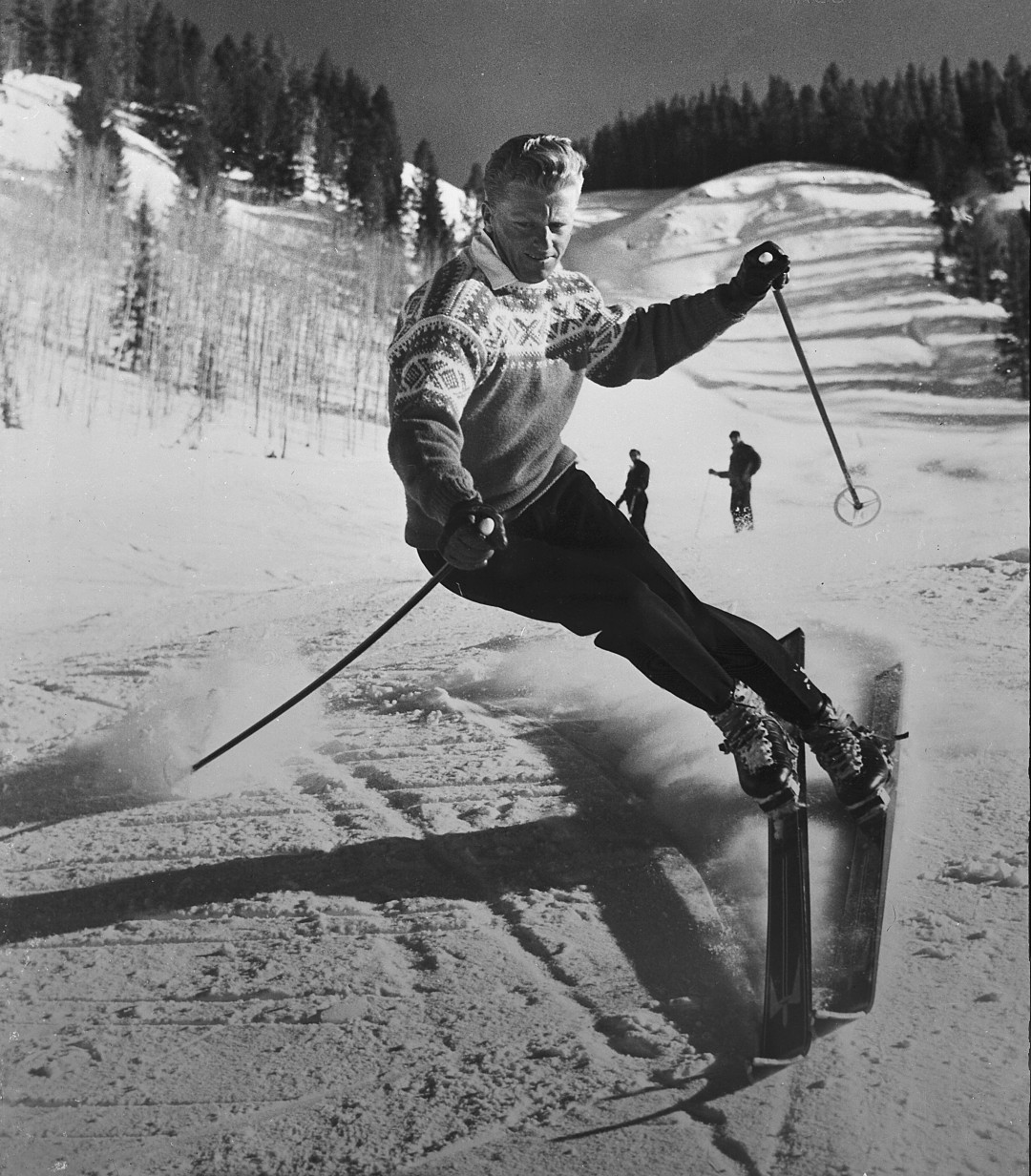
An elegant skier, Stein Eriksen was an Olympian, instructor, skiing ambassador and charming personality.
Credit: Deer Valley


An elegant skier, Stein Eriksen was an Olympian, instructor, skiing ambassador and charming personality.
Credit: Deer Valley


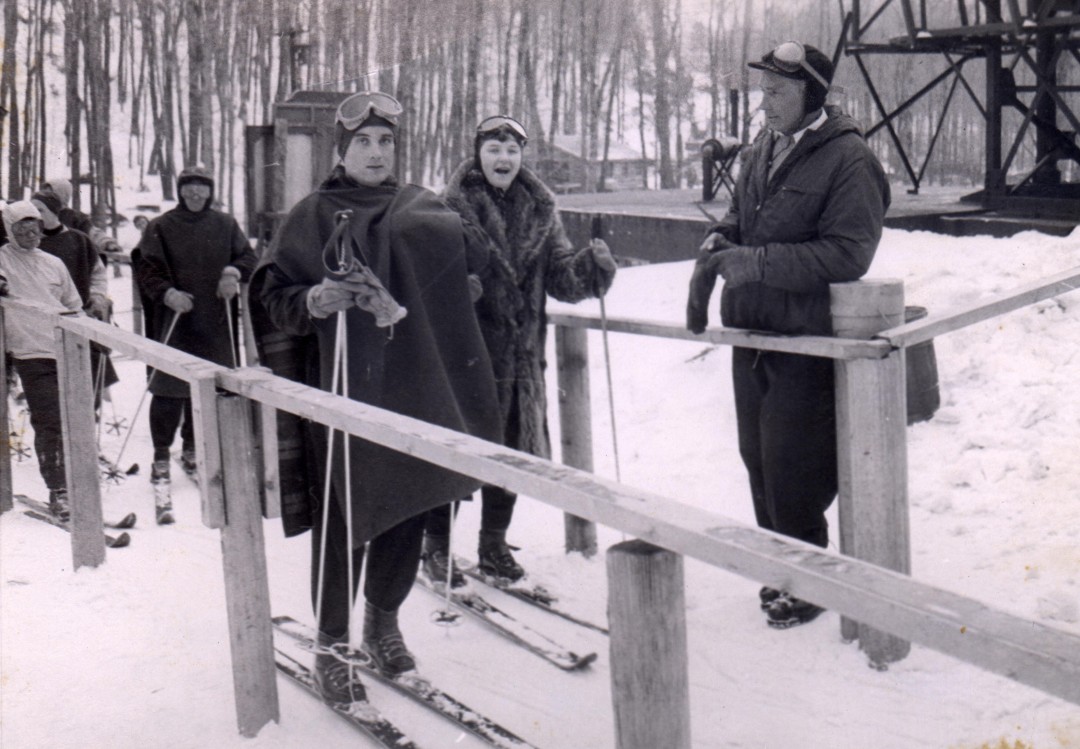
There was a time lift blankets and fur coats kept you warm on chilly days. Here Mad River GM Ken Quakenbush checks tickets on the single chair, circa 1953.
Credit: Mad River Glen
Remember the good old days when we did not have high tech fabrics, boot heaters, hand warmers, and lots of layers to keep us warm as we rode up the single chair lift in our wooden skis with screwed on steel edges and Dovre safety bindings. The lift could be a very cold, one-mile long ride.
At Mad River Glen and other resorts (I remember Stowe), we would pick up a wool poncho type blanket off the rack, slip it over our head, and try to not get it twisted as we loaded the lift. The blankets are no longer there, but the single chair is.
We would then hide under it on the way up the lift. And for a small kid, we also had to worry about not tripping on it when we got off.
I joined the patrol at Mad River in 1962 and still remember those blankets being in use. The lifties at the top would bundle up three or four and try to slam them across the arm of the chair so they would stay there until they were removed at the bottom. On windy days, the occasional bundle would be lifted off the chair, separate into individual blankets and gracefully descend onto the trail below. And, if it was particularly gusty, one or more would end up in a tree anywhere from 10 to 30 feet off the ground.
One of the duties of the patrol was to regularly to ski the lift line and pick up the blankets that had blown off the chairs on the trip down the hill.
This was in the days before the entire lift line was designated trails. On the top of the lift line above mid-station (remember the old 1/3 tickets they gave out if you got off there), picking up blankets on the Chute was relatively straight-forward. We would pick up two or three, roll them into a bundle, and heave them underhanded up to some willing customer in a chair. Of course, this provided great entertainment to the other customers on the lift as many of the throws and catches were not major league quality.
And, if we were in an area that was too high to toss them, we would end up wearing them, sometimes up to five or six. We looked and skied like a gray version of the Pillsbury Dough Boy.
Much of the lift line from mid-station down was not legitimately skiable terrain. So only the hardy patrollers ventured into that territory to retrieve blankets. And as the lift was rather high off of the ground, this usually entailed wearing them down over the cliffs and through the underbrush, again to provide entertainment for the customers. There are great stories of tumbles down the steep faces, and blankets getting tangled up and tripping the patroller.

Former GM Ken Quakenbush takes the last ride up the single chair at Mad River before it was restored in 2007. Credit: Mad River Glen



Ski Archives glittering gala was held on Nov. 5 at the Grand America Hotel, Salt Lake City.
Credit: Harriet Wallis
The country’s largest ski history and research organization, Ski Archives, held its annual gala and fundraiser that helps support its mission. And SeniorSkiing.com contributed four gifts to the silent fund raising auction.
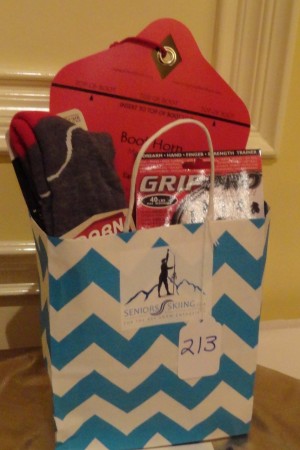
SeniorsSkiing.com contributed four gift bags to the Silent Auction.
Credit: Harriet Wallis
Each SeniorSkiing gift included ski socks by Darn Tough of Vermont, a GripPro hand strength trainer, and a Boot Horn that slides your foot easily into ski boots.
The Ski Archives gala event honors individuals and organizations that set the high mark for their influence on the ski industry.
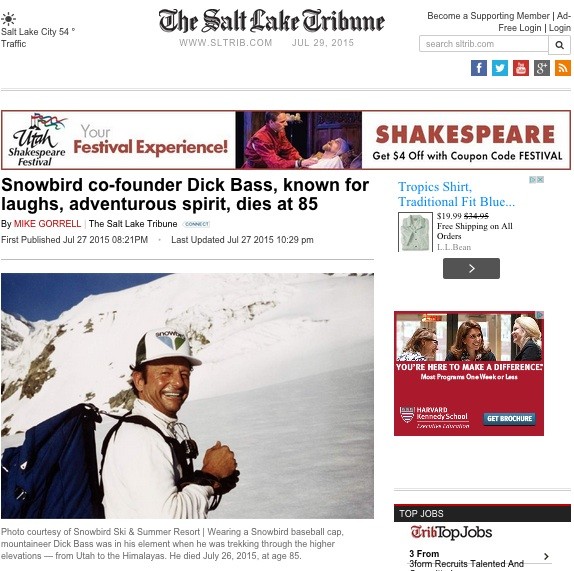
This year, the late Dick Bass, the co-founder of Snowbird, unstoppable outdoor enthusiast, and the first person to climb the highest point on each of the seven continents, was posthumously awarded the S. J. Quinney Award for his contributions to the ski industry. Bass died in July.
“He had a life long love affair with Mother Nature,” said his son who accepted the award.
And Ski Utah earned the state’s top ski industry award—the J. Willard Marriott Library History-Maker Award—that’s presented for extraordinary accomplishments in winter sports.
For 40 years Ski Utah, the state’s non-profit trade organization, has been promoting Utah’s fabulous snow that pumps $1.3 billion annually into the state’s economy. It markets come-to-Utah tourism worldwide, and it fosters winter recreation for in-staters.

The late and legendary Dick Bass, co-founder of Snowbird, was honored for his contributions to the ski industry.
Credit: Snowbird
In a nutshell, Ski Utah promotes the ski industry and the Ski Archives preserves the history of it.
The Ski Archives was founded about two decades ago by ski enthusiasts and visionaries who realized that historic ski photos and manuscripts should be collected to assure they wouldn’t be lost in dusty attics and that old albums wouldn’t be tossed out. The resulting collection is housed in Salt Lake City on the University of Utah campus in the J. Willard Marriott Library, and it’s called the Ski Archives. It has grown to be the largest cache of skiing and snow sports history in the country, it’s a prime research collection, and it’s open to the public. This year’s event was held November 5 at Grand America Hotel in Salt Lake City.
As Junior Bounous celebrates his ninth decade, we salute his love of the sport and his motivation. His message to the rest of us is simple: “Keep moving!” Check. Thanks, Junior and have a great birthday.
Here’s a short documentary produced by Snowbird that chronicles Junior’s trip down the Pipeline at age 80.
Credit: Snowbird Resort
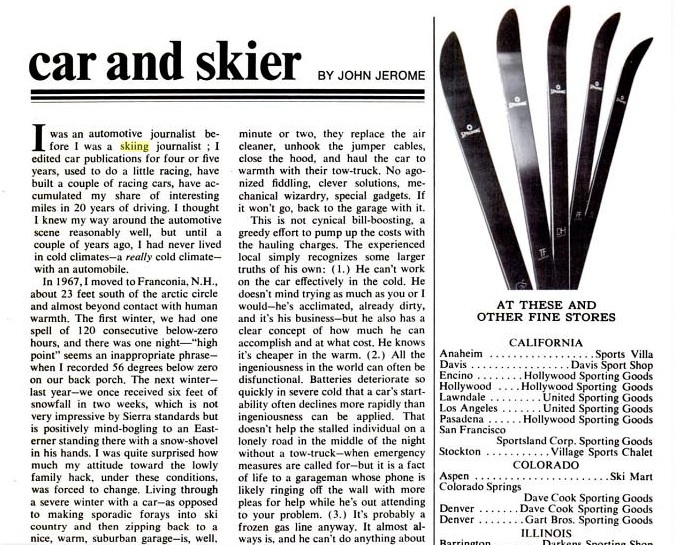

Back in the early 70s, as assistant editor at SKIING Magazine, then located at One Park Avenue in New York, we would occasionally watch a typescript from John Jerome arrive in the mail and work its way through the editorial process. After reading a couple of paragraphs, it became clear that these words were not the usual ski article patter. John was a skilled observer, first requirement of an essayist extraordinaire, and was able to tell stories and administer advice about simple things in a way that revealed a writer was at work.
John Jerome was a polymath; he started in automotive journalism (he was editor at Car and Driver), became a skiing savant (he was editor at SKIING), re-located from the “city, working for magazines, wrestling with words and paper in tall buildings under fluorescent lights” to New England. There, as a freelance, he wrote books and many articles about running, building stone walls, becoming an aging athlete, mountains, the value of stretching, and, yes, skiing. And the halo of subjects around skiing, like cars and winter. Here’s an excerpt we just re-discovered by glancing through a November, 1969, SKIING article, “Car and Skier”. He’s talking about one of the two main problems of winter driving he learned by living in cold-winter New Hampshire, getting unstuck:
“Getting unstuck, or not getting stuck, is a much more diffuse problem, against which logical, ordered stops are not so effective. I hate and despise snow tires, but I put ‘em on, and they saved me a lot of grief. My prejudice was based on their noisiness and feel at highway speeds; what I didn’t realize is that a large part of the process of not getting stuck is a kind of metaphorical shifting of gears that takes place when you are a severe-winter resident. You simply slow down. When winter closes in, you bank your metabolism and your frustrations, and settle down into a calm and bumping 25-mile-per hour way of life. It does wonders for keeping you out of snow banks, and it also overcomes a lot of prejudices about snow tires. You can spot winter tourists by how fast they drive more quickly than by their plates. So can the cops.”
The first problem of winter driving, if you’re wondering, is getting started. Solution: Bring car battery into house at night.
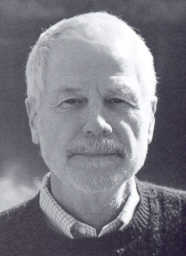
John Jerome, prolific writer, observer, athlete, contemplator of things.
Good writers see connections between things in the world that others either don’t see, or don’t see until the writer points them out. John Jerome was good at that. Here—in this excerpt from his book Stone Work— he makes a link between the rhythm of placing stones on a wall and making linked turns in skiing. On finishing the placement of a stone—the last step of the cycle: start, the move, the finish—he says:
“Sometimes, there is more difficulty in finishing moves than in starting them. I first ran across this principle in downhill skiing, where great instructional emphasis is placed on completing one turn in order to get the next one started right. This didn’t make a whole lot of sense to me: you have to stop turning in one direction if you’re going to start turning in the other, don’t you? I flailed and flummoxed my way through a lot of awkward moments before the significance of the advice sank in. Finishing is a positive act. A ski turn carried to its logical physical conclusion ends with an edge-set that make a stable platform from which to start the next turn. ‘Finished’ means your weight is in the right place, your body and skis prepared for whatever comes next. Without it, you’re in trouble. You have no ‘timing’.’
John Jerome was contemplative writer who wrote in a way that made you feel you were talking with a very interesting friend over a very good drink.
His books are still available on Amazon.com. Have you read Truck, Staying With It, or Staying Supple?


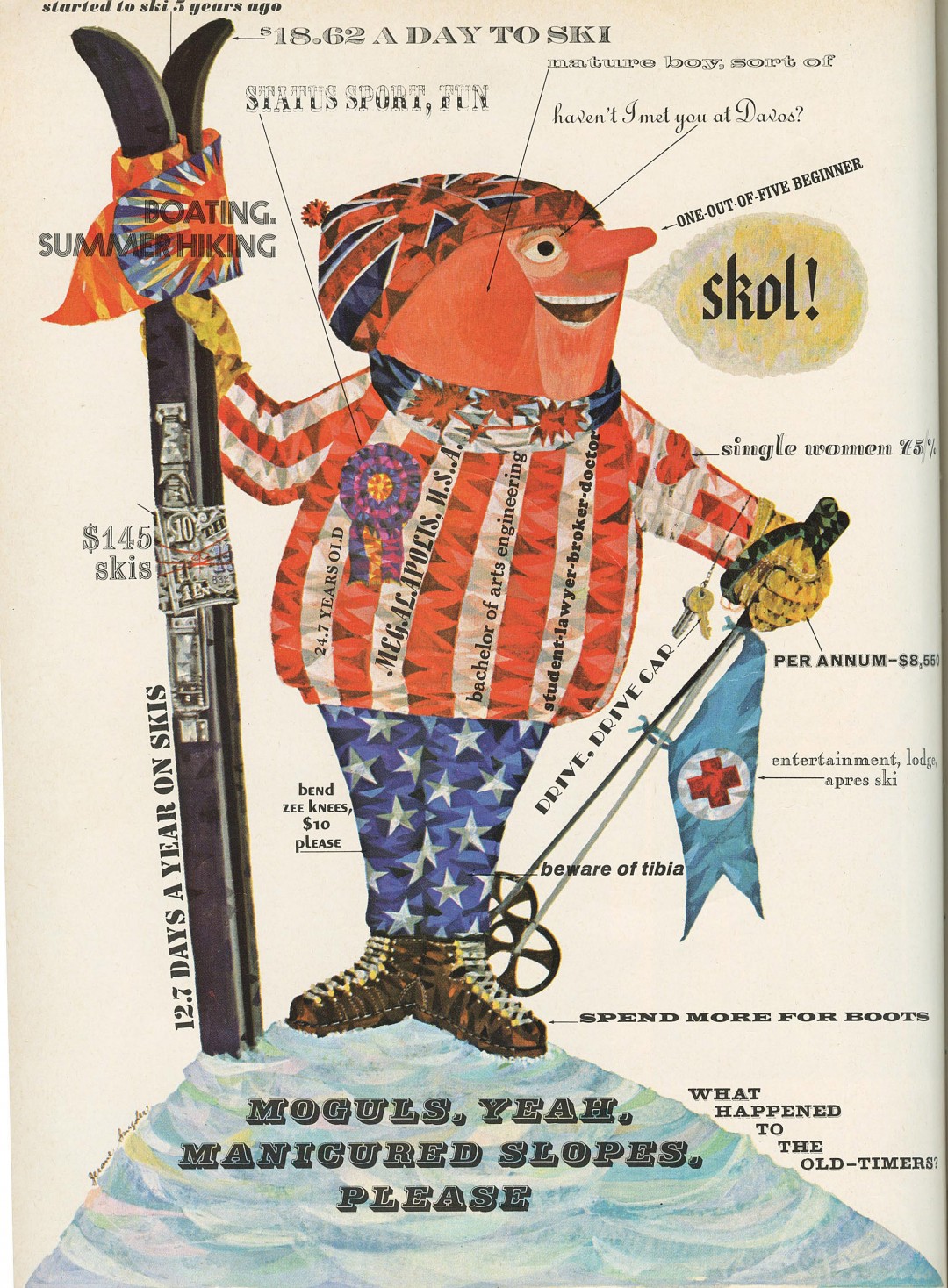
From a 1964 SKI magazine, a skier poses with his attitude.
Illustrator: Jerome Snyder

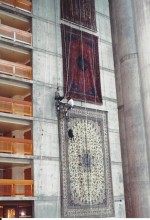
Climbers hang rugs on 11-story Atrium wall.
Credit: Harriet Wallis
Dick Bass was always enthusiastic about everything. He was witty and lively, and he always seemed to be in a jovial
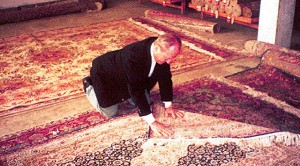
Snowbird founder Dick Bass inspects some of his fabulous collection of Oriental rugs
Credit: Snowbird
mood. He often spent time at his loved Snowbird Ski and Summer Resort, and you could always tell when he was there because he’d be in the center of a group and he’d keep them laughing. He loved to indulge anyone who would listen to his tales and insights. Because of his talkative nature he called himself “the big mouth Bass.”
He loved art and literature, and he had an incredible Oriental rug collection that he displayed at Snowbird. The huge, colorful rugs carpeted many floors in the Cliff Lodge. Skiers probably had no idea they were walking on a fabulous collection. For other rugs, he hired rock climbers to scale the massive 11-story tall concrete walls in the lodge’s Atrium and hang them there for display.
Dick Bass seemed to function on only one speed: full speed ahead. We’ll miss him.
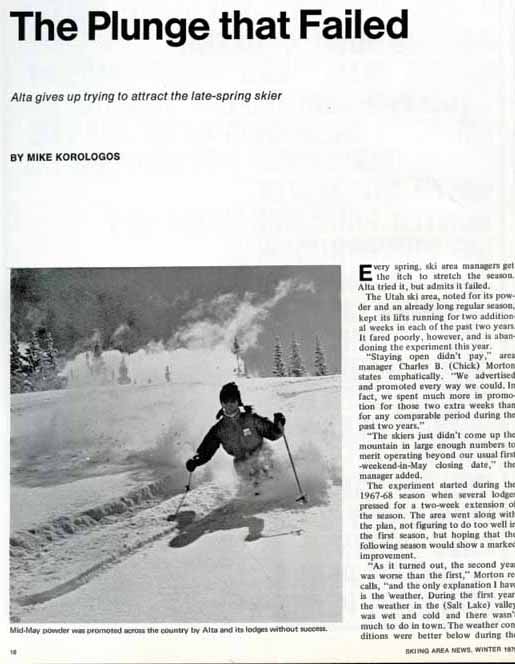
With so many late, unexpected and unusual snowfalls this late spring, we wondered if people were still showing up. After all, it is almost boating season. Yet, a report last week from Faithful Subscriber Paul Remillard showed us that there are die-hards out there. It was not always thus, apparently.
We discovered this article from an archive copy of SKIING AREA NEWS, Winter 1970. An article by Mike Korologos describes an attempt by Alta to stretch the season by two weeks. Unfortunately, no one showed up. “Staying open didn’t pay,” said the then area manager Chick Morton. And that’s after spending more on promotions for those two weeks than any other comparable period during the “real” season.
Morton said he blamed the lack of spring skiing crowds to skiing patterns. The article states that “When May Day arrives, the cry is ‘Head for the links,’ regardless of how good ski conditions are.”
That was 45 years ago. Is it still the same today?
From Skiing Area News, Winter 1970.
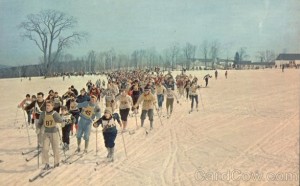
1970 Washington Birthday Race start. Everyone goes at once. Credit: Lewis R. Brown via CardCow.com
It is that special interim period here in New England between the end of winter and the start of spring. Last week, we headed out across the corn snow at Appleton Farms in Ipswich, MA., in the bright, and, yes, warm sunlight. We recalled the first time we skied around the edges of farm fields, way back in 1970 when we stayed at the Whetstone Inn in Marlboro, VT. We were there for the Great Washington Birthday Race, an annual “people’s race” at the Putney School started and run by the legendary cross-country racer and coach John Caldwell. In those days, hundreds of skiers came to Vermont for what must have been the defining event of Nordic skiing in the United States. Modeled after the famous Vassaloppet race in Sweden, the massive starting line stretched across a hay field and, when the gun sounded, it was off you went. We remember skiing along with the then-movie critic of the New York Post, an older chap who said he skied around the field behind his house in Westchester every morning before heading into work. We also remember struggling in dead last in that race along with a couple of other members from the then-staff of SKIING magazine, our wax long worn off, but still laughing at our disastrous first-time-ever trying cross-country skis.
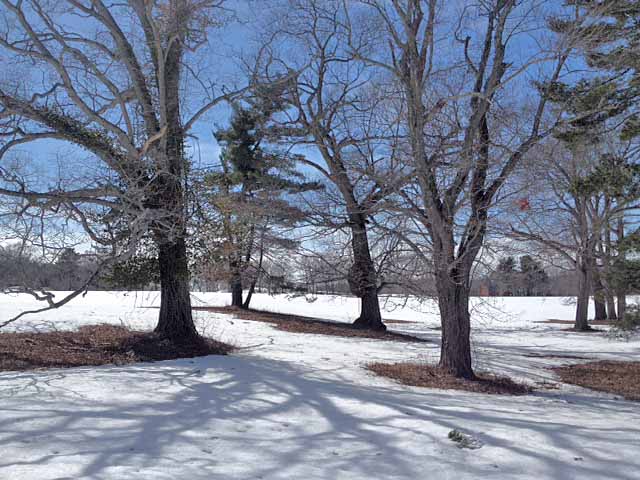
Snow is hanging on this year, melting slowly but inevitably, starting with the trees.
Credit: Mike Maginn
These thoughts came back as we went around that big field at Appleton’s. For a long time, we favored wooden skis, woolen sweaters and wax potions; these days, we go waxless and polypropylene. But the pleasure of being in the sun, noticing the melt around the edges, and the rhythm of planting pole, gliding, planting was the same as ever. As the snow rolls back and the sun comes in and out, Robert Frost’s Two Tramps In Mud Time came to us. This verse hits home:
The sun was warm, but the wind was chill. You know how it is with an April day.
When the sun is out and the wind is still, you’re one month on in the middle of May.
But if you so much as dare to speak, a cloud comes over the sunlit arch,
A wind comes off a frozen peak, and you’re two months back in the middle of March.
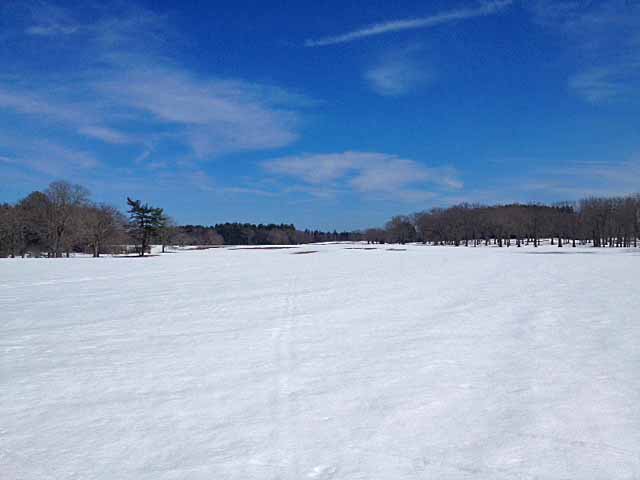
Sunny day, springtime snow, skiing across the field at Appleton Farms, Ipswich.
Credit: Mike Maginn
Signs that the season is ending are starting to sprout along with the crocuses. In the East, many areas will be closing this weekend; there’s still lots of snow on the ground, but many lift lines are nearly empty even on the weekend. Many skiers have had enough. Out West, conditions have been marginal to miserable all season. There’s plenty of cross-country skiing though, even in urban areas in New England, and we’ve been out in the sunshine several times in the last week.
But, can you beat this video from the British Nordic Ski Team, circa 1957, picturing Dutch ski enthusiasts roller-skiing along? It is possible that for some the season never ends.
Roller-skiing is not a new idea. At least you don’t need long underwear.
Credit: British Nordic Ski Team

Appleton Farms, Ipswich, MA.
Credit: SeniorsSkiing

Great Pasture, Appleton Farms, Ipswich, MA.
Credit: SeniorsSkiing
SnowSports Industries America (SIA) is the ski trade association of suppliers to consumers. Think equipment manufacturers, clothing designers and providers, retailers, reps and media, everyone who gets the skier, boarder, X-Cer, backcountry adventurers and snowshoer out on the snow. SIA puts on global trade shows, publishes extraordinary research on market trends, advocates for the industry with government regulators and provides a platform for networking and Founded in May, 1954 as the National Ski Equipment and Apparel Association, the organization is proudly celebrating its 60th year. Here’s a tribute SIA produced with scenes from the by-gone snow sports of the 50s and 60s to present day. It’s an anniversary present from SIA to snow sport enthusiasts everywhere.
Cody Townsend, professional free skier and athlete, takes on the most improbable ski run we’ve ever seen. The scene is a near vertical chute in Alaska’s Tordrillo Mountains, more like a elevator shaft than a ski run. This scene is a clip from Red Bull’s documentary, “Days of My Youth.” We are certain that the legendary Dick Buek, winner of the 1952 Olympics downhill and probably the original extreme skier, would approve. This stunt is reminiscent of Dick’s daredevil runs; he was the first person to schuss Exhibition at Sun Valley, something that French skiing pioneer Emile Allais said could never be done. And, of course, there’s another legend Toni Matt whose run down the Headwall at Tuckerman’s Ravine to win the 1939 Inferno Race still echoes through the White Mountains. All of these guys like to go straight down. Fearless.
Cody, you’re following some pretty impressive skiing heroes. Be careful out there. Or is that not the point?

When Mount Snow’s visionary founder, Walter Schoenknecht, stood atop Mount Pisgah in over a foot of freshly fallen snow back in autumn of 1949, he knew he had found the perfect place to build his dream ski resort. Only a few years later, Walt had purchased the land around the base of the mountain from the family of Rueben Snow and subsequently renamed the mountain in his honor – which is where the name “Mount Snow” was derived from.
The Original Lift at Mount Snow.
Credit: Mount Snow
On December 12, 1954, Mount Snow opened for the first time to skiers with two rope tows and two chairlifts that transported guests up to seven trails. In only a few years since its debut, Walt had transformed the mountain into the premier winter playground of the East with expanded terrain and off-the-wall amenities for the time like a heated outdoor pool, an indoor skating rink and state-of-the-art chairlifts.
Schoenknecht’s boundless energy, ambition and creativity had many comparing him to another such pioneer of that day named Walt Disney. And while not all of his ideas were perfect, including sending a proposal to the Atomic Energy Commission to detonate an atomic bomb at the base of the mountain to create more vertical, many of his initiatives became standard practice for the ski industry like snowmaking, modern lifts and off-mountain amenities.
Now 60- years later, Mount Snow carries on Walt’s pioneering spirit by being in the forefront of on-mountain technology and trends. There is much to celebrate this Founders Day, as December 12 has become known at the southern Vermont resort, with the celebration continuing throughout the weekend.
Mount Snow is offering $12 lift tickets to ski and ride on Founders Day, which can only be purchased at least 24 hours in advance online. There will be a comprehensive historical display in the Main Base Lodge, lift line giveaways, birthday cake for everyone, throwback parties, live music, scavenger hunts and more. The resort is inviting everyone to wear their favorite retro ski gear to honor the styles of the past, and there is an “old school” bamboo gate ski race planned for Sunday, December 14 that will even have a straight ski category.
For more information about the Founders Day Weekend 60th anniversary celebration and to purchase $12 lift tickets for December 12, visit www.mountsnow.com/events/calendar/founders-day.
To learn more about Mount Snow’s history, visit www.mountsnow.com/the-mountain/our-history.
Here’s a seven-minute series of clips from John Jay’s “Ski Down The Years”, a visual history of skiing from the early days of rope tows in the mid-30s in New England to the FIS championships at Aspen in 1950. From our current perspective, those initial attempts appear at once hardy and comical.

A flop on the Inferno, Mt. Washington, circa late 1930s. Credit: John Jay.

Ski Mobile in North Conway, mid-1930s. Credit: John Jay
Oh, the technique! Downhill shoulders leading through a turn. Bending forward at the waist. Oh, the savior-faire. Lowell Thomas, the celeb journalist, has a knowing air about him as he adjusts his skis. And Gary Cooper puffing away at Sun Valley. Oh, the early glory of powder skiing. There’s a series of shots of Dick “Straight Down” Durrance skiing powder at Alta. Amazing. Most interesting is the formation skiing of the Tenth Mountain Division training on Mt. Rainier.
We’re lucky we have this kind of footage to reflect upon. We remember the legacy of those early days in our own first skiing gear and experiences in the mid-1960s. Leather lace-up boots, bear trap bindings, army surplus goggles, rope tows. What equipment from your first days can you track back to that glorious time?


Susan, second left, with her family in the late 50s. Note chic attire. Dad has spats; Susan’s in a loden coat and white jeans.
I’ve been skiing for 65 years, grown and raised in Concord MA. I made my first turns on Punkatasset Hill, a no-lift neighborhood ski hill. That’s where I side-stepped to the top to pack the snow before picking my way down through the labyrinth of slalom poles my dad had set for me and many other local kids. In the late 1920s, the Norwegian National Team used the jump at the short, steep hill for practice.
When I was seven or eight, Dad took me to Suicide Six in Woodstock, VT, where going up meant tackling a big, ferocious rope tow. Standing in line, I prayed that no one tall would step in behind me; I hoped that the person in front would hold on tight, lift the rope off the snow and stay in the track. Garnering all my courage, I’d try to grab the rope quickly, one hand in front and the other wrapped behind my back – ski poles dangling from each wrist. When I first caught hold of the tow, clutching hard with my leading hand, my arm felt as if it had been jerked out of its socket. If no one was in front of me, I was dragged along the snow, squatting in order to keep my body over my skis. If, as I had

Rope Tow at Woodstock, VT. Credit: New England Ski Museum
dreaded, a taller person loaded on the tow behind me, I was lifted off the track into the air, hanging from the rope all the way to the top. When a skier in front lifted the weight of the monstrous rope for me, I was happy until that person unloaded and dropped the rope to ski off, leaving me again dragging along the track, hands soaking in my leather mittens and determined to make it to the top.
But the worst menace of all were the teenage boys. I quivered when one of them was up front for I knew what they did for fun. When dismounting, those boys deliberately snapped the tow as hard as they could, sending rippling waves of rope down the track. Yanked up and down, I was soon dislodged. Skiing down the hill covered in snow and disgrace, I slid to the bottom to get in line and start the ascent all over again.
I miss the old T-bar which took me to the top of Cannon Mountain in Franconia, NH. It was magically quiet gliding up through the hoar-frosted evergreens with the sun shimmering off the clear ice which encased the very tops of the
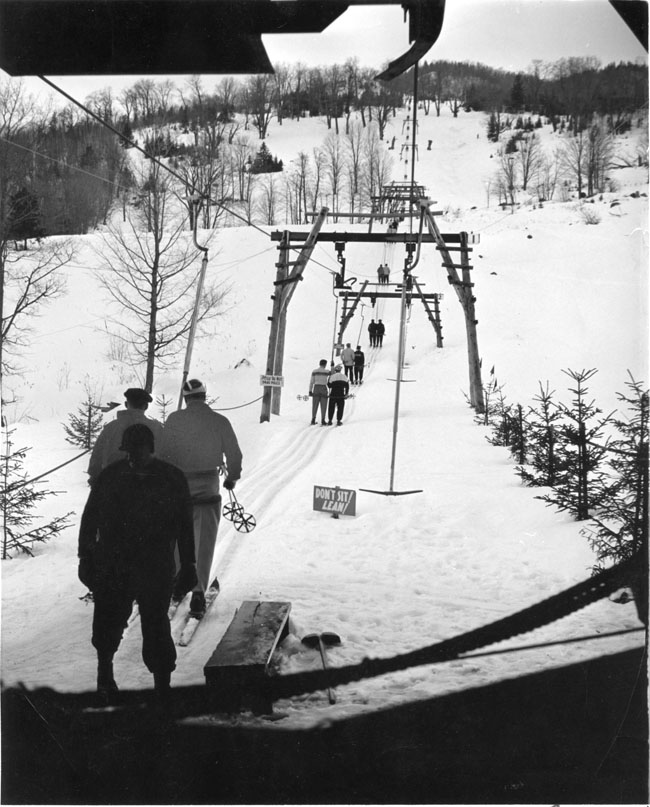
T-Bar at Black Mountain, NH.
Credit: New England Ski Museum
trees. Of course, it was uncomfortable when my side of the T-bar was in the middle of my back with my father riding beside me, struggling to help me, leaning down to hold his side of the bar behind his knees. What a relief when I was old enough to ride the lift with kids my own height or go up on my own holding the T-bar out in front of me, making “S turns” in and out of the track. I danced the whole way to the top.
And then there was Burke, in the “Northeast Kingdom” of Vermont that had a Poma lift running from the bottom to the very top of the Mountain. Here, I bumped off the growing mounds of snow which got larger with every run until I catapulted right to the top of the spring, hurled high into the air – boing, boing, boing. Going up was half the fun.
For more about Suicide Six’s 75th Anniversary.
For more about Gunstock’s old Rope Tow, another favorite.
Susan Winthrop is a long-time skier with memories of the sport extending back more than seven decades. A contributor to SeniorsSkiing.com, she currently lives in Ipswich, MA, enthusiastically skiing in and around New England whenever she can.
Suicide Six also had a Poma lift
Credit: New England Ski Museum
Special Thanks to the New England Ski Museum, Franconia, NH.

Snowbird’s Pipeline (the top to bottom ravine in center of picture) : One of North America’s toughest ski routes, descends from Twin peaks above Snowbird. First skied by Junior Bounous in the early 70s. He skied it again during his 80th year. Junior is an inspiration to senior skiers everywhere.
 
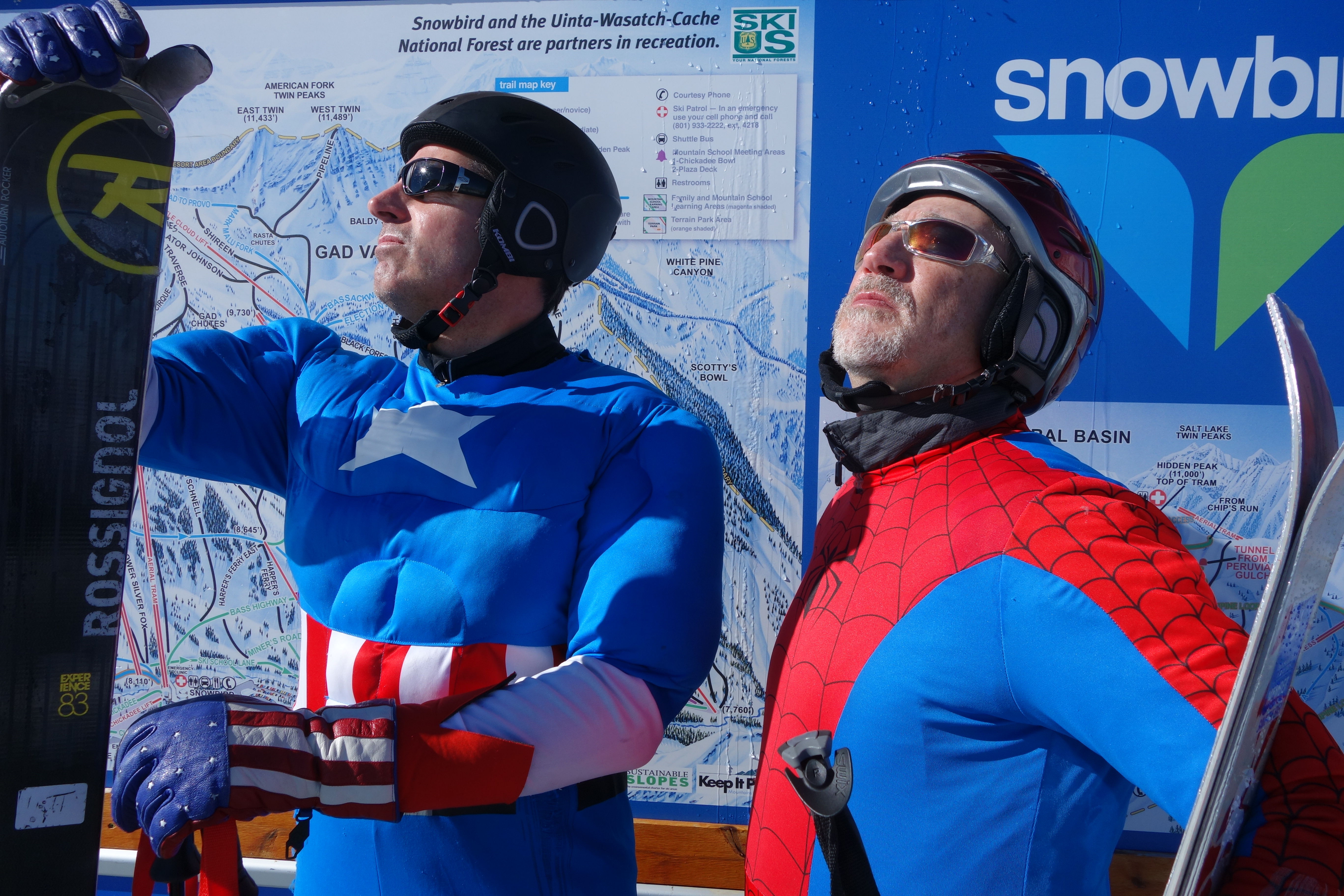
Why not ski in costume?
Credit: Jon Weisberg
Spidey and Cap’n America, Skiing’s Super Heroes, about to save the day at the top of Snowbird tram. Senior Skiers, do you ski in costume? If you could choose one, what would it be?

He isn’t falling. He’s demonstrating a ski technique from the 70s practiced by jet-setting ski racers. What is it called?
Qu’est-ce que c’est?

It is a sunny and cold Thursday morning in early February. There are a handful of other skiers on the mid-New Hampshire ski area lift. I decide to go right at the top. Trail is untouched, the corduroy grooming marks fresh and waiting. I turn, effortless. Ahhh. I turn again, making a big, wide arc. The feeling is like floating, my new skis carving and then, almost without a conscious notion, shifting to the other edge.
Hard to believe this is my first real run in thirty-five years. Okay, there was an expensive, uncomfortable holiday weekend on rental skis and boots in the 90s with cranky children, cheesy condo and unrelenting cold. It was an exception. I had left my real skiing behind long time ago.
I started in college, in the mid-60s. Back then, it was blue jeans and rice-paddy parkas with Moriarity hats, wooden skis, leather boots and Cubco bindings. In the early 70s, I lucked out and worked as an assistant editor at Skiing Magazine working and rubbing elbows with some of the greats. Now, that was fun.

I was Associate Editor in the early 70s
The next few decades had me running a business, flying here and there, finding and keeping clients. No time, no interest in skiing. Too cold, too time consuming. The closest I made it to the slopes was working on my laptop while watching my wife kids from the day lodge window.
Then I came back. With retirement came time. I looked at boots and skis in a ski shop one day and said to myself, “I can do this now.”
I find almost everything about skiing has changed for the better during my long hiatus. The skis are magical instruments, boots are comfortable, clothes are warmer, the lifts are faster, the trails well groomed and, because of my senior status, the lift tickets are relatively cheaper. And, there is no more need for speed. Instead, I relax into the slow turn, pressing down to feel the slice of the edge.

Parabolic skis rule! Turning has never been more easy or more fun.
Apparently, I’m not the only veteran coming back to skiing. Although we are still a small percent of the total, the number of skiers over 65 has doubled since the 1997-98 season, according to a National Ski Areas Association demographic study published in 2013. And we ski more often than younger skiers, too. We get in 9.5 skiing days per season compared to a national average of five days. We are using the gift of time that retirement has bestowed.
What does it take to get back? Fitness for starters. That’s a good idea, regardless. A good ski shop to fit you out with the proper equipment, maybe starting with decent rentals. A lesson might be helpful, too. A couple of friends to go with. A nice winter day in the middle of the week. More and more runs.
What’s your return-to-skiing advice?