Barbara Stewart Anderson

Barbara Stewart Anderson: A Woman Ahead Of Her Time

At Age 82, She’s Athletic And Adventuresome. And She’s The Legacy Of Her Ski Pioneer Father Founder Of Utah’s Sundance Resort.
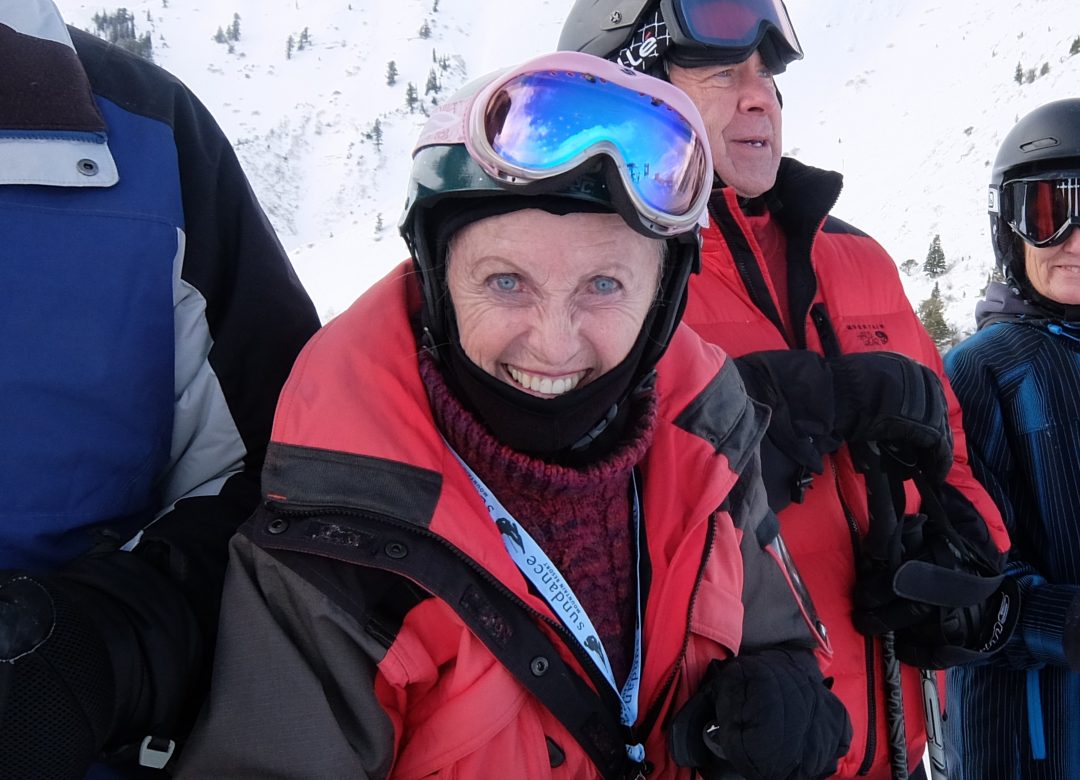
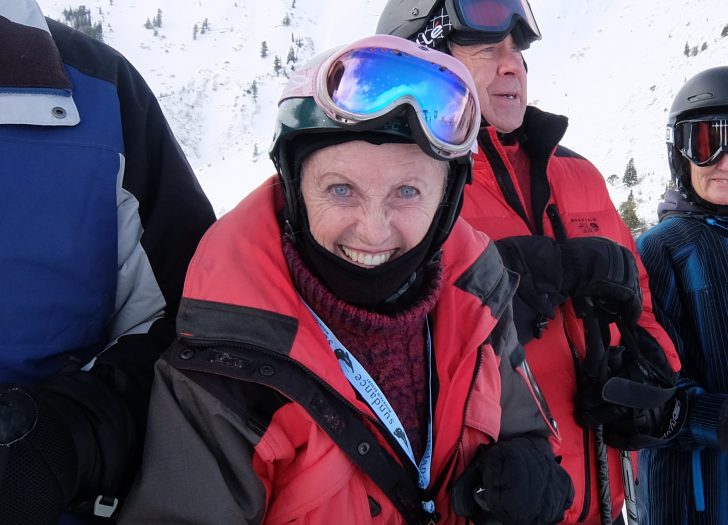
Barbara Stewart Anderson keeps going at 83.
Credit: Harriet Wallis

Barbara Stewart Anderson is like the pink Duracell bunny. She keeps going and going. She lives by her philosophy: “If I can do it today, then why not? I may not be able to do it tomorrow.”

Her accomplishments prove her philosophy. She scuba dived the Great Barrier Reef, completed seven treks in Nepal, rode a yak in Tibet, heli-hiked in British Columbia, and reached the summit of 13,679 foot high Mona Loa in Hawaii. What makes it remarkable—she did it in her 60s.

Looking back, Barbara grew up in the era of the 1930s, 40s, and 50s when women observed strict gender roles. But she was never strapped by the expectations of society. Instead of feeling suppressed or confined, she picked up speed. She has always been a woman ahead of the time.

Her list of accomplishments keeps growing. Just 5 years ago, she sky dived, and she also summited 19,341 foot high Mt. Kilimanjaro, the highest point on the African continent. She was 76.

Growing up loving the outdoors

Her passion for unbridled outdoor adventures began when she was a youngster.

Her family homesteaded in the beautiful North Fork of Provo Canyon. Her dad, Ray Stewart, built a little cabin near the base of Mt. Timpanogos. During the summers, Barbara and her siblings roamed the hills and hiked to the waterfalls. It inspired Barbara to a life of over-the-top outdoor adventures that continues to this day.

WWII changed the course of lives and skiing

During WWII, the little Stewart cabin became headquarters for training the Civilian Defense Ski and Mountain Corps—sort of a civilian version of the military’s 10th Mountain Division. In addition to first aid and other skills, ski pioneer Stewart taught the recruits how to ski. And that fanned their enthusiasm to continue skiing after the war.
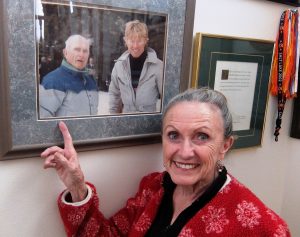
Barbara with photo of dad Ray and Robert Redford.
Credit: Harriet Wallis

When the war ended, Stewart, along with legendary skier Junior Bounous and others from the Defense Corps, cobbled together a rope tow. Stewart bought 1,200 feet of new manila rope for $61 and an old truck for $125 to power the tow. Using written instructions, he learned how to splice the rope into a loop — and it worked. It was the first ski tow in the area.

The tow created new challenges for the whole family. As the oldest child, Barbara was often called on for help. The tow was powered by car batteries, and nine-year-old Barbara helped her dad the lug heavy batteries on and off the mountain so they wouldn’t freeze at night and lose their charge. She also learned to run the snack bar, punch ski tickets and help skiers onto the tow. It was all part of growing up in a ski pioneering family.

As skiing quickly became popular, they built a 50-meter ski jump and raced on the Mt. Timpanogos glacier in the summer. In 1948, famed skier and Olympic coach Alf Engen set the Giant Slalom course on the Timpanogos glacier. The event drew notable racers including Jack Reddish, Dev Jennings, Corey Engen, and Olympian Suzy Harris.

Ray Stewart modified skis so young, energetic Barbara could ski on the glacier too. By the time she was 12, she was winning junior ski tournaments in Downhill, Slalom and Cross Country.

The burgeoning little ski area grew, and it was named Timp Haven. Years later Robert Redford bought it, and it became Sundance.

Stewart was inventive and creative with a passion for tackling the difficult and never giving up. Today, ski pioneer Ray Stewart’s name lives on at Sundance. The main lift is named for him: Ray’s Lift.

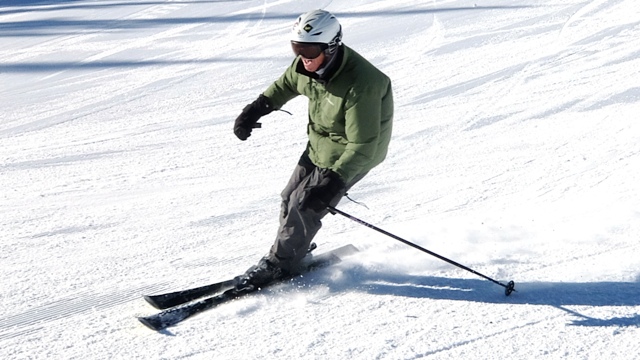
Now at 82, Barbara is an icon of taking on challenges and achieving results much like her dad did. She skis regularly with the Sundance Seniors, walks three miles a day, works out at the gym, took first place in a 5K race, and is active in her church and community. Nothing stops her. Many would be exhausted trying to keep up with her.

Over the years, Barbara built a collection of more than 600 miniature skier figurines that are on a rotating exhibit at the Alf Engen Ski Museum at the Olympic Park in Park City. Visitors can also learn about avalanches, sit in a real bobsled, try their knack at interactive ski jumping, and more.

The $10.5 million museum was funded entirely by private donations, including donations from Utah’s famed and philanthropic Quinney and Eccles families. There is no admission charge. Visit and enjoy the museum.

To read more from Harriet click here for her stories on SkiUtah. 
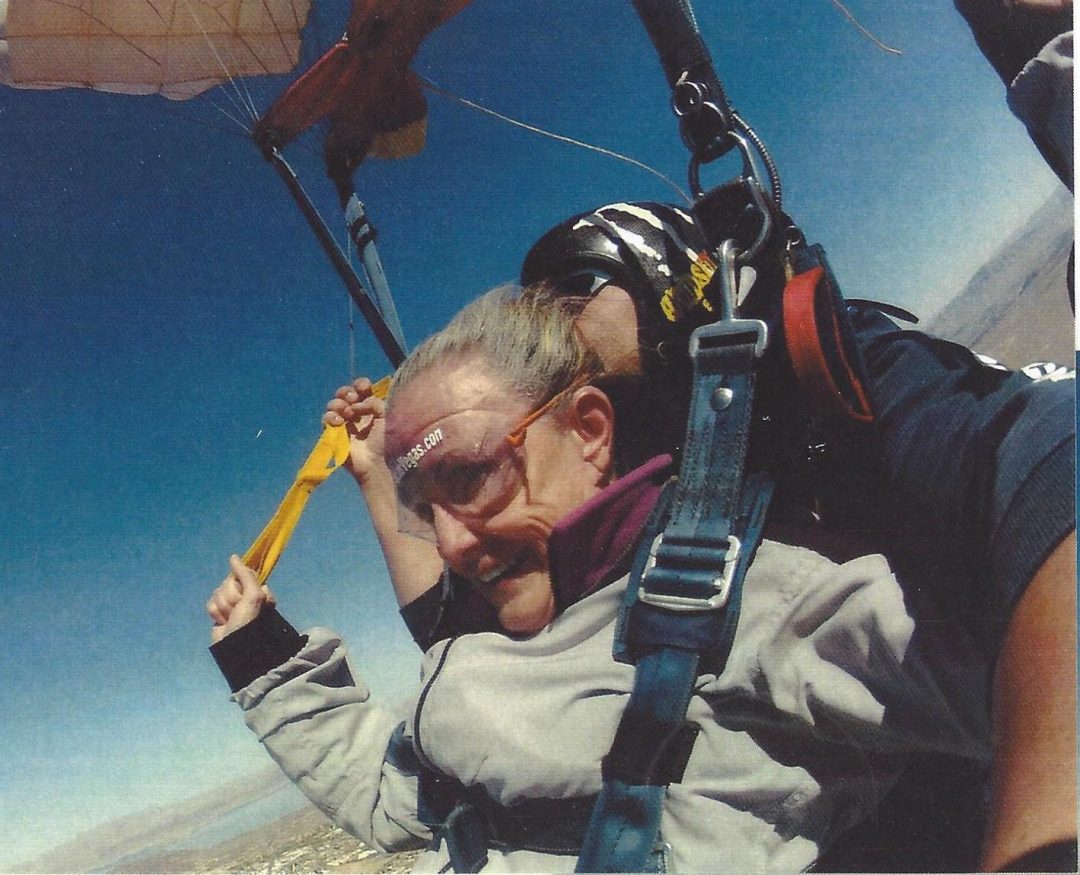
Barbara sky diving. Quite a selfie.
Credit: Barbara Anderson
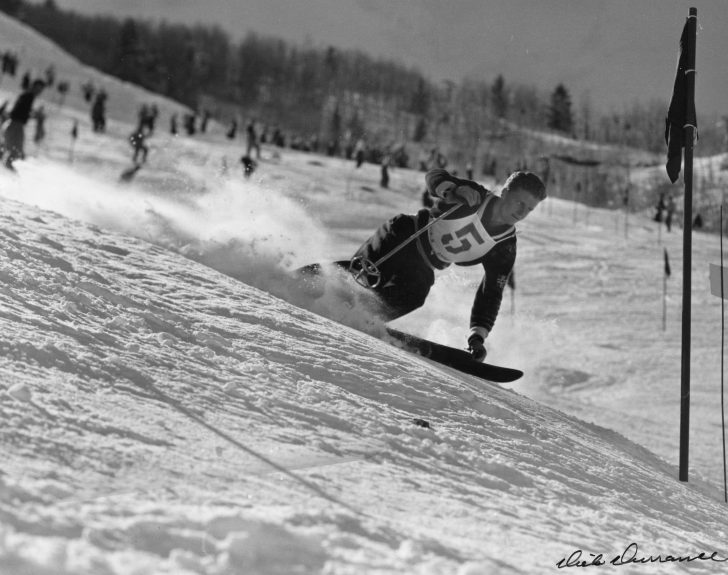
 

Mystery Glimpse: Who And Where?

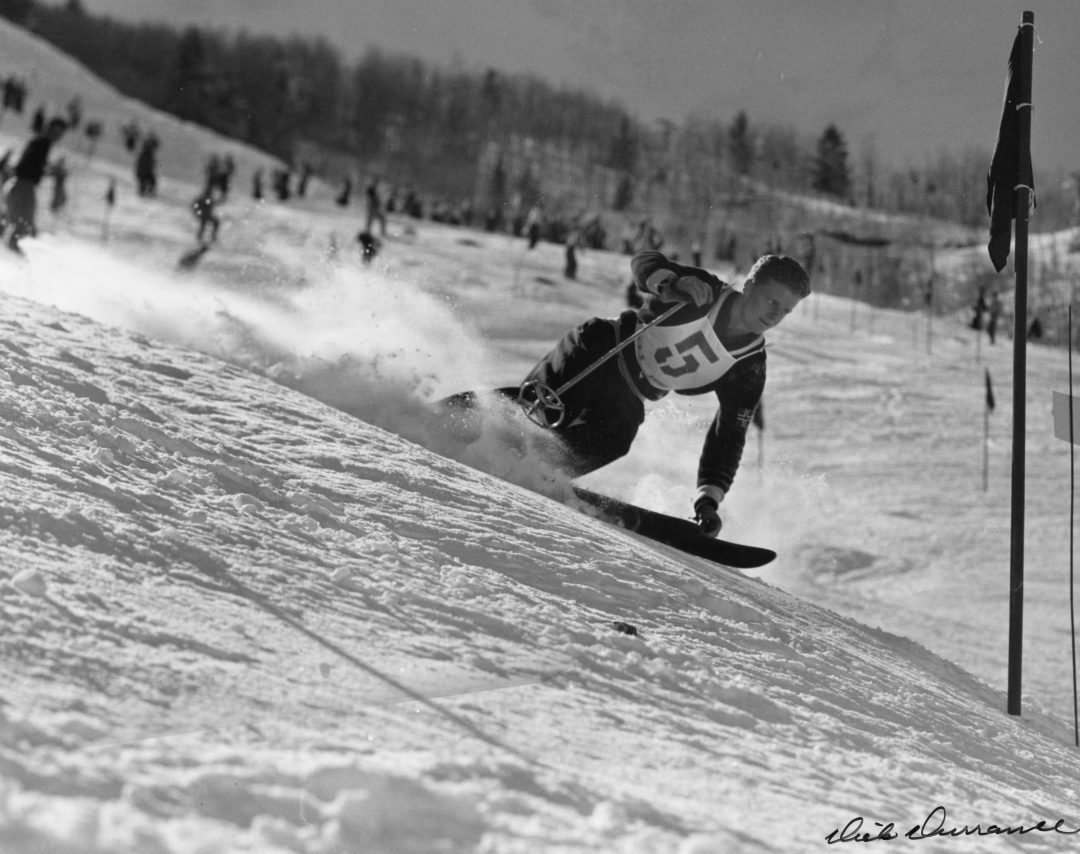
Hint: 1950

Can you spot who this is dashing through the poles? Might be easy. But where and what event and what’s the significance? That’s the challenge. Note your replies in Comments, just scroll down.

Thanks to the Colorado Ski and Snowboard Museum for contributing this photo.

Who, where, 1950. Credit: Colorado Ski and Snowboard Museum

Last Week

Credit: John Emery

Yes, a rope tow gripper. We’ve never used one, we just grabbed the twirling rope. But, many readers certainly have. It is significant that memories of using this device—from the 60s!—are so clear to our respondents.  John Emery, a reader who submitted this picture, says, “There used to be a heavy belt which the clamp was attached to via the short rope. It had a pouch that the clamp fit into when not in use. You would grab the tow rope with one hand and close the two halves of the clamp over the tow rope. The clamp was attached to the belt, and you would just lean back and enjoy the ride—one-handed even.”

Using this device took a bit of concentration.  From what we’ve read in the Comments section, it was getting it off at the top that was tricky.  It is a long way from a rope tow gripper to quadruple, high-speed chairs, and an impressive number of our readers have seen the transition from one to the other.


That Old Ski Poster on the Wall

Vintage ski posters are a fixture in many ski chalets and lodges.

Since the late 1990s, their values at auction have increased. To learn more about their history and their values, we interviewed Nicholas D. Lowry, President and Principal Auctioneer of Swann Auction Galleries, and Director of its Vintage Posters Department . Swann is the world’s largest auctioneer of Works on Paper and New York’s oldest specialty auction house.

JW: Please provide a short overview of the ski poster’s origins, when they were in commercial use, and in which countries.

NL: By all accounts the earliest ski posters were printed in the 1890s. They were printed to drive tourism by train to the French mountains. They began to appear with some regularity in the first decade of the 20th century. Two of the most famous—and therefore most valuable— were Francisco Tamagno‘s image of a couple ski jumping, and Jules Abel Faivre‘s image of a female skier using a single pole. Posters promoting the new sport also began appearing in Switzerland. Some promoted competitions and purveyors of outdoor equipment and clothing.

The first American ski poster featured an image of a female skier. It was produced in1896 to advertise the Christmas issue of Truth magazine.

What is considered when determining their value?

The main factors in determining ski poster value are location advertised; artist; image; date; and condition. A poster from the early days of a prominent Swiss resort such as Gstaad or St. Moritz will command more than one touting a lesser known village. The image also is important. Many people are drawn to depictions of early ski equipment and ski wear.

Among the most famous artist’s names that aficionados and collectors appreciate are Roger Broders, a masterful French Art Deco poster designer; Sascha Maurer, who did a lot of work for the New Haven Railway, and prominent Swiss poster designers, Emil Cardinaux and Martin Peikert.

How would you characterize price trends of vintage ski posters?

The market for ski posters took off in the late 1990s and early 2000s when collectors, including Mason Beekley, recognizing this undervalued segment of the poster market, began to acquire them at auction. Prices attracted attention to the genre; they haven’t subsided.

What should people look for if interested in collecting vintage ski posters? How can readers determine if they have a valuable ski poster?

Our experience at Swann is that most collectors buy works to hang in their chalets or mountain homes. They focus on geographic location. For example, it’s unlikely that someone in Zermatt will be collecting posters advertising Sun Valley.
I would caution potential buyers to consider their source when acquiring a vintage ski poster. Many resorts offer decorative reproductions of famous images. The best bet is to find an accredited poster dealer, so you can have confidence in the authenticity of your purchase.

How can readers learn about upcoming Swann ski poster auctions?

Swann Galleries has been offering a selection of ski posters from around the world in our annual Winter Poster Auction since 1998. We hold at least four auctions of vintage posters each year. Our catalogues are online at www.swanngalleries.com.

Tread Of Pioneers: A Blast From the Past

Quaint Museum Reveals Steamboat Spring’s Rich History.

Ski Joring was the way to get around the valley when the snows came.
Credit TOP Museum

In 1947 an AP dispatch to 1,000 daily papers dubbed Steamboat Springs, Colo., “Ski Town, USA” with the declaration that of its 1,700 residents, 1,685 were skiers.

The others were children under the age of one.

Enthusiasm for skiing run deeps in this town. And you can learn all about it at The Tread of Pioneers Museum in downtown Steamboat. Native Utes, trappers, Yampa Valley settlers, ranchers, miners, farmers, cowboys, skiers, ski jumpers, snowboarders, outlaws, and lawmen, they all shared a part in the creation of this friendly town, sitting just below one of Colorado’s best loved ski resorts.

Famed Norwegian ski-jumper and circus star Carl Howelson arrived in 1913 and taught early residents of Steamboat Springs how to ski and ski jump. Suddenly, the valley’s ranchers were exploring the surrounding mountains on homemade wooden skis, school kids filled recess with downhill races, and locals became expert jumpers.

Billy Kidd, first American to medal in Alpine skiing, has lived in SBS since 1970. Here he is at 20.
Credit: TOP Museum

Favorite fact: Three Wire Winter is agricultural lingo used in the Yampa Valley to indicate that snow has reached the third strand of barbed wire on a four-strand fence, roughly 30 inches. A three-wire winter is just about right, with enough snowpack for spring run-off; more makes it difficult for feeding cattle in winter as well as damage to the barb-wire fences, according to Bill Fletcher, an Elk River Rancher.

The museum has an extensive historic photography collection, a few of which are included here. Go to the museum website to view and purchase online.

The museum is located downtown at 800 Oak Street. New exhibits this year include Staking Their Claim: Pioneer Settlement in the Yampa Valley highlighting early Yampa Valley settlers; Pioneer Kids Bedroom: Hands-on Discovery, letting kids dress up in historic clothes and play with antique toys; and A Legacy of Learning: Celebrating 50 Years of Colorado Mountain College and the Bud Werner Memorial Library exhibit, highlighting these two key local institutions; and the works of portrait and Native American photographer Edward S. Curtis.

The Museum Gift Shop has locally made jewelry, postcards, and photographs. Hours & Admission: Tues.-Sat. 11 a.m.-5 p.m. $6 for adults, $5 seniors over 62, $2 children ages 6-12, under 6 free.

The Harbor Hotel sleigh picked up skiers from the train depot and delivered them to the popular hotel at 7th and Lincoln, circa 1957.
Credit: TOP Museum

warren miller

A Tribute To Warren Miller (1924-2018)

At Sometime In The Past, You Watched A Warren Miller Film That Made A Difference In Your Life.

Remembering Warren Miller: In His Own Words

How Wheaties Affected The 1936 Olympics

The Breakfast of Champions Kept Champion Ski Jumper Alf Engen From Competing.

Wheaties Ad 1936, Courtesy of Alan Engen

Legendary extreme athlete Alf Engen, known as the greatest all-around skier ever, was a champion soccer player, skier and ski jumper. During the 1930s, he set ski jumping world records. He helped design and establish more than 30 ski areas in the western United States. And he’s fondly remembered for pioneering deep powder skiing techniques and for his ski school at Alta.

But world champion Alf Engen was banned from competing in the 1936 Olympics because of a Wheaties breakfast cereal box.

It was just the fourth time that countries faced off against each other in wintertime Olympics. Competition included just four sports: bobsleigh, ice hockey, skating, and skiing. Twenty eight countries sent their best athletes to the IV Olympic Winter Games.

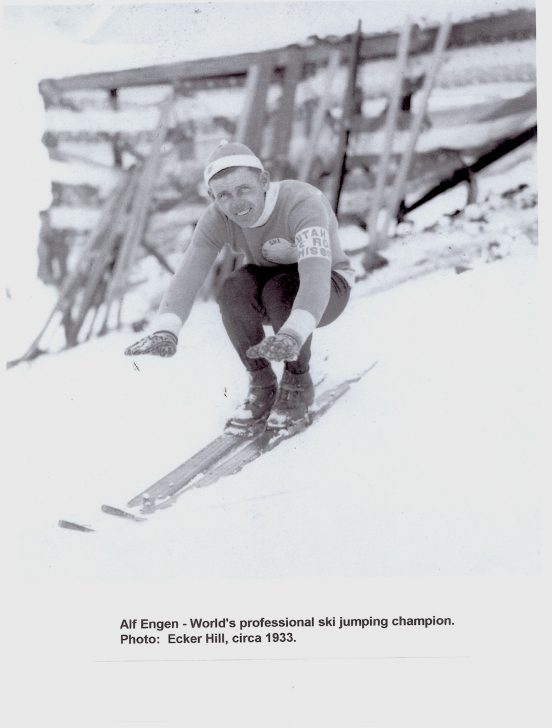
As background, Engen came from Norway to the United States in the 1920s, and he played professional soccer. By the 1930s, he was acclaimed for his ski jumping feats, he joined a ski jumping team, and he soon won 16 national ski jumping titles. And his jumps set world records. He also won national titles in all four ski disciplines: ski jumping, cross country, downhill, and slalom skiing.

Alf circa 1933, Courtesy of Alan Engen

Also in the 1930s, radio was the mass media communication method of the era. There was no television. People used their imaginations to create pictures from the words they heard.

But another form of mass media was taking hold: cereal boxes. Until then, breakfast cereal had to be cooked, but when food manufacturers invented cereal that could be eaten right from the box, they faced a marketing dilemma. How could they convince families to switch from cooked cereal to this newfangled ready-to-eat cereal? A cereal box sitting on the breakfast table with pictures of all-star athletes would be the marketing device. And unlike radio, the images were right there on the box.

Four athletes appeared on the Wheaties box—Bob Kessler, basketball star; Mike Karakas, champion hockey player with the Chicago Blackhawks; women’s speed skating champion Kit Klein; and famed skier Alf Engen.

Meanwhile, Engen became an American citizen. In 1935, at the U. S. Olympic Ski Jumping Finals held at classic Ecker Hill, he out-jumped everyone. He was immediately named as a member of the U.S. Winter Olympic Ski Jumping Team which would compete in the 1936 Winter Games in Garmisch-Partenkirchen, Germany.

But just before he was scheduled to leave, Avery Brundage, president of the International Olympic Committee and a zealous supporter of amateurism, ousted Engen from the team because his picture had appeared on the Wheaties box. He declared that Engen’s image on the cereal box made him a professional, not an amateur athlete.

“Engen said he didn’t remember getting any money from the cereal company, ‘Just a lot of Wheaties. I think I gave everyone in Salt Lake City free Wheaties.'”

Alf with trophies, courtesy of Alan Engen

Ironically, shortly after the Olympics, Engen jumped against—and he beat—both the gold and silver medalists from the Olympic Games, Norwegian gold medalist Birger Ruud and Swedish silver medalist Sven Eriksson.

The remarkable skiing Engen family is the only family to have four family member in the U.S. Ski and Snowboard Hall of Fame: Alf, his two brothers Sverre and Corey, and his son Alan.

Alan lives on in his father’s tradition. He’s a champion skier and athlete as well as an accomplished scholar, author, and historian. He carries on the Engen tradition of serving the skiing community.

Alan dreamed of displaying hundreds of Alf’s ski trophies and memorabilia for the public. The dream grew into the $10.5 million Alf Engen Ski Museum at the Olympic Park in Park City, Utah. Visitors can also learn about avalanches, sit in a real bobsled, try their knack at interactive ski jumping, and more. The museum was funded entirely by private donations, including donations from Utah’s famed and philanthropic Quinney and Eccles families. Visit and enjoy the museum when you’re in Utah.

To read more from Harriet, click here for her stories on SkiUtah.

Alf in flight, circa 1936, courtesy Alan Engen


Mystery Glimpse: Who’s This Unhappy Fella?

Our Next Mystery Photo Is Someone Who Became A Ski Celebrity.

If you think you know who you think this guy is, write your guess in COMMENTS below, just scoll down. We’ll reveal the answer next week.

Credit: SKIING Magazine

Last Week’s Mystery Glimpse 

This is Olympian Picabo Street as a young racer.  Thanks to the Alf Engen Ski Museum in Ogden, UT, for picking this out of its archives for us.

Picabo Street is an American former World Cup alpine ski racer and Olympic gold medalist. She won the super G at the 1998 Winter Olympics in Nagano and the downhill at the 1996 World Championships, along with three other Olympic and World Championship medals.  She was also a heart throb for a lot of men and boys who followed her during her competition. [Wikipedia]

We remember a news clip from coverage of one of her Olympic races. It said that in the midst of a medal run, she gave herself some encouragement by saying,”Come on, come on, come on.” That mantra stuck with us as a useful way to kick oneself into another gear whenever circumstances seem to warrant. She became an inspiration to hundreds of young women ski racers. Thanks, Picabo.

The Midget. The Mountain. The Girl.

The Midget Was Brand-New And The Color Of Ballpark Mustard.

1970 YELLOW MG MIDGET (NOT MINE).

No more than 200 miles on the odometer, when the idiot trying to pass me spun out of control and totaled my new MG Midget.

That was 1970, and looking back, maybe I was the idiot for driving a brand new, tiny sports car onto a snow-slicked Vermont road. The other driver was uninjured, and my buddy in the passenger seat was shaken but okay.

An ambulance took us to the emergency room, where the doctor picked shards of safety glass from my arm. The others were too deep, he explained, and would work their way out over time.

The friend we were staying with picked us up. He was on Killington ski patrol, so the next morning we got to the mountain early.

I skied Killington a lot that season, leaving Manhattan after Friday rush hour; arriving at my friend’s around midnight. Up early for a full day. Party that night. An early start Sunday; leave for Manhattan around 3.

On holiday weekends, we drove the additional distance to Stowe.

Sunday morning, we decided to sleep in and missed our ride to the mountain. This was a time in my life when non-ski clothes and toiletries went in a small daypack. We carried packs and gear out to the road and hitched to the mountain.

It may be because of that experience that I still pick up hitchhikers carrying skis; even a boarder on occasion.

The driver pulled into a line of parked cars. As we thanked him, another car pulled in next to us. It had New York plates, and two pretty girls.

I quickly explained what happened and our need for a lift back to Manhattan. It was their destination, as well. The girls needed to think it over. We agreed to meet them in the day lodge at 3:00 PM when they’d let us know.
Throughout life, we hear about or experience random but life-altering events. I didn’t know this would be one of them.

I made a date with one of the girls for a few nights later, on Saint Patrick’s Day. At lunch, I walked over to Rockefeller Center to see the parade. Negotiating my way through the throng, the girl appeared. Millions of people in the Big City, and we bump into each other a few hours before our date, the first of many.
Skiing has been a major influence in shaping my life. Who could have predicted that losing my new MG Midget on the way to Killington would result in meeting my future wife?

The Story Of The Yellow Ski Suit

Ski Suits Don’t Age, Just Their Owners.

In 1974 while living in Vienna, Virginia, I had a midlife crisis. On December 27, I turned 40 with the thought that I had reached middle-age and would have to limit my skiing.

In the past, while living in California, the family had gone skiing on my birthday. Now in Virginia, my nine-year-old son, Bill, said, “There aren’t any mountains. If you want to ski we’re going to have to go to Utah or Colorado.” There was only one thing to do, jump into the Mercedes and drive to Utah, where we all loved to ski.

Bill Emerson in his yellow ski suit on his 40th birthday

As a belated birthday surprise my wife provided me with a form-fitting yellow ski suit. My first day with the yellow suit was spent at Park City, enjoying a beautiful sunny day.

Thus began a tradition of skiing on special birthdays in my special yellow suit. Between those events, the yellow suit hung in the back of a closet.

It emerged next in 1984 for my 50th. My very grown up son and I headed to Snowbird to celebrate. The yellow birthday suit went with us.

After that trip, the  suit moved again to the back of the closet. Its next adventure w

Bill skiing Park City on his 80th

as 25 years later. This time on my 75th.

In September 2014, approaching my 80th, I returned to the gym to work off a few pounds. I wasn’t going to celebrate on skis without the suit or my son. He was over 40, older than I was when I received the suit on my 40th.

We agreed to meet at Park City.

The cold day required wearing a newer and much warmer red jacket.

At one point I donned the yellow suit so Bill could snap a few shots of my yellow ski suit and me.


A Wad of Tobacco, A Chairlift, And A Ford Maverick

A Long Forgotten Incident Comes Rushing Back.

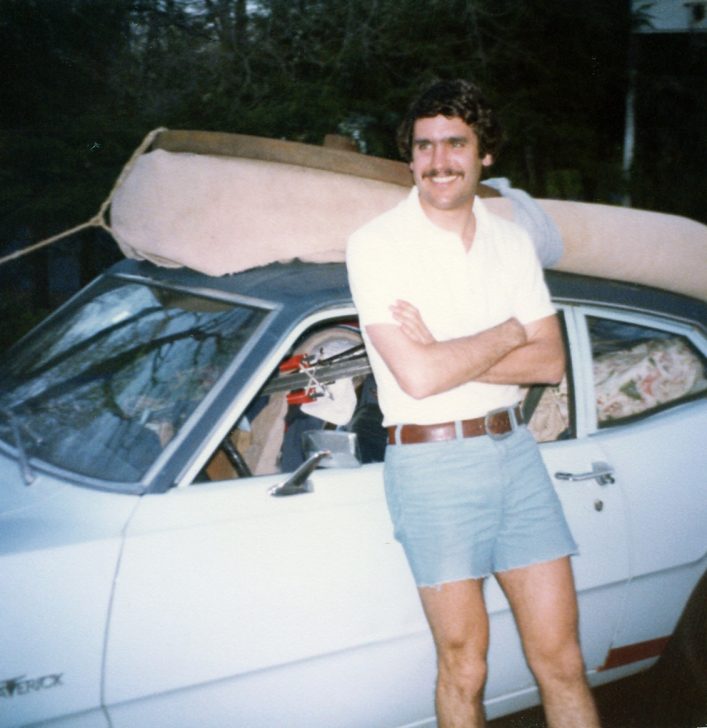
Don Burch, circa, 1970, with the infamous Ford.

In the late 70s, I was working at a ski resort and poor as could be. When the Head Maintenance Engineer asked around for someone to pick up a part for one of the chairlifts, I quickly volunteered. He probably figured I knew what I was volunteering for and wouldn’t have done so without a pickup truck or some other appropriate vehicle.

It was after hours, and we needed the part in order to run the lift in the morning. The supplier agreed to stay open until I arrived.

As a twenty-one-year-old male, there may have been some other decisions I made without much forethought. In my mind, the part was a few bolts or something like that.

Though I was to drive 90 minutes in the dark on country roads, I had confidence in my mature Ford Maverick (Yes, the photo is of the car I used). It was starting to snow, but I knew my new retread snow tires were up to the task. Using the finest workmanship I could muster, I had recently jury-rigged an eight-track tape player under the dashboard so I knew the trip wouldn’t be totally devoid of entertainment.

When I arrived later than promised, the supplier was grumpy as hell. He spat a wad of tobacco into the snow, pointed to large gear laying against a fence post and grumbled, “How the hell are you gonna get that in there?”

Sliding the front passenger seat all the way back, it looked like the gear might just fit. With the grizzly old guy providing special lubricant in the form of sub-vocalized mutterings, we managed to get it in. The car listed unnervingly to starboard.

With no more words spoken, the receipt was tossed in the car, and the parking lot lights were off before I was out the driveway.

On the return trip,  the crown of the road, under slippery conditions and tilt of the car, overcame my ability to keep the old Maverick on the road. Into the ditch I went.

To my great relief, a pickup truck pulled over just minutes after the mishap. With the sweet smell of liquor wafting from their breaths, two good Samaritans offered to pull me out. One attached a chain to their hitch, and the other hooked up somewhere under my car. I took a moment to look under the car, saw the hook on the steering rod and moved it to the frame.

I profusely thanked my new best friends, made it back to the mountain, the chairlift was operational by morning, and I had a windfall of $22.00 bonus.

Thanks to Harriet Wallis whose recent article entitled Lift Maintenance 101 sparked this long forgotten memory.

Fast Freddie

Blind Skier Inspired All Who Knew Him.

Fast Fred Siget on the left with Pat McCloskey, center, and friend at a long ago National Blind Skiing Championships.


The first time I skied with Fred Siget was in Snowshoe, WV, with Larry Walsh of the Pittsburgh Post Gazette. This was my maiden voyage guiding a visually impaired skier. I had Fred, the first blind skier in our area, in front of me. Right turn, left turn, right turn, stay, stay. All of a sudden the only tree around popped up right in front of us as I yelled “Crash,” and Fred sat down as he ran into it.  I felt so bad, but Fred dusted himself off with a smile and said, “Pat, don’t worry about it at all. This will be one of many.” And we continued down the slope. This began a 40-year friendship with the one and only Fast Freddie Siget.

Fred lost his vision as a result of an accident with a high pressure hose when he was a volunteer fireman. As devastating as this injury was, he was undaunted. He became the first visually impaired computer programmer for Koppers Corporation. He continued dancing, and he learned to ski with guys like Larry Walsh, Jim Conley, Lynne (Kravetz) Hartnett, Shorty Leco and Micky Hutchko.

Fred always had ideas on how to make things easier for blind skiers and how to improve guiding techniques. He had a transmitter rig where the guide used a microphone and Freddie had an ear piece which made calling out commands easier and more understandable.

Once I used the transmitter while standing on top of a slope, calling commands to Fred as he skied by himself down to the chairlift. With his “Blind Skier” jacket on, people were shocked viewing his run. In the bar afterwards, we had some fun with Herman Dupre the owner of Seven Springs Mountain Resort. I put the microphone on and guided Fred over in front of Herman and told him to tell Herman how much he admired his red flannel shirt. Herman was stunned and later remarked to me laughing that he was starting to “get hot thinking about all the free passes I gave to Fred and now he is telling me how much he likes my shirt!” Hilarious.

Fred was always anxious to help new guides. He put himself at risk during the training but always felt that it was worth it not only to train guides that could assist him, but to help the other visually impaired skiers who were beginning to show up at BOLD (Blind Outdoor Leisure Development) outings at Seven Springs.

Perhaps the most compelling thing about Fred was his kindness and appreciation for his fellow skiers and guides. He always remembered your birthday and when he called me, he sang, “Happy Birthday to you, Happy Birthday to you, get plastered, you bastard, Happy Birthday to you.”

He was popular for his skiing for sure, but as a person, you could not get a better guy who was always interested in others and never talked much about himself.

We lost Fred this fall at 94 years of age. He had an amazing life, and we will miss him. Fred never let his accident slow him down. He always said that he did more as a visually impaired individual than he ever did before losing his sight. He took a perceived bad thing and turned it into opportunity. Shouldn’t we all learn from that lesson?

X-C Olympian Celebrates 98th Birthday

From The Ski Museum Of Maine.

Chummy Broomhall in his stride. Help him celebrate his 98th.
Credit: Ski Museum Of Maine

Chummy Broomhall, two-time Olympic cross country skier and the oldest living member of the Chisholm Ski Club, will be celebrating his 98th birthday on December 3rd. Last year the Chisholm Ski Club sponsored a card campaign for Chummy’s birthday and he received almost 150 cards! Let’s blow that number out of the water this year and start sending him birthday wishes now.

Send birthday cards to Wendell “Chummy” Broomhall c/o Maine Veterans Home 477 High Street, South Paris, ME 04281

More Skiing Songs Of The Sixties And Beyond

Our Readers Search Their Attics For Old Ski Songs. Hear Them Now.

Wow, what a response!  Thanks everyone for comments and emails on our reprised article, Skiing Songs of The Sixties.  We not only heard about ski song memories, we had some folks sending us (digital) recordings.

We have to tip a pole to Boyd Allen, Exeter, NH, for taking the time to send us two digitized versions of the very songs that some readers requested as a result of the article.  Boyd grew up listening to his dad’s Harry Belafonte, Kingston Trio and other folk records.  In college, he says he came across an old Intercollegiate Songbook with skiing tunes bases on folk songs.  That find launched a hobby where Boyd tracks down and collects old recordings and song books, especially about skiing!  Boyd is a teleskier these days. Thanks so much, Boyd.

Boyd sent us two versions each of Let’s Go Skiing and The Skier’s Daydream by SeniorsSkiing.com reader Ray Conrad. Click on the links below to play.

Let’s Go Skiing by Bernie Knee and the Irving Fields Orchestra.

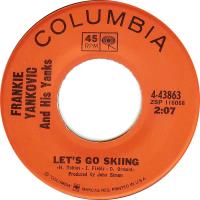
Let’s Go Skiing by Frank Yankovic

The Skier’s Daydream by Ray Conrad

The Skier’s Daydream by Oscar Brand


And to SeniorsSkiing.com reader Alison, we thank you for remembering and sending in a reference to Schifoan, a tune in German written by Austrian folk singer Wolfgang Ambros.  As Alison says, it’s a catchy tune, even if your German is a bit rusty.  Here’s a version we found on Youtube by Wolfgang himself.

Finally, here’s Cotton Pickin’ Lift Tower, another Ray Conrad tune, performed by John Sidle at a coffee shop in Santa Clara, CA.

Fun stuff, thanks everyone!


Super Skier: Skiing Songs of the Sixties

[Editor Note: Here’s an archive article that will bring back some memories.  Back in the Sixties, there was a host of songs devoted to the relatively new and growing sport of skiing.  This article from SeniorsSkiing.com August, 2014 highlights some of the songs and the singers.]

Well, they called him Super Skier
As he sat around the sun deck,
For he swore that he would never take a spill.
When they finally brought him down
They had to use three toboggans
To carry all the pieces down the hill.
Bob Gibson, Super Skier

In the late 50s and early 60s, three cultural threads knit together simultaneously—folk singing, the comedy album and the sport of skiing.  Inspired by the Kingston Trio, Smothers Brothers and the comedy records of Bob Newhart, Woody Allen, Shelly Berman, and Lenny Bruce, a small band of singers created a niche art form: The Stand Up Comic As Skiing Folk Singer.

A pioneer on the scene was Chicago-based Bob Gibson, a 50s folksinger, who, among other things, wrote novelty songs, especially about skiing.  One of those, Super Skier, later recorded by the Chad Mitchell Trio*, became the genre’s archetype.  Here’s a version:

The novelty ski song had a pattern. A naïf—nerdy office worker, country hick, cowboy—goes skiing because it’s macho, ladies find skiers attractive, and it’s cool.  His goal is showing off, joining the Jet Set, finding the girl and having “the look”.  But, misadventures and slapstick outcomes ensue.  All of this is often to a familiar folk tune: Sweet Betsy From Pike, Turkey In the Straw, Railroad Bill and the like, with simple acoustic string-band accompaniment.

Utah skier and resident Ray Conrad is a prime example of this novelty genre.  He was a topical folk singer back in the 60s.  Here’s his song The Big Downhill Skis about a “hard-butt” cowboy who is challenged to go skiing by a city slicker.  Pretty funny.

Ray also has a serious side.  Here’s the opening lyric of his song, “A Skier’s Daydream”.

In the fall of the year, when the summer grows old
When the air has a chill, and the green hills turn cold
It’s then I grow restless and feel at my ease
I yearn for the mountains and the snow in the trees

Then there’s his song Two Cubes and A Slug of VO that compares the joys of skiing with the benefits of “drinking gin with a touch of vermouth, yo-ho.”

The genre went in a different direction when Oscar Brand issued an entire album of ribald ski songs. Brand, a contemporary of Pete Seeger and the Weavers, had an uncanny knack for writing and collecting off-color songs.  His discography (about 100 albums) includes bawdy sea shanties, army ditties, navy songs, and hearty drinking carousers.

Oscar Brand's 1961 collection of ribald ski songs are still funny today.

Oscar Brand’s 1961 collection of ribald ski songs are still funny today.

Ray Conrad was in the mix in those days and contributed two songs to Brand’s 1963 “A Snow Job For Skiers”.  Here are some lyrics from The Ski Instructor from that album.  The rest of the songs range from clever and witty all the way to silly.  Discretion prohibits adding an actual audio track.

Impress her with your ability, don’t let her answer no
Remind her that skiing with no sex involved is nothing but cold, cold snow.

We haven’t noticed après-ski lounge singers embracing these songs or even making up their own in our recent travels.  Google “ski songs,” and you get rock music for your skiing playlist, not the topical send-ups of yesteryear.

Do you have a ski song you remember?

Now the moral of my story
Though my story’s kinda gory
For all you sundeck Charlies, there’s still hope
You buy the fastest clothes you can
Then talk skiing like a man
But don’t let people catch you on the slope…
And Get Charlie Off The MTA

_____________________

*By sheer happenstance, the author was present at Brooklyn College in May 1961, when the Chad Mitchell Trio first performed “Super Skier” on stage and made the recording you can hear on the Youtube link.  They raised the roof on that one.  Here’s the admission (autographed on the back) ticket to prove it.

Chad Mitchell Trio Concert Ticket

George Turns 100 And Skis On His Birthday

Snowbird Made Special Arrangements So George Could Celebrate By Skiing In July.

Birthday boy George Jedenoff flanked by old friends Junior and Maxine Bounous.
Credit: Harriet Wallis

George Jedenoff became an avid skier 51 years ago when he moved to Salt Lake City to oversee the Geneva Steel Plant. He learned from the best: iconic Junior Bounous, legendary Alf Engen, and release binding inventor Earl Miller.

At that time, Miller performed stunt falls to show how well his bindings released. But he credited George with doing whacky falls that he’d never seen. In spite of the falls, George learned to ski and to love the sport.

Junior Bounous, director of skiing at Sundance and then Snowbird, mentored George and they became fast friends. They’ve skied together for 51 years. Even now, I continue to learn new things from Junior, said George.

The two friends skied on July 5—George’s 100th birthday.

George belongs to a very special ski club.
Credit: Snowbird

George lives in California but he returns to Utah every winter to ski at Alta and Snowbird. He skis with the vigor of a teenager and charges through powder with ease. He loves powder.

He also has a philosophy that guides his life and inspires others. “Be kind. Do your best. Don’t be discouraged by bad things that might happen to you. Always be positive,” he says.

When George was 95, Ski Utah, the umbrella organization over all Utah ski resorts, produced a video of him skiing. It was an immediate hit and each winter Ski Utah produces a new and inspiring video of him.

Thanks to Snowbird, George celebrated his 100th birthday by skiing a large field of snow near the top of the mountain with his friend Junior Bounous. He was also awarded a plaque, shared a cake with everyone who attended, and enjoyed a birthday lunch at Snowbird’s slopeside Forklift Restaurant. He also received a letter of congratulations from the nationally known 70+ Ski Club. Only 3 of its 3,000 members have been over 100 years old.

But there’s a back story too. A day earlier, George and Junior drove up the gravel summer road at Alta to search for a patch of snow on which to practice before today’s big event. They found a suitable patch and made turns. “It was about as big as a room and about as wide,” said Junior. “But we skied it.”

The day’s festivities wrapped up with George’s typical, positive outlook. His skis were leaning against a wall, and he spoke to a family member saying: “Let’s remember to pick up my skis, I’ll need them this winter.”

Click on the video below to see George celebrate his 100th on the snow.


Historic Blandford Ski Area Poised To Bite The Dust

This Wonderful Family Area Is Simply Out Of Money.

[Editor Note: According to the Westfield News, Springfield Ski Club’s members will be meeting on July 18 to approve the sale of assets to the owners of Ski Butternut. If two thirds of the total membership do not specifically vote yes, the ski area will close.]

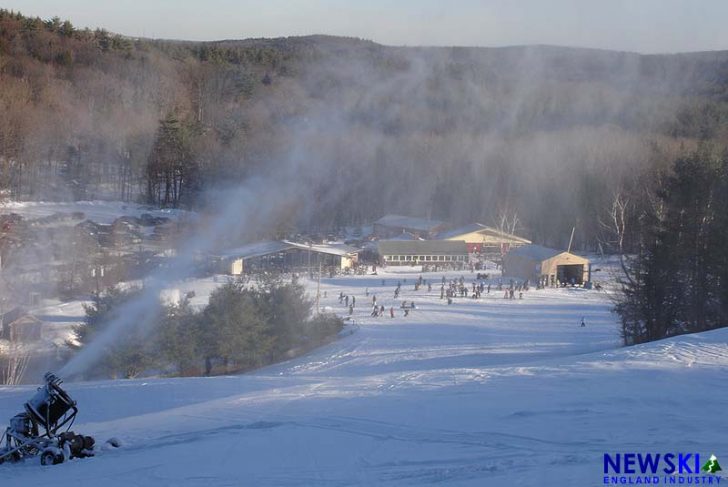
Volunteers kept Blandford going and gave the small area a community feel.
Credit: New England Ski Industry

The website says: “May 28, 2017 – Ski Blandford Financially Insolvent. Could Be Sold or Closed.” The Board of Directors and the skiers are on the brink of making a gut wrenching decision soon about their ski area that’s been going for 81 years.

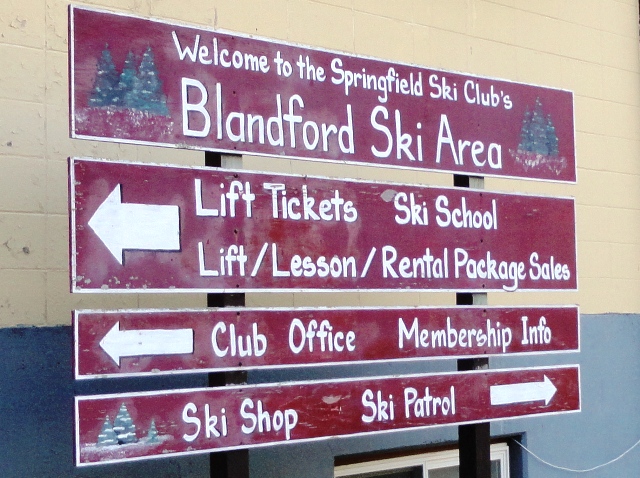
Harriet visited Blandford on a recent visit, finding a welcoming sign at the base lodge.
Credit: Harriet Wallis

As background, recreational skiing spiked after WWII when 10th Mountain Division veterans returned and inspired city folk to take up skiing.

But before that, in the 20s and 30s, hardy skiers skinned up mountains, built primitive lifts and were already into downhill skiing.

And so it was for the Springfield Ski Club. In 1936 it got permission to build a ski slope on a hilly farm in southern Massachusetts. It installed a 1,000 foot long rope tow and used a nearby schoolhouse as a warming hut. A few years later the club bought the land and named it Blandford Ski Area.

Today, about 60 ski areas that started before WWII are still in operation, according to data collected by New England Ski Museum Director Jeff Leich.

But it hasn’t been easy for this small, family-oriented ski area. Modernization from rope tows to chairlifts was costly. Updating to snowmaking was a necessity. But then, interstate highways whisked skiers past Blandford to bigger, destination resorts.

But Blandford—with its 450 feet of elevation, three chairlifts, snowmaking and night skiing—held on while other small ski areas in southern Massachusetts closed. Skiers simply love Blandford.

And they put in countless hours of volunteer work to keep the area ship shape. Work parties painted the picnic tables. And they walked up the slopes picking up stones pushed up by frost and tossed them into the woods so in winter they could ski on a minimal snow base.

During the 1960s and 70s, membership was capped at 5,000, and there was a waiting list to join. My family of four were all novice skiers, and we jumped at the opportunity to join when an opening occurred..

From that humble beginning at the small ski area, we all grew to love the sport. And we progressed to become instructors and ski patrol.

Blandford got us started in the right way. It inspired us with skiing. And it offered family values and great camaraderie with other families.

However, membership slowly dwindled over the years and dropped to just 1,426 in the 2014-15 season. Fickle weather and the economics of operation began to out weigh the camaraderie and the inspiration,

Blandford, like other small ski areas, is a grass roots feeder area that launches skiers into the sport. It’s sad that we might lose this icon of the ski industry. For a closer look, click here for the Ski Blanford site.

To read more from Harriet click here for her stories on SkiUtah.

Small areas like Blandford are where families grow up loving skiing.
Credit: Ski Blandford

Waterville Valley Pioneer Tom Corcoran Dies At 85

Tom Corcoran, an Olympic skier and developer of Waterville Valley Resort, has died at 85 at this home in Seabrook Island, SC.

Read the story of how he created a mountain resort from scratch and brought the Kennedys to visit by clicking here.

Two-time Olympian Tom Corcoran was an all-around athlete who put Waterville Valley on the map.
Credit: Waterville Valley Resort.

Fond Memories Of Blandford Ski Area

Memories Live On Even If The Area Closes.

Blandford has three chairlifts. When I learned to ski, it had seven rope tows but only one chairlift. Credit: Harriet Wallis

Nothing can replace this family-based ski area in southern Massachusetts. But Blandford is now on the brink of being closed or sold. It has offered what mega resorts cannot offer.

If kids got tired of skiing, they’d go off trail with their friends and build snow caves and ski jumps. When my son broke the tip off a ski, we knew exactly how it happened. When my daughter needed a break, she discovered she could mooch cookies from skiers in the lodge.

It was all part of the ski experience. Something that doesn’t happen at the big resorts.

Adults had their fun too. In spring, we’d take a picnic lunch and a bottle of wine to the picnic tables at the summit.

The ski school bell rang when it was time for lessons. Credit: Harriet Wallis.

If it rained we put on garbage bags and did “worm turns” rolling on the soggy snow. One rainy day when no one was riding the T-bar, a group of us slalomed the T-bar line. The Ts were moving targets coming up, and we skied around them going down. Naughty but fun.

Après ski was a food fest. Families brought crockpots and plugged them in on the deck letting dinner simmer while they skied. Oh the glorious smells! At the end of the day, everybody shared.

We skied there every Saturday and Sunday during the 1960s and early 70s when my kids were growing up.

There were family races—our first race experience with gates and awards. My daughter didn’t yet understand the race concept. She stopped to chat with each gate keeper.

The Blandford race team won many competitions even though they trained mostly on dry land because early season snow was too skimpy. The kids honed their muscles and reflexes by quick stepping through an array of tires and other dry land exercises.

The race coach also gave ski tuning demonstrations, a skill I continue to use today.

And he demonstrated ski binding release. He careened down the hill in Olympic form, carving hard lefts and hard rights. Then he would stop, lift each foot and shake his skis off! If you ski technically correct, your binding don’t have to be cranked down, he said.

The ski patrollers found ways to busy themselves as there were few accidents. One day, a patroller watched a youngster cut the chairlift line, slithering through the long line up to the very front. Just before the child got onto the chair, the watchful patroller sent him to the back of the line. The child never cut the line again.

One spring, the patrollers decided to tap the many maple trees and make syrup. Their first morning duty was to gather the makeshift syrup buckets — #10 size cans – and carry them to the patrol’s dispatch shack at the summit. There the dispatcher kept the golden liquid stirred on the pot belly stove. The patrol bottled the syrup and invited everyone for après ski “syrup on snow.”

Then there were parties. In summer, we enjoyed the camaraderie of work parties, pitching in to help with lodge and slope maintenance. That was always followed by a corn husking contest and a giant BBQ.

In winter, there were celebrations with a caldron of gluehwein simmering over a fire, torchlight parades with real torches, and then dinner and dancing. Kids danced. Adults danced. Everybody danced. Everybody danced with everybody.

Small ski areas are the heart and soul of skiing. It’s sad that this could be the end of iconic Blandford Ski Area that’s been in operation since 1936.

To read more from Harriet click here for her stories on SkiUtah.


Senior Skier Profiles: Two Kings Of The Hill

These Octogenarians Are High Spirited Role Models.

Some skiers slow down as they get older. But Bud Temple (84) and Paul Jacobsen (89) pick up steam. Each has skied for more than 70 years. They each learned on primitive equipment in a city park.

Meet Bud Temple

Bud’s been skiing for 70 years.
Credit: Harriet Wallis

Bud launched into skiing in an unusual way. While a student at the University of Utah, he took a ski course offered by Bill Lash, a founder of PSIA (Professional Ski Instructors of America). Bud excelled, and he earned a ski teaching certificate—one of the very earliest. But then he was drafted.

No problem. He entered the U.S. Army with two unusual documents: his ski teaching certificate and a personal letter from Bill Lash to the Commandant at Camp Carson where special troops were trained.

After basic training when assignments were made, Bud presented his two documents to the assignment officials.

“The Army didn’t know what to do with me,” Bud said. “They’d never seen such documents.”

So the officials left the room, called the Commandant, and returned saying: “The Commandant is expecting you.”

Bud taught special troops how to ski, and he also taught survival, mountaineering, and climbing to special forces in all branches of the military.

Bud showing a some form.
Credit: Harriet Wallis

And then he continued to teach and coach. He coached World Cup alpine champion Tamara McKinney, created a ski school at a small mountain that didn’t have a ski school, and taught internationally at eight resorts.

Last year, Bud was clocked at 48 mph.

On land, Bud hobbles because of chronic leg problems. But skis give flight to this retired mining and metals professional. He swoops smoothly down the slopes.

Bud’s advice for older skiers:

“Accept that you’re not as agile as you once were. Slow down,” says speedster Bud. Then he adds: “I guess I should take my own advice!”

Meet Paul Jacobsen

So has Paul.
Credit: Harriet Wallis

Paul holds a 25 year record for skiing every day of the season at Brighton. He’s known as First Chair Paul because he’s always first in line when the lifts open.

Agile and mobile at 89, this retired architect skis daily. Then, for après ski, he goes to most of the University of Utah’s home football and basketball games

Skiing has always meant freedom for him. As a kid he skied for the first time when someone brought a simple pair of slats to the sledding hill. He was hooked.

As a teen he worked in his dad’s grocery store, and he drove to the wholesale produce market daily to buy fresh produce for the store. When his job was done, he was free to ski.

For years, Paul skied with a Japanese fish kite flying from his helmet. But it blew away this winter, and everyone misses seeing it. When skiers dress silly in spring, he wears a tutu.

Paul’s advice for older skiers:

“Enjoy what you’re doing,” says Paul. “Don’t be a couch potato.”

Paul in his tutu. He skis every day, but not always in a tutu. Sometimes he tows a kite from his helmet.
Credit: Harriet Wallis

Mt Snow CROP Harriet puddle skimming

Favorite Memories Of Skiing New England In Spring

Back Road Scenery And Ski Slope Puddles Formed Indelible Pictures.

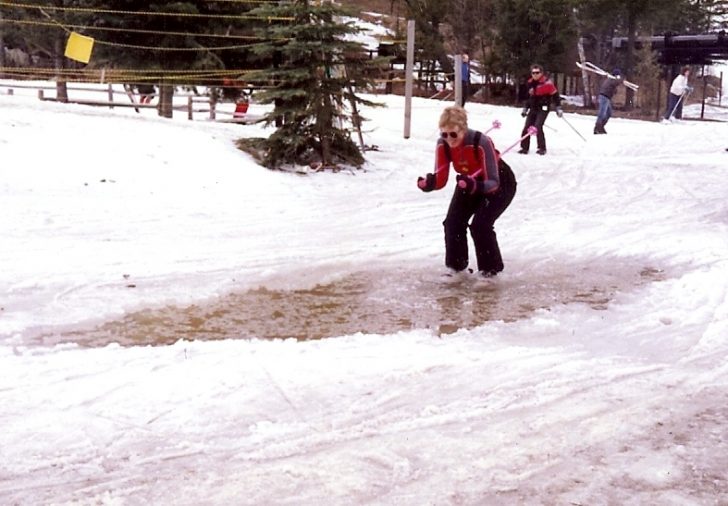
Author Harriet Wallis tries out a puddle at Mt. Snow, Vermont, back in the 80s.
Credit: Harriet Wallis

I loved the scenic springtime drive to the slopes. Steam rose from little sugar shacks as the golden syrup was simmering inside. Horses stood motionless in frozen pastures and breathed clouds of fog into the frosty morning air. Christmas tree farms had fallen silent.

Lichen-covered stone walls divided the winter-flattened landscape into a patchwork quilt. Farmhouse porches that had been stacked solid with fire wood were now nearly empty. What remained was a littering of chips and bark. Frozen laundry flapped on a few clotheslines.

And then there was mud. Road shoulders were rutted. Unpaved roads were impossible, and some parking lots were a quagmire.

Above all else, I loved New England’s ski slopes in spring. When it rained, we put on garbage bags. Those were the days before Gore tex. The bags rattled in the wind. Rain ran down the bags and soaked the legs of our ski pants. Then it wicked into everything we were wearing. We were soaked inside and out.

But the rain also softened the ice, and the ice became slush. It slid downhill like a glacier and melted into puddles. The base area became puddles. A maze of puddles. Many puddles. Deep puddles. Normal skiers went around them. But I loved skiing through those puddles—spraying water everywhere and hoping I could dry my boots by morning. And hoping there would be big puddles the next day.

If you see a puddle at the base of your ski area, please ski it for me—or send me some vibes that springtime puddles still exist at ski areas.

To read more from Harriet click here for her stories on SkiUtah.


Skiing Mt. Tremblant 1948

Ski buses, single-seat lifts, bear trap bindings, racing wipe-outs, skinny trails.

From SkiPresse/Cycle Presse.  Nostalgia.

George Jedenoff, 99-1/2, Skis Like A Teenager

Powder Is His Passion, And His Daily Workout Keeps Him Fit. Let’s Grow Up Like Him.

George at Alta this February. He’s an inspiration to us all.
Credit: Harriet Wallis

George is an inspiration. Watch him ski and you’d never know he’s over 99. He skis Alta or Snowbird every day when he’s in Utah, and he has a knack for finding patches of untracked powder days after a storm.

George came to Utah in 1960 to be the general manager of the thriving Geneva Steel Plant. He was athletic, and he thought he should take up skiing. He learned from the best: Alta’s legendary Alf Engen, Snowbird’s iconic Junior Bonous, and Earl Miller, the granddaddy of release bindings.

“While buying my first pair of skis, I met Earl Miller who offered to teach me how to ski. Of course, I used Miller bindings—the only safe bindings available at that time. We used the rope tow at Alta Lodge for my first lesson.”

Miller demonstrated how his bindings released by showing photos of himself making some sensational falls. But George’s falls were even more spectacular, and Miller complimented him saying: “You know, George, you’ve made some falls that I’ve never seen before!”

George grew to love Alta’s powder with and without falls.

When he was transferred to Indiana in 1967, community leaders honored him for his community service and gave him a gift to lure him back.

“They presented me with a Lifetime Season Pass to Alta,” George said. “I have made good use of this wonderful present.”

But how does a 99 year old stay in shape? He has five fitness machines in his home’s basement, and he works out every morning before breakfast. He’s motivated by his love of skiing.

“I know I’ve got to stay in shape, or I won’t be able to ski,” he says.

He calls it his philosophy of powder: Stay strong, never give up, enjoy whatever the snow conditions are, and, above all appreciate, every day to the fullest.

Ski Utah, the state’s ski industry organization, has produced a video of George skiing for each of the last 5 years. Click here to see my favorite video when he was 95.

He’s the oldest skiing member among Alta’s Wild Old Bunch, the group of senior skiers who enjoys skiing and socializing together.

To read more from Harriet click here for her stories on SkiUtah.

George Jedenoff still shredding at 99 1/2 at Alta this February.
Credit: Harriet Wallis

SKIING Magazine Folds: Goodbye, Old Friend.

After 7o Years Of Chronicling The Sport, The Venerable Publication Closes.

The rumors are true.  SKIING Magazine, like so many other classic magazines, has finally closed down after nearly 70 years of publishing.  This is especially sad for me because I worked for SKIING in the early 1970s as a junior editor.  It was there I found myself catapulted into the whole ecosystem of the ski business where SKIING and its uptown rival, SKI, were the nexus of all that was happening.

Under Doug Pfeiffer, editor-in-chief and already an industry legend, and Al Greenberg, executive editor, the magazine in those days was a creative, innovative and exciting place to work and for readers a valuable and entertaining look at what was emerging as a growing winter sport. Interest in skiing was bursting in the early 70s; celebrities were being recognized and promoted by the press:  Billy The Kid, Jean-Claude Killy, Karl Schranz.  Harry Leonard’s Ski Shows—with a young Bernie Weichsel on his staff—descended on major cities.  The movie, “Downhill Racer”, starring Robert Redford, brought the drama and beauty of racing to the public. There were new boots, new bindings, new skis, new everything from destinations to accessories, and SKIING covered it all with expertise, a touch of irreverence and some really great writing.

I will never forget learning the basics of cross-country skiing in Al Greenberg’s office at One Park Avenue, New York.  Or watching Senior Editor John Henry Auran getting his feet “foamed” for ski boot liners, an outstanding innovation back in the day. “Have you been foamed?” he always asked mischievously. There were also 3:00 AM deadlines, last minute changes, hysterical laughter when coming up with headlines with Managing Editor Dinah Witchel. It was always fun watching Fashion Editor Cathie Judge sort through piles and piles of new clothes for photo shoots.

One month, we were so late in getting final editorial done that I—the junior person— was tasked to personally hand deliver the physical page layouts and copy down to the printing plant in Doraville, GA. I was driven to the airport in New York for an ultra-early flight straight from the office after an all-nighter by John Henry and some other anxious production people. When I landed, I took a cab from Atlanta miles out to Doraville only to find the plant was closed for Confederate Memorial Day.  So I left the whole edition—packaged in a giant cardboard sandwich bigger than two super-sized pizzas—with the security guard at the gate who promised to get it to the right person the next day.  I gulped, left it with him, got back into the cab, and flew back to New York.

And of course, I will never forget the early 70s ski tests with Wayne Wong, Doug and Ginny Pfeiffer and Jim McDill out in Mammoth Mountain after Memorial on spring snow and bright sunshine near the top of the mountain.

Memories, bound volumes, and reunion phone calls from long-ago colleagues are left.  Thanks SKIING for the run.

If you worked at SKIING, what are your stories?  I know that several contributors to SeniorsSkiing.com were on staff back when the magazine was a vibrant center of the skiing community.  Tell us your memories.


Stein Eriksen Honored

Pioneer of Modern Skiing and Beloved Park City Community Member Remembered.

Stein thrilled visitors to Park City with his aerial flips. He was a gymnast by training, and his graceful moves influenced several generations of free stylers.
Credit: Park City

Stein Eriksen’s kind demeanor and passion for alpine skiing defined him in equal measure. An accomplished gymnast, Stein transformed skiing by integrating aerials and other acrobatics into the sport. Stein proudly represented his home country of Norway in the 1952 Oslo Olympic Winter Games, winning gold in giant slalom and silver in slalom. In 1954 Stein became the first alpine skier to win “Triple Gold” in the World Championships in Åre, Sweden. As admired as he was for his grace on the slopes, those who knew him personally will attest just as much to his thoughtfulness, generosity and sense of humor.

Stein’s son Bjorn (right) and Cameron Berard at the dedication ceremony.
Credit: David Eden

Stein arrived in Utah in 1969 and resided in Park City until his death in 2015. He proudly served as director of skiing for Deer Valley from the resort’s inception in 1981, working closely with founders Edgar and Polly Stern to fulfill their vision of providing a resort experience unlike any other in the industry. Stein’s desire to develop an internationally-renowned luxury hotel was fulfilled in 1982 with the opening of the now world-famous Stein Eriksen Lodge. His influence in the ski industry and at both Deer Valley and the lodge that bears his name was infinite and his legacy will always be a fundamental aspect of their success.

This plaque was dedicated by Park City’s City Council on December 11, 2016 to honor Stein’s enduring memory and his outstanding contribution to the sport of skiing and the town of Park City. It also officially commemorates December 11 (Stein’s birthday) as Stein Eriksen Day.

Stein Eriksen is remembered for his charm, his infectious passion for skiing, and his enduring love of family. A favorite saying of Stein’s was, “Na har vi det godt igjen.” “Now we have it good again.”

Milestones of Modern XC Skiing In the US

Remember Skiing On Wooden Skis With A Pine Tar Base And Lathered In Klistervox? Wasn’t That Long Ago.

Norway-born Snowshoe Thompson learned to ski in Telemark, his home town.

Editor Note: XCSkiResort Publisher Roger Lohr has catalogued the main events that propelled XC skiing from a peculiar sport with a small following in the US to a major recreational and racing enterprise with a huge following.  Thanks, Roger, for tracing the trail.

Since wooden skis were found in a peat bog in Sweden dating to 2,000 BC, there have been many milestones that brought xc skiing to where it is today. In the US, the forefathers of xc skiing include legends like Snowshoe Thompson, who delivered the mail in the Sierra Mountains of California and Jack Rabbit Johannsen, who xc skied in northern New York.

The editors of XCSkiResorts.com researched the milestones of modern XC skiing in order of significance:

1. Development of synthetic xc skis in 1974.
2. Development of the waxless based ski in the early 1970’s, most notably the Trak ski with synthetic fish scales on the ski base to eliminate the need for ski waxes. The waxless base gave the recreational skier grip on uphill travel while also allowing gliding downhill.
3. Integrated xc ski binding systems, which provided substantial improvements in simplicity of boot/binding interface and control in the mid 70’s.

4. Bill Koch won the Olympic silver medal in 1976  at Innsbruck and at the World Cup in 1982, the first American to ever win at that level. The Nordic Track exerciser used the Koch image as a fitness icon in advertisements for years. In 2010, there were US Olympic medalists in Nordic Combined and in 2012 there was a World Cup winner in women’s sprint.
5. The onset of the commercial xc ski area concept began in 1968-69 at Trapp Family Lodge. This brought designed, groomed, and maintained trails making xc skiing easier and safer for the average person.
6. The skating technique proliferated for a faster paced and higher performance form of recreation.
7. Revolution Skis developed by Fischer led the way to shorter skis, which were easier to use and consolidated ski sizing and simplified ski selection.
8. New, lighter clothing with synthetic and breathable materials made XC skiing more comfortable; company brands such as Mother Karen led the way in the late 1970’s.
9. Other technological advances such as the 2 Wax System that offered one wax for cold temperatures and one for warm temperatures simplified ski waxing.  BackCountry binding systems provided a beefed up boot/binding system that provided substantially more support and control for backcountry recreation.

New NIS bindings link boot with ski using a plate.

10. Will the Nordic Integrated System (NIS) developed in 2005 change the ski/binding interface? This system combines the ski and binding at manufacture rather than at the retail store.