Lessons From Folk Tale: X-C Ski Adventure

[Editor Note: As the new year begins, SeniorsSkiing.com is again asking our readers to contribute to support our online magazine. Yes, we have grown in the number of subscribers and advertisers. But our expenses have also grown. You can help us defray some of these expenses by helping us out with a donation.  This year, we have a mix of premiums for different level of donations, including stickers, sew-on patches, our new SeniorsSkiing.com ball cap. All donors will be entered into a drawing for a pair of bamboo Polar Poles to be drawn in late March.  You can donate by clicking here.]

Finnish Folk Tale Ingenuity Saves The Day.

Many years ago my wife and I had a small weekend cottage in southeastern Vermont. One Saturday I stopped by the West Brattleboro Library and checked out a book of Finnish folk tales by General Kurt M. Wallenius.

The tale I liked best told of two young fishermen who skied north for a few days ice fishing in winter. They separated one day, agreeing to meet up early evening at camp. One of the fellows snagged a good haul of fish, put them in a sack, and headed back to base. As he was skiing along, he realized he was being stalked by a wolf. He skied faster, but the wolf was closing on him. So, he skied up a small incline, turned abruptly, and skied at the wolf. The wolf leaped to attack him. At the same time, the fisherman leaped, pointing his skis at the oncoming beast. He stabbed it with both skis, killing it but breaking his equipment. So, he sat down, built a fire out of the broken skis, and waited. Sure enough, an hour or so later, his companion saw the firelight and found him. They knew exactly what to do. The fisherman with two good skis gave one to his friend, and they skied back to camp that way, pushing with one leg, skiing on the other. And they brought back all the fish and the wolf’s skin as well.

Not long after I read this story my wife and I were out cross country skiing on a primitive trail. We went fairly far from our cottage when the wet snow started to adhere to the base  of her waxless skis, impeding her progress. I had old-fashioned wax skis and was not having a problem. It started to get late and my wife, making very slow progress, got spooked. She told me to go on without her. She told me that if she did not get back, I had to remember to buy our two boys new shoes every six months, since they were growing quickly.

Remembering General Wallenius’ story, I traded one of my wax skis for one of her useless, waxless skis. Fortunately, we used the same bindings back then. The trick worked. We pushed with the waxless ski, glided on the wax ski, and got back home safely. For many years afterward I made sure we had the same bindings.

 

70s Ski Testing: On The Snow

Step 2: Go Out, Do It.

One of the joys of working at Ski Magazine was that I was paid to test skis!!!  Ski manufacturers shipped skis to our lab for testing and when it was completed, the skis were covered with self-adhesive shelf-paper and numbered so the testers couldn’t identify the ski. 
Mother Nature dictated our location and we didn’t want to test at the same area Skiing used.  One year we started at Mount Hood but weather and poor snow forced a move to Mammoth before we settled on Park City the following year.

Areas were picked that could give testers access to a lift that served terrain suitable to our needs.  To create a hard, icy surface, the area allowed us to spread ammonium nitrate on the snow to create a hard frozen granular.

For racing skis, we set up a NASTAR type course with thirty gates and applied ammonium nitrate to make it rock hard.  Racing skis were tested just like the others before we pulled them aside for the days when we would ring them out on a racecourse.

Our contract testers – six men and four women – and me were all certified instructors with either coaching and/or racing experience.  John Perryman and his wife Joan were expert skiers and were part of the test team.  We wanted strong skiers who could ski consistently and could handle a ski without changing their technique. 

To get it right, it wasn’t about blasting down the mountain on one ski after another.  SKIpp demanded a disciplined methodology.  Each year, we reviewed the on-snow maneuvers designed to replicate how beginners through experts skied.

Because some brands were putting their name under clear P-Tex, testers were not allowed to pick up the ski prior to skiing on them.  To help ensure that each ski was tested the same way, the methodology was designed to minimize the tendency of a tester to adapt his/her technique to the ski.  Testers were limited to two runs per ski. 

 The tester came to the tent to score the test ski and write his or her comments before taking another ski.  Each day we tested ten skis because we learned beyond that it became hard to differentiate each ski’s performance.

The best skis didn’t generate many memorable comments although one tester wrote “On the icy snow, this ski tracks like a train on rails and in the soft stuff, it will derail you.”  Another wrote, “A two-by-four with an upturned end would be better than this ski.”

In the evening, skis were prepped for the next day and the day’s data tabulated.  Even though it was preliminary, we were pleasantly surprised at how well the on snow results compared to the lab’s prediction.

Testing ten skis took us to lunch.  For the afternoon, the testers could pick a ski from that day or prior days to enjoy.  It was tough, demanding skiing, but somebody had to do it!

Rope Tow Escapades

Grabbing That Twirling Rope Was Not Easy.

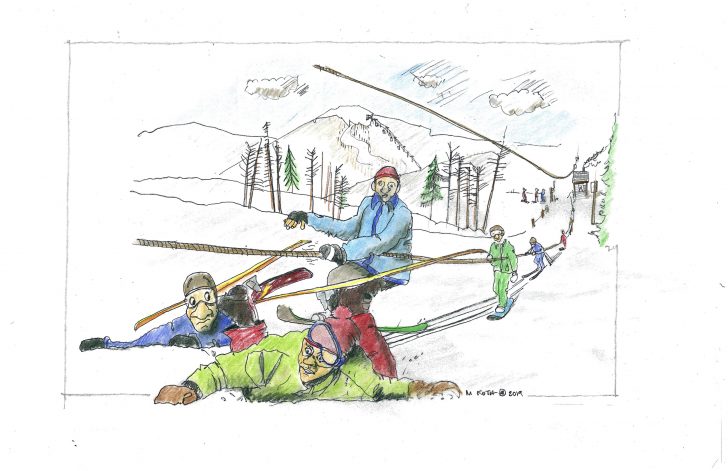
We’ve all been there. Cartoon Credit: Mike Roth

It was the early 1960s, I was in first or second grade and learning to ski at Mohawk Mountain in Connecticut. At the time Mohawk had just installed the first chairlift in Connecticut but most of the experiences I remember where on their numerous rope tows.

The first thing newbies had to master was slowly gripping the rope. Despite instructions to slowly grasp the rope, all first-timers, including myself instantly use a death grip. As a result I’d get hurled up the mountain about five feet before doing a face plant.

To my relief (and later amusement) there was no shortage of people making the same mistake. Every so often there’d be heaps of beginners tossed about on both sides of the tow. Sometimes people got so jumbled up it was impossible to tell whose arms, legs, skis or poles belonged to whom.

After repeating this several times in front of my laughing, older siblings and their friends I finally learned to adjust my acceleration by gently grabbing the rope. Once underway it was an exhilarating ride up the hill.

It was exhilarating because the rope tows at Mohawk moved at about 16 mph. To put that in perspective, modern-day high-speed chairlifts travel at about 12 mph.

After a few tiring rides up the hill someone showed me how to reach my left hand behind my back and grasp the rope while still holding on with the right hand. This did wonders in making the ride physically tolerable.

Another essential skill was learning how to stop once underway. This skill was needed when someone further up the tow fell and blocked the path. Until this skill was learned there would be spectacular pileups. Easing up on your grip wasn’t sufficient because the friction of the rope would tear your gloves apart. Instead you would have to turn one of your skis perpendicular to the hill and use it to keep you from sliding backwards.

The people who didn’t learn this skill would inevitably slide backwards down the hill bumping those behind them. I remember struggling to maintain my place on the tow while two or three skiers slid back into me.

Being six or seven years old the last thing I wanted was to be on the rope tow without others close ahead and behind me. Without other riders close by I would desperately try to hold the rope up off the snow. Being so heavy I’d have to bend over and hold the rope just inches above the snow; a backbreaking way to ride up the hill.

Another challenge was following a tall skier and when you’re a little kid they’re all tall. One of my friend’s fathers was 6’2″. When I rode behind him I’d have to reach up at head level to hold on to the rope. This was another excruciating way to ride up the hill.  In the lift line there was always jostling among my friends to be in the middle of the pack among like-sized skiers.

Being the youngest of three brothers and skiing with a bunch of boys from our neighborhood there was no shortage of mischief. When unloading from the rope tow the older boys would whip the rope in an attempt to knock those following off the tow.

The art form was perfected when one could whip the rope enough to knock off a follower but not so much as to get yelled at by the lift attendant. Those who excelled at this learned to look innocent and express dismay over what happened.

Years later it occurred to me that it was ironic that rope tows, one of the most difficult lifts to master, were most often found serving beginner slopes. I guess they served to toughen us up.

End note: I just recently learned about rope tow speeds at Mohawk having read Nicholas Howe’s fabulous article The Wonders of Walt in the December 2004 issue of Ski Heritage Magazine. Walt Schoenknecht was the ski visionary who founded Mohawk and soon after Mount Snow, Vermont.

Fryeburg, ME, 1936. First rope tow. Credit: MaineSkiMuseum

70s Ski Testing: Defining How Skis Work

Step 1: Inventing The Right Metrics

[Editor Note: In this new series, former SKI editor Marc Liebman recounts how serious ski testing began as a way to provide consumers with objective information about ski performance.]

In the early seventies, ski design was in the midst of a revolution that is still going on today.  It started in 1959 when Art Molnar and Fred Langendorf marketed the first ski with a fiberglass reinforced core under the Tony Sailer brand.  When it came out, skis were made predominantly from wood with a P-Tex bottom and segmented edges screwed into the core.  One piece steel edges were coming into vogue.

Computers and programs to model flex patterns, torsion (twisting) and the impact of different materials on ski performance were in their infancy. Ski design was (and still is) a mix of sound engineering, materials science, and experience.

Ski manufacturers touted the benefits of fiberglass versus aluminum sheets or rods or u-shaped metal versus foam or wood cores and the list went on and on.  Ski Magazine’s (and Skiing’s) customer research said that their readers wanted an objective way to compare skisNet net, we – the skier – were confused.

In 1971, Ski Magazine contracted John Perryman, an aerospace engineer to come up with a methodology that would achieve four objectives:

  1. Measure the dynamic and static properties of the ski;
  2. Analyze these properties mathematically because they don’t act in isolation and are intimately related to each other;
  3. Correlate bench testing with a rigorous on-snow program that requires the skis to be put through a standard set of maneuvers by the tester on a variety of snow conditions and terrain without knowing the ski’s identity; and
  4. Present the results in an easy to understand format that enables the skier to compare ski A with ski B.

The program was called SKIpp for Ski Performance Prediction.  Each year, SKI magazine tested more than 200 skis, all roughly 200 centimeters long. I was on the initial team. Calculations were done with a slide rule and data tabulated on my Bowmar Brain, one of the first electronic calculators.  We created five metrics that we believed defined ski performance:

  1. Foreflex dynamics – complex calculation of the force needed to bend the front portion of the ski and its resistance to rapid flexing;
  2. Afterflex dynamics – same as the front for the portion of the ski behind the boot;
  3. Effective torsion – combination of resistance to a ski’s twisting and how sidecut affects ski’s ability to turn in an arc;
  4. Effective Compression – measured the camber of the ski along with the force needed to flatten the ski; and
  5. Damping – ability of the ski’s to suppress vibration.

Based on the data gathered, we could predict how:

  1. Easy a ski was to turn;
  2. It would perform in different snow conditions; and
  3. How it stable it would be at high speed.

Looking back, we didn’t realize how far ahead we were in ski performance analysis.  In the beginning, several manufacturers challenged our results, but in the end, they came around to our side of the table which was that the correlation between our lab analysis and on snow performance was amazingly accurate.

Memoir Of A Telemark Skier

“Telemarketers” Found Each Other To Practice Their Distinctive Style.

[Editor Note:This remembrance of Telemark skiing by Roger Lohr first appeared in his publication XCSkiresorts.com.]

The North American Telemark Organization set a record with this group turn at Mad River Glen in 1980.

In the 1970s, telemark skiers were called the free heelers, telemarketers, and the Lunatic Fringe. But these skiers performing the historical telemark turn down the slopes at alpine ski areas were seen as “the vanguard of the slopes” by many for their ability and skill descending the runs at high speeds, in the moguls, and landing aerials on their cross country skis. But telemarkers were often heard commenting that they were only riding the lifts at alpine ski areas to improve their downhill skills for the backcountry. Some claimed “free the heel, free the mind”, but they became intoxicated with riding chairlifts rather than getting their thrills in the backcountry.

These days, as alpine touring and backcountry skiing become more popular, the telemark subculture may be a declining breed at the alpine ski areas. However, there was a time when they were racing down through the gates and partying hard and celebrating their differences based on what was perceived as their retro ski techniques. They were dressed in wool pants or knickers with ear flapped knit hats with elongated tassles (designed by Vermonter Poppy Gall, a woman entrepreneur, designer, and currently a co-director of the Vermont Ski & Snowboard Museum).

NATO Founder and Telemark legend Dick Hall wiggles through a narrow spot.

Today, telemarkers, or what is left of this group, are no longer counter culture, but in their heyday, telemark festivals, traveling clinics and workshops, and more were the brainchild of the North American Telemark Organization (NATO) created in 1975 by Richard (Dickie) Hall of Waitsfield, VT. In 2017, Dickie Hall was inducted in the Vermont Ski Hall of Fame, which is a long way from his first time telemark skiing with a dozen others as a group at Pico Mountain, Vt. in 1974.

According to author David Goodman’s article about telemarking in Powder Magazine, “the telemark turn was invented in 1868 by Sondre Norheim in the Telemark district of Norway. As alpine skiing and techniques took over, it was not until Rick Borkovic of Crested Butte, CO, sparked a revival and a number of Nordic skiers rediscovered the old technique.”

I found out about telemarking from the 1977 book “Skiing Cross Country” by Canadian Ned Baldwin while I was living in southern Vermont. Most of us regarded Steve Barnetts’s “Cross-Country Downhill” as the bible of telemarking as it covered downhill techniques in depth. As I improved, I got to know many of the telemarkers in the region, mostly men but there were some women, too. We ran a race series, but beside the competition, it was really a clan of telemark skiers who met on scheduled dates at different ski areas.

As a racer, I felt disadvantaged on my Trucker Light Edge skis, which were narrower and softer compared to the Rossignol Randonee skis, which handled the ruts and hard pack better and were used by most of the other skiers. Always blame the equipment. But Dickie’s motto “Ski Hard. Play Fair. Have Fun” was not so much about winning as it was about spreading the telemark gospel.

Hall developed NATO, (according to Hall, it’s the peaceful one) to conduct workshops, training courses, expeditions, and festivals. He traveled as a telemark evangelist from his home in Waitsfield, VT, and visited the states in the northeast, the Rockies, California, and Alaska among others. These NATO telemark events would feature instructional clinics for all ability levels, and equipment suppliers’ gear for demo use. Hall created the telemark ski school at Mad River Glen as one of the first in the US, and he helped others to become telemark instructors across the country. Over the years, Hall estimated that he has introduced, instructed, or just shared his love of telemark skiing to about 40,000 people!

In 2015, NATO held its 40th and last telemark festival at Mad River Glen, which attracted about 200 participants, a far cry from the 13 attendees at the original Pico event. The races held at the festivals were usually the focus point at these events, but the “group telemark turn” was an activity we all shared together. The telemarkers in Colorado and Alaska would try to top the eastern telemarking crew of deplorables at Mad River Glen, but it is believed that 128 eastern telemarkers in a group turn is the standing record.

At Mad River Glen, Dickie was a task master when it came to the group telemark. In Dickie’s mind, it was paramount that we link two telemark turns for the attempt to count. The photo in the 1984 NATO Eastern Telemark Festival Series poster (and used in many other NATO materials) exemplifies one of those record-breaking group telemark attempts. On the day of that photo (I was there), many of the telemarkers who were near the end of the line got whipped into a gully, and it ended in a yard sale of significant proportion. No injuries, lots of laughs—indeed we played hard and had fun.

NATO is now defunct but Dickie Hall telemark videos are still available via email request at nato@gmavt.net

Author Roger Lohr and two buddies try a three-man tele turn. What’s with the group turning thingy, guys?

70s Ski Testing: A New Series

This is the first in a series about Ski Magazine’s 1970s ski testing program called Ski Performance Prediction or SKIpp.  Its methodology combined engineering analysis as well as a structured series of on the snow maneuvers designed to bring out the best and worst of a ski under a variety of conditions.

Part one of the series Determining How Skis Worked is an overview of the engineering analysis.  The second part discusses the on-snow testing that we did and the third is about the politics of ski testing along with a lesson learned.

Ski (and boot and binding testing) programs came about because skiers were faced with a plethora of choices backed by marketing hype that was confusing at best and to some, downright misleading.  Both SKIING and Ski Magazine decided to jump into the fray and help their readers.  Ski’s approach was significantly different than Skiing.  Given several glasses of smoky, single malt scotch, I might be persuaded to cover the quicksand of boot and binding testing in the 70s.

On the Snow Testing is a very brief overview of the on the snow part of the program.  Typically, we were at a mountain for about twenty-five days and tested 200+ skis.  Not bad work if you can get it, but it wasn’t all fun.  It was work!

Ski testing unleashed a set of business issues that challenged the leadership of Ski Magazine.  Most of the discussions were well above my pay grade as a lowly associate editor.  However, on more than one occasion, I was called into a meeting with the high-mucky mucks and asked why manufacturer A’s didn’t get high marks.  In Politics of Ski Testing, there’s enough to give you an idea of what the discussions were like.

In the end, the SKIpp and the engineering teams at most of the manufacturers found common ground, and we helped each other out.  It was the marketing people that created all the problems because the cries from the ski shops were giving them migraines.

The shaped ski as we know it today wasn’t on the horizon.  The material science and engineering software that creates them was in its infancy and ski design was as much black art as it was engineering.  We got a glimpse of the future one year when we tested twenty odd short skis – 170 – 180 centimeters – and were pleasantly surprised by the results.  The market was ready and when engineering and materials science caught up, voilà, you have the shaped ski.

Sir Arnold Lunn

In Praise Of Ski-ing

Sir Arnold Lunn wrote the rules for slalom and downhill. Credit: JungfrauStories

When this passage (below) from The Mountains of Youth (1925) by Arnold Lunn was published, “skiing” still had a hyphen and “ski” was both the singular and plural form. Lunn (1888-1974) invented downhill and slalom racing, introducing them when the sport was mostly jumping and nordic racing.

Lunn was knighted in 1952 “. . . for services to British skiing.” He was a major figure in promoting ski sports in the Olympic games. As is obvious in this selection, he was a competitive skier who loved speed and took daring chances.

*   *   *   *   *   *   *   *

Arnold Lunn on his first ascent of the Eiger 1924. Credit: Walter Amstutz

The worst and best moments in ski-ing are often separated only by seconds. You are standing at the top of some fierce slope which you have vowed to take straight. You look at the line and observe with sick disgust that the change of gradient is abrupt at the bottom, and that the slight bump half-way down will probably send you into the air. A kind friend says: “I shouldn’t take that straight,” and your enemy remarks: “Oh, it’s safe enough. Jones took it straight yesterday.”And then suddenly, before you quite realize what has happened you are off. The wind rises into a tempest and sucks the breath out of your body A lonely fir swings past like a telegraph pole seen from an express train Your knees are as wax, and your stomach appears to have been left behind at the top. You fight against the tendency of your ski to run apart—the inevitable sequel to undiluted funk—by locking your knees and turning your ski on to their inside edges. And now comes the supreme crisis—the run-out where the gradient suddenly changes. You throw your weight forward, and mutter “Hold it, hold it.” You clench your teeth, and make strange noises as the shock drives up through your legs. Your ski quiver with the strain . . . and you realize to your intense astonishment that you have not fallen.

The pace relaxes. The hurricane dies away. You are drunk with the wine of speed, and you marvel at the faint heart which so nearly refused the challenge. You glory in the sense of control which you have recaptured over your ski no longer untamed demons hurrying you through space, but the most docile of slaves. You are playing with gravity You are master of the snow. You can make it yield like water or resist like steel. Suddenly you decide to stop. A rapid Telemark, the snow sprays upwards, and the “slabberie snow broth,” to quote an old Elizabethan,”has relented and melted about your heeles.”

A laugh floats upwards, and you much enjoy telling your enemy that his diagnosis was correct, and that he can safely venture to take it straight. And, if he falls, your triumph is complete

*   *   *   *   *   *   *

Lunn’s classical education is apparent in his allusion to “an old Elizabethan.” The “slabberie snow broth” quotation, reports the Oxford English Dictionary, comes from the first English translation (1600) of Livy’s Roman History. Shakespeare mentions “snow-broth”—mixed snow and water—once, with reference to the blood in the veins of a villain. (Measure for Measure, I, iv, 57).


British athlete Sir Arthur Lunn helped create a sport out of a past time.

Guest Ski Tester

SKI Magazine Ski Testers Meet The Sundance Kid.

Gene Hackman and Robert Redford in “Downhill Racer” (1969). This heart throb really loved to ski.

Back in the early ‘70s, SKI Magazine (remember it?) developed a program called SKIpp that stood for “ski performance prediction” developed by the late John Perryman. He was a talented engineer who spent years in aerospace and worked with Howard Head at Head Ski Company. SKIpp had two parts, the laboratory analysis that predicted how the ski would perform and on-snow testing. Each year we tested 200+ skis.

John did the analysis and I ran the on-snow testing. Our testers were a mix of male and female skiers, primarily ski instructors with some racing experience. In March, 1974, we were at Park City which let us set up our testing tent near the base of the Shaft lift. Every morning, we tested ten pairs of skis. After lunch, each tester picked his favorite ski from the day or prior days and headed for the lifts.

One bright sunny morning, my lovely wife Betty was collecting test forms in the tent along with Joan, John’s wife, when one of the testers who was, at the time, the ski school director of Sundance Ski Area, walked into the tent and asked a simple question. “Would we allow Robert Redford ski on some our skis?”

We had skis that weren’t on sale yet, some that wouldn’t make it to the market, some that should never been sold to skiers, and Redford hadn’t signed the liability waiver. All of this went out the tent flap when Redford walked into the tent.

I tried to be my best cool, calm and collected Naval Aviator self, but the look on our wives’ faces was priceless – eyes and mouth wide open. Both were speechless that, if you knew them, was rare. His presence attracted the other three female testers who were nonchalantly trying to swap skis or ask Betty, John, or me a question just so they could get in the tent with Redford.

John looked at me, I looked John, and we shrugged. While our wives stared at the famous movie star, I managed to ask, “Can you ski 200 centimeter skis?”

“Yes.”

“What size boot do you wear?”

He gave me a size that I don’t remember. This was back in the days when boot sole shapes weren’t standardized, and we were using Market Rotomat rental bindings that took some fiddling to adjust. None of the easy-to-adjust bindings that we see today existed.

To this day, Betty will tell you she talked to him for a few minutes but has no idea what she said or was she coherent. What we do remember was that Redford was as good-looking in person as he was on the screen.

Oh, and one more thing. By the time he returned the skis, the word was out that Redford was around and a larger than usual crowd had gathered around the tent. None of us were smart enough to get him to autograph the test card he graciously filled out. Oh well!!!

Snow In Literature: Lesson #1

Utah Poet Offers Instruction And Advice For Beginners In Sonnet.

The following loosely-rhymed sonnet is by Utah skier and writer Emma Lou Thayne (1924-2014). It appeared in her 1971 book Spaces in the Sage and was once printed on a ski poster sent nationwide to advertise Utah’s “Greatest Snow on Earth.”

Emma Lou Thayne.

Thayne earned a master’s degree in creative writing from the University of Utah after having already established herself as a published writer. For a time she coached the UU women’s tennis team. She was an activist for women, peace, AIDS awareness, and mental health issues, and she was a much-beloved Utah personality and writer.

Her love of skiing Utah powder and her penchant for off-piste adventure is beautifully expressed in this poetic piece of advice to a young beginner. Growing up with three brothers, and raising five daughters, Emma Lou had plenty of opportunities to observe, advise and instruct youngsters in skiing.

Lesson #1

Alta. Credit: SkiUtah

Ski here, my child, not on gentle slopes

where the snow is packed and the trail is wide.

Instead, cut through the trees where no one’s tried

the powder. Push toward the hill and rotate

as you rise. No, the snow-plow holds you back;

it’s slow and makes you frightened of your turn.

Think parallel. Stay all in one, then learn

to ski the fall line, always down: Switchback

skiers in their caution never know how

dropping with the mountain keeps the balance

right and rhythm smooth. Don’t watch your tips at

all. Look past them at the deep white snow,

virgin as light, and yours. Just bend, release:

You, gravity, and white, will make your peace.

Powder Mountain. Credit: Ian Matteson


My Career As A Folk Singer

An Undergraduate’s Parody Ski Song Led To An Academic Achievement.

How did a ski silly ski song to the tune of a classic melody wind up on a Folkways record which became a classroom classic?


As an undergraduate at Michigan State University in the early 1950s I joined the ski club, and I learned, among other things (like how to kick turn), a bunch of ski songs. We sang them driving up to Caberfae resort near Cadillac and apres ski in a local joint, The Pine Gardens.

These songs—passed from person to person—were often parodies. A takeoff on “The Battle Hymn of the Republic” told the sad tale of an injured ski racer with the chorus “Gory, gory, what a Hell of a way to die!”

Another disaster-themed favorite re-worded the cowboy ballad “Streets of Laredo.”

When I was a-skiing the hills of Sun Valley,

As I was a-skiing Old Baldy one day,

I spied a young skier all wrapped in alpaca,

All wrapped in alpaca, and cold as der Schnee.

This lugubrious piece went on to quote the injured skier who “Once upon Baldy used to ski gaily” but then “caught a right edge, and I’m dying today.”

Later as a graduate student in folklore at Indiana University I took a course on British ballads and learned that our Sun Valley song was part of a much older cycle of variations on the theme of “The Unfortunate Rake.” That’s “rake” in the archaic sense of a dissolute person, a libertine.

Author Jan Brunvand, occasional singer of ski songs, in the 50s.

In the original Irish and English versions the victim was a young soldier, dying from an STD, who describes his sad condition and requests a funeral: “Get six young soldiers to carry my coffin,/ Six young girls to sing me a song.”

In the cowboy song the funeral request became “Beat your drums slowly and play your fife lowly, /Get six of them gamblers to carry me along.” Our skiers’ parody called for “Six from the ski school to carry my coffin,/ Six little bunnies to sing me a song.”

One of my classmates, a rising star in folksong studies, was compiling a record of versions and variants of the “Rake” cycle. He enlisted me to sing the skiers’ version. Trouble was, I couldn’t sing worth a darn.

So we got another fellow student who performed in a local folksong group to plunk guitar chords to keep me more-or-less on key, and I managed to lay down a decent track, as we say in the business.

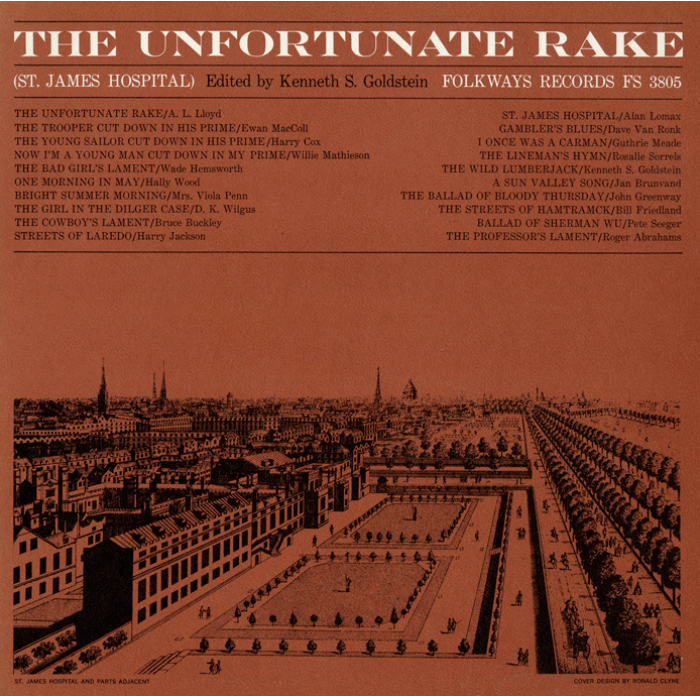
The LP was issued by Folkways Records in 1960, and there I was earnestly chirping my “Sun Valley Song” on the same disk as nineteen real folk singers, including Alan Lomax and Pete Seeger.

“The Unfortunate Rake: A Study in the Evolution of a Ballad” became a classroom classic used to illustrate how texts change as they are transmitted via oral tradition.

And you can listen to a sample of the “Sun Valley” song by clicking here. 

Even though this was my sole appearance as a folksinger, I make up in longevity what I lack in numbers. The Smithsonian Institution bought out Folkways and kept the entire catalog in print. Their website offers “The Unfortunate Rake “ by “various artists” as a CD or a download.

Or you can check it out on Amazon by clicking here.

I still like to sing an occasional ski song, to myself, usually while cruising western slopes, including a few times even those at Sun Valley.


Mystery Glimpse: Who’s Skiing In Skirts?

It Looks Royally Uncomfortable.

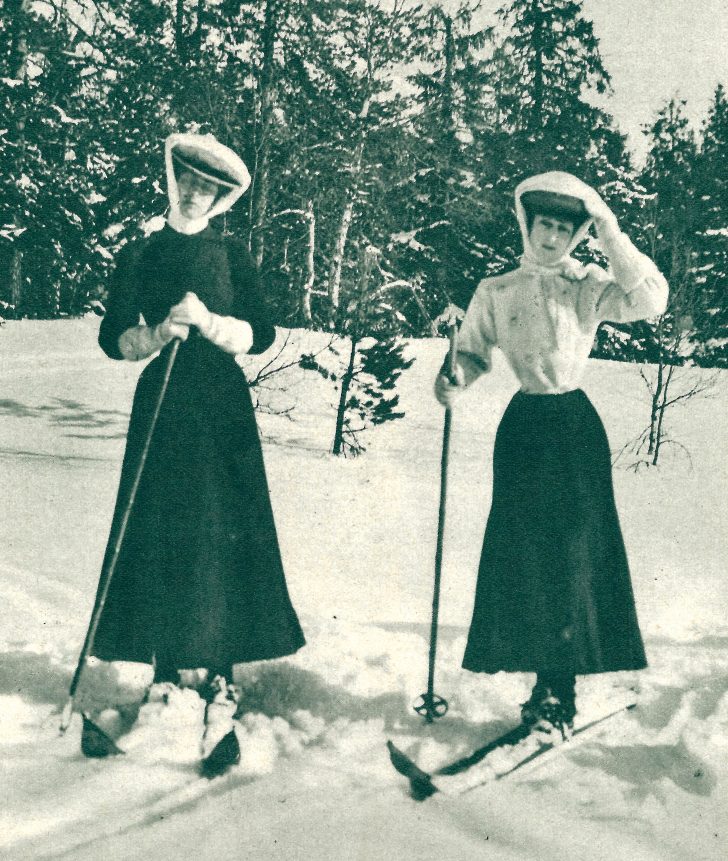
Here’s a picture from long ago. The woman on the right is the mystery lady. Who is she? You can probably guess the era from the skiing “costumes”. Probably foreign. Last hint: Think Scandinavia.

This week’s picture was contributed by Vesterheim, the National Norwegian-American Museum & Heritage Center, in Decorah, IA.  The center has over 33,000 artifacts, 12 historic buildings, a Folk Art School, and a library and archives. This treasure showcases the most extensive collection of Norwegian-American artifacts in the world.

Vesterheim’s exhibitions explore the diversity of American immigration through the lens of the Norwegian-American experience and highlight the best in historic and contemporary Norwegian folk and fine arts. USA Today named Vesterheim one of “ten great places in the nation to admire American folk art.”

Last Week

This is the famous Engen Bell, a fixture in Utah ski history and an official “treasure” of the state.

The bell was used for many years on an old locomotive from the Denver & Rio Grande Railroad. It is estimated the bell was made in the mid-1800s, but no official records are available to verify its exact age. Rio Grande Railroad officials stated that the bell made hundreds of trips through Utah in the late 1800s and early 1900s.

In 1955 the bell was acquired by Martha M. Engen as a gift from the railroad. She gave it her son Alf for use at his Alf Engen Ski School at Alta, Utah. For 24 years, the bell was used every day to toll the start of the morning and afternoon ski school sessions. It became a landmark at Alta; everyone listened for the bell to sound. When Alf Engen retired as the ski school director, it was deemed appropriate to also retire the bell in his honor. The bell rang for the last time in 1989, when Alta celebrated its 50th anniversary as a ski area. Alf gave the bell to his son, Alan, who commissioned a solid oak stand and brass plates identifying it as “The Engen Bell,” in honor of his dad and his grandmother, Martha.

Look closely. There’s the bell on the old steam engine.

In 1995, the old bell was selected as one of the “100 Treasures of Utah” and was put on display at the Utah Winter Sports Park as a featured attraction of the 1996 Utah Centennial celebration. The reasons for being named a Utah treasure are twofold: First, the bell holds historical value due to the time period in which it was used by the Rio Grande Railroad. Secondly, it is the only ski school bell ever used at Alta, and as far as can be determined, is the only bell used by any ski school in Utah’s history. The only other Intermountain Region ski school to use a bell for announcing the start of classes was at Sun Valley, in the late 1930s and early 1940s.

The bell is on display at the Alf Engen Ski Museum located in Park City, Utah.

Mystery Glimpse Returns: What’s Happening?

Guess What’s Going On, Submit Under Comments Below.

Our popular Mystery Glimpse feature is returning after a summer respite. The basic idea is that we publish a photo of a person, place, or thing, and you guess who, where, or what. Most of these photos have been submitted to SeniorsSkiing.com by some very excellent ski museums around the country. We will be highlighting each museum with the week’s new Mystery Glimpse. In the next edition, we’ll reveal the story behind the picture and present a new puzzle.

This week, we have a news photo from the Colorado Snowsports Museum and Hall of Fame located in Vail Village, CO.  Its collection of priceless artifacts tells the story of the birth, rise, and explosive growth of skiing in Colorado. Click here to support the museum’s mission.

What’s going on here?

If you think you know, submit your guess in comments below.

Who, What, Where, When?

You can access our archive of Mystery Glimpse articles by clicking here.


Short Swings!

World War II produced many heroes. One of Norway’s best known died earlier this week. Joachim Ronneberg led the ski-assisted raid that destroyed the facility where Nazis were producing “heavy water,” a component they would have used to produce an atomic bomb.

He was 23 when, according to his obituary in the The New York Times, he and eight other “…Norwegian saboteurs skied across the Telemark pine forest in winter whites, phantom apparitions gliding across moonlit snow. . They halted at a steep river gorge and gazed down at a humming hydroelectric power plant where Nazi scientists had developed a mysterious, top-secret project… Hours later, in one of the most celebrated commando raids of World War II, Lieutenant Ronneberg and his demolition team sneaked past guards and a barracks full of German troops, stole into the plant, set explosive charges and blew up Hitler’s hopes for a critical ingredient to create the first atomic bomb.” Ronneberg was 99. The complete Times obituary provides a brief history lesson on the epic event.

Kirk Douglas and Richard Harris starred in “The Heroes of Telemark,” a 1965 British film based on the raid. The most definitive book on the raid, “The Winter Fortress: The Epic Mission to Sabotage Hitler’s Atomic Bomb” (2016) was written by Neal Bascomb. Click here for “X-C Skiing Saves the World,” SeniorsSkiing.com’s 2016 book review.

RSVP for SeniorsSkiing.com’s 5th Birthday Party!

Help celebrate our Fifth Anniversary, 5:30 – 8:00 PM, Wednesday, November 14, on the Upper West Side of Manhattan. Meet other metro area senior skiers. Win Apex Ski Boots, a trip to Okemo in Vermont, Orsden ski parkas, a season of ski insurance from Safe Descents, The Bootster device to help get boots on, the DeBooter device to get them off, discounts on Masterfit boot products, etc.  Lots of SWAG from areas all over the country. Meet a representative of Alpskitours based in Italy’s Aosta Valley. All free except for cash bar. RSVP, jon@seniorsskiing.com.

Buying Boots? Use a Professional Bootfitter.

If you’re considering buying boots, PLEASE, use a professional bootfitter. It is one way to assure the positive outcome of your purchase. We highly recommend using the services of bootfitters who have gone through training with Masterfit’s America’s Best Bootfitter (ABB) program. To find one near you visit: https://www.bootfitters.com/find-shop.

New England Areas Get a Head Start

Sunday River, Maine, opened last weekend. Mt Snow will open this weekend, the resort’s earliest opening in its 64- year history.

Mind-Boggling Ski Videos

These feats are not to practiced on your home hill.

Skiing East Face of Matterhorn: The six-minute video starts with the climb up Mt Cervin (aka Matterhorn). The skiers unrope themselves from bolts in a rock face and ski — ever so cautiously — a steep, rocky face, until they let loose on saner terrain.

Line of Winter: This three-minute selfie from GoPro shows Nicholas Falquet skiing what appear to be high elevation vertical walls covered in deep powder. Can’t tell if he has a cable attached to his back. I’ve never seen anything quite like it.


Caught in a Crevasse: This one is 17 minutes and shows a skier falling into and being rescued from a deep crevasse. Lesson here is to avoid crevasses and if you’re in those conditions, to ski with others with rescue skills and equipment.


Park City’s BIG SHOT!

Sunrise Rotary Club in Park City (I was a member during my Park City years) set a world record on Saturday, October 13 with its 3rd annual Shot Ski Event. If you’re not familiar with shot skis, they’re skis affixed with shot glasses. For competitions — or just for fun — the glasses are filled with booze (in this case from Park City’s High West Distillery).  The entire ski is hoisted and the contents guzzled by the participants. To reclaim the record from Breckenridge, 1275 Parkites showed up to lift 508 skis (2570 feet long) off Main Street. Congratulations, Sunrise Rotary for raising almost $30,000 from the event!

Axe Throwing and New Pod Hotel at Whistler

Among other new developments at Whistler this year are the Pangea Pod Hotel and apres ski axe-throwing. Two more reasons to visit Whistler Blackcomb, one of North America’s largest and most fascinating resorts. It has an added benefit for seniors — its relatively low elevation (long vertical, nonetheless) makes it easier on the lungs.
My Search For Stein’s Studebaker

Having A Studebaker In Common With A Legend Prompts A Sherlockian Pursuit.

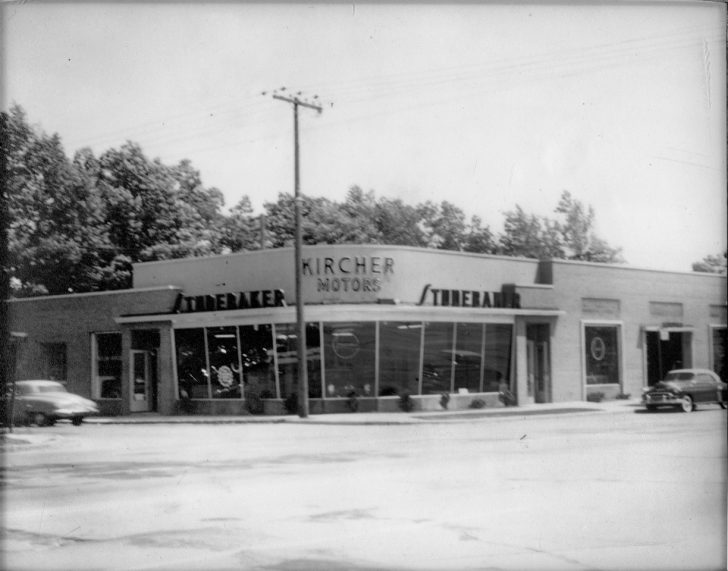
The Kircher Studebaker dealership in Detroit in the early 1950s. The car on the left is clearly a ’50 or ’51 bullet nose model, even though only the back of the car shows here. Those are the only years this model was made.

Stein Eriksen bought a new Studebaker in April 1953. That much is certain. I’d like to know which model Stein bought, what happened to it, and if there is a photo of Stein with the car.

Why? Because my father-in-law bought a Studebaker that same spring, and my wife Judy and I have had it restored. Is it possible that we own a close match to Stein’s Studebaker?

Stein bought his in Detroit from the dealership owned by Everett Kircher, founder of Michigan’s Boyne Mountain ski resort. Judy’s dad bought his from a dealer in Benton Harbor on the other side of the state. Studebakers, seniors may recall, were manufactured in South Bend, Indiana. The company folded in 1966.

Car salesman Don Thomas, also a weekend ski patroller at Boyne, met Stein through mutual Norwegian friends when he attended the 1952 Oslo Winter Olympics. When Stein came through Detroit en route from Sun Valley where he had been training. Thomas invited him to dinner and introduced him to his boss.

Everett Kircher offered Stein a job at Boyne, but Stein wanted to compete in the 1954 FIS World Championships before turning pro. He took the job the next year and spent two seasons at Boyne before moving on, ending up at Deer Valley. But he did buy that Studebaker in 1953.

Various sources describe the car as a “sports car,” a “sports coupe“ and a “graceful 1953 Studebaker coupe.” These ’53’s were a sleek breakthrough concept by the Raymond Loewy design team at Studebaker, coming between the “bullet nose” models and the later Hawk series.

A 1953 model might be the hardtop “Starliner” version or the “Starlight” coupe (our car) which has a pillar supporting the roof. Either version came as either a 6-cylinder “Champion” or a V8 “Commander.”

In an interview, Don Thomas described the car as a “five-passenger coupe,” which could fit either model, although it seems likely a salesman would refer to a hardtop by its proper term.

Once at Deer Valley, I was able to ask Stein about his Studebaker. I was in the singles line at the Northside quad when Stein approached the lift with a couple of celebrity guests. He gestured for me to join them.

I had met Stein a couple of times before, so I used the typical Norwegian greeting for acquaintances, “Goddag, og takk for sist.” Then I asked him about his Studebaker. “Ja,” said Stein, “that was the one that looked like an Italian sports car. I took it with me to Oslo and sold it.”

That’s all I learned straight from the source. But Stein remarked as we got off the lift, “Brunvand, you should speak better Norwegian!”

Since then. I have queried Stein’s son Bjorn, Kircher’s daughter-in-law Molly Clark Kircher, and a Norwegian Studebaker club member, hoping to unearth more information.

The closest I’ve come is finding a 1950’s-era photo of Kircher Motors in the Boyne archive at the Bentley Historical Library in Ann Arbor. Oh, how I wish someone had posed Stein there with his new car for another picture.

Likely Stein’s Studebaker was eventually junked, but it’s barely possible that someone somewhere has the car, perhaps unaware of its past connection with skiing royalty. I plan to keep on searching.

Correspondent Jan Brunvand with his 1953 Studebaker Starlight coupe. In the background, early snow on the Wasatch mountains. Credit: Jan Brunvand

“Ultimate” Quiz Of Ski Terms

You Think You’ve Been Around Snow Sports For A While, Eh? See How Many You Get Right.

  1. Milk Run

a. Ski trail with lots of slush

b. Off-season mountain bike race on ski trails

c. Trail full of slow skiers

d. First run of the day


2. Chatter

a. Noisy lodge

b. Excessive talking on chairlift

c. Squeaky noises from a lift

d. Excessive ski vibration

3. Death Cookies

a. Double stuffed Oreos

b. Cookie-sized ice chunks on a trail

c. Day-old cookies

d. Deep fried cookies

4. Planker

a. Skier who is stays in one spot oblivious that the lift line is moving

b. Someone who falls and can’t get up

c. A skier

d. Someone struggling to get into their bindings

5. Lunch Tray

a. Oversized plate of food

b. Snowboard

c. Device for carrying food in a cafeteria

d. Chairlift chair

6. Blue Run

a. An intermediate trail

b. A run so bad it’s depressing

c. Trail with a stream of melting snow

d. Trail with active snow making

  1. Balaclava

a. Greek desert

b. Tyrolean hat

c. Facemask

d. Dangerous intersecting trails


8. Six Pack

a. Chairlift seating six

b. Parents skiing with young children

c. Group of wild snowboarders. As in, “Look out, here comes a six pack.”

d. Wannabe skier’s lunch

9. Fart Bag

a. Senior skier

b. One piece ski suit

c. Smelly bubble chair

d. Porta Potty at base of remote lift

10. Magic Carpet

a. Easy slope

b. Slang for marijuana

c. Untracked powder

d. Conveyor belt-type lift

Answers:

1d, 2d, 3b, 4c, 5b, 6a, 7c, 8a, 9b, 10d

Do you have some favorite ski slang? Share it with us in the comments section.

Short Swings!

Most people who love skiing take an interest in its history. Preserving and promoting that history is the mission of the International Skiing History Association (ISHA), a volunteer and membership organization that deserves our collective support.

Among other things, ISHA publishes Skiing History, a delightful bi-monthly magazine available in digital and print versions. SeniorsSkiing.com subscribers are eligible to receive a free one-year digital subscription. Click on “Community” at the top of this page.Then click on “Subscriber Only Content” in the drop down box. Scroll to”Free One Year Subscription to Skiing History Magazine” and follow the instructions.

Earlier this week, I attended ISHA’s Skiing History evening at Hickory and Tweed, the venerable ski shop in Armonk, NY. About 60 people showed up for a nice spread and an entertaining presentation about the relatively negative but highly amusing portrayal of skiing on TV sit coms. Jeff Blumenfeld, a member of ISHA’s Board put the show together. The program started with the popular 1950’s Topper program (in which two main characters and a drunken Saint Bernard are buried in an avalanche) and continued with a variety segments from the Dick Van Dyke Show, Here’s Lucy (when Lucille Ball actually had a broken leg), The Brady Bunch, Ellen DeGeneres (on a broken chairlift with two nervous friends), Cheers, and others. ISHA intends to promote use of the presentation by ski clubs, thus building awareness of the association and increasing its membership.

If your club is interested in using the presentation, emailjeff@blumenfeldPR.com.

An article on the same topic, by Jeff, appears in the September/October 2018 issue of Skiing History.

NYC Ski Gatherings

SeniorsSkiing.com Birthday Party!! — We’re ramping up for our 5th Anniversary party, 5:00 – 8:30PM, Wednesday, November 14 in The Rumpus Room of E’s Bar (Amsterdam Avenue, between 84th and 85th Streets) in Manhattan. We’re providing the place and the food. Advertisers and others are providing raffle prizes and SWAG. Prizes include a pair of Apex Boots (courtesy Apex Boot Systems); a ski trip to Okemo in Vermont (courtesy 70+ Ski Club), two Orsden parkas (courtesy Orsden); DeBooter ski boot jacks (courtesy Outdoor Logics Solutions); Bootster ski boot horns (courtesy Bootster); discounts for a variety of Masterfit ski boot products(courtesy Masterfit), GearBeast cell phone carriers (very cool product), and superbly warm socks from The Buffalo Wool Company. Except for your bar bill, it’s all on the house. You’ll meet other older skiers. You might win a prize. You’ll certainly have fun. Add it to your calendar. Your RSVP will help us plan for the event: jon@seniorsskiing.com.

Friends of Alta is the non-profit protecting Alta’s environment, preserving its unique character and heritage; and encouraging stewardship and sustainability of Alta’s environment and community. The group ishosting an event, 6:00PM – 8:30PM, Thursday, November 15, at The Explorers Club in Manhattan. For more information, click here.

Five Minutes of Deep Powder Joy 

Icelantic Skis produced this outstanding deep powder short film on the slopes of Mt. Yotei in Japan. There’s some cliff-hucking and one scene where a skier skims off a powder-topped tree branch…the stuff of younger skiers. But the shots of deep powder turns are dreamy.

An Offer No Serious Skier Should Refuse

Realskiers.com is a website that reviews skis. The reviews are more detailed and refined than what you’ll read in one of the ski magazines. And the site is rich with opinion about the sport. Realskiers.com is a written and published by Jackson Hogen, whose irreverence is reflected in his self-proclaimed moniker, the Pontiff of Powder. For youngsters, an annual subscription is $19.95. For SeniorsSkiing.com subscribers, it is $9.95. To subscribe at the reduced rate, click here and enter SS18 for the discount code.

John Henry Auran: Ski Journalist Extraordinaire, Dies At 90

The Creative, Intense, Funny, Unique Journalist Will Be Remembered As One-Of-A-Kind.

John Henry Auran, journalist, raconteur, skier, sailor, innovator, enthusiast.

Ski journalist John Henry Auran was the kind of person you could never forget. I worked for John Henry, or JHA, as he was known to some, in the early 70s at SKIING Magazine, then located at One Park Avenue in New York City. Despite different life paths since then, we kept in touch, even as his declining health brought him farther and farther away from the sports he loved.

John Henry was always interested in delving into new products, new racing results, new personalities on the ski scene, new ideas for connecting the reading public with the outdoor winter sports industry. His enthusiasm was uncontainable for finding, thinking, analyzing, reporting, and watching the world for news.

I will never forget when he and I went to a ski boot manufacturer somewhere in New Jersey who promised to show us a then new development in boot fitting. This was the first foam-fitting demonstration ever, as far as I know, in the business. Since John Henry was SKIING’s boot expert, he went for a sneak preview, and I tagged along to take pictures.

At the manufacturer’s “plant”, John Henry was seated in a high chair, like the shoe polishing chairs you see at airports or train stations.  His foot was placed in a plastic bladder which was gradually filled with foam and placed in a boot shell. I distinctly recall him reporting all the sensations that involved: “It’s getting warmer, I feel some pressure,” while a big smile crossed his face. “I’m getting foamed!”

After that, John Henry couldn’t resist asking people if they’ve been “foamed”.  Since no one had, that gave him license to launch into describing the experience complete with gestures and enthusiastic and dramatic commentary. “Everyone should try it.”

He was also an innovator in what created a new genre: the industry show newsletter. At the time, the ski business had three regional shows for equipment and clothing manufacturers and wholesalers to meet retailers run by Ski Industries America. John Henry had a terrific idea: Publish a daily newsletter at each show that reported news, gossip, personnel moves and the like every morning of the show. Sounded like a great idea.

JHA enlisted the staff of SKIING to do some reporting, bring it to us in our editorial corner where he and I would create columns by typing copy into an IBM Selectric. We then pasted the columns to a piece of oaktag with a pre-designed masthead and logo and brought it to a printer where we waited until the job was done. We picked up the edition and distributed it throughout the show venue. Did I mention this process took almost all day AND all night? Trial and error was the name of the game. Despite being exhausted, we knew we had a hit when we saw the show people reading the Show News over coffee. That was true journalism.

John Henry always had a story ready whenever we talked over the years. One of his favorites was about his hometown where he was born in Germany. As a young boy, he was a witness to Kristallnacht in November 1938.  A few years ago, the town government had a commemorative event marking that dark past and invited JHA to come back to join the few other surviving town residents to bear witness and tell their stories of what happened.  Despite his disability, he went all the way back to Germany with a companion, all sponsored by the town. It was a remarkable and touching journey.

John Henry was also an enthusiastic member of SeniorsSkiing.com’s Advisory Board.

John Henry lived in a nursing home in upstate New York for the past decade or so. When I called, the nursing staff would chat while John got to the phone. They would tell me he enjoyed being taken to nearby Hunter Mountain where he would sit in the base lodge watching the skiers and the lift traffic. I can see him there, in my mind’s eye, reminiscing to himself about the equipment, the racers, the dramatic places, the deadlines, and the great writers he knew. Watching the lift go around and around.

Rest in peace, John Henry.

Mystery Glimpse: He Was The First

This Well-Dressed Athlete Was The First Of Many.

Thanks to the Colorado Ski And Snowboard Museum for sending this picture along. We’re reaching deep here, dear readers, and if you can get this one, we will be really impressed.  Who is he and what did he do that gave him a place in ski history?

Last Week

This is a glimpse of the famous Winter Park ski train that has recently shut down after 69 years of service.  Ski trains were very popular with skiers from metropolitan areas on both coasts and the Rockies during the 30s and 40s.  But, with roads and interstates, the trains became unprofitable. According to the Colorado Ski and Snowboard Museum, the ski train that brought Denver citizens to the mountains was one of the few that survived.
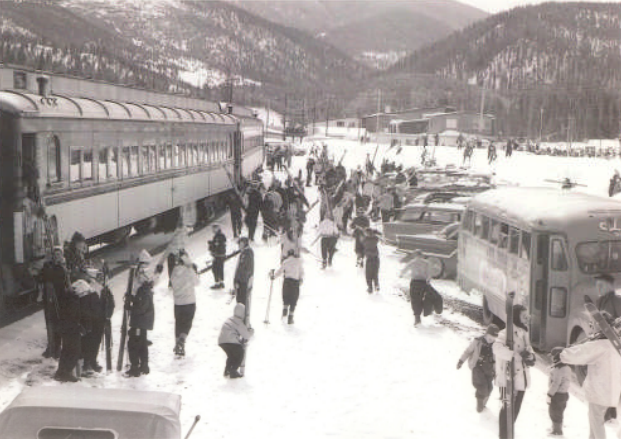
You can only now imagine how convenient and almost luxurious it must have been to take a train to a station near a ski area and get picked up by a bus or horse-drawn sleigh to be taken to a mountain hotel or base lodge. Must have been some fun times on those trains going back and forth.

Anyone remember taking a ski train to and from the mountains?  What was it like?

To read more about the history of the Winter Park ski train, click here.

Visit A Ski Museum

SeniorsSkiing.com salutes the many ski museums who have contributed to the Mystery Glimpse series this season. Our readers should be aware that these often very small museum carry the stories and pictures of the past years of snow sports, going back to the early renderings of hunters and warriors on skis and ski-like gear. If you have a ski history museum near you, visit and support their efforts.

Colorado Ski and Snowboard Museum

Vermont Ski and Snowboard Museum

Ski Museum of Maine

New England Ski Museum

National Ski and Snowboard Hall of Fame

Alf Engen Ski Museum

Museum of Sierra Ski History

We very much appreciate the contributions these ski museums made to SeniorsSkiing.com’s Mystery Glimpse.  It was our way of keeping ski history and heroes alive and in front of an audience who appreciates the value of nostalgia. Next season, we hope to expand our list of contributors.


Mystery Glimpse: Choo-Choo!

Where Are We And What’s Happening?

Thanks to the Colorado Ski & Snowboard Museum for providing this picture from ski history.  The CS&SM is in the process of undergoing a $2.4 million renovation. The first of several exhibits, “Climb To Glory”, featuring the story of the 10th Mountain Division is now open. Other exhibits will be open at the end of April this year.  The museum is located in Vail Village, CO.

Last Week

This is another ski history legend.  Nic Fiore was an influential ski instructor and director of the ski school at Yosemite’s Badger Pass for 50 years. His friendly smile and charming French-Canadian accent attracted skiers who came to Badger Pass every year to learn from and ski with Nic.

He was an early member of the California Ski Instructors Association in the late 40s. At the time, he was concerned about the quality and consistency of ski instruction, becoming a voice for a national ski instruction organization. When the Professional Ski Instructors of America was founded in 1961, Nic remained committed to high standards for instructor certification.

Nic Fiore was an active skier well into his 80s. He continued to hit the slopes nearly every day and teach an occasional ski lesson into the 2003-04 season. Nic passed away at 88 in 2009.

Here’s Nic on the lift at Badger Pass. Note his enthusiasm and magnetic personality.

https://vimeo.com/3111117

Thanks again to the Museum of  Sierra Ski History for sending Nic’s photo.  The MSSH is located at the Gateway Museum at Lake Tahoe, CA.

Bob Beattie, Legendary US Ski Team Coach, Dies At 85

Beattie, Who Coached The US Team For Nine Seasons, Was A Ski Competition Innovator.

Bob Beattie, the coach who put the US Ski Team on the world stage in the 60s, has died on Easter Sunday in Aspen, according to his son, Zeno. For details, click here for the news story from The Aspen Times. 

Bob Beattie, 85, was a colorful leader, coach, and sports commentator.

Senior Skiers: St. Bernard Is Watching O’er

St. Bernard, The Doggie’s Namesake, Is An Actual Saint.

St. B points the way to an Alpine mountain hut. Credit: Bri-Tri.

[Editor Note: This tidbit was submitted by LuAnn Snyder, a freelance writer from Maryland.]

Here’s a bit of trivia about the Patron Saint and Protector of Skiers: St. Bernard of Montjoux.

Little is known for certain about St. Bernard of Montjoux who was probably born in Italy, c. 996 and died at Novara, Lombardy, Italy in 1081 at the age of 85.

He was proclaimed the Patron Saint and protector of skiers, alpinists, and mountain climbers by Pope Innocent XI in 1681 and confirmed by Pope Pius XI (himself a mountaineer) in 1923 because Bernard spent more than four decades conducting missionary work in the Alps by ministering to the welfare of the scattered inhabitants. His Feast day is celebrated on May 28.

St. B has his own flag.

He is said to have been ordained a priest, made vicar general of Aosta and built schools and churches in the diocese. He is especially remembered for two hostels he built to aid and save the lives of pilgrims on their way to Rome who were lost in the mountain passes or who had fallen victims to avalanche, exposure, and other mountain hazards. The mountaintop on which he’d build his monastery in the Alps, between Switzerland and Italy, is named for him: Great and Little Bernard.

He was further honored in the late 1800’s when European dog breeders renamed the Alpine Mastiff, the St. Bernard. The St. Bernard dogs were formerly used by the heroic monks who were accompanied by their well-trained dogs to go out in search of victims who may have succumbed to the severity of the weather. The Saint Bernard dog was especially breed to assist travelers in this mountainous region.

His image appears in the flag of some detachments of the Tyrolean Alpine Guard. He is also the patron saint of skiing, snowboarding, hiking, backpacking, mountaineering.

You may want to keep St. Bernard in mind if you unexpectedly find yourself on top of a double-black diamond.  You never know..

If you’re stuck, St. Bernard will send his pups.

Mystery Glimpse: Who, Where, And What?

Here’s A Classic-Looking Skier In A Classic Pose.

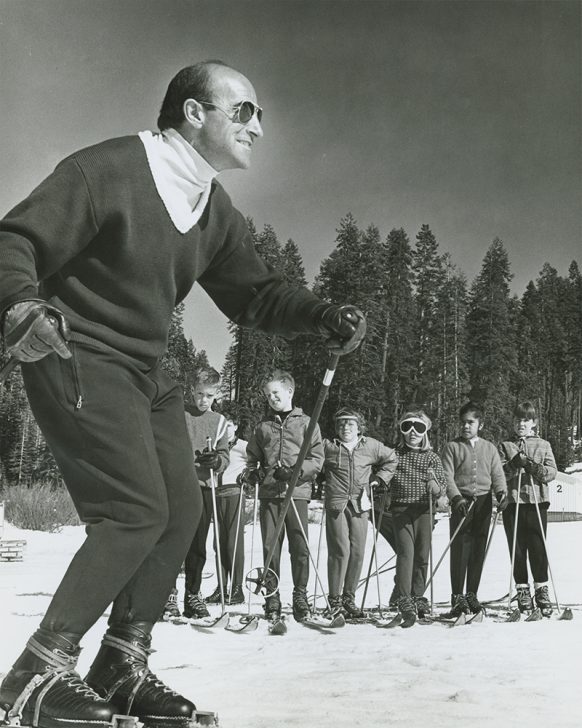
Looks like an instructor demonstrating to a kids’ class. Check the straps around his boots, and you will get a hint about the era depicted here. Don’t you love that turtleneck? No, parka, hmmm. Looks a little like California-stylin’.  That’s enough of a hint for this one. Who is he, where did he hang out, and what’s his claim to fame?

Thanks to the Museum Of Sierra Ski History and 1960 Winter Olympics for contributing this.

Last Week

Mystery Glimpse has stumped the collective hive mind for the first time.  No, not Stein Eriksen’s older brother, but good guess.
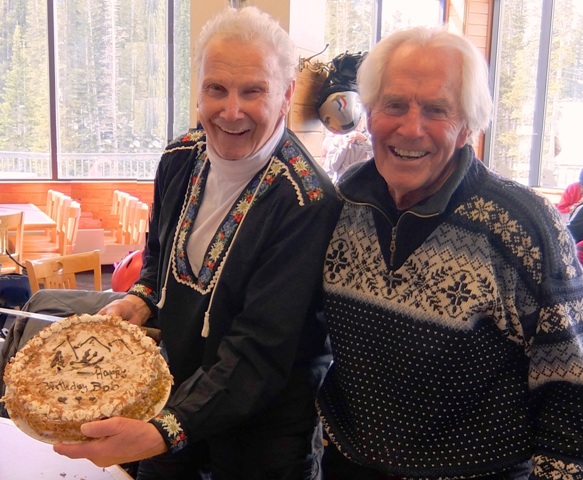
The handsome, young skier is Dick Buek, an extreme skier before there was extreme skiing.  Here’s John Jerome, the noted ski writer, talking about Dick back in the January, 1970 issue of SKIING magazine.

“To Dick Buek, the human body was a device with a certain potential, and the only sensible course for the intelligence which guided that body was to find out what that potential was….Collecting Dick Buek stories is an exercise in the suppression of disbelief.  Shussing Exhibition the first time he saw it. Winning a ski jump the first time—maybe the only time—he ever went down an in-run. Sky-diving with a parachute he found in a scrap heap. Diving off cliffs in Acapulco to win a bet for gas money. Piloting a light plane over a slalom course around lift towers at Squaw Valley, beneath  the cables. And so on. The stories are legend.”

He won the 1952 National Downhill Championship. Then, severe injuries from a near fatal motorcycle accident left him in really tough shape. Despite his knee and shoulder being held together by pins and plates, his leg only able to extend to 60 degrees, he entered and managed to win the Downhill at the 1954 Nationals at Aspen. He was passed over for the 1954 FIS World Championships because he was “a basket case.”

Dick Buek, 1929-1957

There are other stories, like watching Stein Eriksen do his famous flip at Sun Valley and immediately trying it himself, crashing spectacularly, catching a ski in the face, getting up, skiing down the rest of the run on one ski, handing the broken one to Ed Scott (Scott Poles) and telling him to fix it. Reports were he was trying a double flip.

Dick was a daredevil stunt pilot and managed to crash twice into Lake Tahoe, the first time when he was towing water skiers. In the second crash, he was actually giving a flying lesson to a friend, the wings froze up, and the plane went straight down.  He was just short of his 28th birthday.

He was inducted into the National Ski Hall of Fame in 1974.

You can read more about Dick Buek here.


It’s Birthday Party Time at Alta.

Hip, Hip, Hooray! Skier Bob Turns 94!

Bob Murdoch celebrates his 94th on skis at Alta. Credit: Harriet Wallis

You might say that 94-year-old Bob Murdoch is a “senior’s senior” skier. He represents many skiers across the country who are skiing into their 90s and enjoying their mountain friendships as much as the slopes.

Ski friends matter. Skiers gave Bob a birthday card that said: Count your age in how many friends you have, not in years.

Bob’s pal, Nick Looser, baked two special cakes
for the party at Alta. Credit: Harriet Wallis

At Alta, Bob is following in the footsteps—in the ski tracks—of 100 year old George Jedenoff who celebrated his milestone birthday on skis in July. Alta’s snow had melted by July, but its neighbor, Snowbird, gathered enough snow to groom a long swath so George could ski on his 100th birthday.

Next to George, Bob is the oldest skiing member of Alta’s senior group, the Wild Old Bunch—and the Wild Old Bunch threw an on-mountain party to honor him. And what a party it was!

Age has its rewards.

Bob, a retired hydro engineer, skis with his good friend Nick Looser, a retired culinary artist, who baked two specialty cakes for the event. He knew there would be a big crowd to celebrate Bob’s 94th birthday.

Bob currently skis three days every week, and his love affair with Alta goes back a long way. He skied the mountain in the 1930s before it was a resort and before it had lifts. He hiked up to ski down.

Skiing has changed a lot since the days of ungroomed snow and long uphill hikes, but we’re lucky we can celebrate with those hardy, early skiers, and we hope we can grow up to be like them.

To read more from Harriet click here for her stories on SkiUtah.

60s Ski Songs Now AVAILABLE!

You Can Now Download Ray Conrad’s Classic Collection Of Ski Songs.

After many delays, procrastinations, and technical ups and downs, SeniorsSkiing.com is happy to announce that Ray Conrad’s The Cotton-Pickin’ Lift Tower And Other Ski Songs, is now available for download from CDBaby. CLICK HERE.

Ray has kindly agreed to exclusively offer his songs recorded back in the 60s to readers of SeniorsSkiing.com. The music is download only and costs $20. SeniorsSkiing.com is sharing the proceeds with Ray who, at 95 years old, is ecstatic that people are still interested in his music.

In the early 60s, Ray Conrad wrote and performed skiing songs in a folk music style that was gaining popularity in cafes, clubs and college campuses. His songs are satirical, silly, clever, and funny, spoofing the people who ski or want to look like skiers. You can listen to clips of the songs on CDBaby.

Here are the songs from The Cotton-Pickin’ Lift Tower And Other Ski Songs:

  • The Cotton-Pickin’ Lift Tower
  • Snowdrift Saloon
  • The Flatlander
  • Three-Pin Bill
  • Two Cubes and a Slug of VO
  • Mogul Mouse
  • A Skier’s Daydream
  • The Big Downhill Skis
  • Marie
  • Number One Fun
  • The Ski Instructor
  • La La
  • Skier’s Bible School
  • Nastar
  • Round-Bottomed Bogners
  • An Ounce of Prevention

Remember, this is download-only from CDBaby. Once downloaded and on your hard drive, you can play these songs through your iTunes or  music player, transfer them to your Smartphone, listen at the gym or heading up to snow country in your car.

Let us know what you think about this little bit of ski history on SeniorsSkiing.com.


Mystery Glimpse: What’s The Story?

Dire Straits Require Heroic Acts.

Credit: New England Ski Museum

This week, a historic event for Mystery Glimpse.  Can you identify the characters involved in the above picture? What’s going on? Where are they headed? Why? And yes, they are skiing.

Thanks to the New England Ski Museum, Franconia, NH, for hosting this jewel. Congratulations to NESM for opening its new branch in North Conway!

Last Week

Who, where, 1950.

Yes, Stein Eriksen is the racer and the event is the FIS World Championships at Aspen in 1950. This was the first FIS event held outside Europe when Aspen was open for only four seasons. Italy’s Zeno Colo missed sweeping all three events by losing the slalom by 0.03 seconds. Stein Eriksen placed third in the slalom.