Tag Archive for: Mike Roth

OMG!!!! A 1982 Near Disaster at Tuckerman

In the last issue of SeniorsSkiing.com, author/cartoonist, Mike Roth, gave his account of a loooong slide he took in Val d’Isere in 1988. That inspired reader Bob Strum to write in about his 1982 yard sale at Tuckerman Ravine. Mike’s illustration captures the moment!

In 1982, skis strapped to shoulders, I was climbing the main bowl at Tuckerman Ravine on Mount Washington in New Hampshire. At one point, it was too hard to go higher. My body was pressed against the icy snow, supported by boot tips and ski poles. Trying to reach where I could get skis on, I lost  grip and slid about 650 vertical feet. Skis, gloves, poles, goggles and glasses scattered everywhere. People on Lunch Rocks applauded. I broke a rib, tore an MCL in my knee, tore my calf muscle, and bruised my arm. It hurt too much to ski. The hardest part was hiking to the bottom carrying 50 pounds on a slippery trail. Fortunately, I didn’t hit Lunch Rocks. If I had, I wouldn’t be telling this tale.

Have a ski story of your own? Send it to jon@seniorsskiing.com. We’ll select the most entertaining to be published, along with an original Mike Roth illustration!

This Issue: March 18, 2022

In Short Swings!, Jon pairs French philosopher Simone de Beauvoir’s thoughts about aging with giving the finger to some disrespectful kids at Park City.

Skiing Weatherman, Herb Stevens, previews what to expect in ski country over the coming weeks.

Wendy Clinch of TheSkiDiva discusses what the women on her forum are saying about the state of on-hill safety.

Tamsin Venn profiles Deer Valley and the pleasures it delivers for senior skiers.

You probably didn’t know about Alta’s role in the development of a national approach to ski-teaching. Alan Engen, who headed Alta’s Ski School, shares that important chapter in American skiing history.

Jonathan Wiesel, President, Nordic Group International, encourages readers to propose that local golf courses start cross-country ski operations. He establishes a strong case and provides information resources to help make the pitch.

Finally, Mike Roth illustrates a verrrry long fall he took years ago in the French Alps; Test Your Skiing Knowledge poses a new puzzler and announces the winner of the last one, and LUV2SKI presents a few new reader-submitted license plates for your pleasure.

Enjoy the issue. The entire site, including our archive of more than 1,700 articles is accessible at any time. The next editorial package will be distributed Friday, April 1.

Make lots of happy turns, and, remember, Senior Skiers Rock!

Email jon@senorsskiing.com to request the new Senior Skiers ROCK! helmet sticker.


SKIING HISTORY LOGO

This Issue: February 18, 2022

This Issue

Short Swings! starts with some contrarian thoughts about the Beijing Olympics. It’ll be interesting to see if you agree with Jon’s observations. They’re followed by news and other curiosities related to the world of skiing.

Herb Stevens, the Skiing Weatherman, explains why snow is happening in some sections of mountain country and what to expect, weather-wise, over the coming weeks.

Randy Johnson, who writes extensively about skiing south of the Mason-Dixon Line, recommends that overnighting at ski areas is better when staying at an historic inn or hotel. In this installment, he identifies several in New England. His recommendations for other parts of the country will appear in the next issue.

Don Burch’s most recent video production delivers a fast-paced artistic impression of his most recent ski outings. It’s another Winter winner.

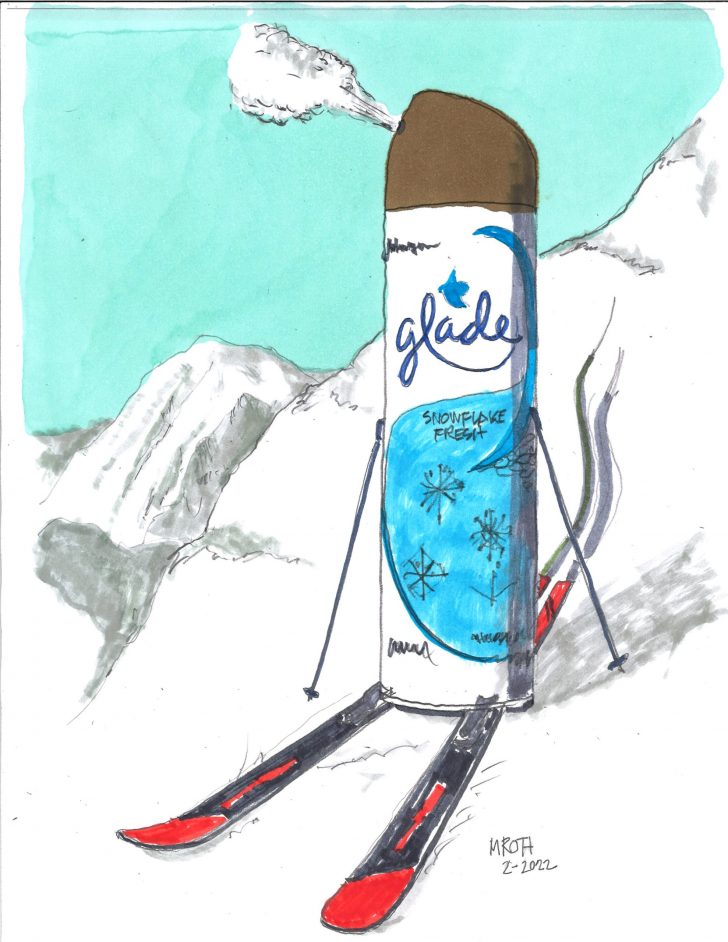
Writer/cartoonist, Mike Roth, provide some thoughts and guidance about skiing in the trees. Be sure to check out his funny Glade Skiing illustration. His cartoon depicting a ski story sent in by Carole Gray of the U.K., captures the nightmarish scenario perfectly!

Check out the summary of the March-April issue of Skiing History magazine, the new Test Your Skiing Knowledge challenge, and the ski-themed license plates added to our growing gallery.

Branching Out: Skiing the Trees

Your Support Helps!

Help us keep SeniorsSkiing.com free. Please support SeniorsSkiing.com with a donation.

DONATE

For many of us, skiing through the aging process means no longer going places we once skied without thinking twice. Now, approaching my 80’s, my mantra is never to overstep my capabilities and always watch out for the other guy!

Anticipate turns when skiing the trees!                                             Illustration: Mike Roth


I’ve always loved skiing in the trees and still do on occasions when conditions are right, and I’m feeling up to the task. I enjoy the silence, the natural snow, and the general absence of other skiers. But I’m always on guard avoiding the trees and their branches.

My Favorite Eastern Glades

Some of my memorable tree runs have been in the East, where I do most of my skiing.

Mount Snow’s North Face tree runs are challenging. However, the tree run on the main face to the left of “One More Time“ is a delightful intermediate. Also, at Carinthia, the trees between Mineshaft and Nitro are fun.

Killington offers plenty of tree runs, for skiers of all ages and abilities. A favorite of mine is Squeeze Play, to the right of Ramshead’s Timberline trail. It is easily handled.

My favorite at Gore Mountain is Twister Glade. Like many other gladed runs, it needs a certain amount of natural snow.

Bromley’s Avalanche Glades are fun. The area’s Everglade to the Glade is a bit easier.

The south face of Okemo is where you’ll find Forrest Bump (cute name), Double Diamond, Outrage, and Loose Spruce. It’s on the latter that a snow snake twisted my leg.

A different take on Glade Skiing.                  Illustration: Mike Roth

Glade Skiing Rules

Here are rules I follow when skiing glades:

  • Never Ski Alone. It’s best to ski with 3 others. If one person is hurt, another can remain, while the third gets ski patrol.
  • Don’t Use Pole Straps. Catching a pole on a branch can damage arm and/or shoulder. The release mechanism on some Leki poles helps avoid the potential problem.
  • Wear Goggles and Helmet. They are essential protection when skiing trees
  • Carry a Loud Whistle. It’s advisable wherever you ski. If you get hurt or lost, a series of loud blasts will attract help.
  • Ski Within Your Ability

And a few pointers for tree-skiing:

  • Anticipate turns: Look to where you want to go between the trees and try to anticipate your next two turns
  • Make smooth rounded turns: In the woods, bumps tend to be soft, with plenty of places to set an edge

We skiers may be getting older, but, with the right attitude and a good dose of caution, we can still enjoy skiing in the trees.

Losing Control on the Green!!!!!!!

Your Support Helps!

Help us keep SeniorsSkiing.com free. Please support SeniorsSkiing.com with a donation.

DONATE

Editor’s note: Virtually all of us have amusing or near-miss skiing stories. Send in your stories and we’ll publish the most interesting…along with an original Mike Roth cartoon depicting the event.

This story is from Carole Gray of the United Kingdom:

Just under twenty years ago we invited our friend Kath on a ski holiday to La Plagne, France. In her late 50s, she had never skied before but loved it from the first. One memorable day, she lost control on a green slope. Gathering more and more speed, Kath was heading straight for a wooden hut at the bottom of the run. Poor Kath was panicking and totally unable to stop. Another friend, who had taught British soldiers to ski and survive in winter conditions, leapt into action. She was on snowblades and managed to intercept Kath just before she collided with the hut. Scary at the time, but we all laughed about it later. Remarkably this didn’t put Kath off. she decided that “at my age I don’t have enough years left to just go skiing once a year.” So she worked as a chalet maid for two seasons  in order to learn to ski as quickly as possible. Now 76, she’s a really good skier and goes 3 or 4 weeks a year.

Have a ski story of your own? Send it to jon@seniorsskiing.com. We’ll select the most entertaining to be published, along with an original Mike Roth illustration!

Hair Cutting Skills Save Skier’s Day

Your Support Helps!

Help us keep SeniorsSkiing.com free. Please support SeniorsSkiing.com with a donation.

DONATE

Editor’s note: Virtually all of us have amusing or near-miss skiing stories. Send in your stories and we’ll publish the most interesting…along with an original Mike Roth cartoon depicting the event.

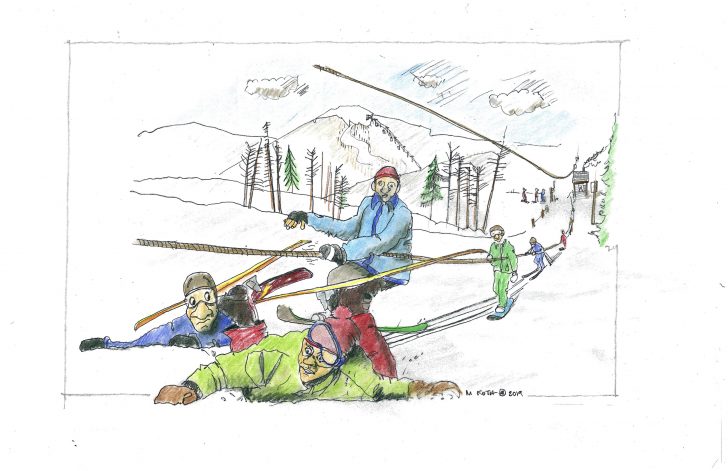
An original Mike Roth illustration.

Reader Michael Hudson writes: I was a ski patrolman at Mt Hood, Oregon, back in the 60’s. I helped rescue a young lady whose long hair got twisted into the rope. Thanks to an alert lift operator and the scissors I was carrying, the event didn’t end in tragedy.

Hanging On for Life and (Almost) Getting Eaten by the Rope Tow

Editor’s note: Spend enough seasons skiing and most of us will get into some form of trouble. Last issue, I explained how I got into hot water by inadvertently becoming end-of-day Pied Piper to a bunch of kids who followed me on a long winding trail, while their parents anxiously waited their return. A few readers emailed their tales of on-slope woe. 

Mike Roth is a ski journalist who writes a regular ski blog for the Albany Time Union. He is also a talented cartoonist and and architect. When asked, last minute, if he had time in his busy schedule to illustrate these reader stories, he responded, “When do you need them?” A few hours later, Mike emailed his drawings.

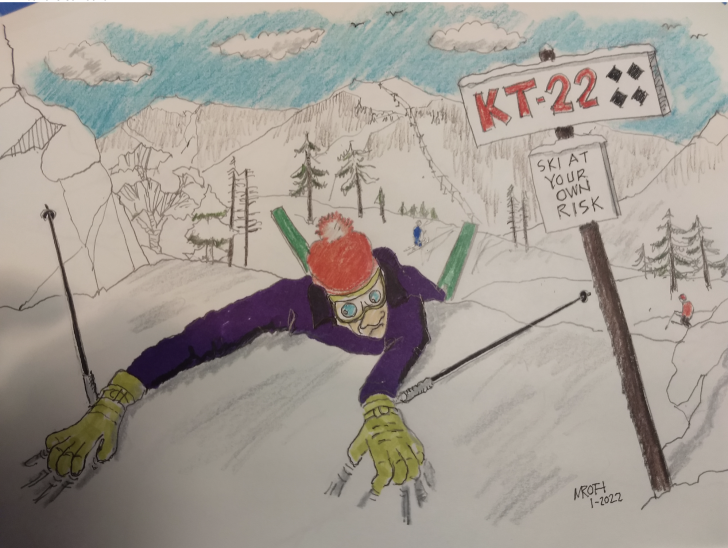
This cliff-hanger happened to Jeffrey M. Fine when he was 40, but he still remembers the day. Jeffery is now based in Dillon, CO.

Sometime in the 1980’s while living in Indiana, I took a trip out to Squaw Valley.  I thought I could ski KT-22, and it almost cost me my life.  While skiing down the right side of the run, I caught an edge and almost went off a cliff with a 50’ drop.  I managed to fall just before going over the edge and held on with my fingers in the snow (I was highly motivated to grab anything) while my skis hung over the edge in space.  The ski patrol was able to throw me a rope and pull me to safety.  I feel very lucky to have survived!

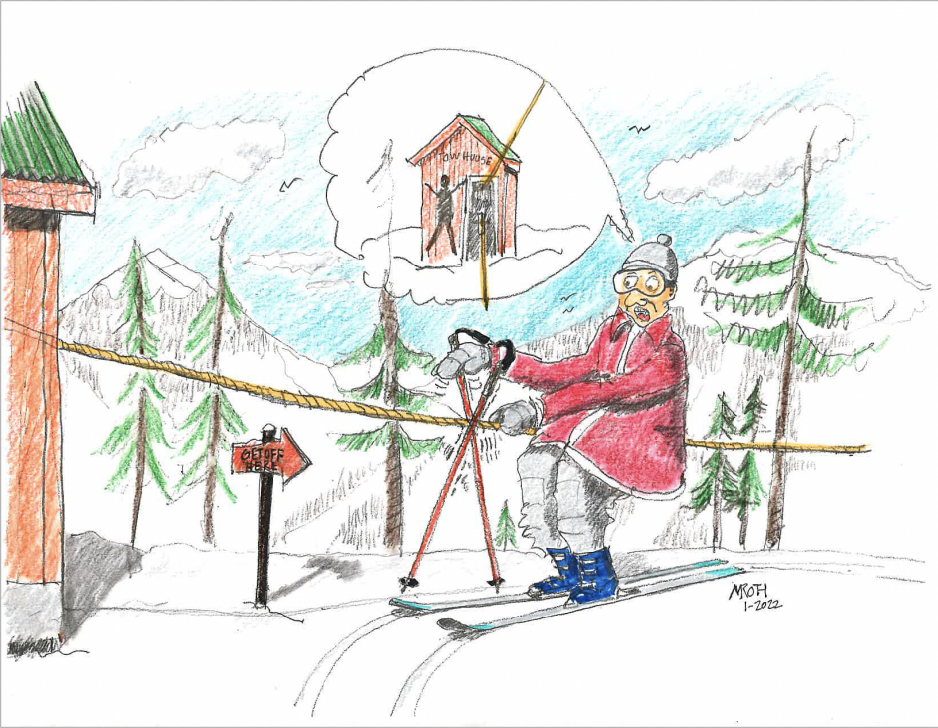
And here’s a rope tow tale from Ed Schultz, Penn Yan, NY. It happened when he was 30.

Back in the early 70’s skiing a small area in Massachusetts near Wooster, (can’t remember the name), I got on the rope tow. I had one arm behind with my pole straps around my wrist. What I didn’t realize was that the poles were bouncing in the snow behind and my pole straps somehow got twisted so when I went to get off I was caught on the rope. The rope tow rose up at the end toward a building housing some of the tow’s mechanism. I had visions of being carried up and going splat on the building. There were no safety stops in those days. Fortunately, I wriggled and twisted, freeing the straps and exiting the tow just in time.

Have a personal ski story you’d like to share? It can be about almost anything. Send it to info@seniorsskiing.com. We’ll share the most interesting with SeniorsSkiing’s 17,000 subscribers, along with an original Mike Roth illustration.

A New Yorker Discovers New Mexico Resorts

A Veteran Skier Can’t Find Ice On His Visit To Taos, Angel Fire, Ski Santa Fe.

Taos Kachina Peak is at 12,481 where the snow stays cold. Credit: Taos

The past three times I skied here in the East the skiing was good.  That means the trails were all skiable but every run you would encounter different conditions.  Most mornings after a cold night, you will find nice groomed corduroy which had set up overnight due to the cold temperatures.  We have not received much snow but thank God for snow making.  After a run or two the firm corduroy changes to loose large granular pieces. Then after a couple more runs that will change to a fine granulated sugar, again very skiable.  As the day progresses that sugar finds its way to the sides of the trails and the rest of the trail, especially the slightly steeper spots get scrappy and eventually Boiler plate.  Time to go home!

Now once in awhile you will hit a day when it was snowing or had just snowed.  Here in the Northeast this seems to be happening less and less and I am convinced that it is a product of global warming.

As Eastern Skiers we can usually ski any condition as it changes throughout the day and lately that has been the norm.  I still love it but it can get frustrating.

Compare that to skiing out West. West, as in New Mexico. Mountains? You bet.

Here’s what I discovered on a recent trip. The New Mexico ski areas are much higher than the Northeast and as you climb up you get colder and receive more major snowstorms.  Skiing at Taos, Red River and Santa Fe you will be skiing approximately from 9,000 ft. to 12,000 feet, that’s 6,000 feet higher than the tallest mountain in the Northeastern United States which is mount Washington in New Hampshire (6288″). 

The average snowfall in Taos is around 300″ per year of very dry fluffy powder due to the high elevation.    It’s 220″ at Ski Santa Fe, 214″ at Red River. With the higher elevations the temps are lower and the snow sits longer. Compared that to the Eastern ski areas where the elevations are below 4,000 feet.  Whiteface is the highest ski area at 4,650′ with average snowfall of just over 100″. Altitude, acreage, the snow and  weather is all the difference.

In the East we fight icy weather conditions up to 4,000 ft., whereas the higher and drier climate of the Rockies are well above 10,000 feet above sea level.

In the East there are wind chills that are very, very cold, where out West it is sunny during the day with Blue Bird sunny skiers. (Most of the time, it seems.)

Moguls are hard and icy here in the East but in the West they are constantly soft snow. No matter how big the moguls may be they are usually always soft so you actually can be a hero out West while in the East you battle the ice on the downside of almost every one. 

Length of trails at all the New Mexico areas were substantial, open Bowls compared to dense trees of the Eastern trails.  Bigger vertical gets plenty of skiing in the West compared to skiing shorter lifts in the East and more runs. 

Taos has the most expert terrain especially now that you don’t have to hike Kachina peak with 1294 acres 51% expert 25% intermediate and 21% beginner. There was only one main lift that gets you to the numerous other fixed grip lifts on the mountain.

Angel Fire has some two mile runs, and best of all 70-75 seniors pay $29, 75+ pay zero. Credit: Angel Fire

Angel Fire has 560 acres of skiing  with 23% expert 56% intermediate and 21% beginner with  their main Chile Express lift over 2 miles long so all the runs down are very long. Their two main lifts are hi speed and you get plenty of skiing in a day. And Angel Fire loves seniors: 70-74 pay $29 a day, over 75 free. 

SkiSantaFe has super senior (72+) tickets for $0. Thanks guys.

Ski Santa Fe was the smallest in skiable acres with 660 acres 40% expert 40% intermediate and 20% beginner but still had plusses. One of which is that you can stay in Santa Fe and drive to the ski area and enjoy the culture. And seniors 72 plus ski free at this resort. Thanks, Ski Santa Fe.

Bottom Line: New Mexico Ski Resorts enjoy low humidity, consistently low temperatures due to elevation and enough snowfall that ice doesn’t form.  It is consistently packed powder from top to bottom

Incidents & Accidents: 5

Here’s A Less Serious Report, But Is There Some Truth In This Cartoon?

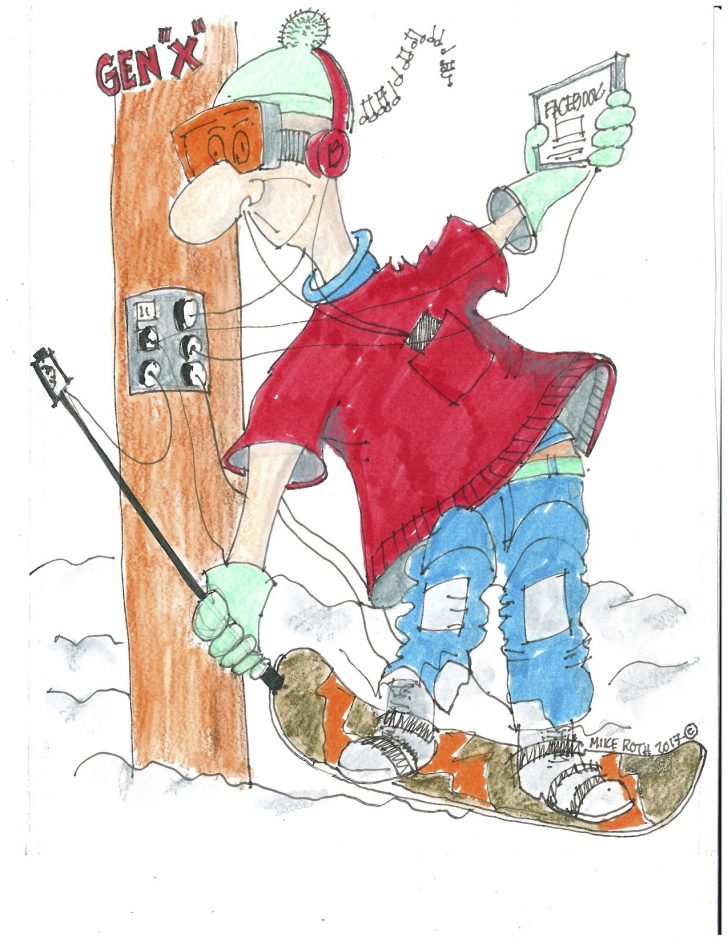
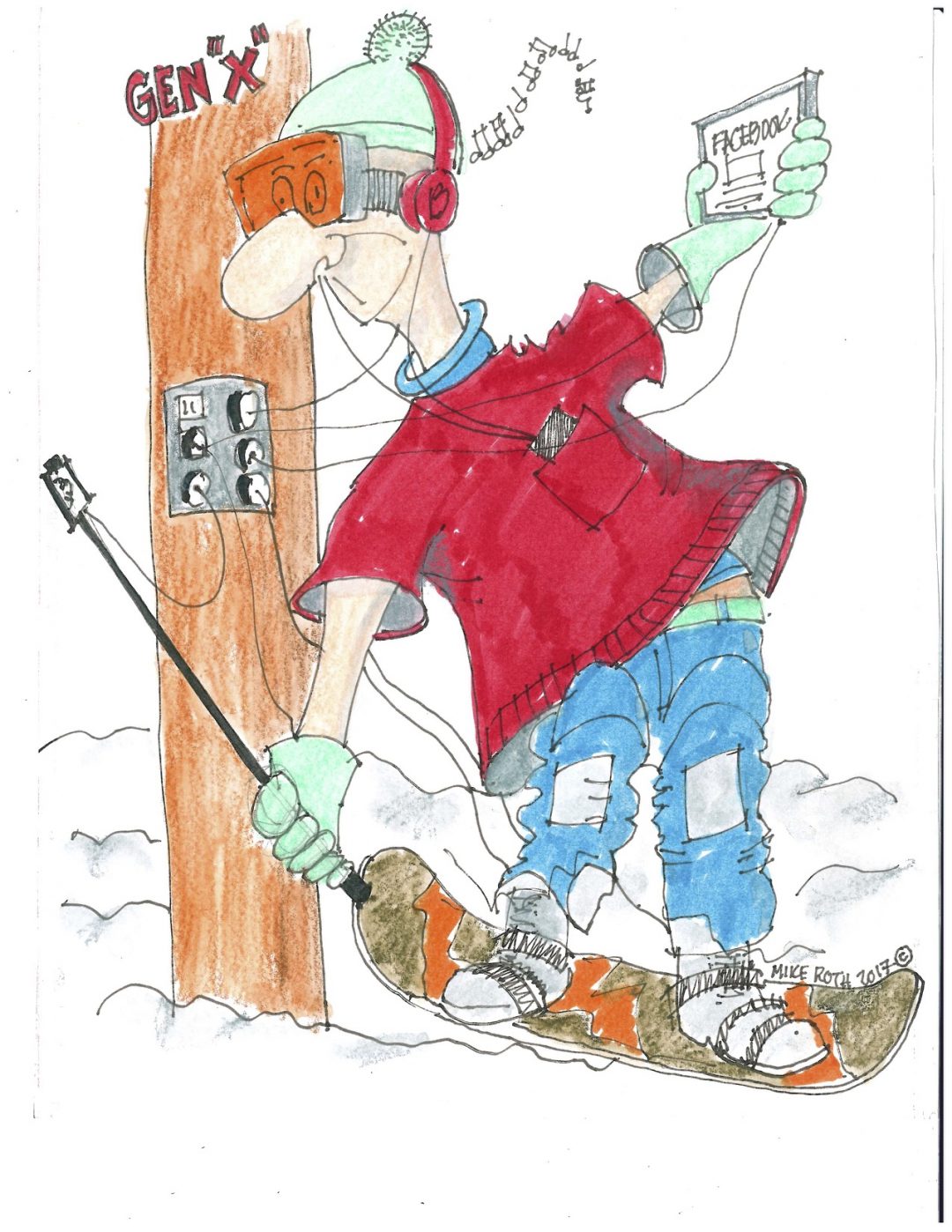
We’re lightening up this week for our ongoing series of Incidents & Accidents. Instead of recounting a collision, here’s a cartoon from veteran journalist Mike Roth, depicting the Gen X-er on the snow.  What think? Truth?

Skier’s Code: Let’s Review

Remember The Right Of Way Rules Please.

Mike Roth with new safety add-ons for the modern skier.

[Editor Note: This article by ski journalist Mike Roth originally appeared in the Albany Times Union. It has been edited slightly from the original.]

On Monday the 19th of March, I skied Mount Snow which was fantastic. Since the week before they had received over five feet of snow. The trail conditions were packed powder over the entire mountain and could not have asked for better conditions aside from fresh ungroomed powder.


There was a decent crowd at the Bluebird bubble six pack chair but that was mainly because it was the only main face lift operating. There was no reason to run any of the others due to the lack of people. Even though the lift line took a few minutes to get through there basically was no one on the trails as you skied down to the base.


While I was on the mountain there were various posters with the Skier’s Code of Responsibility so I will repeat them here for the record.


It’s YOUR responsibility
1. Know your ability and always stay in control and be able to stop and avoid other people or objects. It is your responsibility to stay in control on the ground and in the air.
2. Take lessons from qualified professional instructors, to learn and progress.
3. As you proceed downhill or overtake another person, you must avoid the people below and beside you.
4. Do not stop where you obstruct a trail or run, or are not visible from above.
5. When entering a trail or run or starting downhill, look uphill and give way to others.
6. When riding a chairlifts use the restraining devices. Always use suitable restraints to prevent runaway skiing/boarding equipment. Ensure your equipment is in good condition.
7. Observe and obey all signs and warnings. Keep off closed trails or runs and out of closed areas.
8. Before using any lift you must have the knowledge and ability to load, ride and unload safely.
9. Do not ski, snowboard, ride a lift or undertake any other alpine activity if your ability is impaired by drugs or alcohol.
10. If you are involved in, or witness an accident, alert Ski Patrol, remain at the scene and identify yourself to the Ski Patrol.


To me, Item Three above is the most important!


This is my biggest gripe while on the mountain. When people pass you, they just fly by, many very close to you and without notification. How hard would it be to say “on your right or on your left”? Almost no one says that anymore. What a shame. I say no one, but I do and on Monday one other person said it to me. And I thanked him.

Every time I ski, I am increasingly conscious of the fact that I will be passed by someone behind me and almost always without notification. It is a rule on the Skier’s Code, but it should be a law. It is a law to use your directional in a car when you are going to change lanes or turn. It should be illegal to pass someone without notification.


When skiing I cannot tell you how many near misses I have had by individuals passing me without notification. “On your right or on your left” must not be in anyone’s vocabulary. I am not sure how we can instill this in skiers. Maybe these notifications should be taught through repetition. In that way the repetitive knowledge might sink in. It should start in the ski school levels. It should also be conspicuously posted on all the lifts and in the lodges.

Mount Snow has done some of this. On the trail markers there are signs on the mountain that say “Go With The Flow; People Ahead = Right Of Way” also the codes of skiing are posted on the TV next to the menu in the food court. This can’t be missed.

Anyone have any other ideas?


Rope Tow Escapades

Grabbing That Twirling Rope Was Not Easy.

We’ve all been there. Cartoon Credit: Mike Roth

It was the early 1960s, I was in first or second grade and learning to ski at Mohawk Mountain in Connecticut. At the time Mohawk had just installed the first chairlift in Connecticut but most of the experiences I remember where on their numerous rope tows.

The first thing newbies had to master was slowly gripping the rope. Despite instructions to slowly grasp the rope, all first-timers, including myself instantly use a death grip. As a result I’d get hurled up the mountain about five feet before doing a face plant.

To my relief (and later amusement) there was no shortage of people making the same mistake. Every so often there’d be heaps of beginners tossed about on both sides of the tow. Sometimes people got so jumbled up it was impossible to tell whose arms, legs, skis or poles belonged to whom.

After repeating this several times in front of my laughing, older siblings and their friends I finally learned to adjust my acceleration by gently grabbing the rope. Once underway it was an exhilarating ride up the hill.

It was exhilarating because the rope tows at Mohawk moved at about 16 mph. To put that in perspective, modern-day high-speed chairlifts travel at about 12 mph.

After a few tiring rides up the hill someone showed me how to reach my left hand behind my back and grasp the rope while still holding on with the right hand. This did wonders in making the ride physically tolerable.

Another essential skill was learning how to stop once underway. This skill was needed when someone further up the tow fell and blocked the path. Until this skill was learned there would be spectacular pileups. Easing up on your grip wasn’t sufficient because the friction of the rope would tear your gloves apart. Instead you would have to turn one of your skis perpendicular to the hill and use it to keep you from sliding backwards.

The people who didn’t learn this skill would inevitably slide backwards down the hill bumping those behind them. I remember struggling to maintain my place on the tow while two or three skiers slid back into me.

Being six or seven years old the last thing I wanted was to be on the rope tow without others close ahead and behind me. Without other riders close by I would desperately try to hold the rope up off the snow. Being so heavy I’d have to bend over and hold the rope just inches above the snow; a backbreaking way to ride up the hill.

Another challenge was following a tall skier and when you’re a little kid they’re all tall. One of my friend’s fathers was 6’2″. When I rode behind him I’d have to reach up at head level to hold on to the rope. This was another excruciating way to ride up the hill.  In the lift line there was always jostling among my friends to be in the middle of the pack among like-sized skiers.

Being the youngest of three brothers and skiing with a bunch of boys from our neighborhood there was no shortage of mischief. When unloading from the rope tow the older boys would whip the rope in an attempt to knock those following off the tow.

The art form was perfected when one could whip the rope enough to knock off a follower but not so much as to get yelled at by the lift attendant. Those who excelled at this learned to look innocent and express dismay over what happened.

Years later it occurred to me that it was ironic that rope tows, one of the most difficult lifts to master, were most often found serving beginner slopes. I guess they served to toughen us up.

End note: I just recently learned about rope tow speeds at Mohawk having read Nicholas Howe’s fabulous article The Wonders of Walt in the December 2004 issue of Ski Heritage Magazine. Walt Schoenknecht was the ski visionary who founded Mohawk and soon after Mount Snow, Vermont.

Fryeburg, ME, 1936. First rope tow. Credit: MaineSkiMuseum

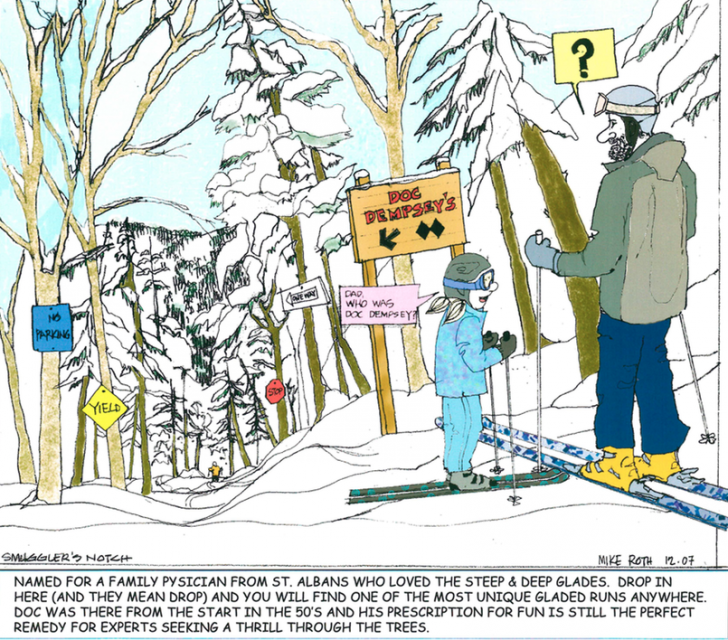
Trail Name Series: Doc Dempsey’s

A Wonderful Cartoon From Mike Roth, Ski Journalist From Albany.

Mike writes and draws cartoons for the Albany Times-Union Ski Blog. This one is about Smuggler’s Notch’s Doc Dempsey’s run.

Credit: Mike Roth