Tag Archive for: seniors skiing

Drumrolllll…2017-18 Trail Masters (all 106 of them) Announced

Trail Masters are those SeniorsSkiing.com subscribers who reported that the number of days they played in the snow (ski/board/shoe) last season met or exceeded their number of years.

For the 2017-18 season,106 people self-qualified. The season before, 77 Trail Masters were named, and in 2016-17, when the program launched, there were 42.

Some readers have commented that the program favors youth—if people in their 50s qualify as “youth.” We understand their position and tried to come up with an alternative way to recognize those individuals who pursue their sport as they get older. We contemplated a few alternatives, but concluded that having the number of days on snow match your years is a pretty good one.

Most of last season’s Trail Masters are from the US. Four are from Canada, two from Australia, and one each from the UK and New Zealand. Each Trail Master has been sent the SeniorsSkiing.com Trail Master sew-on patch and a selection of decals.

The age range is 50 to 79. The two oldest are Roger Bourke and Michael Sharkey, both 79. Roger lives in Alta, Utah and skied 110 days. Michael lives in Waitsfield, Vermont and skied 100 days. The 50-year old is Dianne Maggipinto, 50, of Salt Lake City. She skied 80 days.

Frequent SeniorsSkiing.com contributor, Harriet Wallis, made the list by matching her age with 78 days on the hill.

The highest number of time in snow was achieved by Brad Noren of Ironwood, Michigan, with 210 days. He’s 63. Brad is an alpine/Nordic instructor. He reports that he skis almost every day from late October to late April. In the evening, he snowshoes around his property on Michigan’s Upper Peninsula. Next are Lynn Bourdaghs, 76, Cottonwood Heights, Utah and Rick Morris, 67, Kingscliff, Australia. Lynn reported 155 days; Rick, 152. Carlan Silha, 74, Spokane, Washington, reported 136 days.

There were 24 subscribers on the previous 2017-18 list of Trail Masters who also appeared on this year’s list.

Congratulations, Trail Masters!!!!!

Click here to see the full list of TrailMasters 2017-18

Dog-Sledding Is Another Snow Activity: Don’t Say Mush!

Other Things To Do In Winter For Seniors (Part 2): On You Huskies.

Dog Sled rides with Mountain Man Adventures. Credit: Sun Peaks Resort.

Ok, nobody says mush. Nobody, outside of maybe movies, has EVER said mush, though the folks who drive sleds are often called mushers. Mostly, people who run dogsleds just say, “Go!”

And the dogs aren’t those black and white Siberian Huskies people expect. Your average sled dog is something mushers call Alaskan huskies. They are lean and small with long legs and bred to run. In the case of Chris Schwanke’s pups at Mountain Man Adventures at Sun Peaks Resort, BC, a combo of greyhound or German short hair pointer and … well, who knows what.

“People see some of the dogs with their tails tucked between their legs and think they’re unhappy but that’s what greyhounds do,” said Chris. “So that’s how you tell them apart … the greyhound mixes tuck their tails. The others curl their tails up.”

While these dogs are not an official breed, over the years, the “Alaskan husky” has been recognized by anyone who runs dog teams.

At the end of a tour, guests get to pet the adult dogs and puppies. Credit: Yvette Cardozo

My friend, Nancy Slye and I arrived and first got to pet the dogs and say hello. Chris encourages this. He wants his dogs to be friendly.

Then we loaded into sleds, normally two people in a sled with a guide on back. The ride is 10 km (a bit over six miles) and lasts about 90 minutes.

And we were off—through the woods on narrow trails crowded with trees, along an open lake, across a snow covered golf course, then back into the woods. It can be a semi-wild ride, as snow-caked trees whiz by from doggie level, hardly two feet off the ground.

But what made this trip different from those I’ve done in the past was the chance to run the sled ourselves. Yow!

You stand on the runners behind the sled, which are wider set than you expect if you are a skier. And, guide Destiny said, you just say “go” to start, “easy” to slow and “whoa” to stop.

“Bend your knees a bit and stay flexible,” she added.

It’s kind of like skiing. Or riding a snowmobile. Or a dirt bike. It’s go with the flow.

And, before we knew it, we were back at the start, among the dog kennels and other pups.

Now came more fun. As a treat after a run, the dogs get chunks of meat and fat to fuel them and keep them warm. You toss the chunk in the air and the dog jumps, mouth wide open, teeth flashing in the sunlight. It makes for a killer photograph.

Finally, to wrap up, we went into the puppy pen, where five-month-old Pirate, Sailor, and Captain were waiting to have their ears scratched. It’s not only fun, it helps socialize the dogs from an early age.

Guests are given a chance to drive the sled during the tour. Most sled dogs are NOT Siberian Huskies but, a crossbreed called Alaskan Husky. Credit: Yvette Cardozo

This Week In SeniorsSkiing.com (Oct. 12)

Warren Miller Film Tour, Other Things To Do Series Starts, Flat Light Polka.

It is October and our natural, built-in annual calendar says it’s time for a Warren Miller flick to remind us how graceful, funny, and exhilarating snow sports can be. As long as we can remember, the official pre-start of the snow season has been the viewing of one of Warren’s new films.  Last January, we lost Warren, but his films live on. Below, you’ll find a sample of some Old School footage.

And the Warren Miller Film Tour, kicking off on Oct. 12,  is coming to a theatre near you! Sponsored by Volkswagen and many others, you can catch the Face of Winter in your neighborhood. Click here for details.

Here’s the trailer for Face of Winter.  Enjoy.

This Week 

We’re starting a short series from correspondent Yvette Cardozo who will be telling us about other things to do in the winter besides slide down mountains or trails.  This week, she describes an ice fishing outing around Sun Peaks Resort in British Columbia. If you or your spouse need a diversion or a step down from your usual winter routine, some of these alternatives might be fun.  Gets you outdoors and doing positive things. That’s the point, right?

We also hear from correspondent Jan Brunvand who not only advises us to watch out for dreaded flat light conditions, but also gives us a little ditty he wrote called “The Flat Light Polka”. Flat light can really ruin a day’s outing, so, humor aside, it is a hazard we can be mindful of, especially at the beginning of the season when all things are tentative.

As we mentioned last week, getting ready for the season should be your prime objective, conditioning-wise. this time of year. We’ve been asked to point to some exercises that might be useful for senior folks. A couple of years ago, we did a neat series of progressive exercises featuring Rick Silverman, a physical therapist and professional exercise consultant.  You can find the progressive, three-part series by clicking on these links: Easy Starters, Up A Notch, and Challenge Yourself.  As with all new and demanding physical activities, you should consult with your health care professional if you have any doubts or questions.

New York Gathering

One more reminder, we are having a gathering of folks in NYC on Nov. 14. We’ll have some raffle items, some give-aways, and a chance to meet other senior snow sport enthusiasts. Come on down.

Finally, please remember, there are more of us every day, and we aren’t going away. Tell your friends about us and thanks for reading SeniorsSkiing.com

Short Swings!

I rode a chair last season with a couple who got upset when they saw a dead porcupine on the trail below. They “knew” the animal from skiing there for several months. It looked like it had been attacked.

I’ve seen a lot of animals while skiing over the years. Nothing larger than the moose who frequented part of The Canyons. I’m confident that even with Vail’s acquisition of that wonderful area (now part of Park City), the herd still hangs there, occasionally moseying out on a trail .

Deer Valley had many weasels and, if I have it right, ermine. The critters are long hot dogs making a slinky wave as they run across trails. I had to swerve more than once to avoid trail-kill.

The Catskill and Adirondack areas had occasional deer and lots of porcupines. I remember one tree where the chair passed a porky perched there most of the season.

Rabbits, squirrels, chipmunks, birds of all persuasions, an occasional raccoon. They appear on slope and trail. More often it’s their tracks, but look, and you’ll see them.

And dogs, especially those trained for avalanche rescues. Bless them for their excellent skills and stellar service.

Among the most curious creatures encountered to date are Snowbird‘s and Alta‘s leopard and zebra. They’re a couple who frequent the place and everything they wear — cape to boot — is themed accordingly. He’s the leopard. I’ve bumped into him, solo, a few times on the tram or in the lot and told him how much I enjoy his outfit. His response is always the same: “You ought to see my wife. She’s a zebra. I’m always chasing her down.”

SeniorsSkiing Fifth Anniversary Party!!

5:00 – 8:00PM, Wednesday, November 14, Manhattan.

We’d love you to be there, meet other senior skiers, win cool raffle prizes and help us celebrate our fifth. Prizes and SWAG from Apex Boots, 70+ Ski Club, Masterfit, Orsden Parkas, Buffalo Wool Company, Solitude, Powder Mountain, DeBooter, Bootster, GearBeast (the perfect skier’s cellphone carrier), International Skiing History Association, and others. We’ll provide the nibbles. Open bar. If you plan to attend, please RSVP to jon@seniorsskiing.com. Location: E’s Bar (Rumpus Room), 511 Amsterdam Ave. (bet 84th and 85th Streets), Manhattan.

Snowing Across the West!!!!

The resorts and state ski associations are reporting snowfall, snowmaking, and opening dates. A few examples: Wolf Creek in southwest Colorado got 20″ and will have limited skiing this weekend. The Utah resorts received more than a foot of snow. One of them, Snowbasin, got its first big dump in September! Opening days at the Utah areas range from November 21 to December 21.

Warren Miller, Posthumously

Face of Winter is this season’s Warren Miller film, the first since his passing earlier this year. Click here to find when it will be playing near you and to purchase tickets.

Squaw Valley Extremes

For six minutes of pure skiing fun, watch Drop Everythinga video of the recent history of extreme skiing in Squaw Valley. Click on the name to get you there.

New Ski Utah Magazine

Ski Utah outdid itself with this new, free annual magazine. There 100+ pages. Available in print and digital editions. Not your typical ski industry promotional fare. There’s a page dedicated to the wisdom of George Jedenoff, who celebrated his 100th birthday last July with several runs at Snowbird. Ski Utah is essential reading for everyone from regulars to those planning their first visit. To order a copy or send one to a friend click here.

Skiing History Night

If you’re in the New York area, International Skiing History Association is hosting a free pizza/wine/beer Skiing History Night at Hickory & Tweed (410 Main Street, Armonk). 6:30-9:00 PM, Monday, October 15. Highlight of the evening: ISHA’s Jeff Blumenfeld will present how skiing has been portrayed on TV over the decades. RSVP requestedkathleen@skiinghistory.org.

Ice Fishing Time Coming Up

Other Things To Do In Winter For Seniors.

Ice fishing on Heffley Lake near Sun Peaks Resort with Elevated Fishing Adventures. Here, the guide and guest try their hand at outdoors holes. Credit: Yvette Cardozo

Some folks fish for sport. Some for relaxation. Some to “just get away.”

I fish to eat. If I can’t eventually put it in a fry pan, I’m not really interested.

So enter Elevated Fishing Adventures, near Sun Peaks Resort in British Columbia, Canada, where you get all three. Especially the eating part.

“Probably half the people who come out with us cook their fish that night,” said owner/guide Campbell Bryk.

Owner/guide Campbell Bryk picked my friend, Nancy Slye, and me up at 7 am and we drove out to nearby Heffley Lake, which at this point in the year, was covered with 20 inches of ice.

The lake is stocked with rainbow trout, a mild fish that makes great eating. The red glow is sunlight coming through the red canvas tent. Credit: Yvette Cardozo

A few hundred yards out, Campbell set up his fishing tent, got a portable heater going and re-drilled three of his fishing holes. Then he baited our hooks with natural looking lures that not only wriggle, they glow in the dark water below the ice.

This is really popular with families that have kids. “As soon as  you see fish down there, you can get kids to sit for hours,” Campbell said.

And anybody …really ANYbody…can catch a fish, he insisted, describing one morning where a mom was breast feeding her infant with one hand and hooking fish with the other.

“Her three-year-old caught a 24-inch fish,” he added.

The BC government each year stocks Heffley with 5,000 rainbow trout, a fish that Campbell claims, “Anybody can cook and virtually everybody likes because it’s so mild tasting.”

The best fishing, he explained, is just before Christmas. The most any group has caught in a day is 36, though folks are limited to keeping only five per person. And the largest fish anyone’s ever caught was 30 inches, big enough to feed six people.

The lake has both wild and stocked fish. The wild ones are dark red and green, the stocked ones are shiny but they both taste the same, so we were told

As for us, we were pushing the end of the season. And the fish were nowhere to be found. Have any groups ever come up completely dry?

Only two out of 50 trips. Campbell invited them to come back the next day, free of charge.

Okay, we were running out of time.

And then, with maybe 15 minutes before we had to pack up, something nibbled Nancy’s line. She set the hook and reeled it in. It was cute. It was tiny. It was too small to keep.

So we went back to fishing and now, with merely five minutes to go, Nancy got another one (I was busy taking pictures). Again she hooked it. Again she reeled. Again it came up.

And this time it was over a foot long, one of the stocked fish, holding a good pound of edible meat. A keeper. Campbell filleted the fish and delivered it to us later that day.

As for the cooking part, we removed what tiny bones remained, cut the fish so it lay flat, tossed it into a frying pan with lots of butter, garlic, a bit of salt and a splash of lime juice.

Even I, someone who joyfully eats but doesn’t necessarily cook fish, did a yummy job.

Next year, Campbell said, he will have a permit to fish on Paul Lake, which is stocked with landlocked sockeye salmon, called Kokanee in these parts. He’ll be making salmon sashimi for those who want it and cooking lunch.

Nancy and I WILL be back.

Click for more about Elevated Ice Fishing at Sun Peaks Resort.

After cleaning, there is about a pound of rainbow trout, perfect for two for dinner. Credit: Yvette Cardozo

This Week In SeniorsSkiing.com (Sep. 28)

Other Great Ski Publications, Protect Our Winters, Anticipation, Snowmaking As Fire Protection.

As you may have read, SeniorsSkiing.com is entering its fifth season of publishing. Over these last few years, we have entered the amazing world of ski publications and their publishers, all of whom have been welcoming, supportive, and collegial to Jon and me as newcomers. You should know about some of them.

The Ski Diva is a weekly publication focused on women who ski.  Wendy Clinch, The Ski Diva’s publisher, has been an extremely helpful colleague and friend from the very beginning of SeniorsSkiing.com’s journey.  We thank her for that.  The Ski Diva has won awards from the North American Ski Journalists Association and is recognized for its unique, woman-focused articles.  Its Forum contains thousands of posts from its many subscribers.

Another highly niche-oriented publication, XCSkiResorts.com is published by Roger Lohr, targeting the activities of cross-country ski resorts. Roger has been reporting on cross-country for years and is not only an expert on resorts but also equipment, personnel, travel, technique, and safety. If you are interested in a magical stay at a cozy cross-country resort, XCSkiResorts.com should be your first stop.

Snowbrains.com has been an inspiration to us. We don’t personally know the California-based publishers Miles Clark and Eric Bryant, but we admire their newsy, high quality approach. There’s always an awesome video or current event story worth checking.  There’s also snow reports and forecasts.

OpenSnow.com is a weather/snow reporting site, publisher by Joel Gratz, a professional meteorologist. The site has a ring of correspondents around the country reporting snow conditions and forecasts. There’s also a very cool “Powder Finder” if you’re interested in that sort of thing, and news from resorts. Well done site, especially if you are amateur weather-watchers like us.

We mention these because you, or someone you know, might find them interesting. In one way or another, each of the above has offered—directly or indirectly—material help and support to SeniorsSkiing.com as it got up and running. There are many others that are worth mentioning; we’re sorry we didn’t get to them all.  And we’d like to hear from you what other sites you like.

Of course, SeniorsSkiing.com is the ONLY online magazine for senior skiers, offering a listing of Free Skiing (or Almost Free) For Seniors, Ski and Boot Recommendations,  Experticity Discounts, and Historic Ski Posters, so don’t wander, you guys!

And, also of course, readers of SeniorsSkiing.com can get a FREE SUBSCRIPTION to Ski Magazine, the granddaddy of ski publications, just by signing up under SUBSCRIBER-ONLY CONTENT. (You will be asked to confirm your name and email address.)

Climate Brouhaha

Our recent series of articles on El Nino and its impact on winter weather caused a small handful of readers who are climate change deniers or skeptics to send some flak our way. Let there be no doubt, SeniorsSkiing.com is concerned about global warming and the increasing level of CO2 in the atmosphere. The reality of the impact of those atmospheric changes are all around us from mega-cyclones and hurricanes, droughts, excessive snow or no snow, and coastal flooding.

We admire the work of Protect Our Winters, a non-profit group that is advocating action in the outdoor sports community against climate change. This climate activist group is trying to influence the political agenda as well as educate students and the public about what they can do it mitigate what is happening to the atmosphere. After all, the snow sports industry is dependent on snow and when and if it falls. There are some ski resorts that are actively working to reduce their carbon footprint with different strategies. This is an important development worth paying attention to.

This Week

Speaking of climate change, the wildfires in the west this summer have been frightening. Ski resorts in the high country could be targets and what they can do to avert or minimize damage is an important ingredient the confronting the danger. Correspondent Harriet Wallis offers a story on how Deer Valley has a plan to deal with potential catastrophe.

Also, we have a lovely note on anticipating the ski season from correspondent Don Burch. Think about it; it’s pre-ski show time, pre-parka-buying season.  We’re buying season tickets, and that alone gets excitement going. We can see the season rolling in with snow falling out west, snowmaking operating at A-Basin, and folks bringing in their skis for sharpening.  Anticipation.

Coming Soon

We are preparing the 2018-19 Where Ski Resorts Can Seniors Ski Free (Or Almost Free) directory. Look for it soon. This year, we will be including a host of Canadian resorts.

Don’t forget our SeniorsSkiing.com “gathering” in New York on Nov. 14.  Details below. 

Dear readers, there are more of us every day, and we aren’t going away. See you soon!

Short Swings!

“Snow is the cosmetic of the Earth.” That’s one of many memorable lines from Moby Dick, Herman Melville’s masterpiece about one man’s obsession with the destruction of a gigantic white whale.

Riding early morning lifts, especially on a powder day, brings Melville’s observation to life. The smooth, undulating surface conceals what’s below. My skiing dreams and day-dreams invariably show untouched surfaces. There’s a reason we call it virgin snow.

With rare exception, conditions like that don’t last long. Dropping into an untracked slope and leaving your own lines is a joy. By definition, joy is ephemeral — a fleeting moment of intense happiness. Powder snow is ephemeral. Anything that is temporary is ephemeral. We’re about to enter another season, and we’re not getting younger. Relish the anticipation. Experience the joy. Embrace it all.

Bootster Is THE ESSENTIAL Older Skier’s Accessory

Our newest advertiser is Bootster, a compact ski boot shoehorn that makes boot entry effortless — even when they’re cold and stiff. It utilizes a super slick material that eases foot into boot. It is compact and fits into a pocket. Many of you will have your own techniques: talcum powder; various sprays; etc., etc. but Bootster does the job with perfection. No need for contortions. It’s one of those simple solutions for a persistent problem. Having used an earlier version of the design, I fully endorse its effectiveness. And at $25, it’s an ideal gift for any older skier on your list.


Documentary Explores Abandoned Colorado Ski Areas

Abandoned is the title of a soon to be released documentary about independent Colorado ski areas that no longer exist. The film explores skiing before the influence of corporate resorts and current effects of climate change. I’ve only seen the trailer. It’s well worth watching.

Tremblant Video Shows Latest Improvements

Last week’s Short Swings! column described Mont-Tremblant’s new high speed quad and the expanded glade areas it serves. This very cool short video shows it with unusual creativity.

Jiminy Peak, Bromley, and Cranmore offer savings through their respective value cards (check websites for details):

  • Jiminy Peak‘s costs $62 and includes two days of skiing followed by savings of lift tickets purchased throughout the season.
  • Bromley‘s costs $81 before December 14 and includes one day ticket and $30 off additional tickets throughout the season.
  • Cranmore‘s is $89 and includes one day ticket and $20 off additional tickets throughout the season. Every seventh ticket is free. Cranmore also allows those purchasing a ticket after 2:00PM to use the same ticket the following day.

Ikon Pass Price Increases Oct. 10

The full adult pass (unlimited access to 14 destinations and 7-days or 7-days combined at 21 destinations; no blackouts) is currently available for $999. Starting Oct. 10, it increases to $1,049. The IKON Base Pass (unlimited access to 12 destinations and 5-days or 5-days combined at 23 destinations; 10 blackouts) is currently available for $699. Starting Oct.10, it increases to $749. More at www.ikonpass.com.

Maine Ski Hall of Fame To Induct 19th Century Adventurer, Others

Norman Libby, the winter adventurer who was the first to ski Pleasant Mountain (Shawnee Peak) in the 1890’s will be inducted (posthumously) to the Maine Ski Hall of Fame, Oct 27 at the Grand Summit Hotel at Sunday River. Also being added to the Hall of Fame are Karen Colburn and Anne Dowling, US Freestyle Champions; Leon Akers, cross country coach and ski shop owner; David Stonebraker, prep school ski coach; Warren Cook, Sugarloaf ski executive, and Kristina Sabasteanski, biathlete. The Maine Ski Hall of Fame is a program of the Ski Museum of Maine.

Skiing the Great Indoors

The world’s largest indoor ski resort will open in Shanghai, China in 2022. It will feature three slopes, numerous other attractions, and four hotels with a total of 1,000 rooms.


Short Swings

Short Swings!

In my never-ending  battle with weight, I found myself wondering if we weigh more at sea level than we do in the mountains.  We do.

It’s not a lot, but it is physically factual.

The science of it has to do with gravitational pull, which is what weight is, and the size difference between the entire planet and you. Pretty weird, huh?

Another factor is that gravity decreases as it leaves the part of the planet with the greatest mass; in other words, the higher you are in altitude, the less you weigh.

One estimate I found stated that a 150 lb person standing at 10,000′ above sea level (e.g. 500′ or so below the top of Vail Pass) would weigh 149.92 lbs.

Not enough to tighten the belt, but another good reason to be in the mountains.

You’re Invited to Help Celebrate Our Fifth!


We’re hosting a party to celebrate SeniorsSkiing.com’s fifth publication year. It will be on Tuesday, November 14 on the Upper West Side of Manhattan. Lots of neat raffle prozes (e.g. ski trip to Stratton from 70+ Ski Club; APEX boots; Orsden ski parkas, DeBooters, Bootsters, etc.) plus food and SWAG. Click here for the full invitation and RSVP link.

New This Season

This is the time of year when Northern Hemishphere ski resorts tout improvements for the coming season. In addition to many snowmaking and lodge upgrades, look for the following:

California

Squaw Valley | Alpine Meadows reports that electricity will be sourced from 100% renewable resources, thus reducing its carbon footprint by 49%. In a related green initiative, the resort is increasing convenient parking facilities for carpooling customers.

Tahoe Donner: New triple chair replacing the original double from 1971.

Mammoth Mountain New daily, year-round non-stop service from LA on United, starting Dec. 1; new daily, seasonal non-stop service from Denver on United, starting Dec. 19; and new seasonal non-stop service from Orange County on JetSuiteX.  

Colorado

Arapaho Basin: New four-person Beavers chairlift will access 468-acre  expansion into Beavers and Steep Gullies.

Copper Mountain: Two new chairs at Center Village. American Flyer will now be a high speed six-person chair with bubble enclosures, the only active bubble chair in Colorado. American Eagle will be a high-speed combination lift featuring six-person chairs and eight-person gondola cabins.

Loveland: Inaugurating Chet’s Dream, the first high-speed quad in Loveland’s history.

Silverton:Introducing new heli-skiing terrain, featuring diverse high-alpine terrain and early-season snow. Area also is expanding its Unguided Season Pass to include a 150 percent increase in available ski days to the unguided season.

Winter Park: Features a new 10-person gondola, the resort’s first new lift since 2007.

Wolf Creek: New high-speed, detachable quad, the 10th lift in its system. 

Quebec

Mont-Tremblant: A new high-speed quadon the North Side will boost capacity to 600 per hour.

Vermont 

Killington: New 6-person high speed bubble chairlift and new lift service at South Ridge.

Magic Mountain: New base-to- mid mountain double chair.

Stratton: New high-speed quad will reduce ride time from 14 to five minutes. 

Ski Insurance

Safe Descents is an affordable ski insurance plan providing coverage for transportation costs associated with accidental injuries sustained while skiing, snowboarding, riding a lift, and participating in a lesson within a resort. It cost $4.75 per day or $56.99 per season.


Dreaming of Skiing the Alps? Follow Warren Miller’s Advice: Don’t Delay.

Warren Miller has been gone for less than a year, and his wisdom about not postponing your next ski adventure has been on my mind.

There’s one experience in particular that beckons. It is based in the beautiful ancient village of Saint Vincent in the Aosta Valley in the western Alps, close to Mont Blanc, Zermatt, and Monte Rosa.

Organized by Alpskitour, clients stay in their choice of five- and three-star hotels. The village serves as hub, and every day, they join their guide and a few other people to explore trails and slopes on the highest peaks in the Alps, crisscrossing between Italy, France and Switzerland.

The groups are mostly European-based intermediate and advanced skiers, with the occasional American, Canadian, New Zealander, or Australian. The guide and group ski together for five days, always riding different lifts and exploring new terrain.

They stop at quaint mountain refugios for lunch. Forget burgers and fries. This is on-mountain dining in beautiful settings.

The landscape is incredible. Dramatic peaks. Trails snaking through magnificent rock formations. Slopes that descend through scenic hamlets.

The dreamlike experience is what I remember from the Warren Miller films of my youth and from ski trips to the Alps in the 60s and 70s.

Then, wrapped up in family and career, I skied closer to home, exploring Colorado, Utah, New Mexico, Wyoming, Idaho, Montana, and British Columbia.

The skiing has been great, but the dream of the Alps was always there.  My wife and I booked with Alpskitour for mid-March, 2019. We’re looking forward to returning to the roots of modern skiing, enjoying its history and culture; its  exceptional beauty, and hospitality.

Alpskitour has been advertising with SeniorsSkiing.com since last season. Their website explains the group’s unique concept and is filled with wonderful images of what to expect. I’ve been emailing with Gerry Walsh, a Brit who has booked with Alpskitour for several family ski holidays. He wrote glowingly about the guides, the hotels, the scenery, and the outstanding hospitality.

I know that the exchange rate isn’t optimal. We could wait until it is. And the flight to Milan will be a few hours longer than if I were traveling in the U.S. And committing this early has some risk regarding snow levels.

But forecasters tell us this will be an El Nino year with higher moisture and warmer temperatures and southerly snowfall.  And wherever you go, lodging and skiing tend to add up.

I’ll ski a few weeks in the West this season. Might even catch some warm corn days in New England. But come March, we’ll be in the Aosta Valley with Alpskitour.

Warren Miller had it right. Don’t put it off. If you love skiing, try something different. This will be my 65th consecutive ski season. We’ll be celebrating in the Alps.

This Is What You Told Us You Want

A few months ago, we reported on the key finding from our Spring reader survey:


  • Grandparents are a significant influence getting grandkids into the sport. Once the kids have been introduced, almost 95% stay with it.

Another significant finding is that 56% of respondents reported they spent between $1000 and $5000 per person last season on skiing, boarding, and related activities. More than 10% spent $5000 or more, per person.

The survey also produced robust responses to the open-ended question about how we’re doing and how we could improve. The congratulatory messages gave us a nice feeling. The critical ones focused primarily on technical issues. The majority expressed what you, our readers, want to see covered in SeniorsSkiing.com. Those suggestions fall into six categories, which, when you think about it, reflect the general interests of older snow sports enthusiasts.

Here they are:

Travel/Resort Reviews/Ski Clubs

Readers want to know more about ski resorts outside of where they live, as well as in Canada and Europe. Many of you inquired about organized ski trips. In response, we’ll be increasing our coverage of ski clubs, and I’ll report on a variety of unusual ski programs from the Italian Alps.

Discounts and Free Skiing

These are important reader interests. This season, we’re expanding our list of resorts where seniors ski free (or virtually free) to include Canada.

Finding Other Older Skiers

So many of you want to meet up with your skiing contemporaries. The ski club system is a great way to accomplish that. Many clubs don’t require local membership to participate in their trips. For more information on ski clubs: http://skifederation.org. And the 70+ Ski Club has many regional and international offerings. When traveling in the US, look for a local chapter of the Over-The-Hill-Gang. They give free mountain tours for older skiers.

Health/Conditioning/Recovery

Readers facing joint replacement or recovering from other health issues want more guidance from those who already have been through the experience. How to prepare, how to recover, how to stay fit for the coming season. We have a good selection of those articles and welcome more. If interested, click “HEALTH” on the home page menu bar and start exploring.

Equipment and Technique

Readers want information about ski school programs with special senior offerings. We’ll report on them as we learn about them. Please let us know of your favorites. In terms of equipment, we work closely with realskiers.com to present the best ski selections for seniors and with America’s Best Bootfitters for the best boot choices.

General Editorial

Your suggestions include more articles profiling interesting older skiers. More on snow predictions and snow science. More on X-C (cross-country veteran, Roger Lohr, was recently named X-C and Snowshoe Editor). More on backcountry, snow biking, and Ebikes. Adapting to our age. Identifying good retirement places for older skiers.

Your input gives us direction and lifts us in moments of doubt. We’ll continue to do our best to inform you, to create a community of older skiers/boarders, and to heighten awareness of the importance of the older population to the sport.


Book Review: The Nature Fix

Your Brain On Nature.

[Editor Note: Roger Lohr, publisher of XCSkiResorts.com and SeniorsSkiing.com’s Nordic Editor, reports on the therapeutic effects of being outside.  We thought it, now we know it.]

Lupine field, Sugar Hill, NH. Credit: Roger Lohr

The Nature Fix by Florence Williams, published by W.W. Norton & Company in 2017, provides the most compelling argument to date for people to spend more time outdoors in nature, based on an increasing amount of biological, psychological and medicinal scientific evidence.

Over the years, efforts have been made to quantify nature’s impact on mood, well being, ability to think (remember, plan, create) and sociability. The “biophilic” hypothesis involves lowering human stress, boosting mental health, restoring attention, empathy, and cognitive clarity. Nature also affects a social component like the feeling that is shared among people who spend time together outdoors or people who perform exceeding acts of kindness in the aftermath of a severe environmental event such as a tornado, earthquake, firestorm, and such.

The recommended prescription for getting outdoors in a “nature pyramid” includes both quick doses and longer spells in wild places. Specifically, humans should:

  • Get out in nature nearby on a daily basis for some minutes to de-stress, find focus, and lighten mental fatigue,
  • Spend weekly outings at parks or waterways for an hour or so, and
  • Go on monthly weekend excursions to natural areas to bolster immune systems.

The top of the pyramid includes annual or biyearly multi-day wilderness trips. More significantly, such wilderness experiences are invaluable for adolescents or those who are in grief or suffering trauma.

The author traveled the world over to investigate and experience research on nature’s impact on humans. In Japan, she saw “forest bathing” on a sensory walk in the woods on one of the 48 forest therapy trails in the country. In Scotland, they call it “eco therapy.” She met with a Korean professor of “social forestry” who introduced her to the world’s only college degree for forest healing. In South Korea from 2010-2013, visits to the forest increased from 9.4 million to 12.7 million, while in the USA there was a decline of 25% during the same time period.

The evidence (20 pages of cited notes and credits) about nature impact involves details with cortisol levels, sympathetic nerve activity, heart rate decline, and hemoglobin in the brain’s prefrontal cortex.  The book is replete with that type of information, which may be news to most people who may not be familiar with such neurological details.

One of nature’s benefits are delivered through sound—a bubbling brook, bird tweets in the early morning, the leaves moving in the wind, and so on. But the US Park Service claims that 83% of land in the lower 48 states sits within 3,500 feet of a road and that within 20 years 90 percent of the population will be close enough to hear at least one of the projected 30,000 airplane flights per day.

In Finland, 95 percent of the population spends time recreating outdoors and 50 percent ride bicycles. It is easy to access forests because 74 percent of the country is covered by trees and there are two million summer cottages for a population of two million Finns, who claim the focus on nature correlates to reduced health care costs and mental and physical fitness.

Williams visited Singapore, where 70 percent of the population lives within 400 meters of green space. The government in Singapore allocates .6 percent of the national budget to develop scenery and greenery.

There are successful nature programs to help people who suffer with PTSD (post-traumatic stress disorder) and ADHD (attention deficit hyperactivity disorder). Outward Bound did a study on a therapeutic adventure program showing 9-19 percent of participating veterans who had PTSD, improved. Williams includes a discussion about ADHD programs where 6.4 million kids are diagnosed and half of them are taking medication for the malady.

Isn’t it about time that more therapists, doctors, teachers, and parents prescribe getting outdoors more often?


Summer Adventures At Mammoth Mountain

Non-Snow Activities Make Mammoth A Family Summer Vacation Stop.

Climbing the Via Ferrata at Mammoth Mountain Ski Area.Credit: Peter Morning, Mammoth Mountain Ski Area.

Ok, picture yourself, flat on your belly in “Superman” position, hurtling in the air down a mountain at 60 mph.

No wonder Mammoth Mountain Ski Resort calls this the Mega-Zip. It’s billed as the “most vertical in the USA” (some 2,100 feet from the top of the ski resort at 11,053 feet) to the bottom.

Definitely not for the faint of heart. Adrenalin junkies, line up here.

The mountain is aiming to open the zipline by late summer, before all these non-snow goodies have to close for the winter season (and skiing!). And it’s got three more adventures, one in the works and two others already operating. The “taste of climbing” wall called Via Feratta is being built. The ropes course for kids 12 and under (gotta grab ‘em early) is already open, as is the Woolly’s Mining Co, a gem mining adventure for kids.

The zipline starts at Mammoth’s top, 11,053 feet and plunges over what some locals call “Oh S*%t Cliffs,” heading down at speeds billed at “over 55mph.” The run is more than a mile long from top of mountain to the base, and you will be able to descend side by side with other folks on parallel cables.

The whole ride is actually in two stages, starting from the very top and going on a somewhat sideways path to the mountain’s Chair One, where people exit and get on a second line all the way to the bottom.

Mammoth hopes to open it by early September, which would give about a month before winter snows start.

The Via Ferrata, which translates to “Iron Path” is a mid mountain mostly horizontal traverse along a cliff face. Rebar is being secured into the cliff face and the adventure will include ladders, suspended bridges and iron rungs, among other things. There will be six different routes that progress in difficulty.

“We think of it as an intro to climbing,” said Justin Romero of the mountain’s marketing department. “The idea is to give people who have never thought of climbing an idea of what it’s like.”

You go with a guide, he added, you are clipped in at all times and the total vertical is about 180 feet as you follow a set trail for 300 feet more or less horizontally across the rock.

The website says “perfect for families, groups or individuals. No previous climbing experience required.”

Photos of what it might look like show folks in full climbing gear … helmet, harness and the rest.

Kids’ Ropes Course at Mammoth Mountain Ski Area. Credit: Peter Morning, Mammoth Mountain Ski Area.

Then, for those kids you found climbing the kitchen cabinets while still in diapers, there’s the kids ropes course for children 12 and under. The site says, “Climb, stretch, balance and crawl your way through 10 different elements that include a climbing net, log walk, planks, swings and more before you rappel back to the ground to finish.”

But for the parents, it’s nice to see all this isn’t THAT high off the ground, and the final rappel drops a fairly tame 15 feet.

A lot of these improvements come courtesy of Alterra Mountain Co., which now has interest in a dozen ski destinations, including CMH (heli skiing). The company, which recently merged with Intrawest, pumped serious money into Mammoth. Some $10 million is being used this summer on the zipline, the cliff climb and both children’s adventures along with improvements to Canyon Lodge.

Besides the zip and climbing route, folks in summer can mountain bike, hike, just ride the gondola for the view and in the greater Mammoth Lakes area, fish, kayak and more.

Summer season is usually early June through end of September when the snows arrive.

For more information: https://www.mammothmountain.com/

People enjoy and photograph the view of lakes from the top of the gondola at Mammoth Mountain Ski Area. This viewpoint is a short hike from the gondola top. Credit: Yvette Cardozo

More Ski Chile: What To Expect From A Chilean Ski Trip

Some Adjustments Necessary To Ski The Legendary Mountains Of Chile.

For many, a typical Chilean ski trip will seem a bit like traveling back in time to the USA 30 or 40 years ago. Some of the lifts date back even further than that! While the ski areas around Santiago are progressively upgrading their infrastructure, snow making, grooming, and security, the ones further south remain, in a word, funky.

Most Chileans do not speak English, but those in ski schools, tourism, and management positions generally do. If you have no Spanish, you should still get by just fine, as people are mostly helpful and warm. The Chilean peso converts at 630 to the dollar.

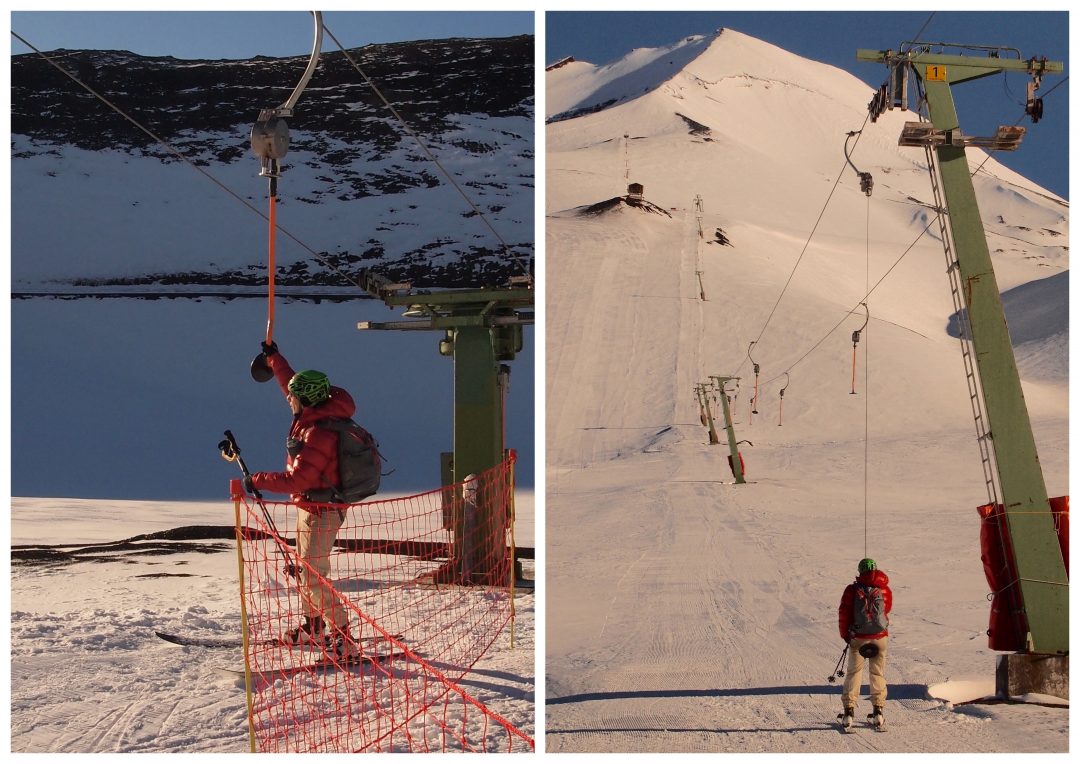
Expect a lot of surface lifts, mainly t-bars and platters, but also the infamous “va et vient” lifts at Portillo (more on that later). On the plus side, these lifts are usually fast, run in windy weather (which is frequent), and you can bail out easily enough if they stop for whatever reason. Some of the chairlifts are second hand from Europe or the USA, and only one high speed quad exists, in Valle Nevado. Lifts open at 9:00 and close at 17:00, with most skiers coming out at around 11:00. Lunch runs from 12:00 to 15:00.

A lonely ride at Corralco. Remember those Poma lifts? Credit: Casey Earle

Don´t expect to get good snow conditions information from the ski area websites, often it is outdated, wrong, or simply non-existent. Portillo is very reliable, but for other ski areas you may have to resort to analyzing webcams or scouring their Facebook pages.

The weather and snow conditions in the Central zone are generally very good. With few but furious snow storms, and occasional extremely light, dry snowfalls, most days will be sunny, fine-packed powder skiing. Off-piste is often limitless, with the southern exposures accumulating triple the amount of the northern ones. With both the sun beating down, and the storm winds roaring in from the north, only in exceptional years can the true north faces be skied, and thus almost all runs are south facing. The season normally runs from mid-June to the end of September.

Casey grabs some pow at La Parva. Credit: Casey Earle

You have to go at least 400 km south from Santiago to the next ski area, Nevados de Chillan, the beginning of the southern climate zone. Here the storms are more frequent and wetter, and the mountains are lower, with skiing starting near or at the tree line. Most people consider skiing in this area more towards spring, when the weather improves. Packed base data is often referred to in meters, reaching up to 5 meters in places. The season in the south often starts late June, and extends into October, with backcountry excursions (on the volcanoes) going into November.

Nevados de Chillan on a windy day. Credit: Casey Earle.

Large hotels are few, at best one per area. La Parva has no hotels, large or small. Aside from Portillo, most people go for the day, or lodge in cabins, small hotels, hostels, or property rentals near the ski areas. Airbnb, Booking.com and other websites have a wide variety of lodging available. In general, what you see is what you get. Chilean food is quite palatable for American tastes, with lots of familiar (and some very unfamiliar) dishes, all accompanied by great local wine and beer.

Lift ticket pricing is based on high and low season, and age group. Avoid the two middle weeks of July, which is the kids winter holiday, as it is quite expensive and crowded. “High season” prices go from July to early/mid August in general, then just weekends, except for Sept 17-19 (National Independence holidays). Seniors start at 65, with about a 20-30% discount on normal adult prices, which run around US$70 in high season and $50 in low. La Parva has a class of seniors from 60-65, and then “super-seniors” as 66+, which only pays US$18 anytime!

Next up is a review of Portillo!

Vail and Alterra’s Unfairness Doctrine

Editorial

Regardless of whether the steady elimination of season pass senior discounts is personally insignificant or presents a financial burden, you should be aware of the lack of fairness and gratitude exhibited by this new policy.

Through Vail’s EPIC Pass and Alterra’s IKON pass, the companies are advancing elimination of senior discounts, while acquiring more areas. In fairness, some localized Vail Epic passes offer senior discounts. But Alterra’s pricing policy is more draconian because it substitutes its own IKON bundled pass for (most) local area season passes. In doing so, it also eliminates local area senior pass discounts.

Granted, for those who choose to travel to ski, IKON and EPIC offer decent value. But for most Alterra resorts, those who don’t travel but want to ski at one of the Alterra areas are now forced to purchase the bundle.

Why is the elimination of senior discounts unfair? Because areas removing senior discounts still offer student and military discounts.

Why does the elimination of senior discounts reflect a lack of gratitude? Perhaps the most obvious reason is related to our years of participation and support. After 30, 40, 50, 70 or more years of supporting ski resorts, why can’t resort operator’s reward us for our collective loyalty? It’s done in many other industries.

A subtler and possibly more significant reason is the older skier’s role in introducing young people to a  sport whose US  base hasn’t grown in 35 years. The most recent SeniorsSkiing.com reader survey shows that grandparents are a major factor introducing grandkids to skiing and boarding. Fifty-eight percent of the respondents were grandparents. They introduced more than 68% of their grandkids to the sport. Of those, 94.5% continue to participate. Considering that each grandparent or grandparent set has an average of 3.7 grandkids, the influence of older skiers on new skier/boarder recruitment — one of the biggest issues facing the ski resort industry — is profound. Why yank discounts when we’re helping to add new skiers and boarders?
Maybe they think they can boost revenues because we’re an easy and decentralized target. Maybe the people making the decisions have a built-in age bias. Maybe it boils down to old-fashioned greed.

And maybe it wouldn’t be so disturbing if it were fair. But it’s not fair. It doesn’t recognize our decades of support to the industry. It does not take into account that most of us go midweek. And it ignores our role introducing new skiers and boarders to the joys of being on snow.

We’d like your thoughts on this point of view. Please comment.

Cycling Efficiency For Seniors

Bottom Line: Knoweth Thy Limits, Wise One.

Ride with younger guys? Then ride wise and slow down. Credit: Pat McCloskey

As I  was pounding the rocks of  Laurel Mountain on the mountain bike with  a group of younger riders here in Pennsylvania’s beautiful Laurel Highlands, I was thinking strategy.  At 63 years old, I am still in pretty good shape but the older I get, I start thinking about the old adage “age and treachery will beat youth and skill”.  Not really applicable in most cases but at least I can try – right?  So the first thing I think of is: don’t push the anaerobic limit to be the first up the hills and over the rocks.  Let the young guns deal with that and I will just keep them in sight.

I have learned to ride within myself and only exert myself enough to keep a visual on the group, especially with a longer three hour + ride.  A more scientific approach is the below which is done with a heart rate monitor:

  • Zone 1: 60 to 70 %; very comfortable effort; use this for warmup and cool down
  • Zone 2: 70 to 80 %; comfortable enough to hold a conversation; most training is done here
  • Zone 3: 81 to 93%; “comfortably hard” effort; you may be able to say short, broken sentences.
  • Zone 4: 94 to 100%; hard effort; the pace is sustainable, but conversation is a few words at a time.

Author Pat McCloskey ponders whether to go around a big section to get back to the parking lot.

Basically the zones are dictated by two theories.  The original theory is dictated by the target maximum heart rate of 220 minus your age. Then you can calculate with a heart rate monitor which zone you can ride in.  This calculation is not quite accurate because it does account for conditioning.  A better way to use the zones is to calculate what is called Heart Rate Reserve which is your max heart rate minus your resting heart rate. Find out what your real max heart rate is by exerting yourself in Zone 4 with a monitor and then in the morning at rest, calculate your true resting heart rate.  This allows for conditioning and the zones can be used according to that calculation on a heart rate monitor.  All in all, I use a monitor on rides to tell me when I am exerting myself above my perceived rate of exertion which will lead to fatigue on a long ride if I am not careful. Use the monitor and slow down accordingly.  As long as I keep the group in sight and can be in the Zone 2 area, I am a happy rider.

Another strategy is not to ride every section but take a breather and bypass a section and/or coast to the next meeting area.  Sometimes that means taking a fire road instead of a technical trail..  I like to challenge myself and take the technical sections but I know if I take them all, I will not be able to keep up or complete the ride.  Ride to ride another day is my motto, and I am not out to prove anything.

Lastly, know your limits and know when you are finished.  You don’t want to get hurt and if you are too fatigued, it can happen easily on a mountain bike.  Sometimes you have to cut out and take the fire road back to the parking area for a head start on the post ride beer.  Hey, you had a good ride, with younger, stronger riders, but for a guy who is older, this is the way to stay involved without compromising your ride or theirs.

Riding season is upon us, and there is no reason not to challenge yourself within limits.  Go for it.  Have fun but as Harry Callaghan once said, “ A man has to know his limitations.”

Cross or divert? Use your noggin and your heart rate monitor to decide. Credit: Par McCloskey

Short Swings!

Are older skiers the Rodney Dangerfields of the slopes? Sometimes it feels like ski resorts show us no respect.

Consider that there are no Epic or Ikon senior discounts, and, in the case of some Ikon resorts, there no longer are local season passes and the senior discounts associated with them.

Some of the big players are doing very well. Vail Resorts, which owns Epic, reported a 58% increase in second quarter net revenue over second quarter 2017. Part of the increase was a one-time bonus from the new tax law; part of it was from increases in lift ticket and season pass products.

Like any other business, the ski industry follows the money. Which brings me to one of the key findings from our most recent reader survey. Fifty-six percent of all respondents spent $1000 to $5000 per person on skiing and related activities last season. More than 10% spent $5000 or more per person.

The same can’t be said for Millennials and Gen-Xers, the industry’s primary target markets.

One in five U.S. skiers and boarders are 52 or older. Our survey, which had more respondents than any of our previous reader surveys, showed an average of 15 days on the hill. More than one-third skied 23 days or more.

For those bottom line oriented ski executives who may be reading this: We use your facilities more and spend more than the youngsters. Think twice before removing senior discounts.


New Canadian Resort to Have Longest Vertical in North America

Valemount Glacier Destination is being developed in the Cariboo Mountain Range in British Columbia. When completed, it will have the longest vertical drop in North America (6726′) and the third longest in the world. Developers expect it to become a year-round skiing and sightseeing destination. Near Jasper National Park, the area already has substantial infrastructure. When completed, there will be skiing on several mountains, the largest of which is Mt XXXX, which summits at XXXXX ‘. The resort is a 75 minute drive from Jasper. It is located on the trans-Canada rail line and has a local airport within walking distance of the resort base. Larger airports are several hours away.

According to Tomas Oberti, project manager, the first phase is expected to open for day skiing in December. Full build-out of the project will occur over 20 years.

More on Valemount Glacier Destination at http://valemountglaciers.com.

Seven Skiers Die in Alps Storm

Seven skiers on the Haute Route in Switzerland died in a sudden storm in early May. They were part of a guided group forced to overnight in freezing temperatures. Adding to the tragedy: they were just a few hundred meters from an alpine hut. Elsewhere in the Alps, the storm claimed the lives of another seven climbers and tourists. It was the most loss of lives in Switzerland since 1999, when 12 died in an avalanche in the Valais.


The Daily Senior Skier Skinning Session at Arapahoe Basin

Doris Spencer is 72; Kent Willoughby, 79. They have been skinning up A-basin for nearly 18 years. This short documentary inspired me. I expect it will do the same for you.


Snowbird’s One Star Season

The Bird just issued this one-minute video summary of the season. The resort characterizes 2017-18 as a “one star” season, but you’d never know it from the skiing and boarding in the video.


Baltimore Ski Club Celebrates Member’s 90th Birthday

Dave Karczmarek, BSC Director of Ski Trips, recognizing John Wotell on his 90th.

John Wotell turned 90 in February, and the Baltimore Ski Club recently turned out in force to celebrate. A long time skier, he and his wife, Ann, were active members of the Ski Club of Maryland since the 1960s. For years, he was president of the group and made “President for Life” when he stepped down. He celebrated his 90th at Big Sky. Happy Birthday, John!


Grazing cows

Summer Trail Prep: How It’s Done

What Happens When the Snow Disappears Along With The Crowds?

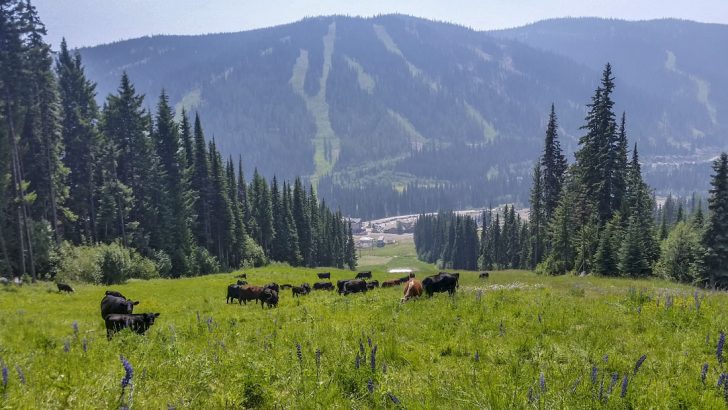
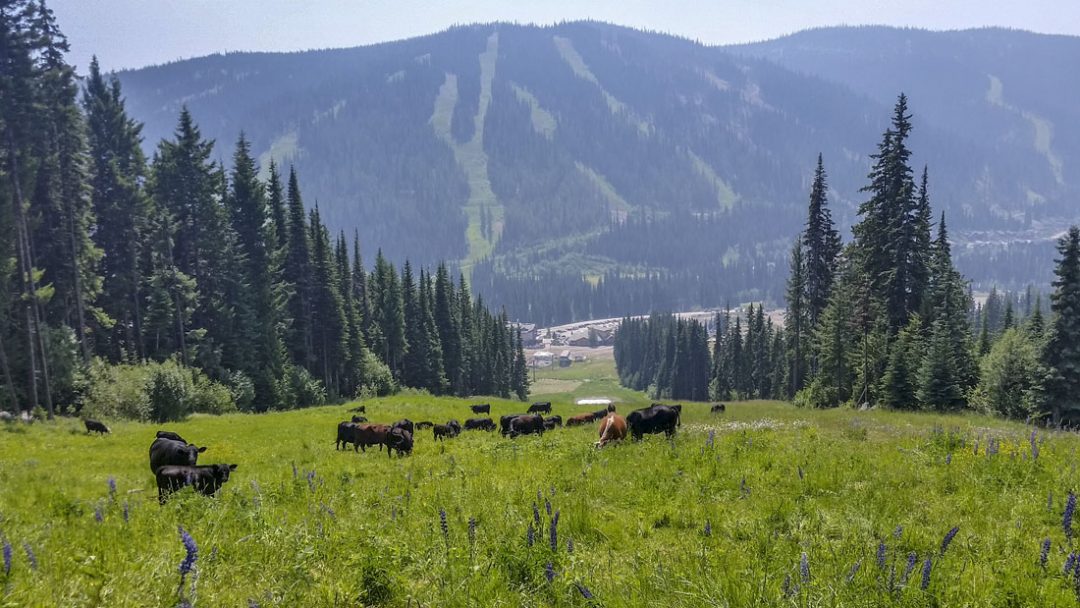
Grazing cows in summer help cut grass on ski runs. Part of summer prep. Credit: Sun Peaks Resort.

Bet you’ve never thought about how your favorite ski runs get cared for when there’s no snow on the ground.

Yes, they have to be prepped each summer.

Seth Worthen, slopes manager at Sun Peaks Resort in British Columbia, Canada, explained how his 11 person trail crew works. And it’s a seven-day-a-week job.

Willow and alder trees, for instance, can grow four to six feet over the summer—the height of an average person. You might think of willows as bushes, but if left alone, they can become 20-foot trees, fast.

“We use a flail mower,” said Worthen. “It practically makes the willow into chips. Even the larger ones can be laid down flat.”

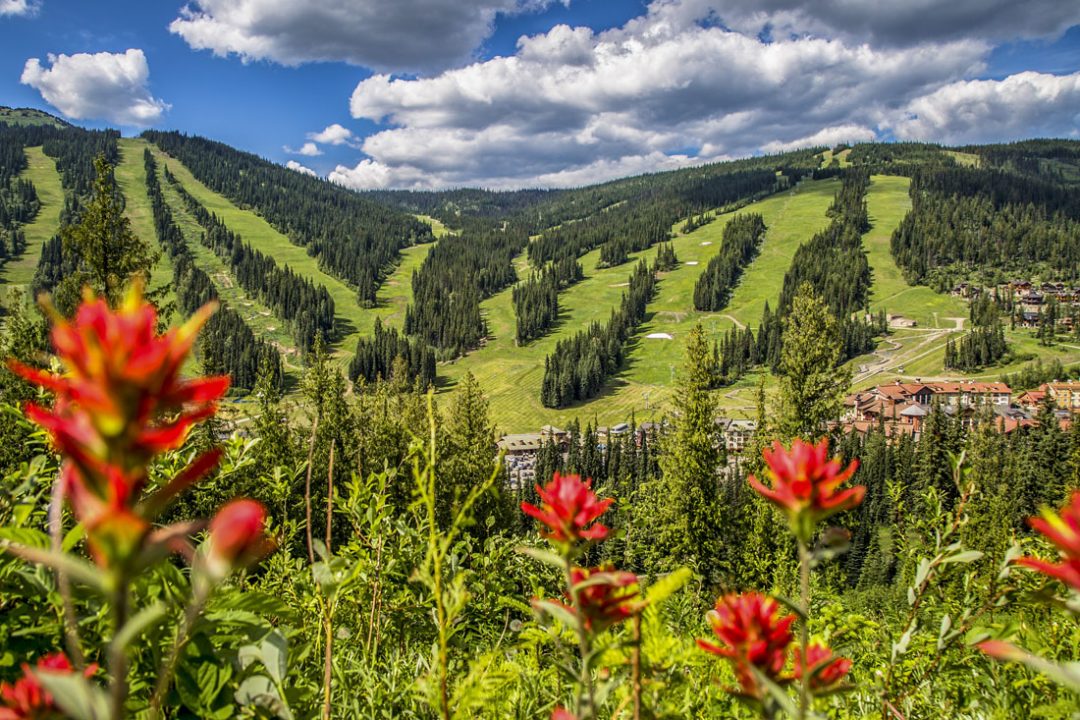
Summer flowers and hiking at Sun Peaks Resort. Summer prep of ski runs will include cutting the grass after the flower bloom. Credit: Sun Peaks Resort.

The crew starts low on the ski mountain in May as soon as the snow clears. But they often can’t get to the tops of runs until July because of lingering snow.

Early grooming years at Sun Peaks Resort were spent removing stumps and rocks. So now, most runs are just grass.

“We mow ‘em with an off road mowing machine, making stripes up and down. Sundance almost looks like a golf course. When you mow two or three feet of grass growth, it lies down and insulates the ground so we need only 25 – 30 cm (about a foot) of snow to open.”

And then, there are the cattle.

Four farms in the area have grazing rights on Crown recreation land. That means the nice, smooth, grassy ski slopes get help with grass cutting from the bovines. Some years, it’s only a few hundred cattle, but it theoretically could be thousands.

So another job here is setting up electric fences to keep the cattle out of the core village. There are gates so people can access hiking trails.

Among the other jobs, there’s cutting some trees along the edges of existing trails each summer to widen them a bit. Also choosing and marking winch cat trees. These are the trees the grooming cats attach cables to so they can manicure steep ski runs in winter.

“We bore into the trees to make sure there’s no decay,” said Worthen.

That’s a smart move when you are expecting to have a cable on a tree keep an eight ton snow cat from sliding uncontrollably down the mountain.

Summer prep is not exactly a hazard free job. One recent summer, one worker was herding a bull (yes, there are bulls among the grazing cattle) when she stepped wrong off a log and broke her ankle. We know she healed just fine because this winter, she was helping run dogsled tours.

At least a third of the runs are prepped each summer, though there are north facing runs on Mt. Morrisey that get more water so the willows grow faster and have to be dealt with yearly.

Thanks to the fact most runs are now just grassy trails that are skiable with a fairly thin layer of snow and are helped by snow making on major green runs, the resort is usually ready to open for skiing each year by the second week of November.

https://www.sunpeaksresort.com/

Summer flowers and hiking at Sun Peaks Resort. Summer prep of ski runs will include cutting the grass after the flower bloom. Credit: Sun Peaks Resort.

John Henry Auran: Ski Journalist Extraordinaire, Dies At 90

The Creative, Intense, Funny, Unique Journalist Will Be Remembered As One-Of-A-Kind.

John Henry Auran, journalist, raconteur, skier, sailor, innovator, enthusiast.

Ski journalist John Henry Auran was the kind of person you could never forget. I worked for John Henry, or JHA, as he was known to some, in the early 70s at SKIING Magazine, then located at One Park Avenue in New York City. Despite different life paths since then, we kept in touch, even as his declining health brought him farther and farther away from the sports he loved.

John Henry was always interested in delving into new products, new racing results, new personalities on the ski scene, new ideas for connecting the reading public with the outdoor winter sports industry. His enthusiasm was uncontainable for finding, thinking, analyzing, reporting, and watching the world for news.

I will never forget when he and I went to a ski boot manufacturer somewhere in New Jersey who promised to show us a then new development in boot fitting. This was the first foam-fitting demonstration ever, as far as I know, in the business. Since John Henry was SKIING’s boot expert, he went for a sneak preview, and I tagged along to take pictures.

At the manufacturer’s “plant”, John Henry was seated in a high chair, like the shoe polishing chairs you see at airports or train stations.  His foot was placed in a plastic bladder which was gradually filled with foam and placed in a boot shell. I distinctly recall him reporting all the sensations that involved: “It’s getting warmer, I feel some pressure,” while a big smile crossed his face. “I’m getting foamed!”

After that, John Henry couldn’t resist asking people if they’ve been “foamed”.  Since no one had, that gave him license to launch into describing the experience complete with gestures and enthusiastic and dramatic commentary. “Everyone should try it.”

He was also an innovator in what created a new genre: the industry show newsletter. At the time, the ski business had three regional shows for equipment and clothing manufacturers and wholesalers to meet retailers run by Ski Industries America. John Henry had a terrific idea: Publish a daily newsletter at each show that reported news, gossip, personnel moves and the like every morning of the show. Sounded like a great idea.

JHA enlisted the staff of SKIING to do some reporting, bring it to us in our editorial corner where he and I would create columns by typing copy into an IBM Selectric. We then pasted the columns to a piece of oaktag with a pre-designed masthead and logo and brought it to a printer where we waited until the job was done. We picked up the edition and distributed it throughout the show venue. Did I mention this process took almost all day AND all night? Trial and error was the name of the game. Despite being exhausted, we knew we had a hit when we saw the show people reading the Show News over coffee. That was true journalism.

John Henry always had a story ready whenever we talked over the years. One of his favorites was about his hometown where he was born in Germany. As a young boy, he was a witness to Kristallnacht in November 1938.  A few years ago, the town government had a commemorative event marking that dark past and invited JHA to come back to join the few other surviving town residents to bear witness and tell their stories of what happened.  Despite his disability, he went all the way back to Germany with a companion, all sponsored by the town. It was a remarkable and touching journey.

John Henry was also an enthusiastic member of SeniorsSkiing.com’s Advisory Board.

John Henry lived in a nursing home in upstate New York for the past decade or so. When I called, the nursing staff would chat while John got to the phone. They would tell me he enjoyed being taken to nearby Hunter Mountain where he would sit in the base lodge watching the skiers and the lift traffic. I can see him there, in my mind’s eye, reminiscing to himself about the equipment, the racers, the dramatic places, the deadlines, and the great writers he knew. Watching the lift go around and around.

Rest in peace, John Henry.

Down Care

How To Wash Your Down Jacket At Home

Season’s Over; Isn’t It About Time You Get That Puffy Back To Clean?

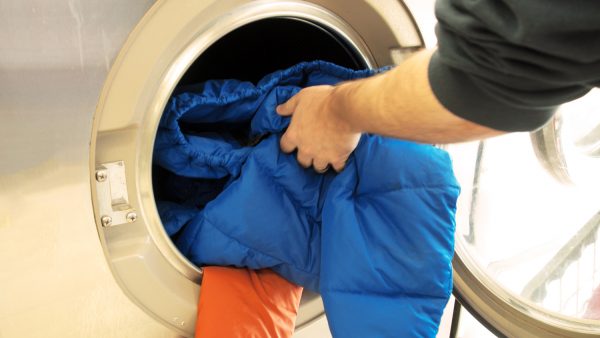
Front loader needed for washing down. Credit: REI

Not only are your season-dirty down jackets, vests, and even sleeping bag dirty and smelly, if you left them that way, they would lose their heat-insulating properties. It is easy to destroy your down gear if you don’t follow some basic rules when washing them at home. It’s not difficult, but it does take some time and know-how.

You will need:

  •  a front load washing machine and a dryer (Top load machines are not recommended.)
  • a bucket
  • special down liquid detergent
  • three-four new tennis balls or reusable drying balls
  • a new sponge (for washing dishes)
  • a clean toothbrush (or something similar)
  • three hours of free time.

10 How To Steps

  1. Purchase a liquid detergent specially designed for down.  Try either Granger’s or Nikwax. You will need about a cap (50 ml) for a jacket.
  2. Inspect the jacket and find especially dirty spots. A bright light really helps. Close all pockets, velcro, and zippers. Turn your jacket inside out.
  3. Soak your jacket in cold water in a clean bucket. Drip a bit of detergent on a sponge and create some foam. Apply foam on wet, dirty areas. Let foam to penetrate the fabric for five to 10 minutes. Brush the really dirty areas with toothbrush. Let it soak for 20 more minutes.
  4. Pull out the detergent dispensing tray of your washing machine, clean it thoroughly. Even a small amount of a wrong detergent or a softener can negatively affect the condition of the down.
  5. Tennis Balls or Dryer Balls are needed to keep the fluff up. Credit: REI

    Take the bucket right next to the washer and gently dump your jacket inside the washer. Add three-four new tennis balls or reusable drying balls. Hint: no balls, no worries. Roll balls out of your heavy cotton socks, wet them, and throw into the washer.

  6. Fill one cap of the detergent, (or the recommended amount in the instructions), into the receiver for the liquid medium. All washers are different, so ideally you need the lowest temperature, the slowest speed, and the longest time —one hour or more. Press the button and…take a break: have a cup of coffee or mow the lawn.
  7. After the machine stops, look at the contaminated zones. Again, a bright light is your friend.  If you still see dirt, repeat step three to five. Check again.
  8. Now, On to your dryer. Set the lowest temperature, the lowest speed, and the longest time . One and a half hours or more would be fine. Click the button and…take another break.

Pull out your clean, dry jacket and hang it on a wide hanger. Regardless of the price and the country of origin (China, Canada, Hungary) of a jacket, feathers may come out.  It is just a question of when. This is a natural process, don’t be surprised if it happens to you. Do not pull out the protruding feather because you will create a larger hole in the fabric and way more feathers will follow. Try to push the feather back inside.

9. Almost all down jackets are only water-repellent and not water-resistant (unless they have membrane fabric like Gore-tex). A few percent of all down jackets do not even have water repellent properties. Those are designed to be a mid layer, which goes under a water resistant shell jacket. All the rest have a water-repellent coating. A smart user should restore this coating after washing, otherwise the fabric will absorb and even let moisture go through in case of rain or wet snow. And water is bad for down. Use a product for water-repellent restoration, typically in a spray. Again Granger’s and Nikwax are very reliable. Apply it according to the instructions. Let it dry.

10. Done! It is time to use your downy friend.

Nixwax and Grangers are specially formulated for Down. Credit: Mountain Equipment Coop


XC Skiing In Spring Is The Best

XC Ski In Shorts And T-Shirts This Spring: A Peak Experience!

Appleton Farms, Ipswich, MA

As the cross country (XC) ski season winds down most XC ski areas close because of lack of skiers rather than lack of snow on the trails. The sun comes out, the temperature rises, and the XC skiers quit. Why? Are we infected with winter fatigue? Is the lure of spring time recreation too strong to ignore?

Lapland Lake, NY, has plenty of snow

XCSkiResorts.com spoke with some xc ski area operators around the nation to get their take on spring skiing. Many areas host springtime season pass holder parties and offer big discounts for purchasers of season passes for next year. Lapland Lake in Northville, NY, commented that their trails are compacted on a daily basis so the snow does not disappear like in the city or open areas in suburbia. Lapland’s Kathy Zahray encourages skiers and snowshoers to “get out and enjoy this weather and these great spring conditions!”

Zahray admits, “The reality is that in the spring it costs more for grooming and staffing than the amount of income earned from the diminishing number of skiing patrons. However, this is one of the most fun times of the year to enjoy the outdoors. The milder temperatures and discounted rates are terrific for everyone, and it is fun to ski in shorts and t-shirts.” Lapland Lake is offering special lodging prices through March.

Carters XC Ski Centers  in Bethel and Orford, ME have been very busy this spring renting cabins and selling equipment. Carter’s hosted the Burger, Beer & Bike Festival for their patrons to try fat bikes and enjoy the area.

In Minnesota at Maplelag Resort, proprietor Jay Richards concurs, “People want to get on the snow early but get tired of winter and ready for warm spring days.” He feels that “skiers in the Midwest are conditioned to colder and drier snow compared to skiers in other regions who are more accustomed to a wider variety of snow conditions.”

At Cross Country Ski Headquarters in Roscommon, MI, they run spring events on machine-made snow such as the Hawaiian Barbecue where they have locally raised pork hocks, along with island style veggies, and, of course, fresh grilled pineapple. Proprietor Lynne Frye invites everyone to celebrate all that is great about spring: long, sunny days of great cross country skiing in MI!

Skier Brenda Winkler, who is a regular at Izaak Walton Inn said, “There is nothing like skiing on Piston Bully groomed trails at Izaak Walton Inn. I skied yesterday and then enjoyed the best Buffalo burger in the restaurant. Izaak Walton Inn has had great grooming all season and there is a lot of winter left at the Inn!”

Breckenridge Nordic Center

The Breckenridge Nordic Center, CO, has skiers who are enjoying the patio and lounging around with a glass of beer or wine. They’ve held some well-attended fundraising events this spring and expect to remain open through April 22. Owner Josh Dayton said “We’re having really warm days but our snow holds up very well.”

The folks at Methow Trails, Winthrop, WA, stated, “This season has been another fantastic snow year!  We have no shortage of snow but people stop skiing in the spring which is really too bad because we often find the best skiing of the season comes in the spring. The trails are well packed, and the days are lighter and warmer making it much more comfortable to ski. We’re seeing that in the Methow right now there’s some of the best ski conditions we’ve had all year!

Short Swings

Short Swings!

I’m in the desert with my skis. There’s snow in the higher elevations but the nearest lifts are a few hundred miles away.

It’s nice to be enjoying a respite from winter. But I feel like a city dweller, removed from my favorite pastime. It’s not permanent. I have the good fortune of being able to get in the car and drive to a mountain. One ski friend just had shoulder surgery. Another is recovering from a spine operation. A few have new hips or knees. They’ve been sidelined for the season. Mine is self-imposed R&R. Resting for a few weeks before returning for a few final days on the hill. I need the hill. I need the snow. I yearn to be back on skis.

Discounts For Subscribers

Ear buds are difficult for me. I feel like using Crazy Glue or nails to get them to stay in my ears. Conventional headphones work but can be bulky; they tend to block out other sounds. Aftershokz headphones use bone conduction to deliver sound to the inner ear. Instead of covering your ears, AfterShokz rest against the bone in front of your ears. They deliver superb sound, but they don’t interfer with other sounds around you, like that snowboarder coming in fast or the the approaching car when you’re road biking. The company is selling them to SeniorsSkiing.com subscribers for 15% less than they can be purchased elsewhere. The wireless version costs as little as $110; wired as little as $42.00. Visit the Discounts for Seniors page and click on the Aftershokz ad.

Late Snow

Don’t give up on the season quite yet. Late March and early April generally produce excellent snowfall. I just visited SnowForecast.com, a site reporting on snowfall around the globe. Each area receiving snow in the past seven days is represented with a red dot. The U.S. map looks like it has measles!

Alpskitour

Alpskitour is our newest advertiser. The Italian company organizes 5-day ski tours limited to groups of seven, each accompanied by a professional guide/instructor who knows the best routes and dining locations. General areas covered include Aosta Valley, Breuil-Cervinia, Zermatt, Cormayeur Mt Blanc, and Pila. Unless requested otherwise, the terrain explored is intermediate to advanced. My wife and I plan to try it out next March. If interested in joining us, please drop me a line: jon@seniorsskiing.com.

Other

News from the resorts is slowing down. Most of the announcement have to do with season pass offerings, new snow, and the occasional fund raiser. This week, the most interesting items are from Colorado and Killington.

On March 19, Colorado Ski Country USA reported that resorts across the state received up to a foot of overnight snow, the first wave of several expected by month’s end. Telluride led the state with 12″, Winter Park got 10″, Steamboat and Powderhorn got 9″. The least amount was 6″ at Eldora.

Killington‘s year round season pass, with access to everything at any time, is available to 65+ for $79 a month ($948 for the year) until June 14. The Unlimited Season Pass is on sale through June 14 for $629 (65 – 79). The Mid-Week (M-F) pass (all ages) is $519. 80+ skiers pay a nominal processing fee for free season passes.

If you, your ski area, ski club, or others have information to be shared with the SeniorsSkiing.com community, please email  jon@seniorsskiing.com.

This Week In SeniorsSkiing.com (March 16)

St. Patrick Brings Snow To (Much Of) Ski Country, Mystery Myth, The Snow Song, Bundled Pass Impact On Seniors, Maine AMC XC Lodge, Friendly Little Mountain In Idaho.

Brodie Mtn, MA, ground zero for St. Patrick festivities, circa 1970.
Credit: NewEnglandSkiHistory.com

The good St. Patrick might have driven the snakes from all of Ireland, but his advent this year has brought late winter snow into the resorts of the West and Northeast which have all been waiting patiently all season for some healthy depth. If you’ve been praying for snow, you got it.  Now also buy a lottery ticket.

Please Give Our Discounts For Seniors Page A Visit 

This week we’d like to feature two vendors who have joined our Discounts For Seniors page, where you can find a collection of offers of interesting products at steep discounts.

The Tea Spot, a purveyor of specialty-artisan teas and infusers, may seem like an unlikely participant for senior outdoor enthusiasts. But think about. The Tea Spot’s products are not just Lipton look a likes. Tea Spot’s products are loose-leaf teas and its innovative Steepware, designed to extract the full health benefits of tea. The company’s founder, Maria Upsenski, is a cancer survivor who was drawn to the health benefits of tea during her recovery. With a steadfast mission to foster health and wellness through tea, The Tea Spot donates ten percent of all sales in-kind to cancer and community wellness programs. To date, they have supported over 100 organizations and touched more than 10,000 lives. The Tea Spot is a Colorado-based, woman-owned and operated philanthropic business. So, that’s why they are with SeniorsSkiing.com.

Another terrific vendor we discovered at the OR show is OS1st which offers medical grade supportive compression sleeves for knees, feet, arms, elbows, and wrists. OS1st’s compression technology is designed to basically hold joints, muscles, ligaments, and tendons in the right anatomically place. That supports and stabilizes the underlying anatomy is either speeds recovery or prevents common injuries.  Currently on the Discounts For Seniors page is a KS7 Knee Compression Sleeve Brace which we think many readers will find useful to relieve or a least mitigate knee pain.

Another product is the FS6 Foot Brace Compression Sock that is designed to prevent PF pain. If you’re an active senior who runs, hikes, skis, plays tennis, golfs, you know that Plantar Fasciitis can create foot pain that ranges from uncomfortable to miserable.  Here’s a product that might be helpful.

All these products are currently being or will soon be reviewed by readers and correspondents.  We’ll let you know their impressions.

This Week

After missing our deadline last week because of a power outage, we have a very challenging Mystery Glimpse this week. Readers who are steeped into the deep history of skiing might get it. Check it out here.

With all the snow in the East (and West) this week, we couldn’t help passing along a really funny song by a Maine journalist aimed at the perpetual grouches who think snow is the enemy. The production is fun, too.  Watch it here.

Correspondent Steve Hines visits a remote AMC hut deep in Maine via cross-country skis with a small crew of friends who have been heading into the woods annually for many years.  Here’s his report on the Little Lyford Pond Camp.

Co-Publisher Jon Weisberg reports on his visit to Pommerelle—no, not a wine. Pommerelle is a small area east of Twin Falls, ID, the kind of area that is a magnet for seniors. Gentle terrain, accessible, not expense.  Read his dispatch from a great off-the-beaten track resort.

Next Week

Thanks for reading SeniorsSkiing.com.  And thanks for the contributions you’ve made that are really helpful in defraying expenses. It is gratifying to see the support we’ve received.

Visit our Discounts For Seniors page, tell your friends, and watch for a very special surprise next week having to do with ski songs!

Remember, dear readers, there are more of us every day, and we aren’t going away.

Short Swings!

We need to adjust our skiing to our age.

Some readers will probably react with a “Mind your own business,” and that’s fine.

But I keep running into too many people beating themselves up on skis: either forcing old bodies to ski like they did when they were young, or not knowing how to adjust to a more age-appropriate technique.

Several years back I was skiing with a contemporary in her sixties. She skied like she did as a college racer. Impressive, but way to fast for my taste. I waited a long time at the bottom of a bumpy Snowbird trail where her husband met me after patrol had put her into the sled. Broken leg.

I tell everyone I ski with that I ski slowly. I turn a lot, aspiring to graceful form. There are two downsides: it can be tiring, and it makes me vulnerable to being struck by a speed demon. I frequently glance uphill. A few weeks ago while linking tight turns at trail’s edge, I glanced back and saw a youngish boarder on my tail. “Thanks,” she called out. “I enjoyed following your turns.”

Epic Pass Additions

The Vail-owned bundled pass has added Crested Butte, Okemo, and Mount Sunapee for next season.

Boyne Aquiring 6 Areas

They are: Brighton (UT), Cypress Mountain (BC), Loon (NH), Sugarloaf (ME), Sunday River (ME), and The Summit at Snoqualmie (WA).

Harlem Globetrotter on Skis

Globetrotter, Bucket Blakes took a lesson at Arapahoe Basin to promote the team’s March 16 – March 18 Colorado tour. The resulting short video is a refreshing treat.

Colorado

Copper Mountain will upgrade two of its Center Village lifts. American Eagle will become a combination gondola/chairlift. American Flyer will become 6-passenger high-speed bubble chair.

Winter Park will replace its Zephyr Express quad with a gondola.

Montana

Big Sky will replace its Ramcharger quad with North America’s first eight-passenger chair. The new lift, to be ready for next season, will have heated seats and blue bubbles. The older, high-speed Ramcharger will replace the much slower Shedhord double chair.

Quebec

Mont Tremblant will replace its Lowell Thomas chair with a detachable quad. Its main summit lodge, Le Grand Manitou, will be expanded.

 Vermont

Snow gods seem to be favoring the Green Mountain State. Six to seven feet have fallen since beginning of the month. Great time to plan a Spring Skiing trip. This weekend will be filled with green snow and green beer as Vermont areas celebrate St Patrick’s Day.

Killington, part of the IKON pass, will continue to offer discounts on its season pass for seniors, 65-79. The pass for 80+ is essentially free (nominal processing fee required).

Stratton will replace its Snowbowl chair with a high-speed detachable.

High Fives Foundation

Jan and Judy Brunvand with their special edition Parlor Skis

Frequent contributor Jan Brunvand sent in this photo with his wife, Judy, holding her special edition High Fives Foundation Parlor Skis. Parlor gives 15% of its High Fives design sales to the non-profit which helps injured athletes reach their recovery goals. Jan is holding the trout skis Parlor made for the American Museum of Fly Fishing.

Short Swings!

The first rule for skiing powder is to get to it before anyone else does.

NO FRIENDS ON A POWDER DAY???

It skis best when untracked, and it doesn’t stay untracked for long. The other day at Grand Targhee in Wyoming, I bought a ticket that gave access to the lifts an hour before opening to the public. The other option would have been pricier cat skiing. As it turned out, eight runs in untracked were more than adequate. Once the others arrived — especially the boarders — the snow got cut up quickly and the skiing, while still nice, was no longer the same. It’s a joy to look down a slope devoid of tracks, to drop in, and have that bottomless experience so difficult to convey to those who haven’t. In your wake is a series of cursive turns that are yours. Warren Miller referred to them as your skiing signature.

Speaking of Warren Miller, someone in Montana mentioned he had seen a bumper sticker with this: Thank You, Warren.

Skiing History magazine Honors NASTAR’s 50th

International Skiing History Association (ISHA) will honor NASTAR’s 50th anniversary Friday evening, March 23, in Squaw Valley. The occasion will be featured during ISHA’s 26th Annual Awards Banquet, which also will honor the year’s best creative works of ski history, including books, films, websites and other media projects. Click here to purchase tickets.

 Melting Western Snowpack
A just-published snowpack study by Oregon State University and UCLA shows reduced snowpack since 1955. It’s not snowing less; snow in higher elevations is melting earlier in the season.

Canada

EPIC Pass has added these Canadian resorts for next season: Fernie, Kicking Horse, Kimberley, Nakiska, Mont Sainte Anne and Stoneham. EPIC now provides access to 61 resorts worldwide.

Mont Tremblant is introducing its new Tonik Pass which gives 118-day access to the mountain, including 28 weekend days. It’s on sale until April 9 for $449, plus provincial taxes. A $75 add-on gives first track access, gear tune-up, $200 gift certificate at Boutiques Tremblant, other benefits.

New Hampshire

Cranmore Mountain will host its 22nd annual Hannes Schneider Meister Cup Race, March 9 – 11, honoring the founding father of ski instruction who joined the resort in 1939. Event includes Friday night uphill race, welcome reception and Dual GS Race; vintage skiwear contest and silent auction, Saturday afternoon. Proceeds to benefit New England Ski Museum. Free spectator admission.                                     

Utah

Winter had a late start across the West, but March came in like the proverbial lion. Some Utah resorts received 120″ in the last 30 days!!!

Deer Valley 2018-19 season passes are available. Purchased before Oct 15, the adult price is $2365. Senior (65-71) is $1205, and Super Senior (71+) is $1,100.

Vermont

Killington will install a new 6-person high speed bubble chairlift at South Ridge.

Visit skivermont.com for up-to-date conditions for the state’s 20 alpine ski areas and 30 cross country ski centers.

Grants to Enable Injured Athletes

David Weiner is being helped by High Fives Foundation

In January, the High Fives Foundation granted $30,678.00 to ten US athletes seeking to reach their recovery goals. One of the grants went to David Weiner, an experienced skier who lost control on black ice and hit a tree. Started in 2009, High Fives has helped 188 athletes with living expenses, insurance, travel, health, healing network, adaptive equipment, winter equipment, etc.

Pebble Creek: A Locals Area That Deserves A Visit

Many readers have expressed interest in learning about lesser-known areas.

When I mentioned that to a representative of Visit Idaho, he suggested visiting Pebble Creek and Pomerelle, both in the southern part of the state.

First stop was Pebble Creek, 2,200′ of impressive vertical not far from Pocatello. I skied there two days and stayed nearby in Lava Hot Springs, at the Aura Soma Lava.

Pebble Creek has about 1,100 acres of green, blue, and black in the Caribou National Forest. The base sits at 6360′. It’s a wonderful place with terrific trail, bowl, and glade skiing served by three chairs. I was fortunate to visit right after a dump, because at the time, the area, like others in the region, was behind reaching its typical 250″ total.

For almost seven decades (2018-19 will be its 70th season), Pebble Creek has been the teaching and gathering place for residents of Pocatello and the surrounding area. It has a friendly vibe. I was there on a Friday and Saturday. Friday is when kids from far and wide arrive in school busses for a day of instruction. Under the guidance of Mary Reichman, longtime owner and GM, the program has introduced skiing to children of all economic backgrounds. Because of the area’s generosity, many children from challenging circumstances have learned how to ski or board.

On the road to Pebble Creek near Pocatello

A new owner recently entered the scene. Shay Carl is a 38 year old who made a bundle in an Internet venture, returned and bought his hometown area. He has the resources and plans to introduce upgrades. His brother-in-law, Mike Dixon, is the new GM.

I have a recommendation for readers who want a low key, off the beaten path experience: Fly into Pocatello (flights from Salt Lake City and elsewhere), rent a car, stay at Lava Hot Springs or Pocatello (I tried both), and ski a few days at Pebble Creek. It’s a real bargain. If you’re 66, the day pass is $32. Stay at any hotel in Lava, and you’re entitled to two passes for the price of one!

Lava Hot Springs at night


Lava has a state park with multiple odorless mineral water pools, one hotter than the other. Sit there for 20 minutes and any ache or pain you brought from home or hill disappears. If the pools don’t do it, the massage services at Aura Soma Lava or other places in town will. While there, dine at Port Neuf Restaurant or River Walk Thai. For breakfast, the Chuckwagon is outstanding. Pocatello is bigger and with more lodging and restaurant options (the new Fairfield Inn and Suites sits on a hill overlooking the city). It’s also the home of the Museum of Clean, a 75,000 square foot facility dedicated to the history of cleaning. A quirky idea, well worth the visit.

Outside its Pocatello fan base, Pebble Creek is not well-known It has terrific terrain and, except on Fridays when the kids descend, you’ll have the place to yourselves.

I’ll cover Pomerelle Mountain Resort next week.