Tag Archive for: seniors skiing

Breaking News: SLC Dubs Itself “Ski City USA”

Salt Lake City launches campaign to attract skiers to a “base camp for skiing”.

Hi From Ski City, USA Credit: Visit Salt Lake

Hi From Ski City, USA
Credit: Visit Salt Lake

Visit Salt Lake President Scott Beck isn’t pulling punches when he says a new $1.8 billion campaign to boost SLC’s brand is aimed at luring skiers away from Colorado’s storied resorts.  Expect a flurry of online and print advertisements promoting Salt Lake City’s short drive to four close-by world-class,

mountain resorts, international airport, restaurants, night life, and bars.

Click here for the full article from the Standard Examiner. 


Why Senior Ski Clubs Matter

Benefits of Membership Go Beyond A Ride To The Mountain

My early years of skiing were with the Troy (NY) Ski Club. At 11, I was the youngest member, attending Thursday night meetings at the YWCA to sign up for the Sunday bus trip to southern Vermont or the Adirondacks. Instruction by an older member was part of the package. I’ve since learned that others in the club went on to prominence in the world of skiing. It was a good beginning, and it was there I learned the value of ski clubs.

70+Ski Club Gathers At Snowbasin, UT. Clubs are a natural magnet for senior skiers. Credit: DailyHerald.com

70+Ski Club Gathers At Snowbasin, UT. Clubs are a natural magnet for senior skiers.
Credit: DailyHerald.com

For many, ski clubs are still at the center of their skiing lives. Snowskiclub.com lists five reasons why:

Friendship—Meeting new friends with common interests and great networking

Convenience—The trip leader makes all arrangements. Members simply “pay, pack and participate.”

Economy—Group purchasing results in better lodging, lift, and airline prices, often at premier resorts that have “bid” on attracting them. Some clubs own lodges, making accommodation costs extremely economical.

Camaraderie—Trip prices generally include parties, mountain picnics, après ski events, and a meal or two. Off-season, ski clubs gather for a host of summertime activities.

Ski clubs serve many interests and ages. We asked leaders of several leading clubs about the value of ski clubs to the 50+ skier. Here’s what we learned:

NSCF organizes councils in each state. Credit: NSCF

NSCF organizes councils in each state.
Credit: NSCF

“Ski clubs encourage older adults to keep active,” says Jo Simpson of the National Ski Council Federation and President of the Sierra Ski Council. NSCF represents 29 councils comprising hundreds of clubs and thousands of members across the US. The group works with the ski industry to promote skiing and boarding to members and to provide them with discounts on goods and services. Click here for a good place to find a club in your area.

Ski clubs help people connect—especially if divorced, widowed and/or not comfortable getting back in the social scene. “Ski clubs can be a safe outlet for developing lasting friendships,” says Debbie Rima, VP

LSS is also an "adventure" club. Credit: Lone Star Skiers

LSS is also an “adventure” club.
Credit: Lone Star Skiers

Trips, Lone Star Skiers & Adventure Club, Dallas, one of whose members is 95 and still racing.

“Many of our members are retired and their children grown,” explains Ann Lawson, VP Special/Travel, Grindelwald Ski Club, Pasadena. “We’re attracting people who fit that profile. It’s a growing area of opportunity for other ski clubs around the country.”

Of the clubs responding to our request for information only one indicated an insurance benefit.

Snowbounders offer liability insurance. Credit: Snowbounders

Snowbounders offer liability insurance.
Credit: Snowbounders

Snowbounders, Orange County, CA, maintains liability insurance for all members as part of the membership fee. According to Bill Houck, a member of the Snowbounder board of directors, the club takes après ski to an entirely new level with activities such as dog sledding and hot air ballooning.

As for my après ski philosophy? Remember that recent T-shirt?

Cruise. Booze. Jacuze. Snooze.

Do you belong to a club?  What’s your experience been?

Sugarbush

Sugarbush Offers$199 Mid-Week Boomer Season Pass. Thank you, Sugarbush.

Thanks, Sugarbush, For The Deal!

Mid-Week Skiing Means Deals and No Crowds Credit: Sugarbush

Mid-Week Skiing Means Deals and No Crowds
Credit: Sugarbush


Sugarbush Resort is offering a wonderful deal: Mid-week season pass for $199 for 65+ skiers.   For mid-week Boomer skiers, this is a good thing.  Thanks, Sugarbush, for acknowledging senior skiers. Click here to BUY NOW.

Ski Patroller Nancy Pitstick

Is There Life After Knee Replacement? Part I

Inspiration Is The First Step.

There’s a saying: If you can’t run with the big dogs, stay on the porch. I had to stay on the porch. My knees had quit, and I spent ski days mostly on the deck of the ski lodge while everybody else went skiing. I slathered on the sunscreen, drank hot chocolate and chatted with visitors. But I was bored. I wasn’t skiing.

Skiing wasn’t fun any more. I’d tried physical therapy, injections and finally an expensive custom made brace with pads, straps and a happy butterfly design all over it. Nothing helped. My knees balked at skiing. Even though I could bicycle, walk through the grocery store and climb stairs, my knees refused to ski. They reduced me to doing out of control wedge turns on easy slopes. I believed that my ski life was over. I was caught between non-skiing knees and the panicked feeling that I’d have learn to knit.

Ski Patroller Nancy Pitstick's comment started Harriet's journey Credit: Harriet Wallis

Ski Patroller Nancy Pitstick’s comment started Harriet’s journey
Credit: Harriet Wallis

Then Brighton Ski Patroller Nancy Pitstick entered my life. It was New Year’s Day. The sun was shining. The snow was perfect. But 20 minutes after the lifts opened, I was done for the day. One careening snowplow run was all I could do. I hung up my skis and headed for the deck.

“Happy New Year,” a voice said. “How’s your day going?”

I ignored the cheerful patroller.

“Guess you didn’t hear me,” she said. “How’s your day?”

She wouldn’t let me off the hook, so I poured out my knee frustration to her.

She listened carefully. Then she told me that she’d had both knees replaced. Right there in front of me was a healthy, active, vivacious patroller who was skiing and patrolling with two artificial knees. She assured me there can be life after knee replacement.

In true patroller style, she rescued me—not from a crash on the slopes but from my fear. And she inspired me to find a solution so I could return to the sport I love. It was New Year’s Day, and it began a fresh start on life.

Ed. Note:  In upcoming issues, Harriet will describe what she learned on her knee replacement journey, offering helpful advice and insights.  Look for articles on how to do your research homework, unusual tips to help you choose a doctor, questions to ask when interviewing doctors and more.

This Bubble Is Heating Up

What is hot, orange and headed uphill?

Okemo recently announced installation of its Orange Bubble, a heated-seat, six-pack chair, the first of its kind in New England.  And, Canyons Resort in Park City installed its Orange Bubble Quad a few years ago. I’ve taken that lift, and the warmth and orange-filtered view are nice‑especially on a bitter day.

Like riding up in a ski goggle Credit: Rob Bossi/Canyons

Like riding up in a ski goggle
Credit: Rob Bossi/Canyons

The technology gives the seats a fast charge when the chair passes through the lift terminals. Fannies and spirits are in a good mood on the way up. These seats have been popular throughout Europe for the past decade and recently started migrating to North America. Vail installed the seats on its Number One gondola about three years ago.

Heated seats on a bubble chair are a vast improvement over the heavy wool blankets worn from the 40’s to the 70’s to fight cold at Stowe, Killington, Mad River, Bromley, Aspen, Gore and Holiday Valley.  Under certain conditions, they froze cardboard stiff.  Under all conditions, they were pleasantly musty. Under no condition was your butt comfy and warm.

Scott Pierpont, SVP Sales, Doppelmayr USA, explains this emerging North American trend as providing another level of comfort beyond the bubble. His company built the lift at Canyons Resort.

Credit: Rob Bossi/Canyons

Keeping Tushies Happy Credit: Rob Bossi/Canyons

Both he and Rick Speer, president, Leitner-Poma of America, the company that built the new Okemo lift, believe that we’ll be riding on many more heated seats over the coming years.

“It’s all about skier comfort,” Speer explains. “The older you are, the more you’re going to like it.”

Why orange?  We have our theories, but what do you think?

Here’s how it looks and feels.  The spiel from the Canyons…


Need to See to Ski?

 Check Your Assumptions: Physical Obstacles Don’t Have To End Your Runs.

The first time I witnessed blind skiers I was blown away.  I assumed vision was a prerequisite for being on the slopes, but was I wrong!

That was years ago. Today, adaptive sports programs around the country train both specialized instructors and the visually impaired. The National Ability Center in Park City is the preeminent program for people with physical and mental impairments. It serves as a model for similar efforts around the globe. And groups like the American Blind Skiing Foundation help train instructors to work with the visually impaired. By learning how to ski—or adapt to their visual impairments—people with compromised vision get a sense of independence and are able to gain confidence that can lead to taking on other life challenges. Getting on the slopes also leads to greater contact with friends and families. Then there are the awe-inspiring visually impaired athletes competing in a broad range of Alpine and Nordic events. Visually-impaired Paralympic athlete Danelle D’Aquanni Umstead explains it this way:

“It is a ‘visually impaired team,’ not an athlete and their guide. Guiding is not something just anyone can do. As a guide, you have to be just as committed, ski faster and also be able to turn around at any given moment to look behind you at the other athlete when at high speeds. This is not an easy task, and takes a lot of training as a team. Finding the right guide is definitely the hardest part for a visually impaired skier. To be able to trust in that person one hundred percent, and find a guide who has the same goals as you.”

 Which brings me to a spirit-lifting tale told in an April 2014 segment on WBUR, Boston’s Public Radio station.  Dick Perkins, 78, and Tony Carleton, 80, Dartmouth Ski Team chums from the 1950s, found a way to keep doing the sport they loved despite encroaching disabilities.  Twenty years ago, Tony was hit with a neurological condition that compromised his upper body strength. But, he could still ski!  Then, Age Related Macular Degeneration (AMD) made his old friend Dick legally blind.

Tony Carleton guides his old pal Dick Perkins.  Credit: Sharon Brody/WBUR

Tony Carleton guides his old pal Dick Perkins.
Credit: Sharon Brody/WBUR

Giving new meaning to the expression “lean on me,” Tony, even with his neurological condition, learned to become a ski guide for his legally blind buddy. The two of them now carve graceful patterns together at Wachusett Mountain Ski Area, a 110 acre/1000′ vertical area not far from Boston. “That lifelong identity as a skier is something that’s really sustaining as we age,” said Dick in the WBUR story.  “It’s a great feeling to say ‘By gosh, I can do that, and I can do it pretty darn well’.” The story of their skiing partnership and a video can be seen at Skiing Together, Old Friends Conquer Uphill.

When Going Up Was Half The Fun

Early New England Tows We Still Miss.

Susan, second left, with her family in the late 50s.  Note chic attire.  Dad has spats; Susan's in a loden coat and white jeans.

Susan, second left, with her family in the late 50s. Note chic attire. Dad has spats; Susan’s in a loden coat and white jeans.

I’ve been skiing for 65 years, grown and raised in Concord MA.  I made my first turns on Punkatasset Hill, a no-lift neighborhood ski hill. That’s where I side-stepped to the top to pack the snow before picking my way down through the labyrinth of slalom poles my dad had set for me and many other local kids.  In the late 1920s, the Norwegian National Team used the jump at the short, steep hill for practice.

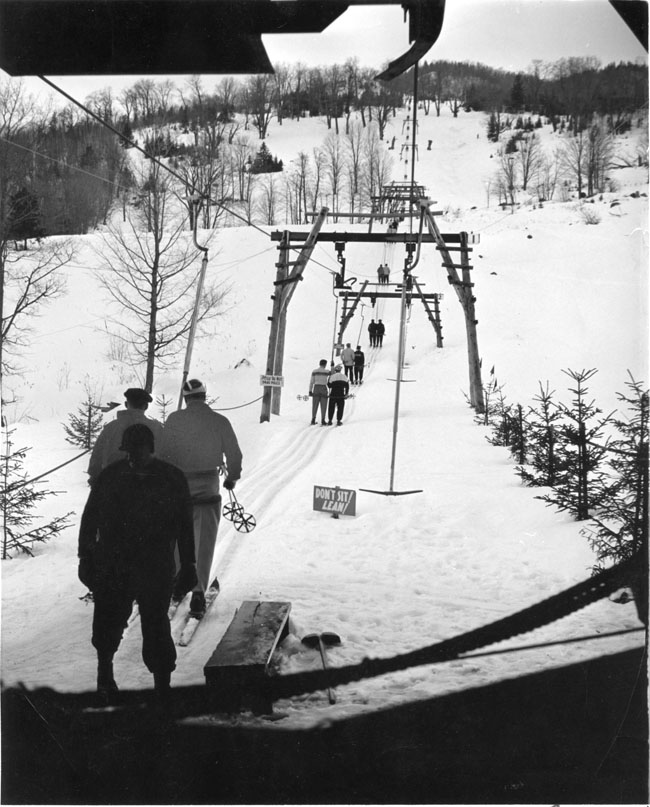
When I was seven or eight, Dad took me to Suicide Six in Woodstock, VT, where going up meant tackling a big, ferocious rope tow. Standing in line, I prayed that no one tall would step in behind me; I hoped that the person in front would hold on tight, lift the rope off the snow and stay in the track. Garnering all my courage, I’d try to grab the rope quickly, one hand in front and the other wrapped behind my back – ski poles dangling from each wrist. When I first caught hold of the tow, clutching hard with my leading hand, my arm felt as if it had been jerked out of its socket. If no one was in front of me, I was dragged along the snow, squatting in order to keep my body over my skis. If, as I had
Rope Tow at Woodstock, VT. Credit: New England Ski Museum

Rope Tow at Woodstock, VT. Credit: New England Ski Museum

dreaded, a taller person loaded on the tow behind me, I was lifted off the track into the air, hanging from the rope all the way to the top. When a skier in front lifted the weight of the monstrous rope for me, I was happy until that person unloaded and dropped the rope to ski off, leaving me again dragging along the track, hands soaking in my leather mittens and determined to make it to the top.

But the worst menace of all were the teenage boys. I quivered when one of them was up front for I knew what they did for fun. When dismounting, those boys deliberately snapped the tow as hard as they could, sending rippling waves of rope down the track. Yanked up and down, I was soon dislodged. Skiing down the hill covered in snow and disgrace, I slid to the bottom to get in line and start the ascent all over again.

I miss the old T-bar which took me to the top of Cannon Mountain in Franconia, NH. It was magically quiet gliding up through the hoar-frosted evergreens with the sun shimmering off the clear ice which encased the very tops of the

T-Bar at Black Mountain, NH.  Credit: New England Ski Museum

T-Bar at Black Mountain, NH.
Credit: New England Ski Museum

trees. Of course, it was uncomfortable when my side of the T-bar was in the middle of my back with my father riding beside me, struggling to help me, leaning down to hold his side of the bar behind his knees. What a relief when I was old enough to ride the lift with kids my own height or go up on my own holding the T-bar out in front of me, making “S turns” in and out of the track. I danced the whole way to the top.

And then there was Burke, in the “Northeast Kingdom” of Vermont that had a Poma lift running from the bottom to the very top of the Mountain. Here, I bumped off the growing mounds of snow which got larger with every run until I catapulted right to the top of the spring, hurled high into the air – boing, boing, boing.  Going up was half the fun.

For more about Suicide Six’s 75th Anniversary.

For more about Gunstock’s old Rope Tow, another favorite.


Susan Winthrop is a long-time skier with memories of the sport extending back more than seven decades.  A contributor to SeniorsSkiing.com, she currently lives in Ipswich, MA, enthusiastically skiing in and around New England whenever she can.
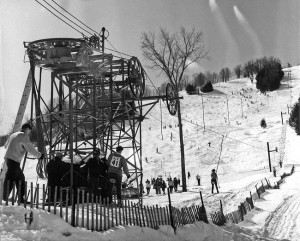
Suicide Six also had a Poma lift Credit: New England Ski Museum

Suicide Six also had a Poma lift
Credit: New England Ski Museum


Special Thanks to the New England Ski Museum, Franconia, NH.