
Tag Archive for: seniors skiing

Try Nordic Walking: Many Benefits By Adding Poles To Hike

Poling While Hiking Is An Exercise Multiplier

Roger Lohr is co-founder and editor of XCSkiResorts.com and a noted writer on all the varieties of Nordic skiing.
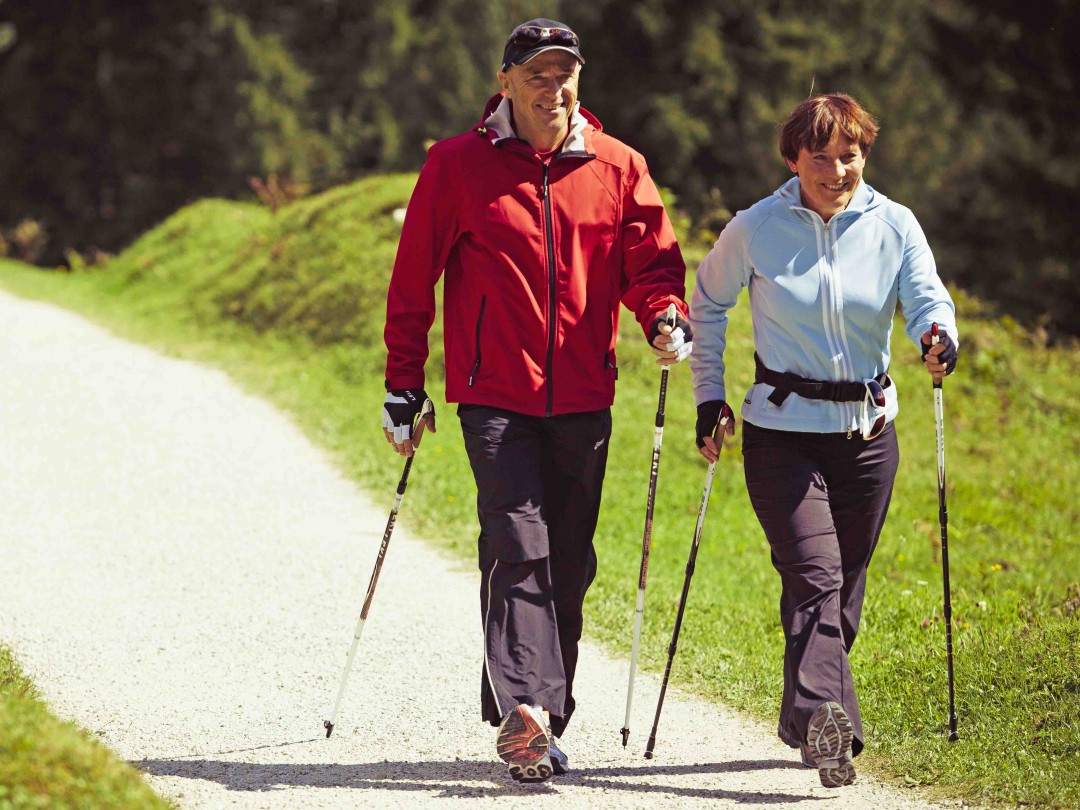
Walking a la Nordic raises efficiency of exercise by 40 percent. Credit: Leki

Walking a la Nordic raises efficiency of exercise by 40 percent.
Credit: Leki

More than 10 million Europeans of all ages and fitness levels are Nordic Walking (also known as Ski Walking) with special Nordic Walking Poles. This new fitness activity turbo-charges the normal walking regimen burning as much as 40 percent more calories compared to regular walking.

For those who are unfamiliar, Nordic walking is a fitness activity that combines walking with specially designed poles to engage the upper body muscles.

Nordic Walking poles help individuals with balance issues, knee issues or new knees, hip issues or new hips, back issues (including those with rods in their back), weight issues, multiple sclerosis (MS), Parkinson’s Disease, neuropathy, arthritis, bursitis, scoliosis, lumbar stenosis, fibromyalgia, post polio, osteoporosis, stroke recovery, cancer recovery, and other limitations to walking. Nordic Walking is helping thousands of people get off the couch, get outside, start walking safely, and effectively launching much needed walking campaigns.

The Human Kinetics book entitled Nordic Walking for Total Fitness by Suzanne Nottingham and Alexandra Jurasin covers the topic. Trekking (hiking with poles) and Nordic walking are two different activities that use very different poles and techniques. It may sound silly, but perhaps “walking is not just walking.” The pole angle, weight, grip, and straps are different between the aforementioned modes of walking. The Nordic walking pole is designed to allow your hands to relax in order to target the larger wrapping muscles of the back. But using poles of any kind automatically stimulates your spine and all of the muscles around it, even with inefficient technique. When walking, the key postural muscles of the core and upper body are engaged.

The book also includes fitness assessments, sample workouts for varying levels of interests from first timer to cross training triathletes. There are also suggestions about customizing your program. Training program recommendations are offered for building distance, fluctuating daily intensity, and rest days.

I’ve been a Nordic Walker for a few years and found many of the claimed attributes in the book regarding posture and exercise to be true. I’ve always been in search of a way to decrease the amount of time spent exercising, so I was sold when I heard that using the poles increases caloric burning by 40 percent. Being a cross-country skier, it is easy to quickly master Nordic walking. After a summer of Nordic walking, I noticed a marked improvement in my cross-country ski poling in terms of strength and timing. It seemed that I increased the amount of forward momentum that was attributable to poling and I was able to pole stronger and longer when skiing.

Nordic Walking for Total Fitness provides a foundation for anyone, ranging from those just looking for an activity to lose weight to health aficionados interested in taking it to higher levels of fitness.

Nordic Walking for Total Fitness is available for $19.95 plus shipping from Human Kinetics at www.humankinetics.com or call 217-351-5076. 

A Worry In The Woods: Tick-Borne Powassan Virus

Shifting From Snow To Summer Activities?  Beware Of This New Menace.

We’re starting to hike or bike in the woods between the receding snowbanks here in New England.  We’ve just learned that you better make sure you review your tick-avoidance-and-protection practices.  Powassan virus is yet another tick-borne disease that, according to this new report from CBS, can be lethal.  So, this is very serious stuff to pay attention to.  Don’t get complacent: check this site for more information on ticks and tick checks before you head to the woods.

Click for CBS News story on Powassan virus in Connecticut.

Click for CBS News story on Powassan virus in Connecticut.

The Last Loop: Snow Leaves The Field, Enter Spring

A final ski tour at Appleton Farms reveals winter letting go.

GWBSR

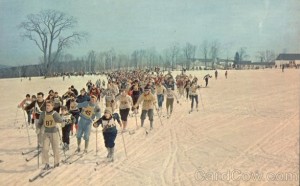
1970 Washington Birthday Race start. Everyone goes at once. Credit: Lewis R. Brown via CardCow.com

It is that special interim period here in New England between the end of winter and the start of spring.  Last week, we headed out across the corn snow at Appleton Farms in Ipswich, MA., in the bright, and, yes, warm sunlight.  We recalled the first time we skied around the edges of farm fields, way back in 1970 when we stayed at the Whetstone Inn in Marlboro, VT.  We were there for the Great Washington Birthday Race, an annual “people’s race” at the Putney School started and run by the legendary cross-country racer and coach John Caldwell.  In those days, hundreds of skiers came to Vermont for what must have been the defining event of Nordic skiing in the United States.  Modeled after the famous Vassaloppet race in Sweden, the massive starting line stretched across a hay field and, when the gun sounded, it was off you went.  We remember skiing along with the then-movie critic of the New York Post, an older chap who said he skied around the field behind his house in Westchester every morning before heading into work.  We also remember struggling in dead last in that race along with a couple of other members from the then-staff of SKIING magazine, our wax long worn off, but still laughing at our disastrous first-time-ever trying cross-country skis.

Snow is hanging on this year, melting slowly but inevitably, starting with the trees. Credit: Mike Maginn

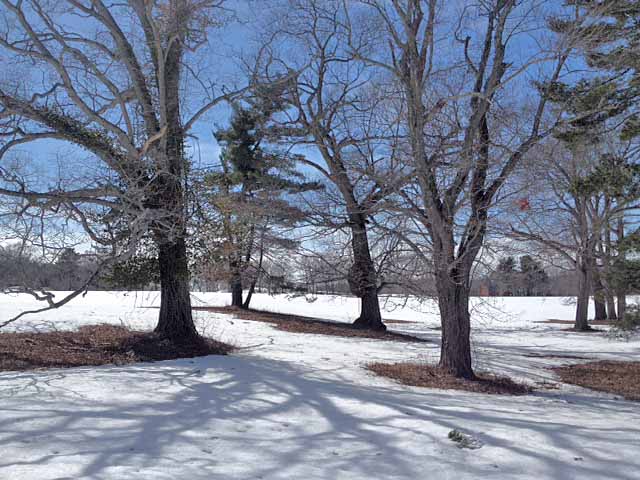
Snow is hanging on this year, melting slowly but inevitably, starting with the trees.
Credit: Mike Maginn

These thoughts came back as we went around that big field at Appleton’s.  For a long time, we favored wooden skis, woolen sweaters and wax potions; these days, we go waxless and polypropylene.  But the pleasure of being in the sun, noticing the melt around the edges, and the rhythm of planting pole, gliding, planting was the same as ever. As the snow rolls back and the sun comes in and out, Robert Frost’s Two Tramps In Mud Time came to us. This verse hits home:

The sun was warm, but the wind was chill. You know how it is with an April day.
When the sun is out and the wind is still, you’re one month on in the middle of May.
But if you so much as dare to speak, a cloud comes over the sunlit arch,
A wind comes off a frozen peak, and you’re two months back in the middle of March.

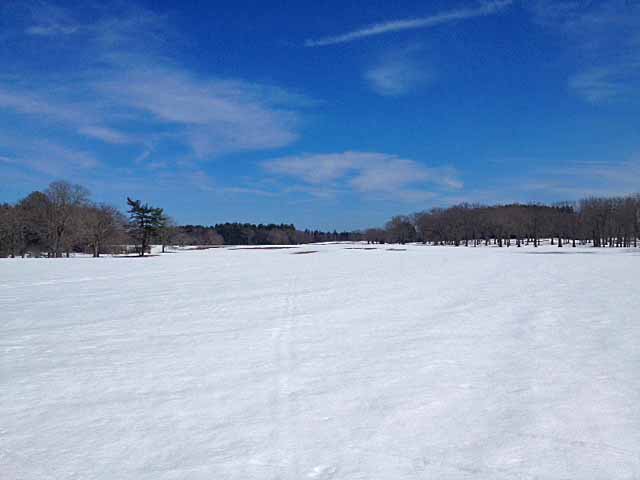
Sunny day, springtime snow, skiing across the field at Appleton Farms, Ipswich. Credit: Mike Maginn

Sunny day, springtime snow, skiing across the field at Appleton Farms, Ipswich.
Credit: Mike Maginn

More Ice Canoe Racing On The St. Lawrence

Looking Back At A Cool, Cold Sport In Quebec.

In February, we traveled to Quebec to visit the Winter Carnavale and the legendary ski resorts on the St. Lawrence, Mount Saint Anne and Le Massif de Charlevoix.  The city was alive with thousands of people celebrating the brilliant cold and the many events of the Carnavale.  One of these was the most extraordinary athletic event we’ve ever witnessed:  The Ice Canoe Race on the St. Lawrence River.  As we watched from the shore, about a dozen or more crews hustled and pushed specially built canoes over and around ice floes.  Triangular course went from one side of the river to the other; the “professional teams” had to make two complete circuits.  Click here for a clip from our eyewitness account.

Now we have more expansive coverage, thanks to our good friends at QuebecRegion.  Have a look; it is clearly an impressive experience for participants and observers alike.  Recall this video when you are complaining about the heat and humidity of next August.

For more information on the Quebec Region’s many attractions for active seniors, please click here.

Sierra Ski Season 2014–15: A Mixed Bag

In a winter with the lowest snowfall in the Sierra Nevada since record-keeping began, some resorts fared well while others barely managed to open.

On April 1st, it was no joke when California’s Department of Water Resources snow surveyors went to Phillips Station off Highway 50 near Echo Summit to do their official April 1st measurement of the snowpack. Whereas the average

Despite snow drought, author's daughter Katie Cleese and friend Rose Cendak practice Quidditch at Heavenly Valley. Credit: Rose Marie Cleese

Despite snow drought, author’s daughter Katie Cleese and friend Rose Cendak practice Quidditch at Heavenly Mountain Resort.
Credit: Heavenly Mountain Resort

snow depth at that location is 66.5 inches on that date since record-keeping began there in 1941, the measuring crew—with Governor Jerry Brown by their side—found themselves in a meadow devoid of any snow at all. It was unprecedented. Since it’s now likely that there will be very little Sierra snowpack runoff into the state’s reservoirs this year coupled with the previous three years of statewide drought, the governor announced on the spot a mandatory 25 percent reduction in water usage for everyone—companies, institutions, and individuals alike.

Yet, despite there being grass instead of snow in the meadow at Phillips Station, one can still ski and snowboard in the Sierra—at least for a couple more weeks. A small handful of wintersports areas will remain open past the traditional Easter weekend closing date, thanks to their snowmaking efforts, their higher elevations, and/or their careful protection and manicuring of the snow they were lucky enough to have fall on their slopes.

To catch a few more runs before all the snow is gone, you can head to any of the following (closing dates as of April 2nd are in parentheses): Bear Valley (Sunday, April 12th), Boreal (Sunday, April 12th), Heavenly (Sunday, April 19th), Mt. Rose (Sunday, April 19th), Kirkwood (Sunday, April 19th), and Mammoth Mountain (Sunday, May 31st). Bay Area skiers rarely make the trek to Mammoth on the eastern slope of the Sierra off Highway 395 since the quickest route there, via Tioga Pass in Yosemite, closes every winter after the first major snowfall. This season, however, Mammoth was and remains a great option since the Tioga Pass road never closed this winter—a first! As of March 31st, Mammoth had 19 of its 28 lifts operating, with a base of 30–60”. The resort has often been open for skiing over the 4th of July weekend; don’t hold your breath this year!

Only one Sierra wintersports resort is closing this Easter Sunday, April 5th, the traditional end of ski season: Alpine Meadows.

Katie Cleese soaks up the bennies in the too-warm patio at Heavenly Mountain Resort.  Note snow melt in background. Credit: Rose Marie Cleese

Katie Cleese and Mike Allen, Director of Ski Services, soak up the bennies in the too-warm, mid-mountain patio at Heavenly.  Note snow melt in background.
Credit: David Koth

Several Sierra resorts had a tough season, especially those with no snowmaking capacity or besieged by higher temperatures that prevented snowmaking or located in the Central Sierra, which didn’t get as much snow as their neighbors farther north. Sierra-at-Tahoe managed to open on December 12th and ran its lifts for a total of 94 days before it had to close on March 16th. Badger Pass in Yosemite National Park opened on December 14th but had to close on January 19th, never to reopen. Dodge Ridge racked up similar stats to Badger Pass, opening on December 17th and closing in mid-January. Homewood on the west shore of Lake Tahoe opened on December 20th but then closed on February 23rd to wait for another significant snowfall that never came. Tahoe Donner closed on March 15th and Diamond Peak closed on March 29th. Sugar Bowl had to cut its 75th Anniversary season short, closing on March 22nd.

Hopefully, all the resorts will have a banner year next year, but with the new normal, it looks more and more like any California resort that hopes to survive the changing climate will have to take the plunge into a robust snowmaking system.

Off-Season Strategy: Ski Without Snow

For Die-Hards, Here’s How To Keep Going.

Signs that the season is ending are starting to sprout along with the crocuses.  In the East, many areas will be closing this weekend; there’s still lots of snow on the ground, but many lift lines are nearly empty even on the weekend.  Many skiers have had enough.  Out West, conditions have been marginal to miserable all season. There’s plenty of cross-country skiing though, even in urban areas in New England, and we’ve been out in the sunshine several times in the last week.

But, can you beat this video from the British Nordic Ski Team, circa 1957, picturing Dutch ski enthusiasts roller-skiing along?  It is possible that for some the season never ends.

Roller-skiing is not a new idea.  At least you don't need long underwear. Credit: British Nordic Ski Team

Roller-skiing is not a new idea. At least you don’t need long underwear.
Credit: British Nordic Ski Team

Early Results From Our Subscriber Survey 2015

Much Useful Information To Steer SeniorsSkiing.com.

Thank you, thank you, thank you.  Our recent Subscriber Survey 2015 had a 22% response.  If you’re familiar with surveys, you know that is exceptional.  To us, it signifies that readers are engaged and involved with this online magazine.  Even more, almost all our respondents answered every question!

SeniorsSkiing.com will be analyzing Subscriber Survey 2015 data over the next few weeks. Credit: digitalart

SeniorsSkiing.com will be analyzing Subscriber Survey 2015 data over the next few weeks.
Credit: digitalart

The early results show us that discounts on lifts and passes are very important or critical for 100% of SeniorsSkiing.com subscribers.  That is a dramatic statistic.  Also very important or critical (75% of respondents) is easy access from parking to lift.  And, a majority say other discounts on food, rentals, and/or equipment (51%) are very important or critical.

We know about our subscribers:  70% male, 30% female and the average age is just touching 70. You’d like to see more stories about gear suitable for seniors, health and fitness, and snow sports industry news.

Finally, 93% of you are interested in either reading or contributing to a Forum were you can contribute ideas, comments, and the like.  Our crack technical team is working on that, and you can expect to see our new Forum soon.

We’re doing to be pouring over the other results of the survey in the coming weeks.  Clearly, you advice and insights are extremely valuable to us.  Thank you for helping us steer SeniorsSkiing.com into the next season.

Skis Just For Women

Should We Have Ski Equipment Just For Seniors, Too?

Jen Gureki saw a clear need for women's skis and founded Coalition Snow. Credit: The Ski Diva

Jen Gureki saw a clear need for women’s skis and founded Coalition Snow.
Credit: The Ski Diva

At the ski shows last fall, we heard rumblings in the ski industry about products for specific segments.  Now, our friend and colleague The Ski Diva has tracked down and interviewed Jen Gureki, CEO and Founder of Coalition Snow, which manufactures skis for women.  Her rationale for developing a ski for women is interesting to us at SeniorsSkiing.com: The segment was getting second shrift from the industry.  Existing women’s skis were shoddy, filmsy and didn’t meet the needs of advanced skiers.  So, Jen designed and manufactured skis to meet their needs.  Pursuit of opportunity. Just like perenial innovator Denny Hanson did with senior-friendly Apex Boots Read her story and let us know what you think about segment-specific equipment.  If someone made senior skis, what would they be like?  What about cross-country equipment?  Boots? Clothing?  We think there is something here to dig into, don’t you fellow senior snow enthusiasts?  Click below for the whole interview.

SkiDiva

If You Like Mountains…

Take An Aerial Tour Of The Himalayas.

Teton Gravity Research, one of our favorite action sports movie makers, has captured the spirit of the mighty giants of the Himalayas.  Using an advanced camera stablizer, this short, ultra HD video takes you up close and personal to Mt. Everest, Ama Dablam, and Lhotse.  Fasten your seat belt and pass the pop-corn.

Getting Fresh On The Mountain

Deer Valley’s Seafood Buffet A Wasatch Institution.

Deer Valley in Park City consistently ranks at the top of SKI Magazine’s polls for guest service, on-mountain food and snow grooming. As a part time instructor there for several years, I came to understand that the resort has a unique hotel culture. Customers are treated as “guests.” As one executive advised us, “Treat them well. They might not be right, but they’re still our guests.”

DeerValleyBuffet2

Freshly shucked oysters are never-ending at Deer Valley’s seafood buffet. Credit: Deer Valley

The food choices are varied, the quality is terrific, and, considering Deer Valley’s posh reputation, reasonably priced. I used to joke that DV is a great restaurant with skiing as an amenity. Actually, DV offers a lot of varied terrain that most of its guests probably never get to. It’s a fine area with a fine reputation and really fine food.

One of its dining institutions is the Seafood Buffet, a ski season-only restaurant that pops up Thursday through Sunday evenings in the resort’s Snow Park Base Village lodge. During ski hours, the cafeteria serves DV’s daytime offerings: far more sophisticated and varied than what you’ll find in most day lodges in North America. Come evening, it transforms to a remarkable array of freshly shucked oysters, crab legs, shrimp, sushi, cooked entrees from sea and ranch, and sweets of every fresh-baked and otherwise concocted description. It’s on Zagat’s “America’s Top Restaurants” list.

You might associate the food choices with dressing for dinner. But given the lodge’s upscale rustic surroundings almost everyone is in jeans.

DeerValleyBuffet

A wide variety of seafood grace the Deer Valley seafood buffet, a ski season-only institution in the Wasatch. Credit: Deer Valley

Then there’s the service. With some exceptions, Utah restaurants are aggravating for their lack of quality service. Historically a culinary backwater, a growing number of excellent eateries in Park City, Salt Lake, tiny Boulder, and a few other locations are attracting attention and clientele from all over. The Seafood Buffet is all about superb service, and its international wait staff in topnotch. Leave your table for another plate of whatever, and you return — each and every time — to one tidied with replaced dishes, flatware, and moist cloth napkins for sticky fingers.

The wine and beer list is reasonably priced, with several whites clustered under the heading “Shell Fish Wines.” While the list has a range of options, our Marlborough (NZ) Sauvignon Blanc was available at a reasonable premium above the state wine store.

The buffet cost is $64 for adults/$34 for kids (11 and under), beverages excluded.

Deer Valley’s Seafood Buffet is a classic. Winter visitors to the Wasatch — the mountain range where Deer Valley and numerous other ski resorts are located within close proximity — have many dining options. But wherever you stay, at Deer Valley, in Park City, at one of the other resorts, or somewhere in the Salt Lake Valley, it’s worth a short drive to the mountains to enjoy first-rate cuisine from the seas.

Reservations advised.

The Ski Diva Heads West

All-Women Ski Trip Brings Kindred Spirits Together

Our friend and colleague, The Ski Diva, gathers a group of Diva Members for an annual ski trip to exciting places.  This year, her group went to Montana where they had a rocking good time.  Click here for her report.  Pass this along to the Ski Diva in your life. The Ski Diva is a super resource for women who ski. Perhaps your diva would be interested in joining.

Ski Divas gathered in Montana this year.  Clear skies and clearly fun. Credit: The Ski DIva

Ski Divas gathered in Montana this year. Clear skies and clearly fun.
Credit: The Ski DIva


SeniorsSkiing.com SubscriberSurvey 2015

 Please Add Your Feedback To Other Subscribers to SeniorsSkiing.com

oldfashionedskierThis month marks our first full year of publishing SeniorsSkiing.com, the only online resource for 50+ snow enthusiasts.  It’s a good time for us to get your advice, comments and input on how we can make our magazine more useful to you.  Please take a minute to complete our short survey.  We very much appreciate your support; we’ll share the results with you when we crunch the numbers.

https://www.surveymonkey.com/s/SubscriberSurvey2015

Breaking News: Boyne, Intrawest, Powdr Launch M.A.X. Pass

MAXSki & ride 22 resorts five times each for total of 110 days.

The Multi Alpine Experience (M.A.X.) Pass is a brand new, groundbreaking ski pass giving access to 22 mountains all over North America. M.A.X. passholders will get five days of skiing or riding at each of the 22 participating resorts for the 2015/2016 ski season. Resorts include:

  • Blue Mountain, Ontario
  • Mont Tremblant, Quebec
  • Stratton, VT
  • Steamboat, CO
  • Snowshoe, WV
  • Winter Park, CO
  • Loon Mountain, NH
  • Sugarloaf, ME
  • Sunday River, ME
  • Boyne Highland, MI
  • Boyne Mountain, MI
  • Big Sky, MT
  • Brighton, UT
  • Crystal Mountain, WA
  • Cypress Mountain, B.C.
  • Summit at Snoqualmie, WA
  • Killington, VT
  • Pico Mountain, VT
  • Copper Mountain, CO
  • Mt. Bachelor, OR
  • Boreal Mountain, CA
  • Las Vegas Ski and Snowboard, NV

Boyne, Intrawest and Powdr combined to form a fourth company, PassCO, LLC, that will handle online sales of M.A.X. passes.

The M.A.X. pass was launched a few days ago. It offers skiing and riding at 22 U.S. resorts and it goes head to head with Vail’s Epic Pass with 81 U.S. and international resorts – and Mountain Collective with 14 U.S. and Canadian resorts.

Editor’s Note: We applaud the creativity the M.A.X. pass has shown in providing multi-resort ski discounts, but we are disappointed to see there aren’t any discounted rates for Senior Skiers. Hopefully, we will see an updated price list that acknowledges seniors, the growth segment of the ski industry. Readers: How say you?

St. Patrick’s Day Snow Art At Brighton, Utah

Everyone enjoys trailside sculptures in annual tradition.

Lift Mechanic Jamill Sami puts finishing touches on his department's gigantic ninja turtle. Credit: Harriet Wallis

Lift Mechanic Jamill Sami puts finishing touches on his department’s gigantic ninja turtle.
Credit: Harriet Wallis

The snow sculpture competition is an annual St. Patrick’s Day event at Brighton Resort, Utah. The competition pits departments against each other in a good natured contest.

During the night as grooming equipment manicures the slopes for the next day, they scoop up a pile of snow for each department.
Lifties who run the beginner lift created an enormous Snoopy lying on top of his dog house. Adults and kids who are learning get to ski and ride around the delightful sculpture.

There are nearly a dozen sculptures located around the base of the resort. Even non-skiers can walk around the base area and enjoy them. They’ll remain on view for a few days and then be groomed back into the slope.

Correspondent Harriet Wallis remembers the outstanding St. Patrick Days at Brodie Mountain, MA. Credit: NewEnglandSkiHistory.com

Correspondent Harriet Wallis remembers the outstanding St. Patrick Days at now closed Brodie Mountain, MA.
Credit: NewEnglandSkiHistory.com

St. Patrick’s Day is for reminiscing. I used to live in the East, and I skied Brodie Mountain, Massachusetts on St. Patrick’s Day. The once thriving ski area went all out to celebrate the Irish holiday. There was green snow,  green beer, green outfits, green face painting and lots of merriment off the snow and on it. Along with 20 others, I sledded down a slope on a cafeteria tray and crossed the finish line first. For that I earned a Brodie Mountain T-shirt. I still have it.

Does your ski area celebrate St. Patrick’s Day in an unusual way?

Product Update: ThinOptics Now has Bold Colors, New Magnification

You’ll Always Have These Readers With You.

Finally, you can read your cell phone, trail maps and restaurant menus with ease because you can always have these very cool reading glasses with you. And the case snaps onto your Smartphone for ready access. Now isn’t that novel!

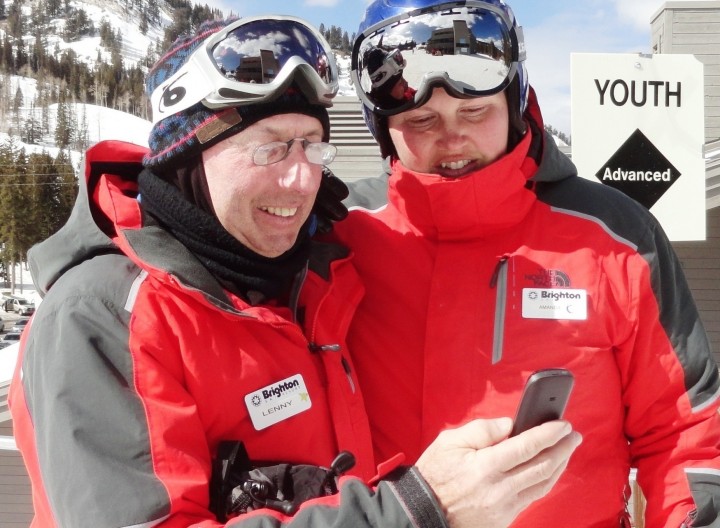
Brighton Resort ski instructors Lenny Bernstein and Amanda Cimini check the phone. Lenny is wearing ThinOptics. Credit: Harriet Wallis

Brighton Resort ski instructors Lenny Bernstein and Amanda Cimini check the phone. Lenny is wearing ThinOptics.
Credit: Harriet Wallis

ThinOptics readers solve the problem that has plagued seniors since Smartphones were invented. The phones are smart, but the info is too small to read. ThinOptics to the rescue. These tiny glasses perch comfortably on your nose then store away on your cell phone. No more fumbling for bulky reading glasses or passing glasses around.

After millions of dollars of research, these virtually indestructible readers were introduced last year, and they rocketed to popularity with seniors. Now they come in vivid frame colors as well as traditional black and clear. In addition. a new magnification level has been added.

Check our original review from October, 2014 here.

There’s Snow In Them Thar (California) Hills

Although Snow Conditions Have Been Less Than Golden This Season,
There IS Some Great Skiing To Be Had In California’s Northern Sierra Nevada.

Northstar-at-Tahoe has been operating full blast since Thanksgiving. Credit: Northstar

Northstar California has been operating full blast since Thanksgiving.
Credit: Northstar California

While much of the U.S. has gotten battered all winter long by massive dumps of snow and other inclement weather, California’s Sierra Nevada has been having a tough time living up to its name (“snowy mountain range” in Spanish). But, a crazily configured jet stream and a persistent giant high off the West Coast notwithstanding, most of the mountain resorts of drought-stricken California have been able to carve out a decent wintersports season.

As of March 8th, most Northern California resorts, particularly those in the Lake Tahoe region and at the higher elevations, have more than half of their lifts running and terrain open to skiers and boarders, thanks to a storm during the first weekend of March that dumped as much as 28 inches of snow on the slopes and to colder temperatures that have allowed for accelerated snowmaking.

Squaw Valley, with a base of 22″ to 52″, has all but five of its 29 lifts going, and its neighbor area, Alpine Meadows, has nine of its 13 lifts operating on a base of 19″ to 47″. Heavenly Mountain Resort, which boasts “the West Coast’s largest snowmaking” operation, is running 19 of its 28 lifts with an average snow depth

Heavenly Valley's been making snow, producing outstanding conditions. Credit: Heavenly Vally

Heavenly Mountain Resort has been making snow, producing outstanding conditions.
Credit: Heavenly Mountain Resort

of 39″. Says Heavenly p.r. coordinator Liesl Kenney, “Everybody is surprised at how good conditions are when they get up here.” Convincing skiers and boarders of this is probably one of the biggest challenges facing many resorts, seeing as how the San Francisco Bay Area has been experiencing perennially sunny skies and basking in 70° temperatures week after week this winter!

Northstar California is “thriving” this season, according to senior communications manager Rachael Woods. “Every chair is served by our snowmaking system, which can be controlled by a smart phone!” The resort has been operating top to bottom since opening shortly after Thanksgiving and hopes to do so until its planned April 19th closing date. The resort currently has an 18″ to 49″ base with 18 of its 20 lifts operating. The higher-elevation resorts, Sugar Bowl (base: 6,883 feet) near Donner Summit, Sierra-at-Tahoe (6,640 feet) near Echo Summit, Kirkwood (7,800 feet) near Carson Pass, and Bear Valley (6,600 feet) near Ebbetts Pass, can all crow about their healthy snowpacks that stack up to as much as 72” (Sugar Bowl).

The two resorts located northeast of Lake Tahoe in Nevada can’t complain this season either. Mt. Rose, with the Tahoe region’s highest base elevation at 8,260 feet, has all 60 trails and all eight of its lifts going, with snow depths of 32″ to 66″. Diamond Peak, at 6,700 feet, has two to three feet of snow with five of its seven lifts in operation. And SoCal favorite Mammoth Mountain off US-395 in Central California has 19 of its 28 lifts running, a base of 30″ to 60″, and a planned closing date of May 31st. Its fellow Central California resorts, alas, have not fared as well. China Peak, Badger Pass in Yosemite, and Dodge Ridge are all currently closed due to a lack of snow cover. Up near Tahoe, Donner Ski Ranch, Tahoe Donner, and Homewood are also temporarily closed—permanently for the season if that high ridge doesn’t budge!

With most currently open Sierra resorts planning to close the third or fourth weekend in April, West Coast skiers 65 years of age and older still have at least six weeks to enjoy some quality spring skiing or boarding and to catch some senior savings. Most resorts offer discounted lift tickets (65+) and you can even ski for free if you’re 75+ (Bear Valley) or 80+ (Diamond Peak). Several resorts offer clinics for 55+ skiers early on, but that’s a story for next season. May it be ever so snowy! Like Boston-snowy!

Serious Stuff: There Is No Such Thing As “Side Country”

And There Is No Such Thing As Being A Little Bit Dead.

Back country warnings are there for a reason. Credit: Harriet Wallis

Back country warnings are there for a reason.
Credit: Harriet Wallis

Yesterday we rode the chairlift with a bozo. Okay. Maybe he wasn’t a bozo. Maybe he was just clueless. All the way up he yapped about his skiing prowess. And near the top he phoned home to give his wife his location. “She worries about me,” he said.

She should worry. He planned to duck under the boundary rope and make some turns in the deep, unspoiled powder beyond.

“Take your avy gear,” we said.

“Don’t need it. It’s in the car. I’m just doing side country,” he said.

Somehow he missed hearing that there is no such thing as side country.

The term “side country” hit the scene a few years ago, and it was quickly squelched by the ski industry’s leading avalanche experts, snow science experts, the U.S. Forest Service, ski area risk managers, mountain patrollers and others. It was likely a marketing brainchild used to promote the newest boots and powder-specific skis and boards.

The term had obvious appeal to intermediate and advanced skiers and riders. They could buy the latest gear and try their skills beyond the rope line thinking it would be okay. They could be a little bit naughty.

But the ski industry took a stance saying you’re either within a resort or else you’re in the unmonitored, ruthless back country. You’re either in bounds or you’re out of bounds. There’s nothing in between. There is no such thing as side country. There is no such thing as “kinda” out of bounds.

“We all must focus on educating skiers and snowboarders that backcountry terrain accessed from a ski lift has the same risks as any other back country or out-of-bounds area,” says the National Ski Area Association.

Later in the day I caught the TV news. A skier died after being caught in an avalanche. The avalanche occurred in the very out of bounds area where a guy— with too much macho and too little knowledge—went to ski. There’s no such thing as side country.

There’s no such thing as being a little bit dead.


Bootfitting 101: TLC For Old “Soles”

Here's a boot fitting pro doing a stance analysis.   Credit: Steve Cohen

Here’s a boot fitting pro doing a stance analysis.
Credit: Steve Cohen

Older people have messed up feet, says Steve Cohen philosophically. Cohen is CEO of Masterfit Enterprises, a company that specializes in training ski shop salespeople to fit boots properly. The company also tests boots, makes insoles and boot fit aids and runs America’s Best Bootfitters, an organization of top bootfitting shops.

“Think how many miles senior feet have trod. They’re like an old car suspension, a little more played out,” he says.

Help is on the way.

“Many people are in boots one size too big for them, some are amazingly even in boots three sizes too big,” says Cohen. “You need snug fitting boots to steer with your ankle, set your edge, and let the ski do its thing with an arc turn. Movement should be minimal to get your ski to turn where you want it.”

The way to test boot size? Remove the liner, slide your foot into the boot until your big toe touches the front. Make sure there is not more than a finger’s to a finger-and-a-half’s width of space between your heel and the shell. That will ensure a snug fit when the liner is reinserted.

Typical foot problems that occur with age are: thinning of the fat pads cushioning the soles, plantar fasciitis (inflammation caused by the stretching of the connective tissue that runs from the front of the heel to the metatarsal heads sole), bunions, and poor circulation.

One recommendation Cohen makes off the bat is to replace the stock insole with an upgraded model that provides support in two key places, the arch and the

Fitting boots may require custom-fit insoles. Credit: MasterFit

Fitting boots properly may require custom-fit insoles.
Credit: MasterFit

heel.

Other pieces of advice:

  • To ease your foot into the boot, spray the spine of the liner with dry silicone spray or use a giant shoehorn, made specifically for ski boots.
  • Remove liners frequently so they can dry out. Your foot sweats and produces moisture. If it sweats a lot, use an underarm anti-perspirant on your feet.
  • Buckle your boots when not in use, to preserve the shape of the plastic.
  • Use thin socks, the liners will provide the necessary insulation.
  • The cuff of the boot should wrap snugly with buckle bails set somewhere near the beginning to middle of the ladders. If you’re near the end of the ladder, the buckles may deform the shell and change the boot’s intended flex pattern.
  • To keep feet warm, start with a warm boot. Use a heated boot bag to keep boots toasty on the way to the slopes or place a microwavable hot pack inside each boot (remove before skiing!). Use Boot Gloves, neoprene insulating covers that Cohen swears by. Or—bootfitters’ trick—put a layer of adhesive aluminum foil underneath the insole (stock or custom) to help reflect heat back to the foot.
  • When shopping for boots, expect to spend several hours. Go when shop personnel are least busy, midweek, midmorning.

“Never buy boots online. In the shop, you’re buying the boot fitter’s knowledge and skills, which is priceless,” says Cohen. “You will get boots that are comfortable and will last you many years. A lot of people buy new boots before their old ones are truly done because they don’t fit or perform well.”

Check out bootfitters that belong to America’s Best Bootfitters. They can help you select a proper fitting ski boot, make modification to enhance fit, comfort, and warmth. Good bootfitters can also stretch or grind shells and liners to relieve pain caused by bunions or other bony prominences.

It’s all good for the senior soles.


Ski Japan: Looking For Snow? Head West. All The Way.

Combine lots of snow with an exotic destination for an incredible skiing experience.

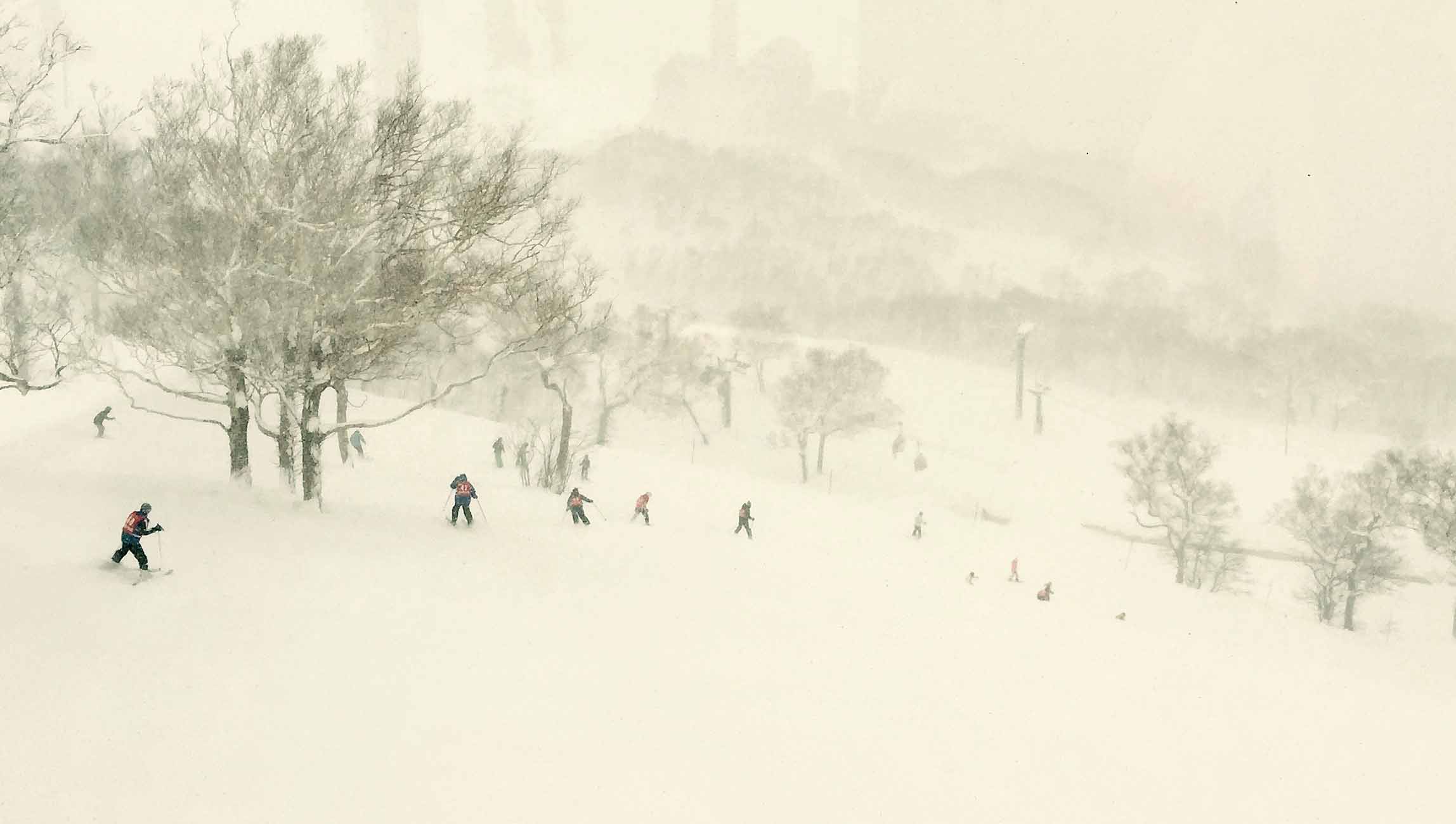
Almost like a Japanese woodcut,  skiers in Niseko run through the flakes. Credit: Susie Winthrop

Almost like a Japanese woodcut, skiers in Niseko run through the flakes.
Credit: Susie Winthrop

O.K., you adventurous senior powder-hounds: How far will you fly to find an awesome stash in this odd winter of snow conditions?  If you don’t fly east to New England or Quebec to ski, how about 14 hours on a JAL flight to Tokyo on a 787 “Dreamliner” direct from Boston?  When you get there, hop on another two-hour flight to Sapporo, the capital of Hokkaido, the northern most island in Japan. Then,  jump on a bus and three hours later you’re in Niseko, home to four (Annupuri, Higashiyama, Hirafu, and Hanazono) interconnected ski areas.  If it’s winter, it will be snowing.  Yes, guaranteed fresh light powder snow everyday all winter.  The aspen trees are perfectly spaced and slopes are rarely skied out, but guides, helicopters and snowcats also await those coveting untracked bliss.

However, the real adventure here is the fact that you’re in Japan. You’ll eat sushi, sashimi, tempura, gyoza, yakitori, miso soup and sea urchins. Be sure to stay

Moku No Sho ryokan has an onsen (hot water spring) on site. Credit: Susie Winthrop

Moku No Sho ryokan has an onsen (hot water spring) on site.
Credit: Susie Winthrop

at a real Japanese Inn (Ryokan) with hot spring fueled baths (Onsens).  You won’t need to bring a bathing suit to the springs; you bathe in the buff.  Niseko Moku No Sho, the fabulous inn we stayed at, provided a yukata (kimono bathrobe) and slippers which we wore at all time until we dressed for skiing.  You don’t even need to bring your own ski garb; you can rent it  at the mountain: parkas, pants, hats, mittens, goggles, helmets, snowboards, skis, boots, poles—all the latest, all for rent.

Like most things in Japan, the resort is clean, organized and efficient.  At the mountain, it took no time to pop grand-daughter, Eloise, in day care, purchase our senior three-day ticket (a real deal at $105 for three days on four mountains), rent our super-wide powder skis and get out on the slopes.  There are no lift lines, even during vacation week.

Tower of beer.  What a novel idea. Credit: Susie Winthrop

Tower of beer. What a novel idea.
Credit: Susie Winthrop

Looking for apres-ski fun? Make some friends and order a high “tower” of beer to share at the base lodge.  Or slide down to the Bar Ice igloo and warm yourself with a hot rum and butterscotch toddy.  “Kampai” is all the Japanese you’ll need to know.

For more information on skiing in Japan, click here.

The Ski Diva Focuses On Senior Skiers

Women’s Ski Site Offers Advice To Seniors

SeniorsSkiing.com’s favorite online resource for women skiers is The Ski Diva, a one-stop shop for interesting ideas, information and a meet-up forum for like-minded women.  In this recent article, The Ski Diva explores how a senior woman approaches skiing at 72.  She also describes how the senior segment in snow sports is growing and quotes SeniorsSkiing.com’s co-founder on how the industry can be more accommodating to seniors returning to the sport after a hiatus.  Click to read the article, Age Is Just A Number, Right?

SkiDiva_2


SuperSeniorSpotlight: George Jedenoff Shreds Alta At 97

SeniorsSkiing Honors A Legend Who’s Skied Alta For 55 Years.

SeniorsSkiing.com is proud to spotlight George Jedenhoff, 97,  who skis Alta every year. Credit: Ski Utah

SeniorsSkiing.com is proud to spotlight George Jedenoff, 97, who skis Alta every year.
Credit: Ski Utah

How’s the spring in your legs?  Here’s George Jedenoff, a 97-year old from Oakland, CA, who has been skiing Alta, UT, since 1960.  With a lifetime season pass and a healthy lifestyle, George shows us that skiing can be a part of any stage of life.

Here’s a short video of George has he sweeps down the slopes in February 2015.  Thanks, George, you are an inspiration to all of us.  And thanks to Ski Utah for documenting George’s return to the slopes for the past three years.  You can see additional videos of George from 2013 here and from 2014 here.


Au Quebec Pays des Merveilles d’Hiver

Au Quebec Pays des Merveilles d’Hiver

Messieurs et Mesdammes, nous aimons le Quebec en hiver! With apologies to Madame Haydu, my high school French teacher, our recent journée au Quebec was trés intéressant, and nous were heureuse to tell you toût de l’historie.

Eçoutez, Senior Skiers, if you are looking for a winter vacation in snow country that is different, even exotic, consider heading north to Quebec. There you will find some incredibly beautiful multi-snow sport resorts, world-class hotels and scenery that is honestly like nothing you’ve ever seen before. All so close, all so exotique. But before we tell you about our skiing adventures, we want to report on Quebec’s winter jewel: le Carnavale de Quebec.

Mascot Bonhomme makes us feel welcome at his Palais. Credit: Tourisme Quebec

Mascot Bonhomme makes us feel welcome at his Palais.
Credit: Tourisme Quebec

If you are reading this, you are most likely a friend of winter. Let us tell you straight up that les Quebecois are amants (lovers) of winter. Frankly, when you live up there, you have to be. Visiting Quebec City during Carnavale is a lesson in celebrating a glorious winter culture built on welcoming the magnificent cold and all it brings.

We met Bonhomme, the puffy white snowman mascot of Carnavale, at an evening parade which featured dramatically lit creatures of the North—narwhales and wolves—floats with scenes of Quebec history, musicians, clowns, acrobats, motorcycles, all in the brilliant cold air. It seemed the entire city lined the parade route with rosy-cheeked children riding on parents’ shoulders, many enthusiastic bleatings of plastic horns, and a warm feeling of camaraderie.

Musicians' hut at le Monde de Bonhomme at Quebec's Winter Carnavale. Credit: SeniorsSkiing

Musicians’ hut at le Monde de Bonhomme at Quebec’s Winter Carnavale.
Credit: SeniorsSkiing

Downtown, we also visited la Palais de Bonhomme, a really large, ornate, multi-room structure built of crystal clear blocks of ice, with themed rooms and ice furniture. We walked over to the Plains of Abraham where we found an extraordinary outdoor exhibition of snow slides, kid’s activities, sleigh rides, ice sculptures, musicians in heated booths, and squeaky snow underfoot.

The pièce de résistance, though, was the canoe racing on the St. Lawrence River, choked as you would imagine this time of year with jagged ice floes and big bergy bits, and with the occasional stretch of open water. Teams of fiveIceboat hardy athletes dressed in wet suits and spiked shoes push, pull, heave, lift and row bateaux about 20-25 feet long through, around and over all this. The idea was to head around three buoys, two placed on the Quebec side of the river and the third on the far side, at least two miles across. Amateur teams went around the buoys once; the pros had to make the circuit twice. Now that’s an extreme sport.

Quebec is an easy car ride from anywhere in the Northeast and even from the Midwest; major airlines fly into Jean Lesage International. It’s probably the most European city in North America. Restaurants and cafes line le Vieux Quebec, and there are many art boutiques and craft shops though out the city. Just being in Quebec in winter is exhilarating; the locals know how to live in winter, and they start by loving it.

Coming next: Skiing the Charlevoix Region.

Adult Stem Cell Therapy For Skiers

Is This Trendy Therapy Right For What Hurts?

Just a week ago, a skier friend underwent stem cell therapy for his painful knee. Ever since, he’s been sending me emails extolling the wonders of this cutting edge technology. We’re all skiers and our knees take a beating over time, so when he began singing praises about adult stem cell therapy, I took notice and became curious. Then I did some superficial homework on adult stem cell therapy. There’s good news and bad news.

Not exotic fruit, fellas.  It's a blossoming stem cell that can be used in healing senior skier joint ailments.;

Not exotic fruit, fellas. It’s a blossoming stem cell that can be used in healing senior skier joint ailments.

The good news is that adult stem cell therapy has been going on for a long time with great success for many health conditions.

However, at this time it can’t cure everything, and I learned that some conditions can be aggravated by it. Patients must pay for the procedures out of their own pockets as insurance does not seem to cover it. And sometimes it takes more than one procedure to solve or make a dent in the health problem.

Stem cell therapy is trendy and clinics are apparently springing up like mushrooms after a rainstorm. The sites I checked have flashy websites with lots of glowing testimonials. But before you jump on the bandwagon of hope, find out if the bandwagon is going where you want to go or whether it might be a pricey ride to nowhere.

So here’s the bottom line: Is adult stem cell therapy the alternative, cutting edge miracle cure for what hurts — or might it be one size fits all hype? Look before you leap. Then decide.

If you’re interested in adult stem cell therapy, the International Society for Stem Cell Research website is a place to start.

Editor’s Note: SeniorsSkiing.com Correspondent Harriet Wallis has two artificial knees, loves life and skis four days a week. She wrote the 5-part series on knee replacement for SeniorsSkiing.

Eldora’s Front Range Gang Is A Model Senior Skier Program

Here’s An Another Area-Sponsored Program For Senior Skiers.

Eldora's Front Range Gang is another model senior-focused program.  Other ski areas: Are you paying attention? Credit: Eldora Resort

Eldora’s Front Range Gang is another senior-focused program. Other ski areas: Are you paying attention?
Credit: Eldora Resort

Anyone who lives in or visits Boulder in winter has absolutely no excuse not to ski Eldora Mountain Resort, not really a resort with lodging but a simple ski area under the brow of the Continental Divide, is just 21 miles west of town. There’s no need to drive, since scheduled RTD buses depart from downtown station, stop at the park-and-ride lot in the heart of downtown Nederland and then drop passengers and their gear off right in front of the Main Lodge, with return service – of course. Fares are half-price for ages 65-plus.

Eldora’s Front Range Gang is a popular program for skiers aged 50 and over. It is offered from 9 a.m. to 12 noon every Monday and Thursday in February and March. Alpine, telemark and Alpine touring gear is welcome. And cross-county skiers are welcome at the Nordic area, which shares base facilities with Alpine skiers.

Each Front Range Gang day includes a three-hour guided group session on a choice of green, blue or black terrain,

City bus from downtown Boulder to Eldora is super convenient.  Credit: Eldora Resort

City bus from downtown Boulder to Eldora is super convenient.
Credit: Eldora Resort

helpful tips and liftline priority access – though in truth, except when Boulder Valley schools are out, you’ll never find a line. Cost is $40 per day, $99 for a one-month package and $189 for two months – too late for 2015, but keep it in mind for next winter.

[Editor’s Note: What other ski area/resort sponsored programs do readers know about?  We’d love to create a directory for our readership.  Please let us know.]


The Art of Cross-Country Skiing: The Basics

Cross country (XC) skiing is a terrific way to enjoy the great outdoors in winter. Is it great for older people that want to stay active? You betcha!

From Roger Lohr, founder and editor at XCSkiResorts.com and prolific writer on cross country skiing

The pleasures of XC skiing can be a wonderful change of pace for winter activities.  Whether you seek the solitude of solo skiing or are spending some quality time with family and friends, it’s relatively inexpensive, accessible and aesthetically pleasing. It’s also a great rhythmic, aerobic activity, enabling you to burn up hundreds of calories per hour without straining joints such as ankles and knees. You’ll get a low-impact workout while enjoying the outdoors, and the scenery sure beats the view at your local health club. Here are some tips:

Boundary Country Trekking x-c skiers in northern MN enjoy some hot chocolate. Credit: Roger Lohr

Boundary Country Trekking x-c skiers in northern MN enjoy some hot chocolate.
Credit: Roger Lohr

Where do you plan to ski? The terrain and location helps determine your equipment choices. XC skiing allows you to choose from a variety of locations. parks, golf courses, hiking trails, or XC ski areas are all good choices. Commercial XC ski areas charge a fee for access, but they offer maintained trails and tracks, signage, and you can get help if you run into trouble out on the trails.

You can rent equipment at your local ski shop or at the ski area. This is often recommended for first-time skiers, and some ski shops will apply the price of rentals toward purchasing new equipment.

Buying used equipment at a ski swap may be a mistake. Be aware that at garage sales and some swaps, you may wind up with gear that is outdated or inappropriate for you. Buy a package deal that offers a discount when you buy skis, boots, bindings, and poles together.

In-track XC skis are used with a traditional kick-and-glide motion on maintained track systems set by special grooming machines. They have minimal sidecut so the skis will stay in the tracks. Sidecut refers to the narrowness of the middle part of the skis in relation to the wider tip and tail.

Off-track XC skis are often used to navigate ungroomed trails and terrain in parks, open fields, and on golf courses. They are wider than in-track XC skis and provide more flotation and stability in fresh snow. Wider and metal-edged backcountry skis are for the more adventurous skier, who experience variable snow conditions.

Some XC skis have waxable bases, on which you put “kick wax” for grip. Other skis have waxless bases, where a pattern in the middle third of the ski base, such as small plastic ridges or scales, provides the grip. Waxless skis have been designed to run beautifully in just about any kind of snow. Your decision will center on whether you want optimal performance by waxing or optimal convenience with waxless skis.

Have the ski bindings professionally installed on the skis. Be aware that the bindings come in different integrated systems so they must be matched to the type

Quebec's Charlevoix region is a wonderful destination for cross-country skiing.  Credit: Tourisme Quebec

Quebec’s Charlevoix region is a wonderful destination for cross-country skiing.
Credit: Tourisme Quebec

of boots that you select. Your boots should feel just like running shoes so try on the boots wearing the socks that you plan to wear when skiing. Consider foot beds or fitted insoles if you have problems with your feet. Because of these various sizing methods, it’s important to try on boots before buying them. The fit should be snug and your heel should remain in place. You should be able to wiggle your toes.

XC ski poles are used to help forward thrust. Skiers plant their poles behind on an angle. If this is your first set of XC gear, any reasonably light pole will be fine. Select poles that fit comfortably under your armpits when you stand on the ground.

Now get going – XC skiing is relatively easy to learn, but first-timers should take a lesson from a qualified instructor at a commercial XC ski area to greatly enhance the experience. As your confidence on the skinny skis grows, you’ll have a life time of nature outdoors, fitness and fun.