Tag Archive for: seniors skiing

Big Sky, Big Win For 3 Gens

Can Mom (74) Adapt To Big Sky Skiing?

Heather, her son, and mom have a knock-out three-gen ski vacation at Big Sky. Credit: Greg Burke www.luxuryskitrips.com

Correspondent Heather Burke, her son, and mom have a knock-out three-gen ski vacation at Big Sky.
Credit: Greg Burke www.luxuryskitrips.com


SeniorsSkiing.com welcomes Correspondent Heather Burke, Ski Journalist LuxurySkiTrips.com and FamilySkiTrips.com

Big Sky is just as massive and scenic as it sounds, with over 5,750-acres and a skiable summit soaring to 11,166’ and dropping 4,350’ vertical feet to the base village. Boom. This Montana ski resort is as intimidating as it sounds, or at least it was to my 74 year old mom. She wanted to join us on a family ski trip, but she had serious alpine anxiety. Would she be able to keep up with us, my husband and me, and our 21 year old son? Would she remember all her skiing skills? Would it be like the proverbial bike after missing a season or two of alpine skiing?

She flew from Florida, a reverse snowbird, to meet us in beautiful Montana. Our first ski day together, I could tell she was wound up, and a bit winded from the elevation (Florida’s highest point doesn’t acclimate you to Big Sky country). As we walked to the Swifty high-speed quad (I carried her skis), I assured mom she had done this thousands of times before, and taught me to ski four decades ago.

As I made those first few gentle turns in sparkling soft snow on Mr K under brilliant blue sky, she followed. I looked over my shoulder to see her skiing fluidly, in perfect form, a pretty big smile on her face. She was feeling the elation of skiing, at 74, and I was feeling pride (and relief). To think that she’d been apprehensive seemed silly now. But her Florida friends had warned her, “don’t break a leg,” and “you’d better come back in one piece.”

Many senior skiers like wide groomers. Big Sky has some beauts. Credit: Greg Burke www.luxuryskitrips.com

Many senior skiers like wide groomers and big turns. Big Sky has some beauts.
Credit: Greg Burke www.luxuryskitrips.com

We skied four fantastic days on Big Sky’s gorgeous groomers—Elk Park Ridge to Calamity Jane.  Mom had her faves—Sacajawea and Ambush. We skied with my son and husband on Big Sky’s Moonlight Basin terrain, three generations sharing comfy quads. Over lunch in the spectacular Moonlight Basin Lodge, we laughed about how our gear and technique had revolutionized during our three generations, and told crazy ski instructor stories – all of us had taught skiing at some point. Mostly we had a blast. I can’t think of another sport than can span 50 years age difference. Senior skiing sure has changed, so has age… 70 is the new 40 for skiers.

The other change, now I’m the over-protective parent, of my mother. I controlled my mom’s ski environment during our week in Montana, leading her down ego-pleasing, beautifully groomed boulevards—Big Sky has many. Our last day brought soft glittery powder and she skied it like a champ. “I have never skied such amazing powder,” she said. I’m pretty sure she had in her six decades, this woman skied on barrel stave skis with trap bindings after all. But who am I to correct my mom though.

Big Sky was the best venue for our three generations, big mountain terrain for the boys, big blues for mom and me, and a compact village at the base – so she could ski back to the slopeside condo mid-day and I could catch up with my guys for tram laps and steep chutes. At après ski, with well-earned scotch in hand at Big Sky’s Carabiner Bar, mom toasted to our skiing legacy.

We returned her rental ski equipment and returned her on a plane safely back to her cynical Florida friends (in one piece, no broken leg). Big Sky made a big impression on these three generations of skiers.
 

On The Threshhold of Winter 2015-16

So It Begins

WhiteMountains

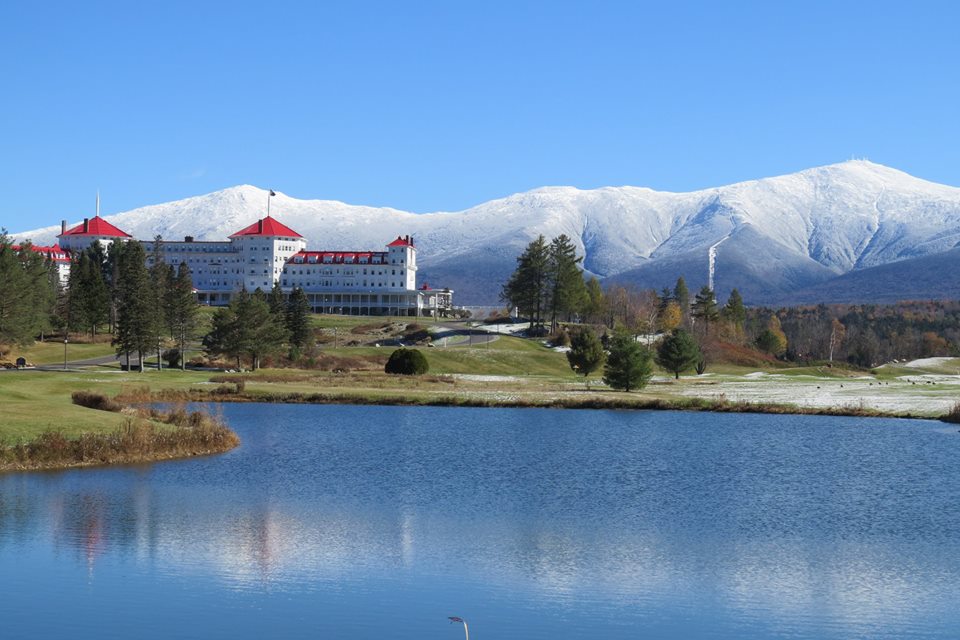
The White Mountains frame Bretton Woods resort with a first dusting in mid October. Credit: Bretton Woods

We’ve been watching reports of snow in high altitude places in the West and East which makes the coming of winter seem a bit rushed this year.  There are still leaf-peepers on the roads of Vermont and New Hampshire, and snow on Halloween decorations doesn’t seem to ring true.  For those of us in New England, the snow fall brings a reflexive response conditioned by last year’s Snowmaggedon.  Yes, bring it on, but hopefully let it regress to the mean.

By now, you’ve probably heard that Killington opened on Oct 18 with a small army of zealots skiing on manufactured snow.  (BTW, Killington was the last ski area in New England to close last spring. The last run of that elongated season was in late May.)   Sunday River followed a day later with 750 season ticket holders playing hookey from work and school to record their first of presumably many days of snow sport to follow. Our friend and colleague, The Ski Diva, puts these early days of enthusiasm in perspective.  See her astute advice on surviving what she calls the White Ribbon Of Death here.

And yet, according to NOAA, this year’s El Nino has become a stronger predictor this year.  OpenSnow, our favorite snow forecaster, explains that despite the early showing, this year might be less snowy than we’d like.

Nevertheless, now is the time to:

  • Start/continue your conditioning program,
  • Bring your gear into your local shop for a tune-up,
  • Consider a season pass while early bird specials are still available,
  • Read the ski magazine reviews of new equipment and ponder your next possible purchase,
  • Think about a destination resort where you can find senior-friendly specials,
  • Re-convene your ski club and start getting excited about the season ahead,
  • Check out deals and discounts at the Snow Shows coming to your city or town,
  • Wash/dry clean last year’s contents of your stowed away ski bag.

Meanwhile, let’s remember winter is a special time for senior snow enthusiasts.  In describing winter, Robert Frost says,

It lifts existence on a plane of snow
One level higher than the earth below,
One level nearer heaven overhead
And last year’s berries shining scarlet red.
 (A Winter Eden, Robert Frost)
Let’s get ready.

Ski Younger Now: Retraining Program At Vail

Ski Younger Now is a retraining program for older skiers, and skiers returning to the sport after recovering from an injury. Developed by veteran instructor, Seth Masia (Seth is on the SeniorsSkiing.com Advisory Board), Ski Younger Now teaches low-impact, low-torque techniques to enable efficient skiing in all kinds of terrain.

Veteran Instructor and SeniorsSkiing.com Advisory Board Member Seth Masia re-teaches seniors to ski at Vail.

Veteran Instructor and SeniorsSkiing.com Advisory Board Member Seth Masia re-teaches seniors to ski at Vail.

The approach works for anyone recovering from an injury and for those getting back on hill after a long absence.

The program is available as a three-day workshop through the Vail Village Ski School (see dates/contact info below). Seth specializes in the 60+ crowd, including grandparents seeking the skills and confidence to ski with the kids. Seth helps them with those skills, including some they can pass on to the youngsters.

His clientele often face similar physical challenges: slowed reactions, weaker muscles, fragile joints. His goal—and theirs—is that retraining will give them another ten or twenty years on the hill.

He gets people skiing smoothly, using ski shape instead of muscle to start turns, guide skis and control speed. One area of focus is reducing torque on knees, hips and lower back. He does this by emphasizing edging as facilitated by shaped skis.

He starts his “retrainees” with the “patience turn.”  It’s simply an exercise of flattening shaped skis on the snow, allowing the tip to find the fall line. The process requires a slight upper body motion in the correct direction. Some of us simply move our hands in the direction of the new pole plant. It works!

He teaches simple lateral motions that flatten and edge the ski and remove both steering torque and body unweighting from the act of skiing. It saves muscle energy and leads to a longer, more relaxed day. These skills and other useful exercises don’t produce heavy breathing, even at higher elevations.

The workshops are scheduled for December 15-17, 2015; January 12-14, 2016; February 16-18; and March 8-10.

 To schedule or learn more, email sethmasia@gmail.com or call Vail Village Private Lesson Desk (800) 475-4543 and ask for Seth Masia.

Op-Ed: SAR In The Mountains

Debit or Credit?

If you head out on the Atlantic Ocean in a canoe and run into trouble, the U.S. Coast Guard (USCG) will send a 110 foot cutter to rescue you. End of story.

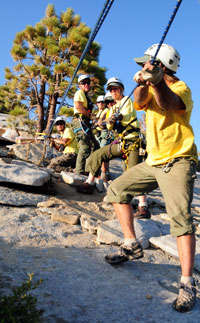
A SAR team practices at Yosemite. Credit: US Park Service

A SAR team practices at Yosemite.
Credit: US Park Service

This is not always the case here on land. The U.S. Park Service also maintains Search and Rescue (SAR) teams in each of the National Parks that have large wilderness and mountainous tracts. It costs each park visitor one and a half cents to maintain the SAR teams. These government agencies are supported by our tax dollars, and it seems well worth what we pay. The USCG has other responsibilities and is considered part of our armed forces. With the largest defense budget in the world, expectations that they conduct SAR activities seem reasonable. But, there’s more to it than that. There is a tradition of rescue at sea that dates back 200+ years. It’s part of our nation’s History and our values.

A comparison of SAR at sea and SAR in the mountains seems apt. However, several states have passed legislation to charge rescued individuals. Colorado was one of the first to pass a “hiker responsibility” law. If you require a rescue and are subsequently deemed to have acted in an “irresponsible” manner, you must pay the cost of the rescue. New Hampshire, in July 2014, changed a law which had been on the books since 1999 to lower the threshold for when to bill hikers for rescues. Under the original law, hikers had to engage in “reckless” behavior; now they need only be “negligent.”

Cost is a key consideration. Many of you senior snow enthusiasts out there have observed the ski patrol rescue injured skiers. Many of these are paid professionals but many also are volunteers.
The Knoxville Tennessee News Sentinel reported, “In Great Smokey Mountain National Park, total search-and-rescue costs for 2012 reached $253,550 with 104 incidents, two involving fatalities.” Hikers and climbers in European countries can purchase rescue insurance.

The results of these laws have seen two teenagers billed for $30,000 dollars for a rescue in New Hampshire’s White Mountains. In Arizona, a lost trail runner hid from SAR teams to avoid being billed.

I disagree with these laws and would like to see SAR in our woods and mountains take a more courageous stance like the USCG’s. There is a strong tradition of helping those in need and the nobility of such attitudes enriches us all.

New Hampshire's Hike Safe program exempts holders from repaying SAR costs, except where reckless or negligent.

New Hampshire’s Hike Safe program exempts holders from repaying SAR costs, except where reckless or negligent.

Another answer is education. “Hike Safe” programs like New Hampshire’s are great safety tools. A hiker can apply for a hike safe card which validates they have been through proper training. This card, however does NOT protect them from being billed for a needed rescue.

The goal is to insure safety in our back country locations and not to “shame” individuals who may have taken a calculated risk and lost. Many mountain communities have selfless volunteers who participate in SAR. Let’s follow their lead and act on our values to care for those who need help. We can adopt the concepts and traditions of the Coat Guard to back country and mountain rescues. Get rid of “hiker responsibility laws”.

Editor Note: These comments reflect the views of veteran mountain and hiking expert Steve Hines and are not those of SeniorsSkiing.com. Steve is a wilderness guide, Wilderness First Responder and a volunteer trip leader for the Appalachian Mountain Club.

Wheelie__510

Time To Get Moving: Now

Five Ways To Start Your Fitness Program.

Motion helps muscles, joints, ligaments limber up for snow season.

Motion helps muscles, joints, ligaments limber up for snow season.

No more procastination.  You have from six weeks to three months, depending on where you live, to get ready for snow season.  If you are a year-round sports activist, then good on you.  If you are a part-timer, weekend warrior, you probably have to start getting more diverse muscles toned up.  If you are as not as active as you could be, reflect on your habits.  You will be safer and feel better when you head out to slopes or trails if you are physically toned.  It is a huge mistake to go from zero to a ski run or cross-country trail without being physically prepared, especially if you are one of those people who distinctly remember the Beatles on their first Ed Sullivan Show appearance.

Here are five ways to begin, especially if you’ve been off your program for whatever reason this summer.

1. Walk.  Simple.  Morning, lunchtime, or evening.  Walk fast, swing your arms, work up a sweat, carry light weights (2 pounds) or walk with ski poles (Nordic walking burns more calories), use a pedometer, keep a record of how far and how many steps.  After a week or so of daily walking,  the “training effect” will kick in, and you will feel looser, more steady and, guess what, you’ll be outside in the beautiful Autumn weather.  Here are some guidelines for getting started.

2. Stretch. Loss of elasticity of connective tissue, an effect of the aging process, can be nasty.  Muscles tighten up, and back and joint problems ensue.  Stretching makes a difference. Learn to stretch your hamstrings, quads, hip flexors, and lower back.  There are many resources you can access for how-to.  Here is a good starter from the NIH. There’s always yoga. This is really, really important: If you aren’t using it, you’re losing it.

3. Gym Class. Going to a class led by a trainer provides structure, discipline and challenge.  An hour-long class will probably keep you in more motion than the same time spent alone in your basement.  In a good gym class, you will also learn about the muscles you are exercising, how to stretch them and gradually build up strength and flexibility all over your body, not just your favorite parts.  Probably most important, you will learn proper form so you get the most out of your efforts and help prevent injuries.  SeniorsSkiing.com’s Harriet Wallis wrote about Silver Sneakers, a national program sponsored by insurance company targeting seniors. There’s probably one near you.

4. Focus on four essentials.  No gym nearby? If you do head down to your basement or studio for exercises, here are four to get you going:  Lunges for legs, lower back, hips, Plank for core and probably one of the two top exercises of all, Pushups for core, upper body and arms, and the other top exercise, and Squats, a fundamental leg and back strengthener.  You must learn to do these correctly; form counts for everything.  Doing a zillion reps without proper form is not that effective and could get you hurt.

5. Get an app or two. There are many apps you can get for your smartphone that can be your training buddy.  This link has a few of many. Point is you will able to get feedback on how you are doing and see progress using a cool app. And in a strange way, the app builds an expectation. Just like the GPS voice in your car, you can have a relationship with your app.

As usual, see your doctor before trying any of this, or if you start a program, and it doesn’t feel good.  Remember this is meant to be a starter kit.  Stay tuned for more advanced fitness activities.

Now, don’t hesitate, get going. What’s your advice?

Lift Tickets: An Area That Charges By The Hour?

And Other Ticket Pricing Ideas.

Station de ski du Semnoz offers hourly ski tickets. Huh?

Station de ski du Semnoz with a  view of Mont Blanc offers by-the-hour lift tickets. That’s different.

Pre-season cocktail hour among veteran skiers often leads to talk of the new season’s pass prices. In 2001 or 2002, when Park City Mountain Resort changed its senior pass from free to $300, a flurry of letters to the editor registered collective outrage. Not to mention that even at $300, it was a great deal for a season’s pass. Now, under Vail’s ownership, it doesn’t matter if you’re 19 or 89, the cost is $599 for locals and $789 for everyone else. To be fair, they throw in the rest of the Vail-owned resorts with the purchase, but not The Canyons, the area next door under Vail’s management.

A short drive away is smaller, more intimate Sundance. Vertical and skiable acreage are smaller, but on weekdays it is less inhabited. On powder days, it is vacant, providing one untracked run after another, some on steep, continuously pitched terrain. Sundance’s food is equivalent to that of a well-reviewed restaurant. And maybe because he’s an older dude, Robert Redford cuts a great deal for seniors (65+). This year, a day pass is $21, up from $15 last season and $12 a few years before that. The season pass is $125.

We’ll be publishing an updated list of where and when the mature set can ski free. Last year, those privileges started at 63 (McCauley Mountain Ski Center, Old Forge, NY) and clustered around 70.

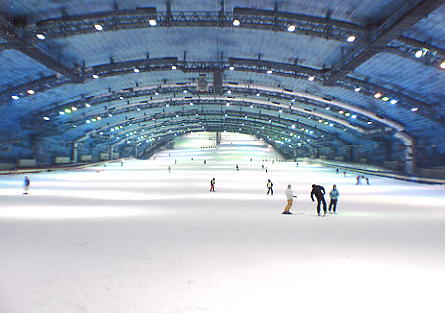
SSAWS (Spring, Summer, Autumn, Winter Skiing) Indoor Ski Dome outside Tokyo.

SSAWS (Spring, Summer, Autumn, Winter Skiing) Indoor Ski Dome outside Tokyo had three-hour day passes.

Throughout the industry, ticket-pricing models tend to follow the same ideas: Age, full day, half day, night, multi-day passes, 10 packs, etc. When it was in business, Lalaporte Ski Dome SSAWS, the indoor ski center outside of Tokyo, sold three-hour tickets. The monotony of the place made three-hours seem especially long.

We’ve just learned of an area not far from Chamonix that offers tickets based on the number of hours you choose to ski. Semnoz, is a short drive from Annecy, with a direct view of Mont Blanc. It is 5575′ above sea level, a midget compared to Mont Blanc’s 15,778′. Semnoz is a local’s place, which like Sundance, is reported to deliver endless untracked following big powder dumps.

We mention Semnoz because paying to ski by the hour is an idea that might deserve some attention here in the States.


Black Diamond Introduces New Online Film Series

Exploring The Call Of Mountains

BD TV will show you how the back country looks and the people who go there. Credit: BDTV

BD TV will show you how the back country looks and the people who go there.
Credit: BDTV

Black Diamond, the climbing, skiing, mountain sports equipment and apparel manufacturer, is introducing BD TV, a new online film series. According to the company, the series is “dedicated to sharing stories from the soul of climbing and backcountry skiing.” The first season covers ski mountaineers, avalanche forecasters and hometown heroes discussing lifelong goals, alpine starts, family traditions and building a life around the unending love for sliding on snow.

To preview the series and watch some amazing mountain scenes, click here.

Warren Miller Does It Again: Chasing Shadows

66th Ski Film Is Designed To Inspire For The Upcoming Season.

The view from the top of the world is pretty impressive in Warren Miller's new flick: Chasing Shadows Credit: Warren Miller Entertainment

The view from the top of the world is pretty impressive in Warren Miller’s new flick: Chasing Shadows
Credit: Warren Miller Entertainment

Warren Miller created the ski movie genre.  We remember the days when Warren’s movies included surfer music, sight gags and a narrator (was that Warren himself?) wise-cracking about how skiers would do almost anything to get on the mountain, including forgetting to mow their lawns (think Southern California).

Now, Warren Miller Entertainment produces a knock-out ski documentary/art/thrill film around this time every year; it has become the most predictable harbinger of the upcoming winter season.  “Chasing Shadows” is this year’s offering.  It will be playing around the country starting in late Sept.  The cast features athletes from basically corner of the sport. And the scenes of mountains around the world are stunning.

For information about where to view “Chasing Shadows”, click here.  Go and get inspired.  Check out the trailer below. Pretty impressive.

Athletes
Rob Kingwill – Seth Wescott – Chris Anthony – Rachael Burks – Sho Kashima – Hannah Kearney Jonny Moseley – K.C. Oakley – Dylan Walczyk – Caroline Gleich – Jeremy Jensen – Steven Nyman – Matt Philippi – Ian Provo – Neil Provo – Lexi duPont – Amie Engerbretson – McKenna Peterson – Øystein Aasheim – Marcus Caston – Kaylin Richardson – Espen Fadnes – JT Holmes – Ian McIntosh – Ingrid Backstrom – Sage Cattabriga-Alosa – Mark Abma – Rory Bushfield – Chris Benchetler – Pep Fujas – Eric Pollard

Destinations
Nepal – Colorado – Wyoming – Utah – Alaska – France – Chile – Italy – Japan – Switzerland


A Better Wine Bottle: Growlers

A Good Idea For Apres-Ski Tailgating.


750mL-fiftyfifty-vacuum-insulated-wine-growler

fifty-fifty wine growlers are perfect for picnics and parties. Be the one with the shiny Chardonnay. Credit: fifty-fifty

When we picnic or party, we usually carry glass wine bottles like most people do. Well, the people at fiftyfifty have come up with a better way to transport wine. It’s a double-wall, vacuum-insulated stainless steel bottle that keeps wine at the perfect temperature—all day long. What’s unusual about the container is its terrific style and its 750 mL capacity. You read that correctly. It’s the same volume as a bottle of wine, hence its name, Wine Growler. Available in tasty wine colors (Chardonnay Silver, Shiraz Red, Champaign Gold, etc.), Wine Growler starts the conversation going as soon as it makes an appearance. Ours has worked out more the past several months than I have. It will be part of the après ski kit this season when we tailgate at Alta and Snowbird. Come January, it will carry something warm. But as soon as those comfortable, sunny days enter the scene, it will be filled with something to be passed around in style. We won’t be the only ones carrying: at about $25 each (less online), they’ll be this year’s Holiday gift to family and friends. The company makes other high quality insulated stainless steel bottles, as well. fiftyfifty Wine Growlers.

Editor’s Note: This is not a paid ad nor a sponsored post.  It’s just Jon’s enthusiastic discovery of a cool product. Enjoy.

Skiing On Pluto?: Never Say Never

Perhaps One Of These Days.

Pluto: Just a rocket ship ride away. Credit: NASA

Pluto: Just a rocket ship ride away.
Credit: NASA

NASA spaceship New Horizon’s zoomed past Pluto in June. It’s the closest we’ve gotten to the dwarf planet. At 3,670,050,000 miles, Pluto is almost 40 times the distance from the Sun as Earth. This spectacular image shows a range of 11,000′ icy mountains. We don’t know if they might require very sharp edges to maneuver, but astronomers report that gravity on Pluto is about 1/12th that on of Earth. In skier terms, that means the slightest effort to jump a mogul and a very long distance before landing. If you were to figure out a way to get to our very distant neighbor, be sure to wear an extra base layer. Pluto’s surface is among the coldest in the solar system: about -375 degrees F (-225 degrees C). Be sure to pack a big lunch and don’t forget the oxygen.


Learn About Layering: It Will Be Cold

Some Lessons About How To Dress For Frigid.

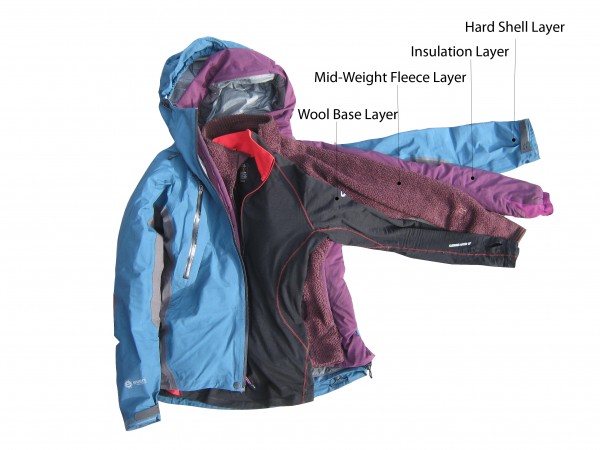
Four layer system for cold weather. Of course, there are pants. Credit: Outdoor Gear Lab

Four layer system for cold weather. Of course, there are pants.
Credit: Outdoor Gear Lab

Last February, we spent a wonderful long weekend in Quebec, visiting the lovely city’s Winter Carnavale and skiing at some fabulous ski resorts (Mte. Ste. Anne, Le Massif de Charlevoix) and dining in a little village of Baie-Saint-Paul.  Delightful.  If you  ever want a Euro-type ski experience close to home, Quebec is the place.  The only cloud was that on those days, it was thrillingly cold, ranging from around at least -20 F up to 0 F.  So we layered up.  We noticed that while we initially kept more or less warm, we soon found ourselves working up a mighty sweat under all those layers.  We had clearly over-dressed, and we paid for it by becoming uncomfortably chilly after a few runs.

So, we decided to learn about layering.  Sure, we know about “cotton kills” and “wet wool is warm” (thank you, Navy basic training), but we weren’t up on the newest thinking.  We consulted the following sources, and, after reviewing the advice from experts, realized we had made some mistakes in our enthusiasm for warmth.

How layering is supposed to work. Credit: BassMegeve

How layering is supposed to work.
Credit: BassMegeve

As you are well aware, it’s all about layers.  Consider this:

Base Layer–This is what used to be called long underwear.  The new performance materials are designed to manage your sweat level, wicking it away from your skin. Thin wool underwear is still a classic.  We all understand that the days of waffle weave are gone.  Check.

Mid Layer–Over your underwear, you will place a classic fleece, a thin wool sweater or one of those puffy, lightweight, squishable puffy jackets, depending on how cold it is and your activity.  The point here is insulation, that is, creating an air space that will create a barrier to cold air.

Insulating Layer–You thought the Mid Layer was insulating, you say?  Yes, if it is moderately cold.  When you get to cold, cold, you are going to need some more.  This could be a light-weight jacket (the squishy kind mentioned above), a fleece jacket or a perhaps a thin vest, depending.

Outer Shell–A “hard” Outer Shell is your wet protection.  A water-resistant top, like Gore-Tex, sheds moisture and keeps you dry while allowing the moisture inside to escape.  A “soft” Outer Shell is basically a wind jacket that can also serve as a rain/snow buffer in more moderate temperatures.

Head Gear and Accessories–You have to let your head breath. Most of your body temperature will exit through your head, so you have to let some of it out.  We all seem to get by with just wearing a helmet in moderate condictions,  When it goes really cold, a thin nylon skull cap underneath your helmet might make a lot of sense. You will need a neck-up gaiter, face mask or a Balacalva to protect your throat and face.

That said, where did we go wrong in our frosty day in Quebec?

  1. We had on too any layers.  Base, double insulating layers, vest, “hard” outer shell with down liner, which was yet another layer.
  2. We had too much head gear on.  Helmet, fleece skull cap, Balaclava, neck-up gaiter, scarf.
  3. We didn’t take the time to change or have dry replacement clothes to unlayer.

All lessons learned.  Ever happen to you?

Here are some links to expert advice about layering.

REI Expert Advice On Layering

Outdoor Gear Lab Layering How-Tos

EVO Dressing For Backcountry

Sierra Trading Post Layering Guide

Here’s a video from Sierra Trading Post you might find interesting.

Women Only Skis and Boards? Yes, Says Coalition Snow

Coalition Snow Fills Women’s Needs For Quality Equipment.

Coalition Snow has skis and boards for women only. Credit: Coalition Snow

Coalition Snow has skis and boards for women only.
Credit: Coalition Snow

Last spring, we’ve were impressed by Coalition Snow’s CEO Jen Gurecki when she talked with our friend The Ski Diva about her line of ski and boards for women only.  She recognized a niche market, defined a set of unique needs, and she put together products that are based on research. Now her challenge was getting the word out.

Last week, Jen won an entrepreneurial competition at the Nevada Governor’s Business Conference.  Her message was strong and simple:  There are a lot of women out there  (eight million) who spend a lot of money ($1-billion) on snow sports.  But their needs are not being met.  Instead of watered-down versions of men’s equipment, Jen has designed skis and boards “that don’t suck”.  She’s made a lot of progress in promoting her company since last spring; her Kick Starter campaign raised $31,000 in 31 days.

Check out her company’s elevator pitch.  Pretty sharp.  Makes us wonder:  We know there are senior-friendly ski boots and bindings.  Is there a need for senior-only skis and boards?  Your thoughts?

Let There Be Snow: Early Signs Of White

There Is Indeed Snow In Those Hills, And It Is Still Summer!

OpenSnow is forecasting snow in the Northwest. Credit: OpenSnow

OpenSnow is forecasting snow in the Northwest.
Credit: OpenSnow

Our very favorite meteorological, snow forecast website is OpenSnow.  If you haven’t visited them, please do: It provides clear explanations about what is happening in the atmosphere and provides snow depth information for most ski hills in North America.  Definitely worth a bookmark in your browser.

A recent posting was a round-up of snow falls in the Northwest.  It’s a dusting but, yes, snow in the summer.  Follow the link and you can peek at web cam images from a dozen or so resorts.  So far, so good.  Let’s see what happens as El Nino continues to heat up.

Lake Louise webcam reveals a dusting. More webcams can be found on OpenSnow.com Credit: OpenSnow

Lake Louise webcam reveals a dusting. More webcams can be found on OpenSnow.com
Credit: OpenSnow

Ted Ligety Flying Down Ohau In En-Zed

Here’s A Dose of Inspiration For The Coming Season.

This summer, the US Ski Team worked out in New Zealand where the skiing was great and the views were magnificent.  Here’s a short video of Ted making his famous elbow turns down Ohau, one of the mountains the visited.  If you’ve never been to New Zealand, consider it as a definite bucket list destination, summer or winter.  For outdoor-minded people, it is paradise.

My Fitness Journey Continues: Part Five

From High-Tech to Low-Tech, Great Gear For Getting Fit

The best fitness gear you can get requires no expense! It’s at the end of your legs: your own two feet. Walking (or jogging or running) as much as you can in any given week will burn calories and keep you cardiovascularly fit. Being on the move is considered one of the key factors in staying healthy and living longer (as well as enhancing one’s stability, litheness, and mind function).

The pioneering body device is Fitbit. Other devices have grown up around it. Credit: Fitbit

The pioneering body device is Fitbit. Other devices have grown up around it.
Credit: Fitbit

But in the digital, tech-centric world we all live in today, even our simple walking regimens can be enhanced by a bit of 21st-century gear, the most popular being Fitbit. The dandy little waterproof device straps on your wrist and keeps track of exactly how much you’re actually walking any given day. The basic device ($80 on Amazon) monitors the number of steps you take and lets you set personal goals you can track. It also monitors your sleep so you know how long and even how peacefully you’ve slept. For a bit more moolah, there are more sophisticated trackers available, like the Apple Watch,  that do such amazing things as alert you when you’ve been idle for a certain length of time, and track your heart rate, skin temperature, and blood oxygenation.


Can you do that? Weights are critical to seniors' fitness. Credit: GymRat

Can you do that? Weights are critical to seniors’ fitness.
Credit: GymRat

The most essential low-tech fitness gear for seniors? Without question, weights. Every official health organization recommends that seniors, whatever their age, incorporate regular strength training into their weekly regimen. In Part Two of this series, the UCSF medical director I was interviewing recommended I get a bone scan since I hadn’t had one since my 50s. The new scan showed that I had osteopenia, meaning lower-than-normal bone mass, now widely considered to be a natural aging process, and one that, in many instances, can be dealt with naturally without drugs. I was told to make sure I was getting enough calcium and to do regular weight-bearing activities. In addition to my weekly half-hour weight class, I now do a half-hour of weights two more times a week. Start out with a weight that’s comfortable (but not too!), then once your round of reps becomes too comfortable, go up a weight. I’m currently using three-pound weights, but I’m about to switch to my five-pound weights. You can find many different weight exercises for seniors online, so it’s easy to create your own program; just be sure you’re getting all the muscle groups.

An update on my own personal fitness journey: I continue to make slow yet steady progress to decrease my weight and measurements and increase my core strength, balance, cardiovascular capability, and stamina. I rarely miss any of my four weekly exercise classes (aerobics, stretching, and weights), which I’ve become a little addicted to. I see a marked improvement in my balance (I can grab an ankle and bring it up behind me for a quad stretch without teetering at all, but I still can’t do burpees, which the 78-year-old woman next to me does without batting an eyelash!). I’ve quit Weight Watcher’s, but I continue to keep a food diary and I’ve cut out some bad eating habits that I miss not at all (such as potato chips with sandwiches). I make it a point to say no to myself dietarily several times a day. When I started this fitness series on May 1st, I weighed 166 pounds; today I weighed in at 156 pounds. At this rate, it would take me another year to reach my target weight of 130 pounds, so I plan on making some major changes in my diet regimen in the coming three months. Stay tuned!

A Dietary P.S.—

How sweet it isn’t! I religiously check the nutrition facts on labels for the daily value percentages, but I didn’t even notice all these years that there is NO percentage listed for sugar until my daughter watched the excellent documentary, Fed Up, and informed me of this fact (thanks, sugar lobby!). I discovered that one Margarita accounts for my entire daily allowance! So if you’re interested in keeping track yourself, know that the American Heart Association recommends 37.5 grams of sugar per day for men and 25 grams per day for women (keep in mind that many unprocessed foods contain sugar naturally); also, before you sugar up, consider the harm sugar can do to aging teeth.

Check out this site if you’d like to know more about sugar and how much is good for you.

Editor Note:  We congratulate Rose Marie for her perseverance.  She has made progress and shared her lessons along the way.  Thank you, Rose Marie, we are all impressed by your commitment to self-improvement. Also note that mention of products was not paid for or supported in any way.

Sugarbush

Early Season Pass Special: Sugarbush

Some Ski Resorts Are Really Trying To Be Senior-Friendly.

One of the mantras of SeniorsSkiing.com is that it is a good thing for ski areas and resorts to be kind to seniors.  Not only do discounts, special activities and amenities bring more frequent senior visits, it also encourages them (us) to bring our families who are the next generation.

Sugarbush has lowered its senior age from 70 to 65. Thanks, guys.

Sugarbush has lowered its senior age from 70 to 65. Thanks, guys.

So, it is with great pleasure and satisfaction that we notice a ski area stepping out nicely in early-season efforts to be senior-friendly.  Sugarbush Resort, Warren, VT., has announced a mid-week, all-mountain, non-holiday pass for 65+ for $109 (until 9/16, then it’s $199, but still…).

In doing so, Sugarbush has LOWERED its senior age for discounted season tickets from 70 to 65.  Now that’s senior-friendly.  Thanks Sugarbush.

Incidentally, this is not an ad or a sponsored post.  We just like the way these people think.  What early-season senior discounts have you discovered?

Lunge Toward Ski Season: Start Now

You don’t need a gym. You can lunge around the neighborhood.

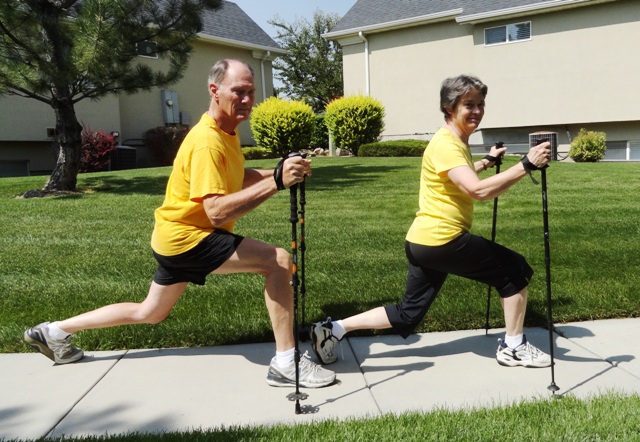
Nick and Carol Bowling are enthusiastic senior-age Alta skiers who enjoy staying fit year round. They just added lunges to their pre-season fitness routine, and they’ve become lunge junkies. But there’s a learning curve to doing lunges correctly, and they’re still working on it.

Carol and Nick Bowling of Washougal, Washington, tune up now for ski season. Credit: Harriet Wallis

Carol and Nick Bowling of Washougal, Washington, tune up now for ski season.
Credit: Harriet Wallis

“Lunges use your own body weight to strengthen your lower body. They’re excellent for your quads and hamstrings – for the big muscles,” says Jo Garuccio, Professional Ski Instructors of America Trainer and Examiner who also teaches at Snowbird. “But be sure your knee is over your shoestrings – not further forward.”

Equipment needed: Your body and a large mirror. Watch yourself. Critique yourself.

Position: Back erect, thigh parallel to the ground, knee over shoestrings.

Incentive: See how many you can do each day while keeping good form. When you’re good at the basic lunge, move on to one of the many variations.

What a lunge should look like:

So here’s a challenge for you. Watch the video, then study Carol and Nick’s position. Pretend you’re a coach. Is there something you’d tell them to improve as they lunge toward ski season?

When will you start to lunge?

A Skier’s Journey: Pushing The Envelope

A Senior Skier Reflects On The Thinking Part of The Sport.

Since I was five I’ve been on a voyage of self discovery through skiing that started at the ski areas of the Laurentian Mountains of Quebec, Canada and grew to be an integral part of my life the older I became. Initially learning to ski on riverbank in Winnipeg wasn’t the most auspicious start to any skier’s career but the passion for the sport of those around me left an indelible impression. Certainly I picked this up from my father, a local and eventually nationally recognised builder of the sport in Canada. It probably meant that skiing and not hockey would become the central sport of my life but I was under no pressure to do this. Instead I was attracted for its own merits to this activity that rewarded individual effort yet was always way more fun in the company of others. And then there was the connection with nature and the fact that skill wasn’t just about the size or sex of the participant. It appealed to me on an intellectual level too. The best skiers always seemed to me to be aware and afterwards reflective of what they were trying to accomplish yet in the moment of performance instinctively connected to the snow. They were and are my inspiration.

As I gained more experience it became obvious to me that I would want to pass this joy on to others so at the age of 14 I became an instructor. I also realised that one of the best ways to understand the sport that was rewarding in so many ways was to never stop trying to learn yourself. In 1986 a close friend invited me to enter the sport from a different angle and coach. Along the way I made a career in the retail sporting goods field and still strive to learn everything I can about the impact of equipment on performance as a professional boot fitter, technician and ski shop manager since 1974. All of which led to jumping off points in my life which I was completely oblivious to at the time. It was never just the destination but the journey that with hind sight mattered most. Like having a great run where sometimes a moment of reflection at the end when you realise what you just accomplished. Now I’m not saying that skiing is somehow always a metaphor for life but it was for me.

So here I am 55 years later from that little boy in Montreal and still learning and pushing the envelope. It’s a fascinating period of time in the evolution of the sport for any of us that have experienced the full range of changes in the last 60 years. Thanks to this website for allowing me to share some of the ride.

Contributor Glenn Allen is an “employee athlete” at Sport Chek, Canada’s largest retail chain of sports equipment.  Thanks for letting us use the video clip.

Happy 90th Junior Bounous!

Still Doing Pow And Inspiring The Rest of Us

As Junior Bounous celebrates his ninth decade, we salute his love of the sport and his motivation.  His message to the rest of us is simple: “Keep moving!”  Check.  Thanks, Junior and have a great birthday.

Here’s a short documentary produced by Snowbird that chronicles Junior’s trip down the Pipeline at age 80.

Credit: Snowbird Resort

Winter 2015-16 Forecast Update: El Nino Rises

This Just In: The Sea Surface Temperature Off Ecuador Exceeds Records.

In its August update, NOAA’s National Weather Service reports this year’s El Nino is roaring along to record highs. NWS predicts that sea surface temperatures in the eastern Pacific will peak in the late fall/early winter near or exceeding 2 degrees C/ 3.2 degrees F above normal.  “If this forecast comes true, it will place the 2015 event among the strongest El Niños in the (admittedly short) 1950-2015 historical record.

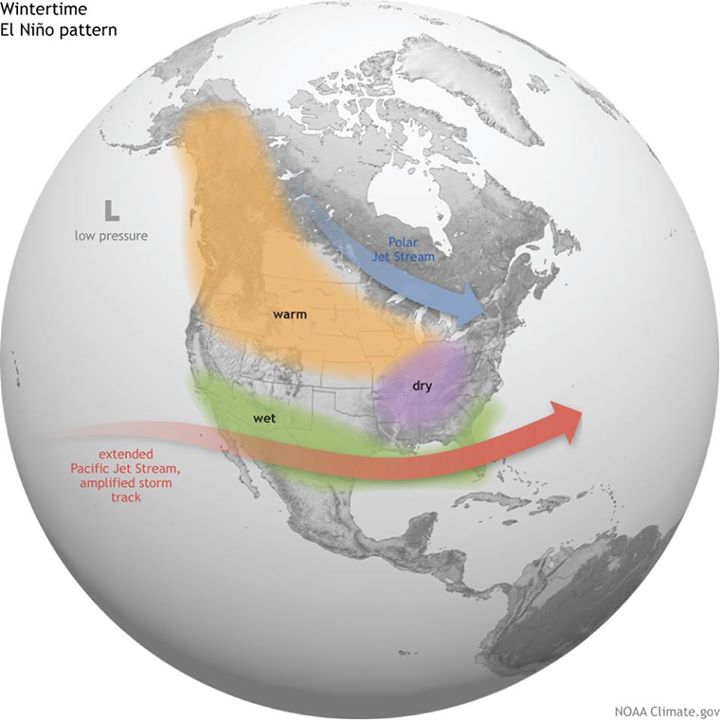
What this means is that forecasters can be assured the odds are growing that El Nino will play a role in various parts of the US as far as winter climate is concerned. As we reported earlier, a strong El Nino event brings wet and cool winter from the West Coast across the lower half of the US,  drier and warmer in the Northern Rockies, Ohio Valley, Great Lakes and Northeast.

Winter forecast 2015-16 shows how the jet stream funnels warm air across the southern US. Credit: NOAA/NWS

Winter forecast 2015-16 shows how the jet stream funnels warm air across the southern US.
Credit: NOAA/NWS

So, we will most likely have a very different winter than we had last year, especially in the northeast where the snow depth and temperature will not come close to the near-Armageddon experience of last season.

To brush up on El Nino meteorology basics, click here. 


Adding Life To Your Years With A Better Grip

Who Knew Grip Strength Was A Diagnostic Measure of Aging?

Over the past few ski seasons, I’ve noticed times when my wrists are weak, especially when rocking my poles. Arthritis? Age? Don’t know. A few days off slope or wearing an elastic wristband, and it goes away.

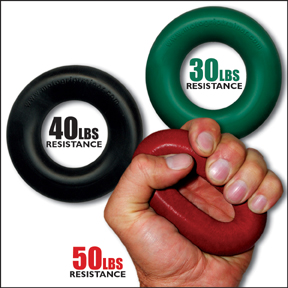
Three different bagels can help you strengthen your grip. Credit: GripProTrainer

Three different bagels can help you strengthen your grip.
Credit: GripProTrainer

Now I’m trying another approach. I have a little exercise device that looks like a rubber bagel, and you squeeze it as part of a grip-improving, hand and forearm workout. It comes in three colors, each calibrated to different strength abilities. I’ve started with green, which gives 30 pounds of resistance. The product website says it’s for “lighter weight people,” which is hardly my profile. But for now it’s enough. Black has 40 pounds resistance and red, 50 pounds. I doubt I’ll graduate beyond green.

But something about it feels very good. It’s compact, portable, and in a design/function way has a simple elegance. I’ve started to pick it up and use it unconsciously.

Studies suggest that grip strength is related to aging. An interview with one researcher published in The New York Times states “…an adult’s hand grip can distinguish different rates of aging in people with different levels of education.”

Some people use a tennis ball or one of those spring-loaded devices, but based on my experience, the green rubber bagel feels good and keeps me going back for more. It’s called the GripPro Trainer. Online, they’re $7.95 each or $19.95 for all three.

It’s too early to know if using it will help my skier’s wrist. I’ll figure that out during the season. But if you golf, fish, water ski, play tennis, or engage in any activity where grip strength is an issue, it’s worth looking into. Who knows? Maybe it will add years to your life…and life to your years.

More Hot Products From SLC’s Outdoor Retailers Show

Gee Whiz, Seniors, Here’s What’s Coming to a Store Near You!!

Shoes whose laces tighten without your needing to bend down to tie them.

Wireless heating insoles controlled with a smart phone app.

A small device that communicates your whereabouts and whether or not you need help when there’s no cell service— nywhere on the globe.

These are just a few of an endless array of products exhibited at the summer edition of the semi-annual Outdoor Retailers Show in Salt Lake City.

Every August, thousands of manufacturers and merchants—from mom and pop to big box—converge on the Salt Palace Convention Center in Salt Lake City to see and place orders for products to be sold a year from now. They return in January, this time focusing on winter sports.

Exhibitors are organized by product category. Paddle board, surf boards, water accessories, etc. in one section. Footwear, socks, foot beds, etc. in another. Yoga equipment here; camping gear there.

handsfree_heel_wheel

Treksta’s hands free lacing system works by sliding the heel back for lace up. Credit: Treksta

Back to those self tying shoes. You can look for them under the name Treksta Hands Free Shoes. It’s an athletic shoe (quite comfortable) with a foot-activated lacing system. Even the most active person will enjoy not having to bend down to tie or tighten shoe laces.

Digisole is a French import that will be in stores in a year. A programmable, heatable insole for ski and other cold weather boots, the insoles can reach 120 degrees F, a bit too toasty for most tootsies. The great thing about Digisoles is that they’re fully adjustable using an app on your Smartphone. Same phone app tells you how many steps that day, what the weather is, etc., etc. The soles are charged via USB connection, and, for most heat levels and in most conditions, will keep your feet comfy for 5-8 hours. Can’t wait to try it on the hill.

SPOT Gen3 will find you almost anywhere on the globe. Credit: SPOT GlobalStar

SPOT Gen3 will find you almost anywhere on the globe.
Credit: SPOT GlobalStar

Spot is a reasonably priced, pocket-sized, personal tracking device that, with the push of a button, lets family and friends know you’re ok or sends emergency responders your GPS location. It’s all about providing you and loved ones peace of mind when you’re out of cell range. Using satellite technology, it works from land, air and sea, anywhere on the globe. The unit, itself, can be purchased for about $75, and the satellite subscription is about $150 per year. A small price to pay for peace of mind. It’s a valuable and necessary addition to every pack or parka.

Outdoor Retailers Show: Harriet’s Three Hot Product Picks

It’s Like Christmas In August.

Outdoor Retailers Show in Salt Lake is the largest outdoor sports show of its kind. Credit: Harriet Wallis

Outdoor Retailers Show in Salt Lake is the largest outdoor sports show of its kind.
Credit: Harriet Wallis

The annual Outdoor Retailers Show is going on in Salt Lake City right now (August 5-8), and it showcases gear for all outdoor enthusiasts. It’s a sneak peek at brand new innovative products as well a upgrades in existing products.

The massive trade show has more than 1,500 exhibitors from around the world. Some exhibitors are well known outdoor recreation companies while others are little companies that strut a single creative product. The show brings buyers together with the sellers and it sets the stage for what you’ll soon see in your favorite recreation store.

I attended the show for SeniorsSkiing.com to search for products that would appeal to our readers. I walked miles to see the show takes up every square inch of the Salt Palace, the city’s convention center, and then it spills outside into three, block-long tents.

Here are my top picks:

Harriet's Pick #1: Addaday Rollers. Credit: Harriet Wallis

Harriet’s Pick #1: Addaday Rollers.
Credit: Harriet Wallis

Addaday rollers for soothing sore muscles. Apply a lot or a little pressure on what hurts. It’s less bulky than traditional foam rollers so you can pack it in your suitcase and take it with you on vacation. www.addaday.com

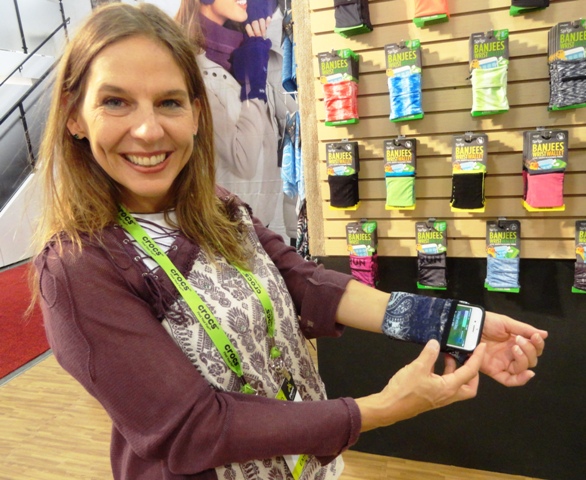
Harriet's Pick #2: Spriggs Wrist Wallet Credit: Harriet Wallis

Harriet’s Pick #2: Sprigs Wrist Wallet
Credit: Harriet Wallis

Sprigs wrist wallet is a comfy cuff that’s safer than your coat pocket. Each wrist wallet has a hidden pocket, a zipper pocket and room for your cell phone too. Stash all your important items — credit card, money, room key and phone – and you’ll always have them with you. Lightweight and lots of patterns. “I invented it in 2004 after my sister came back from a trip to Morocco and said there were lots of thieves,” said Sprigs owner Valerie Ciptak Vierra. www.sprigs.com  

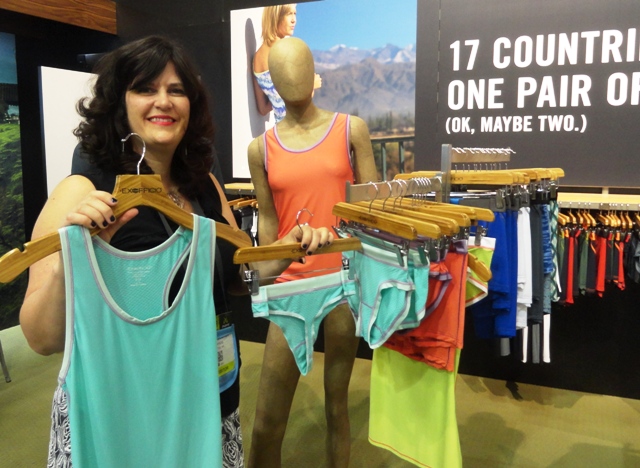
Harriet's Pick #3: ExOfficio undwear Credit: Harriet Wallis

Harriet’s Pick #3: ExOfficio sports underwear
Credit: Harriet Wallis

ExOfficio Give-N-Go Sports Mesh underwear. ExOfficio is already known for it’s lightweight, breathable, quick wicking and quick drying fabrics that are perfect for travel. It’s women’s underwear line now includes the extra-breathable diamond weave sports mesh fabric that will breathe beneath your base layer. Next year, look for the boy shorts style and the fancier lace collection. There are new styles for men too. www.exofficio.com.


Rediscovering John Jerome: Looking Closely At Everyday Things

Leafing Through An Old Magazine Reminds Us Of A Great Writer

Back in the early 70s, as assistant editor at SKIING Magazine, then located at One Park Avenue in New York, we would occasionally watch a typescript from John Jerome arrive in the mail and work its way through the editorial process. After reading a couple of paragraphs, it became clear that these words were not the usual ski article patter. John was a skilled observer, first requirement of an essayist extraordinaire, and was able to tell stories and administer advice about simple things in a way that revealed a writer was at work.

CarSkier


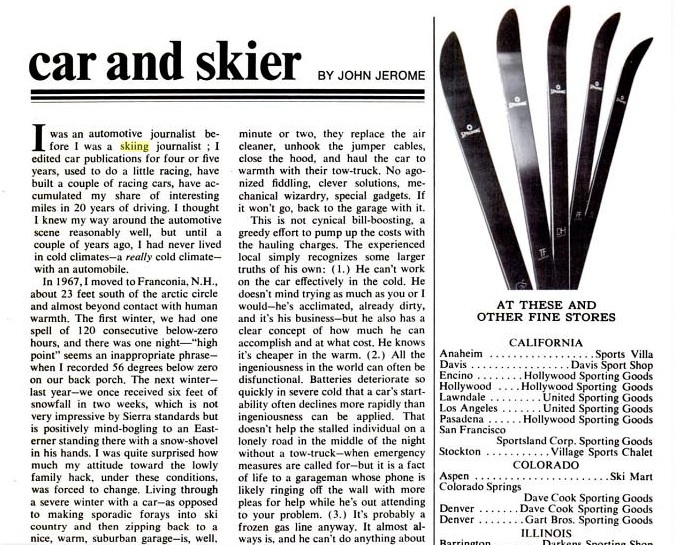
John Jerome was a polymath; he started in automotive journalism (he was editor at Car and Driver), became a skiing savant (he was editor at SKIING), re-located from the “city, working for magazines, wrestling with words and paper in tall buildings under fluorescent lights” to New England. There, as a freelance, he wrote books and many articles about running, building stone walls, becoming an aging athlete, mountains, the value of stretching, and, yes, skiing. And the halo of subjects around skiing, like cars and winter. Here’s an excerpt we just re-discovered by glancing through a November, 1969, SKIING article, “Car and Skier”. He’s talking about one of the two main problems of winter driving he learned by living in cold-winter New Hampshire, getting unstuck:

“Getting unstuck, or not getting stuck, is a much more diffuse problem, against which logical, ordered stops are not so effective. I hate and despise snow tires, but I put ‘em on, and they saved me a lot of grief. My prejudice was based on their noisiness and feel at highway speeds; what I didn’t realize is that a large part of the process of not getting stuck is a kind of metaphorical shifting of gears that takes place when you are a severe-winter resident. You simply slow down. When winter closes in, you bank your metabolism and your frustrations, and settle down into a calm and bumping 25-mile-per hour way of life. It does wonders for keeping you out of snow banks, and it also overcomes a lot of prejudices about snow tires. You can spot winter tourists by how fast they drive more quickly than by their plates. So can the cops.”

The first problem of winter driving, if you’re wondering, is getting started.  Solution: Bring car battery into house at night.

JohnJerome

John Jerome, prolific writer, observer, athlete, contemplator of things.

Good writers see connections between things in the world that others either don’t see, or don’t see until the writer points them out. John Jerome was good at that. Here—in this excerpt from his book Stone Work— he makes a link between the rhythm of placing stones on a wall and making linked turns in skiing. On finishing the placement of a stone—the last step of the cycle: start, the move, the finish—he says:

“Sometimes, there is more difficulty in finishing moves than in starting them. I first ran across this principle in downhill skiing, where great instructional emphasis is placed on completing one turn in order to get the next one started right. This didn’t make a whole lot of sense to me: you have to stop turning in one direction if you’re going to start turning in the other, don’t you? I flailed and flummoxed my way through a lot of awkward moments before the significance of the advice sank in. Finishing is a positive act. A ski turn carried to its logical physical conclusion ends with an edge-set that make a stable platform from which to start the next turn. ‘Finished’ means your weight is in the right place, your body and skis prepared for whatever comes next. Without it, you’re in trouble. You have no ‘timing’.’

John Jerome was contemplative writer who wrote in a way that made you feel you were talking with a very interesting friend over a very good drink.

His books are still available on Amazon.com. Have you read Truck, Staying With It, or Staying Supple?

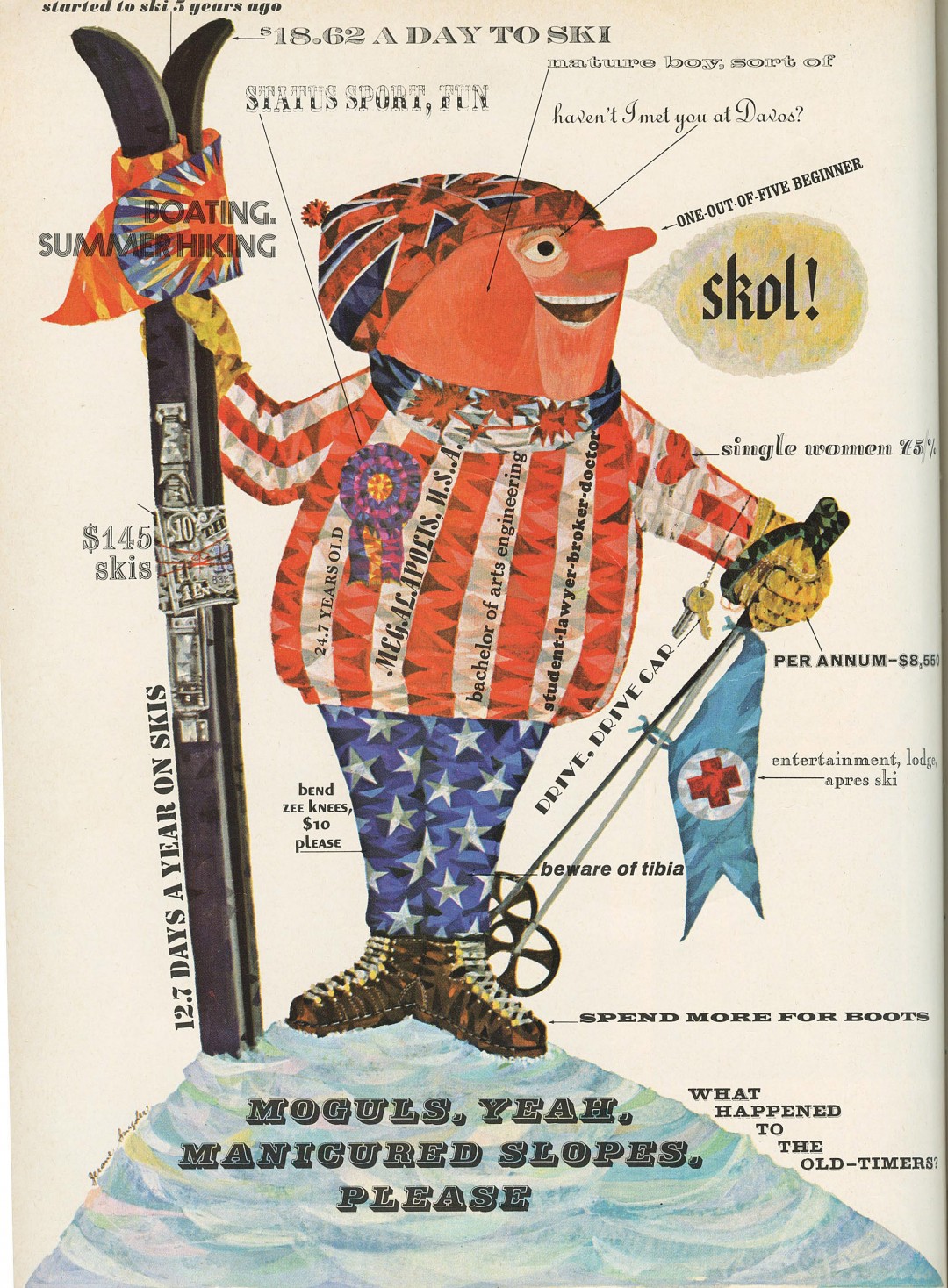
1964: Was It Really So Simple Back Then?

From a 1964 SKI magazine, a skier poses with his attitude. Illustrator: Jerome Snyder

From a 1964 SKI magazine, a skier poses with his attitude.
Illustrator: Jerome Snyder