Tag Archive for: ski instruction

“Intermediate Breakthrough – IB” at Alta, Utah

Hello readers, super great comments and questions on my “Secrets for Your Best Ski Season Ever” piece.  Also spoke with two readers in follow up.  I can sense everyone’s excited for this ski season – me too.  Shoot me your thoughts or questions and I’ll reply.

Alta’s Intermediate Breakthrough program help people go from blues to blacks

Previously I mentioned my good friend (60+) who improved bigtime from only four group lessons at Alta, UT last March.  Result: his skiing improved from confident “blue” skier to eager “black” skier.  In just four lessons.  So let’s dig in to what Alta’s program looks like and why it works.

And it’s worth doing even if you’re NOT going to visit Alta.  Here’s why: it’s a great template for asking the right questions of any ski school or instructor.  As a ski instructor, I LOVE when any skier in a group or private lesson tells me what they want to be able to do better/different.

Source: Alta

Now, back to Alta’s “Intermediate Breakthrough” group lessons.  Curious, I reached out to both Alta’s Ski School Director, and to the instructor who led the program my friend had found so helpful.  A few key observations:

  1. They seek decent “blue run” skiers who want to improve.
  2. They want skiers who will put some thought into their skiing, actively thinking of improvements they’d like to make.
  3. And, they want skiers to go out and practice the improvements a lot, and talk about what they’re seeing and feeling in their skiing.

I spoke with both Jonathan Doty, the on-snow instructor who led the Intermediate Breakthrough (IB) program, and with Jeremy Moore, Alta Ski School Director, who helped design it.  IB consists of one half-day group lesson per week for four consecutive weeks; a total of four group lessons. Talk to your ski buddies and try to pull together 3-4 who could join the lesson; next, talk to ski school and try to schedule a half-day morning lesson for four consecutive Sundays with same instructor.Many Sundays are QUIET at ski schools, so you may have better luck creating a special deal.

Jeremy insisted “the IB program is well-suited for anyone who’s skiing at least easy blue groomed terrain comfortably, and also is willing to put some time and energy into thinking about and hopefully improving their skiing”.

Source: Alta

Best preparation?  Here’s Jeremy again, “You don’t have to prepare in any specific way. However, it would potentially help improve your overall experience if you took some time to think and feel your skiing and come up with some concepts of what you like or don’t like about your skiing so you have a baseline to start from with your coach.”

From my friend, I learned that the IB format focuses on several “themes”, specifically one per week.  I asked Jeremy to unpack this a bit for me.  Jeremy: “The Alf Engen Ski School at Alta is a skills-based ski school, and we help students understand the How/What/Why they are doing with their skis.”  He added, “There are only 3 things you can do to your skis: rotate them, pressure them, or tip them on and off their edges”.  Sounds like a little, but it’s a lot!

Jonathan expanded on the “theme” focus: “We want skiers to succeed not only with us but on their own.  Each week we focus on a specific task they can practice outside of IB lessons, and a theme creates a flow to the lesson where the skills build on each other.”

As an instructor mostly doing private lessons, I know many people are concerned about “being judged” by others, particularly their friends.  Jonathan insisted: “This is a common thought, but everyone is putting themselves out there, and are on a personal journey.  This is a judgment-free zone!”

Like I wrote last time, whenever we improve our skiing proficiency…we have more fun!  Try to create this program at your favorite ski area…or just go to Alta.
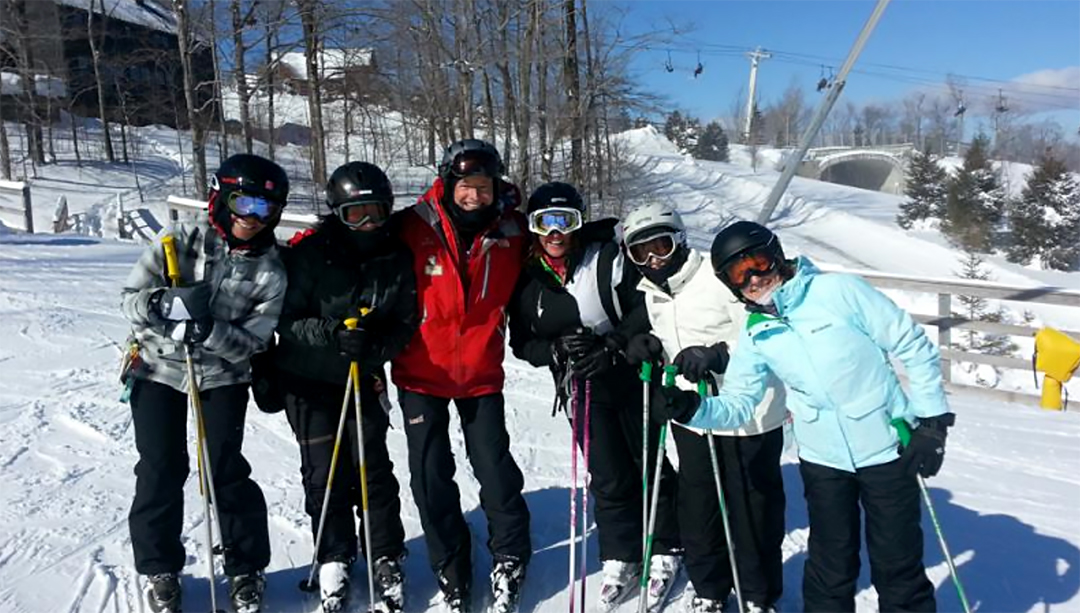
Ski class

Secrets for Your Best Ski Season Ever

Over 11 seasons I’ve probably taught 500-600 kids and adults as a part-time instructor at Stratton/VT & Butternut/MA. “Never-evers”, experts, 4-yr olds to 80-yr olds. Me: flipping through trail names like a deck of cards, choosing the best run for the task at hand and my eager, anxious learner. 

Here’s the huge thing I’ve learned:

Anyone can become a better skier, if the skier has both a desire and determination to improve…simply by taking a few ski lessons at the outset of ski season.  

Why at the beginning?  

Because each season, starting out, we’re all squirming and thinking, trying to put our skiing back together again.  So instead of once again reinforcing some of the “bad” habits carried over from last season, you can trade them for one or two new/better ideas that will help you ski with more skill.  

But wait, there’s more: any improvement in your skiing proficiency ALWAYS leads to enjoying skiing more!  (Shoot me your questions at the end and I’ll reply.)

As an instructor, I’m lucky.  In early December we do OUR training.  We take refresher lessons with the best instructor “trainers” at our resorts.  We’re brushing up on our skills.  It helps me a lot.  But it took me a while to accept the fact I still needed to be in “learning” mode.  

This season try this… either by yourself or with a friend who’s at a similar ability level.  Sign up for a private lesson of 2-3 hours on your second day of the season. On the first day, ski around and get a feeling for what’s working and… what’s not.  Think about what you’d like to change, what’s confusing or difficult, what you’d like to ask questions about, then write it down.  Now you’re ready for that lesson on Day 2.  Because now you’re engaged in being an “active learner”. Real progress as a skier doesn’t just “happen” to you.  It comes as a result of efforts you make to change what’s not working, in favor of more useful approaches.

I witnessed this approach in action, in Utah, last March.  One of my best friends, with whom I’ve skied for 40 years, took a short program of four group lessons at Alta.  Called “Intermediate Breakthrough” it seeks skiers who truly desire improvement.  My friend wanted to improve, and was ready to do what it took.  He explained what he wanted from the lessons, and he worked hard to use the skill tips offered by his instructor.

And he not only improved…he made a quantum leap in his overall skiing proficiency, and in his ability to ski more challenging terrain while enjoying it.  It was remarkable to see, and it was the result of only four lessons, but four lessons in which both student and instructor were invested in producing real results.  Alta’s “Intermediate Breakthrough” is awesome.

Believe me, you can do it too… It’s totally worth it.

Ski class

A Brief History Of Skiing “Style”

Author’s Note : I owe much of the following to a close personal friend. This is wholly my interpretation of his observations, it does not necessarily reflect or deny his views.

In France

In the 1940s/50s France and Austria began competing for increasing skiing tourism. The rivalry was both commercial and political. Each wanted a national “product,” supposedly better than their competitor, that they could differentiate and sell.

At that time, the French believed they had the answer to the question, “What to teach?” They needed a product that trainee ski instructors could be trained to deliver in ski schools.

JCK embodies the French style in 70s Head ad.

Remember that the instructor training systems were nationalized. The Ecole de Ski Francais was a government monopoly. Its name is frequently mistranslated into English, as the “French Ski School” but that is not what it means: it means the School of French Skiing. A product.

They offered the “Rotational Method” which they claimed exemplified the physics involved. What you were to do was to slightly crouch as the “turn” approached, then extend the legs rapidly to unweight the skis, and at the same time rotate your torso in the direction you wanted your skis to go.

This transferred the angular momentum (the twist if you like) of your “upper body” toward the impending new direction, down to the legs and skis. From a physics viewpoint that was “Transference of momentum from part to whole” , your body can only twist so far before it imparts that twist to your legs via your pelvis.

Some of SeniorsSkiing’s respondents to my earlier contributions insisted on this being “the way to ski” and were critical of my introduction of the concept of “arcs” instead of “turns”. Which does not reflect badly on them, but it does illustrate the power of inertia and how susceptible we are to Confirmation Bias.

In Austria

At the time, a leading figure in the Austrian National Ski Instruction System was Prof. Stefan Kruchenhauser. He had been studying, photographing, and filming Austrian racers as they went through the racing gates.

Unlike the French, he observed that as they approached the gate po they turned their shoulders away from the intended “turn” and had their back toward it as the direction change occurred.

Kruckenhauser was a ski photographer as well as a pioneer of the Austrian technique. This photo is by him.

Other writers picked up on this supposedly “New Austrian Technique”, explaining it via Newton’s 3rd Law of Motion (every action has an equal and opposite reaction). It became known as the Counter Rotational Method, conveniently providing a different “product” to that of the French, and endless column inches to the magazine writers.

Because both were governmental, political projects, they each quickly developed their own followers in the ski schools, and woe betide anyone who thought any different. Austrian instructors, attempting to find analogies to help their pupils, began teaching “point your skis across the mountain, and your chest down to the valley.”

In fact, the Austrian racers were not employing Newton’s 3rd Law, they were simply trying to avoid whacking their shoulders into the slalom poles which back then were tree branches cut off the pine trees and bedded very firmly in the snow. Had the good professor filmed his skiers changing direction when not racing round sticks in the ground he would have found they did not “counter rotate”. Be careful what you think you see!

The Austrian concept was exported comprehensively to the USA because Austria provided back then a great many instructors to the newly expanding American ski school industry. The system satisfied ordinary recreational skiers, if it’s making money why change it?

Prof. Georges Joubert.

In late 1960’s early 70’s, Prof Joubert of Grenoble University stood both the French and Austrian instructing methods on their heads. Note that it is academics who are making the discoveries not the ski schools, which simply followed the “official line”, and pretty much did so until their monopolies were broken. Monopolies are not innovators and not good learners.

Still sought after book by French team coach Georges Joubert

What Joubert proved was that racers ski with Independent Leg Action. Racers never skied with their legs together. The legs do NOT act as a single unit. Each rotates independently in its hip socket unless the feet and legs are jammed together, which inhibits such free movement and necessitates throwing your torso about one way or the other.

What this means, and it is very significant indeed, is that the “upper” body is not defined at the waist; it is defined in the pelvis. The leg rotation can be either active or passive, but it happens in the hip socket. There is therefore no need for either the Rotational nor the Counter-Rotational concepts which were not based in physics after all.

To his credit, Prof. Kruchenhauser was one of the first to recognize and adopt this new realization that all that is required is effective balancing (not “balance” which is different and static), accompanied by independent leg rotation with accompanying leg flexion and extension. He called it “Beinspiel” or “leg play”.

Those earlier concepts still facilitate getting folk down skiing pistes, but not in a way that can can now be classified as skillfully. It either matters to you, or it doesn’t. Shakespeare observed “nothing matters, but thinking makes it so”.

It is regrettable that even after 50 years much of the ski school industry has not recognized either the change, or its significance. Though of course, a few have.

[For more thoughts and videos on ski technique, as well as links to Bob’s books, visit https://www.bobski.com/]

Take A Lesson And Improve 25 Percent?

That’s the simple question, would you like to improve your skiing and enjoy it more?

[Please consider supporting SeniorsSkiing.com with a donation. We appreciate your help. Click here.]

When was the last time you took a lesson? Perhaps a mid-season lesson might boost your skill. Credit: Breckenridge

Would you love skiing as much if you were a wedge skier?  Probably not.  What about a pretty good parallel skier, but anxious on the more challenging black diamond runs?  Maybe you’d avoid them, stick to the corduroy and feel great.

My point is this: The more skilled we are, the more we love our skiing days!  It’s that simple.  And when I began as a part time ski instructor in VT eleven years ago (my kids had moved west, and so had my ex-wife), I got myself hired at Stratton.  First thing I learned while doing “clinics” with the best instructors: There was a lot to learn about technique that I DID NOT KNOW.  I thought all my expert skills learned in the 1960s-1970s were enough.

Wrong.  Skiing techniques have changed, because ski design has massively morphed.  Back in the day, longer skis meant you were a better skier.  Today, not so much.  And ski shape has changed dramatically: One shape for all-mountain, and something very different when you’re going into the deep pow.

Here’s what I see the most among my own “senior” skiing friends, and those I teach:

1. Many skiers forget about the importance of maintaining the “athletic stance” on skis, but it’s so important because it’s what brings us forward into our boots, and gets us over our skis for maximum edging and  balance effectiveness.

2. Skiers like to look straight ahead over their ski tips, when much of the time they should be facing more downhill than their skis, such twisting thus keeping the hip into the hill and edges carving.  This is where the saying “move the skis more than the jacket” comes from.

3. Skiers get lazy and stand up too straight and tall, and by doing so, lose control and confidence on more challenging terrain.

These are all little things that can easily be fixed, but it’s easier to “show” the error to skiers and then have them fix it in their own skiing than to simply “tell” them to do it without any demonstration of what’s being done incorrectly.  And with some focus and concentration, any skier can correct these bad habits and see/feel their improvement so quickly,

So what if you could instantly take a step up to a higher level of skiing with one or two short private or semi-private lessons?  Remember the way we used to hop at the moment of turning in order to cause the weight change from one downhill ski to the other?  We don’t do that with today’s skis, because the skis are much more effective, and they have the ability to be moved from one edge to the other almost magically with subtle movement. All it takes is a little new knowledge.  It’s called carving, and it works.  But even as an instructor, I thought I didn’t need it.  Now that I’ve got it worked into my skill set, I would never get rid of it.

And don’t you hate it when you get to a run (usually a black diamond), and you don’t feel confident enough to turn your skis downhill on that run?  A single lesson or two at the beginning or middle of the season could set you on a glorious path of improvement enabling you to ski previously daunting black diamond runs you’d avoid.  Or enjoy them much more!

Let’s face it, we’re not getting younger, but as Mike’s recent piece pointed out, getting more skilled and proficient at the sport we love is just one more way of “keeping the old man away” (or “old lady”), so we can still feel young plunging down the trails we love. And there’s nothing like improvement to make us feel younger.

When you think about all the money you’ve spent (and still spend) on ski clothing and equipment, don’t you owe it to yourself to spend just a fraction on actually getting better?

One lesson each season, that’s all it takes. Just find a great instructor. I’ll tell you more about doing that in another column.

Group or private, a lesson opens new capabilities. Credit: Vail Resorts

Question For You: How Did You Learn?

Did How You Learn Help Or Hinder Your Current Technique?

Hannes Schneider brought Austrian “technique” to the US in early 30s.

I remember taking couple of lessons when I started skiing in the mid-60s. Lessons were based on the snow-plow, stem christie, christie school.  Very Austrian. It served me well over the years I skied up to the time my Alpine career went on hiatus.

When I came back to skiing about 15 years ago with new short skis, new boots, I was trapped in the world of my early technique: still stem christies from time to time, narrow stance a la Stein Ericksen, actually trying to “wedlen” under the lifts. Boy, that didn’t seem to work. And actually still gets in the way.

So I took a lesson and tried to adapt. Better but not easy; old habits die hard.

Which leads us to our question for you this week:

What ski school method was used when you learned to ski? Or did you even take a lesson? How has your “Ur-technique”—the fundamentals from decades ago—impact how you ski today? Help? Hinder? What did you have to unlearn? How did you do that?

Please let us know what your experience has been. Make a comment in Leave A Reply in the box below.

Ski School, Austria, 1930s.


Instructional Advice: Slow Start, Good Turns

Easy Does It And Find The Rhythm.

If you look at Henrik Kristoffersen here in the blue Norwegian National Team uniform doing slow turns, you will see the value of mechanics at a basic level.   

The important thing that I realized in watching Kristoffersen executing basic turn maneuvers at a very slow pace is that we all can work on basics at this speed.  It is important from time to time to practice the basics like this on gentle terrain. 

Another thing about turn speed is that it is a good idea to start each run with a slow series of turns.  When you start out too fast, and the terrain becomes more difficult, the turns are compromised.  It is better to start out slowly and make a series of good turns, then you can develop a rhythm which will take you smoothly through the run and not end up hitting the brakes to find your rhythm. 

Good smooth carved turns are executed when one starts out a run with deliberate slow turns.   Oftentimes I ski behind my wife and have her start out slowly.  I tell her to concentrate on the uphill edge which will become the downhill edge.   I call out the appropriate edge and she makes nice rounded turns with edge pressure control throughout the radius of her turns.  Try it sometime with someone  whom you are trying to move to the next level. 

Should You Teach Your Munchkins To Ski?

[Editor Note: From time to time, SeniorsSkiing.com re-publishes an article from its archive.  Here’s one from Harriet Wallis about teaching your grandkids to ski from way back in 2014. Comments welcome.]

Five Non-Obvious Tips For Making Learning Fun For All.

Because you love to ski or ride, you probably hope that your grandkids will also share your passion for the snow.  Here are some ideas to get things off to a good start if you plan to teach them yourself.

How about those smiles? Credit: Harriet Wallis

How about those smiles?
Credit: Harriet Wallis

Look for deals. Some resorts offer free or low cost tickets for youngsters. A cheapo ticket can take the financial pressure off you, especially if the day’s weather is iffy, or if your grandkids are in town only for a short, gotta-teach-them-to-ski-right-now visit.

Start on flat ground. “A child will not miraculously assume a balanced stance on the beginner hill,” says Jo Garuccio, a Snowbird, UT, instructor and PSIA trainer and examiner. “Children should have some prerequisite sliding time at the bottom of the slope.

“It’s imperative that the child stand and slide independently on a flat surface before giving the child a downhill experience,” she says. “Initially, the terrain should be flat enough so that the child can go straight, lose momentum and stop.”

My friend Larry Green did just that with his granddaughter. He gave little Yoella her first sliding experience on virtually flat snow. “She loved it, and she egged me to pull her up that slight slope again—and again— and again—so that she could slide down. I even used my old snow skates to make it easy for me to maneuver with her. But I’m exhausted,” he said. “That three-year-old totally wore me out!”

Cool kids. Pediatric journals say that children heat and cool differently than adults.  Their bodies cool off faster than adults because they have proportionately more outer skin surface in relation to their body size.  So even though you have them bundled up—and you might be comfy—when kids say they’re cold, it’s time for a hot cocoa in the lodge.

Edgie-Wedgie keeps ski tips from wandering Credit: Amazon

Edgie-Wedgie keeps ski tips from wandering
Credit: Amazon

Gizmos. The snow sports industry offers a variety of devices such as harnesses, leashes and Edgie Wedgie tip clamps. “But aids are not a substitute for skill,” says Garrucio. “Don’t take your child on to high level terrain with tip clamps or leashes. Stay on easy green or very light blue slopes.”

Stifle your own expectations. Be sure to make it fun for the kids, says Mary Whittke, retired ski school director of Brighton Resort, UT. Even if your grandchild is super coordinated and athletic, put your own expectations aside. Kids don’t instantly morph into Olympic champions just because you love the sport. Give them little tips, but back off from the overkill of teaching, teaching, teaching. Help them have fun on the snow.

There’s a warning that comes with teaching your grandkids to ski or ride. Kids catch on and progress so rapidly that they’ll ski and ride compatibly with you for only 15 minutes of their lives. After that, they leave you behind. But maybe that’s okay.

Would you teach your grandkids to ski or ride?  What’s your advice?

Should I Take An Early Season Lesson?

[Editor Note: From time to time, we’re going to dip into our extensive archives for a story that might be useful, interesting, or entertaining.  Here’s one from 2014 from correspondent Harriet Wallis.]

Starting right sticks all season.

My friend says the same thing every winter. She says wants to take a lesson as soon as there’s more snow on the ground or when she has more ski days under her belt.

That’s been going on for as long as I’ve known her, and she still hasn’t taken a lesson.

If you’ve ever said that, you’re not alone. Many skiers and riders think that more snow or more ski days are the prerequisite for a lesson.

So I asked some ski pros about it.

Start early and bond with your instructor! Credit: Harriet Wallis

Start early and bond with your instructor!
Credit: Harriet Wallis

“Skiing is a seasonal activity, so whether you’re a vacationer who skis once a year or whether you ski all season long, you come back to it fresh at the beginning of the season,” said Tom Pettigrew, director of skier services at Park City Mountain Resort in Utah. Early season lessons are really beneficial because “all of your movement patterns are not totally engaged yet, so it’s easier to learn new patterns before you get entrenched in old ones.”

In addition, while the terrain might be limited, it’s actually an advantage. You can get comfortable on your skis and make learning breakthroughs without being distracted by vast terrain choices, Pettigrew said.

Scott Mathers, ski school training director at Alta, UT, says the same thing in a different way. “Your senses are heightened when you first start to ski again. You’re aware of how your body is moving and what it’s doing. But as you ski more, you get desensitized, making it harder for you to make changes.

“It takes a lot of practice for something to become ingrained,” he said. “An early lesson gives you something to focus on for the rest of your vacation or for the season.”

Will you take an early season lesson this winter?

To read more from Harriet Wallis, click here for her articles on SkiUtah!

Earl_1

Snow Sports Leaders: Earl Saline, National Ski Areas Association (NSAA)

Editor’s Note: With this article, SeniorsSkiing.com begins a project of publishing interviews with snow sports leaders. We want our readers to learn more about the people who are influential in snow sports development and their views of the role of older participants in skiing, boarding and snow shoeing.

Earl Saline, Director of Education Programming for the National Ski Areas Association (NSAA)

Earl Saline, Director of Education Programming for the National Ski Areas Association (NSAA)

Earl Saline, Director of Education Programming for the National Ski Areas Association (NSAA), has spent most of his 47 years on snow and around the snow industry. At NSAA he develops education programming for ski areas and their employees, including safety campaigns directed at patrons. Earl has taught at ski areas in the US and in New Zealand, at times managing ski schools with 700+ instructors. Before joining NSAA, he was Education Manager for the Professional Ski Instructors – American Association of Snowboard Instructors (PSIA-AASI) where he oversaw education and credentialing for 32,000+ members.

How did your early career lead to your NSAA position?

For years, I’ve worked with instructors and trainers across the US teaching skiing and boarding. My wife and I even went to New Zealand where I taught, trained, and examined snowboard instructors. In 2009 I took a position with PSIA-AASI focusing on education and credentialing programs. Ski area management was an important stakeholder in these programs, which led me to NSAA in 2014.

What issues face the ski area members of NSAA? 

The big one is attracting and retaining customers. This involves three critical phases, which we identify as “trial,” “conversion,” and “retention.” Areas work hard to bring new skiers and riders to the sport and to their facilities. If they like the experience, they’re more likely to return, improving their skills and enjoying the sport. That’s the conversion phase. As they identify as skiers and riders, our hope is that they return year after year. We define that as ‘retention.’ Ideally, these converted skiers and riders then share their newfound passion with friends and family.

Our member areas compete year-round with their guests’ work and family obligations and with other recreational and non-recreational pursuits. Many activities don’t require the same time commitment as being on the hill. That’s why we work with areas to keep skiing top of mind when people think about where and how they want to spend their winter.

What is your/NSAA’s thinking about the role of the 50+ snow sports enthusiast in the overall skier population?

Research shows that the majority of new participants are introduced to skiing and riding through family and friends. Grandparents have tremendous influence on getting the rest of their family into skiing, especially when they own property at or near a resort. Many areas are embracing 50+ skiers because they may influence their peers, sometimes bringing new people to the sport. Areas like Crystal Mountain, Michigan are leading the charge with programs specifically aimed at experienced and at new 50+ skiers.

Please comment on other macro-issues impacting the industry.

NSAA Logo 24 x 29_v2Time poverty is one of the greatest issues facing increased participation. Many Americans lead busy lives, even after retirement. Family and other activities compete for attention, time, and financial resources.
Reliable snow is another. Areas have invested heavily in snowmaking. Snowmaking technology helped Eastern areas survive last season.

Areas also are investing in the beginners’ experience. Snow-shaping in beginner areas and equipment designed specifically for beginners is making it easier to learn to ski and ride. And new lifts make the beginner’s experience more enjoyable. Last season, areas in the East, put extra effort into keeping beginner areas open. This was critical to get newcomers into the “trial” phase and increasing their likelihood of conversion.

Qualified, trained instruction is crucial for first timers and for more experienced skiers wanting to stay fresh on snow.

These and other advances and improvements make skiing and riding accessible and better than ever. They are among the most enjoyable ways to spend wintertime with family and friends.


Ski Younger Now: Retraining Program At Vail

Ski Younger Now is a retraining program for older skiers, and skiers returning to the sport after recovering from an injury. Developed by veteran instructor, Seth Masia (Seth is on the SeniorsSkiing.com Advisory Board), Ski Younger Now teaches low-impact, low-torque techniques to enable efficient skiing in all kinds of terrain.

Veteran Instructor and SeniorsSkiing.com Advisory Board Member Seth Masia re-teaches seniors to ski at Vail.

Veteran Instructor and SeniorsSkiing.com Advisory Board Member Seth Masia re-teaches seniors to ski at Vail.

The approach works for anyone recovering from an injury and for those getting back on hill after a long absence.

The program is available as a three-day workshop through the Vail Village Ski School (see dates/contact info below). Seth specializes in the 60+ crowd, including grandparents seeking the skills and confidence to ski with the kids. Seth helps them with those skills, including some they can pass on to the youngsters.

His clientele often face similar physical challenges: slowed reactions, weaker muscles, fragile joints. His goal—and theirs—is that retraining will give them another ten or twenty years on the hill.

He gets people skiing smoothly, using ski shape instead of muscle to start turns, guide skis and control speed. One area of focus is reducing torque on knees, hips and lower back. He does this by emphasizing edging as facilitated by shaped skis.

He starts his “retrainees” with the “patience turn.”  It’s simply an exercise of flattening shaped skis on the snow, allowing the tip to find the fall line. The process requires a slight upper body motion in the correct direction. Some of us simply move our hands in the direction of the new pole plant. It works!

He teaches simple lateral motions that flatten and edge the ski and remove both steering torque and body unweighting from the act of skiing. It saves muscle energy and leads to a longer, more relaxed day. These skills and other useful exercises don’t produce heavy breathing, even at higher elevations.

The workshops are scheduled for December 15-17, 2015; January 12-14, 2016; February 16-18; and March 8-10.

 To schedule or learn more, email sethmasia@gmail.com or call Vail Village Private Lesson Desk (800) 475-4543 and ask for Seth Masia.