This Week In SeniorsSkiing.com (Mar. 31)

Out Like A Lamb? Special Request, Report From The Sierras, Face Tape, Top All Time Skis, A Lesson At 72.

Hangmans at Mammoth. Pat calls the big mountain a hybrid between corporate and local.
Credit: Pat McCloskey

We know all about the monster winter that is not going away soon.  Yet more snow coming out West, pushing the snowpack over 160 percent of normal. That is certainly testing the endurance of our Western skiers.  Here in the East, we are facing yet another remarkable snowfall coming this weekend.  So, on-again for this binary season in New England. Bye, bye, March.

In any case, we have a special request you can read in Short Swings.  We are prospecting for the right advertisers for our audience, and we think we’ve found the perfect match.  We are asking you, our readers, to help us make the case with one particular advertiser who we know is right for SeniorsSkiing.com. Check our special request.

Pat McCloskey brings us an interesting perspective on the difference between “ski areas” and “ski resorts”, based on his annual pilgrimage to the High Sierras with his skiing buddies.

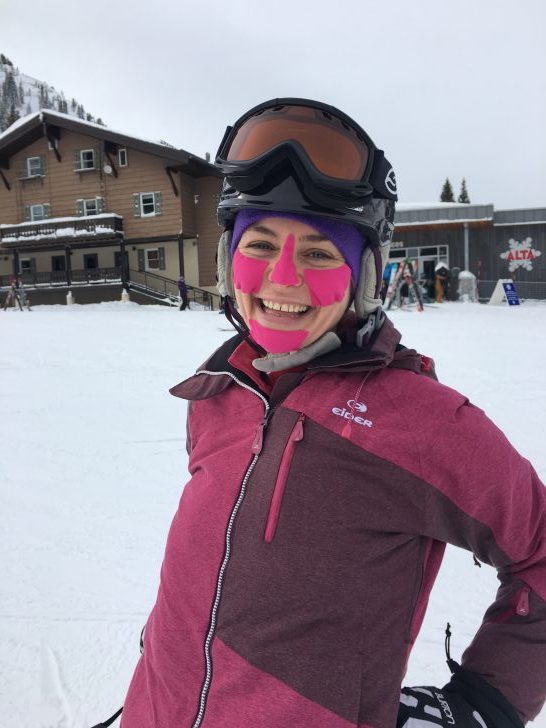
We hear from Jennifer Carlson who tried out Anti-Freeze Tape recently at Alta.  Her reactions and those in her social sphere are quiet amusing.  This is a real product, probably a life saver for some applications. Face tape. Hmmm.

Jackson Hogen, the publisher of realskiers.com, invites us to read about the Top Skis Of All Time.  Thanks to him for letting us republish this article from realskiers.

Finally, we have a report of what it is like for a head-strong senior who takes a lesson and finds change and new things more difficult than expected.  What’s your reaction to learning new things at an advanced age?

We will be heading up to Stowe for the International Ski History Association Hall of Fame induction ceremony next weekend.  Notably we have two members of our Advisory Board being honored by ISHA.  Congratulations to Bernie Weischel and Gretchen Rous Besser for their contributions to snow sports.

April brings transition in many parts of snow country.  We at SeniorsSkiing.com will also be gradually transitioning into our usual range of other topics of interest—exercise, cycling, other sports we know you love to take part in.  Stay with us.

And remember, there are more of us every day and we aren’t going away.

Short Swings!

Mike and I want to report on our progress and thank readers, editorial contributors, advertisers, and online collaborators for your support. We also want to ask for a favor.

SeniorsSkiing.com is starting the fourth year of publication. We went online in April 2014.

During that time we’ve grown from a handful of page views each month to almost 35,000 during the height of the season. Since November, more than 200,000 people visited the magazine. Most spent a few minutes per visit. The number of new subscribers since last April has grown 72%.

Our mission is to serve and represent the interests of the 50+ snow sports enthusiast. In keeping with that goal, we’re more tortoise than hare. Slow, steady, and highly mission-focused.

The community formed around SeniorsSkiing.com is interested and engaged. We know that because of your unusually robust responses to reader surveys. Twenty-seven percent of you responded to the most recent, an unusually high amount for any website or online magazine.

At this time, the modest revenue we receive from advertisers lets us pay for a variety of web services, graphics, and other projects.

There’s one advertiser in particular we’d like to attract. It is KneeBinding, which presents itself as “The only binding proven to help protect your knees on skis.” Our readers, older skiers, are an important part of KneeBinding’s target audience, and we believe that the company will make a good investment by advertising with us. The company head tells us he agrees, but he’s not convinced advertising in a non-print publication will help his sales.

The favor we’re asking is for you to help us convince him to advertise and to provide information about protecting senior skiers from future ski injuries. Please leave a reply (below) expressing your interest in having KneeBinding as an advertiser and a source of information about avoiding accidents related to falls. We’ll forward them to the company.

Thank you!

CALIFORNIA

The 2017-18 Tahoe Super Pass is now on sale starting at $499, with free spring skiing starting April 1 at Squaw Valley Alpine Meadows. Record snowfall means Squaw Valley Alpine Meadows will be open into June and on July 4.

MONTANA

Big Sky Resort named Bob Stinchcomb vice president of business development. He has 20 years ski industry experience, mostly at Vail Resorts.

UTAH

Snowbasin Resort is offering free skiing and snowboarding through the remainder of the season with the purchase of any 2017-2018 season pass. Seniors (ages 65-74) pay $499. A separate Super Seniors (75+) pass with reduced benefits is $49! Purchase at www.snowbasin.com.

WYOMING

This short Teton Gravity Research video from Jones Snowboards shows Freeride World Tour champion Sammy Luebke doing remarkable things on impossibly steep cliff-covered verticals. Enjoy!

OTHER

This has nothing to do with snow sports. It’s a website that shows how stuff — usually big stuff like bleachers, telephone poles, industrial equipment — gets recycled into other stuff and for other purposes. It’s interesting. Repurposed Materials

Ski Areas Versus Ski Resorts

There Is A Clear And Distinct Difference. Which Is For You?

Hangmans at Mammoth. Pat calls the big mountain a hybrid between corporate and local.
Credit: Pat McCloskey

Just returned from my annual ski adventure with my group of guys from all over the country.  We all converge on our friend in Tahoe and enjoy the Tahoe areas and then head to Mammoth to end the week.  Have to tell you folks, there is a lot of snow left out in the Sierra.  Most likely skiing at least until Memorial Day for many Tahoe areas and Mammoth is reputed to be skiing well into July.  We had a lot of interesting conversations on the lift about our experiences at the corporate ski areas (Northstar at Tahoe), the local community supported ski areas( Mt. Rose, Nevada), and the hybrid – Mammoth Mountain, which has the feel of a ski area even though it has a large village which has that corporate resort feel.

No doubt about it. Snowpack in the Sierra is 160% of normal.
Credit: Pat McCloskey

We love Mt. Rose.  It is definitely the local area for the skiers of Reno and they take pride in the fact that it is there primarily to service the day skier.  Where else do you get 25% discount on food if you are a season pass holder?  They have specials on daily lift tickets like “Two fer Tuesdays”—two lift tickets for the price of one.  Ladies day is Thursday, and they also offer a discounted ticket if you show up the day you flew in.  I came in from Denver and was on the chair by 11:30 with a $59.00 ticket.  Pretty reasonable.  Good skiers at Rose, and most of them are either local Reno skiers, retired folks who ski there regularly, and visitors who stop to ski there on the way to Tahoe’s other areas.  The Chutes are pretty special, too, with challenging runs serviced by a chair that brings you back to the main Slide area.

When you ski Northstar at Tahoe,  you can definitely sense that corporate-ish Vail feeling.  Very chic, lots of shops and restaurants in the base village which is surrounded by well developed condo complexes. Bring your wallet because most things like food, lift tickets, and lessons, are pretty pricey as per the corporate ski resort theme.  There is a lot to be said for the ambiance created by Vail and the logistical expertise to bring good food, grooming, and snowmaking to a mountain for all to enjoy.  But a different feel altogether.

Finally, Mammoth is what I call a hybrid.  My friend always parks early in the lot by Chair 2, where we change into our boots. My father in law would call us “trunk slammers” –like the guys changing their golf shoes in the parking lot. Heading up to McCoy Station and ultimately to the Summit, we avoid most of the village rush by parking in this removed location. Most of the people are regulars.  Like Mt. Rose, there are enthusiastic Mammoth loyalists who ride the gondola all day long reveling in the epic conditions.  Again, more of a locals area than the more corporate resort areas.  People drive five hours plus from the LA area and also from the Bay Area to get there.  Ticket deals and lodging are best located on line. A little tip if you go, we ate at Giovanni’s Pizza in the Timber Ridge Resorts property—437 Old Mammoth Road.  Really good Italian food and reasonably priced.  We liked it so much, we ate there every night.  Typical senior skier behavior.

So, all in all, when visiting the Sierra as a senior skier, you have a lot of choices.  But we tend to like the ones that cater to the skier rather than the resort dweller.  But that is just us.  Go and enjoy it.

Pat (second left) and his mates who take an annual trek to the Sierra. This year they found big snow.
Credit: Pat McCloskey

Anti-Freeze Face Tape

Me To My Face: No Need To Freeze!!

Anti-Freeze Face Tape is Quite the Experience.

Jen Carlson wearing Anti-Freeze Face Tape

Okay, it’s Spring and for most of us the cold is fast becoming a distant memory. However, on January 8 at Alta, temps ranged from 12F to 18F. Sunny but chilly. So I took a package of Anti-Freeze Face Tape —a gift from a friend—followed the instructions and skied that day with a well decorated mug. War paint comes to mind.

The package states, “For downhill and x-country skiers, winter runners and cyclists, and those who wish to protect and insulate their skin.” It’s definitely a different way to reduce risk of frostbite.

I did what the package advised and applied the four pre-cut pieces to my nose, cheeks and chin. That was after washing and drying my face.

During the 4 1/2 hours wearing the colorful, flexible fabric, there was a burst of social engagement. It ranged from people doing double takes to straight-up staring, especially from little kids. Gotta love children with their unfiltered responses! Lunch was interrupted by the curious and those who simply pointed. Quite a few bemused people asked about this unusual new product. Who would’ve guessed placing some tape on my face would’ve sparked so much intrigue and commentary? Loved it!

It’s an interesting product, and I’ll use it again, especially on a cold day. I’d skip the cheek and chin covering in favor of my head/face sock. Would definitely use the tape on my nose. With it on, I didn’t have to deal with a cold nose or worry about sun exposure.

Removing Anti-Freeze Face Tape was fine, except from my cheeks, where there was some discomfort. A slight pattern from the adhesive remained on my face, which for a while was red and feeling a little raw.

Bottom line: It felt a bit odd at first. I quickly got used to it. A few times during the day it itched a bit, but wasn’t much of a distraction. Overall, I felt as if my skin could breath while being protected.

Wearing Anti-Freeze face tape brought some extra joy and playfulness to a beautiful day with friends. Hell, it even caught the attention of the Alta photographer for the area’s Photo of the Day.

Anti-Freeze Face Tape comes in three colors: Flesh, Blue and Pink. Available in select stores and online.

The Top All-Mountain Skis of All Time

Excerpted with permission from realskiers.com where the full article was published March 20, 2017.

All-mountain skis — those that purport to do everything reasonably well – started appearing in the mid-90’s. 

Following, listed roughly in order of their debut, are the iconic models that emerged since the term “all-mountain” came into common usage. My picks aren’t necessarily the most innovative or game changing, but they were, for a while, the best at handling any condition the mountain might dish out.

Völkl Snow Ranger

Völkl didn’t invent the fat ski – that distinction goes to Atomic – but they were the first to make an expert powder ski using elite construction. When fat skis were first making a dent in the market, no other model was as powerful and versatile as the original Snow Ranger, which still holds its own as an all-terrain ski today.

Volant Chubb

From today’s perspective, it’s hard to believe that the Chubb, born in the first generation of fat skis, had a 90mm waist. When Shane McConkey began to straight-line steep couloirs on the Chubb, any lingering resistance to fat skis as cheater sticks evaporated. Applying the Chubb’s construction to a water ski’s shape resulted in the Spatula, creating new dimensions in ski design that endure to this day.

K2 Four

K2 wasn’t an early adopter of shaped skis, but once the brand put their marketing prowess into promoting the concept, there was no turning back. A young Bode Miller started to win races on the funky red, white and blue skis, validating the technical capabilities of the deep sidecut. America followed suit, setting the table for K2’s run of dominance in the U.S. market.

Dynastar 4×4

Shaped skis were still by and large a carving club when Dynastar debuted the 4×4 as an unabashed off-road ski, inspiring comparisons to SUV’s for their all-terrain adaptability. Although absurdly narrow by today’s standards (a shade under 68mm underfoot), the first 4×4 would later morph into the 4×4 Big, one of the most popular fat skis of its era.

Salomon X-Scream

Like the 4×4, Salomon’s X-Scream was one of the first shaped skis that wasn’t intended as an on-piste carving tool but as an all-terrain implement. The first X-Scream earned instant acclaim when it rolled out in 2001, spawning a string of successors that made the X-Scream family the most popular in Salomon’s history.

Stöckli Stormrider XL

Stöckli tends to build all-terrain skis with DNA extracted from Super G race models, making their Stormrider series among of the burliest all-mountain skis. The Stormrider XL, sporting a waist of 75mm, was an ancestor of the current crop of Stormriders, which range in width from 83mm to 115mm. The one constant has been a stout, wood and metal lay-up that takes no prisoners as it slashes through any and all snow conditions.

NOTE: This highly unscientific exercise isn’t meant to identify the very best skis, nor the most popular and not necessarily the most innovative or influential. The common thread is that they epitomized versatility in their respective eras.

Six other picks will appear next week.

Subscribe to realskiers.com and receive newsletters, commentary, and expert advice all season long. 

Taking A Lesson At 72

Lessons Learned Beyond Skiing.

When I told my companions I was going to take a lesson in the middle of our three-day ski getaway in Maine a couple of weeks ago, they uniformly said, “What a good idea!  So should I.”  But it was just me signing up for an hour-and-half with instructor Fred (not his real name) whom I was to meet at the ski school hut at 10:00 am the next day. Regardless of the expense, a private lesson, I conjectured, would erase years of skiing almost okay.

Confession:  I never took a real ski lesson.  I got some tips from Ginny Pfeiffer at Hunter Mountain when we had a SKIING Magazine outing one evening back in 1971 or so (yes, evening).  I watched ski instruction videos from time to time, read articles, but never really a bona fide lesson. I just learned vicariously.

But, I had the feeling that an important experience was missing.  Not to mention I couldn’t really carve a turn.  I mean really, neatly carve; I couldn’t match those clean, incised, parallel arcs I saw people making under the lift line.  I could skid a turn, I could stem christie a turn, I would have a great run and then five un-great runs.  My new shaped skis were not being optimally used.

Fred was a veteran instructor.  “What do you want to focus on?” he said when we met.  “I want to carve these skis. The perfect turn is eluding me.” So up we went to a nice wide blue cruising trail.  “Ski down fifty yards or so, I’ll be right behind you,” said Fred. I did, I was self-conscious and tight, nervous, but nevertheless, I wanted Fred to see what he was dealing with.

“You are skiing with your feet together,” Fred said as his first lesson. “Keep them shoulder width.” Hmmm, I thought, I knew I did that, but only sometimes.  Is sometimes okay? After all, couldn’t sometimes be okay? Resistance was emerging.

We went another fifty yards.  “Now, watch how I link my turns. Try that and don’t take such long traverses.”  He showed how with me tagging in his tracks. Ah, linked turns. Then, I went down with him behind, watching.

“Okay, you’re not putting pressure on your front edges. Feel your shins pressing on the front of the boot.  The toe of your outside ski and the pinkie toe of our inside ski need to do the pressing.”  Ah, pressure, okay.

I tried. It was hard. I couldn’t do it. I didn’t like it. It was uncomfortable. I was incompetent. I wanted Fred to go away and stop watching.

More conferences on the side of the trail.  More advice and demonstrations. “I will try harder,” I said to myself, thinking I paid a lot for this. But I am not liking this.

Another couple of runs, Fred skiing behind, and I finally felt it.  I felt my big toe pressing, I was linking, my feet were shoulder width apart.  I was doing it.  I was far from proficient, by a long shot, but I had the idea.  I was linking my way down a long blue trail, non-stop, with Fred behind. I was learning. I found it was hard to learn, I resisted the new physical move, but eventually I learned at least something. I was surprised at how hard it was.

We talked at the bottom at the end of the lesson.  On the lift, we learned we had sailing in Maine in common.  I realized I hadn’t actually seen Fred’s face since we started as we were both goggled up and helmeted.  He took off his goggles.  “How old are you?” I asked, just curious. “Sixty six.  How old are you?”  “Seventy two”, I said.

“No dust on you,” he said, shaking hands.

That made my day.

Haystack MT Hermitage ski area

This Week In SeniorsSkiing.com (Mar. 24)

Sun Screen Explainer, Tremblant 1948, Private Ski Area Visit, Climate Change In New England Skiing, Visiting A Non-Profit Ski Resort, Senior Achievement: Notching Up Mega Vertical Feet.


ATTENTION SUBSCRIBERS: EXPERTICITY HAS CHANGED THE NAME OF THE SENIORSSKIING.COM GROUP TO “SKI EXPERTS”.  The recent quota problem that some of our subscribers have reported has been resolved.  Try signing on to your account OR re-registering with Experticity for major discounts on gear and clothing, a subscriber-only benefit.  For instructions, click here. It’s the third link down. You may have to confirm your email address.  If you have problems registering, call Experticity at 866-376-4685 or member.support@experticity.com.


Hermitage Club inhabits Haystack Mt. as seen across the Deerfield Valley, VT.
Credit: Hermitage

This week has been busy at SeniorsSkiing.com.  We have an explainer on sun protection from Justin Thulin, MD, a dermatologist who spends a lot of time on Nordic skis at high altitude.

For ski history fans, we found a fascinating glimpse into the ski culture of the late 40s at Mt Tremblant. The video clip makes you wonder who those early-adopter, pioneering skiers were, where did they learn, how often did they ski?

What’s it like to ski or visit a private ski area? How can a curious non-member get a taste of the experience?  Correspondent Karen Lorentz was a guest at The Hermitage Club at Haystack in VT for a couple of days in March.  She reports on a way for non-members to get access to Hermitage for a visit without having member friends inviting them.  Check out her story here.

Spring Skiing 2016, somewhere in New England.
Credit: Mike Maginn

Climate change is happening, and it is already affecting the ski season in New England.  Find out what’s ahead for ski resorts and what entrepreneurs are doing to adapt to these changing conditions. We’ve posted an excellent WBUR Boston radio segment from the New England News Collaborative that reports on the threat and the response.  You can also read a transcript by following the link.

Correspondent Yvette Cardozo completes her round-up of Idaho ski resorts by reporting on Bogus Basin, a non-profit area what offers great skiing, short lift links and economical prices.  Are these kinds of low key, community-owned, local areas the analogue of a private area without the membership fee? Hmmm.

Finally, correspondent Marc Liebman and his brother Scott take on the Wasatch with vigor.  He has proof that they clocked 157,906 vertical feet in six days.  And he has three key lessons for seniors about skiing at Solitude, Deer Valley, Snowbird and Park City.

Spring skiing has officially started.  It’s going to last a month or so longer in the East.  We know the Sierra Tahoe resorts have plans on extending to…gulp…July.

Thank you for subscribing to SeniorsSkiing.com.  We really do depend on you for spreading the word about our online magazine.  And there really are more of us every day, and we aren’t going away.


Short Swings!

Pond Skimming at Vail

Skiing’s Silly Season starts this weekend with the annual ritual of the pond skimming competition. They’re generally associated with live music, costumes, BBQ, beer and LOTS OF FUN. Seven Springs (PA), Stratton (VT), Mt Snow (VT), Nashoba Valley (MA) and others have theirs scheduled for Saturday. Many others will be in April. Mt Bachelor‘s (OR) is the latest I found — May 28. It’s unlikely many SeniorsSkiing.com readers will compete, but if you do, check out these instructions for getting a good run. Be sure to send the video!!

COLORADO

Colorado Ski Country USA announced that its 22 member ski areas reported a January/February increase in skier visits over the same months last year. Snowpack is 125 percent of average and March and April are typically the snowiest months.

MASSACHUSETTS

Nashoba Valley Ski Area’s March Meltdown will be held this Sunday. Prizes for best costumes and pond skimming. Costume theme is 80’s TV or cartoon characters.

QUEBEC

Mont-Sainte-Anne announced the start of its 6 week spring season featuring live outdoor music, a slopeside sugar shack, and sunny terraces. Last day: April 30th.

UTAH

Snow Basin celebrated #nationalpuppyday with an Avalanche Dog Fundraiser benefitting Wasatch Backcountry Rescue.

Whisper Ridge, the new Utah heli/snowcat operation about a hour north of the airport has closed for the season. The company reports a banner season. Whisper Ridge is taking reservations for the coming season: 801-876-4664 or email info@whisperridgeutah.com

VERMONT

Okemo is promoting  an “all-new, bigger, better and bolder lineup” of season passes for ’17/’18. All passes are eligible for a M.A.X. Pass add-on. Purchase by April 30 for best prices and added value. Prices drop dramatically starting at age 65.

OTHER

Zeal Optics has an end of season 30% off sale on all goggles.

KJUS skiwear is beautiful, technical and pricey. 2016-17 Fall/Winter merchandise currently available online at 20% off.

Dermatologist on Sunscreens and Skiing

Memo to Skiers: Always use a “broad- spectrum” sunscreen with a SPF of at least 30.

Commercial sunscreens are divided into two classes: physical and chemical. Physical sunscreens contain Zinc oxide and titanium oxide. They deflect ultraviolet energy from the skin by scattering ultraviolet light.

All other sunscreen compounds are “chemical,” which act by absorbing ultraviolet light and re-emitting the energy as heat. Most commercially available sunscreens are a combination of two or more active sunscreen compounds.

The best sunscreens have a high sun protection factor (SPF) and are labeled as “broad-spectrum” because they protect against both ultraviolet A (UV-A) and ultraviolet B (UV-B) radiation. UV-B causes sunburn. UV-A penetrates deeper into the skin, causing aging.

Most people don’t apply enough sunscreen. A good rule of thumb is to use a strip of sunscreen about 1/4″ wide from the middle of the tip of the index finger to the crease where the finger meets the palm. That will be about the right amount to apply to the face and neck. If you perspire a lot, use a water-resistant product.

For Nordic skiers, I recommend liberally applying product 15-30 minutes before skiing (it allows the sunscreen to absorb), then re-applying every two hours. For downhill skiers, I recommend reapplying at lunch.

I wear a physical sunscreen combining zinc oxide and titanium dioxide (Vanicream SPF 60). I think it performs better than chemical sunscreens and is less irritating. For more cosmetically aware skiers, I recommend a high SPF chemical sunscreen such as Neutrogena Ultra Sheer Dry-Touch SPF 70 or 85 or 100. Other sunscreens along these lines will probably do the job as long as you apply correctly.

Wearing sunscreen takes a bit of consistent effort, but then again, almost every form of skiing takes some effort. Before your next snow venture, add a finger full of sunscreen to your head and neck. Your skin will appreciate it.

Skiing Mt. Tremblant 1948

Ski buses, single-seat lifts, bear trap bindings, racing wipe-outs, skinny trails.

From SkiPresse/Cycle Presse.  Nostalgia.

Haystack MT Hermitage ski area

Private Ski Area: A Warm Visit to the Hermitage Club on a Frigid Day

What’s It Like To Visit A Members-Only Resort? Find Out How You Can Do It.

Well-tended trails, bubble chair and low traffic trails are benefits of Hermitage, a private ski resort in VT.
Credit: Hermitage

On March 12 — zero degrees, wind whipping — my ski companion who had never ridden a bubble covered, heated-seats six-pack commented, “This lift is a spoiler.” Anita doesn’t do well in the cold, but thanks to the Barnstormer these two seniors skied for two hours before heading in for Mimosas and lunch in the Hermitage Clubhouse at Haystack Mountain, VT.

No, we didn’t pay the $85,000 joining fee and $8,500 annual dues to ski what she called “best conditions I’ve skied this winter.”

We were guests of Hermitage. Anyone can enjoy this delightful private ski area as a guest of a member of the Hermitage Club. You also have access by booking a room at one of the Hermitage properties in the Deerfield Valley area — White House Inn, Wilmington; Inn at Sawmill Farm or Hermitage Inn, in West Dover; Snow Goose Inn, Dover; Brook Bound Inn or Vermont House in Wilmington.

There’s a limit of one ski-guest package a year so think about snow conditions and check out these lodgings.  Consider a two-four day ski-and-stay for a unique experience — un-crowded slopes, no lift lines, and VIP treatment. (You can also be a guest by considering membership.)

Delightful Day, Warm Experience

Base lodge at Hermitage features great food, comfortable and space.
Credit: Peter Hines

As we arrived, I was directed to guest parking from whence a shuttle van ferried us up to the Clubhouse. We booted up in a carpeted guest area with cubbies for our boot bags, picked up our skis from the rack, and boarded the Barnstormer.

This Doppelmayr express lift accesses the summit in six protected-from-the-wind minutes. By the way, even though a sticker says, “open the bubble before the station”, you don’t have to lift a finger — bubble and footrest go up automatically at the unload platform! Talk about senior heaven!

We found packed powder on Upper and Flying Dutchman and side trails, Ventura Highway (a green roller coaster), and my blue favorite of the day Last Chance.

While the Witches Triple, which accesses some wide steeps, was running, I didn’t revisit my favorite trails there because we needed the warm Barnstormer lift — our experiment of not pulling down the bubble didn’t last too long — viva la difference!

Hermitage Club inhabits the Haystack Mt. as seen across the Deerfield Valley, VT.
Credit: Hermitage

We sampled a fabulous brunch spread of lunch and breakfast items — waffles, omelets, raw bar, salads, meats, potatoes, etcetera. We topped fresh berries with real whipped cream for a great dessert — yum.

After another run we skied the Tunnels Trail to the learning area below the lodge. What fun to see little kids safely learning on wide trails away from the schussboomers!

“The vast majority of our members are families with children; they love skiing, and they love skiing together. They are comfortable that their kids are safe on the mountain and appreciate the sense of community and a feeling of going to a second home,” explained Brendan McGrail, director of communications for The Hermitage Club.

With 46 trails, 194 skiable acres, 5 chairlifts, handle tow, separate beginner-area, 1,400-foot vertical, magnificent Clubhouse, valet service and more, it’s easy to see why families love this special area, and, if you have the swag, it’s worth checking out! Learn more at hermitageclub.com and bring the grandkids!

Club house, aka Base Lodge, at night. Note corduroy.
Credit: Hermitage

New England Ski Industry And Climate Change

The Facts Are Tough To Face, But The Ski Season In New England Is Getting Shorter.

Spring Skiing 2016, somewhere in New England.
Credit: Mike Maginn

This story comes via the New England News Collaborative, and was first published by Maine PublicIt aired on WBUR Boston, March 15, 2017.

Two years ago during the infamous 2014-15 season, there was enough snow, it seemed, in New England to cover Mt. Washington many times over.  The 2015-16 season was the opposite; we were lucky to get a string of decent days and many resorts closed early.  This season, it was on-again, off-again, with an on-again storm at the beginning of March that will definitely extend the season.

This up-down trend is part of a bigger picture that is reported here in a WBUR Boston NPR Radio segment that we are passing along.  Although the tone is frank and a bit foreboding, the entrepreneurial spirit of mountain business people is encouraging, especially when they talk about plans for the dealing with what’s coming.

CLICK HERE TO LISTEN TO THE SEGMENT OR TO READ THE TRANSCIPT.  It’s about five and a half minutes long, or you can read a transcript in the link.

What do you think? Will summer activities on mountains run by ski resorts be viable business alternative and money maker?

SeniorsSkiing Guide: Bogus Basin Not Your Usual Local Ski Hill

This Non-Profit Ski Area Is Community Owned And Prices Reflect It.

View from the top at Bogus Basin, the ski resort outside Boise, ID
Credit: Yvette Cardozo

Bogus Basin outside Boise, ID, is the local ski hill. But it’s not your usual tiny, rustic, over run local hill.

“What you get here is destination skiing at local prices,” said General Manager Brad Wilson. “Our lift tickets are $59, our ski rental package $30, our burgers are $7. We’re able to do that because we are non-profit. It’s community owned.”

Skiing couple takes a selfie at Bogus Basin outside Boise, ID.
Credit: Yvette Cardozo

Indeed, the size might make it a destination hill in many places. It is second largest in Idaho after Schweitzer. But the vibe is definitely local, families doing box lunches, school buses loaded with local kids, night skiing seven days a week.

“We see people from Texas, from Florida but this is not our focus because we have so many local people to draw from.

“The quality of our skiing is equal to destination areas but there’s no granite in the bathrooms, and our chefs aren’t wearing tall hats.” Wilson added.

Why, then ski Bogus as a visitor?  Because it’s 40 minutes from Boise. If you are flying in to ski elsewhere, say, Brundage and Tamarack near McCall, or Sun Valley, odds are you come through Boise, a vibrant, fresh new city. So it makes sense to spend a day or two, and also perhaps a day skiing Bogus.

Snow, Terrain And More

Location: Bogus Basin is 16 miles north of Boise, ID, which is towards the southwest end of the state. It’s about a 40 minute drive from downtown. The city is in the midst of a construction boom with 800 new hotel rooms expected by next summer. The ski area draws from the entire “Treasure Valley,” some 700,000 people from Boise and surrounding towns.

Snowfall: 200 – 250 inches a year.  Four “fan guns” fill in where snow is sparse in early season.

Terrain, lifts: Three detatchable high-speed quads, a triple chair and three doubles, along with  a conveyer belt for beginners, serve the 2,600 skiable acres. There are 78 named runs. Eighteen percent are easiest, 42 percent intermediate, 40 percent expert. Free mountain tours are offered weekends at 10:30am and 1:30pm.

Vertical: 5,800 feet at the base, 7,582 at the top, resulting in just shy of an 1,800 foot vertical drop.

Nordic & more: 37 km of groomed Nordic trails for day skiing, 7 km for night, 12 km for winter fat bikes and snowshoes. Frontier Point Nordic Lodge has a gas fireplace, equipment rental, ticketing office and waxing bench.

Lot to Lift Access:  Seven parking lots with ski in-ski out access, more with shuttle service.

Public transportation: Roundtrip buses with stops in Caldwell, Nampa, Middleton, Star, Eagle, Meridian, Boise State and various Boise locations through bogusbasin.org or Caldwell Transportation Co. (208) 459-6612

Accommodations: No on slope lodging.

Culture:

The Vibe: This is a local hill on steroids. Not wild and crazy but, rather, casual, friendly, but much larger than you expect. Since most skiers here are locals, they ski well and know the mountain. Ride a lift with one, and he/she will give you tips on getting good snow.

Dining: Of the three lodges, two have grills, bars or some sort of food. These include the J.R. Simplot Lodge at the base and Pioneer Lodge on the upper mountain.

Mountain Life: Snow, snow and more snow. Alpine and nordic skiing, fat tire cycling. You don’t come here to lounge in front of a fireplace in expensive duds. You get out and go, then come in to rest, then get out and go some more.

Trail Map click here

Webcam and Conditions click here

Three Lessons Learned From 157,906 Vertical Feet In Six Days

No, This Is Not Bragging.

Marc, 71, left, and brother Scott, 60, at top of Snowbird Tram

My brother and I have proof through an app we used to track our movements. More important than the great early March skiing at Snowbird, Solitude, Park City and Deer Valley, were three takeaways that should interest senior skiers…

Lesson #1. We found lift ticket bargains in two flavors – military discounts and over 70. It was a race to which one was cheapest. Snowbird sold me a Monday thru Thursday all area lift ticket for $53 ‘cuz I’m over 71. Solitude’s rate for military active duty and retirees was about half off the full price. Just make sure you bring your ID cards for both  service member and dependents.

Senior only passes were equally cheap. When I walked up to the window, I asked which was cheaper, military or over 70? In one case, I got a little of both. Corollary A to lesson one is that these tickets were cheaper than what we could get on-line or at ski shops in the local area. Corallary B is that Park City doesn’t offer much of a discount.

Lesson #2. Through AirBnB, we rented a two bedroom, two bath house within spitting distance of the main routes to the resorts for about $160 a night. It took 25 minutes to get to the areas. We picked the area each morning based on weather and road conditions.

Lesson #3. Ski lodge designers don’t take old joints and tired legs into account when designing facilities. How do I know? Bathrooms are rarely on the same floor you enter and elevators are rare. Fortunately, the new Summit Lodge and Restaurant at Snowbird and the Roundhouse at Solitude have convenient bathrooms.

Conditioning, as I’ve noted before, helps. We averaged ~26,300 vertical feet per day despite my brother having to take time off on Day 2 to get new boots after the bladder in his elderly Nordicas died.

Here’s the most important takeaway from the trip: Airfare, lifts, ski rentals, lodging and food cost us each for six days about $335/day. Granted, we didn’t eat out a lot, but still, 335 bucks a day is, at least for a ski trip, reasonable. According to the ski tracker app on my brother’s iPhone, we skied a total 157,906 vertical feet at four different areas. That’s $.013 per vertical foot. An absolute bargain!!!

This Week In SeniorsSkiing.com (Mar. 17)

Happy St. Patrick’s Day! Senior Skin Sun Protection, Tamarack Bargain Resort, Steamboat’s Masters’ Program, Learning To Ski As An Adult.

Brodie Mountain in Western MA was ground zero for St. Paddy’s Day Skiing. Ah, memories.
Credit: Brodie Mtn

There was a wicked big, late winter snowstorm in the Northeast this week.  While not living up to dire predictions, this one (Stella, according to the Weather Channel) brought yet more snow to the high country in NH, VT and Maine.  There is a LOT of skiing left out there, extending this on-again, off-again season yet more weeks.  We are reminded that last year at this time there were resorts closing or closed already.

This week we’d like to remind you to respond to our currently available Subscriber Survey 2017.  The response rate continues to be very strong so far.  If you haven’t had a chance to complete it, check your email for the message send last Tuesday.  We’ll send a reminder again later this weekend.

SLC-based Harriet Wallis tells us about an after-hours, walk-in injury clinic handy to Alta, Brighton, Snowbird, and Solitude, and run by the University of Utah Health Care Orthopedic Center. Nice to have competent, convenient help if things go awry on vacation.

Bay Area Correspondent Rose Marie Cleese reminds us what to do and think about if you’ve been on hiatus from skiing for a while or, if you or a person you know is considering taking up the sport at an advanced age.  We know many senior skiers who are coming to the sport through retirement from busy careers, recovery from long-time injury, seeking social connections or just plain curiosity.  The new equipment and techniques also make it a lot easier for seniors to re-start their skiing experience. If you are or know someone who is returning, her advice is quite important.  Are you a returnee? What’s your story?  I took a 20 year pause in my skiing when I was running my own business. It’s a different world, but that’s another story for another time.

The base at Tamarack Resort with sports and cafe domes and a snow rainbow.
Credit: Tamarack Resort

We hear from Oregon-based Yvette Cardozo about Tamarack, a resurrected resort in the middle of Idaho that offers amazing bargains for seniors.

Correspondent Tamsin Venn reports on the Mountain Masters’ program at Steamboat Springs, where seniors can gather in the morning and ski with a guide who matches ability with terrain.  And, that’s free, folks.  We love these kind of program that extend a special hand to seniors. This program is a sign that ski resorts are waking up to the potential of treating seniors nicely.

Finally, we hear from Justin, Thulin, MD, an SLC-based dermatologist, who advises us about skin protection.  If you’ve ever had a skin cancer removed, you know how disturbing the whole experience can be.  The best protection is prevention, so pay attention to his wise words.

Why Do I Have To Re-Enter My Name And Password?

If you are being asked to re-enter your email to confirm your subscription to SeniorsSkiing.com, you might be a bit annoyed.  We don’t blame you, but there is an explanation.

  • You are accessing SeniorsSkiing.com through a device that is different from the one you originally signed up on. Subscribing to SeniorsSkiing.com puts a “cookie” on your device.  If you use a different device, no cookie, so you are viewed as a non-subscriber. If you re-enter name and password, you’ll be okay with the new device.
  • You have disabled cookies or cleared browser history on your device. Turn cookies back on, and you’ll not have to re-enter again, or leave it disabled and realize you have to re-enter each time.  Your call.
  • You are trying to access our Subscriber-Only Content.  Instead of building a firewall that requires usernames and passwords, we elected a much simpler way of getting to our exclusive content: Just confirm your name and email.  You will have to do that each time you want to get to that information, which, by the way, is under the Community tab at the top.

Thanks And Green Beer Tonight!

We very much appreciate your support as evidenced by the wonderful response we are getting to our Subscriber Survey 2017.  Thanks so much.

Toast the old country this evening!  Remember there are more of us every day and we aren’t going away.

Steamboat Mountain Master Guide Steve Cozette (red jacket) herds his charges down Two O’Clock.
Credit: Tamsin Venn

Short Swings!

Tuesday I was sledding with grandkids in Manhattan’s Central Park.

I arrived a few days earlier in New York unprepared for winter; felt it from head to toe. Wednesday, I stepped out of Salt Lake International Airport into 75F. The resorts are reporting temps in the 40s and 50s. It’s expected to cool off later next week. My experience in this part of the world is that the first two weeks of April generally deliver large snowfalls. Will it happen this year? In New York my fingers were frozen. Now they’re crossed.

CALIFORNIA

Next season’s Tahoe Super Pass is available for purchase now. Buy before April 18 to get extra savings. Multiple plans are available. The most luxe offers unlimited skiing at Squaw Valley and Alpine Meadows plus 50% at all Mountain Collective resorts, plus free skiing from April 1 to end of season, plus other benefits. 65+ costs $719; 76+ costs $389.

COLORADO

Aspen Highlands will host an old school bumps challenge at its Freestyle Friday, noon March 31. Should be a blast with neon one-pieces and other retro garb.

OREGON

Registration now open for the Ligety Weibrecht Ski Camp at Mt Hood. From the website, it looks like a terrific experience for teen-aged grandkids.

QUEBEC

The Canadian Alpine Ski Championships will be held March 24-28 at Mont-Tremblant.

Stoneham Mountain Resort issued a short artsy video of skiers and boarders on its Olympic half pipe. It appears that the riders are jumping in front of a massive screen filled with colorful images.

UTAH

Park City’s Grand Summit Hotel in Canyons Village will undergo $15 million in renovation this spring, after which it will become a RockResorts property. The project is expected to be completed by mid-summer.

Snowbird‘s free Plaza Deck Concerts are scheduled for every weekend starting March 17 through May 14. Always good for a nice afternoon vibe.

VERMONT

Okemo Mountain Resort’s on-the-snow beer festival is slated for April 1. This will be the third year for the one-day Hops in the Hills event. Admission is free and open to the 21+ crowd, but there’s a fee to sample the 10 seasonal brews. Food also on tap.


Walk-In Orthopedic Clinic Opens Near Salt Lake City’s Resorts

Nobody wants to get hurt while on vacation, but sometimes it happens.

Did you crash at one of the Wasatch Front resorts, think you were okay, but later decide to get checked? This new after-hours clinic treats what was hurt while skiing during the day.

The University of Utah Health Care Orthopedic Center is one of only a handful of academic medical centers in the nation to open an after hours, walk-in injury clinic, and it’s the first of its kind in the state. It’s very convenient for those skiing at Alta, Brighton, Snowbird, Solitude.

Resorts have their own on-mountain clinics, but often things don’t hurt until after you go back to your hotel. Skiers sometimes twist a knee, pull a hamstring, or get hurt some other way; and when the pain doesn’t go away they realize they really should be checked. The walk-in, after hours clinic fits the need.

The clinic treats fractures, strains, sprains, tendon injury or tendonitis, joint problems, or orthopedic injuries.

On a personal note, three friends recently went to the clinic and were delighted with the attention and care. X-rays showed one friend has a bone crack. Two others were identified with muscle tears. All were treated right there; they’re on their way to swift recoveries.

The clinic offers low wait times and an office visit co-payment that’s less expensive than a trip to the emergency room.

“The concept of acute care ortho clinics is a new one,” said Joy English, M.D. 36, sports medicine physician and clinic director. “People are starting to realize it’s a much better place for them than the ER.”


Senior Skiers: Take Care in the Sun!

Advice From a Dermatologist Nordic Skier.

The sun is by far and away the most common cause of both (1) skin cancer and (2) skin aging.

More than two million cases of skin cancer are diagnosed annually in the USA. Caught early, most skin cancers can be removed, leaving a cosmetically acceptable scar. In more advanced cases, valued anatomic parts such as noses and ears can be partially or completely lost. Unfortunately, ten thousand deaths occur yearly in the US from skin cancers.

Many Nordic skiers, blithely dedicate ourselves to going outside as much as we can whether skiing in the winter or running, biking, and hiking during snowless times. My recommendations to preserve skin health while frolicking out of doors:

  • Exercise early in the morning (before 10) or later in the after- noon (after 4) when the sun is less damaging.
  • Wear clothing that covers or shades the skin (e.g., a broad- brimmed hat is better than a visor).
  • Apply a “broad-spectrum” (protects against UV-A and UV-B) reasonably thickly with an SPF of at least 30. If downhill skiing or hiking all day, consider re-applying at lunch
  • Consult a dermatologist periodically, especially if you’re over 50, have a non-healing sore/bump, or have a changing or new brown or black spot.

Learning To Ski As An Adult

The Number Of Senior Skiers Is Growing By Leaps And Bounds Every Year. Join The Gang. 

[Editor Note: This article first appeared in Liftopia Blog. SeniorsSkiing.com thanks Liftopia for sharing Rose Marie Cleese with us.]

Statistics show that many people who give skiing a try—regardless of age—never return after their first day. Why? Because it wasn’t the most pleasurable of experiences. They didn’t prepare (wrong clothing, out of shape, etc.) and they didn’t start with proper instruction on Day One. To give skiing and boarding an honest shot and ensure that you’ll want to go back for Day Two, be prepared for Day One and make sure that day includes a good ski lesson. You’ll be rewarded with a lifetime of exhilarating days on the slopes. Here are four important first steps…

Step #1: Check yourself out.

Before you sign up for those beginner senior lessons or if you’ve been off the slopes for a number of years and you’re itching to get out there again, the first step is to have a physical exam and get your doctor’s blessing.

If you’ve turned into a couch potato, get back in shape. Attend aerobics classes weekly; walk a lot; start a daily regimen that includes balancing exercises, weights, and some cardiovascular activities.

Here’s the recommended conditioning checklist for older skiers issued by the Professional Ski Instructors Association (PSIA):

  • Check with your doctor before starting any physical training
  • Choose a low-impact exercise regimen that includes stretches, half-squats, drive-ups, lunges, leg curls, crunches—avoid polymetric exercises, such as box jumps
  • Include weight training in your exercise program—start with light weights and low reps, gradually increasing both
  • Don’t over-train; alternate among walking, biking, stretching, and active rest.

If you’re over the age of 50, see important tips for cardio, balance and strength exercises that senior skiers can do to prep for the slopes.  Click here for some ideas from Liftopia and here for the beginning of an exercise series from SeniorsSkiing.com.

Step #2: Gear up.

If you’re a first-timer, either purchase ski apparel that you can wear both on and off the slopes or rent ski clothing. You can also rent a helmet and equipment (boots, skis, poles, boards) until you’re sure that you’re going to continue. If you’re returning to the sport after a hiatus, consider upgrading since ski equipment has improved markedly in the past couple of decades and makes skiing easier, safer, and more enjoyable. And buy a helmet!

Step #3: Start smart.

Seek out mountain resorts that offer special instruction programs or workshops for adult or senior skiers. For your first day, pick a day with great weather and good snow conditions and go on a weekday when the slopes are more empty.

Choose a ski area that employs PSIA-certified instructors who have been trained and accredited to instruct skiers 50 years of age and older. PSIA’s Accreditation I offers its Levels 1-, 2- and 3-certified instructors two days of training to address the instructional needs of beginning and intermediate senior skiers; Accreditation II is three days of training available to Levels 2- and 3-certified instructors to enable them to teach all levels of senior skiers modern ski techniques that will optimize their strength, balance, and enjoyment of the sport.

Step #4: Be enlightened.

Talk to other older skiers about skiing at a certain age. What are the pluses? The minuses? Helpful hints?

To sum it up…

When considering sports that seniors typically take up, Snowsports Industries Association’s Director of Research Kelly Davis says, “While golf and sailing and hiking are amazing activities, skiing gives you an experience of freedom that’s difficult to match. While working your core, you get the thrill of flying down a snow-covered hill. Plus the bonds you form on the slopes and on ski lifts are second to none.”

Her message is obviously resonating. The number of senior skiers is growing by leaps and bounds every year. In 2014, skiers aged 55 and older accounted for 6% of all skiers (double that of 1994); today in 2017, approximately 15% of all skiers are over the age of 50. Make this the year you join (or rejoin) the growing ranks of older skiers. You won’t be alone!


SeniorsSkiing Guide:Tamarack’s Cruising Ground Is Wide Open

Almost Down And Out, This Resurrected Resort Returns As A Bargain For Senior Skiers.

The base at Tamarack Resort with sports and cafe domes and a snow rainbow.
Credit: Tamarack Resort

Tamarack is the original comeback kid.

It opened in 2004 to great fanfare and serious celebrity cred, the first new ski resort in the US since Beaver Creek in 1980. With tennis star Andre Agassi and wife Steffi Graf at their publicity helm, the idea was to focus on real estate. 
And for four years, this worked.

Skiing powder at Tamarack, Donnelly, ID., near McCall.
Credit:Tamarack Resort

Then came the recession; the resort was forced to close for a year and one ski lift was repossessed (a helicopter actually carried it away). 
  It took years to sort out the financial problems, which finally, were laid to rest in 2014.

And now, the homeowners have taken over, the lifts are running, the grooming could be mistaken for Deer Valley manicuring, and you can ski on a budget ($69 adult, $44 senior) while feeling like the place belongs to you and you alone.

Today, the resort remains in a somewhat half finished state. The original village was never completed (you can see uncovered Tyvek on the side of the unfinished lodge), and the base lodge consists of “temporary” domes covering the sports shop and restaurants.

And while powder hounds are not disappointed, what truly makes this place shine is cruising that will never, ever, put you to sleep. No straight down the fall line, yawn stuff, the cruisers here twist and turn, drop over unexpected humps, sift through widely spaced trees and, heck, are adrenaline fun.


Snow, Terrain and More

Location: Tamarack is in Tamarack, ID, close to Donnelly, ID, about 20 miles south of McCall, and 100 miles north of Boise, in west central Idaho.

Snowfall: 300 inches average.

Terrain, lifts: 42 runs and 6 lifts, including 2 high-speed quads across 1,000 acres of lift- served terrain. 17 percent novice, 45 percent intermediate, 38 percent advanced terrain. Ski season is usually early December to early April. 25 percent of terrain is covered by snowmaking.

Vertical: 2800 feet, top at 7,700 feet, base at 4,900 feet.

Skiing powder at Tamarack Resort.
Credit: Tamarack Resort.

Nordic and more: The Tamarack Nordic Trail system offers a variety of trails that wind through open meadows and forested paths. Choose your own adventure through the groves of Aspen, fir, pine and Tamarack trees on classic or skate skis, fat tire bike or snowshoes.

Lot to lift access: One main parking lot about 100 feet from the Sports Dome that serves as Tamarack’s base lodge. On the rare occasion this fills, there’s a second lot near the unfinished village along the main entrance road. You can also easily walk to the lifts from this lot.

Public transportation: None. You really need a rental car.

Accomodations: Options at Tamarack Resort are numerous and reasonably priced. Hotel rooms during regular season this year were running $150 a night and a four bedroom chalet could be had for $309 (though fees and taxes are extra). These run from the Lodge at Osprey Meadows to cottages, chalets, town homes and estate homes, all located in the resort. For lodging, click here.

Culture

The vibe: Do you want a resort with killer slopes, grooming and powder all to yourself? This IS the place. Sometimes, it’s a bit lonely out there. But, except on school ski days, you don’t have to worry if some out of control boarder is going to take out your shoulder blades. While the “temporary” domes give the place an incongruously rough and ready feel, the service, the food and, yes, the accommodations, are closer to Deer Valley than Bogus Basin.

Dining: Five options for dining running the gamut from burgers and pizza at Canoe Grill to a nice selection at Seven Devil’s Pub at the resort base (don’t miss the stuffed chicken breast).

Mountain life: As with other area ski resorts from Brundage in McCall to Bogus Basin in Boise, you don’t come here to lounge around a fireplace. It’s snow. More snow. Even more snow. You ski downhill. You ski nordic. You snowshoe. You fat tire bike. You don’t sit.

Trail Map click here

Webcam and Conditions click here


SeniorsSkiing Guide: At Steamboat Let Mountain Masters Be Your Guide

Popular Program For Seniors Offers Guided Skiing All Day. For Free.

Mountain Master Guide Steve Cozette (red jacket) herds his charges down Two O’Clock.
Credit: Tamsin Venn

On one of those perfect bluebird Colorado days, I rode up the Gondola at Steamboat (www.Steamboat.com) with a group of women from the Indianapolis Ski Club (www.indyskiclub.org), who thought I was one of them. All us skiers look alike in our goggles and helmets.

They were spending a week here and were on their way to join Mountain Masters, a program at Steamboat for skiers and riders 50 years and over that meets daily at 9 a.m. and 12:30 p.m. right outside Thunderhead Lodge at the top of the Gondola. Mountain Masters replaced the long-standing Over the Hill Gang when Steamboat wished to consolidate senior programs.

Mountain Masters is the only program of its kind in the U.S. that offers free all-day, guided skiing for seniors, according to one guide. You just need to sign a waiver, then head out and join a group: The “mellows” ski intermediate groomed runs, the middle group, the groomed blues and blacks, and the top group, bumps and powder. My new friends, Janet and Marilyn, with whom I buddied up, had been skiing groomed blue all week and wanted to up their game with someone leading the way.

Guide Steve Cozette briefs his charges before a run.
Credit: Tamsin Venn

For fledgling Steamboaters, Mountain Masters takes the guesswork out of where to ski on this mountain with 168 trails and 16 lifts spread over nearly 3,000 acres. But the program is also very popular with locals and many vacationers actually return to Steamboat because of it.

Take Anne Keddie from Dundee, Scotland. Each year, she and her husband spend four weeks at Steamboat, in part because of the program. He snowboards on the gnarly tree runs like Closets and Shadows, while she likes to rip down the groomed blacks.

Why is this so wildly popular?

As one participant said, no one wants to ski alone. Whether you’ve skied the mountain before or haven’t, it’s nice to have someone lead you to the uncrowded spots according to the day’s traffic, plus follow the grooming and sun across the mountain.

And the anecdotes and tips are fun and useful. Don’t try to outrun a moose you see on the trail (“Moose Don’t Shoo”). A bear hibernates off the Hurricane trail. Here’s where the champagne powder is stashed. Get up speed for the connector ahead. Use the Burgess Creek lift when Storm Peak Express is too crowded. Head for the Pony Express first thing in the morning to rip the groomed blacks, or else sunny Sunshine Peak. The north facing Norther keeps good snow on its bumps. Cyclone is the easiest black on the mountain. Four Points has the best food. For luck, touch the shoulder of Buddy Werner’s bust before jetting down Buddy’s Run. That is all invaluable for the first time and regular Steamboat skier alike.

Steve Cozette is our guide today, a very personable, experienced, and knowledgeable skier. He leads our large group with the assurance of a cowboy taking his herd to pasture.

No reservations needed. Just show up. You should be able to comfortably ski blue runs. Group size varies from one or two people to eight or more. Rest breaks for hot chocolate and stops to enjoy the scenery, or to perhaps hear a little local history, are all part of the experience.

Mountain Stats

Base: 6,900 feet

Mt. Werner Elevation: 10,568 feet
Vertical Rise: 3,668 feet

Permitted Acres: 2,965 acres
Trails: 165 named trails
Trail Classification: 14% Beginner 42% Intermediate 44% Advanced
Total Lifts: 16

Annual Snowfall: 349
Snowmaking: 375 acres

Trail Map: Click Here

Web Cams: Click Here

Indie Ski Club members get ready to ski Mountain Masters: left to right:
Anne Kelvin, Laryn Peterson, Marilyn Rader, Janet Zusman, Sue Johnson
Credit: Tamsin Venn


raccoons

This Week in SeniorsSkiing.com (March 10)

Stay conditioned to keep skiing. It’s a message I, not as well-conditioned as I’d like to be, think of every time I feel the need to take a break. The other day, I took a few runs with a couple from Arkon, OH. It was their third day at elevation and he, 75, was feeling it. Fortunately they’ll be out for the next month. I’m confident his normal stamina will return.

That said, John Nelson reports on 74 year-old Fred Frost who clocks between 35,000 and 40,000 vertical feet every ski day at Whitefish Mountain in Montana. Fred is a local marvel who racks up 4+million vertical a season!

Marc Liebman gives his advice on what to do to stay conditioned. His practical guidance explains why exercise needs to change as we age. I had the pleasure of skiing with Marc and his brother recently. They were skiing between 27,000 and 30,000 vertical a day.

If that sounds tiring, check Yvette Cardozo’s account of snowmobiling in Idaho to remote natural hot springs. She and friends did it at Brundage Mountain. Looks like a terrific adventure with a hot soak as reward.

Finally, Harriet Wallis gives us a tour of the sculpted delights on Deer Valley’s Last Chance beginner’s run. It is a must-see for grandchildren. Even if kids aren’t a factor, if you visit Deer Valley, ski the run and see the numerous houses graced with cute carved animals doing amusing things.

The next reader survey will be on your screens when Mike returns next week from sailing in the BVIs. Personally, I’d rather be skiing. (My wife would have an entirely different point of view.)

For those who may have encountered difficulties with the Experticity discount program we appreciate your patience. We hope to resolve the issue soon.

In the meanwhile, keep visiting SeniorsSkiing.com and referring it to your friends. Our numbers — just like the numbers of seniors who like to play in the snow — are growing. There are a lot of us, and we are not going away!

Short Swings!

Mountain goats in Little Cottonwood Canyon, Utah. Photo: Harriet Wallis

Contributor Harriet Wallis snapped this pic on her way down one of the Cottonwood Canyons connecting Salt Lake City with several resorts. Mountain goats are visible from the road this time of year. They maneuver the narrowest ledges like they’re strolling Main Street. Thanks for the picture, Harriet!

CALIFORNIA

Dennis Quaid’s band, The Sharks, will kick off Squaw Valley’s Toyota Ski Pro-Am, Saturday, March 11 at the Resort at Squaw Creek.

COLORADO

Aspen hosts the 2017 Audi FIS Ski World Cup Finals. March 15 – 19. The world’s top 25 men’s and women’s alpine ski racers will compete in Aspen, the first time the event has been held outside Europe since 1997.

UTAH

Park City Area Lodging Association’s Delta Gift Card Program gives an $800 Delta Air Lines electronic gift card when booking a minimum six-night stay, valued at $800 or more. Good through April 16. Program details: 855-585-0776.

Snowbird got 75″ in seven days. It released a brief video to celebrate the event.

Solitude Mountain Resort is offering several attractive Spring ski and stay packages.

OTHER

The ’17-’18 Mountain Collective pass just went on sale for $399. It provides two days of skiing at some of the world’s best resorts. Additional days are 50% off. This season, I’ve met several older couples on a grand tour of Mountain Collective areas. One couple from D.C. started at Stowe and worked their way to Sun Valley, Jackson Hole, Snowbird and Alta. Another couple, from the state of Washington, started at Whistler Blackcomb and worked their way south to the participating Idaho, Wyoming, Utah and Colorado resorts. Now is the time to get the best deal on the pass; prices increase over coming months. If you ski two days at each of four resorts, the daily rate will be less than $50. This season, an online advance purchase for two days at Aspen, alone, (included in the pass) costs $250.

FITS is the sock manufacturer that makes the FILM SKI OTC sock. I tried it and liked it. Because it’s thin, I recommend it for spring conditions. I needed to buckle down one additional notch to accommodate for thinness. Made with non-cushioned merino wool, the sock has graduated compression all the way over the calf. It also has anti-itch and flame resistant properties (good if you plan to place feet on hearth). Odor resistant and antimicrobial, the FILM SKI OTC is a practical addition to any ski wardrobe. Around $24.00 online or in ski shops.

Super Seniors Rack Up Vertical at Whitefish Mountain Resort

Up the mountain he goes, down the mountain he goes. Repeat, endlessly.
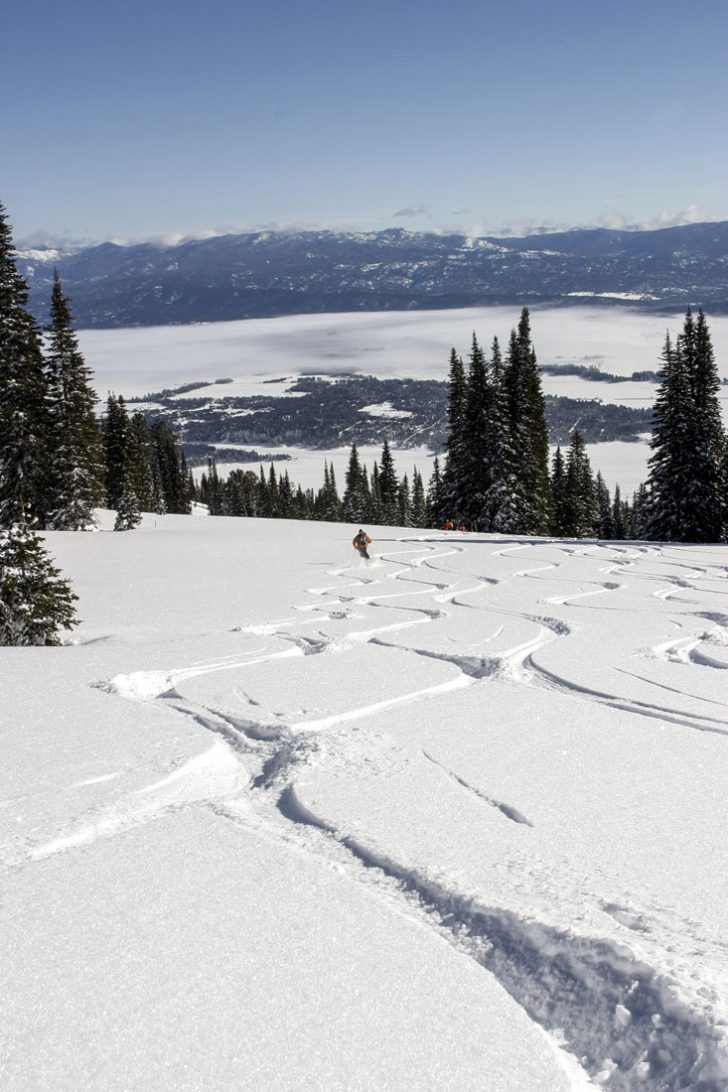
Fred Frost, 74, is a marvel of skiing stamina, regularly racking up more than 4 million vertical feet per season at Whitefish Mountain Resort.

Fred Frost, 74, skis 35,000 – 40,000 vertical daily.

Frost is among the many hard-charging senior skiers at the Montana resort who take advantage of a free-ticket policy for anyone older than 70.

“What else are you going to do in the winter?” says Frost, who skis six days a week during the season, taking only Saturdays off. “I moved here to ski, so I’m going to ski.”

Frost is a retired high school math teacher from Pateros, Wash., who came to Whitefish to enjoy the outdoors.
On a single-degree day in January, Frost skis run after run on Whitefish Mountain’s Chair 1, with its 2,084 feet of vertical. In a typical day, he accumulates between 35,000 and 40,000 vertical feet of skiing, stopping only to do what he calls a “D and R.”

“What’s that?” he’s asked.

“A drain and refill,” he says with a little smile. No food, just a visit to the bathroom and drinking fountain.

To understand why Frost pays so much attention to how much vertical he gets, you need to delve into Whitefish Mountain’s annual Vertical Tracker competition. Since the 2004-05 season, the resort has ranked passholders’ vertical — based on its electronic ticket scanners — and posted the results online. That led to a heated competition to rack up the most vertical in all age groups.

Frost, in the “Super Senior” category, has won the overall title several times and regularly places in the top three. Last year’s overall winner, Ken Jones, 52, is in awe of what Frost accomplishes year after year.

“When I moved here, everyone was telling me about Fred. He was the legend,” Jones says. “He’s so inspirational when you think of his age and how he keeps going.”

Jeanne Reichstadt, 63, skis with Frost regularly and is “amazed by his stamina. He never even stops to eat.”

Reichstadt also bicycles with Frost in the summer and mountaineers with her husband in nearby Glacier National Park to stay in shape.

“It is really amazing how fit many older people are here,” says Reichstadt, who moved to Whitefish 17 years ago from Nebraska. “They want to stay healthy so they can keep going.”

Pam Shaw, 60, is a Kiwi who skis hard at Whitefish

At age 60, Pam Shaw is another older skier who hits it hard at Whitefish Mountain. Shaw, a New Zealander who is spending the winter in Whitefish skiing and working as a nurse, takes a visitor on some of her favorite runs — all rated advanced. She shreds with abandon, laughing at the fun of it all.

And then there’s the over-70 threesome of Ken Meckel, Bob Donahue and Gary Simonsic, who also like to ski the steeps. They don’t care about the vertical competition —  skiing hard is their thing.

And it helps that their skiing is free.

“So far, we haven’t figured out how we can get the resort to pay us,” Meckel jokes.

Adapting your workout to your age.

Stamina, skiing and senior skiers.

Have you noticed that the older you get, you have to work out harder to maintain an ever-decreasing level of conditioning?  Yeah, yeah, yeah…  I know all the reasons but the reality is vigorous work-outs just delay the inevitable.  As we get older our:

  • Bodies aren’t as flexible;
  • Bones are more brittle;
  • Muscles don’t recover as fast; and
  • We lose muscle mass and brain function.

Since I’m losing brain muscle, that must be why I can’t remember why I should stop skiing, so I keep riding lifts.  Then I have to remember how to get down!

Marc Liebman recommends elliptical training for senior skiers.

Seriously, what I did to keep in skiing shape at 40 isn’t appropriate for someone who is 71.  Like my body, it has evolved over time.  Back when I was just four decades old, I ran a 10K five to six times a week at a 7.5 minute per mile pace.  Plus, I did chair sits, squats that strained my thighs and calves, crunches to build my core and other stuff.  All in the name of conditioning for skiing.

Workout menopause started at age 60 during a visit to an orthopedic surgeon.  He gave me a “twofer” of bad news after looking at an MRI.  First, he said if you keep running you’ll need new knees around age 65.  Second, I needed surgery to repair a torn and worn meniscus.  What a bargain!

That was the last day I ran, did squats and chair sits because they strained my joints way too much!  My workout evolved into 50 minutes on an elliptical at least five days a week going fast enough with enough resistance to get my heart rate into the 140s.  Interval training led to strained groin muscles that took months to heal.  My goal in each session is to burn at 475 – 500 calories and cover 4.3 miles.  Crunches and a daily 3.5 mile walk minimize the strain on my leg joints.

All this is in the name of building stamina.  If my legs are dead tired, it is hard to turn or stop which could lead to a bad fall and/or slamming into a tree, lift tower, or worse,  another skier…

I also do much more stretching now than I did before. My focus is on maintaining flexibility. Over time, my body has told me my groin and hamstrings need stretching, and I’ve learned the hard way to listen.  Stretching is also important if for nothing else, flexibility minimizes the pain and strain of putting on ski boots!

You have to tune your body.  Nobody else can.  I’m not big on personal trainers but if that’s what it takes, go for it.  Just remember, as you get older, the whole conditioning process takes more calendar and workout time and effort.  The pay-off in building stamina and keeping flexible is longer ski days.  For me that translates to 27 to 30 thousand vertical.