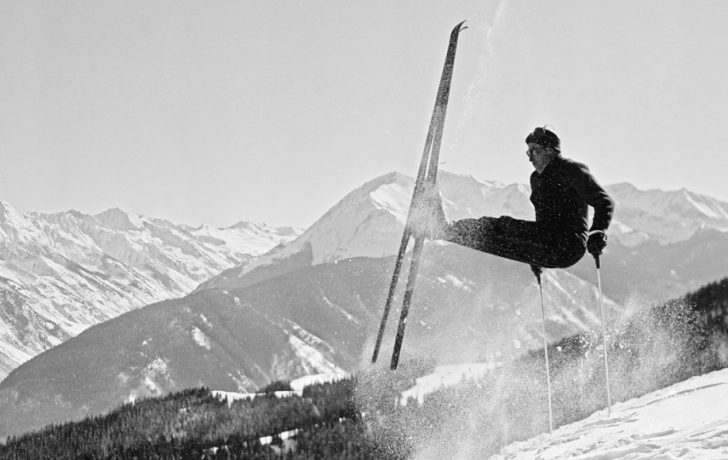
Sir Arnold Lunn wrote the rules for slalom and downhill. Credit: JungfrauStories
When this passage (below) from The Mountains of Youth (1925) by Arnold Lunn was published, “skiing” still had a hyphen and “ski” was both the singular and plural form. Lunn (1888-1974) invented downhill and slalom racing, introducing them when the sport was mostly jumping and nordic racing.
Lunn was knighted in 1952 “. . . for services to British skiing.” He was a major figure in promoting ski sports in the Olympic games. As is obvious in this selection, he was a competitive skier who loved speed and took daring chances.
* * * * * * * *
Arnold Lunn on his first ascent of the Eiger 1924. Credit: Walter Amstutz
The worst and best moments in ski-ing are often separated only by seconds. You are standing at the top of some fierce slope which you have vowed to take straight. You look at the line and observe with sick disgust that the change of gradient is abrupt at the bottom, and that the slight bump half-way down will probably send you into the air. A kind friend says: “I shouldn’t take that straight,” and your enemy remarks: “Oh, it’s safe enough. Jones took it straight yesterday.”And then suddenly, before you quite realize what has happened you are off. The wind rises into a tempest and sucks the breath out of your body A lonely fir swings past like a telegraph pole seen from an express train Your knees are as wax, and your stomach appears to have been left behind at the top. You fight against the tendency of your ski to run apart—the inevitable sequel to undiluted funk—by locking your knees and turning your ski on to their inside edges. And now comes the supreme crisis—the run-out where the gradient suddenly changes. You throw your weight forward, and mutter “Hold it, hold it.” You clench your teeth, and make strange noises as the shock drives up through your legs. Your ski quiver with the strain . . . and you realize to your intense astonishment that you have not fallen.
The pace relaxes. The hurricane dies away. You are drunk with the wine of speed, and you marvel at the faint heart which so nearly refused the challenge. You glory in the sense of control which you have recaptured over your ski no longer untamed demons hurrying you through space, but the most docile of slaves. You are playing with gravity You are master of the snow. You can make it yield like water or resist like steel. Suddenly you decide to stop. A rapid Telemark, the snow sprays upwards, and the “slabberie snow broth,” to quote an old Elizabethan,”has relented and melted about your heeles.”
A laugh floats upwards, and you much enjoy telling your enemy that his diagnosis was correct, and that he can safely venture to take it straight. And, if he falls, your triumph is complete
* * * * * * *
Lunn’s classical education is apparent in his allusion to “an old Elizabethan.” The “slabberie snow broth” quotation, reports the Oxford English Dictionary, comes from the first English translation (1600) of Livy’s Roman History. Shakespeare mentions “snow-broth”—mixed snow and water—once, with reference to the blood in the veins of a villain. (Measure for Measure, I, iv, 57).
British athlete Sir Arthur Lunn helped create a sport out of a past time.
https://seniorsskiing.com/wp-content/uploads/2018/12/Screen-Shot-2018-12-31-at-9.06.35-AM.png257383Jan Brunvand/wp-content/uploads/2014/04/Seniors-Skiing-since2013-Logo@2x-300x68.pngJan Brunvand2018-12-31 09:24:192024-08-21 11:00:00In Praise Of Ski-ing
Last Minute Gift, Tell-Tale Hoar Frost, Jim Gaddis Profile, Mystery Boarder, Seasons Greetings.
Yikes, here come the Santas! Credit: EasternSlopes.com
If you’re caught empty-handed and about to head to another senior ski friend’s party, consider ordering and instantly downloading a copy of Ray Conrad’s classic collection of ski songs, The Cotton-Pickin’ Lift Tower and Other Ski Songs.
Ray wrote and recorded these songs ‘way back in the 60s. If you recall, the revival of folk music and growing interest in skiing happened at the same time. The resulting mash up of ski songs is actually funny, nostalgic, kind of corny, and fun to blast out on the car stereo as you (or the giftee) heads to ski country. Click below for a sample.
You can order the 16-song CD as an instant download from CDBaby/RayConrad for $20.
This Week
We are reprising a timely article from correspondent Harriet Wallis who asks “Should you take an early season lesson?”One of our surveys revealed that about one-third of our readership does in fact take an early season lesson for a variety of reasons, like having to adapt to changing physical capabilities. Click here for her story.
This week’s Mystery Glimpse is a woman snowboarder who…well, you tell us. The function of last week’s thingy is revealed. No, it wasn’t an inclinometer, at least according to the Colorado Snowsports Museum who supplied the pic.
One of our readers, Hiller Hardie, from Pittsburgh, responded to our request for contributions by sending in an interesting article on Hoar Frost, the crystalline formation that appears on the ground or in woodland floors after a humid, cold night. Turns out, hoar frost is used by guides and ski patrollers to assess the risk of avalanche in back country. Find out how by clicking here.
Co-Publisher Jon Weisberg writes about the innovative Apex boot which provides both comfort and support for senior skiers who dread the aches and pains of “regular” ski boots. When we first started SeniorsSkiing.com, we noticed an article about Olympic star Billy (the) Kidd who said that he wore the boots as a way to adapt to his more senior style of skiing. These boots were designed by Denny Hanson who revolutionized the industry in the early 70s with his Hanson rear-entry boot that many people regard as a major advancement in boot design. Readers of SeniorsSkiing.com can get a 20 percent discount on Apex boots until Dec. 31.Jon will tell you all about it by clicking here.
Some interesting comments on last week’s Short Swings! asking if older skiers and boarders are invisible to the people making business decisions about skiing.
Reader Rich Spritz, a Breckenridge instructor, wrote that seniors don’t spend money and it makes sense that, resorts, being businesses, don’t give seniors their attention.
There’s no question that the group he describes exists. I see them sitting around lodges, nursing a cup of coffee; shooting the breeze. But they don’t represent all older skiers. Our reader surveys indicate that on day trips, seniors spend about $100 per person per day and, on vacation, $250 per person per day. Last year we asked how much they spent per person on skiing and skiing-related activities for the season. 56% reported they spent between $1000 and $5000 per person for the season. More than 10% spent $5000 or more. Note that their ages averaged around 67. It may be that older people like to sit around and socialize. But even the most hard-hearted corporations should keep a soft spot for loyal customers who for decades have supported their (or their prior owners’) operations. Considering that most older skiers are at the mountain mid-week, when operations are at full capacity and usage is not, letting older, dedicated skiers hang out over a cup should not a hardship for anyone.
Catherine Meyer wrote that PSIA now offers Senior Specialist credentials to instructors interested in working with older skiers. Many of these instructors are organizing special programs at their home resorts to cater to older skiers and riders.
SeniorsSkiing.com would like to publish a list of areas offering special programs for older skiers and boarders. We’d appreciate information about those programs from readers.
Bob Ohrt wrote that skiing has always been young adult oriented. The pics you see in ads are almost always the young and the beautiful. That is fitting…When skiing we don’t think of ourselves as Seniors.
Bob is correct. One of our reader surveys asked for actual age and how respondents felt after a good day on the hill. The average actual age was 67; the perceived age was 47. That’s consistent with age perception surveys in non-skiing sectors. For most people, behavior (e.g. spending and lifestyle decisions) is influenced by perception, and when we perceive ourselves as younger, we behave that way. I’m in favor of keeping that 20-year subtraction in our age arithmetic.
And Ellen wrote, Senior skiers are the healthiest seniors I know, it would be awesome to see us depicted in some ski ad!! I…bet lots of the youth and families out there are being bankrolled for these pricey endeavors by grandma and grandpa.
Ellen, you are spot on!
Summit County (CO) 50+ Winter Games to be Held Feb 10-12
The 39th Annual 50+ Winter Games in Summit County, Colorado will be held February 10 – 12. Seniors compete in Alpine and Nordic events, figure and speed skating, and “hockey shoot skills.” The event also features a series of social events. It’s a fund-raiser for the Summit County Senior Nutrition Programs. Inexpensive to participate and sounds like a lot of fun. Click hereto register or for more information.
Tribute to Stein and Best Pow Vids of the Year
Stein Eriksen was born in and died in the month of December. His grace on skis transformed the sport. I had the good fortune of riding the lift and skiing with him a few hours one morning at Deer Valley. It was in the late-80s or early-90s. This 41/2 minute tributeto his skiing accomplishments is wonderful.
Powder Magazine,which always publishes mind-boggling ski pix, issued this 3 minute video compilation of the best powder videos of the year. My guess is that the skiers pictured are between 16 and 24.
Ski Cakes!!!!!
Last week I showed a picture of my ski-oriented brithday cake and asked to see some of yours. Please keep them coming…
Marilyn Edman sent in this beauty made by her friend Sue McEvoy on the occassion of Marilyn’s 70th.
And Kelli Majiros sent in this from her Tuesday morning Ski Divas group at Jack Frost in the Poconos. Group leader, Bernie Oldroyd, leads an annual Susan B. Komen Ski for the Cure fundraiser.
Skiers’ Travel Trailer?
Reader Scott Colesworthy asks if anyone can recommend a travel trailer made for winter conditions: insulated, cold-resistant plumbing, etc. Please register suggestions in Comments following this article.
Happy Holidays!
Mike and I are taking a break for the holidays. SeniorsSkiing.com will be back January 4.
A Tell-Tale Sign To Watch For In Avalanche Country.
As the weather in the Northeast has gradually become colder over the last few weeks, I have noticed the soil in my garden develops into crystalized patterns such as those in the picture below:
Crystalline shoots are a sign of hoar frost. Credit: Hiller Hardie
Of course, as the weather starts to turn cooler, I naturally start to think about skiing. As these thoughts materialized recently, I realized that this crystallization follows the same process as that of surface hoar in the snow pack. Surface hoar presents, on a smaller scale than these pictures, in a very similar manner. It develops overnight when the following weather conditions exist:
Clear sky
No direct sunshine, or very weak sun
Calm or light winds
Open slope exposed to a clear sky (trees or clouds can radiate their own heat and disrupt the process)
Humid air
If you have been fortunate enough to participate in guided backcountry skiing, including heli or snow catting,you may have witnessed the guides digging a pit in to the snow pack to evaluate its stability. You may also have seen ski patrollers doing this, notably at Western ski areas. Evidence of surface hoar in the underlying layers is one of the things they are looking for. It is also cause for alarm as it generally represents a very weak layer at high risk of releasing. (Another feature they may note, with alarm, is a layer of “ball bearing” like snow similar to hail. It looks like very small marbles and is a hazard as the overlying snow pack could literally roll right off of the “ball bearings’ forming a slide).
At any rate, the fact that this crystallization is occurring in my garden is good news for me as it means the weather is cooler and ski season is upon us. Here’s to a good winter!
https://seniorsskiing.com/wp-content/uploads/2018/12/SH2-e1545249737916.png518690Hiller Hardie/wp-content/uploads/2014/04/Seniors-Skiing-since2013-Logo@2x-300x68.pngHiller Hardie2018-12-19 15:14:432018-12-19 15:14:47Looking At Surface Hoar Frost
[Editor Note: From time to time, we’re going to dip into our extensive archives for a story that might be useful, interesting, or entertaining. Here’s one from 2014 from correspondent Harriet Wallis.]
Starting right sticks all season.
My friend says the same thing every winter. She says wants to take a lesson as soon as there’s more snow on the ground or when she has more ski days under her belt.
That’s been going on for as long as I’ve known her, and she still hasn’t taken a lesson.
If you’ve ever said that, you’re not alone. Many skiers and riders think that more snow or more ski days are the prerequisite for a lesson.
So I asked some ski pros about it.
Start early and bond with your instructor! Credit: Harriet Wallis
“Skiing is a seasonal activity, so whether you’re a vacationer who skis once a year or whether you ski all season long, you come back to it fresh at the beginning of the season,” said Tom Pettigrew, director of skier services at Park City Mountain Resort in Utah. Early season lessons are really beneficial because “all of your movement patterns are not totally engaged yet, so it’s easier to learn new patterns before you get entrenched in old ones.”
In addition, while the terrain might be limited, it’s actually an advantage. You can get comfortable on your skis and make learning breakthroughs without being distracted by vast terrain choices, Pettigrew said.
Scott Mathers, ski school training director at Alta, UT, says the same thing in a different way. “Your senses are heightened when you first start to ski again. You’re aware of how your body is moving and what it’s doing. But as you ski more, you get desensitized, making it harder for you to make changes.
“It takes a lot of practice for something to become ingrained,” he said. “An early lesson gives you something to focus on for the rest of your vacation or for the season.”
https://seniorsskiing.com/wp-content/uploads/2014/08/EarlySeasonLesson-e1407245883594.jpg587600Harriet Wallis/wp-content/uploads/2014/04/Seniors-Skiing-since2013-Logo@2x-300x68.pngHarriet Wallis2018-12-19 13:45:162018-12-19 15:47:12Should I Take An Early Season Lesson?
A competitor, a snowboarder (obviously), a woman. See if you can put these clues together. Once again, thanks to the Colorado Snowsport Museum in Vail, CO., for this contribution. Put your guess in comments below.
Last Week
Credit: Colorado Snowsports Museum
This artifact is a United States Forest Service avalanche control gun sight. It was used by Dick Stillman in 1955 at Berthoud Pass. During World War II, Dick served in the 10th Mountain Division, trained at Camp Hale, and saw action in Italy. After service, he started a 30-year career with the Forest Service as part of the U.S. Department of Agriculture. He established and maintained the High Alpine Avalanche Research Station at Berthoud Pass, Colorado from 1950 to 1963. At that time, the station was the highest in the world conducting avalanche research at 11,315 feet
Advice Jim Followed: When You Come To A Fork In The Road, Take It.
Ski buddies Alan Engen (l) and Jim Gaddis at Alta c. 2001. Credit: Alan Engen Collection
From the time Jim was a youngster, his single goal was to be an Olympic ski racer. He lived for that. He trained for that. But when he was shut out of the Olympics, it didn’t stop him. He generated ways to help others in the sport he loves.
His accomplishments include being an elite Intermountain ski racer, an inspiring coach, a great salesman, an imaginative program starter, a premier fundraiser — and he’s still moving on. Just try to keep up with him.
Yankee baseball legend Yogi Berra had a saying for it: “When you come to a fork in the road, take it.” Every time Jim came to a fork, he took action, reinvented himself, and moved forward. It’s a lesson we all can learn.
From Sears Skis To Winning National Racer
As a youngster Jim sledded on a golf course and saw someone using strange equipment: skis. He asked for skis for Christmas, and his parents bought him a complete set: skis, strap bindings and boots from the Sears catalog for $5.
He practiced at Alta and Brighton when his older brothers could give him a ride there. And he strived to ski like his good friend and acclaimed ski champion Alan Engen, son of famed Alf Engen.
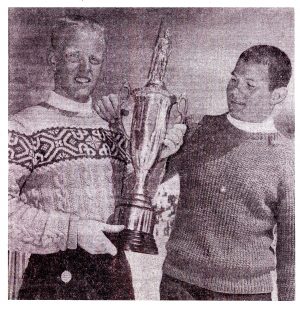
Alan Engen (l) and Jim Gaddis hold the Intermountain Ski Association Alpine Combined trophy. Each won the championship 3 times. c. 1959. Credit: Alan Engen Collection
Early on, he entered his first race on his $5 skis. It was a slalom-type course on the steep face of Collins at Alta. “I don’t know how many times I fell, but I made it down in about 4 minutes,” he said. The winning time was 40 seconds! Defeat spurred him on.
His skills and determination grew, and he entered — and won — national races. He won the National Giant Slalom Championship. And three times he won the NCAA Alpine Championship and three times the famed Snow Cup. But three was not his lucky number. His dreams were derailed when he broke his legs not once, but three times in race accidents, Still nothing stopped him.
Finally he was on target for the 1964 Olympics, and he qualified for it. But his dream was crushed. He was shut out of the elite team that included Jimmie Heuga, Buddy Warner, Billy Marolt and Billy Kidd, with Bob Beattie as the coach.
“It was very hard to deal with,” he said. “It was my whole life’s ambition to be an Olympic racer — and maybe win.” At that point, he didn’t even have a job because he was totally focused on being an Olympic racer.
It was a fork in the road. He took action, reinvented himself and surged ahead.
Metamorphosis
Using his degree in banking and finance, he became a stock broker. But his passion was skiing, so he created the Gaddis Training Organization to coach elite and youth racers. The program grew to 110 racers with seven coaches, and he ran it for 12 years. It became Park City Mountain Resort’s ski team.
His Olympic dream had a legacy. But he didn’t stop there.
Another fork
Jim discovered he had a natural ability to promote and sell. When the University of Utah had trouble raising funds to expand its stadium, Jim took the challenge and quickly sold 40 seats.
From that beginning, his fund raising expertise expanded. His accomplishments read like a Who’s Who of skiing.
Energetic and active Jim Gaddis today. Credit: Harriet Wallis
He spearheaded fundraising for many ski organizations, and founded and chaired others including: the Youth Winter Sports Alliance which gets kids involved in winter sports; the National Ability Center, teaching skiing to handicapped; the Stein Eriksen Opportunity Endowment, which raised $2 million in two years to help local athletes with equipment and travel expenses; and the U.S. Ski and Snowboard Foundation Ski Ball, raising funds for the U.S. Ski and Snowboard teams.
He also chaired the Jimmie Huega Express, which raised $1 million annually for the Huega Multiple Sclerosis center; was instrumental in fund raising for construction of the Alf Engen Ski Museum, which preserves the Intermountain history of skiing; and helped found and raise funds for the Utah Ski Archives, the country’s largest ski research repository of historic material. The Archives collection currently contains 500,000 images, 250 manuscripts and 6,000 audio,video and films, and it’s open to the public.
Just recently, Jim once again raised funds for his Alma Mater. He chaired the University of Utah’s campaign that raised $2.5 million and built a dedicated training facility for the University’s winning ski team.
His Olympic dream lives on in unique ways. He really is a gold medal champion.
Jim’s life demonstrates his philosophy: “Always do a good job. Do it right, and do it honestly. Don’t let anything stop you.”
Today, energetic and active, he takes time from initiating programs and raising funds to ski with a group of friends at Deer Valley and Park City Mountain Resort.
https://seniorsskiing.com/wp-content/uploads/2018/12/3-Alan-Engen-and-Jim-Gaddis-circa-April-1959-001-CROP-e1545155165135.jpg728706Harriet Wallis/wp-content/uploads/2014/04/Seniors-Skiing-since2013-Logo@2x-300x68.pngHarriet Wallis2018-12-18 12:47:452018-12-18 12:51:56Ski Champion Jim Gaddis: When Life Got Tough, He Surged Ahead
Cozy Feet. Happy Skier. That’s the headline for the APEX Ski Boot System advertisement at the right of this article. It’s worth taking notice…especially with the unusual, limited time 20% discount to SeniorsSkiing.com readers.
In a reader survey from a few years ago, we asked which new equipment you intended to purchase in the coming season. 25% of you responded “ski boots.” Your reasons generally had to do with issues of comfort and support. Cold feet. Painful feet. Blackened toe nails. The need to spend more time than wanted in the lodge. Difficulties getting the damn things on and off.
APEX offers an excellent solution to these and other problems. It combines a comfortable snowboard-type boot with a hardshell partial exterior. The beauty of this approach is that it allows the wearer to walk to the lift or the lodge in the soft boot only and carry or leave the hardshell in the bindings.
There are many ways to adjust the boot and many sources of help to get it right.
The boot was conceived by Denny Hanson, whose Hanson rear-entry skiboot was popular in the 1970s and is still favored by some older skiers who fell in love with the comfort it provided.
For some, finding a boot that is functional and comfortable is enough of an obstacle to get in the way of their favorite winter outdoor activity. If that includes you, or if you are curious about stepping into a new, comfortable, and proven ski boot design you may want to 1) demo the APEX (free to SeniorsSkiing.com readers) at any of its dedicated demo centers (click here for locations), or 2) take advantage of the company’s rare 20% discount (exclusively for SeniorsSkiing.com readers) by entering SENIOR3000 at checkout.
https://seniorsskiing.com/wp-content/uploads/2018/11/Screen-Shot-2018-11-21-at-10.45.26-PM.png421411Jon Weisberg/wp-content/uploads/2014/04/Seniors-Skiing-since2013-Logo@2x-300x68.pngJon Weisberg2018-12-17 18:07:042018-12-17 18:16:46How Cozy Are Your Feet?
Open The Archives, Technique, Mystery Glimpse, Gift Ideas With Serious Discounts For Readers.
SeniorsSkiing.com’s fifth anniversary year has caused us to reflect back on the articles that have appeared on these virtual pages. Incredibly to us, we have posted almost 1,000 articles from professional journalists, ski business people, freelancers, readers, contributors-from-out-of-the-blue, and correspondents. Our archives is an amazing collection of opinion, wisdom, tips, nostalgia, commentary, reviews, jokes, and you-name-it, all focused to the interests of the senior snow sports enthusiast.
So, throughout this year, we will be re-posting some of our most popular and our personal favorite stories from our vault.
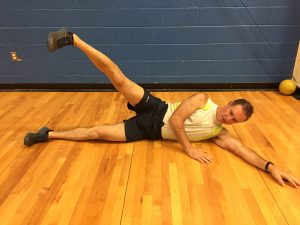
Since we get a lot of inquiries about how to get fit, here is a series of three, progressively-more challenging articles showing you five basic exercises you can do at home. These were originally published in October and November 2016. Our teacher is Rick Silverman, a physical therapist and exercise consultant, who demonstrates these basic exercises with increasingly more challenging variations.
Check out our other hidden gems. We’ll be excavating more interesting posts in future issues.
This Week
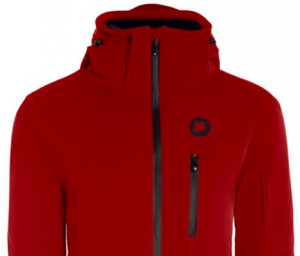
Get an Orsden parka at 30% off thru Dec 31.
Co-Publisher Jon Weisberg opens Santa’s gift bag with lots of ideas for seniors. Note: SeniorsSkiing.com readers can get a discount on any and all of these cool products. Seriously folks, now is the time to buy those presents in time for the holidays. Just make sure you get your discount code right! Click here for the story.
We hear from correspondent Pat McCloskey who has looked at the “One Team” concept and how it relates to ski technique. It is an interesting take on the basic athletic requirement of moving through a motion. Let him explain it by clicking here.
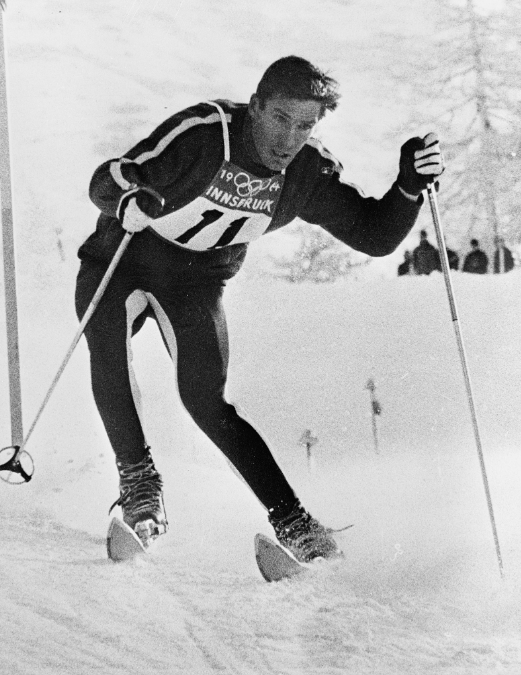
Learn who the Mystery Glimpse racer was and see the new challenge by clicking here. For the first time, we had many, many correct answers. Our racer was lost far too soon, and, had he lived, he would have been a big celebrity in the ski industry. Here’s the answer.
Buddy at Innsbruck.
Finally, correspondent Marc Liebman recalls an incident when he was testing skis for SKI magazine back in the 70s. Guess who showed up at testing headquarters and asked if he could give a few pairs a whirl?
Thanks for reading SeniorsSkiing.com. Please tell your friends, and remember, there are more of us every day and we aren’t going away!
https://seniorsskiing.com/wp-content/uploads/2018/12/Screen-Shot-2018-12-11-at-3.37.24-PM.png675521seniorsskiing/wp-content/uploads/2014/04/Seniors-Skiing-since2013-Logo@2x-300x68.pngseniorsskiing2018-12-14 00:15:462018-12-14 06:24:25This Week In SeniorsSkiing.com (Dec. 14)
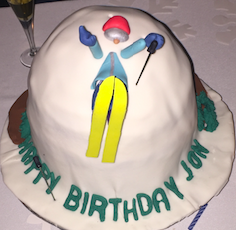
Here’s a picture of the birthday cake that, along with a lot of other things, surprised me last weekend. The side you don’t see had pine trees around the bottom. Looked good and tasted delicious.
Jon’s surprise birthday cake.
If you have a ski-related cake or other confection you’d like to share with the SeniorsSkiing.com community, send a picture to jon@seniorsskiing.com or mike@seniorsskiing.com.
https://seniorsskiing.com/wp-content/uploads/2018/12/Screen-Shot-2018-12-13-at-3.32.30-PM.png230236Jon Weisberg/wp-content/uploads/2014/04/Seniors-Skiing-since2013-Logo@2x-300x68.pngJon Weisberg2018-12-13 15:46:482018-12-13 15:46:48Piece of Cake
No Matter What You Are Sliding On, Basic Athletic Principles Apply.
When I was a boy, my dad knew a woman who was a former USGA Senior Amateur Champion from South Carolina named Carol Cudone. She constantly reminded my dad to finish his golf swing with his “belly button to the ball.” Ultimately she was trying to get my dad not to hit his shot off the back foot. Or swing in a static position.
When I played a lot of tennis back in the day, I always was reminded by my coaches to finish the stroke on the front foot with my center of mass facing the completed shot. Again, not off the back foot.
Mikaela Shiffrin says that skiing is not static either. It is a continuous movement of working the ski from tip to tail in the turn with the center of mass always moving towards the next turn. Three separate sports with a common theme of moving the body in an efficient manner in order to complete a shot, stroke, or turn. The common movement pattern is getting the center of mass in a position to execute a turn in the direction that you wish to go and to make a shot in the direction that will be successful. Fluid movement and not static at all.
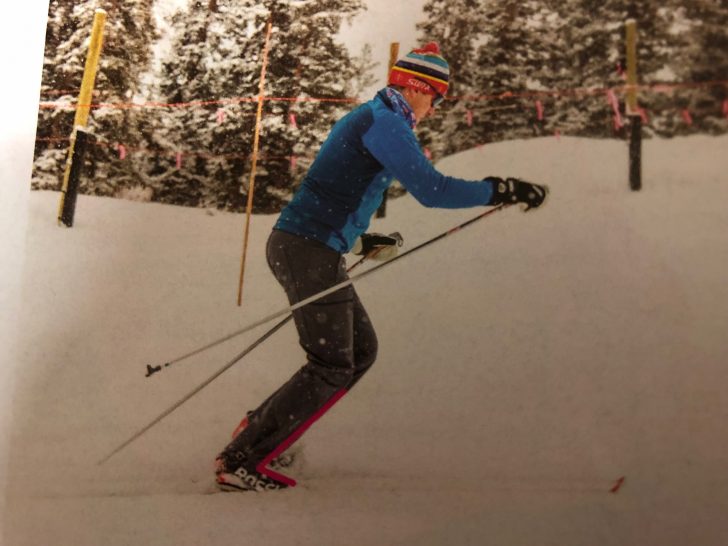
Recently, there was a commentary in the winter issue of 32 Degrees, the official publication of the Professional Ski Instructors of America, about the “One Team Concept”. The magazine was doing a series of interviews about “Interski”, a global summit of international ski instructors with the goal of sharing knowledge and technique.
Forward, not on the back heel. Credit: “32 Degrees”
The United States team is always very popular at these events, and, in recent years, the concept of “One Team” has been a focus. “One Team” is all about representatives of alpine, cross country, telemark, and snowboarding all coming together to discuss the value and similarity of teaching techniques as they relate to how people learn and how to teach different personality types.
“One Team” also explored how similar movements in different disciplines of sliding on snow create efficiency and effectiveness. As in the movements of golf and tennis, these four disciplines of snow sports have similar movement patterns. Not only is the center of mass moving towards the new turn a common goal, but there is also the important role of a flexed ankle. As you can see from the alpine photo, the flexed ankle manages the pressure of an alpine ski turn against the terrain. So many people refer to bending the knees but the primary joint critical in the execution of a ski turn is the ankle.
Note forward ankle bend. Credit: “32 Degrees”
If you look at the cross country photo, the key to balanced forward movement in traditional cross country technique requires a flexible ankle to not only initiate the stride, but to keep the center of mass where it should be—forward— and not static-centered which hampers the glide process. The same technique is required for successful telemark turns with a soft ankle utilized to maintain balance and forward movement.
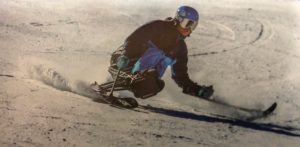
Finally, in the adaptive world, there is a lot of talk about the outriggers being used as legs on an upright skier. As the adaptive skier moves his center of mass towards the new turn, the outrigger extends on the initiation of the new turn and the other collapses on the inside of the turn. This is much like the flexed soft ankle of the uphill ski in an alpine turn.
As the adaptive skier moves his center of mass towards the new turn, the outrigger extends on the initiation of the new turn and the other collapses on the inside of the turn much like the flexed soft ankle of the uphill ski in an alpine turn. Credit: “32 Degrees”
Alpine, cross country, adaptive, telemark, and snowboarding all have a common balance and ankle platform that really creates a “one team” concept both in the actual instructional technique but also in the philosophy of a united front in teaching and learning techniques. No matter what you are sliding on, the basic athletic principles apply. Have you ever pressed your outside foot down and your inside foot up in a bicycle turn to the left? The same principles apply there as well with the center of mass headed towards the turn along with the long leg, short leg, flexed technique.
As Mikaela says, nothing is static. A good athlete is fluid and utilizes good body balance, movement, and flexion to execute that shot or turn. Think about it the next time you do something other than skiing and definitely think about that center of mass movement across the skis towards the next ski turn with your ankles flexed.
https://seniorsskiing.com/wp-content/uploads/2018/12/XC_ankle-e1544623544650.jpg546728Pat McCloskey/wp-content/uploads/2014/04/Seniors-Skiing-since2013-Logo@2x-300x68.pngPat McCloskey2018-12-12 09:14:322018-12-13 13:41:25Technique: The One Team Concept
Thanks again to the Colorado Snowsports Museum in Vail, CO, for contributing this photo to our series. A special shout-out to curator Dana Mathios for picking some interesting relics and for providing answers to the “glimpse”.
The collection at the Colorado Snowsports Museum tells the story of the explosive rise of skiing in the Colorado Rockies, preserving a legacy for future generations.
Last Week
Tread Of Pioneers Museum in Steamboat Springs, CO, provided this picture of racer and celebrity Buddy Werner in happy times. On the left is Vanda, his wife, on the right is Skeeter Werner, his sister. As so many of you commented, Buddy was raised in Steamboat, raced in the late 50s and 60s, make the ’56, ’60, and ’64 Olympic teams, and, in 1959, managed to be the first non-Austrian or Swiss to ever win the famed and formidable Hahnenkamm downhill race in Kitzbuhel. Only one other American has ever won that race since, and that was Daron Rahlves in 2003.
Buddy at Innsbruck.
After the 1964 race season, Werner retired from ski racing at age 28. Later that year, he and others were filming ski scenes for Willy Bogner’s first of many movies, Ski Fazcination, when he and German racer Barbi Henneberger were buried in an avalanche at St. Moritz. Bogner was eventually tried and convicted of negligent homicide and served a suspended sentence. The entire ski world was stunned.
Buddy Werner was posthumously inducted into the National Ski Hall of Fame, now the US Ski and Snowboard Hall of Fame, later that year.
Buddy Werner, American ski racer, 1936-1964. Credit: Tread Of Pioneers Museum
https://seniorsskiing.com/wp-content/uploads/2018/12/Screen-Shot-2018-12-11-at-2.58.06-PM.png679713seniorsskiing/wp-content/uploads/2014/04/Seniors-Skiing-since2013-Logo@2x-300x68.pngseniorsskiing2018-12-11 15:26:512018-12-11 15:40:15Mystery Glimpse: What’s This Thingy?
Are older skiers and boarders invisible to the people making business decisions about skiing?
Unless, you’re a marketer selling reverse mortgages, extended care facilities, pharmaceuticals, or walk-in bathtubs, most companies ignore our market segment.
In the world of skiing corporate ski area consolidators are eliminating senior discounts, and ski makers haven’t bothered to present a product designed and presented for our unique needs. There are exceptions, but the norm is to focus on youth.
When’s the last time you opened one of the dwindling number of ski magazines and saw an ad showing anyone from our set?
This isn’t a complaint. It’s an observation. We represent 20% of all skiers/boarders. We ski more frequently, spend more money, and have more influence on introducing people to the sport.
Maybe if we simply started to speak about the issue with each other, we’ll start a process that will help older skiers gain greater visibility. With visibility comes recognition. With recognition comes value. And with value, comes respect.
If you have a point of view on this matter, please share it with other readers in Comments.
Weight Training Reduces Strokes, Heart Attacks
A study published in October in the journal Medicine & Science in Sports & Exercise provides evidence for the first time that even a little weight training might reduce the risk of heart attack or stroke. It is based on healthcare data of thousands of men and women getting annual checkups at the Cooper Clinic in Dallas. Risk of experiencing heart attack, stroke or death was about 50% lower among those who lifted weights occasionally compared to those who never did.
Seeking Financial Support for Military With Disabilities
Disabled Sports Eastern Sierra (DSES), the non-profit adaptive sports program based in Mammoth Lakes, CA, is seeking contributions for its 13th annual week-long sports camp for active duty and veterans with disabilities. More at www.WoundedWarriorsMammoth.org/Donate .
Skiing Through a Straw
This 90 second videois amazing. It shows Cody Townsend skiing what appears to be an almost vertical narrow slot canyon somewhere at the top of the world. AMAZING!
If you’re still looking for something different and/or special for older snow enthusiasts, the following suggestions are discounted for SeniorsSkiing.com followers and can be ordered online.
APEX Ski Boot combines a removable Open Chassis with a walkable boot.
APEX Boot System is offering 20% off retail for SeniorsSkiing.com readers. This is the boot many olderskiers are talking about. It’s a good performer, comfortable, and let’s you walk with ease. No issues getting it on or off. Enter Senior3000 at checkout.
Panda Poleshave bamboo shafts and are beautifully hand-crafted in Idaho. SeniorsSkiing.com subscribers get a 30% discount off the regular price of $95. Enter SENIORS30 at checkout.
Orsdenmakes wonderful parkas and pants in great colors. They’re sold only online. Comparable products in stores sell for twice as much. SeniorsSkiing.com subscribers get a 30% discount through December 31. Enter WINTER30 at checkout.
The Buffalo Wool Companymakes socks, gloves, hats from bison down mixed with silk, yak, wool, and cashmere. SeniorsSkiing.com subscribers get a 10% discount. Enter SeniorsSkiing in the discount code window at checkout.
DeBooter is a skiboot jack, that makes boot removal a breeze. SeniorsSkiing.com subscribers get a 20% discount. Enter SENIORSSKIING at checkout.
GearBeast is a colorful smartphone carrier attached to a comfortable neckstrap. While skiing, the phone is under the parka, keeping it warm, accessible, and safe. GearBeast has a little built-in pocket to carry credit card, driver’s license and a few bills. SeniorsSkiing.com readers receive a 20% discount (regular price: $9.99 – $12.99) by visiting gearbeast.comand entering SENIORS-SKIINGat checkout.
Wild West Jerkymakes great-tasting, all-natural, jerky products. SeniorsSkiing.com subscribers receive a 20% discount off full retail. Enter seniorsskiing in the promo code window at checkout
Happy Holidays!
https://seniorsskiing.com/wp-content/uploads/2018/11/Screen-Shot-2018-11-21-at-10.48.11-PM.png264200Jon Weisberg/wp-content/uploads/2014/04/Seniors-Skiing-since2013-Logo@2x-300x68.pngJon Weisberg2018-12-11 13:18:522019-01-18 09:24:45Holiday Gifts For Senior Skiers
Gene Hackman and Robert Redford in “Downhill Racer” (1969). This heart throb really loved to ski.
Back in the early ‘70s, SKI Magazine (remember it?) developed a program called SKIpp that stood for “ski performance prediction” developed by the late John Perryman. He was a talented engineer who spent years in aerospace and worked with Howard Head at Head Ski Company. SKIpp had two parts, the laboratory analysis that predicted how the ski would perform and on-snow testing. Each year we tested 200+ skis.
John did the analysis and I ran the on-snow testing. Our testers were a mix of male and female skiers, primarily ski instructors with some racing experience. In March, 1974, we were at Park City which let us set up our testing tent near the base of the Shaft lift. Every morning, we tested ten pairs of skis. After lunch, each tester picked his favorite ski from the day or prior days and headed for the lifts.
One bright sunny morning, my lovely wife Betty was collecting test forms in the tent along with Joan, John’s wife, when one of the testers who was, at the time, the ski school director of Sundance Ski Area, walked into the tent and asked a simple question. “Would we allow Robert Redford ski on some our skis?”
We had skis that weren’t on sale yet, some that wouldn’t make it to the market, some that should never been sold to skiers, and Redford hadn’t signed the liability waiver. All of this went out the tent flap when Redford walked into the tent.
I tried to be my best cool, calm and collected Naval Aviator self, but the look on our wives’ faces was priceless – eyes and mouth wide open. Both were speechless that, if you knew them, was rare. His presence attracted the other three female testers who were nonchalantly trying to swap skis or ask Betty, John, or me a question just so they could get in the tent with Redford.
John looked at me, I looked John, and we shrugged. While our wives stared at the famous movie star, I managed to ask, “Can you ski 200 centimeter skis?”
“Yes.”
“What size boot do you wear?”
He gave me a size that I don’t remember. This was back in the days when boot sole shapes weren’t standardized, and we were using Market Rotomat rental bindings that took some fiddling to adjust. None of the easy-to-adjust bindings that we see today existed.
To this day, Betty will tell you she talked to him for a few minutes but has no idea what she said or was she coherent. What we do remember was that Redford was as good-looking in person as he was on the screen.
Oh, and one more thing. By the time he returned the skis, the word was out that Redford was around and a larger than usual crowd had gathered around the tent. None of us were smart enough to get him to autograph the test card he graciously filled out. Oh well!!!
Weather Factoids, Driving School, PA Trail Names, Utah Poet, Special Birthday For Klaus.
Sno Country’s Martha Wilson slides thru a turn under Tim O’Neil guidance. Credit: Martin Griff
Busy week here at SeniorsSkiing.com. We attended the Northeast Winter Weather Summit at Stratton Mountain, VT, and met with meteorologists, ski resort operators, and lots of journalists to discuss matters of mutual interest. And we picked up some amazing fun facts from hanging around with some weather people:
Add this to climate change anxiety. A veteran weather man said the number of sun spots is on the increase. More spots means the sun is burning less hot than the past. The meteorologists call this the “solar minimum”, where sun spot activity causes the upper atmosphere to cool down. Apparently, it’s a cycle, and we are in the coolest part. Expect: Bitter cold winters, cool summers, perhaps a new Ice Age. (Not kidding, watch the news.)
For every 1,000 feet of altitude you ascend in going from a low lying area to a ski resort in the mountains, there is a drop of 3.7 degrees F. So, if it is 32 degrees in Boston, when you travel up 1,900 feet to the base lodge of Cannon Mountain, the temp will be roughly 24 degrees.
The record wind speed at the top of Mount Washington was 231 mph in 1934. Since then, the record has passed on to Australia where a speed of 253 mph was recorded during Cyclone Olivia in 1996.
The crew at the top of Mount Washingtonhas to de-ice their manual wind anemometers and other instruments by hand, climbing a ladder to the top of the station and banging off the ice with a hammer, regardless of the weather. That happens as much as every 15-20 minutes, if a storm keeps building up the ice rime. Note: during storms on Mount Washington, the wind can be up to 140-170 mph. Here’s a 38 second video of a guy outside the MWO when the winds are only 109 mph. Click on the image to play.
Winter Driving Tips
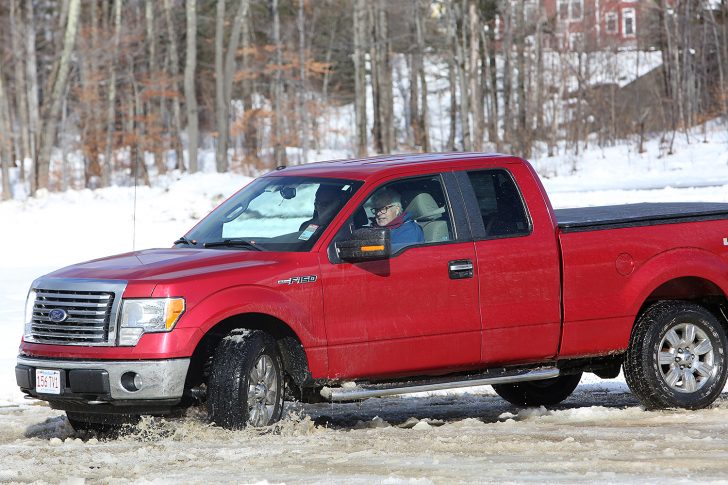
My Big Red Truck sliding thru a turn, under the guidance of the Team O’Neil Rally School. Credit: Martin Griff
We also had a lesson in how to drive in winter conditions from the Team O’Neil Rally School in Dalton, NH. In a separate story, we’ll show you the one extremely important driving control button on our Ford truck we never knew existed and what happened when we pushed it. This was a counter-intuitive eye-opener, and we want to make sure you know about what your special button does in your car because it is imperative you understand how to use it in certain conditions. In addition, we learned about lower tire pressure for deep snow (up to a point), and the importance of being prepared for the mountains. You can watch lots of different videos on driving techniques from Team O’Neil by clicking here.
Correspondent Don Burch’s series on ski trail names continues east to Pennsylvania. Writer and cartoonist Mike Roth offers a whimsical take on trail names, too. Jan Brunvand brings us a poem from a Utah poet with advice for a new skier. Our Mystery Glimpse presents a new challenge with two photos of a legendwho was gone before his time and the answer to last week’s puzzle. Someone actually got the right answers, others were pretty close.
Finally, we honor Klaus Obermeyer, the venerable ski fashion icon, who is 99 this week.
Please remember us to your friends. There are more of us every day and we aren’t going away.
https://seniorsskiing.com/wp-content/uploads/2018/12/SENIOR-01-e1544126870182.jpg485728seniorsskiing/wp-content/uploads/2014/04/Seniors-Skiing-since2013-Logo@2x-300x68.pngseniorsskiing2018-12-07 00:48:482018-12-07 07:47:30This Week In SeniorsSkiing.com (Dec. 7)
Twenty-seven thousand, three hundred and ninety-four days. Exactly, nine hundred months. On Wednesday I turned 75. For all but the first nine years, skiing has been my passion.
Two things about me contribute to this craziness: I love being outside in the cold, and what I lack in athleticism, I’ve made up for with persistence.
In Okemo’s early days, when I was 11 or 12, I spent the better part of a season determined to ride the Poma without falling. Eventually, I conquered that demon.
For several years, it seemed I was condemned to the stem, functional but awkward. I remember the moment at Mount Snow when a mogul inadvertently caused me to parallel turn. Before long, I had to think twice before stemming.
There were times when I was bedridden. Regardless of time of year, crumpled sheets became mountain ranges, and my mind took me places where I would ski.
In my teens and twenties, friends and I would jump-turn down Eastern trails, stopping with the occasional tip roll. We wore double leather boots wrapped with long thongs. More than once, I’d get to the bottom and realize my skis were splintered.
There were long weekend rides from Manhattan to Killington and Stowe. On the Stowe Road, the LaMarr’s provided a bunk bed and a hearty breakfast for $5.00. On one of those trips another car spun out of control and wrecked my new MG Midget. Hitchhiking that weekend put me on the road to getting hitched. One of the girls who picked me up became my bride.
Soon, skiing shifted to the West, starting in Alta in 1972. It’s been a rare season since when I haven’t
skied that magic mountain. At one point I fell in love with powder. Those of you who have been up to your knees or thighs or waist will understand. When it’s that deep, steep is your friend. It’s a joyful experience, and, like the word, “joy,” it’s ephemeral.
Over the years, I’ve learned to follow the snow. It’s great to spend the day seeking out the best conditions. It might take you to blacks, blues, or greens. If you know how to use your equipment with the least amount of effort, and if you enjoy making graceful turns, you’ll understand this preoccupation with the physics of poetry.
These days, I’m deliberately slow. Wherever I go – and if I feel up to it – I like to play with the fall line, skiing slowly, making well-formed turns. Some kid me about getting more turns per vertical foot. Others get tired of waiting.
I view skiing as a metaphor for life. We develop and use a range of skills. Some days are bluebird; some are dark. There are times of confusion when we feel our way into clarity. Other times it can be cold, miserable, and ugly. But most of the time, skiing is an expression of love.
Legally Younger?
A 69 year old in the Netherlands tried to legally change his age to 49, which, he says, is how old he feels. The Dutch government rejected the request. He plans to appeal, based on the idea that other forms of personal transformation, such as name and gender, are gaining traction in the Netherlands. In one of the SeniorsSkiing.com reader surveys we asked about your actual age and how old you felt after a good day on the slopes. Your ages averaged about 67. How old did you feel? Twenty years younger!
Rare 20% Discount from Apex Ski Boot System
If you’ve been thinking about slipping your feet into a pair of Apex boots — they provide comfort and performance and, like the ad states, let you Ski Hard and Walk Easy — now is a good time to do it. The company is offering a 20% discount to the first 50 SeniorsSkiing.com readers who respond (shipping to the lower 48, included). Offer ends Christmas day. Go to the Apex website, make your selection, and enter SENIOR3000 on checkout.
Ski Whiteface with an Olympian
Mirror Lake Innin Lake Placid, is a lovely place to stay when visiting Whiteface Mountain and other North Country attractions. Starting this season, Andrew Weibrecht, son of the Inn’s owners and an Olympic medalist, is available to ski with Mirror Inn guests at Whiteface. It’s on the pricey side ($450 for 8:00AM to noon, lift ticket included), but for the deep-pocket set, it sounds like a fun experience.
Vermont Adaptive Honors Volunteers
Vermont Adaptive Ski and Sports, the nationally-recognized group empowering people of all abilities through inclusive sports and recreational programming, announced its Volunteers of the Year. They are Phil Crowell, of Plainfield, N.H., and Jackie Levine, Barry Whitworth, and Ryan Kennedy, all of Burlington, VT. Vermont Adaptive Ski and Sports provides services regardless of ability to pay.
Stoking Your Inner-Pow
I don’t know where this videowas shot, but it’s titled “First lines of 2018 – skiing some powder.” Enjoy.
More Great Holiday Gifts for Older Skiers
I just purchased a dozen GearBeasts– all different colors – as holiday gifts for my skiing friends. They’ll use and love this neat, little smartphone carrier. It fits over the neck and under the parka, keeping the phone warm, accessible, and safe. Warm, because it’s close to the body and helps keep the charge. Accessible, because it’s always there and no need to search pockets. Safe, because the phone can be used on the lift without concern for accidental drops. GearBeast has a little built-in pocket to carry credit card, driver’s license and a few bills. When I use it – and I use it often — I leave my wallet in the car. As a holiday gift to SeniorsSkiing.com readers, the company – an advertiser – is giving 20% off its regular prices that range from $9.99 to $12.99 (I bought the $9.99 version.) Go to gearbeast.com (or click on the adjacent ad) and enter SENIORS-SKIING when checking out.
A thoughtful gift for any older skier visiting Aspen/Snowmass is a one-day Ski Younger Now session with Seth Masia: $820 with 7 day advance booking.
Other Recent Gift Giving Suggestions:
Wild West Jerkymakes great-tasting, all-natural, jerky products. SeniorsSkiing.com subscribers receive a 20% discount off full retail. Enter seniorsskiing in the promo code window at checkout
The Buffalo Wool Companymakes socks, gloves, hats from bison down mixed with silk, yak, wool, and cashmere. SeniorsSkiing.com subscribers get a 10% discount. Enter SeniorsSkiing in the discount code window at checkout.
Panda Poleshave bamboo shafts and are beautifully hand-crafted in Idaho. SeniorsSkiing.com subscribers get a 30% discount off the regular price of $95. Enter SENIORS30 at checkout.
Orsdenmakes wonderful parkas and pants in great colors. They’re sold only online. Comparable products in stores sell for twice as much. SeniorsSkiing.com subscribers get a 30% discount through December 31. Enter WINTER30 at checkout.
DeBooter is a skiboot jack, that makes boot removal a breeze. SeniorsSkiing.com subscribers get a 20% discount. Enter SENIORSSKIING at checkout.
Safe Descents is emergency ski and snowboard evacuation insurance.Among other benefits, it covers ambulance or air evacuation services if injured in-bounds at any ski resort in the United States. The policy is available to residents of all but five of the lower 48. $56.99 for the season.
Join Us in the Alps
Join us the week of March 10 when we ski in the Aosta Valley with guides fromAlpskitour. Each day, we’ll go to a different resort in Italy, Switzerland and France. The all-inclusive price — $4500 to $5500 per person– depends on where you fly to and whether you stay in a 3 or 5 star hotel. Orsdenis a sponsor and giving a parka to each participant. If interested, email me:jon@seniorsskiing.com.
An Eye-Opening Lesson From Team O’Neil Rally School About Spinning Tires And Traction Control In Snow.
Turning off traction control to see how the Big Red Truck behaves. Credit: Martin Griff
At this past week’s Northeast Winter Weather Summit held at Stratton Mountain, VT., we had a chance to do some driving, spinning, skidding, and generally driving like a cowboy home from the range on a controlled, enclosed test area with mixed conditions: gravel, ice, snow, and mud. We learned something about our Big Red Ford 150 truck that we never knew. There is a button dedicated to tire spinning.
Driving School owner Tim O’Neil says know how your vehicle reacts in different conditions. Credit: Martin Griff
Here’s the concept, according to Tim O’Neil, owner of the Team O’Neil Rally School, Dalton, NH, which has been in business for over 20 years. Usually your vehicle is operating in traction control mode. That is, there is a mechanism that is usually on that prevents your wheels from spinning, preventing certain skids and spin-outs. Tim said, “In deep snow, you may want to turn off that traction control so you get some helpful spinning from the tires. If you don’t, your tires might want to spin, but the traction control makes the engine cut out. That’s the way the system works.”
Where’s that button? The traction control button (aka AdvanceTrac (R) on a Ford truck) was in plain sight right in the middle of our dash. When pressed, traction control is off, you can do all kinds of interesting spins and skids on that gravelly roadway. When turned back on, the truck noticeably behaved itself in the turns. However, if the snow was deeper, and/or you were going up a snow-filled or deep sand road on a hill, we would have turned the AdvanceTrac (R) off, and the spin would have actually helped us by allowing the engine to keep delivering power and not cutting out.
Ford calls this the AdvanceTrac (R) system. Turning it off allows the wheels to spin in deep snow.
Of course, when we turned on the four-wheel drive, the truck handled our outrageous turns and braking like a mountain goat. But not everyone has four-wheel drive.
In some cars, traction control is tied in with what’s called the Dynamic Control System or DCS which ties in the anti-locking brakes (ABS) along with the engine.
The bottom line is that you need to find that button, check your vehicle’s manual to understand how to use it, when it is appropriate to turn it off, and experiment in an empty parking lot on a snowy day.
From Tim’s perspective, newer cars have so many features that owners often overlook some important controls. “The more you know about your car and how it behaves in the snow, the better and more confident you’ll drive. Learn when about to brake hard, and when to brake gently. Brake in the middle of a turn in snowy conditions and see what happens. Or brake early in a turn. Basically, know how your car reacts and use that in different conditions.
“When driving in the winter, it really makes sense to prepare: know how to control your car, get the right tires, shovels, new wipers, an emergency kit, and start earlier than you think. Don’t let a snowfall cancel your trip to the mountains,” Tim concluded.
SnoCountry’s Martha Wilson slides thru a turn under Tim O’Neil guidance. Credit: Martin Griff
https://seniorsskiing.com/wp-content/uploads/2018/12/SENIOR-01-e1544126870182.jpg485728mikemaginn/wp-content/uploads/2014/04/Seniors-Skiing-since2013-Logo@2x-300x68.pngmikemaginn2018-12-06 15:58:282018-12-07 07:46:24Winter Driving: Where’s Your Car’s TC Button?
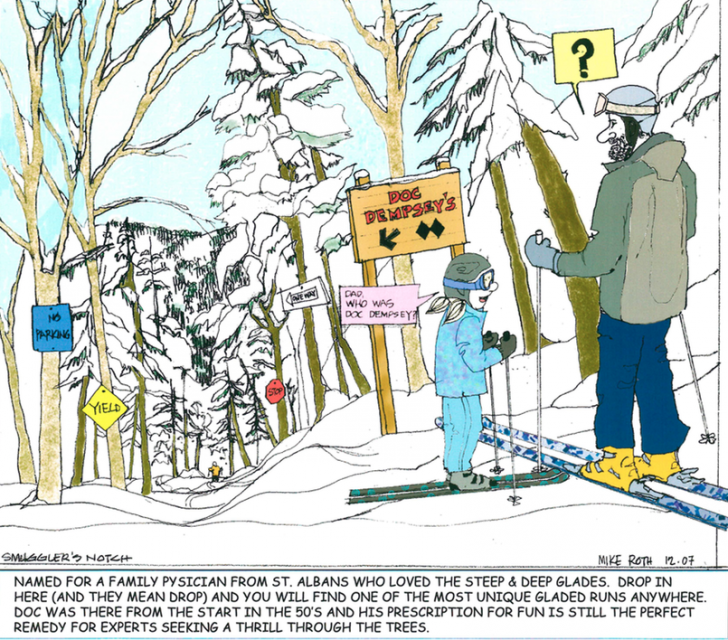
Spend a little time looking at resort maps and you’re sure to find some attention-grabbing trail names. When I looked at Pennsylvania resorts I found some beauties. Powder Puff and The Elevator at Jack Frost along with Extrovert at Blue Knob topped the list.
Among the best is High Hopes also at Blue Knob. Seven Springs has three trails making it into the top of the list; Santa’s Beard Terrain Park, Lost Boy Trail and Lost Girl Trail. Also noteworthy are Vertigo Park at Liberty Mountain and White Lightning at Montage Mountain.
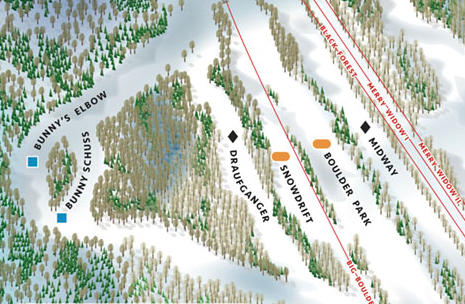
See if you can spot Draufganger on Big Boulder’s Trail Map.
Rounding out the list is Draufganger (German for daredevil) at Big Boulder.
Several Pennsylvania resorts stand out for having trail names that follow a theme. At Roundtop Mountain many trail names relate to the Revolutionary War. These include Recruit, Bunker Hill, Lafayette’s Leap and Fife and Drum. At Camelback trails are Egyptian themed such as Nile Mile, Pharaoh, Asp, King Tut and Cleopatra.
As you’d expect, at Eagle Rock trails (and lifts) are eagle-related. Trails include Baldy, Talons, Nestling and Screaming Eagle. Lifts include Wings and Soaring Heights. At Elk Mountain trails have Native American names such as Mohawk, Kickapoo, Seneca, Iroquois and Chippewa.
Do you have a favorite trail name that’s been overlooked? Please let us know in the comments section.
https://seniorsskiing.com/wp-content/uploads/2018/12/Screen-Shot-2018-12-05-at-2.50.07-PM.png304465Don Burch/wp-content/uploads/2014/04/Seniors-Skiing-since2013-Logo@2x-300x68.pngDon Burch2018-12-05 15:23:372018-12-06 16:00:00Trail Name Series: Pennsylvania
Utah Poet Offers Instruction And Advice For Beginners In Sonnet.
The following loosely-rhymed sonnet is by Utah skier and writer Emma Lou Thayne (1924-2014). It appeared in her 1971 book Spaces in the Sage and was once printed on a ski poster sent nationwide to advertise Utah’s “Greatest Snow on Earth.”
Emma Lou Thayne.
Thayne earned a master’s degree in creative writing from the University of Utah after having already established herself as a published writer. For a time she coached the UU women’s tennis team. She was an activist for women, peace, AIDS awareness, and mental health issues, and she was a much-beloved Utah personality and writer.
Her love of skiing Utah powder and her penchant for off-piste adventure is beautifully expressed in this poetic piece of advice to a young beginner. Growing up with three brothers, and raising five daughters, Emma Lou had plenty of opportunities to observe, advise and instruct youngsters in skiing.
Lesson #1
Alta. Credit: SkiUtah
Ski here, my child, not on gentle slopes
where the snow is packed and the trail is wide.
Instead, cut through the trees where no one’s tried
the powder. Push toward the hill and rotate
as you rise. No, the snow-plow holds you back;
it’s slow and makes you frightened of your turn.
Think parallel. Stay all in one, then learn
to ski the fall line, always down: Switchback
skiers in their caution never know how
dropping with the mountain keeps the balance
right and rhythm smooth. Don’t watch your tips at
all. Look past them at the deep white snow,
virgin as light, and yours. Just bend, release:
You, gravity, and white, will make your peace.
Powder Mountain. Credit: Ian Matteson
https://seniorsskiing.com/wp-content/uploads/2018/12/Screen-Shot-2018-12-05-at-2.26.30-PM.png334569Jan Brunvand/wp-content/uploads/2014/04/Seniors-Skiing-since2013-Logo@2x-300x68.pngJan Brunvand2018-12-05 14:27:592018-12-06 14:27:24Snow In Literature: Lesson #1
Who Is The Airborne Skier? What’s His Story? Do You Know His Hometown?
This week, we made the Mystery Glimpse a little more challenging. Name this high flyer. Tell us about him and (hint) how he met his unfortunate and untimely end.
Okay that’s hard. Here’s another one of this celebrated personage.
These photos come from the collection of the Tread Of Pioneers Museum, Steamboat Springs, CO. The museum is a not-for-profit historical institution that promotes an understanding and appreciation of the history of the Steamboat Springs area by collecting, preserving, exhibiting, interpreting, and sharing that history and heritage with audiences of all ages and interests. Check out its collection of historic skiing photos.
Last Week
German POWs making shingles at Camp Hale, CO, circa 1943-46. Credit: Colorado SnowSports
We had at least one correct comment on who these soldiers were, as well as some very close guesses.
Those hard-working chaps were German POWs held at Camp Hale, CO. Did you know that from 1943 through 1946, Colorado had 48 Prisoner of War Camps? Out of the many camps, the Army placed several hundred German prisoners of war at Camp Hale, the 10th Mountain Division training facility. Though communication between prisoners and soldiers was officially forbidden, the German prisoners regularly talked with the German sympathizers in the 620th Engineer General Service Company, which arrived at the camp on December 5, 1943. The 200 soldiers who made up this unit were not actually engineers. Like several other army units, the 620th was made up of suspected Nazi sympathizers (mostly Germans) and other opponents of the war. They got along quite well with the POWs, exchanging greetings and illegal gifts. The images show POWs making shingles and stacking lumber at Camp Hale.
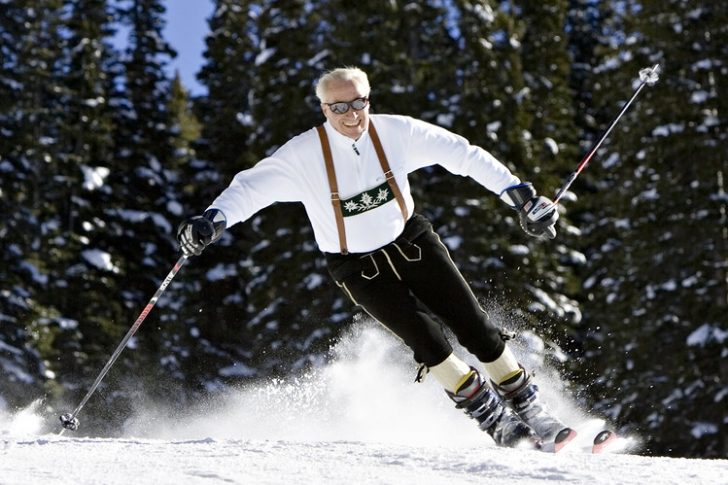
Klaus Obermeyer, the legendary skier and innovator, whose eponymous ski clothing brand is found almost everywhere, recently has his 99th birthday. The following interview with Klaus appeared in SeniorsSkiing.com, January 27, 2017:
“It’s Easier To Ski Than To Walk.”
Klaus Obermeyer is a skiing legend and innovator. The 97 year old founded Sport Obermeyer Ltdbased on insights about ski wear while working in the late 40’s as an instructor in Aspen. One of his many innovations was the down ski parka, stitched together from a goose down comforter. Other product innovations include high-altitude suntan lotion, turtlenecks, nylon wind-shirts, and mirrored sunglasses. In 1961, the first Sport Obermeyer factory warehouse opened in Aspen, and innovations continued with “soft-shell” jackets, double lens goggles, pre-shaped gloves, the first waterproof, breathable fabrics, a built-in ski boot canting system and fashion-conscious, technically responsible skiwear.
Klaus Obermeyer
What are the most significant changes you have observed in the world of skiing?
Skis have gotten shorter and wider. Their advantage is that you can float at lower speeds in deep snow. They make it easier for everyone to ski deep snow. They also allow those who climb mountains to use a lot more of the mountain with or without the lifts.
During your time, which well-known skiers have had the most impact on ski fashion?
Maria Bogner probably.
Please comment on the role of form and function in ski apparel?
For ski apparel to function well, for example, ski parkas, they need:
– To be waterproof and breathable;
– To have stretch material in places where stretch is needed;
– Be lightweight;
– Look terrific
For many years, you have been a role model for older skiers. Do you think equipment and apparel manufacturers would benefit from using older models and showing older people in their advertising and marketing?
The older models are slowly dying out and the young ones are tomorrow’s old ones. I think age makes no difference as far as technical performance of clothing.
What advice would you give older skiers who are still healthy but thinking about hanging up their boards in favor of other activities?
I think one should never give up skiing as it keeps the legs in good shape and even improves your walking after you’re over 80.
What advice would you give ski area operators to encourage older skiers to remain in the sport?
Have parking places for older skiers so you don’t have to walk so far in those awful ski boots.
Of all people past and present with whom would you like to ride the lift?
With the best looking girl!
Please add any comments not covered above.
Skiing and boarding are sports that are absolutely unique and wonderful. The make you appreciate the incredible beauty of being outdoors in the mountains and give you tremendous choices of how fast to go, where to put your turns, and where to jump to get a zero G feeling. In the end it’s easier to ski than to walk.




 This week’s Mystery Glimpse is a woman snowboarder who…well, you tell us. The function of last week’s thingy is revealed. No, it wasn’t an inclinometer, at least according to the









 Tread Of Pioneers Museum


 GearBeast


 athleticism, I’ve made up for with persistence.
 I just purchased a dozen






 Please comment on the role of form and function in ski apparel?