This Week

Even though senior skiers ski more and spend more per capita on skiing than younger generations, there’s a perception throughout the industry that the older cohort is made up of tight wads taking up otherwise valuable space in the day lodge. Jon touches on the issue in this week’s Short Swings! column.

In his typical light and informative style, Skiing Weatherman, Herb Stevens, presents a clear picture of the forecast for snow country.

Henry David Thoreau wasn’t a skier, but, as Mike Maginn writes,  Winter presents an excellent opportunity to visit Walden Pond on XC skis and contemplate how the naturalist/philosopher/poet spent his time there.

Staying on the topic of XC skiing, Roger Lohr explains the basics for newcomers to select a functional XC package. Very good advice.

Also in the Department of Good Advice, Bob Trueman offers guidance for coping with the dreaded Day 3 slump.

Harriet Wallis reports on Brighton’s tree nursery and it’s Ski With an Arborist program.

And Jackson Hogen explains what to do and what not to do to keep your binding functioning effectively.

Finally, check out this issue’s Test Your Skiing Knowledge feature. The winner will receive a one-year subscriiption to Outside+, will full access to the new Warren Miller film, magazine subscriptions, and lots of other goodies.

Note that the next issue of SeniorsSkiing.com will be issued Friday, December 3. In the interim, my wife and I will be moving permanently from East Coast to Salt Lake City, where the condo that’s been under renovation since June, won’t be ready for yet a few more months. Chalking this up to the challenges of managing contractors from a 2250 mile distance.

Short Swings!

Many in the ski resort industry harbor an image of older skiers taking up otherwise profitable space in day lodges while consuming their bag lunches and lingering over a cup of coffee. I take offense at that stereotype. I prefer a cup of hot tea to coffee and I take my own teabag from home.

Clearly, the facility makes more selling beers than charging $0.25 for a cup of hot water. And, like it one not, a few lunchtime drafts are more likely to produce on-hill crashes than coffee or tea.

On a recent trip to the skateboard park with my grandson, I realized that good pre-season safety training might involve dodging boarders while wandering through the half-pipe.

Most areas have well-known secret places where skiers and boarders go for a bowl. Some claim it gives them greater awareness and control. I can see it working that way in mature minds and bodies. But teenage boarder boys and girls? Those are accidents waiting to happen.

Which brings me back to what we quote most from that American patriot, Spiro Agnew. I don’t intend to be a nattering nabob of negativism but looking at the hypocrisy in the industry (what industry, government, institution doesn’t have its fair share of hypocrisy?), all I’m asking is that the people in charge recognize that older skiers are a good thing. We keep their lifts occupied mid-week. We ski more. We make more skiing-related purchases for ourselves, our kids and our grandkids. We tend to ski in control and show consideration for others on the lift, in the lodge, and on the hill.

Rodney Dangerfield

Most of us have supported the industry through bad and good times. Yet, they keep taking away the discounts and other privileges. The majority of those still offering discounts have upped the age threshold…most now at 80; some as high as 90. It’s not that we need the discounts, but it would be nice to have greater respect. Rodney Dangerfield was right.


Killington Now Skiing

Vermont’s Killington Resort, the largest ski and snowboard destination in Eastern North America launched its 2021-22 winter season last Friday. It was the first Eastern resort to open for skiing and boarding.

Steamboat’s $269 Lift Ticket

Steamboat Ski Resort (CO), announced that a holiday/weekend day ticket will cost $269 when purchased at the window that day. Last season, Steamboat upped its day pass to $225 from $199. Most skiers will purchase in advance at a lower rate or ski Steamboat on their Ikon pass.

What a Run!

Markus Eder is an Italian freestyle skier of great nerve and grace. This 10 minute video shows him negotiating some remarkable terrain. Enjoy the show.

Ski Maps Galore

Remember the area ski maps of your youth? Skimap.org is a site with 16779 images of ski area maps. For example, listings for Mount Snow in southern Vermont shows more than 50 maps from 1957 to 2021. The Americas shows 8849 maps; Europe, 5100; Asia, 1633. There’s even 232 maps for fantasy ski areas shown. Viewers can upload maps after registering.

Reality TV at Mount Baldy

Given the ski area labor shortage, it made sense that the CBS reality TV series, Tough As Nails, would have its two teams race to fix chairs at Southern California’s Mount Baldy ski area. It broadcasts as Episode 2 of the show’s third season. Click here to preview.

Snowbird Patrol

Safety Keepers, produced with support from Mammut, documents a day in the life of two Snowbird patrol people. It’s short and worth watching.

Ski Area Map Making Made Easy

Here’s a fun time-lapse video of ski trail map artist, Kevin Mastin, painting Tennesee Creek Basin at Ski Cooper (CO).

weather diagram

The Skiing Weatherman-November 12, 2021

Cold air supply growing…

Before I look forward in this discussion, let’s look back. October was a very warm month relative to normal across the country, in large part because a sizable upper level dome of high pressure stretched across Canada and the northern states. Early snow cover over northern Asia and Canada are typically harbingers of a fast start to our winter sports season, and although Russia stocked up with snow early and often, the upper ridge over Canada meant that a buildup of early season snow cover there was a non-starter. Now that doesn’t rule out a quick start to the season, but it does make it tougher. The good news is that the pattern in the high latitudes has been changing, and snow cover is accelerating. That has led to a rapid buildup of the cold air that we need for snowfalls and snowmaking. Forecasters use temperatures at 5,000 feet as a proxy for predicting surface temps and just a couple of weeks ago, there was a warm anomaly at that level spread out from the Canadian Rockies to the Maritimes. But take heart, the supply of cold is growing and the jet stream mechanism for delivering the cold…upper level troughs…have started to appear. Here’s proof. First, the jet stream setup for 11/13…

That large blue ball of yarn centered over the western Great Lakes is a deep trough that has delivered snow to the northern Plains this week, and it will generate lake effect and mountain snow showers as it pivots east this weekend. It has the goods in terms of cold air, as you can see on this map of the temperature anomalies at 5,000 feet.

In November, we find smaller “chunks” of cold air than we will a month or two from now, and that is why you see orange to the west and east of the cold shot in the middle of the continent. That tells me that the pattern will be rather changeable through the end of the month, with the cold shots alternating with brief warmups…very typical for a transitional month like November. As time goes on, the supply of sufficiently cold air for snow will grow, and we can see that if we look at the 5,000 foot anomalies for the Sunday before Thanksgiving…

Notice that is appears as though the Lakes and East will be well supplied with cold air and the next cold air mass will be linked to the piece over the eastern third of the continent. The purple color you see over NW Canada suggests that the cold will be deepening, as well. So, it appears to me that the resorts in the Great Lakes and East will have opportunities for snowmaking leading up to Thanksgiving, and the air masses will, at times, be cold enough to support natural snow. In the West, more of an upper ridge will be in place and that will limit the opportunities for significant Pacific storms to lend a hand. The northern Rockies will catch a glancing blow from the NW-SE push of cold air masses, and that could generate some snowfall in the next couple of weeks. Let’s break it down by region…

Northwest U.S./Western Canada: Best shot at snow in the next week is higher elevation slopes in B.C. NW U.S. prospects very limited for now.

Sierra: West coast upper ridge keeps it mild and dry until further notice
Rockies: Glancing blows from systems diving into central/eastern U.S. trough brings light snow every few days to northern resorts. Central and south quiet for now.

Midwest: Upper trough, cold shots, and lake snow become commonplace up through Thanksgiving. Solid prospects for early openings.

Mid Atlantic/Southeast: Enough cold air penetrates from the north to get snowmaking started at times over the next couple of weeks.

Northeast/QB: Good snowmaking opportunities will develop leading up to Thanksgiving. Several shots at mountain snow, as well.

Around Walden Pond

There are two trips around Walden Pond near Concord, MA. The first is a ski tour through a picturesque New England landscape, with sharp and steeply wooded hillsides surrounding an ice-covered, lambchop-shaped lake.

Around the same pond is a second trip, a pilgrimage that passes the cabin site of Henry David Thoreau, “self-appointed inspector of snowstorms”, conjuring the spirit of a special place and inspiring the thoughts of the pilgrim visitor.

Henry David Thoreau in 1856. Source: Wikipedia

If you choose the first trip, you‘ll find a pleasant ski tour: maples, birch, and oaks, rubbing branches in the wind, a frozen-solid pond to ski across, varying widths of trails in and out of sunlight, all free of charge, all well-tended, all convenient to the Walden Pond State Reservation parking lot on the Concord Road.

But, if you choose the second, be prepared to confront a man who discovered himself in those very woods and hills of Walden Pond, giving us a model of independence and renewal. One thing is for sure; if you take this trip around Walden, you won’t come out the way you went in.

What is it about Thoreau that initiates such pilgrimages? Why are visitors on foot and on skis so drawn to this singular place, the site of a small cabin gone long ago?

The answer is in the subtle message Thoreau left in those winter woods. To know the message, you have to know why Thoreau went to the woods to live alone by Walden Pond and what changes the woods made to his life.

Born in Concord in 1817, Thoreau went to Harvard College where he was homesick for the fields and forests where he once had played. Upon graduation, he and his brother, John, started a school in Concord. John became ill, the school closed, and Henry went to live with Ralph Waldo Emerson, serving as the philosopher’s gardener and handyman. Shortly after moving in, John Thoreau died, and Emerson’s five-year-old son passed away; their mutual grief bonding the two.

Now, Thoreau turned his attention to the community of thinkers surrounding Emerson, splitting his time between handyman and writing philosophical essays.

He was 28, an unsuccessful writer and poet living among the most dynamic American literary and philosophical giants of the time.  Frustrated by the complexities of society, Thoreau returned to the woods, to think, write, learn and sort out his life.

Replica of Thoreau’s cabin. Source: The Walden Woods Project

On July 4, 1845, he moved into the cabin he had built on the northwest shore of Walden Pond on land owned by Emerson.

You can ski up to the site of Thoreau’s cabin by following the shoreline trail on the north side of the pond or by a ridge trail also to the north of the pond but in more rugged terrain. If conditions are right, you can ski right across the frozen surface.

All of these trails are short, about a quarter-mile from the parking lot. A circumnavigation of the pond is less than three miles. If you want more skiing,  cross Concord Road and link into the web of well-tended trails that spread around Sandy Pond and into the town of Lincoln.

But this is a pilgrimage.

Thoreau’s house site and cairn. Source: The Walden Woods Project

The cabin site is in a clearing of pine and hickories “on a pleasant hillside.” A cairn nearby has been building since the site was discovered  in 1947. Stone markers indicate a small cabin, about 11 by 15 feet, the door facing the pond.

Much has been written about Thoreau’s two-year residence in the woods as a practical experiment and a naturalist’s odyssey. However, as you stand in that clearing by the cabin site, imagine Thoreau writing  on his little desk, remembering his brother and struggling to express his thoughts about life, values, and simplicity. Surely, the time spent at Walden was a time of renewal.

“I went to the woods because I wished to live deliberately, to front only the essential facts of life, and see if I could not learn with it had to teach and not, when I came to die, discover that I had not lived,” he wrote later.

In September 1847, Thoreau left Walden and moved back to his father’s house in Concord. He left knowing he could live the life he wanted. For the rest of his life until he died in 1862 at 43, Thoreau wrote, lectured, travelled, and continued to wander the woods.

Walden had been a turning point; the woods were a catalyst that helped him recognize who he was and where he was going, a man marching to a different drummer.

If you make this pilgrimage in winter, go early. You’ll find yourself alone in the woods next to Walden Pond. Stop skiing and stand quietly. The wind will crackle the branches, and you’ll hear your heart pounding.

Like Thoreau, let the woods give you respite. Recall what these woods have done, what any woods can do to vexed souls. Reflect on the simple beauty around you, read aloud from Walden, go back to the parking lot, different than when you went in.

Out Of Control

The Day Three Slump

This is my shortest ever blog, but it may have a significant impact on your next ski holiday.

Should have taken the day off.

It’s your first day back on the slopes, and you want to hit the ground running.  You don’t want to miss a thing, so you‘re up early, on the first chair, and skiing like a mad thing all day.  It feels so good!

The next day you’re just a wee bit sore, but not enough to stop you.

But on the third day you hit the “Day Three Slump”.  Your skiing seems to have got worse.  Your energy levels have slumped.  You hoped you’d get better; it’s frustrating.  At the end of the week you feel you’ve made no improvement; got no better than last year.  This is how your week may go:

Source: Bob Trueman; Bobski.com

I have a suggestion for “slump day”:  take it easy, be patient, don’t push it, do lessthan you might.

Would it be sacrilege to suggest taking a later breakfast?  An even greater sacrilege to suggest starting at 11:30 and finishing at 2:30?  Or, if it pleases you, consider taking a half day out and visiting a local place of interest. You could spend an amusing hour or two in a ski shop trying to guess which of this year’s new wonder skis is actually last year’s but in different livery.

Tomorrow do just a little bit more.  On day three you’ll be ready to fly; stronger, your muscle memories will have kicked-in.  You’ll find yourself skiing better, not worse.

At the end of the week, you’ll be skiing better than last year, and you won’t get home feeling frustrated that your skiing is in decline.

Your week will go like this and end on a high:

Source: Bob Trueman; Bobski.com

It will be a better feeling and well worth a try!

Moving seedlings

Move it or lose it

Moving seedlings at Brighton

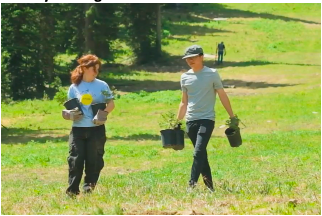
In a sheltered, out-of-the-way spot, a tree nursery suddenly popped up at Brighton, the ski area gem at the end of Salt Lake City’s Big Cottonwood Canyon. That’s where 266 saplings are adjusting to life in pots until they’re big enough to be planted back onto the mountain.

Mother Nature inconveniently sowed seeds on ski trails where they took root. But the young trees didn’t know they’d get mashed down by heavy snow grooming machines or mangled by skiers and boarders. Solution: Move them or lose them.

It’s a small part of Brighton’s environmental sustainability commitment.

“Brighton Resort is known for its terrain parks, exceptional annual snow fall, and, most importantly, it’s amazing tree runs. We’re … investing in preserving these areas with our new forestry program,” said Director of Sustainability Erika Kazi.

Brighton kicked off the tree moving project by partnering with Tree Utah whose mission is get people excited about trees and plant trees in public spaces throughout Utah – parks, schools, along trails, in national forests and more. On the days when trees are being rescued, an arborist trains volunteers on-the-spot before they head onto the trails to find, dig, and pot vulnerable trees.

But its more than shovels and pots. Tree rescue has gone high tech. “With new technologies we will be able to map out our trees in a more succinct way through GIS mapping,”  Kazi said, and we’ll have a better understanding of our forest.

Brighton’s Ski with an Arborist program. Source: Brighton Resort

Brighton invites guests to ski with an arborist on free tree tours and learn about the mountain’s ecosystem. Meanwhile, the rescued trees are snug and safe under their winter blanket in the secluded nursery.

Devils-Thumb-Ranch-Cross-Country-Skiers-630x420

Buying NEW XC Ski Equipment

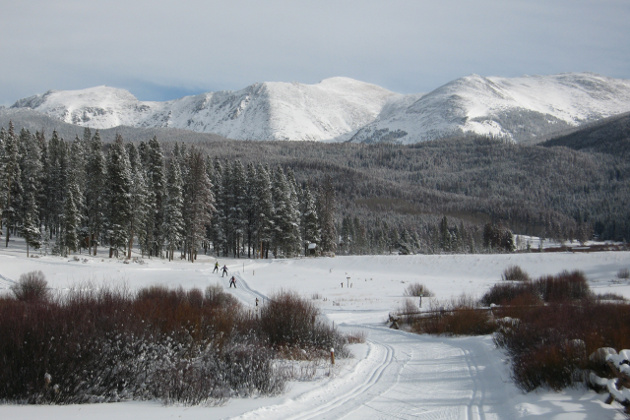
For newcomers to cross country (XC) skiing, deciding on the best skis can be intimidating, especially if you don’t want to rely entirely on retail sales people or on-line outlets for advice.

Devil’s Thumb Ranch, Colorado

The following guidance about selecting and using XC gear is general and intended to help you be an informed consumer.

Note that as a rule of thumb, standard XC equipment packages include skis, boots, bindings and poles and are less expensive than purchasing components individually.

Which pair of cross country (XC) skis is right for you?

Average recreational XC skiers should rule out light weight very narrow gear (used by racers) and waxable XC skis and/or wide steel edged XC skis (used by backcountry mountain skiers). Instead, consider looking at a lightweight XC ski with a waxless base. In general, these bases include skins or a pattern milled into the base (e.g. a crown or fish scale pattern) which allow one ski to grip the snow, while the other is pushed off to glide. They also keep the skier from slipping backwards while traveling up a hill. Note that ski length should correlate to skier’s weight.

Ski choice also is a function of where the ski will be used. Places with groomed, packed trails are best experienced using narrower skis. Wider (e.g. 55 millimeters in the shovel) and softer skis provide some stability in places without groomed trails (e.g. many golf courses and city parks).

Many people try to compromise and get wider XC skis to accommodate both groomed trails and ungroomed areas. I recommend choosing one type or the other or purchasing separate skis for each type of skiing.

For many newbies, the biggest obstacle to XC ski control is the incomplete use of the snowplow. Unlike heavier Alpine  equipment which accommodates snow plow turns, with XC skis it’s important to feel the weight on the boot heel against the edged ski and command it to push outward to plow. Without this “feel the heel” and push movement, the skis won’t plow and speed will increase rather than decrease.

New gear makes XC fun for newbies

XC ski boots are an important component of the package. Most boots have similar characteristics such as an ankle cuff, covered easy lacing, dry, warm, comfortable, etc. In general, higher boots with more substantial plastic cuffing provide better control compared to a lowcut soft boot. Stiffness or softness is associated with the torsional rigidity of the boot. Determining whether or not a boot’s sole is stiff is as easy as twisting the sole. Stiffer boots provide more stability.

Now that you know, make the right choices and enjoy your time in the snow!


skier on stilts

Test Your Skiing Knowledge

skier on stilts

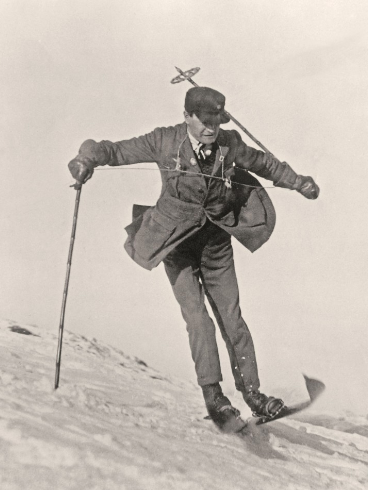
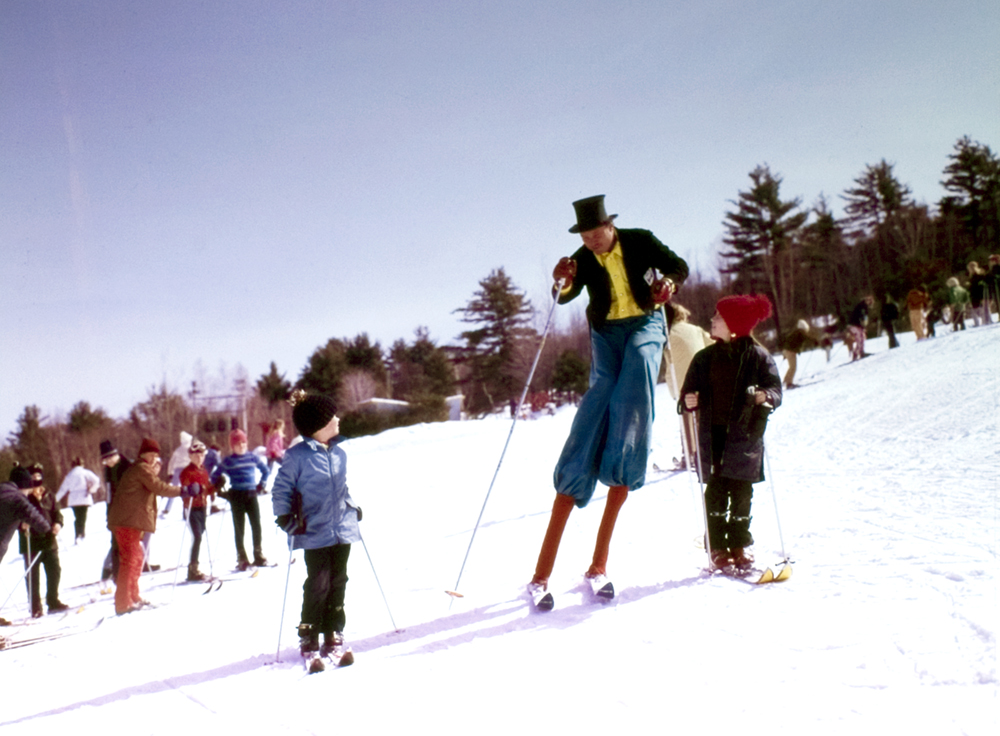
Each issue of SeniorsSkiing.com has a picture to help test your skiing knowledge. The pictures are from collections in a variety of participating ski museums, which we encourage readers to visit.

This big time skier was hardly stilted when it came to skiing or to publicity stunts. He was ski school director of the ski school of a New England area which has since changed names. The New England Ski Museum submitted the image for Test Your Skiing Knowledge.

Be the first to identify both the stilted skier AND the name of the ski area (before its name change) and receive a one-year membership to Outside+ ($79.00 value) with access to this season’s Warren Miller film, Winter Starts Now, plus two annual print subscriptions to your choice of SKI magazine, Outside, Backpacker, BETA MTB & more; access to extended gear reviews and instructional video from SKI from bumps to backcountry courses; Gaia GPS Premium access to thousands of maps and backcountry navigation recommendations; member-only content on all 18 sites in the Outside network, and full access to OutsideTV premium adventure films & series. Only answers sent to jon@seniorsskiing.com will qualify. Please do not submit your answer to Comments.

The correct answer and the name of the winner will appear in the next issue of SeniorsSkiing.com.

The winner of the last Test Your Skiing Knowledge  is Kay Geitner of Centennial, Colorado. She correctly identified the ski jumper as Alan Engen, past diector of  skiing at Alta and currently a member of SeniorSkiing.com’s Advisory Council. Kay taught at her home resort, Copper Mountain, for 28 years. She was the first American woman to graduate with the National Diplome from Ecole National de Ski and Alpinisme in Chamonix France. She represented the Pacific Northwest Ski Association at the US Junior Nationals and for five years represented Washington State at the Western States American Legion Championship in Sun Valley. Kay reports she’s been a SeniorsSkiing.com subscriber since we started in 2014. She wins a free pair of EZFIT Universal Insoles from Masterfit (retail value: $44.95).


close up binding

Bindings Made Simple

Originally published in the 2020-21 Masterfit Buyer’s Guide and realskiers.com

Bindings are rugged little devices, but like any mechanical unit they can wear out quickly if not kept clean and lubricated.

At the beginning of the season, do a binding check. Annual shop inspections of the ski/boot/binding system will reveal any deviations in the release system that may require a binding to be re-set or retired if it won’t release within a standardized range.

close up binding

After a given binding model has been off the market for several seasons, the binding company’s liability insurer can decline indemnity coverage for a model it deems obsolete due to its age and likely condition. If shop personnel inform you they “can’t work on this binding,” they’re acting within established guidelines over which they have no control. No matter how much you once loved them, if your bindings are no longer indemnified, it’s time for them to go.

DO:

Determine your binding setting. It’s based on height, weight, age, boot sole length and skiing style. Any shop tech can help you do this in about 10 seconds

Pick a binding with your setting number (often called a “DIN” number) near the middle of the binding range. If your setting is “6,” a binding with a 3 – 10 scale should be fine.

Ask a salesperson about any special features that may make one binding more suitable for you than another.

DON’T

Continue to use a binding the manufacturer no longer indemnifies.

Use a boot with a touring sole or walking sole that’s incompatible with your Alpine bindings.

Use a boot with worn-out soles.

Mix a child’s normal boot sole with an adult binding.