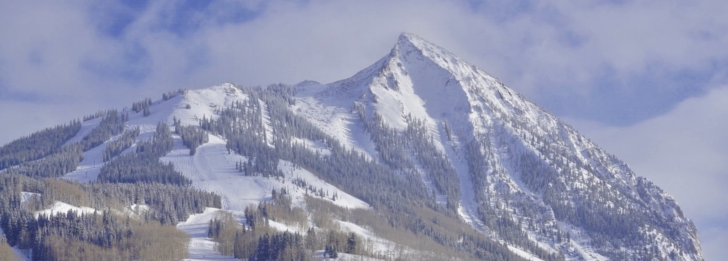
The season’s beginning to wind down. Area closing dates have been arriving by email, and wherever I look here in Salt Lake City, flowers are springing from the ground and golfers are swinging away on the fairways. For skiers it’s a bittersweet time of year. Patches of brown on the slopes signal it’s coming to an end. But there’re always plans and visions for the coming season. April 15 will be our final full issue for the 2021-22 season.
Short Swings! has some surprises in store. Herb Stevens’ weather report mixes good news and less than good news for the coming weeks.
Jon describes an upcoming guided ebike tour of the Umbria region of Italy. The electric-assisted bikes will carry the small group through gorgeous countryside as they visit wineries, ancient villages, and luxurious small hotels.
Dave Irons draws on his rich experience heading patrol at Sunday Mountain to share thoughts on why some skiers are, literally, out of control, and what can be done to reduce this growing problem.
Tamsin Venn explores Park City’s minimg history and how, in the early days of the resort, subways delivered skier to the slopes.
Mike Roth illustrates a reader’s 1982 experience in Tuckerman Ravine, and Don Burch presents his newest; a video account of his recent visit to several Colorado resorts. His take on the ski video is entertaining and refreshing.
Be sure to check out Test Your Skiing Knowledge and the answer to last issue’s challenge. And visit the growing LUV2SKI vanity license plate gallery.
Enjoy the issue. Enjoy these last weeks of skiing. See you again on April 15.
https://seniorsskiing.com/wp-content/uploads/2014/03/cropped-seniors-skiing-final-small.jpg2761016seniorsskiing/wp-content/uploads/2014/04/Seniors-Skiing-since2013-Logo@2x-300x68.pngseniorsskiing2022-03-31 20:00:002024-08-15 14:44:39This Issue: April 1, 2022
Did you see the recent article about the frozen fish blizzard in the Altai Mountain region of China? It’s the same region where for thousands of years, indigenous people have been navigating winter on homemade skis. Apparently, a tornado-like waterspout touched down in Kanas Lake, picked up a large school of 5” – 7” fish and deposited them across several small villages in the region.
A naturally occurring avalanche in a remote section of the Dolomite region of Italy, uncovered the remains of a German bi-plane that crashed there during World War I. Inside was the preserved body of the pilot, as well as a partially eaten loaf of bread and an unopened bottle of beer.
Park City chiropractor, Ben Dover, was repairing a plumbing leak in the basement of his 100+ year old home when he noticed cool air blowing through the wood paneled wall. Curious, he carefully removed a few boards and found the entrance to an old mine. Flashlight in hand, he walked into the space where he saw something hanging on a wall. It was a calendar from 1909 with a date circled in red: April 1!
Happy April Fools Day!!!
It’s part of the human condition that, regardless of our age, every one of us has an unknown expiration date. I believe we should be aware of the news of the day and have empathy for those who suffer. Among the ways we can help is through volunteering and financial and other forms of support. We can also make an extra effort to be kind to ourselves and to each other. Next time you’re being jostled in lift line or cut off before you pull into that ideal parking space, give the other person a smile. When you get to the chair, thank the liftee. On the trail, do what you can to avoid a collision. There’s a lot wrong with the world of skiing: the crowds, reckless people, etc., etc. But there’s a lot right with it, too. Otherwise we wouldn’t go to the effort.
Spring has arrived. Delicious warm days await us on the hill. Soon we’ll be hanging up our boards and thinking about next season.
Enjoy April Fools Day. Enjoy the pond skim. Enjoy the live band and the cold beer. Enoy it all. It’s skiing.
Fashion Statement?
Tommy Hilfinger’s ski-in/ski-out home sold for a $19 million profit after three months of ownership.
Fashion Designer/manufacturer, Tommy Hilfiger, sold his Aspen ski in/ski out home last week for $50 million. He purchased in in December for $31 million. Yes, you read that correctly. He made a $19 million profit in three months…reflecting the current hot mountain town real estate market.
The Future of XC Skiing
If you’re associated with a XC ski club or facility, be sure to set aside time April 5 and 6 to attend (by Zoom) the Cross Country Ski Areas Association 2022 Spring Conference. Topics will cover current trends and events impacting the XC industry and maintaining growth and optimizing the guest experience. Cost:$45; https://ccsaa.org/annual-conference-2021/.
OR Returns to Salt Lake City
Five years ago, the twice-yearly Outdoor Retailer trade show decamped from Salt Lake City to Denver. Among the numerous reasons for the move was the State of Utah’s resistance to protecting its wilderness lands from development by extraction industries and from continued illegal use by ATVs and other motorized vehicles. Given that the outdoor recreational industry is based, in large part, on use of public lands, numerous big brands threatened to withdraw from the trade show if it continued in the state. Now, with support from the mayor of Salt Lake City, the twice-annual show will return to its roots. The past five years has seen unprecedented growth in Salt Lake City and the surrounding area. The new international airport, a $5.5 billion investment, is the first major hub airport replacement built in the 21st century.
Telltale Signs of Stroke
This valuable information arrived in my inbox along with the story of a woman who died after the signs of her stroke went undetected. If treated within three hours of onset, chance of recovery is increased. To determine if someone is experiencing a stroke ask the person to 1) smile; 2) talk and speak a simple sentence; 3) raise both arms. If there is difficulty performing any of these, immediately call 911 and describe the symptoms to the dispatcher. An additional sign of stroke: Ask the person to stick out the tongue. If it goes to one side or the other, the person may have had a stroke.
Ski Mo
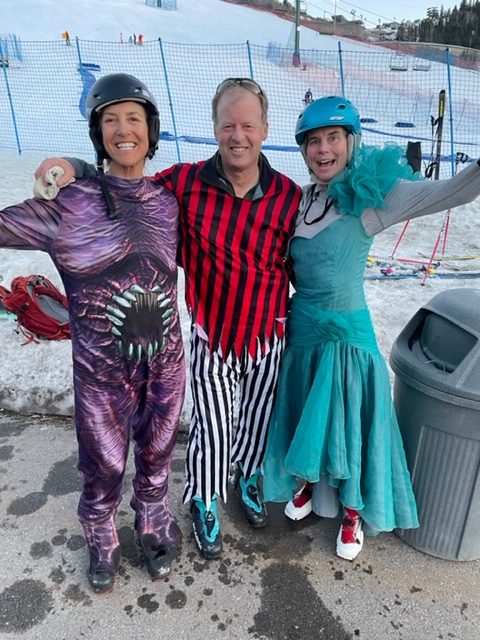
Lauren (l), Tom, and Liz costumed-up for the last Park City SkiMo event of the season.
If you’re not already familiar with this soon-to-be Olympic event, chances are, you soon will be. SkiMo (short for Ski Mountaineering) is a competitive event in which participants race up the hill on skins and/or carrying their boards, then clicking in and skiing down. It has many variations, including the one I witnessed one evening last week at Olympic Park in Park City. There, participants tried to make as many laps of the 300′ vertical as they could in an hour. One person clocked six or seven laps.
Remembering “Super Skier”
Remember the song, Super Skier, from the Chad Mitchell Trio? Released in 1963, it tells the amusing tale of of a guy whose sense of his skiing self far exceeds his skiing skills. Click on the above image and listen with fresh ears.
Important Notice
The annual fundraiser is over. Again, I want to thank all who provided support for the site. Your gifts help defray the cost of publication. The majority of posters, stickers and thank you notes have been mailed, but I’m a few weeks behind completing the chore. Too many doctors visits and our move to a new (for us) home have complicated matters. Also, several mailings to reader-provided addresses were returned. Thanks for your patience.
The Skiing Weatherman 4/1 West favored for snow…East hangs on
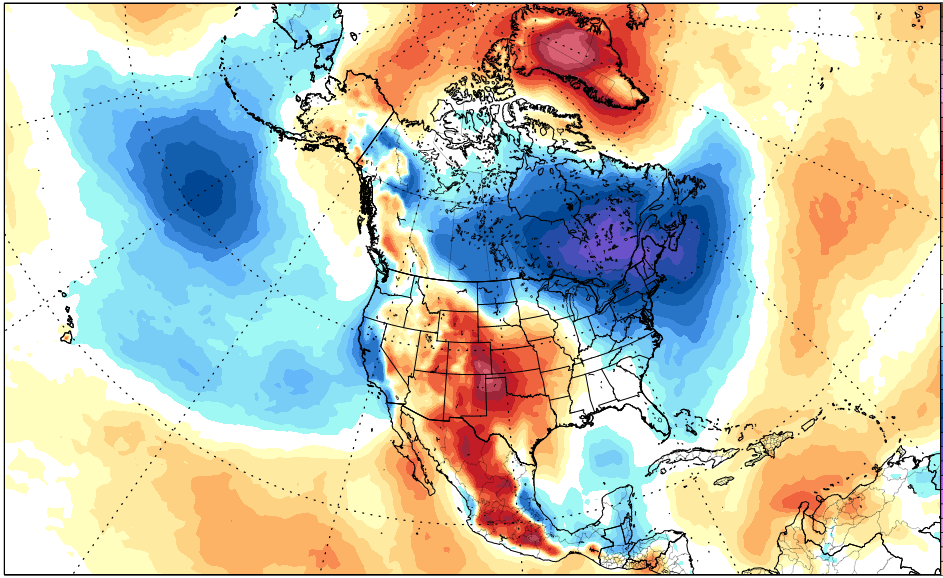
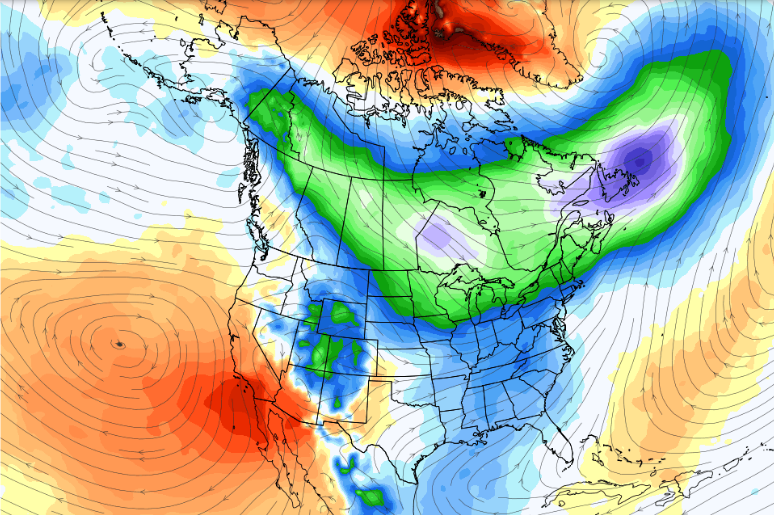
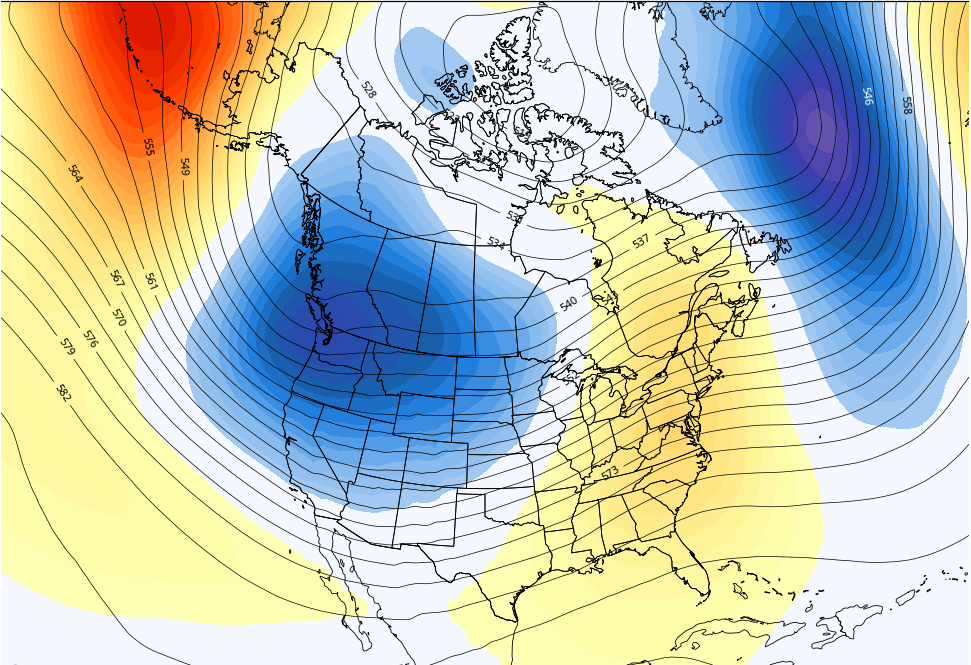
In my last installment, I discussed the extreme back and forth nature of the winter in much of the country, as well as the transition of the upper air pattern to a typical springtime short wavelength configuration that helps to sustain a rapid back and forth sequence of weather systems. For the next 10 days or so, we are looking at pretty much a “rinse and repeat” scenario from coast to coast. Cold air is still quite plentiful across Canada, but it is more difficult at this time of year to break off a big chunk that descends into the lower 48 for an extended period of time. We will have to make do with smaller shots of cold air that fuel and sustain transient upper level troughs, but we’ll also have to accept the short wavelength ridges that move from west to east that lead to milder weather and spring surface conditions. By the middle of the month, I do see signs of a colder pattern setting up in the West, with a mild ridge popping up in the East, one that will likely be the knockout punch for the season at most of that region’s resorts. Here is a look at the jet stream next Thursday…
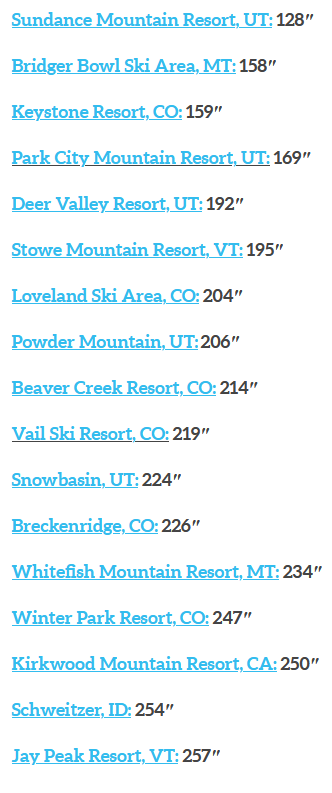
A deep trough will be located over the middle of the country, with ridging dominating the West with a spell of dry, mild weather. It will also be mild in the East…after a chilly start to the week…as a ridge also pops up along the Atlantic seaboard. The trough will send yet another surface low-pressure center along an unfavorable path for eastern resorts through the eastern Great Lakes and into the St. Lawrence Valley. That track will generate rain and some higher elevation snow in New York and New England. While eastern skiers and riders have cursed the numerous “cutter” lows this season, the far northern Great Lakes resorts have been on the snowy side of that storm track and have enjoyed a banner season. Mount Bohemia in the Upper Peninsula of Michigan is a natural snow, ungroomed, advanced skier-only powder magnet in the Lake Superior snowbelt. They average about 270 inches of snow a year and have received 280 inches as of 3/24. As this list illustrates, Bohemia has racked up more snowfall than many more famous resorts, east, and west.
With the potential for additional snowfall looking pretty solid across the northern Lakes, Bohemia could very well stretch their lead on the snowfall scoreboard through mid-April.
Out west, snow levels have been on the high side of late, with spring conditions quite common, even into parts of the northern Rockies. The relatively mild pattern will remain in place for the next week, but by about the 10th, a significant trough will move in from the Pacific, and colder air will flow into that trough from western Canada. That will lead to a period of at least several days with enhanced prospects for late snow from the Cascades down through the Sierras and eastward to the Rockies. At the same time a mild ridge will build in the East, and with rather a skimpy base snow in place, the end of the season will arrive at many resorts. Here is a jet stream forecast for 4/13 that displays the pattern change.
Regional details…
Northwest U.S./Western Canada: Some light snow early next week, then mild and dry. Turns snowy from the 10th onward.
Sierra: Spring conditions rule for another 10 days before mid-month pattern change delivers snow.
Rockies: Weak system brings light snows early next week then ridge rules for a while. Pattern favorable for late snow after the 11th or so.
Midwest: Many resorts have closed. Snow still in the cards across the northern Lakes for the next couple of weeks.
Mid Atlantic/Southeast: Boom-boom, out go the lights. The season is over.
Northeast/QB: Chilly weekend sustains snow cover. First ten days of April hold hope for high elevation snow at northern resorts.
https://seniorsskiing.com/wp-content/uploads/2022/03/seniorsskiing1-1-1.png636943Herb Stevens/wp-content/uploads/2014/04/Seniors-Skiing-since2013-Logo@2x-300x68.pngHerb Stevens2022-03-31 19:50:432022-04-04 15:00:13The Sking Weatherman April 1, 2022
The way skiers and boarders enter the sport determines their behavior on the hill. Years ago, many were introduced to skiing by their parents; skiers who knew the commonsense safety rules and made sure their children knew them, as well. For decades, those entering the sport through ski school have been exposed to the Skier’s Responsibility Code during lessons, their instructors citing examples in real time:
Looking up the hill when entering a trail is pointed out each time an instructor takes his or her class onto a new run.
Stopping at the edge of a trail and not obstructing traffic is taught by example as instructors always pull to the side when talking to the class.
Unlike driving there’s no requirement for beginning skiers to pass a test before taking to the trail. They simply show up, usually with a friend who attempts to teach them; a friend who may not know the safety basics himself.
Riding the rope. Harriet’s daughter Alison, 5, in leather boots and wooden skis on Jiminy Peak’s rope tow. Credit: Harriet Wallis
There can be serious consequences. Eight years ago at Cranmore Mountain I was struck and seriously injured by a boarder who was uphill from me. As the uphill rider, it was her responsibility to avoid anyone below. She knowingly entered a populated slow-skiing area without slowing down. Had we been in Colorado, she would have been held liable for my injury.
Over my years patrolling at Sunday River, I always pointed out, “If you’re good enough to overtake another skier, you had better be good enough to avoid them.” Skiers have don’t have rearview mirrors or turn signals. If one turns into your path, it’s up to you to change your path to avoid her. The responsibility code calls this skiing under control.
Source: The New York Times
Another frequent safety violation is skiing closed trails and out-of-bounds terrain. Trails are closed for a reason, and that reason could be hazardous conditions. Years ago, a skier at Loon Mountain fell on an intermediate cross trail and slid under a rope onto a closed steep and icy run. His companions had to work their way through the trees to reach their injured friend. It even was difficult for patrol to reach the injured skier, who eventually died. The double lesson here: 1.Stay off closed trails. 2.If terrain and conditions between you and the injured skier are beyond your ability, wait for patrol.
Know how to report an accident. The key is to know where you are on the mountain. You can always go to the bottom of a lift, where the accident will be called in. Most areas have a number to call for ski patrol. Make sure it’s in your cell.
Out of bounds is another issue. There is no grooming, and unless your skills are up to handling all conditions, stick to the groomed runs. These areas are not patrolled and not swept at the end of the day. Never ski these areas alone. Three or more is preferred. If someone is in trouble, one can stay with the injured party while the other goes for help. If you choose to ski out-of-bounds, think of the sign at the top of Killington: The mountains will be just as cold and lonely tonight as they were 200 years ago.
/wp-content/uploads/2014/04/Seniors-Skiing-since2013-Logo@2x-300x68.png00Dave Irons/wp-content/uploads/2014/04/Seniors-Skiing-since2013-Logo@2x-300x68.pngDave Irons2022-03-31 19:45:072022-04-04 15:02:07An Old Pro Shares Thoughts on Staying Safe on the Hill
Park City, Utah started as a mining camp in the 19th century, transferred business from silver mining to skiing in the early 1960s and never looked back. These days Park City Mountain Resort, owned by Vail Resorts, has about 1,200 miles of underground tunnels and shafts and mining structures all over the mountain that you ski by and over along 348 trails.
In 1963 United Park City Mines, the last active operation in Park City, opened Treasure Mountain Resort on the 3,700 acres it owned. Relying on mining engineering know-how, it put up J-bars, a gondola, and a Skier’s Subway.
Now in the Park City Museum, this “subway” car used to transport skiers into the mountain, where they would enter an elevator and travel to the base of the Thayne’s chair.
In what has to be the most unusual lift in skidom, the Skier’s Subway ran from January 1965 to July 1967, starting near the spot where the Silver Star chair is now located. Skiers rode more than three miles through the west end of the Spiro Tunnel on repurposed mining carts, water dripping onto their parkas, to the Thaynes Shaft where they got hoisted 1,700 feet up to the Thaynes chair lift. From out of the dark depths…Voila!, the slopes. The ride took about 25 minutes. Most skiers did it once for the novelty, once for the kids, and that was enough.
Early March, I skied to the Silver Star base area and discovered this bit of mining history: In 1917, owner Solon Spiro built a tunnel 21,675 feet into the mountain to draw excess water down and away from mining operations above.
The town now uses the tunnel to provide about a quarter of its water for drinking, snowmaking, and golf course irrigation. To protect this resource, a few years ago the town removed debris and shored up the first 400 feet of the tunnel to prevent cave-ins.
On a guided skiing tour of Park City’s mining history. Photo: Tamsin Venn
The very active Friends of Ski Mountain Mining History collaborated with the town to open a commemorative plaza in the fall of 2021 with signage at the fenced-off tunnel entry at Silver Star Village. It’s a delightful starting point to the day, away from the crowded Park City Mountain Resort’s nearby free parking area. The Silver Star chair gives easy access to King Con chair. The village has a small lift ticket booth, friendly lift attendants, the well-equipped Silver Star Ski & Sport, located in an old mining building, and the Silver Star Café that transforms from skier-patio-lunch-spot to award winning restaurant at night.
For a fuller view of Park City’s mining history spread throughout the mountain, take the Silver to Slopes Historic Tour, a complimentary two-hour visit led by PC’s mountain services guide (See SeniorsSkiing article: There’s Silver in Them Thar Hills!).
https://seniorsskiing.com/wp-content/uploads/2022/03/Screen-Shot-2022-03-31-at-1.33.17-PM-e1648755971383.png433728Tamsin Venn/wp-content/uploads/2014/04/Seniors-Skiing-since2013-Logo@2x-300x68.pngTamsin Venn2022-03-31 19:35:422023-05-20 19:54:04The Skier’s Subway: Most Unusual Lift in Skidom
Don Burch recently returned from his first ski trip to Colorado in almost 50 years. He titled this video summary of his time at Beaver Creek, Copper, Keystone, Breckenridge and Vail,“Come Ski With Me.” It’s another fine example of Don’s refreshing new genre of ski video: brief, graphically interesting, and easy to watch.
https://seniorsskiing.com/wp-content/uploads/2022/03/come-ski-with-me.jpg6101200Don Burch/wp-content/uploads/2014/04/Seniors-Skiing-since2013-Logo@2x-300x68.pngDon Burch2022-03-31 19:30:262022-04-04 15:04:08“Come Ski With Me”: A New Don Burch Video
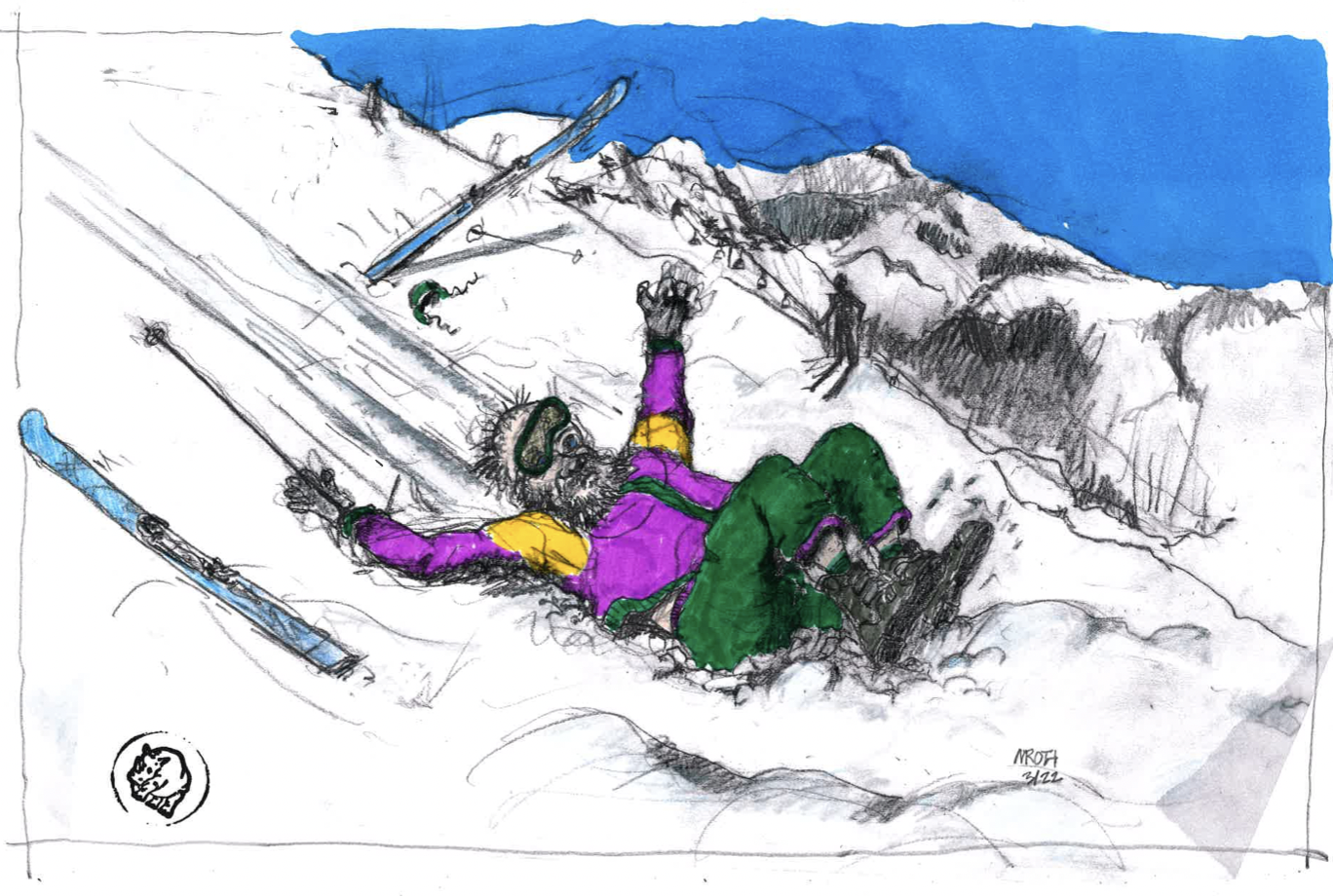
In the last issue of SeniorsSkiing.com, author/cartoonist, Mike Roth, gave his account of a loooong slide he took in Val d’Isere in 1988. That inspired reader Bob Strum to write in about his 1982 yard sale at Tuckerman Ravine. Mike’s illustration captures the moment!
In 1982, skis strapped to shoulders, I was climbing the main bowl at Tuckerman Ravine on Mount Washington in New Hampshire. At one point, it was too hard to go higher. My body was pressed against the icy snow, supported by boot tips and ski poles. Trying to reach where I could get skis on, I lost grip and slid about 650 vertical feet. Skis, gloves, poles, goggles and glasses scattered everywhere. People on Lunch Rocks applauded. I broke a rib, tore an MCL in my knee, tore my calf muscle, and bruised my arm. It hurt too much to ski. The hardest part was hiking to the bottom carrying 50 pounds on a slippery trail. Fortunately, I didn’t hit Lunch Rocks. If I had, I wouldn’t be telling this tale.
Have a ski story of your own? Send it to jon@seniorsskiing.com. We’ll select the most entertaining to be published, along with an original Mike Roth illustration!
https://seniorsskiing.com/wp-content/uploads/2022/03/Screen-Shot-2022-03-31-at-2.52.41-PM-e1648760002580.png810728Mike Roth/wp-content/uploads/2014/04/Seniors-Skiing-since2013-Logo@2x-300x68.pngMike Roth2022-03-31 19:25:032022-04-04 15:05:30OMG!!!! A 1982 Near Disaster at Tuckerman
This is the final Test Your Skiing Knowledge feature of the 2021-22 season.
Each issue of SeniorsSkiing.com has a picture to help test your skiing knowledge. Generally, the pictures are from collections in a variety of participating ski museums, which we encourage readers to visit.
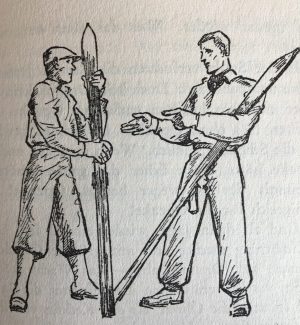
This test has one simple answer: Name the only female skier to win three Olympic gold medals in alpine skiing in a single Olympics. The first reader to correctly identify her will win the new “Licensed to Ski” poster with photos of ski-themed vanity license plates. Only responses sent to jon@seniorsskiing.com will be considered.
The person pictured in the last Test Your Skiing Knowledge is Sir Arnold Lund (1888-1974), skier, mountaineer and writer, knighted in 1952 for “services to British Skiing…” He introduced the racing concept that speed should be the only determinant to test the skier’s ability to turn securely and rapidly on steep Alpine terrain. He established numerous ski organizations and race events and was influential in introducing ski events to the Olympics. The first reader to correctly identify him was Enzo Falco of Belmont, MA. He once had the privilege of meeting Lund in person.
https://seniorsskiing.com/wp-content/uploads/2022/03/Screen-Shot-2022-03-31-at-4.42.37-PM.png498706seniorsskiing/wp-content/uploads/2014/04/Seniors-Skiing-since2013-Logo@2x-300x68.pngseniorsskiing2022-03-31 19:20:412024-08-15 14:46:14Test Your Skiing Knowledge
Two new plates for the ever-expanding LUV2SKI vanity license plate gallery: Laurie Beach, has had her SNO JOB plate for 45 years, the same length of time she’s been working in the ski business. She’s currently a rep for SOS Skiwear and works in a ski shop. Chas Crosier sent in FOOTR 2. Thank you Laurie and Chas.
In Short Swings!, Jon pairs French philosopher Simone de Beauvoir’s thoughts about aging with giving the finger to some disrespectful kids at Park City.
Skiing Weatherman, Herb Stevens, previews what to expect in ski country over the coming weeks.
Wendy Clinch of TheSkiDiva discusses what the women on her forum are saying about the state of on-hill safety.
Tamsin Venn profiles Deer Valley and the pleasures it delivers for senior skiers.
You probably didn’t know about Alta’s role in the development of a national approach to ski-teaching. Alan Engen, who headed Alta’s Ski School, shares that important chapter in American skiing history.
Jonathan Wiesel, President, Nordic Group International, encourages readers to propose that local golf courses start cross-country ski operations. He establishes a strong case and provides information resources to help make the pitch.
Finally, Mike Roth illustrates a verrrry long fall he took years ago in the French Alps; Test Your Skiing Knowledge poses a new puzzler and announces the winner of the last one, and LUV2SKI presents a few new reader-submitted license plates for your pleasure.
Enjoy the issue. The entire site, including our archive of more than 1,700 articles is accessible at any time. The next editorial package will be distributed Friday, April 1.
Make lots of happy turns, and, remember, Senior Skiers Rock!
Email jon@senorsskiing.com to request the new Senior Skiers ROCK! helmet sticker.
https://seniorsskiing.com/wp-content/uploads/2022/02/SS-Sticker-4r.jpg800667seniorsskiing/wp-content/uploads/2014/04/Seniors-Skiing-since2013-Logo@2x-300x68.pngseniorsskiing2022-03-17 20:00:002022-03-17 23:25:22This Issue: March 18, 2022
This edition of Short Swings! is dedicated to the many readers who generously donated during the fundraiser. The funds will help us continue to send you, free, original articles and other content created specifically for older snowsports participants. Thank you!
—————————————————————————————————————————————-
As in other areas of our culture, we older skiers become less and less visible as we age. You may not have noticed this if you’re in your fifties or sixties. But become a septuagenarian or older, and it becomes obvious. Some cultures honor, respect and value the experience and wisdom that often accompanies longevity. There are exceptions, but it is less common in ours.
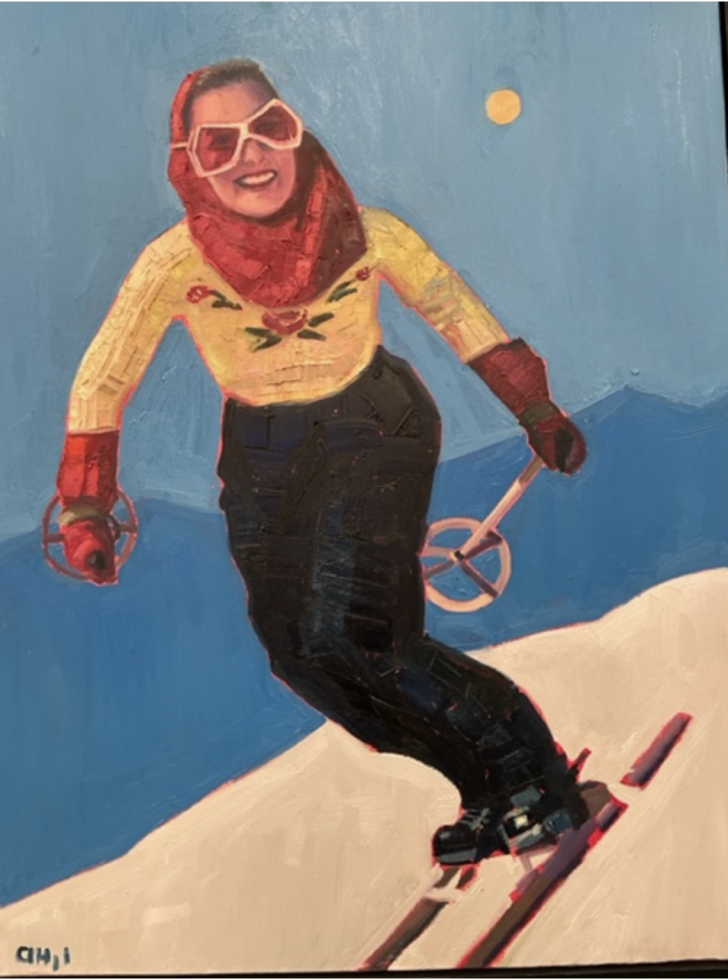
Bluebird. Artist: Aaron Hazel
French philosopher, Simone de Beauvoir argued that aging isn’t only biological decline; societal ageist discrimination helps add insult to that injury. These and other observations by Beauvoir about the psychological effects of aging appear in an article by Skye C. Cleary in the March 11 edition of aeon, the free online magazine exploring big issues in science, philosophy, society and the arts.
According to Beauvoir, while, inside, we may not feel old, others judge us as old when they look upon our faces and bodies. That helps form a context in which we’re excluded.
Obviously, you won’t feel that alienation in the lift line or on the slope. But get into a conversation with younger people on a gondola where you’re face-to-face, and it’s quickly evident.
A few weeks ago, on a long gondola ride at Park City, I was, by far, the oldest. One couple was in their forties. The others were in their twenties. I broke the ice by asking if they were visiting. Once they recognized my age (one of them may have asked), I was promptly left out of the conversation.
Beauvoir wrote, “There is only one solution if old age is not to be an absurd parody of our former life, and that is to go on pursuing ends that give our existence a meaning – devotion to individuals, to groups or to causes, social, political, intellectual or creative work.”
I agree with her thinking but would add one more factor for good measure. Do what you do well and to the best of your ability.
When I exited the gondola and clicked into my skis, I saw that several of the youngsters who had excluded me from the conversation were standing nearby, looking at the old guy with whom they had ridden up. I took some slow, graceful turns down the edge of the steep trail…my quiet way of giving them the classic one-finger salute.
Cautionary Tale
Reader David Engel was hit while skiing. He’s been told it’s unlikely that his shoulder can be repaired. Read the following (slightly edited) account he posted in Comments and his appeal to ski areas to take action to improve on-snow safety:
On a recent ski trip to Northstar, California, I was skiing on Burnout, an easy black diamond groomer with a friend. We were skiing at a moderate speed, working on our technique and staying well clear of other skiers.
After trips to the emergency room, to other doctors, x-rays and meetings with surgeons, I’ve learned that it is unlikely my shoulder can ever be repaired. A separated clavicle and three torn ligaments causes my arm to hang limply. Prior to this, I was an avid rock climber and raft guide, even at age 66. The surgeon said that I should wait 6-12 months, and if I decide surgery is needed, there is still a 30% failure rate.
A teenage girl skiing out of control has changed the trajectory of my life.
I write this because it’s imperative that ski patrol, courtesy patrols and ski instructors start to take an active role in stopping skiers/boarders from skiing out of control. There needs to be an enforcement of a safe area around each snow participant. There is no need to pass within 20 feet of someone else. This is a very serious situation that winter resorts MUST start to enforce.
Now I live a compromised life because ski areas are not taking enforcement of safe skiing rules seriously. Safe skiing can only result if all those involved in the ski industry take this seriously and stop out of control and wild skiers/boarders.
Ski Town Game-Changer
Vail Resorts announced that a $20 minimum wage is being instituted at its 37 North American resorts. The minimum for Patrol, maintenance technicians and drivers will be $21. The much-needed increases should give VR a hiring advantage and, hopefully, cause other resorts to up their minimums.
RIP: Suzy Harris Rytting
Suzy Harris Rytting Source: J. Willard Marriott Digital Library
In the 1940s and 50s, Suzy Harris Rytting was one of America’s greatest feamale ski racers, winning one important event after another. She was a member of the 1950 US Women’s FIS Team and the 1952 US Olympic Team. While training for the Games in Oslo, she and her husband learned she was in her early days of pregnancy. Doctors cleared her to race, but Avery Brundage, in his first year as president of the International Olympic Committee, was outraged upon learning of her situation. She was removed from the US team and sent home. Born January 21, 1930, she passed away February 28, 2022.
The Future of Skiing?
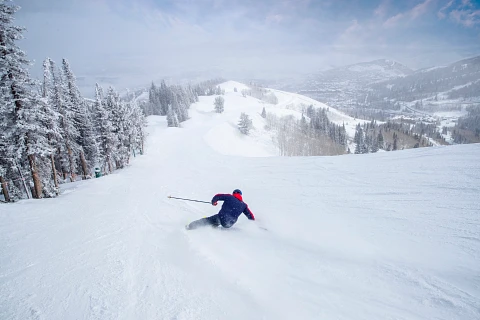
A ski through the park.
An article about Big Sky in the March 15 edition of The New York Times suggests that the resort’s modern lifts, vast terrain, and high ticket prices provide a glimpse into the future of successful ski resorts. Like so many other prognostications, there may be some of truth in the piece. High prices are a barrier to access, which, combined with thousands of acres of terrain, keep slopes and trails uncrowded. But doesn’t that run against the industry’s current emphasis on making skiing more accessible and inclusionary?
Happy Birthday, Bob!
Happy 98th, Bob!!! Photo: George Ramjoue
At 98, Bob Murdoch of Salt Lake City is the oldest member of Alta’s Wild Old Bunch. Many of his fellow WOBs showed up a few weeks ago to help celebrate his birthday. Even though he hung up his boards a few seasons back, he enjoys memories of many years on Utah’s trails.
The Failure of the Mt Hood Skiway
The Mt Hood Skiway was a bizarre engineering project intended to transport skiers and tourists from the small community of Government Camp, Ore to Timberline Lodge. This video tells the story of its creation, its short life, and its demise.
The Skiing Weatherman 3/18 One step forward, one step back…
While Upper Midwestern and western U.S. resorts have seen some meaningful snowfall at times the past 2-3 weeks, areas in the East have battled the back and forth pattern that has been dominant much of this winter. La Ninas typically produce enhanced variability in the winter, and this winter has been a very dramatic example. Significant snowfalls have often been followed by a system that tracked through the eastern Great Lakes into the St. Lawrence Valley, leading to a warmer outcome and rain not long after newly minted snow. Sleet, freezing rain, and strong winds are also eastern hallmarks of La Ninas and we have seen more than enough of all three this season. The result of the changeable weather has been to limit the growth of base snow, and many areas are now in need of fresh snow to ensure that they can stretch their seasons as far as they had planned.
Transition months like March and April are a challenge for forecasters, in large part because the wavelengths between troughs and ridges shorten. The pools of cold air that are available to dynamically support the troughs start to shrink as the hemisphere heads into spring, and more storms become events with marginal temperatures for snow. In addition, the contrast between lingering cold across the north and advancing warmth to the south makes the flow across the country speed up, so changes tend to come often. The following jet stream map, valid on 3/22, illustrates the busy state of the upper levels of the atmosphere…
You can see the trough over the Maritimes, which will help to keep it cool over the Northeast next week, helping to preserve the modest bases. A mild ridge will cover the Midwest, but bases depths there are more substantial. Then you have another trough that will have just produced snow in the central and southern Rockies, with a ridge blanketing the west coast. Gone are the midwinter days of western ridge/eastern trough or vice versa.
This second map shows the pooling of the cold and mild air masses at 5,000 feet associated with the ridges and troughs. The 5,00 foot level is a proxy for surface temperatures.
The fast flow across the country will make it very difficult for either air mass to remain in control at a given location. However, during the week of the 28th, the pattern will slow down somewhat, with a trough favored in the East and a weak ridge in the West, as you can tell from the 5,000 foot temp anomalies on the 29th.
What does this mean? Well, it means some snow will fall in the West, starting this weekend in coastal ranges, and early next week in Colorado. And it suggests that help is on the way to the northern mid-Atlantic and Northeast (next week), where base snow is going to have to fight off some rain this weekend. In the Great Lakes, fresh snow will provide reinforcements for the stretch run, pretty much ensuring a season that will carry on into April. Here’s a map of potential snowfall for the next two weeks…
Regional details…
Northwest U.S./Western Canada: Snowy pattern this weekend into next week, especially in B.C. Snow levels rise thereafter.
Sierra: Light snow this weekend…mild and dry next week. Next snow around the 28th.
Rockies: Substantial snowfall for Colorado late weekend/early next week. Lighter snows northern and southern Rockies.
Midwest: Several snowfalls in the next ten days in the central and northern Great Lakes. Excellent prospects for skiing/riding in early April.
Mid Atlantic/Southeast: Central and northern resorts…at elevation…looking okay for the next 10-14 days. Potential for some snow there late next week. Southern resorts will have to stretch the snow they have on the hill.
Northeast/QB: Some rain will fall this Saturday, ending as snow far north. Cooler next week. Potential for snowfall late next week. The final week of the month looks promising.
The Skiing Weatherman 3/18 One step forward, one step back…
While Upper Midwestern and western U.S. resorts have seen some meaningful snowfall at times the past 2-3 weeks, areas in the East have battled the back and forth pattern that has been dominant much of this winter. La Ninas typically produce enhanced variability in the winter, and this winter has been a very dramatic example. Significant snowfalls have often been followed by a system that tracked through the eastern Great Lakes into the St. Lawrence Valley, leading to a warmer outcome and rain not long after newly minted snow. Sleet, freezing rain, and strong winds are also eastern hallmarks of La Ninas and we have seen more than enough of all three this season. The result of the changeable weather has been to limit the growth of base snow, and many areas are now in need of fresh snow to ensure that they can stretch their seasons as far as they had planned.
Transition months like March and April are a challenge for forecasters, in large part because the wavelengths between troughs and ridges shorten. The pools of cold air that are available to dynamically support the troughs start to shrink as the hemisphere heads into spring, and more storms become events with marginal temperatures for snow. In addition, the contrast between lingering cold across the north and advancing warmth to the south makes the flow across the country speed up, so changes tend to come often. The following jet stream map, valid on 3/22, illustrates the busy state of the upper levels of the atmosphere…
Insert Seniorsskiing1
You can see the trough over the Maritimes, which will help to keep it cool over the Northeast next week, helping to preserve the modest bases. A mild ridge will cover the Midwest, but bases depths there are more substantial. Then you have another trough that will have just produced snow in the central and southern Rockies, with a ridge blanketing the west coast. Gone are the midwinter days of western ridge/eastern trough or vice versa.
This second map shows the pooling of the cold and mild air masses at 5,000 feet associated with the ridges and troughs. The 5,00 foot level is a proxy for surface temperatures.
Insert Seniorsskiing2
The fast flow across the country will make it very difficult for either air mass to remain in control at a given location. However, during the week of the 28th, the pattern will slow down somewhat, with a trough favored in the East and a weak ridge in the West, as you can tell from the 5,000 foot temp anomalies on the 29th.
Insert Seniorsskiing3
What does this mean? Well, it means some snow will fall in the West, starting this weekend in coastal ranges, and early next week in Colorado. And it suggests that help is on the way to the northern mid-Atlantic and Northeast (next week), where base snow is going to have to fight off some rain this weekend. In the Great Lakes, fresh snow will provide reinforcements for the stretch run, pretty much ensuring a season that will carry on into April. Here’s a map of potential snowfall for the next two weeks…
Insert seniorsskiing4
Regional details…
Northwest U.S./Western Canada: Snowy pattern this weekend into next week, especially in B.C. Snow levels rise thereafter.
Sierra: Light snow this weekend…mild and dry next week. Next snow around the 28th.
Rockies: Substantial snowfall for Colorado late weekend/early next week. Lighter snows northern and southern Rockies.
Midwest: Several snowfalls in the next ten days in the central and northern Great Lakes. Excellent prospects for skiing/riding in early April.
Mid Atlantic/Southeast: Central and northern resorts…at elevation…looking okay for the next 10-14 days. Potential for some snow there late next week. Southern resorts will have to stretch the snow they have on the hill.
Northeast/QB: Some rain will fall this Saturday, ending as snow far north. Cooler next week. Potential for snowfall late next week. The final week of the month looks promising.
https://seniorsskiing.com/wp-content/uploads/2022/03/seniorsskiing1-.png573938Herb Stevens/wp-content/uploads/2014/04/Seniors-Skiing-since2013-Logo@2x-300x68.pngHerb Stevens2022-03-17 19:50:522022-03-17 23:39:33The Skiing Weatherman March 18, 2022
Editor’s Note: TheSkiDiva.com is an online community of women skiers without the male orientation. The forum’s founder, Wendy Clinch, recently posted this report, comprised, in part, of comments by forum participants.
Source: #RideAnotherDay
In the past few weeks, there have been at least 10 deaths at North American ski resorts. While one death is way too many,The NationalSki Areas Association says ski fatalities are pretty rare: as low as one for every one million visitors to a ski resort. (It’s also noted that more men are victims of skiing accident deaths than women).
Despite this, many participants on TheSkiDiva forum believe that resort skiing has become increasingly dangerous.
This season, stories of near misses, collisions, and risky behavior are all too common. And while I don’t have the data, it seems like the situation is getting increasingly worse.
What’s the cause? Some say the slopes are more crowded because of multi-resort passes and the ability of high-speed chairs to get more people on the hill. Some believe the problem is caused by ski movies and social media glorifying risky, extreme behavior, treating it as though it’s part of the norm. Others believe skiers and riders are distracted by music, texting, and selfies. And some feel that equipment has evolved to the point where people are skiing beyond their abilities.
HERE ARE A FEW EDITED COMMENTS POSTED BY FORUM MEMBERS:
I’ve been quitting earlier these days because I’m concerned that someone will hit me. It’s not fun when the slopes are crowded with hotshots or folks who are skiing beyond their abilities. We avoid weekends when we can.
As someone who only skis weekends, it seems the mountains are more crowded, and people aren’t being mindful of those around them. I’ve noticed many near collisions and had a few incidents where someone got way too close while trying to pass me. In two cases they whizzed right over the tips of my skis causing me to lose my balance.
Cheap season passes have resulted in dangerous slopes on busy days, primarily Saturdays. Way too many people I know have been hit by others. The way the terrain parks are laid out where I ski adds greatly to the kamikaze attitude, ineptitude, and general disregard for anyone else on the mountain. I am sad to say that all I hear are excuses. I’m pretty over it. The perspective definitely changes when you have a child out there.
I quit skiing at our local bump because of crowds and out of control skiers. It’s been a zoo. I was working with a friend on the long beginner run when an out of control kid scared the sh*t out of her, causing her to fall and break her wrist. I was done after that; it could have been me.
I was hit hard enough to be knocked out of my bindings. Ski patrol did notpull the person’s pass even though he had been straight lining down the mountain while I stood stopped in plain view with other skiers at the bottom
There’s no question that ski safety is an important issue that needs to be addressed. Here are a feww suggestions from forum members about what can be done:
Limit ticket sales:Crowded slopes are more dangerous slopes. Require skiers to go online and reserve their spots at least 24 hours in advance. This might help reduce overcrowding.
Require everyone who buys a pass to go through interactive safety presentation. Make it mandatory for those under 18; give everyone else an incentive (e.g. $10. off or special lift access for completing training.
Hold people accountable. Don’t tolerate unsafe behavior.This requires policing from resort personnel. Mammoth patrollers take photos of violators’ passes. Guests with a second speeding offense are required to screen the “Ride Another Day” video and take a quiz before their pass is reactivated.
Better regulate/police alcohol and marijuana use.Many on the forum believe that the mix of skiing or riding with alcohol and/or weed, particularly among minors, results in alarming behavior. No one should be allowed to ski or ride under the influence.
See something, say something.Let resort personnel know when you see unsafe behavior, and make it clear that this is something you will not tolerate. The more we make our feelings known about this, the better.
WHAT CAN YOU DO TO IMPROVE YOUR OWN SAFETY?
Wear a helmet. This can reduce can reduce the risk of sustaining a head injury by as much as 29 to 56%.
Make sure your bindings have the proper DIN setting for your size and ability.
Always look uphill before taking off, and always be aware of your surroundings.
Give the downhill skier the right of way.
Always ski in control.
Don’t ski alone in the trees or backcountry.
Avoid tree wells.
Stay safe out there, everyone.
https://seniorsskiing.com/wp-content/uploads/2022/01/Screen-Shot-2022-01-30-at-12.48.23-PM-e1643572176385.png971728Wendy Clinch/wp-content/uploads/2014/04/Seniors-Skiing-since2013-Logo@2x-300x68.pngWendy Clinch2022-03-17 19:45:052022-03-17 23:23:32IS RESORT SKIING GETTING MORE DANGEROUS?
Like many of its patrons, Deer Valley is extremely well-groomed. Source: Deer Valley
Deer Valley Resort is just easier. Easier to ski, easier to get to, easier to gear up for the day (free overnight ski and boot check). As a senior skier, I’m totally on board with that.
A few minutes drive or free bus from ski town Park City, UT, the base at Snow Park Lodge (7,200 feet) is the main starting point to these well-manicured slopes and to the reliable, friendly staff in their forest-green uniforms. Some will still carry your skis from the car.
Most of the skiing (snowboarders not allowed) rises above Bald Eagle Mountain (8,400 feet), putting you at Silver Lake Lodge. From here, you have access to skiing at Bald and Flagstaff Mountains with intermediate runs. Quincy Express offers short, fun intermediate trails off Northside Express like Sidewinder, Lost Boulder, and Lucky Star. Use the singles line to lap these more quickly. Veer skiers’ right on top of Bald and ski the double blues and blacks and iconic Stein’s Run overlooking the Jordanelle Reservoir off Sultan Lift.
It’s a feast: 2,000 acres of skiing over six peaks. All have a beginner or intermediate run from the top. When we were there early March, groomed runs numbered 62 out of 103, more than half.
Deer Valley Winterscape. Source: Deer Valley
Grooming status is posted on boards at the top of lifts. For the chutes and trees, do what my daughter and her boyfriend do, use a walkie-talkie. One goes first, and the other radios back, “Don’t come down here.”
After a splendid lunch at Empire Canyon Lodge (fish tacos with grilled Scottish salmon, Deer Valley turkey chili, seasonal salads, Mac and Cheese with raclette – the resort is well known for good dining — hop on Empire Express to Empire Peak (9,570 feet, highest elevation). Here you ski bumps or powder in the steep bowls. Most cruise the intermediate groomers. More options are one lift over at Lady Morgan Express.
Deer Valley is always fun… especially on a powder day. Source: Deer Valley
The mountain ops staff clear the glades for well-spaced tree skiing. This year they thinned out three new low-angle, easily accessible, glades, giving seniors a chance to ski the trees like they used to, no tree hugging. Ask a mountain host stationed at the trail map billboards for their locations.
Deer Valley was crowded on the weekend we were there (parking lot and access road full) and was close to restricting ticket sales. The 12 high-speed chairlifts keep people moving though.
Next season, it will only offer access (seven days) on the Ikon Base Plus Pass, not the Ikon Base Pass, presumably to help keep skier numbers down.
I met several older skiers on the lifts, transplants from the East, skiing on a DV senior season pass grateful, despite a recent price hike, they could freely choose the best conditions.
Full day senior pass, 65 and older: $134-$187 (to April 17, conditions permitting)
Season Pass (22/23 season) 65 and older: $1,995
https://seniorsskiing.com/wp-content/uploads/2022/03/20182019-WinterDVSkiing-Drone-PhotosRoss-Downard-110jpg.jpeg360640Tamsin Venn/wp-content/uploads/2014/04/Seniors-Skiing-since2013-Logo@2x-300x68.pngTamsin Venn2022-03-17 19:40:552022-03-17 23:37:27Deer Valley Resort: Great Skiing; Great Service; Great Food
The origins of the Professional Ski Instructors of America’s (PSIA) harmonized approach to ski instruction in the United States can be traced back to Alta.
When skiing was first taking hold as a participation sport around the Intermountain region in the mid- to late-1930s, ski instruction was informal; limited to tips provided by anyone who had been on a pair of skis more than once.
By the early 1940s, many people were taking up the sport, and it became evident there needed to be some form of training, control, and certification for people teaching others how to ski.
During the 1946-47 season, the Intermountain Ski Association (ISA) took the first steps to form a unified approach to ski teaching in the Intermountain region. One of the organizers was my uncle, Sverre Engen, at the time, head of Alta’s ski school.
During the 1946-47 season, the Intermountain Ski Association (ISA) took the first steps to form a unified approach to ski teaching in the Intermountain region. Source: Alan Engen Collection
Two years later ISA conducted the first Intermountain region instructor examination at Alta. According to Bill Lash, former Alta ski instructor and founder of the Professional Ski Instructors Association (PSIA), “Alf and Corey Engen ran the program. The test was given in three grades: master instructor, instructor, and apprentice instructor. The cost of the exam was $10.00 and the renewal fee was $2.50 per year. In 1950, instructor pins were given out. There were two pins and classes of certification: apprentice and instructor.” My father was Alf, who headed the Alta Ski School from 1948 to 1989 and for whom the Alta Ski School in named.
Early December,1950, another certification examination was conducted at Alta. This time, under the direction of Friedl Lang, a noted ski instructor who had been certified by the U.S. Eastern Ski Instructors Association. Lang had taught skiing in North Conway, New Hampshire for Hannes Schneider, father of the Arlberg Technique. He brought special insights to the new ski instructor certification process.
At the same time, the Intermountain Ski Instructors Association (ISIA) was created to oversee certifying instructors.
1958 National Ski Association Certification Meeting at Alta Source: Alan Engen Collection
Throughout the 1950s, Alta hosted numerous Intermountain Ski Instructor Association examinations. And in 1958, coordinated by the Alf Engen Ski School, Alta hosted the first National Ski Association “on-snow certification conference” to establish national certification standards. A significant outcome of this gathering was Outline of Ski Teaching, by Bill Lash. The first complete ski-instructors manual, it was distributed nationwide and became the basis of the American Skiing Technique. A few years later, in 1961, representatives of the National Ski Association met and agreed to formalize teaching the American Skiing Technique under a new umbrella: the Professional Ski Instructors of America.
So, wherever you take your next ski lesson at an area in the United States, if the instructor is PSIA-certified, she may not know it, but Alta played a role in bringing professional, harmonized instruction to the sport.
https://seniorsskiing.com/wp-content/uploads/2022/03/1958-Natl-Ski-Assn-Cert.-Meeting-at-Alta-e1647119256367.jpg514728Alan Engen/wp-content/uploads/2014/04/Seniors-Skiing-since2013-Logo@2x-300x68.pngAlan Engen2022-03-17 19:35:162023-05-20 19:55:00Your Next (or Last) Ski Lesson Can Be Traced Back to Alta
If you’re a cross country skier in the U.S. snowbelt states or any Canadian province, you may well have enjoyed a golf course offering XC skiing – not surprising, since there are more than 250 in North America, from Halifax to Whistler, Boston to Lake Tahoe.
In my admittedly biased opinion, this isn’t nearly enough.
So I suggest that if there’s a golf course near you that has 60 days of snow cover (or managers have the vision and resources to add snowmaking and lights), you should propose that they open for skiing and snowshoeing. XC operators have learned a lot during two COVID Winters, and XC is clearly growing as a sport and business.
Simply put, we need more places to ski that are close to home – ideally places with professional-quality grooming and XC and snowshoe rental equipment, useful stuff to sell (sunglasses, gloves…), at least minor food service, and instruction. Golf course roughs and fairways can provide great sliding surfaces, while there may also be a clubhouse and pro shop that can be converted for winter. As we seem to be getting in the habit of traveling shorter distances for everything from daily recreation to vacations, having groomed trails in the neighborhood can be a huge stimulus for the sport.
Right now, many golf courses are groomed by dedicated volunteers who may personally provide snowmobiles (or ATVs or UTVs) and grooming implements. These tend to be situations with minimal services, though most have plowed parking and,often, a portable toilet.
Approach local courses to encourage winter XC operations
This concept of approaching a local golf course isn’t the result of a recent revelation. I know of dozens of courses in different regions that have opened for XC at the suggestion of neighbors, golf club members, ski clubs, or community-minded groups.
There are numerous good business reasons for courses to operate in winter. Among them: XC generates cash flow through trail fees, dining, retail, accommodations, instruction, events, club memberships, equipment rental, and more. And land values tend to increase when recreational opportunities are nearby.
There are golf courses that offer XC just to keep key staff employed; or to protect delicate grasses from skiing/snowshoeing/walking; and probably most often to serve the community – providing healthy, low-risk, inexpensive, convenient recreation and social contact.
P.S. Cross Country Ski Areas Association is a great resource on the sport and business (https://xcski.org for consumers,https://ccsaa.org for industry) – lots of persuasive research on the nature and growth of XC skiing in North America.
https://seniorsskiing.com/wp-content/uploads/2022/03/Teton-Pines-Golf-Clubhouse-Jackson-Hole-WY-JH-Nordic-3-scaled-e1647298770182.jpg654728Jonathan Wiesel/wp-content/uploads/2014/04/Seniors-Skiing-since2013-Logo@2x-300x68.pngJonathan Wiesel2022-03-17 19:30:452022-03-17 23:17:35Encourage Your Local Golf Course to Become a XC Skiing Center
After a terrific lunch, my friends and I returned to an off-piste area we had skied that morning. On a traverse across the steep slope, I slipped, lost my skis and couldn’t stop sliding. Digging my heels into the snow launched me into a forward somersault. FINALLY, I came to a stop, only to start sliding again! In all, I slid about 350 yards. Nothing broken but lots of black and blue. It was 1988, and I was much younger. Had it happened in 2022, I’m not sure I’d have survived the slide of my life.
Have a ski story of your own? Send it to jon@seniorsskiing.com. We’ll select the most entertaining to be published, along with an original Mike Roth illustration!
https://seniorsskiing.com/wp-content/uploads/2022/03/Screen-Shot-2022-03-15-at-3.37.41-PM.png9201368Mike Roth/wp-content/uploads/2014/04/Seniors-Skiing-since2013-Logo@2x-300x68.pngMike Roth2022-03-17 19:25:412024-08-15 14:47:34The Slide of My Life
Each issue of SeniorsSkiing.com has a picture to help test your skiing knowledge. Generally, the pictures are from collections in a variety of participating ski museums, which we encourage readers to visit.
This Englishman was instrumental in formalizing ski racing in the early part of the 20th Century. 1908, He founded the Alpine Ski Club in 1908, and in 1911 organized the Kandahar Challenge Cup, a race that continues annually to this day. In 1922, he set the first modern slalom course. For these and other skiing race innovations, he was knighted in 1952 by Queen Elizabeth for “…services to British skiing…”.The first reader to correctly identify his name will receive the new Licensed To Ski poster. Please email answers to jon@seniorsskiing.com.
Greg Zoll, of Hillsdale, NJ, was the first reader to correctly identify the image as Gilbert’s Hill in Woodstock, VT. In the 1930s,it was a popular New England ski location. A rope tow, powered by the motor of a Ford Model T truck, was placed on the hill in 1934, making it possible for skiers to quickly get to the top. The hill was used as a ski area until 1965. There’s now a historical marker near the site. Greg, who will receive the new “Licensed To Ski” poster, currently is celebrating his 60th ski season. He was introduced to the sport by his father, a a 10th Mountain Division veteran, who, at one time, held the patent on the Curtiss-Wright Jet-Air compressor used for making snow at New Jersey’s Great Gorge ski area. He’s carried the skiing tradition to his own family and has skied throughout the US, the Alps and in Chile. Congratulations, Greg!
https://seniorsskiing.com/wp-content/uploads/2022/03/Screen-Shot-2022-03-02-at-6.20.03-PM-e1646270750467.png449728seniorsskiing/wp-content/uploads/2014/04/Seniors-Skiing-since2013-Logo@2x-300x68.pngseniorsskiing2022-03-17 19:20:242022-03-17 23:13:31Test Your Skiing Knowledge
Wendy Clinch and Steve Cohen emailed pictures of their license plates. Wendy is founder of TheSkiDiva, an online community of women skiers and author of “Is Resort Skiing Getting More Dangerous,” in this issue. Her Vermont plate reads: SKIDIVA. Steve is CEO and co-founder of Masterfit Enterprises, the snowsports industry’s foremost boot and shoe fitting company. While executive editor of Ski Magazine, he created the magazine’s on-hill boot testing program. His New York plate reads: SKI365.
We’ve selected some of the cleverest plates for the new “Licensed to Ski” poster. It is available as a gift in our annual SeniorsSkiing.com fundraiser which runs through March. Click here to donate.
While the annual fund-raiser will continue through March (can you believe we’re already in March?), poster and stickers will start to be mailed over the coming days.
Short Swings! explores a different way of understanding our age by subtracting our years from our date of birth. Using that formula, Jon winds up in 1865.
Herb’s weather report bodes well for Colorado, Utah and New Mexico. Be sure to check expected conditions for other parts of ski country.
Marc Liebman gives us an orientation to Crested Butte. And Pat McCloskey helps launch what may become a new feature on the site: thoughts on different ways to experience an area.
Randy Johnson’s second instalment on historic hotels in ski regions around the country take us south of the Mason Dixon Line and west of the Mississippi.
Don Burch has a new short video; this one titled, “Ski Buddies.”
Cartoonist/writer, Mike Roth, has sketched an impossible scene that really happened. It’s funny and terrifying!
Don’t mss the newest additions to the LUV2SKI license plate gallery.
Enjoy the issue. The entire site, including our archive of more than 1,700 articles is accessible at any time. The next editorial package will be distributed Friday, March 18.
Make lots of happy turns, and, remember, Senior Skiers Rock!
https://seniorsskiing.com/wp-content/uploads/2022/02/SS-Sticker-4r.jpg800667seniorsskiing/wp-content/uploads/2014/04/Seniors-Skiing-since2013-Logo@2x-300x68.pngseniorsskiing2022-03-03 19:00:402022-03-03 21:39:04This Week: March 4, 2022
There’s a weird age game I often play with myself and others. Simply take your age and subtract it from the year you were born. In my case, born in 1943, it takes me to 1865. It’s a bit of a mind-bender, providing a different perspective on our number of years and, at least in my case, honing my awareness of where I am on the clock.
Most of us perceive ourselves to be 20 years younger than our chronologic age, a factor informing decisions influencing what we buy, where we travel, and how we live. The other day at Park City, I found myself on a steep, wildly bumpy slope. I worked my way down slowly and, with some exceptions, smoothly. During one of numerous catch-my-breath stops, four guys skied fast and straight through those mega-moguls. It was a demonstration of skill, nerve, and beauty. My knees hurt watching them. Even when I was a youngster, I never mastered bumps like they have. That, too, was a reminder of my limitations.
Mid-slope, I felt my age, maybe older. When I got toward the bottom, where the bumps and the pitch mellowed-out, the years peeled away. My body told me how I was feeling. It generally does. That subtract-your-age game may have placed me in the mid-1860s. When I skied through the mild moguls at the bottom of Double Jack, I was young again.
Skiing Responds to Russian Aggression
The International Olympic Committee recommended that all International Federations stop participation of Russian and Belarusian athletes in their competitions. This was followed by the International Ski Federation (FIS) announcement discontinuing all events in Russia and banning Russian and Belarusian athletes from further events this season. Then, Russian and Belarusian athletes were banned from the Beijing Paralympics. Bukovel Ski Resort, in Southwestern Ukraine, is offering two free meals a day to people displaced by the war. Wyoming’s Sleeping Giant ski area pledged 100% of its Saturday, March 5 ticket sales to help Ukraine. Curiously, soon after making the announcement, the area’s site was hacked. Numerous areas around the country have removed Russian vodkas from their bars, and Beaver Creek took down a Russian flag from one of its base lodges.
Trapped in Swiss Covid Hell
Despite its reputation for fine hospitality, impeccable order and trains running on time, Switzerland’s inconsistent Covid policy wreaked havoc recently for a group of upstate New York senior skiers. While riding crowded telecabines at St Moritz, twelve of the group of 34 tested positive just hours before they were scheduled to return to the States. They quarantined for five days in their hotel rooms. But getting home became super-complicated because of inconsistent Covid policies between Swiss cantons, airlines, insurance companies, and the US-CDC. This caused additional extended delays for some of the travelers. Once resolved, a few of them, their car at Newark, landed at JFK. Skiing the Alps is a wonderful experience on many levels. But the hardships experience by this group older skiers is chilling. Thanks to SeniorsSkiing readers Harold Goldberg and Steve Cohen for sending these details.
Snowbird Surprise
Skiers in Snowbird’s Mineral Basin witnessed an unusual sight on Tuesday, February 22 (Tue 2/22/22): two Utah National Guard Blackhawk helicopters collided and crashed. No injuries reported.
And More News from the Bird
New tram cars will have outdoor balconies for Summer rides
The resort’s two tram cars will be replaced this Spring with sleek new ones featuring floor-to-ceiling windows and a rooftop balcony for summertime outdoor rides. The original cars have been in continuous use since the tram was opened a half-century ago. In the interim, they’ve travelled almost 800,000 miles; the equivalent going to the moon and back one and one-half times.
PCMR Unmasked
Am I the only one who sees the word “ass” in Park City’s logo?
Earlier in the week, Park City Mountain Resort dropped mask requirements in gondolas and indoor spaces. The announcement said “guest proof of vaccination is still required for cafeteria-style dining establishments.” All well and good, except, in my experience, for the past few months, no one monitored mask-wearing in the resort’s gondolas and last Saturday, no one was checking proof of vaccination or anything Covid-related in the area’s Summit Lodge.
Arapahoe Basin at 75 Years
A-Basin then.
A-Basin today.
A-Basin will celebrate its 75th the weekend of April 1-3 with a series of events including a 1940s themed dinner, retro events and retro costumes, a scavenger hunt, parties, live music, birthday cakes, etc. Sounds like a lot of fun. If you plan on attending, purchase lift tickets in advance online. They won’t be available on site.
Mama and Her Cubs
This Bear family recently stopped traffic on a road in New England. If you’re a parent, you’ll relate.
This past week brought several rounds of fresh snow from Alberta Clipper systems to the northern Lakes and the higher peaks of the Northeast and as this weekend unfolds, new snow will fall over much of the West. I spent a couple of days at Stowe, where several inches of powder piled up both Tuesday and Wednesday nights. Conditions were outstanding, and I am happy to report that at least this Vail resort had its act together, as both lift ops and food service were close to normal.
The overall pattern has become very active the past couple of weeks, with a fight between Canadian cold and southeastern warmth causing numerous storms to rapidly cross the middle and eastern parts of the country. The West is still quiet overall, as following the record December snowfalls have been followed by two very dry months. But now that we have moved into March, the wavelengths of troughs and ridges tend to slowly shrink(shorten), which makes it possible for both the East and the West to be stormy at the same time.
The first 4-5 days of this discussion period will see an upper trough dominant in the West, with a milder ridge calling the shots over the east half of the country. Here is a jet stream forecast for Monday the 7th that illustrates…
With a strong ridge sitting just off the coast of the Pac NW, there will be a good supply of cold delivered into the West. A storm earlier this week brought moisture to the NW, but it wasn’t cold enough to fend off relatively high snow levels…that will not be an issue this weekend. The weekend storm will have energy in both the northern and southern branches of the jet stream, so new snow is in the cards from the Oregon Cascades all the way down to New Mexico. This won’t be a blockbuster, but it will be most welcome, I am sure.
If you take another look at the jet stream map, you will see a broad southwesterly flow aloft from west Texas to the St. Lawrence Valley. That is roughly the track that a low pressure center will take late this weekend, but a low that follows a couple of days later will track further south, so weekend mixed precip in the Lakes and Northeast will be followed by a round of snow about Tuesday or so.
Longer term, the WPO and EPO indices that I discussed in my last installment are both headed for negative territory very soon, signaling a return to an upper trough and colder pattern dominating the eastern half of the country. Here are Exhibits A and B…
Exhibit A is the likely jet stream setup on the Ides of March, when a deep, chilly trough will cover the country from the Plains to the east coast. Exhibit B is a map of the 5,000 foot temperature anomalies at that time…a proxy for surface temps. It looks colder than normal from the Lakes to the Northeast…the southern Appalachians, too. Right now, it looks to me that the cold pattern will hang on through the rest of March and on into April…more on that next
Northwest U.S./Western Canada: After some early weekend snow, much of next week looks quiet, aside from a round of light snow around Wednesday. Week Two looks active, but snow levels will be elevated.
Sierra: Southern branch of jet brings moderate snowfall Saturday…hard to get snow into this region thereafter.
Rockies: Light snow this weekend in the north. Higher amounts in UT, CO, and northern NM into next week. Quiet until the following week after that.
Midwest: Snow this weekend in far north. Colder pattern evolves midweek onward next week.
Mid Atlantic/Southeast: Warm week has been rough south of the M/D line. Turn to colder next week should help sustain the season.
Northeast/QB: Messy system Sunday. Colder system Tuesday. Colder again by later next week…prospects for snow improve after that.
https://seniorsskiing.com/wp-content/uploads/2022/03/seniorsskiing1-1.png518848Herb Stevens/wp-content/uploads/2014/04/Seniors-Skiing-since2013-Logo@2x-300x68.pngHerb Stevens2022-03-03 18:50:102022-03-03 21:37:57The Skiing Weatherman March 4, 2022
No matter where you ski or ride, historic ski country lodging may not be far away. One of the most offbeat indicators of that is how many Southern Appalachian ski accommodations compare to the coolest historic places skiers check into up North and out West. A stay at the fanciest won’t be cheap, but it won’t be ordinary either.
Just take North Carolina’s High Country ski region, for instance, where the East’s highest peaks ripple the skyline and spectacular Grandfather Mountain signals an orographic uplift sufficient to net neighboring peaks 130”+ annual accumulations. Three major ski areas (Sugar Mountain Resort, Beech Mountain Resort, and Appalachian Ski Mountain) draw skiers from all over the nation’s most populous region and, surprising to many, help the South mint an abundance of new skiers.
Green Park Inn— Blowing Rock, North Carolina’s historic, rambling landmark is the contemporary of many Green and White Mountain hotels. Photo courtesy Green Park Inn.
Blowing Rock’s Green Park Inn is an Historic Hotel of America monument to the rarefied summer climate that sparked early mountain tourism in the 1880s. The first folks fleeing baking lowland heat found summer weather comparable to New England’s cool. In 2021 the Green Park celebrated 130 years. It’s just minutes from Appalachian Ski Mountain (which offers Green Park “Ski and Stay” lodging packages).
The rambling white landmark was honored with the HHA’s 2015 Best Small Hotel Award. Its refurbished rooms, great atmosphere, and dining “represent the pinnacle in historic hotel achievements.” The Green Park’s Divide lounge (literally astride the Eastern Continental Divide) is a popular apres-ski watering hole.
Southerners who may never have stayed in a New England inn get a similar experience at the Mast Farm Inn in Valle Crucis (pron: croo-sis), close to Beech and Sugar Mountain. This is the state’s first rural National Historic District and includes the Mast Store, a sagging 1882 country store that Charles Kuralt called an American classic.
Sugar Mountain Summit – Grandfather Mountain stands out dramatically from Sugar Mountain’s mile-high summit. Photo by Randy Johnson.
Mast Farm Inn, a hostelry 100-plus years ago, features an immaculate 1880s farmhouse, ancient log cabins and quaint guest houses dating back to the 1790s. Nearby Over Yonder is a gourmet southern eatery housed in a Civil War–era structure.
Historic lodging is found coming and going to ski country. Some folks pick Asheville, North Carolina as an urban base with two ski areas within an hour. The city’s 1913 Grove Park Inn has a fireplace you’ll want to sleep in.
Virginia’s Homestead, 255 years old in 2021, is itself a ski area noted for the South’s first complete-coverage snowmaking system, an accomplishment that put Southern ski pioneer Sepp Kober in the National Ski and Snowboard Hall of Fame.
Historic ski lodging exists all over ski country. Durango, Colorado has the 1887 Strater Hotel.Jackson, Wyoming’s historic Wort Hotel wasn’t built till 1941. One of my favorite ski town hostelries is the 1889 Jerome in Aspen. And Oregon’s Timberline Lodge is both hotel and all-encompassing ski history experience.
Almost anywhere you go in America’s ski regions, time-transcending ski memories can be yours. Just pick the right place to hang your helmet.
https://seniorsskiing.com/wp-content/uploads/2022/02/GreenParkInn.BlowingRockNC-e1646093213238.jpg274728Randy Johnson/wp-content/uploads/2014/04/Seniors-Skiing-since2013-Logo@2x-300x68.pngRandy Johnson2022-03-03 18:45:142022-03-03 21:36:19History Awaits Your Next Ski Trip (Part 2)
The first thing one notices about the terrain at Crested Butte is the jagged, arrowhead shaped mountain peak thrusting into the sky. The base of the mountain is 9,820’, and lifts take you to a notch, several hundred feet below its 12,162’ summit.
There’s lots to like about skiing Crested Butte: beaucoup, well-groomed beginner, intermediate and expert trails spread over ~3,000 feet of vertical; 121 runs in all, 23% beginner, 57% intermediate and 20% expert.
The runs off the East River and Paradise Express lifts – hallelujah, they have footrests – are an intermediate’s dream with rolling terrain coupled with some interesting pitches. Or, if you prefer greens, you can yo-yo up and down Red Lady Express. In fact, all the lifts with the word Express in the name, have footrests!
If you like it steep, groomed, or ungroomed, ride Silver Queen Express and pick International or Keystone. Both were groomed when my brother and I were there a few weeks ago. They have challenging steep pitches and are gratifying to ski. If your knees can handle moguls, Joker, Crystal, or Twister await.
Source: Travel Crested Butte
If you’re more adventurous, take Paradise Express and ski to the North Face Lift which provides access to several steep tree runs. You’ll end on the intermediate Black Eagle Trail that will take you to the bottom of the East River Express. Be advised, some hiking may be required to ski the areas served by North Face.
Good news for senior skiers: on-hill lodge restrooms tend to be on the same level as the snow. At the base, they’re downstairs but serviced by elevator!!!
Accommodations are plenty. There are condos at the base of the area in what is known as Mount Crested Butte. Crested Butte is owned by Vail Resorts, and our Epic passes got us skiing and a 20% discount off the nightly rate at a condo 500 feet from the lift and discounts at some of the stores, bars, and restaurants.
According to my iPhone, the town of Crested Butte is 2.8 miles down the road, where you’ll find plenty of restaurants and stores. Gunnison is 27 miles to the south and has its own charm. If you stay in a condo and want to bring food, Gunnison’s City Market is well stocked and reasonably priced.
We reserved gear via Black Tie Ski Rentals. They bring the equipment right to your condo.
Gunnison is the nearest air-carrier served airport with direct flights from Dallas, Houston, and Denver. From the Dallas -Fort Worth Metroplex, Crested Butte is, weather permitting, about a 13-hour drive. From the Denver area, it is 4 – 5 hours.
When’s the last time you screened a short, professional video of ski friends?Ski Buddies is the newest entry into the unique canon of ski videos being developed by Don Burch. At 82-seconds, it explores an aspect of skiing life overlooked by many.














 The person pictured in the last Test Your Skiing Knowledge is Sir Arnold Lund (1888-1974), skier, mountaineer and writer, knighted in 1952 for “services to British Skiing…” He introduced the racing concept that speed should be the only determinant to test the skier’s ability to turn securely and rapidly on steep Alpine terrain. He established numerous ski organizations and race events and was influential in introducing ski events to the Olympics. The first reader to correctly identify him was Enzo Falco of Belmont, MA. He once had the privilege of meeting Lund in person.