Skiing Weatherman: Transition Month Trials
Late Season Powder. Rain And Snow.
Although astronomical spring begins with the vernal equinox later in March, “meteorological spring” begins on the first day of March. That’s when the questions start to arise about how long the season is likely to extend. Those questions are more common for resorts over the eastern half of the country, where injections of milder Pacific air have been present at times in the past week, and they will continue to come east at times during the first two weeks of the new month. Surfaces have become more variable, especially on sunny days when trails with full exposure to the sun start to soften up and moisten by midday, thanks to the increasing seasonal output of Old Sol.
Transitional months are the most difficult for forecasters as the battle between warm and cold expands both in area and magnitude. It is still mid-winter cold in Canada, but the South is steadily warming up in spite of what we witnessed in Texas a week or two ago. The contrast in air masses can lead to some blockbuster late season snows but if the low center happens to cut up over the Great Lakes rather than run up the eastern seaboard, some of the early spring warmth from the South can rush northward and deal a nasty body shot to snow conditions. However, back in 2014-2015, three Nor’easters came up the coast and the Northeast got three significant dumps of snow. While it is great to see a late season parade of storms like that, more often than not, the air mass fight leads to more variety in terms of temps and precip types. For the next couple of weeks, the pattern will be quite changeable over the eastern half of the country. With colder air a little harder to find, elevation will play a big role in the snow vs. rain equation.
Overall, the pattern currently does not look like as productive in terms of significant storm threats as what unfolded during February. The best shot at a meaningful snowfall would appear to be at the end of the first week of the new month. Here is a surface map for Friday the 5th that shows a storm impacting the central and northern Appalachians.

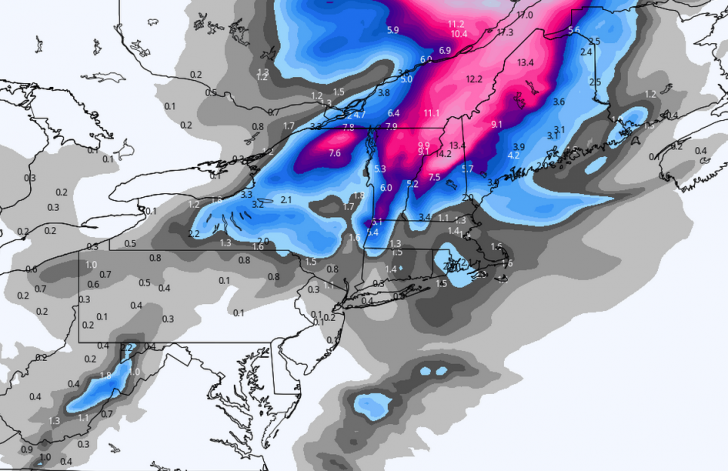
The track is hugging the coast, which would allow enough mild air to spread into the mountains to start the precip as rain. However, as the low tracks northeastward, the rain would change back to snow and a sizable “backside” accumulation could be in the cards, as suggested by this snowfall map for the 5th and 6th.
Longer term, I tend to think that the pattern will deliver enough cold air to keep the season going. March in La Nina years tends to favor a continuation of winter across the North and for now I am going to lean on that analog.
In the West, weather worries are minimal, as transient upper level troughs will swing through the region at times and those systems will produce some late season powder days and sustain outstanding conditions.
REGIONAL HIGHLIGHTS:
Pac NW/B.C.:
The hits just keep on coming. After very heavy snow to end the weak, weaker systems sustain the snowy pattern next week; quieter in OR.
Central and southern Sierra:
Windy weekend for Tahoe and SoCal resorts. Quiet week coming up, best shot at snow next weekend.
Rockies:
Light snow this weekend; ridging leads to quiet week thereafter. Next shot at snow next weekend.
Midwest:
Seasonable weather overall for next week. Passing weak systems produce light snow in northern Great Lakes.
Northeast:
Light mixed precip this weekend. Elevation matters! Early week cold shot, then milder. Potential for sizable late week storm.
Mid-Atlantic/Southeast:
Damp weekend; colder with high elevation snow Monday. Snow potential mid to late week-north. Challenging upcoming week of weather in southern Appalachians.







 If we were in Utah where we have a place, my wife and I would be able to get shots on Monday, January 18. But we’re in NY where, over the past few days, the Governor announced that people 65+ are now eligible. Scheduling the shot is confusing. The state’s vaccination registration website listing places administering vaccine has hundreds of drugstores, hospitals and dedicated vaccine administration sites. Virtually everyplace we called had no idea when the vaccine would be available.
 Our friends in Vail were given cards verifying they’ve been vaccinated (the first of two doses). It will be interesting to see if a more sophisticated digital system will evolve to identify who has been vaccinated. If it does, it probably will raise issues about privacy. I’m all for maintaining individual digital privacy, but I’m also aware that most Internet users reveal far too much personal detail on Facebook and other social media platforms, often in contrast with their concerns about government knowledge of their personal lives. Articles I’ve read suggest that at one point, those of us who’ve been vaccinated will be part of a national digital registry. Eventually, when airlines and other enterprises limit access only to those who’ve been vaccinated, they’ll get that info from the registry.




 Several Covid vaccines, like many other drugs and technologies, were developed with some level of government participation. In the case of Pfizer’s, the government guaranteed to purchase $1+ billion of product long before it was approved. For decades, technology transfer programs have helped medical and other technologies — discovered, invented, and/or developed with public funds — get picked-up and commercialized by the private sector.


 Fellow ski journalist, Dave Irons, 82, reports, “…all I need is a morning that includes 5-10 runs.” He and his 60-year old daughter ski
  At 74, Kevin Toolan’s perfect day is about 4 hours with his 6 and 10-year old grandsons at


 At the other end of the country, Howard Vipler finds skiing Hunter Mountain’s 1,600’ satisfying but generally calls it quits by noon. He retired from Hunter’s Ski Patrol after 40 seasons there, so he knows where to find fewer people and better conditions. Even so, for him, 1600’ has it limitations.


 Those of you who live close to where you ski won’t feel the pain. Not so for those of us who must travel.
 For several seasons, Utah has encouraged people skiing the Cottonwood Canyons (Alta, Snowbird, Brighton, Solitude) to take public transportation. Depending on time of day or day of week, ski buses were at their 60 passenger capacity. This season, each bus will be limited to 20.








 We see this type of poor judgment when people drink and drive. Or when they back up and over a cliff taking a selfie.