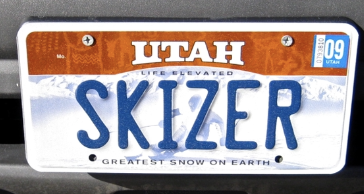
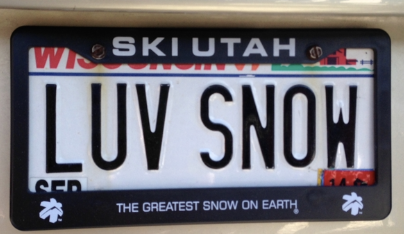
Isn’t it fantastic what a good imagination can do with six or seven characters…especially when a passion for identifying with skiing is involved?
These new additions to the license plate gallery came from Margery Martin, Minneapolis; Jack Whalberg, Cape Cod, and Hamlin “Ham” Pakradooni, Cape Cod.
If you run across a skiing license plate and want to add it to the SeniorsSkiing license plate picture gallery, take a picture (preferably close up and straight on) and send it to info@seniorsskiing.com. We’ll do our best to credit each contributor.
This is being written from Salt Lake City, the day after 20” fell at Snowbird. It’s almost at the top of Little Cottonwood Canyon and just a short distance from Park City, where the total was 10”. Compare that to Mammoth Mountain in California’s Sierra range… 44” in 72 hours!
Jon’sShort Swings! column is a bit self-confessional this time, speaking to the factors that help us age gracefully. As usual, it also reports on industry news and recent curiosities. The link to a history of how snowball fights have been shown in art shouldn’t be missed.
Herb Stevens, the Skiing Weatherman, reports on winners and losers in the most recent storm cycles. His articles are always good reading.
We really should appreciate our ski buddies because, as we age, they become like hen’s teeth. Harriet Wallis advises how to find others with whom to ski.
Longtime ski instructor, John Gelb, addresses a common and often undiscussed issue among skiers of all ages: fear. He offers good guidance on conquering what he calls, the Fear Monkey.
Contributor Pat McCloskey, who is accustomed to skiing in his home state of Pennsylvania, explains how to use smaller mountains to hone skiing skills for trips to bigger terrain. Pat has skied them all and offers readers excellent counsel.
XC editor, Roger Lohr, presents 10 places around the country where XC beginners can learn the basics.
The winner of our last Test Your Skiing Knowledge feature is presented along with the new challenge. Remember, first correct answer mailed to jon@seniorsskiing.com wins the prize.
And, thanks to the contributions from numerous readers, the ski-oriented vanity license plate photo gallery has expanded.
Enjoy the issue. Have a great Holiday Season. Next issue: January 7.
Yes, age does give many of us some advantages. Wisdom is often cited, but, I, for one have made enough errors in judgment to be exempted from checking that box. I’m probably not alone.
Financial well-being is another frequent citation. Fortunately, along with about two-thirds of SeniorsSkiing readers who say they’re financially independent, I’m okay in that category. But I know too many older skiers whose fortunes took them in another direction. Many have adjusted lifestyles so they can continue to pursue their favorite sport.
Outlook and attitude also are advantages for some of us. My old friend, Frank Burgmeier, is 98. A veteran of 65+ bomber flights in WWII, he continues to have a sharp mind and a great attitude. “I’m blessed,” he tells me. That, despite disappointments from some family members. “When I peel all of those things away, I’m happy and at peace.” If I make it to that age, I hope my mind and spirit are as healthy as his.
Jim Cobb is another example. Jim is 89 and the developer and manufacturer of TheBootster, the ski boot shoehorn that advertises on these pages. He skied many years with the National Brotherhood of Skiers before age caused him to retire. When I mention that we just had a 24-hour snowstorm here in Utah, he sighs with resignation and says, “I’m envious that you’ll be skiing. That part of my life is behind me.”
Some are fortunate enough to ski on and on. George Jednikoff continued past 100. At 99, Claus Obermeyer is still going. I know there are others, but I don’t know their names.
Luck also is a big factor. I recall being at a luncheon where the speaker was Mike Singletary, then coach of the San Francisco 49ers. One comment that stuck with me was the 20% luck factor. Being in top physical condition and having outstanding skills were essential for his players’ good results, he said. But luck always plays a role on the field; he thought about 20%.
Luck (good or bad) also is a factor as we age. Like many other senior skiers, I’ve had my fair share of bad luck. Much of it seems to have occurred health-wise in 2021. I’ve been climbing out of that hole for the past six months, and I’m now ready to get back to what I love: skiing. I readily admit that the goal of publishing SeniorsSkiing.com kept me motivated during some dark and difficult times.
Wisdom. Financial well-being. Outlook and attitude. Good luck. They can keep us going as we age. Whether we possess all of them or a few, we should be grateful for what we have, while we have it.
Wishing all readers good health, good skiing, and good times for the Holidays, and beyond.
[[Taking Christmas and New Year’s off. Next issue of SeniorsSkiing.com will be sent January 7. You always have access to all articles by visiting seniorsskiing.com. New articles are posted on the site during the week leading up to each publication date. Please help us grow the seniorsskiing.com audience by sharing seniorsskiing.com with other senior skiers.]]
232 Skiing Santas Raise Charity $$$s
For the past 21 years, Sunday River (ME) has kicked off the Holiday Season with Santa Sunday, a fund-raiser for a local charity. This year, 232 Santa-clad skiers each paid a $20 entry donation, raising more than $5000 for The River Fund, which invests in the education of young people in the region.
Vail Resorts Tops Season Pass Sales
Vail Resorts reported it sold more than 2.1 million season pass products for this season. That’s 700,000 more than last year, a record for the company. Also, for the second year in a row, Newsweek named VR one of America’s Most Responsible Companies.
Jackson Hole Ups Hourly Wage
Jackson Hole Mountain Resort is increasing its minimum wage for all non-tipped positions to $18 per hour, up from $15 per hour. The increase is intended to attract new and retain existing employees.
Really Smart Helmet Technology
Source: Twiceme
Twiceme, a Swedish company, has teamed up with Salomon to produce “smart” ski helmets. To be available late 2022, the helmets will utilize twICEme® technology to provide a suite of safety information ranging from personal medical records to finding a lost child. It will be readily accessible to ski patrol and search and rescue.
NE Areas Banning Boot Bags?
SeniorsSkiing subscriber, Torry Hack, writes: “As a grey-haired skier who likes to put on his boots in the lodge vs in his car, I am disappointed to find that many New England areas are still banning bags.”
New England skiers: Please email info@senioirsskiing.comto let us know if your area bans bags in the day lodge, and we’ll publish the list.
Shipping Container Ski Lodge
The Pad Hotel, Silverthorne, CO
The town of Silverthorne, in Summit County, Colorado, is home to The Pad, a hotel constructed from 18 shipping containers. Private rooms are $350. per night; bunk rooms, $50. It’s not far from Copper, Keystone, Breckenridge, and A-Basin.
Surprise Storm
Reader Donna Ohanian in New Hampshire, sent in this photo along with a note stating, “This storm was supposed to be 3-6”. Nope. 30!” Note the LUV-SNO license plate. Thanks, Donna!
Snowball Fights in Art
Detail from a fresco depicting the month of January at Buonconsiglio Castle in Trento, Italy, ca. 1400
Public Domain Review is a British-based organization that issues interesting articles and illustrations outside of copywrite restrictions. Click here to enjoy PDR’s history of snowball fights in art over the centuries and in a variety of cultures. It’s a treat.
When was the last time this happened to you on the mountain: you’re skiing down one of your regular trails, having fun, where you know every turn by heart, and then, as you approach a trail sign for a more difficult run than you’re used to, you think maybe it’s a good time to try it…but then you keep on skiing down the regular old way.
So what happened? It happens to me also: a tiny little wave of discomfort/anxiety/fear creeps into my head (I call it the “fear monkey”) and causes me to ski the easier way, meanwhile telling myself, “I’ll do this one tomorrow.” And just like that… fear becomes the boss of me! I hate that, but it happens. How can we change our patterns, so we take the turn down the more challenging terrain?
Don’t let the fear monkey get in your way.
I’ve noticed this for years in my own skiing, although I’ve gotten better at deciding when I’m going to “go for it” and challenge myself more than usual. The key for me in making positive changes, and skiing more challenging terrain on a regular basis, started when I began ski instructing twelve years ago! Huh? Let me explain…
I’d take a group of skiers, usually 3-6 people, ranging in ages from 18-50. While the group was being organized, I’d always introduce myself to each skier, and ask each person a few questions about why they were taking a lesson, what types of sports and activities they enjoyed, what they hoped to get out of the lesson; stuff like that. I’d also ask, ”What are you worried about?”
I’d hear a lot of things that would help me figure out what each person’s “takeaways” were for their lesson. It was almost like each person would give me the magic key for solving their “personal skiing puzzle.” Everyone’s got one, hidden away, just waiting to be revealed, including me: “afraid of going too fast,” “getting my skis more parallel in the turn,” “keeping my speed under control to lower my fear,” ”not be so afraid,” “looking as good skiing the tough stuff as the easier stuff!” What’s yours?
For skiers, the degree of FEAR in their heads is the ultimate limiter on both performance and improvement. Of course, we need fear to warn us away from true danger, but fear is greedy, and likes to hang around unless we send it away.
The good news is that you can send fear to the back of your mind. It’s simple. Just figure out your own magic key to your own skiing puzzle. What do YOU need to do on a tougher run to stay confident? For me it was this: take the more difficult trail, but plan to ski it in a very measured way, slower than the other runs, pausing to pick each line, just one turn at a time, and stay smooth. Once I started thinking differently about skiing the tougher stuff, it became much easier to choose those double blacks, and it felt good at the end of each day to have skied them.
https://seniorsskiing.com/wp-content/uploads/2020/12/IMG_1071-rotated.jpg640480John Gelb/wp-content/uploads/2014/04/Seniors-Skiing-since2013-Logo@2x-300x68.pngJohn Gelb2021-12-16 20:14:262024-08-20 15:16:16The Fear Monkey in Our Heads
Finding someone to play with was easy when we were kids. “Can Johnny come out and play?” But as seniors, it’s not easy to find someone to ski with. Ski friends drop out, move away, or go to the great beyond.
SeniorsSkiing.com is an amazing source of information. Here’s what happened recently: A skier emailed me saying: “I saw your stories in SeniorsSkiing.com and I want to connect with senior skiers in the Salt Lake area when I’m out there this winter. I’ve heard about Alta’s senior group called the Wild Old Bunch. How do I connect with them?”
The Wild Old Bunch meets daily at the only round table in Alf’s, mid-mountain at Alta. Photo Harriet Wallis
That was easy. I told her all about theWild Old Bunch – the upbeat group of senior skiers who gather about 11- 11:30-ish weekdays for camaraderie and snacks at the only round table in Alf’s mid mountain restaurant. It might be a big group or maybe just a few. It just depends on who’s skiing that day. They talk about all kinds of things: golf, plumbing, road trips and more. You’ll likely meet someone who skis the way you like to ski.
Look for the WOB patch. Photo: Harriet Wallis
Enthusiastic WOB-er Bob Phillips said: We welcome anyone who shows up to join us at the round table. It’s a good way to find a ski buddy. And on the hill, look for the smiley face WOB patch that many wear on their jackets.
Bet you’re thinking: “I won’t be at Alta. How do I find ski buddies?”
Nationwide, the 70+ Ski Club is a senior club that typically has a handful of week-long trips to US and foreign destinations. Travels include everything: hotels, tickets, transportation, and of course cocktail parties and dinners together. It says: ”Since 1977, 70 Plus Ski Club members have enjoyed free and discounted skiing, developed lasting friendships, and skied together at resorts worldwide.”
Bet you’re still thinking: “I want to find ski buddies. How do I do it?”
Many areas have ski hosts who conduct mountain tours. The tours usually are a few hours, and participating in one may help you meet someone with comparable skills.
Another suggestion: Many older skiers read SeniorsSkiing.com, so let’s start a list of senior ski groups across the country. Just fill in the Leave a Reply message box following this story and we’ll get this going.
What ski area?
In what state?
Does the group have a name?
Where do they gather?
A certain day of the week? Daily?
What time?
Do they ski together? Ski with a guide? Other?
Please add everything else you’d like skiers to know.
SeniorsSkiing.com is an amazing source of information. Using the site to create a central registry of senior ski groups will benefit the entire community. Let’s do it!
https://seniorsskiing.com/wp-content/uploads/2021/12/Screen-Shot-2021-12-13-at-3.25.46-PM-e1639434405528.png401728Harriet Wallis/wp-content/uploads/2014/04/Seniors-Skiing-since2013-Logo@2x-300x68.pngHarriet Wallis2021-12-16 20:12:132021-12-16 22:27:45Finding a Senior Ski Buddy
Each issue of SeniorsSkiing.com has a picture to help test your skiing knowledge. The pictures are from collections in a variety of participating ski museums, which we encourage readers to visit.
Source: New Mexico Ski Museum and Sk Hall of Fame
The hairdo’s scream late 1960s. But these co-eds weren’t the only students of the man in the middle. He trained members of the US men’s and women’s Olympic ski teams and went on to write books on finding inner peace. What is his name and what is the name of the area where this picture was taken? One clue: it was submitted by the New Mexico Ski Museum and Ski Hall of Fame.
The first person to submit the correct answer to jon@seniorsskiing.comwins a yet to be determined, but skiing-related prize. Note, only answers sent to that address will qualify.The correct answer and the name of the winner will appear in the next issue of SeniorsSkiing.com.
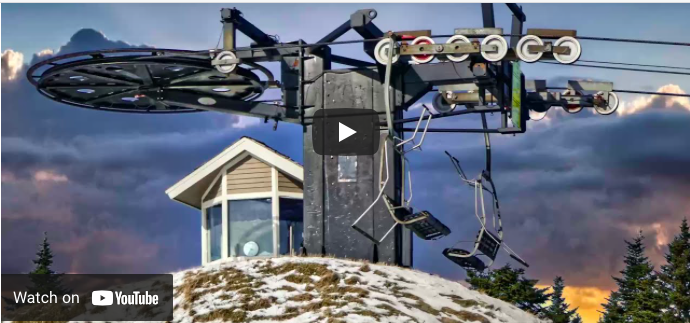
The winner of the last Test Your Skiing Knowledge is Jimme Quinn Ross of Stephentown, NY. He was the first of several readers to correctly identify the top terminal of the Lynx chairlift being helicoptered into place at Wildcat, NH. The Lynx chair was a Riblet double that opened in the winter of 1970-1971. Jimme’s prize is a container of Slide On, the compact spray that helps ski boots slide on effortlessly by forming a layer of dry lubrication. One can is a full year’s supply. Value: $12.95.
https://seniorsskiing.com/wp-content/uploads/2021/12/Screen-Shot-2021-12-16-at-10.32.26-AM-e1639677022752.png613728seniorsskiing/wp-content/uploads/2014/04/Seniors-Skiing-since2013-Logo@2x-300x68.pngseniorsskiing2021-12-16 20:10:322021-12-17 09:20:42Test Your Skiing Knowledge
We had an unfortunate reminder that “skiing is an inherently dangerous sport” with the untimely death of Ron LeMaster, ski writer/photographer and certified PSIA instructor. The 72-year-old was killed earlier this week after colliding with a snowboarder on Eldora Mountain (CO). May he rest in peace.
Like so many things in life, sometimes fortune is not on our side, even though we plan carefully and exercise caution. We need to remember to appreciate what we have when we have it.
There’s a lot to read and see in this issue.
The Short Swings! column makes a statement about the proliferation of redundant promotional ski videos.
Skiing Weatherman, Herb Stevens, has encouraging news that snow is on the way!
Dreaming of skiing the Dolomites? An account, updated to reflect changes since it was published two years ago, will fire your imagination.
Don Burch shares with us another delicious short video titled, “Calling Me.”
Jon has been collecting photos of ski-oriented vanity license plates. Hope you enjoy them and send in some photos of ski plates you spot in the lot.
Jonathan Wiesel writes about Latigo Ranch, a high-elevation cross-country skiing paradise in northern Colorado.
Executing a proper turn is explained in a short article by British ski coach and writer, Bob Trueman.
And Pat McCloskey introduces us to The Fall Line with Chaos and Company, a PSIA podcast filled with good advice.
Finally, please take a peek at the photo in Test Your Skiing Knowledge. If you think you know the answer, submit it through info@seniorsskiing.com. The first one with the correct answer will receive a can of Slide On, the compact spray that helps stockinged foot slip effortlessly into boot.
A belated Happy Thanksgiving and best wishes for a safe and enjoyable season.
We live in what some call an attention economy. Those who attract attention – regardless of how they go about it – appear to be the victors in our narcissistic new world. The companies making skis and related gear are no exception. One of their primary ways of competing for attention is producing short videos of pro skiers using their gear in wild and wooly terrain.
Videos of people doing amazing things on skis are similar to porn: there are just so many tricks in the bag, and it’s not long before they get boring. That said, ski manufacturer lemmings invest in making videos that, in one way or another, try to outclass their competition.
The New Age of Reason is a new addition, from a company named WNDR (Wonder Alpine). It combines a soundtrack of barely audible British voices making quasi-intellectual statements, while pro skiers make deep powder turns and jump cliffs in some easy-to-watch and quickly forgettable scenes. Unlike most other short promotional videos which depend on big-name super skiers and/or pulsing rap music to appeal to their intended audience(s), this one relies on pretense. That said, WNDR appears to be a company with good policies and good products.
Will its video approach help the the company break through the rest of the promotional ski video clutter? Maybe for a few minutes while the ski marketing echo chamber resonates with email congratulations.
A few years ago, at the Winter Outdoor Retailer Show, I attended a presentation that discussed a variety of advertising and promotional investments. The activities were listed in order of their perceived effectiveness in contributing to product sales. As I recall, in-store salespeople and word-of-mouth were most effective. Way down on the list…I mean toward the very bottom…were promotional videos. They cost a lot to produce. They reach a relatively small audience. They make their sponsors feel good about their investments. But do they move the needle when it comes to sales? You know the answer.
As I finished drafting this, yet another video landed in my inbox. At 21 minutes, it’s a bit on the long side. But if you want to see what has become possible on skis in entirely impossible terrain, “Good Luck” will get you up to speed with a smile. Click here to screen.
Ski Journalist Dies Following Collision with Snowboarder
Ron LeMaster, 72, was killed earlier this week after colliding with a snowboarder on Eldora Mountain (CO). LeMaster, a ski writer and photographer, was a certified PSIA instructor. No charges were filed against the boarder. The tragedy is a reminder for older skiers/boarders to exercise extreme caution on the hill. R.I.P.
Realskiers.com: Ski Industry Is in Trouble
Jackson Hogen publishes realskiers.com, a long-established website featuring in-depth reviews of each year’s new skis and a host of observations about the sport. The self-proclaimed Pontiff of Powder periodically sends out thought pieces under the heading, “Revelations.” A few weeks back, he took a dystopic and disturbingly realistic view of the future of skiing. It’s titled, “Will the Next Generation of Skiers be the Last?”, covering, among other big issues, cost, accessibility, competing interests and climate change. To read the short essay, click here. SeniorsSkiing.com subscribers are eligible for a 50% discount off the annual realskiers.com rate of $19.95. Use Code SS21 at checkout.
Klaus Obermeyer is 102!
Klaus created the ski apparel line bearing his name. He is credited with making the first down-filled parka. When I interviewed him a few years ago, he said that he found it easier to ski than to walk.
Winter Park to Donate Uphill Ski Pass Revenue to Charities
Source: Winter Park Resort
The area will donate proceeds from sales of its uphill ski passes to local charities. The passes cost $25 each. It’s good policy, given that paying to climb on the slopes is a relatively new development that has been met with some criticism.
Aspen Bumps Minimum Wage
Aspen Skiing Co. will increase starting wages to $17 per hour, a significant bump from Colorado’s current $12.32 minimum. The company also increased employee housing to 1,000 beds.
High Tech Bandage Changes Color
DrySee is a long-lasting bandage that changes color when it needs to be changed. Cost depends on bandage size. Manufacturer of this interesting new product is offering SeniorsSkiing.com readers 20% off when they enter “Facebook 20” at checkout. Visit www.drysee.com to learn more.
Last Minute Gift for Senior Skiers
The Bootster ski boot shoehorn is ideal gift for older skiers
Get them The Bootster. It’s a clever, fit in your pocket ski boot shoehorn that is solidly made and will last many, many seasons. Handmade by company founder, Jim Cobb. At $25, it’s one of the best bargains around. Click on the adjacent ad and read the rave reviews.
Dep’t of Wretched Excess
The world’s most expensive “hotel” room costs $175,000 per night.Lover’s Deep is a luxuriously tricked-out submarine in St Lucia. Amenities include captain, cook and helicopter.
Diamonds Are Forever Martini
The world’s most expensive cocktail is now available at Tokyo’s Ritz Carlton hotel. The Diamonds Are ForeverMartini costs $22,880 and is garnished with a one-carat diamond. Kampai!
New 10th Mountain Division Documentary
https://youtu.be/x6BpDQ85ZN8
“Mission to Mt. Mangart” is a new documentary exploring the famed 10th Mountain Division, whose members relied on skis. Click on the trailer (above) to see the slalom they organized in June, 1945.
Update: Jackson Hole’s Skiing Wunderkind
I wrote about Kai Jones when he was 12. Kai, now 14, is the Jackson Hole ski wunderkind whose skiing is a joy to behold. This short video was shot last season, when he was a high school freshman.
No impossible steeps, flips or cliff-hucking. Don Burch creates kinder and gentler ski videos showing normal skiers doing normal things. His editing, use of interesting digital enhancements and choice of scenic shots have a warm, old-school quality appealing to skiers and boarders of a certain age. “Calling Me” (about 3-minutes) is Don’s most recent production. Click on the image to view.
https://seniorsskiing.com/wp-content/uploads/2021/12/Screen-Shot-2021-12-01-at-8.44.24-AM.png323690seniorsskiing/wp-content/uploads/2014/04/Seniors-Skiing-since2013-Logo@2x-300x68.pngseniorsskiing2021-12-02 22:46:442021-12-03 08:41:58Ski Videos for the Rest of Us
Sometimes life exceeds expectation. That’s what I’ve found with winter ranches in the Rockies.
In summer, hundreds of dude ranches draw thousands of visitors. They’re crazy-diverse: homespun and elegant; private and heavily peopled; mostly self-service or with staff at your call. You’ll find Spartan working ranches as well as places with canapés and kidney-shaped swimming pools.
The few ranches open in winter are outstanding – magnificent settings and staff, excellent facilities and food, and snow so delicate it drifts through the air like cold smoke. They’re run for cross-country skiers, snowshoers, and, increasingly, fat bikers by people who love the season and their profession.
Wecome to Latigo Ranch
A prime example is Latigo Ranch, near the town of Kremmling in north-central Colorado’s Gore Range. It’s owned and managed by Lisa and Randy George and their kids.
Latigo used to run cattle, sheep, and “dudes” before it totally converted to guest ranching in 1987. Once you turn off Highway 134, you start climbing, trading sage for pine, spruce, and aspen, interspersed with vast meadows. It feels like the top of the world.
Latigo can cater to pretty much any culinary taste, be it red meat, vegetarian, kosher, low carb, or low fat. Breakfast is my favorite meal. I have fond memories of buttermilk pancakes imprinted with the ranch brand, complemented by genuine maple syrup.
Latigo comfortably handles 22 guests, but you’ll seldom find that number except during holidays. Cabins are ski-in/ski-out, nestled in pines above the lodge with wood-burning stoves. This is a ski ranch, not a resort (no phones or TVs in the rooms).
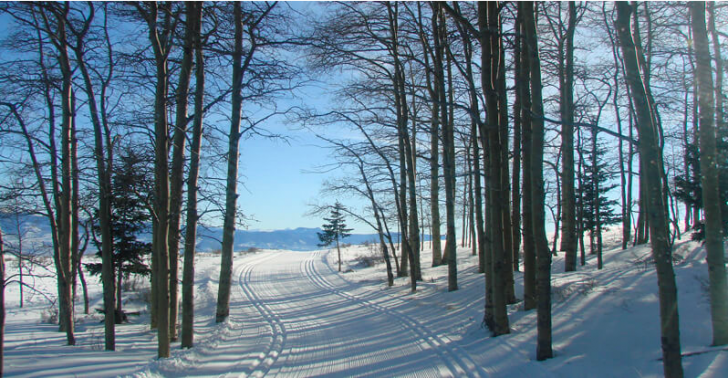
50km of groomed trails lace through Latigo
Latigo grooms 50 kilometers of trail for track, skating, and fatbiking.
This is gorgeous, rugged country, with some of the most enjoyable skiing and diverse trails I’ve ever experienced. For example, the descent on Arena Run can be like silk in fresh snow; lightning in the spring.
High up on windswept Jumper Flats, you’ll find a broad panoramic view. You can tear down The Luge at sunset, when you may be greeted with a spectacular play of colors over the Indian Peaks Wilderness – 70 miles of mountain and valley snowscape.
If you’re altitude-sensitive, book a longer stay and take it easy for at least the first day. (Latigo’s trails range from around 8,600’ to 9,400’ above sea level.)
It’s a wonderful thing to ski back to the ranch on a crisp afternoon, saunter over to the Social Center, and finish the day with a sybaritic Jacuzzi soak!
When You Go
Latigo is 150 miles from Denver International Airport. In addition to trails, you can go sledding, tubing, and snowshoeing. Skis, snowshoes, and pulks can be rented at the ranch, but you’ll need to bring your own fat bike.
Adult rate for winter 2021-’22 is $225/day and covers lodging, meals, trails, and “100 % free views.” The season begins just before Christmas and runs into early March. Interested in learning more? Call 970-724-9008; email Randy@LatigoRanch.com, or visit www.latigoranch.com.
Even though senior skiers ski more and spend more per capita on skiing than younger generations, there’s a perception throughout the industry that the older cohort is made up of tight wads taking up otherwise valuable space in the day lodge. Jon touches on the issue in this week’s Short Swings! column.
In his typical light and informative style, Skiing Weatherman, Herb Stevens, presents a clear picture of the forecast for snow country.
Henry David Thoreau wasn’t a skier, but, as Mike Maginn writes, Winter presents an excellent opportunity to visit Walden Pond on XC skis and contemplate how the naturalist/philosopher/poet spent his time there.
Staying on the topic of XC skiing, Roger Lohr explains the basics for newcomers to select a functional XC package. Very good advice.
Also in the Department of Good Advice, Bob Trueman offers guidance for coping with the dreaded Day 3 slump.
Harriet Wallis reports on Brighton’s tree nursery and it’s Ski With an Arborist program.
And Jackson Hogen explains what to do and what not to do to keep your binding functioning effectively.
Finally, check out this issue’s Test Your Skiing Knowledge feature. The winner will receive a one-year subscriiption to Outside+, will full access to the new Warren Miller film, magazine subscriptions, and lots of other goodies.
Note that the next issue of SeniorsSkiing.com will be issued Friday, December 3. In the interim, my wife and I will be moving permanently from East Coast to Salt Lake City, where the condo that’s been under renovation since June, won’t be ready for yet a few more months. Chalking this up to the challenges of managing contractors from a 2250 mile distance.
Many in the ski resort industry harbor an image of older skiers taking up otherwise profitable space in day lodges while consuming their bag lunches and lingering over a cup of coffee. I take offense at that stereotype. I prefer a cup of hot tea to coffee and I take my own teabag from home.
Clearly, the facility makes more selling beers than charging $0.25 for a cup of hot water. And, like it one not, a few lunchtime drafts are more likely to produce on-hill crashes than coffee or tea.
On a recent trip to the skateboard park with my grandson, I realized that good pre-season safety training might involve dodging boarders while wandering through the half-pipe.
Most areas have well-known secret places where skiers and boarders go for a bowl. Some claim it gives them greater awareness and control. I can see it working that way in mature minds and bodies. But teenage boarder boys and girls? Those are accidents waiting to happen.
Which brings me back to what we quote most from that American patriot, Spiro Agnew. I don’t intend to be a nattering nabob of negativism but looking at the hypocrisy in the industry (what industry, government, institution doesn’t have its fair share of hypocrisy?), all I’m asking is that the people in charge recognize that older skiers are a good thing. We keep their lifts occupied mid-week. We ski more. We make more skiing-related purchases for ourselves, our kids and our grandkids. We tend to ski in control and show consideration for others on the lift, in the lodge, and on the hill.
Rodney Dangerfield
Most of us have supported the industry through bad and good times. Yet, they keep taking away the discounts and other privileges. The majority of those still offering discounts have upped the age threshold…most now at 80; some as high as 90. It’s not that we need the discounts, but it would be nice to have greater respect. Rodney Dangerfield was right.
Killington Now Skiing
Vermont’s Killington Resort, the largest ski and snowboard destination in Eastern North America launched its 2021-22 winter season last Friday. It was the first Eastern resort to open for skiing and boarding.
Steamboat’s $269 Lift Ticket
Steamboat Ski Resort (CO), announced that a holiday/weekend day ticket will cost $269 when purchased at the window that day. Last season, Steamboat upped its day pass to $225 from $199. Most skiers will purchase in advance at a lower rate or ski Steamboat on their Ikon pass.
What a Run!
Markus Eder is an Italian freestyle skier of great nerve and grace. This 10 minute video shows him negotiating some remarkable terrain. Enjoy the show.
Ski Maps Galore
Remember the area ski maps of your youth? Skimap.org is a site with 16779 images of ski area maps. For example, listings for Mount Snow in southern Vermont shows more than 50 maps from 1957 to 2021. The Americas shows 8849 maps; Europe, 5100; Asia, 1633. There’s even 232 maps for fantasy ski areas shown. Viewers can upload maps after registering.
Reality TV at Mount Baldy
Given the ski area labor shortage, it made sense that the CBS reality TV series, Tough As Nails, would have its two teams race to fix chairs at Southern California’s Mount Baldy ski area. It broadcasts as Episode 2 of the show’s third season. Click here to preview.
Snowbird Patrol
Safety Keepers, produced with support from Mammut, documents a day in the life of two Snowbird patrol people. It’s short and worth watching.
Ski Area Map Making Made Easy
Here’s a fun time-lapse video of ski trail map artist, Kevin Mastin, painting Tennesee Creek Basin at Ski Cooper (CO).
There are two trips around Walden Pond near Concord, MA. The first is a ski tour through a picturesque New England landscape, with sharp and steeply wooded hillsides surrounding an ice-covered, lambchop-shaped lake.
Around the same pond is a second trip, a pilgrimage that passes the cabin site of Henry David Thoreau, “self-appointed inspector of snowstorms”, conjuring the spirit of a special place and inspiring the thoughts of the pilgrim visitor.
Henry David Thoreau in 1856. Source: Wikipedia
If you choose the first trip, you‘ll find a pleasant ski tour: maples, birch, and oaks, rubbing branches in the wind, a frozen-solid pond to ski across, varying widths of trails in and out of sunlight, all free of charge, all well-tended, all convenient to the Walden Pond State Reservation parking lot on the Concord Road.
But, if you choose the second, be prepared to confront a man who discovered himself in those very woods and hills of Walden Pond, giving us a model of independence and renewal. One thing is for sure; if you take this trip around Walden, you won’t come out the way you went in.
What is it about Thoreau that initiates such pilgrimages? Why are visitors on foot and on skis so drawn to this singular place, the site of a small cabin gone long ago?
The answer is in the subtle message Thoreau left in those winter woods. To know the message, you have to know why Thoreau went to the woods to live alone by Walden Pond and what changes the woods made to his life.
Born in Concord in 1817, Thoreau went to Harvard College where he was homesick for the fields and forests where he once had played. Upon graduation, he and his brother, John, started a school in Concord. John became ill, the school closed, and Henry went to live with Ralph Waldo Emerson, serving as the philosopher’s gardener and handyman. Shortly after moving in, John Thoreau died, and Emerson’s five-year-old son passed away; their mutual grief bonding the two.
Now, Thoreau turned his attention to the community of thinkers surrounding Emerson, splitting his time between handyman and writing philosophical essays.
He was 28, an unsuccessful writer and poet living among the most dynamic American literary and philosophical giants of the time. Frustrated by the complexities of society, Thoreau returned to the woods, to think, write, learn and sort out his life.
Replica of Thoreau’s cabin. Source: The Walden Woods Project
On July 4, 1845, he moved into the cabin he had built on the northwest shore of Walden Pond on land owned by Emerson.
You can ski up to the site of Thoreau’s cabin by following the shoreline trail on the north side of the pond or by a ridge trail also to the north of the pond but in more rugged terrain. If conditions are right, you can ski right across the frozen surface.
All of these trails are short, about a quarter-mile from the parking lot. A circumnavigation of the pond is less than three miles. If you want more skiing, cross Concord Road and link into the web of well-tended trails that spread around Sandy Pond and into the town of Lincoln.
But this is a pilgrimage.
Thoreau’s house site and cairn. Source: The Walden Woods Project
The cabin site is in a clearing of pine and hickories “on a pleasant hillside.” A cairn nearby has been building since the site was discovered in 1947. Stone markers indicate a small cabin, about 11 by 15 feet, the door facing the pond.
Much has been written about Thoreau’s two-year residence in the woods as a practical experiment and a naturalist’s odyssey. However, as you stand in that clearing by the cabin site, imagine Thoreau writing on his little desk, remembering his brother and struggling to express his thoughts about life, values, and simplicity. Surely, the time spent at Walden was a time of renewal.
“I went to the woods because I wished to live deliberately, to front only the essential facts of life, and see if I could not learn with it had to teach and not, when I came to die, discover that I had not lived,” he wrote later.
In September 1847, Thoreau left Walden and moved back to his father’s house in Concord. He left knowing he could live the life he wanted. For the rest of his life until he died in 1862 at 43, Thoreau wrote, lectured, travelled, and continued to wander the woods.
Walden had been a turning point; the woods were a catalyst that helped him recognize who he was and where he was going, a man marching to a different drummer.
If you make this pilgrimage in winter, go early. You’ll find yourself alone in the woods next to Walden Pond. Stop skiing and stand quietly. The wind will crackle the branches, and you’ll hear your heart pounding.
Like Thoreau, let the woods give you respite. Recall what these woods have done, what any woods can do to vexed souls. Reflect on the simple beauty around you, read aloud from Walden, go back to the parking lot, different than when you went in.
This is my shortest ever blog, but it may have a significant impact on your next ski holiday.
Should have taken the day off.
It’s your first day back on the slopes, and you want to hit the ground running. You don’t want to miss a thing, so you‘re up early, on the first chair, and skiing like a mad thing all day. It feels so good!
The next day you’re just a wee bit sore, but not enough to stop you.
But on the third day you hit the “Day Three Slump”. Your skiing seems to have got worse. Your energy levels have slumped. You hoped you’d get better; it’s frustrating. At the end of the week you feel you’ve made no improvement; got no better than last year. This is how your week may go:
Source: Bob Trueman; Bobski.com
I have a suggestion for “slump day”: take it easy, be patient, don’t push it, do lessthan you might.
Would it be sacrilege to suggest taking a later breakfast? An even greater sacrilege to suggest starting at 11:30 and finishing at 2:30? Or, if it pleases you, consider taking a half day out and visiting a local place of interest. You could spend an amusing hour or two in a ski shop trying to guess which of this year’s new wonder skis is actually last year’s but in different livery.
Tomorrow do just a little bit more. On day three you’ll be ready to fly; stronger, your muscle memories will have kicked-in. You’ll find yourself skiing better, not worse.
At the end of the week, you’ll be skiing better than last year, and you won’t get home feeling frustrated that your skiing is in decline.
Your week will go like this and end on a high:
Source: Bob Trueman; Bobski.com
It will be a better feeling and well worth a try!
https://seniorsskiing.com/wp-content/uploads/2021/01/OutOfControl.png490368Bob Trueman/wp-content/uploads/2014/04/Seniors-Skiing-since2013-Logo@2x-300x68.pngBob Trueman2021-11-11 22:55:492021-11-11 18:20:18The Day Three Slump
For newcomers to cross country (XC) skiing, deciding on the best skis can be intimidating, especially if you don’t want to rely entirely on retail sales people or on-line outlets for advice.
Devil’s Thumb Ranch, Colorado
The following guidance about selecting and using XC gear is general and intended to help you be an informed consumer.
Note that as a rule of thumb, standard XC equipment packages include skis, boots, bindings and poles and are less expensive than purchasing components individually.
Which pair of cross country (XC) skis is right for you?
Average recreational XC skiers should rule out light weight very narrow gear (used by racers) and waxable XC skis and/or wide steel edged XC skis (used by backcountry mountain skiers). Instead, consider looking at a lightweight XC ski with a waxless base. In general, these bases include skins or a pattern milled into the base (e.g. a crown or fish scale pattern) which allow one ski to grip the snow, while the other is pushed off to glide. They also keep the skier from slipping backwards while traveling up a hill. Note that ski length should correlate to skier’s weight.
Ski choice also is a function of where the ski will be used. Places with groomed, packed trails are best experienced using narrower skis. Wider (e.g. 55 millimeters in the shovel) and softer skis provide some stability in places without groomed trails (e.g. many golf courses and city parks).
Many people try to compromise and get wider XC skis to accommodate both groomed trails and ungroomed areas. I recommend choosing one type or the other or purchasing separate skis for each type of skiing.
For many newbies, the biggest obstacle to XC ski control is the incomplete use of the snowplow. Unlike heavier Alpine equipment which accommodates snow plow turns, with XC skis it’s important to feel the weight on the boot heel against the edged ski and command it to push outward to plow. Without this “feel the heel” and push movement, the skis won’t plow and speed will increase rather than decrease.
New gear makes XC fun for newbies
XC ski boots are an important component of the package. Most boots have similar characteristics such as an ankle cuff, covered easy lacing, dry, warm, comfortable, etc. In general, higher boots with more substantial plastic cuffing provide better control compared to a lowcut soft boot. Stiffness or softness is associated with the torsional rigidity of the boot. Determining whether or not a boot’s sole is stiff is as easy as twisting the sole. Stiffer boots provide more stability.
Now that you know, make the right choices and enjoy your time in the snow!
https://seniorsskiing.com/wp-content/uploads/2021/11/Devils-Thumb-Ranch-Cross-Country-Skiers-630x420-1.jpg420630Roger Lohr/wp-content/uploads/2014/04/Seniors-Skiing-since2013-Logo@2x-300x68.pngRoger Lohr2021-11-11 22:45:022024-08-20 15:23:56Buying NEW XC Ski Equipment
Each issue of SeniorsSkiing.com has a picture to help test your skiing knowledge. The pictures are from collections in a variety of participating ski museums, which we encourage readers to visit.
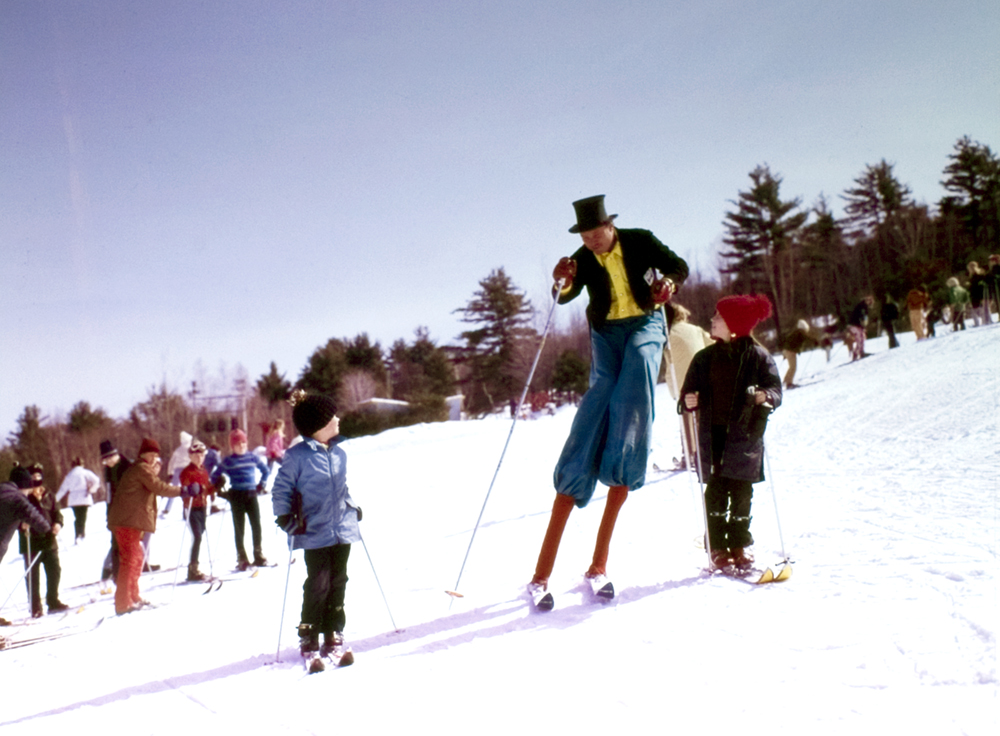
This big time skier was hardly stilted when it came to skiing or to publicity stunts. He was ski school director of the ski school of a New England area which has since changed names. The New England Ski Museum submitted the image for Test Your Skiing Knowledge.
Be the first to identify both the stilted skier AND the name of the ski area (before its name change) and receive a one-year membership to Outside+ ($79.00 value) with access to this season’s Warren Miller film, Winter Starts Now, plus two annual print subscriptions to your choice of SKI magazine, Outside, Backpacker, BETA MTB & more; access to extended gear reviews and instructional video from SKI from bumps to backcountry courses; Gaia GPS Premium access to thousands of maps and backcountry navigation recommendations; member-only content on all 18 sites in the Outside network, and full access to OutsideTV premium adventure films & series. Only answers sent to jon@seniorsskiing.com will qualify. Please do not submit your answer to Comments.
The correct answer and the name of the winner will appear in the next issue of SeniorsSkiing.com.
The winner of the last Test Your Skiing Knowledge is Kay Geitner of Centennial, Colorado. She correctly identified the ski jumper as Alan Engen, past diector of skiing at Alta and currently a member of SeniorSkiing.com’s Advisory Council. Kay taught at her home resort, Copper Mountain, for 28 years. She was the first American woman to graduate with the National Diplome from Ecole National de Ski and Alpinisme in Chamonix France. She represented the Pacific Northwest Ski Association at the US Junior Nationals and for five years represented Washington State at the Western States American Legion Championship in Sun Valley. Kay reports she’s been a SeniorsSkiing.com subscriber since we started in 2014. She wins a free pair of EZFIT Universal Insoles from Masterfit (retail value: $44.95).
https://seniorsskiing.com/wp-content/uploads/2021/11/IMG_4834.jpg7361000seniorsskiing/wp-content/uploads/2014/04/Seniors-Skiing-since2013-Logo@2x-300x68.pngseniorsskiing2021-11-11 22:30:092021-11-11 18:22:51Test Your Skiing Knowledge
Every industry benefits from a mix of offerings. The ski area industry is no exception. I find it enjoyable to ski big corporate resorts as well as independently-owned areas. Some, like Alta, Big Sky, and Jackson Hole offer both big terrain and an attractive level of smaller resort intimacy.
SUN VALLEY in the old days
It may surprise you that, according to the National Ski Areas Association, of the 37 states with ski areas, New York State has the most with 51…almost 11% of the country’s 470 areas. Next is Michigan with 40 areas, then Colorado and Wisconsin (31 each); California and New Hampshire (30 each), followed by Pennsylvania (26), Vermont (23) and Minnesota (20).
The majority of these are smaller and either independent or part of small group ownership.
Many smaller areas make it because they’re close enough to population centers and/or they’re the only game around. They get a large enough following to sustain them season-after-season.
Skiers in Norway: 1907
I like to mix up my skiing experience with visits to big and small. A few seasons ago I spent a delightful day exploring Pomerelle, a smallish area in southern Idaho. The terrain wasn’t challenging but it was interesting. And the base lodge was like going back in time…including the price of lunch.
Skiing big resorts is a different kind of experience. Vail is endless. Aspen, Breckenridge, Jackson Hole and others are challenging. Ditto with my home resorts Alta and Snowbird. I know them and their hidden stashes well. Alta, especially, combines great skiing with local friendliness and warmth. There’s a reason it’s a magnet for skiers from around the globe.
Teton Gravity Research recently produced “In Pursuit of Soul,” a short film celebrating smaller ski areas. To view the trailer click here. It builds the case for independently owned areas and was sponsored, in part, by Indy Pass, the reasonably priced pass that offers skiing privileges at 80 independently owned areas in North America and Japan.
Two skiers. Two skis. One turn.
If I had a few long weekends each season to ski and deep-enough pockets, I’d book at one of the big places in a region with reliable snow. For a family ski holiday with young grandkids, I’d choose a smaller resort with trails that funnel into one or two bases. That way there’s less chance for them to get separated or lost.
I like big mountains with a variety of terrain, and, frankly, it doesn’t matter much who owns them. They just need to be well-covered in snow.
Newly Found: 1300 Year-Old Ski
Archaeologists in Norway recently dislodged a 1300 year-old ski from the Digervarden Ice Patch. They believe it matches another ski found nearby in 2014. The newly found ski has an intact binding of twisted birch and leather. Click on the video (above) to witness the discovery in real time. A more detailed account appears in the Secrets of the Ice website which documents glacial archaeology.
The Superior Rx Goggle
SnowVision Rx goggles integrate prescription with inner lens
If you wear prescription goggles you owe it to yourself to learn about SnowVision‘s unique prescription lens. Unlike other Rx goggles, SnowVision integrates the prescription lens onto the inner lens of the goggle (see middle lens in picture above). Among its numerous advantages is the total lack of fogging. Another is remarkable visual clarity and full range of vision, including around the periphery of the lens. This is virtually unheard of in conventional prescription ski goggles and results from the curvature in SnowVision’s prescription and outer lenses. The lens – fully photochromic so it gets dark or light depending on conditions — is available as unifocal, progressive or bifocal. SnowVision’s components are made by high-quality vendors in Germany, Italy and Japan. Every senior skier who wears glasses should take special care when it comes to prescription goggles. There are some unsatisfactory products on the market, as I, unfortunately, have encountered. SnowVision is a breakthrough.
Please Help with This SeniorsSkiing Crowd-Sourcing Project
Numerous readers have asked about groups for older skiers. Some, like the Wild Old Bunch (Alta) and the Over The Hill Gang (multiple areas) are fairly well-known. SeniorsSkiing.com wants to compile a list of groups. If you know of any, please email name, location(s), a contact name and email and/or phone number to jon@seniorsskiing.com. The info will be posted on the site and updated as new info is received.
Special Discounts
EZ•Fit Auto Adaptable Insoles
Masterfit is offering 20% off any of its EZFit insoles (Snow and Universal models), Tongue Eliminators, Boot Horn and SkiSkootys. To learn more about these products, and/or make a purchase, visit https://masterfitinc.com. The Tongue Eliminators, Boot Horn and SkiSkootys can be found under “Fit Aids.” The 20% discount is good at any time. Simply enter the code SS21 during check out.
Use code SENIORSSKI to receive a 30% discount on online orders for any of Arcadia Publishing’s 27 ski titles. The offer is valid through November 7.
Holiday Shopping for Older Skiers
The Bootster ski boot shoehorn: ideal gift for older skiers
It’s really quite easy…and reasonably priced. The Bootster is an ingenious ski boot shoehorn so compact that it easily fits in a parka pocket. The little device unrolls to reveal a slippery surface that helps the foot slide easily into the ski boot…even when the boot is cold. Each Bootster is hand assembled and very well made. The price is $25 plus shipping. I can’t think of a better or more appropriate gift for older skiers on your list.
FeedSpot Now Delivering SeniorsSkiing.com Content
FeedSpot is an online service that consolidates and delivers news based on the user’s preferences. Happy to report that for FeedSpot subscribers seeking ski-related news, SeniorsSkiing.com articles are now part of their package.
Skiing in Taiwan?
Before global warming had taken it’s toll on so many places with snow, skiers in Taiwan frequented the island nation’s Hehuanshan ski resort. Alas, like so many other locations around the globe, there no longer is enough snow to ski there.
RIP: The Farmer
Dave Van Dame, The Farmer, was an Alta ski legend, skiing deep powder there for 48 years. He recently passed away. Those of you who were privileged to witness his technique are fortunate. Alta recently issued this short video tribute.
The Best Car Commercials
A thing of beauty: my Willys 1/2 Ton Pick Up
I recently sold my (unrestored) 1950 Willys half-ton truck. It was love at first sight several years ago when I saw it on a side street in Ouray, Colorado…a foolish purchase requiring far more skill than I had and more money than I wanted to spend. I concluded that, like many things, old cars can be enjoyed without ownership. During my infatuation I started to follow Hagerty, which insures vintage vehicles and publishes online and print content about them. This article about 10 “unforgettable” car commercials contains links to some funny and moving examples. Not skiing but a lot of fun. Click here to access
The ski shop makes more money renting out or selling higher performance equipment.
Be honest with yourself – if you don’t ski hard and fast you probably don’t need it.
Higher performance skis perform worse when not skied hard – they need higher momentum, and more force to get them to work well. Skied slower they can be harder work. Is that what you want?
It may well have been a year since you last skied – maybe more. You likely won’t ski too hard on days one and two. Try renting an easy, flexible ski first. If you find you ski hard enough to make it “chatter”, you can always change up.
Dizzy of Dizzy’s boot fitting shop at Big White ski resort shows off an early 1970s ski boot that boasted fantastic ski technology that, sadly, was ahead of the boot’s ability to support it. The boots famously would come apart during skiing. Credit: Yvette Cardozo
BOOTS
Same rules apply. Boots designed for beginner/early intermediate will be less expensive.
Priority number one is comfort. Don’t put up with anything less.
Very few skiers need boots as stiff as the ones they have; or rent. Most skiers are “over-booted” and it holds back their skiing. Plus it’s often painful.
Start off the vacation with a lower grade boot: it’s easy to exchange them.
Why do I say this? Because if you cannot forward flex your ankle very readily, your skiing will never be as good as it could be. And you’ll never be as stable.
When you do-up your boots don’t have the higher buckles too tight.
When the buckles are done flex your shin forward and hold it there, and only then fasten the unfortunately named “power strap”. It will be somewhat slack until you flex your shin forward. At first you may feel this is a bit “wobbly” – but for heaven’s sake you don’t have your ankles clamped when you move about at home! And it doesn’t make you lose control.
Source: Praxis Skis
SKI POLES (The ski shop will have a small fit when you tell them this.)
You want them
They hate it. They will patiently explain to you as if you were a child that they know what length you need, and will explain how they derive it.
At this point listen attentively, take the pole they proffer, and then tell them you want a pair like that but 3” (7.5 cms) shorter. Insist on it. They will suggest that if you do, you will die. You won’t.
Why shorter poles? Because the length ski shops always hand out, makes skiers stand upright and almost lean back every time they do a pole plant.
Try it – all experiments are worthwhile. You will very quickly prefer the shorter ones because they will help improve your posture. Anyway you can always go back up a length later if you want to – it’s not a lifetime contract.
https://seniorsskiing.com/wp-content/uploads/2021/02/Screen-Shot-2021-02-16-at-8.46.33-AM-e1613483590387.png386728Bob Trueman/wp-content/uploads/2014/04/Seniors-Skiing-since2013-Logo@2x-300x68.pngBob Trueman2021-10-28 18:15:142021-10-28 18:56:46Things to Remember when Choosing Alpine Ski Equipment
Isn’t it remarkable how electric vehicles are taking over the automotive industry? By 2035, virtually all General Motors vehicles will be battery powered. Our grandkids will look back and tell their kids about a time when combustion engines ruled.
I think a similar new frontier is being established with the Dahu ski boot. The company has parted ways with traditional boot makers and come up with materials and design that make it as different from the others as Tesla is to Dodge.
It’s a game changer.
Dahu boots were conceived and developed to be fitted more easily, minimize ski boot discomfort, and maximize performance.
The shell has a dozen strategically located holes that eliminate foot hotspots most skiers – especially older skiers – experience. Think about this feature: it gets rid of the need for bootfitters to manipulate the plastic to relieve pressure points. The car equivalent? No more engine tune-ups!
Made of a Swiss polyamide composite, the shell combines lightness and durability and consistent flex, regardless of temperature. It has a hinged tongue with two micro-adjustable buckles and a hinged, releasable rear with a patented aluminum spine which helps transfer body energy to the ski. Interestingly, the spine contributes to each skier’s ideal stance.
A comfy, insulated leather inner boot has a grooved rubber sole which provides traction when the inner is worn separately from the shell. Those grooves interlock with ridges and grooves in the shell, the net erect being greater torsional stiffness and more efficient energy transfer from body to ski.
I understand this is a lot to absorb. But I know that many of you have had it with your conventional boots. Our August reader survey asked, among other things, what items you intended to purchase in the next two years. Of the 3000+ responses, about one-third indicated ski boots. And from comments made during past reader surveys, sent to the site and to me personally, I know that finding a better boot is top-of-mind for many older skiers.
If you’ve had it with conventionally designed boots and are looking for a pair that can be fit more easily (including using one-on-one zoom sessions), will keep your feet warm and comfortable and, most importantly, perform for any level of skiing, click on the Dahu advertisement on the right side of the page.
https://seniorsskiing.com/wp-content/uploads/2021/10/Screen-Shot-2021-10-26-at-7.41.07-PM.png389459Jon Weisberg/wp-content/uploads/2014/04/Seniors-Skiing-since2013-Logo@2x-300x68.pngJon Weisberg2021-10-27 08:53:002021-10-28 19:01:14Dahu: The Tesla of Ski Boots
Don Burch creates short, artistic ski videos that capture the small moments showing people of all ages and abilities having fun together on the mountain.
“Skiing The East” features scenes from Stowe, Okemo, Otis Ridge, Sunday River, Killington, Sugarbush, Mount Snow, Stratton, Wildcat, Magic, Waterville Valley and Maple Valley (long closed). Enjoy this two-minute ride.
https://seniorsskiing.com/wp-content/uploads/2021/10/Screen-Shot-2021-10-27-at-9.17.13-AM.png315685Don Burch/wp-content/uploads/2014/04/Seniors-Skiing-since2013-Logo@2x-300x68.pngDon Burch2021-10-27 08:45:142021-10-28 18:50:00Enjoy Don Burch’s Newest Creation
Last winter XC ski gear was in demand like never before and all segments of cross country ski equipment sold out, with few or no options for retailers to reorder. There also was an uptick for backcountry gear and snowshoes.
Retailers are still experiencing demand and supply issues. Coupled with global supply chain challenges, everything from the components that complete a ski binding to the actual cardboard boxes in which products are shipped have been in short supply. Demand and wait times have increased dramatically for these vital pieces, further impacting supply.
Responding to these factors, retailers placed orders as early as possible and for as much gear as they could get. But some wholesale distributors limited the amount of equipment they planned to make available in the US.
The result? Retailers may not be able to reorder sold out merchandise.
If you want to get new gear this year, here are some tips from Burlington, Vermont retailer Ski Rack:
Start Early
The earlier you begin the process the more likely you’ll get the right winter gear for you. The process begins with your own preliminary research into what you’re looking for and how you want to enjoy the outdoors this winter. Starting early is great! However, keep checking for new arrivals.
Buy Locally
Once you’ve identified the type of XC ski activity you’re interested in (for example, skiing in tracks, on ungroomed trails, in the backcountry, or ski skating) the next step is to head to a local gear shop and talk with the retail experts. They can be a great resource to help with sizing and to discuss various details, including differences between products. Consider custom fitting for all categories, to get the right gear the first time. This way, you’ll save time and avoid having to return something down the line when you find it’s not the right fit. By then, that item may not be in stock anymore.
Flexibility
Another key piece of getting winter gear this year is flexibility. There are lots of options from many brands that will serve you well. Some models may already be sold out for the year, pre-sold, or unavailable for months. It’s advisable to explore all options to see what the best fit may be, even if it’s not your first choice, but ACT FAST! If you find something you want at the store, don’t wait. It could be gone the next day or the next hour.
https://seniorsskiing.com/wp-content/uploads/2021/10/Fischer-nordic_cruising_selfie.jpg213320Roger Lohr/wp-content/uploads/2014/04/Seniors-Skiing-since2013-Logo@2x-300x68.pngRoger Lohr2021-10-27 08:20:452021-10-28 19:03:17Tips to Buy New XC Ski Gear for This Winter
Would you pay an additional $49+ not to wait in the lift line? Express lines have been available for years for members of exclusive clubs and for skiers accompanied by instructors. Now it will be available for a fee on a day-by-day basis at Snowbird (UT), Killington (VT), Copper Mountain (CO) and Mount Bachelor (OR), all areas owned by Utah-based Powdr Corp.
Years ago, friends at Snowbird with “black passes,” went to the head of the line on the Tram and other lifts as a benefit of membership in the resort’s pricey Seven Summits Club.
In the late 60s I skied Chamonix with an American photographer living there. Organized lift lines were nonexistent. He pushed his way to the front of the pack and slipped some francs to the lift attendant. It was uncomfortable to me, but perfectly normal to him.
Now that privilege will be accessible to anyone with spare change. Dedicated fast access lanes are being established at the most popular lifts at each of the participating resorts (Snowbird’s Tram, not included). Starting Nov 1, skiers can purchase the Fast Tracks add-on in advance or on-mountain. Fast Tracks — quantity to be capped daily –will be available to all skiers holding day passes, season passes or Ikon Passes.
Is this new level of premium pricing a natural evolution of how lift tickets are valued? I think so. A few years back, areas assigned different values to lift tickets based on how far in advance they were purchased, day of the week, holidays., etc. Some areas discount passes based on military service, student status and age. Remember when 60 year olds got free skiing? In the US, the age threshold has been steadily increasing. Now, generally, you need to be 75 or 80 to get a deal, if any exists.
Most resorts and the bundled pass offerings discount for early purchases. Their purveyors get to invest that capital any number of ways.
Who will make the add-on Fast Tracks purchase? Anyone with a cushy account planning a trip to the mountains. They paid for the flight, the lodge, lift tickets, etc. Why spend time on the hill waiting in line? That’s the market…and those to whom the added cost means nothing.
So much about skiing, like life in general, has changed, and those changes may grate on those who have been enjoying it for decades. If this works for Powdr Corp, it’s just a matter of time before paying the additional fee to get to the head of the line will be commonplace.
The Season Is Underway…
…at least in Finland where Levi and Ruka have opened with the benefit of recycling last season’s snow. The procedure, know as “snow farming” stores snow from the previous season in protective structures and redistributes it on trails once temps have dropped enough to keep it from melting. Here in the US, Copper Mountain (CO) fired up its guns last week to prepare for US Ski Team training staring October 22 and its general opening on November 22. And, as of this writing, resorts around the West have been dumped on. Alta has about 18.” Wolf Creek opens Saturday; Arapahoe Basin on Sunday. Winter is here!
Welcome Ski Idaho!
Ski Idaho, which promotes the state’s 17 ski areas, is our newest advertiser. The best known of the resorts isSun Valley. Less frequented but with substantial vertical and snow are Grand Targhee (actually in Wyoming but a participant in the Ski Idaho initiative), Schweitzer, Tamarack, and Pebble Creek. Many private jets are parked at the airport in Hailey, the gateway to Sun Valley. Not so at the other areas. Any senior skier wanting to expand the list of areas skied or planning a reasonably priced family ski holiday is well-advised to look into Idaho. Its official nickname is “the gem state.” Precious minerals and stones aside, it is one gem of a place to explore and ski!
Snowboarder To Be Featured on $1 Coin
Source: US Treasury
Vermont will be represented in a series of new $1 coins issued by the U.S. Mint.The coin will feature an image of a snowboarder. The “American Innovation” series of $1 coins started in 2018 and will eventually include a coin for each state, the District of Columbia and five U.S. territories. Vermont’s coin, to be released in 2022, shows a snowboarder holding the edge of her board while doing a trick.
Full Tilt to be Retired
Source: Full Tilt Boots
The 3-piece boot, particularly popular with many SeniorsSkiing.com readers, will be retired after this season. It is made and distributed under the K2 umbrella.
Man Completes London Marathon in Ski Boots
Credit: Guinness World Records
Paul Bennett ran the London Marathon in ski boots, as a fund-raiser supporting injured military personnel. His time: 5 hour, 30 minutes, 20 seconds. He was 7 seconds faster than the last ski boot marathon runner.
On this side of the pond, last week, 87 untramarathoners in Utah ran into a blizzard that dumped 12″ – 18″ on portions of the high-elevation, 5o mile course. Officials called off the race, and there were no injuries; a far different outcome from last May’s mountain race in China when 21 runners died from exposure.
New Aspen Logo
Old Aspen logo. Source: Aspen
New Aspen logo. Source: Aspen
The original aspen leaf design was introduced in 1946. Now, 75 years later, it has a cleaner, new look. The design’s last iteration was an aspen leaf with ski tracks forming the stem. The new version is an outline of an aspen leaf. More on how the resort will be celebrating its 75th in future issues.
Big Expansion for Sunday River
Sunday River to expand into Western Reserve. Source: Sunday River
Sunday River (ME) announced a major expansion that will get underway in 2022. This, as reported in The Storm Skiing Journal website. The terrain expansion will eventually double the size of the resort. Click here for resort’s explanation.
30% Discount on Ski Books
Use code SENIORSSKI when placing online orders for any of the 27 ski titles published by Arcadia Publishing. The offer is valid through November 7.
Air Access to Mammoth Mountain Increases
United Airlines is starting flights from L.A., San Francisco and Denver to Eastern Sierra Regional Airport in Bishop (CA), about 49 miles from Mammoth Mountain. Another service, Advanced Airlines, which bills itself as providing “public charter flights,” will provide flights to Mammoth Yosemite Airport from three Southern California airports (Burbank, Carlsbad and Hawthorne). It’s 12 miles from the resort.
This Ski Film Was Made 101 Years Ago!
Arnold Fanck, a German documentary filmmaker and pioneer of the mountain film genre, is credited with creating one of the first ski films. “The Wonder of Skis” (Das Wunder des Schneeschuhs) was issued in 1920…101 years ago! It shows skiers in a variety of alpine beauty spots, executing surprisingly beautiful turns. Length of this segment: 30 minutes. Click on image to screen.
In 1991, while guiding a small group in Yellowstone National Park, I tried to describe walking outside as the sun rose one February morning near Old Faithful:
“Morning light pours over the hills, reflecting off the frost in a blinding cloud of diamonds. Elk and bison shake snow off their backs, stirring after a long night’s chill. Duck and geese stretch and preen. Billows of geyser steam hover and settle, creating dense, lacy patterns on bowed pine branches. Yellowstone tastes of winter magic.”
Summer and Winter
To me, Yellowstone isn’t a great treat in summer. Yes, the combination of animal and geothermal activity is unique – but this year there were close to three million visitors, June to August. That’s too many vehicles and frowning faces jammed along narrow roads.
Winter is totally different. First, there’s almost no traffic (no bears either, although they may peep out of their dens in January). The only road that’s kept plowed runs east from Mammoth in the northwest to Cooke City, where it dead ends. All other roads are snow-covered and accessible by snowmobile, snowcoach (enclosed and heated tracked vehicles), or on skis or snowshoes.
Yellowstone’s winter is created for superlatives. No other place in the world has such an inspiring combination of wildlife and wild geology. It’s rich in history; has spectacular mountain scenery; and the park’s 2.2 million acres are yours without crowds or pollution.
Getting There
Yellowstone is located in the northwest corner of Wyoming, with little extensions north into Montana and west into Idaho.
To enter the park, you can travel north from Jackson Hole; west from Cody, Wyoming; or east from West Yellowstone, Montana. My favorite (fourth) route is east from Bozeman to Livingston; south through the Paradise Valley; pass through the sleepy town of Gardiner; and drive up to Mammoth Hot Springs, where you can overnight at the venerable Mammoth Hot Springs Hotel, with elk grazing outside the ground floor windows.
Using Mammoth as a base, you can drive toward Cooke City, with a lot of photos stops for wildlife in the Lamar Valley, and then backtrack.
Heading South
From Mammoth you can get to Old Faithful by snowcoach or snowmobile, sight-seeing, skiing, and snowshoeing along the way. Norris Geyser Basin and the jaw-dropping Canyon of the Yellowstone River, with ice-laden and thunderous falls, are natural stops.
The center of the park is a volcanic crater, 40 miles across, with the world’s greatest concentration of geothermal features: geysers and fumaroles, mud pots and hot pools. One of my favorite Yellowstone memories is a morning ski on a snow-covered wooden boardwalk, watching a bison standing above a steam vent, basking in the warm air billowing around his belly.
Snowpack around Mammoth can be thin, but Old Faithful has reliable conditions and all kinds of good trails. You’re guaranteed to see lots of elk and bison, maybe coyotes, possibly wolves.
SOURCE: YELLOWSTONE NATIONAL PARK LODGES
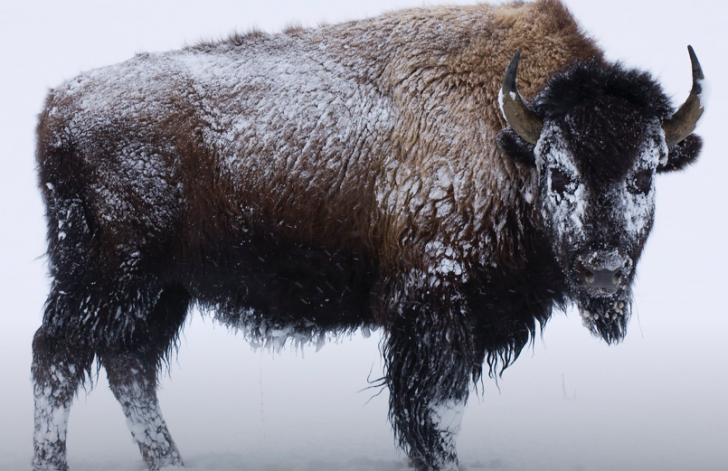
In winter, bison are relatively indifferent to humans, since they’re intent on scarce forage and surviving sometimes bitter cold, but it’s not something to count on. I’ve skied within feet of a bison, on a narrow trail with a cliff to one side and sheer drop on the other. We came around a corner and there they were. We carefully didn’t make eye contact with the cows and calves that plodded toward us, and I could hear muttered prayers from the other skiers (my teeth were chattering too hard to enunciate).
Of all the times I’ve visited Old Faithful, the most indelible and endearing memory isn’t a glorious streamside tour, two feet of light fresh snow, or being mock-charged by a bull elk. It’s the smiles on three kids’ faces as one cold morning they dropped tablets of food coloring in glasses of hot water, ran outside the Snow Lodge, and threw them in the air! It was a cold morning, and the droplets turned into rainbows of frozen mist – blue, red, green – that slowly drifted in the breeze and disappeared. So a half-dozen of us adults did the same thing.
Now, that’s magic.
Resources
The Mammoth Hotel and the Old Faithful Snow Lodge provide Yellowstone’s only winter accommodations and dining other than yurt village/guide service Yellowstone Expeditions (https://yellowstoneexpeditions.com/). They typically open for the season mid-December 20th through early March.
Getting ready for spring skiing at Tuckerman. Credit: Tamsin Venn
It was serendipity to arrive at Wildcat in the northern Presidential Mountains of New Hampshire the first week in March and find spring skiing. Many of us missed that part of the ski season last year in the pandemic shut-downs.
Due to its north facing slopes and deep snowpack, Wildcat usually is the last ski area to close in New Hampshire. This year it’s April 18.
While there, temps shot up to 66 degrees. Wildcat is not always so hospitable. It sits across the street from weather magnet Mt. Washington, tallest peak in the Northeast at 6,288 feet, and highest recorded wind speed 231 mph.
Away we go down Upper Catapult. Credit: Tamsin Venn
This year we were on the lookout for non-crowded midweek slopes, a friendly local atmosphere, and no state travel restrictions for us. Wildcat fit the bill.
The L-shaped parking area minimizes the schlep to the main lodge. Boot up from your tail gate, tiptoe across the icy parking lot, hike past four new, neon-colored porta-potties, get your RFID card zapped, and hop onto the Wildcat Express Quad. Seven minutes later, in one of the swiftest trips in skidom, you have reached the summit.
For several hours I lapped the Express Quad, zipping up-down-up, alternating from the left to the right flank on long, winding trails of 2,100 vertical feet. The trails draw you down as the head and shoulders of Mt. Washington rise. It’s like being in a movie… with good lighting.
Snow was corn, sweet, smooth. My left-foot steering was working as well as my right, always a good sign. Around 11, soft conditions required maneuvering into skied-off slots to save on thigh burn. Clearly early-morning skiing is best for spring skiing, even at a north facing mountain. But when I left early afternoonish, the parking lot was jammed. Spring fever had hit.
Although it has a reputation as an expert’s mountain, Wildcat has beginner terrain (20 percent)—Pole Cat is a 2.5 mile beginner trail, longest in New Hampshire—(see video article in this issue)— intermediate terrain (47 percent)—Lynx is a sweet roller with fun intermediate pitches—and expert terrain (33 percent)— famed black bump runs under the lift line. Midweek, you’ve got your turns to yourself and stress-free trail junctions.
The “cans” are display only. Credit: Tamsin Venn
Looking across to the top of Mt. Washington and thinking of spring skiing Tuckerman Ravine, you will always be grateful for the Express Quad that whips you to the area top at 4,028 feet. No hiking required. On wind holds, the Tomcat Triple gives you the bottom three-quarters.
When Vail Resorts bought Wildcat two years ago to add to its Epic mix, it took many by surprise. Wildcat is loved for its no-frills amenities and boot-scarred lodge, not exactly a Vail kind of place.
But a modern mega-resort corporation can’t erase the memories. My neighbor asked me:
“Does Wildcat still have those cold gondolas? When skiing there circa 1950s, the cable jammed [and] we near froze in the can in the hour it took to get them moving. When people did emerge at the top, all the men ran for the bushes! Anyway, it was exciting to ski there.”
https://seniorsskiing.com/wp-content/uploads/2021/03/IMG_1164-scaled-e1615915364686.jpg546728Tamsin Venn/wp-content/uploads/2014/04/Seniors-Skiing-since2013-Logo@2x-300x68.pngTamsin Venn2021-03-16 17:06:142021-03-25 11:42:54Spring Comes to Wildcat
The young Mueller family in their first season at Okemo. Credit: Okemo Resort
When Tim and Diane Mueller purchased Okemo Mountain in August 1982, it was a ski area with six Pomalifts and three double chairlifts. Under their mom-and-pop hands-on leadership, it became a year-round destination resort with summer activities and programs as well as a vastly expanded two-mile wide ski area with 667 acres of terrain, 46 miles of trails, 98 percent snowmaking, 121 trails and glades, a 2,200 foot vertical, and 20 lifts.
Attorney George Nostrand characterized the purchase as “a struggle and a monumental risk. They had limited funding and if it failed, they would have lost everything they owned. I told Tim that I wouldn’t have had the stomach to take this kind of risk. He said to me, ‘Well, George, that’s the difference between an entrepreneur and a lawyer.’”
Referring to a Sno-Engineering 1981-82 Master Plan which concluded Okemo could become “a major destination resort,” with $8 million in improvements, mountain expansion and additional condominium complexes, Tim cited “the potential” as worth taking that risk.
“We assumed we would be successful because that is part of being an entrepreneur, but never in our wildest dreams did we foresee Okemo becoming what it did. Tim thought going from 90,000 skier visits to 200,000 annually would be doable, and that was our idea of being successful. We never thought we would reach 600,000 or operate three resorts — that was not a goal then,” Diane said.
Hospitality and Service Orientation
The Classic Red Poma Lift in 1956 which the Muellers replaced. Credit: Okemo Resort
With their background operating and expanding a beach resort on St. Thomas — and a Vermont home construction business prior to that — they had “a lot of energy and experience. There were good employees here with experience so it wasn’t as if we were wildly entering some field blindly,” Tim noted.
Still their first season was a struggle. With no time to research a chairlift, they focused on sprucing up with paint, new signs (saving money because Diane did them), and fixing the lifts as fast as possible when they broke down.
With natural snow not falling until mid January, the Muellers relied on snowmaking and had six trails by Christmas with two from the top, contributing to loyal skier appreciation and a “we can do it” attitude among staff.
They also focused on service. Diane cited their beach resort experience as giving them “a jump on the ski industry” in terms of offering quality service. The emphasis on Okemo and its employees providing top notch service was part of Okemo’s core values that enabled the ski area to grow to such a success, she added.
Their hands-on management style was impressive as they worked alongside their staff and management team . They listened to staff suggestions and were able to delegate responsibilities, which eventually allowed them to add Mount Sunapee (NH) in 1998 and Crested Butte (CO) in 2004.
Expansion and Success
Sunburst Six as it approaches the summit. Credit: Okemo Resort
With employee input as to where the replacement chair for the main Pomalift should go, the Northstar Triple was installed in 1983 (later a quad and then a sixpack). The development of the Clock Tower reception area and base village followed in 1984, creating excitement and a growing confidence in the mountain and the Muellers.
Hands-on resort operators Tim and Diane Mueller shown at the 2005 start of the Spring House at Jackson Gore. Credit: Karen Lorentz
The continuing addition of chairlifts, snowmaking, and new trails was impressive. The expansion to Solitude Peak in 1987 provided the Muellers’ first new lift-and-trail complex on 225 acres and was enhanced by a lodge and trailside units.
The development of convenient trailside condominium complexes — on private land the founders had purchased and on land the Muellers acquired — enabled profits to be invested into mountain improvements, including lodges, halfpipe and terrain parks, another new trail-and-lift complex at South Face (1994), a novice area at lower Solitude (1995), and the Jackson Gore complex (2004-06).
The offering of children’s daycare and ski instruction programs combined with an early welcoming of snowboarding in 1987 enhanced the area’s appeal as family friendly and an avant garde ski and snowboard school further propelled its growing popularity. By 2009, Okemo ranked in the top two in Vermont and the East and top 13 in the nation by skier visits!
When Vail Resorts acquired Okemo Mountain Resort September 27, 2018 it may have been the end of the Mueller era at Okemo, but thanks to their success, it was also the beginning of an Epic era that pays homage to their legacy of creating a great family-oriented resort.
https://seniorsskiing.com/wp-content/uploads/2021/03/SunSix-e1614809089479.jpeg485728Karen Lorentz/wp-content/uploads/2014/04/Seniors-Skiing-since2013-Logo@2x-300x68.pngKaren Lorentz2021-03-01 09:42:542021-03-04 11:18:12Okemo Mountain Resort: A Mom And Pop Success Story