Keep Moving: Fighting Arthritis With Activity

Here’s What You Can Do To Manage Your Inevitable Osteoarthritis.

If you’re a snow-sport enthusiast and subscriber to SeniorsSkiing.com, you are most likely a senior with an active life style.  We know from our SubscriberSurvey 2015 that many of our respondents not only enjoy Alpine skiing, but also Nordic and snow shoeing, and you ski a lot.  More than 55 percent of the responses say they ski more than 30 days a season.  Anecdotally, we’ve also heard how our subscribers love to hike, cycle, kayak and generally keep moving all year round.

In a recent article by NY Times Personal Health columnist Jane Brody, we see how critically important it is for seniors to keep that kind of active lifestyle.  Not only does activity help stem arthritis, reasonable levels of activity help avoid other chronic health problems. Brody quotes a researcher at the Alabama Research Institute on Aging: “As we get older, if we don’t get up and move around as much as we can, then we soon won’t be able to move at all.”

Read the Comments section attached to this article as well.  There are some insights and advice from NY Times readers you might find interesting.  If you’d like to comment on SeniorsSkiing.com, please do.  How do you stay active?  What does that do for you?  What’s your challenge in keeping in motion?  What works that you can share?

NY Times Columnist explains why activity is a way to fight arthritis. Credit: NY Times.

NY Times Columnist explains why activity is a way to fight arthritis.
Credit: NY Times.

How Many Subscribers Ski Over 30 Days A Season?

Check More Results From SubscriberSurvey 2015.

UphillMuch to our happiness and gratification, the SeniorsSkiing.com SubscriberSurvey 2015 was a tremendous source of insight and guidance. We reported the highlights in March with a promise to provide some more detail. What follows are more interesting responses to some of our questions.

We asked you to rate the importance to SeniorsSkiing subscribers of the amenities provided by ski areas and resorts. Here are the results in rank order:

Amenity Very Important or Critical
Discounted Lift Tickets and Season Passes 100%
Easy Access From Parking To Lifts 76%
Newsletters/Web Pages For Senior Activities 50%
Other Discounts (Food, Rentals, Gear) 50%
Ski Lessons Tailored For Seniors 46%
Family/Group Discounts 36%
Walkable Base Lodge With Shops, Restaurants 34%
Meeting Place For Seniors 31%
Set-Aside Areas in Lodge For Seniors 22%
Valet Parking 4%

Here’s what kind of content topics you said you’d like to see in SeniorsSkiing.com. These reflect the results for Very or Extremely Interested ratings only.Note these are just the Very Important or Critical responses. Clearly, discounts are a universal need for seniors. And, there are also some ideas here about access from parking lots, information sharing, discounts, ski lessons and other ideas that can make a Senior Skier’s time at a ski area or resort more valuable and attractive. It’s interesting that some of these ideas are really low-cost expenses for the ski area.

Topic Very or Extremely Interested
Gear For Seniors Reviews 72%
Destination Profiles For Seniors 67%
Health, Nutrition, Fitness 60%
Legends, Heroes, History 58%
SnowSport Industry News 54%
Features about People, Places, Things 54%
Restaurant Reviews 17%

Finally, we see that you report skiing with family and grandchildren about an average of 8.6 days a season. That’s an impressive amount, considering the median number of ski days per season for our subscribers is 9.7. We used median for the number of ski days because 55 percent of you skied over 30 days a season, skewing that data ‘way northward. Now that’s passion in action.We also notice your average age is 69.4 and 44% of you belong to ski clubs.

Several respondents said they’d be interested in contributing articles to our online magazine next season. Thank you! That’s a terrific endorsement. Please contact us at info@seniorsskiing.com with your ideas and we will get right back to you.

Adieu Winter 2014-15: Shifting To The Non-Snow Season

SeniorsSkiing.com Will Be Publishing This Summer.

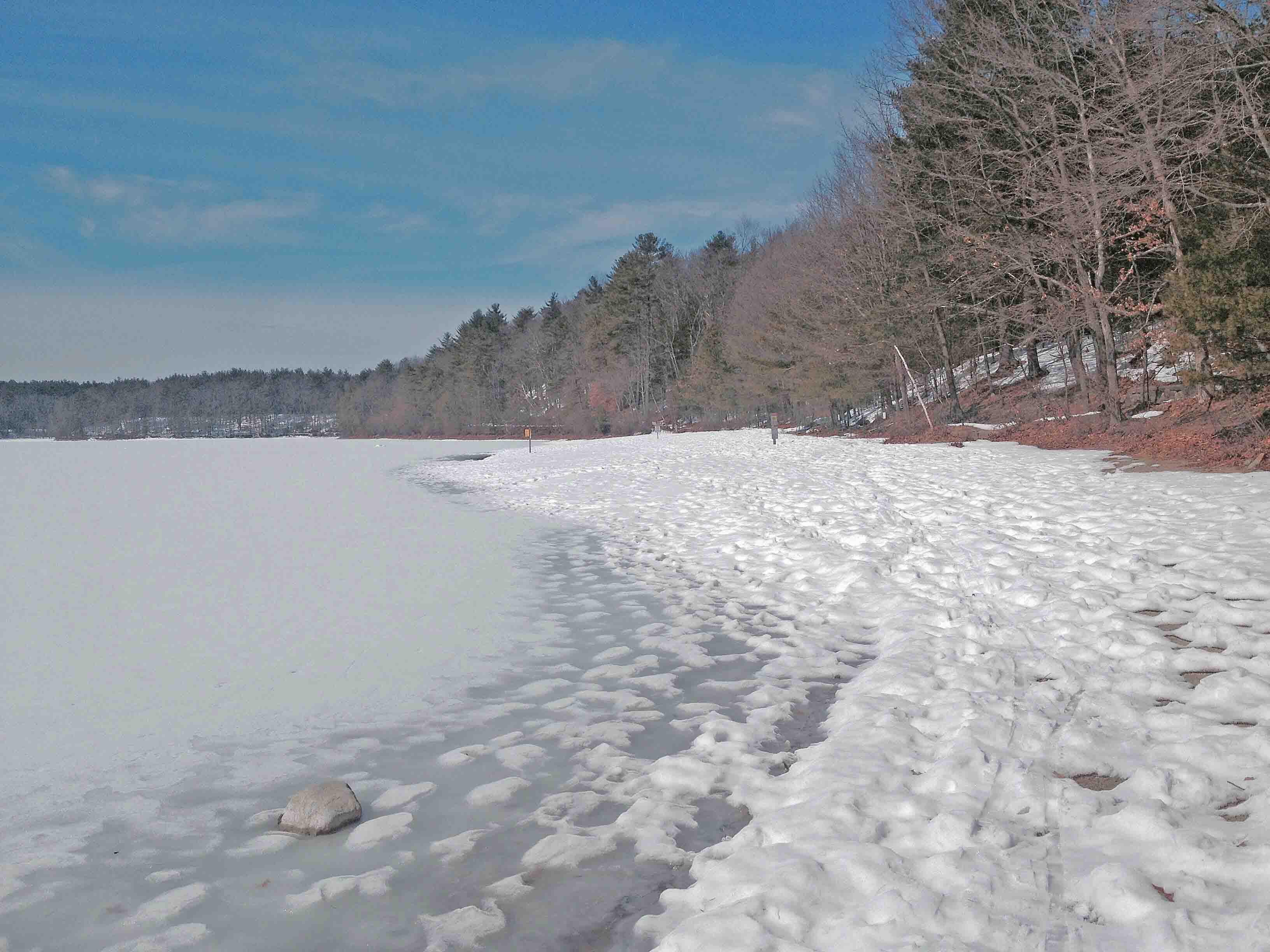
One of our best ski tours of the season came at the beginning of April at Walden Pond.  We go there occasionally throughout the year to reflect on the messages of Henry Thoreau and to take a picture or two of the “pleasant hillside” where he built his tiny cabin.  When we skied in, the trails along the ridges surrounding the pond were chopped up and icy, so we scooted around the snow-covered ice on the edges, thinking that Henry probably walked this way when the snow at Walden got too thick. It’s a short ski, maybe three miles around, but it was a beautiful spring day, we were pretty much the only ones there, and the spirits were a-rising, so to speak.  There’s more to be told about skiing at Walden, and we will have to save that for next season.

Early spring ski tour on a quiet day around Walden Pond.  Priceless. Credit: Mike Maginn

Early spring ski tour on a quiet day around Walden Pond. Priceless.
Credit: Mike Maginn

Based on the responses from Subscriber Survey 2015, we learned that you, our readers, are interested in fitness and product ideas for seniors.  As we move through the summer months, we and our correspondents will be offering both of those topics—as well as whatever pops up—in the spirit of keeping in touch with you, our active and engaged readers.  Please note that we will be starting our online Forum very shortly—another major recommendation from the survey—so you can more readily talk back to us and your fellow snow sport enthusiasts.

Two requests:  Tell your friends about SeniorsSkiing.com. And please watch for our Forum, coming soon.

Let the non-snow season at SeniorsSkiing.com begin!

Try Nordic Walking: Many Benefits By Adding Poles To Hike

Poling While Hiking Is An Exercise Multiplier

Roger Lohr is co-founder and editor of XCSkiResorts.com and a noted writer on all the varieties of Nordic skiing.

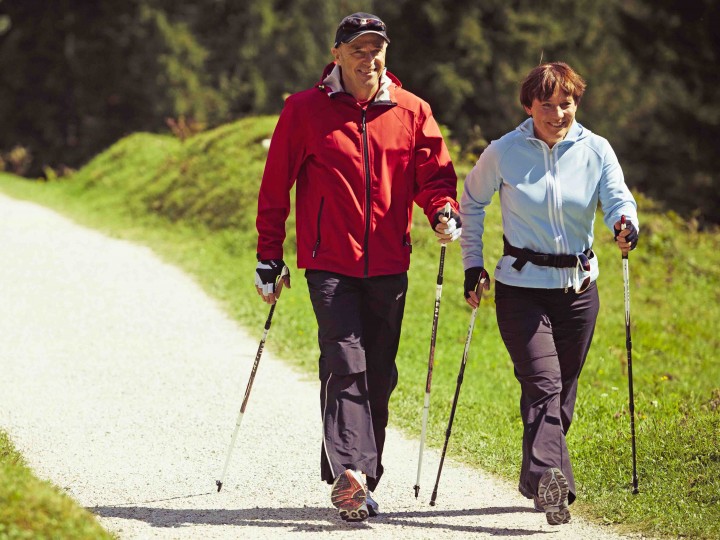
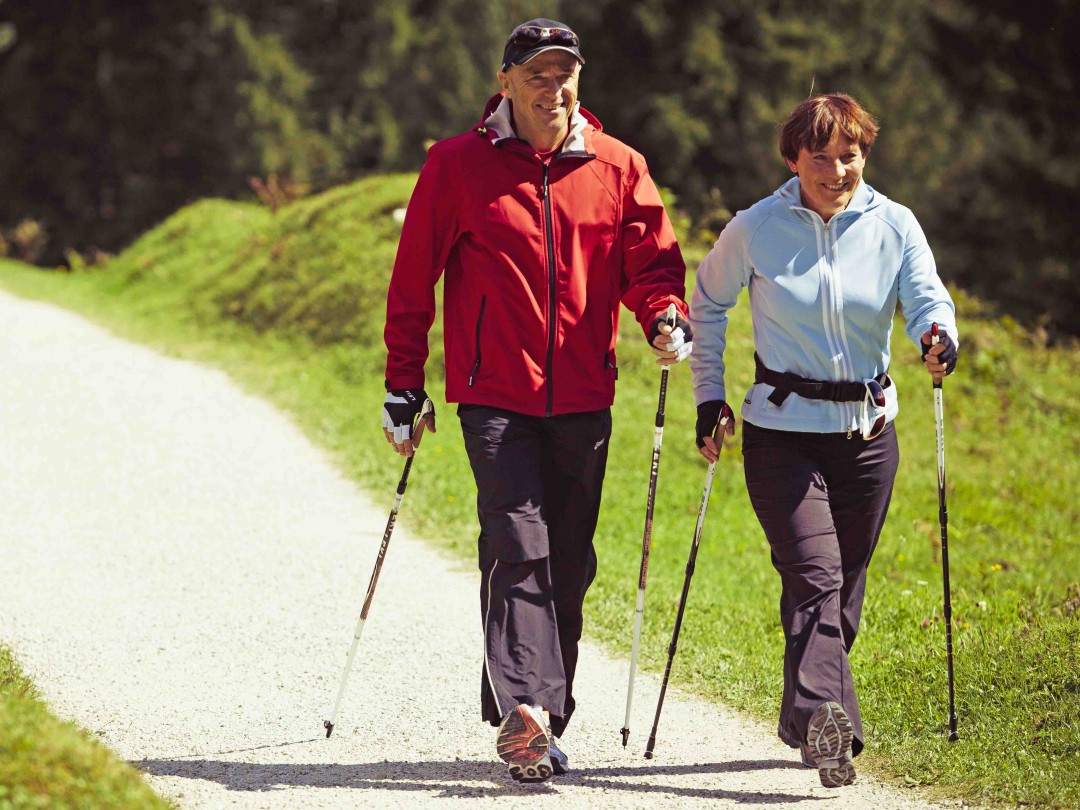
Walking a la Nordic raises efficiency of exercise by 40 percent. Credit: Leki

Walking a la Nordic raises efficiency of exercise by 40 percent.
Credit: Leki

More than 10 million Europeans of all ages and fitness levels are Nordic Walking (also known as Ski Walking) with special Nordic Walking Poles. This new fitness activity turbo-charges the normal walking regimen burning as much as 40 percent more calories compared to regular walking.

For those who are unfamiliar, Nordic walking is a fitness activity that combines walking with specially designed poles to engage the upper body muscles.

Nordic Walking poles help individuals with balance issues, knee issues or new knees, hip issues or new hips, back issues (including those with rods in their back), weight issues, multiple sclerosis (MS), Parkinson’s Disease, neuropathy, arthritis, bursitis, scoliosis, lumbar stenosis, fibromyalgia, post polio, osteoporosis, stroke recovery, cancer recovery, and other limitations to walking. Nordic Walking is helping thousands of people get off the couch, get outside, start walking safely, and effectively launching much needed walking campaigns.

The Human Kinetics book entitled Nordic Walking for Total Fitness by Suzanne Nottingham and Alexandra Jurasin covers the topic. Trekking (hiking with poles) and Nordic walking are two different activities that use very different poles and techniques. It may sound silly, but perhaps “walking is not just walking.” The pole angle, weight, grip, and straps are different between the aforementioned modes of walking. The Nordic walking pole is designed to allow your hands to relax in order to target the larger wrapping muscles of the back. But using poles of any kind automatically stimulates your spine and all of the muscles around it, even with inefficient technique. When walking, the key postural muscles of the core and upper body are engaged.

The book also includes fitness assessments, sample workouts for varying levels of interests from first timer to cross training triathletes. There are also suggestions about customizing your program. Training program recommendations are offered for building distance, fluctuating daily intensity, and rest days.

I’ve been a Nordic Walker for a few years and found many of the claimed attributes in the book regarding posture and exercise to be true. I’ve always been in search of a way to decrease the amount of time spent exercising, so I was sold when I heard that using the poles increases caloric burning by 40 percent. Being a cross-country skier, it is easy to quickly master Nordic walking. After a summer of Nordic walking, I noticed a marked improvement in my cross-country ski poling in terms of strength and timing. It seemed that I increased the amount of forward momentum that was attributable to poling and I was able to pole stronger and longer when skiing.

Nordic Walking for Total Fitness provides a foundation for anyone, ranging from those just looking for an activity to lose weight to health aficionados interested in taking it to higher levels of fitness.

Nordic Walking for Total Fitness is available for $19.95 plus shipping from Human Kinetics at www.humankinetics.com or call 217-351-5076. 

A Worry In The Woods: Tick-Borne Powassan Virus

Shifting From Snow To Summer Activities?  Beware Of This New Menace.

We’re starting to hike or bike in the woods between the receding snowbanks here in New England.  We’ve just learned that you better make sure you review your tick-avoidance-and-protection practices.  Powassan virus is yet another tick-borne disease that, according to this new report from CBS, can be lethal.  So, this is very serious stuff to pay attention to.  Don’t get complacent: check this site for more information on ticks and tick checks before you head to the woods.

Click for CBS News story on Powassan virus in Connecticut.

Click for CBS News story on Powassan virus in Connecticut.

The Last Loop: Snow Leaves The Field, Enter Spring

A final ski tour at Appleton Farms reveals winter letting go.

GWBSR

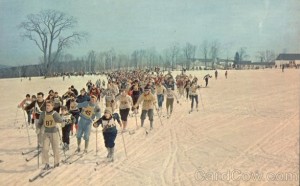
1970 Washington Birthday Race start. Everyone goes at once. Credit: Lewis R. Brown via CardCow.com

It is that special interim period here in New England between the end of winter and the start of spring.  Last week, we headed out across the corn snow at Appleton Farms in Ipswich, MA., in the bright, and, yes, warm sunlight.  We recalled the first time we skied around the edges of farm fields, way back in 1970 when we stayed at the Whetstone Inn in Marlboro, VT.  We were there for the Great Washington Birthday Race, an annual “people’s race” at the Putney School started and run by the legendary cross-country racer and coach John Caldwell.  In those days, hundreds of skiers came to Vermont for what must have been the defining event of Nordic skiing in the United States.  Modeled after the famous Vassaloppet race in Sweden, the massive starting line stretched across a hay field and, when the gun sounded, it was off you went.  We remember skiing along with the then-movie critic of the New York Post, an older chap who said he skied around the field behind his house in Westchester every morning before heading into work.  We also remember struggling in dead last in that race along with a couple of other members from the then-staff of SKIING magazine, our wax long worn off, but still laughing at our disastrous first-time-ever trying cross-country skis.

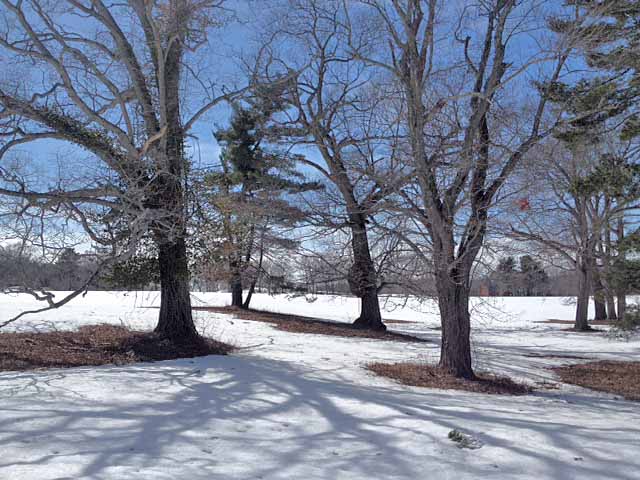
Snow is hanging on this year, melting slowly but inevitably, starting with the trees. Credit: Mike Maginn

Snow is hanging on this year, melting slowly but inevitably, starting with the trees.
Credit: Mike Maginn

These thoughts came back as we went around that big field at Appleton’s.  For a long time, we favored wooden skis, woolen sweaters and wax potions; these days, we go waxless and polypropylene.  But the pleasure of being in the sun, noticing the melt around the edges, and the rhythm of planting pole, gliding, planting was the same as ever. As the snow rolls back and the sun comes in and out, Robert Frost’s Two Tramps In Mud Time came to us. This verse hits home:

The sun was warm, but the wind was chill. You know how it is with an April day.
When the sun is out and the wind is still, you’re one month on in the middle of May.
But if you so much as dare to speak, a cloud comes over the sunlit arch,
A wind comes off a frozen peak, and you’re two months back in the middle of March.

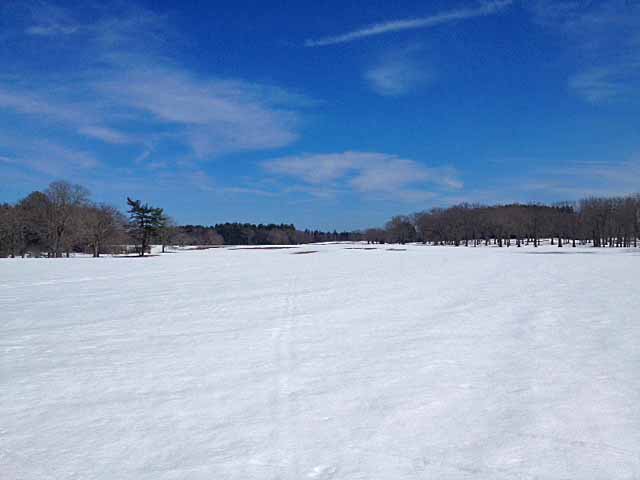
Sunny day, springtime snow, skiing across the field at Appleton Farms, Ipswich. Credit: Mike Maginn

Sunny day, springtime snow, skiing across the field at Appleton Farms, Ipswich.
Credit: Mike Maginn

More Ice Canoe Racing On The St. Lawrence

Looking Back At A Cool, Cold Sport In Quebec.

In February, we traveled to Quebec to visit the Winter Carnavale and the legendary ski resorts on the St. Lawrence, Mount Saint Anne and Le Massif de Charlevoix.  The city was alive with thousands of people celebrating the brilliant cold and the many events of the Carnavale.  One of these was the most extraordinary athletic event we’ve ever witnessed:  The Ice Canoe Race on the St. Lawrence River.  As we watched from the shore, about a dozen or more crews hustled and pushed specially built canoes over and around ice floes.  Triangular course went from one side of the river to the other; the “professional teams” had to make two complete circuits.  Click here for a clip from our eyewitness account.

Now we have more expansive coverage, thanks to our good friends at QuebecRegion.  Have a look; it is clearly an impressive experience for participants and observers alike.  Recall this video when you are complaining about the heat and humidity of next August.

For more information on the Quebec Region’s many attractions for active seniors, please click here.

Sierra Ski Season 2014–15: A Mixed Bag

In a winter with the lowest snowfall in the Sierra Nevada since record-keeping began, some resorts fared well while others barely managed to open.

On April 1st, it was no joke when California’s Department of Water Resources snow surveyors went to Phillips Station off Highway 50 near Echo Summit to do their official April 1st measurement of the snowpack. Whereas the average

Despite snow drought, author's daughter Katie Cleese and friend Rose Cendak practice Quidditch at Heavenly Valley. Credit: Rose Marie Cleese

Despite snow drought, author’s daughter Katie Cleese and friend Rose Cendak practice Quidditch at Heavenly Mountain Resort.
Credit: Heavenly Mountain Resort

snow depth at that location is 66.5 inches on that date since record-keeping began there in 1941, the measuring crew—with Governor Jerry Brown by their side—found themselves in a meadow devoid of any snow at all. It was unprecedented. Since it’s now likely that there will be very little Sierra snowpack runoff into the state’s reservoirs this year coupled with the previous three years of statewide drought, the governor announced on the spot a mandatory 25 percent reduction in water usage for everyone—companies, institutions, and individuals alike.

Yet, despite there being grass instead of snow in the meadow at Phillips Station, one can still ski and snowboard in the Sierra—at least for a couple more weeks. A small handful of wintersports areas will remain open past the traditional Easter weekend closing date, thanks to their snowmaking efforts, their higher elevations, and/or their careful protection and manicuring of the snow they were lucky enough to have fall on their slopes.

To catch a few more runs before all the snow is gone, you can head to any of the following (closing dates as of April 2nd are in parentheses): Bear Valley (Sunday, April 12th), Boreal (Sunday, April 12th), Heavenly (Sunday, April 19th), Mt. Rose (Sunday, April 19th), Kirkwood (Sunday, April 19th), and Mammoth Mountain (Sunday, May 31st). Bay Area skiers rarely make the trek to Mammoth on the eastern slope of the Sierra off Highway 395 since the quickest route there, via Tioga Pass in Yosemite, closes every winter after the first major snowfall. This season, however, Mammoth was and remains a great option since the Tioga Pass road never closed this winter—a first! As of March 31st, Mammoth had 19 of its 28 lifts operating, with a base of 30–60”. The resort has often been open for skiing over the 4th of July weekend; don’t hold your breath this year!

Only one Sierra wintersports resort is closing this Easter Sunday, April 5th, the traditional end of ski season: Alpine Meadows.

Katie Cleese soaks up the bennies in the too-warm patio at Heavenly Mountain Resort.  Note snow melt in background. Credit: Rose Marie Cleese

Katie Cleese and Mike Allen, Director of Ski Services, soak up the bennies in the too-warm, mid-mountain patio at Heavenly.  Note snow melt in background.
Credit: David Koth

Several Sierra resorts had a tough season, especially those with no snowmaking capacity or besieged by higher temperatures that prevented snowmaking or located in the Central Sierra, which didn’t get as much snow as their neighbors farther north. Sierra-at-Tahoe managed to open on December 12th and ran its lifts for a total of 94 days before it had to close on March 16th. Badger Pass in Yosemite National Park opened on December 14th but had to close on January 19th, never to reopen. Dodge Ridge racked up similar stats to Badger Pass, opening on December 17th and closing in mid-January. Homewood on the west shore of Lake Tahoe opened on December 20th but then closed on February 23rd to wait for another significant snowfall that never came. Tahoe Donner closed on March 15th and Diamond Peak closed on March 29th. Sugar Bowl had to cut its 75th Anniversary season short, closing on March 22nd.

Hopefully, all the resorts will have a banner year next year, but with the new normal, it looks more and more like any California resort that hopes to survive the changing climate will have to take the plunge into a robust snowmaking system.


Off-Season Strategy: Ski Without Snow

For Die-Hards, Here’s How To Keep Going.

Signs that the season is ending are starting to sprout along with the crocuses.  In the East, many areas will be closing this weekend; there’s still lots of snow on the ground, but many lift lines are nearly empty even on the weekend.  Many skiers have had enough.  Out West, conditions have been marginal to miserable all season. There’s plenty of cross-country skiing though, even in urban areas in New England, and we’ve been out in the sunshine several times in the last week.

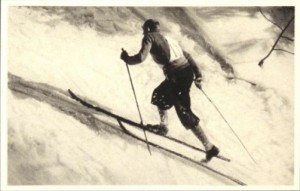
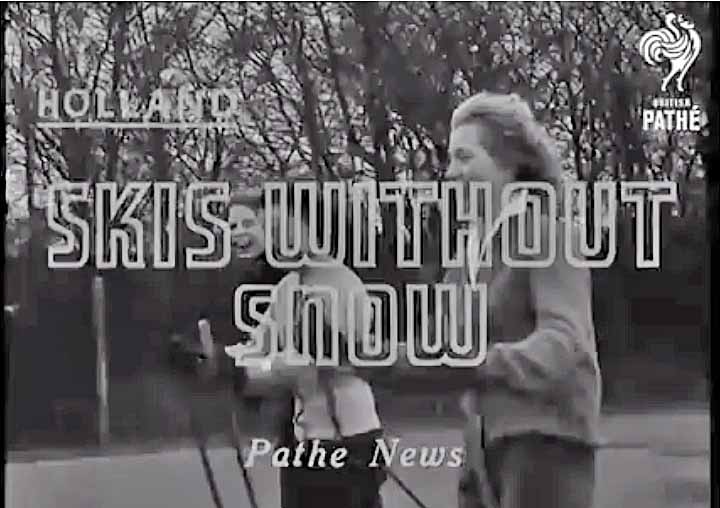
But, can you beat this video from the British Nordic Ski Team, circa 1957, picturing Dutch ski enthusiasts roller-skiing along?  It is possible that for some the season never ends.

Roller-skiing is not a new idea.  At least you don't need long underwear. Credit: British Nordic Ski Team

Roller-skiing is not a new idea. At least you don’t need long underwear.
Credit: British Nordic Ski Team