Tag Archive for: Cross Country Skiing

Celebrate Winter: Anecdotes and Insights from a Cross-Country Skier’s Experience

Over the past 50+ years, John “Morty” Morton has cross-country skied around the world, been an international-caliber racer and coach, and, as far as I’m concerned (this is homage from a friendly competitor), is the premier Nordic ski trail designer in North America.

Morty has seen dramatic evolutions in the sport – from wood skis to synthetic, wool to spandex, the introduction of skate technique, grooming snowmobiles replaced by snowcats, narrow trails sometimes giving way to highways, etc. Over these years, he served in Vietnam, taught high school English, and has served as broadcast journalist and newspaper columnist.

Now he’s written Celebrate Winter, a book filled with anecdotes and insights based on his intriguing life. It’s his third book, preceded by Don’t Look Back (1992), where he shared his story and training program, and A Medal of Honor: An Insider Unveils the Agony and the Ecstasy of the Olympic Dream (1998), a novel about biathlon.

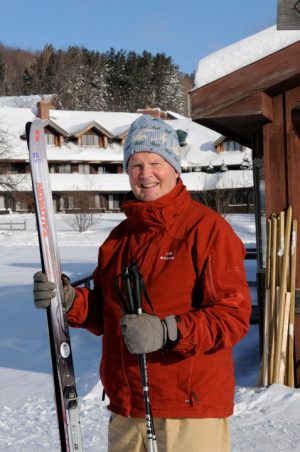
John Morton, age 76.

Celebrate Winter is a compilation of memories, from John’s days as a kid in New Hampshire to skiing for Middlebury College in Vermont; competing and coaching internationally in biathlon; coaching at Dartmouth College in New Hampshire; designing multi-use trails for the past 30+ years; to (most recently) skiing with his young granddaughter in a backpack while she calls out for more downhills!

Biathlon is a theme tying many of the roughly 70 stories together, as are observations on the human condition (ego, anger, generosity, laughter, inspiration). He covers the role TV plays in popularizing biathalon; Coca Cola at feeding stations; weather and altitude as they can affect racing; Olympic politics; doping; saunas; holding the Olympic torch for a moment at the Calgary Winter Olympics; and a constant sense of the magnetism of cross-country skiing, its beauty, diversity, and comraderie.

As trail designer, Morty has worked with schools and colleges, lodges and real estate projects, alpine resorts and pure cross-country areas, communities and private land owners, ski clubs and non-profits. Unlike some other designers, he’s well aware of the fact that really tough trails are only suited for elite athletes, whereas the great majority of us are recreational skiers (and the bread-and-butter for most Nordic ski areas).

If having your own professionally planned and built trail system sounds intriguing (cross country skiing, hiking, running, biking, snowshoeing, equestrian…), John Morton (https://www.mortontrails.com/) is still going strong in his mid-70s.

I recently purchased several copies of Celebrate Winter to give as gifts. Many of the anecdotes are just a few pages long, making for a delightful – no, mesmerizing – read.


Make More Tracks: Yellowstone Expeditions

A Rustic Retreat In Remoteness.

Yurts and heated tent cabins accommodations in remote corner of Yellowstone.

When skiers talk about great backcountry, they often cite the Tenth Mountain and Braun systems in Colorado; Sierra Club huts in California; Skoki Lodge, Assiniboine and Shadow Lake in the Canadian Rockies. I’d like to add a new destination, near Canyon in Yellowstone National Park. (Check an atlas, find Yellowstone in the northwest corner of Wyoming; Canyon is in the north central part of the Park.)

Actually, Yellowstone Expeditions is in its 38th season. And to be honest, they use yurts and tent cabins, not log huts or lodges. But “great” is perfectly appropriate, whether it’s skiing or snowshoeing, staff, dining, or the amazing landscape of the world’s first national park (1872).

Yellowstone isn’t exactly a winter secret, but skiers visit the Canyon area only when they’re passing by in enclosed heated snowcoaches or on snowmobiles, mainly because there’s no lodging within 35 miles except Yellowstone Expeditions.

The company was founded by Arden Bailey, who in summer works as a geologist who once specialized in radioactive waste disposal. (There’s a theory Arden is such a bright guy that no one in his vicinity needs a headlamp.)

The high point of my winter used to be running winter trips in the U.S. and Canadian Rockies, so it was a joyous thing to be a guidee around Canyon. Most of the time I skied with Erica Hutchings, a Renaissance woman who’s been office manager, snowcoach driver, PSIA-certified instructor, and super-guide. Come summer, she’s been a river ranger in Grand Teton National Park.

Who Are Those Guys?

Dining room and kitchen yurts glow at sunset.

All the guides are a hoot. They’re also naturalists, dishwashers, and talented cooks, working crazy hours with all kinds of clients, and carrying it off with humor and panache and quick wits. What a work ethic!

Arden’s talents include amazing stories and still more unbelievable jokes. This sense of humor seems to inspire guests, who tend to be crazy-diverse in their professions and interests anyway. Our group on one visit included a doctor from New Mexico, a writer from New York, and the owner of a trucking firm in Texas. I learned something about publishing fiction, summer weather around Houston, anatomy, movies, Superfund sites, national politics, and succession tree species after the Yellowstone fires of 1988.

A typical four-, five- or eight-day trip begins with a snow van ride from West Yellowstone to Canyon with skiing near the rim of the Yellowstone toward the end of the day. We enjoyed a novel experience along the Gibbon River—a herd of maybe 200 slow-moving bison. We couldn’t pass them for almost two hours. It was a photographer’s dream, including the chance to take pictures of fuming snowmobilers who revved engines but still didn’t intimidate the beasties.

And There’s Skiing

Here’s why people come to Yellowstone.

You can visit the park for its beauty, for wildlife, for geysers. I did it that time for long tours, powder, and downhills. It’d been a long time since I’d really skied hard in the backcountry. It’s easy to forget how few miles a small group can REALLY go in eight hours when you’re breaking trail through two feet of fresh snow.

The Yurt Camp is based at 8,000 feet, so it gets and holds 200-250 inches of snow, usually the light stuff Montanans call “cold smoke.” It’s in a spectacular area, minutes from the deep canyon of the Yellowstone. Terrain runs from long-open-steep to wooded-gentle.

I’ve always been a so-so unenthusiastic telemarker, never quite found that ideal combination of grace, strength, and technique. After that trip, I’m a certified Wannabe.

It stood to reason that 205 cm light touring gear would do the trick for touring, even for low-angle telemarking. This might have worked if the heels of my boots hadn’t kept jamming with snow. It’s demoralizing to start a turn, come round just far enough that skis are pointed down the fall line, and find the only part of the boot/binding system meeting its obligations is the toe.

Humility is a great teacher.

Yeah yeah, I know, “It’s the equipment.” But the next day I used mid-length general touring gear with a 3/4 metal edge with backcountry boots and bindings. Spectacular improvement! Even carrying a full pack, those skied floated and came around on request.

Actually, we could have skipped hills almost entirely. There’s a huge variety of trails—groomed, ski-set, or just marked—taking off right from camp, including gentle tours to places like Inspiration Point and Cascade Lake.

Wilderness luxury

Guests stay in warm, comfortable hut tents, a moments walk from the kitchen and new dining yurts. Here’s the thing you sweat for and dream of on skis or snowshoes: getting home at twilight and trying the new cedar sauna before dinner. Or better yet, a backwoods (indoor) shower—rapture!

Among my favorite moments were the intermittent thunder of the Yellowstone’s Lower Falls (much higher than Niagara); walking around Washburn Hot Springs (it’s a map-and-compass trip in); watching a park ranger skate at dusk beside the Grand Canyon of the Yellowstone, just after a grooming machine came through; learning the differences between fisher and coyote tracks; digging a snow pit for evaluating avalanche potential; and the pleasure of a heated outhouse.

Now, that’s livin’!

More Detail

Packages include delish meals, lodging, snowcoach, sleeping bags and sheets, and guiding. The season runs December 17-March 7th. Four-day/three night visits run $1,260 per person, double occupancy. The camp holds 10-12 guests. Check out the dynamite web site by clicking here or call 800-728-9333.

Late afternoon along the thermal waters of Alum Creek


 

Question For You: Groomed Or Au Naturel?

What Is Your Preference? 

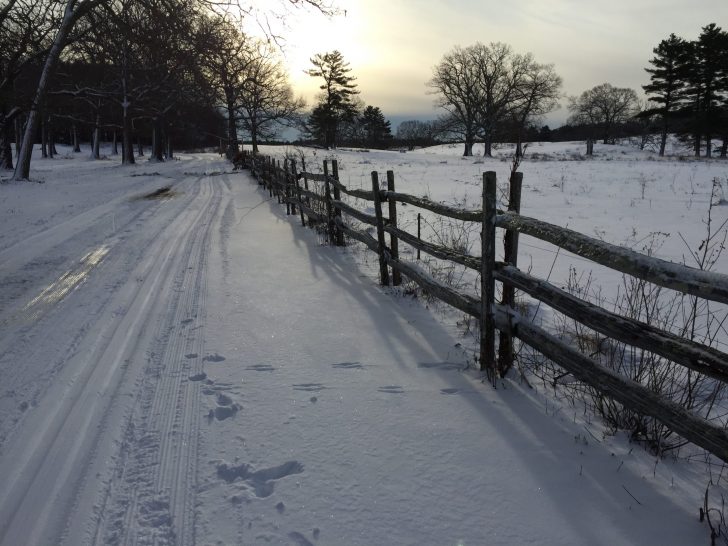
Appleton Farms, Ipswich, MA. Trails are groomed by a volunteer group. Credit: SeniorsSkiing.com

We live across a little country road from a 900-acre conservation property. For years, we’d walk across the road, stumble over the stone wall bordering the street, and plod our way about 20 feet through tree-falls and heavy brush to a trail where we’d put on our xc skis. And then we’d break trail around our favorite loop, eventually meeting up with trails already made by skiers who made it out earlier than us.  Then we’d follow those.

In recent years, North Shore Nordic, a local, volunteer-run non-profit, regularly runs a trail-maker snow mobile around the property, creating perfect, groomed grooves for classic skiing and a corduroy path for xc skaters.  Now, we have the best of both worlds.  To get to the groomed track, we break trail from a remote corner of the property to the main area. We like the groomed trails.  But then, there are the walkers who are enjoying the beautiful snow-filled fields by walking on—and disturbing—the groom. So, hmmm.

And, here’s our question for you:

Do you favor going to a cross country ski area with groomed trails or on a local trail that is not maintained? Do you have a place that is cross country skiing close to home? Is it au naturel or groomed?

“Au naturel” trail across Appleton Farms field. Credit: SeniorsSkiing.com

Question For You 8: The XC Option

What About Cross-Country?

Let’s imagine that the recovery from the Corona virus doesn’t go as we all hope it will.  And that by the time snow flies again in the mountains, the second wave has landed.  Ski resorts are either closed or postponing opening dates until later in the winter. Or ski resorts are limiting access through a lottery or other ways of restricting access. In other words, no or limited opportunities for Alpine skiing.

And backcountry may be discouraged for senior skiers because of the potential for deploying essential search and rescue personnel when they are needed elsewhere.

Got it?  So here’s the question:

Please write your response in the Reply Box below.

Given your attraction to snow sports and physical activity, if Alpine skiing is cancelled, delayed, or restricted, will you find opportunities to go cross-country skiing in parks, golf courses, open farm fields, even XC resorts?

This Week In SeniorsSkiing.com (Dec. 13)

Nordic Volunteers, Poutine For Calories, Exoskeleton Helps Legs, More Incidents & Accidents, Southern Skiing, Mystery Team, Weather Report.

Early morning finds a groomed trail ready to go. Credit: MDM

This co-publisher of SeniorsSkiing.com loves to cross-country ski. Since we live directly across the street from a 900-acre tract of conservation land, owned and managed by the Trustees of Reservations, we head over the stone wall whenever there is decent coverage.

In former days, we bushwhacked our own trail through the woods until we connected with the network of tracks made by the early birds. (There are always earlier early bird tracks.) And we followed the early bird trail loops until we decided to bushwhack again back to home base.  Fun, but kind of tough for a seventy-five year old, especially at the beginning of the season and deep-ish snow.

NSNA Crew grooms all night for a wonderful trail in the morning. Credit: NSNA

Enter the North Shore Nordic Association. This is an all-volunteer, non-profit, community-based group which forms alliances with large landowners, most of whom are also non-profit organizations or municipalities, to maintain and groom existing hiking and biking trails for cross-country skiing, snowshoeing, and snow skating. For the past four years, NSNA has bought and maintained a collection of equipment through donations from local people and businesses.  Every time it snows, the groomers are out there, usually right after the snow stops falling, often in the middle of the night or early morning.

Your retro-attired co-publisher at the Farms. Credit: AAM

The grooming machines create two ski tracks, one a broad corduroy for skating and two pairs of grooved classic tracks on each side. There are many benefits to having these ready and waiting for a senior skier. It is obviously easier to ski, for both beginners and, well, everyone. The packed snow also lasts longer. The machines also loosen up hard pack to extend whatever snow is down.

The NSNA uses social media to alert folks about conditions every day. The group also maintains trail maps on a Smartphone app.  When we encountered a grooming crew on the trail one morning, the young man took our picture and immediately posted it on the group’s Facebook page.

All this is free for the skier. Enthusiasts and occasional visitors can donate to the NSNA to keep the machines turning. The group is well-run, organized, and community-focused. In the long term, they hope to create a racing league, offer lessons, and run a rental program.

The Point: If you don’t live near a cross-country ski area or resort where trails are groomed and maintained and rental equipment is available, consider forming a group like NSNA. All it takes are people who love to cross-country ski or snowshoe, some willing land organizations or town governments, and some energy to get all this organized.

Trail Masters Update

We have mailed out over 150 Trail Master patches to readers who responded to our Spring Survey as having skied more days than their age.  Most were sent to US and Canadian readers, but there were also numerous addresses in Sweden, Finland, England, and Australia.  Please note because some addresses were not completely filled out in our survey form, we were not able to send patches to all qualified readers.

This Week

Poutine, a Frency Canadian comfort food dish. Credit:Yvette Cardoao

SeniorsSkiing.com Northwest correspondent Yvette Cardozo  reports on a Canadian cuisine specialty at Silver Star Resort in BC. Ever have Poutaine? It’s a hearty meal designed to replace calories lost to a heavy day of skiing.  There’s more.  Ever had a Caesar? Not a salad.  Find out here.

We have a contributor review of the skiing assist aid Againer Exoskeleton.  This device can actually extend your skiing career by supporting your legs and back. Consider our reviewer’s experience here.

What’s the highest mountain on the East coast of the US? If you said Mt. Washington, you’d be wrong.  Mt. Washington tops off at 6,288 feet, but Mt. Mitchell reaches up 6,684. Where is Mt. Mitchell? North Carolina. Surprise.  Co-publisher Jon Weisberg reveals more secrets about Southern geography and skiing in his book review of Southern Snow: The New Guide To Winter Sports From Maryland To The Southern Appalachians. Read more here.

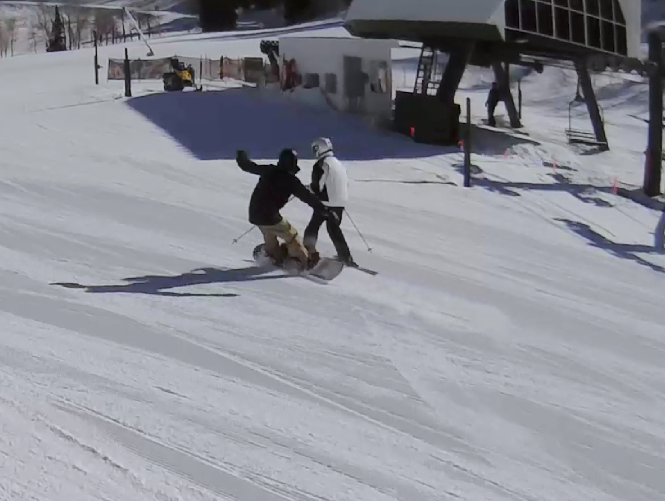
Correspondent Jan Brunvand reports an Incident & Accident that he actually filmed taking place.  His on-scene photos and report are astonishing.  As readers know, we are collecting a portfolio of collisions to see if there are comment threads.  With that information, we hope to influence ski industry practices and policies on managing unruly and dangerous skiers.

Correspondent Jan Brunvand captured an incident in action.

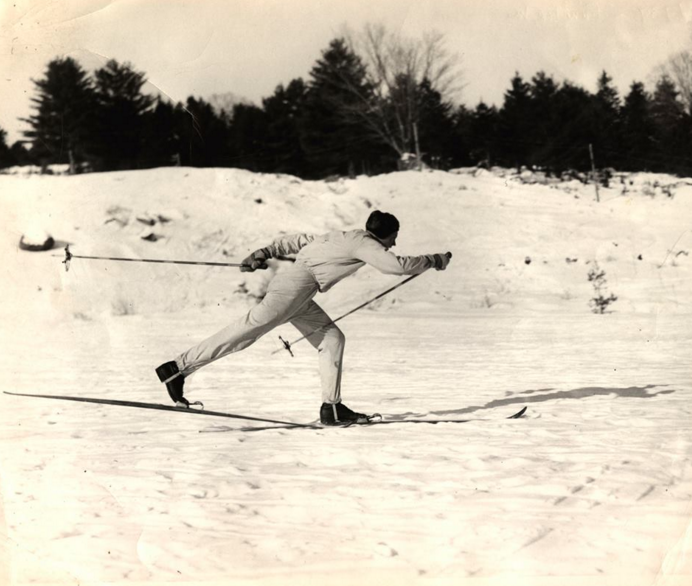
Last week’s Mystery Glimpse photo was Rip McManus in action. We provide a capsule profile of Rip and his impactful but all too short career in the skiing world.  This week’s Mystery presents a jumping team from long ago from Alan Engen’s collection of historic ski photos.

Finally,  Herb Stevens, the Skiing Weatherman, gives us a round up of regional forecasts as well as a tutorial on what a “trough” is. Here’s his story.

Thanks for reading SeniorsSkiing.com.  Tell your friends and remember, there are more of us every day and we aren’t going away.

Feb 1941. Ski Jumper. Can you name them? Credit: Alan Engen Collection


At Great Glen Trails, Nordic Skiing and Activities for Everyone

New NH Cross-Country Resort Offers Winter Sports Alternatives.

Olympian Sue Long Wymess demonstrates “Gorilla Arms” technique at Great Glens Trails. Credit: Tamsin Venn

Great Glen Trails Outdoor Center just past Wildcat on Route 16 in New Hampshire, sits at the base of the towering Mt. Washington. At 1,600 feet in an area known as the Glen, the snow is plentiful, and the managers cut Nordic trails to perfection daily for both classic and skate.

Cruise around a 45-km network of groomed and backcountry trails. Most trails are double tracked, for two-way traffic.

“Great Glen has some of the finest designed trails for cross country skiing in the world. The late John Frado is famous for designing them for quality and whimsy that the Great Glen trails beautifully convey,” says Roger Lohr, SeniorsSkiing.com cross-country editor and publisher of XCSkiResorts.com. 

“The Meister program at Great Glen may be the most successful in the country with a fat bike component, too,” he adds of the weekly locals’ race series.

Learn from the best. Ski School Director Sue Long Wemyss, a U.S. Ski Team member from 1983-86, competed in all four of the XC races in the 1984 Olympics in Sarajevo. She offers a lesson package of three one-hour private lessons.

Heads up. Nordic equipment has changed radically in the past decade. You can rent or buy skis that are waxable, waxless, or skinned. A new adjustable binding system lets you move your weight forward or backward with the turn of a dial. The new skin skis are much faster than the old mohairs (“slohairs”). Music to our ears: “You can enjoy skiing more with the new gear,” says Great Glen XC shop director Nate Harvey.

A scavenger hunt for grandkids will keep them searching for forest friends. Credit: Tamsin Venn

Take the grandkids out on the green trails and let them spot all their furry friends at animal cartoon stations. Punch all the holes on the map and they earn an official Trails Tracker button.

Come and stay awhile trailside. Just opened in September, The Glen House is the fifth hotel on this site (four others burned down). It’s an airy building that manages to be both rustic and sleek. Thanks to the efforts of Great Glen Trails General Manager Howie Wemyss (Sue’s husband), the hotel uses state-of-the art green technology to harness geothermal for heating and cooling and eventually solar and hydro. Half the hotel’s 68 rooms have balconies facing the Northern Presidential mountains and the Carter Moriah range. The Notch Grille and indoor heated saltwater make après ski relaxing. In the great room, two story windows face the peaks of Mt. Washington, Jefferson, Adams, and Madison, and Architectural Digest recently named it “The Most Beautiful Bar in New Hampshire.”

Great Glen is a good spot to try a new activity or for everyone in the family to enjoy themselves. Choose fat biking, snowshoeing, tubing, or taking the SnowCoach up Mt. Washington to timberline into an Arctic winter wonderland. Ski and stay packages are reasonable. Summer brings a whole other basket of activities.

The Glen House hotel has a truly beautiful bar with dramatic artwork. Credit Tamsin Venn

Nordic Rates: Season Pass Seniors $100 (62 Plus), $75 if bought by Dec. 1. Day pass Senior (62 Plus) $12. Two for 1 Mondays and Fridays (non holidays).

Trails are groomed to perfection at Great Glen. Credit: Tamsin Venn


Lessons From Folk Tale: X-C Ski Adventure

[Editor Note: As the new year begins, SeniorsSkiing.com is again asking our readers to contribute to support our online magazine. Yes, we have grown in the number of subscribers and advertisers. But our expenses have also grown. You can help us defray some of these expenses by helping us out with a donation.  This year, we have a mix of premiums for different level of donations, including stickers, sew-on patches, our new SeniorsSkiing.com ball cap. All donors will be entered into a drawing for a pair of bamboo Polar Poles to be drawn in late March.  You can donate by clicking here.]

Finnish Folk Tale Ingenuity Saves The Day.

Many years ago my wife and I had a small weekend cottage in southeastern Vermont. One Saturday I stopped by the West Brattleboro Library and checked out a book of Finnish folk tales by General Kurt M. Wallenius.

The tale I liked best told of two young fishermen who skied north for a few days ice fishing in winter. They separated one day, agreeing to meet up early evening at camp. One of the fellows snagged a good haul of fish, put them in a sack, and headed back to base. As he was skiing along, he realized he was being stalked by a wolf. He skied faster, but the wolf was closing on him. So, he skied up a small incline, turned abruptly, and skied at the wolf. The wolf leaped to attack him. At the same time, the fisherman leaped, pointing his skis at the oncoming beast. He stabbed it with both skis, killing it but breaking his equipment. So, he sat down, built a fire out of the broken skis, and waited. Sure enough, an hour or so later, his companion saw the firelight and found him. They knew exactly what to do. The fisherman with two good skis gave one to his friend, and they skied back to camp that way, pushing with one leg, skiing on the other. And they brought back all the fish and the wolf’s skin as well.

Not long after I read this story my wife and I were out cross country skiing on a primitive trail. We went fairly far from our cottage when the wet snow started to adhere to the base  of her waxless skis, impeding her progress. I had old-fashioned wax skis and was not having a problem. It started to get late and my wife, making very slow progress, got spooked. She told me to go on without her. She told me that if she did not get back, I had to remember to buy our two boys new shoes every six months, since they were growing quickly.

Remembering General Wallenius’ story, I traded one of my wax skis for one of her useless, waxless skis. Fortunately, we used the same bindings back then. The trick worked. We pushed with the waxless ski, glided on the wax ski, and got back home safely. For many years afterward I made sure we had the same bindings.


Ski West Yellowstone

Cross Country Apparel: Recommendations From An Expert

Guidelines For What To Choose And Why.

[Editor Note: Thanks to Roger Lohr, publisher of XCSkiResorts.com, for this review of the latest in XC skiwear that was printed first on that site.]

Wearing the right apparel for cross country skiing can keep you warm and comfortable.

I’ve often wondered why there isn’t more hoopla about cross country skiwear. I’m not talking about the suction suits worn by cross country ski racers; rather, I mean the recreational garb, which is versatile, functional, and fashionable.

Currently, I cross country ski wearing apparel from vendors like Craft, Sporthill, Swix, and others.  What is important is that the products that I select to ski in fit a number of personal parameter preferences.

Comfortable Pants For XC Skiing

XC Ski pants with zipper all the way up the leg.

The Craft AXC Touring Pants (about $80) that I wear have zippers along the entire length of the legs, and, at the ankle, there is an elastic area closed with a zipper and a snap.

I feel that this pant ankle set-up is the most significant aspect of the pants. It tightly fits around the boot and keeps snow out of the boot top, avoiding wet socks while skiing.

And if you’re worried about losing your keys, the zippered side pockets are comforting to lock away your valuables.

The comfortably lined material of the Craft pants is also enough to stay warm with or without a base layer underneath.

Craft Cross Country Ski Jacket

Sporthill, Craft, and Swix jackets have most everything I want in a jacket, except few have pit zips to provide an extra way to cool off and transport perspiration away. These jackets have a mesh liner and material that is comfortable when you zip up the collar on a very cold day.

Look for jackets with cuffs and neck closures, mesh linings and, if you can find it, under arm zippers.

I’ve used the packable hood on the jacket quite a few times when it suddenly got cold out on the trail. The high-hip fit keeps you warm, and the zipper side pockets can be closed to avoid losing pocketed items. The jacket arms might have extended fleece cuffs, which are a nice touch to keep snow out of your glove. The inside chest pocket has a zipper and a hole for an earbud cable from my phone or iPod for the times that I want musical accompaniment on solo trail outings.

Socks And Gloves

Socks, gloves, shirts, and base layers are an entirely other matter that will need to be covered in a separate article. In short, parameters for selecting socks include thickness, space for your toes, and height of the sock on your leg. Expect to pay as much as $25 or more for quality socks these days.

I have a few different pairs of gloves so I can adjust to the temperature ranging from heavier, insulated, three-fingered gloves for the really cold days to lightweight gloves for springtime. I also have base layers in various thicknesses to correlate to warm and cold days. Moving perspiration away from the body is very important, and I use very lightweight underwear on those nice winter or spring days, but on the coldest days I use a heavier or thicker base layer pants and a top that has a turtleneck.

Problem: Limited Inventory In Stores

One of the challenges that confronts cross country skiing apparel availability is the fact that there is a limited inventory of these products in retail outlets. Because the cross country market is smaller than Alpine, there are relatively few sales in the stores. Retailers react by purchasing fewer items offering less selection in the following year. So let’s break this cycle. Go out and purchase more cross country skiing apparel!

Johannes Von Trapp

Johannes Von Trapp: Climbing Every Mountain

Scion Of The Famous Family Is The Inventor Of The Modern X-C Center.

Johannes Von Trapp makes X-C skiing acccessible and fun for guests at the family lodge.
Credit: Roger Lohr

[Editor Note: This article first appeared in XCSkiResorts.com.  Our thanks to publisher Roger Lohr for allowing us to reproduce it here.]

If there was an American Cross Country Ski Hall of Fame, Johannes von Trapp would be one of the surefire inductees. The famous story of the von Trapp family is well known; their escape from Austria in the beginning of World War II, and the Broadway and Hollywood songs such as Edelweiss, My Favorite Things, and Do Re Mi. In November of 2014, Johannes von Trapp spoke at a luncheon of Nordic ski area operators and one could tell they looked at him as their living history. He grew up with nine siblings as the last born in the original von Trapp family and he is also known as the proprietor who opened Trapp Family Lodge, the first commercial Nordic ski area in 1968.

In 1938 just before World War II, the Baron and Baroness von Trapp left all their possessions and estate near Salzburg, Austria. With nine children and one on the way, they fled Austria and were granted asylum in the US. That child on the way was Johannes, who was born in 1939 and now is the president of the modern day Trapp Family Lodge in Stowe, VT.

Arriving in the US with only four dollars, the family settled in Philadelphia and, through their music, turned a family hobby into a profession as the Trapp Family Singers. In 1942, they bought a small farmhouse in Stowe, Vermont because the landscape reminded them of home. They rented out rooms at their farmhouse to skiers and ran the Trapp Family Music Camp.

Johannes commented that they were too poor to pay to use the ski lifts in Stowe, so they skied up and down in the woods around the farm. He attended Dartmouth College and upon returning to Stowe, he later operated the lodge. He started the ski area out of his barn, renting cross country skis, and giving ski lessons to become the first commercial cross country ski resort in the world. He had hired his first staff person, Per Sorlie, an ex-navy man from Norway, who had great enthusiasm for cross country skiing and who had a brother who wholesaled cross country ski equipment from Norway.

They would pack the trail in the early morning, rented and sold Nordic skis, and taught ski lessons. Johannes stated that he grossed $8,000 that first year in the cross country ski business, and he doubled the revenue in the following year. The original concept was a way to attract guests to fill the rooms at lodge.

He always thought that the business would involve backcountry skiing as the key element and today he still hopes that backcountry will grow and become a more noticeable part of the Nordic ski scene. He commented about the “violent contrast” in product development that has become “plastic, nylon, and form fitting,” citing the Americanization of Nordic skiing. But he does admit that the new equipment and clothing have great virtues, and he has come full circle embracing the high tech that has been incorporated into the sport and business.

Johannes reminisced about the first snow machine he bought for $50 to pack the trails. They built many different weighted boxes with skis on the bottom to drag behind a snowmobile and set tracks on the trails.

In the early 1970s, the lodge included a riding stable but the horses impacted the trails too much so horseback riding was discontinued. Johannes cited a recent survey taken by UVM students at Trapp Family Lodge that revealed the skiers mostly cared about the track quality. But he still believes in the psychic benefits of being outdoors and loves how the sport has taken off.

The lodge occupancy has increased over the years.  Acquiring the nearby land (Trapp Family owns 90% of the trail property) was important to maintain the trails. The lodge history included the fire in 1980 and rebuilding in 1983. In 2000, Trapp added 24,000 square feet of meeting space and accommodations to the lodge and four years later the first villas adjacent to the lodge were completed and sold.

Johannes’ son Sam became vice president of the operation in 2007 adding mountain bike trails in the summer and snowmaking in the winter. In 2008, Trapp Family Lodge celebrated its 40th anniversary and was covered in the NY Times, on ABC World News, and the lodge created its first television advertisement. In 2010, Trapp Lager beer was introduced on the property and a new facility was opened in 2015 in Massachusetts to greatly expand the brewery operation.

Johannes von Trapp is one of the American cross country skiing forefathers, who will be recognized for his vision of cross country skiing and his connection to a world famous family story.

Short Swings!

A Weekly Round-Up Of Industry News.

historic7_CALIFORNIA

11th annual Alpenglow Sports Winter Film Series will be held at Squaw Valley’s Olympic Village Lodge, November 17.

Squaw Valley Alpine Meadows promoted Tom Feiten to VP, Marketing and Business Development, overseeing marketing and sales. Before joining the resort in 2011, he helped Teton Gravity Research revitalize the Teton Gravity Research annual film tour. He also worked eight years as Director of Strategic Finance for Booth Creek Ski Holdings in Vail, CO.

COLORADO

Arapahoe Basin will open for the season on Friday, October 21.

Ski Younger Now, instructed by Seth Masia at Vail Ski and Snowboard School, is a great program for older skiers. This season there will be four monthly midweek clinics (Tuesday thru Thursday, December 13-15, January 17-19, February 14-16, March 14-16) and one over the Martin Luther King Jr Day weekend (January 14-16). More at skiyoungernow.com or call Seth at 303.594.1657.

Colorado Cross Country Ski Association (CCCSA) announced the lineup (classic and skate skiing) for the inaugural 2017 Colorado Nordic Race Series taking place at four iconic Colorado destinations between January and March 2017.

GetSkiTickets.com announced it now offers discounts on ski lodging as well as lift tickets for resorts across North-America.

MICHIGAN

Boyne Resorts appointed Ian Arthur Chief Marketing Officer, a new position on the company’s executive team. He joins Boyne Resorts with 30+ years of marketing and related experience. Much of his career success has been achieved in the resort and travel industries. 

NEW HAMPSHIRE

Omni Mount Washington Resort, Bretton Woods, NH was named one of the Top 25 Resorts in New England in Condé Nast Traveler’s 2016 Readers’ Choice Awards. The awards recognize the best travel destinations from around the world.

UTAH

Ski Utah published its fifth annual Ski Utah Magazine, including, among other features, a comprehensive guide of all of Utah’s 14 ski resorts. Highlighted is an article about the Ski Utah Interconnect Tour, a great opportunity to ski six Utah resorts in the central Wasatch Mountains in one day. Online at: http://bit.ly/SkiUtahMagazine2016-17.

Deer Valley Resort has a new offering: Guests can hit the slopes with Olympic athletes such as Heidi Voelker, Shannon Bahrke, Kris “Fuzz” Feddersen, Kaylin Richardson, and Trace Worthington.

POWDR, owner of “experiential businesses” (e.g. Copper Mountain, Killington/Pico, Mt Bachelor, Boreal, others) announced it has rebranded. www.POWDR.com.

VERMONT

Okemo is offering its transferrable “3 & Easy” multi-pack that includes three days of lift access, valid any day of the season, with no restrictions. Lift access can be redeemed one day at a time or all on the same day. $204 for seniors (ages 65-60); $186 for super seniors (age 70+). Special offer available until October 31.

OTHER

SeniorsSkiing.com co-publisher was interviewed on Rudy Maxa’s World with The Careys, a nationally-broadcast radio program. Podcast of interview: http://rudymaxa.com/podcasts/2016-2/

Vail Resorts announced that it has added three days at Whistler Backcomb to its Epic Pass and Epic Local Pass.

Returning To X-C: New Technology, New Found Serenity

John Christie, Ski Industry Veteran, Re-Discovers His Love For Cross-Country Skiing.

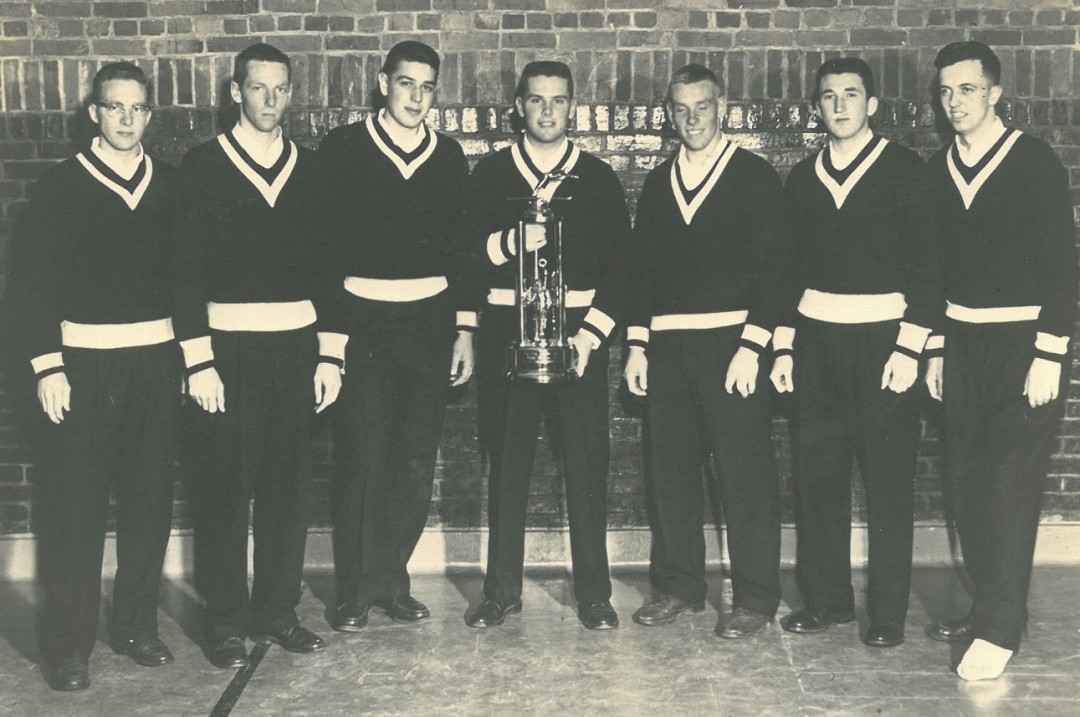
Bowdoin College ski team circa 1958 with state championship trophy. John Christie is third from right. He was originally a reluctant competitor. Credit: John Christie

Bowdoin College ski team circa 1958 with state championship trophy. John Christie is third from right. He was originally a reluctant competitor.
Credit: John Christie

Editor’s Note: SeniorsSkiing.com is proud to have this contribution from John Christie. John is a legend in the ski business. Founder, owner and/or manager of several New England ski resorts (Sugarloaf, Mt. Snow, Saddleback),  John has served as president of Vermont and Maine Ski Areas Associations, was a board member of the National Ski Areas Association and other charitable non-profits as well as author of books (The Story of Sugarloaf, Maine Outdoor Adventure Guide, Skiing Maine) as well as numerous and regular features in a variety of publications.  At 78, he is still discovering and re-discovering that “it’s never too late”.  Our kind of guy.

As someone who bought his first sea kayak just before he reached the age of 70, and now spends hours on end in the summer exploring Maine’s coastline, I guess I’m authorized to say that it’s never too late to discover a new way to enjoy the outdoors.

Similarly, I’m amazed as I travel from ski area to ski area in the winter and see the number of retirees who continue to ski regularly, many who’ve rediscovered the sport after a long absence, and, most impressively, seniors who’ve taken up alpine skiing for the very first time.

Former x-c racer in college, John Christie re-discovered cross-country skiing as a senior. Now he skis to enjoy the outdoors and keeps fit. Credit: John Christie

Former x-c racer in college, John Christie re-discovered cross-country skiing as a senior. Now he skis to enjoy the outdoors and keep fit.
Credit: John Christie

It’s those newcomers to the sport who are discovering how much fun, and how easy it is to make the most of Maine’s long winters. Thanks to improvements in ski equipment technology, along with senior-friendly professional instructors at virtually every ski area in the state, learning to ski at an advanced age is not only a piece of cake, but it’s an opportunity to enjoy the winter to its fullest.

But enough about alpine skiing. Many seniors have learned that a few hours out on cross-country skis is a magical way to spend a winter day.

I was introduced to cross-country skis during my freshman year in college, in 1956. Not because I had harbored a yearning to do so, but because I had little choice. You see, this was the now by-gone era of the four-event intercollegiate competitor that required those of us who wanted to claim our berth on the team to compete in all four disciplines: downhill, slalom, jumping and cross-country.

As an alpine skier, I begrudgingly became a Nordic competitor as a reasonably accomplished jumper and a slightly more than passable cross-country racer. Any success I had in achieving decent results related in no way to my having mastered the technique or much of any technique at all. I did it through exhausting exertion, determination, youthful fortitude and strength, a nagging feeling that I had a responsibility to my team and my beloved Bowdoin, and sheer stupidity.

The result was that every race, a symphony of intermittent stumbling, cursing and frequent vomiting was, I’m sure, great entertainment for the throngs of co-eds along the racecourse. I remember one race in particular in Farmington where I not only artfully combined all of the above, but added an especially amusing touch by sticking a ski pole directly into the top of my right foot, finishing the race in great pain and with a bloody sock. An act to be replicated decades later by a certain Red Sox pitcher during a crucial World Series game.

So that was my context for cross-country skiing. An activity to be undertaken when absolutely required and avoided whenever possible. This less-than-enthusiastic attitude for the sport was further encouraged by the quality of the equipment during my racing hey-days: loose-fitting boots, easily-breakable wood skis and bamboo poles, and bindings that deluded the skier into thinking that he could actually control his skis on icy downhill runs. And skis without any edges, of course.

It’s not too much of a stretch to say that when I stepped up on the stage to accept my hard-earned Bowdoin degree in June of 1959, my first thought was, “Thank God, now I’ll never have to cross-country ski again!”

Although my antipathy toward the sport was clearly more exaggerated than the average skier, it’s apparent that very few people were eagerly embracing the activity during the 1960’s . It was during this period of time that I was cutting my teeth in the ski business, and alpine skiing was my life. When I left the business in the late 1970’s to embark on more mature, and fiscally-reliable pursuits, I was surprised…no, shocked…to hear that people were being lured to, and actually embarking on cross-country skiing for FUN!

So was born the renaissance of the sport, and the next act in the evolution of cross-country skiing from hunting to warfare to exploration to competition to recreation. I begrudgingly reintroduced myself to it, as I was taking a self-imposed hiatus from alpine skiing, and was pleasantly surprised with two things. First, the technology had evolved from wood to composite skis, from imitation to actual bindings that allowed you to actually control the skis, and from waxable wood bottoms (that never adequately and simultaneously accommodated the proper waxes for both uphill and downhill skiing) to fish scales that provided for both uphill traction and downhill gliding. Second, I was struck that without the need to better your competitors, you could actually ski along at a leisurely pace and even enjoy the serenity and the scenery and the exhilarating fun of being out in nature on a crisp winter day.

The popularity came about for a variety of reasons, including the increasingly prohibitive cost of alpine skiing for some folks. Additionally, there was a growing national awareness of the importance of physical fitness, so many people were becoming more active, and when the summer hiking season was over they were looking for a winter counterpart.

So that was my reintroduction, thankfully, to an activity I’ve grown to love. I will say that when the weather’s right, and I have the time, I’ll head for the hills with my alpine skis, but increasingly I’ll opt for the fun of a few hours out on the trail on my skinny ones.


Remembering The Great Big Washington’s Birthday Touring Race

Bang and everyone charges off across the hay field. The Washington's Birthday Race circa 1971 or so. Credit: Spencer Grant

Bang and everyone charges off across the hay field. The Washington’s Birthday Race circa 1971 or so.
Credit: Spencer Grant

 Such Fun. Should We Do It Again?

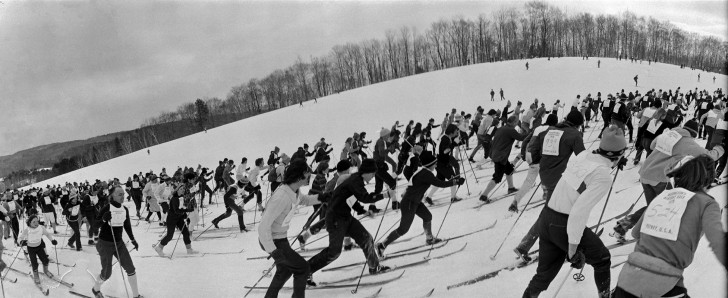
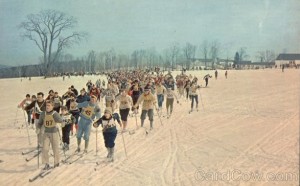
What a celebration of winter it was. Imagine several hundred cross-country skiers, some serious racers—even Olympians—, college kids, couples and families, office people (like us) up from the Big City, all in a long line, awaiting the gun in a big, snow-covered Vermont hayfield. Bang, and everyone charges off, either fast skating or slowly shuffling to the far end where the field funnels into a tractor road and the rest of the 20-km (12-mile) course beyond.

This was the Washington’s Birthday Touring Race, a “people’s race” in more or less the same tradition as Sweden’s Vasaloppet where you went from point to point or town to town, not stopping if you’re racing or stopping for a picnic snack if you weren’t. In 1963, Eric Barradale, a Brattleboro dentist and former Dartmouth Outing Club member, and a cluster of southern Vermont educators, business people and professionals, thought a race like the Vasa would help promote cross-country skiing in the US. Back then, Nordic skiing was esoteric, and an event like a great, big race would—and did— attract lots of attention.

A small group of SKIING magazine staffers participated in the 1971 edition along with about 1000 other folks. We arrived with brand new kangaroo skin boots, wooden skis, four pin bindings and bag of waxes. It was our first time ever on cross-country skis. In fact, SKIING magazine’s editor and our boss Al Greenberg gave us a lesson in his office before we left for Vermont in our rented car. “Just shuffle like you have bedroom slippers on and keep your arms moving.” Doug Pfeiffer, the editor-in-chief at the time, opined about ski wax. “Some concoctions are said to include whale blubber,” he hinted mysteriously. The hook was set. The night before the race, we learned how to put on pine tar and wax in the basement of the Whetstone Inn, in Marlboro. From that delicious aroma, we knew we were going to love it.

The GWBDR was modeled after Sweden's Vassalopett. Credit: CardCow

The GWBDR was modeled after Sweden’s Vassalopett.
Credit: CardCow

The first race in 1963 had 54 participants. Bob Gray, a two-time Olympian and student of John Caldwell, a long time coach, member of the 1952 Olympic team and eventually USSA team coach, was the winner. Bob told us in a recent interview the first race went from Hogback Mountain to Brattleboro. In subsequent years, the race was held on different courses throughout southern Vermont, some more challenging than others, all linking towns around the area. And the numbers of participants grew. Bob said, “We had the US Women’s Cross-Country team in one race. More and more competitive racers started coming.” That’s when Barradale started having second thoughts.

“There were racers knocking people off the track,” said Gray. “Barradale got discouraged.” The charm of a citizen’s race was disappearing as more and more serious racers showed up. Over the years, we had always thought the race was finally called off because of lack of snow. We asked Bob Gray if that was the reason. “No, it was because the race became too much of race.”

The final official Washington’s Birthday Race was held in 1973. Bob Gray was in that one, too, as he was in five since 1963. The people’s race run by a group of volunteers was experiencing the embarrassment of success. Too many details, too many arrangements, and too many racers. “After 1973, there were about five years where we had loop races around the a county club in Brattleboro for real racers, but the basic idea was lost,” said Gray. Gray said he got to keep the Winner’s Bowl when the race “retired”.

Gilbert_Stuart_Williamstown_Portrait_of_George_WashingtonIn 1971, our group from SKIING managed to come in dead-last. Our wax had long gone, we got lost, yet we laughed our way to end point at Putney School. We did get a pin for finishing. It instantly became one of our proudest possessions.
Should we have another generation of the Washington Birthday Race? Would you go?


SeniorsSkiing Guide: History All Around At Appleton Farms

Boston’s North Shore Has A Peaceful Place For Senior Nordic Skiing Or Snowshoeing.

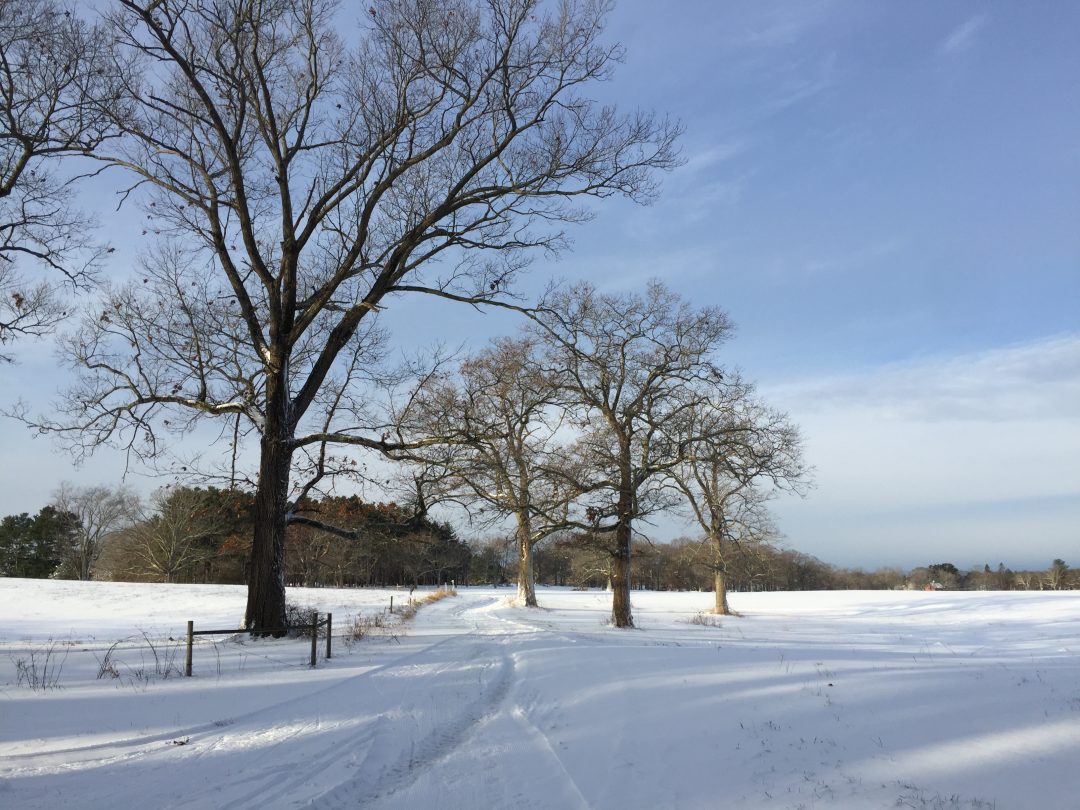
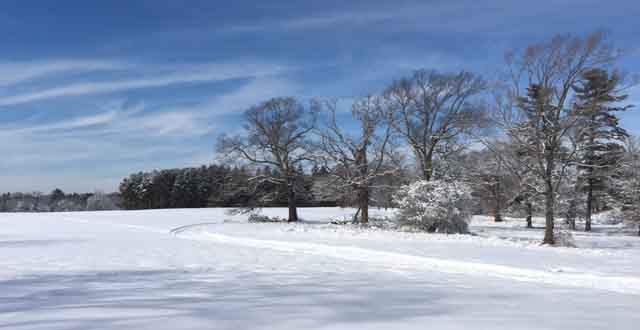
Skiing in open fields under a bluebird sky at Appleton Farms, Ipswich, MA is about as good as it gets. Credit: SeniorsSkiing

Skiing in open fields under a bluebird sky at Appleton Farms, Ipswich, MA is about as good as it gets.
Credit: SeniorsSkiing

We cross the road and climb over the stone wall into a grove of trees, walking a few yards to a trail. Stepping into our skis, we take a look around; we are in the woods, frosty air, untracked trail ahead. No one around but us. Off we go to our favorite loop around The Farms, a very special place to ski, snowshoe or walk.

History and Setting

In 1638, Charles I gave Samuel Appleton a grant of land on Boston’s North Shore. Since then, Appleton Farms has continuously been a bona fide, 1,000-acre farm, first run by the Appleton family and now under the care of the Trustees of Reservations, a land conservancy in Massachusetts. Appleton straddles the border between Ipswich and Hamilton, MA., in the heart of equestrian estate country. When it snows, the open fields and pastures and windy trails welcome snow sports enthusiasts. For cross-country skiers and snowshoers, Appleton is a trip through beautiful vistas and historical artifacts of a 377-year-old property what has remained more or less intact since colonial days.

Terrain

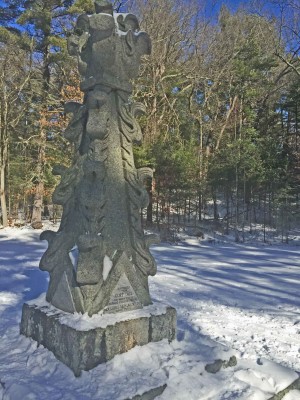
A pinnacle from Gore Hall, former library at Harvard. The Appleton family had close ties. Credit: SeniorsSkiing

A pinnacle from Gore Hall, former library at Harvard. The Appleton family had close ties.
Credit: SeniorsSkiing

There are two sections to the farms: The working farm itself with big fields and tractor roads, and the Grass Rides, a spoke-and-hub networks of trails arranged around one of the four pinnacles from Gore Hall, the former library at Harvard University.  The three others are scattered in strategic points around the property. It’s fun finding them.

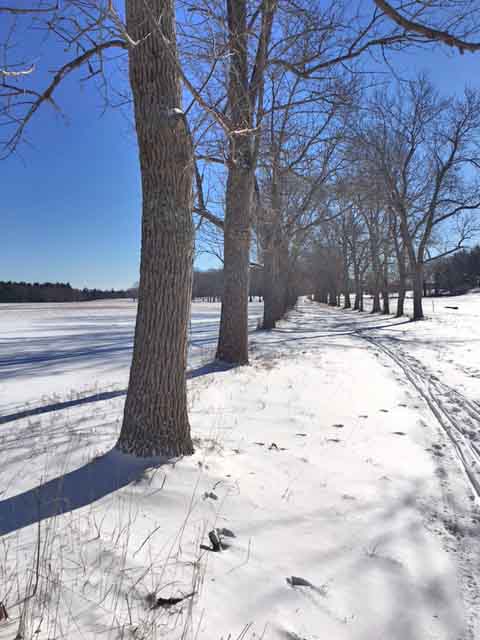
Generations of Appletons created a country estate with long allées—parallel rows of linden trees—that were used for carriage and horse riding. They make perfect ski trails. On the farm side is the Great Pasture, a 133-acre field that is reportedly the largest piece of open land left in Massachusetts, historic farm buildings and the restored main house, plus a dairy that sells milk and cheese from the farm’s herd and much more. Skiing through these big, open fields on a bluebird day is what keeps bringing people back to the sport; it’s quite a restorative experience. The Grass Rides network wanders through marsh and hillside settings where birds and wildlife abound.

This year, North Shore Nordic Association, a new community group, is using a snowmobile groomer to create trail loops around the property. A groomed track really helps with traction and glide, taking away need to break trail.

Why Seniors?

Seniors will find the relatively flat terrain at the Farms easy to ski or snowshoe. On a weekday, you will find the trails to yourself. Indulge your photography hobby or bring a lunch in your backpack and enjoy the quiet. If you’d like slightly more challenging terrain, the Grass Rides has some ups and downs, but nothing that is too aggressive. The Farms restricts visits to humans only, while the Grass Rides is a popular place for dog walking, even in the winter. Doggies tend to disrupt ski tracks, so get to the Grass Rides early if you go. Access to the trails is easy. Just park and put on your skis, no walking. Visit if you’re passing through, in town for a wedding, heading to or from ski areas in New Hampshire or Maine or just looking for something different.

Appleton's famous Allees, formerly carriage paths, make perfect ski trails. Credit: SeniorsSkiing

Appleton’s famous Allees, formerly carriage paths, make perfect ski trails.
Credit: SeniorsSkiing

Bottom Line:

If you are member of the Trustees of Reservations, access to Appleton’s is free. Non-members pay $5 per car at the solar powered kiosks in the parking areas.

If you are coming from away, you can find lodging in Ipswich and Hamilton where there are archetypical country inns. The Trustees also maintain an inn at the Crane Estate, down by the beach. Skiing on the beach in the winter is another story for another time.

Trail Map


The Art of Cross-Country Skiing: The Basics

Cross country (XC) skiing is a terrific way to enjoy the great outdoors in winter. Is it great for older people that want to stay active? You betcha!

From Roger Lohr, founder and editor at XCSkiResorts.com and prolific writer on cross country skiing

The pleasures of XC skiing can be a wonderful change of pace for winter activities.  Whether you seek the solitude of solo skiing or are spending some quality time with family and friends, it’s relatively inexpensive, accessible and aesthetically pleasing. It’s also a great rhythmic, aerobic activity, enabling you to burn up hundreds of calories per hour without straining joints such as ankles and knees. You’ll get a low-impact workout while enjoying the outdoors, and the scenery sure beats the view at your local health club. Here are some tips:

Boundary Country Trekking x-c skiers in northern MN enjoy some hot chocolate. Credit: Roger Lohr

Boundary Country Trekking x-c skiers in northern MN enjoy some hot chocolate.
Credit: Roger Lohr

Where do you plan to ski? The terrain and location helps determine your equipment choices. XC skiing allows you to choose from a variety of locations. parks, golf courses, hiking trails, or XC ski areas are all good choices. Commercial XC ski areas charge a fee for access, but they offer maintained trails and tracks, signage, and you can get help if you run into trouble out on the trails.

You can rent equipment at your local ski shop or at the ski area. This is often recommended for first-time skiers, and some ski shops will apply the price of rentals toward purchasing new equipment.

Buying used equipment at a ski swap may be a mistake. Be aware that at garage sales and some swaps, you may wind up with gear that is outdated or inappropriate for you. Buy a package deal that offers a discount when you buy skis, boots, bindings, and poles together.

In-track XC skis are used with a traditional kick-and-glide motion on maintained track systems set by special grooming machines. They have minimal sidecut so the skis will stay in the tracks. Sidecut refers to the narrowness of the middle part of the skis in relation to the wider tip and tail.

Off-track XC skis are often used to navigate ungroomed trails and terrain in parks, open fields, and on golf courses. They are wider than in-track XC skis and provide more flotation and stability in fresh snow. Wider and metal-edged backcountry skis are for the more adventurous skier, who experience variable snow conditions.

Some XC skis have waxable bases, on which you put “kick wax” for grip. Other skis have waxless bases, where a pattern in the middle third of the ski base, such as small plastic ridges or scales, provides the grip. Waxless skis have been designed to run beautifully in just about any kind of snow. Your decision will center on whether you want optimal performance by waxing or optimal convenience with waxless skis.

Have the ski bindings professionally installed on the skis. Be aware that the bindings come in different integrated systems so they must be matched to the type

Quebec's Charlevoix region is a wonderful destination for cross-country skiing.  Credit: Tourisme Quebec

Quebec’s Charlevoix region is a wonderful destination for cross-country skiing.
Credit: Tourisme Quebec

of boots that you select. Your boots should feel just like running shoes so try on the boots wearing the socks that you plan to wear when skiing. Consider foot beds or fitted insoles if you have problems with your feet. Because of these various sizing methods, it’s important to try on boots before buying them. The fit should be snug and your heel should remain in place. You should be able to wiggle your toes.

XC ski poles are used to help forward thrust. Skiers plant their poles behind on an angle. If this is your first set of XC gear, any reasonably light pole will be fine. Select poles that fit comfortably under your armpits when you stand on the ground.

Now get going – XC skiing is relatively easy to learn, but first-timers should take a lesson from a qualified instructor at a commercial XC ski area to greatly enhance the experience. As your confidence on the skinny skis grows, you’ll have a life time of nature outdoors, fitness and fun.

Contemplative Ski Tour Around Appleton Farms

The Road Not Taken By Robert Frost

Two roads diverged in a yellow wood,
And sorry I could not travel both
And be one traveler, long I stood
And looked down one as far as I could
To where it bent in the undergrowth;

Appleton Farms, Ipswich, MA. Credit: SeniorsSkiing

Appleton Farms, Ipswich, MA.
Credit: SeniorsSkiing

Then took the other, as just as fair,
And having perhaps the better claim,
Because it was grassy and wanted wear;
Though as for that the passing there
Had worn them really about the same,
And both that morning equally lay
In leaves no step had trodden black.
Oh, I kept the first for another day!
Yet knowing how way leads on to way,
I doubted if I should ever come back.
I shall be telling this with a sigh
Somewhere ages and ages hence:
Two roads diverged in a wood, and I—
I took the one less traveled by,
And that has made all the difference.
Appleton Farms is a 900-acre property owned by the Trustees of Reservations on Boston’s North Shore in the historic town of Ipswich.  The farm had been the Appleton family since 1636, granted to them by Charles I.  It was deeded to the TOR in 1998. Many of the buildings have been restored, and the farm is producing crops for the local community.  The cross country skiing is magnificent, parking is plentiful, and the quiet is most welcome.

Great Pasture, Appleton Farms, Ipswich, MA. Credit: SeniorsSkiing

Great Pasture, Appleton Farms, Ipswich, MA.
Credit: SeniorsSkiing