Tag Archive for: senior skier

Mystery Glimpse: Bang, Bang

The First Glimpse Challenge This Season Is Not What You Think.

When, Where, What, How, Who?

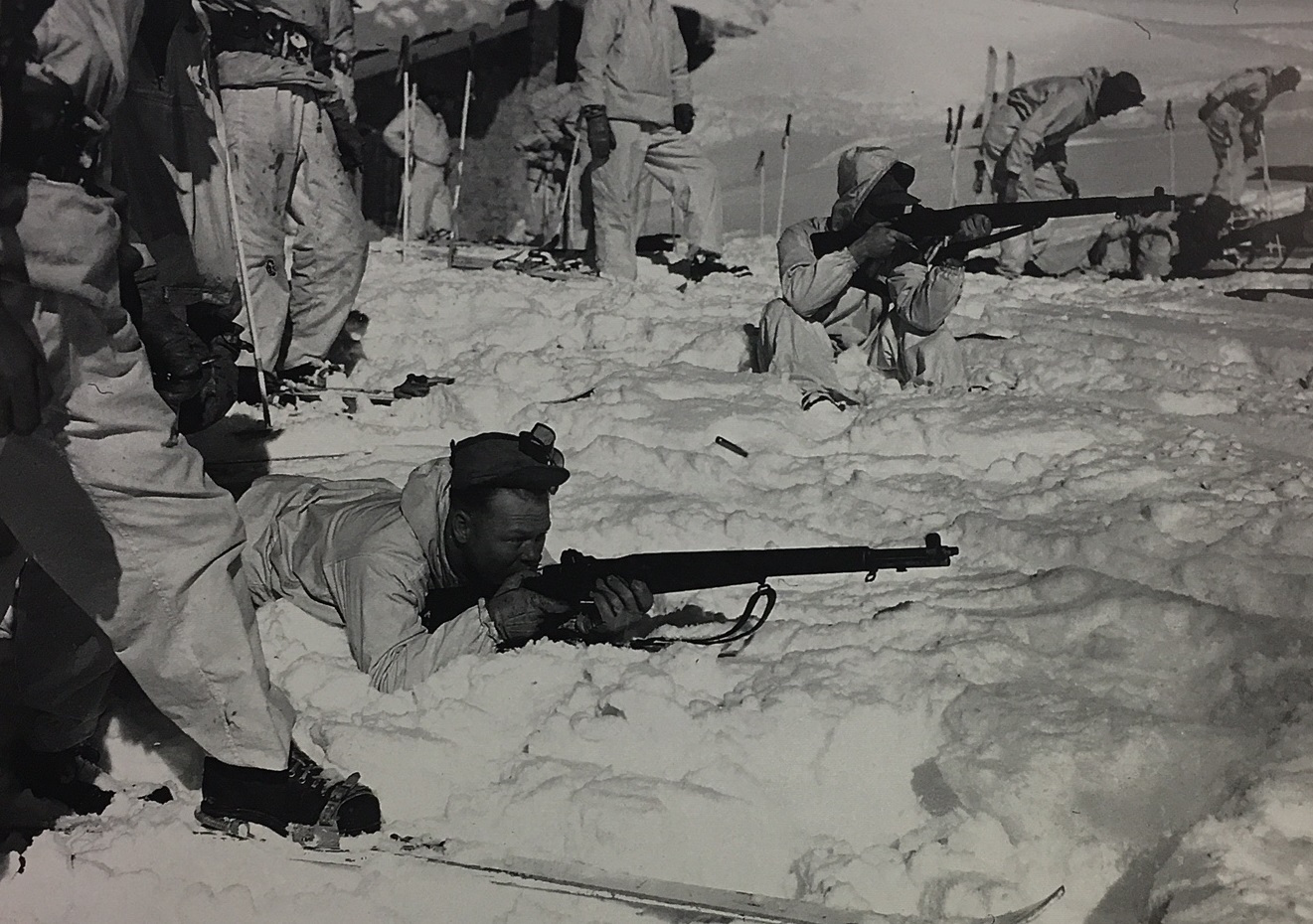
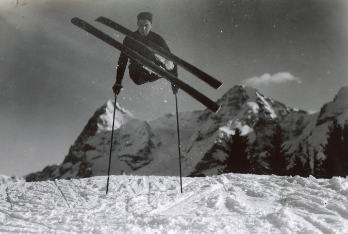
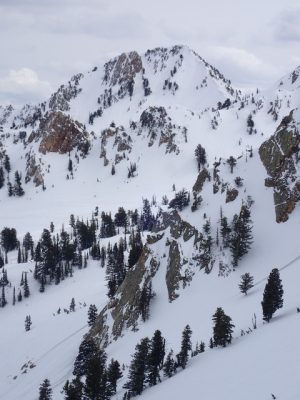
This Mystery Glimpse photo comes from the archives of the Alf Engen Ski Museum in Park City, UT. Take a virtual tour of the museum’s collection by clicking here.

The Mystery Glimpse feature posts a photo from one of the ski industry’s wonderful museums. Often these museums are located at or near ski resorts. They preserve and maintain unique assortments of ski history memorabilia, artifacts, documents, publications, and photographs. We are very grateful that so many ski museums are sharing photographs with our readers.

Do you know what’s going on in the picture? Take a guess in the Comment Box below. We’ll reveal the story behind the photo next week.

100+ Skiier

102-Year Old Skier George Jedenoff’s Autobiography Published On Apple Books

It’s A Thriller, A History, A Love Story And More. Read It Free On Your Computer.

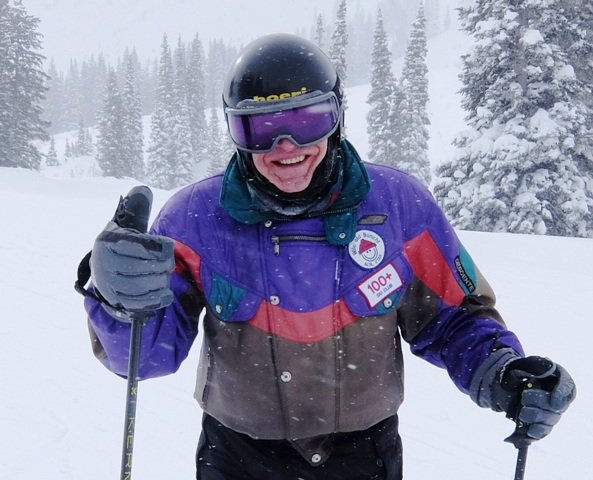
George Jedenoff never gives up. Credit: Harriet Wallis

George skis with enthusiasm. He cruises steep trails and shouts with glee when he jumps into powder. That’s George!

Skiers at Alta flock to him for inspiration. “Age is just a number,” he says. “Don’t let it be a barrier.” His motto is: “Never give up.” His positive outlook is a cornerstone of his life.

George’s autobiography, My Centenarian Odyssey, chronicles his life and adventures starting with his family’s flight from the Russian Revolution when he was just a toddler, coming to America, and later working as a young man in a California magnesite mine for 50 cents an hour. He graduated with honors from Stanford, served in World War II then worked his way up in the steel industry to become president of Kaiser Steel, a premier supplier of shipbuilding steel.

Along the way he learned to ski, and he’s passionate about snow and the beauty of the world around him.

Read his autobiography free on Apple Books. Or you can download it free onto your computer. Be patient as downloading takes several minutes. Click to Download

George Jedendoff is out and about. Not bad for 102. But age is just a number, right? Credit: Harriet Wallis

This Week In SeniorsSkiing.com (Oct. 4)

What Pisses You Off.

Last spring, we asked a provocative question in our annual SeniorsSkiing.com Subscriber Survey. We asked, “Thinking back on the 2018-19 season, tell us what pissed you off the most about the following…” Then we listed “On the slopes”, “In the lodge”, “Tickets and passes,” “Restaurant”, “Other skiers”. We also asked what delighted skiers the most, but let’s look at the opposite first. Based on the language in the responses, it is certainly where the passion lies.

We were surprised that so many respondents made comments like the following sample of many more:

Rude and dangerous skiers and boarders
Inconsiderate skiers and snowboarders
Lack of ski etiquette
Out of control skiers
Dangerous skiers
Beginners on advanced trails
Careless riding and skiing
Skiing too fast and too close to other skiers
Not skiing in control
Some are dangerously fast and reckless
Skiing and riding too fast
A few jerks skiing dangerously
Not following safe skiing rules
Risk takers who don’t turn on groomers
Straight-lining on easy slopes
Complete disregard for slower skiers

Respondents also mentioned high lift and pass prices, lousy cafeteria food, long walks from parking lots, and other grievances. However, the out-of-control skier situation is the most disturbing. Why? Because you probably thought that the Ski Patrol would be enforcing the Skier’s Code of Responsibility. Or that the resort’s Ski Ambassadors would be chiding characters acting dangerously. As we have learned from your comments, that apparently isn’t happening much.

Let’s be clear. There is a difference between skiing fast in control and skiing fast out of control. We know many of our readers like the former, but, as we have seen, many are intimidated by the latter.

As a result, SeniorsSkiing.com believes we have shone a light on a key area of ski resort management that needs improvement. The chain of consequences that dangerous, out-of-control skiers brings is significant: the risk of injury from collisions, turning off beginners, seniors returning to skiing, or the occasional skier who spends several hundred dollars for a once-a-season ski weekend, and creating anxiety in grandparents who fear for their grandchildren.

This week, we hear from SeniorsSkiing.com correspondent Roger Lohr about his own close encounter with an out-of-control skier and his thoughts about what to do about the situation.

Let’s hear from you. What can be done to slow down the jerks who can potentially ruin a senior skier’s season? What can we do to influence the industry?

Also This Week

SeniorsSkiing.com correspondent Don Burch offers a clever “Analogy Test”, that challenges your skiing knowledge and your ability to figure out analogies. Be advised, this is not a creme puff test; pay attention.

Herb “The Skiing Weatherman” Stevens follows up last week’s debut article as a SeniorsSkiing.com correspondent with a clear explanation of how the Northwest got whammed with a mega storm at the end of September.

Finally, we are reprising the third in a series of articles on shaping up for the season. This final set of exercises raises the challenge level. Remember, the key to fitness is a consistent routine. Dashing around the gym once a week, pumping as much iron as you can ain’t gonna do it.

Next week look for our first Mystery Glimpse feature of the new season. If you have story ideas or would like to comment, please scroll to the bottom of the page and enter your thoughts in the comment box.

We hope you’re getting ready to go to the ski shows. We know we are. See the discount for SeniorsSkiing.com subscribers at the top banner ad or click below.

Remember to please tell your friends about SeniorsSkiing.com. As usual, there are more of us every day, and we aren’t going away.

Blind-Sided And Body-Slammed

Is It Time To Address Ski Slope Collisions? How?

[Editor Note: This summer, we published a little play about the speeding, out of control skier and what the ski patrol can do about it. You can read it here. Bottom line: It’s not their job, at least, that’s the party line. They are there to maintain the lines, help injured people, sweep the slopes. They are not trained nor prepared to confront unruly or out of line customers who are not complying with the Skier’s Code of Responsibility. What to do? Here’s SeniorsSkiing.com XC editor and publisher of XCSkiResorts.com publisher Roger Lohr’s story about his collision and consequences.]

This year, I was one of the many skiers and riders who got blind-sided and body-slammed by someone on the slopes. After seeing me bounce into the snow a couple of times and violently twist my lower body, the “guy in orange” who plowed into me said nothing and skied away. No apology, no asking if I needed help.

I got up slowly after the collision and immediately thought about how effective my new MIPS helmet worked. Just afterward, I felt shooting pain in my lower back.

Out of the corner of my eye I saw the guy in orange about 40 yards away. He had stopped and was looking across the terrain at me while I was taking stock of my bruises and sprains associated with the collision. Then he took off.

I stopped in at the patrollers’ cabin and saw six guys sitting at a table. I requested some kind of heat compress or rub for my pain and was told that they are not allowed to distribute anything like that.

This incident was in fact, the third collision that I’ve had in recent years. What can the industry do to deal with the increasing number of slope collisions?

Can we blame lack of skill in the kind of collision I experienced? It might have been a miscalculation of his line, his ability to change course, his maintenance of too much speed, inattention, an obstruction, etc.

The collision occurred near the bottom of the slope, so was there a chance that I cut him off? Would more patrollers on the slopes talking to people about control, speed, where they stop, and so on, make a difference?

I often ride the chair with patrollers but I don’t remember the last time I heard from a patroller out on the slopes. I can’t say that I’ve seen many of them speaking with skiers and riders about unsafe situations. Would a broad skier/rider education campaign about speed and skiing in control make a difference for safety purposes and curtail the collisions?

As I’ve aged I’ve become much more cautious keeping an eye on the slopes around me. In my collision situation, I was heading to the lift line and did not look up the slope for five seconds on a day when there were very few people skiing. I paid for those seconds with medical bills and three weeks of pain.

The statistics on ski area collisions are mounting and this past spring’s SeniorsSkiing.com reader survey showed a serious concern among site visitors about these incidents. And we all know parents who have freaked out watching their child get steamrolled and mangled on the slopes.  It is not only older skiers who have cause to worry about collisions.

What happened after I was hit was significant. The speedster took off, offering no help and no curiosity as to whether I was injured.

There are seven points in the Skier’s Responsibility Code about staying in control, avoiding others, stopping in places that do not obstruct, and the like. There is no suggestion in the code that there is any responsibility to help a victim or check that the subject who’s been hit is able to ski away after the incident. Yeah, you’d think it was common courtesy for the slammer to apologize and see if aid is required but in my experience and other incidents that I’ve heard about, this is not the case; this is not standard protocol.

I understand the ski area operators’ perspective: no one wants a “patroller policeman” yelling at guests, but can we develop a more robust educational campaign to curtail slope collisions and incorporate a new tenet for courtesy when such incidents occur? Can we amend the Skier’s Responsibility Code to include helping people who are hit?

Analogy Test

SeniorsSkiing.com Analogy Test

[Editor Note: Thanks to SeniorsSkiing.com Correspondent Don Burch for this challenging test. Good luck, you’ll need it. Answers at the end.]


This Week In SeniorsSkiing.com (July 26)

“Not Our Job”: A Play In One Very Short Act

Scene: Curtain rises on an evening outdoor dinner party under a tent. Several guests are gathered around a table with a variety of appetizers: shrimp, cheese and crackers, fruit. Bottles of wine, beer, and booze are at another table. A couple of dozen guests are mingling and getting to know one another. Two characters, an Online Magazine Publisher (OMP) and A Volunteer Ski Patrolman (VSP), continue their discussion.

How many speeders can you spot? Credit: Jean-Yves Bruel

OMP: We’ve just completed our Spring Survey a couple of weeks ago. We asked an unusual question of our readers, What Pisses You Off The Most About Ski Resorts? Can you guess what the number one winner was?

VSP: Easy, speeding skiers.

OMP: Give that man a kewpie doll! Out-of-control, wild, dangerous skiers who ski with abandon and no sense of safety. How’d you guess?

VSP: We hear it all the time. People are always asking us to nail these air-heads, pull their tickets, and banish them from the mountain. (Note: This ski patrolman volunteers at a Very Big Vermont Resort.)

OMP: And?

VSP: We have to explain it’s not our job. We’re there to provide aid to injured skiers, keep the fences up, sweep the trails. You know, safety.

OMP: Really?

VSP: We’re not cops, and we are not trained to be enforcers. Besides, we’re understaffed. We need two guys at the top, a guy on the phone, and a spare on patrol. That’s all we’ve got.

OMP: So who’s supposed to…

VSP: The resorts Ambassadors. They are the people on the hill who can pull tickets, if they do. But often even they don’t. The management doesn’t want to alienate customers by pulling tickets.

OMP: Alienate customers? But what about the senior who goes out five times a year and who just spent $140 on a lift ticket and gets terrorized by schuss boomers, and no one does anything about it?

VSP: Yeah, that’s a problem. The day lift ticket guy probably isn’t coming back, especially if he’s new to the resort or the sport.

OMP: So, speeding, out of control skiers, the number one thing that seniors in our survey find that pisses them off about ski resorts, is an intractable problem?

VSP: I guess so.

OMP: (Walking away): I think I’ll have another couple of shrimp.

[Curtain]

[Editor Note: We know a lot of our readers are either active or former ski patrollers. Please let us know what you think of our play. We want to take it to Broadway, but before we do, we need to hear your opinion. Is VSP correct? What can a resort do to chill the hotshots? A complete report of Spring Survey results will be coming out in the Fall.]

______________________________________________________________________________

This Week

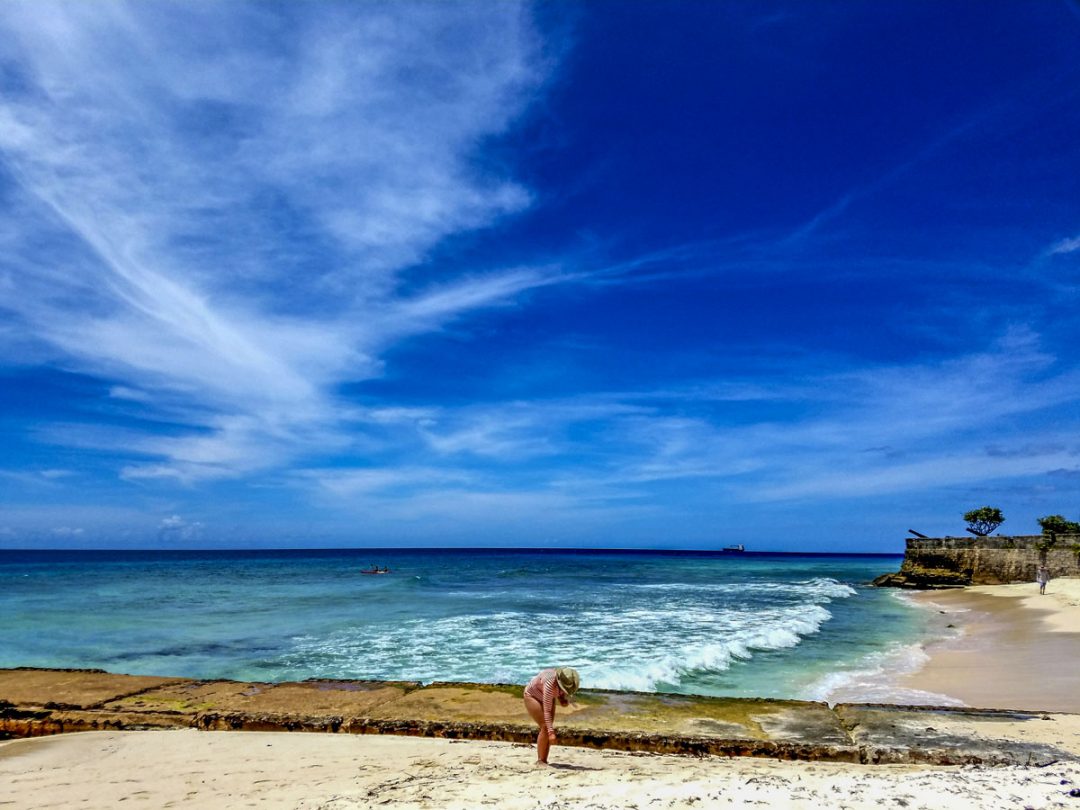
Looking for shells, early morning on the beach at the Hilton Barbados. Credit: Yvette Cardozo

In our ongoing Non-Snow activities series, Yvette Cardozo shows us that scuba diving in Barbados can be as refreshing as a run down a wide blue trail. Well, at least it’s cool. If you haven’t snorkled on a reef or scuba-dived in the Caribbean, you might want to revise your bucket list.

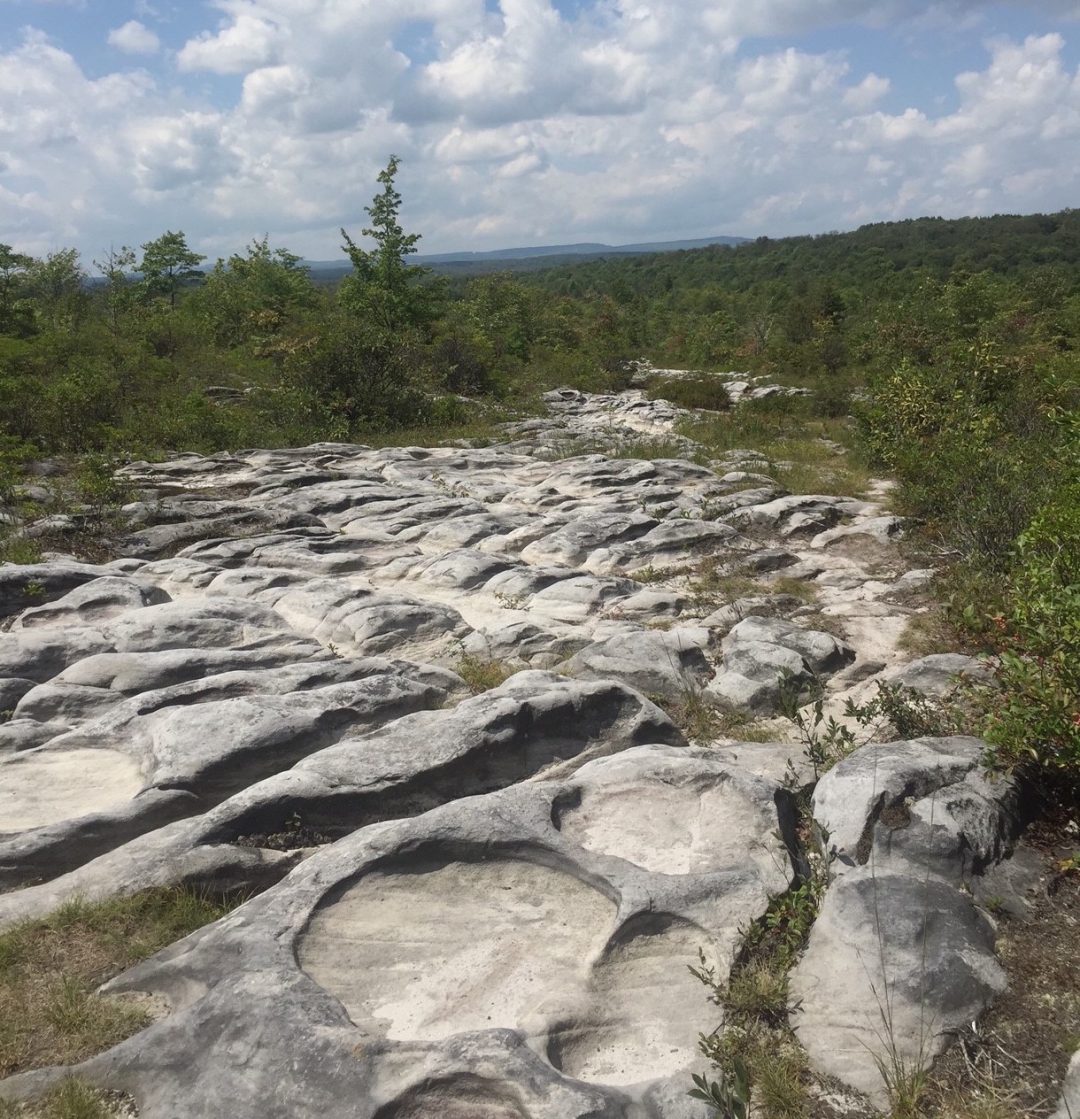
Moon Rocks, Davis, WV. Credit: Pat McCloskey

Pat McCloskey continues our Summer Cycling Series with a visit to Davis, WV, which is becoming the Moab of the East for mountain biking. Ride with him over the famous Moon Rocks, an apt adventure considering we’re celebrating the 50th of Apollo 11.

Finally, Murray Sandman, a new SeniorsSkiing.com correspondent from New Zealand, explains how he created a DIY, three-week tour of the Dolomiti Superski in Northern Italy. 

On to August, and summer sailing for us. Thanks so much for reading SeniorsSkiing.com. Tell your friends, and remember, there are more of us every day and we aren’t going away.

Short Swings!

Too Darn Hot.” Cole Porter got it right with his enduring 1948 hit. What a summer!

Weather is getting more and more extreme. Hot. Cold. Wind. Flood. I like this church sign:

But I don’t like these pictures taken within a week of each other from near the top of Mont Blanc. Going from snow to lake in such a short time is a bad sign.

Credit: @bryanthealpinist

I don’t know if there’s much we can do about this any more except attempt to take action to slow the process down and figure out how to make the best of it. 

Waiting for the flurries, I think abut that magical combination of gravity and snow and being waist-deep in light powder.

In the meanwhile, Irving Berlin also got it right with his saucy 1933 song, “Heat Wave.”

###

Vail Resorts Acquires Mount Snow, Hunter, Wildcat, Roundtop, Others

Earlier this week, Vail Resorts announced it is acquiring Peak Resorts. The areas comprise many Eastern and Mid-Western signature resorts (Mount Snow, VT; Hunter Mountain, NY; Attitash, Wildcat, and Crotched, NH; Liberty, Roundtop, Whitetail, Jack Frost and Big Boulder, PA; Alpine Valley, Boston Mills, Brandywine, and Mad River Mountain, OH; Hidden Valley and Snow Creek, MO, and Paoli Peaks, IN). The areas will be accessible on the Epic and Military Epic passes.

Alta’s Enduring Butterfly

Contributor Harriet Wallis sent in these pictures of the butterfly shaped snow patch on Alta’s Mt. Superior. The color shot was taken recently. It matches up perfectly with the shot from 1873.

Credit: Robin Roberson

Delta Eliminates $150 Ski/Board Checking Fee

The new policy follows a similar announcement in May by American. Complete checked baggage fee detail, including the new sporting equipment fees: Delta.com

Killington Breaks Ground on New Lodge

Killington Resort, the largest ski and snowboard resort in Eastern North America , broke ground last week on its 58,000 sq. ft. K-1 Base Lodge.  Slated to open for the 2020-21 winter season, it will be 21,000 sq. ft. larger than the previous structure.

Colorado Has Fewest Obese People. West Virginia Has Most.

The Centers for Disease Control (CDC) estimates that 30.1% of US adults are obese as of 2017. The US obesity rate has doubled since 1990 when 15% of the population was classified as obese. The five least obese states are Colorado, D.C., Hawaii, California, and Utah. The five with the most obese are West Virginia, Mississippi, Oklahoma, Iowa, and Alabama. Click here for complete list.

2010 Olympic Gold Medal Auctioned for $68,750

The Vancouver 2010 Olympic gold medal belonging to Belarusian freestyle skier Alexei Grishin sold at auction last week for $68,750 according to Boston-based RR Auction. The anonymous winning bidder is a collector from Belarus. The medal is among the heaviest in Olympic history. Each of the 615 medals created for the Vancouver Games features a hand-cropped section of the artwork that ensures that no two medals are the same. 

Live Weather Reports Now Available from Mt. Everest

Researchers from National Geographic Society and Kathmandu’s Tribhuvan University recently installed weather stations on Mount Everest. The two highest are at 27,257’ and 26,066’. To access these high elevation conditions click here.

Good Conditions At South Africa’s Only Resort

At the time of this writing, Tiffindell Alpine Resort, South Africa’s only ski area, has almost 12”. All five lifts are operating and more snow is predicted for this week.

Guadalajara Gets 5’ Hail Dump

Credit: CNN

A freak early-July storm left 5’ of hail in the Mexican city of Guadalajara. It happened following several days of warm, dry weather.

Surfing On Skis?

Candide Thovex is the French extreme skier who seems set on doing every imaginable thing that can be done on skis. In this short video, appropriately named The Wave, he uses snow skis on artificially-generated surf. 

Correspondent Don Burch Wraps the Season

Don Kept A Video Diary Of His 2018-19 Season.

Perhaps this will keep you cool in July. If you have videos of this past season, please let us know at info@seniorsskiing.com.

(Some videos by Peter Hines)


Non-Snow Activities: Dude Ranchin’

From Yodeling To Yippee-ing, Yvette Rides The Range.

Riding the foothills of the Tucson Range. Credit: White Stallion Ranch

 I’m not sure if skiing gets you into shape for horseback riding or vice versa, but, yes, a lot of the same muscles are at play. 

Either way, both take strong legs.

I confirmed all of this at White Stallion Ranch just outside Tucson, AZ at the end of last ski season. 

I packed my schedule full because I wanted to do EVERYthing. 

So on my first day, I went on the slow mountain horseback ride. We left the main ranch compound and sauntered leisurely across the valley, following a well worn path through the cactus.

Fast ride. Credit: White Stallion Ranch

At the foot of the volcanic, granite hills of the Tucson Range, we headed up via a rocky trail, passed the tall fingers of saguaro cactus and all sorts of blooming brush: yellow, purple, violet flowers. All in all, a great intro to the ranch rides.

There are also breakfast rides, wine and cheese rides, and a beer and Cheetos ride. Yum.

Such is life at one of the two remaining guest (aka dude) ranches in the Tucson area. Not that many years ago there were a hundred but population growth and development swallowed them one by one.

The White Stallion Ranch has been around since the turn of the 20th Century, first as a cattle ranch, and later home to 30,000 chickens.  In 1945, it became a guest ranch. The True family bought it in 1965, and. when they saw that the area guest ranches had already dwindled to about 30, they started buying land and adding rooms. Today, the 3,000 acre ranch has 43 rooms, a five bedroom hacienda, 160 horses, 120 cows, and wranglers on hand to lead rides, teach, tend to the livestock, cook and all the rest.

 For me, it wasn’t all riding. A couple of mornings I went shooting. I’ve only touched a gun once before in my life, but Bob and Sharon Callan will talk you through everything, how to aim, how to cock the guns, how not to accidentally blow your head off.

They’ve run the firearms training program for the Tucson police department, so they’re used to teaching.

You get to use a six shooter and a rifle, and there’s a set of steel plate targets.

“Consider all guns loaded and don’t point at anything you don’t want to shoot,” Sharon said. And added, “You can shoot the pistol one handed, but if you want to hit something, use two.”

All those cowboy movies where folks at a gallop shooting one-handed pick off the bad guys? Not on your life.

Western star Loop Rawlins does rope tricks during evening entertainment at White Stallion Ranch. Credit: Yvette Cardozo

I also did the movie tour by van. 

The ranch has been a popular site for movies since the 1930s. And for good reason. It’s literally around the corner from Tucson. You leave the ranch, climb a low hill and there, on the other side are the outskirts of the city. Talk about convenient.

Marty Freese, the ranch’s history guy, took us to all the popular sites where dozens of movies, TV shows, and commercials have been filmed,  including High Chaparral, a Lone Ranger movie and enough others to fill a two-page list.

 Each night there an activity. Bill Ganz sang cowboy songs by a campfire. Phil and Hector brought tarantulas and scorpions and a bearded dragon named Stumpy that attached itself to Phil’s chest like velcro, along with a Burmese python so long, it took nine kids to hold it. 

But the star of the week was Loop Rawlins who is an artist with gun and rope. He kept the Spring Break crowd of kids spellbound as he twirled guns, flipping them into his holster, skipped rope with his lariat and did a finale that involved a flaming, twirling lasso. 

On one of my last days, the ranch held its once-a-week rodeo. It’s sort of Rodeo 101, which is great if you’re like me and have never been to one. Russell True, who was five when his folks bought the place and now pretty much runs it, explained barrel racing, bulldogging, where you ride alongside a steer and jump astride it to bring it down (as bone rattling and dusty as you imagine) and team roping which Russell says he calls “cowboy judo” and is even more frenetic than bulldogging.

I also took a horse riding lesson and discovered all the things I was doing wrong. 

So maybe next time, I can actually get my horse to canter.

For more information on the White Stallion Ranch, click here.

Guests leave the breakfast corral on horseback during a breakfast ride. Blooming hedgehog cactus in foreground. Credit: Yvette Cardozo


SeniorsSkiing Guide: La Parva, Chile

La Parva Is A GS Cruiser’s Heaven.

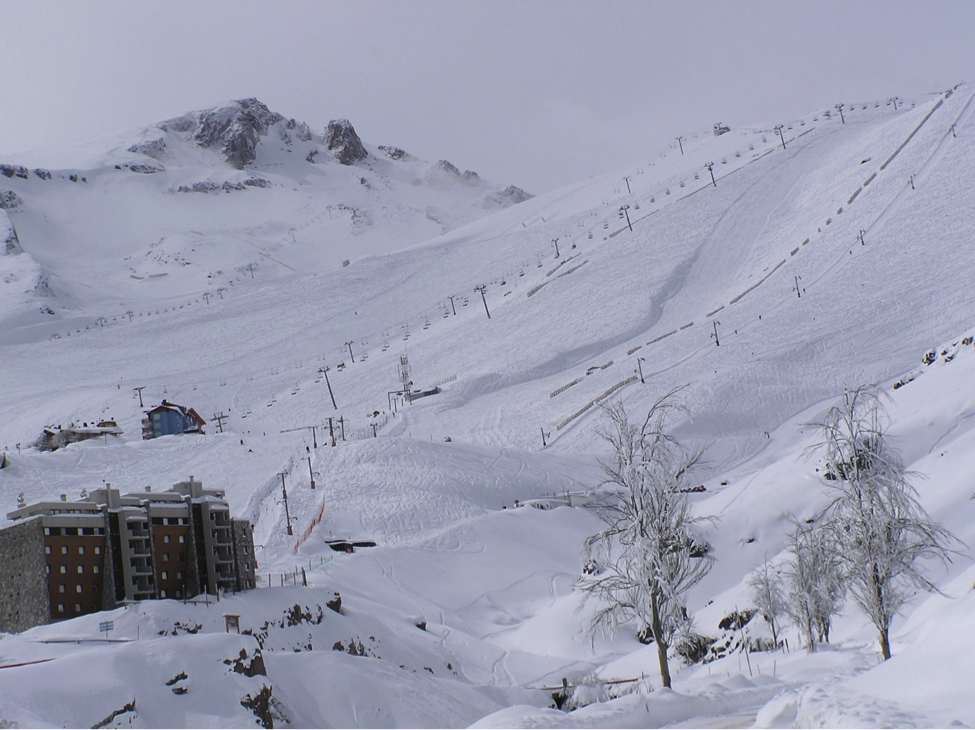
As a first installment on the Three Valleys of ski fame in Chile, I’ll write about La Parva. One hour and a half from the Santiago airport, La Parva is perched up at 8,700 ft on the front side of the Andes, and overlooks the city. The road up involves 40 switchbacks and a vertical rise of 7,000ft.  I do not recommend tackling it during a storm!
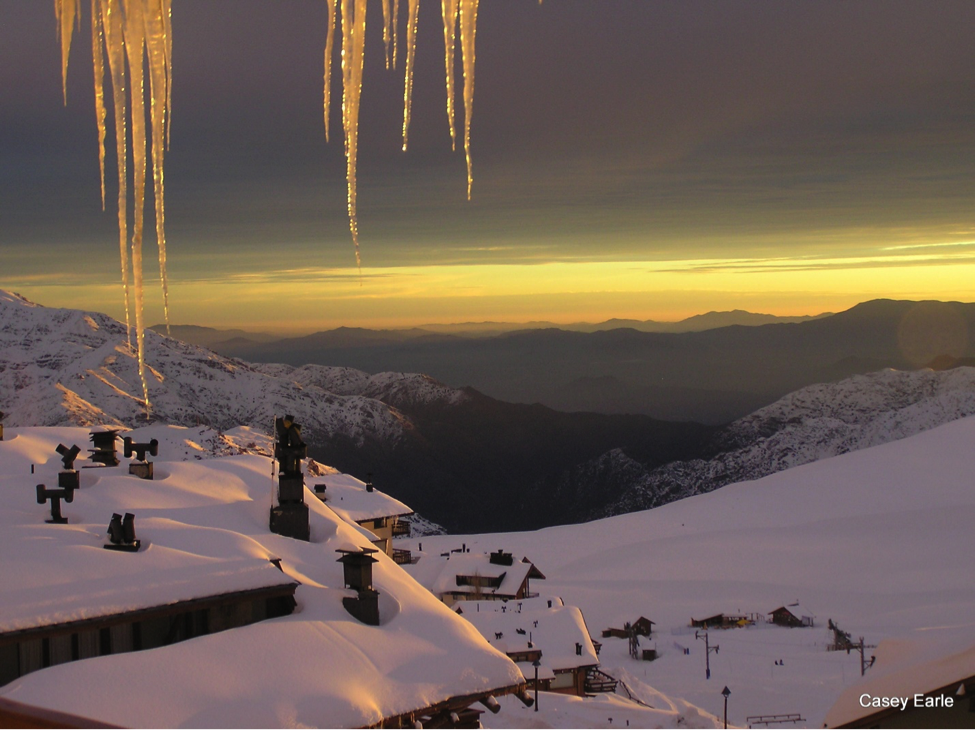
The furthest north of the three ski areas, the village rests at the base of the La Parva peak (13,000ft), which itself is a sub-peak of the El Plomo Massif (18,000ft). Stretching for a width of three miles across several watershed— all connected with skiable cat tracks— the area faces mostly west, with the north sides of the valleys collecting the most snow. While this western orientation exposes it to the sun and north wind, often leaving bare ridge lines, it also means snow accumulates in those multiple bowls where the snow is blown, and the sun hardly shines.

On a good year such as this, even the north faces are skiable.

As a bonus, the sunsets over Santiago are wildly beautiful.

To get you up the hill, there are four chairlifts, each serving different terrain, and seven good surface lifts (platters, thank god). In windy weather, the platters are safest, as you can bail out wherever you want. But, with 80% of the days being sunny, and often with no wind, the weather is generally not an issue. Grooming is excellent with no mogul bashing required, ever, but add in 70% of the runs being intermediate level, and this is a GS cruisers heaven. The entire vertical rise of 3,000 ft can be skied in one go, so get the long boards out boys!

The village itself is like a classy suburb of Santiago with no hotels, but several restaurants. Most of the 2,000 or so beds are ski in-out apartments, and the family-oriented atmosphere is manifest in the hoards of little racers out at 9 am sharp every weekend. Racing is the name of the game in La Parva, and while often fun to watch, it does take up some of the best runs, especially when the international teams arrive in August. Fortunately, there is a lot of room in the ski area, especially when the off-piste is in good shape.

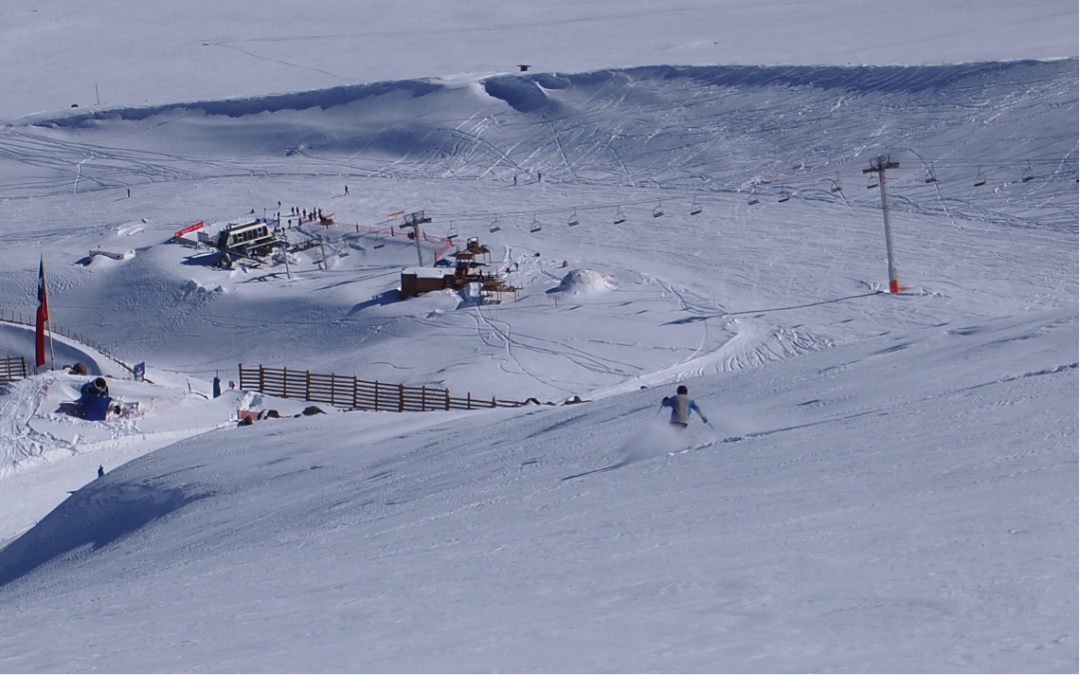
Casey finds a lonely route down to the Las Aguilas chair, and the small restaurant at its base.

For lodging, there many private apartments, and a few houses on Airbnb or Booking.com. The village has three restaurants, a bar/disco, and a small grocery store. On the hill, aside from the three restaurants mentioned (all accessible on skis) there are two mid-station restaurants, and a small, occasional, open-air one at 11,400 ft. Careful with the pisco sours, it is a long way down…

For La Parva Trail Map, click here

For La Parva Webcams, click here

Check out the La Parva website here.

This Week In SeniorsSkiing.com (May 31)

Still Spinning, Still Snowing. Still Going?

In 1816, incessant cold throughout the year drove New Englanders to despair.

In 1816, there was no summer in New England. Six inches of snow fell in June, and it was as low as 40 degrees in Connecticut in July and August.  There was frost every month of the year, and, in May, strong, freezing winds from Canada wiped out tree buds, and frozen birds dropped from the trees.  One 74 degree day in Salem, MA,  was followed by a 21 degree day. Crops didn’t grow, and people went a little crazy. Contemporary observer Samuel Goodrich described the impact of the errant weather on the people of New Hampshire: “At last a kind of despair seized upon the people. In the pressure of adversity, many persons lost their judgment, and thousands feared or felt that New England was destined, henceforth, to become part of the frigid zone.” 

Some pointed to the eruption of Mt. Tambora in Indonesia that ejected massive amounts of ash and debris into the atmosphere as the root cause.  Other scientists say 1816 was part of a mini-ice age lasting from around 1400 to the 1860s. Click here for more on this fascinating event in meteorological history. 

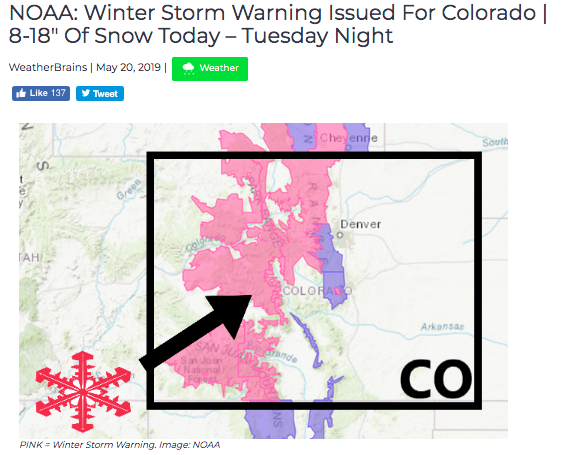
Whatever the cause, New England, and dare we say, a large number of mountain states are experiencing an extension of Winter 2018-19 that is eerily similar to 1816. To wit: It is snowing in mid-May in Colorado.

Credit: WeatherBrains

A new 10-inches in Breckinridge.

Credit: Breckinridge Ski Resort

This was Killington on May 14th.

Killington in mid-May.

Here’s a video from Killington from May 14. Killington is extending the season to at least June 2. It has been 20 years since Killington has been open in June.

And, in the Sierra.

Credit: WeatherBrains.

And Mammoth is going to AUGUST!

Credit: Snowbrains

And so it goes.  A highly unusual year for snowfall and an extended winter. Have you seen closing days like these in recent years?  These resorts are the late-closers for the 2018-19 season.

  • Mt. Hood Meadows Memorial Day
  • Aspen Memorial Day
  • Crystal Mountain Memorial Day
  • Snowbird Weekends until it lasts
  • Whistler Memorial Day
  • Heavenly Weekends
  • Mt. Bachelor Memorial Day
  • Arapahoe Weekends to June 23
  • Breckenridge Weekends to June 9
  • Killington June 2
  • Squaw Valley June 7
  • Mammoth August
  • Timberline Lodge August 31

The question to our readers: If the resorts are still open, and the snow is still falling, are you still skiing? If so, please tell us your story.  What’s it like out there?  Who else is skiing this time of the year? Please let us know in Comments below.

This Week

Our first non-snow issue features an interesting comparison of skiing and cycling by correspondent Pat McCloskey.  Also, we hear from a reader who had a successful experience with a stem cell treatment for bad knees. This may be alternative for some seniors, but it’s important to understand what you are getting into. Finally, we hear from another reader who has some philosophical thoughts his last run on a pretty gnarly day when most folks would rather have put another log on the fire.

Onwards to summer.  Please send us you story ideas.  We love submissions by our readers. 

Remember, dear readers, there are more of us every day and we aren’t going away.

Cycling And Skiing Similarities

Both Require Looking Down The Trail, Pressurizing To The Outside Of The Turn.

I was out the other night riding with my pals and noticed that I was starting to look at the front of my wheel in sketchy terrain, and my balance was starting to be  compromised. 

Looking down the trail, not over the wheel.

I thought to myself, “Pat,  keep your eyes focused down the trail and not on what is right in front of you.”  I know this.  I always do this skiing: look down the trail three turns or more to allow efficient skiing and don’t look at what is right in front of your ski tips.  Sometimes you lose focus on what you are doing and let the terrain dictate your visual field.  The solution is something that I always tell skiers looking to improve. Don’t let the terrain ski you,  you ski the terrain. And the best way to do that is relax and look down the trail or slope.  When you allow your field of vision to open up by looking ahead, you have much more time to react to the terrain changes that will come before you, often at a rapid pace in skiing or riding a mountain bike. When you focus on your ski tips or your front wheel, that reaction time is severely compromised.  Momentum is your friend and if you look ahead, you can handle any terrain changes much better and in plenty of time to react.  Look at the rider in the picture here.  Looking ahead and down the trail.  He is focused and able to react to the technical challenges ahead. 

Another similarity between skiing and mountain biking is the position of the pedals during a turn.  The picture above shows an extreme example of a sharp turn on a mountain bike.  Look at where the inside leg is allowing full pressure on the outside pedal in the down position. 

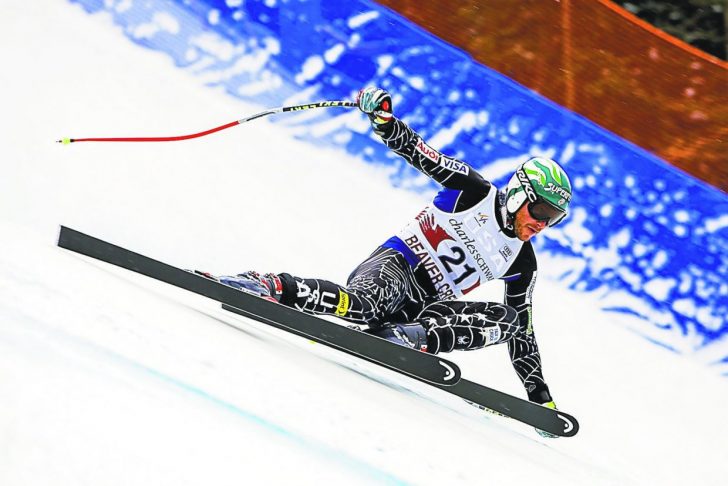
Bode Miller putting weight on outside ski.

If you look at Bode Miller here, you will see a similar leg position in his downhill race  turn at Beaver Creek Birds of Prey World Cup. As soon as his outside ski makes contact, he will have it fully pressurized because of his leg and hip position.  This is very similar to the cyclist who is able to execute a steep turn on his mountain bike by allowing his outside pedal to be fully pressured in the turn.  Oftentimes when I ride, I can even feel a slightly countered position on my bike allowing the outside pedal to be fully under pressure and my inside pedal in the up position and stable in the turn.  I learned how efficient this is when I used to race on my road bike.  Those high speed turns have to be executed with the outside pedal fully under pressure, otherwise you cannot execute a tight high speed turn in the corners of a criterium race.  Racers who could not commit were often off the back or crashed out because of a poorly balanced turn. 

So, if you are longing for skiing during the off season, think about those turns during your bike rides.  Whether on the road or trail, the movements are very similar and can give you the feeling of a ski turn when it is 80 degrees outside.  Enjoy the summer and the riding. 

Stem Cell Injection Alternative To Knee Replacement?

[Editor Note: Robert Leaverton presents a positive experience with stem cell therapy for ailing knees. However, there are many caveats in pursuing this route. As Robert indicates in his conclusion, there are some indications that the therapy may have gotten ahead of the science. For a report on the state of stem cell therapy for joint repair, see this NYT article.]

I am a very active 82 year old skier, former runner. My knees were in pain to the point that I had to consider replacement if I wanted to continue skiing. I live and ski in Utah during the ski season. I ski at least six days a week,  seven if the POW is good.

Viable alternative? Research carefully, caveat emptor. Results may vary.

I went to a stem cell seminar in Spring 2018. I listened to the information and decided I should investigate further. I had the exam, some x-rays, and it was determined I was a good candidate for stem cell therapy. The previous ski season was a painful time. I was taking OTC pain meds to be able to ski all day. If my knees touched while I was sleeping, I would wake up. I knew that if I wanted to continue skiing, I would have to do something. I also knew that there was no guarantee SC would work, and I would pay $4,000 for each knee. I did not want to endure general anesthetic, pain, and re-hab. There is high success for total knee replacements, but no absolute guarantee.

I went to Wisconsin Stem Cell Therapy for injections in May 2018. The stem cell injections in each knee were painless. [Editor Note:  Stem cells are extracted from a patient’s own bone marrow and injected into worn or injured joints to promote healing.] I did therapy as suggested, and the results have been way more than I expected. I was being practical, and I would have been happy with 60 or 70 percent improvement. I rate my stem cell therapy as 100 percent success. I waited until I was done skiing for the season to make a final judgment of the SC therapy. After many years of painful skiing, I had a season with NO knee pain.

I have returned from more than two months in Utah. Had great snow and a lot of powder. Wind and visibility made for some difficult conditions (bumps & drifts) that were a real test for the SC therapy. SC therapy has been a huge success for me and will allow me to enjoy skiing for many more years.

Without any hesitation I would recommend stem cell therapy for anyone who suffers from joint pain and wants to continue to be active and enjoy life to the fullest.

Caution: When considering a clinic for stem cell therapy, be sure you investigate the clinic thoroughly. There are some “snake oil salesman” out there.

Last Run

Bring This Memory With You Through The Summer.

Silver Mountain, ID. Not ideal conditions, but it was a magical Last Run. Credit: Bob Ohrt

Like many, skiing has been a very large part of my life for a long time. I mis-spent much of my youth on a pair of skis, but as the demands of life came around, the skiing was abbreviated. 100 plus day seasons went to three or four. Semi-retirement has let me get back to the 20 to 40-day seasons, and the modern equipment allows for skiing with a curtailed version of what was even with the list of injuries accumulated along the way. As the clock keeps ticking, the Last Run of the Season is taking a more meaningful place that deserves remembering; this was it for the 2018 -2019 skiing year.

The last day saw me at Silver Mountain, ID. A really nice under-rated ski area that I hadn’t skied for a number of years. At the base, I was warned by a guy, who looked like he could turn both ways, to not go up due to the awful weather and abominable snow conditions. Not a particularly auspicious way to start the day, but I was going skiing; if conditions were that bad, I could leave. The guy was not far off on conditions, the wind was howling over the ridges, and three or four days of wind blew loose the Pacific Northwest’s finest late spring snow off the groomers. All told, the conditions could be best described as “interesting and deserving of your undivided attention”. It was not bad enough to chase an old idiot away though. 

Most days I ski solo, nobody wants to ski as slow as I do anymore.  Today was no exception. Going into the trees was not a wise idea so just cruised around on the blues and blacks in very light traffic, thoroughly enjoying myself (good thing it is easy to entertain the village idiot). I skied a lot of runs in 6” to 8” heavy snow that was lightly crusted or soggy sticky groomers. As the day progressed, the visibility did get better though, the weather was gathering itself for the next bout.

About 3:00, the body was telling me it was about time to wind the day up and feeling a bit glum at the thought. Fate had me cruising down a gentle low angle ridge called Sunrise, not thinking just skiing. On the left appeared three cleared spots in the trees. I stopped to admire the view at the third opening and realized I was in Heaven. Honest that is the name of the run, Heaven. To make matters even better, nobody else had been to Heaven that day, or at least not through that access. 

It honestly could not have been too much better; it lived up to its name. Heaven had a roll-over cornice accessing three or four hundred vertical feet of mostly untracked wind loaded slope with over a foot of fresh on a moderately steep face. Feeling my weight flow down the hill as my skis came around to support me at the bottom of the turn and set up for the next arc might be the essence of skiing. That little bowl offered up 15 or 20 of those turns in nearly untracked snow, it truly was Heaven for that run.

Did not even stop to look back. Why? This was a very good way to end it, Lord willing the story will continue next season.

It could have been worse, but those last 20 turns made it worth it. Credit: Bob Ohrt

This Week In SeniorsSkiing.com (April 26)

An Enormity Of Gratitude, Season Wrap, Mystery Retro, Survey Watch, Looking Ahead.

And, poof, it’s almost May. For most of us, the ski season is behind us, and this is our last regular snow season edition. This week, we close our season-long celebration of our fifth publishing year with boundless gratitude that we were able to come so far.

SeniorsSkiing.com has hit a sweet spot in providing a forum for older folks, many of whom have been pursing snow sports for a half-century or more. The only forum, we hasten to add. You know the role you, our readers, have played and are playing in making skiing and other winter snow sports a regular past-time for yourself and your family. We believe the industry is finally beginning to recognize that we bring more to these sports than our enthusiasm

At a recent presentation, Kelly Pawlak, the new NSAA (National Ski Areas Association) president, mentioned the role seniors have in bringing family members, especially grandchildren into the sport. We’ll call that a beachhead in the consciousness of the ski and snow sport industry. Clearly, progress has been made.

All of this cannot have been possible without the contributions of our stalwart correspondents. The people who write for SeniorsSkiing.com are long-time industry veterans, some of whom are or have been professional journalists and are members of the North American Snowsports Journalists Association and others are long-time skiers who love to write and have a message for our demographic in one way or another. Note that most of these contributors have been writing for SeniorsSkiing.com since we started.

We simply could not bring you SeniorsSkiing.com without their contributions. Our thanks to our wide-spread regulars:

  • Harriet Wallis, Utah
  • Marc Liebman, Texas
  • Pat McCloskey, Pennsylvania
  • Don Burch, Massachusetts
  • Tamsin Venn, Massachusetts
  • Yvette Cardozo, Washington
  • Jan Brunvand, Utah
  • Bob Nesoff, New Jersey
  • John Nelson, Washington
  • Roger Lohr, (Cross-Country Editor) New Hampshire
  • Wendy Clinch, Vermont
  • Joan Wallen, New Hampshire
  • Janet Franz, Vermont
  • Mike Roth, New York
  • Casey Earle, Santiago, Chile
  • Jonathan Wiesel, Montana

In addition to our regular correspondents, a number of readers have offered articles. This is the first year we have so many pieces come “over the transom” from our readership. We hope other readers feel motivated to offer a contribution next year,

Readers who contributed articles last year are:

  • David Bairns
  • Peter Schmaus, MD
  • Bill Widman
  • Ted Levy
  • Hiller Hardie
  • John Blagys

Since we started publishing five years ago, we have accumulated 1,073 articles which now reside in our archives and are accessible to you. That’s roughly 200 articles a year since we began.

This Week

Our final Mystery Glimpse of the season reveals the identity of the ski-joring-jumping character from last week. We also highlight a few of our most popular photos from the feature. Mystery Glimpse is made possible by contributions from ski museums throughout North America. This museums hold the history of our winter sports and are worth a visit, a donation, and your support.

We reprise Don Burch’s article on putting away your gear for the season. Give your equipment a little TLC, and it will be good to you next season.

Spring Subscriber Survey Coming

Be on the lookout for our Spring Subscriber Survey coming your way in a week or two. We’ve been conducting surveys of our readership from the very beginning, and the information we gather is extremely valuable in shaping our mission. Thank you in advance for offering your input.

SeniorsSkiing.com will be publishing on a monthly basis starting in May. Look for articles on non-snow sports, skiing in South America and Oceania, curious people and places, and developments in snowsports.

And remember, there are more of us every day, and we aren’t going away. On to year six!

This Week In SeniorsSkiing.com (Apr. 19)

Tell Us About Your Season, Pondering The Last Turn, Mystery Horse, Snowbasin Report, E-Biking Coming Up.

Signs of the season winding down include ads and promotions for next year’s season passes. The time is now to get the bargains. One development to note is that Arapahoe Basin COO Al Henceroth said that the resort is ending its 22-year relationship with Vail and the Epic Pass. Reason: Crowded slopes and packed parking lots. A-Basin will also not be joining IKON as an option, nope, no way. The only way to get unlimited skiing at the venerable resort is to buy a $399 A-Basin-only pass.  Unintended consequences, friends, are catching up to what some might call an “oversold” market. Anyone been up Little Cottonwood Canyon on a Saturday morning in the last few weeks? How’s that parking situation working out for ya?

Another sign of the season ending is some stock-taking of what 2018-19 has meant for you.  For us, we didn’t get as much skiing in as we’d planned, nor did it snow enough in the Boston area to really do extensive xc-skiing in local conservation land and parks. Poor planning, low snow. But the good news for us is we spent quality time with good friends, met new ones, explored new places, and know where to get started next year.

How Was Your Season?

How about you?  How was your season?  What were the highlights? The lowlights? The bad news? The good news? Happy with your IKON/Epic? Unhappy with too many people in your space on the lift line? Did you invite your grandkids to come ski with you? Did you try a new area? Did you learn something new? Did you stop doing something you used to do? Write your summary of the year in the Comments section below, and we can all get a sense of how the SeniorsSkiing.com community made it through this incredible snow year.  Yes, sure, we know there are still lots and lots of you skiing out West. How’s that extra long season treating you guys? Let us know.

This Week

Speaking of winding down, Marc Liebman offers a thoughtful piece on his Last Perfect Turn, a conspicuous part of everyone’s last run of the season. Our Mystery Glimpse offers a picture of skijoring somewhere out West.  Can you guess what’s up? Tamsin Venn visits Snowbasin and, unlike the crowds at A-Basin, finds lots of room to swing as well as beautiful views. Finally, Pat McCloskey looks ahead to non-snow activities with an interesting introduction to e-bikes. As someone who has pedaled many a mile on road bikes in charity events and cross-country rides, the very idea of an assist-pedal bike was anathema. Now we are not so sure.  Looks pretty interesting.

Next week will be our final weekly edition until next fall. We will continue to publish monthly through the non-snow months. Coming soon will be our 2019 Spring Survey.  Watch for it.  We promise it will be short and sweet, and the information we gather really helps us steer SeniorsSkiing.com.

Once again, please tell your friends about us. Remember, there are more of us every day, and we aren’t going away.

Credit: Alf Engen Museum

Alf Engen

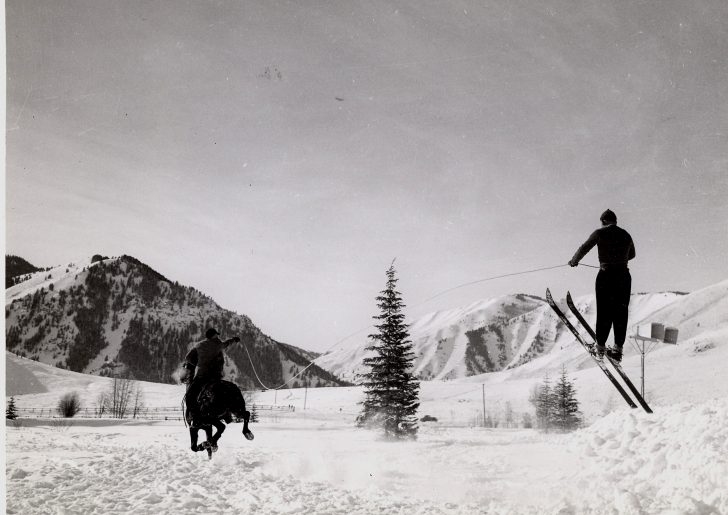
Mystery Glimpse: Up, Up And Giddy-Up

Horses And Skiing Have A History.

Yes, skijoring.  But where, who, when?  Anyone ever skijor? What’s it like?

Credit: Alf Engen Museum

Many thanks to the Alf Engen Museum, Park City, UT, for contributing this spirited photo of skijoring in (hint, hint) the West.

The Alf Engen Ski Museum Foundation was established in 1989 with a mission to preserve the rich history of skiing in the Intermountain Region. It strives to provide a world-class facility which highlights the many contributions made in ski area development, athletic competition, snow safety, ski innovation and ski teaching methods.

Last Week

Yes, indeed.  This is the venerable Cannon Mountain Aerial Tramway. The following was adapted from the Journal of the New England Ski Museum (Winter, 2019).:
The Aerial Tramway was the first such conveyance in North America and opened for business in Summer 1938. In its first summer and fall, it carried 100,000 passengers up Cannon Mt.  

That year, Hannes Schneider also arrived in North Conway to begin his stellar career as a ski instructor and innovator. Between the new tramway, the advent of Schneider, and the robust support of Harvey Dow Gibson, a North Conway-born New York financier, New Hampshire was poised to become a mecca for skiing.

Thanks again to the wonderful New England Ski Museum, now with two locations, a new  gallery and archive in North Conway, and at the base of this aerial tramway at Cannon.

Snowbasin Goes Epic

Uncrowded, Beautiful Views, Variety Of Terrain, No Hotels.

Most of the trails at Snowbasin wind up at the Needles Gondola. Credit: Tamsin Venn

Older skiers would really like Snowbasin outside Ogden, UT. You have nearly 3,000 acres in which to avoid other skiers and 3,000 vertical feet to get some rhythm going. A remotish location keeps lines short midweek. Lifts whisk you up to the top of six scenic, craggy peaks: two high-speed gondolas, three high-speed chairlifts. You can dine on really good food at a choice of three swank lodges, all glass and timber, wall-to-wall carpeting, stone fireplaces, and chandeliers. Locals think about skiing elsewhere, but why bother?

“You ski on a Tuesday here, even on the biggest powder day, and you’re looking for somebody to ride the lift with,” says new General Manager Davy Ratchford, quoted in Powder Magazine.

The layout is easy to follow. Most of the 106 tree-dotted trails end up at the base of the Needles Gondola. The mostly intermediate and expert trails include a fun variety: wide groomed boulevards, low angle chutes to dip into, hikes to cirques and chutes close to lifts, such as the popular Lone Tree. Typically the area gets 300 inches of snow a year.

Stop at the top to view four states: Utah, Wyoming, Colorado, Nevada. At the Strawberry Gondola, take the longest Elk Ridge trail at 3.5 miles. Flat light can be a problem up top on weather days, but low visibility markers lead you back to the base area.

Snowbasin hosted the downhill at the 2002 Olympics. You can hurl down the course if you like. Credit: Tamsin Venn

Snowbasin hosted the men’s and women’s downhill in the 2002 Olympics. Take the 15-passenger tram up to Allen Peak (9,465 feet), stare in awe over the precipice looking down at Ogden’s grid and Great Salt Lake. Then heart in throat, hurl yourself down The Grizzly, start of the men’s downhill. The less ambitious can take the tram back down to the newly widened and graded Mt. Ogden Bowl Road, a lower-angled return.

Snowbasin is not new. About 50 minutes north of Salt Lake City, it opened in 1939, and is one of the oldest continually operating ski resorts in the U.S. Utah native Earl Holding (of Sun Valley) bought it in 1984, made a large investment in lifts and snowmaking over the years, then pulled out all the stops for the 2002 Winter Olympics.

Snowbasin has no lodging. In nearby Huntsville, the newly opened Compass Rose Lodge, run by skiers Jeff and Bonnie Hyde has 15 bedrooms and its own observatory to take advantage of nearby North Fork dark-sky park. Grab a beer and burger at the No Name Saloon, oldest bar in Utah.

Or stay in Ogden, 30 minutes away, once a key stop on the transcontinental railroad. It has historic hotels like The Roosevelt, many ethnic restaurants, craft beer breweries like Roosters Brewing Company, and Social Axe where you can throw axes with your friends for fun. UTA public buses run up Ogden Canyon to Snowbasin and nearby Powder Mountain.

The Facts

Snowbasin has gone Epic. The 2019-20 Epic Pass provides seven days of skiing each at Snowbasin and Sun Valley, no blackout dates, and 50 percent off lift tickets once days are used.

Day pass senior at window (65-74) $89. 75 plus is $45. Midweek season pass (all ages) $439. 75 plus is $49. Snowbasin will close this year on April 21.

Click here for Snowbasin Trail Map.

Click here for Snowbasin Webcam.

Not too crowded big mountain skiing at Snowbasin. Credit: Tamsin Venn


This Week In SeniorsSkiing.com (April 12)

Take Away Senior Discounts? Epic vs Ikon, Italy Update 2, Mystery Cable Car, Mammoth And Jackson Hole In Spring.

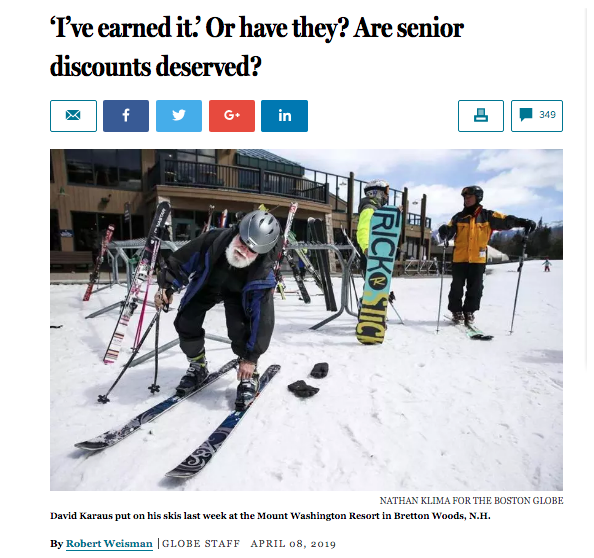
Glancing through the Boston Globe last Monday (April 8), our eyes locked on a front page story:

” ‘I’ve earned it.’ Or have they? Are senior discounts deserved?” 


The point of the article is that while seniors figure they’ve “earned” discounts on movie tickets, donuts, clothing, access to National Parks, transportation, and the like, there are others who feel they don’t deserve them anymore.

“Some question whether senior discounts are warranted in an era when many of those enjoying them are relatively well off, while large numbers of younger folks strain under the weight of student debt and labor in a gig economy bereft of benefits,” the article states. The article goes on: “David Wallis, who leads the Economic Hardship Reporting Project, a nonprofit that supports journalism focused on inequality, argues that the deals for seniors are a relic of an earlier time. He calls for replacing them with income-based discounts for people of all ages.

“The senior discount should be radically rethought,” Wallis said. “Let’s say you have a very comfortable lifestyle. Do you deserve cheap seats at the movie theater?”

The rest of the article posits that debt-burdened millennials need discounts, too, so why not have a means-based approach to discounts, economy wide? 

Well, both SeniorsSkiing.com co-publishers couldn’t let this pass without a retort. We composed a Letter To The Editor of the Boston Globe, submitted it, and now await word of its fate. Here is our response:

To The Editor:

The logic behind “Time to retire these discounts?” (April 8) is based on the assumption that older people have adequate resources, therefore discounts are unnecessary. It smacks of narrow thinking, focussed on self-sufficiency and the notion that businesses shouldn’t subsidize certain demographic populations because there is money out there. Why leave it on the table?

Yet, we find some businesses use senior discounts as a key differentiator. What would AARP be like if it stop offering discounts to members? How about the AAA? Clearly, senior discounts mean value to older folks, regardless of means, and most businesses know it and use them to advantage. 

But not every business sees the value that discounts for seniors bring.  Vail and the Epic Pass have denied seniors a discount, despite the fact that older skiers play a major role in introducing new skiers (grandchildren) to the sport, a significant, unrewarded service to the ski industry.  And older skiers have been supporting that industry for as long as 50 years or more.  These committed customers deserve both encouragement and a reward for continuing in the sport and for, yes, generating revenue. Doesn’t that deserve a discount on a lift ticket mid-week when no one else is around?

There are many senior skiers who have bridled against the corporate. no-discount for seniors pricing policy, some of whom have given up visiting non-senior friendly resorts. Instead, we know that seniors flock to those areas that do offer senior discounts and even free skiing, keeping the lifts running and the burgers flipping. Offering a discount to seniors is a business differentiator in an increasingly expensive sport.

Your thoughts?


Meanwhile, there was another fascinating article from Bloomberg Business Week on the trend of consolidation of ski resorts and the multi-resort pass. We’ve all felt the impact of these changes, some have benefitted, and some feel they’ve lost out. There is no question the ski resort business will be seeing more changes in the future.  For a link to the Bloomberg article, click here. Or click on the image below.


This Week

Co-publisher Jon Weisberg continues his reporting on the Italian Dolomites, a ski safari that seems to be the crowning experience of anyone’s ski career.  We also have another Mystery Glimpse and reveal the function of that little whisk broom left over from 10th Mountain Division training in the Rockies. Finally, we hear from Marc Liebman on spring skiing at Mammoth Mt, CA., and from David Barnes, a reader who submitted a story about “Gaper Day” at Jackson Hole.

Thank you again for reading SeniorsSkiing.com.  Tell your friends, and remember, there are more of us everyday and we aren’t going away.


Spring Skiing And Gaping At Jackson Hole

The First Week Of April Brings “Gapers” To JH And A Different Skiing Experience

Weirdness prevails on Gaper’s Day (April 1) at Jackson Hole. Credit: Buckrail.com

Editor Note: We are quite pleased when readers submit articles for publication in SeniorsSkiing.com.  David Barnes is a long-time reader who sent us this account of a yearly ritual at the venerable Jackson Hole.  Thanks David.


Jackson Hole.  Two words that strike double-black-diamond terror in the hearts of many skiers, young and old alike.  But, it shouldn’t.  Sure, half of the runs are black diamonds, including one called Corbet’s Couloir that’s more akin to a cliff than a ski run.  But the other 50% of the mountain’s runs are blue and green, making for a welcome ski experience for any senior skier. 

I first skied Jackson Hole in the late 80’s, with my new wife whose great aunt and uncle lived at the base of Rendezvous Mountain in Teton Village.  At 72 years old, Uncle Warren took me on the old aerial tram, up 4,139 vertical feet to the 10,450’ summit.  The wind was howling, the air was thin, and the run was steep.  “Ready?” grinned Uncle Warren?  I swallowed hard, clicked into my bindings, squeezed the poles hard, and nodded like a rodeo cowboy on a wild bull, waiting for the gate to open and release the snorting, bucking beast.  I was 30 years old and quickly realized I was being out-skied by a 72 year old.  When we’d reached the bottom, I declared I wanted to be like Warren when I grew up. 

Since then, we’ve had the privilege of visiting Jackson Hole a dozen times or so, including the last week of skiing (first week of April) for the last three years.  This is thanks to my mother-in-law, who owns a fraction of the Teton Club, a beautiful and massive log structure near the base of the Tram.  Does this make me an expert on spring skiing at the Hole?  Not exactly.  But I’ve learned enough to understand that skiing the Hole in early April makes for a different experience.  Generally, the weather is warm, sometimes too warm at the lower elevations; later in the week, the snow conditions at or near the bottom can be mashed potatoes.  But the upper elevations typically provide good snow conditions. 

In addition, there’s a fun day.  April 1st is Gaper Day at the Hole.  What’s Gaper Day?  If you have to ask, you are one.  I had to ask.  Gaper Day is a chance for locals to poke fun at tourists by dressing up in kooky outfits on April Fools’ Day.  You’ll see everyone from Uncle Sam, girls in bikinis and dudes in shorts and Hawaiian shirts with old film cameras hanging around their necks.  And for some reason on this particular day, and, only this day, every chairlift spouts a prominent sign reading, “Absolutely no Alcohol on Lifts.”  The signs didn’t seem to be 100% effective…

Loose Moose. Credit: David Barnes

Finally, the moose.  Jackson Hole Mountain Resort is just south of the Grand Teton National Park, which in turn is just south of Yellowstone.  Hence, wildlife is abundant in the area, including moose.  We saw a number of them this year, some on the mountain and some right in Teton Village at the base of the mountain.  Most people are wise enough to keep their distance from the moose.  Some don’t, either deliberately or by accident. My wife, for example, took a walk around the village one morning.  As she turned a corner, she saw the back-end of a large brown animal close by.  As she approached what she assumed was a cute stuffed moose, it slowly turned its big head and looked at her.  Wide-eyed, my wife slowly backed away and then hot-footed it back around the corner, where she nearly ran into a Jackson Hole Mountain Resort employee.  “It’s REAL!” stammered my wife.  The employee gave her a dispassionate look.  “Oh no,” thought my wife as she watched the employee amble away.  “I’m a Gaper…”

Editor Note: The video below is from 2013, but it shows the “spirits” of Gaper Day, honoring April 1, a day for foolishness.

This Week In SeniorsSkiing.com (April 5)

Maple Syrup Time, Dolomite Ski Safari Update, Resort Reviews, Miss Tweedie, XC Lessons

Into the sugarbush we go at the end of winter. Boil and boil and boil.

There is clearly a disparity between snow conditions in the East and the West.  New England areas are starting to wind down, with some closing this weekend and others hanging on a week more. Exception: Killington will strive on until May, as usual. Out West, the snow is still coming down with multiple storms per week. Nevertheless, we’ve heard that some resorts (see Park City) are closing down despite the surfeit; local pass holders are not amused. Other mountains are planning to keep spinning until July Fourth (see Mammoth). Think about that for a second.  The Fourth of July on skis. You going?

Cold night, warm days make the sap run. Time to get the buckets out.

Meanwhile,in  the East, it looks like it really is spring. Maple sugaring has been going on for a month or so with maybe a week left to harvest sap and boil, boil, boil. Here’s a verse from Pete Seeger’s Maple Syrup Time, a classic song about this time of year. If you want to hear Pete sing the whole piece, just click here.

Maple Syrup Time by Pete Seeger

First you get the buckets ready, clean the pans and gather firewood,
Late in the winter, it’s maple syrup time.
You need warm and sunny days but still a cold and freezing nighttime
For just a few weeks, maple syrup time.
We boil and boil and boil and boil it all day long,
Till ninety sev’n percent of water evaporates just like this song
And when what is left is syrupy don’t leave it too long –
Watch out for burning! Maple syrup time. 

This Week

The Dolomites is a UNESCO Wolrd Heritage site and the world’s largest ski area

Co-Publisher Jon Weisberg reports on an amazing, five-day long ski safari across the Dolomites, under the guidance of Tim Hudson of Inspired Italy, a SeniorsSkiing.com advertiser. The transit of the vast mountain range included staying on the mountain in “refugios”, on-mountain hotels with gourmet restaurants. This is the skiing experience of a lifetime and really worth considering if you think you’ve done it all.

Our Mystery Glimpse includes a device from the war years in Colorado. Last week’s photo was revealed to be Betty Welch Whitney, who, with her husband Bill founded the Whitney Inn in Jackson, NH, back in 1928. What makes the inn notable is that it was the first to combine lodging, dining, and lift operations in one location. The venerable Whitney Inn is still around after all these years.

We have three Resort Reviews to share: Silver Star, BC, Cranmore, NH, and Sunapee, NH.  We have found this type of medium-sized resort is often the most accessible to seniors, especially mid-week.  Even though Sunapee has joined the Epic Pass, by the way, the resort still has a special mid-week season pass for its loyal senior following. This is the kind of resort we like, and we hope you do, too.

Outside the Brighton Lodge. Credit: Harriet Wallis

Correspondent Harriet Wallis offers an “average skier’s” perspective of what the really big snows really look like.

No, it’s not a collection of dramatic pictures of skiers plunging through clouds of powder with dramatic blue skies. Instead, her photo album shows conditions literally on the ground and what she had to contend with on her outing at Brighton, UT, her local area.


Jan Brunvand shares an interesting accounting of a one Miss Tweedie, a young English woman from Victorian times, who ventures to Norway to try some skiing in the 1880s. Have times really changed that much?

And finally, XC expert Jonathan Wiesel tells us the merits of group versus private cross-country lessons. There are different reasons for each, as you will see.

Thanks again for reading SeniorsSkiing.com.  We really do depend on your telling your friends about us. And remember, there are more of us every day, and we aren’t going away.


Mystery Glimpse: A Rare Artifact

What Is This? Who Used It? Why Is It A Rare Artifact Of Ski History?

Thanks to the Colorado Snowsports Museum for this photo from its collection.

Last Week

Credit: New England Ski Museum archive

This is Betty Welch Whitney, born in Haverhill, MA, graduated from Smith College in 1923, and first went on a ski trip with the AMC in 1928. She remained an AMC member for life, and became a ski fashion and equipment buyer for Filene’s in 1936. With her husband H.H. “Bill” Whitney, she purchased the Moody Farm in Jackson, NH and with him operated Whitneys’ as the first ski area to combine food, lodging and a ski hill serviced by a tow.

They improved the existing the rope tow lift a year later by attaching 72 shovel handles to the cable, making it easier for skiers to hold on. The lift was henceforth known as the Shovel Handle, and it helped make Whitneys’ one of the more popular early ski areas in New England. Whitney’s Inn is still in business and offers a traditional New England get-away experience with four-season activities.

Thanks to the New England Ski Museum, now with locations in Franconia and North Conway, NH, for offering this photo for our Mystery Glimpse series.

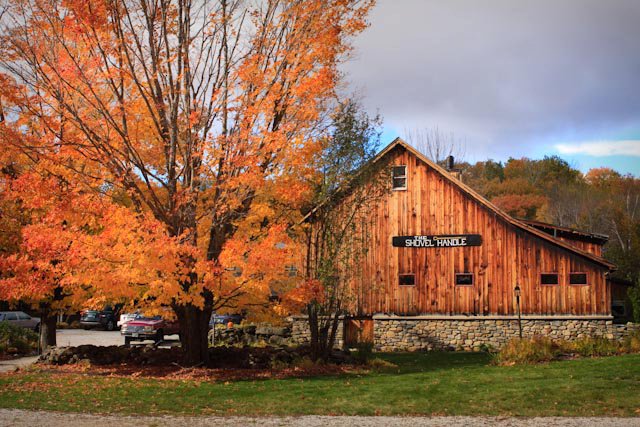
Here’s the Shovel Handle pub at the current Whitney Inn, Jackson, NH.

Image result for historic ski area Whitney Inn

Group Or Private XC Lesson?

Here’s What The Experts Say.

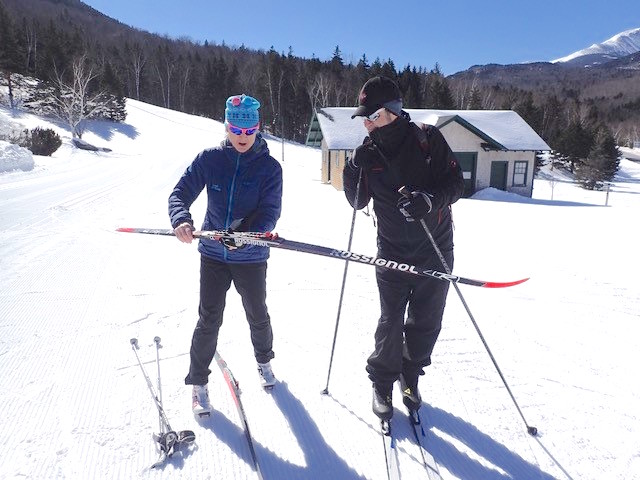
Olympian Sue Wemyss, instructor at Great Glen Trails, NH, gives a student some tips on adjusting bindings. Credit: Roger Lohr

Let’s say you want to learn how to cross-country ski relatively quickly and easily: How to move with grace and minimal effort, develop endurance, and enjoy what you’re doing from the git-go.

Well, it’s going to take time on skis to develop that self-assurance, balance, and muscle memory (though kids can do a lot of that with amazing ease); but the surest shortcut to becoming a good xc skier is to take several lessons or clinics – not just one – with a professional instructor.

I’ve wondered for years what’s the simplest way to speed up the learning-and-fun process for people of any age, not just us perennials: group lessons or private instruction. Figuring that it would help to ask the pros, I contacted three renowned Nordic instructors/coaches/ski school directors. They all have long strings of credentials, but a quick overview: Emily Lovett is co-director of the famous West Yellowstone Ski Festival’s XC Ski Camp in Montana;and Scott McGee is a celebrated cross country, telemark, and alpine instructor, trainer, and examiner in Jackson Hole, Wyoming; JoJo Toeppner has run two XC areas in California at Royal Gorge and Tahoe Donner. They’re experts not just at technique but also at communication and accelerating the learning curve.

They explain that there can be a bunch of factors involved in your choice, ranging from expense to self-consciousness.

All three experts agree that cost can be a factor. Emily makes the point that group lessons can be really fun and meaningful as you learn from each other and bond through a shared experience. She adds, “I think taking a private sometimes depends on if you like having more of a one-on-one experience and attention.” She adds that a group lesson involves some willingness to be open to others’ abilities, questions, and learning styles, which can be fun and interesting.

In a group lesson, you learn from other students and through repetition. Credit: Jonathan Wiesel

Scott comments, “When your goals are specific enough, or if the price difference isn’t an issue, private lessons give you the tailored experience that is most likely to meet your goals and be targeted at your abilities.” JoJo feels that “It’s much more expensive to take a one-hour private where everything is charged separately (ticket, rental, lesson, as opposed to a 75-minute discounted package). But privates can be customized to what the student wants if there’s a specific need, such as mastering hills, corners, or stopping, while groups cover a little of everything.”

Scott feels that a group lesson is a great way for new skiers to meet people, plus they’re easier to book than privates. He says, “Nordic centers most likely have a beginner lesson once or twice a day. As skiers progress, up through intermediate level, there are many undiscovered breakthroughs waiting to happen. Small improvements to efficiency and effectiveness take time to integrate into technique. So multiple group lessons at a beginner-ish level can provide great value as long as repetition (“Here’s how you put a ski on”) is not an issue.”

It sounds like above intermediate level, the likelihood that a group lesson will meet your goals decreases. One great exception to this is the fall “camps” with multiple groups for different ability levels, like the West Yellowstone Ski Festival or Silver Star Mountain Resort in BC, which see dozens of senior skiers among participants each November.

Fast and happy trails to you!

Miss Tweedie Goes Skiing In Norway

Was ever anything so vexatious?”

One of the most enthusiastic English Victorian tourists who made a ski trip to Norway was Mrs. Alec Tweedie, author of A Winter Jaunt to Norway (1893). Not only did she sketch a vivid picture of Norwegian skiing equipment, technique, and terrain, but she also reported on the second-ever Holmenkollen Day events.

Mrs. Tweedie, then a young widow, travelled with her sister to Christiania (now Oslo) where they were met by her brother and a friend, then joined by “Herr Schmelck, one of the best skiløbers in Norway.”

Never having skied before, she decided to try it. As it turned out she loved skiing, which she described as “one of the most exhilarating and enchanting sports in the world . . . [which] bids fair to become a fashionable winter amusement for English people.”

Her description of the gear used at the time:

“An ordinary-sized man’s ski are eight or nine feet long. They are about four and a half inches wide and an inch at the thickest part, immediately under the foot, but towards either end they taper to half this thickness. . . . In the middle the toes are fastened by a leather strap. Another strap goes round the heel in a sort of loop fashion, securing the foot, but at the same time giving the heel full play.

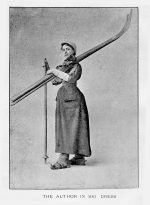
Although Mrs. Tweedie’s description of her “ski costume” included “short skirts, reaching but little below the knee . .  .[worn over] thickly lined black knickerbockers,” the commercial photo used as a frontispiece in the book shows her skirt going right down to the ankles. The photo also reveals that the skiers used just one pole for control and balance.

Their first attempt at skiing was frustrating:

“We struggled on to the incline of the hill. Hardly had we arrived there, when off started the ski, taking us unexpectedly along on them. The pace increased each yard of the way, until over we went, dejected bundles, into several feet of snow. Was ever anything so vexatious?”

As the English tourists gained more confidence, they took a ski tour to a saeter [mountain pasture], staying in a log cabin, and working on their form, assuring the reader that “No amount of tumbling in Norwegian snow would ever give as much as a bruise. It is like falling into sand or flour, and one has only to have a shake to be as dry as if nothing had happened.”

On their last day in the mountains the determined Brits even organized races:

“We tried who could steer most equally between two given posts with only a few inches to spare on either side of the ski. Then we raced in couples, which nearly always ended in some frantic spill. Oh, how we fell over, and how we laughed and enjoyed ourselves, while the way we improved was marvelous!”

Herr Schmelck remarked, “Why, there is nothing you English ladies will not dare,” a kind observation considering that the local expert had surely seen many Norwegian ladies expertly skiing since their childhood.

A Banner Winter Through The Camera Of An Average Skier

Harriet’s Album Of Deep, Deep Snow Pics At Brighton.

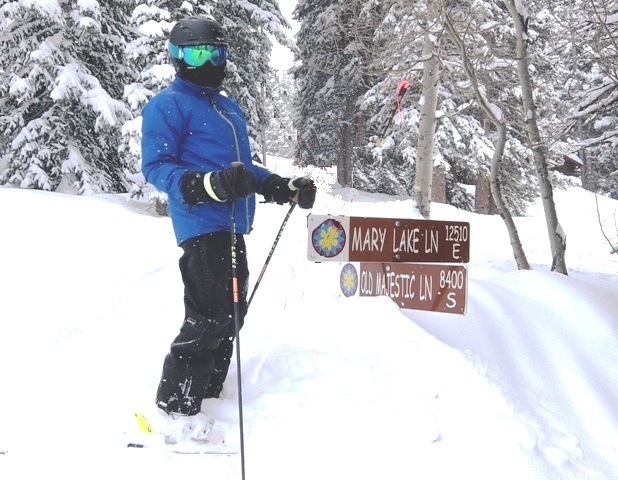
Beware of the buried street signs at the corner of Mary Lake Lane and Old Majestic Lane. The summer road became a deep snow ski trail. Credit: Harriet Wallis

At my home resort Brighton, the snowfall has topped 500 inches—about 41 feet—and the snow keeps coming. Brighton is a down home, low key resort near Salt Lake City that’s favored by families and snowboarders.

This two-story trailside cabin has an access problem. Must dig down deep to find the door. Credit: Harriet Wallis

One more snowstorm and this cabin will disappear. Bamboo poles and a rope line keep skiers off the roof. Credit: Harriet Wallis

Plentiful snow is crucial because It’s our drinking water supply, and there have been several years of low snowfall. When Spring runoff starts, every drop of melting mountain snow is captured. It takes just 24 hours from stream to faucet. Dogs are banned from the canyon watersheds to help keep the pure water free from transmittable diseases.

Just before one of those plentiful snowstorms, my friend and I booked a room at the slope-side Brighton Lodge so we could be first on the mountain in the morning.

Inside the cozy Brighton Lodge. Credit: Harriet Wallis

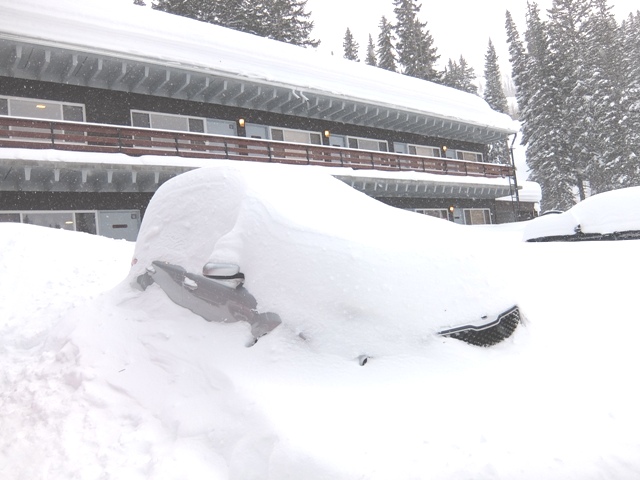
It snowed all night. We skied all day. Then we had to cope with the car.

Outside the Brighton Lodge. Deep snow is fun until it buries the car. Credit: Harriet Wallis


Snowboarders dug it out. Credit: Harriet Wallis

The ample winter also creates some other quirks at Brighton.

While the snow keeps falling, these father and son skiers pitch in to help dig out the gates. Credit: Harriet Wallis


The children’s warming yurt looks more like an igloo. Credit: Harriet Wallis


The parking lot is walled by snow. Where will they put the next storm’s dump? Credit: Harriet Wallis 

Even the ride down the canyon toward home has rewards. Deep snow drives the peak-loving mountain goats down to lower elevations. It’s a treat to see them so close.

Shaggy coats and quizzical looks. Credit: Harriet Wallis

To read more from Harriet click here for her stories on SkiUtah.