Tag Archive for: SeniorsSkiing.com

Snow In Literature: Fwooosh

Fwoosh! By Matthew Haddad (Age 12)

[Editor Note: This poem was written when Matthew was 11 for his grandfather SeniorsSkiing.com reader Doug Haddad. Proud grand dad submitted it on his behalf.]

Past snowy hills

On a 100 degree down

Intricate snowflakes

Frozen hearted yet making a winter wonderland 

Where skiing takes place

Over thousands of moguls

Making the snow a light wave

Directed down a thin river

When at a halt below, at the base all seems your fault

For the fun has stopped

Yet you may go up for another round

Lifted up by chairlifts

To another zoom down the mounting

This Week In SeniorsSkiing.com (Jan. 22)

Does Technique Matter? Corduroy XC Tracks,  Beginning XC, Making Turns, Think Arc, Robert Frost, How Did You Learn?

This week we reflect on how you ski and how you learned. We learned by following a fellow college student down the baby trails at Song Mt in Tully, NY, many decades ago. “Just do this”, he said showing me how to snow plow, then a stem christie. And that’s how I turned for many years: stem christie.  Couldn’t get past it.  Imprinted. Embedded. Habituated.

That was in the years of 205 cm skis and, yes, leather boots. After a long hiatus of non-skiing, I returned to the sport with new short skis and better boots.  I could shake the stem, but, honestly, when things got touchy, I stemmed. A long, long overdue lesson gave me some concepts to practice that helped stamped the stem and take advantage of those new skis.

All of which got us to wonder about technique, especially when ski coach Bob Trueman sent us a provocative article on forgetting about “making turns” and thinking “arcs” instead. His is a conceptual view of what is happening when going down a hill with skis strapped on feet. We are curious what you think.

Pat McCloskey, a ski instructor, gives us a view of slow turning and why that helps control along with a clear video of slow turning practiced by Norwegian national team member Henrik Kristoffersen.

There is such as thing as “vicarious learning”, that is, learning by watching someone perform.  If you were a Warren Miller fan back in the day, you couldn’t help but pick up what “rhythm” meant and how “flow” looked. That helped frame the mental part of what had to be done to create those arcs. The physical behavior was another matter.

Let us know what your experience in learning to ski and what the “mental model” is that you keep in your brain as you arc down the hill.  Or if there is anything in your brain, for that matter, and maybe that’s the point.

This Week

An arc is a segment of a circle.

The Skiing Weatherman Herb Stevens is calling for coast-to-coast snow in one form or another over the next couple of weeks.  Just in time as we hear snow is needed in the Rockies and Northeast. Click here.

We have an unprecedented third week in a row with a Snow In Literature poem.  This time, it’s Robert Frost’s wry Brown’s Descent, Or The Willy-Nilly Slide. Old Robert had a sense of humor, New England-style. Click here.

As mentioned there are two articles on ski technique: Bob Trueman’s Don’t Do Turns, and Pat McCloskey’s Slow Start, Good Turns. We’d love your comments.

Finally, we also have two Make More Tracks articles, a great how-to video on beginning cross-country skiing from Breckenridge Nordic Center.  Even if you feel like you know what you are doing on skinny skis, you’ll pick up some neat tips in this video.

Arc thinking makes a difference. Perhaps.

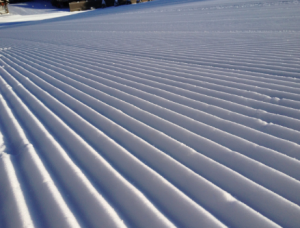
And correspondent Jonathan Wiesel explains why ski trails are “corrugated”. There is a reason the corduroy shape is used to groom ski trails.

Thanks for reading SeniorsSkiing.com.  Tell your friends, and remember, there are more of us every day and we aren’t going away.

Credit: M. Maginn


Make More Tracks: Corrugation For Groomed Trails

The Technical Reason Why Ski Trails Are Corrugated.

Freshly groomed XC trails last longer. Credit: North Shore Nordic Association

[Editor Note: This article was written in collaboration with Auguste Lockwood, Yellowstone Track Systems.]

Interest in winter recreation promises to grow phenomenally in winter 2020-’21, despite—or because of —COVID-19, and a lot of us are looking forward to more friends and families on more and better groomed trails.

One of the subtle, unsung, but vital elements of high-quality (read “fun”) cross-country ski, snowshoe, fatbike, and snowmobiling grooming is corrugation. You’re probably familiar with metal or plastic corrugated panels that increase strength and rigidity for roofs and siding. Those same qualities apply to trails, where consistent, durable, beautiful surfaces are essential for skiers, snowshoers, and riders as well as groomers. 

If you’re interested in either producing or using high-quality trails, first thing to know about corrugation is something about the physics of snow. Corduroy —that’s the grooming version of corrugation —has peaks and troughs that create minute pressure differentials. These differences promote the movement of free moisture up through the snowpack to the tips of the peaks, where evaporation is accelerated by increased exposure to cold air.

The phenomenon of “hot moves to cold” describes the movement of moisture from a warm material to a cold one, like condensation on a cold drink on a hot day. Corduroy increases the surface area of the trail, exposing more snow to the air where moisture transfer can happen.

Corduroy creates a strong, stable surface if it’s in place long enough before being used. In addition to faster set-up time (“mechanical age hardening”) and increased snow metamorphism, the triangular shape of the individual ridges adds strength and stiffness. Ideally, corduroy peaks form a thin glaze that extends about 1/3rd of the way down the trough, in effect building a little ice cap. With a well-distributed load, these caps are the first defense against trail flattening, friction, and melt.

En masse, these caps are extremely strong, easily holding the weight of a skier, fatbiker, etc., leaving virtually no damage or even marks. Once the caps or tips fail, the upper half of the ridge is fairly soft, but the layer just above the trail base (about 1/4 inch high) remains extremely strong.

This slightly ridged trail can last for days or weeks under the right conditions. A ridged trail sets up faster, bonds harder, and lasts longer than a flat trail.

Fat Biking On Corduroy

Fat biking promises to become a major winter sport that complements cross-country skiing and snowshoeing, and it’s new enough that grooming for it is a little mysterious. Groomers’ knowledge about any of these sports can help create a premium product for the others.

With the widely-spaced lugs of a fat bike tire, there are two types of interaction with the trail: the lugs, and the smooth rubber of the tire. A corduroy surface makes for a better riding experience by providing consistent traction. With corduroy, tire lugs fall between the peaks of the ridges, allowing the smooth rubber to evenly distribute pressure between the tips of three to five ridges at a time.

Lugs that contact the ridges will crush the snow, digging in and providing lateral traction, while the lugs between ridges grab the edge of a ridge and provide lateral traction, without damaging the trail. This creates a superior surface, as an increased number of ridges per foot of the grooming comb has several advantages.

One advantage is increased surface area, decreasing setup (consolidation) time. Another is more surface contact with a tire, since with widely spaced ridges, the tire will only be contacting a couple of ridge tips, increasing the pressure on the tips and breaking them. In contrast, on a smooth trail, tire lugs either don’t penetrate enough if the trail is too firm, thus reducing traction; or they’ll penetrate the top surface of the trail, until the weight is transferred to the smooth rubber of the tire.

The ideal density can be hard to achieve—too hard and there’s not much traction, too soft and the weight of the rider will crush the top layer of trail, creating a weak spot.

Finally, from an aesthetic point of view for fat biking, really good corduroy leaves a small line of snow on the tire. So while riding, there are three or four (depending on tire width) thin white lines that circle the tire. This produces a mesmerizing pattern on the wheels to watch on your front tire or on the back tire of someone you’re following. The lines run longitudinally around the tire if you’re going straight, but you can zigzag and make cool patterns as they interact with the regularly spaced lugs while turning.


Skiing Weatherman: Something For Everone

Snow For All.

Often when I write this piece, I have good news for one region of the country and not-so good news for other areas of ski country. Such is the nature of winter weather across a country that stretches 3,000 miles from coast to coast and with so many and varied climate zones. However, just as there are times in the middle of the summer when much of the country is warmer than normal, occasionally we see a pattern in winter where most or all of the skiing regions get lined up for significant snowfall at roughly the same time. We are entering just such a period.

In order for a favorable pattern to set up for such a large area of the country we obviously need an ample supply of cold air. From mid-December until just recently, most of the air flowing across the country was of Pacific origin, not the prime source region for winter weather. The jet stream configuration now in place is tapping cold air from the northwestern corner of the continent. There is still a risk that we could see an intrusion of severely cold arctic air by the end of the month, but at a minimum, enough cold has showed up to make even southern regions cold enough to be on the lookout for fresh snow. It certainly helps that this is the time of year when normal temps in most areas are right at their climatological minimums for the year. To illustrate the extent of the cold air, here is a look at the forecasted 5,000 foot level for Friday, Jan. 29th

The area shaded in hues of blue indicate where temps will be below freezing. Sub-freezing temps at that level are a proxy for where the column of air overhead is cold enough to support snow, even the southern Appalachians look sufficiently cold.

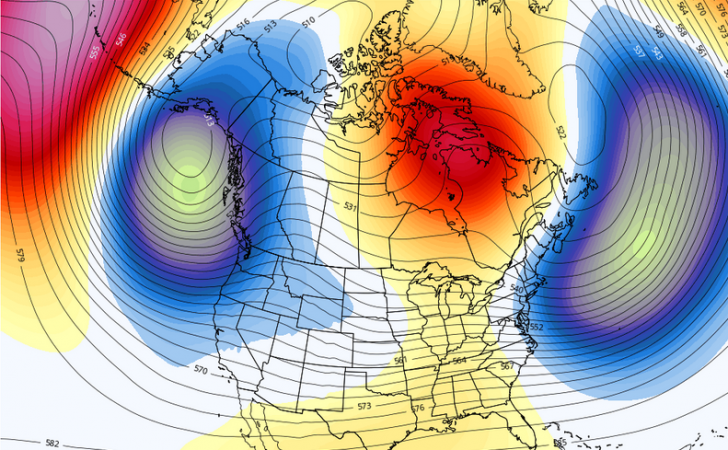
The other ingredient for widespread snow is a favorable jet stream configuration. Here is a forecast for the jet stream for late next week that I agree with, showing three key components to a snowy pattern from coast to coast.

The trough along the west coast will produce fresh snow from Alaska down to the southern Sierra, and inland to AZ and NM as well. Storms from the southern end of that trough will traverse the country and bring the opportunity for snow to the central and southern Appalachians. The red ridge over northeastern Canada will remain in place and help keep storms from cutting through the Great Lakes, which would produce rain to the east of the track. Northern disturbances will come out of the Gulf of Alaska, move along the U.S./Canadian border, and produce snow in the Great Lakes and Northeast from time to time. Those systems are often called Alberta Clippers because they typically move through that province. If the impulses in the northern and southern branches of the jet combine forces, the trough off the east coast will be pulled westward and potentially lead to a blockbuster coastal storm for the mid-Atlantic and Northeast. The potential is high nationwide. Let’s hope the pattern delivers the goods!!!

Regional Details

Northwest U.S./Western Canada: The trough along the coast produces multiple rounds of meaningful snow over the next couple of weeks. No issues with snow levels due to input of arctic air.

Sierra: Trough extends far enough south to produce a much more active storm pattern to this region.

Rockies: Full length of the mountain range will have frequent snow events into early February.

Midwest: Clipper systems keep coming every two-three days into next month. Each one will produce light snow with backside lake effect, as well.

Mid Atlantic/Southeast:  Cold enough for snowmaking; southern storm track could generate natural snow at times.

Northeast/QB: Clipper systems help northern resorts with light snow at times. Ridge over Canada likely to suppress major storm track too much UNLESS two jet branches combine for coastal storm.

Question For You: How Did You Learn?

Did How You Learn Help Or Hinder Your Current Technique?

Hannes Schneider brought Austrian “technique” to the US in early 30s.

I remember taking couple of lessons when I started skiing in the mid-60s. Lessons were based on the snow-plow, stem christie, christie school.  Very Austrian. It served me well over the years I skied up to the time my Alpine career went on hiatus.

When I came back to skiing about 15 years ago with new short skis, new boots, I was trapped in the world of my early technique: still stem christies from time to time, narrow stance a la Stein Ericksen, actually trying to “wedlen” under the lifts. Boy, that didn’t seem to work. And actually still gets in the way.

So I took a lesson and tried to adapt. Better but not easy; old habits die hard.

Which leads us to our question for you this week:

What ski school method was used when you learned to ski? Or did you even take a lesson? How has your “Ur-technique”—the fundamentals from decades ago—impact how you ski today? Help? Hinder? What did you have to unlearn? How did you do that?

Please let us know what your experience has been. Make a comment in Leave A Reply in the box below.

Ski School, Austria, 1930s.


Instructional Advice: Don’t Do Turns

Words Matter. Why “Arcs” Works Better Than “Turns”. 

Arc thinking makes a difference. Perhaps.

Recently I wrote a small piece on how to handle tough skiing situations and used the word “arcs” where most folk would use the word “turn”. My insistence on using the word “arc’”raised an eyebrow or two on the grounds that it was perhaps mere semantics or even nit-picking. Believe me, it isn’t.

Every single ski instructor I have ever met only uses the word “turn(s)”. You are admonished to “do turns”.  Even worse, you are recommended by some to “turn your skis”. It  tells you nothing at all about what movements you need to make with your legs/feet/body while in motion. 

What on earth is it supposed to mean? Is that how skis work, by “turning” them?  Is that a route to understanding, and to excellent skiing? No. Most of the movements you make should be in response to the skis, very little to do with making them do things.

What Is Really Happening When A Ski Changes Direction ?

The objection I have to using the lazy word “turn” is that it does not describe what happens.  It tells you nothing about how a ski changes direction and carries you with it.  It suggests that you do the “turn”.  You can “turn” a lot of things—a quick buck;  you can turn to the person on your left; you can turn a screwdriver; you can turn a triumph into a disaster. There is no end to the things you can turn.

An arc is a segment of a circle.

But let’s talk about skiing.  When you or an instructor refer to a “turn” in skiing, that is becomes something you think you do. But it is not what happens.

A change of direction may occur, (it may not) but that is an outcome of things you do, and of things that happen at the interface of the snow and the ski; it is not what you do.  If you haven’t already, then buy my top selling, incredibly inexpensive and value-for-money book “Ski In Control”

If you think you do turns, you are highly likely to also think that in order to do it, you will need to “turn your skis” (or worse, your body!)  Let’s substitute the word “pivot” for “turn” in this instance; it’s more descriptive.  There are times when pivoting your skis may be appropriate to achieving some outcome you desire.  Somewhat regrettably it may, though not necessarily, induce a change of direction. 

I say regrettably because if and when that happens it is likely to reinforce the idea in your head that you did it.  You didn’t.  Only very indirectly did the rotation of your ski (your foot) induce a deflection of your ski.  An outside force deflected your skis, and because you are attached, you went with them.  In a sense, they “turned” you, not the other way about.

Sometimes I allude to Tiger Woods and his golf.  If you think you have seen Woods “do” a 300 yard drive, you are mistaken.  What you have seen is Woods doing a complex of minute behaviors (many too difficult to observe) the outcome of which is a 300 yard drive.

Does My Insistence Matter? 

Yes, it does, because as long as you retain the word “turn” and as long as that affects your understanding, then it will in equal part inhibit your learning and hence your skiing skill development. My dislike of the word “turn” (in a skiing context) is not pedantry, nor semantic nit-picking—it has had singular importance in helping them my pupils to become significantly better skiers.

What Happens Between Skiing “Turns”?

Another issue of faulty perceptions about ski “turns” is the issue of what happens in between them. Probably when you were in the early stages of ski school, you will have been told that there is this type of turn (say a “snowplow”);  later, if you are old enough, you may have been admonished to do a “stem turn”; and then if you are good student on the fourth day of your week you might be allowed to try a “parallel” “turn”.

All of this is rubbish. It’ll get you down the hill maybe, but not much more. I accept that there has been a small (far too small) change in some ski schools, but nothing like enough, and I am personally more concerned about folk who learned their skiing quite a long while back.  Once learned, poor habits are extremely hard to change/eliminate.  I’m advocating good habits and understanding from the start.

A problem that the out-dated, and regrettably still extant, process creates is the idea that you “do a turn”, then a little later on as you ski, you “do another turn”. This process is repeated.

What is not clarified is what happens between “turn” one, and “turn” two. Presumably something, but what?  Unfortunately it is commonly a straight line. This is a pity in many circumstances because skis pick up speed when they are describing a straight line if they’re pointing to any extent downhill; and you may not particularly want that.  Fine, if you do.

Let’s say that a time of just two seconds passes between “turns” one and two.  (Try counting them now, in your head – “ thousand one, thousand two  …” ). If you are skiing at 15 mph, hardly excessive—about the speed you’d ride your bike—then in that two seconds you will traverse 44 feet, just under 15 yards. Fifteen yards of potential added speed. Fifteen yards perhaps past the spot you intended to change direction. Downhill racers love it; they attempt to draw the straightest line down the mountain that they can.

A Conclusion: Linked Arcs

Finally this leads us to a conclusion:  Since outside forces induce skis to deflect, and perhaps describe arcs, and you don’t “do turns”  and arcs are segments (would have been better to say “sections”) of circles or parabolas, then the objective for your skiing skill development is to make movements while in motion (our equivalent of Tiger Woods’ minute behaviors) that lead to continuously linked (and rounded) arcs. Not “turns”.

Leave a comment below or email me (bobski@bobski.com) if you want to continue this investigation.

[Editor Note: Ski Coach Bob Trueman has a series of 19 YouTube videos on different aspects of skiing in control.  Enter “BobSki” into the YouTube search.]


Snow In Literature: Brown’s Descent

Or the Willy-Nilly Slide

Credit: M. Maginn

By Robert Frost (1916)

Brown lived at such a lofty farm
That everyone for miles could see
His lantern when he did his chores
In winter after half-past three.
And many must have seen him make
His wild descent from there one night,
’Cross lots, ’cross walls, ’cross everything,
Describing rings of lantern light.
Between the house and barn the gale
Got him by something he had on
And blew him out on the icy crust
That cased the world, and he was gone!
Walls were all buried, trees were few:
He saw no stay unless he stove
A hole in somewhere with his heel.
But though repeatedly he strove
And stamped and said things to himself,
And sometimes something seemed to yield,
He gained no foothold, but pursued
His journey down from field to field.
Sometimes he came with arms outspread
Like wings, revolving in the scene
Upon his longer axis, and
With no small dignity of mien.
Faster or slower as he chanced,
Sitting or standing as he chose,
According as he feared to risk
His neck, or thought to spare his clothes,
He never let the lantern drop.
And some exclaimed who saw afar
The figures he described with it,
”I wonder what those signals are
Brown makes at such an hour of night!
He’s celebrating something strange.
I wonder if he’s sold his farm,
Or been made Master of the Grange.”
He reeled, he lurched, he bobbed, he checked;
He fell and made the lantern rattle
(But saved the light from going out.)
So half-way down he fought the battle
Incredulous of his own bad luck.
And then becoming reconciled
To everything, he gave it up
And came down like a coasting child.
“Well—I—be—” that was all he said,
As standing in the river road,
He looked back up the slippery slope
(Two miles it was) to his abode.
Sometimes as an authority
On motor-cars, I’m asked if I
Should say our stock was petered out,
And this is my sincere reply:
Yankees are what they always were.
Don’t think Brown ever gave up hope
Of getting home again because
He couldn’t climb that slippery slope;
Or even thought of standing there
Until the January thaw
Should take the polish off the crust.
He bowed with grace to natural law,
And then went round it on his feet,
After the manner of our stock;
Not much concerned for those to whom,
At that particular time o’clock,
It must have looked as if the course
He steered was really straight away
From that which he was headed for—
Not much concerned for them, I say:
No more so than became a man—
And politician at odd seasons.
I’ve kept Brown standing in the cold
While I invested him with reasons;
But now he snapped his eyes three times;
Then shook his lantern, saying, “Ile’s
’Bout out!” and took the long way home
By road, a matter of several miles.

This Week In SeniorsSkiing.com (Jan. 15)

Don’t Let The Old Man In, Vortex Coming, More Poetry, Luxury XC Resort, Ski World Art, Season Pass Value, Ski Boot For Seniors, Norway .

Don’t Let The Old Man In. From “The Mule.”

My self-image has always been as an active, healthy, strong, relatively athletic person who also happened to be 76 years old.  Friends were frequently impressed when they learned my age. “Really? You certainly don’t look it,” was the usual reaction. I am willing to bet that the vast majority of SeniorsSkiing,com readers have the same self-image and have had the same reactions from friends.

So, when I had a hip replaced last week, I had a snapshot of what the opposite of that self-image could be. One week post-op, I am (temporarily) disabled, I hobble, I lean on a cane, I depend on others, I don’t sleep, I take lots of drugs. Despite knowing that this is at least a six-week journey back to normalcy, it was bringing me down. I became antsy, reluctant to do my therapeutic walking, a little pissy-and-moany.

I was getting a view of what it might like to be “old”.

On a Zoom call with an good friend, I unloaded my frustration at being tossed into this debilitated state.  Then he said something that flipped my attitude on the spot: “Don’t let the old man in.”

He said that’s what I was doing. The Old Man was in, and I had opened the door.

I am sure that most of SeniorsSkiing.com readers are keeping the Old Man out every day, even if they don’t call it that.

Where did this stunningly inspirational phrase come from?

Turns out that country singer and songwriter Toby Keith was playing golf with Clint Eastwood then 88 at a charity event.  Toby asked Clint how he managed to keep up his energy, interest, and engagement at his age. Clint said, “Every morning I get up and say to myself, don’t let the old man it.”  The phrase struck the songwriter. Eventually he wrote a song about the keeping the old man at bay.  Eastwood included it in his latest movie, “The Mule.”

Here it is with scenes from the movie.

This Week

The Skiing Weatherman Herb Stevens brings news about ongoing change in the snow weather.  The Polar Vortex is on the way.  Eastern skiers, hang in there.

We have another poem in our ongoing Snow In Literature series, the first time we’ve had two poems in a row in our weekly editions. This time, it’s Interlude, by Linda Pastan.

Credit: MD Maginn

Our Make More Tracks series continues with a resort review of The Lodge and Spa at Three Forks Ranch, WY, a luxury inn just north of Steamboat, catering to the outdoor sports including cross-country crowd. This place is really classy.

Correspondent videographer Don Burch has submitted a very interesting video which is essentially a portfolio of artistic images of our ski world. Some of these are “frame-worthy”.  If you think so, too, let Don know.

Our Question For You this week asks if you’re happy you bought a season pass.  Any regrets? Buyer’s remorse? Or, are you getting more than the value you expected?

Correspondent Jan Brunvand takes a nostalgic look back at his family’s ski roots in Norway.

Finally, co-publisher Jon Weisberg reviews the Swiss Dahu ski boot which is designed for comfort.  Read his review and discover what the fitting process is all about.

Remember, tell your friends about us. And there are more of us every day, and we aren’t going away.

Jan and brother, Tor


Short Swings!

Friends in Vail recently got their Covid vaccinations. Colorado is making them available to people 70 and older.

If we were in Utah where we have a place, my wife and I would be able to get shots on Monday, January 18. But we’re in NY where, over the past few days, the Governor announced that people 65+ are now eligible. Scheduling the shot is confusing. The state’s vaccination registration website listing places administering vaccine has hundreds of drugstores, hospitals and dedicated vaccine administration sites. Virtually everyplace we called had no idea when the vaccine would be available.

Eventually, one of us was able to schedule an appointment at a freestanding vaccine administration site for the end of February. We’re still searching for another time slot.

Our friends in Vail were given cards verifying they’ve been vaccinated (the first of two doses). It will be interesting to see if a more sophisticated digital system will evolve to identify who has been vaccinated. If it does, it probably will raise issues about privacy. I’m all for maintaining individual digital privacy, but I’m also aware that most Internet users reveal far too much personal  detail on Facebook and other social media platforms, often in contrast with their concerns about government knowledge of their personal lives. Articles I’ve read suggest that at one point, those of us who’ve been vaccinated will be part of a national digital registry. Eventually, when airlines and other enterprises limit access only to those who’ve been vaccinated, they’ll get that info from the registry. 

It wouldn’t surprise me if, at one point in time, that info also will be registered on your electronic ski pass…the one that provides access to the lift. When that happens, it will help determine who has access to restaurants, rental facilities, etc. That’s probably several seasons out, but don’t be surprised when it happens.

Schweitzer Mountain Fights Back

Schweitzer Mountain’s Twilight skiing suspended because of disrespectful clientele

Schweitzer Mountain Resort, Sandpoint, Idaho, announced it will close its twilight skiing operations for two weekends as retribution for “…the verbal abuse…directed towards our staff as they have attempted to enforce our safety requirements…” Some customers have resisted wearing masks and social distancing.

$10,000 Reward to Identify Hit and Run Teen Skier

The collision occurred in Vail’s China Bowl on January 6. A teenage boy on skis crashed, full force, into Betty Benjamin, 74. She’s now hospitalized with a collapsed lung and all right-side ribs broken. Her brother is offering the reward. Colorado law makes it illegal for anyone involved in a ski accident in which someone is injured to leave the scene without giving name and address to an area employee or member of patrol. In a related matter, last week a panel for Colorado Court of Appeals affirmed use of waivers protecting ski resorts from lawsuits filed by people injured while skiing/boarding. It appears to be a win for the resorts, not the people who use them.

Own an Epic Pass but Unable to Use it? Read this.

This article from The New York Times explains the dilemma faced by Epic Passholders unable to cross stateliness because of Covid restrictions and and Vail’s response to the issue.

Alyeska Reports 460+”

Alyeska under the Northern Lights

Alaska’s Alyeska Resort is the first North American resort to top 400′ this season. Storms over the paset several days dumped almost 5′.

Indoor Dining Suspended at Aspen Snowmass

Pitkin County, where the resort is located will allow outside dining and takeout. The county has the second-highest Covid incidence rate in Colorado. One in 35 residents is infected.

Remember Eddie the Eagle?

He was the British ski jumper who bedazzled spectators during the 1988 Calgary Winter Olympics with his barely competent but highly courageous derring-do. I’ve been thinking about Eddie’s pluck during this time of confinement. He didn’t win any medals but he inspired a world of onlookers with his grit and determination. His story was the subject of a feature film a few years ago starring Hugh Jackman. To watch the trailer, click on the picture. This brief, upbeat report about Eddie, now in his mid-50s, also is worth watching.

And Now For Something a Little Different

Chuck Patterson is a California freeskier who has graced the cover of Powder Magazine. Over the past few years, using ski boots and skis, he’s shifted from flakes to surf . Enjoy this video produced by Salomon.

Skiing Weatherman: Pattern Change Continues

The Vortex Is Coming.

Last week I discussed a major pattern change that would unfold over North America this month. As we hit the midpoint of January, those changes are well underway. An episode of stratospheric warming over the far northern reaches of the hemisphere has matured in typical fashion, leading to the displacement of the polar vortex away from the North Pole. One chunk of the vortex’ cold air has descended into Asia, with another pushing into Europe, causing a 20 inch snowfall in Madrid! North America is next in line as the jet stream reshapes itself and changes the prime source region of air for the U.S. from the Pacific to the Yukon and Arctic regions. Here is the current jet stream set up…

If you start in the eastern Pacific and head inland you will see that all the way from British Columbia to the Baja, the air flowing onto the continent is of Pacific origin. Maritime air masses can be cold across the far north, but overall, they are not friends of winter sports. Yes, they provide moisture but the relative warmth of the underlying body of water ensures that their chill is limited. This is the configuration that has dominated for several weeks and while the high elevations of the West have been able to convert most of the moisture to snow, further East, each storm of late has been battle for every snowflake. The deep trough that you see over the Midwest on this map has just enough cold air directed into its’ circulation from the north to promise some fresh snow this weekend from the northern Great Lakes eastward to New York and much of New England. Due to the presence of the blocking ridge over Quebec and Labrador, this system will linger into next week, leading to additional accumulations over the mountains of the Northeast.

Next week, a series of additional troughs will spin out of the trough over Alaska, crest the ridge that is building in western Canada, and track southeastward through the Lakes and into the East. One of those systems will split, with one piece continuing southeastward and another piece turning into the Southwest. Each successive disturbance will bring with it increasingly cold air masses. By the time we reach the 23rd or so, the jet stream pattern will look something like this:

Now, if you start on the peak of the ridge north of Alaska and head south, you will see that the prime source region will be very different, and potentially very cold. With a trough covering much of the country AND with plenty of cold air involved, we will enter a stretch of weather when snows are frequent. The block over northeastern Canada will help to suppress the storm track enough so that the risk of lows that cut through the Great Lakes and bring mixed precip/rain to the Northeast will be limited. With the possible exception of the southern Appalachians, where the ridge over Cuba will push milder air northward, we are heading toward a pattern favorable for snow nationwide. Bring it!

Regional Details

Northwest U.S./Western Canada: Parade of storms resumes late next week as ridge axis eases offshore.

Sierra: West coast ridge keeps it mild and dry for a week. As ridge axis moves offshore, snow prospects improve late month.

Rockies: Northern resorts pick up fresh snow every few days. Fresh snow for central and southern resorts as upper air disturbance settles/develops over region.

Midwest: Pattern turns progressively colder and Clipper systems bring snow every few days. Lake effect snow supplements the Clippers.

Mid Atlantic/Southeast:  Northern resorts benefit from colder, snowier pattern. SW Atlantic ridge turns ii milder in southern Appalachians.

Northeast/QB: Weekend storm brings meaningful mountain snow. Pattern turns colder late next week, likely with new snow threat. Great conditions a solid bet by late month.

Make More Tracks: “Tasty” Three Forks Ranch

Luxury Ranch Includes Gourmet Food And Outdoor Sports.

I’m a winter guest (or “dude”) ranch specialist – ski at them, write about them, consult with them, love them. Which is a little ironic because when you think “ranch,” you probably also think “horses!” – but I’m a wondrously inept horseman, whatever the season.

I’ve been lucky enough to visit maybe 50 guest ranches in the West, including a bunch near downhill resorts in Colorado, Wyoming, Idaho, and Montana. So it was intriguing but not a huge novelty some time ago to get a writing assignment about Three Forks Ranch, some forty miles northwest of Steamboat Springs, Colorado, along challenging narrow roads.

I came home gushing, totally out of character for a reserved New Englander. Here’s a whole string of adjectives about Three Forks that might sound ludicrous but are absolutely true—“vast,” “majestic,” “exquisite,” “tasty,” and on and on.

“Tasty”? Ohh yes, when there were multiple professional chefs (head, sous, pastry…? – I’m a gourmand, not a gourmet) under the command of an Executive Chef. The ranch serves no more than 30 guests (probably fewer in winter) – something better than a 3:1 ratio of staff to guests.

The majestic but graceful 35,000 square foot lodge, which opened in 2008, offers not just fabulous dining – my experience was three or four dinner entrées, vegetarian options, two desserts (you can have both; I did) – but also wine tasting and cooking classes in making delicacies such as chocolate truffles. In fact, the chocolates set on your pillow are made in-house. It’s pricey (from $1,695/person/night); it’s worth it.

The lodge-and-spa is the centerpiece of the more than 200,000 (no typo!)-acre getaway, in the midst of the Sierra Madre mountains. You can fly to airports in Wyoming and Colorado and take a guided snowmobile tour on 100 miles of private groomed trails the same day. Other options are guided trips on 50 kilometers of groomed cross-country ski trails – starting virtually outside your door – as well as snowshoeing, dog sledding, and sleigh rides where you’re wrapped in warm furs and can sip hot toddies.

I didn’t try them but there’s also private snowcat skiing and ’boarding (1,100’ vertical), tubing, snowshoeing, and ice fishing – no lift lines, no crowds

The bar with art work. Three Forks has been called “A Ritz with an art collection”

St. Louis businessman David Pratt bought the spread in 1999. Pratt out-bid developers who wanted to subdivide the working cattle ranch, and then he commissioned restoration of 16 miles of the Little Snake River – a huge project that has made it into one of the most productive fisheries in the Rockies. Three Forks as evolved into a world-famous fishing and hunting destination. As a former manager told me, “There’s just not more that you can do outside in Colorado on one property.”

There’s really no typical winter day at the ranch – instead they’re tailored to your wishes. Judging by my experience (after visiting more than 200 resorts in North America), Three Forks is an off-the-charts winter attraction, with superb recreation, setting, facilities, and staff. And did I mention the food? Sumptuous accommodations? Super-nice people?

The lodge is the ranch signature piece, the epitome of elegance. At the same time, it’s an imposing building, starting with the high-roofed porte-cochere and leading to the Great Room, with a 40’ ceiling. There you’ll find an autographed 1866 Steinway grand piano built of silky polished woods – one of the two in the world of this model. (No, I didn’t bang on them keys. Now if they’d had a house Stradivarius, as an ex-violinist…)

The lodge interior is a marvel. Walls are paneled with flawless American cherry wood and imported Russian Pine, a rare knotless wood. The 6,000-square-foot spa downstairs offers massage, body treatments, and an indoor/outdoor swimming pool. There are 15 luxurious bedrooms and suites, dining, conference space, and a fitness room.

I heard one visitor call the place “Ritz-Carlton on a ranch, with an art collection” – a fun summation. The art collection was a unique melding of dominant Western with Oriental, including some pieces from the Ming dynasty. Among the more recognizable artists were Charlie Russell and Frederic Remington, though there were also paintings and bronzes by almost -contemporary artists.

Outside the lodge you’ll often see elk grazing among life-size bronzes of fishermen and Ute Indians, adding still another dimension to the remarkable winter experience that’s Three Forks Ranch.


Snow In Literature: Interlude

By Linda Pastan

Credit: MD Maginn

We are waiting for snow
the way we might wait for a train
to arrive with its cold cargo—
it is late already, but surely
it will come.
We are waiting for snow
the way we might wait
for permission
to breathe again.

For only the snow
will release us, only the snow
will be a letting go, a blind falling
towards the body of earth
and towards each other.

And while we wait at this window
whose sheer transparency
is clouded already
with our mutual breath,

it is as if our whole lives depended
on the freezing color
of the sky, on the white
soon to be fractured

Excerpted from Queen of a Rainy Country by Linda Pastan. Copyright © by Linda Pastan. Used with permission of the publisher, W. W. Norton & Company, Inc. All rights reserved. Buy Now.


Growing Up Norwegian-American on Skis

A classic ski poster shows a blonde baby in a quaint wooden cradle, one outstretched hand holding ski poles, with a pair of skis protruding from the other side. The caption is “Norway. The Cradle of  Ski-ing.” This poster reminds me of my roots.

Jan Brunvand, age 3

I was on skis from before I can remember. An undated snapshot in the family album proves this. I appear to be about three years old.

I suspect that my parents posed me on adult skis, as those boards are super long, even for the late ‘30s. ( I was born in 1933.) My mother surely knit that hat, while those fancy mittens were from Norway. I’m holding one long ski pole, but I don’t seem to be going anywhere.

In a second childhood photo I’m posing with my brother Tor in what could be about my seventh year. Tor was born in 1935, and we had matching ski jackets. The snow sticking to my pants hints that I must have fallen on the run before the shutter clicked.

Jan and brother, Tor

My parents came from Kristiansand, Norway. They were married in 1929 in Windsor, Canada, then moved to Northern Michigan. I was born in Cadillac. By the time Tor arrived we had moved to Lansing.

I have one slightly damaged photo of my dad on a ski trip in the old country, captioned “Easter 1925.” He’s on the right with his hand on the railing. Check out those vintage skis!

Jan’s father

As Tor and I grew up Dad would take us to parks or golf courses to climb up and slide down on skis. Before we gained some proficiency with “snow plow” and “stem” turns he would hold his poles out horizontally for us to cling to for balance as we schussed the gentle slopes. 

We climbed either by traversing and kick-turning, or using the herringbone method. When our skis got sticky, we rubbed on a mix of graphite and paraffin.

In 1948 realtor Rollie Stebbins convened a group of skiers to form the Lansing Ski Club with my dad as a charter member. A portable rope tow in Stebbins’ backyard was my first experience with motorized uphill ski travel. After the club bought rural property and installed a real rope tow we enjoyed many days there working on our turns. We also made occasional trips north to ski Caberfae near Cadillac.

In photos of me in those days I am usually wearing  a dark blue or red V-neck ski-jumper’s sweater sent to me by my maternal grandfather in Norway.

My Dad carved a graceful Telemark turn, and Tor soon got the hang of it. I never mastered Telemarking, but instead worked on my stem-Christies and eventually achieved a more-or-less full Christiania turn. It was gratifying to learn that both these turns were named from places in Norway. Never mind that the Christie was part of the Austrian-inspired Arlberg system.

Starting college at in 1951 I joined the Michigan State Ski Club and entered a new world of skiing with friends who had actually taken lessons and learned from pros. This led to further trips to Caberfae, and eventually to skiing in the Rockies..

At college I met my non-Norwegian non-skiing future wife and converted her to the sport after a disastrous first experience.

To be continued . . .  

Finally! A Ski Boot For Older Feet

I recently had an online boot-fitting session with Dahu, the remarkable Swiss ski boot that advertises with SeniorsSkiing.com.

Before sending a pair of loaners, the company asked for my street shoe size. I could have used their App to determine foot volume but didn’t go through that short step. As it turned out, the boots they sent were the correct size.

Why is this Swiss-designed ski boot remarkable? This is not the same-old prettified with a new buckle or a different color. Dahu was conceived and developed to be fitted more easily, minimize ski boot discomfort, and maximize skier performance.

Although I have not yet skied Dahu, I am convinced it is the ideal boot for older skiers.

Here’s why: The boot has a comfortable, insulated leather inner boot with a patented grooved rubber sole that interfaces strategically with grooves in the shell. This interlocking interface enhances the boot’s torsional stiffness, thus maximizing energy transfer from skier to ski. 

Worn separately from the shell, the inner boot delivers traction in all conditions. Good looking, too.

Dahu’s shell is made of Grilamid polyamide composite, a Swiss product combining lightness and durability and consistent flex at all temperatures.

The shell features a hinged tongue with two micro-adjustable buckles and a hinged, releasable rear, incorporating the patented aluminum Powerbeam spine. Similar to the inner boot that interfaces with the shell, the Powerbeam helps transfer body energy to the ski. It also contributes to each skier’s ideal stance. 

Like another Swiss product – Swiss cheese – the shell is filled with holes. This feature eliminates the vexing hotspots on most skiers’ feet. Those of you who’ve engaged skilled boot fitters to reshape conventional boots using hair dryers and other tools will know what I’m talking about. By analyzing the common hot spots on most skiers’ feet and removing those sections of shell, Dahu has overcome that issue – extremely important for skiers whose feet have changed with age.

I haven’t skied them yet, but my 40-minute Zoom fitting session assured me it will be a good on-hill experience.

Words don’t do this boot justice. I strongly recommend visiting Dahu’s website to get a more visual picture of the way this unique product works.

One additional thing:  Dahu named its shell, Corsair, after the aircraft carrier fighter planes. I’m sure it’s a lot easier to slip foot into liner and liner into shell than it is to land on an aircrat carrier. 

Students of Naval history will recall that corsairs also were pirate ships operating hundreds of years ago. Based on ease of fit, comfort and performance, I think Dahu’s Corsair shell and that super comfortable liner will be plundering attention and sales from the rest of the industry.

This Week In SeniorsSkiing.com (Jan. 8)

Happy New Year, It’s January. The Year Has Flipped.

There’s a groomed trail, but lots of folks just went their own way across the pasture at Appleton Farms. Credit: A. Maginn

We launch into 2021 with the notion that positive change is just over the horizon, on the other side of the hill, beyond that copse of trees, around the next turn, and down the road.  The vaccine is coming, and, eventually, we will get out from the shadow of this miserable virus. That’s the good news.

The other side of the coin is that there is no timetable for lifting the restrictions and precautions put in place. Chances are, the entire North American ski season will be under COVID rules, perhaps loosening up in late spring when and if the cases go down.  Who knows? We don’t even have a schedule for when shots are coming our way. It’s early days, and we are hung up between the optimism of the vaccine and the uncertainty of how implementation will work.

Because of the uncertainty and changes in ski area operations due to virus restrictions, many readers have said they are putting their Alpine ambitions away for a while, taking up skinny skis and making the most of winter that way.

In any case, if you are an outdoor winter lover of snow and cold, you’ve probably already thought of making some snow shoe or cross-country tracks whenever the snow flies. We’ve been promoting the benefits of these other ways of enjoying the snow in our season long series Make More Tracks, highlighting cross-country and snow shoe stories from our correspondents.

Just the other day after a 15 inch snow fall–the first major one of the year—, a contractor came over to look at a leak in our roof. Wrapping up his visit, he looked across the road to Appleton Farms where he could see people XC skiing through the trees.  Lots of people.  “That looks like fun,” he said.  “Easy to do and inexpensive to get into,” says I. “And it’s good for you. Aerobic, full body workout. Kids can do it. Try it.” “Maybe I will,” he said getting into his truck.

Never tried it, probably will. That’s the theme this year when it comes to snow sports.  Yes, there are those devotees who will ski at their local resort, others who will venture to destination resorts, some will head to back country (be careful) and a whole bunch of people who will be trying cross-country, snow shoeing and fat biking for the first time. In fact, last week’s big snowfall here in the Boston area brought the biggest crowd we’ve even seen skiing in Appleton Farms, the 900-acre Trustees of Reservations land we are lucky to live across the road from. Cars were overflowing the regular parking lots and parked on side roads. Our local volunteer non-profit North Shore Nordic Association prepared the trails the night before, grooming with their snowmobile, creating a corduroy skating tracks as well as tracks for classic striders. It was encouraging to see so many people coming out.

Have you Made More Tracks this season? Tell us.

This Week

Reminders are everywhere. Credit: Evelyn Kanter

Correspondent Evelyn Kanter made a pre-holiday visit to Aspen and she reports on how a big destination resort is implementing its COVID plans.  Check out her “report card” here.

One of our frequent correspondents Marc Liebman has been contemplating how he will get to those big destination resorts in lieu of flying. He can’t wait to get back to skiing after a long convalescence, and he has his doubts about getting on an airplane. Here’s his story.

Back country skiing is one of the alternatives to resort based skiing that is seeing a huge surge of interest.  Correspondent Tamsin Venn overviews some resources for educating yourself about keeping out of trouble in remote areas. This is an important article to read if you have any interest in going “under the ropes” or farther afield. Read this important article here.

We have a poem for January that fits the mood.  Here’s Wallace Steven’s The Snow Man. Let us know what you think.

Ski the TOA. Race? Fun? Both? Up to you. Credit: Anchorage Daily News

Correspondent Don Burch has been producing some great videos this season. Here’s one that proves a you-are-there experience of skiing the classic New England trails at Killington, Okemo, Mt. Snow. Western skiers, this is Eastern Skiing at it’s best.  Thanks Don.

Our Question For You this week pings off Evelyn Kantor’s report card on how well COVID precautions are being implement in a big destination resort.  How say you?  Are resorts delivering on the plans they made to keep visitors and staff safe? Tell us your experience.

The next article in our Make More Tracks series tells correspondent Jonathan Wiesel’s story of his Tour of Anchorage XC race. Ill-prepared, slightly out of shape, jet-lagged, he signed up for the 50km because it seemed like a good idea at the time.  Find out what happened when his favorite candy bar saved the day.

Thanks for reading SeniorsSkiing.com.  Tell your friends and remember, there are more of us every day, and we aren’t going away.


Skiing Weatherman: Ch-Ch-Ch-Changes

For the title of this piece I chose a line from David Bowie’s classic song. The jet stream pattern that ultimately determines the snowfall haves and the have-nots is undergoing change and, ultimately, it will be dramatic.

As a lifelong skier and weather nerd, my step gets a little lighter and I tend to have a song in my mind when the weather pattern is soon to become more favorable for cold and snow.  I’m an Easterner and guilty of a provincial bias. So far, the East is at the short end of the weather stick. Other regions (i.e. Southwest, Wasatch, and Tahoe) also are struggling to attract snow. But much of the East remains significantly below typical trail counts for early January, largely due to the massive Christmas rainstorm.  

In my last report, filed a week before Christmas, it looked like the holiday storm could be a major snow producer.  Alas, there wasn’t enough cold air available to make that happen, and that has been the case much of the time since.  Pacific air has been flowing across the country, leading to heavy snow in the Pacific Northwest, with lighter, but still significant amounts across the northern Rockies.  Further downstream, plenty of disturbances have tracked through the Midwest and East, but without cold air from Canada, those disturbances have produced mixed precip events. 

So, what is going to change?  It’s the jet stream, the hand that moves the pieces on the weather chess board.  Here is picture of the current set up… 

The red blob over northeastern Canada is a blocking ridge slowly migrating west.  It will end up over far northwestern Canada by mid-month, where it will tap a growing supply of cold air.  The blue area over the Southeast is a trough that is delivering a late week snowfall to the southern Appalachians.  That storm is suppressed by the ridge to the north and until it the ridge moves northwestward, it will be tough for any storm to turn the corner into the Northeast.  But I do think that will happen within the next week, and likely several times in the following weeks.  Also of note, if you look over the eastern Pacific and follow the lines from west to east, you can see that the prime source of air masses is the Pacific, not the Arctic.  

Now take a look at a jet stream forecast for the 18th, one that I agree with.


The changes are substantial.  The ridge is stretched out across the far northern latitudes, with an extension over the northeast Pacific.  The clockwise circulation around the ridge will help access cold in the Yukon.  A deep trough over eastern North America is poised to receive the cold and spawn surface storms.  

Better times are ahead for skiers and boarders east of the Mississippi.  At the same time, rather quiet weather will develop out West.  This pattern, once established, will persist into February.                  

Regional details…         

Northwest U.S./Western Canada:  Occasional Pacific systems will bring snow next week…slowing down after,  as western ridge builds.  

Sierra:  Storm track to the north for the foreseeable future.  

Rockies:  Moderate snow events across the north in the next week…weaker systems fight through the ridge after that.  Central and southern Rockies pick up occasional light snowfalls.       

Midwest:  Cold starts pushing late next week, Alberta Clippers and lake effect snows will become frequent events for the second half of the month…and beyond.

Mid Atlantic/Southeast:   Fresh snow in NC mountains late this week.  Entire region in line for mountain snows and great snowmaking as the cold air deepens after mid-month.     

Northeast/QB:  Cold, but with suppressed storm track through next week.  Extended cold, snowy pattern develops thereafter.    

The How-Do-I-Get-There Conundrum

What If Driving Is An Undesirable Or A Non-Option?

Some planes are full; others are half empty. Credit: Picture Alliance

The world’s COVID hangover is going to continue well into 2021 so obviously ongoing precautions are needed to keep from contracting the disease. For those who live within three to four hours by car of a ski area, you’ve got options. Your car becomes your transportation bubble and then while skiing, just stay away from people and wear a mask under your scarf.

However, for those of us who live a long way from a ski area, getting to a ski area is, at best, a one day trek each way. So three days of skiing turn into five, five days of skiing, needs seven, etc.

Ski Apache is the closest to my place in Texas, 560 miles straight west and an eight or nine-hour drive.

Taos is 650 miles from my front door. Plan on 10 hours. I’ve made the drive in eight, but….

Ski Durango, a.k.a. Purgatory and one of my all-time favorite places to ski, is 860 miles away. Plan on 13 hours in a car unless you want a ticket or two.

Conditions are already very good in the Rockies and Sierra Nevada. I can feel the slopes beckoning. So, how do you get to a ski area if you don’t like driving long distance?

If you own a plane or can afford to charter one you can fly in your own bubble. For the rest of us, unless you can take a train or bus, the only other practical way is sitting in an airline seat with 150 or more of ‘your closest friends.’ The airlines have done a yeoman’s job of sanitizing the planes, updating the cabin filtration systems as well as trying to convince the traveling public that sitting in one of their aluminum tubes won’t lead to becoming infected. I’m not convinced.

The risk doesn’t come from just the plane ride. There are the people in the terminals and who knows if they’ve been exposed. Throughout the trip, you touch all kinds of things so latex gloves become the order to the day. Net net, the CDC says the risk of catching COVID is increased if you travel by plane.

When you actually receive the COVID vaccine should be factored into the decision to go skiing. For example, I’m in category 1B (over 75, compromised immune system) which means early this year, I should have the first dose injected. Second dose comes, depending on which flavor you receive, about a month later. Full efficacy of the vaccine occurs about a month after the second injection.

The vaccine gives me choices. There are non-stop flights from DFW Airport to airports a short drive from almost any ski area in the country. In a COIVD-vaccinated world, flying on airlines again becomes the best option for those of us who don’t live near a ski area.

So here’s the timeline that’s rattling around in my head. Mid-January, first dose. Mid-February, second does. Mid-March, full efficacy. That’s when I am going skiing!

Snow In Literature: The Snow Man

By Wallace Stevens

One must have a mind of winter
To regard the frost and the boughs
Of the pine-trees crusted with snow;

And have been cold a long time
To behold the junipers shagged with ice,
The spruces rough in the distant glitter

Of the January sun; and not to think
Of any misery in the sound of the wind,
In the sound of a few leaves,

Which is the sound of the land
Full of the same wind
That is blowing in the same bare place

For the listener, who listens in the snow,
And, nothing himself, beholds
Nothing that is not there and the nothing that is.

Call Of The Mountains

A Lyrical Look At Classic Eastern Ski Trails.

Killington, Okemo, Mt. Snow. See what you’re missing, Western Skiers?

Thanks to SeniorsSkiing.com correspondent Don Burch for another great, feels-like-you’re-there video.

How Aspen/ Snowmass/ Highlands is Coping with Covid

A Major US Destination Resort Implements Its Virus Plan. Here’s An Early Report Card.

Line up for the Silver Queen gondola at Aspen. Credit: Evelyn Kanter

The biggest challenge ski/snowboard resorts face this season just may be lunch.

Covid-19 restrictions limit lifts to 50 percent capacity, but indoor dining restrictions are even less.  That means many skiers will not be able to find a place to sit to eat, even if they are brown-bagging PBJ sandwiches.

My recent pre-holiday visit to Aspen/ Snowmass/ Highlands showed compliance to social distancing requirements often did not make sense.

Some water fountains were wrapped in plastic and not available.  At others, the fountain part was shut off but the bottle refill part was operational, and at others, both parts worked fine.  Bathrooms can be immediately adjacent to an entrance door, or require walking through the entire lodge.

“Quonset”-like hut provides a place to go “inside”. Credit: Evelyn Kanter

At Aspen, the large, modern and wonderful Sundeck lodge at the top of the Silver Queen Gondola has added a large Quonset hut for the overflow.  But even that can accommodate only about 30 people at a time.  50-ish in the lodge, 30 in the hut, another 50-ish at outdoor tables – that’s enough for a 10am hot chocolate break, but not for the lunch crowd. 

At Snowmass, Ullrhof also added a large Quonset-like hut, also for only 30 people at a time.  Luckily it has a large outdoor deck area, as does Elk Camp, which has not added a heated hut.   So we’re talking about 100-or-so lunchers at a time at either spot.  That’s just not adequate.

At Highlands, Merry-Go-Round at the top of the main Exhibition lift from the base doesn’t even have an additional hut, which means about 50-ish people at a time inside.

None of the outdoor areas had heaters when I visited in mid-December.  That’s okay for a sunny day, even a cloudy one, with temperatures in the 30s but not for a frosty zero-degree day.

The four-mountain resort has been moving visitors to online touchless ordering, which has accelerated this season.  But it also is spotty.

If you have an Ikon Pass and account, or have the patience to input your credit card information on the resort app, you can pre-order food for a specific time and for pick-up at a special window. The problem is when the restaurant is at its limited capacity, and a burly security guard prevents you from entering, even to pick up the food you ordered online and already paid for online.

Limited capacity inside the “Quonset” hut. Credit: Evelyn Kanter

At Aspen, that meant waiting on line at the take-out bar, while a clearly over-worked solo employee was taking new lunch orders, handing out electronic buzzers to alert when orders were ready, and mixing drinks including Bloody Marys and Margharitas.  Not the most efficient way to handle a line of hungry and thirsty skiers and riders. 

My group waited nearly 20 minutes for our orders, tying up limited tables and chairs.  Our soups, chilis and mac-and-cheese orders were all barely warm at pick-up, but nobody asked for a reheat, which might take another 20 minutes.

And when I traded the buzzer for my lukewarm food, the staffer simply staked it on a spindle, without sanitizing it.  Maybe the stack was sanitized after I went to my table with my food.  Maybe not.

By comparison, at Highlands, I was texted when my order—a grilled cheese sandwich with tomato and bacon—was ready, within five minutes of my requested pick-up time, and it was piping hot. It was the best mid-day meal I had at four lodges on three mountains (I did not ski Buttermilk, so I can’t tell you about lunch or lift lines).

Yes – spotty.  Maybe they’ll fix it during the season. Maybe not.  Maybe it’s better at other mountain resorts.  Maybe not.

From my brief experience, it’s clear that resorts need to expand grab-and-go sandwiches, snacks, bottled drinks and outdoor seating with heaters.  The option of making a meal out of a couple of granola bars, trail mix and chocolate squirreled away in our jacket pockets and consumed while going uphill is okay occasionally, but not as a steady diet.  We’ve all done it to avoid long lift lines.  Now we’ll do it because a chairlift or gondola is the only place we can find to sit down, until après, of course.

As for lift lines, the rule is you can go up with your friends or family, ride alone, or ride with a stranger from the singles line. 

On my pre-holiday trip, lift lines ranged from 20 minutes for the Aspen gondola to ski right into the quad or six-pack. That’s pretty much standard for a non-holiday weekday, when there are normally fewer skiers wrestling for seats.  It seemed to balance out—fewer skiers and riders overall because of the pandemic filling fewer available chairlift and gondola seats.

The primary job of lift attendants this season just may be to remind everybody to cover their mouths and faces. I’m one of those who lowers my neck gator on a nice day to ski with my nose and mouth exposed for easier breathing.  So every time I came into the lift line there was a new additional step of pulling up my neckie.

This season, my hotel requires reservations for the pool, hot tub and gym, to manage social distancing.  That was less an issue than the lack of housekeeping.  At my hotel, staff enters only before check-in, to change the sheets and sanitize everything.  If you request fresh towels or more coffee during your stay, housekeeping leaves a bundle outside your door.   

For me, the issue was this new policy was not mentioned when I made the reservation, no discount was offered for the reduction in service, not even the offer of a few “points” on my loyalty membership program with the hotel brand.  Over the years, several hotel chains have offered courtesy points if you opt to skip a linen change during your stay.   

You can be sure that before my next ski trip anywhere that I ask about the housekeeping policy—if it’s not on the website—and will negotiate for either a small discount or some loyalty membership points.  And so should you.

We skiers and riders always adapt—to the weather, to conditions, to the speed and expertise of those in our group—and adapting to the new reality of Covid-19 rules is no different.

EDITOR NOTE – Pritkin County, where Aspen/ Snowmass/ Highland/ Buttermilk is located, now requires a recent negative Coronavirus test for out-of-state visitors.  Details here on the Pritkin County website

Reminders are everywhere. Credit: Evelyn Kanter

Make More Tracks: Nutter Butters And The Tour Of Anchorage

Joining A Race Without Training? Hey, It Could Be Fun.

Ski the TOA. Race? Fun? Both? Up to you. Credit: Anchorage Daily News

In this strangest of times, I think back to the great and diverse and sometimes unorthodox adventures I’ve had cross-country skiing. And although I haven’t competed often, there was this one time, some years ago…

As I understand it, you’re supposed to train for a major race. Seems sensible, right? But sometimes it just doesn’t work out that way.

Chalk it up to an uninspiring winter in the Rockies or maybe just a lazy streak, but I didn’t bother to prepare for the Tour of Anchorage. Didn’t train, hardly skied, ate too well; then flew up to Alaska at the end of February, did a little track skiing. Lay awake the night before the race, thinking: “Hey, my first marathon! I’ve never done anything longer than 25 kilometers. I’ve skied three times since prepping skis. What am I doing?”

As it turned out, what I did was have the time of my life. First, you can’t help but love Anchorage—150 km of groomed trails, maybe a quarter lit, eight mountain ranges visible on a good day, and incredible hospitality. There’s a large and dedicated racing community, from kids to Masters, represented by the Nordic Skiing Association of Anchorage is one of the most active XC clubs in North America. Their Alaska Ski for Women (held on Super Bowl Sunday) is the most popular all-women XC event in North America.

The Tour of Anchorage rings the city with a choice of distances.

The Tour of Anchorage is actually four point-to-point races, 25 km classical and 25 km, 40 km, or 50 km freestyle. The longer distances begin on one side of the city and go through the center of town—strange and wonderful to pass through birch and spruce forest, over roads streaming with traffic, and along the ice floes of Cook Inlet.

I chose the 50 km (don’t ask). Luckily the day was perfect, starting off cool with great snow, air crystalline, so we had great views of Denali.

I was saved by four things. First, at home I lived at 8,500 feet, so Anchorage’s altitude was an oxygen-rich dream. (Highest point on the trails is around 1,000 feet, lowest is four feet below sea level.) I got tired enough to do several face plants in the last 15 km, usually at conspicuous spots (why does that happen?), but never ran out of breath.

Second, friends who’d skied the race said to take it easy on the first ten kilometers because that’s where the hills are. Right! They’re not very prolonged, but a lot of up and down. You finish the Tour with a longish uphill in Kincaid Park (weirdly wonderful to see moose on these trails and jets flying low overhead).

Racing fuel.

Third, I carried several packages of Nutter Butters. They tasted good from the beginning, better as I got more tired. 

And last, people made all the difference between dropping out (which was a definite possibility) and finishing—not graceful but grinning. Race volunteers kept us hydrated and full of cookies and enthusiasm; spectators yelled us on; other skiers were inspirational, like the guy who broke a pole in the first series of hills and just kept going. (We passed one another at least a half-dozen times; I stuck around the finish area to give him an exhausted cheer.)

Best of all, I talked with two people who’d skied the Tour before, and they slowed down to give me an emotional lift. Without that, they’d probably have finished in the middle of the pack instead of waaay back. (My time was 4:04:20.6, 276th out of 292 male finishers. My pre-race fantasy had been 3:45.)

So what do you do when you’ve finished a 50 km, are staggering around beaming groggily, and one of your kind hosts takes you back to your hotel? I’d hoped to attend the awards banquet but slept through it; grabbed a late dinner; headed back to bed, and flew home the next morning, stiff but not hurting.

I’d love to ski the Tour again, with a few changes. Like about two consecutive months on skis, distance training, a much higher general fitness level, and hotter skis. But there’ll still be Nutter Butters.     

Anchorage Convention & Visitors Bureau is a great resource on the region. My favorite place to stay is Copper Whale Inn, a snowball’s throw from the Tony Knowles Coastal Trail and with 80 mile views over Cook Inlet.

The Tour of Anchorage is scheduled to be held on Sunday, March 7, 2021.  Plenty of time to train.

Choice of 25, 40, and 50 km and classic or skate races at the TOA. Credit: Anchorage Daily News

Get Smart About Back Country Skiing

It’s Socially Distanced For Sure. And Could Be Dangerous.

If you go under the rope, you have to know what you are doing. Credit: Tamsin Venn

The number of skiers and split boarders heading into the backcountry is skyrocketing as we search for ways to avoid ski areas’ confusing restrictions on lift capacity and parking plus social distance. Sales of skis, boots, skins, probes, and shovels are up (137 percent in the past three years). Trailheads are packed.

Those in the search and rescue fields are understandably concerned about our—and their—well being.

In-person avalanche safety courses, the norm, are full with waiting lists. The good news is that there is a ton of great online free education content out there. That could be a good entry point for those of us wanting to give skinning and skiing a try, now that gear, clothing, and navigation technology have improved so much.

BRASS Foundation offers a 90-minute intro webinair from certified avalanche safety instructors. It includes a harrowing 13-minute video Off Piste about two up-and-coming U.S. Ski Team members Ronnie Berlack, 21, and Bryce Astle, 20, killed in an avalanche in Soelden, Austria, when caught in a massive slide in January 2015. Ronnie’s Dad Steve Berlack spearheaded BRASS to raise awareness about what he felt was a preventable accident with the right knowledge.

The Utah Avalanche Center created Know Before You Go (KBYG), a free hour-long online course with five simple modules: Get the Gear, Get the Training, Get the Forecast, and while out in the snow, Get the Picture, Get Out of Harm’s Way. UAC Director Mark Staples says once out there you are your own avalanche forecaster and first aid provider. “You gotta take the classes,” he says.

The legacy of heli-skiing operations in the Canadian Rockies has generated much online guidance. Matthew Smith, a Whistler ski patroller and flight paramedic, stresses four things to do to prep: Take an avalanche safety course. Take a wilderness first aid course for your specific activity from a professional with real-world paramedic experience. Learn technical knowledge such as weather and gear. Practice Leave No Trace.

Avalanche Canada posts weather and avalanche reports and offers a free intro online tutorial. AC is partially funded by federal funds. Prime minister Justin Trudeau’s younger brother Michel Trudeau died in an avalanche in 1998 in British Columbia.

Meanwhile, the Canadian Avalanche Assn. supports guides with professional training and info exchange but also offers recreational courses for non-guides.

Across the U.S., find help from two dozen regional avalanche forecast centers that provide “geo-targeted” reports on snow conditions through local authorities and U.S. Forest experts.

Recognizing the rise in backcountry sales, Nick Sargent, president and CEO of Snowsports Industries America (SIA) points out that SIA now provides a “one-stop shop” of resources for backcountry safety.

The American Avalanche Institute offers an avalanche fundamentals course (cost $30) covering all the basics.

Mark Smiley’s Mountain Sense has produced “A Comprehensive Guide to Avalanche Safety” (cost $249) available online. Smiley is a Certified Mountain Guide with the Swiss-based IFMGA (International Federation of Mountain Guides Associations).

“Take the risks but get the training,” sums up patroller Matt Smith.


This Week In SeniorsSkiing.com (Dec. 18)

Once in a year, it is not thought amiss

To visit our neighbors and sing out like this:

We wish you a Merry Christmas

We wish you a Merry Chanukah

We wish you a Merry Holiday

And a Happy New Year!


More Music And Snow Sports

Here’s another holiday treat. The Colorado Snowsports Museum has compiled a YouTube music collection with Colorado as a theme. Many of those videos are involved with skiing and snow sports. Here’s a timely tune from none other than the Nitty Gritty Dirt Band.  As you will see, the whole playlist of additional tunes of Colorado and snow country music can be found in the right column when you play this video. Enjoy!

This Week

Skiing Weatherman Herb Stevens nailed the Nor’easter that blasted up the east coast this week.  Now, he’s looking at another honker of a storm for Christmas Day in the east. See his predictions for all regions.  Bottom Line: Game on snow-wise.

We hear once again from David Chambers, the Traveling Australian, who visits Revelstoke, Silver Star and little towns in  the Kootenay region of British Columbia, meeting some extraordinary characters along the way.  Take a visit with him

We reveal the location of last week’s Mystery Glimpse photo along with a history written by the historian of the Ski Museum of Maine. And there’s a new picture puzzle to figure out. Where did all those Santas come from?

Cross Country editor Roger Lohr traces the major modern milestones of XC skiing. The point is that there has been a huge evolution of XC skis, equipment, and infrastructure in just the last 50 years from wood to high tech. Roger’s article is the latest in our Make More Tracks series, focusing on alternative winter sports that our readers may find attractive in this unusual season.

Our Question For You asks what’s on your list for Santa. It will be interesting to see what our readers would like to see under their trees this year.

Ski world notable and SeniorsSkiing.com Advisory Board member Seth Masia adds more tips for taking lessons in COVID times. He’s building on last week’s article by Keller Minton on what makes sense in taking a lesson.

Correspondent Pat McCloskey brings us a view of carving the “modern” turn, or “arc” as some ski coaches call it. Watch the sl0w-motion video of instructor Paul Lorenz as he demos the carve on GS and slalom skis.

We’ll be taking a couple of weeks off our publishing schedule to celebrate the holidays. See you next year!

And thanks for reading SeniorsSkiing.com. Tell your friends, and, remember, there are more of us every day, and we aren’t going away.


Short Swings!


This is our final issue of 2020. We’re not saddened to see the year go. Whatever your holiday of choice, please enjoy it safely. And celebrate the arrival of the New Year. It’s time to turn the page on so many things. Here’s wishing you a great season and many bright and promising days ahead!

What Do Vaccines and Ski Areas Have in Common?

Vaccine development and ski areas have something loosely in common: the public-private partnership. This may be a stretch, but hear me out.

Several Covid vaccines, like many other drugs and technologies, were developed with some level of government participation. In the case of  Pfizer’s, the government guaranteed to purchase $1+ billion of product long before it was approved. For decades, technology transfer programs have helped medical and other technologies — discovered, invented, and/or developed with public funds — get picked-up and commercialized by the private sector.

What does that have to do with skiing? At least 122 ski areas lease property from the Forest Service. Among the more prominent are Vail, Aspen, Snowbird and Mammoth.

Next time you’re making turns on leased -government land, consider the public-private partnership helping you enjoy the sport and, hopefully, protecting you from Covid.

Six Word Challenge

Tom Irving, 82, is a volunteer instructor for the Two Top Mountain Adaptive Sports Foundation. He says  teaching in the program is “the best decision I ever made.” He mostly teaches disabled veterans 3-4 days a week at Whitetail Resort (PA). Tom’s scheduled PSIA clinic was cancelled, as were two group ski trips he had booked. And he has high hpes for the vaccine. All of which leads to his six-word summation: Missed one. Cancelled two. Future’s Bright.

Corky Miller, 75, loves skiing Buena Vista (230’ vert) near Bemidji (MN), which explains his six-worder: Local fast hill, ski all day!

Brian Frias is a California skier. As part of the Masterfit organization he has developed a keen eye for the sport. Looking at the bright side of Covid, he offers this one: Long lines lead to empty slopes.

Please keep sending your six-word entries. A few winners will receive the Bootster Shoe Horn for Ski Boots. Please post your entry to Comments or send to jon@seniorsskiing.com.

A Completely New Approach to Prescription Goggles

SnowVision Rx goggles integrate prescription with inner lens

SnowVision makes a unique goggle with your prescription integrated into the inner lens. Unlike conventional Rx inserts, in which the insert is a separate component subject to fogging and often limiting vision range, this goggle maintains the eye-to-lens distance, resulting in fog-free wider range-of-vision. I’ll be reporting on my experience with the SnowVision goggle in an upcoming issue. But from everything I know about it, the goggle is a breakthrough, especially for older skiers. For more, click here or on the SnowVision advertisement.

Wolf Creek Has 10 Feet!

Wolf Creek Ski Area in Southwest Colorado keeps on getting the goods. As of this writing, the area has received more than 129″.

Alta/MIT Study: Silence Reduces Risk of Infection

The more and louder we speak, the greater infected individuals transmit the virus. A team of MIT students scientifically analyzed how and where residents and guests of Alta have the greatest probability of catching Covid. They determined that people in loud indoor dining areas have a 60% chance of catching the virus – even with tables 6 feet apart. Analyzing space, air circulation and time spent in public buses transporting people to/from the resort, they learned that if no one spoke, the busses could carry 60 masked passengers vs the 20 masked and socially distanced passengers Utah Transit Authority has mandated for this season.

New Chapter in Skiing Haves vs Have Nots

Luxury seating in the VIP gondola

The Eiger Express, a new tri-cable gondola system was launched earlier this month on Switzerland’s famed Jungfrau. It “…combines all the advantages of the aerial gondola and the funicular,” being able to run across long expanses with fewer support towers – only 7 for a length of more than four miles! A ride that used to take more than an hour is now reduced to 15 minutes. Among other Eiger Express features is the Platinum Club which includes a VIP lounge, where members can await their own VIP Gondola car. The car holds 8 people and features leather chairs and a champagne bar. Couple’s membership is a mere 18,000 CHF ($21,000+) a year. Numerous US resorts already have VIP clubs and passes. How long before they, too, get their own gondola car?

Redford Sells Sundance

Butch Cassidy and the Sundance Kid

Movie star and environmental activist Robert Redford sold Utah’s Sundance Mountain Resort to two high-end real hotel development companies. The new owners plan to add a high-speed lift and new trails. Sundance is a jewel long in need of infrastructure improvement. I’m looking forward to seeing what the new owners do. Redford started the resort in 1969 after purchasing the small Timp Haven area and renaming it Sundance after Butch Cassidy and the Sundance Kid, in which he and Paul Newman co-starred.

Saddleback Re-Opens

Saddleback covered in snow

Saddleback Mountain (ME) reopened earlier this week after being dark for the past 5 years. Arctaris Impact Fund purchased the mountain less than a year ago and has invested $18 million.

Two Short Videos

Mount Cain is an old-fashioned powder magnet on Vancouver Island (BC). Average snowfall is 38′. Vertical drop: 1,499′. Two T-Bars and one rope tow. May be on the small side, but as you’ll see in this 15 minute video, it is well-loved and skis big.

Ski Rio in the Sangre de Cristo Mountains of northern New Mexico has been closed since 2000. This eight minute video shows its abandoned state and the turns still possible for those who choose to climb.


Skiing Weatherman: The Beat Goes On

The Busy Pattern Continues.

Last week’s installment headlined a progressive pattern that has been sending ridges and troughs west to east across the continent at a dizzying pace.  That pattern produced some meaningful snow in the West earlier this week and then unloaded a blockbuster on the mid-Atlantic and much of the Northeast midweek, jumpstarting the season at dozens of resorts in the East as a result.  The heavy snow did not extend to far northern New England, but snowmaking temps have been in place all this week so trail counts are on the rise.

For the foreseeable future, the fast moving pattern will continue with a tendency for upper level troughs to spend more time in the East then they did earlier in the season.  Why the change?  It has a lot to do with the phase of the NAO, or North Atlantic Oscillation.  When the NAO is negative, we typically see an upper level ridge over Greenland and the waters to the south.  In that position, it tends to slow down troughs as they move into eastern North America, giving them a chance to strengthen, spawn surface lows near the coast, and tap more in the way of cold air from Canada.  That scenario unfolded this week during the current Nor’easter, and another storm could be in the cards again around Christmas Day.  Here is a jet stream forecast for Christmas night that illustrates a classic negative NAO.

Christmas Day Jet Stream snapshot.

Prior to the arrival of the trough you see in the East, it will bring some snow to the upper Midwest on Christmas Eve, but in that position, a milder southwesterly flow will be in place further east.  We could see one storm cut up through the Lakes, with a second storm then forming along the coast as the trough (and its cold air) tracks eastward.  That could result in a rain to snow sequence playing out in the East on Christmas Day.  Cold air will flow then into the Midwest and East early in the holiday week as the NAO will remain negative.

In the West, most of the action will continue to be focused in WA, OR, and BC, where shorter wavelength troughs keep rolling in from the Pacific Ocean.  This weekend will bring a juicy system that originates further south, so it will lead to higher snow levels in the Cascades—as high as six-seven thousand feet.  Snow levels will drop later Sunday into midweek, however, with fresh snow continuing through that period.  Further inland, lighter snows will be common for the first half of next week in ID, MT, and WY.  South of there, fresh snow will be scarce next week due to the presence of a flat ridge that doesn’t want to give way to systems from the north.  Now, if you take a look at the jet stream map again, you will notice a large blue blob just off the west coast around Christmas Day.  That trough will likely move toward the coast and perhaps bodily move inland early in the holiday week.  That could turn into a very productive storm across a wide swath of the West.  So, COVID restrictions aside, the holiday period is starting to shape up. Better late than never.

Regional Details

Northwest U.S./Western Canada:  Plenty of snow in the next week, but with bouncing snow levels in the Cascades.  A snowy, colder trough arrives just after Christmas.

Sierra:  A quiet week leading up to Christmas. Prospects for snow improve after that.     

Rockies:  Light to moderate snows across the north leading up to the holiday keep surfaces soft and boost trail counts.  Central and southern resorts waiting for the post-Christmas trough.       

Midwest:  Light snow early next week, more significant snow looking good for Christmas Eve.  Good snowmaking temps much of the time.

Mid Atlantic/Southeast:   Nice weekend on the slopes after fresh midweek snow.  Milder next week.  Colder after Christmas.    

Northeast/QB:  Quiet until Christmas storm that brings rain to snow.  Wintry pattern during holiday week.