



Ski instructor Paul Lorenz has a great instructional series on You Tube showing how to carve on skis. To properly execute this type of turn, it is important to consider the basics of balance.
Those of us who have skied for a while know that it is most important to stand on the new downhill ski during a turn and make sure that most of your weight powers that ski through the radius of the turn. For some of us coming from a traditional background with longer skis, that also meant lifting the inside ski a little to aid in the execution of the turn and to make sure that most of the weight was on that downhill ski.
With the advent of the modern ski with shorter lengths and more dramatic side cut, the up-unweighting that we all utilized is not that necessary any more. Sure there are times when you need to up- unweight ( powder, crud, etc). But for the most part, the modern turn is executed by moving the center of mass across the skis and towards the next turn. Think of it as moving your belly button towards the next turn. This way, the turn is more lateral than vertical.
Look at the video and you will see a balanced, wider track stance, with lateral movement and flexion to execute the modern turn on groomed conditions. If you watch the World Cup on the Olympic Channel or NBC Peacock, watch the racers and their stance. GS turns today are very much like Paul’s. Lateral movement with very little vertical movement. Downhill and Super G are similar with the exception being slalom, where sometimes vertical movement is crucial to get the skis in position for a tight turn.
At the beginning of each season, I try to make my first turns rounded and executed with both feet on the ground throughout the turn. I make a conscious effort to be flexed, in a lower position (I cut my pole length this season to accommodate), and move across the skis instead of utilizing vertical movement. We are not skiing on longer skis anymore and to really appreciate the value of the modern ski, we need to study and practice the modern turn. Try it on your first outing. Nice rounded turns.

From Wooden Skis, Wax, And Pine Tar Bases To High Tech Equipment in 50 years.
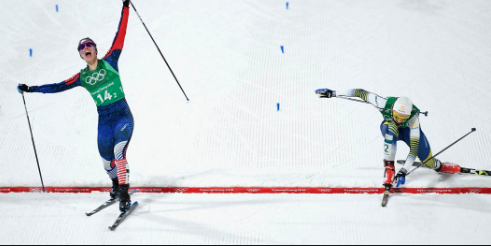
Jessica Diggins with Kikkan Randall win first Gold Medal for US XC in 2018, making Americans serious competitors on the international racing scene.
Since the time that wooden skis were found in a peat bog in Sweden dating to 2,000 BC, there have been many milestones that brought XC skiing to where it is today. In the USA, the forefathers of cross-country skiing include people like Snowshoe Thompson, who delivered the mail in the Sierra Mountains of California and Jack Rabbit Johannsen, who XC skied in northern New York.

Before around 1970 or so, XC skis were wooden, required the right wax combination to work on the snow, and bases had to be prepared with pine tar “melted” in. Since then, the XC world has experienced enormous growth and change. The editors of XCSkiResorts.com, using various sources, considered this recent history and development of the sport and created this list of the Milestones of Modern XC Skiing in the USA in rank order of significance:

Waxless skis with fish
scale bottoms made skiing simpler. (Credit: Tahoe Trail Guide)
1. Development of synthetic XC skis in 1974.
2. Development of the waxless based ski in the early 1970’s, most notably the Trak ski with synthetic fish scales on the ski base to eliminate the need for ski waxes. The waxless base gave the recreational skier grip on uphill travel while also allowing gliding downhill.
3. Integrated XC ski binding systems, which provided substantial improvements in simplicity of boot/binding interface and control in the mid 70’s.

Bill Koch started skating on XC skis in the Olympics and changed the sport. Credit: ISHA
4. Olympic and World Cup successes, like Bill Koch who won the Olympic silver medal in 1976 and World Cup in 1982, the first American to ever win at that level. The Nordic Trak exerciser used the Koch image as a fitness icon in advertisements for years. In 2010, there was US Olympic medalists in Nordic Combined, and in 2012 there was a World Cup winner in women’s sprint.
5. The onset of the commercial XC ski area concept began in 1968-69 at Trapp Family Lodge. This brought designed, groomed, and maintained trails making XC skiing easier and safer for the average person.
6. The skating technique proliferated, creating a faster paced and higher performance form of recreation.
7. Revolution Skis developed by Fischer led the way to shorter skis which were easier to use and consolidated ski sizing and simplified ski selection.

Vintage Mother Karen XC jacket made of synthetics came out in the 80s.
8. New lighter clothing with synthetic and breathable materials was more conducive to XC skiing comfortably; company brands such as Mother Karen led the way in the late 1970’s.
9. Other technological advances such as the 2 Wax System that offered one wax for cold temperatures and one for warm temperatures simplified ski waxing, while the BackCountry binding systems provided a beefed up boot/binding system that provided substantially more support and control for backcountry recreation.
10. The Nordic Integrated System (NIS) developed in 2005 has changed the ski/binding interface. This system combines the ski and binding at manufacture rather than at the retail store. NIS plates were affixed to the ski by the manufacturer and the binding was slid onto the plate rather than screwed directly into the ski.
The changes in XC skiing in the last 50 years has been explosive and exponential, compared to the 4000 prior years. What’s next? Better binding-ski-boot systems, warmer-adaptable clothing, improved grooming, and more resorts catering to the sport.


Protect yourself and others. Be prepared. Credit: Marketwatch
Correspondent Keller Minton’s article last week on taking a lesson in COVID times was praised by a ski world notable. Seth Masia, president of the International Ski History Association, long time ski journalist, active ski instructor at Aspen/Snowmass, and member of SeniorsSkiing.com’ Board of Advisors, wrote to us with some additional comments. Here are his observations:
Based on early-season experience at Snowmass, here are some points to bear in mind:
Stay warm! Indoor facilities may be limited, which limits opportunities to warm up over a hot chocolate. You may be out in the cold all day, so dress appropriately. Take measures to keep boots and gloves warm. This factor alone is reason enough to wear a mask, or a proper double-layer neck gaiter.
Lunch may be a problem. Many on-mountain restaurants sell take-out only, and some require you to order food in advance with a smart-phone app. Your instructor should be able to help set up lunch. Time indoors is limited, and you may wind up eating outdoors, on a patio or in a tent.
A mask may fog your goggles or sunglasses. In general you can ski with the mask down, but need to wear it on the lift or when the class stops to talk on the hill. When you mask up, consider lifting your goggles to prevent fogging. Invest in a no-fog cloth for sunglasses and prescription lenses.
Lift capacity may be limited. In a group lesson, where you’ll mix with strangers, you may be asked to ride lifts alone, or limited to two passengers on a triple or four-pack lift. This goes double for gondolas and trams.
Consider a private lesson, which opens the possibility of skiing as a family. This simplifies lift loading because members of a household can ride together. Some resorts that limit the number of people on the hill may give ticket-sales priority to private-lesson clients.
Prove you are negative. Some jurisdictions require proof of a negative COVID test for entry or overnight stays. Be prepared.
Go all online. Expect to make all reservations online, for rental gear, lessons, lodging and parking. Call centers are universally overloaded.
Seth Masia teaches in the Aspen/Snowmass ski school, and is based at Snowmass. See his website skiyoungernow.com


Where are we? What’s special about what’s going on?

Last Week

Clearly, there are some fantastic ski history buffs in among our readership. We had some spot-on descriptions of this old hotel last week.
This is the Poland Springs House in Poland Springs, ME. Here’s a bit of this famous landmark’s story from Glenn Parkinson, the historian at the Ski Museum of Maine. He writes:
“Hiram Ricker expanded his family’s inn at Poland Spring in 1876 by building a hotel with 350 guest rooms. The resort was marketed as a “country getaway with recreational activities and having water with health benefits,” according to the official history. The hotel became popular for the country’s social elite and the basic design was used to develop other resorts such as the Samoset and the Mt Kineo House.
“Recreational activities included one of the first golf courses in the state and of course a variety of winter activities. In some ways the Poland Spring resort was Maine’s first winter resort. Activities such as horse drawn sleigh rides, snowshoeing and skiing were popular. A toboggan slide ran all the way down to the lake. There was even winter harness racing on the ice of the lake. Photos of the time show lots of people wearing big fur coats watching a few people on skis or snowshoes. Into the 1920’s skiing was so new to most people that it was more of a spectator event than an activity.
“Well into the 1920s the Poland Spring Resort was one of Maine’s most popular places for winter sport and recreation.”
There are some fascinating photos of ski history in Maine at the museum site. Thanks to the Ski Museum of Maine for allowing us to use this picture.

After last week’s discovery of the two musical events that are held in the middle of the ski world, we thought we’d explore the intersection between snow sports and the music world one more time.
Last week, we highlighted the highly unusual and kinda cool “Gondola Sessions” where a band or sub-set of a band rides in gondola while performing and recording tunes. Just writing that sentence makes it sound nuts, but it seems to work. Kind of. There are a host of different bands riding gondolas at various resorts; we focused on our fav, Elephant Revival, singing on a Telluride gondie. Search YouTube for “Gondola Sessions”.
We also found WinterWonderGrass, blues and root music festivals held at snow country resorts in the winter. Indoors and outdoors. Senior music lovers, the idea for these gatherings goes back to Woodstock. Obviously, this season’s events are postponed.
SeniorsSkiing.com also has an interest in ski music, too. A couple of years ago, we re-published the music of Ray Conrad and his 1970 ski song album, The Cotton-Pickin’ Lift Tower and Other Ski Songs. Ray’s tunes are funny and sentimental. Here’s a sample.
This week, we were reminded of another great ski song performer. Correspondent LuAnn Snyder reminds us that John Denver composed “Annie’s Song” on a chairlift at Aspen. And, he performed one of the first pre-Go Pro ski music videos, skiing and singing “Dancing In The Mountains.” Check out her story here.
This Week
Skiing Weatherman Herb Stevens forecasts a parade of storms across the US. Finally, we are getting the snow and the cold to hold it on the ground, especially in New England. Click Here.

Could this be Nordic Heaven? Credit: Teton Pines
We have a great story in our Make More Tracks series from correspondent Jonathan Wiesel about nordic skiing in the magnificent Jackson Hole area. He says the snow conditions are beyond great, they’re “superb”. And check out the scenery. Click Here.

This might have been do-able last week, but, hmmm, today you can’t handle “it.” Rambo at Crested Butte. Credit: Chris Segal
Ski coach and correspondent Bob Trueman offers an article on what to do when you’re in a difficult situation, when you feel you can’t make it down, when you tense up. It has happened to all of us. His advice is useful and insightful. Click Here.
And our Question For You this week asks for your advice in handling those tense situations. What do you do when you freeze? We’d like to hear your experiences and its outcomes. Click Here.
Correspondent Don Burch has compiled a short video of an early season ski day at Okemo, VT. If you haven’t been out yet, this might get you moving. Click Here.
A new contributor Keller Minton, an instructor at Vail, offers some tips on taking a lesson during COVID. As you know, a lesson at the beginning of the season can make a big difference for the rest of your year. We know a lot of our readers do take an early season lesson. Here’s how it might be different this year. Click Here.

The old Model T can be seen at the head of the lift line. Credit: Ski History.
Mystery Glimpse this week reveals the site and date of that picture of the rope tow powered by a Model T Ford. And there’s a new picture of an old hotel. Can you identify where it was? Click Here.
Meanwhile, In The Seemed-Like-A-Good-Idea-At-The-Time Department.
If anyone knows the back story of this video, please let us know.


 Fellow ski journalist, Dave Irons, 82, reports, “…all I need is a morning that includes 5-10 runs.” He and his 60-year old daughter ski Shawnee Peak (ME). “The 1200 feet of vertical is plenty. She’s…in great shape, which is why she is good for a few more runs after the old man is ready for a beer.”
John Emery, 67, and his wife ski Bogus Basin (ID). “I still track and log my vert, not for bragging purposes but to keep myself honest.”
Rick Hovey is 66 and a resident of Park City (UT) since the mid-70s. Typically, he skis one million vertical and 80 days a season. Poor guy, last season he clocked 58 days and 900K vert. He writes, “I expect to meet my goals this year but will try to be satisfied with what I get.”
Rich Spritz writes, “My goal is to ski my age, though this year I may miss 70.” His family has a rule: “three runs counts as a day.” To anyone challenging the rule he suggests skiing three at “Breckenfridge” when it’s 7°F with wind howling, “then come meet inside by the fire and tell me that doesn’t count as a ski day!”
Susan Shaffer, Chapel Hill, NC, has skied one million vertical for several seasons. Last March, when areas closed, she was three days short of skiing her age.
Tony’s local area is Cannonsburg (MI) with 250’ vertical. The area is a few miles from where he and his wife are on patrol (99 years of patrolling between them). For Tony, a light day is 100 runs or about 25,000 feet. “It’s a lot cheaper than the gym and lots of fresh air.”
 At 74, Kevin Toolan’s perfect day is about 4 hours with his 6 and 10-year old grandsons at Okemo (VT) followed by lunch, a glass of wine and a nap.
Peter Hogan skis Copper Mountain with his step-son. They enjoy lunch at a sheltered woodsy spot with a view, then ski the bowls and take a long “butt-kicking” mogul run before a few beers.
Connie Grodensky writes, “Skiing local is what skiing is about this year.” She takes 10-run days at Mt. Bachelor (OR) and is happy to leave before the crowds arrive.
Ed Schultz, 76, skis 15 runs at Brantling (NY), with 250’ vertical. It’s small but in region that receives lots of snow.
Bob Ohrt, provides these words of wisdom: “Have been skiing local for many years. Depending on the year, ‘local’ might be a 300′ valley or a 3,000′ resort. It really doesn’t matter. Skiing is the experience and the sensation. Every ‘where’ can offer different joys. Ski what you have got.”
Many thanks to everyone who took the time to share their thoughts.

Here’s the challenge: summarize your thoughts about the season in 6 words. Several have been received. If you want to enter SeniorsSkiing.com’s Six Word Challenge, you may win a Booster ski boot horn, a great gift for any older skier.
Here’s a selection from the past week.
Louis Vigorita, Ventura, CA, commented on escaping Covid isolation:
Out of the bubble, into the snow.
Susan Zangrilli, Sandy, Utah, expressed one of this season’s dilemmas:
Mask, balaclava, gaiter, helmet, goggles. Breathe?
Her husband, David, laments not being able to boot-up in the Alta locker-room:
Boots on. Boots off. Sans bench.
Bob Ohrt puts this optimisitc spin on the season:
It’s the smiles not the miles.
And Jan Brunvand, Salt Lake City, who’s already skied seven days, sent this about his season’s goals:
Fifty days? Good luck with that!
National Ski Areas Association reports that last season, skier/boarder visits using season passes were greater than visits using single and multi-day lift tickets…a first for the industry.
Colorado Ski Country USA’s $35 Gems Card provides two 2-for-1 adult lift tickets or two 30-percent (30%) off adult lift tickets at each of these Colorado resorts: Arapahoe Basin, Cooper, Echo Mountain, Eldora, Granby Ranch, Hesperus, Kendall Mountain, Loveland, Monarch, Powderhorn and Sunlight. For more information: www.ColoradoSki.com/Gems.

You may have noticed a new look in the trail maps at places like Vail, Sun Valley, Squaw and Alpine Meadows, Stowe, Mt Snow, and Killington. They are among the areas utilizing the services of VistaMap, a company providing a comprehensive system for creating and maintaining trail and guest maps. Like any good map, these are easy to read and understand. The technology utilized let’s them be updated easily. Click here to visit Vistamap‘s website.
Remember Liftopia, the online ticket seller, which advertised extensively over the past few seasons? The company went under earlier this year after several resorts were not paid for the tickets Liftopia sold. The company’s liquidated assets were acquired by Skitude, a European ski-oriented tech.
Abandoned (24 minutes) tells the stories of several defunct Colorado areas.
Made Back East (21 minutes) follows a group of ski friends as they ski backcountry in New York and Vermont.
Twelve year old, Jacob Smith was diagnosed with a brain tumor at age 8. After years of surgery, he is well but legally blind. This 7 minute video tells Jacob’s story, including his descent on skis of Big Sky’s Big Couloir. Need a pickmeup? Don’t miss this one!


More than great, these are superb conditions. Credit: Teton Pines
The week before Christmas, 1980, I drove west from Cody, WY, through the rugged Absarokas, over Togwotee Pass, dropping into the northeast corner of Jackson Hole, then south to the town of Jackson. Deep fresh snow covered the landscape, with occasional bison, moose, and coyote tracks crossing broad meadows. The road parallels the Snake River. So do the Tetons, which tower about 7,000’ above the river, with maybe the most spectacular skyline of any mountains in the Lower 48
For the next ten years, I skied, hiked, ran, and biked on both sides of the Tetons on the western edge of the valley (“hole” in frontier lingo), the Absarokas, and the Gros Ventre and Hoback ranges to the east. It was a fantastic time to live there, working as one of the world’s first Nordic ski area consultants.
Watching Jackson’s explosive transition from a cow town to a resort region was a little alarming. Happily the surrounding country stayed pretty much unchanged because almost 97 percent of the region is federal land that won’t be developed. Yellowstone National Park is just north of the valley.
Jackson Hole is a special place for winter lovers. Part of that’s the beauty and the pristine quality of Grand Teton National Park; some of it’s the amount and quality of snow. But for Nordic skiers, maybe the main draw is diversity in that stunning setting. It doesn’t matter whether you’re a track aficionado or skater, tourer or telemarker, loner or family skier —there’s not just that sad cliché, “something for everyone,” but a lot that’s absolutely superb quality. Today you can find an online resource that introduces you to all things Nordic (including snowshoeing and fatbiking) in the Jackson Hole area: click here for JH Nordic. You can figure on 300 km of groomed trails in total regionally.
Movin’ and Shakin’
Perhaps the most influential XC player around Jackson has been a specialty shop, Skinny Skis, which provides high quality rental gear, retail equipment, and clothing.
There’s also a core of friendly long-time locals in town who’ve played a huge role in popularizing Nordic skiing. They’ve been coaches and racers, backcountry guides and Olympians, as well as people who ski non-competitively, just delighting in the outdoors in such a beautiful place. A lot of them are members of the Jackson Hole Ski & Snowboard Club, whose Nordic division has been grooming at Trail Creek Ranch since the late 1960s, at the base of Teton Pass.
Private Tracks
Teton Pines has 16 km of gentle golf course skiing, complemented by instruction, rentals, and guided tours with affable Nordic director Cody Downard. (You’ll often find his photos in Cross County Skier magazine).
Grand Targhee Nordic Center, on the western slope of the Tetons, has 15 swooping kilometers of groomed trails. The resort is about a 75 minute drive from Jackson.
Open since 2014, Turpin Meadow Ranch is a relative newcomer locally but already has a national reputation. Anchoring the north end of the 50-mile Hole, they’re a complete destination—cabins and chalets, great food (check out the Bob Dylan photo in the lodge, taken at the ranch in the 1980s), amiable staff, and 20 km of groomed trails. The ranch is a little higher than most other regional skiing, but generally routes are on the gentle side in meadows and forest, though there are some climbs and thrills too, starting right behind the lodge. Dogs, snowshoes, and fat bikes are all welcome.
Public Trails
Jackson Hole doesn’t have interconnected trails on the scale of Sun Valley, Idaho, or the Methow Valley, Washington, but public trails are immensely popular locally—and they’re free.
As much as 30 km (and growing) of the Jackson Hole Community Pathways and Trails are groomed, some very close to town. Teton Valley Trails and Pathways, at multiple locations on the west (Idaho) side of the Tetons, is rapidly evolving into a destination. And Grand Teton National Park grooms almost 25 km of summertime road, with wonderful profiles of the Tetons to the west and no snowmobiles within sight or sound.
When you visit
Plan a week’s stay, or you’re depriving yourself of grand exploration. There’s also world-famous downhill skiing, dog sledding, the fabulous National Museum of Wildlife Art, sleigh rides on the National Elk Refuge, and recreational eating at dozens of restaurants (try Fish Creek Inn in Wilson for breakfast and The Blue Lion in Jackson for dinner).
My favorite lodging is the Alpine House, a 22 room B & B that’s owned and run by Nancy and Hans Johnstone, both former Olympians. They’re still avid skiers with great stories about everything from international competition to climbing in the Tetons.
Could this be Nordic Heaven? Credit: Teton Pines
Progressive Storm Threats Gets Underway
Although it’s likely that the holiday period will be a Covid-induced quiet one across the country, it is now crunch time for opening terrain that will create adequate social distancing to fend off further operating restrictions.
The past week brought about a pattern change that delivered snow to many resorts that had seen very little. Of late, storms have moved into the West, across the continent, and through the East and that trend will continue. Canada has been milder than normal for many weeks, but cold air is now building and becoming available for the storms further south so the potential for more snow in more spots is on the rise. In addition, I am a little less concerned about a holiday eastern warmup than I was last week.
In weather geek language, we are in a “progressive” pattern, meaning jet stream ridges and troughs are moving along from west to east without locking in for an extended stay. That produces changeable weather, but with more cold air becoming available from Canada, we are now talking more about snow and less about rain. There are still forecast challenges with respect to storm tracks, but overall, things are looking up.
In the near term, storms will move southeastward from the Gulf of Alaska and dump on the coastal ranges of British Columbia, Washington, and Oregon. Much of the moisture will get wrung out before the systems reach the northern Rockies, but there will be “topdressing” snow further inland most mornings through next week. The central and northern Sierra will pick up snow later this weekend and early next week with the prospects not as good further south due to the systems tracking too far to the east. Northern Utah and Colorado will cash in on the passage of these quick hitting systems next week but a lack of deep moisture will keep amounts light. The southern Rockies will see little new snow in the next week.
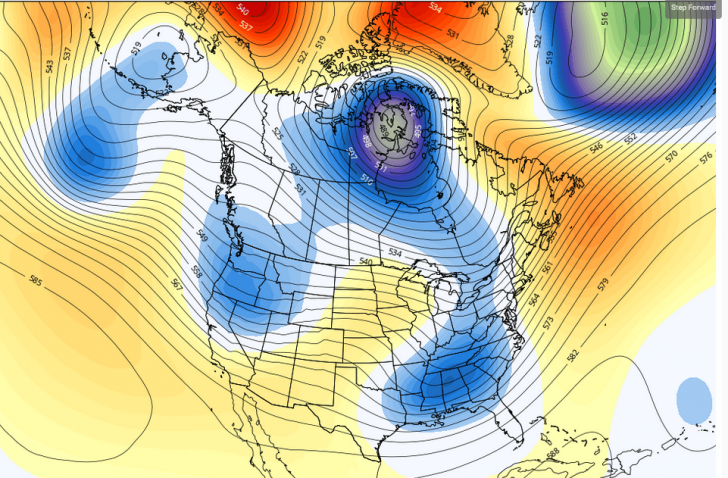
Over the eastern half of the country, disturbances will approach in both the northern and southern branches of the jet stream. Cold air will still be a little scarce in the short term, so the track of any storm will determine where it snows. But the potential is clearly there, as this jet stream forecast for Monday, December 14 clearly illustrates.
On this map we see a trough over the South, with an extension northward to Canada, a combination that could easily produce snow from the mid-Atlantic resorts up through New England. Notice also the trough along the Pacific Northwest coast and the next in line south of the Aleutians. The deeper trough over northern Canada acts as the center of the wheel, with the other features effectively rotating around it. The orange over Greenland plays an important role for the East in this pattern. That’s an upper level ridge that makes it easier for eastern troughs to strengthen as they approach the Atlantic. Indications are that the ridge will remain in the same general area until late month, so storm threats will be fairly frequent. Each trough that passes by will deliver a chunk of colder air from Canada, so the snowmakers will have ample opportunities as we approach the holidays.
Northwest U.S./Western Canada: Frequent storms from the Gulf of Alaska bring heavy snows every two-three days. Snow levels bounce a bit in Oregon Cascades.
Sierra: Periodic light snows from Tahoe northward until further notice. Minimal snow in southern Sierra.
Rockies: Northern resorts get frequent light to moderate snows. Occasional light snows Wasatch and central resorts. Limited snow prospects further south.
Midwest: Clipper system brings light snow Tuesday and delivers good snowmaking temps and modest lake effect snows.
Mid Atlantic/Southeast: Colder weather arrives Monday. Potential snowfall Tuesday. Good snowmaking week.
Northeast/QB: Mixed precip Sunday. Mountain snow showers Monday. Good snowmaking week with additional storm threats.

This might have been do-able last week, but, hmmm, today you can’t handle “it.” Rambo at Crested Butte. Credit: Chris Segal
Consider a ski run you’ve done before and which you found perfectly do-able with your present level of technical skiing skill. But conditions have changed, and the snow is less easy to ski; perhaps the temperature has fallen and the surface is now more crisp. Or the light has gone totally flat. Or the cold is really distracting. All of a sudden you find yourself getting scared.
The most likely reason for this is you probably don’t have the skills that will make you feel confident you have total control of your skis. In the longer term, it is clear that you need to improve your level of skiing skill. Right now, however, you are not certain you will able to handle the situation.
Shouting “Be Confident” won’t work. Having someone else shout “Just do it” also won’t work. “Go on, you’ll be okay” won’t work, unless you find it immediately believable. Being able to ski better is the single thing that would give you more confidence, but it is not available to you in the moment, now, when you really need it. What you need now are a few self control techniques to help you get down safely in control of the situation.
Getting Focused Is The Key.
Here are a few “emergency situation” tricks that may help you get out of a bit of trouble, so you can get down safely, without too much psychological damage, and begin a plan of action to improve your skiing and the number of situations you can conquer.
• When things begin to “go pear-shaped”, we need to bring your focus to the situation, not think “expansively”.
• First of all, even if there seems to be a shortage of time, STOP. Stop and reassess. Don’t be afraid to actually shout “STOP!” You need to get your brain waves smoothed out. Stopping still will help. Be prepared to do it repeatedly as you descend; it’s likely not to be a one-off job.
• Ask yourself—and take care answering—”Is this the end of the world, or something less? What single small thing can I do that will help?” Remember, whatever that is, it doesn’t have to be a complete cure; it only has to get you through the next few seconds. They will in turn lead you to the following few seconds.
• The general rule of thumb is: The more dire the situation seems to you, the shorter should be your attention span.
• Don’t think big: think small. Don’t think “long distance”, think “the next ten yards”.
• Don’t think long term: think the next ten seconds or even less. “Can I get through and survive the next two minutes / ten seconds / the next one second? What do I have to do to hang on?
• Don’t think “skiing down to the bottom”: think the next single arc. Only one. Then stop again. Pull that one off, and it will give you confidence for the next one. (Successes lead to successes) Give yourself a few seconds at least, to take your single-arc success on board. Recognize it.
• Stop after each arc until something in your head says, “Hey, we could link a couple together now”.
• Finally, for now, do not blame yourself. Resist the temptation to call yourself names. Avoid belittling your self. Being scared is natural, commonplace, and surmountable. It is a strong emotion, and your best defense is anything at all that helps you not to be emotional. Do your best to be rational, and content with that “best”.
Get used to these ideas before you head to the piste. In the quiet of your study, spend some time sitting and imagining situations where you may use them. Those imagination sessions will serve you well next time you need one of these, in earnest. When you are imagining, get deeply into it, “see” more than you normally see, make slopes steeper than they really are, imagine the slope more polished, hear snow-boarders scraping the snow right behind you; enlarge the whole situation. See the colors brighter. Hear the sound around you louder. Imagine yourself lifting one ski off the ground and sense what it feels like. You are completely safe, it’s only imagination.
Anytime we feel fear or apprehension, our perceptions are telling us that “we may not be able to handle it”. So, STOP and define what “it” is.
If for example “handling it” involves skiing with linked arcs down something you don’t like the look of, then how about redefining “it”. Call “it”, “Getting down the next 20 yards safely,” and the picture will look different, because you have now taken skis out of the equation. You could even take them off, carry them, and walk based on your definition. Or you might perhaps side-skid if you know how.
When you have taken control, you will have done it by defining the problem. No one would blame you or call you names (except you, if you let yourself). In fact probably no one would even notice; most folk on ski slopes, especially tricky bits, don’t notice anything, except their own situation.
Never be ashamed of being apprehensive or scared; just realize there are ways to handle difficult moments.
Editor Note: Bob Trueman has a free self-coaching guide called My Performance Review that has helped hundreds of skiers re-set their psychology after a difficult day. It’s simple to use and powerful. Click here to visit Bob’s website Bobski.com, then go to Contact Us and send him an email. He’ll send My Performance Review to you via email.

John Denver Composed The Lyrics On A Chairlift.
John Denver filling up our senses. He wrote the lyrics to Annie’s Song on a chairlift.
[Editor Note: Correspondent LuAnn Snyder, a director of the Baltimore Ski Club and a big John Denver fan, contributed to this article.]
Did you know that John Denver was an avid skier? John Denver wrote his classic song “Annie’s Song“, while riding a chairlift to the top of Ajax Mountain in Aspen as an ode to his then wife Annie Martell. John spoke about the making of Annie’s Song” and what the song meant to him.
“Annie’s Song” was written after we had been through a particularly difficult time and had come together again, in many ways closer than ever before. We really felt together and much closer from the experiences we had been through.
One day I was skiing, and I had just finished a run that was totally exhilarating. I skied down to the lift, got on the chair, and was off and up the mountains again, my thighs burning and still in the process of catching my breath. I looked out at the mountains I love, and the Colorado sky was a blue color you can only see from this altitude, my favorite color I might add. The deep green of the trees against the white of the snow, the colorful outfits the people were wearing, the sounds if life as it goes over each tower, and birds singing, and laughter, and the smell of the clean, fresh air out there in the wilderness-all those things were going through my mind and it was all beautiful. It filled me completely.
I began thinking about other things that are like that for me, and my first thought was of the woman I had fallen in love with again, and how she filled me so completely. Then I started thinking of other things—things in nature. And in the ten minutes it takes to go from the bottom of Bell Mountain lift to the top, I had written “Annie’s Song.” I had the melody in my head, and I knew the chords on the guitar. I skied down to the bottom, of the hill, raced home, picked up my guitar, and played it.
You fill up my senses, like a night in a forest
Like the mountains in springtime, like a walk in the rain
Like a storm in the desert, like a sleepy blue ocean
You fill up my senses, come fill me again
Come let me love you, let me give my life to you
Let me drown in your laughter, let me die in your arms
Let me lay down beside you, let me always be with you
Come let me love you, come love me again
Let me give my life to you
Come let me love you, come love me again
Annie’s Song sold more than a million copies staying at number one in the US pop charts for two weeks and three weeks in the US adult contemporary charts in the summer of 1974. Since then it has graced many a wedding, though it did not cement Denver’s marriage. He and Anne were divorced in 1983.
Back in 1980, John Denver also filmed a music video production at Aspen, featuring his Dancing With The Mountains tune. Note his form, the sunglasses, the one-piece ski suits, the free-stylers, the Go-Pro like shots–classic early 80s ski scene. Hugely popular, this music video had apparently faded into obscurity until it was unearthed and posted on YouTube. We miss you, John Denver.
Some skiers are Alta took at shot at re-creating the original 1980 Dancing In The Mountains video to celebrate the end of the 2017 season. The dude doing the John Denver part has the green parka and cool shades down. Check it out below.


Ugh, tensed up and clutching happens to everyone.
Yesterday, you did fine on Wild Thing, that steep, narrow trail on the shady side of the mountain. Today, Wild Thing is crusty, heavy, or worse, boilerplate, and it’s the only way down. Or, the afternoon light has gone totally flat, you’re at the top of the mountain, heading through the trees to the bottom. Or, you took the wrong lift at a resort new to you, and you’re in double black diamond territory. Or, you’re really, really cold. Or, it’s the last run of a long day, you’ve pushed it a bit too far, and you’re whipped. Or, you’ve had a fall that came out of nowhere, and you’re spooked, perhaps sore.

Uh-oh, the mojo ain’t working today. Credit: AlexanderTT
We have all been there: In a difficult situation, tensed up, and wondering why people put sticks on their feet to slide down mountains in the first place. Where’s the hot tub? Where’s the fireplace? Where’s the Heineken? Gotta get down and outta here!
Ski coach and SeniorsSkiing.com correspondent Bob Trueman has an interesting article elsewhere in this edition. He provides some guidelines for dealing with difficult situations like these, where the world suddenly goes pear-shaped and fear narrows your perspective.
But we’re curious what you do in those tense, scary moments.
Write your comments in Leave A Reply below.


Snow finally came to New England last week whether through machines or from the sky. It finally got consistently cold enough to make the stuff or for real snow to stick.
SeniorsSkiing.com correspondent Don Burch ventured out to see what was going on at Okemo, VT. Here’s his video report from the slopes. If you haven’t been out yet this year, perhaps this short video will rev up your enthusiasm.

Imagine our surprise when we were searching YouTube for tunes from one of our favorite bands when we found, wait for it, the “Gondola Sessions.”
We love the Colorado band Elephant Revival; they have creative, evocative tunes played with expert musicality. So when we saw them playing ensemble in a gondola going up a mountain in winter, we were stopped cold. What the heck is going on? A band playing music in a gondola? Don’t believe me? Click below.
Yes, that’s an ER-er Bonnie Paine playing the saw in a gondola along with the other members of Elephant Revival heading up at Telluride.
It seems there are “Gondola Sessions” filmed at ski resorts from New England to New Zealand. It all started when producer John Austin was inspired by “unplugged” music—videos of artists playing acoustic instruments in relaxed settings—and the intimate feeling those created. Austin started booking bands to play at Aspen’s Silver Queen gondola, recording them during the 15 minute ride up. Since then, you can find more than 80 different gondola sessions with widely-diverse bands and solo artists on YouTube, recorded in summer as well as winter sessions. Just search for “Gondola Sessions” in YouTube.
Along with our initial YouTube search for Elephant Revival tunes, we discovered another musical happening at ski resorts that we never knew about. Have you heard of WinterWonderGrass? For 10 years, music impresarios have staged winter music festivals in Steamboat, Squaw Valley, and Stratton Mountain. The days-long festivals feature bluegrass and roots music from very cool bands along with craft beer and merch from a variety of sustainable, environment-friendly vendors. Performances are sometimes indoors and, yes, sometimes outdoors. The motto of the producers is Music, Brews, Mountains. Click here for more information about WinterWonderGrass. As you can imagine, this season’s festivals are adapting to the pandemic.
What is it like? Here’s a full Elephant Revival set at the 2015 WinterWonderGrass festival at Steamboat. Enjoy.
Note: Elephant Revival is a terrific band and has a number of excellent videos on YouTube. Unfortunately the band has suspended performing indefinitely.
So, there is music in the mountains. Innovative, energetic, embedded into the resort environment. No, you don’t have to be under 35 to enjoy these musicians and their music. You just have to love music.
Have any of our readers been to a WonderWinterGrass festival? Let us know. Leave a comment in the reply box below.
This Week.

Dreamcatcher at The Canyons. Plenty of snow already for the new season.
Skiing Weatherman Herb Stevens reports that winter snow is finally coming to the Northeast. Consider how lucky Killington was last year; the Women’s World Cup was held on 11/30-12/1/19 with the help of some expert snowmaking. This year, not much cold to make the stuff until now, that is. Click here.
We are asking a Question For You that we asked before: What is the experience of your first visit to a ski resort like in COVID times? When we asked a couple of weeks ago, we didn’t get many comments because it was way too early. Let’s see what happens this week. Let us know. Click here.
We do have a report from John Farley on his first outing at Wolf Creek, CO, the first resort in North America to open this season. His strategy for dealing with parking is interesting. Click here.
Correspondent Tamsin Venn summarizes the pandemic preparations and regulations at big Utah resorts. Know before you go. Click here.
Stephen Bell’s series on renting an apartment in your ski house concludes with some advice on operating the rental as well as financing a purchase. Steve seems to have made a small business pay for his new residence in Big Sky. Click here.

Hirsch Stube in the summer. Small, friendly, perfect for a day of rest from skiing.
New correspondent Dave Chambers writes about a charming incident in a tiny trattoria in the Aosta Valley. Dave is an Australian who spends time skiing the Alps when he’s not skiing the scene in OZ. Click here.
Long time correspondent Marc Liebman tells us about is recuperation from a debilitating infection. It is interesting he was inspired by an ultra cheap season pass for veterans, and he’s determined to use it somewhere this season. Click here.
As part of our Make More Tracks series on alternative snow sports, Cross country editor Roger Lohr summarizes what you have to know to get started in Cross Country skiing. We believe the xc option makes a lot of sense for seniors who want to get outside this weird winter. Click here.
Finally, our Mystery Glimpse picture this week is one that goes back to the start of skiing in New England. And we tell the remarkable career of Bjorn Daehlie, the fantastically Greatest Of All Time Nordic racer. Read about his VO2 max and and how that made him a very special human specimen. Click here.
Note: From time to time, SeniorsSkiing.com will send our readers a special email from one of our advertisers. You will be getting one from us soon. Please know we will never sell our list of subscribers to a third party, and we hope you support the vendors who are advertising with us.

Restrictions: Help, hinder, hopeless? What is your experience? Credit: USNews&WorldReport


Currently, we’re in our place several miles north of New York City. The closest reasonable skiing is about 2.5 hours to the north where there are several areas with vertical drops ranging from 1,100’ to 1.600’.
Which got me thinking: how much vertical feet is needed for a satisfying day of skiing?
I posed the question to several skiing friends around the country. Their responses offer insight into what makes us happy about the sport.
Travel Writer Roger Toll, 75, lived in Park City and Santa Fe and has been skiing for 60 years. In his 60s his daily diet ranged from 20k’ to 40k’. When he moved from Park City to New Mexico, he was lured by free skiing at Ski Santa Fe, an area with about 1,200’. Enjoyable as he found some parts of the mountain, its 1,200’ vertical entertained him for about 10 runs or 12k’; “…enough to have a great day, especially when it’s free.”
 At the other end of the country, Howard Vipler finds skiing Hunter Mountain’s 1,600’ satisfying but generally calls it quits by noon. He retired from Hunter’s Ski Patrol after 40 seasons there, so he knows where to find fewer people and better conditions. Even so, for him, 1600’ has it limitations.
Back to the west, where Dick Chapman, retired pain researcher of international renown, skis Wolf Creek in Southwestern Colorado. Dick was 58 when he started. He’s now 76. Wolf Creek has about the same vertical as Hunter Mountain, but far more snow. Its tagline: “The Most Snow in Colorado.” Dick’s measure for a satisfying day on the hill isn’t vertical. He writes, “Fun is skiing at the edge of my ability and successfully meeting little challenges.”
Now to Colorado’s I-70 corridor and Vail, where David Orlinsky books a minimum of 10 runs and/or 15,000’ to qualify for a satisfying day on the hill. Having skied with him, I know that’s an understatement. Over the past two decades, the retired businessman has averaged one million vertical feet per season!
One state over, in Utah, Jan Brunvand and Harriet Wallace have different takes on what it means to have a satisfying day. Their names often appear with their SeniorsSkiing.com articles.

Jan, professor emeritus of English at the University of Utah and widely recognized as popularizing the concept of the “urban legend,” doesn’t count daily vert. At 87, he requires skiing a minimum of five runs in order to log the day. Usually he’s in the 7-10 run range. I’ve taken a few runs with Jan and hope I’ll be as graceful and having as much fun when I’m 87.
I’ve also skied with Harriet, 80, whose optimistic outlook is infectious. As she explains it, “It’s not about vertical. It’s about being outdoors…dancing down the slope…blue skies and whiteouts. It’s all about friends, no app needed.”
There were several other responses which I’ll try to include in a future column. I’d like to hear what you think makes for a satisfying day on the hill. Please post a comment or drop me a line: jon@seniorsskiing.com.
Hemingway may have started this form. Six words that express a thought. What six words express this season? Send your entries to jon@seniorsskiing.com, please. Planning to select some good ones. Author credits will appear with each. Reminder: six words about this season. I came up with the following. “Escaping Covid. Skiing in my mind.”

Before/After: Arapahoe Basin Patroller, Thomas Olsen, Credit…Ian Zinner/Arapahoe Basin Ski Area
It’s all about getting a proper fit for masks, and it’s changing the traditional face of male ski patrollers. As this recent New York Times article explains, patrollers’ beards are going, going, gone!
British Columbia’s third-largest ski resort is ending skiing privileges for pass holders refusing to wear masks. First offenders lose a week; second offenders, a month. “It’s pretty simple, if they don’t wear their mask, we pull their pass. Once we told them they lose their skiing privileges, the argument stopped pretty quick,” said Michael Ballingall, senior vice president, Big White Ski Resort.

Here’s a Swiss lift ticket concept, US areas might consider: Crans Montana, the large, seniors and family-friendly Swiss ski resort has a new HotelPass allowing those lodging in participating hotels to purchase last minute lift passes at deep discounts. No advance reservations. Total flexibility of when to use. Click here for more info on the HotelPass. Participating Crans Montana hotels also have new, highly flexible cancellation policies.
We’re taking the final laps before crossing the vaccine finish line. Do what you need to do to avoid getting infected. If you already have been or are, do whatever you can to get well. Above all: Think positive. Test negative.
The Chairlift is one of the best short ski films to date. A little over 12 minutes, it’s an homage to the chairlift and it’s unique culture. A production of Salomon, which released it a few days ago.
You’ll start receiving occasional emails from some of our advertisers. Each will be relevant to skiing and related topics. SeniorsSkiing.com will distribute the emails; we don’t sell our list or your email addresses to third parties. We hope you’ll find them of interest.
Restrictions: Help, hinder, hopeless? What is your experience? Credit: USNews&WorldReport
A few weeks ago, we asked our readers to tell us how their first visits to a ski resort went in this unusual year. We wanted to hear reactions to constraints, regulations, and policies designed to keep visitors and staff safe.
Unfortunately, we didn’t get many responses, presumably because it was a bit too early for resorts to open and our readers to visit.
When we received a detailed report from a reader on a visit to Wolf Creek, CO, we decided to ask our question again. Reader John Farley described his visit to the moderate-size Colorado area—the first in North America to open—and how his strategy for parking and getting to the lifts worked out for him. Click here to read his dispatch.
Please write your comments in the Leave A Reply box below.

If the optimist in all of us considers November 1 the start of the winter sports season, then the first month of this season was a dud in the eastern half of the country. Cold air masses were infrequent visitors, and natural snow was even harder to find.
A persistent jet stream pattern brought early snow to the West while the East was stuck in mid-autumn weather much of the month. A western trough/eastern ridge couplet was common and kept any early winter weather bottled up over the West, especially in the Northwest, closer to the source of cold air. The ridge kept it unseasonably mild in the Midwest and East, with only passing chunks of cold air that supported brief snowmaking windows.
Well, the weather worm has turned, and it is now the eastern half of the country where an upper trough is promoting cold and snow while the West sits under a strong, quiet, ridge. Now, the air across Canada is milder than normal pretty much from coast to coast, but as it flows into the lower 48, it is just cold enough to lead to snowfall. Much of Ohio as well as western New York and far western Pennsylvania got tagged with a moderate snowfall early this week. Another storm will be on the weather maps this weekend. Because the axis of the upper trough that supports it will be further east than it was several days ago, the track of the surface storm will also be displaced eastward to the coast where it can tap deep moisture as it tracks toward southeastern New England.
Here is a look at how the jet stream will look early Saturday.
The axis is just east of the Appalachians and a surface storm that forms along the mid-Atlantic coast will be ushered up toward southeastern New England, a nice track for snow for the mountains of the Northeast. Cold air will be limited with this storm so elevation will play a big role in the battle of snow vs. rain.
If all the pieces come together, this storm has the potential to produce moderate to heavy amounts from the Catskills and Adirondacks through the mountains of western and northern New England. In addition, sufficiently cold air will move in behind the storm to allow productive snowmaking in the Upper Midwest and Northeast early next week. Full disclosure: If the northern and southern branches of the jet don’t work together to form the system you see on the map, then the storm will be a dud. But I am an optimist; first turns look plausible next week!!!
Looking further down the road, it looks like the eastern trough will dominate for about two weeks and additional opportunities for snow will develop. After that, the pattern is likely to revert to the western ridge/eastern trough combo, which is more favored in La Nina winters like this one.
Here are the regional details:
Northwest U.S./Western Canada: A storm will try to dent the ridge late this weekend/early next week and lead to high elevation snow from Washington into B.C. Better pattern evolves mid-month.
Sierra: Dry for at least the next week; pattern change mid-month is next good chance at snow.
Rockies: The upper ridge keeps it dry for the next week. This region will also be waiting for the western ridge to break down.
Midwest: Seasonably cold for the next week and likely longer. Decent snowmaking temps most nights. Alberta Clipper systems will bring light snow every few days.
Northeast/QB: Favorable pattern for snow and snowmaking temps for next 12-14 days. Potential for significant mountain snow this weekend. Pattern change to milder
[Editor Note: This article first appeared in XCSkiResorts.com.]

XC in Mammoth Lakes, CA. Beautiful vistas are included free of charge.
Getting outdoors, going at your own pace, enjoying and sharing an outing with a friend or family member of any age, and getting some winter exercise are all good reasons for older folks to try XC skiing. You can have a purpose (fitness or reaching a destination) or a goal (getting out a few times a week, or attaining a number of times on skis a year) with your XC skiing. The sport is known to provide a level of calorie burning but it also is very helpful to combat various ailments including mental health such as depression and anxiety.
Tips for alpine skiers to have a positive introduction to XC skiing include:
There are some major differences between XC skiing and downhill skiing that include:
Skis are much narrower and the boots offer much less support compared to alpine skis. This requires more reliance on balance and weighting the skis rather than leaning on a big plastic ski boot.
The clothing issues are also significantly different as noted in the above tips. XC skiing creates heat for the skier and you don’t go as fast so there is less wind involved that makes you feel cold. You also do not sit on the chair lift, so less insulation is needed.
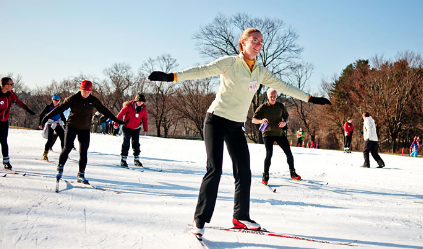
Take a lesson from a pro. Here’s balance practice. Credit: Weston Ski Track
On downhills, XC skis require an even weighting technique when snow plowing and it is recommended that you dominate the skis by making sure that weight is distributed to both your heel and the front of your foot. Rolling the ankles inward really helps to push the skis out in the snow plow (weighting the central part of the ski) so it slows down and allows control. Flimsy XC ski boots makes this more difficult but stiff boot should give more control. Twist the boot sole to compare the stiffness of different pairs of boots. On XC skis it is possible to go faster and out of control. In untracked snow you can burrow into soft snow and fall forward if too much weight is on the toes when snow plowing.
Longer poles have a different purpose in XC skiing as they should provide about 20 percent of forward momentum and are more than a turning cue as in alpine skiing except when you are turning the skis while going down hill.
The best suggestion is to avoid overdoing it—bring some chocolate treats, take in nature and winter scenery, and make it about more than skiing, and it can give you a quality experience and great memories.


Marc—The Inspired Biker—Liebman
Last winter and spring, like many others, I watched the ski season melt away. For those who went before the big shut down, good on you. For, me, the only hopes I had of skiing was in late April or May or June at Mammoth. And, poof, that was gone.
Slowly, I had been building back the stamina I had from a persistent infection I was fighting since the previous summer, but at 74 and more than a half, what was gone was gone, never to return.
Yet, I had hope.
Hope came from several sources. One was that medically I knew I was beating the bug. Another was from the emails from ski areas saying they just received X inches of new snow. Snow wasn’t going away. That was comforting.
Another inspiration came from an odd source. One morning, my inbox has an email from the people who run Epic Pass offering a steep discount for an unlimited pass assuming I could prove that I was a member—active, reserve or retired—of the U.S. military. I read the fine print, called and then had a long online chat with the online person before I plunked down my credit card data for an Epic Pass that cost about what I would spend for two days of skiing! The purchase was a no brainer.
So, with that in hand, so to speak, I was even more inspired to regain as much as I could the way of fitness for the season to come. At the end of June, I was finally off the medications and cleared to start exercising more “vigorously” than walking. Since Covid had shut down all gyms and even when they re-opened, they were considered high-risk for a septuagenarian.
What was left? Summer in North Texas was here, and I pulled my bike down from the rack. The tires were flat and when I tried to pump them up, I popped both tubes. Since it hadn’t been ridden in a year, I took it to a bike shop which recommended that I replace the brake pads, (cracked and split and soon wouldn’t work) and the chain which was showing some signs of wear.
How long to fix? Six weeks! Egads! Everyone was rehabbing their bikes, it seems. So it was back to walking.
But, beginning in August, I was on the bike four or five times a week. The goal, get back to 20 miles a ride. Now, before you are impressed, the elevation change of the route I take is a whopping 94 feet. I’m averaging about 10.6 miles per hour so I am not riding like a bat out of hell. Eleven miles takes roughly an hour.
The most important thing is that I am riding and am, as of this writing, doing about 12 miles a ride. Still working on getting to 20. Next challenge is figuring out how to get to the slopes to make use of my Epic Pass.
Now that’s an inspiration.

Credit: Trapp Family Lodge
There’s more to winter besides downhill skiing. This issue will explore additional ways you can Make More Tracks.
Let’s be clear at the top: We love Alpine skiing, the thrill, the speed, the grace, and all that. We always will, so don’t think this Special Edition of SeniorsSkiing.com devoted to alternative winter snow sports is an abandonment of the mainstay that almost all of our readers have been participating in for years.
However, this year, we anticipate that while our readers will at first enthusiastically head to Alpine resorts, reserve online, gear up in their cars, mask up, social distance, eat a bag lunch, and all the rest, many will grow weary of those restrictions. Or become frustrated. Or not bother going at all.
But, since we know our readers love winter and snow, we also anticipate that they might be open to alternative snow sports that might be new to them or to which they may be returning. Like cross-country skiing and snowshoeing. These are accessible, easy to learn the basics, affordable, safe (social distance built in), and good for body and soul.
Since the beginning of October we have been publishing a series of articles named Make More Tracks. These include instruction, resort reports, clothing advice, and the like. In addition, we’ve compiled a Make More Tracks Resource Guide with a compendium of articles about the alternative winter snow sports, covering gear, destinations, technique, and how to dress, and much more.

Co-Publisher Mike Maginn on wooden skis, circa 1970.
We are dedicating this entire issue to Nordic skiing, snowshoeing, and Fat Biking. Hopefully, you will read something that might stir you to think about getting into other winter sports. We’ve been loving cross-country skiing since the early 70s. So much so that we still (occasionally) get out our wooden skis, wax, four-pin bindings, and take a loop around the farm across the street. On a bluebird day with perfect snow, the right wax combo, and a Heineken in your backpack, there is nothing like it.
ANNOUNCEMENTS
We are extending our special introductory classified ad offer until Dec. 4th. That means you can post a classified ad for 30 days from the date you post for just $1. We’re hoping you take advantage of this opportunity to find ski buddies, share rides, rent condos or apartments, and sell gear and collectibles.
We’ve been contacted by several readers who are frustrated by having to re-enter their name and email on the subscription pop-up. We know this can be frustrating. Here’s what you can do to eliminate the problem: TURN ON “ENABLE COOKIES” IN YOUR BROWSER ON EACH DEVICE YOU USE TO ACCESS SENIORSSKIING.COM. We’re working with our IT resource to make enabling cookies more clear as a way to avoid constantly re-entering name and email.
This Week

SeniorsSkiing.com’s cross-country editor and publisher of XCSkiResorts.com Roger Lohr explains what XC means to him. Our thanks to him and cross-country journalist and consultant Jonathan Wiesel for their support and contributions to the Make More Tracks series. Click here.
Our Mystery Glimpse picture this week is a Nordic competitor who may be the greatest xc racer of all time. We predict some of our readers will get this one right away; others will have no clue. Such is the fate of Nordic celebrity in the snow sport world. You will also learn the name of that odd parka from last week. Click here.

“Au naturel” trail across Appleton Farms field. Credit: SeniorsSkiing.com
This week’s Question For You asks our reader’s preference for what kind of XC ski trail they like best: groomed and groovy or no grooming. Our choice is actually a little of both. Click here.
We have a short video about a cyclist making his first fat bike ride on a chilly day. We learned that keeping toes warm is a project. Click here.
Kelly Davis is a noted snow sports industry market researcher. We met her several years ago when she was director of research at SIA, the industry trade group. Currently, she runs Snow Sports Insights, a consulting company that brings information to decision-makers about the changing market place. Here’s her view of what’s happening this year in the Nordic/Snowshoe market space. Interesting stuff, and thanks to Kelly for allowing us to reproduce this article which first appeared on the Cross Country Ski Area Association website. Click here.

Credit: LL Bean group lessons
Snowshoeing is the easiest alternative for those who want to get outdoors in the winter without a learning curve or significant outlay of cash. It is also the most grandchild-friendly choice. Here’s a short video that explains the basics of How To Snowshoe from LL Bean. Click here.
Cross-country editor Roger Lohr offers his inventory of XC ski resorts that he considers “hidden gems”, tucked away from hustle and big areas. These resorts offer extraordinary opportunities to enjoy a socially-distanced vacation in snow country. Yes, you can! Click here.

Methow resort has lots of ways to make more tracks. Credit: XCSkiResorts.com
Cross-country journalist and consultant Jonathan Wiesel expounds on when and how you might take XC lessons: Group or private. Trust us, we’ve been xc skiing since the 70s and we took a brief lesson last winter from a former Olympian and US Ski Team member Sue Wemyss at the Great Glens Trails Outdoor Center in Gorham, NH. Amazing how quickly you can improve your stride with a few simple moves. Click here.
For those readers who have never tried to cross-country ski or who might have tried to learn on their own, here’s a short video from REI that is a clear and really helpful guide on How To Cross-Country Ski. Click here.
Finally, the Skiing Weatherman Herb Stevens explains how the winds of November will favor some regions and not others. Click here.

Appleton Farms, Ipswich, MA. Trails are groomed by a volunteer group. Credit: SeniorsSkiing.com

 Those of you who live close to where you ski won’t feel the pain. Not so for those of us who must travel.
That’s one of the reasons I plan to try cross country this season. I won’t be alone.
Cross country skiing is about to boom. Since its impact was first felt, Covid has prompted many more people to pursue solo outdoor sports.
According to Reese Brown, executive director of the non-profit Cross Country Ski Areas Association (CCSAA), early sales of entry-level gear packages were up over 200% in August and September. This bodes well for that branch of the sport.
This issue of SeniorsSkiing.com is dedicated to cross country and other Nordic activities. When Covid entered the scene, we anticipated that many of you, turned off by new obstacles, might look to Nordic activities as an alternative. That’s why we introduced the Make More Tracks: Nordic Resource Guide and are featuring a Nordic article in each issue. You’ll note that Alpina, which makes top-of-the-line Nordic ski boots and other gear is supporting the initiative.
Cross country, skate skiing, snowshoeing, and snow biking don’t always require traveling great distances to enjoy. If you live where there’s snow, many parks and local golf courses have groomed trails. If you’re fortunate enough to be near a cross country resort, you can enjoy extensive trail networks with many amenities.
Clearly, Covid has turned skiing on its head.
What did I learn in that media briefing mentioned earlier? Among other things, advance ticket reservations will be required. It’s one of several ways areas will limit access.
Places like Snowbird will regulate the number of skiers by requiring parking reservations. And at least for the first part of the season, parking spots will be for morning arrivals only.
 For several seasons, Utah has encouraged people skiing the Cottonwood Canyons (Alta, Snowbird, Brighton, Solitude) to take public transportation. Depending on time of day or day of week, ski buses were at their 60 passenger capacity. This season, each bus will be limited to 20.
Many senior skiers enjoy the amenities of a locker room. Now, in an effort to improve social distancing, Deer Valley will limit access locker room access. The resort already has removed all seating.
Snowbasin is introducing portable “executive” restrooms.
Restaurants will require reservations or ordering by app. Powder Mountain will do both as well as increase take-out locations around the resort.
These changes are representative of what to expect at resorts throughout the U.S.
In closing the media briefing, Nathan Rafferty, who heads Ski Utah, shared his metric for success for the coming season. As I recall, in the past it has been increasing the number of skiers and the number of skier days. This year, it’s simply “Get open and stay open.”

source: Alta
Vail, Park City Mountain Resort and Killington each announced season openings on Friday, November 20. Alta will open Monday, November 23. Check your email and favorite mountain website for more opening dates.
That’s the name of the new online magazine for cross country skiers. Click here to visit the free site and find resorts, retailers, lots of good articles and tips for everyone interested in or already enjoying the cross country skiing lifestyle.
Parlor Skis is the Boston-based custom ski manufacturer known for high quality skis designed for the purchaser’s individual skiing style and needs. I know several skiers who’ve invested in Parlor skis, and they absolutely love them! The company takes an intelligent and analytical approach to the customization process. Its New England heritage is reflected in a new email series exploring back country skiing in the Northeast. If you’d like to receive Parlor’s emails, send your request to mark@parlorskis.com.

International Ski History Association
ISHA (International Skiing History Association) is the non-profit that, among other things, publishes Skiing History magazine. If you’re not already a member, I urge you to join. You’ll receive Skiing History every other month. Click on ISHA’s ad at the bottom of the stack of ads on the right and you’ll receive the free digital version. But at this time, it’s important to send ISHA money. Like so many other non-profits, the group is feeling the effects of Covid, especially from corporate sponsors cutting back because of reduced revenues. Please help ISHA weather this particularly tough storm. A one-year membership is only $49.
This is another worthy non-profit whose revenues this year were interrupted by Covid. The Hall of Fame‘s mission is to honor and celebrate the athletes, pioneers and visionaries of the United States who have significantly enriched the global sports of skiing and snowboarding and to showcase their stories and historic memorabilia…” To learn more and/or make a donations, click here.
Next Thursday the U.S. celebrates Thanksgiving, a time when we give thanks for our good fortune by stuffing our faces and tolerating people we’re obligated to have at our tables. I apologize for the cynicism. This year will be different. Like others we know, Pam and I will be alone for our traditional feast. We’ll eat well, knowing that many will not and that many will be alone. As we do on every Thanksgiving and throughout the year, we’ll remember those no longer with us and those less fortunate. As skiers, we should be expressing thanks to the people who work hard so we can enjoy our good times on the hill. There are the groomers who work throughout the night, often in dangerous conditions, to prepare slopes and trals for our enjoyment. There are the lifties, standing in bitter cold to assist us onto the chair. And patrol, up early to control avalanches and working throughout the day to make trails safer. The people preparing and serving food. Those clearing the lots. There are many we never see and whom we never have the opportunity to thank. Maybe it’s not the purpose of Thanksgiving to thank them, but this year, let’s do it anyway. And while we’re at it, let’s thank the medical researchers, especially those at Pfizer/BioNTech and Moderna. It sounds like their commitment to developing Covid vaccines will soon get us back to some form of normal, including a more normal ski season. Thank you!
Frustration #1: Readers are reporting that SeniorsSkiing.com requires re-entering name and email address each time you try to open the site. We believe the issue may be the need to enable cookies on each device used to access SeniorsSkiing.com. If you’ve done that on your laptop and want to open the site on your phone, you must enable cookies on each device. On my iPhone, I went to Settings, scrolled to Safari, turned off (grey bubble) “Block All Cookies” and turned on (green bubble) “Prevent Cross-Site Tracking.” Other phones may require other steps.
Frustration #2: We’d like more classified advertisers. It’s a great deal. Advertise for four weeks for $1. Once the classified section takes hold, we plan to increase the cost of advertising. For the immediate future, however, you can advertise something for sale, something for rent, a club trip, look for someone to ski with, etc. for a buck.
SeniorsSkiing.com is taking next week off. See you December 4!

[Editor Note: Roger Lohr is SeniorsSkiing.com’s Nordic Editor and publisher of XCSkiResorts.com]
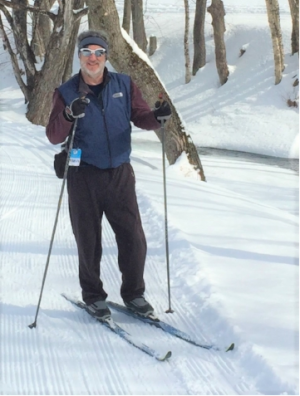
Roger Lohr in the grooves. Credit: XCSkiResorts.com
I love the sensation of gliding on the snow through the forest, being outdoors in nature. I can smell the fragrance of the trees. I can hear the bubbling brook and the sound of a bird in the distance, or the screech of my ski bases on the snow.
Groomed trails make it so easy to pass through the woods without worrying about the snow condition or getting tripped up by a hidden branch. But there is also something ethereal about skiing between the trees backcountry down the hill avoiding obstacles and picking my way to the destination. Even on a local trail network, being out in the forest seems like in the words of author Anders Morley (This Land of Snow), where wilderness and civilization meet to negotiate their differences. Even if you can hear cars on a nearby road, that negotiation allows a meditative state in the here and now.
Most skiers are encouraged to go skiing by their family or friends, or they personally always wanted to do it. Getting outdoors is among the list of reasons for people getting into XC skiing, and exercise is most likely an important reason for people to try it. The well-being factor goes beyond exercise as psychological and emotional benefits may very well be the cross beams of XC skiing that buttress the soul.
I love XC skiing in my light jacket and pants over a lightweight base layer, taking my small backpack with all my necessities. Barriers to XC skiing are low. For example, you can XC ski where ever there is snow so it is very accessible in parks and on local trails. While the sport admittedly takes time and practice to master, XC skiing is easy to do at beginner levels. It is also rather inexpensive compared to many other recreational activities. Additionally, people can ski at their own pace and go to a local park to get some outdoor exercise or enjoy the winter scenery.
On the other hand, there are issues that make XC skiing a challenge to people who’ve not tried it. Beginning XC is easy, but if you want to get proficient you have to work at it. Proficiency to higher levels only comes with time, experience, and practice. Specific equipment is important for the different types of XC skiing such as on track, off track, beginner, backcountry with heavy or light weight gear, skating, etc. Struggling on skating skis up a hill exemplifies the need for learning the right technique, skiing on proper equipment, and practice. The different segments of XC skiing may be perplexing to some people. Another factor is that experienced skiers are a tight-knit group, and it maybe a little while before the uninitiated feel accepted.
Why people quit cross country skiing is similar to why people quit any activity. People get tired of traveling or take the time to get to the trails or ski area. Time commitment can be an issue to some. Responsibilities such as work or family are also a significant reason for people deciding to reduce or eliminate time for skiing.
There are few injuries suffered by XC skiers, well, beyond being sore on the next morning because of muscles that are unaccustomed to being used. For XC skiing, proficiency is a factor when learning to glide, go uphill without backsliding, or control the skis on steep downhills.
The reasons why people start or quit skiing have been understood for decades and developing programs and incentives to address concerns is a great challenge for the snow sports industry. But personally I begin longing for the snow as spring time flourishes and am exultant the next time the ground is covered come November or December. Valhalla.
This week’s challenge might be very difficult for some, easy for others. Why? Because not as many people follow the fortunes of cross-country competitors compared to their Alpine counterparts. Everyone knows Karli Schranz, Jean-Claude Killy, Bode Miller, and the rest. But how about Sverre Stenersen, who consistently won medals in the Olympics and World Championships through the 50s? Remember what Jessica Diggins and Kikkan Randall did just a few years ago in the team sprint at the PyeongChang Olympics? Curious? Check it out here.
This week we are presenting a photo of an xc racer who some have called the very best. If you know who he is, comment in Leave A Reply below.
Okay, that’s a nice pic, but hard to identify the person. How about this one?

Last Week
 This is ski jumper Anders Haugen wearing his 1924 Chamonix Olympics coat. Norwegian-born Haugen came to the States in 1909 and started ski jumping with his brothers in the Milwaukee area. Between 1910 and 1920, Anders and his brothers won the US Championship 11 times. As captain of the US team at the inaugural Winter Games, Haugen wound up placing fourth behind three Norwegians.
However, in 1974, a sports statistician noticed that Haugen’s score was incorrectly calculated. After verification by the International Olympic Committee, Anders Haugen, at 85 years old, was awarded a bronze medal. Thus, he became the first American Winter Olympics medalist and the only US athlete to win an Olympic medal in ski jumping.
As for this fantastic coat, it was created for the US team by the Hudson Bay Co. of Canada and is called a Capote.
The 1924 Olympic capote is made of felted, twill-weave wool. It is white or natural color with printed bold stripes in black, yellow, red and green-blue. There is fringe along the top of the shoulders and sleeves and along the top front opening of the coat made of the same wool fabric, along with a tall, pointed hood.

Anders Haugen’s “Capote” from 1924 Olympics. Credit: Colorado Snowsports Museum
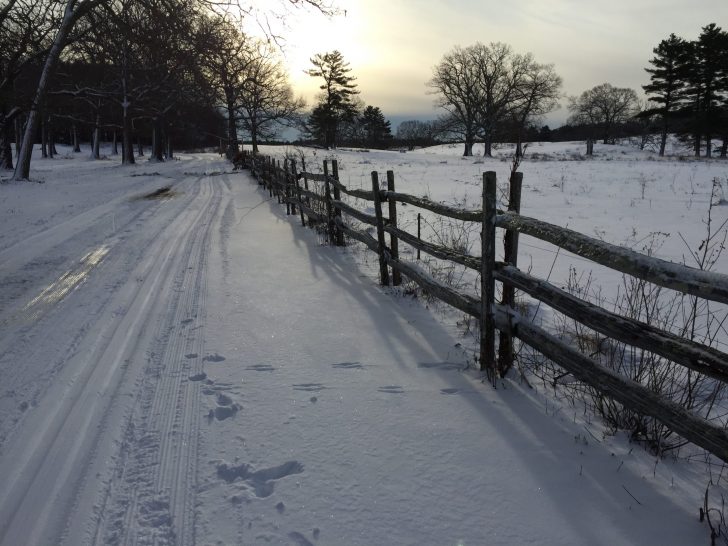

Appleton Farms, Ipswich, MA. Trails are groomed by a volunteer group. Credit: SeniorsSkiing.com
We live across a little country road from a 900-acre conservation property. For years, we’d walk across the road, stumble over the stone wall bordering the street, and plod our way about 20 feet through tree-falls and heavy brush to a trail where we’d put on our xc skis. And then we’d break trail around our favorite loop, eventually meeting up with trails already made by skiers who made it out earlier than us. Then we’d follow those.
In recent years, North Shore Nordic, a local, volunteer-run non-profit, regularly runs a trail-maker snow mobile around the property, creating perfect, groomed grooves for classic skiing and a corduroy path for xc skaters. Now, we have the best of both worlds. To get to the groomed track, we break trail from a remote corner of the property to the main area. We like the groomed trails. But then, there are the walkers who are enjoying the beautiful snow-filled fields by walking on—and disturbing—the groom. So, hmmm.
And, here’s our question for you:
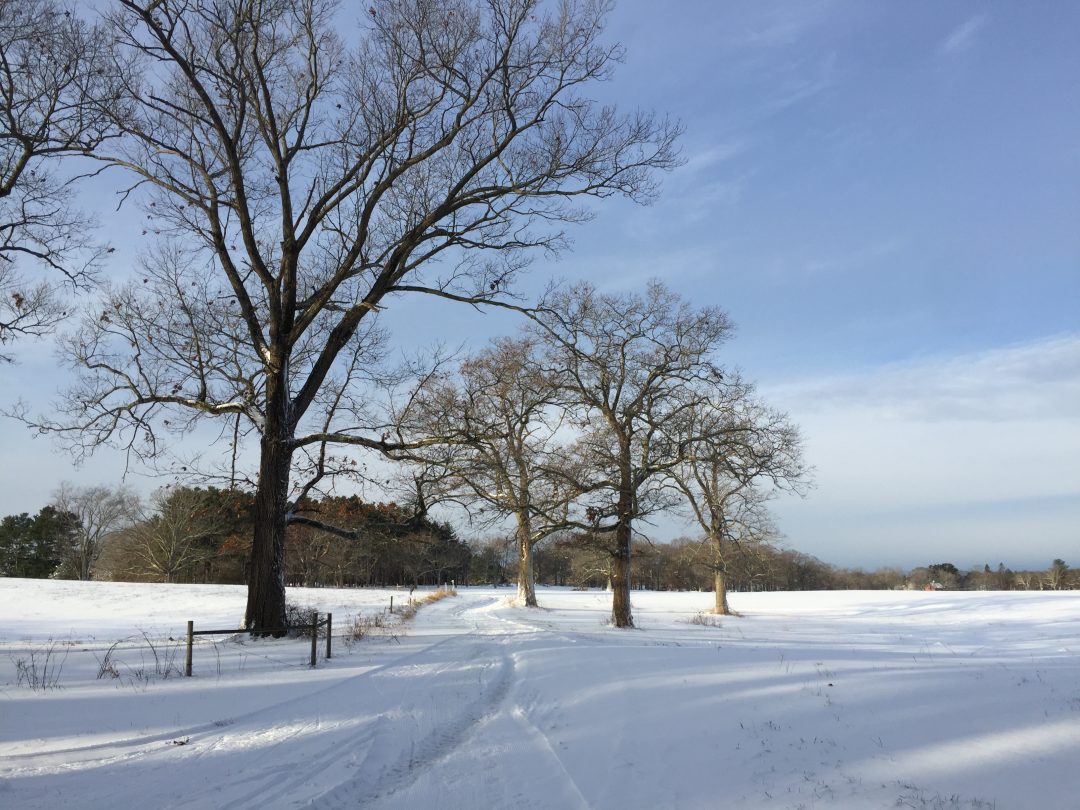
“Au naturel” trail across Appleton Farms field. Credit: SeniorsSkiing.com
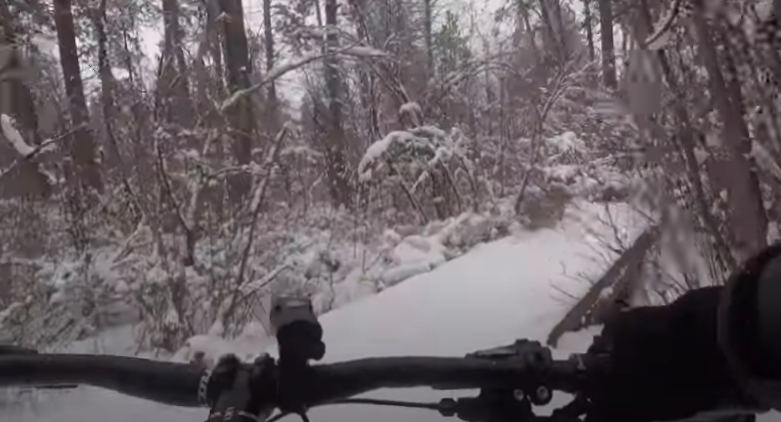
If you’re a cyclist, you will love the fat bike experience. You will most likely want to head out on a cold day so the snow is firm but not icy. Many xc ski resorts have groomed tracks for Fat Bikes as well as skiing. Deep snow: Fat Bikes don’t work, maybe downhill, but it’s much more pleasant on a track. Soft snow: Fat Bikes work, but so will you. Alot. Weather makes a difference.
Here’s a short video on what the Fat Bike experience is like. Click on the image below.