Tag Archive for: ski history

New England Ski Museum Tells 3,000 Years Of Ski History

From The Stone Age To Today.

The tiny museum in Franconia, New Hampshire is located next to Cannon Mountain’s gondola base, and it’s a wonderland. Even before you enter, you’re intrigued by what you see just outside the door and you ask yourself: “What’s that thing?”
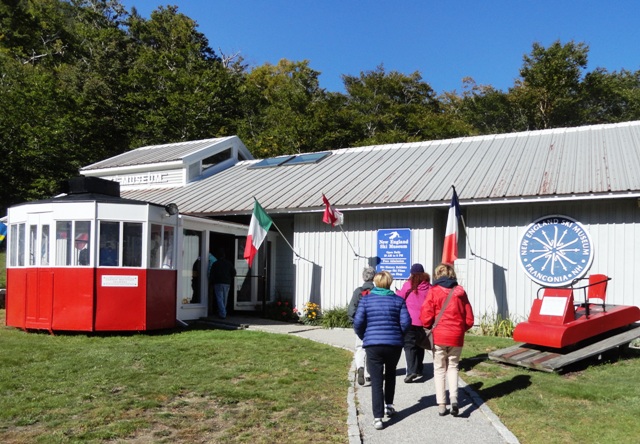
New England Ski Museum is located at the base of Cannon Mt., NH. Credit: Harriet Wallis

New England Ski Museum is located at the base of Cannon Mt., NH. Antique gondola car guards entrance. Credit: Harriet Wallis

The big red boxy thing is one of Cannon’s original tram cars from 1938. “Eeegads,” you say. “They went up the mountain in that?”
2-alg-skisThe sled-looking thing was Cranmore Mountain’s idea of an uphill lift. Skiers sat in the sleigh, and it was hauled uphill on a trestle.

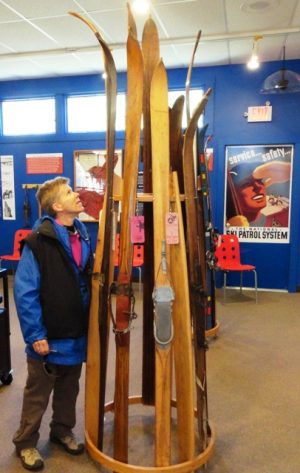
Inside the museum, “We show how skis evolved from the stone age — to a slab of wood with a leather strap — to modern skis,” said Executive Director Jeff Leich.

And exhibits show milestones: the 10th Mountain Division, the founding of the National Ski Patrol, and a display of the funky clothes we wore not so long ago.

The museum’s name is misleading. This wonderful Ski Museum happens to be located in New England, but it covers skiing across the country.

And when you’re all revved up, you come face to face with skiing Mt. Washington’s Tuckerman’s Ravine. It’s New England’s highest peak and is known for having the world’s worst weather. Actually, it’s a photo that covers an entire wall, and you feel like you’re right there. It stirs memories of hiking up the trail for hours. Lugging your skis all the way. Then clobbering up the steep slope to make a run for bragging rights.

This museum is a “must see.”
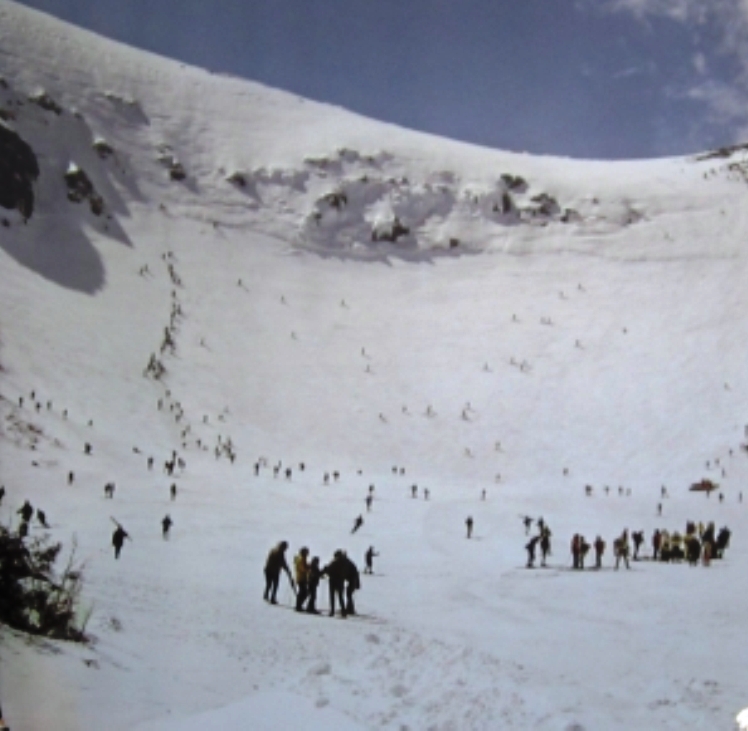
This photo of Tuckerman's Ravine on Mt Washington occupies an entire wall. Credit: NESM

This photo of Tuckerman’s Ravine on Mt Washington occupies an entire wall.
Credit: NESM

Ski Gifts and Collectibles

The NESM online catalog has something for everyone on your gift list. There are books and posters, jewelry, pottery, pillows, belts, children’s gifts and much more. Images are taken from history and will satisfy any skier’s wish list.
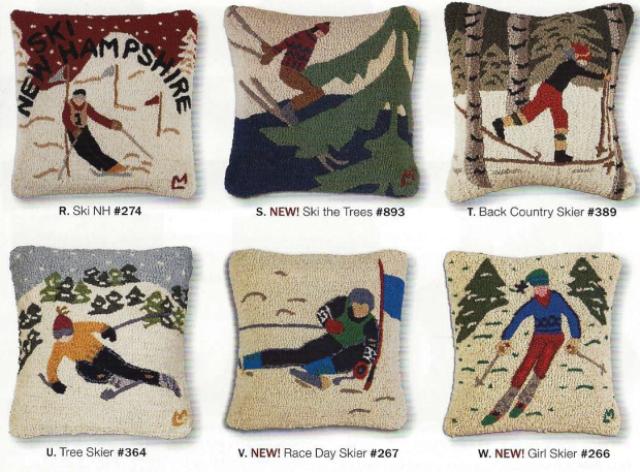
These beautiful pillows are

These beautiful pillows capture the spirit of the sport.  There are many other gift ideas in the NESM catalogue.  Credit: New England Ski Museum

Consider membership

Even if you can’t get to the museum, membership brings you a beefy, quarterly, 24-32 page journal full of archaic photos and stories that will keep you inspired and informed. An individual membership is $35 a year.

For more information and to shop the catalog online, check here.

To read more from Harriet click here for her stories on SkiUtah.
 

From One Ski Pole to Two

A Personal Experience As Told To Alan K. Engen.

Early One Pole Skiers

Early One Pole Skiers

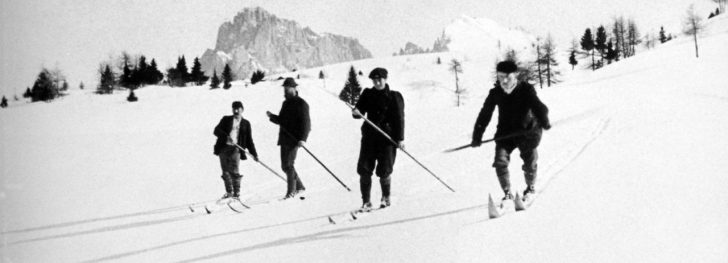
The late Ruth Rogers Altmann, a good friend and longtime Alta skier, was born in Vienna in 1917. She learned to ski in the Austrian Alps. Ruth’s earliest ski lessons involved the transition from Mathias Zdarsky’s (1874-1946) turning technique using one ski pole and leaning into the mountain to Hannes Schneider’s (1890-1955) turning technique using two ski poles and leaning away from the mountain.

Zdarsky transformed cross-country skiing to downhill skiing during the late 1800s and the early 1900s. He is recognized as the father of alpine (downhill) ski technique.

Young Ruth Altman in Austria

In the early ’20s, Ruth learned to ski in Zdarsky’s Ski School using a single, 5′ to 6′ metal-tipped bamboo pole for balance, turns, and to stop. With this technique, Zdarsky could teach people to ski in about five days.

The following excerpts are from Ruth’s recollections, which I recorded in 1988:

“The one long pole generally was made of bamboo and had a sharp metal point at the bottom. It was light and slightly flexible. Its purpose was to balance and support the skier. It was supporting when climbing up hill. One leaned on it with each step. When trails were too narrow for stemming or wedeln turns, we placed the pole between our legs and sat on it lightly, using it as a brake.”

“As skiing became more popular and developed from a means of transportation to a sport, games and racing competitions came into being. The popular game was a fox hunt on skis. A group of people had to find and catch the human fox’s red zipfel mūtze [long red night cap with a pom-pom]. The fox had an earlier start than the hunters so he could hide and flee from the hunters. ”

“As speed control became a factor in this new sport, the Zdarsky technique was challenged by Hannes Schneider’s speedier technique, which developed according to the law of physics and gravity. The weight had to be changed to lean downhill in turns, and two shorter poles, with baskets, replaced the one pole.

“We, the younger generation, and our older teenage brothers and sisters went with the new. A new division (of the ski school) was formed for two-pole skiing. Even some of the elders would use two poles, which when needed could be batted together to form one pole.”

Ruth Rogers Altmann skied every year at Alta well into her 90s and was a member of the “Wild Old Bunch,” Alta’s ski ambassadors. She passed away in the fall of 2015 at age 98 in New York City, where she lived most of her adult life.

From the permanent collection of the Joe Quinney Winter Sports Center/Alf Engen Ski Museum,

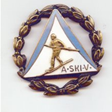
Several years ago, she presented me with the instructor pin she received in the 1920’s by the Austrian Ski School. That pin on permanent display in the Joe Quinney Winter Sports Center/Alf Engen Ski Museum, at Utah Olympic Park, shows a skier with a single pole.


Remembering The Great Big Washington’s Birthday Touring Race

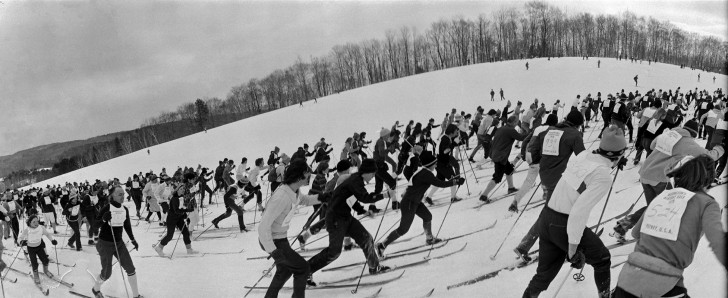
Bang and everyone charges off across the hay field. The Washington's Birthday Race circa 1971 or so. Credit: Spencer Grant

Bang and everyone charges off across the hay field. The Washington’s Birthday Race circa 1971 or so.
Credit: Spencer Grant

 Such Fun. Should We Do It Again?

What a celebration of winter it was. Imagine several hundred cross-country skiers, some serious racers—even Olympians—, college kids, couples and families, office people (like us) up from the Big City, all in a long line, awaiting the gun in a big, snow-covered Vermont hayfield. Bang, and everyone charges off, either fast skating or slowly shuffling to the far end where the field funnels into a tractor road and the rest of the 20-km (12-mile) course beyond.

This was the Washington’s Birthday Touring Race, a “people’s race” in more or less the same tradition as Sweden’s Vasaloppet where you went from point to point or town to town, not stopping if you’re racing or stopping for a picnic snack if you weren’t. In 1963, Eric Barradale, a Brattleboro dentist and former Dartmouth Outing Club member, and a cluster of southern Vermont educators, business people and professionals, thought a race like the Vasa would help promote cross-country skiing in the US. Back then, Nordic skiing was esoteric, and an event like a great, big race would—and did— attract lots of attention.

A small group of SKIING magazine staffers participated in the 1971 edition along with about 1000 other folks. We arrived with brand new kangaroo skin boots, wooden skis, four pin bindings and bag of waxes. It was our first time ever on cross-country skis. In fact, SKIING magazine’s editor and our boss Al Greenberg gave us a lesson in his office before we left for Vermont in our rented car. “Just shuffle like you have bedroom slippers on and keep your arms moving.” Doug Pfeiffer, the editor-in-chief at the time, opined about ski wax. “Some concoctions are said to include whale blubber,” he hinted mysteriously. The hook was set. The night before the race, we learned how to put on pine tar and wax in the basement of the Whetstone Inn, in Marlboro. From that delicious aroma, we knew we were going to love it.

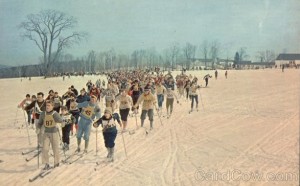
The GWBDR was modeled after Sweden's Vassalopett. Credit: CardCow

The GWBDR was modeled after Sweden’s Vassalopett.
Credit: CardCow

The first race in 1963 had 54 participants. Bob Gray, a two-time Olympian and student of John Caldwell, a long time coach, member of the 1952 Olympic team and eventually USSA team coach, was the winner. Bob told us in a recent interview the first race went from Hogback Mountain to Brattleboro. In subsequent years, the race was held on different courses throughout southern Vermont, some more challenging than others, all linking towns around the area. And the numbers of participants grew. Bob said, “We had the US Women’s Cross-Country team in one race. More and more competitive racers started coming.” That’s when Barradale started having second thoughts.

“There were racers knocking people off the track,” said Gray. “Barradale got discouraged.” The charm of a citizen’s race was disappearing as more and more serious racers showed up. Over the years, we had always thought the race was finally called off because of lack of snow. We asked Bob Gray if that was the reason. “No, it was because the race became too much of race.”

The final official Washington’s Birthday Race was held in 1973. Bob Gray was in that one, too, as he was in five since 1963. The people’s race run by a group of volunteers was experiencing the embarrassment of success. Too many details, too many arrangements, and too many racers. “After 1973, there were about five years where we had loop races around the a county club in Brattleboro for real racers, but the basic idea was lost,” said Gray. Gray said he got to keep the Winner’s Bowl when the race “retired”.

Gilbert_Stuart_Williamstown_Portrait_of_George_WashingtonIn 1971, our group from SKIING managed to come in dead-last. Our wax had long gone, we got lost, yet we laughed our way to end point at Putney School. We did get a pin for finishing. It instantly became one of our proudest possessions.

Should we have another generation of the Washington Birthday Race? Would you go?


Blanket - Ken Q and Barbara Smith 1953-54

Those Blanket Days

Long-Time Ski Patroller Remembers How Lift Blankets Made Mischief.

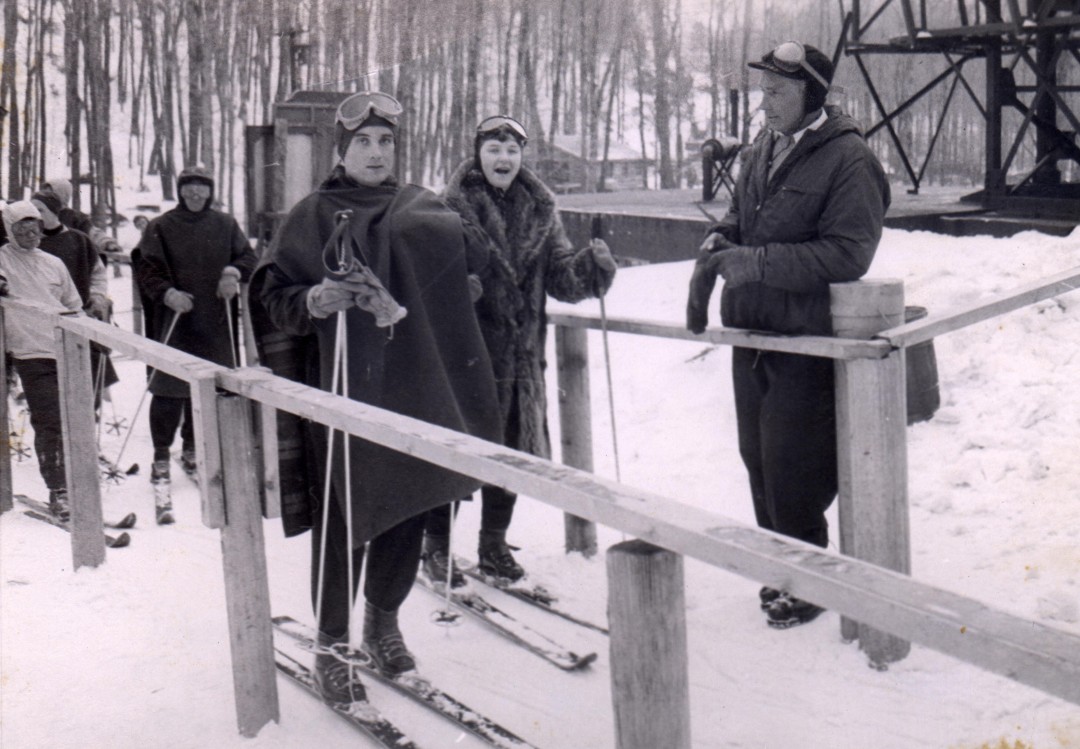
Long ago, lift blankets and fur coats kept you warm. Here Mad River GM Ken Quakenbush checks tickets on the single chair. Credit: Mad River Glen

There was a time lift blankets and fur coats kept you warm on chilly days. Here Mad River GM Ken Quakenbush checks tickets on the single chair, circa 1953.
Credit: Mad River Glen

Remember the good old days when we did not have high tech fabrics, boot heaters, hand warmers, and lots of layers to keep us warm as we rode up the single chair lift in our wooden skis with screwed on steel edges and Dovre safety bindings. The lift could be a very cold, one-mile long ride.

At Mad River Glen and other resorts (I remember Stowe), we would pick up a wool poncho type blanket off the rack, slip it over our head, and try to not get it twisted as we loaded the lift. The blankets are no longer there, but the single chair is.

We would then hide under it on the way up the lift. And for a small kid, we also had to worry about not tripping on it when we got off.

I joined the patrol at Mad River in 1962 and still remember those blankets being in use. The lifties at the top would bundle up three or four and try to slam them across the arm of the chair so they would stay there until they were removed at the bottom. On windy days, the occasional bundle would be lifted off the chair, separate into individual blankets and gracefully descend onto the trail below. And, if it was particularly gusty, one or more would end up in a tree anywhere from 10 to 30 feet off the ground.

One of the duties of the patrol was to regularly to ski the lift line and pick up the blankets that had blown off the chairs on the trip down the hill.

This was in the days before the entire lift line was designated trails. On the top of the lift line above mid-station (remember the old 1/3 tickets they gave out if you got off there), picking up blankets on the Chute was relatively straight-forward. We would pick up two or three, roll them into a bundle, and heave them underhanded up to some willing customer in a chair. Of course, this provided great entertainment to the other customers on the lift as many of the throws and catches were not major league quality.

And, if we were in an area that was too high to toss them, we would end up wearing them, sometimes up to five or six. We looked and skied like a gray version of the Pillsbury Dough Boy.

Much of the lift line from mid-station down was not legitimately skiable terrain. So only the hardy patrollers ventured into that territory to retrieve blankets. And as the lift was rather high off of the ground, this usually entailed wearing them down over the cliffs and through the underbrush, again to provide entertainment for the customers. There are great stories of tumbles down the steep faces, and blankets getting tangled up and tripping the patroller.

Fifty years later, former GM Ken Quakenbush rides the restored single, blanket and all. Credit: Mad River Glen

Former GM Ken Quakenbush takes the last ride up the single chair at Mad River before it was restored in 2007.  Credit: Mad River Glen

Breaking News: Mount Snow to Celebrate 60th Anniversary on Founders Day, December 12

Walt Schoenknecht’s Vision Was Far and Creative

When Mount Snow’s visionary founder, Walter Schoenknecht, stood atop Mount Pisgah in over a foot of freshly fallen snow back in autumn of 1949, he knew he had found the perfect place to build his dream ski resort.  Only a few years later, Walt had purchased the land around the base of the mountain from the family of Rueben Snow and subsequently renamed the mountain in his honor – which is where the name “Mount Snow” was derived from.

The Original Lift at Mt. Snow. Credit: Mt. Snow

The Original Lift at Mount Snow.
Credit: Mount Snow

On December 12, 1954, Mount Snow opened for the first time to skiers with two rope tows and two chairlifts that transported guests up to seven trails.  In only a few years since its debut, Walt had transformed the mountain into the premier winter playground of the East with expanded terrain and off-the-wall amenities for the time like a heated outdoor pool, an indoor skating rink and state-of-the-art chairlifts.

Schoenknecht’s boundless energy, ambition and creativity had many comparing him to another such pioneer of that day named Walt Disney.  And while not all of his ideas were perfect, including sending a proposal to the Atomic Energy Commission to detonate an atomic bomb at the base of the mountain to create more vertical, many of his initiatives became standard practice for the ski industry like snowmaking, modern lifts and off-mountain amenities.

Now 60- years later, Mount Snow carries on Walt’s pioneering spirit by being in the forefront of on-mountain technology and trends.  There is much to celebrate this Founders Day, as December 12 has become known at the southern Vermont resort, with the celebration continuing throughout the weekend.

Mount Snow is offering $12 lift tickets to ski and ride on Founders Day, which can only be purchased at least 24 hours in advance online.  There will be a comprehensive historical display in the Main Base Lodge, lift line giveaways, birthday cake for everyone, throwback parties, live music, scavenger hunts and more.  The resort is inviting everyone to wear their favorite retro ski gear to honor the styles of the past, and there is an “old school” bamboo gate ski race planned for Sunday, December 14 that will even have a straight ski category.

For more information about the Founders Day Weekend 60th anniversary celebration and to purchase $12 lift tickets for December 12, visit www.mountsnow.com/events/calendar/founders-day.

To learn more about Mount Snow’s history, visit www.mountsnow.com/the-mountain/our-history.

When Skiing Was New: Early Scenes From 30s To 50s

Skiing was once considered a fad like Mah-Jong.  That was a long time ago.

Here’s a seven-minute series of clips from John Jay’s “Ski Down The Years”, a visual history of skiing from the early days of rope tows in the mid-30s in New England to the FIS championships at Aspen in 1950.  From our current perspective, those initial attempts appear at once hardy and comical.

A flop on the Inferno, Mt. Washington, circa late 1930s.  Credit: John Jay.

A flop on the Inferno, Mt. Washington, circa late 1930s. Credit: John Jay.

Ski Mobile in North Conway, mid-1930s.  Credit: John Jay

Ski Mobile in North Conway, mid-1930s. Credit: John Jay

Oh, the technique! Downhill shoulders leading through a turn.  Bending forward at the waist.  Oh, the savior-faire.  Lowell Thomas, the celeb journalist, has a knowing air about him as he adjusts his skis.  And Gary Cooper puffing away at Sun Valley.  Oh, the early glory of powder skiing.  There’s a series of shots of Dick “Straight Down” Durrance skiing powder at Alta.  Amazing.  Most interesting is the formation skiing of the Tenth Mountain Division training on Mt. Rainier.

We’re lucky we have this kind of footage to reflect upon.  We remember the legacy of those early days in our own first skiing gear and experiences in the mid-1960s.  Leather lace-up boots, bear trap bindings, army surplus goggles, rope tows.  What equipment from your first days can you track back to that glorious time?


Snowbird’s Pipeline Conquered By Junior Bounous at 80 (Taken March 8, 2014)

DSC04514

Snowbird’s Pipeline (the top to bottom ravine in center of picture) : One of North America’s toughest ski routes, descends from Twin peaks above Snowbird. First skied by Junior Bounous in the early 70s. He skied it again during his 80th year. Junior is an inspiration to senior skiers everywhere.
&nbsp

Long Time Between Runs

SeniorSkiing

It is a sunny and cold Thursday morning in early February.  There are a handful of other skiers on the mid-New Hampshire ski area lift.  I decide to go right at the top.  Trail is untouched, the corduroy grooming marks fresh and waiting.  I turn, effortless.  Ahhh.  I turn again, making a big, wide arc.  The feeling is like floating, my new skis carving and then, almost without a conscious notion, shifting to the other edge.

Hard to believe this is my first real run in thirty-five years.  Okay, there was an expensive, uncomfortable holiday weekend on rental skis and boots in the 90s with cranky children, cheesy condo and unrelenting cold.  It was an exception.  I had left my real skiing behind long time ago.

I started in college, in the mid-60s.  Back then, it was blue jeans and rice-paddy parkas with Moriarity hats, wooden skis, leather boots and Cubco bindings.  In the early 70s, I lucked out and worked as an assistant editor at Skiing Magazine working and rubbing elbows with some of the greats.  Now, that was fun.

I was Associate Editor in the early 70s

I was Associate Editor in the early 70s

The next few decades had me running a business, flying here and there, finding and keeping clients.  No time, no interest in skiing.  Too cold, too time consuming.  The closest I made it to the slopes was working on my laptop while watching my wife kids from the day lodge window.

Then I came back.  With retirement came time.  I looked at boots and skis in a ski shop one day and said to myself, “I can do this now.”

I find almost everything about skiing has changed for the better during my long hiatus.  The skis are magical instruments, boots are comfortable, clothes are warmer, the lifts are faster, the trails well groomed and, because of my senior status, the lift tickets are relatively cheaper.  And, there is no more need for speed.  Instead, I relax into the slow turn, pressing down to feel the slice of the edge.

Parabolic skis rule! Turning has never been more easy or more fun.

Parabolic skis rule! Turning has never been more easy or more fun.

Apparently, I’m not the only veteran coming back to skiing.  Although we are still a small percent of the total, the number of skiers over 65 has doubled since the 1997-98 season, according to a National Ski Areas Association demographic study published in 2013.  And we ski more often than younger skiers, too.  We get in 9.5 skiing days per season compared to a national average of five days.  We are using the gift of time that retirement has bestowed.

What does it take to get back?  Fitness for starters. That’s a good idea, regardless. A good ski shop to fit you out with the proper equipment, maybe starting with decent rentals.  A lesson might be helpful, too.  A couple of friends to go with.  A nice winter day in the middle of the week.  More and more runs.

What’s your return-to-skiing advice?