Tracking Down The Reckless Party: YOU Must Capture Data At The Scene.
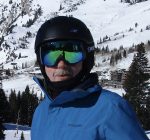
Mark Stangl, Steamboat, CO
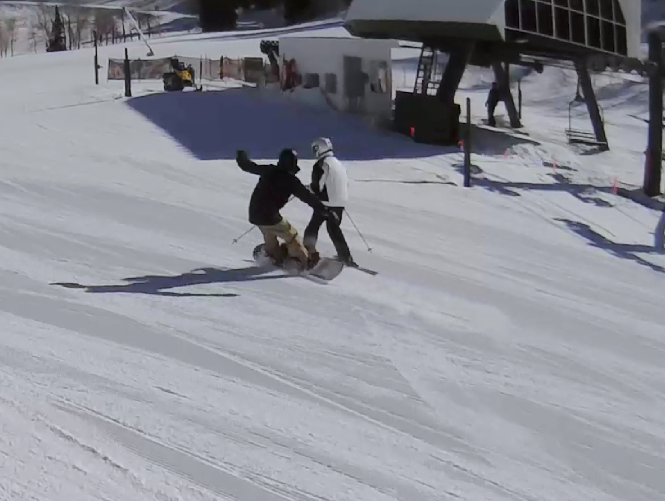
What Happened: Snowboarder collided with me from behind, causing a spiral leg fracture. Both fibula and tibia were broken and required internal hardware treatments. Major life changes and financial impacts resulted. (The snowboarder was from Panama and although at fault resisted all contact from my attorney and was shielded by the corrupt legal system there.)
Role of Ski Patrol: Transported me from the slopes to the local hospital. Patrol did not conduct an accident investigation, nor help identify nor locate the snowboarder. My friends snapped a cellphone image of the on-the-spot ‘incident report’, but name and contact information were wrong, or “wildly incomplete”. Later inquiry to Steamboat about identity and location yielded a response of “Too bad. Here is the policy indicating it is not our job to authenticate information given to us by patrons”.
Subsequently, a Denver TV station conducted an investigation and aired the results. The ski area stonewalled their questions, but undercover work revealed the high number of injuries at that ski area every year. Over 3,000! Link to that TV aired report is here.
Followup investigation to 12 other ski areas and industry trade groups were further stonewalled, or responded to with the common façade of “…myth out there…our numbers are so low…”.
Lessons Learned: A systemic concealment and conspiracy is in existence regarding skier safety by the industry. An image of “wonderful family experience” is shadowed by the truth of high non-fatal injury rates, and exculpatory laws/waivers releasing the operators from virtually all responsibility.
Advice: Upon being the victim of an”at fault accident”, call police and report an assault. Have others snap a photo of the offenders ski pass or ticket. Tracking data is available from that. Detain the offender if possible, and call patrol.
For Prevention: Wear a flashing red bicycle light on your helmet facing back. These are being used by seniors to alert followers and seem to inspire attention.
Life Happens. We Get Older And Our Spouses Pass Away. That’s When We Ski Alone, Often Really Alone.
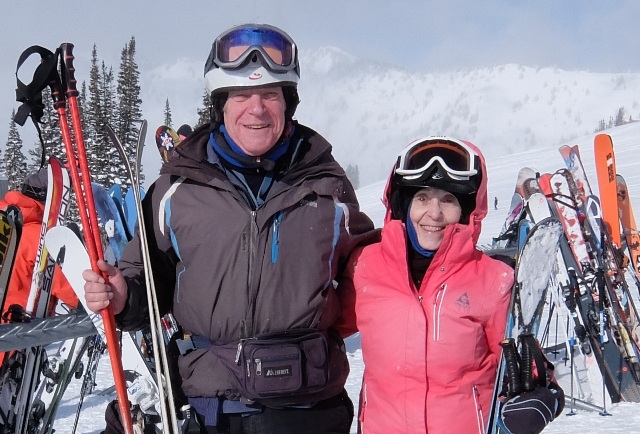
“Take some runs with us,” say Howard and Naimi. Credit: Harriet Wallis
This is a true story, and a sad story. It’s just one of many similar stories. It might sound like sour grapes, but the goal is to offer a perspective on what it’s like to ski as a widow. The story has a perfect ending because of five great words.
It’s a beautiful day. The sun is shining. The road is clear and dry as I head up the canyon. The radio keeps me company until the signal fades into hissing static. I shut it off and drive the rest of the way in silence.
Whether you’re widowed or single by choice, there’s often a lot of silence. Skiing can offer camaraderie.
The mountain comes into view. It sparkles with fresh snow. What a great day to be alive and to ski.
The lodge is filling up with skiers. Sue and John tap me on my shoulder from behind, and we greet each other with hugs. As we gear up and stuff our feet into ski boots, I hear about their summer, their travels, and their projects. They’re having a great time.
But as we finish gearing up, Sue looks across the lodge and abruptly says: “Our friends are here. Bye!”
Those are not the best five words to hear.
Widows and singles are often cast off because we’re not a couple. We’re misfits. But we shouldn’t have to go two-by-two to qualify. It’s not Noah’s Ark. It’s the ski slopes!
I ski alone.
But then the day takes a turn.
It’s bitter cold on the mountain. Skiers pour into the mid-mountain lodge to thaw out. On the way to get a hot chocolate, I encounter Naomi and Howard. They’re hard core skiers with lots of enthusiasm.
Howard sees there’s no one with me and says: “Are you skiing by yourself? Take some runs with us.”
“Take some runs with us” are the five best words to hear when you’re skiing alone. They’re magic words. They reach out with camaraderie and kindness. “Take some runs with us” are five words that anyone can say to make someone’s day brighter.
Many ski areas have senior groups that ski together. But you don’t have to be part of any group to say: “Take some runs with us.” Seniors who are skiing alone will appreciate your kindness.
Camaraderie is the key. At Alta, the senior group is the Wild Old Bunch, and they can be identified by the large smiley-face patch on their jackets.
The 70+ Ski Club is a nationwide ski club that offers a variety of week long ski trips. Upcoming trips include skiing in the U.S., Canada and France. And the club is an advertiser in SeniorsSkiing.com.
[Editor Note: Some resorts sponsor and/or support senior clubs. Waterville Valley has its Silver Streaks, for example. Other resorts, like Dodge Ridge, offer senior week specials including lessons, races, and gatherings. Ski clubs are a sure place to ski with other seniors. These communities offer a chance to meet new friends and share the experience of snow sports.]
https://seniorsskiing.com/wp-content/uploads/2019/12/algHoward-Naomi.jpg434640Harriet Wallis/wp-content/uploads/2014/04/Seniors-Skiing-since2013-Logo@2x-300x68.pngHarriet Wallis2019-12-30 11:31:512020-01-02 09:07:43Skiing Single: Five Best Words To Hear On The Slope
The Longest White Winters South of the Mason-Dixon Line.
Start at the top at Snowshoe Mountain Resort, WV, Credit: Snowshoe Mountain
Most ski resorts have their hotels and restaurants in a valley. Some resorts have hotels at the bottom of the slope and some restaurants at the top. But Snowshoe Mountain Ski resort has everything at the top of the hill. People call it “an upside-down ski resort”. Imagine a cherry on top of the mountain cake, decorated by snow and a picturesque lake. While Snowshoe is located less than a five-hour ride from the Washington, D.C. metro area, it is indeed as “wild and wonderful” as the rest of West Virginia.
The elevation of the resort is 4,848 ft, the second-highest point in the state. That is quite high by Mid-Atlantic standards. The location and the weather combined with modern snowmaking equipment gives Snowshoe a reason to guarantee “more open terrain than any other resort in the region.”
The resorts looks compact, cute, and cozy. The restaurants, bars, and stores are located in the pedestrian area. By the way, tap water here is clean and tastes better than many types of bottled water. The layout of the condos and hotels is designed to protect you and your car from snow and wind.
The resort has three ski areas: Snowshoe Basin, Western Territory, and Silver Creek. The majority of the slopes are senior skier friendly. One local Ski Patroller has noted that certain guests who have limited experience on small Southern hills, challenge each other on the black slopes of Snowshoe. The black slopes are not as wild as in the Rockies, but are still challenging for the beginners and enjoyable for experienced skiers.
According to one of the Slope Safety Volunteers, more than half of the resort volunteers are retirees residing here. One day I noticed a snowboarder with a big stick and decided that it was just another selfie maniac. Later I got a chance to talk to this 60+ year old ski and snowboard veteran. He uses a monopod (photography tool) to maneuver on flat areas and around the ski lifts. He skied for decades, but recently decided to switch to snowboarding because of joint pain. He found that his knees felt better on a snowboard than on skis.
In case you need a break from skiing, go visit The Green Bank Science Center, which is only 20 min away. The resort is active in summertime. Besides riding on bicycles, the guests enjoy golfing, boating, and hiking.
Useful facts:
Snowshoe offers an 800 ft vertical drop, 60 trails, 13 lifts, 250 acres of slopes, and 180 inches of natural snow annually.
An adult daily pass is $79 on a weekday and $109 on a weekend, and for people over 75 years old, it is $39 on any day of the season. A seasonal pass for those older than 70 costs $499 in 2019-2020. The resort is part of the IKON ski pass system.
As a holiday gift from SeniorsSkiing.com to you, here’s a poem celebrating the Winter Solstice and this special celebratory time of year welcoming Yuletide. The Shortest Day was written by Susan Cooper for the Christmas Revels, a wonderful show with music, dance, and poetry reflecting different cultures and styles of art.
The narration and video is by our friend and colleague Barry O’Brien, a videographer who has captured some special images to accompany the verse.
The Shortest Day By Susan Cooper
So the shortest day came, and the year died,
And everywhere down the centuries of the snow-white world
Came people singing, dancing,
To drive the dark away.
They lighted candles in the winter trees;
They hung their homes with evergreen,
They burned beseeching fires all night long
To keep the year alive.
And when the new year’s sunshine blazed awake
They shouted, revelling.
Through all the frosty ages you can hear them
Echoing, behind us — listen!
All the long echoes sing the same delight
This shortest day
As promise wakens in the sleeping land.
They carol, feast, give thanks,
And dearly love their friends, and hope for peace.
Correspondent Marc Liebman recounts a chronic, stubborn condition that threatens his ski season. He has a lesson for all of us about not being able to make it this year.
We have a new Mystery Glimpse photo to guess. This should be easy. Also we reveal the identities of the seven Hall of Fame ski jumpers who appeared last week.
If you’re stuck for a gift, check our Very Last Minute gift suggestions. Do not delay!
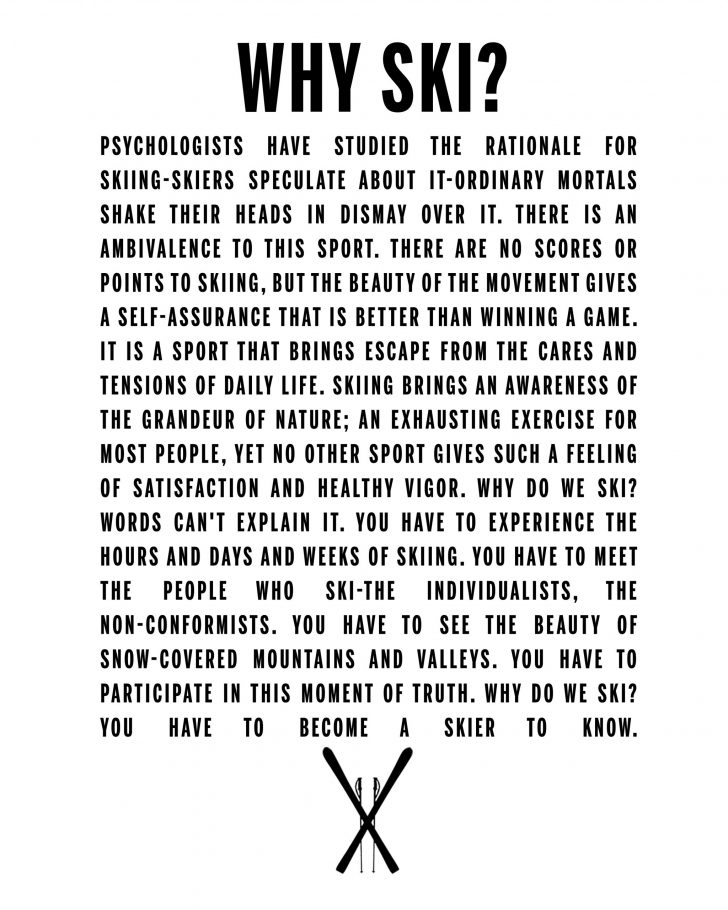
Away this week through the New Year, so no fully-developed column. But thought you’d enjoy this statement explaining what it is about skiing that is so inexplicably wonderful.
It’s available as a poster in a variety of sizes.Click here for specific sizes and (very reasonable) prices.
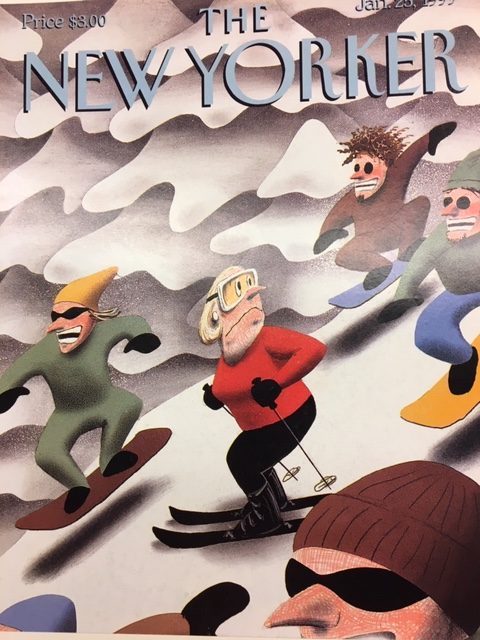
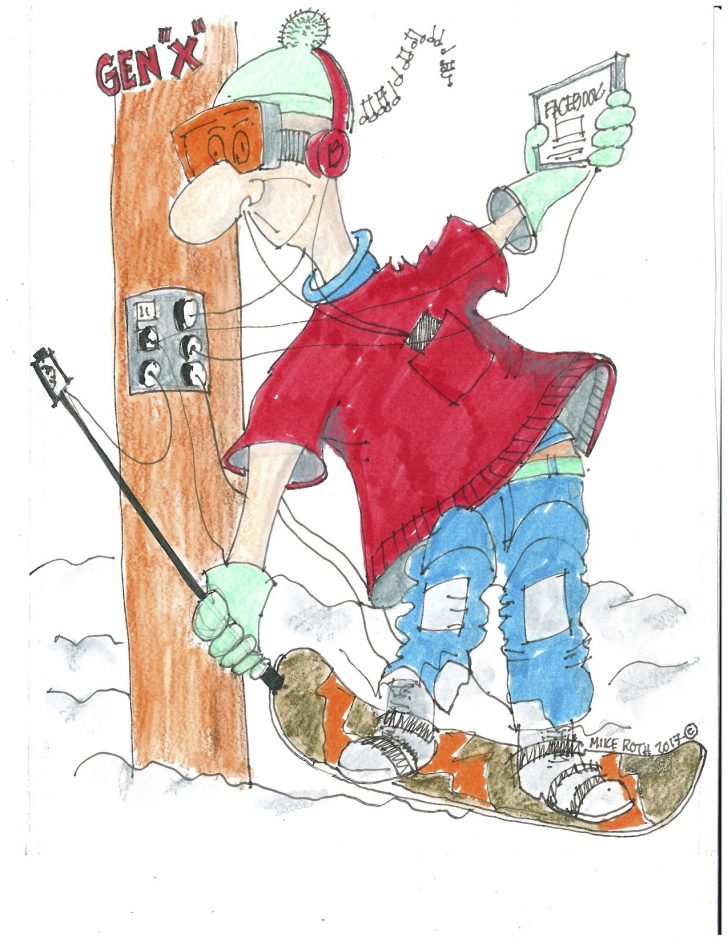
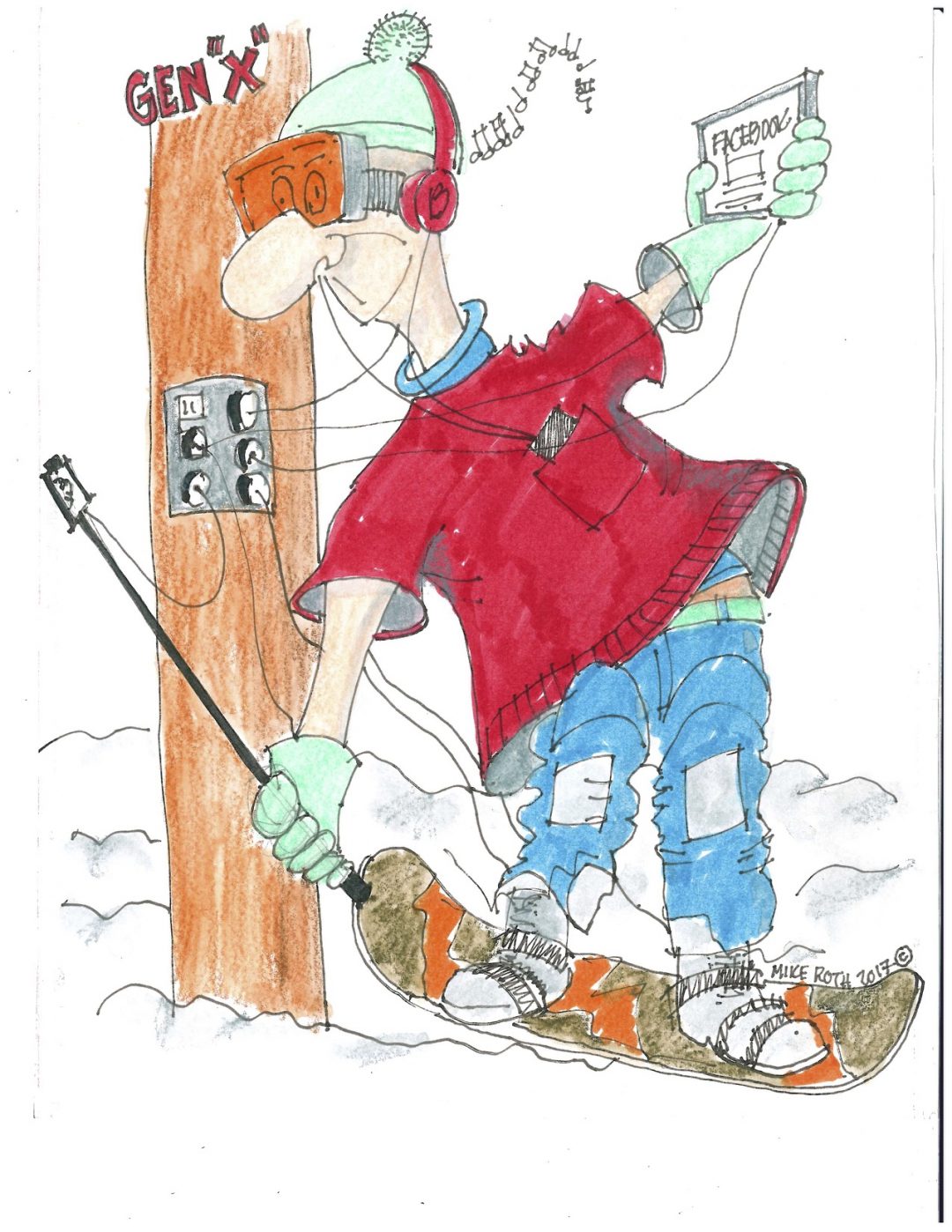
Here’s A Less Serious Report, But Is There Some Truth In This Cartoon?
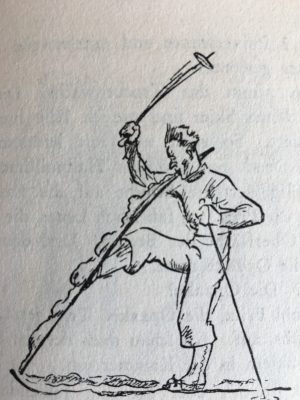
We’re lightening up this week for our ongoing series of Incidents & Accidents. Instead of recounting a collision, here’s a cartoon from veteran journalist Mike Roth, depicting the Gen X-er on the snow. What think? Truth?
What Happened To Me And WhyYou Should Treasure Your Health And Fitness.
As I get older, each ski season is more precious than the one before. I’m pushing 60+ years of skiing, and early in my life, I learned never to take one for granted. Except for being deployed overseas during Vietnam and Desert Shield and Storm, I haven’t missed a ski season in decades.
There is a rhythm to my ski year. After the ski season, I change my conditioning routine and start ramping back up after Labor Day up so that by December, I’m ready to ski my usual 25,000+ vertical feet. Yes, at my age I’m bragging!
On August 23rd, my routine changed thanks to a bacterial infection in my right elbow. During the bursectomy, the surgeon found an infected ulna bone, tendons and muscles in my forearm. Aaaaaaarrrrggggghhhh!
Samples were sent to a lab to grow cultures and find out what the bug was. Over the next four weeks, the four drains were slowly removed. Exercise was not possible because dirt in the sweat could lead to a staph or other type infection, and I had very limited use of my right arm.
Eleven weeks later, the culture and susceptibility tests told the doctors that the infection was a hard to kill avian acid fast bacilli. It takes a combination of three powerful antibiotics taken daily over eight to 12 months to kill it. It gets worse because this is one of the bug that often develops immunity to antibiotics so sometimes in the middle of the treatment, one has to start over.
As luck would have it, I had an allergic reaction to the antibiotic that was the most effective against the avian bacilli that sent me to the emergency room having difficulty breathing, a 102 degree fever, rashes and hives all over my body. I was off everything other than steroids and antihistamines to get my system back to normal.
The bug and the toll the antibiotics were taking on my body sapped my stamina. I’d work on a book for four to five hours in the morning and after lunch, I was exhausted and it was nap time. By nine at night, I was ready for bed!
Exercise, you have to be kidding! Go skiing? No way.
So now in early December, two MRIs and two sets of x-rays later, I’ve started walking again and am up to about four miles every day. By the time this is published, hopefully I’d daily sessions on an elliptical or a stationary bike.
Next major checkpoint is another MRI and x-rays in early January to see if my ulna bone is continuing to heal. Blood work every other week gives an indication the drugs are working. My goal is to ski late in late March but its 50-50.
The point of this piece is simple. Don’t take any ski season for granted. Each season, each trip, each run is precious, and they could be taken away from you in a flash. Just ask!
https://seniorsskiing.com/wp-content/uploads/2019/12/SkiInstruction_-scaled-e1584627877317.jpg728546Marc Liebman/wp-content/uploads/2014/04/Seniors-Skiing-since2013-Logo@2x-300x68.pngMarc Liebman2019-12-17 11:10:282019-12-17 11:11:14Gone In A Flash
https://seniorsskiing.com/wp-content/uploads/2020/09/Screen-Shot-2020-09-30-at-5.44.54-PM.png624610seniorsskiing/wp-content/uploads/2014/04/Seniors-Skiing-since2013-Logo@2x-300x68.pngseniorsskiing2019-12-16 18:57:512024-08-21 10:42:032020-21 Best Boots For Seniors
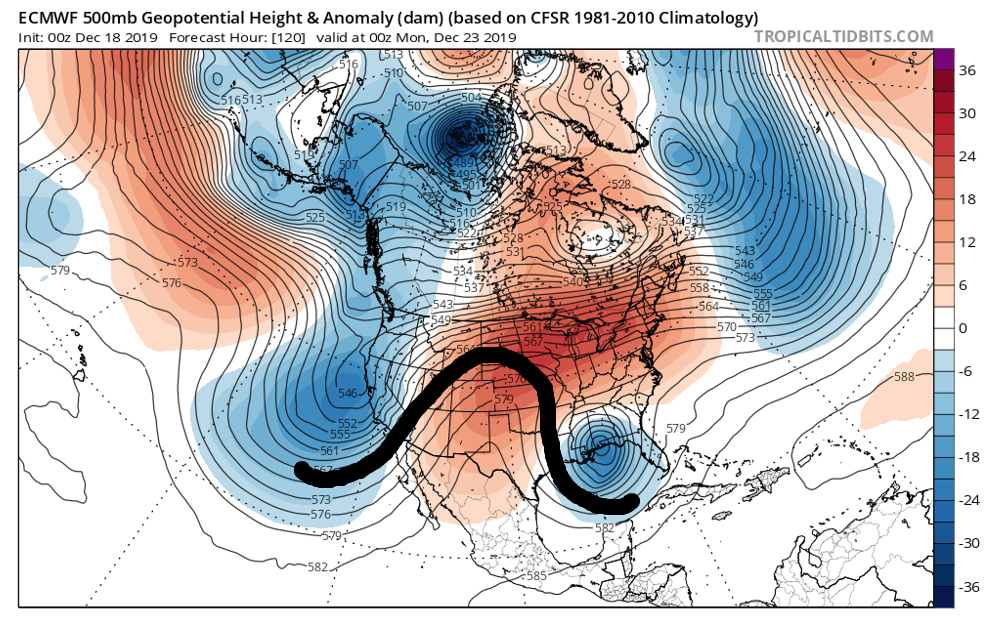
Last week I discussed the role of upper level troughs as they relate to our insatiable appetite for fresh snow, both natural and machine made. Most of the time, troughs are indeed our friends but that doesn’t necessarily mean that upper level ridges are the enemy. The influence of ridge is just like the old cliche about real estate: location, location, location. Troughs often look like the letter “U” on a map while ridges tend to take on the shape of the Greek letter Omega. I have used a jet stream forecast map for Sunday the 22nd to illustrate this common configuration.
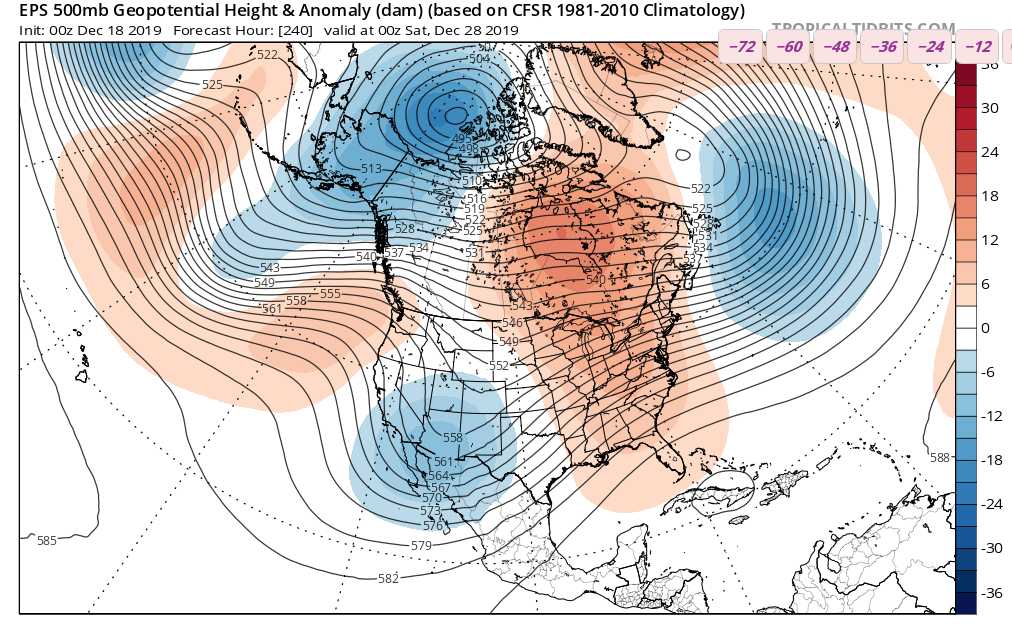
Now, in order to take on the Omega shape, you can see that the two ends of the line are wrapped around adjacent troughs, and that is where the location piece comes into the equation. You see, ridges are areas where overall, the air is sinking. Sinking air limits cloud cover and precip, and it also warms up as it sinks, consistent with the laws of physics. So, if you find your favorite resort under a ridge, your odds of seeing snow are greatly reduced. But, if that same ridge is off to the west of the resort by several hundred miles or more, the clockwise flow around the ridge will work together with the counterclockwise flow around a downstream trough to the east to tap cold air from the north. At that point, the ridge becomes your ally. As I have expressed in earlier posts, I am confident that a western ridge/eastern trough couplet is going to be the favored setup as we head through this winter, but in the shorter run, the ridge is going to spread out and cover much of the eastern two thirds of the country as we head through the holidays. Overall, Pacific systems will bring seasonable cold and some snow to the west while it is milder than normal east of the Mississippi.
Here Are The Regional Details.
Northwest U.S./Western Canada: A very juicy storm will be in progress into this weekend. Whistler finally gets tagged. Cascades get healthier trail counts. Pattern more benign next week.
Cascades and Sierra: The same storm will nail the Cascades. Snow levels will be rising through the storm, so only count on “all snow” above 6K feet. Amounts will be 2-3 feet WA and OR. CA Sierra pick up moderate snow Sunday. The pattern will turn quieter through most of Christmas Week.
Rockies: The coastal storm will slow coming inland due to the spreading of the upper ridge further east, so any snow that makes it out of the Cascades will be spotty and light late this weekend/early next week. No big storms next week by the looks.
Midwest: Late week lake effect will help set up this weekend. Milder temps develop into next week, which limits snowmaking windows. The good news is, it looks rather dry, under the ridge, Christmas week. Colder air returns after the 29th or so.
Northeast: Late week shot of Arctic air will allow snowmakers to get busy 24/7 in most spots. It will turn milder next week and snowmaking will be feasible in the mountains. The lower elevation areas should have some windows, too. With the ridge axis fairly far to the west next week, some colder air will filter into the region at times. No significant snow events appear to be in the cards through the end of next week.
Overall, after a major “Cascade Cement” storm in the NW at the outset, the holiday period looks rather dull from a forecaster’s perspective. Some lighter snow will fall in the west…the milder temps will keep it comfortable on the slopes for skiers and riders in the Midwest and East.
https://seniorsskiing.com/wp-content/uploads/2019/12/senior_ski1.PNG.png621986Herb Stevens/wp-content/uploads/2014/04/Seniors-Skiing-since2013-Logo@2x-300x68.pngHerb Stevens2019-12-16 16:20:532019-12-18 16:26:06Skiing Weatherman: All Is Calm
60s Ski Songs, Powder Addicts, New England Ski Museum Shop.
Stuck for a present for a senior snow sports partner, friend, spouse, colleague? Here are three sources that can fill in the blank.
Download 60s Ski Songs.
Ray Conrad wrote and performed skiing songs in the early 60s in a folk music style that was gaining popularity in cafes, clubs and college campuses. His songs are satirical, silly, clever, and funny, spoofing the people who ski or want to look like skiers. SeniorsSkiing.com re-produced and is distributing the download-only CD on CD Baby. Click here for immediate download.
Powder Addicts
Powder Addicts has a complete line of ski and snowboarding t-shirts, skiing gifts, snowboarding gifts and other snow sports accessories. They also have an exclusive range of ski jewelry and snowboarding jewelry. Check out the collection here.
New England Ski Museum Shop
Many ski museums have excellent gift shops. We are highlighting the NESM’s gift shop because SeniorsSkiing.com’ correspondent Harriet Wallis visited and was wow-ed by the interesting, high-quality merchandise. Hurry, though; start by clicking here.
https://seniorsskiing.com/wp-content/uploads/2019/12/RayConrad_Cover__657.jpg720752seniorsskiing/wp-content/uploads/2014/04/Seniors-Skiing-since2013-Logo@2x-300x68.pngseniorsskiing2019-12-16 09:51:162024-08-21 10:42:53Very Last Minute Gifts
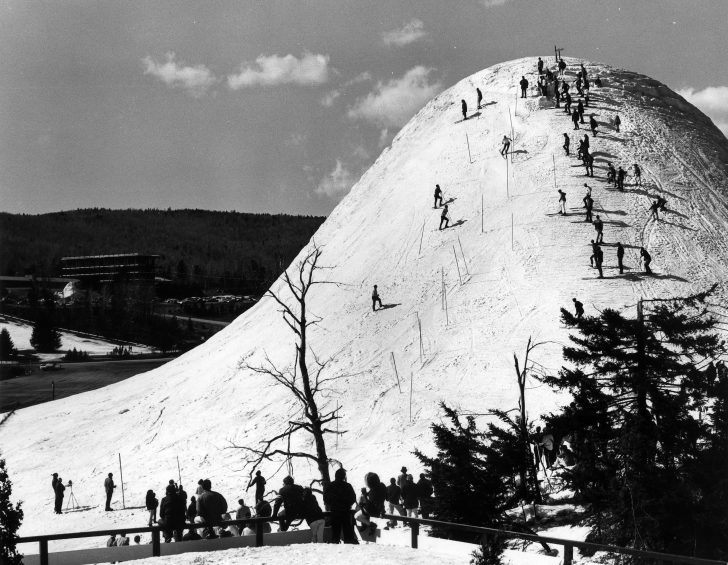
If you’ve skied this…structure, tell us your story. Where, why?
Last Week
Feb 1941. Ski Jumpers.
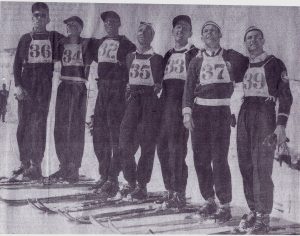
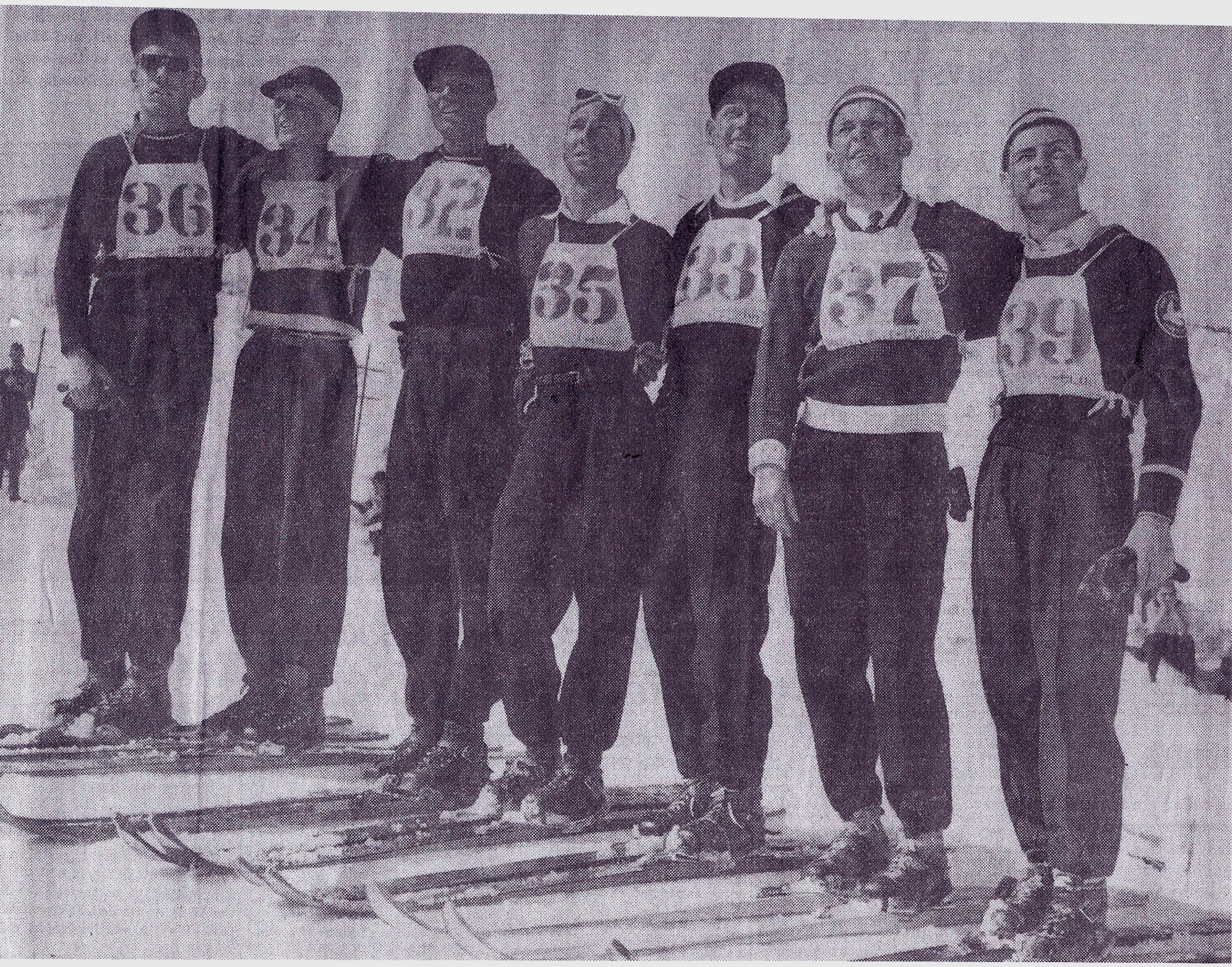
This iconic image is of seven great ski champions from the past. All have been inducted into the U.S. Ski and Snowboard Hall of Fame and are regarded as SkiSport Legends. The image comes from a early 1940s clipping Alan Engen included in his donated ski history, four volume scrapbook series, The Engen Skiing Dynasty. The books currently reside in the University of Utah J.Willard Marriott Library Utah Ski Archives.
The photo was taken in Sun Valley, ID at the base of the old Ruud Mountain Ski Jumping Hill in February 1941. In the photo are, left to right: Corey Engen, Barney McClean, Sverre Engen, Gordon Wren, Alf Engen, Torger Tokle, and Art Devlin. Not long after this photo was taken, the great ski jumper, Torger Tokle, went into the military service, joining the 10th Mountain Division at Camp Hale and ultimately lost his life in combat during WWII. Torger and Alf father were two of the greatest U.S. ski jumpers of that time period.
https://seniorsskiing.com/wp-content/uploads/2019/12/MysteryGlimpse_-scaled-e1577805080568.jpg565728mikemaginn/wp-content/uploads/2014/04/Seniors-Skiing-since2013-Logo@2x-300x68.pngmikemaginn2019-12-16 09:08:142019-12-16 09:08:14Mystery Glimpse: Ski The Cone
Nordic Volunteers, Poutine For Calories, Exoskeleton Helps Legs, More Incidents & Accidents, Southern Skiing, Mystery Team, Weather Report.
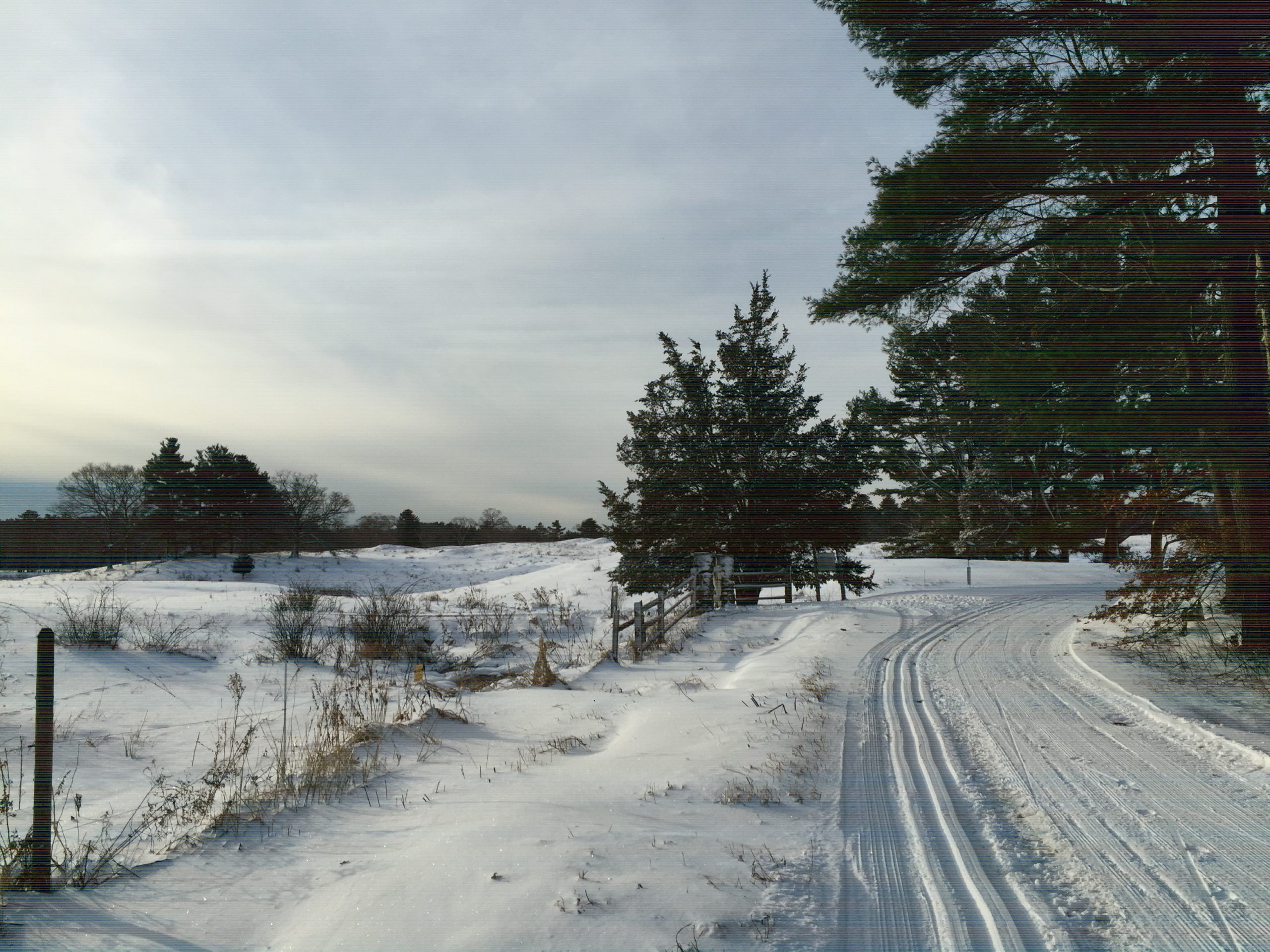
Early morning finds a groomed trail ready to go. Credit: MDM
This co-publisher of SeniorsSkiing.com loves to cross-country ski. Since we live directly across the street from a 900-acre tract of conservation land, owned and managed by the Trustees of Reservations, we head over the stone wall whenever there is decent coverage.
In former days, we bushwhacked our own trail through the woods until we connected with the network of tracks made by the early birds. (There are always earlier early bird tracks.) And we followed the early bird trail loops until we decided to bushwhack again back to home base. Fun, but kind of tough for a seventy-five year old, especially at the beginning of the season and deep-ish snow.
NSNA Crew grooms all night for a wonderful trail in the morning. Credit: NSNA
Enter the North Shore Nordic Association. This is an all-volunteer, non-profit, community-based group which forms alliances with large landowners, most of whom are also non-profit organizations or municipalities, to maintain and groom existing hiking and biking trails for cross-country skiing, snowshoeing, and snow skating. For the past four years, NSNA has bought and maintained a collection of equipment through donations from local people and businesses. Every time it snows, the groomers are out there, usually right after the snow stops falling, often in the middle of the night or early morning.
Your retro-attired co-publisher at the Farms. Credit: AAM
The grooming machines create two ski tracks, one a broad corduroy for skating and two pairs of grooved classic tracks on each side. There are many benefits to having these ready and waiting for a senior skier. It is obviously easier to ski, for both beginners and, well, everyone. The packed snow also lasts longer. The machines also loosen up hard pack to extend whatever snow is down.
The NSNA uses social media to alert folks about conditions every day. The group also maintains trail maps on a Smartphone app. When we encountered a grooming crew on the trail one morning, the young man took our picture and immediately posted it on the group’s Facebook page.
All this is free for the skier. Enthusiasts and occasional visitors can donate to the NSNA to keep the machines turning. The group is well-run, organized, and community-focused. In the long term, they hope to create a racing league, offer lessons, and run a rental program.
The Point: If you don’t live near a cross-country ski area or resort where trails are groomed and maintained and rental equipment is available, consider forming a group like NSNA. All it takes are people who love to cross-country ski or snowshoe, some willing land organizations or town governments, and some energy to get all this organized.
Trail Masters Update
We have mailed out over 150 Trail Master patches to readers who responded to our Spring Survey as having skied more days than their age. Most were sent to US and Canadian readers, but there were also numerous addresses in Sweden, Finland, England, and Australia. Please note because some addresses were not completely filled out in our survey form, we were not able to send patches to all qualified readers.
This Week
Poutine, a Frency Canadian comfort food dish. Credit:Yvette Cardoao
SeniorsSkiing.com Northwest correspondent Yvette Cardozo reports on a Canadian cuisine specialty at Silver Star Resort in BC. Ever have Poutaine? It’s a hearty meal designed to replace calories lost to a heavy day of skiing. There’s more. Ever had a Caesar? Not a salad. Find out here.
We have a contributor review of the skiing assist aid Againer Exoskeleton. This device can actually extend your skiing career by supporting your legs and back. Consider our reviewer’s experience here.
What’s the highest mountain on the East coast of the US? If you said Mt. Washington, you’d be wrong. Mt. Washington tops off at 6,288 feet, but Mt. Mitchell reaches up 6,684. Where is Mt. Mitchell? North Carolina. Surprise. Co-publisher Jon Weisberg reveals more secrets about Southern geography and skiing in his book review of Southern Snow: The New Guide To Winter Sports From Maryland To The Southern Appalachians. Read more here.
Correspondent Jan Brunvand reports an Incident & Accident that he actually filmed taking place. His on-scene photos and report are astonishing. As readers know, we are collecting a portfolio of collisions to see if there are comment threads. With that information, we hope to influence ski industry practices and policies on managing unruly and dangerous skiers.
Correspondent Jan Brunvand captured an incident in action.
For most of my skiing life, I looked forward to next season with enthusiasm. But several years ago, I began to face the season with some anxiety. Was I in good enough shape? Will the knees continue to do what they’re supposed to do? Will I get hit by a boarder? Should I listen to my wife and go south?
Inevitably, my love for playing on snow overrides those concerns. And my impression is that most of you share the point of view. If not, there wouldn’t be as many of us still skiing. Those over 52 comprise 20% of all U.S. skiers and boarders.
A ski through the park.
But the questions linger. For many, the older we get, the less confidence we have in our ability to return to earlier performance. Unless you’re in poor health or very poor physical condition, we should consider Bernie Weichsel’s advice. Bernie is a lifelong skier, winter sports marketing entrepreneur, past chairman of the U.S. Ski and Snowboard Hall of Fame, and member of the SeniorsSkiing.com Advisory Council.
“Everyone gets in shape for the new season differently. Some people do pre-season conditioning. Others do it on the slopes with a lot of easy gliding,” he explains. Not of the “do as I say” school, Bernie tries to ski, at the very least, the same number of days as his age — a goal he encourages all to emulate.
My first time on the snow for this season will be in January, and if things go as expected, I’ll rack up at least half my age, the most days skied in several years.
It will be good reward for working out five days a week. A few months ago I started to work with a trainer.My goal was to improve stamina and explosive energy. The trainer introduced me to several diabolically effective routines. Diabolical, because they require major effort. Effective, because hiking and walking staircases, I feel stronger.
And (sometimes) I listen to my wife and go South. That’s next week’s agenda.
If you’re a bit anxious about returning to the hill, give it a try. Most people are back in the groove after a few runs or a few days of runs, enjoying the thrill, the fresh air, and the scenery. So if you think you’re too old, think again. Go skiing!
Vermont Nordic Ski Center Stores Last Season’s Snow
Craftsbury Outdoor Centerin Northern Vermont was able to save about 6,000 cubic meters of snow from last season. Working with the University of Vermont, the 500 acre Nordic center preserved more than 60 percent of its original snow supply. It’s an important development for low-elevation Nordic centers as the globe warms. Click here for The Boston Globe’s full report.
Mt Norquay (AB) Carpool Incentive
Paid parking is used as an economic incentive to reduce traffic and encourage carpooling. Mt. Norquay Ski Resort in Alberta is trying a different approach. Once a month, the resort lets all car occupants split the cost of a single $89 lift ticket and get their own pass for the day. The area also encourages use of free shuttles from Banff with $20 tickets for the day.
Wise Counsel From The Pontiff of Powder
Jackson Hogen (aka, the Pontiff of Powder) is a reliable font of useful advice, which he conveys through RealSkiers.com, the go-to website for info on skis and other gear. A recent missive presents the case for tipping your bootfitter. It’s really about the value a good bootfitter delivers to your skiing comfort and pleasure and how that service deserves a cash reward. It’s a simple idea and a good one. If your fitter delivers good service, give him (or her) a few bucks. BTW, RealSkiers.com is available to SeniorsSkiing.com readers for half its $19.99 subscription fee. Enter SS20 on checkout.
Last Minute Shopping?
Here are five sites for unusual and interesting ski and cold weather gifts.
The Buffalo Wool Company
This is the place to get the most wonderful socks, hats and gloves. The socks I use are made primarily of bison down and merino wool. They’re soft, comfortable and wear forever. Visit https://thebuffalowoolco.com.
BRR! Skincare
This company makes a variety of skincare products specifically for skiers and others spending time in the cold. They use botanicals to protect against the effects of cold and wind on the skin without any toxic ingredients. Visit https://www.brrskincare.com.
Vermont Glove
This little company has been hand making gloves in Vermont since 1920. They’re full grain goat leather and last forever. I use the heavy duty Farmer model for splitting firewood and other outside chores. Wool liners make them cozy on very cold days. They also make a mitten. Visit https://vermontglove.com.
Bootster
This is one of my favorite skier gifts. It’s the effortless way to get foot into ski boot. The smart design makes this little shoe horn for ski boots easy to fit in parka pocket so it can be used after lunch. Great $25 gift. Visit http://thebootster.com.
NW Sales Connection
Here’s a fantastic site to find reasonably priced women’s and men’s ski clothing in a wide range of sizes and styles. You’ll also find a full range of kid’s ski wear and women’s swimsuits. Enter discount code seniorski10 for 10% off. Visit https://www.nwsalesconnection.com.
The “Snow” Song
Irving Berlin’s White Christmas is the 1954 musical-comedy film starring Bing Crosby, Danny Kaye, Rosemary Clooney and Vera-Ellen. The Crosby and Kaye become a popular song and dance team following WW II, meet Clooney and Vera-Ellen in a nightclub in Florida and accompany them by train to Vermont. The film begins and ends with the song “White Christmas” and includes classics such as “Sisters” and “Gee, I Wish I Was Back in the Army.” On the ride from Florida to Vermont they sing “Snow,” in a delightful quartet laced with references to skiing. Click on the picture for a nice treat.
There’s no ski resort in Mexico. Actually, there is one: Bosques de Monterreal and when there’s no snow, people use a dry, bristle surface.
There’s no place to ski in South Africa: There is. It’s called Tiffindell and it receives ample natural snow.
The American South doesn’t have much to offer when it comes to skiing. WRONG. WRONG. WRONG.
I’ve been reading Southern Snow: The New Guide to Winter Sports from Maryland to the Southern Appalachians, (472 pps; UNC Press) and it’s fascinating! There are 23 ski areas south of the Mason-Dixon line, most of which are in the Appalachian Mountains, the same range that provides elevation and vertical drop for skiers in Vermont, New Hampshire and Maine. But down South, the mountains are higher than their northern cousins, and because of geography and weather patterns they attract a surprising amount of natural snow, supplemented, of course, by snow-making.
The author, Randy Johnson, published the first edition in 1986 and did a thorough update for this 2019 edition by The University of North Carolina Press. His articles and photographs are widely published and, for most of two decades, he was editor of Hemispheres, United Airlines’ inflight magazine.
Johnson does a thorough exploration of his subject. He explains the geography and the weather systems that deliver cold and snow to the region. I found the history particularly interesting, especially the region’s pro-Union role during the Civil War, and how these higher elevations became summer playgrounds for residents of Washington, Roanoke, Baltimore and other flat-land cities.
The book presents the development of the southern ski industry. The SCWDC (Ski Club of Washington D.C.) organized early winter forays into the mountains, cleared trails, and installed rope tows. More sophisticated lifts were in place by the late 1940s. Howard Head developed the first metal ski in Baltimore.
Each of the Southern ski areas is categorized by state; the most extensive areas are in West Virginia and North Carolina where vertical drops are as high as 1,500’ (Snowshoe, WV) and 1,200’ (Sugar Mountain, NC). This section includes places to stay and dine. While that information is kept current on the Internet, it’s helpful to have the author’s preferences.
The last part of the book details places for cross-country skiing, winter hiking and winter mountaineering. These cover, among others, state parks, national forests, Blue Ridge Parkway, and Great Smoky Mountains National Park.
The book is infused with personal accounts and points of view. The author is a booster for the region he loves, often comparing conditions there to those on New England and, a few times, to those in the West.
Southern Snow immerses the reader in a general understanding and appeal of winter in the southern Appalachians. In this comprehensive and interesting read, Randy Johnson shares his love of the Southern highlands. Now I feel the need to add some of these resorts to my life list. If only there were world enough and time….
https://seniorsskiing.com/wp-content/uploads/2019/12/Screen-Shot-2019-12-11-at-11.08.15-AM.png416279Jon Weisberg/wp-content/uploads/2014/04/Seniors-Skiing-since2013-Logo@2x-300x68.pngJon Weisberg2019-12-11 11:22:172019-12-11 11:22:17Book Review: Southern Snow Explores Skiing; Other Outdoor Winter Activities in the South
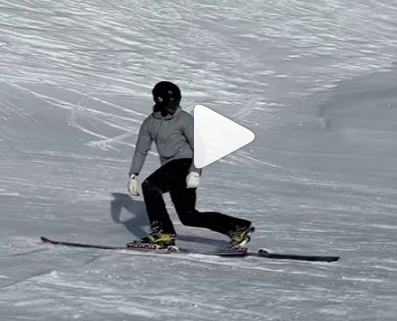
This is Tobi Heinle, ski guide, Voekyl-Marker-Dalbello pro athlete, doing his thing on Zugspitze Mountain, Garmisch-Partenkirchen. More on Tobi, click here.
Click on arrow to see video. And try to caption it. Write your entry below.
[Editor Note: Thanks to Snowbrains.com for originally posting this.]
https://seniorsskiing.com/wp-content/uploads/2019/12/Screen-Shot-2019-12-11-at-9.09.36-AM.png321397seniorsskiing/wp-content/uploads/2014/04/Seniors-Skiing-since2013-Logo@2x-300x68.pngseniorsskiing2019-12-11 09:10:462019-12-11 09:10:48Can You Do This?
Had my first day on snow last Thursday at Jiminy Peak in the Berkshires. It was a wonderful day on nearly perfect snow: chalky packed powder with some windblown pillows of powder along the edge of several trails.
Today, I thought I would tell you about the jet stream feature to look for when you are hungry for snow or cold weather.
For the most part, troughs are your friends. On a map they look like the letter “U” and act as receptacles for cold air delivered from Canada. They also provide the upper level support for surface low pressure centers to form and deliver fresh snow. There are two “branches” of the jet stream that flow across the continent in the winter, northern and southern. Northern troughs tap into the cold from Canada, and southern troughs enhance the injection of moisture into surface lows. When the two branches combine, or “phase”, we often see our strongest storms. In the West, single branch systems can be pre-loaded with moisture as they roll ashore from the Pacific, so phasing isn’t as necessary to generate a major snowfall. The next opportunity for a significant snowfall in the East will come next Tuesday, when some phasing looks possible. This jet stream map for Tuesday night illustrates the attempt at phasing:
Notice that the southern branch feature is lagging behind the northern one. If it catches up to the longitude of the northern branch system, the storm will be more intense.
Here is the surface map that goes along with that trough at that time:
The High to the north, in Quebec, will feed the system with cold air and should suppress the track to the south far enough to keep most of the NE in moderate snow.
Next week I will discuss the role of upper level ridges in winter weather.
Here is the outlook for the next 1-2 weeks, by region.
Northwest U.S./Western Canada: Light to moderate snow has fallen in BC in the past week with heavier snow in Alberta helping to boost skiable acreage. With the eastern Pacific ridge temporarily replaced by a trough for much of the next couple of weeks, new snow should be significant.
Cascades and Sierra: A much needed juicy storm hit the Sierra last weekend and open terrain percentages took a major jump. Late this week, the Cascades are cashing in, and totals will be two-four feet when the storm winds down over the weekend. Tahoe will pick up five-10 inches. Cascades will also be hit by a moderate storm early next week. Additional troughs will arrive every few days up until the holiday.
Rockies: The northern branch storm that nails the NW will bring heavy snow to ID, MT, WY, northern UT and northern CO over the weekend. One-two foot totals look likely. Like the coastal ranges, the northern half of the Rockies can expect additional helpful systems in the next 10-14 days. The southern Rockies will see lighter snow this weekend, but will have to wait for a southern system for help…later next week at the earliest.
Midwest: Lake effect snow has helped this week, especially in northern Lower Michigan, but it looks as though the air that flows over the Lakes in the next week will not be as cold, so amounts will be modest. An Alberta Clipper or two next week could help the northern Lakes, in addition to pretty solid snowmaking temps.
Northeast: Early week rain was followed by outstanding snowmaking temps this week but another wet storm will move through Saturday, due to a track that hugs the coast too closely…some backside snow will occur across northern New York and New England on Sunday. Prospects are better for a meaningful snow event on Tuesday/Wednesday of next week. Cold air will not be abundant, so there will be an elevation component to the storm. The snow should provide a shot in the arm to resorts roughly north of I-80. Longer term will be a high wire act leading up to Christmas, as the progressive pattern will make it difficult for cold air to get locked in enough to ensure snow vs. rain. There will be enough cold intervals for helpful snowmaking, however.
Overall, the weather in the Western half of the country looks good while the pattern will be rather chaotic with an enhanced degree of variability over the Eastern half for the next 10-14 days.
https://seniorsskiing.com/wp-content/uploads/2019/12/senior-ski1-e1576095296677.png466728Herb Stevens/wp-content/uploads/2014/04/Seniors-Skiing-since2013-Logo@2x-300x68.pngHerb Stevens2019-12-10 15:27:002019-12-11 15:27:20Skiing Weatherman: How A Trough Works
Poutine Is A Huge Comfort Food. Add That To A Mighty Bloody Mary And You Have Dinner At A Cozy BC Resort.
Yes, poutine is one of those things that requires an excuse to eat.
Poutine, a Frency Canadian comfort food dish. French fries are covered in tasty gravy and cheese curds. Next to the dish is a model of an historic birch bark canoe. Served in the Voyageur Bistro at Sun Peaks Resort, BC, Canada
We’re talking the massively popular comfort food that is Canada’s answer to Mac and Cheese. There isn’t an easy way to rationalize a dish that includes french fries, gravy, and cheese curds.
Unless, maybe, you’ve been skiing all day.
Bear in mind, poutine comes from Quebec, a scarf-culture place that has yet to embrace the idea of full face covering against the cold, a place where minus 30 degree temperatures in winter are a way of life. You NEED fuel in those conditions. Or anyplace else with that kind of weather.
So, enter Voyageur Bistro at Sun Peaks Resort in British Columbia, Canada. It’s a tiny cafe with hardly a dozen tables but if you’re looking to bolster your inner heat lamp when it’s freezing outside, you can hardly do better.
A former river rafting guide, owner Kevin Tessier started adding authentic Voyageur cuisine to his tours. It was all based on what folks ate during fur trading days (bison, berries, cedar plank salmon, lots of maple syrup). His meals were wildly popular, and this whole concept found a home in his restaurant, which he co-owns with his wife Diane Larsen.
There’s Elk Wellington, Bison Burgers and, in the past, a Mac and Cheese that included Tenderloin Steak.
As for poutine, one often-cited tale is that of Fernand Lachance, from Warwick, Quebec, which claims poutine was invented there in 1957. Lachance is said to have exclaimed, ” Ça va faire une maudite poutine” (“It will make a damn mess” in French slang), hence the name. The sauce was allegedly added later to keep the fries warm longer. Over time, the dish’s popularity spread across the province and later throughout Canada.
Well, of course, then, I had to try Kevin and Diane’s poutine, which is made with real (they stressed that point) locally made cheese curds and fries, topped with their own special gravy which includes drippings from beef, pork and turkey. The secret ingredient is apple cider vinaigrette.
The final extra yummy product—mind you, I had skied 25,000 vertical feet that day and was truly READY—was a mouth wateringly hearty dish, rich with a hint of sweet from vinaigrette and interspersed with chewy, tangy cheese.
I was forking my way through when a local sat down on the bar stool next to me.
“Caesar,” he said, ordering from Diane, the bar keep.
I started to pay attention when the drink took its final form and immediately ordered one for myself.
Canada’s classic Caesar drink. This is an upscale version made with salmon infused vodka, the usual tabasco, and Worcestershire sauces and Clamato juice.Cheese curds, salmon and pickled vegetables are included. Served in the Voyageur Bistro at Sun Peaks Resort, BC, Canada
A Caesar is basically a bloody Mary with an attitude but Voyageur’s Caesar is something very special: first into a tall glass rimmed with celery salt, the barman put the ice, then two shots of smoked salmon-infused vodka (“We don’t skimp,” Diane added about the vodka they make themselves), followed by squirts of tabasco sauce, Worcestershire sauce, a touch of horseradish and finally Clamato juice. This is topped with a skewer of assorted pickled or roasted vegetables, a chunk of First Nations-caught sockeye salmon, sometimes a chunk of cheese curd and maybe bison or elk sausage.
Yes, this was dinner.
https://seniorsskiing.com/wp-content/uploads/2019/12/SKI_SUN_PKS_0006a_sm.jpg8251100Yvette Cardozo/wp-content/uploads/2014/04/Seniors-Skiing-since2013-Logo@2x-300x68.pngYvette Cardozo2019-12-10 12:22:222019-12-10 12:22:24Canadian Cuisine? Sun Peaks, BC, Has Poutine Plus
SeniorsSkiing.com’s Reviewer Tried Againer Exoskeleton On His Second Day On Snow. Find Out How It Worked For Him.
I am a 75-year old, advanced intermediate skier with 10 years experience as a PSIA instructor in the East and mild osteoarthritis in my left knee. I currently ski at Alta; that’s where I recently tested the Againer Exoskeleton.
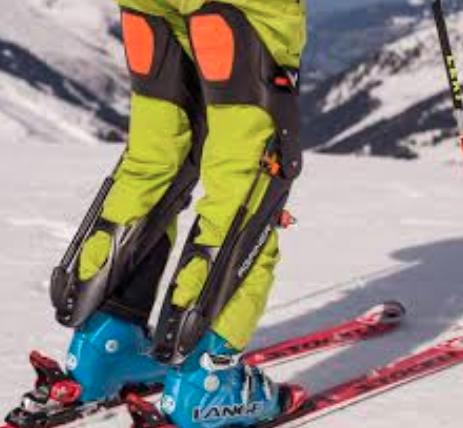
Againer Exoskeleton attaches to thigh and boot, using a gas piston as a shock absorber.
The Againer consists of a hinged plastic frame which runs from the upper thigh to the lower calf and is held in place by two straps. The key to the Againer system is a gas cylinder attached at the top to the upper section of the frame and at the bottom to a bracket on the rear of the ski boot. When the gas cylinder is engaged, it works like a shock absorber when flexing the knees and provides upward lift at the end of each turn.
The Againer helped me ski one of my favorite runs at Alta, Devil’s Elbow, a long intermediate run with a fairly gentle lower half. On my run, I made as many short radius turns as I could—probably 50 or 60 in a row—in the lower half . When I stopped, my legs were not tired, as they often are at the end of this drill, especially considering that this was only my second day on snow this season.
I can also see two advantages of wearing the Againer in case of a fall, which can be especially damaging to senior skiers. First, the Againer would prevent any lateral movement in the knee, reducing chances of ligament damage. Second, when I fall in powder, I often find one of my knees (usually my weaker left one) flexed underneath me. The Againer system would eliminate that problem and, of course, protect against the opposite occurrence, hyperextension.
The Againer was easy to use, thanks mainly to a well-illustrated and detailed instruction manual. I attached the brackets to my ski boots in about five minutes and put on the frames in another five to 10 minutes. The repetition of daily use would, I’m sure, reduce the time needed to get into the frames, and the brackets would stay on the boots all season.
For more information about the Againer Exoskeleton, check out the website at againer-ski.com.
[Editor Note: Below is a product demo video from Againer Ski.]
[Editor note: SeniorsSkiing.com is collecting stories from readers about incidents and accidents that they have experienced. We intend to review these for patterns and themes and use that data to influence the safety policies of resorts and other stakeholders. The following is the fourth article submitted by a reader in our new feature “Incidents and Accidents”. If you have a story to tell, please follow the format used below and send to INFO@seniorsskiing.com]
Jan Brunvand, Snowbasin, UT
What Happened
My wife Judy and I, both octogenarians, were skiing a blue run called Bullwinkle at Snowbasin, UT, on a nice clear midweek day with smooth groomed snow and few other skiers or riders. I had my helmet cam turned on, and I skied down first in order to get a video of Judy’s run. Looking back up the slope I noticed a skier and two snowboarders entering the run at the top, but Judy was on skier’s right, and they were on the left. What could possibly go wrong?
Skier veers toward Judy. Credit: Jan Brunvand
When Judy was about three quarters of the way down, suddenly the skier veered towards her and barely missed cutting her off. Then, just as she reached the run-out at the bottom, one of the boarder dudes cut straight across the hill towards her and ran over the back of her skis. The kid toppled, but Judy managed to stay upright by waving her poles to offset the collision.
Boarder crosses Judy’s skis. Credit: Jan Brunvand
The boarder, probably noting Judy’s white hair sticking out from under her helmet, apologized profusely. Judy checked her skis, and they had remained solidly attached. We proceeded to the base, keeping careful eyes on the others around us.
Boards goes down, Judy is waving her pole for balance, not repelling boarders. Credit Jan Brunvand
Back home I checked the video and saw again what close calls these had been. I took screen shots of three frames showing the two near misses plus the aftermath. In the last one it looks like Judy is poking the boarder dude with her ski pole—fighting him off. Not true, but it all happened too fast for us to realize how it might have appeared to a bystander.
Role of the Ski Patrol
No patrollers in sight
Lessons Learned
Danger can come from anywhere, no matter how much you try to stay in your lane and watch out for others on the hill. Not all skiers and riders are out of control or aggressive, but neither are they necessarily aware of their surroundings, so YOU have to be the aware one.
Advice
As in photo 3 above: Don’t Mess With Grandma!
https://seniorsskiing.com/wp-content/uploads/2019/12/Screen-Shot-2016-02-25-at-9.00.18-PM.png501665seniorsskiing/wp-content/uploads/2014/04/Seniors-Skiing-since2013-Logo@2x-300x68.pngseniorsskiing2019-12-10 11:18:252019-12-10 11:18:27Incidents And Accidents: 4
All Inducted In US Ski and Snowboard Hall of Fame.
Hints: Photo from Feb. 1941, Sun Valley. One of these men later enlisted in the 10th Mountain Division and was killed in action. Can you name them all?
Thanks to Alan Engen for contributing this photo from his four-volume scrapbook series, The Engen Skiing Dynasty, currently at the University of Utah, J. Willard Marriott Library Ski Archives.
Last Week
Yes, Rip McManus. We were surprised to see so many correct entries, and even anecdotes from commentators about his colorful, but much too short career in the ski business and sport.
We remember meeting Rip at an SIA Ski Industry Trade Show, back in 1970 or so. He was a smiling, fun-loving guy with a lot of energy who left a positive impression with everyone he met.
Rip was born in Boston, raised in Connecticut, and raced in the East until he went to Denver University. In 1964, we was a member of Bob Beattie’s US Olympic team. He was a three-event racer who captured North American and Canadian GS and downhill titles. At one time, he ranked 11th in the world in FIS points.
Rip left racing in 1965 and joined the Head Ski Co. as product manager and director of racing. He later moved to Lange as director of the boot division. He also consulted in marketing, ski testing, racing and product development with the Olin Ski Company.
Rip (r) in his role as TV sports commentator in Downhill Racer.
You may remember Ripper as a commentator and technical advisor to ABC-TV for the 1968 Winter Olympics, also covering the 1970 World Alpine Ski Championships for NBC-TV. He was an associate editor of Ski Racing magazine. What most people probably don’t realize is that Rip did the downhill racing sequences for the Robert Redford classic, Downhill Racer. He also played an onscreen role as a TV commentator.
He was clearly a unique character, coming up through the ranks of ski racing with few connections, little money, working on the trail crew at Stowe to earn entry fees and lift money. He did it all by himself.
Rip McManus’ life so full of potential was cut short by a traffic accident in 1982. As veteran journalist John Henry Auran wrote in a 1965 profile of McManus, “He’ll be remembered because he may be the last of his kind.”
[Note: This article was adapted from January, 1983 SKI magazine]
https://seniorsskiing.com/wp-content/uploads/2019/12/MysteryGlimpse.jpg15641992mikemaginn/wp-content/uploads/2014/04/Seniors-Skiing-since2013-Logo@2x-300x68.pngmikemaginn2019-12-10 11:15:352019-12-10 11:15:37Mystery Glimpse: Seven Great Champs
There Is A LOT Of Snow Out There. Have You Made Your First Run?
Snow Across North America this week. Time to get out there.
It has started. It’s official. It’s on. Go. 2019-2020 is happening. Now.
We are watching the post-Thanksgiving double-whammy snow storm fall here in New England and contemplating getting out on our xc skis this morning. We know our local ski shop has been jammed this whole past week with people collecting new or newly-tuned skis. There’s a lot of snow up country, and resorts are opening or have been open.
Open for skiing since Nov. 3 this year, the Killington snow making crew pulled off a minor miracle when the resort got ready to hold the Women’s World Cup over the Thanksgiving weekend. Mikaela Shiffrin handily won the slalom and Italy’s Federica Brignone received first place in giant slalom in front of 39,000 spectators, a record breaking crowd. Enthusiasm, much?
This week, we hear from SeniorsSkiing.com correspondent Marc Liebman on his routine for making the first runs of the season. Marc is an analytical guy, and his account of the initial moves are interesting in their focus on his tracks as an assessment of his early-season technique.
Some of us are about to make our first turns of this new season very soon, perhaps this weekend. Many probably already have been out and about. What was special about your first outing? What was new? Different? Better?
Seriously folks, the very first turns. What do you do? Do you have a mental picture of yourself or your skis carving through a turn? Do you talk to yourself, give yourself instructions or reminders? (We do. We think, “Athletic Stance” which has meaning for us.) Are you self-conscious? Uncomfortable? Cautious?
We’re curious how you approach the first of thousands and thousands of turns extending far into the spring. Let us know. Add a comment to the Leave A Reply box below.
This Week
Fun at the Boston Ski and Snowboard Expo. Credit: Don Burch
Correspondent Don Burch has produced a short video on the recent Boston Ski and Snowboard Expo. Check out the enthusiastic faces and the energy of the crowd in what might be dubbed the official kick-off of the season around New England. FYI, this is the last year the Expo will be held at Boston’s World Trade Center and produced by Bernie Weichsel’s BEWI Productions. Next year, the show will be at the Hynes Auditorium and SIA will manage the whole show. Thanks to Bernie for decades of hosting what has become a national tradition.
Parking Lots Closed!
Salt Lake City correspondent Harriet Wallis reports on last season’s monster traffic jams in Little Cottonwood Canyon, a two-lane road leading to four prominent resorts. This season, the problem has been recognized and solutions are being implemented. The jams seem to correlate with the flood of multi-resort passes that everyone seems to be using. Cause and effect?
Thanks for reading SeniorsSkiing.com, the only online magazine for senior snow sports enthusiasts. Please tell your friends. Remember, there are more of us every day, and we aren’t going away.
Appleton Farm, Ipswich, MA, trails are groomed by North Shore Nordic, a volunteer organization. Credit: MDM
https://seniorsskiing.com/wp-content/uploads/2019/12/3Appletontrail-scaled.jpg19202560seniorsskiing/wp-content/uploads/2014/04/Seniors-Skiing-since2013-Logo@2x-300x68.pngseniorsskiing2019-12-06 00:48:032019-12-05 09:18:06This Week In SeniorsSkiing.com (Dec. 6)
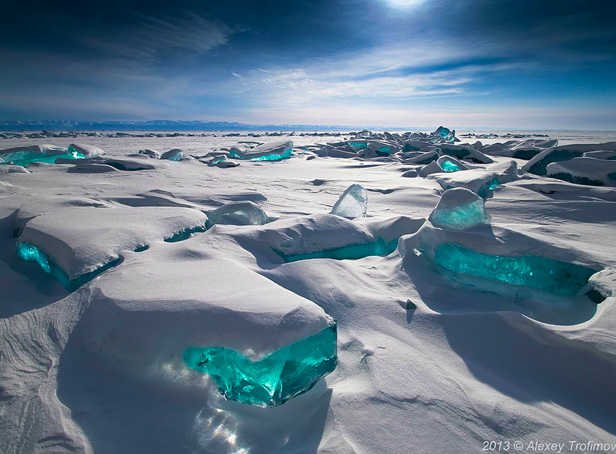
Growing up in Troy, N.Y., my friends and I often rode our bikes to Oakwood Cemetery, where we’d visit the tombstone of Samuel Wilson, aka Uncle Sam. One cold day, a pond had frozen in a way I never forgot and never saw again. For some reason, the ice had formed thousands of vertical tubes.
Oddities like this happen throughout nature. I find them special because they’re ephemeral. We’re fortunate to be there when they occur. And when they do, they don’t last for long. The brevity of their existence, like ours, makes the moment even more beautiful.
Since these occurrences are so fleeting, I find myself relying on pictures taken by others.
Google “weird snow and ice formations” and you’ll get many results. One website that pops up is called Bored Panda. It describes itself as dedicated to publishing articles about “lightweight and inoffensive topics.” There, you’ll find a photo gallery of fascinating ice and snow formations from around the globe.
As we enter the Northern Hemisphere’s 2019-20 season, take a few minutes to enjoy these photos of unusual, natural winter formations. And when you’re out and about in the cold, whether skiing, in your garden, or walking through the park, look around and see what natural wonders are there.
Every year, TIME highlights the Best Inventions “…making the world better, smarter and a bit more fun.” This year, under the headline, Pain-Free Skiing, TIME gave Special Mention toRoam‘s Elevate robotic ski exoskeleton. “The equipment includes a backpack and a device that resembles a knee brace, which you strap to your legs. Elevate sends air pressure from the backpack to the brace, acting as an intelligent shock absorber that reduces load off the quads and knees.” Starting December 15, the Roam Elevate will be available for rental from 10 resorts in California, Colorado, Idaho, Montana and Utah for as little as $25. Click on adjacent ad for more information.
Happy 100th, Klaus!
Klaus Obermeyer
Klaus Obermeyer, the legendary skier and innovator, whose eponymous ski clothing brand is found almost everywhere, turned 100, December 2. Click here for “It’s Easier To Ski Than To Walk,” the interview with Klaus which appeared in SeniorsSkiing.com in 2017.
Alta: 117″ To Date
There are many reasons Alta (UT) is among my favorite places to ski. The old school ambience. The fantastic terrain. The lack of boarders. And the remarkable snow!!!! As of this writing (early in the week) the resort has captured more than 10′ of the natural stuff. More is predicted by the time you read this.
Indiana’s Perfect North: Earliest Opening in 40 Years
Perfect North Slopes, Indiana, opened Nov. 15, the earliest date in its 40 year history. Thanks to Cathy Meyer for letting us know! Other news from Perfect North Slopes: It is purchasing Timberline Four Seasons Resort in West Virginia.
Whiteface Lodge Burns
Whiteface’s Mid-Station Lodge was destroyed by fire last weekend. Staff there notified firefighters around 9PM Saturday. Area firefighters reached the structure via snowcat. No one was injured.
Skiing Idaho With The Grandkids?
The Idaho Peak Season Passport lets 5th and 6th graders ski or board 18 mountains for $18. The program allows 5th graders to ride three days for free at each of the Gem State’s 18 ski resorts (Sun Valley and Grand Targhee, included) and offers 6th graders two days free at 17 areas. Unlike some other states with similar programs, Idaho makes the free skiing available to kids from any state or country.
Candide Thovex skis Great Wall of China
A current Land Rover commercial shows an SUV ascending an impossibly steep portion of China’s Great Wall. Now, Audi has released this short video of French skier, Candide Thovex skiing a snowless Great Wall.
[Editor note: SeniorsSkiing.com is collecting stories from readers about incidents and accidents that they have experienced. We intend to review these for patterns and themes and use that data to influence the safety policies of resorts and other stakeholders. The following is the second article submitted by a reader in our new feature “Incidents and Accidents”. If you have a story to tell, please follow the format used below and send to INFO@seniorsskiing.com]
Jon Weisberg, Teasdale, UT.
Where: Deer Valley, Park City, UT
What Happened: I was skiing the left edge of a wide slope, about three quarters of the way down. The bottom of the lift was visible. A skier in a green parka came from behind and passed within an inch or two. His skis crossed mine. I stopped and watched as the ugly green parka made its way clumsily to the bottom. Taking chase, I caught up with him and his friend in the lift line and confronted him. He was in his late teens or early 20s and denied that he was the skier in question. I pressed the issue. “You’re the only person wearing that ugly green jacket.” He still didn’t admit that he skied so close and almost knocked me down. “You did it, and you know you did,” I persisted. His buddy then spoke up and admitted that his friend had done it. They were about to get on the chair. I gave him a short lecture. “If you got hit at your age, you’d get up or spend a few days sidelined and be back on the hill. I’m in my seventies, and you almost knocked me down. I’ve been skiing more than 60 years. If you hit me, I might have been out for the season or for the rest of my life.” Maybe it registered, maybe not. He got on the chair and, fortunately, I never saw the twerp again.
Role of the Ski Patrol: Had Patrol been nearby, I would have reported the kid. They were not, and I did not.
Lessons Learned: I like to ski the fall line which is what I was doing when this happened. I deliberately ski slowly and in control. But many others don’t ski with the same level of control. It’s important to redouble looking around and upslope when skiing.
Advice: The incident made me realize that regardless of how well I conduct myself on the hill, I need to expect the unexpected.
https://seniorsskiing.com/wp-content/uploads/2019/11/historic6-e1582739799348.jpg546728seniorsskiing/wp-content/uploads/2014/04/Seniors-Skiing-since2013-Logo@2x-300x68.pngseniorsskiing2019-12-04 12:39:052019-12-05 15:13:39Incidents And Accidents:3
Instructor Pat McCloskey Recommends An Approach To Early Days.
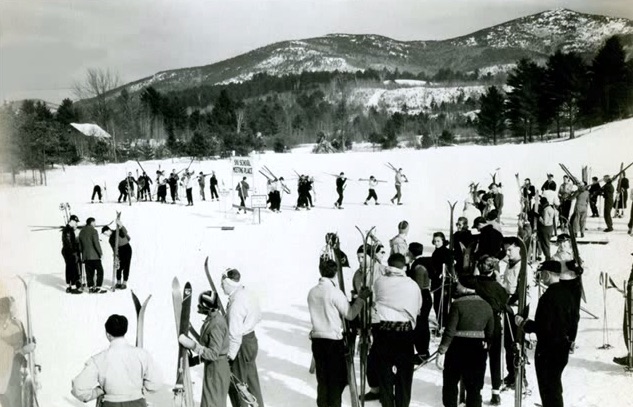
Opening Day, Cranmore, NH, 1938.
I had an interesting discussion with my lift mate this weekend at our local ski area.
I asked the fellow beside me how his day was going. He remarked, “Well, the hill is fighting me back a little today.” I chuckled because the guy was a certified PSIA instructor but was feeling a little uneasy with the current conditions. After all, it is early days for the season, and the snowmaking can bring terrain to life but can also provide less than adequate conditions if you are not prepared.
What did he mean the hill was fighting him back? As I exited the chair, I began to think about how to tackle ice, scraped snow, and the inevitable sand-like conditions that occur with a big crowd on not so big terrain. If you started out too fast, you ended up defensive in your stance, and the timing of turns was compromised by too much speed too early, resulting in a skid for life.
So, my recommendation to anyone starting out on their first run on limited terrain and icy conditions is to begin slowly and finish your turns. Make a series of turns by finishing them and reducing your speed by the radius of your turn. Your timing will come back to you and you can eventually increase your speed.
If you start out slowly and allow the cadence of finished turns to happen at a lower speed, you can eventually ski with a faster cadence once a comfortable series of turns are made. Be aware of your ankles and make them flex in the bottom of the turn to assist the ski in making a finished, rounded turn.
I did this for a while and really concentrated on rounded turns and feeling my edges grip the ice. Then I became more aggressive and said, “Come on Pat, you’ve got this” and increased my cadence and speed but didn’t compromise my turn. I was able to do this because of starting the run conservatively and making rounded turns.
I end up doing this all season long. If you can start slowly and make the first couple of turns correctly and rounded, you can ski any terrain anywhere.
My favorite condition for my first run on my first day of skiing on any trip is freshly raked frozen granular. Why? Because I can feel the edges of the ski carve in the snow.
Early enough in the season, even if one skis out west, you’ll see more hard packed snow than powder which works. But, only on frozen granular can you can hear the skis cut through the snow. The crunching and scraping sound of skis on frozen granular is unique and it sends a confirming message to my brain that I am skiing again. On hard packed powder, you have to listen for the singing sound of the skis cutting through the snow. It is there, just hard to hear above the ambient noise.
For each first run, I follow the same drill that puts the racer, the rec skier, the instructor and the ski tester in me in instant conflict.
The racer in me wants to go fast, straight down the fall line. At my advanced age, I still like to ski fast but force myself to ski slower because can at 74, my bones don’t break, they shatter.
The rec skier wants to charge off, get to the bottom and up before the lift lines build.
The instructor part of my brain says make the perfect turn in, of course, perfect form, but not in the Final Forms that PSIA pushed in the 70s. Body position – square over the skis, knees flexed, back straight, arms out and bent, ready to plant the pole – is important to enable one to control the skis and speed.
Since I rent skis, I’m back being a ski tester. How does the ski carve? How easy are they to turn?
My technique is the same for my first turn. Pick-up some speed and as the skis come through the fall line, press forward with my knees and edge the ski. Plant the pole, unweight, roll my knees …. Yeah, yeah, yeah, I’m old fashioned. After three or four turns, I stop and look at my tracks.
Why? Because on frozen granular the tracks tell me where I unweighted and where I finished each turn. There edges should make straight lines and there should be a bit of feather at the end of the turn where I set the edge to build a platform for the next turn.
It is about muscle memory. My last turns were in April, eight long months ago. Technique is important because it is how one controls one’s speed on a steep pitch and how one navigates through any condition. And, I’m a year older.
First four turns examined, I make another set and look back. The snow tells me how good my technique is. Sometimes, it takes three or four segments to convince me that my turns are O.K., other years, it has taken only one or two. It just depends on the snow, the skis and me. But the joy is back because I’m turning skis on a mountain.
/wp-content/uploads/2014/04/Seniors-Skiing-since2013-Logo@2x-300x68.png00Marc Liebman/wp-content/uploads/2014/04/Seniors-Skiing-since2013-Logo@2x-300x68.pngMarc Liebman2019-12-04 11:03:002024-08-21 10:44:34My First Run









 As I get older, each ski season is more precious than the one before. I’m pushing 60+ years of skiing, and early in my life, I learned never to take one for granted. Except for being deployed overseas during Vietnam and Desert Shield and Storm, I haven’t missed a ski season in decades.
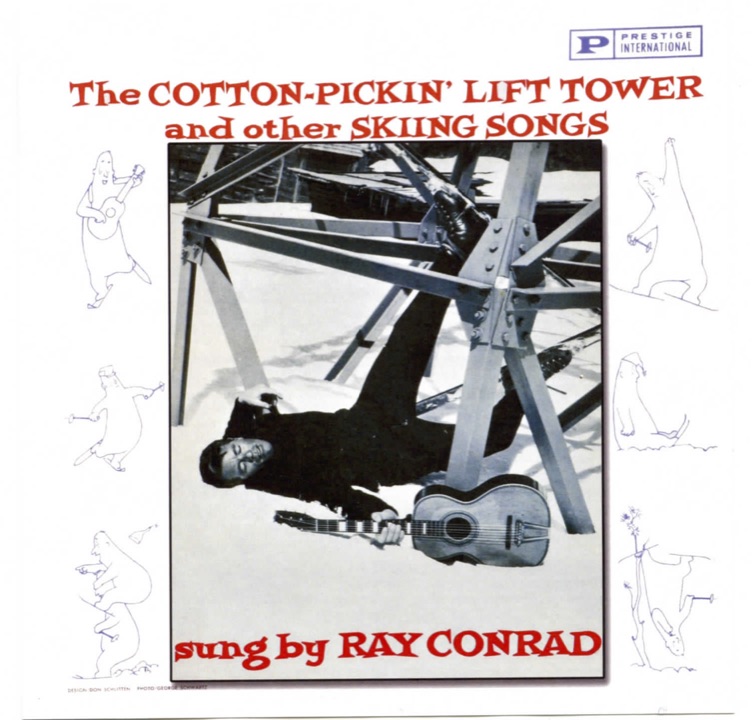
 Ray Conrad wrote and performed skiing songs in the early 60s in a folk music style that was gaining popularity in cafes, clubs and college campuses. His songs are satirical, silly, clever, and funny, spoofing the people who ski or want to look like skiers. SeniorsSkiing.com re-produced and is distributing the download-only CD on CD Baby.