Ever since Vail Resorts and Alterra started gobbling up ski areas, there’s been industry chatter about corporate vs. independent resorts. Among other topics, this issue’s Short Swings! weighs in on the issue.
Ski instructor and contributor, John Gelb, reports on Alta’s Intermediate Breakthrough instruction program and suggests ways to replicate it at other areas. One suggestion: take lessons on Sunday, when ski school activity tends to taper off.
Don Burch is back with another skiing video. No flips and hucks here, simply shots from a variety of New England mountains presented in a gentle and artistic mix.
British author Bob Trueman offers practical (and at times, counterintuitive) advice for when you select ski gear. Jackson Hogen of realskiers.com provides excellent guidance on keeping that gear in good shape.
The innovative Dahu ski boot is profiled. Jon refers to its breakthrough design as the Tesla of ski boots.
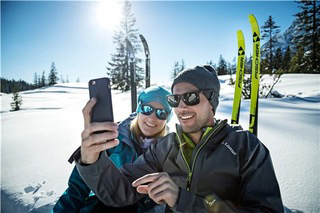
X-C editor Roger Lohr advises shopping for X-C equipment early this season. Supplies are low, and inventory probably will not be restocked.
And Herb Stevens, The Skiing Weatherman, gets us up to date on what to expect in mountain weather around the country. Spoiler alert: It’s snowing in the West and more areas are spinning their lifts.
If you enjoy SeniorsSkiing.com, forward it to a friend. The next issue will be distributed Friday, November 12.
Every industry benefits from a mix of offerings. The ski area industry is no exception. I find it enjoyable to ski big corporate resorts as well as independently-owned areas. Some, like Alta, Big Sky, and Jackson Hole offer both big terrain and an attractive level of smaller resort intimacy.
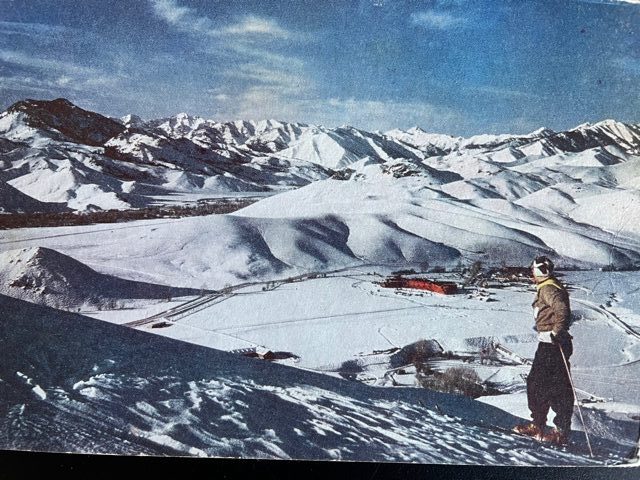
SUN VALLEY in the old days
It may surprise you that, according to the National Ski Areas Association, of the 37 states with ski areas, New York State has the most with 51…almost 11% of the country’s 470 areas. Next is Michigan with 40 areas, then Colorado and Wisconsin (31 each); California and New Hampshire (30 each), followed by Pennsylvania (26), Vermont (23) and Minnesota (20).
The majority of these are smaller and either independent or part of small group ownership.
Many smaller areas make it because they’re close enough to population centers and/or they’re the only game around. They get a large enough following to sustain them season-after-season.
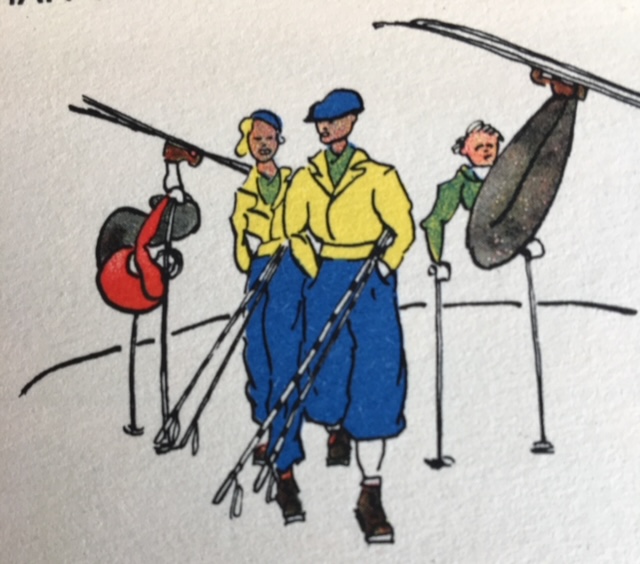
Skiers in Norway: 1907
I like to mix up my skiing experience with visits to big and small. A few seasons ago I spent a delightful day exploring Pomerelle, a smallish area in southern Idaho. The terrain wasn’t challenging but it was interesting. And the base lodge was like going back in time…including the price of lunch.
Skiing big resorts is a different kind of experience. Vail is endless. Aspen, Breckenridge, Jackson Hole and others are challenging. Ditto with my home resorts Alta and Snowbird. I know them and their hidden stashes well. Alta, especially, combines great skiing with local friendliness and warmth. There’s a reason it’s a magnet for skiers from around the globe.
Teton Gravity Research recently produced “In Pursuit of Soul,” a short film celebrating smaller ski areas. To view the trailer click here. It builds the case for independently owned areas and was sponsored, in part, by Indy Pass, the reasonably priced pass that offers skiing privileges at 80 independently owned areas in North America and Japan.
Two skiers. Two skis. One turn.
If I had a few long weekends each season to ski and deep-enough pockets, I’d book at one of the big places in a region with reliable snow. For a family ski holiday with young grandkids, I’d choose a smaller resort with trails that funnel into one or two bases. That way there’s less chance for them to get separated or lost.
I like big mountains with a variety of terrain, and, frankly, it doesn’t matter much who owns them. They just need to be well-covered in snow.
Newly Found: 1300 Year-Old Ski
Archaeologists in Norway recently dislodged a 1300 year-old ski from the Digervarden Ice Patch. They believe it matches another ski found nearby in 2014. The newly found ski has an intact binding of twisted birch and leather. Click on the video (above) to witness the discovery in real time. A more detailed account appears in the Secrets of the Ice website which documents glacial archaeology.
The Superior Rx Goggle
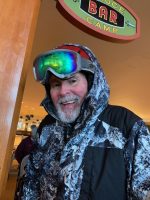
SnowVision Rx goggles integrate prescription with inner lens
If you wear prescription goggles you owe it to yourself to learn about SnowVision‘s unique prescription lens. Unlike other Rx goggles, SnowVision integrates the prescription lens onto the inner lens of the goggle (see middle lens in picture above). Among its numerous advantages is the total lack of fogging. Another is remarkable visual clarity and full range of vision, including around the periphery of the lens. This is virtually unheard of in conventional prescription ski goggles and results from the curvature in SnowVision’s prescription and outer lenses. The lens – fully photochromic so it gets dark or light depending on conditions — is available as unifocal, progressive or bifocal. SnowVision’s components are made by high-quality vendors in Germany, Italy and Japan. Every senior skier who wears glasses should take special care when it comes to prescription goggles. There are some unsatisfactory products on the market, as I, unfortunately, have encountered. SnowVision is a breakthrough.
Please Help with This SeniorsSkiing Crowd-Sourcing Project
Numerous readers have asked about groups for older skiers. Some, like the Wild Old Bunch (Alta) and the Over The Hill Gang (multiple areas) are fairly well-known. SeniorsSkiing.com wants to compile a list of groups. If you know of any, please email name, location(s), a contact name and email and/or phone number to jon@seniorsskiing.com. The info will be posted on the site and updated as new info is received.
Special Discounts
EZ•Fit Auto Adaptable Insoles
Masterfit is offering 20% off any of its EZFit insoles (Snow and Universal models), Tongue Eliminators, Boot Horn and SkiSkootys. To learn more about these products, and/or make a purchase, visit https://masterfitinc.com. The Tongue Eliminators, Boot Horn and SkiSkootys can be found under “Fit Aids.” The 20% discount is good at any time. Simply enter the code SS21 during check out.
Use code SENIORSSKI to receive a 30% discount on online orders for any of Arcadia Publishing’s 27 ski titles. The offer is valid through November 7.
Holiday Shopping for Older Skiers
The Bootster ski boot shoehorn: ideal gift for older skiers
It’s really quite easy…and reasonably priced. The Bootster is an ingenious ski boot shoehorn so compact that it easily fits in a parka pocket. The little device unrolls to reveal a slippery surface that helps the foot slide easily into the ski boot…even when the boot is cold. Each Bootster is hand assembled and very well made. The price is $25 plus shipping. I can’t think of a better or more appropriate gift for older skiers on your list.
FeedSpot Now Delivering SeniorsSkiing.com Content
FeedSpot is an online service that consolidates and delivers news based on the user’s preferences. Happy to report that for FeedSpot subscribers seeking ski-related news, SeniorsSkiing.com articles are now part of their package.
Skiing in Taiwan?
Before global warming had taken it’s toll on so many places with snow, skiers in Taiwan frequented the island nation’s Hehuanshan ski resort. Alas, like so many other locations around the globe, there no longer is enough snow to ski there.
RIP: The Farmer
Dave Van Dame, The Farmer, was an Alta ski legend, skiing deep powder there for 48 years. He recently passed away. Those of you who were privileged to witness his technique are fortunate. Alta recently issued this short video tribute.
The Best Car Commercials
A thing of beauty: my Willys 1/2 Ton Pick Up
I recently sold my (unrestored) 1950 Willys half-ton truck. It was love at first sight several years ago when I saw it on a side street in Ouray, Colorado…a foolish purchase requiring far more skill than I had and more money than I wanted to spend. I concluded that, like many things, old cars can be enjoyed without ownership. During my infatuation I started to follow Hagerty, which insures vintage vehicles and publishes online and print content about them. This article about 10 “unforgettable” car commercials contains links to some funny and moving examples. Not skiing but a lot of fun. Click here to access
Halloween is upon us and it’s now reasonable to think snow. In the past week we have seen some major amounts of snow fall in the West, particularly in the Sierras of California. After a very dry summer, a veritable firehose of moisture pointed at the coastal ranches and let fly. Thankfully, there was just enough cold air around to convert it to bountiful, base-establishing snowfall. Tahoe resorts hit the jackpot with 30-40 inches burying their higher terrain. Further south, Mammoth Mountain will be kicking off its season late this week. In the East, a major storm battered New England but it was too early to expect much in the way of snow…the higher elevations of northern New England did see snow, however, which put some pep in the step of the locals.
The Nor’easter was a classic case of what my grandmother called a “line storm”, which she said drew the line between an extended warm autumn and the start of a more winter-like pattern. That is exactly what is happening to the jet stream pattern now. “Endless Summer” is an iconic surf movie, but not a term that skiers and riders like to hear at this time of year. After weeks and weeks of an upper level ridge sitting over the eastern half of North America, keeping temps above normal, upper level troughs, which support storms and deliver cold air, have become more common. A solid cold shot will move through the Lakes and into the Northeast later next week, potentially producing the first meaningful snowfall of the season. Here is the 10-day forecast for snow from the European model…
It won’t be a massive event, but it will deliver at least a couple of nights of productive snowmaking temps across the higher terrain of NY and northern New England around the 6th/7th.
Here is the western snowfall forecast for the same 10 days…
Much of the snowfall that you see in CO and NM will come from an upper level disturbance that will track east and lead to the eastern event. Clearly, the northern Cascades and the ranges of BC and AB look to be the big winners as we head into November.
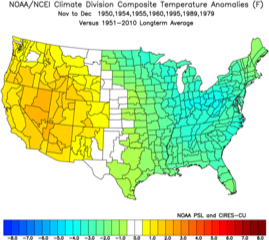
Last time, I referred to “analog” forecasts that are a big part of my long range forecasting methodology. I don’t just look at models, but rely heavily on “pattern recognition” and analog forecasting. Pattern recognition simply means that at my age, I have seen a lot of cold fronts come and go. Analogs are developed by looking at historical patterns and phenomena that are similar to what’s in place right now…on a time frame of weeks and months. Like many other things in nature, the weather tends to repeat itself. If you do the detective work and find setups in the past that match up with the present, you can forecast the future quite accurately. One set of analogs have me bullish about the start of the season over the central and eastern U.S. The common factors are a colder than normal May, a busy hurricane season with a significant landfall on the U.S., and widespread warmth in October, all of which occurred this year. Here is the temperature regime of the Decembers of the years that shared those events…
The pattern is changing, and this is where I feel we are headed, temperature-wise, for the next 60 days or so. Look for the Great Lakes and East to get off to a quick start. The West will be fine, too, as warm anomalies at elevations can be overcome. Next time I will start the regional breakdowns…here we go!
Hello readers, super great comments and questions on my “Secrets for Your Best Ski Season Ever” piece. Also spoke with two readers in follow up. I can sense everyone’s excited for this ski season – me too. Shoot me your thoughts or questions and I’ll reply.
Alta’s Intermediate Breakthrough program help people go from blues to blacks
Previously I mentioned my good friend (60+) who improved bigtime from only four group lessons at Alta, UT last March. Result: his skiing improved from confident “blue” skier to eager “black” skier. In just four lessons. So let’s dig in to what Alta’s program looks like and why it works.
And it’s worth doing even if you’re NOT going to visit Alta. Here’s why: it’s a great template for asking the right questions of any ski school or instructor. As a ski instructor, I LOVE when any skier in a group or private lesson tells me what they want to be able to do better/different.
Source: Alta
Now, back to Alta’s “Intermediate Breakthrough” group lessons. Curious, I reached out to both Alta’s Ski School Director, and to the instructor who led the program my friend had found so helpful. A few key observations:
They seek decent “blue run” skiers who want to improve.
They want skiers who will put some thought into their skiing, actively thinking of improvements they’d like to make.
And, they want skiers to go out and practice the improvements a lot, and talk about what they’re seeing and feeling in their skiing.
I spoke with both Jonathan Doty, the on-snow instructor who led the Intermediate Breakthrough (IB) program, and with Jeremy Moore, Alta Ski School Director, who helped design it. IB consists of one half-day group lesson per week for four consecutive weeks; a total of four group lessons. Talk to your ski buddies and try to pull together 3-4 who could join the lesson; next, talk to ski school and try to schedule a half-day morning lesson for four consecutive Sundays with same instructor.Many Sundays are QUIET at ski schools, so you may have better luck creating a special deal.
Jeremy insisted “the IB program is well-suited for anyone who’s skiing at least easy blue groomed terrain comfortably, and also is willing to put some time and energy into thinking about and hopefully improving their skiing”.
Source: Alta
Best preparation? Here’s Jeremy again, “You don’t have to prepare in any specific way. However, it would potentially help improve your overall experience if you took some time to think and feel your skiing and come up with some concepts of what you like or don’t like about your skiing so you have a baseline to start from with your coach.”
From my friend, I learned that the IB format focuses on several “themes”, specifically one per week. I asked Jeremy to unpack this a bit for me. Jeremy: “The Alf Engen Ski School at Alta is a skills-based ski school, and we help students understand the How/What/Why they are doing with their skis.” He added, “There are only 3 things you can do to your skis: rotate them, pressure them, or tip them on and off their edges”. Sounds like a little, but it’s a lot!
Jonathan expanded on the “theme” focus: “We want skiers to succeed not only with us but on their own. Each week we focus on a specific task they can practice outside of IB lessons, and a theme creates a flow to the lesson where the skills build on each other.”
As an instructor mostly doing private lessons, I know many people are concerned about “being judged” by others, particularly their friends. Jonathan insisted: “This is a common thought, but everyone is putting themselves out there, and are on a personal journey. This is a judgment-free zone!”
Like I wrote last time, whenever we improve our skiing proficiency…we have more fun! Try to create this program at your favorite ski area…or just go to Alta.
The ski shop makes more money renting out or selling higher performance equipment.
Be honest with yourself – if you don’t ski hard and fast you probably don’t need it.
Higher performance skis perform worse when not skied hard – they need higher momentum, and more force to get them to work well. Skied slower they can be harder work. Is that what you want?
It may well have been a year since you last skied – maybe more. You likely won’t ski too hard on days one and two. Try renting an easy, flexible ski first. If you find you ski hard enough to make it “chatter”, you can always change up.
Dizzy of Dizzy’s boot fitting shop at Big White ski resort shows off an early 1970s ski boot that boasted fantastic ski technology that, sadly, was ahead of the boot’s ability to support it. The boots famously would come apart during skiing. Credit: Yvette Cardozo
BOOTS
Same rules apply. Boots designed for beginner/early intermediate will be less expensive.
Priority number one is comfort. Don’t put up with anything less.
Very few skiers need boots as stiff as the ones they have; or rent. Most skiers are “over-booted” and it holds back their skiing. Plus it’s often painful.
Start off the vacation with a lower grade boot: it’s easy to exchange them.
Why do I say this? Because if you cannot forward flex your ankle very readily, your skiing will never be as good as it could be. And you’ll never be as stable.
When you do-up your boots don’t have the higher buckles too tight.
When the buckles are done flex your shin forward and hold it there, and only then fasten the unfortunately named “power strap”. It will be somewhat slack until you flex your shin forward. At first you may feel this is a bit “wobbly” – but for heaven’s sake you don’t have your ankles clamped when you move about at home! And it doesn’t make you lose control.
Source: Praxis Skis
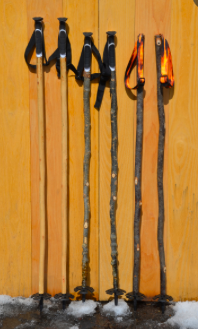
SKI POLES (The ski shop will have a small fit when you tell them this.)
You want them
They hate it. They will patiently explain to you as if you were a child that they know what length you need, and will explain how they derive it.
At this point listen attentively, take the pole they proffer, and then tell them you want a pair like that but 3” (7.5 cms) shorter. Insist on it. They will suggest that if you do, you will die. You won’t.
Why shorter poles? Because the length ski shops always hand out, makes skiers stand upright and almost lean back every time they do a pole plant.
Try it – all experiments are worthwhile. You will very quickly prefer the shorter ones because they will help improve your posture. Anyway you can always go back up a length later if you want to – it’s not a lifetime contract.
https://seniorsskiing.com/wp-content/uploads/2021/02/Screen-Shot-2021-02-16-at-8.46.33-AM-e1613483590387.png386728Bob Trueman/wp-content/uploads/2014/04/Seniors-Skiing-since2013-Logo@2x-300x68.pngBob Trueman2021-10-28 18:15:142021-10-28 18:56:46Things to Remember when Choosing Alpine Ski Equipment
Isn’t it remarkable how electric vehicles are taking over the automotive industry? By 2035, virtually all General Motors vehicles will be battery powered. Our grandkids will look back and tell their kids about a time when combustion engines ruled.
I think a similar new frontier is being established with the Dahu ski boot. The company has parted ways with traditional boot makers and come up with materials and design that make it as different from the others as Tesla is to Dodge.
It’s a game changer.
Dahu boots were conceived and developed to be fitted more easily, minimize ski boot discomfort, and maximize performance.
The shell has a dozen strategically located holes that eliminate foot hotspots most skiers – especially older skiers – experience. Think about this feature: it gets rid of the need for bootfitters to manipulate the plastic to relieve pressure points. The car equivalent? No more engine tune-ups!
Made of a Swiss polyamide composite, the shell combines lightness and durability and consistent flex, regardless of temperature. It has a hinged tongue with two micro-adjustable buckles and a hinged, releasable rear with a patented aluminum spine which helps transfer body energy to the ski. Interestingly, the spine contributes to each skier’s ideal stance.
A comfy, insulated leather inner boot has a grooved rubber sole which provides traction when the inner is worn separately from the shell. Those grooves interlock with ridges and grooves in the shell, the net erect being greater torsional stiffness and more efficient energy transfer from body to ski.
I understand this is a lot to absorb. But I know that many of you have had it with your conventional boots. Our August reader survey asked, among other things, what items you intended to purchase in the next two years. Of the 3000+ responses, about one-third indicated ski boots. And from comments made during past reader surveys, sent to the site and to me personally, I know that finding a better boot is top-of-mind for many older skiers.
If you’ve had it with conventionally designed boots and are looking for a pair that can be fit more easily (including using one-on-one zoom sessions), will keep your feet warm and comfortable and, most importantly, perform for any level of skiing, click on the Dahu advertisement on the right side of the page.
https://seniorsskiing.com/wp-content/uploads/2021/10/Screen-Shot-2021-10-26-at-7.41.07-PM.png389459Jon Weisberg/wp-content/uploads/2014/04/Seniors-Skiing-since2013-Logo@2x-300x68.pngJon Weisberg2021-10-27 08:53:002021-10-28 19:01:14Dahu: The Tesla of Ski Boots
Don Burch creates short, artistic ski videos that capture the small moments showing people of all ages and abilities having fun together on the mountain.
“Skiing The East” features scenes from Stowe, Okemo, Otis Ridge, Sunday River, Killington, Sugarbush, Mount Snow, Stratton, Wildcat, Magic, Waterville Valley and Maple Valley (long closed). Enjoy this two-minute ride.
https://seniorsskiing.com/wp-content/uploads/2021/10/Screen-Shot-2021-10-27-at-9.17.13-AM.png315685Don Burch/wp-content/uploads/2014/04/Seniors-Skiing-since2013-Logo@2x-300x68.pngDon Burch2021-10-27 08:45:142021-10-28 18:50:00Enjoy Don Burch’s Newest Creation
Each issue of SeniorsSkiing.com has a picture to help test your skiing knowledge. The pictures are from collections in a variety of participating ski museums, which we encourage you to visit and to support.
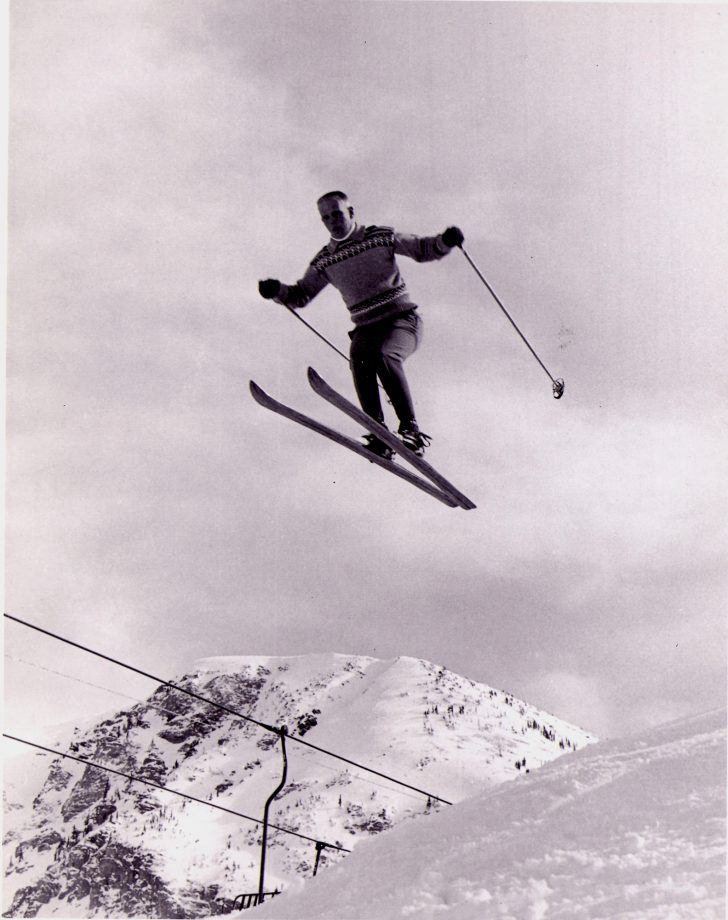
Who is this Utah living ski legend?
This image was submitted by the Alf Engen Ski Museum, located in Park City, Utah. The museum is dedicated to preserving the rich history of skiing in the Intermountain region. Its extensive collections and interactive exhibits make it an innovative leader among the world’s ski museums.
The jumper in this image is well-known in many ski circles. A member of one of America’s best-known skiing families, he was an active Nordic and Alpine competitor, ski school director of one of Utah’s premier resorts, and the author of a few books on skiing. What is his name? If you know or want to take a guess, send your answer to jon@seniorsskiing.com. The first person to correctly identify this living skiing legend will receive a free pair of EZFIT Universal Insoles from Masterfit (retail value: $44.95).
The correct answer and the name of the winner will appear in the next issue of SeniorsSkiing.com.
The winner of the last Test Your Skiing Knowledge (several others had the correct answer but were not the first to submit it) is Charlie Sanders of Briarcliff Manor, NY. He correctly identified the site in the image as White Sands National Monument in New Mexico. Charlie has impressive ski history credentials. He is the author of “Boys of Winter: The US 10th Mt Division in WWII.” His article,“Sunshine On My Shoulders: The History of Ski Music,“ appears in the current issue of Skiing History magazine. Charlie also serves on the boards of the International Skiing History Association and the US Skiing and Snowboarding Hall of Fame. His prize is Arcadia Publishing’s book, Skiing in New Mexico. Several readers sent their answers to “Comments.” When submitting a Test Your Skiing Knowledge response, please email to jon@seniorsskiing.com.
https://seniorsskiing.com/wp-content/uploads/2021/10/Alan-Engen-Gelande-at-Alta-circa-1961-1-e1635351352142.jpg920728seniorsskiing/wp-content/uploads/2014/04/Seniors-Skiing-since2013-Logo@2x-300x68.pngseniorsskiing2021-10-27 08:27:512024-08-21 09:47:28Test Your Skiing Knowledge
Last winter XC ski gear was in demand like never before and all segments of cross country ski equipment sold out, with few or no options for retailers to reorder. There also was an uptick for backcountry gear and snowshoes.
Retailers are still experiencing demand and supply issues. Coupled with global supply chain challenges, everything from the components that complete a ski binding to the actual cardboard boxes in which products are shipped have been in short supply. Demand and wait times have increased dramatically for these vital pieces, further impacting supply.
Responding to these factors, retailers placed orders as early as possible and for as much gear as they could get. But some wholesale distributors limited the amount of equipment they planned to make available in the US.
The result? Retailers may not be able to reorder sold out merchandise.
If you want to get new gear this year, here are some tips from Burlington, Vermont retailer Ski Rack:
Start Early
The earlier you begin the process the more likely you’ll get the right winter gear for you. The process begins with your own preliminary research into what you’re looking for and how you want to enjoy the outdoors this winter. Starting early is great! However, keep checking for new arrivals.
Buy Locally
Once you’ve identified the type of XC ski activity you’re interested in (for example, skiing in tracks, on ungroomed trails, in the backcountry, or ski skating) the next step is to head to a local gear shop and talk with the retail experts. They can be a great resource to help with sizing and to discuss various details, including differences between products. Consider custom fitting for all categories, to get the right gear the first time. This way, you’ll save time and avoid having to return something down the line when you find it’s not the right fit. By then, that item may not be in stock anymore.
Flexibility
Another key piece of getting winter gear this year is flexibility. There are lots of options from many brands that will serve you well. Some models may already be sold out for the year, pre-sold, or unavailable for months. It’s advisable to explore all options to see what the best fit may be, even if it’s not your first choice, but ACT FAST! If you find something you want at the store, don’t wait. It could be gone the next day or the next hour.
https://seniorsskiing.com/wp-content/uploads/2021/10/Fischer-nordic_cruising_selfie.jpg213320Roger Lohr/wp-content/uploads/2014/04/Seniors-Skiing-since2013-Logo@2x-300x68.pngRoger Lohr2021-10-27 08:20:452021-10-28 19:03:17Tips to Buy New XC Ski Gear for This Winter
Years ago, a fellow I knew in the fitness industry commented, “You don’t ski to get in shape. You get in shape to ski.”
I didn’t always agree, but as I’ve aged, I’ve realized that it really does require considerable training to prepare for the season.
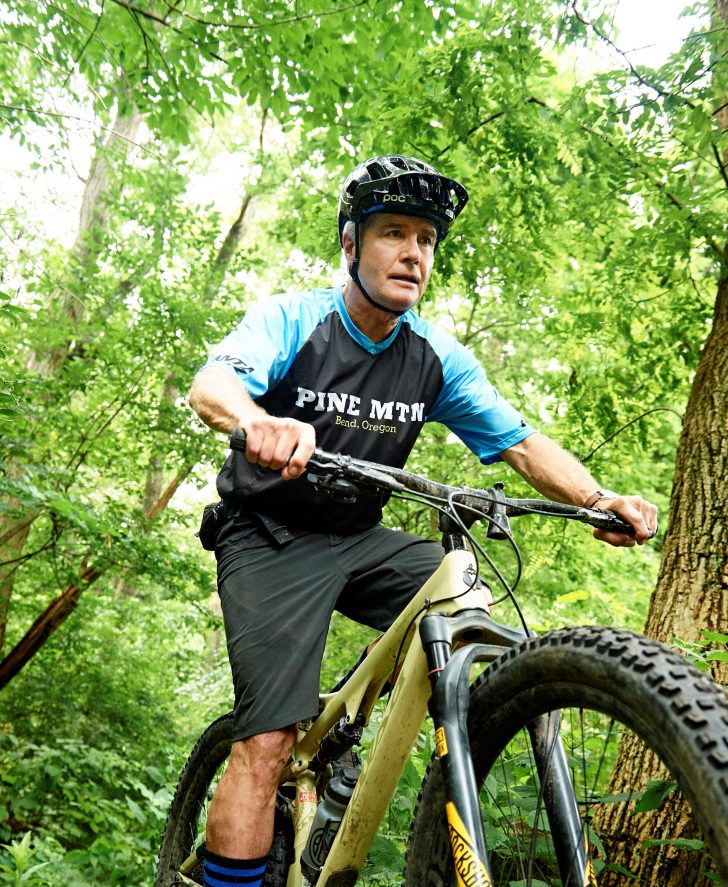
This issue has some good advice from Pat McCloskey about similarities between mountain biking and skiing and how the former helps prepare for the latter.
Also included is a photo-essay offering excellent pre-season training advice that can be done on your own. It first appeared in last season’s Masterfit Buyer’s Guide. How do I know this is the right advice? For several months, now, I’ve been working with a trainer to help me get in shape for the season. All of the recommended exercises (plus a lot more) are in my 2-3 x a week routine.
Dave Chambers has written his account of skiing the Canadian Rockies with a few friends in the 2020-21 season. The Aussies have always been great travelers, and in this informative account, he and his mates crisscrossed the mountains enjoying seven different resorts in one trip.
I’ve come to appreciate the unique skiing experience as an occasional alternative to quotidian resort skiing. Frequent contributor, Jonathan Weisel, introduces us to the beauty of cross-country skiing in Yellowstone National Park. Yellowstone Expeditions, which operates a small yurt village and provides 5-day guided trips and specialized photo trips, sounds like a fantastic ski experience.
And Herb Stevens, the Skiing Weatherman, provides a heads up on the weather and what to expect from it. Parts of the West are getting inundated. Let’s hope and pray that this is a good sign for the entire season…and the wildfire-mitigating snowpack.
Check out your skiing knowledge with this image submitted by the New Mexico Ski Hall of Fame and Ski Museum. While you’re there, learn who correctly identified Arthur Conan Doyle from the last Test Your Skiing Knowledge photo.
Finally, enjoy Jon’s ShortSwings! column. At the end of his sometimes quirky ski news roundup, there’s a link to a ski film shot more than a century ago. We rarely see jump turns like those anymore.
Would you pay an additional $49+ not to wait in the lift line? Express lines have been available for years for members of exclusive clubs and for skiers accompanied by instructors. Now it will be available for a fee on a day-by-day basis at Snowbird (UT), Killington (VT), Copper Mountain (CO) and Mount Bachelor (OR), all areas owned by Utah-based Powdr Corp.
Years ago, friends at Snowbird with “black passes,” went to the head of the line on the Tram and other lifts as a benefit of membership in the resort’s pricey Seven Summits Club.
In the late 60s I skied Chamonix with an American photographer living there. Organized lift lines were nonexistent. He pushed his way to the front of the pack and slipped some francs to the lift attendant. It was uncomfortable to me, but perfectly normal to him.
Now that privilege will be accessible to anyone with spare change. Dedicated fast access lanes are being established at the most popular lifts at each of the participating resorts (Snowbird’s Tram, not included). Starting Nov 1, skiers can purchase the Fast Tracks add-on in advance or on-mountain. Fast Tracks — quantity to be capped daily –will be available to all skiers holding day passes, season passes or Ikon Passes.
Is this new level of premium pricing a natural evolution of how lift tickets are valued? I think so. A few years back, areas assigned different values to lift tickets based on how far in advance they were purchased, day of the week, holidays., etc. Some areas discount passes based on military service, student status and age. Remember when 60 year olds got free skiing? In the US, the age threshold has been steadily increasing. Now, generally, you need to be 75 or 80 to get a deal, if any exists.
Most resorts and the bundled pass offerings discount for early purchases. Their purveyors get to invest that capital any number of ways.
Who will make the add-on Fast Tracks purchase? Anyone with a cushy account planning a trip to the mountains. They paid for the flight, the lodge, lift tickets, etc. Why spend time on the hill waiting in line? That’s the market…and those to whom the added cost means nothing.
So much about skiing, like life in general, has changed, and those changes may grate on those who have been enjoying it for decades. If this works for Powdr Corp, it’s just a matter of time before paying the additional fee to get to the head of the line will be commonplace.
The Season Is Underway…
…at least in Finland where Levi and Ruka have opened with the benefit of recycling last season’s snow. The procedure, know as “snow farming” stores snow from the previous season in protective structures and redistributes it on trails once temps have dropped enough to keep it from melting. Here in the US, Copper Mountain (CO) fired up its guns last week to prepare for US Ski Team training staring October 22 and its general opening on November 22. And, as of this writing, resorts around the West have been dumped on. Alta has about 18.” Wolf Creek opens Saturday; Arapahoe Basin on Sunday. Winter is here!
Welcome Ski Idaho!
Ski Idaho, which promotes the state’s 17 ski areas, is our newest advertiser. The best known of the resorts isSun Valley. Less frequented but with substantial vertical and snow are Grand Targhee (actually in Wyoming but a participant in the Ski Idaho initiative), Schweitzer, Tamarack, and Pebble Creek. Many private jets are parked at the airport in Hailey, the gateway to Sun Valley. Not so at the other areas. Any senior skier wanting to expand the list of areas skied or planning a reasonably priced family ski holiday is well-advised to look into Idaho. Its official nickname is “the gem state.” Precious minerals and stones aside, it is one gem of a place to explore and ski!
Snowboarder To Be Featured on $1 Coin
Source: US Treasury
Vermont will be represented in a series of new $1 coins issued by the U.S. Mint.The coin will feature an image of a snowboarder. The “American Innovation” series of $1 coins started in 2018 and will eventually include a coin for each state, the District of Columbia and five U.S. territories. Vermont’s coin, to be released in 2022, shows a snowboarder holding the edge of her board while doing a trick.
Full Tilt to be Retired
Source: Full Tilt Boots
The 3-piece boot, particularly popular with many SeniorsSkiing.com readers, will be retired after this season. It is made and distributed under the K2 umbrella.
Man Completes London Marathon in Ski Boots
Credit: Guinness World Records
Paul Bennett ran the London Marathon in ski boots, as a fund-raiser supporting injured military personnel. His time: 5 hour, 30 minutes, 20 seconds. He was 7 seconds faster than the last ski boot marathon runner.
On this side of the pond, last week, 87 untramarathoners in Utah ran into a blizzard that dumped 12″ – 18″ on portions of the high-elevation, 5o mile course. Officials called off the race, and there were no injuries; a far different outcome from last May’s mountain race in China when 21 runners died from exposure.
New Aspen Logo
Old Aspen logo. Source: Aspen
New Aspen logo. Source: Aspen
The original aspen leaf design was introduced in 1946. Now, 75 years later, it has a cleaner, new look. The design’s last iteration was an aspen leaf with ski tracks forming the stem. The new version is an outline of an aspen leaf. More on how the resort will be celebrating its 75th in future issues.
Big Expansion for Sunday River
Sunday River to expand into Western Reserve. Source: Sunday River
Sunday River (ME) announced a major expansion that will get underway in 2022. This, as reported in The Storm Skiing Journal website. The terrain expansion will eventually double the size of the resort. Click here for resort’s explanation.
30% Discount on Ski Books
Use code SENIORSSKI when placing online orders for any of the 27 ski titles published by Arcadia Publishing. The offer is valid through November 7.
Air Access to Mammoth Mountain Increases
United Airlines is starting flights from L.A., San Francisco and Denver to Eastern Sierra Regional Airport in Bishop (CA), about 49 miles from Mammoth Mountain. Another service, Advanced Airlines, which bills itself as providing “public charter flights,” will provide flights to Mammoth Yosemite Airport from three Southern California airports (Burbank, Carlsbad and Hawthorne). It’s 12 miles from the resort.
This Ski Film Was Made 101 Years Ago!
Arnold Fanck, a German documentary filmmaker and pioneer of the mountain film genre, is credited with creating one of the first ski films. “The Wonder of Skis” (Das Wunder des Schneeschuhs) was issued in 1920…101 years ago! It shows skiers in a variety of alpine beauty spots, executing surprisingly beautiful turns. Length of this segment: 30 minutes. Click on image to screen.
In the past week, some significant early season snow has fallen over portions of the western U.S. and far western Canada. The season is off and running…at least for now…as Wolf Creek Pass in southern Colorado will open this weekend with limited terrain. I wish I could say that it is a sustainable plan going forward, but unfortunately, the weather pattern that brought the early snow is breaking down and not locking in. Here is a look at the jet stream pattern that lead to much of the western snow earlier this week…
On this map from Tuesday morning, the dark blue feature in the west is a deep upper level trough where cold air pooled after travelling south from Canada. The counter clockwise flow around the center of circulation over northern Arizona dragged the cold air southward and mixed it with moisture pulled off the Pacific to provide the ingredients for Wolf Creek’s snow. The high elevation of the ski area (10,000+ feet) in the San Juan Mountains helped, too. The result was 14 inches of snow…enough for the groomers to work with so some early turns will be possible this weekend. The other notable feature on the map is the strong ridge that covers much of the eastern half of the continent. Ridges are warm and late September and the first half of October have been a classic case of “endless summer” east of the Mississippi. Heck, I haven’t even heard of any frost yet, let alone snowflakes.
The pattern is going to change this weekend, however. First, it is going to become more progressive. That is, the troughs and ridges will be moving along across the continent. For the most part, the jet stream has been in a stagnant mode for the past several weeks. I would love to tell you that the ridge is going to break down and go away, but unfortunately, it is going to migrate northward in Canada. That will allow troughs to cut underneath it and move across the U.S., with each trough bringing along a shot of cooler…not colder…air with it. When the troughs pass through the West, the air will be chilly enough for high elevation resorts to pick up some additional snowfall, but the air masses just won’t be cold enough to generate snow or snowmaking temps further east. And that is where the position of the migratory ridge becomes important. As I indicated earlier, ridges support warmer air masses, and with warm anomalies headed for central and northern Canada, the process of stockpiling early season cold will become more difficult to start. This map of 5,000 foot temperature anomalies, valid on the 24th, illustrates this issue.
The temperatures at 5,000 feet are an effective proxy for surface temperatures in the forecasting world, and you can plainly see that Canada is projected to be blanketed with (relatively) warm air later this month. You can also see a cool swath over the East where a trough will be passing through, but again, it won’t be cold enough to jump start the season. This is not a long term issue, though. We just have to give the increasingly longer nights a chance to cool things down in the prime source region for U.S. cold and we will be starting the process from a warmer baseline this season. I am still bullish on November, based on analog years I have identified. I will delve into those in my next installment. Until then, patience is a virtue.
Pat McCloskey training for ski season. Picture: Becky Thurner, Thurner Photography, Pittsburgh, Pa
There are many similarities between mountain biking and skiing aside from the fact that both sports engage the same type of people. I love to mountain bike, but I use it primarily as an exercise to keep me in shape for skiing. I don’t take any chances. I ride to ride another day. But it is good exercise and keeps your skiing skills sharp in the off season. Consider the following:
Look Ahead – As in skiing, if you focus on the tips or your front tire, you’ll reduce the amount of reaction time needed to make any last minute changes. You are way better off concentrating on what is down the trail by looking ahead. This way, you have plenty of time to make adjustments and won’t get caught off guard by changes in terrain. Just like skiing, look ahead not at your front tire.
Focus on the trail ahead. Picture: Pat McCloskey
Tire selection – I tend to like a more knobby tire to handle all kinds of different terrain. Here in Western Pennsylvania and West Virginia, we have many rocks and roots which tend to become slick when the weather turns ugly. A good tire with a good rubber compound and an aggressive tread pattern can be ridden all year long. The important thing is to make sure there is an adequate knobby pattern on the edges of the tire to help with cornering in slick conditions. As with good ski edges, if you have a good tire edge pattern, you can lean the bike over in the turns…similar to carving on the slopes.
Body position – Utilize body position on the bike to face the new turn, keeping your outside pedal weighted just like you would do with the outside ski during an aggressive GS turn.
Terrain selection – Just like in skiing, selection of terrain and line is important on a mountain bike. When looking ahead, you can quickly see your line and make your way over and through rough terrain. Momentum is your friend and the shocks will soften the blow of rugged trails. Be aggressive but always be safe. At our age, no need to be a hero. Look ahead and select a good line just like you would on a pair of skis.
Mountain biking is great aerobic exercise as well which is important in skiing. If you’re in good aerobic shape and your legs are strong from riding, you’ll enjoy your ski season all the more. Ride to ride another day, get in shape, and be ready for the season to come.
https://seniorsskiing.com/wp-content/uploads/2021/10/210715_PatMcCloskey_Doch_DSC_6768r-2-scaled-e1633977091219.jpg887728Pat McCloskey/wp-content/uploads/2014/04/Seniors-Skiing-since2013-Logo@2x-300x68.pngPat McCloskey2021-10-11 14:22:142024-08-21 09:48:08How Mountain Biking Improves My Skiing
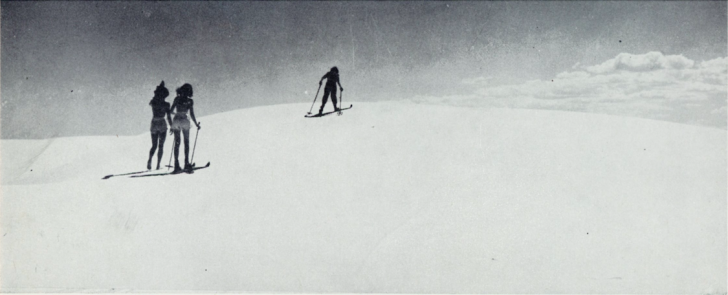
Where are these skiers? Source: New Mexicao Ski Museum
Each issue of SeniorsSkiing.com has a picture to help test your skiing knowledge. The pictures are from collections in a variety of participating ski museums, which we encourage you to visit and to support.
This image was submitted byNew Mexico Ski Hall of Fame and New Mexico Ski Museum, located outside Albuquerque, at the base of the Sandia Peak Aerial Tramway. The museum collects, preserves and displays items connected with and/or celebrating the history of snow skiing in New Mexico. The Ski Hall of Fame celebrates individuals who have contributed substantially to the development of skiing and snowboarding in the state.
It is open daily year-round, and admission is free.
Where in New Mexico are the skiers in this picture? The first person to identify the correct location (email jon@seniorsskiing.com) will receive a copy of Arcadia Publishing’s book, Skiing in New Mexico.
The correct answer and the name of the winner will appear in the next issue of SeniorsSkiing.com.
The winner of the last Test Your Skiing Knowledge (a few others had the correct answer, but were not the first to submit it) is George Treisbach of Harrisburg, Pa and Copper Mt, Co. He identified author Arthur Conan Doyle, creator of Sherlock Holmes. Congratulation for this mystery well-solved, George. Enjoy the membership we purchased for you to The New England Ski Museum.
https://seniorsskiing.com/wp-content/uploads/2021/10/Screen-Shot-2021-10-11-at-12.16.52-PM-e1633973400811.png295728seniorsskiing/wp-content/uploads/2014/04/Seniors-Skiing-since2013-Logo@2x-300x68.pngseniorsskiing2021-10-11 14:21:352021-10-14 21:33:57Test Your Skiing Knowledge
I was inspired by (SeniorsSkiing.com contributor) Yvette Cardozo and her excellent missives re skiing Canada and the world. Her unique turn of phrase will inspire some to write, but mostly will move others to keep skiing when they can. Those three words, ‘when they can’ are important. COVID has jolted us to the here and now, prompting many to get vaccinated. To those with a needle phobia, I would suggest that a death phobia trumps needle phobia anytime.
Which leads me to think back to the 2021-20 season and this Aussie’s Canadian skiing road trip with three good senior skiing mates brimming with optimistic youthful exuberance.
We set out to tour the snow resorts of central British Columbia…just as reports of the mysterious virus were beginning.
Source: Lake Louise Ski Resort. Image by Philip Forsey
First we skied Nakiska, a family, friendly resort, steep in places and well-resourced with lifts in all the right places (season pass for those 75+ is less than $100). Then we drove to Sunshine and Lake Louise (season pass for 80+ is $20), two of the planet’s most scenic places. In Lake Louise, large ice sculptures adorned the area between the Lake Louise Chateau Fairmont Hotel and the lake. They’re magnificent (hotel and sculptures)!
Skiers are among the many ice sculptures. Source: Lake Louise Tourism
Next, we drove the mighty Trans Canada No.1 to Golden to ski legendary Kicking Horse Mountain Resort (season pass for 75+ is less than $100). It features views that take your breath away and fall lines steep and deep enough to keep it that way. If you go, don’t fail to lunch at Eagle Eye Restaurant for great views and food. If wallet permits, you can arrange for a helicopter to transport you to the super deluxe Eagle Eye Suites, each assigned with a personal butler and the highest accomodations in Canada.
A few days later, we plunged into the unpopulated wilderness of the Western side of the massive Canadian Rockies. Our large rented SUV delivered us to Panorama (season pass for 75+ is $39) our next ski in-ski out accommodation. The resort has plenty of back country double blacks.
Fernie is big!
Following Panorama we drove to Fernie (season pass for 75+ is less than $100), where out friend Pat shared with us his years of skiing advice and his knowledge of Fernie’s more famous watering holes. Fernie is a destination which receives prodigious dumps of dry powder all season. If visiting, be sure to partake of a lager or three, upstairs in the Griz Hotel.
Navigating the pass at Crows Nest, on the border of BC, we were soon back in Alberta on our way to Castle MountainSki Resort (season pass for 75+ is $19), a great hill driven by ski enthusiasts; not accountants. My kind of place. Unfortunately, a flu virus prevented me from experiencing what my friends Ray and Allen pegged to be one of the best places skied of the entire trip.
Ski buddies at the start of their journey. Source: Dave Chambers
On this journey, we were mostly constrained to groomed runs because of a lack of fresh snow. Whenever you go, I recommend driving. It’s the best way to indulge in the culture and to experience the human kindness displayed by the Canadian people.
https://seniorsskiing.com/wp-content/uploads/2021/10/Screen-Shot-2021-10-12-at-5.36.34-PM.png558437Dave Chambers/wp-content/uploads/2014/04/Seniors-Skiing-since2013-Logo@2x-300x68.pngDave Chambers2021-10-11 14:20:042021-10-14 17:12:30A Down-Under Skier Reminisces About His 2019-20 Canadian Road Trip
In 1991, while guiding a small group in Yellowstone National Park, I tried to describe walking outside as the sun rose one February morning near Old Faithful:
“Morning light pours over the hills, reflecting off the frost in a blinding cloud of diamonds. Elk and bison shake snow off their backs, stirring after a long night’s chill. Duck and geese stretch and preen. Billows of geyser steam hover and settle, creating dense, lacy patterns on bowed pine branches. Yellowstone tastes of winter magic.”
Summer and Winter
To me, Yellowstone isn’t a great treat in summer. Yes, the combination of animal and geothermal activity is unique – but this year there were close to three million visitors, June to August. That’s too many vehicles and frowning faces jammed along narrow roads.
Winter is totally different. First, there’s almost no traffic (no bears either, although they may peep out of their dens in January). The only road that’s kept plowed runs east from Mammoth in the northwest to Cooke City, where it dead ends. All other roads are snow-covered and accessible by snowmobile, snowcoach (enclosed and heated tracked vehicles), or on skis or snowshoes.
Yellowstone’s winter is created for superlatives. No other place in the world has such an inspiring combination of wildlife and wild geology. It’s rich in history; has spectacular mountain scenery; and the park’s 2.2 million acres are yours without crowds or pollution.
Getting There
Yellowstone is located in the northwest corner of Wyoming, with little extensions north into Montana and west into Idaho.
To enter the park, you can travel north from Jackson Hole; west from Cody, Wyoming; or east from West Yellowstone, Montana. My favorite (fourth) route is east from Bozeman to Livingston; south through the Paradise Valley; pass through the sleepy town of Gardiner; and drive up to Mammoth Hot Springs, where you can overnight at the venerable Mammoth Hot Springs Hotel, with elk grazing outside the ground floor windows.
Using Mammoth as a base, you can drive toward Cooke City, with a lot of photos stops for wildlife in the Lamar Valley, and then backtrack.
Heading South
From Mammoth you can get to Old Faithful by snowcoach or snowmobile, sight-seeing, skiing, and snowshoeing along the way. Norris Geyser Basin and the jaw-dropping Canyon of the Yellowstone River, with ice-laden and thunderous falls, are natural stops.
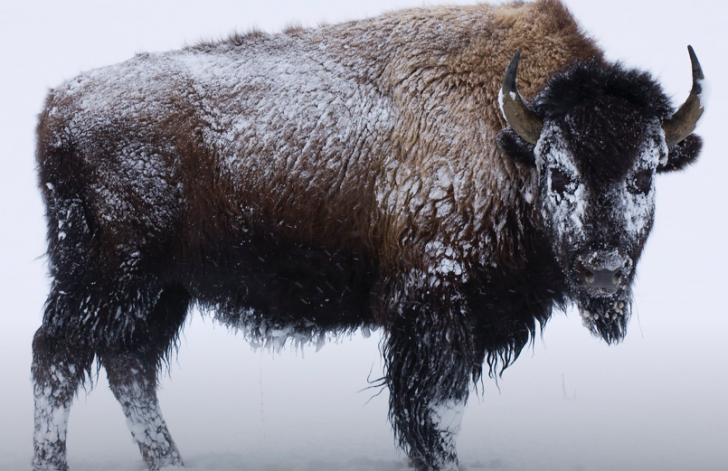
The center of the park is a volcanic crater, 40 miles across, with the world’s greatest concentration of geothermal features: geysers and fumaroles, mud pots and hot pools. One of my favorite Yellowstone memories is a morning ski on a snow-covered wooden boardwalk, watching a bison standing above a steam vent, basking in the warm air billowing around his belly.
Snowpack around Mammoth can be thin, but Old Faithful has reliable conditions and all kinds of good trails. You’re guaranteed to see lots of elk and bison, maybe coyotes, possibly wolves.
SOURCE: YELLOWSTONE NATIONAL PARK LODGES
In winter, bison are relatively indifferent to humans, since they’re intent on scarce forage and surviving sometimes bitter cold, but it’s not something to count on. I’ve skied within feet of a bison, on a narrow trail with a cliff to one side and sheer drop on the other. We came around a corner and there they were. We carefully didn’t make eye contact with the cows and calves that plodded toward us, and I could hear muttered prayers from the other skiers (my teeth were chattering too hard to enunciate).
Of all the times I’ve visited Old Faithful, the most indelible and endearing memory isn’t a glorious streamside tour, two feet of light fresh snow, or being mock-charged by a bull elk. It’s the smiles on three kids’ faces as one cold morning they dropped tablets of food coloring in glasses of hot water, ran outside the Snow Lodge, and threw them in the air! It was a cold morning, and the droplets turned into rainbows of frozen mist – blue, red, green – that slowly drifted in the breeze and disappeared. So a half-dozen of us adults did the same thing.
Now, that’s magic.
Resources
The Mammoth Hotel and the Old Faithful Snow Lodge provide Yellowstone’s only winter accommodations and dining other than yurt village/guide service Yellowstone Expeditions (https://yellowstoneexpeditions.com/). They typically open for the season mid-December 20th through early March.