


Still Time for a Winter Tune-up

Get Ready Now to Ski and Snowboard!

Cold weather is approaching fast. Don’t procrastinate. There’s still time to get ready for the ski season. Fitness can help prevent injury, improve abilities and ensure a long, safe season.

Alpine fitness programs routinely include movements to enhance balance and stability, strength, power, agility, mobility and flexibility. Workouts

Exercise ball crunches tune up those all important abs. Credit: Harriet Wallis

Exercise ball crunches tune up those all important abs.
Credit: Harriet Wallis

often combine exercises in a circuit-type workout which includes an aerobic component. Although alpine sports are anaerobic in nature with short hard bouts of activity followed by rest, basic aerobic fitness can help the average winter enthusiast avoid fatigue related injuries. In addition to training more specific skills and energy systems, it’s prudent to include 60 minutes of aerobic activity 3-4 times per week.

Focus strength training on core, legs and shoulders. Incorporate exercises that require some twisting movements since many of our summer activities like hiking, biking and running are performed in a single plane of motion. Quad muscles and those in the lower leg are important for balance and turning. Hamstrings help protect knees. Hips play a role in lateral movements. Core and shoulders function as stabilizers.

Although gym machines can be helpful and certainly convenient, considerably larger benefits can be reaped with routines that use body weight, dumbbells, stability balls, kettle balls, medicine balls and exercise bands. Or check out TRX Suspension Training. Originating in Navy SEALs training,

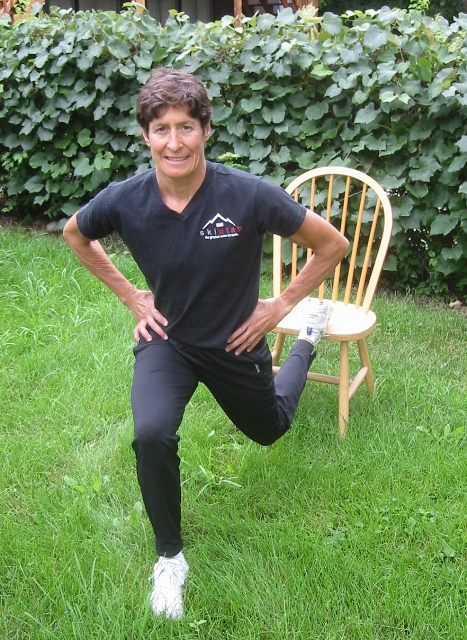
Work on balance with one-foot lunges. Credit: Harriet Wallis

Work on balance with one-foot lunges.
Credit: Harriet Wallis

TRX is used in the NFL and in USA Ski and Snowboard Teams to prepare for the season. TRX classes have also become extremely popular at many fitness clubs and recreation centers.

Look for exercises that include multiple joints because that’s how we move in all sports. Squats, leg curls and dead lifts, overhead press and rowing movements are good examples. With the lower body, progress from two-legged exercises to one-legged and then add some instability to the exercises to improve balancing abilities. Eventually add plyometric—explosive movement exercises—for power. Progress from two-footed hits to one. An easy activity associated with this ability is jumping rope.

Don’t neglect flexibility. Stretch after training and include muscles that were worked during the session as well as problem areas. A good yoga class is great way to improve flexibility. Pilates is another option and adds a little more of a strength component to the mix.

I hope this will help guide your quest for winter fitness. I wish I could individualize an actual exercise routine for each of you, but you can get help by looking for a trainer or class instructor in your area who has a solid understanding of the concepts covered above.

Jo Garuccio is a PSIA Trainer and Examiner, and she teaches at Snowbird. She’s also a Triathlon World Champion and a USA Triathlon Certified Coach. She’s a mega athlete and a mega sports enthusiast who loves to get people moving to be their best.

Knee Replacement Isn’t For Sissies: Part 2

Tips to Kick Start Your Research

A Brighton, Utah, ski patroller with two artificial knees assured me there’s definitely life – and skiing – after knee replacement. Her unbounded success motivated me to launch into research. I’m glad I did my homework. What I learned affected the direction I took, the outcome and ultimately my success. Here are some tips to help you get started.

Metal Knee Model: Is there one in your future? Credit:  Harriet Wallis

Metal Knee Model: Is there one in your future?
Credit: Harriet Wallis

Don’t be duped. Learn about the whole knee replacement process. Don’t be duped by a well-meaning friend who says: “I’d go to Doctor Smith. He’s such a nice man.”

That would be as stupid as buying a car because your friend says: “I’d buy a Honda. It’s such a nice car.”

Do your own research

Get on the phone. Call athletes you even vaguely know who might have some insights on artificial body parts, surgery, and rehab. I called several ski instructors, an operating room nurse, and a 75-year-old mogul skier. I picked their brains .

I also plopped down at the table with ski patrollers while they ate breakfast in the lodge. My question to all of them: What should I learn about?         

They’ll all have different angles, so write their answers down or they’ll become scrambled mush in your head.

Knees, glues and cadavers. With clues you gather from the athletes about what’s important, get on the internet. Do not start on the internet. There’s so much information you’ll get overwhelmed and quit.

Read up on bone-to-metal adhesives, quad-sparing technique, risks, new knee limitations and more. Be sure to separate information from marketing hype. If you have the stomach for it, I recommend that you watch a YouTube video of a knee replacement on a cadaver.  Warning: it’s not for the faint of heart.

Find the top docs. Use the internet to review potential surgeons. They’ll all have illustrious credentials, so do some creative screening. Call each one’s office and ask what his/her specialty is. The phone-answerer should be well informed. Listen carefully. If you get mixed vibes or uncertainty as to whether this is truly a knee replacement guru, it should be a red flag.

Get the inside track. Physical therapists work with patients after surgery. They have refined knowledge about which surgeons give the best outcomes. But they might be reluctant to blurt out a doctor’s name. You’ll probably have to phrase it subtly: “Do you think Doctor A’s outcome is better than Doctor B’s?”

Good luck with your research. Check back for the next installment: Questions for surgeons and how to interview them.

 Note: This is a five- part series in which I describe my knee replacement journey with tips to guide you if you’re anticipating knee replacement. Part 1: Inspired by a ski patroller with artificial knees. This is Part 2. Upcoming will be Part 3: Interviewing surgeons and questions to ask. Part 4: How I found the right doctor for me. Part 5: Rehab and why to love it.

Warren Miller’s Newest: “No Turning Back”

This one is not to be missed.

Flipping out: Lofoten, Norway Credit: Oystein Aasheim

Flipping out: Lofoten, Norway
Credit: Oystein Aasheim

My first Warren Miller film was in the early 50’s. That was when the Master, himself, was present to narrate each showing. You knew the season was

Chute running: Mt. Olympus, Greece Credit: Josh Bibby

Chute running: Mt. Olympus, Greece
Credit: Josh Bibby

starting when Warren rolled into town.

I’ve seen many ski films over the years. After a while, despite camera tricks, ski gymnastics, and the latest soundtrack, they took on a boring sameness. How many times can you watch a daredevil huck the big cliff?

But I just watched Miller’s newest production, “No Turning Back”, and I’ve gotta tell you, this is not to be missed. It is a beautifully shot travelogue of some magnificent lines carved through some of the world’s best terrain.

For the SeniorsSkiing.com crowd, there’s a segment shot in Chamonix featuring a few 50+ skiers (52 and 60) and filled with wisdom about aging and skiing. One line sums it up: “When skiers say 50 is the new 40 (I’d make that 70 is the new 60), what they’re really saying is, Thank you, fat skis!”

“No Turning Back,” Miller’s 65th film, is narrated by Jonny Moseley, who, in his own way, channels the Warren Miller feeling with artful script laced with philosophy and humor. Interspersed throughout are great snippets of skiing history, including a northern Norway search for a ski that was carbon-dated to 3200 BC.

There’s a beautifully shot segment in steep powder runs in Cordova, Alaska, boarding in the bottomless powder of   Hokkaido, Japan, and a piece on skiing in Greece, where there’s more than 20 areas less than two hours from the Aegean.

Two skiers hike and ski Mount Olympus while the narrator links it to Daedelus and Icarus.

A few hundred miles west, we’re introduced to two “speed riders” in Switzerland, guys skiing with paragliding kites, which allow them to huck enormous cliffs, touch down on a stretch of snow and get airborne within seconds.

Throughout, the film pays homage to female skiers, featuring several carving great turns on incredibly steep terrain.

Powder running: Chamonix, France Credit: Mike Hatrup

Powder running: Chamonix, France
Credit: Mike Hatrup

For me, the most enjoyable segment was shot in Montana with big mountain skiers Julian Carr and the charming Sierra Quitiquit. (Julian has done any number on mind-boggling cliff jumps, including a 210′ front flip in Engleberg.) Montana has many smaller areas known for steeps and deeps. And their towns, unaffected by contemporary ski culture, remain time-warped, non-commercial, and down-home friendly.

“No Turning Back” is being shown around the country (locations and schedule). If ski films are your thing, or if you’ve been away from that genre for a while, find a hall where it’s playing. Regardless of age, it will make you want to be on the hill.

Special Edition: First SeniorsSkiing Ski Area Survey Results

Free Skiing, Deep Discounts For Senior Skiers Plus “Senior Friendly” Awards

oldfashionedskierWhich areas are truly trying to accommodate 50-plus skiers? To find out, we surveyed 85 North American resorts. Several resorts stand out for giving senior skiers special attention and deals. They received the new SeniorsSkiing Skier Friendly Award. Those with the deepest discounts and best amenities received Gold awards. Those with better than average discounts received Silver Awards.

The survey had a 34 percent response and will be conducted annually. We hope that by asking the right questions for our readers, SeniorsSkiing.com will help drive greater recognition, discounts and amenities for senior snow sports enthusiasts.

SeniorsSkiing “Senior Friendly” Gold AwardsGold_Waterville_Valley_Resort

Of all respondents, six stand out with the best discounts and amenities.

  • Whitefish Mountain Resort, MT — Free skiing for 70-plus skiers
  • Hood Ski Bowl, OR — Free skiing for 71-plus skiers
  • Ski Whitewater, BC — Free skiing for 75-plus skiers
  • Alta, UT — Free skiing for 80-plus skiers
  • Lake Louise, AB — $20 season pass for 80-plus skiers
  • Waterville Valley, NH — Hosts Silver Streaks, the country’s longest running senior ski program. “We provide the structure and facilities; the members organize their own events,” explains Peter Sununu, Waterville spokesman. Members gather daily for coffee and pastries in a designated meeting area; enjoy mid-week NASTAR races, complimentary clinics, preferred parking, après-ski parties, awards banquets, other amenities.

Free skiing as a strategy to introduce the next generation

The percentage of all midweek senior skiers at resorts which offer free lift tickets for seniors is estimated to be about 50 percent. Mt. Hood Ski Bowl’s Hans Wipper explains the value of providing free skiing to the older customer, “We want to reward loyal skiers, and we want them to bring their extended families.”

SeniorsSkiing “Senior Friendly” Silver Award

Silver_Copper_MountainThese respondents had great discounts for seniors:

  • Sutton, QUE — 55 percent off tickets Tuesdays, January – mid February.
  • Okemo, VT — pre-December season pass purchase (includes Mt. Sunapee, Pico Peak, Killington, Crested Butte): 45 percent off for 65-plus; 70 percent off for 70-plus.
  • Ski Butternut, MA — pre-December season pass purchase: $125 for 65-plus
  • Sugarbush, VT — $199 for Mid-Week Boomer Pass for 65+ (was $99 before Sept 9).

Other Silver Awards went to:

  • Alpine Meadows, CA
  • Copper Mountain, CO
  • Vail, CO
  • Hunter Mountain, NY
  • Windham Mountain, NY
  • Deer Valley, UT
  • Snow Basin, UT
  • Snowbird, UT
  • Red Mountain Resort, BC
  • Whistler Blackcomb, BC
  • Mont Tremblant, QUE

Takeaways: Lift ticket deals are out there, especially for the early-bird, pre-season buyer. So are discounts in restaurants, rentals and other amenities. Look and ask.

We also encourage ski area management to consider the business benefits of catering to the interests of the senior skier: increased mid-week traffic, younger “tag along” full paying clients, and a loyal and vocal clientele.

Toast Your Booties: Two Ways To Keep Feet Comfy On Cold Days

No more wrestling with cold, stiff boots on a crowded ski lodge bench.

A few years ago, I indulged in my version of the middle-aged cliche: Instead of a red sports car, I snagged some very nice new skis and a serious pair of custom-fit boots. All was glorious but for one problem—the boots were 120’s, so stiff that by the time I forced my feet into

Plug your boot bag in for pre-ski warm-ups.  Ahhhh. Credit: HotGear

Plug your boot bag in for pre-ski warm-ups. Ahhhh.
Credit: HotGear

them in the ski lodge, I was exhausted, bathed in sweat and ready for a break. To the rescue came the Hot Gear Bag, a thoughtfully-designed, electrically-heated boot bag. Plug it into the condo wall or your car for the ride to the mountain, toast your booties, and you can ease into a deliciously warm and pliable pair of boots. If you have trouble with your back or hands, you will greatly appreciate how rigid ski boots become like slippers and easier to buckle, too. Depending on your boots and the weather, your feet stay warm and comfy for a few hours.

Pair the heated boot bag with  Boot Gloves ($29.95) from DryGuy to retain the heat, and you have a comprehensive warm-foot strategy. The Boot Glove is, well, a

Boot gloves can make a difference on cold, cold days. Credit: DryGuy

Boot gloves can make a difference on cold, cold days.
Credit: DryGuy

neoprene glove for your boot. For more on boot gloves, click here.

Heating feature aside, Hot Gear has a great bag, well-designed and sturdy. Zippered or mesh pockets are everywhere! Carry it with the grab handle or the removable, padded shoulder strap, stowable in a zip side pocket. The other side pocket opens to reveal fleece-lined sleeves for goggles and spare lenses. Another zipper on the back reveals backpack straps for a balanced carry and also an integral cable and lock for security. A bungeed helmet carrier on top zips flat when not needed, and a padded plastic foot pad can be deployed from the underside to provide a clean place to stand.  Now, that’s a clever addition. The connection cords for house or car outlets hide behind their own zippers in front. Sturdy rubber feet protect the bottom of the bag.

The large main compartment is surrounded with an electric heating pad. Select one of three settings, and your boots, gloves and anything else you can fit in are nicely warmed and softened, or, at the end of the day thoroughly dried out. Velcro-ed in place, the heating pad is easily removed for replacement, if necessary. Velcro-tabbed compartments hold extra socks, neck gaiters or base layers, and there’s a generous mesh pocket for all those small doodads. I keep an old hand towel at the bottom of my bag to soak up melting slush at the end of the day. When traveling, besides my boots, I can put my helmet, gloves, and several pairs of socks in the bag, and it fits nicely in the overhead bin on a plane.

There's a variety of heated boot bag models from Hot Gear. Credit: Hot Gear

There’s a variety of heated boot bag models from Hot Gear.
Credit: Hot Gear

I own the Classic 110-volt model ($179). Other models include the somewhat larger Pro ($199), a double-size for two pairs of boots ($249), the smaller Ajax ($149) and the Classic Trolley ($239) with wheels and a telescoping handle, variously available in 110- and 220-volt versions.

I’ve used mine for several years now and consider it an essential piece of equipment. I love the heating feature and am currently working on a recipe for Boot Bag Baked Brownies.

To find a retailers near you, click here.  Not near you?  Click here to buy direct.

Winter 2015 Forecast: Maybe Snow, Maybe Not

Handicapping 2014-2015 winter can lead to confident-sounding but wrong predictions.

By now, you’ve noticed that the weather in the past few years has become a series of conversation-starting, concern-causing, head-scratching, question-asking phenomena.  Last winter was—as they say down east— a “hoser”.  In the Northeast, we had the most persistent, bitterly cold winter in memory.  According to the National Weather Service, New England temperatures frequently and persistently ranged at or below normal low ranges from January to the end of March.  Even the Mid-Atlantic States had a cold and snowy season.  Early snow and a lot of it created deep powder conditions in the Alps, especially Italy.  Meanwhile, the Polar Vortex brought a cold and snowy season to the Northern Rockies and Midwest while California was unseasonably dry and warm.

What’s in store for 2014-15?  Joel Gratz of OpenSnow, an interesting online forecasting site we recommend to our readers, is

OpenSnow Compared US and International Models Credit: OpenSnow

OpenSnow Compared US and International Models
Credit: OpenSnow

not enthusiastic about long-range forecasts in general.  Nevertheless, he compared a number of US and European forecasts for the upcoming 2014-15 season and found some consensus:  Dry in the Northwest, Snowy in the Far West and uncertain from the Rockies eastward to New England.  Just to test the reliability of long-range predictions like this, he compared the accuracy of several forecast models from the prior 2013-14 season with actual results.  Those predictions were “far from perfect”.

So, he concludes, “Can we trust seasonal forecasts from these models? Based on last year (predictions), definitely not.”  He suggests we treat all of this as entertainment.  On the other hand, this year’s El Nino might actually “force the weather to behave in more predictable ways.” At the end of the day, who knows?

Besides, the Boston Globe reported this June that long-range climate is warming fastest in the Northeastern states, led by Maine and Vermont and in the South West.  Conclusion:  Ski when and where you can.

When Skiing Was New: Early Scenes From 30s To 50s

Skiing was once considered a fad like Mah-Jong.  That was a long time ago.

Here’s a seven-minute series of clips from John Jay’s “Ski Down The Years”, a visual history of skiing from the early days of rope tows in the mid-30s in New England to the FIS championships at Aspen in 1950.  From our current perspective, those initial attempts appear at once hardy and comical.

A flop on the Inferno, Mt. Washington, circa late 1930s.  Credit: John Jay.

A flop on the Inferno, Mt. Washington, circa late 1930s. Credit: John Jay.

Ski Mobile in North Conway, mid-1930s.  Credit: John Jay

Ski Mobile in North Conway, mid-1930s. Credit: John Jay

Oh, the technique! Downhill shoulders leading through a turn.  Bending forward at the waist.  Oh, the savior-faire.  Lowell Thomas, the celeb journalist, has a knowing air about him as he adjusts his skis.  And Gary Cooper puffing away at Sun Valley.  Oh, the early glory of powder skiing.  There’s a series of shots of Dick “Straight Down” Durrance skiing powder at Alta.  Amazing.  Most interesting is the formation skiing of the Tenth Mountain Division training on Mt. Rainier.

We’re lucky we have this kind of footage to reflect upon.  We remember the legacy of those early days in our own first skiing gear and experiences in the mid-1960s.  Leather lace-up boots, bear trap bindings, army surplus goggles, rope tows.  What equipment from your first days can you track back to that glorious time?


Buddy Up: Senior Ski Clubs Have More Fun

Alan Engen Recounts How Alta’s Wild Old Bunch has been meeting on the mountain since 1969.

With the baby boomers now reaching retirement age, there is a growing population of senior age skiers on the slopes, some of whom are even active in competitive skiing activities.

As a result, senior ski programs are becoming a significant part of many ski area activities in the Intermountain Region.  For example, at Snowbird, Junior Bounous has his “Silver Wings” program.  I used to have an Alta seniors program called “Silver Meisters.”  In addition, various “seniors” ski clubs abound such as The Over the Hill Gang, The One Ski in the Grave Ski Club, The 70 plus Ski Club, and a special group here in Utah called the Wild Old Bunch.

WOB clowning around at Alta circa 1970. Credit: WildOldBunch.com

WOB clowning around at Alta circa 1970.
Credit: WildOldBunch.com

In 1969, several senior ski buddies started the Wild Old Bunch by getting together on a weekly basis to enjoy Alta’s famous deep snow conditions.  The founders were Art Wilder, Foley Richards, Johnny Bell, and Rush Spedden.

Shortly after, Rush Spedden made a home movie of the group skiing powder.  Spedden named the film “The Wild Old Bunch.”  This title gained immediate favor with Wilder, Richards, and Bell.  It was decided by unanimous decree to

adopt the name on a permanent basis. Foley Richards created a patch for identification purposes which, in turn, became the groups logo.  The smile face is well-known around local ski circles and quickly sends a message as to what the group is all about—namely enjoying the pleasure of winter skiing and the companionship that goes with it.

By 1973, the group had grown to about a dozen or so regulars and, by the end of the 1970s, it had about 130 active skiers from ages 50 on up.  Because most of the membership consists of men and women retirees from the hectic pace of the corporate world, they have time to ski whenever they wish throughout the week.  Rush Spedden solemnly told me the club’s rules when I was given my special membership WOB patch.  He said, “The only rule is…there are no rules.”

Throughout the winter ski season at Alta, the Wild Old Bunch can be found congregating at Alta’s ALF’S mid-

WOB is one of the many ongoing senior ski clubs that endure across the country.

WOB is one of the many ongoing senior ski clubs that endure across the country.

mountain restaurant at 11:00 a.m. several times a week.  One of the articles written about the WOB said, “There, they swap jokes, agree to disagree, boost a few toddies and welcome other skiers.”

The driving inspiration binding this group was Rush Spedden who passed away at age 97 in late 2013.  He served as the WOB primary spokesperson for many years.  He was not only an outstanding skier; he was a noted engineer/scientist, teacher and historian in Utah.  Rush Spedden’s generous donation to the Alf Engen Ski Museum Foundation made it possible to add a special pair of handmade skis from the Alaska gold rush days of the mid- 1800s to the permanent exhibit in the Alf Engen Ski Museum near Park City.

Intermountain ski history certainly includes the wonderful contributions of senior groups such as the Wild Old Bunch, and they deserve special mention as ambassadors for the joys of skiing at any age.

Alan Engen is a SeniorsSkiing Advisory Council member and recognized ski historian and author.

Handwarmers Expiration Date

The Truth About Hand Warmers

A hot tip for happy hands.

The fall hunting season can be the best time to stock up on the “shake ’em up” hand warmer packets that we put into our ski gloves and mittens. In my area—Salt Lake City—some big box stores have special deals on the packets in the fall when outdoorsmen are preparing to head to the woods for the deer hunt.

Beware outdated hand warmers. Credit: Harriet Wallis

Beware outdated hand warmers.
Credit: Harriet Wallis

But before you buy a load of special deal packets, examine them for the expiration date. It’s probably embossed or printed into the edge of the foil wrapper. Packets that are close to their expiration date may have lost their oomph.

Last year, my locker room buddies stocked up on hand warmers from a big box store in fall as usual. But then they moaned and groaned all winter about the packets. Many packets heated inconsistently and some never heated at all. On close examination, we found the packets to be nearly outdated, and some were past their expiration date. The store probably had old inventory and stocked the shelves with it first.

On the other hand, I’ve had packets buried in the bottom of my ski bag for several years, and yet they heated well.

The bottom line: To assure warm hands, check the expiration date before you buy. The expiration date should be several years into the future.

What’s your hand warmer story?


Fogless, Wide-Screen View While Wearing Glasses From Osbe Helmet

How To Look Like A Skiing Top Gun

Like many seniors dependent on glasses and contact lens-phobic, I’ve always searched for a way to keep my specs from fogging up while skiing.  I overheat easily and goggles steam up so none of the usual tricks (rubbing dry soap on the lenses, etc.) help for long. I tried different goggles with a tiny built-in fan, but those have other drawbacks. A very good solution is

The Osbe's visor allows a flow of air to evaporate fog. Credit:  Michael Conley

The Osbe’s visor allows a flow of air to evaporate fog.
Credit: Michael Conley

the Osbe Proton Senior, a helmet featuring an integral pivoting visor that covers your face— but not your nose—from the cheeks up. I’ve used mine for a few years now in a variety of conditions, and I’m quite happy with it. There are several advantages to this visored helmet over the traditional helmet/goggle combo.

Most important for me, no fogging of my glasses at all!  The visor doesn’t actually contact your face to form a seal like a typical goggle. There is an “air dam” of foam rubber on the inside lower edge to minimize the gap, but a small amount of air can circulate through the inside of the visor. This is necessary to continually clear away any buildup of humidity, and it works very well. Occasionally on the lift a bit of fogging can occur depending on the wind but never while skiing.  Another important benefit is a greatly increased field of vision. The Osbe visor, unlike goggles, does not make a frame around your face with thick foam that restricts peripheral vision; this helps avoid what I consider the biggest danger on the slopes:  other skiers.

Since the visor does not touch your face there is no pressure to restrict breathing through the nose. Goggles tended to press my glasses into my face, and occasionally I almost pulled my glasses off when removing them. It’s a simple

Admit it.  Navy pilot helmets are cool.  Check that visor. Credit: Andrea Salimbeti

Admit it. Navy pilot helmets are cool. Check that visor.
Credit: Andrea Salimbeti

matter to pivot the well-made, distortion-free visor up or down as needed.  Since the visor is very light, it doesn’t affect the balance of the helmet.

Visors are available in clear, mirrored, smoke and orange and can be easily changed in a few minutes. One minor problem is a small loose part that can fall off in the visor-changing process, so be careful. I just leave the orange visor on at all times and use clip-on shades when needed.

Osbe is an Italian maker of motorcycle helmets with years of experience in helmet design. Maybe being European-designed the sizing seems to run small. I’ve always worn a large in helmets, but the sizing chart on the Osbe website indicated I should wear a medium (my head is about 23-1/2″ around). I ordered a large anyway, and it was definitely too tight, so I ended up with an XL which fits fine.

The Osbe tends to start conversations on the chair—some say it looks odd. I’m 58, and I couldn’t care less at this point in my life if it does. Seeing clearly at all times is key. If I make someone smile, hey, what’s bad about that?

For more information: check Osbe Ski Helmets

What’s your experience been with Osbe?

SeniorsSkiing Contributor Michael Conley re-discovered skiing in his late 40’s when his daughter took up snowboarding. A Brooklyn, NY-based artist and furniture maker, he skis as often as possible (not nearly enough…) in upstate New York and New England, with excursions to Montana where that now grown-up daughter is in college. In warmer weather he kayaks and hikes and bikes with his cold-phobic wife.

Editor’s Curiosity Corner:  According to the NSAA, 77% of skiers 55-64 and 81% of skiers 65 and over wear helmets.  If you do, what’s your rationale?  If you don’t, what’s up?  Let us know.