Grow A Hiking Habit: Part One

An Expert Offers Advice On Getting Started

Here are the "Ten Essentials": Gear you will need for a hike. Credit: Steve Hines

Here are the “Ten Essentials”: Gear you will need for a hike.
Credit: Steve Hines

Hiking is a great fitness activity for seniors. Whether you are an Alpine or Nordic skier, hiking can keep you in shape to enjoy the slopes or trails this coming winter. Hiking is enjoyed on many levels from simple day hikes in your local woods or conservation lands to classic mountain hikes in our national parks.

Whether you’re an experienced hiker with many trails and summits behind you or you’re new to it,  a few basics make it more enjoyable and safe.

On every hike, when you are away from roads and people always pack the “Ten Essentials”  in your 15-to 20-liter day pack.  The “Ten” are:

Essential Item  Comment
1. Map Contour maps are best. Maps with trails labeled are even better.
2. Compass Know how to orient the map, take a bearing and follow it, triangulate to find your position. Classes are available online and through your local outdoor club. Until you’re familiar with map and compass, keep to well-marked trails.
3. Sunglasses and Sunscreen Prescription sunglasses are great, especially at altitude where the UVs are strong. Don’t forget to put sunscreen on your ears and the back of your neck!
4. Extra Clothing Avoid cotton clothing except for desert hiking. Wool and synthetics are best. Take along a waterproof rain jacket and pants. A light fleece jacket or shirt should be adequate. A light wool or fleece hat and gloves/mittens will help if you are going to higher altitudes where weather is very changeable. And, always bring dry socks.
5. Headlamp/Flashlight Small high intensity lights and lamps keep your pack weight down. A light will be helpful if you are late in coming back from your hike.
6. First-aid Kit This kit should also include bug “dope” and any medications you require i.e. heart, blood pressure, diabetes meds.  Bandaids for blisters might also be helpful.
7. Fire-starter Waxed tinder sticks or tinder balls are available at your local camping store or outfitter. You can make your own using a few simple steps.  Just click here for instructions.  If you don’t think a fire-starter is necessary, read Jack London’s “To Build A Fire”.
8. Matches Waterproof matches are good, but a lighter works even when wet. Butane lighters may now work as well at high altitudes.
9. Knife Your handy Swiss army knife is best. No need for a big sheath knife unless you plan on cutting saplings for a shelter.
10. Water and Extra Food Out for just a day? Take lunch and some snacks or energy bars.   Water is crucial. It’s easy to get dehydrated as we get older. Don’t wait until you feel thirsty to sip water.  Drink frequently!


Here's a 12-15 liter day pack you will need for your stuff.  It should weigh about 12 lbs. Credit: Steve Hines

Here’s a 12-15 liter day pack you will need for your stuff. It should weigh about 10-12 lbs.
Credit: Steve Hines

Other items also come in handy. Some people like a walking staff or trekking pole(s). (See “Try Nordic Hiking” article in SeniorsSkiing.com). Bringing a cap or wide brim sunhat is a good idea. If hiking with friends, a camera adds to the fun. All tallied, your hiking day pack should weigh in at no more then 10-12 pounds.

When I hiked with my kids and they began to gripe about all the stuff in their packs I would tell them, “The only way to make sure you won’t need something, is to have it with you.”

Start slow on level ground hikes. Then, as you feel stronger make your hikes longer and on rolling terrain. When you’re ready, plan a mountain ascent. But always, before beginning a new exercise routine, check with your doctor to make sure your heart is healthy enough for hiking.



Ski Lessons Improve Senior Skiers’ Technique

It’s Never Too Late to Take A Lesson.

William Smith, age 91, started skiing at Mt. Cranmore, N.H., after WW II. His wife even took lessons from ski legend Hannes Schneider. She quit skiing when she was 73, but Smith continued. He was skiing with his son that morning when I rode the lift with them at Waterville Valley Resort, N.H. Father Smith taught his kids and grandkids to ski, but he doesn’t want to take lessons himself.

Senior Skiers take lessons at Waterville Valley Resort. Good technique means more enjoyable skiing. Credit: Steve Bryan

Senior Skiers take lessons at Waterville Valley Resort. Good technique means more enjoyable skiing.
Credit: Steve Bryan

“I’m skiing as well as I’m going to. My legs aren’t holding up as well.” I then watched him push off down the slope swiftly in well balanced short parallel turns. So much for weak knees.

Like Smith, many seniors are skeptical of what they call teaching old dogs new tricks, unless they plan to do something very different, like ski powder in Utah for the first time.  However, a senior ski lesson can actually lead to more enjoyment.

“Most senior skiers like the medium to long radius turns and cruising the mountain and enjoying it,” says Peter Weber, Snowsports Director at Waterville Valley Resort for 15 years. But that is no reason not to ramp up your technique.

“Whether you’re 7 or 77, technique trumps all. The better you are technically, the easier everything gets,” Weber says.

In teaching seniors, an instructor would most focus on pacing—how fast you ski, how many time outs for trailside chats vs. pushing top to bottom runs, and the need for biobreaks.

Fitness level in general is key, adds Weber. “Skiing anything above a moderate level is an athletic endeavor,” he says.

Like other resorts with comprehensive snow sports schools, Waterville Valley Resort matches you to the right instructor, so you don’t end up in a class with a bunch of young hot shots. Weber also recommends a private lesson as well as taking several group lessons.

Mark Hanabury, an instructor at Waterville Valley, says, “I think it’s more important for seniors than anyone else to take lessons.” He feels seniors will be safer and will enjoy skiing more if they embrace the new techniques including a wider stance and shorter, wider shaped skis.

“Skiing has evolved so much,” he says.

He knows first hand. Last year,  he took his dad Dick Hanabury, age 83, to ski Snowbasin, Utah, after convention in Las Vegas.

“He’s been an avid skier all his life and skied on long Head Standard skis when he was younger. I told him he had to retool his techniques to ski safely at his age. I drilled it into his head,” says Hanabury.

“My dad’s outside ski was getting hung up. He was used to stepping onto the outside ski, but his balance wouldn’t allow that. So, a fellow instructor told him to slide the ski forward and free it up. That allowed him to keep both skis on the snow so it was no longer a balance issue,” says Hanabury.

“My son Mark is keen on knowing the latest technique, so he’s done a good job for helping me to keep up as far as turning techniques,” says Dick Hanabury.

“I used that technique, letting the skis do the work, not throwing your body into the turn but just weighting the skis properly and making sure the outside ski in the turn is well weighted, that’s about the best way I can explain it,” he adds.

“If you’re in good condition, I would recommend skiing at any age. I play tennis a couple of times a week, exercise daily, so I’m ready when the time comes,” says Dick Hanabury.

No matter if seniors are updating old technique or learning for the first time, “I feel it is never too late to learn. Skiing is a dynamic sport and seniors enjoy learning just as much as younger folks. This enables them to ski longer and enjoy more terrain with family and friends,” says Mark Hanabury.

Many ski areas have created programs for those interested in new movement patterns associated with shaped skis or improving techniques. They list these programs on the resort website under the snowsports school tab.

Keep Moving: Fighting Arthritis With Activity

Here’s What You Can Do To Manage Your Inevitable Osteoarthritis.

If you’re a snow-sport enthusiast and subscriber to SeniorsSkiing.com, you are most likely a senior with an active life style.  We know from our SubscriberSurvey 2015 that many of our respondents not only enjoy Alpine skiing, but also Nordic and snow shoeing, and you ski a lot.  More than 55 percent of the responses say they ski more than 30 days a season.  Anecdotally, we’ve also heard how our subscribers love to hike, cycle, kayak and generally keep moving all year round.

In a recent article by NY Times Personal Health columnist Jane Brody, we see how critically important it is for seniors to keep that kind of active lifestyle.  Not only does activity help stem arthritis, reasonable levels of activity help avoid other chronic health problems. Brody quotes a researcher at the Alabama Research Institute on Aging: “As we get older, if we don’t get up and move around as much as we can, then we soon won’t be able to move at all.”

Read the Comments section attached to this article as well.  There are some insights and advice from NY Times readers you might find interesting.  If you’d like to comment on SeniorsSkiing.com, please do.  How do you stay active?  What does that do for you?  What’s your challenge in keeping in motion?  What works that you can share?

NY Times Columnist explains why activity is a way to fight arthritis. Credit: NY Times.

NY Times Columnist explains why activity is a way to fight arthritis.
Credit: NY Times.

How Many Subscribers Ski Over 30 Days A Season?

Check More Results From SubscriberSurvey 2015.

UphillMuch to our happiness and gratification, the SeniorsSkiing.com SubscriberSurvey 2015 was a tremendous source of insight and guidance. We reported the highlights in March with a promise to provide some more detail. What follows are more interesting responses to some of our questions.
We asked you to rate the importance to SeniorsSkiing subscribers of the amenities provided by ski areas and resorts. Here are the results in rank order:

Amenity Very Important or Critical
Discounted Lift Tickets and Season Passes 100%
Easy Access From Parking To Lifts 76%
Newsletters/Web Pages For Senior Activities 50%
Other Discounts (Food, Rentals, Gear) 50%
Ski Lessons Tailored For Seniors 46%
Family/Group Discounts 36%
Walkable Base Lodge With Shops, Restaurants 34%
Meeting Place For Seniors 31%
Set-Aside Areas in Lodge For Seniors 22%
Valet Parking 4%

Here’s what kind of content topics you said you’d like to see in SeniorsSkiing.com. These reflect the results for Very or Extremely Interested ratings only.Note these are just the Very Important or Critical responses. Clearly, discounts are a universal need for seniors. And, there are also some ideas here about access from parking lots, information sharing, discounts, ski lessons and other ideas that can make a Senior Skier’s time at a ski area or resort more valuable and attractive. It’s interesting that some of these ideas are really low-cost expenses for the ski area.

Topic Very or Extremely Interested
Gear For Seniors Reviews 72%
Destination Profiles For Seniors 67%
Health, Nutrition, Fitness 60%
Legends, Heroes, History 58%
SnowSport Industry News 54%
Features about People, Places, Things 54%
Restaurant Reviews 17%

Finally, we see that you report skiing with family and grandchildren about an average of 8.6 days a season. That’s an impressive amount, considering the median number of ski days per season for our subscribers is 9.7. We used median for the number of ski days because 55 percent of you skied over 30 days a season, skewing that data ‘way northward. Now that’s passion in action.We also notice your average age is 69.4 and 44% of you belong to ski clubs.

Several respondents said they’d be interested in contributing articles to our online magazine next season. Thank you! That’s a terrific endorsement. Please contact us at info@seniorsskiing.com with your ideas and we will get right back to you.

Adieu Winter 2014-15: Shifting To The Non-Snow Season

SeniorsSkiing.com Will Be Publishing This Summer.

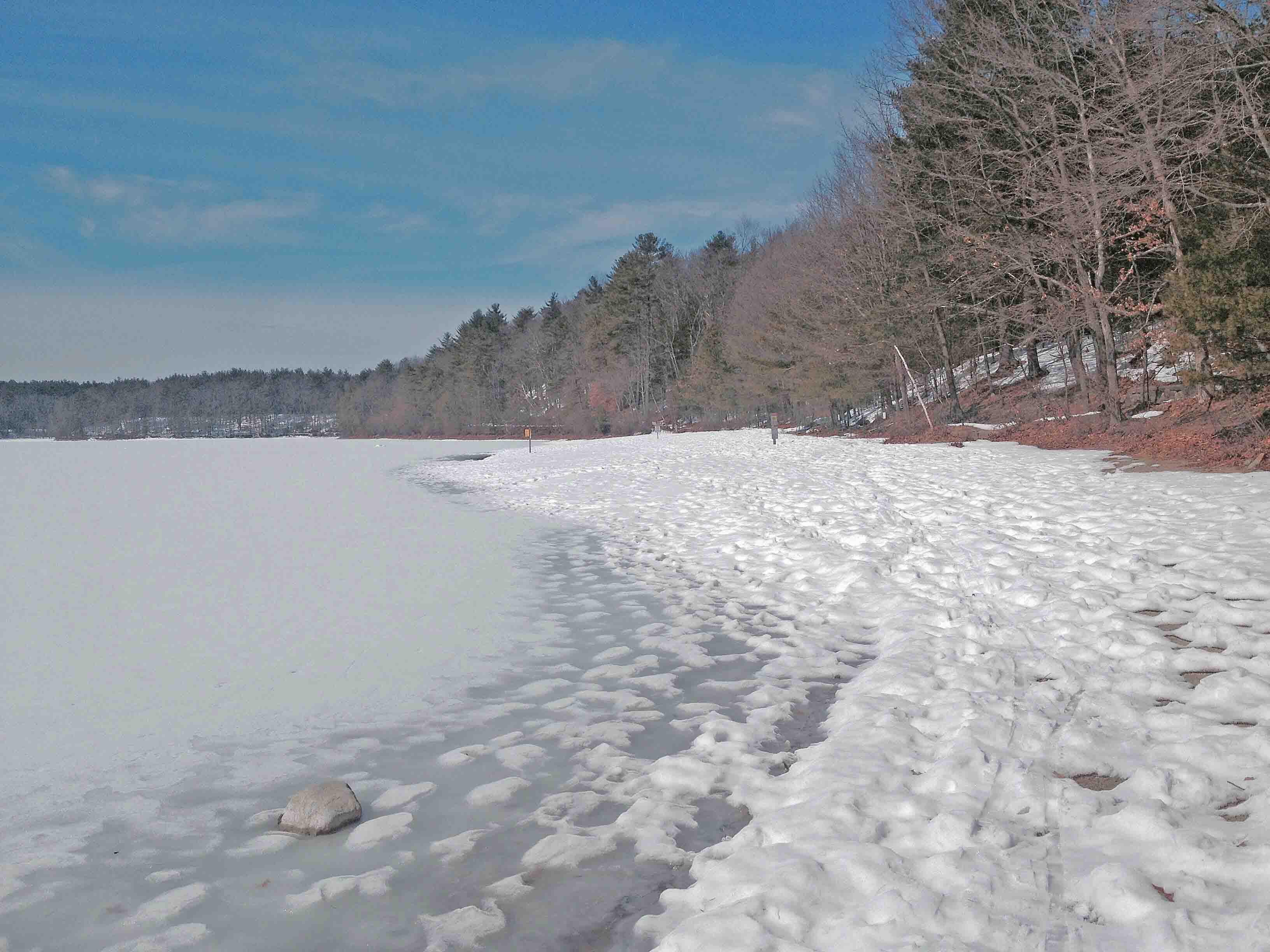
One of our best ski tours of the season came at the beginning of April at Walden Pond.  We go there occasionally throughout the year to reflect on the messages of Henry Thoreau and to take a picture or two of the “pleasant hillside” where he built his tiny cabin.  When we skied in, the trails along the ridges surrounding the pond were chopped up and icy, so we scooted around the snow-covered ice on the edges, thinking that Henry probably walked this way when the snow at Walden got too thick. It’s a short ski, maybe three miles around, but it was a beautiful spring day, we were pretty much the only ones there, and the spirits were a-rising, so to speak.  There’s more to be told about skiing at Walden, and we will have to save that for next season.

Early spring ski tour on a quiet day around Walden Pond.  Priceless. Credit: Mike Maginn

Early spring ski tour on a quiet day around Walden Pond. Priceless.
Credit: Mike Maginn

Based on the responses from Subscriber Survey 2015, we learned that you, our readers, are interested in fitness and product ideas for seniors.  As we move through the summer months, we and our correspondents will be offering both of those topics—as well as whatever pops up—in the spirit of keeping in touch with you, our active and engaged readers.  Please note that we will be starting our online Forum very shortly—another major recommendation from the survey—so you can more readily talk back to us and your fellow snow sport enthusiasts.

Two requests:  Tell your friends about SeniorsSkiing.com. And please watch for our Forum, coming soon.

Let the non-snow season at SeniorsSkiing.com begin!

Try Nordic Walking: Many Benefits By Adding Poles To Hike

Poling While Hiking Is An Exercise Multiplier

Roger Lohr is co-founder and editor of XCSkiResorts.com and a noted writer on all the varieties of Nordic skiing.

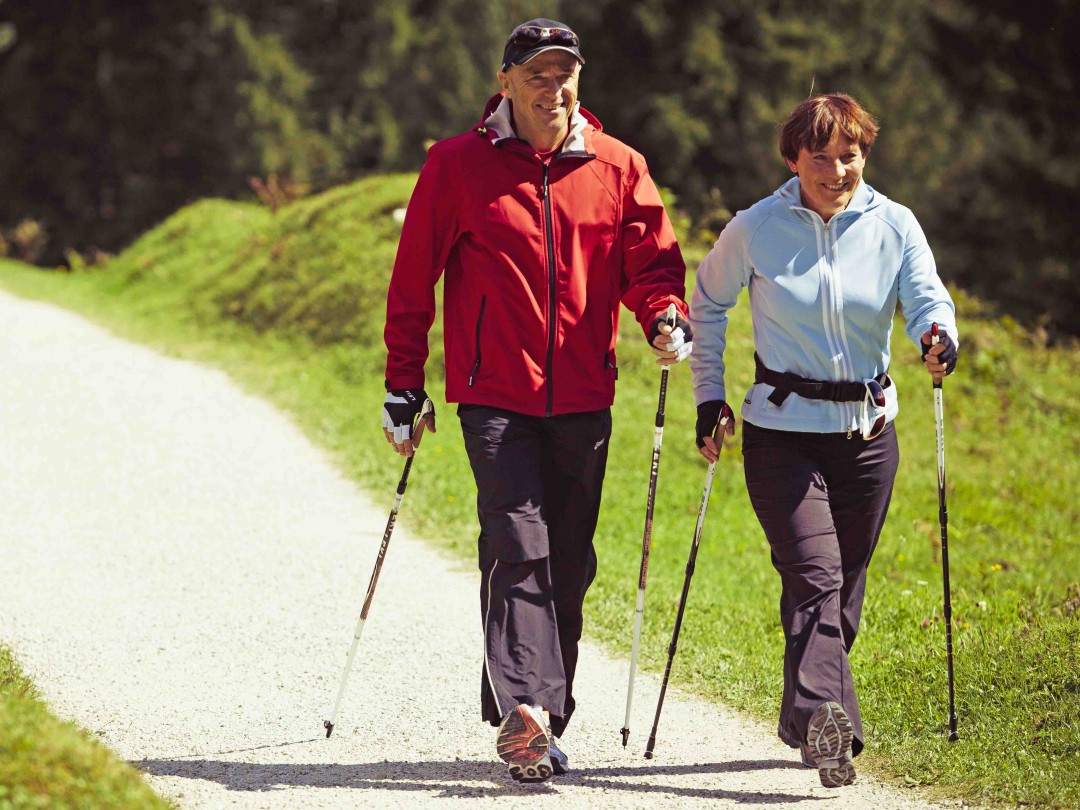
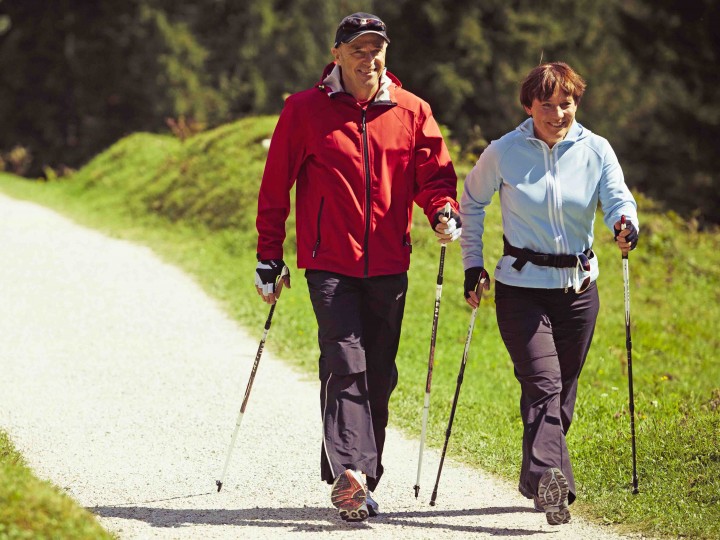
Walking a la Nordic raises efficiency of exercise by 40 percent. Credit: Leki

Walking a la Nordic raises efficiency of exercise by 40 percent.
Credit: Leki

More than 10 million Europeans of all ages and fitness levels are Nordic Walking (also known as Ski Walking) with special Nordic Walking Poles. This new fitness activity turbo-charges the normal walking regimen burning as much as 40 percent more calories compared to regular walking.

For those who are unfamiliar, Nordic walking is a fitness activity that combines walking with specially designed poles to engage the upper body muscles.

Nordic Walking poles help individuals with balance issues, knee issues or new knees, hip issues or new hips, back issues (including those with rods in their back), weight issues, multiple sclerosis (MS), Parkinson’s Disease, neuropathy, arthritis, bursitis, scoliosis, lumbar stenosis, fibromyalgia, post polio, osteoporosis, stroke recovery, cancer recovery, and other limitations to walking. Nordic Walking is helping thousands of people get off the couch, get outside, start walking safely, and effectively launching much needed walking campaigns.

The Human Kinetics book entitled Nordic Walking for Total Fitness by Suzanne Nottingham and Alexandra Jurasin covers the topic. Trekking (hiking with poles) and Nordic walking are two different activities that use very different poles and techniques. It may sound silly, but perhaps “walking is not just walking.” The pole angle, weight, grip, and straps are different between the aforementioned modes of walking. The Nordic walking pole is designed to allow your hands to relax in order to target the larger wrapping muscles of the back. But using poles of any kind automatically stimulates your spine and all of the muscles around it, even with inefficient technique. When walking, the key postural muscles of the core and upper body are engaged.

The book also includes fitness assessments, sample workouts for varying levels of interests from first timer to cross training triathletes. There are also suggestions about customizing your program. Training program recommendations are offered for building distance, fluctuating daily intensity, and rest days.

I’ve been a Nordic Walker for a few years and found many of the claimed attributes in the book regarding posture and exercise to be true. I’ve always been in search of a way to decrease the amount of time spent exercising, so I was sold when I heard that using the poles increases caloric burning by 40 percent. Being a cross-country skier, it is easy to quickly master Nordic walking. After a summer of Nordic walking, I noticed a marked improvement in my cross-country ski poling in terms of strength and timing. It seemed that I increased the amount of forward momentum that was attributable to poling and I was able to pole stronger and longer when skiing.

Nordic Walking for Total Fitness provides a foundation for anyone, ranging from those just looking for an activity to lose weight to health aficionados interested in taking it to higher levels of fitness.

Nordic Walking for Total Fitness is available for $19.95 plus shipping from Human Kinetics at www.humankinetics.com or call 217-351-5076. 

Sierra Ski Season 2014–15: A Mixed Bag

In a winter with the lowest snowfall in the Sierra Nevada since record-keeping began, some resorts fared well while others barely managed to open.

On April 1st, it was no joke when California’s Department of Water Resources snow surveyors went to Phillips Station off Highway 50 near Echo Summit to do their official April 1st measurement of the snowpack. Whereas the average

Despite snow drought, author's daughter Katie Cleese and friend Rose Cendak practice Quidditch at Heavenly Valley. Credit: Rose Marie Cleese

Despite snow drought, author’s daughter Katie Cleese and friend Rose Cendak practice Quidditch at Heavenly Mountain Resort.
Credit: Heavenly Mountain Resort

snow depth at that location is 66.5 inches on that date since record-keeping began there in 1941, the measuring crew—with Governor Jerry Brown by their side—found themselves in a meadow devoid of any snow at all. It was unprecedented. Since it’s now likely that there will be very little Sierra snowpack runoff into the state’s reservoirs this year coupled with the previous three years of statewide drought, the governor announced on the spot a mandatory 25 percent reduction in water usage for everyone—companies, institutions, and individuals alike.

Yet, despite there being grass instead of snow in the meadow at Phillips Station, one can still ski and snowboard in the Sierra—at least for a couple more weeks. A small handful of wintersports areas will remain open past the traditional Easter weekend closing date, thanks to their snowmaking efforts, their higher elevations, and/or their careful protection and manicuring of the snow they were lucky enough to have fall on their slopes.

To catch a few more runs before all the snow is gone, you can head to any of the following (closing dates as of April 2nd are in parentheses): Bear Valley (Sunday, April 12th), Boreal (Sunday, April 12th), Heavenly (Sunday, April 19th), Mt. Rose (Sunday, April 19th), Kirkwood (Sunday, April 19th), and Mammoth Mountain (Sunday, May 31st). Bay Area skiers rarely make the trek to Mammoth on the eastern slope of the Sierra off Highway 395 since the quickest route there, via Tioga Pass in Yosemite, closes every winter after the first major snowfall. This season, however, Mammoth was and remains a great option since the Tioga Pass road never closed this winter—a first! As of March 31st, Mammoth had 19 of its 28 lifts operating, with a base of 30–60”. The resort has often been open for skiing over the 4th of July weekend; don’t hold your breath this year!

Only one Sierra wintersports resort is closing this Easter Sunday, April 5th, the traditional end of ski season: Alpine Meadows.

Katie Cleese soaks up the bennies in the too-warm patio at Heavenly Mountain Resort.  Note snow melt in background. Credit: Rose Marie Cleese

Katie Cleese and Mike Allen, Director of Ski Services, soak up the bennies in the too-warm, mid-mountain patio at Heavenly.  Note snow melt in background.
Credit: David Koth

Several Sierra resorts had a tough season, especially those with no snowmaking capacity or besieged by higher temperatures that prevented snowmaking or located in the Central Sierra, which didn’t get as much snow as their neighbors farther north. Sierra-at-Tahoe managed to open on December 12th and ran its lifts for a total of 94 days before it had to close on March 16th. Badger Pass in Yosemite National Park opened on December 14th but had to close on January 19th, never to reopen. Dodge Ridge racked up similar stats to Badger Pass, opening on December 17th and closing in mid-January. Homewood on the west shore of Lake Tahoe opened on December 20th but then closed on February 23rd to wait for another significant snowfall that never came. Tahoe Donner closed on March 15th and Diamond Peak closed on March 29th. Sugar Bowl had to cut its 75th Anniversary season short, closing on March 22nd.

Hopefully, all the resorts will have a banner year next year, but with the new normal, it looks more and more like any California resort that hopes to survive the changing climate will have to take the plunge into a robust snowmaking system.

Serious Stuff: There Is No Such Thing As “Side Country”

And There Is No Such Thing As Being A Little Bit Dead.

Back country warnings are there for a reason. Credit: Harriet Wallis

Back country warnings are there for a reason.
Credit: Harriet Wallis

Yesterday we rode the chairlift with a bozo. Okay. Maybe he wasn’t a bozo. Maybe he was just clueless. All the way up he yapped about his skiing prowess. And near the top he phoned home to give his wife his location. “She worries about me,” he said.

She should worry. He planned to duck under the boundary rope and make some turns in the deep, unspoiled powder beyond.

“Take your avy gear,” we said.

“Don’t need it. It’s in the car. I’m just doing side country,” he said.

Somehow he missed hearing that there is no such thing as side country.

The term “side country” hit the scene a few years ago, and it was quickly squelched by the ski industry’s leading avalanche experts, snow science experts, the U.S. Forest Service, ski area risk managers, mountain patrollers and others. It was likely a marketing brainchild used to promote the newest boots and powder-specific skis and boards.

The term had obvious appeal to intermediate and advanced skiers and riders. They could buy the latest gear and try their skills beyond the rope line thinking it would be okay. They could be a little bit naughty.

But the ski industry took a stance saying you’re either within a resort or else you’re in the unmonitored, ruthless back country. You’re either in bounds or you’re out of bounds. There’s nothing in between. There is no such thing as side country. There is no such thing as “kinda” out of bounds.

“We all must focus on educating skiers and snowboarders that backcountry terrain accessed from a ski lift has the same risks as any other back country or out-of-bounds area,” says the National Ski Area Association.

Later in the day I caught the TV news. A skier died after being caught in an avalanche. The avalanche occurred in the very out of bounds area where a guy— with too much macho and too little knowledge—went to ski. There’s no such thing as side country.

There’s no such thing as being a little bit dead.


Ski Japan: Looking For Snow? Head West. All The Way.

Combine lots of snow with an exotic destination for an incredible skiing experience.

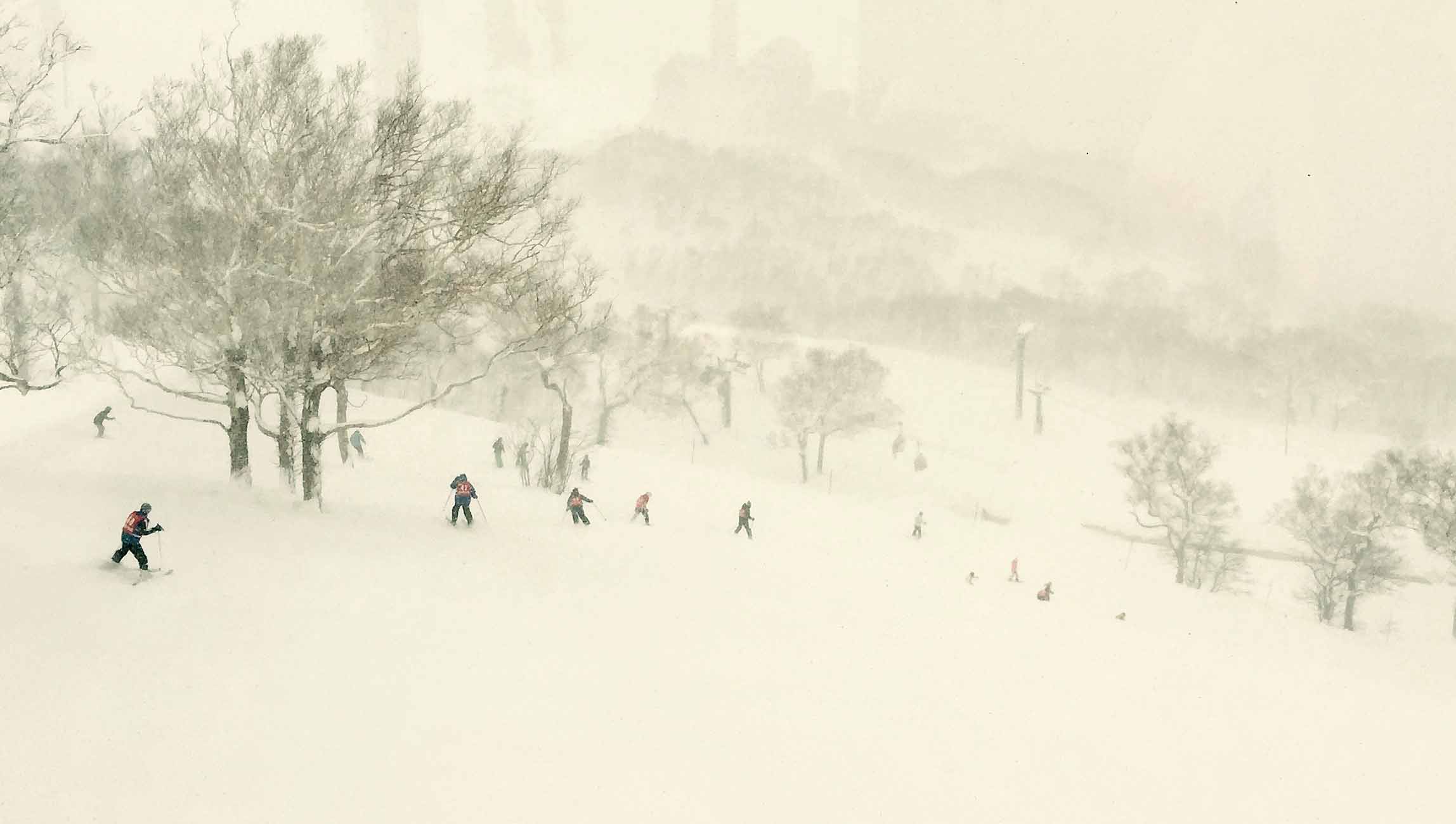
Almost like a Japanese woodcut,  skiers in Niseko run through the flakes. Credit: Susie Winthrop

Almost like a Japanese woodcut, skiers in Niseko run through the flakes.
Credit: Susie Winthrop

O.K., you adventurous senior powder-hounds: How far will you fly to find an awesome stash in this odd winter of snow conditions?  If you don’t fly east to New England or Quebec to ski, how about 14 hours on a JAL flight to Tokyo on a 787 “Dreamliner” direct from Boston?  When you get there, hop on another two-hour flight to Sapporo, the capital of Hokkaido, the northern most island in Japan. Then,  jump on a bus and three hours later you’re in Niseko, home to four (Annupuri, Higashiyama, Hirafu, and Hanazono) interconnected ski areas.  If it’s winter, it will be snowing.  Yes, guaranteed fresh light powder snow everyday all winter.  The aspen trees are perfectly spaced and slopes are rarely skied out, but guides, helicopters and snowcats also await those coveting untracked bliss.

However, the real adventure here is the fact that you’re in Japan. You’ll eat sushi, sashimi, tempura, gyoza, yakitori, miso soup and sea urchins. Be sure to stay

Moku No Sho ryokan has an onsen (hot water spring) on site. Credit: Susie Winthrop

Moku No Sho ryokan has an onsen (hot water spring) on site.
Credit: Susie Winthrop

at a real Japanese Inn (Ryokan) with hot spring fueled baths (Onsens).  You won’t need to bring a bathing suit to the springs; you bathe in the buff.  Niseko Moku No Sho, the fabulous inn we stayed at, provided a yukata (kimono bathrobe) and slippers which we wore at all time until we dressed for skiing.  You don’t even need to bring your own ski garb; you can rent it  at the mountain: parkas, pants, hats, mittens, goggles, helmets, snowboards, skis, boots, poles—all the latest, all for rent.

Like most things in Japan, the resort is clean, organized and efficient.  At the mountain, it took no time to pop grand-daughter, Eloise, in day care, purchase our senior three-day ticket (a real deal at $105 for three days on four mountains), rent our super-wide powder skis and get out on the slopes.  There are no lift lines, even during vacation week.

Tower of beer.  What a novel idea. Credit: Susie Winthrop

Tower of beer. What a novel idea.
Credit: Susie Winthrop

Looking for apres-ski fun? Make some friends and order a high “tower” of beer to share at the base lodge.  Or slide down to the Bar Ice igloo and warm yourself with a hot rum and butterscotch toddy.  “Kampai” is all the Japanese you’ll need to know.

For more information on skiing in Japan, click here.

Le Massif de Charlevoix: Views, Trails, and Chic

Where else can you ski into a major river (almost) and take a ski train to a charming village?

About an hour north of Quebec City, we find Le Massif de Charlevoix, a magnificent and major North American ski area that offers several exceptional features:

Skiing into the river? Looks that way at Le Massif de Charlevoix Credit: SkiZone

Skiing into the river? Looks that way at Le Massif de Charlevoix
Credit: SkiZone

  • Most people arrive and park at the top of the mountain, making their first run down without an inaugural lift up.
  • Runs are varied and long from very pleasant groomers (which we like best) to mogul fields, glades and double diamonds. There is even an off-trail sector of 99 acres for back-country adventurers. Le Massif de Charlevoix has the highest vertical drop (2,526 ft.) in Eastern Canada and east of the Rockies, so trails basically keep going and going. (The longest one is 3.2 miles.) But stopping to take in the view is worth it because…
  • …A couple of hundred yards from the bottom is the St. Lawrence River. The impression you get as you head down the piste is that you are heading straight into the water. It’s an illusion that is quite captivating and photogenic.
  • Not only does Le Massif de Charlevoix host a piste de luge—sled run—that is 7.5 km long, it also has the only TRIPLE black diamond trail we’ve ever seen. It’s called La Charlevoix, it’s “extremely steep”, and it’s designed as a downhill course for FIS approved races. We looked at it respectfully from afar.


  • Light rail train stops at Hotel le Ferme in Baie-Ste-Paul Credit: PhotoGT

    Light rail train stops at Hotel le Ferme in Baie-Ste-Paul
    Credit: PhotoGT

    You take your last run down, and, at the very bottom of the piste, you and your skis, gear and boots can take a transit gondola to a light rail station where a train will take you about 30 minutes along the shore of the St. Lawrence to the little town of Baie-Saint-Paul, the hometown of the world famous Cirque du Soleil. The beer on the little train was most welcome, served by une serveuse très charmant. Again, the views of the river were breathtaking; we were glued to the window until we arrived at…

  • Hotel La Ferme in Baie-Saint-Paul, a new, very chic, stylish, design-winning hotel built as the first phase of a multi-phase project that will “responsibly” develop the area. With the hotel in town as a four-season destination for visitors, plans are also in process to develop ski-in, ski-out condos at the base of the Le Massif de Charlevoix within five years.
  • The quaint and historic village of Baie-Saint-Paul is an artist colony with galleries, shops and chef-owner gourmet restaurants that capitalize on fresh, local agriculture. Our discovery was Au P’tit Resto Suisse where the fondu and raclette brought us to a magical place.

    Au Ptit Resto Suisse serves gourmet racelette. Credit: Tourisme-Charlevoix

    Au Ptit Resto Suisse serves gourmet racelette.
    Credit: Tourisme-Charlevoix

So, senior snow enthusiasts, we’ve discovered something new for us in the north. The Charlevoix region is not only a winter destination for skiers, cross-country, snow-shoers and back-country explorers, but from what we’ve seen, there are many outdoor adventures for other times. A short drive from the northeast or the mid-west, this is an experience waiting to happen.

For more information on the development at Le Massif visit LeMassifVision2020.com

The Ski Diva Focuses On Senior Skiers

Women’s Ski Site Offers Advice To Seniors

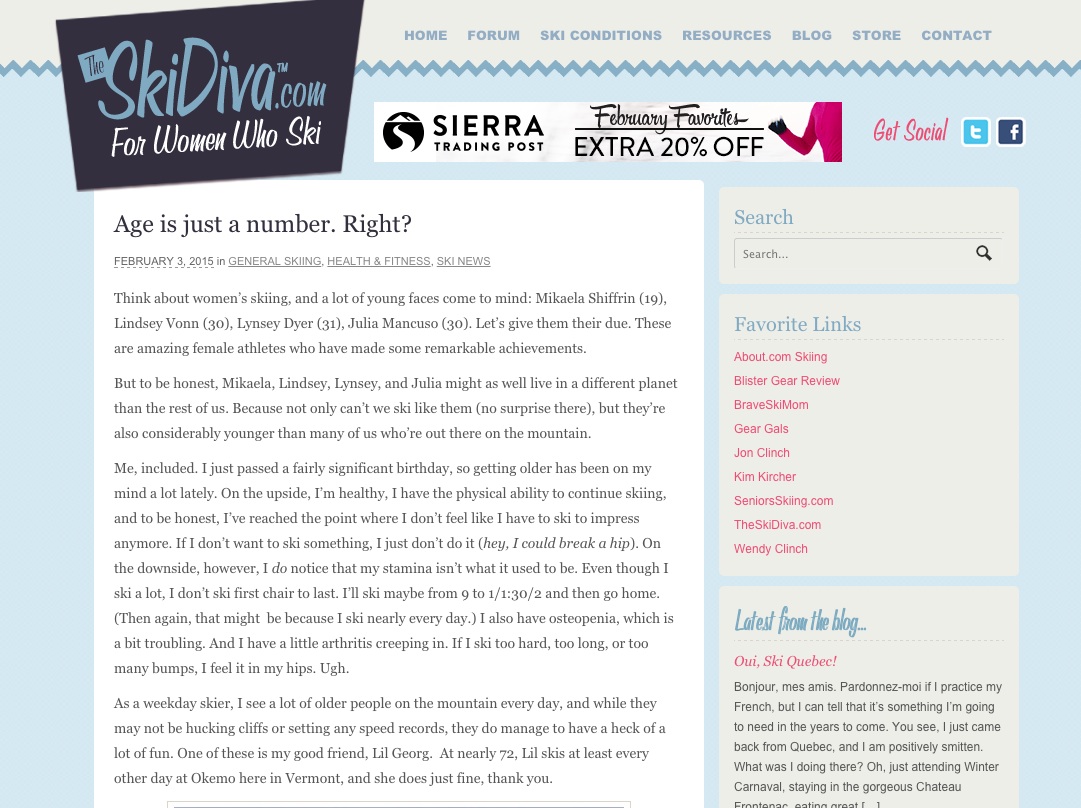
SeniorsSkiing.com’s favorite online resource for women skiers is The Ski Diva, a one-stop shop for interesting ideas, information and a meet-up forum for like-minded women.  In this recent article, The Ski Diva explores how a senior woman approaches skiing at 72.  She also describes how the senior segment in snow sports is growing and quotes SeniorsSkiing.com’s co-founder on how the industry can be more accommodating to seniors returning to the sport after a hiatus.  Click to read the article, Age Is Just A Number, Right?

SkiDiva_2


Managing Fear, Building Confidence

Ski Instructor: “Encouragement Is The First Lesson For Returning Skiers”

It makes no difference whether a skier has just recovered from joint replacement, traumatic accident, ski injury or is returning to skiing from a long hiatus. There is going to be some level of anxiety.

Walt Lattrell, ski instructor at Smugglers Notch (VT), teaches a clinic on managing fear for other instructors. “We see people coming back to skiing who are harboring apprehension, negative thoughts and low expectations for performance. The good news is that they take a class from a professional instructor. That’s an indicator they want and need help.”

Thinkin' about it.  Revelstoke, BC, cornice has some folks wondering. Credit: Walter Latterell

Thinkin’ about it. Revelstoke, BC, cornice has some folks wondering.
Credit: Walter Latterell

The goal of ski instructors is to help their students to acknowledge their fears. “Our first challenge is to help returning students believe they are capable of higher performance. Self-limiting beliefs lead to self-defeating behavior. The instructor has to inspire their students, provide a vision of success and lots and lots of positive reinforcement,” says Lattrell.

Lattrell tells students not to expect perfection, to pay attention to their thoughts, and to visualize success. He provides clear goals for each lesson, and explains how the student is going to get there through a series of small steps.

There are some stages that Mermer Blakeslee, in her book ,“In The Yike! Zone” sees some students going through as they gain confidence. It seems it is key for the instructor to positively reinforce the student at each step:

  • At first, the student doesn’t want to try. Small attempts are guided and reinforced by the instructor.
  • Then, the student will try a skill, but only on “safe” terrain. Success will bring the student confidence to try again at a higher level.
  • Next, the student will try a more ambitious skill, but bails out. Now, the instructor demonstrates, guides, and encourages again.
  • Finally the student tries again and follows through with sense of relief, joy and accomplishment. The instructor points out what the student did right and acknowledges the progress.

“The goal of any lesson needs to be a progression from simple skills to more challenging ones. Each step is built upon with growing confidence,” says Lattrell, a PSIA Level 2 instructor.

As we have learned from Harriet Wallis’ series on Knee Rehabilitation, some returning skiers need a run or two by themselves to adjust to the slopes after illness, injury or rehab. Others could benefit from a supportive lesson or two. Lattrell, himself, had bilateral knee replacements.

To paraphrase the great Yankee Hall of Famer Yogi Berra: “Half this game is 90 percent mental.”


Hydration Chronicles: An Easy Way To Keep Drinking

Carry Water On Your Back Like A Camel.

In my younger days, my friends and I launched our adventures without giving a thought to proper nutrition, hydration and so on. On one fondly remembered camping trip, provisions were down to shredded wheat, peanut butter and warm beer, and we still had fun.

Dehydration is pretty common and may be the reason for low energy.

Dehydration is pretty common and may be the reason for low energy.  Benefits of drinking water are many. No joke.

Now we have the benefit of decades of research in sports medicine, nutrition and physiology. When planning my slope time, I try to take advantage of this knowledge to give myself any boost I can, whether it’s diet, exercise or technique. Proper hydration, while an often-discussed topic, is easy to overlook when it comes to winter sports yet surprisingly easy to maintain.

Easy to overlook, because, well, it’s cold out! Cold, dry air and modern technical clothing which so effectively manages perspiration combine to mask how much you may be sweating even on the most frigid day. The “start/stop” exertion common to skiing, where you do a run then relax on the chair, can further hide the amount of water you may be losing through sweat. Medium intensity steady exercise can cause you to lose an average of two liters of water an hour; even if you halve that because the exertion in skiing isn’t steady, it’s still a significant loss. If you get cold, you can still lose through “cold dieresis”, where the body loses water through increased urine production.

The benefits of staying well hydrated are many: You avoid fatigue, confusion, irritability, dizziness. Your joints function better. When dehydrated, the body will draw water from the blood; decreased blood volume leads to colder extremities and greater susceptibility to hypothermia and frostbite. As dehydration increases the heart rate can rise as blood pressure drops.

For my water supply, I like to wear a hydration pack. I prefer a simple, minimal design like the CamelBak Bootlegger ($55) which is made to be worn under your jacket. This keeps the drinking tube from freezing and keeps the pack from shifting around as I ski, or snagging on a chairlift. It’s a simple matter to unzip my jacket a bit & pull out the tube to take a sip every 15 minutes or so,

Camelbak Bootlegger carries the right joy juice to keep hydrated. Credit: Camelbak

Camelbak Bootlegger carries the joy juice to keep you hydrated.
Credit: Camelbak

whether stopping for a breather on a run or while sitting on a lift. The Bootlegger holds 1.5 liters; usually I’ll only fill it halfway and press all the air out to keep it as flat as possible. It’s easy to refill when stopping for a break or lunch. The bulk is barely noticeable, and the water bladder is sturdy enough that I can lean back on the chair lift without fear of bursting it.

I use plain water, which makes keeping the bladder and tube clean very easy. Sports drinks like Gatorade aren’t necessary; they all contain some form of sugar, and some contain up to 150 mg of sodium per cup, which may be an issue if you need to watch sodium intake. I think electrolyte loss in skiing is minimal; it’s more an issue when hot-weather exertion causes copious sweating.

A hydration pack is a much more comfortable way to carry water than having a big bottle banging around in your pocket. Making access easy and convenient means you’re more likely to stay well-hydrated and keep the fun going!


Silver Streaks: A Model For How Ski Areas Can Serve Seniors

You Always Have Someone to Ski With at the Waterville Valley Program.

Gold_Waterville_Valley_Resort[Editor Note:  Waterville Valley’s Silver Streak Program was a Gold Senior Friendly Award Winner, based on SeniorsSkiing.com’s First Ski Area and Resort Survey.  Silver Streaks is the oldest senior ski program in the US.  We hope that other ski areas can start “Thinking Seniors” like Waterville.]

“I’m so excited, I just turned 65,” says Anne Pelletier, booster for the Silver Streaks, a program for the 50-plus set at Waterville Valley, N.H.

Silver Streakers Mike and Anne Pelletier totally enjoy the benefits of the Waterville Valley program. Credit: Tamsin Vinn

Silver Streakers Mike and Anne Pelletier totally enjoy the benefits of the Waterville Valley program.
Credit: Tamsin Venn

Nearly 30 years old, it was one of the first senior ski programs in the country to cater those 50 and over, a demographic astutely valued by Waterville’s founder ex-Olympian Tom Corcoran.

Pelletier, a lively woman in fire-red ski pants and state-of-the-art heated jacket, has reason to be happy. At age 65, the Waterville season pass benefits kick in: $379 for non-holiday midweek skiing.

For much longer, though, she has been with the Silver Streaks.

For the $95 joining fee, senior skiers get:

  • Reserved area in Parking Lot # 1 (one 90-year-old joined for that reason alone).
  • Complimentary coffee and pastries in the Base Lodge from 8:30-10 a.m. in special meeting area.
  • Complimentary Snowsports clinics for seniors only.
  • Après-ski party every Wednesday at rotating venues.
  • Banquets and other special events throughout the season.
  • Reduced price NASTAR every Wednesday.
  • Nordic program every Wednesday for two hours of Nordic skiing with professional guides, followed by lunch at the Nordic Center.

The program runs Monday-Thursday, non-holiday, early December to mid-March.

Also every Monday night the Coyote Grill at the White Mountain Athletic Center offers a $12 dinner; après-ski two times a month. (unfortunately $5 martini night was retired for reasons easy to imagine).

Other events: a Memorial ski run from the top in single file to remember those who have died in the past year.

The Pelletiers like the friendships, but they have an ulterior motive.

Says Anne, a platinum (top) NASTAR racer, “We have a need for speed.” Husband Michael, 72, is a top-ranked marathon runner in New England.

Silver Streakers Randy and Reggie Breeckner moved full time to Waterville 15 years ago from their home in the Litchfield Hills in northwestern Connecticut where they raised seven children.

Reggie notes, “I’m going to try snowshoeing when I get old.”

“You develop strategies not to get hurt,” adds Randy, a six-decades-long New England skier. Those include not skiing when it’s icy, foggy, or on busy weekends.

What about snowboarding?

“We know only one person in the group who snowboards,” he says.

Albert and Kristina Ruehli from southern New Hampshire are also on board. Albert learned to ski at age six in his native Switzerland.

Says Albert, “the mountains, the view, it’s a beautiful sport, plus you’re expressing yourself on the hill.”

“I went to a meeting and one of members said, ‘You’re too young to join,’ so of course I joined immediately,” says Kristina, 71.

 “We figure when we can’t ski anymore, we should just let an avalanche take us,” adds Kristina philosophically

Julius Feinleib from Thornton, N.H, has grandchildren ages seven and nine who now whiz by him on the trail. His reasons for joining are simple. “Just being with people I recognize.” He also likes the cup of coffee and doughnuts.

For more on Silver Streaks, click here.


A Much Better Way To Boot-Up

Taking The Pull Out Of Pulling On Boots.

Every now and then I come across a product that makes a big difference in the comfort of older skiers. I’ll explain in a minute.

No more wrestling with boots. Ski Boot Horn makes a BIG difference. Credit: Ski Boot Horn

No more wrestling with boots. Ski Boot Horn makes a BIG difference.
Credit: Ski Boot Horn

I always boot-up in the parking lot. The difficulty of that process advances with age. Over the years, I’ve found that using boot warmers on the way to the mountain makes it easier to get boots on — especially on very cold days, when the shells are stiff and resistant. Because I find it easier to be seated, I carry a folding chair in the car.

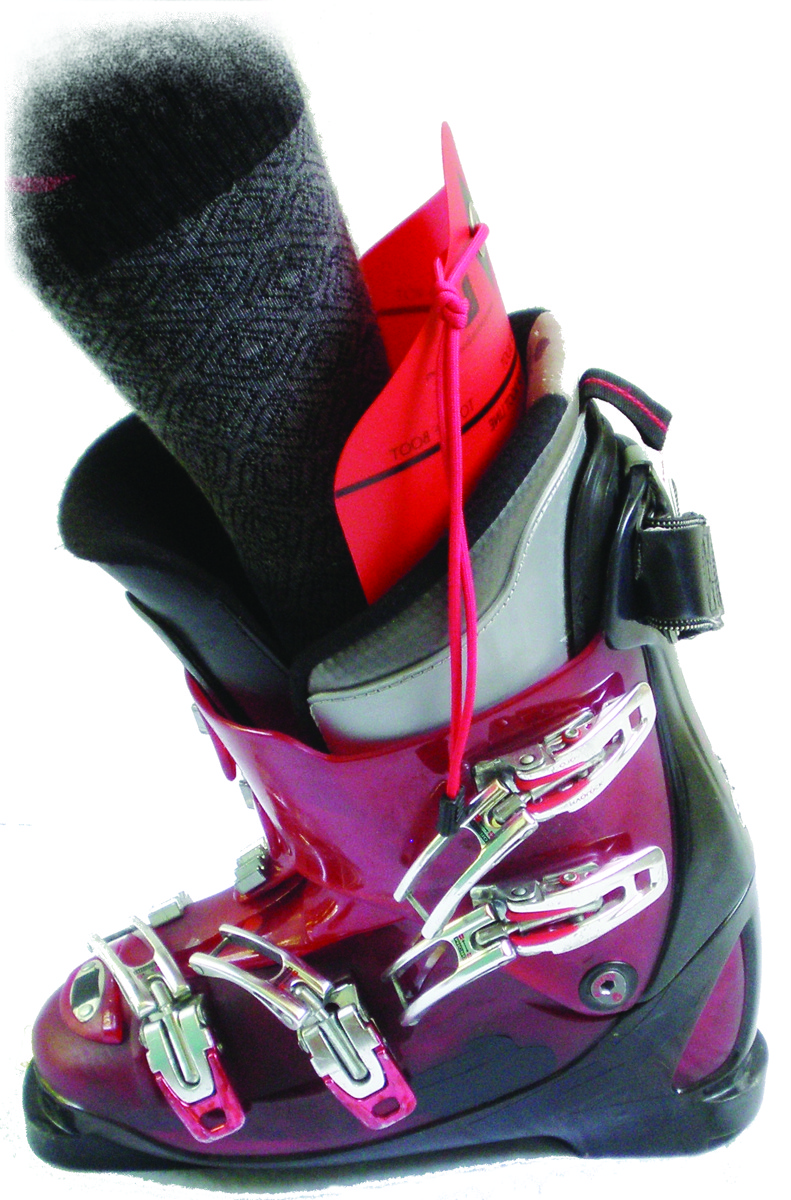
Recently I learned about the Ski and Snowboard Boot Horn, and, WOW, does it make a difference! This specially-designed sheet of flexible and slippery plastic is placed in the boot and helps your foot slip into place. It is simple, effective, and costs less that $10, when purchased online.

In addition to letting your feet slip in easily, the boot horn helps avoid foot and ankle pain from earlier injuries, while putting on boots. It also protects hand and finger injury and discomfort that can occur in the frustration of trying to get boots on in very cold conditions.

The ski boot horn website features a few useful videos about ways to improve getting your boots on, including useful tips about boot liner care. For reasons I don’t understand, there’s even a video of a group of skiers dropping into Jackson Hole’s iconic Corbet’s Couloir. I checked that one off on a deep powder day almost 25 years ago.

I haven’t tried the boot horn with cowboy boots, fishing waders, skates, etc., but the makers claim it works well for them and for all types of shoes. I’ll try those as the seasons change, but for now, I treat my Ski and Snowboard Boot Horn like I treat my AMEX card. I don’t leave home without it.

Knee Replacement—What Do I Do Now? Part 5

If you want to get back to skiing, learn to love your physical therapy.

It took my expert knee replacement surgeon one hour to cut, saw, hammer and install each new knee. It took me a year to rehab them. I was astounded by how long it took.

Correspondent Harriet Wallis works it. The key to recovery is following through with your  physical therapy regimen. Credit: Harriet Wallis

Laurie O’Connor, friend of correspondent Harriet Wallis, works it. The key to recovery is following through with your physical therapy regimen.
Credit: Harriet Wallis

I was in good physical condition before surgery, and I had the mind set that I would bounce right back. I’m strong. I’m tough. I thought that a set of new knees would be something like taking my car in for an oil change. Drive in with old oil. Drive out with new oil and keep on rolling. I was incredibly wrong. The analogy didn’t work. Healing and rehab take time

The good news is: The body is a healing machine.

The bad news is: Lots of people slack off their physical therapy exercises as soon as they can get into the car and do their grocery shopping. They lose their motivation and unfortunately they don’t get full benefit of their new knees. They probably aren’t skiers. We skiers are motivated to get back to the sport we love.

Eight months after surgery I was back on the slopes – starting on the opening day of the season. I skied 93 days that year. EEEhaw! (During the winter before knee replacement, all I could do was skid down a bunny slope.)

Friends asked: “How long did it take to get used to artificial knees?

My response: “About six turns.” My new knees worked wonderfully.

Skiing is good exercise, but it’s not focused physical therapy. Continuing the prescribed exercises was vital. Now, two years later, I still do certain exercises. I believe that maintaining artificial knees is an ongoing process.

My new knees do have some minor disadvantages. I cannot squat with my butt down to my heels. Artificial knees aren’t designed to bend that far. Therefore I sit on a low stool while weeding the garden. And swimming laps confounded me because it took more strokes to get across the pool. I think that’s because metal is heavier than bone, so my legs are lower in the water. I had to find a new balance point for swimming.

The bottom line is this: When the surgeon is done, your work is just beginning. Do your rehab exercises with gusto – and I’ll see you on the slopes.

Note: This is a five-part series in which SeniorsSkiing.com’s correspondent Harriet Wallis describes her knee replacement journey with tips to guide you if you’re anticipating knee replacement. Part 1: Inspired by a ski patroller with artificial knees. Part 2: Research 101 – why and how to do it. Part 3: Interviewing surgeons and questions to ask. Part 4: How I found the right doctor for me. This is Part 5, the final segment of the series.


Eat Your Way To Fitness: Gourmet Ski Tours

Lots of Chocolate: Nordic Ski and Snowshoe Events Collected By XCSkiResorts.com

From Roger Lohr, XCSkiResorts.com: Want a guilt-free way to indulge yourself with food while exercising? XC Skiing is one of the best forms of aerobic exercise but if you go on a “Gourmet Ski Tour” on your xc skis or snowshoes, you may very well eat your way to fitness at a number of trailside food stops. What a grand time so go ahead, eat, ski, and be merry – appetizers, wine, champagne, fondue, entrees, desserts, and more.

Here’s a cross section of the culinary XC ski events that are planned this winter across the country with a varied menu of fun and fine cuisine.

EAST

Smugglers Notch in VT has Sweets and Snowshoes every Wednesday night 7-9 PM for adults only. Hot cocoa, coffee, and desserts await snowshoers after a 30-minute trek to a pavilion and campfire. A warming meal of hot soup, bread and beverage at a trailside cabin is a destination for the Soup and Snowshoes guided trek mid-day on Sundays, and on Tuesday nights there’s a Snowshoe Adventure Dinner at the mountain summit.

Eastman (NH) Cross Country’s Nordic Nibbles in Grantham, NH on January 18 has a Scandinavian theme with a visit to a fire pit at each stop for cheese from a local smokehouse, Lindt chocolate, gingerbread cake and pastries, local dairy milk for hot coco, soup, and the main meal from 11 AM – 1 PM.

Munching along at Eastman's outdoor ski party. Credit: Roger Lohr

Munching along at Eastman’s outdoor Nordic Nibbles ski party.
Credit: Roger Lohr

The Valentine’s Day Destination S’Mores Station at Bretton Woods Nordic on February 14 with two self-guided tour for sweets from 10 AM – 4 PM. The shorter tour will be less than 2 km on easy trails so it’s great for the kids. Purchase S’Mores Kits at the center or at the station to make your own.

The Chocolate Festival at Mount Washington Valley Ski & Snowshoe Center in Intervale, NH on February 22 is an inn-to-inn affair at 10-12 stops to experience your chocolate fantasies including moose and fondue. Go on a tour of any length and actually gain calories, even if you ski as far as 20 kilometers. A shuttle is also available for those that have overindulged at the event dubbed the “Sweetest Day on the Trails.”

CENTRAL

The Upper Peninsula of Michigan in Ironwood features cuisine from local restaurants that can be purchased at a nominal fee along a designated route along the trails at the Taste of the Trails on the ABR trails on March 7 at 11 AM – 2 PM.

MOUNTAINS

Snow Mountain Ranch in Granby, CO hosts the Grand Huts.org Progressive Dinner on Feb 28 with a multi-course meal at outposts along the trail in a fundraiser for the huts.

Just Desserts Eat & Ski in the Enchanted Forest in Red River, NM on February 28 features goodies from 20 different local restaurants at three trailside stations with up to 100 desserts within a 4 kilometer loop. Their motto is, “It’s not a race, just a gorge fest.”

The Rendezvous Trails in West Yellowstone, MT features cuisine from local restaurants that can be purchased at a nominal fee along a designated route along the trails at the Taste of the Trails on February 7.

Crested Butte Nordic Center has has the Magic Meadows Yurt Dinners reached by a 2 km ski or snowshoe tour where 10 gourmet dinners are offered during the winter including the Saturday Yurt Dinners each month, and special dinners on Winter Solstice on December 20, New Year’s on December 31 and Valentine’s Day on February 14.

Look to the Galena Lodge in Ketchum, ID for the Full Moon Dinners on nights associated with the full moon, (Jan 3 & 4, Feb 3,4, & 5, Mar 5,6, & 7, Apr 3 & 4) whereby you can go ski or snowshoe ($5 snowshoe rental offered) and then return to lodge for a four-course dinner at $40 or half price for kids under 12. There are also special Wine Dinners, Holiday Dinners, and a Valentine’s Day Dinner.

Lone Mountain Ranch in Big Sky, MT has the Glide & Gorge event on March 8 from 11:30 AM-2 PM with trail luncheon stationed with appetizers, soups, entrees, desserts from the Ranch’s four-star kitchen, local brew, wine, music and shuttles.

WEST

Royal Gorge XC Ski Resort in Soda Springs, CA has the Royal Fondo Tour on Jan 25 with skiing or snowshoeing to various huts along the trails for snacks and lunch at the resort deck.

Tahoe Donner Cross Country Center in Truckee, CA has the Taste of Truckee presenting food from local restaurants along the trails on Mar 22.

Cypress Mountain outside of Vancouver, BC has Ladies Only Chocolate Fondue Snowshoe Tours on Friday and Sunday nights starting at 6:30 PM. Warm up with a mug of steaming apple cider before enjoying appetizers then a chocolate fondue Jan 9 & 23, Feb 6 & 20, and Mar 6. These programs include rental equipment, trail access, guides/instructors, and the appetizers.

Coming Back From Injury: Avoid One-Sidedness

Adaptive Ski Instructor Provides Advice on Predictable Issues for Returnees

Alisa Anderson, Smuggler’s Notch’s (VT) adaptive skiing program manager, is a highly-specialized PSIA instructor who, over the past 20 years, has applied techniques and tools for skiers of all kinds who need a little extra help getting down the mountain.

Adaptive Ski Instructor Alisa Anderson guides a student on the "Snow Slider" at Smuggler's Notch. Credit: Alisa Anderson

Adaptive Ski Instructor Alisa Anderson guides a student on the “Snow Slider” at Smuggler’s Notch.
Credit: Alisa Anderson

She trained at the National Sports Center for the Disabled, Winter Park, CO, where she learned how to use bi-skis, mono-skis, and outriggers. At Smuggler’s Notch, she purchased a “Snow Slider” which is basically a walker on skis. While these tools are mostly used with people who have chronic physical disabilities, she also helps people who can ski on their own skis get back to skiing after injury, accident, or knee, hip or shoulder replacement.

“It’s important that people coming back from an injury take a lesson from a trained instructor,” said Alisa. “One reason is to help them get through the natural apprehension that you’d expect after being through major surgery and a year or so of rehab. The other reason is to spot and correct physical mistakes before they become habits.”

Most people coming back after rehabilitation, she said, will clearly favor the healing side. “It’s natural. There’s been a trauma to the area, and the body wants to ‘save’ that side. What you see are people not pressing the ski on that side or being very tentative about flexing.” That stiffness is risky because the skier doesn’t have bi-lateral control.

People aren’t even aware they are favoring one side, she said. That’s where coaching comes in.

“If they continue to be stiff and one-sided, they are going to form some bad behaviors. Stiff muscles lead to fatigue, and the risk of injury goes up,” she said. “They need to be constantly in motion.”

The solution is for the instructor to give the student skier active feedback on what she sees. “Basically, I remind the student to focus on keeping pressure on the front of the boot and weight on the ball of the foot. It’s really back to the basics. It’s important for the skier to loosen up, extend, get tall and bend their joints into through the turn.”

Alisa says that one lesson might be all a skier needs, others, maybe a couple more. “Most people get it pretty quickly. It’s just a matter of getting through the first days doing it right.”

Alisa knows what she is talking about. In addition to her experience as an adaptive ski instructor, she’s also recovering from ACL reconstructive surgery. “I have to wear a brace. It reminds me all the time about what it’s like to be rehabbing. Sometimes, I don’t like wearing it, but I do it, and I’m still skiing.”


Knee Replacement—How I Chose My Surgeon: Part 4

How To Identify An Athletically-Empathic Surgeon.

I’m lucky to live in Salt Lake City. There are 10 ski resorts nearby, and there are opportunities for an active lifestyle year-round. Because of that, there are many top surgeons here who put athletes back together when they get injured or need replacement parts.

Correspondent Harriet Wallis chose Dr. Beck for many reasons. Credit: Harriet Wallis

Correspondent Harriet Wallis chose Dr. Beck from Salt Lake City for many reasons that made sense to her.
Credit: Harriet Wallis

But when I needed to have my knees replaced, I wanted to choose the right doctor for me. My list of questions helped me differentiate between the five surgeons I interviewed. Here’s the essence of just three of my questions and how the doctors’ answers focused my decision.

Do my knees need to be replaced? When?

            Doctor X: Yes, they need replaced — when you’re ready.

Doctor Beck: When the quality of your life is gone, and you can’t do the things you want to do, it’s time. Do it while you’re still active enough to get the best outcome and get back to the things you want to do.

What’s your surgery technique?

            Doctor Y said: I do the surgery this way. I do it this way all the time. I never vary from doing it this way.

Doctor Beck said: This is what I plan to do. But when I get into your knee I might find something that doesn’t show up on the x-rays and I’ll have to take care of it — but “I don’t want to hurt you any more than I have to.”

Can I ski?

            Doctor Z said: I wouldn’t ski anymore.

Doctor Beck said: “You’re darn tootin’ you can ski!” Pick good snow days, take some breaks, and you probably should stay out of the moguls.

For many reasons, this was the right surgeon for me.

         Good luck finding the right surgeon for you.

Editor’s Note: This is a 5-part series in which SeniorsSkiing’s correspondent Harriet Wallis describes her knee replacement journey with tips to guide you if you’re anticipating knee replacement. Part 1: Inspired by a ski patroller with artificial knees. Part 2: Research 101 – why and how to do it.  Part 3: Interviewing the docs.  Upcoming Part 5: Rehab and why to love it.

Move It! Get Fit Your Way With Silver Sneakers

Nationwide Health Insurance Program Supports Senior Fitness.

Tune yourself up for ski season and beyond. Get started by checking your health insurance plan to see if it includes Silver Sneakers. It’s a nationwide program sponsored by many health insurance plans, and it encourages older adults to get fit in whatever way they want to.

Correspondent Harriet Wallis loves her Silver Sneakers aerobics class. Credit: Harriet Wallis

Correspondent Harriet Wallis loves her Silver Sneakers aerobics class.
Credit: Harriet Wallis

Silver Sneakers gives you access to gyms where you can walk on the treadmill, swim laps, stretch with yoga, lift weights and work out with certified instructors. You may also enjoy community-based programs that include everything from line dancing to boot camp. There are 12,000 Silver Sneaker facilities across the country. Find one near you and get going.

For me, I enjoy an aerobics class designed for seniors. It gets the heart rate up and the joints moving – but the class does it gently. My classmates and I are a heap of replacement parts. We’re full of metal hips, knees and shoulders. The instructor understands, and when she introduces a new move that’s too hard for some of us, we make adaptations. Nobody laughs. We’re all there for the fun of it and to keep our bodies moving.

But we “mambo” and we “grapevine.” We huff and we puff. We feel like prima donnas because we face a mirror and we can see ourselves. But we’re all wearing T-shirts, not tutus!

Silver Sneakers allows you to choose the exercise programs you like. Credit: Harriet Wallis

Silver Sneakers allows you to choose the exercise programs you like.
Credit: Harriet Wallis

Classes also offer the benefit of socializing with others of like age before and after class. Just for fun, our class goes to lunch once a month. The recent lunch reminder email said:  “We go right after class with sweat and no make-up. So far we have never been turned away looking and smelling of exercise.”

Many seniors fear trying something new because their heads fill up with negative thoughts such as: Will the class be too hard? What should I wear? Will I fit in? Skip those thoughts.

Find a Silver Sneakers program near you. Put on your sneakers and get going. Now.

Seniors: Don’t Hit The Snow Without Preparation

Here’s a Must-Read for Seniors Before They Head for the Slopes.

Paul Petersen, who begins his 38th season running Bear Valley Cross-Country in California this winter, is 56 years old and comes with the kind of credentials that should make you sit up and take note of what he has to say! He’s been a certified alpine and cross-country ski instructor for nearly four decades. He’s also the former coach of the national nordic team of the Professional Ski Instructors of America and is currently on its education advisory committee.

“I’m a fully addicted skiaholic, and I don’t see that getting better any time soon,” avows Petersen. “It’s one of the most fun things you can do in life outdoors.”

Long-time coach Paul Petersen has wise words about physically preparing for the season.

Long-time coach Paul Petersen has wise words about physically preparing for the season.

He’s made “staying in the game of skiing a life goal,” and he’d like to help you do the same. First and foremost, plan ahead. You can’t just hit the slopes or trails without any preparation after several months of not skiing. Start with exercises that simulate the movements you make when you ski or snowboard. Here are Petersen’s four cornerstones to focus on in the weeks before the wintersports season begins:

  • BALANCE: Stand on one foot, moving from foot to foot every 15 seconds or so multiple times; look for other balance-focused exercises you can do easily anywhere, any time.
  • STRENGTH: Simulate a chair—every skier’s “go to” thigh-strengthening exercise! Slide your back down a wall so that your hips and knees are at right angles. Hold for as long as you can stand it, slide back up, and repeat! Check out other leg and trunk strengthening exercises, such as lunges and squats.
  • FLEXIBILITY: Streeeeetch! Do yoga, or any other stretching exercises you’re comfortable doing.
  • CARDIO: Take the stairs. Park in the farthest parking space in parking lots. Walk around two or three blocks several times a week. Run in place.

What about fitness classes? Paul recommends aerobics for cross-country skiers to enhance cardio and yoga for downhill skiers/boarders to stretch out tight muscles and loosen joints.

And don’t forget about pre-season equipment safety. What good will it do you to plop your fit-as-a-fiddle body atop skis that negate all the prep? It’s worth the money to get your skis tuned up ahead of time, getting the edges sharpened, and most importantly, having your binding settings checked to be in sync with your age, current weight, and ability—all of which might have changed since the last time you had your bindings checked.

Not a big fan of helmets? After all, you’ve skied unencumbered by headgear for eons without any ill effects. Petersen says, “It’s a no-brainer [pun not intended]…wear a helmet! It keeps you warmer, and it doesn’t affect your balance or equilibrium. It’s not so much that you might hit a tree, but rather that some out-of-control newbie snowboarder can come crashing into you.” Petersen also suggests buying some of the incredibly well-designed sports padding that’s available today, such as padded shorts that protect one’s hips, which are particularly vulnerable as we age, and wrist guards for snowboarders.

Editor Note: Petersen also has a lot of excellent tips for the day before you ski and things that are very important to do the morning of. But that’s another whole article for another day…watch for it coming soon!

Lightweight Pakems: Flip Flops for Cold Weather

Clever new “portable” boot makes feet happy.

Pakems CEO Julie Adams shows off high and low models at the Boston Ski and Snowboard Show. Credit: SeniorsSkiing.com

Pakems CEO Julie Adams shows off high and low models at the Boston Ski and Snowboard Show.
Credit: SeniorsSkiing.com

We’ve been padding around SeniorsSkiing.com’s New England office for the past few days wear-testing our new Pakems boots that we picked up at the Boston Ski and Snowboard Show last month. The real trial will come in a couple of weeks on some ski hill in New Hampshire, Vermont, or Maine after the final run of the day. I look forward to the moment when I take off my ski boots, relieving that clamped feeling—[regardless of how comfortable you think your boots are, there is always that clamped feeling]—and slipping on these lightweight, comfortable, warm and water-resistant booties and head off for après ski activities. Ahhh.

Pakems are relaxation machine. Credit: SeniorsSkiing.com

Pakems are relaxation machines.
Credit: SeniorsSkiing.com

Julie Adams, CEO and “Cruise Director” of Pakems, calls her company’s innovative boots, “flip-flops for cold weather.” After a day of skiing, rather than put on another heavy pair of hiking boots, Merrells, Sorrels, or even Bean boots, the solution, according to Pakems, is to slip on these ultra-light comfies for “happy relaxation.” We think it’s a pretty good idea to let your feet be happy after all that hard work.

There are many kinds of Pakems, from low to high cut, in different colors and ruggedness features. You’d probably want the insulated and thicker-soled Extreme model if you were planning to regularly trudge across a slushy parking lot back to your car. For us, the Classic boot is just fine for cruising around the lodge, condo or even heading out to an informal dinner. You can also give your kids or grandkids the chance to design their own boots with a set of fabric pens that come with the Kid’s Bodie model, named after Julie Adams’ eight-year old.

Pakems come in a very clever, squishable tote bag into which you can store the boots, making carrying them around instantly easy and convenient. Put Pakems in a backpack if you’re cross-country skiing , snowshoeing or ice-skating up a frozen river. Oh, and also for non-winter activities like cycling, hiking, fishing or being a tourist in a foreign land. You’ll be glad to have them at the end of the day.

Check the Pakems website for models, dealer locations and ordering information. You can also get them on Amazon.

Flash: Colder, Snowier Winter 2015 Forecast For New England

Latest Prediction from WBZ-TV Meteorologist Forecasts Cold and Snow

With the season just getting started, we’ve been diligently watching snow forecasts as we know know you have as well.  As we reported in an earlier post, Joel Gratz, our favorite snow meteorologist who prognosticates at OpenSnow, has been compared a number of weather models and found a consensus for dry in the Northwest, snowy in the Far West, and uncertain from the Rockies to New England.  But, then he says, don’t trust long range forecasts.

2015 Snowfall Predictions for New England Credit: WBZ-TV Graphic

2015 Snowfall Predictions for New England
Credit: WBZ-TV Graphic

With a couple of more months of data and many models to contemplate, Barry Burbank, Boston’s WBZ-TV meteorologist, has just put a new winter prediction in play.  Barry says that he’s “relatively confident of a cold and snow winter overall.”  He is calling for more snow in the New England area, 10-20 inches above average, for a total forecast of 55-65 in Boston.  That places 2014-15 as the third consecutive year above average.  He also is calling for cold, speculating that the Polar Vortex that vexed the Midwest last winter will be moving eastward.  Below average temperatures should reign especially in January when he expects an “outbreak of arctic air.”

So, New England senior snow enthusiasts, this is good news.  It also means you have to dress for the weather, prepare your equipment your car, and your self.  As the old Swedish expression says: “There is no such thing as bad weather, just bad clothing.”  Get ready.

Here’s Barry.  Click here for WBZ’s Winter 2015 video report.


Huff Post: What Senior Skiers Must Remember

Huffington Post Highlight’s SeniorSkiing’s Co-Founder: Is there something outdated about your equipment?

SeniorsSkiing.com’s Co-Founder Jon Weisberg has a new article on Huffington Post’s Post 50 blog, this time about the potential risks of skiing with old equipment and a lack of reasonable fitness in senior skiers.  Click here for the Huffington Post blog about what seniors should think about before heading downhill with those long, skinny skis, rear-entry boots and untoned muscles. 

Huff2

Who Are You? The Ski Patrol Wants To Know

Carrying Identification Can Help The Ski Patrol Help You.

HIghly trained ski patrollers will be looking for your id. Credit: Deer Valley

Highly trained ski patrollers will be looking for your id.
Credit: Deer Valley

Accidents happen. And when they do, the ski patrol will likely be your savior. But the patrol needs your help. Here’s what you should have with you every time you ski or ride–just in case.

Carry identification. If you’re injured and can’t speak for yourself, the patrol will have to figure out who you are. Chris Erkkila, assistant ski patrol manager at Deer Valley resort in Utah, said: “We’re trained to look for ID and medical necklaces and bracelets.”

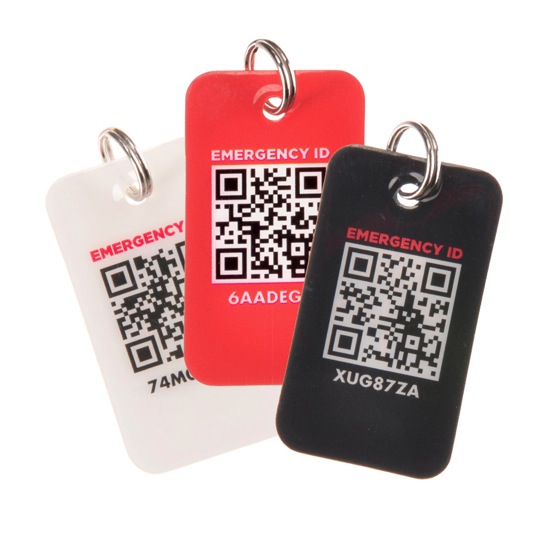
Emergency ID tags from Ecosperformance can be worn as bracelets, plastic tags or as stickers that can be applied to a helmet or even stuck on a phone.

EID Tags contain important profile information in case of emergency. Credit: Ecosperformance

EID Tags contain important profile information in case of emergency.
Credit: Ecosperformance

EIDs store identification, emergency contact and important medical information. When the QR code on the EID is scanned by a Ski Patroller’s smartphone, a skier’s Emergency Profile appears. A seven-digit EID number that can be entered into Ecosperformance website is a backup.

Other times patrollers have to be Sherlock Holmes to find even the most basic information about you—your name. They’ll look for a season pass that carries your name or look for your driver’s license. Sometimes they have to search your cell phone for information. “Often skiers don’t know each other very well, but a ski companion can tell us that the phone is in his injured friend’s right pocket,'” he said.

Carry a list of medications. “Seniors typically take more medications than others,” he said. Based on your condition, it might be vital for the patrol to know what prescriptions you’re taking. Same goes for allergies to medications

“Be sure to carry this information every time you go skiing,” Erkkila said. “Very basic things help us the most.”

And one more thing.

If you’re part of an accident, stay and identify yourself. And then there’s another aspect of accidents, he said. Sometimes there’s a collision between several skiers. Erkkila pointed out that the local city’s ordinance requires you to stay on the scene and identify yourself.  And, “We’re trying to educate the public about this,” he said. For those of us who are veteran skiers, staying on the scene after a collision seems to be common sense courtesy. But it’s also an official part of some resort areas’ regulations.