Technique: The One Team Concept
No Matter What You Are Sliding On, Basic Athletic Principles Apply.
When I was a boy, my dad knew a woman who was a former USGA Senior Amateur Champion from South Carolina named Carol Cudone. She constantly reminded my dad to finish his golf swing with his “belly button to the ball.” Ultimately she was trying to get my dad not to hit his shot off the back foot. Or swing in a static position.
When I played a lot of tennis back in the day, I always was reminded by my coaches to finish the stroke on the front foot with my center of mass facing the completed shot. Again, not off the back foot.
Mikaela Shiffrin says that skiing is not static either. It is a continuous movement of working the ski from tip to tail in the turn with the center of mass always moving towards the next turn. Three separate sports with a common theme of moving the body in an efficient manner in order to complete a shot, stroke, or turn. The common movement pattern is getting the center of mass in a position to execute a turn in the direction that you wish to go and to make a shot in the direction that will be successful. Fluid movement and not static at all.
Recently, there was a commentary in the winter issue of 32 Degrees, the official publication of the Professional Ski Instructors of America, about the “One Team Concept”. The magazine was doing a series of interviews about “Interski”, a global summit of international ski instructors with the goal of sharing knowledge and technique.
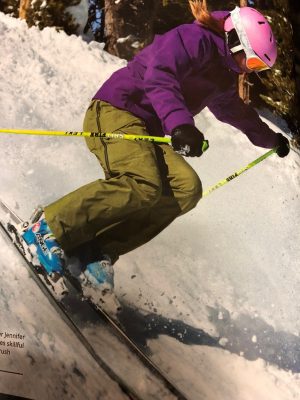
Forward, not on the back heel. Credit: “32 Degrees”
The United States team is always very popular at these events, and, in recent years, the concept of “One Team” has been a focus. “One Team” is all about representatives of alpine, cross country, telemark, and snowboarding all coming together to discuss the value and similarity of teaching techniques as they relate to how people learn and how to teach different personality types.
“One Team” also explored how similar movements in different disciplines of sliding on snow create efficiency and effectiveness. As in the movements of golf and tennis, these four disciplines of snow sports have similar movement patterns. Not only is the center of mass moving towards the new turn a common goal, but there is also the important role of a flexed ankle. As you can see from the alpine photo, the flexed ankle manages the pressure of an alpine ski turn against the terrain. So many people refer to bending the knees but the primary joint critical in the execution of a ski turn is the ankle.
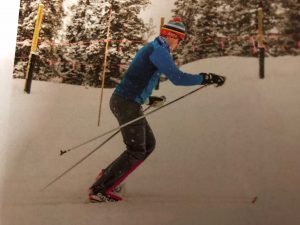
Note forward ankle bend. Credit: “32 Degrees”
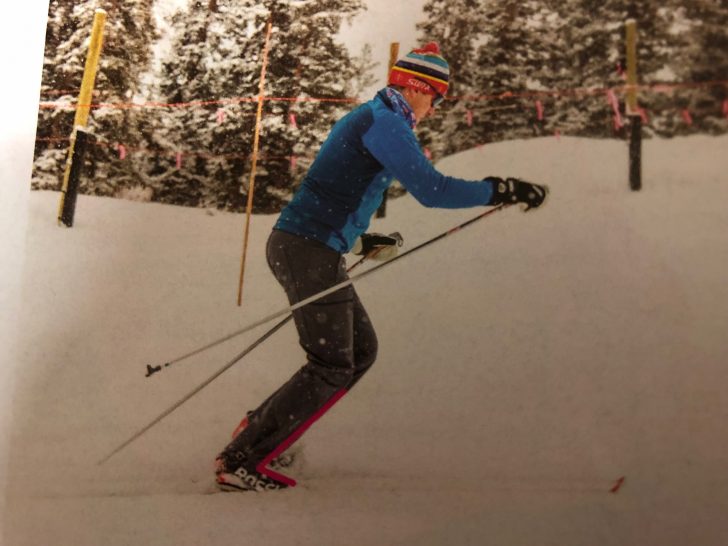
If you look at the cross country photo, the key to balanced forward movement in traditional cross country technique requires a flexible ankle to not only initiate the stride, but to keep the center of mass where it should be—forward— and not static-centered which hampers the glide process. The same technique is required for successful telemark turns with a soft ankle utilized to maintain balance and forward movement.
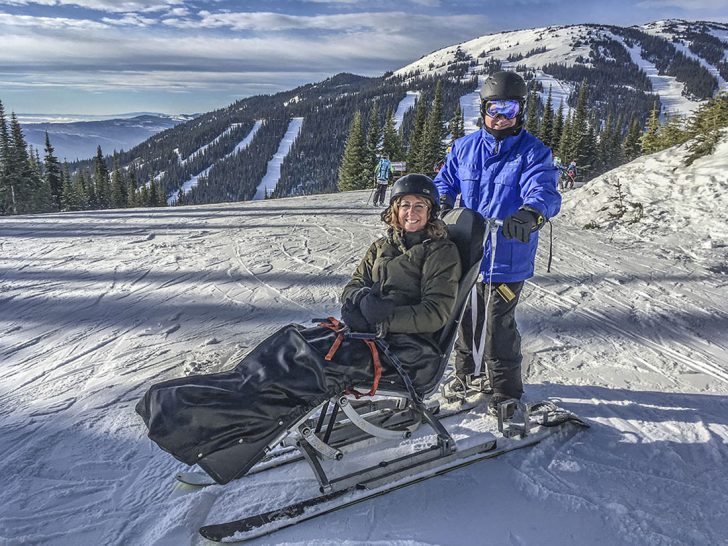
Finally, in the adaptive world, there is a lot of talk about the outriggers being used as legs on an upright skier. As the adaptive skier moves his center of mass towards the new turn, the outrigger extends on the initiation of the new turn and the other collapses on the inside of the turn. This is much like the flexed soft ankle of the uphill ski in an alpine turn.
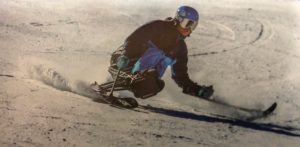
As the adaptive skier moves his center of mass towards the new turn, the outrigger extends on the initiation of the new turn and the other collapses on the inside of the turn much like the flexed soft ankle of the uphill ski in an alpine turn. Credit: “32 Degrees”
Alpine, cross country, adaptive, telemark, and snowboarding all have a common balance and ankle platform that really creates a “one team” concept both in the actual instructional technique but also in the philosophy of a united front in teaching and learning techniques. No matter what you are sliding on, the basic athletic principles apply. Have you ever pressed your outside foot down and your inside foot up in a bicycle turn to the left? The same principles apply there as well with the center of mass headed towards the turn along with the long leg, short leg, flexed technique.
As Mikaela says, nothing is static. A good athlete is fluid and utilizes good body balance, movement, and flexion to execute that shot or turn. Think about it the next time you do something other than skiing and definitely think about that center of mass movement across the skis towards the next ski turn with your ankles flexed.


 Tread Of Pioneers Museum














 Casey Earle reports on the ski season in Chile, sharing some good news-bad news. Despite a shortage of snow, there were some great days and he took advantage of them.




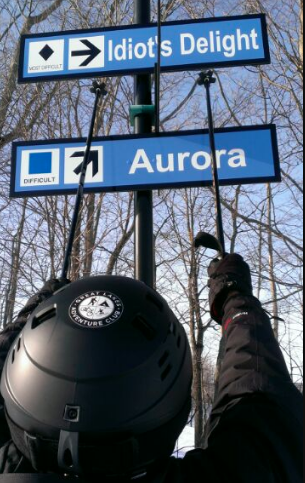
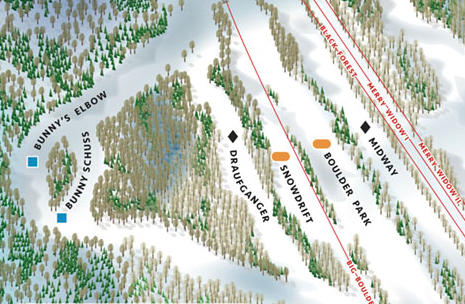
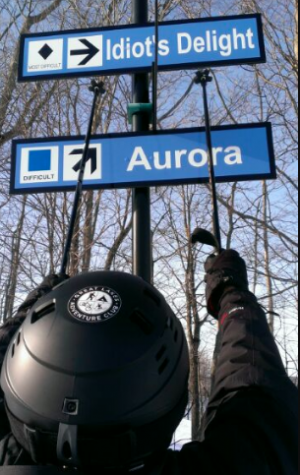 Look at some resort maps and you’ll find some very creative trail names. Among resorts in Michigan, I found some gems. Making the top ten are Idiot’s Delight at Boyne Mountain, Fun Bubble at Marquette Mountain and Crisis at Pine Knob.



 This is the famous Engen Bell, a fixture in Utah ski history and an official “treasure” of the state.


 This week’s



 So some other tips for building your confidence. Another good tool is positive self talk. Talk to yourself the way you’d like a good friend to talk to you. You want to focus on your strengths – we all have them — and instead of tearing yourself down, build yourself up. Studies show that maintaining a positive attitude can do wonders for your confidence. If you keep telling yourself you can do this, amazingly enough, you will.

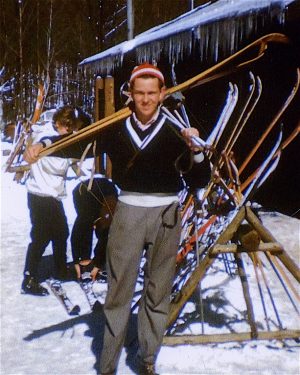
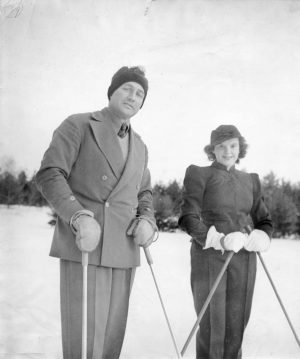 Nope, not Gary Cooper. Yes, Judy Garland. This is Otto Schniebs, shown here with the young movie star, who settled in Waltham, MA, after immigrating from Germany in the late 20s. He set up one of the first ski schools in America there and was soon discovered by AMC members as a talented ski instructor who had vast ski teaching experience in his native country.