Tag Archive for: 50+

Mystery Glimpse: Whose Olympic Medals?

[Many expenses for technicians, designers, and others are associated with delivering SeniorsSkiing.com free each week and developing and publishing Subscriber-Only content. Please help by making a modest donation by clicking here.]

Silver And Gold Belongs To…

We stopped at the wonderful New England Ski Museum in Franconia, NH, the other day to check out their current exhibit on the 10th Mountain Division and the veterans who contributed to the ski industry.  Another small exhibit contained the medals of a famous Olympian, and since we are currently in the midst of the Pyeong Chang games, we thought we’d carry the Olympic theme forward and ask you to identify who these belong to and the events they represent. Please place comments below. Note the New England Ski Museum is about to open a brand new branch in North Conway on Feb 26. Keep growing NESM.

Medals. Whose?

Last Week

Thanks Vermont Ski And Snowboard Museum

Yes, indeed a hand warmer powered by lighter fluid. And as a commenter pointed out, put a flaming gizmo in our pockets to keep us warm? Ahhh, sure.

And yes, Zippo still sells a version of this. An original is considered a collectible to some.

What made reading the replies interesting was how many commenters noted they remember their fathers using this unusual device.  In fact, I remember my dad using this to keep his hands warm at Aqueduct race track where he played the ponies in the middle of winter back in the 50s.  I remember the little flannel bag and the draw string it came in.  Since I was a kid at the time, it was off limits for me.

According to Google, this was called a Peacock Hand Warmer that was made in Occupied Japan circa late 1940s to 1952.  Apparently, some GIs brought these home with them and others turned up in Army-Navy stores.

Many thanks to the Vermont Ski and Snowboard Museum for contributing this memory.


100 Year Old Skier Inspires Us To Become Our Better Selves

[Many expenses for technicians, designers, and others are associated with delivering SeniorsSkiing.com free each week and developing and publishing Subscriber-Only content. Please help by making a modest donation by clicking here.]

George Jedenoff, 100, Is In Love With The Mountains, The Snow, And Life. Everyone Who Meets Him Says, “I Want To Be Like George.”

The paparazzi chase George while trying to keep up.
Credit: Harriet Wallis

“Age is just a number,” he says adding: Don’t let age be a barrier. Do your best. Become your best. And keep on going. He’s a living legend at Alta.

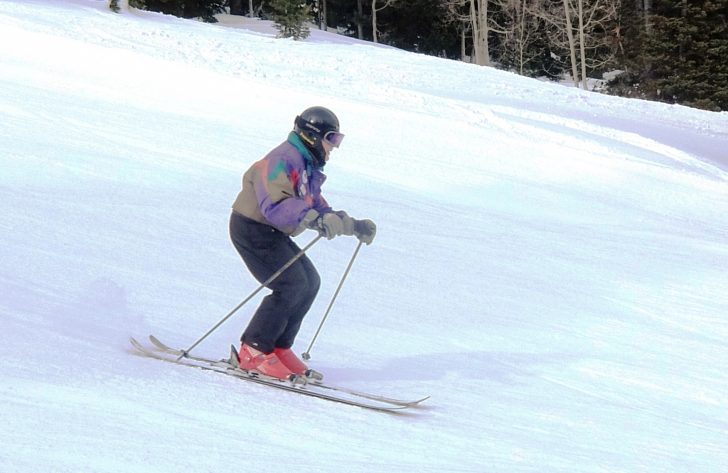
He’s also quite a super skier who skis like a kid. He swings his feet on the chairlift. He cruises down steep trails. And when jumps into patches of powder he shouts with glee.

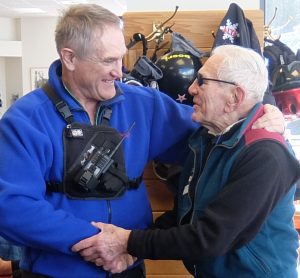
Two moguls meet. Alta’s new General Manager Mike Maughan welcomes George.
Credit: Harriet Wallis

To maintain his fitness, he works out every day for 45 minutes before breakfast. The workouts toughen him mentally and physically to keep him going even when life is unkind.

“Never give up,” is his motto.

On a chairlift ride, he leaned over to me and said: “People come up to me — sometimes with tears in their eyes — and tell me that I’ve inspired them to keep going and never give up. Of all the things to be remembered for, I’m so surprised that I’m being remembered for my skiing.”

But it’s more than just about skiing. It’s about life.

George stirs others to become their better selves — to try harder, to reach higher, and to never give up. While others are revered for their academic achievements, business success or community service, George is loved because he touches people’s souls.

Age is just a number even when it’s 100.
Credit: Harriet Wallis

Back in 1960, George was transferred to Utah to be the general manager of the Geneva Steel Plant. He was athletic, and he learned skiing from the best: Alta’s legendary Alf Engen, Snowbird’s iconic Junior Bonous, and Earl Miller, the granddaddy of release bindings.

George grew to love Alta’s powder, and when he was transferred away in 1967, community leaders honored him with a gift that was sure to lure him back: a lifetime season pass to Alta. He’s still using it! He now lives in California but he returns annually to ski Alta.

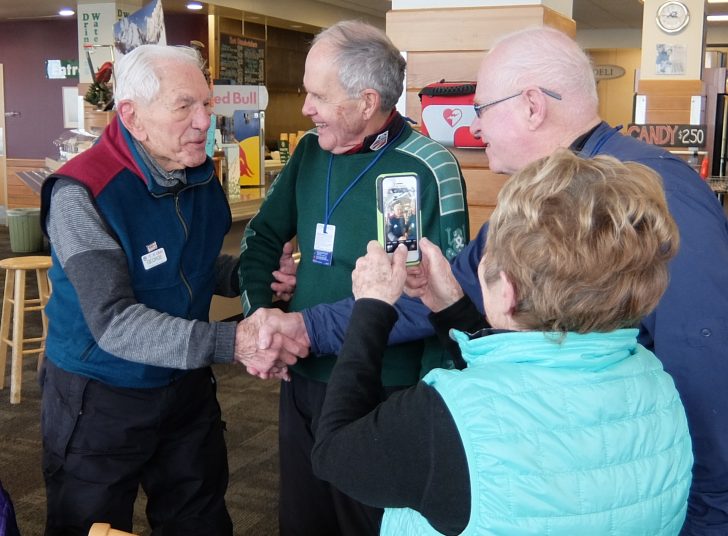
He’s a celebrity and a living legend. Skiers cluster around him to have their photos taken with him. The digital images become reminders to reach higher, try harder, and keep going — just like George.

Ski Utah has produced annual videos of George. The very first one, when he was 95, is still my favorite. Enjoy!

https://www.youtube.com/watch?v=KoQ5IEUpKEA

http://www.skiutah.com/explore/videos/george-jedenoff-97-year-old-utah

https://www.skiutah.com/blog/authors/yeti/98-year-old-skier-george-the-powder

https://www.youtube.com/watch?v=Bb23maq0rtQ

To read more from Harriet click here for her stories on SkiUtah.


The Back Story: Skiing With 100 Year Old George

[Many expenses for technicians, designers, and others are associated with delivering SeniorsSkiing.com free each week and developing and publishing Subscriber-Only content. Please help by making a modest donation by clicking here.]

Missed Turns, A Slipping Helmet, And Being In The Wrong Place. It’s All In A Day’s Work.

Hey, George, wait up!
Credit: Harriet Wallis

Covering a ski race is easy. Racers will be on the course.

But shadowing 100 year old George Jedenoff on Alta’s ski runs had challenges. Furthermore, we had two different genres going: A Ski Utah crew was videoing him, and I was shooting still photos I needed to stay out of the way of their cameras. It’s already getting complicated.

Here are some of the funny things that happened to me on the slopes with George for two days.

Can’t outski a 100 year old. We started from the top of a lift and George was in the lead. When he paused, I bulleted ahead to position myself at the side of the trail to snap photos as he’d ski by.

I yanked off my gloves and grabbed my camera. But before I could point it … there goes George… and he was gone. Repeat. Repeat.

When you come to a fork, take it. Skiers love George. They see him on the slopes and gather around him to talk and take photos. He is so gracious.

While Ski Utah videoed an impromptu trailside gathering, I knew I had lead time. I left the group, skied ahead, and chose the perfect spot to get my photos. I was on a steep slope under a chairlift.. My camera was ready. I waited and waited, but no George.

Then the group called down to me from the lift overhead. I looked up — and my helmet fell down over my eyes. I was stuck in my helmet and could see nothing. I felt really stupid.

I pushed my helmet back into place and wondered how George got past me. The main trail had a fork, and he opted for the side trail. Missed him again.

Deep powder, but over there. Another wrong guess. This time, we separated on purpose. George and the video crew took the high road to video him skiing deep powder. I took the low road and positioned myself for the best still shots.

But George didn’t appear on the most likely open slope. He found the snow up there was worn out, so he moved on down the ridge — out of sight behind dense evergreen trees — in search of fresher powder.

He found the fresh snow he wanted. But I couldn’t find George. Missed him again. But George had a wonderful time. That’s what really counts.

To read more from Harriet click here for her stories on SkiUtah.

Why Take An XC Ski Lesson?

[Many expenses for technicians, designers, and others are associated with delivering SeniorsSkiing.com free each week and developing and publishing Subscriber-Only content. Please help by making a modest donation by clicking here.]

A Lesson?  But It Looks So Easy.

[Editor Note: This article first appeared in XCSkiResorts.com.  Thanks to Publisher Roger Lohr for providing it to SeniorsSkiing.com.]

Old expression worth heeding. “Nordic skiing is easy to do but even easier to do wrong.” Take a lesson.
Credit: XCSkiResorts.com

The vast majority of cross country (XC) skiers do not take XC ski lessons, but rather they start with friends or family, who are usually not trained to teach XC skiing. So, who needs XC ski lessons? Most of us do!

Starting with the basics, a XC ski instructor can help a skier choose clothing and equipment that is appropriate for weather and his or her skiing goals and abilities. Equipment selection can make a huge difference in a skier’s experience.

A ski instructor can gently guide any XC skier to better skills and match a skier’s pace to his or her level of fitness and interest, keeping the skier from working too hard. Interestingly, most people who do not XC ski perceive the sport as too much work. An instructor can show the proper way to balance, transfer weight from one ski to another, and how to use the poles. Learning to keep the body forward with appropriate ankle and knee bend can start a new skier with confidence.

The first time a new skier approaches a hill, whether going up or down, can be a make-or-break experience. A lesson can help one learn simple techniques to travel up a hill with confidence. Going down a hill on XC ski equipment can be challenging to any skier. Narrow trails, difficult snow conditions, rocks and trees are difficult even for experienced XC skiers. An instructor can make sure the initial down hill experience safe and comfortable by starting on the right terrain and practicing skills and techniques.

Can a Lesson Help Seasoned Skiers?

Alpine (downhill) skiers who are trying XC skiing for the first time will also greatly benefit from XC ski instruction because the equipment and techniques so different between the sports. Skiing uphill is a totally new experience for the Alpine skier and going down hills on XC ski equipment, which is lightweight and has a free heel can be more than thrilling.

An experienced XC skier can also benefit from a ski lesson. Most XC ski control and efficiency problems involve incorrect body movements or timing issues and these problems will waste energy. Even constantly looking down at the skis will distort good body position while XC skiing.

Years of incorrect technique can instill the wrong muscle memory and  correction requires a certified and experienced instructor.

Because many XC skiers use outdated equipment, instructors can be helpful in discussing newer, appropriate products. There are so many derivations of XC skiing, that it is imperative to get informed advice to match what someone wants to get out of XC skiing— gliding on a groomed trail or mastering the glades in untracked powder or other ski conditions.

Finding a Qualified XC Ski Instructor

To find a qualified XC ski instructor visit or call a XC ski area. Discuss skiing goals with the instructor and find out if they have been certified by the Professional Ski Instructors Association. Certification involves training and passing a test to teach XC skiing. The instructor should be a “people person” easy to talk to and offer positive feedback on a skier’s strong points and encouragement on how to do better. With enhanced skills and techniques, XC skiers can experience the fun aspect as well as enjoy the outdoors and fitness associated with the sport.

Thank you to Brad Noren, of NordicFusion.ski who is a PSIA certified level 3 Alpine and Level 2 Nordic ski instructor for information in this article based on his experience teaching since 1972 in northern Michigan.


This Week In SeniorsSkiing.com (Feb. 9)

Northeast Snow, Editorial On Senior Empowerment, A Senior Skier Person Zero, More Stuff For Car Safety, Discovering Beaver Mountain.

The blue is snow. Pretty significant coverage for the Northeast at last.
Credit: NECN

As we write this, the anticipation is mounting for a significant mid-week snowfall in the Northeast. From Maryland to Maine, it appears the region is going to get—to finally get—a nice covering that will add to the meh base and draw crowds for the coming weekend, President’s Day and beyond. The season has been up and down here with occasional rain mixing with dustings since Christmas. How’s your season going?  Please let us know where you are and what kind of conditions you’ve seen this winter so far.

This Week

This week we have an important editorial for our readers that indirectly stems from last week’s visit to the OR show in Denver.  Please read Tools For Empowerment. We outline our rationale for publishing the boot and ski for senior recommendations and all the other valuable assets we have created for our readers like the Where Seniors Can Ski Free directory. Basically, it is all about raising the profile of seniors in the whole snow sports—and outdoor recreation—industry and arming them with knowledge they can use to guide buying decisions of different kinds.  It also puts the onus on the industry to be aware of what needs seniors have and what kinds of gear fits those needs.  Let us know what you think.


We have a new Mystery Glimpse for you. Many respondents spotted the “hot hill” as Tuckerman Ravine, but the specific event and the date varied from reader to reader.  Curiously, some respondents noted that they were actually present at the event where the photo was taken. Find out the whole story.

Who is he? Why is he smiling? Credit: John Nelson

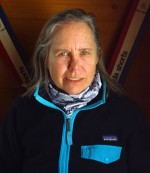
Correspondent John Nelson has skied with a 74-year old ski host at Big White in British Columbia who may fit the profile of the perfect senior skier.  Fit, retired, skis 120 days a season, works on a glorious ski hill, lives in snow country. Carlan Silha, the lucky guy, is the kind of all-year active senior that we admire and aspire to be. Meet him here.

Marc Liebman adds to his list of what to keep in your car for safety backup when you head to the snowy mountains. Does your car have any of this equipment? Consider the unexpected happens with unexpected regularity. Be prepared.

Finally, Utah’s Harriet Wallace discovers another hidden gem of a ski resort right in her back yard. Beaver Mountain, the “Beav”, lies in the opposite direction of the bigger Wasatch resorts.  As a result, she finds a charming area, comfy lodge, great terrain, and no crowds.  Virtual visit here.

We’re off to take advantage of some of that new snow up country.  We’ll report on what will be our first trip out this season.  Seriously.  Boot bag ready, skis sharpened, clothes about to be packed. Stay tuned.  New Hampshire here we come.

Thanks for reading SeniorsSkiing.com and please tell your friends.  Remember, there are more of us every day, and we aren’t going away.

Beaver Mountain, Utah. This is uncrowded. Nice.
Credit: Harriet Wallis


Editorial: Tools Of Empowerment

Why We Publish Skis And Boots For Seniors Recommendations.

We don’t know the numbers in other countries, but in the U.S. one-fifth of all skiers and boarders are 52 or older.

Based on reader surveys, we, as individuals, have more time, ski more often, and make more frequent equipment purchases than the kids.

Four years ago, when we started SeniorsSkiing.com, we set about to create a community of similarly aged people with a shared passion for playing in the snow. Then, as now, our goal was to provide you with information about the sport through the lens of the older participant.

Part of realizing that goal includes publishing the annual SeniorsSkiing.com Best Skis and Best Boots guides for older skiers. We like to think of these guides as—excuse the phrase—tools of empowerment: information you can use to assess the advice from sales personnel when shopping for your next pair.

Top equipment reviewers at realskiers.com and at America’s Best Bootfitters make the recommendations based on criteria relevant to older skiers.

In our experience, professional boot fitters are great at identifying the best product for your feet and your ability. But finding store personnel who can recommend the best skis for older skiers is a rarity.

During the recent SIA/OR show in Denver, we visited a ski company with more than one product on this season’s Best Skis for Senior Skiers list. Everything about the company’s products and personnel is oriented to youth. Yet, testers at realskiers.com determined some of its products would be good for the older set. The marketing people we met with were unaware their product had made the list and had difficulty envisioning their product being used by older skiers.

It made us realize that we seniors need to guide the conversation about what is best for us. It’s not coming from manufacturers, and, with the exception of professional boot fitters, it’s not coming from retail personnel. But armed with the knowledge that we at SeniorsSkiing.com are providing about the best skis and the best boots for seniors, it can come from you.

Jon Weisberg, Mike Maginn

Co-Publishers

This Week In SeniorsSkiing.com (Feb. 2)

Mid-Winter Is Here, Re-Discover Snowshoes, New Mystery Glimpse, Steamboat Museum, SeniorsSkiing.com’s Own Poem, Tribute To Warren Miller.

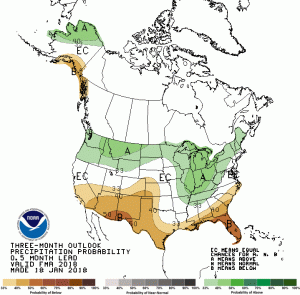
By Ground Hog’s Day, winter is half over. As we have noted before, you’d better have at least half your woodpile left.  At least that’s if the Ground Hog sees another six weeks of winter ahead.  It could be another six weeks of blah which is what we are wondering when we saw the latest Climate Prediction Center’s projection for February, March, and April. Precipitation chart (left) shows above average of water falling in the upper midwest and west and a drier band along the southern border. Temperature chart (right) shows below average temps in the upper midwest and west and not so much along the southern border and New England. Bottom line: Canadian Rockies, Montana, parts of Idaho, Washington are looking good. As with most predictions, don’t bet your 401k on the outcome. [Click on maps for more detail.]


This Week

We returned from the Outdoor Retailers and Ski Industries America combined trade show in Denver with lots of ideas for SeniorsSkiing.com.  The vendors and retailers we met knew about our online magazine for senior snowssport enthusiasts and were very supportive of what we are trying to do for our readers. That felt very rewarding, indeed.

While at the show, we happened to meet a young poet selling poetry from a little hut on 14th in downtown Denver.  Here’s the story and “Knees”, the poem he wrote for senior skiers.

We noticed that snowshoes and snowshoeing had a noticeably big presence at the show. So, the article about snowshoes from correspondent Jonathan Wiesel is timely.  Snowshoes have indeed come a long way, and snowshoeing is a very spouse-friendly way to enjoy the winter.

Our Mystery Glimpse this week asks you to identify an event rather than a person.  There were fewer guesses about the previous week’s tennis playing ski racer.  Turns out, she was not only an Olympian, but a great humanitarian as well.

We love museums that celebrate snow sports.  Correspondent Tamsin Venn stopped by a classic in Steamboat Springs on a recent trip. Here’s her report on the unusually named Thread Of Pioneers Museum with some interesting archival pictures.

Finally, we found a fitting tribute to Warren Miller, who left us last week. There isn’t a person we know of a certain age who hasn’t been affected by Warren Miller’s films.

Coming Up

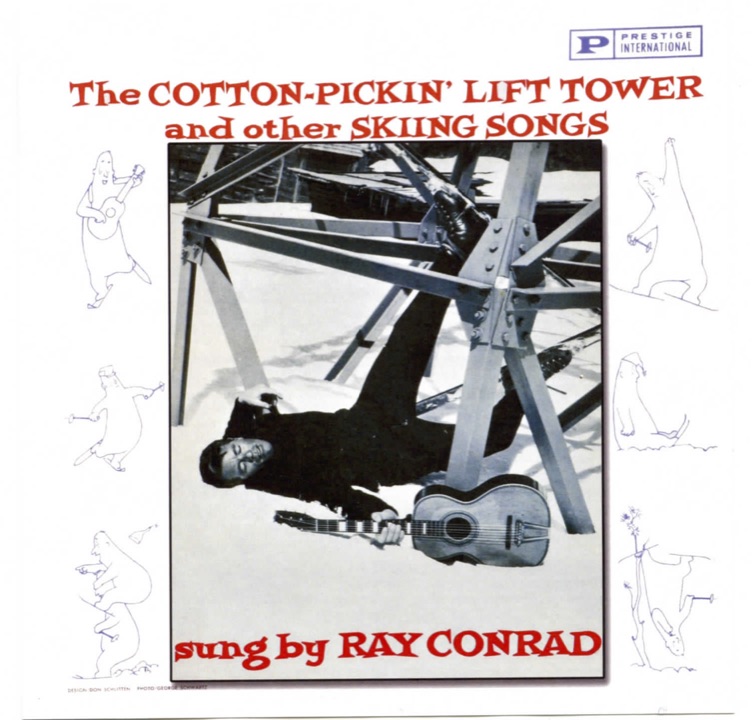
Next week, we’ll be exploring why you should consider taking XC lessons, more about what to put in the box in the back of your car, and other news.  Please note: We are working hard on our release of Ray Conrad’s The Cotton-Pickin’ Lift Tower.  We should be making that available to you very soon.

Thanks for reading SeniorsSkiing.com.  Tell your friends, and remember, there are more of us everyday and we aren’t going away.

Ski resort version of Ground Hog Day? Is the moose trying to tell us something?


Lovin’ Snowshoes

‘Shoes Have Come A Long Way.  Have You Looked Lately?

Old: Good for decorating rustic cabins.

Back in 1971, when I transferred winter affections from downhill to Nordic skiing (due to a spectacular fall in Austria that racked up one knee and stripped off my ski suit—but that’s another story), I also tried snowshoeing. After all, cross-country skis and snowshoes were both made of wood and quite beautiful; they’re both ways to travel over snow rather than wade through it; they’re both very low-impact sports.

But cross-country evolved into my lifelong true love, while snowshoeing became merely the affably boring cousin you contact every few years. Too much work; bindings were crappy (now you’re in, now you’re not—and your fingers are gonna freeze putting the damn things back on); ‘shoes didn’t slide like skis, except sideways downhill on crust; wood frames cracked; rodents enjoyed chewing the rawhide webbing in summer storage.

Modern snowshoes confirm the theory of evolution. They’re clearly descendants of the woodies but virtually a new species in design, materials, flotation, and fun.

I found this out one January about a dozen years ago, laying out ski trails at a resort in Montana. (Sadly, I hadn’t visited that cousin in almost 30 years.) The snow was too deep, buried underbrush and deadfall too catchy to use Nordic skis. So since slogging through waist-deep powder on foot was out of the question, what to do? Happily, intuition had suggested bring my new aluminum snowshoes along to test the frozen waters. They behaved magnificently, though I dumped a couple of times trying to back up, sinking the tails of the ‘shoes. (My style of absorbing knowledge always seems to be “education through error.”)

Modern: Light, durable, inexpensive. Credit: Tubbs

So what’s new about this next generation (or two – more on that shortly) of snowshoes? It may seem minor at first, but bindings have improved incredibly; they’re easy to use, they stay on, and they don’t stretch. The ‘shoes themselves are durable and have no food value to rodents, since they’re generally made with aluminum frames and synthetic decking that’s durable and gives great flotation.  That combination is light weight, so there’s less effort. The addition of bottom cleats gives you much better grip on crust and even side-hills, though it’s still smart to avoid those when possible.

What else? Modern models definitely aren’t as pretty, but it’s a trade off of aesthetics for dependability, longevity, and convenience.

Snowshoes are nowhere near as pricey as Alpine or even Nordic gear, but it’s still smart to rent before you buy to see if you like the sport. You can use hiking or snow boots with today’s adjustable bindings, or even sneakers with neoprene booties.

There’s a new kind of ‘shoe that came on the market this fall ago from Crescent Moon Snowshoes, a Colorado company. They’re made of foam (!) but from my destructive testing are not just light but also sturdy, incredibly maneuverable.  I backed up in them, did a 180 degree jump-turn for no good reason.  They have great binding and are setting the snowshoe industry on its butt.

There are a thousand more subtleties to fun snowshoeing—using poles, running vs. walking, clothing, etiquette, and the like. They’re mostly unimportant. Snowshoeing has become easy, and easy on your bones and joints. And even if you don’t glide, just repeat too yourself, “600+ calories per hour!”, enjoy the burn, and head for the dessert tray.

Most Modern: Foam ‘shoes from Crescent Moon.

Tread Of Pioneers: A Blast From the Past

Quaint Museum Reveals Steamboat Spring’s Rich History.

Ski Joring was the way to get around the valley when the snows came.
Credit TOP Museum

In 1947 an AP dispatch to 1,000 daily papers dubbed Steamboat Springs, Colo., “Ski Town, USA” with the declaration that of its 1,700 residents, 1,685 were skiers.

The others were children under the age of one.

Enthusiasm for skiing run deeps in this town. And you can learn all about it at The Tread of Pioneers Museum in downtown Steamboat. Native Utes, trappers, Yampa Valley settlers, ranchers, miners, farmers, cowboys, skiers, ski jumpers, snowboarders, outlaws, and lawmen, they all shared a part in the creation of this friendly town, sitting just below one of Colorado’s best loved ski resorts.

Famed Norwegian ski-jumper and circus star Carl Howelson arrived in 1913 and taught early residents of Steamboat Springs how to ski and ski jump. Suddenly, the valley’s ranchers were exploring the surrounding mountains on homemade wooden skis, school kids filled recess with downhill races, and locals became expert jumpers.

Billy Kidd, first American to medal in Alpine skiing, has lived in SBS since 1970. Here he is at 20.
Credit: TOP Museum

Favorite fact: Three Wire Winter is agricultural lingo used in the Yampa Valley to indicate that snow has reached the third strand of barbed wire on a four-strand fence, roughly 30 inches. A three-wire winter is just about right, with enough snowpack for spring run-off; more makes it difficult for feeding cattle in winter as well as damage to the barb-wire fences, according to Bill Fletcher, an Elk River Rancher.

The museum has an extensive historic photography collection, a few of which are included here. Go to the museum website to view and purchase online.

The museum is located downtown at 800 Oak Street. New exhibits this year include Staking Their Claim: Pioneer Settlement in the Yampa Valley highlighting early Yampa Valley settlers; Pioneer Kids Bedroom: Hands-on Discovery, letting kids dress up in historic clothes and play with antique toys; and A Legacy of Learning: Celebrating 50 Years of Colorado Mountain College and the Bud Werner Memorial Library exhibit, highlighting these two key local institutions; and the works of portrait and Native American photographer Edward S. Curtis.

The Museum Gift Shop has locally made jewelry, postcards, and photographs. Hours & Admission: Tues.-Sat. 11 a.m.-5 p.m. $6 for adults, $5 seniors over 62, $2 children ages 6-12, under 6 free.

The Harbor Hotel sleigh picked up skiers from the train depot and delivered them to the popular hotel at 7th and Lincoln, circa 1957.
Credit: TOP Museum

This Week In SeniorsSkiing.com (Jan. 26)

Off To The OR/SIA Show, Mystery Tennis Player, Questions To Find The Right Instructor, Pat’s Peak For Hobbits, A Very Successful Senior Ski Club.

SeniorsSkiing.com co-publishers are heading out from various starting points to the great, big Outdoor Retailer and Snow Show in Denver’s gigantic Colorado Convention Center. We will be there to look for stories, product ideas for our readers, and to meet and schmooze with some industry friends. Our objective is to embed the message that the senior snow sports demographic is an unpolished jewel and to promote our growing online magazine.

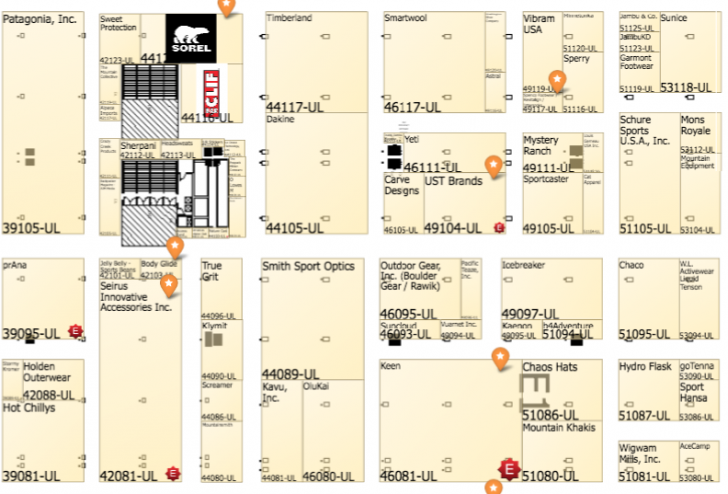
This trade show combines the OR Show with Ski Industries America (SIA), and it looks like a mammoth undertaking. The list of exhibitors goes from Adventure Travel to Yoga/Pilates with just about every other outdoor activity to can think of in between. This promises to be a learning experience for us with demos, educational seminars, fashion shows, and special exhibits all revolving around active life style products and services.  It’s a chance for vendors to show off their new products to buyers from retail organizations of all kinds and sizes.

We are extremely impressed with the level of planning and tools provided to exhibitors, buyers and media. There are tools to help filter exhibitors whose products/services you want to see, maps which plot those interest points, direct email channels to vendors and lots and lots of public relations communications from the thousands of vendors and show promoters.

The whole industry has come a long way from the crowded hotel corridors we remember from the venerable Doc Desroches SIA shows of yore. In fact, we remember meeting the great mountain climber Jim Whittaker, the first American to climb Mount Everest, at the SIA Show in Chicago in 1970. Yes, it was a narrow, crowded corridor, so narrow in fact that Jim decided to proceed down the passageway with his hands on one wall and his feet on the other. True story.  We also shook hands with a very sun tanned Stein Erickson at the Chicago show.  SIA was the ski industry trade show that rotated through New York, Chicago and LA shows for many years.

So, we are ready, we’ve planned who we want to see and what we’re looking for.  So wish us luck, and we’ll report on progress next week.

Ski The World: Audi Hires Candide Thovex To Ski On Anything

Here’s a commercial from Audi  Quattro that will get your attention.  The “Flying Frenchman” Candide Thovex, extreme athlete, stuntman, adventurer, completely rips it up on grass, sand, rock, you name it.  This is for those of you who are still awaiting a decent base out there. It’s worth the five minutes.

This Week

A new Mystery Glimpse appears with a challenging photo of a ski racing notable from yesteryear. Can you guess who she is? Thanks to the United States Ski & Snowboard Hall of Fame for contributing this week’s picture.

Only a few readers rose to last week’s stuffed animal challenge. See what significant event the rabbit, bear, and coyote represented.

Marc Liebman continues his advice on taking a ski lesson.  This week, he gives us five questions to ask an instructor before you sign up.  You may not be surprised to learn there is no universal, system-wide, standardized PSIA curriculum for teaching seniors. We know there are people who are very much interested in creating and promoting this idea. Seems like a long time coming.  If there was a senior-focused curriculum, we bet there would be more lapsed senior skiers coming back to snowsports of all kinds, not just Alpine skiing.

Sk clubs are a mecca for senior skiers.  In fact, you can find a ski club to join just by clicking through to the National Ski Council Federation.  Just click Find Ski Buddies Near You on the top menu box.  Correspondent John Farley brings us a report of a mountain-based ski club that sounds like it has a hardy mix of skiing and socializing.  They call themselves the Gray Wolves Ski Club, and they are based at Wolf Creek Ski Area in Colorado.  If you are looking for a model ski club to emulate, there are some ideas here for you.

Finally, correspondent Tamsin Venn shows us a really fine family-oriented ski area in New Hampshire that is the archetype senior-friendly area. Moderate-sized and modest facilities, Pat’s Peak has been a landmark since the early 60s.  And check out the retro-style base lodge.  What more do you really need, anyway?

That’s it.  We’re off to Denver. In fact, we’ll be there when you read this!  Thank you for reading SeniorsSkiing.com, and you know there are more of us every day, and we aren’t going away.


Mystery Glimpse: Tennis, Anyone?

She Also Skis Pretty Well.  Any Guesses?

This should be a challenge. No hints this time. Please write your response in COMMENTS below. Wild guesses welcome on this one.

Many thanks to the United States Ski & Snowboard Hall of Fame, Ishpeming, MI for providing this picture.

Credit: US Ski & Snowboard Hall of Fame

Last Week

Some funny responses to this one from last week.

These three stuffed creatures are the official mascots of the 2002 Salt Lake City Olympics.

Powder (rabbit), Coal (bear), and Copper (coyote) represent three resources which are abundant in Utah. They also symbolize the Olympic motto: Citius, Altius, Fortius, which is Latin for “Faster, Higher, Stronger.”

Not sure why a “Higher” is symbolized by a bear, or “Stronger” by a coyote.  We get the “Faster” for the rabbit.  Anyway…

Thanks again to the Alf Engen Ski Museum, Park City, UT. for the contribution.

Five Questions To Ask Before Taking A Lesson

If You Haven’t Taken A Lesson In A While, These Questions Can Reassure You Are Getting What You Need.

Last week, we listed five scenarios when you should consider taking a lesson. The next logical question is how do I figure out whether or not the ski school and/or the instructor can help me? The bad news is that there is not really a good answer. However, any senior skier considering taking a lesson should try to find the answers to the following five questions that are listed in no particular order. And, the great thing about being a senior skier is that we have the experience to evaluate the answers and separate the truth from the B.S.

  1. Are you certified? Right answer: Yes, I’m level 2 or Level 3.
  2. Have you taken a clinic on teaching senior skiers? Right answer: Yes. Here’s the caveat. The Professional Ski Instructors Association (PSIA) and the American Association of Snowboard Instructors (AASI) has not come out with a standard nationwide framework for teaching. Some of the PSIA/AASI regions have their own certification programs but most don’t. Among those that do, the content and rigor varies a lot.
  3. Does your ski school offer special instruction for senior skiers? Right answer: Yes. The problem is that there are precious few ski areas which do. There is a greater likelihood that you’ll find instructors who are senior skiers who have experience teaching their peers than ski areas who have specialized programs for seniors.
  4. How old are you (the instructor)? Right answer: I’m 50+. You want someone who can relate to you and who may share the same physical limitations and challenges facing all senior skiers. There are many instructors who have retired from the business world and work as ski instructors to stay active in the sport. Find them!
  5. How often do you teach senior skiers? Right answer: The best possible answer is, “I teach seniors all the time” or “I only teach seniors.” This is where your instinct comes in. If you get a BS answer, then you have a decision to make.

So those are the questions I suggest you ask. What else you can do in the way of due diligence and how you evaluate your answers is up to you.


SeniorsSkiing Guide: Pat’s Peak With Little Hobbits

And Grandparent Hobbitts, Too.

Hobbitts can be found at Pat’s Peak, New Hampshire
Credit: Tamsin Venn

Skiing with grandchildren is one of grandparents’ great joys and comes with perks: easier slopes, hot chocolate breaks, and slower (maybe) pace. Some ski areas are more finely tuned to multi-generational skiing than others, based not just on the amenities but the spirit of the area.

Pat’s Peak in Henniker, southern N.H., is one such place. The old-time vibe of this popular area is the first clue things are going to be fun. Tyrolean-style architecture harkens back to the days when Austria set the scene with boiled wool jackets and “bending the knees”. Greeters stand by with signs that say, “May I Help You?” which avoids the usual stumbling search for the lunch area and ticket booth. Free or low-cost tickets take the bite out of days shortened by tired or cold grandkids.

Three beginner areas sit apart from the main slopes so no one crashes into the grandchildren under your watch. One is located in a hobbit-like stand of trees with a carpet lift free to everyone. Another beginners’ slope has a handle tow, and the third features the Bluster Carpet, the longest magic carpet in New Hampshire. Older grandchildren will enjoy catching air in the three terrain parks. Grandparents, if you’re brave, try a Snowbike lesson/rental. You get to sit down while you’re skiing.

The base lodge harkens back to the early 60s, nostalgia for many seniors.
Credit: Tamsin Venn

A spirit of sustainability has guided Pat’s Peak development since the four Patenaude brothers, seeking an area closer to home, built the base lodge out of local timber and opened the area in 1963. That spirit continued this year when Pat’s Peak replaced the old Peak Double Chair with a triple bought from Vermont’s Ascutney Mountain and refurbished, doubling lift capacity from 800 to 1,600 people an hour.

Two interconnected lodges spread the crowds. Signs encourage you to share the long tables and benches. A blazing stone fireplace warms the toes. Food is homemade daily, and the grandkids like the M&M cookies the size of small Frisbees.

Sometimes it just comes down to the vibe of the place. Pat’s Peak feels like an area where you can let the kids loose to ski on their own while you attack the serious expert terrain.

More Perks:

Ski New Hampshire’s 4th and 5th Grade Passport: Children from any state in these grades ski for a day at 34 Alpine and XC ski areas across N.H.

January’s Learn to Ski and Snowboard month: $39 beginner special, including group lesson, rentals, lift ticket.

Pat’s Peak

Henniker, N.H.

Vertical: 770 feet

Skiable acres: 103

Runs: 28. Novice 50 %, Intermediate 21 %, Advanced 12 %, Expert 17 %

4 triple chairs, 2 double chairs, 1 J-bar, 1 beginner handle tow, 1 park handle tow, 2 carpet lifts

100 percent snowmaking

Children five and under ski free with a ticketed adult. Day tickets are discounted for ages 6-17 and over 65, only $49 on weekdays. The beginner lift is $26 a day. Saturday night POP (Pay One Price) of $49 includes skiing, snowboarding, snowtubing, rentals, lesson tips, and entertainment.

Click here for Pat’s Peak Trail Map

www.patspeak.com

Pat’s Peak Update Video


This Week In SeniorsSkiing.com (Jan. 19)

Book Review, Why Take A Lesson, Mystery Glimpse, 12 Tips and Tricks.

First, let’s look at what’s going on in Zermatt.

Zermatt has beaucoup de neige.

Yessir, folks.  If you want to find snow so far this winter, we suggest you head to 1) The Alps, 2) New England, 3) Canadian Rockies. Perhaps a handful of other places.  We know that Vail and Aspen are producing disappointing financial results, and Utah is depending on the snowmaking arts to add to the stingiest base in 30 years.  However, it is still early days and white winter can roll in any time, despite the odd profile of weather’s happenings, like snow in Florida. We will be watching.

Reminder: 2017-18 Ski and Boots For Seniors, 115 Ski Resorts Where Seniors Ski Free*

If you are a subscriber, you can access our ski and boot recommendations for seniors.  Just look under the Subscriber-Only Content box in the top menu OR under COMMUNITY in the blue menu.  Both resources are free to subscribers.  You’ll also find our book of Historic Ski Posters to download, including 115 ski resorts where seniors can ski for free (or almost free). Some resorts give such big discounts on senior tickets, (i.e., $15 for mid-week), they might as well be free. You can also sign up for a free subscription to SKI Magazine and a free online subscription to Ski History. 

Coming Soon: We Are Re-Releasing Ray Conrad’s Collection Of Ski Songs.

It has taken a while, but we are in the final stages of preparing to re-release Ray Conrad’s amusing and clever “The Cotton-Pickin’ Lift Tower And Other Ski Songs.”  Originally released in the 60s in LP form and again the 90s as a CD, these songs are hard to find these days.  They will be available for download purchase very soon.  Details to follow.

Why Do I Have To Re-enter My Name And Email?

Every so often, we get complaints from readers who have to re-enter their names and emails when they visit SeniorsSkiing.com.  The reason is often that the reader has disabled cookies on their browser.  Think of a cookie is a little automatic log on tool; it stores your log on information for specific sites.  If you disable it, no log on information.  Hence, you get the pop-up. Solution: Enable cookies on your browser.

You also might be trying to access SeniorsSkiing.com on a device that is different from the one you used to originally sign on with.  Again, that different device might not have the cookie that the log on is looking for.  Just sign on again and, if the browser is enabled for cookies, you are good to go.

This Week.

We have two articles that refer to technique and ski lessons.  Jan Brunvand offers a book review of Soft Skiing, by Lito Tejada-Flores, which explains the ski turn in simplest terms. As a senior skier, it is encouraging and clarifying to read his description of what the skis do to make a turn and how to initiate it. If you haven’t skied in a while or are much delayed in this particularly odd snow season, it might be a very refreshing view to take on board before you head out.

Meanwhile, correspondent Marc Liebman has been busy gathering the answer to the question posed to seniors: Why take a lesson?  We know that almost 30 percent of our readers do take a lesson during the season. Marc was curious as to why.  Here are the five big reasons he uncovered in his research.

Turns out our new Mystery Glimpse feature is quite popular.  Lots of readers took a shot at identifying the hot dog skier who was noodling on the slopes.  It shows how knowledgeable and experienced our readers are.  Even the wrong guesses were kind of interesting.  Check out this week’s MG.  Be advised: We think it’s not that easy.

Finally, correspondent Don Burch offers some life hack tips and tricks for skiing. Here’s one: Wipe silicone on your tips and boots to keep the snow off. We are sure our readers also have a collection of clever ideas for making the experience easier, safer, more fun.  Let us know.

OR SIA Show In Denver.

The publishers of SeniorsSkiing.com are heading to Denver next week to attend the combined Outdoor Recreation and Snowsports Industries America show.  We’ve been planning to visit specific vendors who have products our readers might find valuable.  If you have any recommendations about who to look up, please let us know.  It seems the entire outdoor activities world will be there.  The only thing missing is a company selling 40 foot sailboats.

Thanks for reading SeniorsSkiing.com.  We really are growing every day and we are not going away.

Mystery Glimpse: Stuffed Animals Are…What?

Okay, Here’s A Tougher One.

Clearly there are some knowledgable snow sports enthusiasts out there.  Based on your responses from the last few Mystery Glimpse photos, you not only knew the right answers, you added details about the people and the pictures. So this week, we’re posing a little more difficult puzzle.

Who are these stuffed creatures and what do they represent? If you know, respond in COMMENTS below the picture.

Credit: Alf Engen Ski Museum, Park City, UT

Last Week

This is the infamous Jet Turn or Avalement which made a brief flash in the early 70s. We learned it is also called the Slow Dog Noodle by at least a few responders.

Former SKI Magazine editor, founder of Snow Country and creator of NASTAR John Fry commented on this maneuver:

“Avalement is not a turn, and Killy despised it. It was a technique term invented by Georges Joubert, derived from the French ‘avaler’ to swallow. The skier swallows bumps and irregularities in the terrain by collapsing and extending legs. At one point in the process, the skier looks like he or she is sitting back. It was more suited to hotdogging than to effective technique in slalom or gs.

For more on Joubert and Killy, read my book, The Story of Modern Skiing.”

We believe the skier is Tom Leroy, a forerunner of freestyle and the first person to do a double forward somersault back in the 6os.


When Should A Senior Skier Take A Lesson?

Five Good Reasons To Join A Class.

A ski class practicing kick turns at Peckett’s-on-Sugar Hill, 1930s, where, for the first time, Americans could take lessons with skilled Austrian.
Credit: Concord Monitor

[Editor Note: In a SeniorsSkiing.com Survey, 30 percent of respondents revealed they took a lesson sometime during the season. Why? Correspondent Marc Liebman  found out five core reasons lessons might be a good idea.]

Back in the days when I was on the staff of Ski Magazine responsible for all its ski equipment and instruction articles, the most frequently asked question from readers was “When do I need to take a lesson?”

The question is a good , and the good consulting answer is “It depends….” After talking to several ski instructors and racking my brain as a former certified instructor, here’s a short list of conditions assuming you are not new to the sport and walking onto the slopes for the first time.

Keep in mind, Mother Nature didn’t have skiing 30,000 vertical feet a day down through waist high moguls when she created the aging process. As we age, despite our best efforts, we lose flexibility, muscle, and bone strength. In short, we’re more susceptible to injury. When we are hurt, it is usually more serious, and, even worse, it takes longer to heal.

So, you need to take a lesson…

  1. After you have a serious illness or a major injury or a joint replacement or it hurts when you ski. Why? You don’t know how what happened will affect your ability to turn, your balance or stamina. The lesson, assuming it is taught by a trained instructor, will help you figure this out.
  2. If you haven’t skied in awhile. Why? Two reasons. One, ski equipment has changed. The new short skis are easier to turn, generate less torque on your legs and more stable than the longer skis of yesterday. To ski them well, you have to adjust your technique. Two, while some may think skiing is like riding a bike, it is not. If you haven’t skied for awhile and your name is not Billy Kidd or Jean-Claude Killy, take a lesson!
  3. If you just bought new equipment. Why? Unless you were the first person to use a pair of demo skis, your new ones even though they are the same make and model, may ski differently than you remember for reasons beyond the scope of this article. So, to get the most out of your new skis, take a lesson!
  4. If you are planning to ski conditions with which you are not familiar. Why? If you have never skied waist deep powder, take lessons to learn how. Or, if you skied only in Utah or Colorado and suddenly find yourself living and skiing in Vermont, you need a lesson!
  5. To polish your skills. Why? Unless you are an expert and can ski any condition with aplomb and in perfect control, you need a lesson. The majority of skiers are “intermediates/advanced intermediates” so take a lesson. Even instructors go to clinics to polish their skiing (and teaching) skills.

So that’s the consensus five. I’m sure there are others. Net net, if you cannot ski any condition or trail on the mountain like an expert and without hesitation, then you need a lesson!

Ski School, Austria, circa, 1930s.

12 Tips And Tricks For Skiing And SnowSports

Clever Hacks For A Better Winter Experience.

Nevertheless, she’s having fun by using Don Burch’s tips and tricks.

  1. When skiing wet and slushy snow, spray the top of your skis and even your ski boots with silicone (wipe it off after spraying). The faster heavy snow slides off skis, the easier it’ll be to make turns.
  2. Toe warmers work better in gloves than hand warmers. Use the sticky back on toe warmers and attach them to the backhand side of your gloves. If you’ve used hand warmers, you know they have a tendency to fall out when you take your gloves off.
  3. When skiing groomers, especially hardpack, wider skis put more stress on knees because they require more angulation to get them on edge.
  4. Skis with softer tips puts less stress on skiers’ knees.
  5. When purchasing used skis, make sure the bindings aren’t so old that ski shops won’t service them. A Google search with the words “Binding Indemnification List” will provide you with an up-to-date list of acceptable bindings. Better yet, ask your local ski shop if they’ll service them.
  6. Don’t use lens wipes on the inside of your goggles. Most goggles have anti-fog on the inside and wiping it may cause damage.
  7. On crowded days, the single line will almost always be faster even when skiing in groups. Lifts that don’t start at the main lodge are also good bets on crowded days.
  8. Always stop on the side of trails where you can be seen by uphill skiers. Look up hill before starting. Wear a helmet and make sure it is strapped.
  9. Thoroughly dry your boots each day after skiing especially if skiing back-to-back days. If your boots are the least bit damp, your feet will be cold. I use a dedicated boot dryer.
  10. If you want to demo skis, do it at a mountain where you can try several during the day. On less crowded days, you’ll get a much better selection and won’t have to wait for the model or size you want to try. Select a day that will have varied conditions on the mountain; this way you can try the skis on both hard pack and softer snow. Within a specified time period, many shops will apply the cost of the demo to a pair of new skis; ask about their policy.
  11. If you plan on sharing skis, consider getting demo bindings. These bindings can be adjusted to fit about any size ski boot without needing to remount the binding.
  12. In a pinch, you can use a plastic card from your wallet to clear sleet from goggles.

If you have any tips that work for you please share them with other readers in the comments section.


This Week In SeniorsSkiing.com (Jan. 12)

Snow In Odd Places, SKI AREA MANAGEMENT Article,  Next Mystery, Survival Kit Advice, Wheaties And The Olympics, Snow Poetry, 60s Ski Songs, Stupid Questions.

Okay, this is shaping up to be a strange season. There’s this in the Alps:

Rescuers digging through 7 m of snow to reach stranded Zermatt guests.
Credit: Alain Duclos

Avalanches, isolated villages, impossible skiing conditions are causing havoc. The snow is frankly unbelievable. Here’s the story.

Meanwhile, in the Sahara Desert, we have snow.  That’s snow in the desert. Here’s more from Snowbrains.com. 

On January 7, snow fell on one of the hottest deserts on earth, the Sahara Desert.
Credit: Karim Brouchetata/ Geoff Robinson

And Utah and Colorado are still waiting for some significant snowfall which is reportedly coming this weekend.

Why mention this? The atmosphere is changing, and the snowsports businesses and enthusiasts should notice. Perhaps we should all be taking notice.

SeniorsSkiing.com Correspondent Publishes In SKI AREA MANAGEMENT

We congratulate correspondent Marc Liebman for publishing A Wise Target Market”, a comprehensive article on the senior skier market in Ski Area Management, an industry trade magazine read by resort operators and marketing people.  His premise is that instead of treating the senior demographic as an after thought, the industry should embrace this segment.  That’s been the SeniorsSkiing.com mantra since we started this online magazine four and a half years ago.  Bravo Zulu, Marc.  Here’s a link to the story.


This Week

This week, we reveal the name of the grouchy ski racer from our Mystery Glimpse and offer another puzzle to solve. This time it’s naming the name of a long-ago ski turn.

Correspondent Marc Liebman also offers some important advice on what to put in a survival kit for those long winter drives through the back country.

We also hear a fascinating story from Harriet Wallis about what kept Alf Engen, the world’s most successful ski jumper, from the 1936 Olympics. It has to do with breakfast cereal.

We offer a snow poem by Wallace Stevens for those who appreciate occasional touches of literature in our pages.  Let us know what you think about The Snow Man; we’re always looking for more Snow In Literature references.

COMING SOON! Ski Songs From Ray Conrad.

And SeniorsSkiing.com is also proud to announce that we are getting very close to offering an album of skiing songs from the 60s by Ray Conrad.

Stay tuned; you’ll soon learn how you can order and download 16 songs from his famous album, The Cotton-Pickin’ Lift Tower and Other Songs.

Ray has agreed to make this CD available to readers of SeniorsSkiing.com. He is thrilled that so many subscribers reacted positively to some earlier articles on ski songs of the 60s and that the music lives on.

Finally, Harriet Wallis offers her insights into the four most stupid questions a skier can ask.  Have you asked one of them? Find out.

Thanks for reading SeniorsSkiing.com.  Please send comments, story ideas, pictures, videos. And please tell your friends about us.  There are more of us every day, and we aren’t going away.


The Box In The Back

When You Need “The Box” For Survival, You Really Need It.

This can happen. If it does, you’ll be glad you have the “Box.”

Most people think driving to a ski area is a routine trip. Before they leave, they check and recheck what they think are the most important items—ski equipment. That’s not the only “equipment” you should bring.

Back in the good old days when the back seats of our all wheel drive van or SUV had two kids, ski gear and luggage went in first. Followed by what my daughter dubbed at age eight—“The Box.”

Mandated clothing for everyone was jeans, boots, long sleeve shirt or turtleneck, and, if they wanted, a sweater. In our ski jackets that were always an easy reach in case we had to leave the car in a hurry, we stuffed our gloves in one sleeve and a ski hat in the other. The boots stayed on at all times.

Why? “Because”… It’s a good parental answer because in this case, just “because” is true.

Anytime you head off to the mountains, you need to think about survival. Black ice, mechanical failure, an accident up ahead that halts traffic for hours, or worse, you get into an accident can turn a pleasure trip into a nightmare. BS, you think, I’m one of those who think the glass is always half empt

Au contraire. Enter “The Box” in the back. Actually, it wasn’t a box. It was and still is a medium size tool box. It contains a hatchet, survival knife, a multi-tool,  small bricks of fire starter, matches in a sturdy waterproof container, six thermal blankets,  a hundred feet of rope, a first aid kit complete with ace bandages to make a splint, tweezers, a scalpel with the blades still in the sterile packages,  hydrogen peroxide and isopropyl alcohol in sturdy plastic bottles. And, when they became available, eight MREs (Meals Ready To Eat).  Lashed to “The Box” by four bungee cords were two lightweight shelter halves. Also in the back were two gallons of water either in twenty ounce bottles or large jugs. All this is wedged in the back so if we got into an accident, it wouldn’t fly around. Under the luggage, I carried a snow shovel!

You’re thinking, this guy is nuts! Well, have you ever driven the road between Mojave and Lone Pine, CA? If you haven’t, you’re on the western edge of the Mojave Desert and not much of anything else. I-40 between Amarillo to Albuquerque is arid, and there isn’t a soul for miles. I-91 through Vermont or I-93 through New Hampshire can get really lonely at 11 at night with a broken car in the middle of a snowstorm. On any one of these roads (and many others), you can slide off into the gullies and not be seen from the road.

It can get lonely out there, worse if you’re not prepared.

Don’t think your car will be your lifeboat. If you’re in an accident, the engine may not run or worse. Sitting in an idling car puts you at risk of dying from carbon monoxide. The car is designed to dissipate heat, not retain it!

If you are stuck a long way from the nearest gas station, and do not know how long you are going to be stuck, stay with the car.  Don’t use it for a source of heat unless it is well vented. Heat rises so it goes out the windows very quickly.  If you are on a road, get something or someone on the road to stop whatever traffic comes by. Don’t set off for help unless the weather is clear, and then take your survival stuff with you.  In today’s world, a working fulling charged mobile phone is your best friend.  Small, solar-powered rechargers might be wise to carry in your glove box.

My point in all this is every year, people get stuck alongside the road and the news stories all involve hunger, exposure, frostbite, hospitalization, etc. Don’t be one. Create and carry your own box and be prepared. It’s insurance and you never know when you’ll need it. Not having it could ruin your day.

How Wheaties Affected The 1936 Olympics

The Breakfast of Champions Kept Champion Ski Jumper Alf Engen From Competing.

Wheaties Ad 1936, Courtesy of Alan Engen

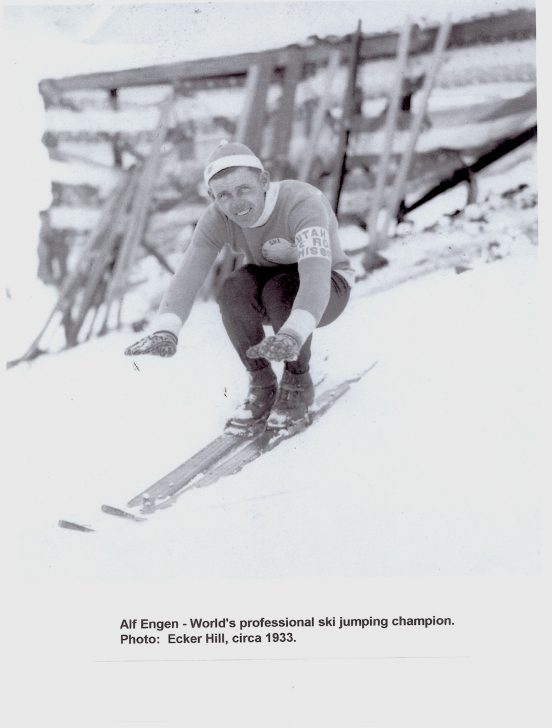
Legendary extreme athlete Alf Engen, known as the greatest all-around skier ever, was a champion soccer player, skier and ski jumper. During the 1930s, he set ski jumping world records. He helped design and establish more than 30 ski areas in the western United States. And he’s fondly remembered for pioneering deep powder skiing techniques and for his ski school at Alta.

But world champion Alf Engen was banned from competing in the 1936 Olympics because of a Wheaties breakfast cereal box.

It was just the fourth time that countries faced off against each other in wintertime Olympics. Competition included just four sports: bobsleigh, ice hockey, skating, and skiing. Twenty eight countries sent their best athletes to the IV Olympic Winter Games.

As background, Engen came from Norway to the United States in the 1920s, and he played professional soccer. By the 1930s, he was acclaimed for his ski jumping feats, he joined a ski jumping team, and he soon won 16 national ski jumping titles. And his jumps set world records. He also won national titles in all four ski disciplines: ski jumping, cross country, downhill, and slalom skiing.

Alf circa 1933, Courtesy of Alan Engen

Also in the 1930s, radio was the mass media communication method of the era. There was no television. People used their imaginations to create pictures from the words they heard.

But another form of mass media was taking hold: cereal boxes. Until then, breakfast cereal had to be cooked, but when food manufacturers invented cereal that could be eaten right from the box, they faced a marketing dilemma. How could they convince families to switch from cooked cereal to this newfangled ready-to-eat cereal? A cereal box sitting on the breakfast table with pictures of all-star athletes would be the marketing device. And unlike radio, the images were right there on the box.

Four athletes appeared on the Wheaties box—Bob Kessler, basketball star; Mike Karakas, champion hockey player with the Chicago Blackhawks; women’s speed skating champion Kit Klein; and famed skier Alf Engen.

Meanwhile, Engen became an American citizen. In 1935, at the U. S. Olympic Ski Jumping Finals held at classic Ecker Hill, he out-jumped everyone. He was immediately named as a member of the U.S. Winter Olympic Ski Jumping Team which would compete in the 1936 Winter Games in Garmisch-Partenkirchen, Germany.

But just before he was scheduled to leave, Avery Brundage, president of the International Olympic Committee and a zealous supporter of amateurism, ousted Engen from the team because his picture had appeared on the Wheaties box. He declared that Engen’s image on the cereal box made him a professional, not an amateur athlete.

“Engen said he didn’t remember getting any money from the cereal company, ‘Just a lot of Wheaties. I think I gave everyone in Salt Lake City free Wheaties.'”

Alf with trophies, courtesy of Alan Engen

Ironically, shortly after the Olympics, Engen jumped against—and he beat—both the gold and silver medalists from the Olympic Games, Norwegian gold medalist Birger Ruud and Swedish silver medalist Sven Eriksson.

The remarkable skiing Engen family is the only family to have four family member in the U.S. Ski and Snowboard Hall of Fame: Alf, his two brothers Sverre and Corey, and his son Alan.

Alan lives on in his father’s tradition. He’s a champion skier and athlete as well as an accomplished scholar, author, and historian. He carries on the Engen tradition of serving the skiing community.

Alan dreamed of displaying hundreds of Alf’s ski trophies and memorabilia for the public. The dream grew into the $10.5 million Alf Engen Ski Museum at the Olympic Park in Park City, Utah. Visitors can also learn about avalanches, sit in a real bobsled, try their knack at interactive ski jumping, and more. The museum was funded entirely by private donations, including donations from Utah’s famed and philanthropic Quinney and Eccles families. Visit and enjoy the museum when you’re in Utah.

To read more from Harriet, click here for her stories on SkiUtah.

Alf in flight, circa 1936, courtesy Alan Engen



Skiing In Literature: The Snow Man

The Snow Man By Wallace Stevens

One must have a mind of winter
To regard the frost and the boughs
Of the pine-trees crusted in snow;
And have been cold a long time
To behold the junipers shagged with ices,
The spruces rough in the distant glitter
Of the January sun; and not to think
Of any misery in the sound of the wind,
In the sound of a few leaves,
Which is the sound of the land
Full of the same wind
That is blowing in the same bare place
For the listener, who listens in the snow,
And, nothing himself, beholds
Nothing that is not there and nothing that is.
Ray Conrad Cover

Coming Soon: Ski Songs From The 60s

Stay Tuned.

We’re close to announcing a fantastic opportunity to download Ray Conrad’s classic ski songs.  You asked for them; we got them.

COMING SOON! Ski Songs From Ray Conrad.


Four Stupid Things You’ll Hear Skiers Say

Make A New Year’s Resolution To Avoid Saying These Things. Here Are Tips To Help.

Don’t be a scare crow skier.
Credit: Harriet Wallis

The Scare Crow Skier. I know a skier who is so stiff he looks like a scarecrow with a pole up his back. Nothing moves. Nothing flexes. His ski poles hang down and drag behind.

“I’m practicing,” he says. “I’ll take a lesson when I get good enough.”

Vince Lombardi had it right: “Practice does not make perfect. Perfect practice makes perfect.”

Even good skiers get stuck in a rut, says Tim Wolfgram, director of Snowsports Services at Solitude Snowsports Academy. Take a lesson, brush up skills, and you’ll have more fun.

The Vintage Equipment Skier. “My skis are 20 years old,” says another skier. “I’d try new equipment if I enjoyed skiing more.”

Technology marches on. Current skis have so much nifty technology built into them that updated skis make skiing much easier.

Many resorts have demo days throughout the season, and you can try skis right there at no cost. All you have to do is show some identification. It’s a great way to try what’s new. You might find skis you really like. Check on when demo days are scheduled at your favorite resort.

The Willy-Nilly Skier. This man grew up in a European village where skiing was a way of life. Then gave it up for many years. Recently, he got back into the sport, and he bought skis willy-nilly off a used equipment rack.

Now he whines: “These skis are terrible. I wasted my money. They won’t go straight.”

His expert, old school technique is incompatible with the ultra-shaped, learner-type skis he grabbed and bought.

There’s nothing wrong with buying used equipment. Most reputable ski shops will give honest advice about what skis you might like—whether new or used—even if you don’t buy there.

The Tuneless Skier. “Don’t wax my skis. I don’t want to go fast,” say many skiers, especially women. But it’s a misconception that taking care of your skis will turn you into an Olympic racer.

“Tuned and waxed skis slide and turn more easily. And you won’t get as tired because they won’t use as much energy,” said Brayden Morgan, head of rentals at Alta Ski Shop.

Many shops will inspect skis and give a no-cost assessment of what needs to be done. Often, skis just need to be waxed. Or, if they haven’t been tuned or waxed for a long time, they might need more work, said Brett Pergrossi, rental manager at Snowbird. “It’s all about safety and the quality of turns.”

To read more from Harriet click here for her stories on SkiUtah.


This Week In SeniorsSkiing.com (Jan. 5)

Undergoing Bombogenesis, Next Mystery Glimpse, Cold Wx Tips, X-C Apparel, Jon’s Midget Memory.

We write this in haste, lest the power snap off before we can file before SeniorsSkiing.com’s deadline.

New England and most of the East Coast, are in the midst of a monster “Cyclone Bomb”, as the meteorologists are calling it, or “Bombogenesis”, an even scarier name. Fast-moving, majorly deep atmospheric pressure, big winds and snow.  You might say, well, that’s great for snow sports.  True, but the minus-zero degree cold and wind chill that has been stalling outdoor activity of all sorts in the region for the past week will go on at least for another week.

That dramatic cold has actually kept skiers off the slopes in many eastern resorts, despite excellent conditions. Looking ahead, there is more extreme cold in the forecast.  The good news is it cold, not marginal or even mild temps being experienced in other snow country places.  We hear that some California resorts are doing well, others still waiting.  The Rockies has had winds, fluctuating temps. Utah would like more snow. On the other hand, the Northwest has snow, thanks to some monster storms before New Years. By the way, this pattern is what was predicted by forecasters as a result of the La Nina, seasoned with an awesome dip in the jet stream.

This Week

This week, we have our next Mystery Glimpse.  See if you can recognize the frowning fellow in the picture, and offer your guess in the COMMENTS below.  We’ll tell you who it is next week.  By the way, last week’s Mystery was Picabo Street, the gold medalist at the 1998 Nagano Olympics.

Correspondent Tamsin Venn ventured very bravely up to Stowe Mountain Resort over the holidays. She returned with some advice for seniors in dealing with very cold conditions. Recommended reading.

Co-Publisher Jon Weisberg offers a personal anecdote about what happened to him when his MG Midget was disabled, and he had to get a ride from two pretty girls. That wasn’t yesterday, by the way.  It was way back when.

Finally, Roger Lohr, who publishes XCSkiResorts.com, gives some advice on choosing Nordic ski apparel, based on his personal preferences.

Coming Soon: Ski Songs From Ray Conrad

In the past, we’ve published a couple of articles about ski songs of the 70s and from Ray Conrad in particular. Click here and here to check them out.  He wrote an album’s worth of satirical, funny, witty, and remarkably observant songs about what the ski culture was like back in the early-mid-60s.

Over the past few months, we’ve worked with Ray to offer his music through SeniorsSkiing.com.  Pretty soon, you will be able to download Ray’s entire album,  The Cotton Pickin’ Lift Tower and Other Skiing Songs. It includes favorites like A Skier’s Daydream, The Ski Instructor, Two Cubes and a Slug of VO, and more.

We’ll let you know when the download will be ready. Stay tuned.

Meanwhile, Happy New Year and remember folks, there are more of us every day and we aren’t going away!

COMING SOON! Ski Songs From Ray Conrad.

Mystery Glimpse: Who’s This Unhappy Fella?

Our Next Mystery Photo Is Someone Who Became A Ski Celebrity.

If you think you know who you think this guy is, write your guess in COMMENTS below, just scoll down. We’ll reveal the answer next week.

Credit: SKIING Magazine

Last Week’s Mystery Glimpse 

This is Olympian Picabo Street as a young racer.  Thanks to the Alf Engen Ski Museum in Ogden, UT, for picking this out of its archives for us.

Picabo Street is an American former World Cup alpine ski racer and Olympic gold medalist. She won the super G at the 1998 Winter Olympics in Nagano and the downhill at the 1996 World Championships, along with three other Olympic and World Championship medals.  She was also a heart throb for a lot of men and boys who followed her during her competition. [Wikipedia]

We remember a news clip from coverage of one of her Olympic races. It said that in the midst of a medal run, she gave herself some encouragement by saying,”Come on, come on, come on.” That mantra stuck with us as a useful way to kick oneself into another gear whenever circumstances seem to warrant. She became an inspiration to hundreds of young women ski racers. Thanks, Picabo.