Tag Archive for: 50+

Best Time to Buy Senior Ski Passes is Now

The Deals Are Out There.  Time To Act.

Mike “Bear Trap” Warner is a former ski instructor committed to finding discounts for seniors.

[Editor Note: Mike “Bear Foot” Warner produces SeniorsSkiDeals.com which publishes the prices of top ski resorts and offers advice on where to find the best discounts and when to buy.] 

If you are a senior skier and are planning to ski over a week this winter, you might want to consider buying a season pass. The ski resorts’ season passes  listed here are worth buying if you plan on skiing four or five days at one area. Telluride 70+ Season Pass is $900 while Aspen is $499. With daily lift tickets at $114 on a week’s ski trip you would buy the pass in Aspen but not at Telluride. There is also insurance available for your pass if you need to cancel your trip.

When Alex Cushing owned Squaw Valley, kids up to 12 and seniors 65 and over skied for free. His thinking was the kids would love the sport and come back for 60 years, and the seniors were being rewarded for a lifetime of lift tickets. Now seniors are a profit center for most resorts. An article appeared in Huffington Post in 2015 of 108 ski area’s with free lift tickets for seniors. This year of the 100 top rated ski resorts from ZRankings.com only four offer free skiing for 70+ skiers.

There are a number of ski areas that still offer very good senior season pass rates. Below is a list of the resorts that still offer real deals to 65+ or 70+ senior skiers. These resorts make it worthwhile to buy their pass if you plan to ski there five days or more.

Eastern skiers will be surprised, or already know, that there is only one good deal offered out of the top ranked 17 ski resorts. Out of the top 11 Canadian ski resorts, again only one deal is posted. An example is Killington’s senior pass 65-79 costs $659. The online daily lift ticket is $70. So you’re better off buying lift tickets if you ski nine days or less there.

California:

Heavenly Valley 65+ Epic Value Pass $389

Also good discounts with restrictions at Northstar and Kirkwood.

Homewood 62-69 $349

Diamond Peak 65-69 $169

Mammouth: 65-79 $499

Also good discounts at June, Bear Valley, Snow Summit

Utah

Sundance 65+ $150

Beaver Mountain 70+ $100

Eagle Point 62-69 $ 239  70+ $199

Idaho

Bogus Basin 70+ $229

Tamarack 70+ $199

Colorado

Aspen 70+ $499

Winter Park 60-69 $ 429 70+ $339

Loveland 60-69 $ 399 70+ $99

Copper Mountain 65+ $319

Wolf Creek 65+ $323

Also good discounts at Snowmass, Buttermilk, and Highlands

Montana

Whitefish Mountain 70+ Free

Oregon

Timberline 65-70 $ 169 71+ Free

Mt. Hood Ski Bowl 65-70 $ 149  71+ Free

Washington

Mt. Baker 70+ $ 125

Stevens Pass 70+ $ 99

White Pass 73+ $ 20

Vermont

Smugglers Notch Resort 70+ $29

British Columbia

White Water 70+ Free

Cycling Series: Update On “Arthritis Proof” Never Flat Bicycle Tires

I’ve Learned A Lot And Here Are The Lessons.

Find out what Harriet thought about these tubeless, foam-filled tires. Credit: Harriet Wallis

If your hands are arthritic, you know how hard it is get a tire back on the rim after fixing a flat. Lightweight Tannus tubeless foam tires were recently introduced into the U.S., and I was quick to buy a set. They don’t take a tube, and since they are filled with foam, they can never get a flat. Never. And they’re good for 5,000 miles. That seemed to be the perfect solution for my hands.

I had them installed just before a charity ride in the cool weather of early June. They rode wonderfully. They were the cat’s meow.

But as summer temperatures heated the road surface, the road softened the tires, and they became sluggish. The hotter the day, the slower they rode. Hot weather riding and hill climbing became work. Dang!

I think the lightweight, solid foam, Tannus tubeless tires live up to their reputation that they can never get a flat. My tires picked up several of those dreaded goat head thorns. I pulled them out and rode on. No problem. No flat. I think casual riders and commuters who face road debris will enjoy them. And they come in 12 lively colors.

But for me, it was time to move on and find another “arthritis proof” bicycle tire. Stay tuned for my review of the Bontrager brand tubeless tire-wheel system.

To read more from Harriet click here for her stories on SkiUtah.


This Week In SeniorsSkiing.com (Sept. 15)

Down Under Snow Reports, Experticity Update, Early Winter Forecast.

A unique arrangement: No lifts at Charlotte Pass in Australia, just a 30-minute Sno-Cat Ride each way to the slopes.
Credit: Bernie Weichsel

While we start thinking about buying season passes, contemplating new boots, and enjoying the last of summer activities (btw: great sailing in New England these days), the snows of Australia have been falling mightily.

We have two reports from the land of Down Under.  One focuses on the massive amounts of snow currently covering the ski hills of Victoria and New South Wales, Australia. Folks, it’s yet another weather phenomenon; it’s the most snow in a decade. Thanks to Snowbrains.com for bring this to our attention.

The second report comes from Ski and Snowboard Show Impresario and SeniorsSkiing.com advisory council member Bernie Weichsel who has just returned from a three-week trip to New Zealand and Australia.  His report is a really interesting guide to some of the most popular ski hills in those countries as well as some differences in how resorts are run done down there. Thanks, Bernie.

Last week, we published an update on the new Experticity application process for our subscribers. We are publishing it again because we know that right now and the next few weeks are the start of the equipment and clothing buying season. The discount policy offered to our subscribers is different than before, and it requires that a subscriber demonstrate some type of “professional” connection to the ski industry. There’s contact information for Experticity if you have questions.

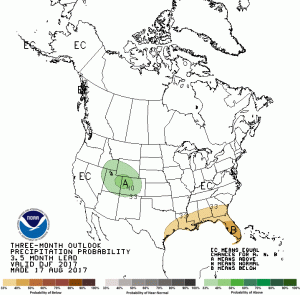
Meanwhile, the National Weather Service Climate Prediction Center has published its early winter forecast. Here are the late-fall, early winter maps from the NWS.

Precipitation forecast: Sept-Nov 2017

Temperature forecast: Sept-Nov 2017


So, above average precip in the Rockies and Wasatch, a drier Florida, and/but above average temps radiating out from Arizona. However, do not place your bets yet.  We also hear from the folks who monitor the El Nino Southern Oscillation (ENSO) that the waters off western Peru are “neutral”, not too hot, not too cold.  Since the ENSO drives a lot of the weather in North America and around the world, having a neutral ENSO makes the forecast much more difficult to predict.  Again, these predictions are merely placeholders in an ongoing story.  We will be watching and will let you know what evolves.

Thanks for subscribing to SeniorsSkiing.com.  We very much appreciate your presence and your input.  If you’re interested in a free and wonderful 3″ x 3″ SeniorsSkiing.com sticker, please send a self-addressed, stamped envelope to: SeniorsSkiing.com, Box 416, Hamilton, MA 01936.

And remember, there are more of us every day and we aren’t going away.

Oz And EnZed: Skiing The Antipodes

Ski And Snowboard Show Impresario Bernie Weichsel Reports On The Down Under Scene.

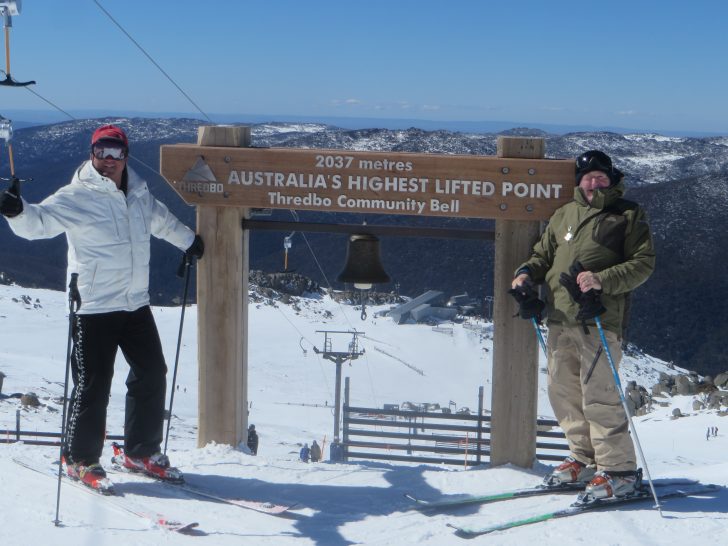
Bernie (r) at Thredbo’s highest lift.
Credit: Bernie Weichsel

For most of us in the international ski community, whether here in the US and Canada, or within the Alpine countries of Europe, there is good news to be found in Australia and, to a lesser degree, New Zealand. Over the past three weeks, I had the opportunity to visit a number of ski areas in New Zealand’s South Island and in Australia’s states of Victoria and New South Walks. I skied at the four areas around Queenstown and Wanaka (The Remarkables, Coronet Peak, Cardrona and Treble Cone and in Victoria (Mt Buller and Falls Creek) and New South Wales (Skiing at Perisher, Thredbo, and the unique Charlottes Pass. I am glad to report in both countries skiing, and, in contrast to the US at least, snowboarding, too, seemed to not only being doing well, but to be thriving.

Skiing The Remarkables, Queenstown, NZ. Anyone notice any hobbits?
Credit: Bernie Weichsel

New Zealand areas’ growth seemed to be coming from visitors from Asia. There were loads of Chinese and Koreans, plus a lot of athletes from Northern Hemisphere countries taking advantage of the snow to prepare for the upcoming Olympics, including Lyndsey Vonn among other US athletes.

But it was in Australia where the growth in the local market was most evident. All the resorts I visited were crowed with families and students, and it wasn’t even vacation time. Resort management all said that they were witnessing growing interest and participation in SnowSports which might be the only SnowSports market in the world where that can be said!

One effort that is propelling growth is a program called Inter-School, a regional wide, multi-discipline, competitive program with local races that lead to regional events and ends in a National Championship. The regional event I saw at Mt Buller—the Victorian State Championships—had 6,000 participants, in many cases, with their parents on hand for a whole week. I am not aware of a similar program in our country. I presume the best analogy is an NCAA program but for High Schools. We all know how school programs for soccer, football, etc. dominate American youths’ time and keeps them—and their families—away from the slopes. Maybe the Australians have found something for us to think about!

All the resorts had decent facilities—from lifts, snow-making and day lodges—and pretty good grooming. New Zealand, for us spoiled North Americans, is a bit of a challenge since there is virtually no on-snow lodging. Most of the lodging is in Queenstown and Wanaka, where it almost never snows;  to get to the skiing you must drive with chains always at the ready in your “boot”—or take a bus.

Weather is also a consideration in New Zealand since all the skiing is above timberline, leading  to some serious white-outs when the clouds hang low, which is often.  But the snow quality is good, the runs decently long— think Northern New England. When it is clear, you can see some of the most stunning scenery anywhere.

Australia, on the other hand, has lodging right on the mountains making it possible to ski in, ski-out. However, the mountains are not as high as New Zealands’ and are wider rather than high, that is, many runs over a number of hills.  That is, except for Thredbo which has a vertical of about 2,000 ft. What really intrigued me was how popular skiing was given that in Australia, there were many road-blocks one has to overcome to get the mountains.  You have to pay an entry fee to enter the Park; all the ski resorts are in state or national parks, you have to pay to park and again pay for a snow taxi to take you to your lodging—not in all resorts but the majority.  And lodging isn’t cheap. The resorts, though, have copied—or might have pioneered—the idea of expensive day tickets versus reasonable priced season pass.

Usually, so I was told, New Zealand gets the better snow.  But, during my visit, it was the opposite: I had basically spring skiing in New Zealand and super mid-winter conditions in Australia—packed powder and blue-bird days. And recently Australia’s resorts have had some of the biggest snow dumps in almost two decades!

One oddity worth noting. The small area near Perisher, Charlottes Pass, might be —I can’t think of any other resort that can only be accessed—in and out—by Sno-Cat . It’s a 30-minute ride each way. Nice, but small skiing, once you get there,  and it’s pretty private and worth the effort.

A unique arrangement: No lifts at Charlotte Pass, just a 30-minute Sno-Cat Ride each way to the slopes.
Credit: Bernie Weichsel

Update: Change In Gear/Clothing Discounts From Experticity

There’s Been A Big Change In How SeniorsSkiing.Com Subscribers Can Access Discounts From Experticity.

When SeniorsSkiing.com was launched, we made an arrangement with Promotive.com to offer discounts to our readers.  There was no cost involved, readers who subscribed signed up with Promotive using a code provided and enjoyed the same kind of discounts offered to professional racers, teams, coaches, instructors, etc.

Promotive merged with Experticity, another discount gateway website. Experticity promises the vendors that list their products on its site that people who have access are bona fide members of a professional group of some kind to earn the offered discounts. When Experticity looked at our list of subscribers, they had no way to tell who was a pro and who was a committed amateur without industry standing.  So, the rules of access to Experticity have changed.

If you are already signed up with Experticity, you will still have access to the site up to the anniversary date of your initial sign up.  After your anniversary date of your sign up passes, you will be asked to re-apply using the application process below.

If you are new to SeniorsSkiing.com and are signing up with Experticity for the first time, you have to follow the new application process.

The new application process requires you to enter the code provided by Experticity which you can find in our Subscriber-Only Content area under Community in the top blue menu. You will be asked to complete a questionnaire and verify your status by submitting some type of evidence.

Here’s the application form.

If you have any questions about any of this, please call Experticity at 866-376-4685 or email at member.support@experticity.com.

Mount Washington

This Week In SeniorsSkiing.Com (Sept. 1)

Long-Awaited Experticity Update, Hiking Caveats, More Ski Songs.

Our thoughts are with the people in Southeast Texas who have been displaced by Harvey.  As we remember from the monster snow winter in New England 2015-16 when we had nine feet in a matter of weeks, this kind of disruption can cause much anxiety and distraction that lasts for months.  But Don’t Mess With Texas.

This week we finally have news about the Experticity discounts on gear and clothing for our subscribers. Here’s the background.

When SeniorsSkiing.com was launched, we made an arrangement with Promotive.com to offer discounts to our readers.  There was no cost involved, readers who subscribed signed up with Promotive using a code provided and enjoyed the same kind of discounts offered to professional racers, teams, coaches, instructors, etc.

But Promotive merged with Experticity, another discount gateway website. Experticity promises the vendors that list their products on its site that people who have access are bona fide members of a professional group of some kind to earn the offered discounts. When Experticity looked at our list of subscribers, they had no way to tell who was a pro and who was a committed amateur without industry standing.  So, the rules of access to Experticity have changed.

If you are already signed up with Experticity, you will still have access to the site up to the anniversary date of your initial sign up.  After your anniversary date of your sign up passes, you will be asked to re-apply using the application process below.

If you are new to SeniorsSkiing.com and are signing up with Experticity for the first time, you have to follow the new application process.

The new application process requires you to enter the code provided by Experticity which you can find in our Subscriber-Only Content area under Community in the top blue menu. You will be asked to complete a questionnaire and verify your status by submitting some type of evidence.

Here’s the application form.

If you have any questions about any of this, please call Experticity at 866-376-4685 or email at member.support@experticity.com.

Hiking Fatality Study

Over the summer, we noticed an important article in the Boston Globe, by Martin Finucane, about a research study on the causes of hiker fatalities in the White Mountains of New Hampshire. We are presenting it here because we know that many of our readers are hikers. We were surprised by the cause of most fatalities.  Read the article here.

More Skiing Songs!

Thanks to our readers, we have even more “venerable” ski songs you can listen to.  We apparently struck a nostalgic note with our readers who took it upon themselves to send in digital copies of old tunes and referred us to other favorites. Listen to some oldies here.  This all started with our archival article on Ski Songs of The Sixties which can be accessed here.

Why You Might Have To Re-Enter Your Name And Email

We hear from annoyed (and angry) readers from time to time asking why they have to re-enter their name and email address when they access SeniorsSkiing.com even though they are already subscribed.  There is an answer to this and it has to do with browsers and cookies.  We are reminding everyone about how to avoid this admittedly annoying glitch.  Read all about it here.

On To Labor Day

Once we pass through the Labor Day barrier, we will be getting closer to snow season.  At SeniorsSkiing.com, we are brushing off our notebooks and spreadsheets after a lazy (and busy) summer and planning for the upcoming season.

Hang with us, tell your friends, let us know how we are doing and what you want to see in SeniorsSkiing.com.  Remember, there really are more of us every day and we aren’t going away.


Short Swings!

Thank You. Thank You. Thank You.

It is the end of summer, and we’ll soon be back to our weekly schedule.

Mike and I want to take this moment to thank our readers, contributors, and advertisers for keeping SeniorsSkiing.com active and relevant.

Our combined efforts seem to be working.

All summer long, the number of new SeniorsSkiing.com subscribers kept increasing. The volume wasn’t as great as other times of the year, but the steady flow was both surprising and encouraging.

We have some data that shows the 50+ snow sports demographic represents almost 1/3 of all U.S. skiers, and the more who learn about the site, the more who sign up.

Our goal is to create community and help the ski industry better appreciate the value of all older snow sports participants.

I was in a meeting last week on the East Coast that had nothing to do with skiing. I mentioned SeniorsSkiing.com in passing. One of the people around the table is a reader. This morning, while hiking here in Utah, I met a couple from Washington, DC. They are skiers and have followed SeniorsSkiing.com for the past few years.

Please tell others about SeniorsSkiing.com.

UTAH

Many improvements and changes for the coming season:

  • Alta’s new Supreme high-speed quad replaces its former namesake and Cecret lifts. Its base is near Alf’s Restaurant. This will be Alta’s 80th anniversary. 2017-18 open/close dates (conditions permitting): Opening Day: November 22, 2017; Closing Day: April 15, 2018 + April 20-22; April 27-29 & May 4-6, 2018.
  • Deer Valley Resort, as reported earlier, is being acquired by an area consortium including Aspen, Intrawest, Mammoth, and Squaw.
  • Park City Mountain has a new, enclosed-surface lift and a new designated beginner trail.
  • Powder Mountain will cap day passes at 1,500 and season passes at 3,000.
  • Snowbasin is replacing the Wildcat triple chairlift with a new high-speed detachable six-pack.
  • Snowbird’s newly remodeled 13,500+ square foot Creekside Lodge, will open at the start of the season.
  • Solitude Mountain Resort invested $1.5 million in several improvements to lodges. If you’ve got limited time, fly into the Ogden-Hinkley Airport. This small airport, serviced by Allegiant Air, is located five minutes from downtown Ogden and will be adding new flights from Los Angeles (LAX) and Las Vegas (LAS) this fall.  Scheduled Thursday through Monday with starting prices at $35 each way, this is a great option for the weekend warrior.

VERMONT

Parker Riehle, who has been with Vermont Ski Areas Association (VSAA) for the past 20 years, has been named president and CEO of the National Ski Areas Association (NSAA). NSAA is the non-profit trade association that represents US ski area owners and operators. He replaces Michael Berry who will retire this winter following 25 years as NSAA president. VSAA represents Vermont’s $1.6 billion ski and snowboard industry. A search is underway for a new president.

  • Trapp Family Lodge, North America’s first cross-country skiing center is turning 50!
  • Bolton Valley is upgrading its snowmaking system
  • Burke Mountain is installing a high speed T-bar which will substantially increase uphill capacity. Burke’s snowmaking is being extended.
  • Magic Mountain has new base to mid-mountain chair and expanded snowmaking.
  • Mount Snow doubled its snowmaking capacity.
  • Okemo also upgraded snowmaking and grooming capacity.
  • Stratton increased its groomer fleet
  • Sugarbush installed RFID ticket-reading gates at all base lifts; improved its snowmaking guns and the size of its groomer fleet.
  • Suicide Six instituted trail improvements, added new load/unload decks to the summit quad, and more snow making improvements.

OREGON

And here’s an amazing shot of Crater Lake from NASA taken in mid-summer 2017. The remnants of the colossal 2016-17 snowfall in the Cascades is there for all to see.

More Skiing Songs Of The Sixties And Beyond

Our Readers Search Their Attics For Old Ski Songs. Hear Them Now.

Wow, what a response!  Thanks everyone for comments and emails on our reprised article, Skiing Songs of The Sixties.  We not only heard about ski song memories, we had some folks sending us (digital) recordings.

We have to tip a pole to Boyd Allen, Exeter, NH, for taking the time to send us two digitized versions of the very songs that some readers requested as a result of the article.  Boyd grew up listening to his dad’s Harry Belafonte, Kingston Trio and other folk records.  In college, he says he came across an old Intercollegiate Songbook with skiing tunes bases on folk songs.  That find launched a hobby where Boyd tracks down and collects old recordings and song books, especially about skiing!  Boyd is a teleskier these days. Thanks so much, Boyd.

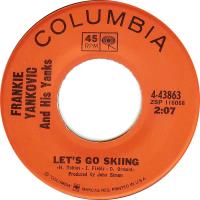
Boyd sent us two versions each of Let’s Go Skiing and The Skier’s Daydream by SeniorsSkiing.com reader Ray Conrad. Click on the links below to play.

Let’s Go Skiing by Bernie Knee and the Irving Fields Orchestra.

Let’s Go Skiing by Frank Yankovic

The Skier’s Daydream by Ray Conrad

The Skier’s Daydream by Oscar Brand


And to SeniorsSkiing.com reader Alison, we thank you for remembering and sending in a reference to Schifoan, a tune in German written by Austrian folk singer Wolfgang Ambros.  As Alison says, it’s a catchy tune, even if your German is a bit rusty.  Here’s a version we found on Youtube by Wolfgang himself.

Finally, here’s Cotton Pickin’ Lift Tower, another Ray Conrad tune, performed by John Sidle at a coffee shop in Santa Clara, CA.

Fun stuff, thanks everyone!


Why Do I Have To Re-Enter My Name And Email?

For New Subscribers, You Should Know What To Do When You Get Annoyed By Pop-Ups.  There IS an answer.

If you are being asked to re-enter your email to confirm your subscription to SeniorsSkiing.com, you might be a bit annoyed.  We don’t blame you, but there is an explanation.

  • You are accessing SeniorsSkiing.com through a device that is different from the one you originally signed up on. Subscribing to SeniorsSkiing.com puts a “cookie” on your device.  If you use a different device, no cookie, so you are viewed as a non-subscriber. If you re-enter name and password, you’ll be okay with the new device.
  • You have disabled cookies or cleared browser history on your device. Even iPads can accept or disable cookies. Turn cookies back on, and you’ll not have to re-enter again, or leave it disabled and realize you have to re-enter each time.  Your call.
  • You are trying to access our Subscriber-Only Content.  Instead of building a firewall that requires usernames and passwords, we elected a much simpler way of getting to our exclusive content: Just confirm your name and email.  You will have to do that each time you want to get to that information, which, by the way, is under the Community tab at the top.

We are also hearing complaints from people who say the email delivery of SeniorsSkiing.com ends up in the spam folder.  What you should do is identify SeniorsSkiing.com as an okay email sender.  Usually if you just click on the file in the spam folder, you will get a menu allowing to change SeniorsSkiing.com to “Not Spam.”

Thanks everyone for your patience.

This Week In SeniorsSkiing.com (Aug. 18)

Summer Rounds The Far Turn.

We’ve heard there were snow falls in this mid-August in the Rockies.  Big snowfalls.  And the venerable Farmers’ Almanac, predicting the weather using its own mix of folk lore and natural observations for 200 years, has forecast a “snowier-than-normal” 2017-18 winter for the Northeast from the mid-Atlantic to the Canadian border.  The FA has even “red-flagged” five time periods for heavy precipitation along the Atlantic Seaboard: Jan. 20-23; Feb. 4-7, 16-19; and March 1-3, 20-23. Place your bets, ladies and gentlemen.  Here’s the forecast map that the folksy publication has recently produced.

Meanwhile, the hurricane watchers have upped the number of named storms to expect for the remainder of the June-Oct season.  Clearly the atmosphere is very active. And, we are watching the El Nino-La Nina reports from the National Weather Service.  It seems incredible but the temperature of the sea surface water in the eastern Pacific plays a vital role in forming weather patterns around the world.

We are still in summer publishing mode, issuing a SeniorsSkiing.com edition every other week.  This week, we are reaching back to the archives for some interesting and amusing articles.

We are reprising Harriet Wallis’ article on her adventures as a ski thief.  An innocent ski thief we hasten to add.

We are also re-publishing an article about the songs of skiing which we originally published in August, 2014, exactly three years ago.  It’s a micro-thesis on the emergence of ski songs in the 50-60s including some samples you can listen to. We’ve been wondering where the new ski songs are.  Know any? Have fun with this.

We are still figuring out the changes in our arrangement with Experticity.  If you have access to the site as a subscriber now, you will continue to have access until the anniversary date of your original sign up.  Then you will be asked to re-apply for access.  New subscribers who want access to Experticity will have to go through the new application process.We are trying to understand what that re-application process entails. So please be patient.

Enjoy the rest of August.  Wear sun screen and remember there are more of us every day and we aren’t going away.


This Week In SeniorsSkiing.com (August 4)

SPECIAL EDITION: The SnowSports Industry And Climate Change.

A 12 acre solar farm at Jiminy Peak, MA, generates power for lifts, lodge and snowmaking.
Credit: Jiminy Peak

As we write this in early August, the National Weather Service has issued an excessive heat warning for most of the West Coast.  Seattle is poised to entertain temperatures near 100 degrees, Reno 110, Portland 106. Meanwhile, we hear of a massive snowfall in New Zealand’s Mt. Hutt, bringing 26 foot snow drifts over the weekend of July 22-23.  Here’s some video shot from a helicopter, thanks to Snowbrains.com.

We’ve seen reports from Portillo, Chile, with similar reports of gargantuan snowfalls in the Andes. Short duration, big depths.  Clearly, the atmosphere is reacting to an increase in global temperatures.

So this week, we will devote our issue to climate change and the ski business.  Obviously, there is a link and a concern. We hear from three reports from SeniorsSkiing.com correspondents Rose Marie Cleese and Roger Lohr on how the ski industry is embracing sustainable energy, conservation policies and practices, and new technologies that save money and reduce fossil-fuel consumption and carbon dioxide footprints.

In How The Ski Industry Is Fighting Climate Change, Rose Marie Cleese provides a broad look at how the industry is preparing and responding to a future with potentially less cold weather.  She reports on NSAA, a non-profit called Protect Our Winters, and two major resort operators’ efforts to deal with a game-changing threat to the business and the environment.  Rose Marie also provides links to other resources to check out where you can become more informed about the industry’s response.

In Jiminy Peak: How To Be A Sustainable Resort and At Killington, The Sun And Cows Power Lifts And Lodges,  Roger Lohr presents two case studies of how very practical resort owners have committed to alternative energy sources and conservation business practices, saving money and natural resources.  Find out how the cows play a role in fighting climate change.

On we go into the summer.  Mammoth Mountain finally ended the 2016-17 season by closing down on August 1.  Click below for an intrepid final run over snow and pumice on the final day, again thanks to Snowbrains.com.

We’ll be back later in August.  Meanwhile, summer on.  Remember, there are more of us every day, and we aren’t going away.


How The Ski Industry Is Fighting Climate Change

Climate Change Is Literally In The Air. Here’s A Roundup Of What’s Going On.

[Editor Note: This article first appeared on the Liftopia.com blog and can be found at http://blog.liftopia.com/ski-industry-fighting-climate-change/.]

Cold, snowy weather is the very foundation of the ski industry. So, it’s not surprising that climate change has been at the top of the industry’s priority list since the turn of this century. Before that, ski areas relied on rudimentary snowmaking to get them through bad snow years. Today, snowmaking is a much more sophisticated and dependable operation, and resorts and industry associations are doubling down on their environmental efforts, using energy-conscious snowmaking, other sustainable technologies, and climate sensitive business practices and policies. They know how high the stakes are—the very future of wintersports.

Here’s what ski industry organizations and ski resort management are doing in order to ensure that you’ll be able to slide down snowy slopes for many winters to come.

Julian Carr (POW Riders Alliance Member), Snocru, Ski Utah, and POW at Powder Mountain in Utah at POW Day in January 2017. Credit: Jana Rogers

1. The National Ski Areas Association has been pushing environmental initiatives over the past 15 years.

The National Ski Areas Association (NSAA) has been rolling out environmental initiatives for the past 15 years and is not about to let up. Says Geraldine Link, NSAA’s director of public policy, “Climate change presents challenges to the ski industry that require proactive planning, bold action and leadership. The good news is that the ski industry is adept at managing challenging conditions and began work on addressing this issue 15 years ago with the adoption of a cutting-edge climate change policy in 2002. While every industry is affected by climate change, impacts to the ski industry receive a great deal of visibility in the media, given the operations’ natural connection to climate. This visibility provides a unique opportunity to lead by example, and we have done so successfully with respect to climate change education, mitigation, advocacy and adaptation.”

NSAA emphasizes several important areas with its member ski areas and resorts:

  • Reducing carbon emissions through energy efficiency, on-site renewable energy, green-building/retrofitting, and alternative fuels, among other actions
  • Increasing investments in snowmaking, water facilities, and water resources
  • Developing smarter grooming technology
  • Shifting to a four-season model
  • Advocating for legislation and regulation on broader-based climate solutions

Aspen Mountain reflected in Solar Panels at resort.
Credit: Aspen Skiing Company

The association works on many fronts: Since 2009, NSAA has been providing its member ski areas grants through its Sustainable Slopes Grant Program that provides cash and in-kind funding to support resorts’ sustainability projects. Its Climate Challenge is a voluntary program that helps participating ski areas reduce greenhouse gas emissions and reduce energy costs. Its annual Golden Eagles Awards for Environmental Excellence recognizes ski resorts for their performance in several environmental categories, from overall excellence to water conservation to visitor education and community outreach. And its online Green Room provides links to resorts’ environmental web pages listed by state (and Canada) so that fellow resorts and the public are all up to speed on the latest environmental actions and ideas.

Director Link adds, “In light of the political climate in Washington, the industry needs to be even more proactive about climate solutions to forge a sustainable path forward for the industry.

Her call for advocacy is not misplaced. In a study released by the Natural Resources Defense Council in 2012, it was calculated that the ski industry loses $1.07 billion in revenue in low snowfall years. And according to a report recently issued by the EPA and prepared by Elsevier, a global information analytics company based in the Netherlands, estimates show that climate change will cause a drop of about 30% of current snow sports revenue and skier/snowboard visits in the U.S. by 2050. The report states that the drastically shortened snow sports seasons, in the Northeast and Southeast in particular, will force many resorts out of business between now and 2050.

Kelly Davis, director of SnowSports Industries America (SIA) says, “The industry must determine whether to accept the impacts and wither [or] consider options that include opening new areas for snowsports in less-affected regions, improving snowmaking technology, developing gear innovations that make skiers and riders less dependent on snow conditions, [etc.] to thrive in the next 50 years.”

POW founder, Jeremy Jones, on Capitol Hill testifying at a House Subcommittee Hearing in April 2017. Credit: Protect Our Winters

2. Protect Our Winters is dedicated to engaging and mobilizing outdoor enthusiasts in climate issues.

Protect Our Winters (POW) is a nonprofit organization, founded in 2007 by professional snowboarder Jeremy Jones to encourage various groups to be active participants in the fight against climate change. POW works closely with outdoor businesses, ski resorts, professional athletes, and outdoor enthusiasts to be in the front lines of environmental action and green practices. Its volunteer professional athletes talk to students in schools, and POW staffers are frequent visitors to state capitols and the power centers in Washington, D.C., advocating for the reduction of greenhouse gas emissions via carbon pricing, solar energy, and the electrification of public and private transportation.

3. Aspen Skiing Company is one of many ski resorts combating climate change.

Matthew Hamilton is Aspen Ski Company’s sustainability director, overseeing its community philanthropy and supporting the company’s internal environmental programs. He says, “Today there is much more significant discussion of climate change and its impact than there was 12 years ago.” Aspen’s sustainability department was the industry’s first such entity when it was founded in the early 2000s, and the company has emerged as a major industry leader in environmental issues, from issuing an annual sustainability report that dutifully records both its successes and rare failures to developing a program to use the methane from a nearby defunct coal mine to generate 24 million kilowatt hours annually—enough to power its entire operation—four ski areas, three hotels and 17 restaurants— for a year.

A presentation at Aspen’s methane-to-electricity conversion operation at Elk Creek Mine. Credit: Aspen Skiing Company

Whether it’s lobbying in Washington, funding educational opportunities, or having its visitors use paperless apps for receipts and lift tickets, Aspen is solidly in the forefront of tackling today’s environmental challenges. To get inside the head of Aspen Skiing Company’ president and CEO Mike Kaplan, read his bold manifesto that appeared in The Aspen Times last December.

Aspen is just one of several U.S. ski resorts that are environmentally proactive. Even the simplest actions make a difference. For instance, to save water, the Resort at Squaw Creek in Squaw Valley, CA, gives its guests $5 coupons to spend at the resort’s shops and restaurants every day they opt out of having their bathroom towels replaced. To learn more about what U.S. ski areas are doing to meet the challenges of a changing climate and other environmental issues, check out NSAA’s list of resorts’ environment-specific web pages.

4. Ski resorts’ commitments to the environment keep snowballing.

On July 25th, Rob Katz, chairman and CEO of Vail Resorts Inc. announced to its 30,000-plus employees at a company-wide town hall meeting Vail’s commitment to zero net emissions, zero landfill waste, and zero operating impact on forests and habitats by the year 2030. Its Epic Promise for a Zero Footprint includes everything from purchasing 100% renewable energy, restoring equal forest habitat for any habitat displaced, working with vendors to up their “green” quotient, and educating resort visitors to diverting 100% of waste from landfills and financially supporting environmental stewardship projects. Says Katz, “The environment is our business, and we have a special obligation to protect it.”

Vail Resorts’ subsidiaries operate nine major ski resorts and urban ski areas in the U.S., plus Whistler Blackcomb in Canada and Perisher in Australia, as well as RockResorts, a collection of luxury hotels in Colorado. 

What can you do to make a difference?

Want more specifics about the environmental actions many ski industry organizations, areas and resorts are currently undertaking or planning for the future? Here are some informative and action-oriented links you may want to check out!

Night time snowmaking at Aspen Mountain. Credit: Aspen Skiing Company

Jiminy Peak: How To Be A Sustainable Resort

This Almost 100% Renewable Energy Ski Resort Is A Pioneer In Harnessing Solar And Wind.

[Editor Note: Thanks to Roger Lohr, publisher of XCSkiResorts.com, for steering this article our way.  It first appeared in XCSkiResorts.com in late July.]

A 12 acre solar farm generates 2.3 megawatts. Wind power and solar power cover most of the resort’s needs.
Credit: Jiminy Peak

Jiminy Peak Mountain Resort located in the heart of the Berkshires of Western Massachusetts constructed a 2.3 megawatt community solar facility located on 12 acres of the ski area and resort’s property, owned and operated by Nexamp. Renewable energy is not new to the resort—back in 2007 it was the first ski area in North America to generate power from its own GE 1.5 MW wind turbine.

The solar project significantly expanded Jiminy Peak’s renewable energy program, while extending the environmental and cost-saving benefits of solar to up to 200 neighboring homes and small businesses. By adding the solar power facility to Jiminy Peak’s existing wind turbine, 75 kWh cogeneration unit, and extensive conservation efforts, the resort can claim to be one of the few resorts in the U.S. powered 100% by renewable energy and one of the most sustainable energy ski resorts.

Solar and Wind Energy

The solar project significantly expanded Jiminy Peak’s renewable energy program. All power generated by the 7,500-module solar facility is exported to the grid. Resort president Tyler Fairbank said, “We receive net metering credits in return. Half the net metering credits are utilized by Jiminy Peak and the balance by about 200 neighboring homes and small businesses in the local area.”

The resort uses all the power generated by the wind turbine according to Jim Van Dyke, vice president of environmental sustainability, and a veteran 43-year employee who commented “The turbine handles 33% of our energy needs on an annual basis, up to 66% in the winter when the winds blow strongest. Any excess energy is sent out to the grid and Jiminy receives a net metering credit, which is used when we need to purchase energy from the grid. So in that fashion we now use 100% of the electricity that the turbine generates.”

Lighting, Recycling, and Cogeneration

Jiminy has upgraded to more efficient lighting and programmable thermostats in the lodges, and the resort more than doubled the energy efficiency of the lights used on the slopes for night skiing. In the Country Inn, 658 lights were converted to  LEDs to be more efficient and 230 slopeside lights have been replaced with lighter, brighter, more energy efficient LED lighting covering 60 percent of the mountain. The difference has been likened to that between a manila envelope and a white envelope.

Waste oil is taken from snowmaking compressors, grooming machines, and all vehicles to heat the Mountain Operations building using approximately 200 gallons of waste oil per year, and the process avoids the storage and disposal of old used oil.

Jiminy Peak installed a cogeneration unit in the Country Inn. The unit uses propane gas that powers a turbine that in turn produces hot water for use throughout the Inn. This hot water also provides the heating source for the central core of the building that includes the year-round outdoor pool, hot tubs, and John Harvard’s Restaurant & Brewery, too.

Using the heat from two snowmaking compressors to heat 34,000 square feet of space in three Village Center buildings avoids the need of an equivalent of 63,800 kWh.

The towel and sheet program in the lodge rooms saves about 25,000 gallons of water a year by only washing the sheets and towels when requested by guests staying for more than one night. They’ve eliminated the use of toxic cleaning agents and only use green, biodegradable solvents and cleaners. Conversion to waterless urinals in bathrooms of several buildings and at JJ’s Lodge saves 40,000 gallons of water per urinal.

Snowmaking

Jiminy averages 615 acre feet of snow per winter using machine-made snow and approximately 123,000,000 gallons of water. The entire 450-gun snowmaking arsenal was replaced with energy-efficient Snowgun Technologies “Sledgehammer” snowguns. The new guns convert more water with less air and at warmer temperatures than traditional snowguns. This means the resort runs air compressors for fewer hours, consuming less electricity, while producing 100% more snow (assuming Mother Nature cooperates).

For example, the snowmaking system’s old technology would have required 4,566,100 kWh ten years ago versus 1,368,326 kWh today. The annual savings is 70% in energy or 3,197,774 kWh.

Slope Grooming

Jiminy Peak has equipped two PistenBully groomers with digital mapping and GPS to tell drivers exactly how much snow is beneath their treads, blades and rollers. The maps are based on aerial photography captured during summer, and are accurate to within two inches (5 cm). “Rather than eyeball it, the SNOWSat technology allows us to more precisely gauge depth and place more snow where the cover is thin, and less where the cover is already sufficient for skiing or riding. This means fewer passes by groomers,” Van Dyke explains, noting that Jiminy Peak is one of only a few resorts in the U.S. using the new technology.

Speaking of groomers, Jiminy Peak is purchasing the new energy efficient Pisten Bully 600 E+ snowcat, one of three in use in the northeast. Kassbohrer’s Pisten Bully “Green Machine” 600E+ is the world’s first groomer with a diesel-electric drive. One of the most significant advancements in snow grooming technology over the past two decades, the 600 E+ uses a diesel engine to drive two electric generators which power electric motors that turn the tracks and the snow tiller. It reduces the emission of nitrogen oxides and carbon dioxides by 20%, produces 99% fewer sooty particles and registers a 20% fuel savings over their standard 600 model.

Jiminy turbine.jpg

Transportation

There are plans at Jiminy Peak for the installation of four EV charging stations, working with an Albany, N.Y., EV Drivers Club, with support from Tesla. Van Dyke notes that EV car owners, in addition to saving on fossil fuels, will be recharging with renewable electricity generated by both solar and wind.

Jiminy Peak has won environmental recognition, but awards are not why Jiminy Peak Resorts conserves and invests in renewable energy. Fairbank reflected, “Conservation is practiced every day at Jiminy Peak. It’s part of our corporate DNA. We have an in-house energy management team that conducts an on-going and aggressive program to help us to identify and curtail energy waste and research ways to source 100 percent of our energy from renewable resources. They are constantly evaluating opportunities for savings. Our renewable efforts have come from facilities we’ve built, and we’re proud for reaching 100% of our electricity energy, which is from local, on site-generated renewable resources.”

At Killington, The Sun And Cows Power Lifts And Lodges

Killington Is Another Ski Resort Leading The Way In Sustainable Energy.

[Editor Note: This article by XCSkiResort.com publisher Roger Lohr first appeared in SnoCountry.com.]

Summer At Vermont’s Killington.
Credit: Killington

Ski areas in the U.S. continue to implement innovative energy conservation measures and environmental practices to reduce energy consumption and the effects of climate change. Killington Resort in Vermont strives and continues to exceed customer expectations as a steward in the battle against climate change.

Renewable Sourced Electricity

Recently Killington announced its intention to install solar arrays at Pico Mountain with 100 kilowatts (kWh) of solar panels on the Pico Base Lodge and Administration building. Tracker solar panels that move to maintain the optimum angle with the sun will be located at six sites around the resort with three trackers at each site. Power from these systems will be sent back to the electric company (net metering).

The Cow Power program is a unique form of producing energy whereby about a dozen Vermont farmers use cow manure at their farms in an anerobic digester system to generate electricity to sell to Green Mountain Power. Killington purchases 1,125,000 kWh annually of this energy to power the K-1 Gondola and the Peak Lodge.

In 2007, the resort converted 12 walk-in coolers to Freeaire Refrigeration, which uses outside air to refrigerate the coolers instead of using high energy-consuming compressors.

Recycling

Killington has been recycling for years, currently recycling 100 tons of waste annually. It uses 50,000 pounds of 100 percent recycled certified paper products annually. Killington trail maps and guest guides are printed on paper certified by the Forest Stewardship Council.

An innovative design to use recycled waste water systems in the restroom facilities is employed at the six Killington base lodges, saving up to 35,000 gallons of fresh water each day during peak days. Since 1987 when the water conservation system was installed about 62 million gallons of fresh water have been conserved.

Transportation

On transportation, Killington participates in the Marble Valley Regional Transportation District. Current resort-related ridership on “The Bus” exceeds 375,000 one way trips annually including 75,000 commuter and employee related trips.

In 2014, two ChargePoint stations for electric cars were installed at the Killington Grand Resort Hotel with dedicated spaces open to all guests. There are also plans to have two Tesla Destination Charging stations (at the Snowshed and Skyeship areas) installed prior to 2017-18 the ski season.

Snowmaking

Killington purchased 400 new energy-efficient snow guns as a part of Efficiency Vermont’s Great Snow Gun Roundup in 2014, an investment of snow guns valued at over $2 million.  That program required that for every five energy-efficient snow guns purchased, four less efficient snow guns be scrapped. Killington retired 317 snow guns in a variety of styles and added 396 new guns to its fleet.

Killington snowmaking
Killington begins snowmaking for an early season. (Killington)

Killington added 150 new tower bases for these more efficient snow guns and mounting guns on towers allows for more “hang time” in snowmaking, adding to efficiency and output while reducing noise for skiers and providing a more authentic snowfall experience. Dave Lacombe, snow surfaces manager for Killington Resort commented, “Modern, energy-efficient snow guns require up to 85 percent less energy to operate than older snow gun models, and the new snow guns represent the most advanced, energy-efficient technology available.”

One standard diesel-powered air compressor used for snowmaking produces 1600 cubic feet of air per minute (CFM). Older snow guns use 600 CFM while new energy-efficient guns use 8-26 CFM, allowing for far more snow guns to be powered by a single compressor. To further improve sustainability, all Killington diesel compressors have Tier 4 engines that use cleaner burning fuel and have increased energy efficiency overall.

Killington projected direct savings for the season associated with the new snow guns totaled 1,453,000 kilowatt-hours of electricity, 84,000 gallons of diesel fuel, 3,452,000 pounds of carbon emissions and roughly $470,000—and that’s a return on investment in about a year and a half.

Cycling Series: Designed Trails Make A Difference In PA.

Mountain Bikers: These Trails Are Worth The Trek.

Here’s the view from the Alligrippis. Nice summer ride through beautiful mountains in central PA.
Credit: Pat McCloskey

One of the smoothest, most  buttery trail systems in the east is situated in the middle of rural Pennsylvania near a beautiful body of water—Raystown Lake.  The Alligrippis Trails were IMBA( International Mountain Bike Association) designed in conjunction with the Appalachian Regional Commission, the Pennsylvania Department of Conservation and Natural Resources, the U.S. Army Corps of Engineers, and the Huntington County Visitors Bureau.

Check the smiles and the kids on the nice smooth single track.
Credit: Pat McCloskey

These trails are a must for anyone who appreciates flow on a mountain bike with berms and rollers galore.  There is some climbing but for the most part very gradual rollers with perfectly manicured conditions maintained by a robust volunteer system of local mountain bikers.  The Raystown Mountain Bike Association helps to keep these trails in tip, top condition, and if you are looking for a great day on the trails in the central mountains of Pennsylvania, this is your place.

There are 24 trails each stacked to provide loops that can be intertwined and lots of available bail out points.  Thirty miles of trails are available with hours of non-repetitive riding available.  Lots of riders make this a day trip when visiting State College to ride Rothrock State Forest trails which are another type of riding with more rocky challenging terrain.  The combo of each type of riding can provide a visitor to the central mountains of Pennsylvania enough variety to satisfy any level of rider.

Access to the trail system:

  • Seven Points Road Entrance in Raystown Lake Recreation Area
  • Bakers Hollow Road
  • Susquehanna Campground Entrance
  • Bicycle Shop Support- equipment, clothing, rentals, guide services and maps

Gear, Repairs, Supplies

Don’t miss eats:

  • Smitty’s Eats and Treats (Hesston, PA) Smitty’s pork bar-b-que is not to be missed prepared with meats from a local farm. Delicious!!!!! 

Oh, forgot to mention. Smitty’s also has ice cream.
Credit: Pat McCloskey


Cycling Series: “Arthritis-Proof” Bicycle Tires—Flat No More

Get 5,000 Miles On These Airless Tires And Never Have To Wrestle With A Flat.

The dealer installs tubeless Tannus tires onto my rims before the big charity ride.
Credit: Harriet Wallis

If your hands are arthritic, you know how hard it is get a tire back on its rim after fixing a flat. Arthritic hands just don’t have the strength they used to have. But it’s impossible to get a flat with solid tires, so that’s good news for arthritic hands.

I saw airless tires for the first time just a few weeks ago. It was the evening before a major all-women’s bicycle ride fund raiser for women’s cancer research. The annual event is sponsored by the Bonneville Cycling Club here in Utah and the women-only ride is called Little Red Riding Hood.

This year there were 3,900 riders who could choose to ride routes ranging from 27 to 100 miles through rolling rural countryside. Once again, my friend Laurie and I were good-will Course Ambassadors, which means we’d ride a route amongst the women reminding them how to ride safely.

Tires That Can’t Get Flats? My Hands Need Them.

Ride on. These colorful tires won’t get flats.
Credit: Harriet Wallis

On the evening before the ride, the start area becomes a shopping mall of vendors with bike-related products: bike clothing, bike jewelry, bike art—and for the first time, tubeless bike tires.

Right then, the night before the ride, we each bought a set of colorful Tannus tubeless tires and had them installed. During the long ride the next day they seemed to feel and ride like regular tires at 100 – 120 psi.

Details

The Tannus website says this design reduces drag to 1-2%, but we didn’t notice any drag on the Little Red route with rolling terrain and few hills. Apparently other brands of solid tires can produce considerable drag.

I’ll give you my follow up evaluation after I give the tires a good workout this summer on a variety of terrain.

The Tannus foam tires are lighter weight than a tube/tire combination. They also reduce weight because there’s no need to carry a pump or compressed air cartridge or tire tools.

They come in several road bike tire styles and in a dozen flashy colors. Aren’t my red ones pretty? Price: about $65 each plus installation

You can install them yourself, but I wouldn’t recommend it. It’s a very unconventional installation, and it uses a specialized tool to squeeze the tire onto the rim. If you already have arthritis in your hands, installation won’t be fun. But installation directions are available online.

To read more from Harriet click here for her stories on SkiUtah.


This Week In SeniorsSkiing.com (July 7)

Mammoth revels on the Fourth of July.
Credit: Mammoth Mountain

As we have been hearing from media sources, the skiing goes on. Apparently, July 4th at Mammoth was a combo beach party and ski festival as witnessed by the photo above.  Alas, although we closely scrutinized the details in the picture, we couldn’t see any senior skiers reveling in their bathing suits and bikinis.  What’s the matter with you guys?

George belongs to a very special ski club.
Credit: Snowbird

On the other hand, George Jedenoff, who celebrated his 100th birthday skiing at Snowbird on July 5th with his pal Junior Bounous, wasn’t in a Speedo this week. Correspondent Harriet Wallis tells us the back story of this interesting, positive, and inspirational man who learned to ski 51 years ago and has been at it ever since.  Certainly the king of Trailmasters!

We continue our Fitness Focus series this summer with a look at an highly effective stretch and strengthening pose that is one of the most iconic yoga positions.  Down Dog, aka Downward Facing Dog, is relatively simple to do and yields huge benefits, especially in stretching those tight hamstrings which can play mischief with lower back and hip pain. There’s a video included in the story that shows how to correct common mistakes in Down Dog.

Harriet also has submitted an update to her nostalgic profile of Blandford Ski Area in the Springfield, MA area. Regrettably, like many small areas, Blandford is and has been in financial difficulties. We love these little areas,

Small areas like Blandford are where families grow up loving skiing.
Credit: Ski Blandford

especially for senior skiers.  The mid-week traffic is minimal, the ticket prices are usually discounted, and there is often a community of folks to hang around with.  The good news is that Blandford might actually merge with Ski Butternut.  Let’s see what happens.

The ski industry lost Tommy Corcoran, the developer of Waterville Valley Resort and a former Olympian.   He made a mark on the sport when it was on the steep upside of the growth curve, making central New Hampshire a cool destination for Bostonians, New Yorkers, as well as celebrities. He was 85.

Finally, we have a fantastic report from Rose Marie Cleese on what’s happening in the never-ending season in the California Sierra.  As you can imagine, the biggest snow accumulation in years is still bringing the devotees back to the high country.  She has identified what is happening where as well as some tips on skiing in that highaltitude sunshine during the summer.

Two-time Olympian Tom Corcoran was an all-around athlete who put Waterville Valley on the map.
Credit: Waterville Valley Resort.

Our top Trailmasters are being mailed their prize Debooters as we speak. Well done, everyone.

If you want a handsome SeniorsSkiing.com 3 x 3 inch sticker, send a self-addressed stamped envelope to SeniorsSkiing.com, Box 416, Hamilton, MA 01936.  We will send you a few.

Onward to mid-summer.  And remember, there are more of us every day, and we aren’t going away.


George Turns 100 And Skis On His Birthday

Snowbird Made Special Arrangements So George Could Celebrate By Skiing In July.

Birthday boy George Jedenoff flanked by old friends Junior and Maxine Bounous.
Credit: Harriet Wallis

George Jedenoff became an avid skier 51 years ago when he moved to Salt Lake City to oversee the Geneva Steel Plant. He learned from the best: iconic Junior Bounous, legendary Alf Engen, and release binding inventor Earl Miller.

At that time, Miller performed stunt falls to show how well his bindings released. But he credited George with doing whacky falls that he’d never seen. In spite of the falls, George learned to ski and to love the sport.

Junior Bounous, director of skiing at Sundance and then Snowbird, mentored George and they became fast friends. They’ve skied together for 51 years. Even now, I continue to learn new things from Junior, said George.

The two friends skied on July 5—George’s 100th birthday.

George belongs to a very special ski club.
Credit: Snowbird

George lives in California but he returns to Utah every winter to ski at Alta and Snowbird. He skis with the vigor of a teenager and charges through powder with ease. He loves powder.

He also has a philosophy that guides his life and inspires others. “Be kind. Do your best. Don’t be discouraged by bad things that might happen to you. Always be positive,” he says.

When George was 95, Ski Utah, the umbrella organization over all Utah ski resorts, produced a video of him skiing. It was an immediate hit and each winter Ski Utah produces a new and inspiring video of him.

Thanks to Snowbird, George celebrated his 100th birthday by skiing a large field of snow near the top of the mountain with his friend Junior Bounous. He was also awarded a plaque, shared a cake with everyone who attended, and enjoyed a birthday lunch at Snowbird’s slopeside Forklift Restaurant. He also received a letter of congratulations from the nationally known 70+ Ski Club. Only 3 of its 3,000 members have been over 100 years old.

But there’s a back story too. A day earlier, George and Junior drove up the gravel summer road at Alta to search for a patch of snow on which to practice before today’s big event. They found a suitable patch and made turns. “It was about as big as a room and about as wide,” said Junior. “But we skied it.”

The day’s festivities wrapped up with George’s typical, positive outlook. His skis were leaning against a wall, and he spoke to a family member saying: “Let’s remember to pick up my skis, I’ll need them this winter.”

Click on the video below to see George celebrate his 100th on the snow.


Fitness Focus: The Essential Down Dog

Here’s One Of The Most Important Stretches An Active Senior Can Do.

[Editor Note: Our summer series Fitness Focus is taking a distinctive turn toward several important yoga positions. We’ve highlighted the Squat, the Plank, and now the Down Dog.  We are a bit biased toward these poses because we have experienced personal progress and various muscle pain relief by practicing them.  We’re curious, too, about your experiences with these and others.  Let us know.]

Downward Facing Dog
Credit: Yoga Basics

Hamstrings are the big muscles behind your thighs.  If you stand and raise one heel towards your backside, you are using your hamstrings. When you sit down on a chair, those muscles are relaxed and become shortened and tight.  When they are tight, they pull on your hips and, in our experience, have been one source of classic lower back pain.  There are other sources, of course, i.e., bulging discs, arthritis and even infection.  But we’ve found that stretching those hamstrings goes a long way in resolving that uncomfortable lower back.

According to physical therapists, the most effective way to stretch those hamstrings and many other muscle sets is the Down Dog pose (aka Downward Facing Dog, or Adho Mukha Svanasna).

It is a rather simple pose that involves your entire body.  You start on your hands and knees, hands under shoulders, knees under hips.  With an exhale, up you go, bringing your rear end up, your head between your shoulders and your legs as straight as you can get them.  Spread your hands out like a star fish and gaze back at your shins while keeping your neck in line with your spine. The ideal is to plant your heels down on the floor while your legs are straight, your spine lengthened and your belly button drawn into your spine. Chances are, you’re not going to get your heels down if you’re just starting.  Or perhaps never. Most people feel comfortable just “pedaling” their heels up and down as a first step to getting comfortable.

Breath slowly and deeply from your belly button.  You are strengthening your shoulders, neck, back, glutes, and lots of other muscles while you are stretching your hamstrings.

One-Legged Down Dog is an easy variation.
Credit: Yoga Basics

From Down Dog, you can transition to Plank, hold that for 10-20 seconds, and then go back to Down Dog.  Back and forth between those two is a tremendous stretching and strengthening exercise. Breathe deeply and slowly. We’ve heard this combination is used in various military boot camps to get recruits into shape.

There are several variations you can use once you get into Down Dog.  Lifting one leg straight up is one.  There are others which you can check here.

As usual, if you have any carpal tunnel, shoulder, back, joint issues, or unregulated high blood pressure, please check with a health care professional before you try any of these stretches.

Here’s a demonstration and tips for correcting common problems in doing Downward Dog.

https://www.youtube.com/watch?v=4Z8rZJ6sk48


Historic Blandford Ski Area Poised To Bite The Dust

This Wonderful Family Area Is Simply Out Of Money.

[Editor Note: According to the Westfield News, Springfield Ski Club’s members will be meeting on July 18 to approve the sale of assets to the owners of Ski Butternut. If two thirds of the total membership do not specifically vote yes, the ski area will close.]

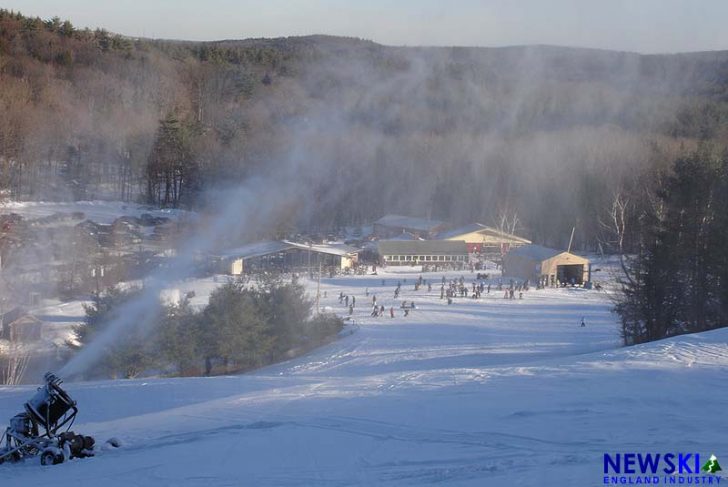
Volunteers kept Blandford going and gave the small area a community feel.
Credit: New England Ski Industry

The website says: “May 28, 2017 – Ski Blandford Financially Insolvent. Could Be Sold or Closed.” The Board of Directors and the skiers are on the brink of making a gut wrenching decision soon about their ski area that’s been going for 81 years.

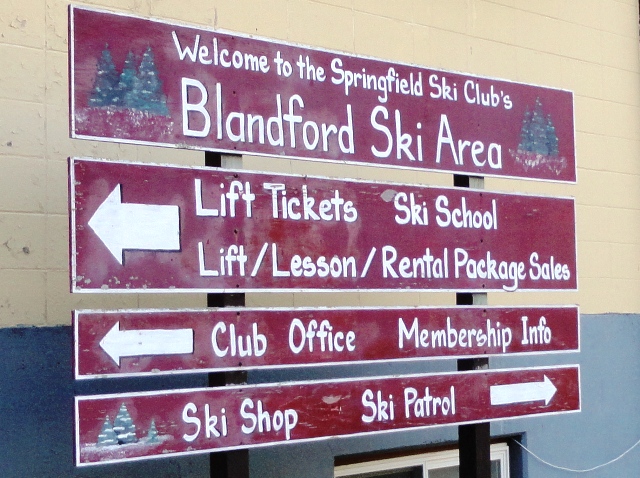
Harriet visited Blandford on a recent visit, finding a welcoming sign at the base lodge.
Credit: Harriet Wallis

As background, recreational skiing spiked after WWII when 10th Mountain Division veterans returned and inspired city folk to take up skiing.

But before that, in the 20s and 30s, hardy skiers skinned up mountains, built primitive lifts and were already into downhill skiing.

And so it was for the Springfield Ski Club. In 1936 it got permission to build a ski slope on a hilly farm in southern Massachusetts. It installed a 1,000 foot long rope tow and used a nearby schoolhouse as a warming hut. A few years later the club bought the land and named it Blandford Ski Area.

Today, about 60 ski areas that started before WWII are still in operation, according to data collected by New England Ski Museum Director Jeff Leich.

But it hasn’t been easy for this small, family-oriented ski area. Modernization from rope tows to chairlifts was costly. Updating to snowmaking was a necessity. But then, interstate highways whisked skiers past Blandford to bigger, destination resorts.

But Blandford—with its 450 feet of elevation, three chairlifts, snowmaking and night skiing—held on while other small ski areas in southern Massachusetts closed. Skiers simply love Blandford.

And they put in countless hours of volunteer work to keep the area ship shape. Work parties painted the picnic tables. And they walked up the slopes picking up stones pushed up by frost and tossed them into the woods so in winter they could ski on a minimal snow base.

During the 1960s and 70s, membership was capped at 5,000, and there was a waiting list to join. My family of four were all novice skiers, and we jumped at the opportunity to join when an opening occurred..

From that humble beginning at the small ski area, we all grew to love the sport. And we progressed to become instructors and ski patrol.

Blandford got us started in the right way. It inspired us with skiing. And it offered family values and great camaraderie with other families.

However, membership slowly dwindled over the years and dropped to just 1,426 in the 2014-15 season. Fickle weather and the economics of operation began to out weigh the camaraderie and the inspiration,

Blandford, like other small ski areas, is a grass roots feeder area that launches skiers into the sport. It’s sad that we might lose this icon of the ski industry. For a closer look, click here for the Ski Blanford site.

To read more from Harriet click here for her stories on SkiUtah.

Small areas like Blandford are where families grow up loving skiing.
Credit: Ski Blandford

Five Tips For Sierra Summer Skiing

[Editor Note: This article by Correspondent Rose Marie Cleese first appeared in Liftopia’s The Blog.  We thank Liftopia for allowing us to pass it along to the readers of SeniorsSkiing.com.]

Even though summer has officially arrived and temperatures are reaching triple-digits across the country, are you still nostalgic about winter and wish you had gotten in a couple more days of skiing or boarding?

You’re in luck. Ski season is alive and well in the Sierra, at Squaw Valley near Lake Tahoe for at least two more weekends and at Mammoth Mountain off State Route 395 east of Yosemite daily into August.

See California lift tickets.

Summertime, when the vibe is chill and the air is hot…

So how different is it to ski and board in the summer? When’s the last time you spotted a marmot basking in the sun next to a ski tower? Or had a flurry of ladybugs alight on your table while lunching on the lodge deck. Everyone on the slopes is happy and laid back because we all know we shouldn’t be able to be doing this at this point on the calendar. Below are 5 tips if you’re headed to the slopes this summer.

1. Enjoy the soft, easy-to-ski corn snow.

Corn refers to the snow during the time window when it has become soft and forgiving, but not too wet and slushy.

At Squaw Valley, after you leave the green, grassy terrain around the base of the mountain, it’s a bit of a shock to find yourself a few minutes later on the snow-covered slopes of Squaw Valley’s upper mountain, currently boasting a snow depth of up to 131 inches (that’s nearly 11 feet, folks!).

Now, over the long 4th of July weekend, July 1–4, and on Saturdays thereafter “as long as we can provide a safe skiable surface,” says Squaw Valley spokesperson Sam Kieckhefer, you can enjoy a full four hours of skiing on corn snow, from 8:30 AM to 12:30 PM.

The surfaces of most runs are easily skiable corn snow, kept nice and crisp due to the deep snowpack. The only places you’ll find full-blown heavy slush are on the wide, flat runs that feed into the Gold Coast Lodge area. Last weekend, the temperature on the upper mountain was 60 degrees and the resort had four lifts running: Gold Coast, Big Blue, Siberia and Shirley. Skiers could also traverse and hike up to ski the runs on Headwall.

2. Check out Squaw Valley’s poolside party at High Camp.

PHOTO CREDIT: Katie Cleese Photography

After you shed your skis, be sure to check out the lively scene at Squaw Valley’s pool and hot tub at its High Camp location, open from 11 AM to 4 PM. For the price of admission ($15), you get a locker, towel, and access to an 8,200-foot-elevation alpine party, complete with a poolside dj spinning house music and scantily clad 20-somethings cavorting and splashing around the big pool wearing ski goggles.

Catch the shuttle back to the Resort at Squaw Creek where you’ll have the options of sunbathing by its more mellow pool sipping a margarita, soaking in a hot tub, playing a round of golf, hiking, or playing a game of tetherball, corn hole, or giant chess. The best of summer and winter all in a single day.

See Squaw Valley lift tickets.

3. Defy winter and ski well into summer at Mammoth Mountain.

PHOTO CREDIT: Mammoth Mountain

On the eastern side of the Sierra, Mammoth Mountain, the queen of ski resorts staying open past April, is experiencing three to four times the number of skiers and boarders they usually get this time of year, according to Mammoth Mountain’s communication manager, Lauren Burke. “We’re committed to daily operations into August,” she says. “In the last 50 years, we’ve stayed open into July some 15 times. Our longest season on record was 1994–95 when we closed on August 14th.”

Hours of operation at Mammoth are 7:30 AM to 2 PM, with 6 lifts, 57 trails and 2 terrain parks available midweek, and 7 to 8 lifts and 70 trails available on weekends. Currently, Mammoth has 45 inches at its base and 180 inches, or 15 feet, at its 11,000-foot-high summit.

For Bay Area skiers, the quickest way to reach Mammoth right now by car is via I-80 through Reno and south on SR 395. The faster route via Highway 120 over Tioga Pass, which closed for the winter season last November 16th, is still closed with no projected opening date. In the last 80-plus years, the latest Tioga Pass opening was July 1st, so it looks like that record is soon to be toast!

See Mammoth Mountain lift tickets.

4. Garb up or garb down… Whatever you prefer, just don’t forget the sunscreen!

PHOTO CREDIT: Katie Cleese Photography

If you NEVER fall, wear whatever or how little you want. We saw a pair of skiers in flowing Batman and Superman capes, a boarder wearing a Speedo®, plus a plethora of cut-offs, tank tops, no tops (guys only!), and streamlined helmets. So wearing apparel is whatever strikes your fancy, but there are a few “musts” when you hit those corn-fed slopes:

Before you go out, cover every bit of exposed skin with a high-SPF waterproof sunscreen (including ears, napes of necks, hands if you’re going gloveless, etc.) and reapply as needed. The summer sun is intense at these high elevations, plus you’ll be skiing in mostly sunny weather. Also be sure to entirely cover your lips well with a good lip sunscreen.

Wear goggles or make sure that your sunglasses are completely protecting your eyeballs. Never, never, never head out to the slopes without one or the other. Snow blindness (when you burn your cornea from overexposure to the sun’s UV rays) is incredibly painful and can take a couple of days to recover from.

5. Stay hydrated.

PHOTO CREDIT: Katie Cleese Photography

Drink lots of water throughout the day or you’ll find yourself getting parched pretty quickly. Squaw Valley had water stations set up both outside and inside the Gold Coast Lodge, with plastic water cups stacked up behind the water fountains. Save the alcohol imbibing for après ski!

Provided that the winter snows come on schedule next December, it’s nice to know that all those happy campers up at Squaw’s High Camp last weekend have to wait only five months to ski and board again—but it certainly won’t be as much fun as skiing in workout pants!

Rose Marie Cleese is a correspondent for SeniorsSkiing.com, an e-magazine devoted to wintersports enthusiasts aged 50 and up.


Short Swings!

I’ve spent the past several days in downtown Chicago.

Maybe it’s the nice weather or the pleasure of being in a big city after an extended post-season stay at our desert place, but Chicago is wonderful. The architecture is impressive, as was the tour boat through downtown explaining the broad variety of design. While I was working, my wife took a Frank Lloyd Wright tour in Oak Park. This is the 100 anniversary of his death, and there’s a lot of the Wright stuff going on. She had a glowing report. The food here is something else. I don’t watch chefs on TV, but, apparently, every star has staked turf in Chicago. One BBQ place, Isabelle’s in Wicker Town, was memorable. Lou Malnati’s deep dish pizza was out of this world. Steak at Gene & Georgetti was very good, but not on our return list. Millennium Park is filled with treats including the 110-ton polished stainless steel “Cloud Gate” sculpture by Anish Kapoor; “Crown Fountain,” comprising two 50-foot glass blocks with LED composite images of Chicagoans spouting water from their mouths, and an outdoor concert stage and serpentine bridge designed by Frank Gehry. My kinda town!

THE SEASON

Nationally, skier days were up to 54.7 million from 52.8 million in 2015-16, a 3.7 percent increase. Visits varied by region with strong rebounds in the Northeast, Southeast and Pacific Northwest. Declines were seen in the Pacific Southwest, Rocky Mountains and Midwest. Those declines notwithstanding, visits at Colorado Ski Country USA‘s 22-member areas (Vail not included) totaled 7.3 million, estimated to be the state’s second best on record. Ski Utah reported 4.6 million skier days, up 2.85 percent from the previous record during the 2015-16. And Ski Vermont reported 3.9 million visits.

MEANWHILE, IN NEW ZEALAND

It’s the first run of the first day of ski season at Coronet Peak, Queenstown, NZ.
Credit: Coronet Peak

Coronet Peak, the closest ski field to Queenstown, NZ, opened on June 17 as planned with the Magic Carpet lifts, Meadows Express and Coronet Express Chair lift, and the tubing park, all open.

Coronet Peak Ski Area Manager Nigel Kerr said, “This is a really good start to the season. We had a big turn out for that first ride and it has been building up throughout the day.”

Coronet Peak welcomed more than 1000 people by lunchtime on Day One.

ESSENTIAL KNOWLEDGE

The New York Times publishes short videos each day that allow the viewer to mouse around the image at will. It’s an interesting use of technology. Today, the first day of summer, the Times 360 video shows how to make an igloo.

DISCOUNTS

25% off Panda ski, trekking, and camera poles.

SUPER DUPER SENIOR SKIER GEORGE JEDENOFF TURNS 100

100 and still skiing, George Jedenoff.
Credit: Ski Utah

George Jedenoff, a resident of California has been traveling to Utah to ski Little Cottonwood Canyon (Alta and Snowbird) every year since 1960. George learned how to ski at Alta when he was 43 and claims it was the best decision he has ever made. He is a remarkable man who draws his true happiness from the slopes and has become an inspiration to the Utah ski community. His official birthday is July 17.  Happy Birthday, George and thanks for the inspiration.


2016-17 Trail Masters

Congratulations to the 2016-17 Trail Masters!

Trail Masters are those senior skiers whose number of days skied last season matched or exceeded their ages. Seventy-seven qualified, compared to 42 in 2015-16, the first year Trail Masters were recorded.

At the top of the list is our oldest Trail Master, Fredi Jakob, who skied 83 days at age 83. Fredi’s home resort is Alta. He has been skiing 66 years. Next is Jack Nixon, 82, who skied 110 days, whose most frequently skied resort is Crested Butte.  Jack was also in second place last year.

Several people made the list both years. Among them is David Orlinsky, a ski buddy of the past few seasons. We’re both 73, and when we skied Copper Mountain in January, he was always waiting at the end of the run. Glad to see “Speedy” clocked 85 days.

The average age of all Trail Masters is 66. Their average number of days skied last season is 83.5, and their average number of years skiing is 48.5.

Each of the ten oldest Trail Masters will be mailed a DeBooter, that outstanding ski boot jack that lets your remove boots quickly and painlessly! Every older skier should own one.

Skiing one’s age is a terrific accomplishment. For all of us it will be easier to accomplish next season than the season that follows.

CLICK HERE TO SEE THE COMPLETE LIST OF TRAIL MASTERS

Why Do I Have To Re-Enter My Name And Password?

We Explain Why This Annoyance Happens And What You Can Do About It.

Editor Note: We get emails from time to time about how frustrated some of our readers are in having to re-enter their name and password when they visit our online magazine.  Sometimes those emails are in ALL CAPS, sometimes they use naughty words. Trust us, there is an explanation, and not everyone who subscribes has this problem. We’ve published this before and will continue to do so. It’s an easy fix.

If you are being asked to re-enter your email to confirm your subscription to SeniorsSkiing.com, you might be a bit annoyed.  We don’t blame you, but there is an explanation.

  • You are accessing SeniorsSkiing.com through a device that is different from the one you originally signed up on. Subscribing to SeniorsSkiing.com puts a “cookie” on your device.  If you use a different device, no cookie, so you are viewed as a non-subscriber. If you re-enter name and password, you’ll be okay with the new device.
  • You have disabled cookies or cleared browser history on your device. Turn cookies back on, and you’ll not have to re-enter again, or leave it disabled and realize you have to re-enter each time.  Your call.
  • You are trying to access our Subscriber-Only Content.  Instead of building a firewall that requires usernames and passwords, we elected a much simpler way of getting to our exclusive content: Just confirm your name and email.  You will have to do that each time you want to get to that information, which, by the way, is under the Community tab at the top.

Kayak Angling: A New Sport To Consider

Summer Is The Time To Try On A New Sport.

WhyKnotFishing guide Joe Gugino teaches how to kayak and fish in Marblehead Harbor.
Credit: Tamsin Venn

As a publisher of a sea kayaking magazine in the off season, I have witnessed the huge growth in the popularity of kayak fishing. It has been an opportunity for avid fisher people to get into the sport without the expense of a motorboat and launching and mooring fees, plus a chance to slide into some spots where only the kayak can go.

Fishing here in New England is big when the stripers move in around May and June. So in late May, I head over to the Little Harbor Boathouse in Marblehead, MA, to take part in a Guided Hobie Kayak Fishing Excursion. It would be a three-hour fishing program with use of a Hobie Kayak, fishing gear, and know-how from three very friendly and experienced guides: Jesse Minoski, Joe Gugino, and Mike Marquis. Perfect for a beginner like me. My first lesson was actually how to cast a line. Fortunately, my teacher Joe Gugino is a former fourth grade teacher. And even more fortunately, I was already used to a kayak wobble in unsteady seas so I felt secure in my balance with my hands free to fish. For skiers, that sense of balance comes naturally in a kayak, since we are so used to weight shifts.

The rocky shoreline around Marblehead is ideal striped bass territory, Hobie Team member Minoski says, and the Little Harbor Boathouse’s “hidden gem” location means you don’t have to go more than a half mile from the launch to fish and duck out of the wind behind Crowninshield and Gerry’s Islands.

Maryellen Auger, owner of Little Harbor Boathouse, has a Hobie Revolution 11 waiting for me. It’s an ideal boat size for women, she notes. Sleek and lively, the Revolution uses a pedal system to propel forward (a paddle is attached by bungee chord on the side if you need it). She points out the pedal system can be ideal for older people who may have developed shoulder issues over the years.

The kayak comes in three lengths, 11, 13 and 16 feet, increasing in speed with the hull length. A molded-in rod holder, multiple hatches, lots of on-deck storage, and a “hyper adjustable” Vantage CT seat with webbing, that is so comfortable you could sit out there all day and cast a line, are some of the pluses.

I “power-pedal” my way out through Little Harbor behind Crowninshield and catch up with six eager clients and three helpful guides.

I’m not so lucky in catching a fish, but I can tell you how wonderful it is to sit out on the ocean in a comfy seat on a fresh spring day, casting a line, enjoying the beautiful surroundings, camaraderie, and communing with a species that obviously knows the most of any of us about the water dynamics below. All and all, I had a very good time and highly recommend it, especially for someone new to kayak angling.

For more info, www.littleharborboathouse.com

For ongoing fishing guiding service on Boston’s North Shore—the blue fish come out in July—with 2017 Hobie Fishing Team Members Joe Gugino and Jesse Minoski: www.whyknotfishing.com

In the off season, Tamsin Venn publishes Atlantic Coastal Kayaker Magazine. www.atlanticcoastalkayaker.com