Tag Archive for: senior skier

SeniorsSkiing Guide: Belleayre, A World Away…

…But Close Enough To Enjoy The Day.


The new Belleayre Gondola whisks skiers to the summit in comfort. This is part of the continuing upgrading of facilities at the mountain. Credit: Belleayre Mtn.

Folks living in and around major urban centers, with the exception of places such as Denver and Salt Lake City, often find it difficult to plan a ski day within an easy drive. And while the population is graying, more seniors are skiing that ever before. So the hunt for ski areas within easy driving distance becomes a chore.

Belleayre Mountain in Highmount, NY, off New York Throughway Exit 19 and about 40 minutes west of Kingston on a straight run along Rt. 28, neatly fills that bill. About an hour from Albany and two hours more or less from the New York City/North Jersey Metro area, the resort makes a day trip a reality for urbanites.

While there’s no danger of Belleayre ever becoming an Olympic ski venue, its trails offer enough of a challenge for expert and novice skiers alike.

The Catskills resort is owned by New York State’s Olympic Regional Development Authority, a public benefit corporation originally formed to manage the facilities at the 1980 Lake Placid games. Not too long ago in a move to cut expenses, New York dispensed with the Belleayre Gold Lifetime card that granted seniors over 70 the opportunity to ski for free. There was also a Silver Sliders Card for those with little color but silver in their hair, that also offered older skiers courtesies. But according to mountain spokesmen that program was discontinued because of a lack of participation.

Holders of the Gold Card often arrived at Belleayre on midweek days and more often than not were practically the only ones on the slope. Looking at the Gold and Silver cards, it’s difficult to understand why they would have been discontinued for lack of participation. The cost to the state of granting such privilege was microcosmic. 

In view of the fact that they did not detract from the mountain’s bottom line, they could have carried on infinitum. But powers beyond the mountain—read that to say “Albany”—decided that those over 70 years of age should pay to ski. The savings hardly filled the budget gap for Gov. Cuomo.
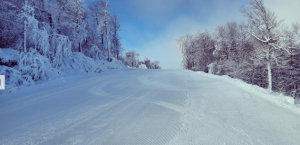
Onondaga trail looks ready for action. Nice blue! Credit: Belleayre Mtn.

There are discounted program that are currently offered. A septuagenarian will pay only $20 for a daily lift ticket. That’s not bad. If you fall into the 65 to 69 age category, your ski tab is $52 mid week and $60 weekend at the ticket window. If you buy online, that mid week price drops to $32. Belleayre also offers a variety of differently priced passes. A Season Ski3 combo pass good for Belleayre, Gore and Whiteface now costs $999 for those from 65 to 69. A Belleayre only pass was listed as $459 for 70 plus. Season passes would have been way cheaper if purchased in August.

All of that being said, Belleayre is one of the more attractive ski destinations in the Lower Northeast. It’s easy to get to and drive time is more than reasonable. The runs offer enough excitement for expert skiers with a variety of Black Diamonds running from the summit to the lodge. 

The blues are a terrific variety that give skiers an opportunity to condition their legs and move on to a more challenging blue before hitting the steep moguls and runs on the black diamond trails. Green trails are often used to loosen up before hitting  blues or blacks and are both easy enough for true novices and interesting enough for older skiers who simply want to put on skis and enjoy a day on the slopes.

Even on holidays and weekends when the caravans of buses head to the mountain from New York City, North Jersey, Albany and every school district in-between, the lift lines move along at a rapid pace giving you the opportunity to spend more time on the mountain and less time getting there.

The mix of skiers and snowboarders, young and not so young gives Belleayre a great panache. Respect for each other is paramount and it’s not uncommon to see a senior skier stopping to help or offer advice and suggestions to a younger skier who seems to be struggling down hill.

The mountain’s ski/snowboard school offers instructors capable of working with any age group to truly imparting the love of skiing.
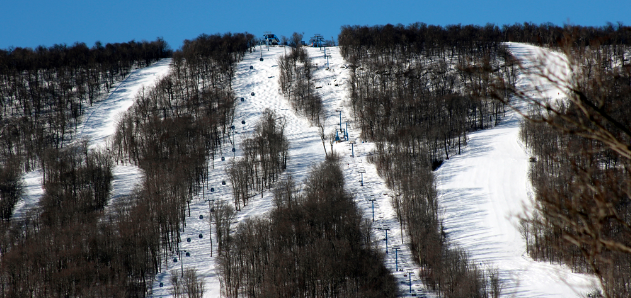
For a trail map, click here.

For web cam, click here.

Two hours from New York/New Jersey is Belleayre. That’s doable for a mid-week run where you will find lots of room on the slopes. Credit: Belleayre Mtn.

70s Ski Testing: A New Series

This is the first in a series about Ski Magazine’s 1970s ski testing program called Ski Performance Prediction or SKIpp.  Its methodology combined engineering analysis as well as a structured series of on the snow maneuvers designed to bring out the best and worst of a ski under a variety of conditions.

Part one of the series Determining How Skis Worked is an overview of the engineering analysis.  The second part discusses the on-snow testing that we did and the third is about the politics of ski testing along with a lesson learned.

Ski (and boot and binding testing) programs came about because skiers were faced with a plethora of choices backed by marketing hype that was confusing at best and to some, downright misleading.  Both SKIING and Ski Magazine decided to jump into the fray and help their readers.  Ski’s approach was significantly different than Skiing.  Given several glasses of smoky, single malt scotch, I might be persuaded to cover the quicksand of boot and binding testing in the 70s.

On the Snow Testing is a very brief overview of the on the snow part of the program.  Typically, we were at a mountain for about twenty-five days and tested 200+ skis.  Not bad work if you can get it, but it wasn’t all fun.  It was work!

Ski testing unleashed a set of business issues that challenged the leadership of Ski Magazine.  Most of the discussions were well above my pay grade as a lowly associate editor.  However, on more than one occasion, I was called into a meeting with the high-mucky mucks and asked why manufacturer A’s didn’t get high marks.  In Politics of Ski Testing, there’s enough to give you an idea of what the discussions were like.

In the end, the SKIpp and the engineering teams at most of the manufacturers found common ground, and we helped each other out.  It was the marketing people that created all the problems because the cries from the ski shops were giving them migraines.

The shaped ski as we know it today wasn’t on the horizon.  The material science and engineering software that creates them was in its infancy and ski design was as much black art as it was engineering.  We got a glimpse of the future one year when we tested twenty odd short skis – 170 – 180 centimeters – and were pleasantly surprised by the results.  The market was ready and when engineering and materials science caught up, voilà, you have the shaped ski.

Weird Weather: Rethinking Ski Clothes For A Fickle Climate

Let’s Review The Basics Of Layering To Deal With Changing Weather.

Sun, fog, snow all in one day. How do you dress for that? Credit: Janet Franz

Here in New England, temperatures swing high and low a lot lately, with 50-degree-plus spikes and heavy rains interposing snow squalls and blizzards. This winter seems hell-bent on convincing the last climate change denier that something weird is going on. Accurately assessing atmospheric conditions for a day on the slopes can challenge even the most seasoned skiers.

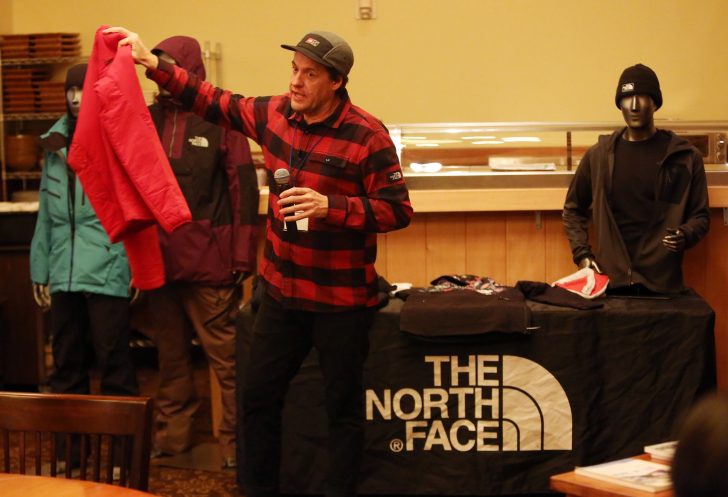
Stan Kosmider, field representative for The North Face, presented on “How to Dress for Cold Temperatures” at the Northeast Weather Summit at Stratton Mountain Resort in December. Credit: Martin Griff

Stan Kosmider, field representative for The North Face, talked with winter sports enthusiasts recently about packing for a multi-day cold weather adventure. “It could be a bluebird day, but the next day it’s pouring rain and icy,” he said. “So pack everything you own and plan on layers. You can remove or add clothes so that you never feel too hot or too cold.”

Three main layers provide for moisture management, heat retention and exterior protection.

Base: The most crucial layer for temperature and moisture control is the first one—your underwear. Skin sweats even when the air is cold, and if the perspiration soaks in to your long johns, the wet clothes will suck the heat out of your body, making you cold.

“The base layer gets moisture off your body and into the atmosphere,” explained Kosmider. This prevents excessive sweating, which can cause additional heat loss, especially when you slow down or stop to rest.

Look for under garments made of lightweight, breathable, wicking fabrics such as a synthetic (usually polyester) fiber, silk or ultra-fine merino wool. Avoid cotton, which absorbs and retains moisture, keeping the skin beneath it clammy and cold. A comfortably snug fit everywhere is essential, because to wick sweat efficiently, your next-to-skin layer must actually touch your skin.

Insulating: The middle layer’s job is to capture and retain body heat that radiates from your body, Kosmider explained. The more efficiently this layer traps heat, the warmer you will feel. Insulated jackets and sweaters come in a range of weights and synthetic and natural insulation choices abound. Down sweaters offer wind resistance but lose insulating efficiency when damp. Synthetic insulations mimic down’s efficiency, with better water resistance. Polyester fleece (not cotton fleece) is a great choice because it stays warm even when damp and dries fast. Fleece fabrics come in a range of plushness and thickness. Microfleece is thin and does a great job of wicking moisture away from the body.

For maximum temperature regulation, insulating clothing should fit close to the body, “snug, not baggy, and you should not have to size down,” Kosmider said. “The fabric should be thick enough to layer and be breathable,” so avoid thick fleece (more than 300 weight) or heavy wool sweaters. Fabrics with insulation-filled bubbles or ripples trap heat well.

Outer: The exterior layer, generally a shell jacket and pants, must do three things: block the wind, keep out rain and snow and allow sweat vapor to escape. Shells range from pricey mountaineering coats to simple wind-resistant jackets, but “even a $600 shell is worthless if you don’t have the right clothes underneath it,” said Kosmider.

Shell insulation types include down (again, warm but not waterproof), synthetic down (such as Primaloft, made from recycled plastic). “Down has the highest weight to warmth ratio, but when it gets wet it’s not warm. So, in this environment, it’s not reliable, and synthetic insulators are a better choice,” Kosmider explained. Shells with zippers and vents allow you to cool off without stripping down.

Shells may be waterproof/breathable for full-on squall conditions with high activity (they wick sweat but keep rain out) or water resistant/breathable for drizzly, breezy conditions and high activity. Avoid waterproof/non-breathable coats unless you plan to stand around in the rain (they keep precipitation out and trap sweat within). Kosmider recommends shells treated with a durable water repellent finish such as Gore-Tex – a rubberized, waterproof, breathable coating that allows water molecules to hold their shape, bead up and rolls off the surface.

Head, Face, Fingers and Toes

It’s not a myth that body heat escapes through the head, hands and feet. If you’re skiing or snowboarding, you should be wearing a helmet, which will keep your head warm. Look for a helmet with vents to let the heat out on warm days. For very cold days, don a skull cap or balaclava made of wicking fabric, because heads sweat, too. Liner socks and liner gloves keep feet and hands dry. Pack extra liners for extra sweaty days. A neck gaiter or face mask keeps the wind off cheeks and nose. Buffs serve the same purpose and work well as a headband to cover up “helmet hair” apres ski.

Product care

Ski clothes can be costly, but well cared for garments will last for many years, and layers will work best if cared for properly. Tiny pores in water-repellent fabrics become clogged with dirt and oils from skin, requiring periodic washing to remove debris and revive their breathability. Gore-Tex makes a special detergent for its products, but any liquid detergent without dyes, scents or fabric softeners will work. Dry garments in the dryer—without fabric softener— to reactivate the waterproof coating.

Down garments should also go into the dryer, without fabric softener. Use low heat, and place tennis balls or toddler’s shoes in the pockets to thrash the garments around so they will fluff up.

You can’t control the weather, but if you bring all your layering choices with you to the slopes, you can easily adapt as conditions change.


Mystery Glimpse: Who’s Flyin’?

Airborne Family Members.

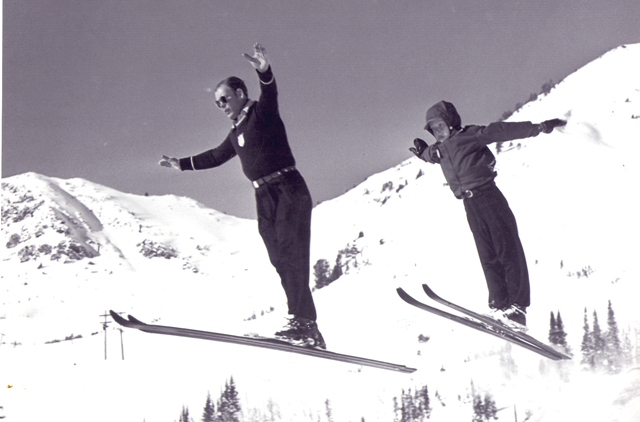
Who is airborne? Can you guess where?  Hint: We can’t tell you the name of the museum that contributed this picture. Know why?

Last Week

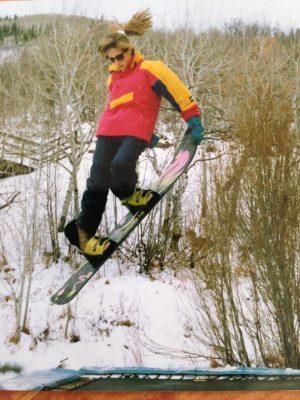
Only one reader got this one.  The enthusiastic boarder is Shannon Dunn-Downing, the first U.S. woman to win an Olympic snowboard medal with a halfpipe bronze in 1998.
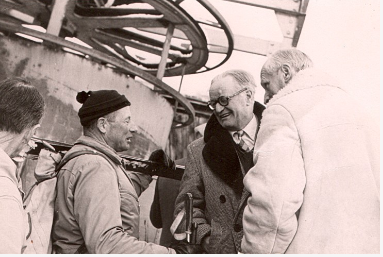
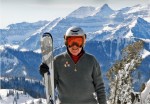
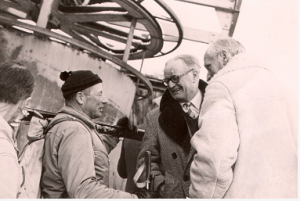
Shannon was the first woman to land several difficult halfpipe tricks in competition, including a frontside 540 in 1991, backside 540 in 1994, Mctwist in 1994, frontside 720 in 1995, and frontside rodeo 720 in 2001. She is also noted for working behind the scenes on the development women’s products for companies such as Burton Snowboards and Velvet Goggles.

In the mid-2000s, Shannon retired from professional snowboarding to focus on raising her family. She lives in Southern California and tries to surf whenever she can.

In 2016, the Colorado Snowsports Hall of Fame and Museum produced a tribute video to Shannon, highlighting her early days and Olympic success.  Check it out below.


Sir Arnold Lunn

In Praise Of Ski-ing

Sir Arnold Lunn wrote the rules for slalom and downhill. Credit: JungfrauStories

When this passage (below) from The Mountains of Youth (1925) by Arnold Lunn was published, “skiing” still had a hyphen and “ski” was both the singular and plural form. Lunn (1888-1974) invented downhill and slalom racing, introducing them when the sport was mostly jumping and nordic racing.

Lunn was knighted in 1952 “. . . for services to British skiing.” He was a major figure in promoting ski sports in the Olympic games. As is obvious in this selection, he was a competitive skier who loved speed and took daring chances.

*   *   *   *   *   *   *   *

Arnold Lunn on his first ascent of the Eiger 1924. Credit: Walter Amstutz

The worst and best moments in ski-ing are often separated only by seconds. You are standing at the top of some fierce slope which you have vowed to take straight. You look at the line and observe with sick disgust that the change of gradient is abrupt at the bottom, and that the slight bump half-way down will probably send you into the air. A kind friend says: “I shouldn’t take that straight,” and your enemy remarks: “Oh, it’s safe enough. Jones took it straight yesterday.”And then suddenly, before you quite realize what has happened you are off. The wind rises into a tempest and sucks the breath out of your body A lonely fir swings past like a telegraph pole seen from an express train Your knees are as wax, and your stomach appears to have been left behind at the top. You fight against the tendency of your ski to run apart—the inevitable sequel to undiluted funk—by locking your knees and turning your ski on to their inside edges. And now comes the supreme crisis—the run-out where the gradient suddenly changes. You throw your weight forward, and mutter “Hold it, hold it.” You clench your teeth, and make strange noises as the shock drives up through your legs. Your ski quiver with the strain . . . and you realize to your intense astonishment that you have not fallen.

The pace relaxes. The hurricane dies away. You are drunk with the wine of speed, and you marvel at the faint heart which so nearly refused the challenge. You glory in the sense of control which you have recaptured over your ski no longer untamed demons hurrying you through space, but the most docile of slaves. You are playing with gravity You are master of the snow. You can make it yield like water or resist like steel. Suddenly you decide to stop. A rapid Telemark, the snow sprays upwards, and the “slabberie snow broth,” to quote an old Elizabethan,”has relented and melted about your heeles.”

A laugh floats upwards, and you much enjoy telling your enemy that his diagnosis was correct, and that he can safely venture to take it straight. And, if he falls, your triumph is complete

*   *   *   *   *   *   *

Lunn’s classical education is apparent in his allusion to “an old Elizabethan.” The “slabberie snow broth” quotation, reports the Oxford English Dictionary, comes from the first English translation (1600) of Livy’s Roman History. Shakespeare mentions “snow-broth”—mixed snow and water—once, with reference to the blood in the veins of a villain. (Measure for Measure, I, iv, 57).


British athlete Sir Arthur Lunn helped create a sport out of a past time.

This Week In SeniorsSkiing.com (Dec. 21)

Last Minute Gift, Tell-Tale Hoar Frost, Jim Gaddis Profile, Mystery Boarder, Seasons Greetings.

Yikes, here come the Santas! Credit: EasternSlopes.com

If you’re caught empty-handed and about to head to another senior ski friend’s party, consider ordering and instantly downloading a copy of Ray Conrad’s classic collection of ski songs, The Cotton-Pickin’ Lift Tower and Other Ski Songs.

Ray wrote and recorded these songs ‘way back in the 60s. If you recall, the revival of folk music and growing interest in skiing happened at the same time.  The resulting mash up of ski songs is actually funny, nostalgic, kind of corny, and fun to blast out on the car stereo as you (or the giftee) heads to ski country.  Click below for a sample.

You can order the 16-song CD as an instant download from CDBaby/RayConrad for $20.

This Week

We are reprising a timely article from correspondent Harriet Wallis who asks “Should you take an early season lesson?”One of our surveys revealed that about one-third of our readership does in fact take an early season lesson for a variety of reasons, like having to adapt to changing physical capabilities. Click here for her story.

This week’s Mystery Glimpse is a woman snowboarder who…well, you tell us.  The function of last week’s thingy is revealed.  No, it wasn’t an inclinometer, at least according to the Colorado Snowsports Museum who supplied the pic.
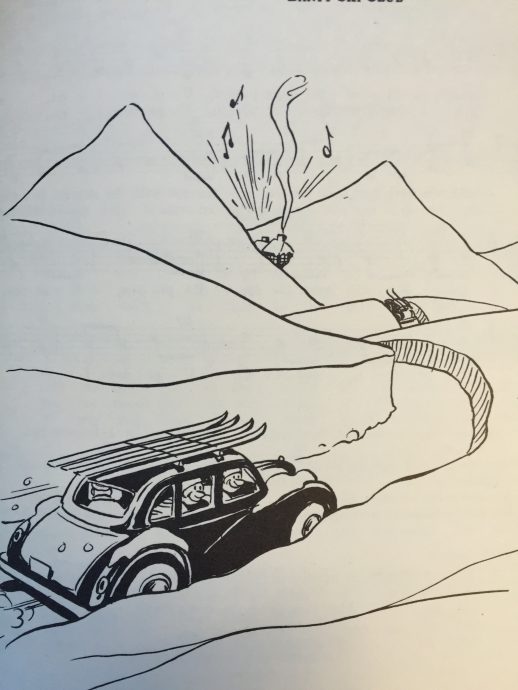
One of our readers, Hiller Hardie, from Pittsburgh, responded to our request for contributions by sending in an interesting article on Hoar Frost, the crystalline formation that appears on the ground or in woodland floors after a humid, cold night. Turns out, hoar frost is used by guides and ski patrollers to assess the risk of avalanche in back country.  Find out how by clicking here.

Co-Publisher Jon Weisberg writes about the innovative Apex boot which provides both comfort and support for senior skiers who dread the aches and pains of “regular” ski boots.  When we first started SeniorsSkiing.com, we noticed an article about Olympic star Billy (the) Kidd who said that he wore the boots as a way to adapt to his more senior style of skiing.  These boots were designed by Denny Hanson who revolutionized the industry in the early 70s with his Hanson rear-entry boot that many people regard as a major advancement in boot design. Readers of SeniorsSkiing.com can get a 20 percent discount on Apex boots until Dec. 31.  Jon will tell you all about it by clicking here. 

Finally, Harriet is back with a tribute to a SnowSports leader, Jim Gaddis, who made his mark as a fundraiser for a number of important snow sports institutions. 

Thanks very much for reading SeniorsSkiing.com. Tell your friends and remember, there are more of us every day, and we aren’t going away!

SeniorsSkiing.com is taking a break during the Christmas week. See you in 2019! 

Drive safely this week!

Looking At Surface Hoar Frost

A Tell-Tale Sign To Watch For In Avalanche Country.

As the weather in the Northeast has gradually become colder over the last few weeks, I have noticed the soil in my garden develops into crystalized patterns such as those in the picture below:

Crystalline shoots are a sign of hoar frost. Credit: Hiller Hardie

Of course, as the weather starts to turn cooler, I naturally start to think about skiing. As these thoughts materialized recently, I realized that this crystallization follows the same process as that of surface hoar in the snow pack. Surface hoar presents, on a smaller scale than these pictures, in a very similar manner. It develops overnight when the following weather conditions exist:

  • Clear sky
  • No direct sunshine, or very weak sun
  • Calm or light winds
  • Open slope exposed to a clear sky (trees or clouds can radiate their own heat and disrupt the process)
  • Humid air

If you have been fortunate enough to participate in guided backcountry skiing, including heli or snow catting,you may have witnessed the guides digging a pit in to the snow pack to evaluate its stability. You may also have seen ski patrollers doing this, notably at Western ski areas. Evidence of surface hoar in the underlying layers is one of the things they are looking for. It is also cause for alarm as it generally represents a very weak layer at high risk of releasing. (Another feature they may note, with alarm, is a layer of “ball bearing” like snow similar to hail. It looks like very small marbles and is a hazard as the overlying snow pack could literally roll right off of the “ball bearings’ forming a slide).

At any rate, the fact that this crystallization is occurring in my garden is good news for me as it means the weather is cooler and ski season is upon us. Here’s to a good winter!

Mystery Glimpse: Woman Snow Boarder Winner

Who Is She? What Makes Her Special?

Credit: Colorado Snowsports Museum

A competitor, a snowboarder (obviously), a woman.  See if you can put these clues together. Once again, thanks to the Colorado Snowsport Museum in Vail, CO., for this contribution.  Put your guess in comments below.

Last Week

Credit: Colorado Snowsports Museum

This artifact is a United States Forest Service avalanche control gun sight. It was used by Dick Stillman in 1955 at Berthoud Pass. During World War II, Dick served in the 10th Mountain Division, trained at Camp Hale, and saw action in Italy. After service, he started a 30-year career with the Forest Service as part of the U.S. Department of Agriculture. He established and maintained the High Alpine Avalanche Research Station at Berthoud Pass, Colorado from 1950 to 1963. At that time, the station was the highest in the world conducting avalanche research at 11,315 feet


Technique: The One Team Concept

No Matter What You Are Sliding On, Basic Athletic Principles Apply.

When I was a boy, my dad knew a woman who was a former USGA Senior Amateur Champion from South Carolina named Carol Cudone.  She constantly reminded my dad to finish his golf swing with his “belly button to the ball.” Ultimately she was trying to get my dad not to hit his shot off the back foot.  Or swing in a static position.

When I played a lot of tennis back in the day, I always was reminded by my coaches to finish the stroke on the front foot with my center of mass facing the completed shot.  Again, not off the back foot.

Mikaela Shiffrin says that skiing is not static either.  It is a continuous movement of working the ski from tip to tail in the turn with the center of mass always moving towards the next turn.  Three separate sports with a common theme of moving the body in an efficient manner in order to complete a shot, stroke, or turn. The common movement pattern is getting the center of mass in a position to execute a turn in the direction that you wish to go and to make a shot in the direction that will be successful.  Fluid movement and not static at all.

Recently, there was a commentary in the winter issue of 32 Degrees, the official publication of the Professional Ski Instructors of America, about the “One Team Concept”.  The magazine was doing a series of interviews about “Interski”,  a global summit of international ski instructors with the goal of sharing knowledge and technique.

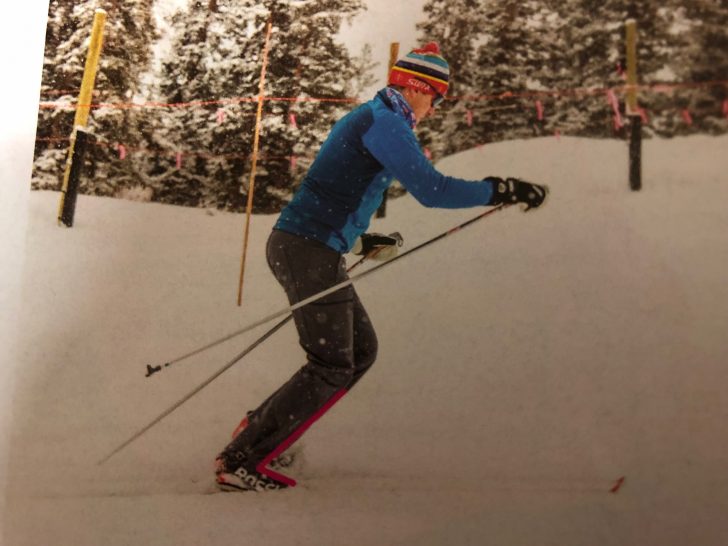
Forward, not on the back heel. Credit: “32 Degrees”

The United States team is always very popular at these events, and, in recent years, the concept of “One Team” has been a focus. “One Team” is all about representatives of alpine, cross country, telemark, and snowboarding all coming together to discuss the value and similarity of teaching techniques as they relate to how people learn and how to teach different personality types.

“One Team” also explored how similar movements in different disciplines of sliding on snow create efficiency and effectiveness.  As in the movements of golf and tennis, these four disciplines of snow sports have similar movement patterns.  Not only is the center of mass moving towards the new turn a common goal, but there is also the important role of a flexed ankle.  As you can see from the alpine photo, the flexed ankle manages the pressure of an alpine ski turn against the terrain.  So many people refer to bending the knees but the primary joint critical in the execution of a ski turn is the ankle.


Note forward ankle bend. Credit: “32 Degrees”

If you look at the cross country photo, the key to balanced forward movement in traditional cross country technique requires a flexible ankle to not only initiate the stride, but to keep the center of mass where it should be—forward— and not static-centered which hampers the glide process.  The same technique is required for successful telemark turns with a soft ankle utilized to maintain balance and forward movement.

Finally, in the adaptive world, there is a lot of talk about the outriggers being used as legs on an upright skier.  As the adaptive skier moves his center of mass towards the new turn, the outrigger extends on the initiation of the new turn and the other collapses on the inside of the turn. This is much like the flexed soft ankle of the uphill ski in an alpine turn.

As the adaptive skier moves his center of mass towards the new turn, the outrigger extends on the initiation of the new turn and the other collapses on the inside of the turn much like the flexed soft ankle of the uphill ski in an alpine turn. Credit: “32 Degrees”

Alpine, cross country, adaptive, telemark, and snowboarding all have a common balance and ankle platform that really creates a “one team” concept both in the actual instructional technique but also in the philosophy of a united front in teaching and learning techniques.  No matter what you are sliding on, the basic athletic principles apply.  Have you ever pressed your outside foot down and your inside foot up in a bicycle turn to the left?  The same principles apply there as well with the center of mass headed towards the turn along with the long leg, short leg, flexed technique.

As Mikaela says, nothing is static.  A good athlete is fluid and utilizes good body balance, movement, and flexion to execute that shot or turn.  Think about it the next time you do something other than skiing and definitely think about that center of mass movement across the skis towards the next ski turn with your ankles flexed.

Mystery Glimpse: What’s This Thingy?

Hint: It’s Government Issue.

Credit: Colorado Snowsports Museum

Thanks again to the Colorado Snowsports Museum in Vail, CO, for contributing this photo to our series. A special shout-out to curator Dana Mathios for picking some interesting relics and for providing answers to the “glimpse”.

The collection at the Colorado Snowsports Museum tells the story of the explosive rise of skiing in the Colorado Rockies, preserving a legacy for future generations.

Last Week

Tread Of Pioneers Museum in Steamboat Springs, CO, provided this picture of racer and celebrity Buddy Werner in happy times. On the left is Vanda, his wife, on the right is Skeeter Werner, his sister. As so many of you commented, Buddy was raised in Steamboat, raced in the late 50s and 60s, make the ’56, ’60, and ’64 Olympic teams, and, in 1959, managed to be the first non-Austrian or Swiss to ever win the famed and formidable Hahnenkamm downhill race in Kitzbuhel. Only one other American has ever won that race since, and that was Daron Rahlves in 2003.
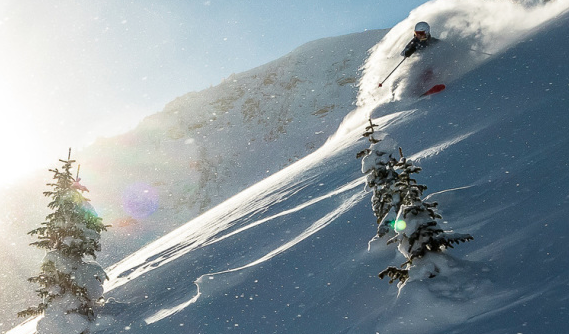
Buddy at Innsbruck.

After the 1964 race season, Werner retired from ski racing at age 28. Later that year, he and others were filming ski scenes for Willy Bogner’s first of many movies, Ski Fazcination, when he and German racer Barbi Henneberger were buried in an avalanche at St. Moritz. Bogner was eventually tried and convicted of negligent homicide and served a suspended sentence. The entire ski world was stunned.

Buddy Werner was posthumously inducted into the National Ski Hall of Fame, now the US Ski and Snowboard Hall of Fame, later that year.

Buddy Werner, American ski racer, 1936-1964. Credit: Tread Of Pioneers Museum

Guest Ski Tester

SKI Magazine Ski Testers Meet The Sundance Kid.

Gene Hackman and Robert Redford in “Downhill Racer” (1969). This heart throb really loved to ski.

Back in the early ‘70s, SKI Magazine (remember it?) developed a program called SKIpp that stood for “ski performance prediction” developed by the late John Perryman. He was a talented engineer who spent years in aerospace and worked with Howard Head at Head Ski Company. SKIpp had two parts, the laboratory analysis that predicted how the ski would perform and on-snow testing. Each year we tested 200+ skis.

John did the analysis and I ran the on-snow testing. Our testers were a mix of male and female skiers, primarily ski instructors with some racing experience. In March, 1974, we were at Park City which let us set up our testing tent near the base of the Shaft lift. Every morning, we tested ten pairs of skis. After lunch, each tester picked his favorite ski from the day or prior days and headed for the lifts.

One bright sunny morning, my lovely wife Betty was collecting test forms in the tent along with Joan, John’s wife, when one of the testers who was, at the time, the ski school director of Sundance Ski Area, walked into the tent and asked a simple question. “Would we allow Robert Redford ski on some our skis?”

We had skis that weren’t on sale yet, some that wouldn’t make it to the market, some that should never been sold to skiers, and Redford hadn’t signed the liability waiver. All of this went out the tent flap when Redford walked into the tent.

I tried to be my best cool, calm and collected Naval Aviator self, but the look on our wives’ faces was priceless – eyes and mouth wide open. Both were speechless that, if you knew them, was rare. His presence attracted the other three female testers who were nonchalantly trying to swap skis or ask Betty, John, or me a question just so they could get in the tent with Redford.

John looked at me, I looked John, and we shrugged. While our wives stared at the famous movie star, I managed to ask, “Can you ski 200 centimeter skis?”

“Yes.”

“What size boot do you wear?”

He gave me a size that I don’t remember. This was back in the days when boot sole shapes weren’t standardized, and we were using Market Rotomat rental bindings that took some fiddling to adjust. None of the easy-to-adjust bindings that we see today existed.

To this day, Betty will tell you she talked to him for a few minutes but has no idea what she said or was she coherent. What we do remember was that Redford was as good-looking in person as he was on the screen.

Oh, and one more thing. By the time he returned the skis, the word was out that Redford was around and a larger than usual crowd had gathered around the tent. None of us were smart enough to get him to autograph the test card he graciously filled out. Oh well!!!

This Week In SeniorsSkiing.com (Dec. 7)

Weather Factoids, Driving School, PA Trail Names, Utah Poet, Special Birthday For Klaus.

Sno Country’s Martha Wilson slides thru a turn under Tim O’Neil guidance.
Credit: Martin Griff

Busy week here at SeniorsSkiing.com.  We attended the Northeast Winter Weather Summit at Stratton Mountain, VT, and met with meteorologists, ski resort operators, and lots of journalists to discuss matters of mutual interest.  And we picked up some amazing fun facts from hanging around with some weather people:

  • Add this to climate change anxiety. A veteran weather man said the number of sun spots is on the increase. More spots means the sun is burning less hot than the past. The meteorologists call this the “solar minimum”, where sun spot activity causes the upper atmosphere to cool down.  Apparently, it’s a cycle, and we are in the coolest part.  Expect: Bitter cold winters, cool summers, perhaps a new Ice Age. (Not kidding, watch the news.)
  • For every 1,000 feet of altitude you ascend in going from a low lying area to a ski resort in the mountains, there is a drop of 3.7 degrees F. So, if it is 32 degrees in Boston, when you travel up 1,900 feet to the base lodge of Cannon Mountain, the temp will be roughly 24 degrees.
  • The record wind speed at the top of Mount Washington was 231 mph in 1934. Since then, the record has passed on to Australia where a speed of 253 mph was recorded during Cyclone Olivia in 1996.
  • The crew at the top of Mount Washington has to de-ice their manual wind anemometers and other instruments by hand, climbing a ladder to the top of the station and banging off the ice with a hammer, regardless of the weather. That happens as much as every 15-20 minutes, if a storm keeps building up the ice rime. Note: during storms on Mount Washington, the wind can be up to 140-170 mph. Here’s a 38 second video of a guy outside the MWO when the winds are only 109 mph. Click on the image to play.

Winter Driving Tips

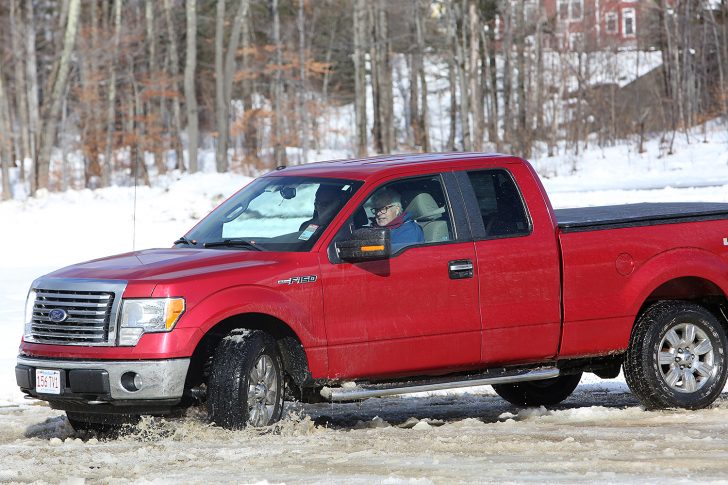
My Big Red Truck sliding thru a turn, under the guidance of the Team O’Neil Rally School. Credit: Martin Griff

We also had a lesson in how to drive in winter conditions from the Team O’Neil Rally School in Dalton, NH. In a separate story, we’ll show you the one extremely important driving control button on our Ford truck we never knew existed and what happened when we pushed it. This was a counter-intuitive eye-opener, and we want to make sure you know about what your special button does in your car because it is imperative you understand how to use it in certain conditions. In addition, we learned about lower tire pressure for deep snow (up to a point), and the importance of being prepared for the mountains.  You can watch lots of different videos on driving techniques from Team O’Neil by clicking here.

Click here for our story on “the button”.  Incidentally, if you have a teenage grandchild, the driving school might be an excellent holiday gift.

This Week

Correspondent Don Burch’s series on ski trail names continues east to Pennsylvania. Writer and cartoonist Mike Roth offers a whimsical take on trail names, too. Jan Brunvand brings us a poem from a Utah poet with advice for a new skier. Our Mystery Glimpse presents a new challenge with two photos of a legend who was gone before his time and the answer to last week’s puzzle.  Someone actually got the right answers, others were pretty close.

Finally, we honor Klaus Obermeyer, the venerable ski fashion icon, who is 99 this week.

Please remember us to your friends. There are more of us every day and we aren’t going away.


Winter Driving: Where’s Your Car’s TC Button?

An Eye-Opening Lesson From Team O’Neil Rally School About Spinning Tires And Traction Control In Snow.

Turning off traction control to see how the Big Red Truck behaves. Credit: Martin Griff

At this past week’s Northeast Winter Weather Summit held at Stratton Mountain, VT., we had a chance to do some driving, spinning, skidding, and generally driving like a cowboy home from the range on a controlled, enclosed test area with mixed conditions: gravel, ice, snow, and mud. We learned something about our Big Red Ford 150 truck that we never knew.  There is a button dedicated to tire spinning.

Driving School owner Tim O’Neil says know how your vehicle reacts in different conditions. Credit: Martin Griff

Here’s the concept, according to Tim O’Neil, owner of the Team O’Neil Rally School, Dalton, NH, which has been in business for over 20 years. Usually your vehicle is operating in traction control mode. That is, there is a mechanism that is usually on that prevents your wheels from spinning, preventing certain skids and spin-outs. Tim said, “In deep snow, you may want to turn off that traction control so you get some helpful spinning from the tires. If you don’t, your tires might want to spin, but the traction control makes the engine cut out. That’s the way the system works.”

Where’s that button? The traction control button (aka AdvanceTrac (R) on a Ford truck) was in plain sight right in the middle of our dash. When pressed, traction control is off,  you can do all kinds of interesting spins and skids on that gravelly roadway.  When turned back on, the truck noticeably behaved itself in the turns. However, if the snow was deeper, and/or you were going up a snow-filled or deep sand road on a hill, we would have turned the AdvanceTrac (R) off, and the spin would have actually helped us by allowing the engine to keep delivering power and not cutting out.

Ford calls this the AdvanceTrac (R) system. Turning it off allows the wheels to spin in deep snow.

Of course, when we turned on the four-wheel drive, the truck handled our outrageous turns and braking like a mountain goat.  But not everyone has four-wheel drive.

In some cars, traction control is tied in with what’s called the Dynamic Control System or DCS which ties in the anti-locking brakes (ABS) along with the engine.

The bottom line is that you need to find that button, check your vehicle’s manual to understand how to use it, when it is appropriate to turn it off, and experiment in an empty parking lot on a snowy day.

From Tim’s perspective, newer cars have so many features that owners often overlook some important controls. “The more you know about your car and how it behaves in the snow, the better and more confident you’ll drive. Learn when about to brake hard, and when to brake gently. Brake in the middle of a turn in snowy conditions and see what happens. Or brake early in a turn. Basically, know how your car reacts and use that in different conditions.

“When driving in the winter, it really makes sense to prepare: know how to control your car, get the right tires, shovels, new wipers, an emergency kit, and start earlier than you think.  Don’t let a snowfall cancel your trip to the mountains,” Tim concluded.

SnoCountry’s Martha Wilson slides thru a turn under Tim O’Neil guidance.
Credit: Martin Griff

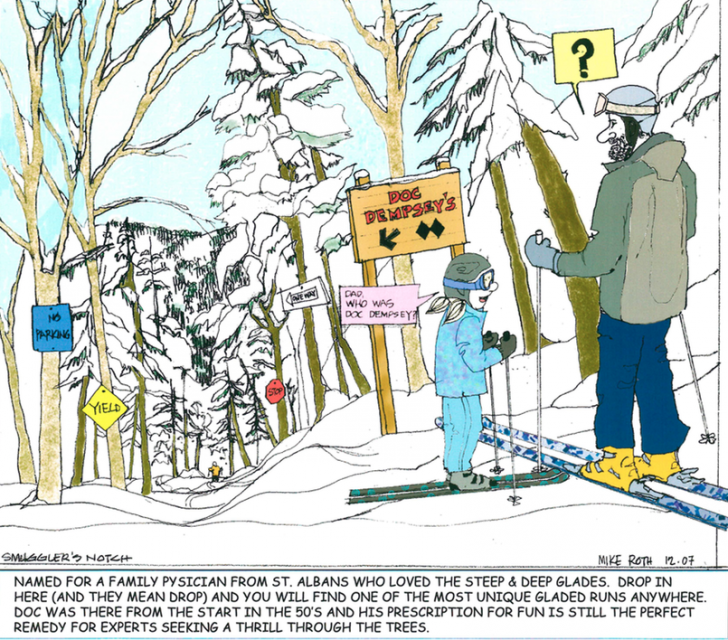
Trail Name Series: Doc Dempsey’s

A Wonderful Cartoon From Mike Roth, Ski Journalist From Albany.

Mike writes and draws cartoons for the Albany Times-Union Ski Blog. This one is about Smuggler’s Notch’s Doc Dempsey’s run.

Credit: Mike Roth

Trail Name Series: Pennsylvania

Extrovert, Powder Puff, and The Elevator

Spend a little time looking at resort maps and you’re sure to find some attention-grabbing trail names. When I looked at Pennsylvania resorts I found some beauties. Powder Puff and The Elevator at Jack Frost along with Extrovert at Blue Knob topped the list.

Among the best is High Hopes also at Blue Knob. Seven Springs has three trails making it into the top of the list; Santa’s Beard Terrain Park, Lost Boy Trail and Lost Girl Trail. Also noteworthy are Vertigo Park at Liberty Mountain and White Lightning at Montage Mountain.

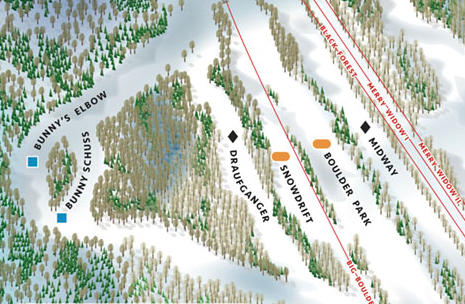
See if you can spot Draufganger on Big Boulder’s Trail Map.

Rounding out the list is Draufganger (German for daredevil) at Big Boulder.

Several Pennsylvania resorts stand out for having trail names that follow a theme. At Roundtop Mountain many trail names relate to the Revolutionary War. These include Recruit, Bunker Hill, Lafayette’s Leap and Fife and Drum. At Camelback trails are Egyptian themed such as Nile Mile, Pharaoh, Asp, King Tut and Cleopatra.

As you’d expect, at Eagle Rock trails (and lifts) are eagle-related. Trails include Baldy, Talons, Nestling and Screaming Eagle. Lifts include Wings and Soaring Heights. At Elk Mountain trails have Native American names such as Mohawk, Kickapoo, Seneca, Iroquois and Chippewa.

Do you have a favorite trail name that’s been overlooked? Please let us know in the comments section.

Snow In Literature: Lesson #1

Utah Poet Offers Instruction And Advice For Beginners In Sonnet.

The following loosely-rhymed sonnet is by Utah skier and writer Emma Lou Thayne (1924-2014). It appeared in her 1971 book Spaces in the Sage and was once printed on a ski poster sent nationwide to advertise Utah’s “Greatest Snow on Earth.”

Emma Lou Thayne.

Thayne earned a master’s degree in creative writing from the University of Utah after having already established herself as a published writer. For a time she coached the UU women’s tennis team. She was an activist for women, peace, AIDS awareness, and mental health issues, and she was a much-beloved Utah personality and writer.

Her love of skiing Utah powder and her penchant for off-piste adventure is beautifully expressed in this poetic piece of advice to a young beginner. Growing up with three brothers, and raising five daughters, Emma Lou had plenty of opportunities to observe, advise and instruct youngsters in skiing.

Lesson #1

Alta. Credit: SkiUtah

Ski here, my child, not on gentle slopes

where the snow is packed and the trail is wide.

Instead, cut through the trees where no one’s tried

the powder. Push toward the hill and rotate

as you rise. No, the snow-plow holds you back;

it’s slow and makes you frightened of your turn.

Think parallel. Stay all in one, then learn

to ski the fall line, always down: Switchback

skiers in their caution never know how

dropping with the mountain keeps the balance

right and rhythm smooth. Don’t watch your tips at

all. Look past them at the deep white snow,

virgin as light, and yours. Just bend, release:

You, gravity, and white, will make your peace.

Powder Mountain. Credit: Ian Matteson


Mystery Glimpse: Flying Racer

Who Is The Airborne Skier? What’s His Story? Do You Know His Hometown?

This week, we made the Mystery Glimpse a little more challenging.  Name this high flyer.  Tell us about him and (hint) how he met his unfortunate and untimely end.

Okay that’s hard. Here’s another one of this celebrated personage.

These photos come from the collection of the Tread Of Pioneers Museum, Steamboat Springs, CO. The museum is a not-for-profit historical institution that promotes an understanding and appreciation of the history of the Steamboat Springs area by collecting, preserving, exhibiting, interpreting, and sharing that history and heritage with audiences of all ages and interests. Check out its collection of historic skiing photos.

Last Week

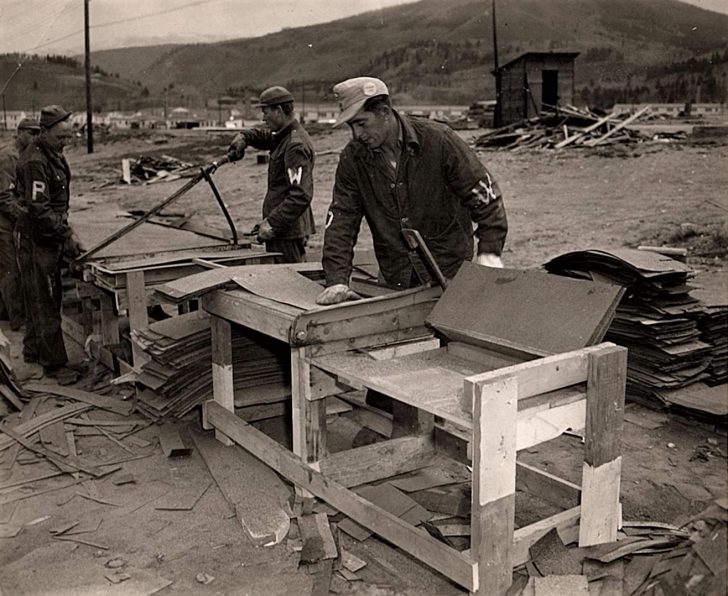
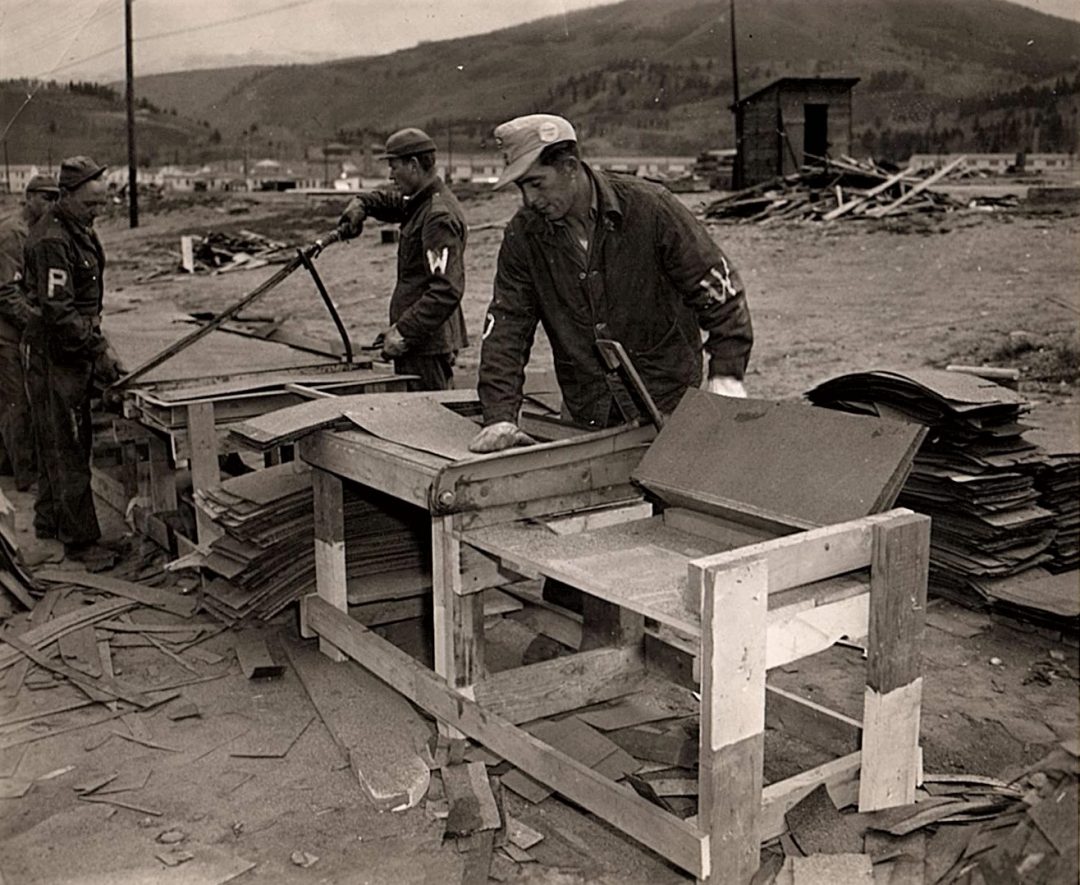
German POWs making shingles at Camp Hale, CO, circa 1943-46. Credit: Colorado SnowSports

We had at least one correct comment on who these soldiers were, as well as some very close guesses.

Those hard-working chaps were German POWs held at Camp Hale, CO. Did you know that from 1943 through 1946, Colorado had 48 Prisoner of War Camps? Out of the many camps, the Army placed several hundred German prisoners of war at Camp Hale, the 10th Mountain Division training facility. Though communication between prisoners and soldiers was officially forbidden, the German prisoners regularly talked with the German sympathizers in the 620th Engineer General Service Company, which arrived at the camp on December 5, 1943. The 200 soldiers who made up this unit were not actually engineers. Like several other army units, the 620th was made up of suspected Nazi sympathizers (mostly Germans) and other opponents of the war.  They got along quite well with the POWs, exchanging greetings and illegal gifts. The images show POWs making shingles and stacking lumber at Camp Hale.

Thanks again to the Colorado Snowsports Museum, Vail, CO, for contributing the photograph from its archives.  You can virtually visit the museum by clicking here. 

SeniorsSkiing Guide: Japan’s Hakuba Valley

A Senior’s Introduction To Some Of The Best Skiing In Japan.

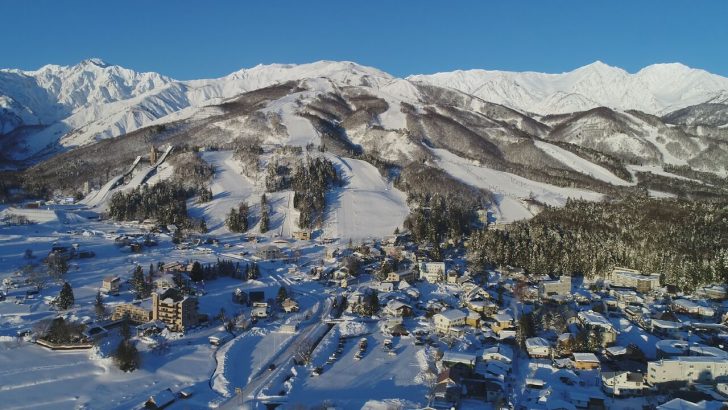
Happo One is the largest resort in the Hakuba Valley with four base areas serving the mountain. Credit: Hakuba.com

The Hakuba Valley sits three hours west of downtown Tokyo and boasts some of the best skiing in all of Asia. Host to the 1998 Winter Olympics, Hakuba offers a unique combination of diverse terrain spread out over 11 resorts, 12 meters of annual snowfall, world class facilities, and amazing Japanese cultural experiences: think sushi, hot springs, and thousand year old temples. The entire valley has been added to the 2018/19 Epic Pass allowing pass holders five days of free riding across all of the resorts.

Access

From downtown Tokyo you will take the famous Japanese bullet train one and a half hours to Nagano Station where you will need to transfer to a bus for the last one hour of the journey. The entire is just 3 hours and costs ¥10,000. ($85.00)

Two Outstanding Resorts In The Valley

Happo-One

The largest and most central resort in the valley is Happo-One (pronounced On Ay), spreading across 220 hectares. The highest run is 2,696 m and spreads to four base areas providing everything advanced skiers could want: steep runs, high vertical drops, and powder runs. There are opportunities for beginners as well but this resort is best suited for intermediate and advanced skiers.

Adult Lift Ticket: ¥5,200 ($46.00)

Senior Lift Ticket: ¥4,700 ($41.00)

Cortina

Cortina has become synonymous with powder skiing for Hakuba enthusiasts. The resort receives the highest and driest snowfall in the valley and usually gets nearly twice as much snow as neighboring resorts. The snow patrol at Cortina are quite relaxed, and off-piste skiing is not an issue.

Adult Lift Ticket 1 Day ¥4,000 ($35.00)

Senior Lift Ticket 1 Day ¥3,200 ($28.00)

Alternatively, visitors can buy the Hakuba All Valley Pass which gives pass holders access to all 11 resorts.

Lessons

The Evergreen Outdoor Center is the largest international ski school in Hakuba and offers English language lessons with certified instructors on Happo-One.

Gear

You can get all your rental gear at Central Snow Sports. They have several locations throughout Hakuba and have very knowledgeable and friendly English speaking staff.

Basic Ski Rental Package: Approximately ¥4,000 per day ($35.00)

Where to stay?

Happo Village has everything you need for a comfortable stay in Hakuba: proximity to the resorts, best restaurants, hot springs, and public transportation.

Marillen Hotel

Only in Japan: Marillen is an Austrian-themed hotel in the heart of the Hakuba Valley. Credit: Hakuba.com

The Austrian-themed Marillen Hotel sits on the Nakiyama slope and is one of the few true ski-in-ski out hotels in the Hakuba Valley. The Austrian theme stretches  to the food with schnitzel and pretzels served while a fire roars and live musical acts perform in the après bar. Nakiyama even offers night skiing if you find the energy for a few extra runs after dinner.

Onsen

Soaking in a Japanese hot spring after a long day on the slopes is a terrific way to relax. Be advised,  it’s customary to bathe in the nude. It may feel daunting to walk into a public onsen at first but the experience is well worth any initial awkwardness. There are multiple onsens within Happo-Village, and they cost approximately ¥600 ($5.50) per visit.

Off the Slopes

Join a day tour and soak in the rich Japanese culture and visit the world famous snow monkeys. This full day tour takes you from Hakuba to Nagano City where you’ll stop at Zenkoji, an eighth century Buddhist temple. Many believe the first Buddhist sculpture ever brought to Japan remains within this sacred building. After touring the temple, you’ll be taken to the snow monkey park where you’ll be able to see the only monkeys in the world known to bathe in hot springs.

For more information, click here for the Hakuba Valley site.

The Cortina resort offers lots of snow and powder opportunities. Credit: Hakuba.com


Mystery Glimpse: Who’s Diligently At Work?

They’re Lucky To Be In The Mountains And Not Where They Were.

This should be relatively easy.  Who are these chaps? What are they doing? Where are they doing it? When? Look closely. There are clues you can see.

Thanks, again, to the Colorado Snowsports Museum and Hall of Fame for contributing this picture. The museum’s website has some well-researched articles on the history of snow sports of all kinds in the Rocky Mountains and Colorado. Click here for more. SeniorsSkiing.com thanks Dana Mathios, Director of Collections, for working with us on this series.

Last Week

We thought this would be more difficult. Clearly, there are some fans of Queen Maud of Norway out there. The photo is the young Queen, right, skiing with her sister, Princess Victoria, in 1907. The Vesterheim Norwegian-American Museum contributed this photo. Apparently, this pose was an attempt by English-born Maud to look more “Norwegian”.

Queen Maud was daughter of Britain’s Edward VII, was raised in England, and married a Danish prince. Clearly, inter-marriage of royals was a way to ensure longevity for blue bloods. During her first years in Norway, she and her spouse were photographed in Norwegian folk costumes, and enjoying winter sports such as skiing, to give them a Norwegian appearance in the eyes of the public. Hence, this picture.

In 1877, Norwegian Americans began collecting and preserving objects at Luther College in Decorah, Iowa, documenting their chapter of the immigrant story, making them pioneers in the preservation of cultural diversity in America. That early collection

Maud of Wales in 1906

has grown into one of the most comprehensive museums in the United States dedicated to a single immigrant group—Vesterheim Norwegian-American Museum, now an independent not-for-profit organization accredited by the American Alliance of Museums (AAM).


My Career As A Folk Singer

An Undergraduate’s Parody Ski Song Led To An Academic Achievement.

How did a ski silly ski song to the tune of a classic melody wind up on a Folkways record which became a classroom classic?


As an undergraduate at Michigan State University in the early 1950s I joined the ski club, and I learned, among other things (like how to kick turn), a bunch of ski songs. We sang them driving up to Caberfae resort near Cadillac and apres ski in a local joint, The Pine Gardens.

These songs—passed from person to person—were often parodies. A takeoff on “The Battle Hymn of the Republic” told the sad tale of an injured ski racer with the chorus “Gory, gory, what a Hell of a way to die!”

Another disaster-themed favorite re-worded the cowboy ballad “Streets of Laredo.”

When I was a-skiing the hills of Sun Valley,

As I was a-skiing Old Baldy one day,

I spied a young skier all wrapped in alpaca,

All wrapped in alpaca, and cold as der Schnee.

This lugubrious piece went on to quote the injured skier who “Once upon Baldy used to ski gaily” but then “caught a right edge, and I’m dying today.”

Later as a graduate student in folklore at Indiana University I took a course on British ballads and learned that our Sun Valley song was part of a much older cycle of variations on the theme of “The Unfortunate Rake.” That’s “rake” in the archaic sense of a dissolute person, a libertine.

Author Jan Brunvand, occasional singer of ski songs, in the 50s.

In the original Irish and English versions the victim was a young soldier, dying from an STD, who describes his sad condition and requests a funeral: “Get six young soldiers to carry my coffin,/ Six young girls to sing me a song.”

In the cowboy song the funeral request became “Beat your drums slowly and play your fife lowly, /Get six of them gamblers to carry me along.” Our skiers’ parody called for “Six from the ski school to carry my coffin,/ Six little bunnies to sing me a song.”

One of my classmates, a rising star in folksong studies, was compiling a record of versions and variants of the “Rake” cycle. He enlisted me to sing the skiers’ version. Trouble was, I couldn’t sing worth a darn.

So we got another fellow student who performed in a local folksong group to plunk guitar chords to keep me more-or-less on key, and I managed to lay down a decent track, as we say in the business.

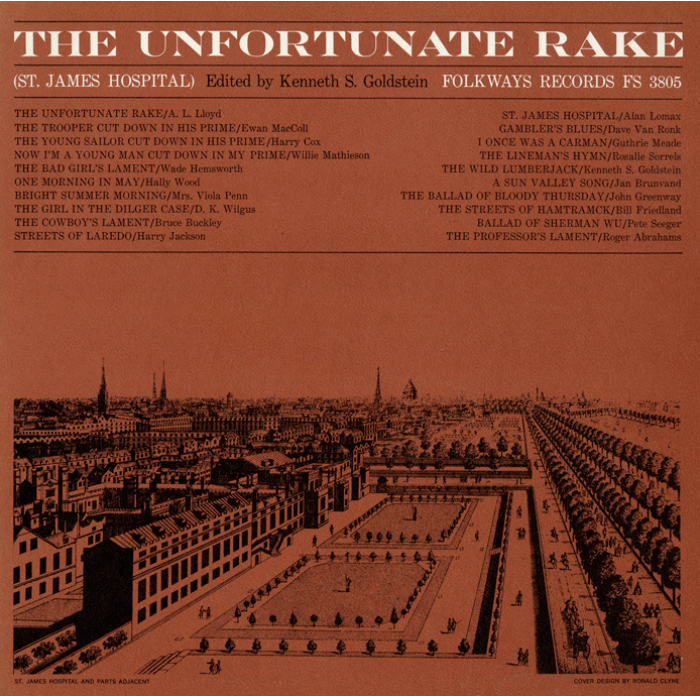
The LP was issued by Folkways Records in 1960, and there I was earnestly chirping my “Sun Valley Song” on the same disk as nineteen real folk singers, including Alan Lomax and Pete Seeger.

“The Unfortunate Rake: A Study in the Evolution of a Ballad” became a classroom classic used to illustrate how texts change as they are transmitted via oral tradition.

And you can listen to a sample of the “Sun Valley” song by clicking here. 

Even though this was my sole appearance as a folksinger, I make up in longevity what I lack in numbers. The Smithsonian Institution bought out Folkways and kept the entire catalog in print. Their website offers “The Unfortunate Rake “ by “various artists” as a CD or a download.

Or you can check it out on Amazon by clicking here.

I still like to sing an occasional ski song, to myself, usually while cruising western slopes, including a few times even those at Sun Valley.


Treasure Your Ski Buddies: A Tribute

Skiing Binds Friends Together; Don’t Skip A Trip.

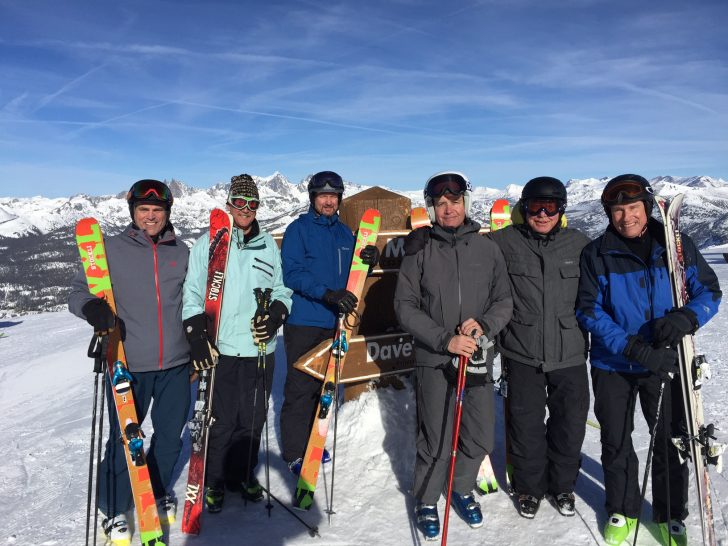
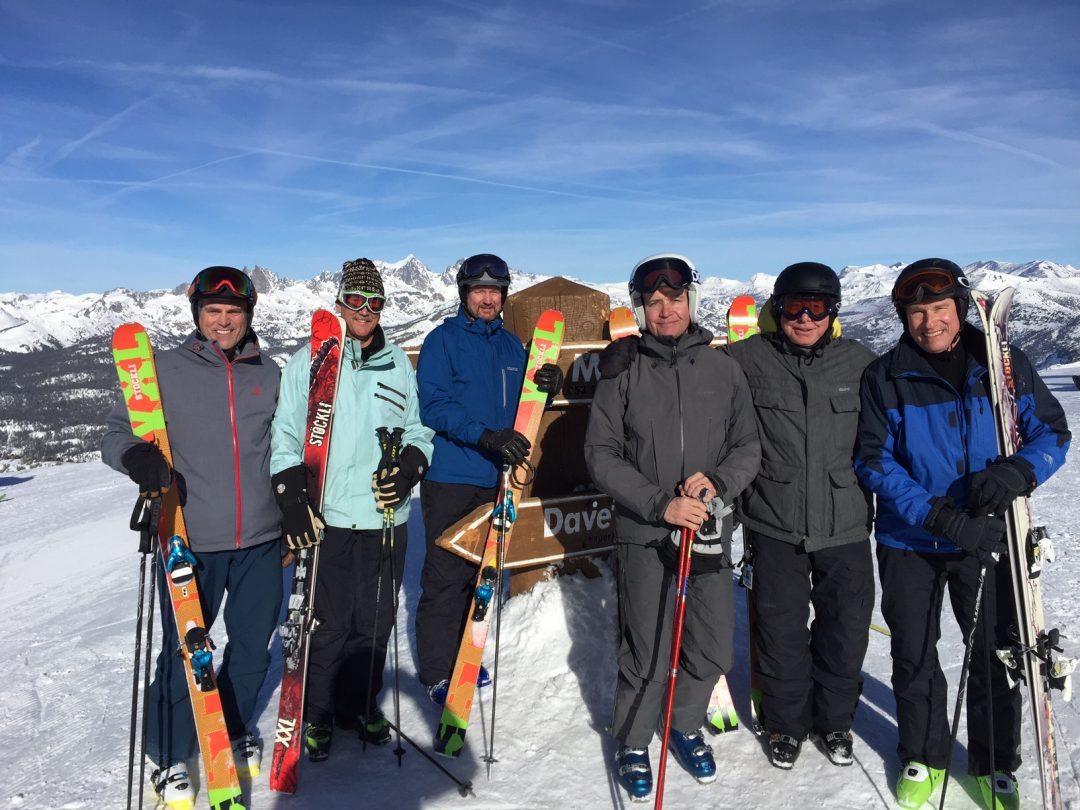
Great friends, great memories. At the top of Mammoth Mountain.  Credit: Pat McCloskey

One of the great things about the sport of skiing is that it is a conduit for friendships.  There is nothing like the anticipation of the weekly get together with friends or the ski trip with pals that you have skied with for over 40 years.  There’s a buzz: the excitement, the snow reports, who has new equipment, and when and where will we all meet.  The guys that I ski with every year on a March ski trip go hard.  They are ex-ski racers and coaches and keep themselves in good shape and we all look forward to the annual trip together coming in to Tahoe from all over the country.

They are cherished friends, and we lost one this summer to an unexpected heart attack.

Proctor Reid was a Dartmouth ski racer back in the day and a highly educated head of a government engineering think tank in DC.  Proctor always impressed me with his big strong GS turns as well as his intellect, and great sense of humor.  It will be a hole for sure in our group this coming March as we toast and ski a run or two for our pal Proctor.  He is pictured on the right in the blue and black jacket with all of us at the top of Mammoth with the great backdrop of the Minarets.  God bless him.  We miss him terribly.

Another guy in this group pictured in the back with the blue jacket is our ring leader and host Eric Durfee from Incline Village, NV.  He recently cut short a trek in Nepal with his wife because of an unfortunate accident.  While spreading the ashes of his in-law at the base camp at Everest, he blacked out and fell eight feet into rocks off the side of the trail.  He was helicoptered to Kathmandu where he and his wife spent a week during extensive tests to determine when and if he could fly home.  Fortunately, everything checked out, and they are on their way back to the states flying first class to Reno from Kathmandu.  He tells us all not to worry.  He will be skiing Mammoth next week.  Tough old bugger.

Not being morose here and hoping to spark a little thought, life is precious.  There are no guarantees and that is why it is so important to get together with friends and no better way than on a ski trip.  Sure, things come up and there are always a million excuses for why we are too busy, it is a bad time, had a flat tire, or some other lame excuse.  But when you make it a priority, skiing binds you all together for memories that last a lifetime.  Same with the groups at your local areas.  Yes, it is cold, the weather might not be optimal here in the East, but drag yourself out and be held accountable to your local group and expect the same results of laughs, great turns together and that cold IPA at the end of the day in the ski lodge.

I just had another birthday and I still ride mountain bikes at night with lights and ski as much as I can during the winter.  I have to keep it going.  I asked Scott Nicol of Ibis Bike fame how long he thought we would be riding and skiing at this level.  He said, “ Pat, don’t even think of it. Don’t let anyone say that you are too old to do anything.”  Like the saying goes, “You don’t quit skiing because you get old.  You get old because you quit skiing.”

Treasure your friends.  Go ski with them.  And always remember—no friends on a powder day.

This Week In SeniorsSkiing.com (Nov. 23)

Free (Or Almost Free) Skiing Directory, Skis For Seniors Recommendations, Chile Wrap, Trail Name Series, Ski History Gala, Skiing In Skirts.

Here’s one Tom who made it past Thursday, glad to be trotting on the snow. Credit: SnoCountry

Happy Thanksgiving On The Snow!  For the first time in recent memory, there are plenty of lifts spinning in New England areas and in Colorado and other places in the West. The recent East Coast Nor’easter brought a snow covering and this week’s persistent precipitation has raised the snow level up to the top of boots in many areas.  Fingers crossed this is a harbinger of a long, cold season.  By the way, that is counter to the official El Nino-fused forecast for warm and wet here in the North East.

Last week, we published an update to our listing of resorts where the US and Canada where seniors can ski for free or almost free. We believe this is the only listing of its kind in the ski world.  You can access this list by clicking on the third menu box from the left under the blue ribbon at the top of the page.

We also published our list of ski recommendations for seniors which we compiled with the help Realskier.com, a long-time and respected reviewer of and commentator on skis and ski design. You can find this listing on the second menu from the left, next to the free (or almost ski list) list.

You may be asked to re-enter your name and email address to access these resources. There is no charge for any of these assets. We’re presenting them to the SeniorsSkiing.com community of readers to give you more specifically tailored resources for senior.

This Week

Casey Earle reports on the ski season in Chile, sharing some good news-bad news. Despite a shortage of snow, there were some great days and he took advantage of them.  If you haven’t even seen pictures of South American skiing, his article is a good introduction.  We’ve also included a link to more comments on Casey’s Ski Chile page on Teton Gravity Research.

We continue Don Burch’s trail name series with a swing through Michigan’s many resorts. Also Harriet Wallis reports on the University of Utah’s Ski Archives Gala where awards were handed out to Olympic visionary Harold Peterson and the US Forest Service and the Utah Avalanche Center, a team which has played a major role in controlling errant snow flows in the state.

Finally, our Mystery Glimpse looks at a pair of young ladies skiing in skirts more than a hundred years ago. We report on what the significance of that big brass bell was from last week’s puzzle.

Thanks for reading SeniorsSkiing.com.  Tell your friends, and remember, there are more of us everyday and we aren’t going away.

Chile skiing. Credit: Casey Earle


Chile 2018 Ski Season Wrap Up

Finding Good Days In A Disappointing Snow Season In The Southern Hemisphere.

The 2018 season started on time in June, after a serious drought, but sputtered out before it ever really got going. The Chilean Central Zone ended with a 54 percent precipitation deficit, despite ENSO-neutral conditions. For a ski area in Chile not to get to the Sept 18 National holidays is shameful. Which is not to say there were no good days, just that they were few and far between.

Being relatively free to select those good days, I can share a couple of snaps that are deceivingly good.

The Las Vegas lift out of the La Parva village on a cold day in July. Helps to know where the rocks aren’t.

La Parva. Credit: Casey Earle

The conditions were not sufficiently good to ski other Central Zone ski areas, where I am not so intimately familiar with their thin base rock gardens.  So in September we headed 560 miles to the south where Mother Nature was more accommodating.

The Hotel Puyehue. Credit: Casey Earle

Our first lodging was the venerable and grandiose “Termas Puyehue Wellness & SPA Resort”, formerly the Gran Hotel Puyehue, founded in 1907. Back then, guests arrived by steam boat across the Lago Puyehue to enjoy its charming hot springs. The hotel is very well located at the entrance to the Parque Nacional Puyehue, established in 1941, and the lovely Antillanca ski area, tucked up in a volcanic cirque 18 km away. This is reached at the end of a good dirt road that winds through temperate rainforest and lagoons. The snowpack was 6-10 feet, from the mid station up, as it had rained hard at the base.

Here it can rain six feet a year, so when that falls as snow, it adds up, and 10-15 ft bases are not uncommon.

I seized an unusually brilliant sunny day and headed up. Nary a rock to be seen, and superb spring snow.

Heading down back off the crater towards the ski area, with the Puyehue Lake in the distance.

La Parva. Credit: Casey Earle

After the traditional September 18 mega-BBQ at a friend’s place in Puerto Varas, on the Llanquihue Lake, we drove back north 200 miles to Corralco ski area, on the Lonquimay Volcano.

This time we chose a cozy cabin in Malalcahuello, a nearby up-and-coming mountain town nestled in a group of volcanos. Monkey puzzle trees greet you as you wind up through the forest to the barren eastern bowl of the volcano.

Again, no rocks here, even at the end of September.

Credit: Casey Earle

While the American ski team trained on the far right side of the ski area, those venturing into the bowl to the south got fresh tracks

Corralco closed at the end of October, by far the latest closing for any ski area in Chile this year.

If you liked this 2018 summary, and want to drill down to the nearly daily detail of how it panned out, try reading a bit of my 276-entry collaborative thread on the Teton Gravity Research website. Click here for my Ski Chile comments.

Michigan Skiing

Trail Name Series: Michigan

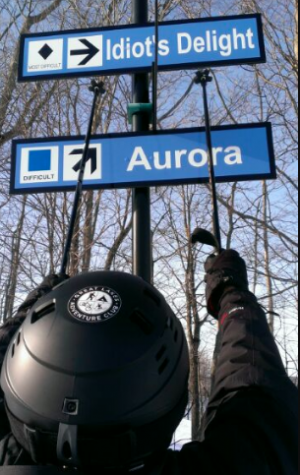
Idiot’s Delight, Fun Bubble and Crisis.

[Editor Note: Last week, we launched Don Burch’s Trail Name series with a round-up of trail names from resorts in California.  This week, we move to Michigan. If you have some trail names that stick in your memory, please let us know in the comments section below.]

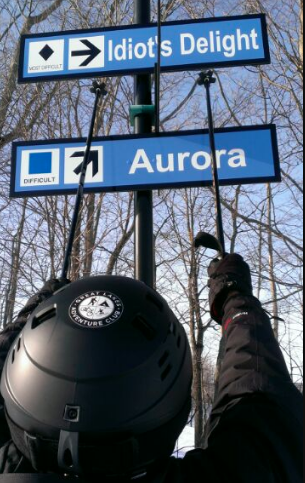
Look at some resort maps and you’ll find some very creative trail names. Among resorts in Michigan, I found some gems. Making the top ten are Idiot’s Delight at Boyne Mountain, Fun Bubble at Marquette Mountain and Crisis at Pine Knob.
Marquette Mountain has another trail in the top ten, Oh, Zone. Nub’s Knob also has two in the top ten; Hot Flash and Bark Eater (there is also a Bark Eater at New York’s Titus Mountain). Rounding out the list are Don’t Chute at Big Powderhorn, Coffin Canyon at Mt. Holly, Elf Buster at Schuss Mountain and Old Face Full at Treetops.

Michigan has a slew of great trail names making the Honorable Mentions list: At Alpine Valley there are Mineshaft and Hidden Splendor. At Big Powderhorn Crazy Trail and Vertical Drop make the list as do Lois Lane and Joust at Boyne Highlands. Big Snow has No Name Trail making the list which is also the name of a trail at California’s Mt. Waterman and New York’s Labrador Mountain.

Crystal Mountain has three trails on the Honorable Mentions list: Abbey Road, Penny Lane and Giggles. Mountain Slayer Chute at Caberfae and both Old School and Bear Trap at Cannonsburg are also noteworthy (there is also a Bear Trap at Vermont’s Mount Snow).

Bonsai and The Sweet Spot at Mount Ripley, Mogul Mania at Mt. Holly, Chicken Chute at Brighton, Kingdom Come at Schuss Mountain, Whitewater at Ski Brule and Boneyard at Marquette Mountain round out the list ( there is also a Boneyard at Dodge Ridge in California).

Mount Bohemia deserves its own paragraph for the number of creative trail names at the resort. These include Cursing Werewolf, Thirsty Vampire, Hungry Vulture and Wacky Jackrabbit. Not to be overlooked are Dynamite Blast, Forbidden Cliffs and Ghost Trail.

A final note about the popularity of skiing in Michigan: Michigan ranks number two as the state with the most ski resorts (42). It is only surpassed by New York with 48. Tied for third are Colorado and Wisconsin each with 30 (based on 2015-16 data from SnowBrains.com).

Do you have a favorite trail name that’s been overlooked? Please let us know in the comments section.

Mount Bohemia. Credit: Ramada Hancock


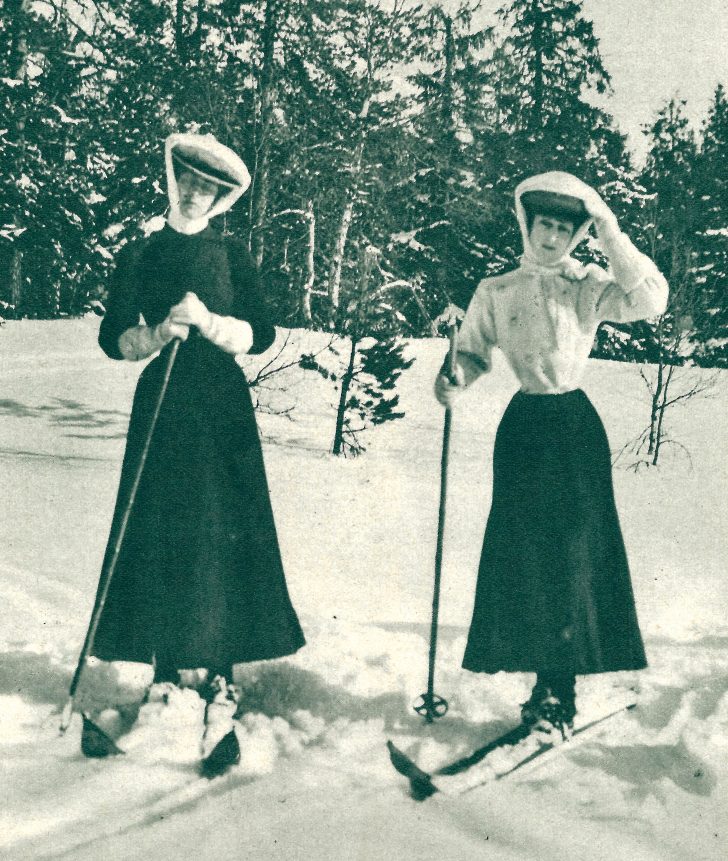
Mystery Glimpse: Who’s Skiing In Skirts?

It Looks Royally Uncomfortable.

Here’s a picture from long ago. The woman on the right is the mystery lady. Who is she? You can probably guess the era from the skiing “costumes”. Probably foreign. Last hint: Think Scandinavia.

This week’s picture was contributed by Vesterheim, the National Norwegian-American Museum & Heritage Center, in Decorah, IA.  The center has over 33,000 artifacts, 12 historic buildings, a Folk Art School, and a library and archives. This treasure showcases the most extensive collection of Norwegian-American artifacts in the world.

Vesterheim’s exhibitions explore the diversity of American immigration through the lens of the Norwegian-American experience and highlight the best in historic and contemporary Norwegian folk and fine arts. USA Today named Vesterheim one of “ten great places in the nation to admire American folk art.”

Last Week

This is the famous Engen Bell, a fixture in Utah ski history and an official “treasure” of the state.

The bell was used for many years on an old locomotive from the Denver & Rio Grande Railroad. It is estimated the bell was made in the mid-1800s, but no official records are available to verify its exact age. Rio Grande Railroad officials stated that the bell made hundreds of trips through Utah in the late 1800s and early 1900s.

In 1955 the bell was acquired by Martha M. Engen as a gift from the railroad. She gave it her son Alf for use at his Alf Engen Ski School at Alta, Utah. For 24 years, the bell was used every day to toll the start of the morning and afternoon ski school sessions. It became a landmark at Alta; everyone listened for the bell to sound. When Alf Engen retired as the ski school director, it was deemed appropriate to also retire the bell in his honor. The bell rang for the last time in 1989, when Alta celebrated its 50th anniversary as a ski area. Alf gave the bell to his son, Alan, who commissioned a solid oak stand and brass plates identifying it as “The Engen Bell,” in honor of his dad and his grandmother, Martha.

Look closely. There’s the bell on the old steam engine.

In 1995, the old bell was selected as one of the “100 Treasures of Utah” and was put on display at the Utah Winter Sports Park as a featured attraction of the 1996 Utah Centennial celebration. The reasons for being named a Utah treasure are twofold: First, the bell holds historical value due to the time period in which it was used by the Rio Grande Railroad. Secondly, it is the only ski school bell ever used at Alta, and as far as can be determined, is the only bell used by any ski school in Utah’s history. The only other Intermountain Region ski school to use a bell for announcing the start of classes was at Sun Valley, in the late 1930s and early 1940s.

The bell is on display at the Alf Engen Ski Museum located in Park City, Utah.