Tag Archive for: senior skier

Product Review: Company Based On Tea’s Cancer-Fighting Properties

Tea Offers Flavor, Enjoyment, And Health.

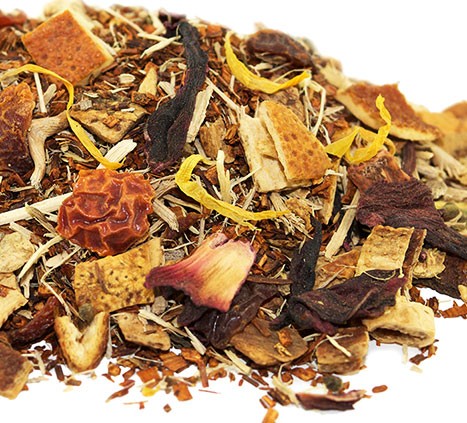
Cold Buster tea blend soothes colds and is caffeine-free. Credit: Harriet Wallis

Let’s make it clear. Tea cannot cure cancer. But the chemical make up of many teas can be part of a healthy anti-cancer lifestyle.

It’s not hocus pocus. Tea is a most studied anti-cancer plant. Check out what the National Cancer Institute says about tea’s anti-cancer benefits: https://www.cancer.gov/about-cancer/causes-prevention/risk/diet/tea-fact-sheet

But let’s start at the beginning.

Maria Uspenski was healthy and active until she was slammed with ovarian cancer that turned her life upside down. That’s when the IBM engineer and tech business owner launched full bore into making nutrition and lifestyle changes to give her a life-saving edge. She learned that teas can boost the immune system and might inhibit cancer.

In 2004, this cancer survivor founded The Tea Spot, a woman-owned tea and tea ware company in Boulder, Colorado.

So what about the teas?

I like tea, but I’m a beginner. I had no clue there are so many kinds of tea, and I don’t speak “tea language.” But I like to explore tea flavors and try new tea techniques. It’s okay to be a beginner and learn as you go. Real connoisseurs, however, will appreciate the breadth of The Tea Spot’s offerings.

They offer many, many types of White, Green, Oolong, and Black teas. And there are also Herbal, Mate, Organic and Pu’erh teas.

I’d never heard of this Pu’erh-thing, so I looked into it. It’s a special process that gives those teas an earthy taste. It’s thought to do good things such as: reduce cholesterol, aid digestion, improve weight loss, and it might relieve hangovers.

Each tea has its special properties and benefits. And the Tea Spot site describes each tea in detail. There are so many teas to try.

The bottom line:

The market is saturated with health drinks. Perhaps it’s time to try tea as your health drink.

To read more from Harriet click here for her stories on SkiUtah.

Marker Recalls Some 2017/18 Touring Bindings

Possible steel pin breakage in Marker’s Kingpin models 10 and 13 may lead to lower release forces and result in falls, according to the manufacturer.

Marker is recalling its 2017-18 Kingpin toe binding

The ski touring binding is targeted at the backcountry market. Marker is replacing the binding toes at no cost. If you have the binding contact your local Marker Authorized Retailer or visit https://www.marker.net/en-us/support/recall/ for assistance.

This Week In SeniorsSkiing.com (July 20)

More On Skiing Chile, Fat Bikes For Seniors, Mammoth Invests In Summer, Lost Baby Robin, Alone In The Woods.

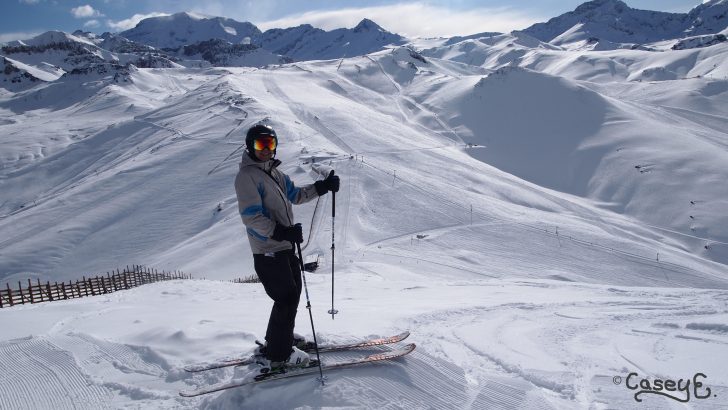
Casey grabs some pow at La Parva, Chile. Credit: Casey Earle

Summer is in full glory as we write this. So far, in New England, we’ve had a massive, long-lasting heat wave, heavy rains, clear skies, and classic summer days.  We’ve been hiking, riding our bike in prep for a charity ride in a couple of months, sailing, and generally enjoying the outdoors.  And that is probably not unlike what you, dear reader, are doing this summer.

In our recent survey, we asked what kinds of summer activities you were involved in.  The collective responses revealed a demographic of active, fitness-oriented seniors who have a vast array of different activities off the snow. In a way, you inspire us to get going when we’d rather be lazy.  We have readers who are volunteers restoring historic vessels, one Master of Foxhounds(!), lots of gardeners, car show exhibitors, swimmers, tennis and polo players, weight lifters, dog trainers, yoga practitioners, and community service activists.  Well done, SeniorsSkiing.com readers! In fact, you’ve shown us another side of you, an interesting you that we’d like to know more about.  So, we’re going to follow up with a new feature next winter profiling some of our readers who have unusual and noteworthy past-times.  Stay tuned.

This Week

Our focus on the Southern Hemisphere continues with another look at skiing in Chile.  This time, SeniorsSkiing.com correspondent Casey Earle tells us what to expect when you ski in Chile; be advised, it’s really different from your local area.

Long-time correspondent Pat McCloskey tells us about the emergence of the “Fat Bike”, a mountain bike with tires on steroids.  Turns out, fat bikes are boon to seniors who love to ride the gnarly.  If you’re looking for a new way to ride, check out what might be a serious game changer for our many readers who cycle.

Utah-based correspondent Harriet Wallis has time on her hands as she recovers from a wrist injury.  She recounts a charming tale of rescuing a baby robin. Who hasn’t had an encounter with a baby bird outside the nest?

Washington state-based Yvette Cardozo has taken a trip down to Mammoth Mountain to report on the investments in summer activities funded by the Alterra Mountain Co., Mammoth’s new owners.  It’s amazing what $10 million will do when poured into developing non-snow activities.  How about a Mega-Zip line from 11,000 feet down to the base lodge?  Whee!

Finally, we are publishing “Alone In The Woods, A Lost Hunter’s Guide,” a document we discovered a few years ago from the State of Maine. It is filled with advice and guidance on surviving in the woods if you are lost, injured, or just unlucky.  Despite the folksy presentation and cartoon illustrations, the content is invaluable.  We’re offering it as a free download to all readers. Tell us what you think.

El Nino Cometh

We’ve been called a bit nerdy for watching the El Nino conditions in the Eastern Pacific.  Nevertheless, the La Nina-El Nino natural oscillation has shown to be predictive of the weather not only in North America but around the world.  The latest report from the National Weather Service Climate Prediction Service says the probability for having an El Nino are literally warming up.  Here is what a classic El Nino winter looks like:  Remember, this is a prediction of the future in a chaotic weather system.  Learn, but don’t place any bets.

A typical El Nino winter may be in store for 2018-19. Credit: Climate Prediction Center.


Thanks for reading SeniorsSkiing.com.  Tell your friends about us.  Remember, there are more of us every day and we aren’t going away!


Summer Adventures At Mammoth Mountain

Non-Snow Activities Make Mammoth A Family Summer Vacation Stop.

Climbing the Via Ferrata at Mammoth Mountain Ski Area.Credit: Peter Morning, Mammoth Mountain Ski Area.

Ok, picture yourself, flat on your belly in “Superman” position, hurtling in the air down a mountain at 60 mph.

No wonder Mammoth Mountain Ski Resort calls this the Mega-Zip. It’s billed as the “most vertical in the USA” (some 2,100 feet from the top of the ski resort at 11,053 feet) to the bottom.

Definitely not for the faint of heart. Adrenalin junkies, line up here.

The mountain is aiming to open the zipline by late summer, before all these non-snow goodies have to close for the winter season (and skiing!). And it’s got three more adventures, one in the works and two others already operating. The “taste of climbing” wall called Via Feratta is being built. The ropes course for kids 12 and under (gotta grab ‘em early) is already open, as is the Woolly’s Mining Co, a gem mining adventure for kids.

The zipline starts at Mammoth’s top, 11,053 feet and plunges over what some locals call “Oh S*%t Cliffs,” heading down at speeds billed at “over 55mph.” The run is more than a mile long from top of mountain to the base, and you will be able to descend side by side with other folks on parallel cables.

The whole ride is actually in two stages, starting from the very top and going on a somewhat sideways path to the mountain’s Chair One, where people exit and get on a second line all the way to the bottom.

Mammoth hopes to open it by early September, which would give about a month before winter snows start.

The Via Ferrata, which translates to “Iron Path” is a mid mountain mostly horizontal traverse along a cliff face. Rebar is being secured into the cliff face and the adventure will include ladders, suspended bridges and iron rungs, among other things. There will be six different routes that progress in difficulty.

“We think of it as an intro to climbing,” said Justin Romero of the mountain’s marketing department. “The idea is to give people who have never thought of climbing an idea of what it’s like.”

You go with a guide, he added, you are clipped in at all times and the total vertical is about 180 feet as you follow a set trail for 300 feet more or less horizontally across the rock.

The website says “perfect for families, groups or individuals. No previous climbing experience required.”

Photos of what it might look like show folks in full climbing gear … helmet, harness and the rest.

Kids’ Ropes Course at Mammoth Mountain Ski Area. Credit: Peter Morning, Mammoth Mountain Ski Area.

Then, for those kids you found climbing the kitchen cabinets while still in diapers, there’s the kids ropes course for children 12 and under. The site says, “Climb, stretch, balance and crawl your way through 10 different elements that include a climbing net, log walk, planks, swings and more before you rappel back to the ground to finish.”

But for the parents, it’s nice to see all this isn’t THAT high off the ground, and the final rappel drops a fairly tame 15 feet.

A lot of these improvements come courtesy of Alterra Mountain Co., which now has interest in a dozen ski destinations, including CMH (heli skiing). The company, which recently merged with Intrawest, pumped serious money into Mammoth. Some $10 million is being used this summer on the zipline, the cliff climb and both children’s adventures along with improvements to Canyon Lodge.

Besides the zip and climbing route, folks in summer can mountain bike, hike, just ride the gondola for the view and in the greater Mammoth Lakes area, fish, kayak and more.

Summer season is usually early June through end of September when the snows arrive.

For more information: https://www.mammothmountain.com/

People enjoy and photograph the view of lakes from the top of the gondola at Mammoth Mountain Ski Area. This viewpoint is a short hike from the gondola top. Credit: Yvette Cardozo

Tale Of A Baby Robin

You Can Find Adventure In Your Own Back Yard. This Adventure Began In A Window Well.

Found: Baby Robin in distress. Credit: Harriet Wallis

[Author’s note: I’m stuck at home with an arm in a cast. Can’t drive. Can’t hike. Can’t, can’t, can’t. The baby robin tale is a good reminder that adventure and joy can be right at home.]

Laurie called to me: “A baby bird has fallen down into the window well.”

A little robin sat as still as a stone. His little beak pressing against the glass, and his eyes looking in. He couldn’t fly out with his stubby little wings, and his mom couldn’t get down into the narrow space to feed him. There was no other choice. The little fledgling had to be rescued.

Laurie climbed into the window well, put the little fluff into a bucket, and lifted him out. But then what? He was limp and weak. His one foot curled uselessly under him. How long was he in the window well? How long since he’d been fed? Instinctively he opened his mouth wide.

When I was a child, I raised a baby robin by feeding it worms. My dad and I would go into the back yard after dark and get onto our hands and knees. We’d shine a flashlight onto the grass and spot the night crawlers coming up out of the soil. We’d catch them as food for my little robin.

Worms. Robins eat worms. We have a box of fishing worms stored in the refrigerator. Laurie put a fat worm onto a paper plate and cut it into bite size pieces with an old knife.

The little mouth opened wide and she dropped a piece in. Gulp. Down it went. Then his little mouth opened wide again. Repeat. Repeat. He consumed the whole worm.

We got on the internet and read up on what to do with a fledgling bird. We were relieved to find that birds have a poor sense of smell, and handling the baby would not cause his mother to abandon him. And we learned what to do.

The next step: Build a temporary nest for him from a little box and shredded paper towels. We put the worm-fed baby robin into the temporary nest, and put the nest on a stool beneath the tree where he was born. We hoped his mom would find him.

The passive, weak little robin came to life. Did the good meal revive him? He jumped from his cushy nest onto the edge of the box and called loudly: Mom! Mom! Mom!

Adult robins flew in with bugs in their beaks to feed their fledglings on the ground. But they ignored him. He wasn’t one of their own. He called and called— but he was all alone.

Daylight was fading, but we saw him jump off the edge of the box and stumble over some long blades of grass. Then he disappeared.

To read more from Harriet click here for her stories on SkiUtah.

Free: Baby Robin, well-fed and alert, about to head out to the world. Credit: Harriet Wallis

Fat Bikes Are A Boon For Senior Cyclists

New Technology In Mountain Bikes Can Keep Seniors On The Trails.

Here’s a Fat Tire bike; carbon frame has room for wider tires. Credit: Pat McCloskey

Remember when you first bought your first pair of “shaped” skis?  I do.  I jumped on them to take advantage of an easier turn and less work.  Fast forward, I have a nice quiver of skis now with some 107s under foot for powder, loose snow, and crud.  Just point and shoot with total confidence.  Equipment keeps senior skiers in the game.

Same thing with mountain biking.  For several years now, the rage has been “fat” bikes and plus size tires with lower pressures for traction and control. Recently, while watching some friends maneuver very easily over tombstone like rocks and greasy roots here in the East, I marveled at the control that the plus tires and full suspension give the rider.

For those of you who are not familiar with the plus tire revolution, the description of plus refers to any tire width that is basically 2.6 inches and wider in diameter.  Most mountain bike tires have traditionally been in the 1.95-2.3 inch diameter range.  But in recent years, the technological advances in mountain biking have developed carbon frames which are compatible with wider .35 mm rims that accept a wider width tire.  With lower tire pressures around the 12-psi to 15-psi range, the plus technology allows the rider to have a more plush ride with suspension that grips gnarly terrain like glue. For the senior rider who wants a challenge but wants to maneuver safely through rocky, rooty, terrain, the plus bikes are just like our wider width skis—just point and shoot.

Knobby Fatties grip any kind of trail and make the going smoother. Credit: Pat McCloskey.

While riding behind one of the best riders I know who happens to be in his late sixties, I noticed that he didn’t even pick his lines anymore on a technical trail.  He just points the 3-inch tire and rolls over everything.  So, I recently purchased a 29er plus, full suspension bike from Salsa and VOILA, I do the same.  I feel much more confident with the plus technology.  A definite “plus” for a senior rider who still wants the challenge.

Many of the current generation of the plus bikes now (either 27.5 or 29ers) come equipped with the SRAAM Eagle components.  Simply put, they have a wide range of gearing with a 50 tooth cog in the back that allows for easy climbing of virtually anything that is thrown at you on the trails.  Even though the plus 29ers, for instance, are a little heavier than the standard carbon full suspension bikes, the Eagle gearing makes it easier for a senior rider to maneuver the plus bikes up a steep, rock strewn trail.  Personally, I love the “old man” gear and even though my local bike shop employees say I don’t need it, I definitely want it, and I use it.  I will take every advantage I can—on the slopes or on the trails.

So, take a look at plus technology.  Those 3-inch width tires may be a little excessive for your local trails and you may want to scale back to 2.67 or 2.8, but the lower pressures, enabled by wider profile rims, make life a lot easier and more enjoyable on the trails for a senior rider.  Modern equipment keeps you in the game, folks.  Take advantage of it.

Here’s the big 50-tooth inside “old man” gear that provides mega leverage. Credit: Pat McCloskey


This Week In SeniorsSkiing.com (June 22)

Southern Hemisphere Special, Safe and Sane Cycling For Seniors, Zany Videos, El Nino Coming.

Yes folks, it’s the start of the ski season in far away places below the Equator. Here’s a picture of downtown Santiago, Chile, which received a highly unusual coating of snow for the first time in years.

If there’s snow in the city, there’s more in the mountains. Credit: anis_velasco/instagram

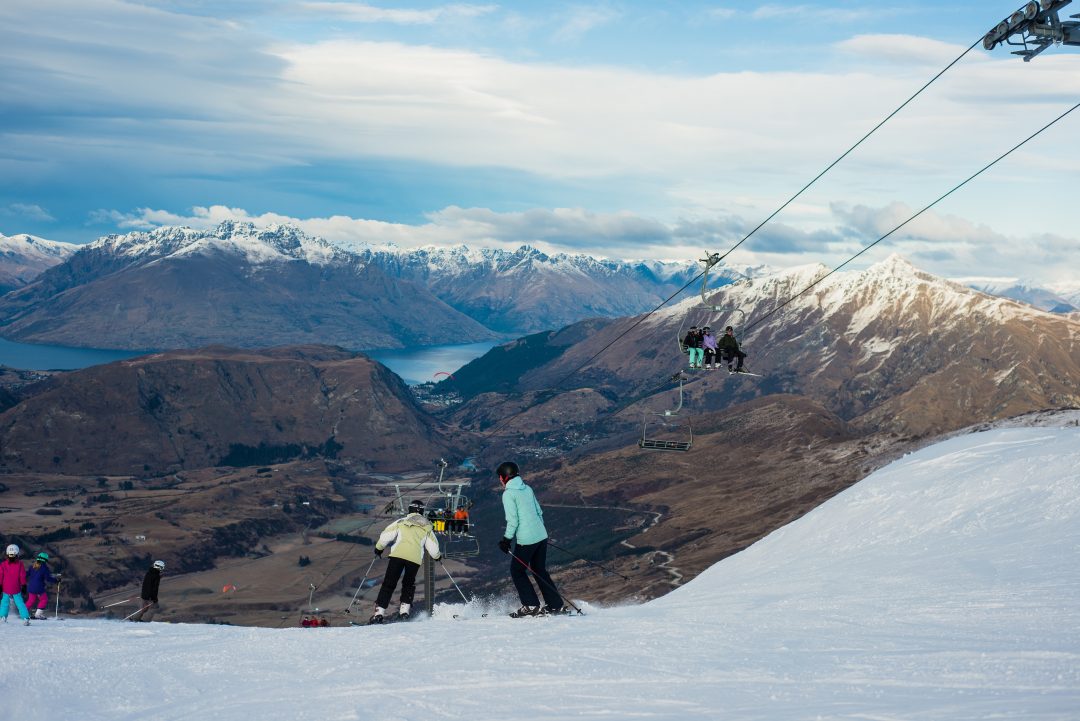
And in New Zealand, The Remarkables, those beautiful, mystic mountains from Lord of the Rings fame near Queenstown, are open for the season.  Check out the video of opening day at the bottom of this article. Nearby Coronet Peak has been open for a couple of weeks.  Here’s what the early season skiing looks like down there.

First turns of the season at Coronet Peak, Queenstown, New Zealand.

Skiing Chile

If you’ve ever wondered what it might be like to follow the snow during the summer and weren’t quite sure how to do it, we have a new series that might get you started.

Portillo Plateau, Chile. Amazing skiing starting now. Credit: Casey Earle

In celebration of the beginning of the snow season in the Southern Hemisphere, we have an orientation to skiing in Chile by a new SeniorsSkiing.com correspondent Casey Earle, an American ex-pat who lives and skis down there.  His first article describes the different resorts what line the magnificent Andes mountains. You will hear more about skiing in Chile in the coming months.

Biking With Young Hammerheads

Veteran cyclist, skier, and SeniorsSkiing.com correspondent Pat McCloskey offers some advice for seniors who ride with a gang of younger riders.  He has strategies for going around the loop safely and saving face at the same time. It pays to recognized the limitations that senior status brings, especially on a mountain bike.

Have You Seen These Videos?

Here’s Opening Day at The Remarkables, Queenstown, New Zealand. Click below for the festivities.

And, Check Out What Happens To A Show Off When His Ski Flipping Trick Doesn’t Work. Click the picture below.

Finally, mountain biking down Corbet’s Couloir? First time ever, but you can be sure it isn’t the last.  Thanks Teton Gravity Research. Click on picture to view.

And Looking Ahead. El Nino Is Knocking.

Weather worriers are looking at an emerging El Nino pattern forming in the eastern Pacific. El Nino comes around when the surface water temperature increases ever so slightly in the ocean west of the Peru and Ecuador. Since everything in the weather world is connected, that water temperature change impacts the atmospheric wind patterns which impacts the everyone’s weather.  From the Weather Channel Explainer:

“If El Niño conditions are present during the winter, the jet stream pattern over the U.S. shifts and can result in a wetter-than-average winter across the southern tier of the U.S., including portions of California.

“During an El Niño winter temperatures are also typically cooler-than-average from the southern Plains into the Southeast and warmer-than-average from eastern Alaska into western and central Canada and into the Pacific Northwest, northern Plains and Midwest.

“The strength of the El Niño plays an important role in impacts across the U.S., including in the tropical Atlantic. At this point, it is too early to know when an El Niño pattern may develop and how strong it might be.”

Happy First Day Of Summer.

Onwards.  Have you bought your season ticket yet? Time to pay attention to whatever deals are left.

And tell your snow loving buddies about SeniorsSkiing.com.  Remember, there are more of us everyday, and we aren’t going away.


Ski Chile: An Introduction For Neophytes

Chase The Snow To Summer’s Skiing Headquarters In The Southern Hemisphere.

Come May, you have probably set your skis into hibernation and begun patiently waiting for the snow to fly next fall. But you really don´t have to wait!  Southern America’s greatest mountain range starts getting snowed on in May, and by June the ski areas are normally in full swing.

In Chile the resorts are sprinkled just east of the Pan Am highway along the 700 mile stretch from Santiago south, at roughly the equivalent latitude of central California. With an 80 year tradition of skiing, you will find a whole new world of winter adventure, lasting into October on good years.

Santiago and the Andean foothills, after a rare low altitude snowfall. Credit: Casey Earle

Visitors will be happy to know that within a two hour drive of the airport in the capital, Santiago, there are four good ski areas, and upwards of 70 percent of winter days are sunny. Closest are the Three Valleys, which hang above Santiago on the western slopes of the Andes. At night, you can see the snocats grooming trails from this metropolis of seven million!

The La Parva, Valle Nevado, and El Colorado ski areas are interconnected, and it is possible to enjoy a total of 40 lifts and dozens of groomed runs, with multiple options for lodging and dining. Skiing here starts at 8,000 to 9,000 feet, reaching up to 12,000 feet, and is entirely above the treeline. The sunsets are extraordinary.

Casey looks out from El Colorado ski area towards the upper Valle Nevado and La Parva lifts. The 18,000 foot El Plomo mountain looms in the background. Credit: Casey Earle.

Two hours north of Santiago is the world-renowned Portillo hotel and ski area, smack in the middle of some of the highest mountains in the Western Hemisphere. The hotel sits looking north over the mysterious and beautiful Laguna del Inca lake and boasts a long tradition of great service and entertainment. Here you can rub shoulders with racers and ski fanatics from all around the globe.

Portillo and the Plateau chairlift (spot it!), with the Laguna del Inca. Credit: Casey Earle.

Further south, the ski area infrastructure and access may leave a bit to be desired, but I love it nonetheless. All of the ski areas are situated on volcanoes which have varying levels of activity. They are also surrounded by gorgeous temperate rainforests, lakes, rivers, and hot springs. The main ski areas are Nevados de Chillan, Corralco, Villarrica, and Antillanca. The first three have adjacent towns within a 30 minute drive with plenty of lodging and other touristic services. All but Villarrica have a good hotel at the ski area base.

Villarrica ski area, note the smoking volcano. Credit: Casey Earle.

My recommendation for potential visitors is to contact one of the tour companies operating in Chile, or book directly with one of the on-hill hotels such as Portillo. You will have one of the best and most unusual ski trips of your life. Most of the tour operators

Las Araucarias ski area, west side Volcan Llaima. Credit: Casey Earle

in Chile are mainly for younger, adventurous skiers, such as Casa Tours or Powder Quest. However, for the +50 crowd, I can recommend DreamSki Adventures which offers group guided resort based tours in Chile and Argentina for the 45-70+ skier. Their guides are seasoned ski instructors trained in the CSIA (Canadian Ski Instructor Alliance) and offer a high degree of customer service on and off the snow.

Come on down!

For the latest in conditions in Chile from Casey Earle, click here.

Here are the resorts mentioned.

This Week In SeniorsSkiing.com (May 18)

Survey Results: Summer Activities, Summer Trail Prep, Sacropenia Defense.

We are in high spring, as it were, as of this writing, and yet they are still squeezing out runs in Killington, VT, and will be until the end of May. Here’s a pic from last weekend from Aspen East Ski Shop’s Facebook page.

Still turning at Killington with one week to go. Credit: Aspen East Ski Shop

And also at Killington, Scott Howard, (65) a senior skier (!), has managed to break the unofficial record for the total number of vertical feet skied in a

Vertical record holder (unofficial) Scott Howard. Credit: Scott Howard.

season.  According to Trace, his iPhone app, Scott has racked up over six MILLION vertical feet by skiing 60 runs a day, seven days a week. Just so you know, six million vertical feet is equal to 1136 miles. That’s a little short of the distance from Vermont to Colorado.

Couple more runs, Scott, and you can head to the hot tub.

For more about this achievement, click here to read story from our friends at Snowbrains. 

Meanwhile, most of us have put up out skis and are into our non-snow activities. In case you are wondering, what do senior skiers do in the off season.  Let’s look at the results from our recent survey.

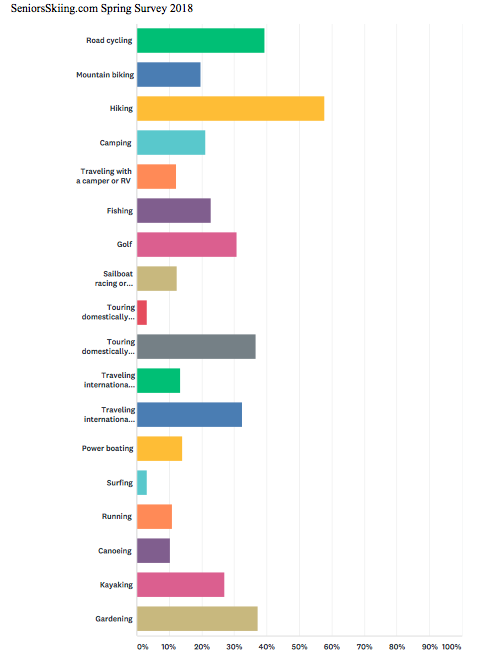
Non-Snow Activities From SeniorsSkiing.com Spring Survey 2018

We asked our readers what activities they participated in after the snow melts. Here’s the top ten.

  1. 57.83% Hiking
  2. 39.32% Road Cycling
  3. 37.31% Gardening
  4. 36.54% Touring independently domestically
  5. 32.44% Touring independently internationally
  6. 30.78% Golf
  7. 26.93% Kayaking
  8. 22.78% Fishing
  9. 21.18% Camping
  10. 19.69% Mountain Biking

The most interesting write-in comment was Dragon Boat Paddling. We also noted many write-ins for Tennis, Swimming, and Hunting. We should have made these choices in this survey and will include them next time. Your comments? Reactions?

This Week

Correspondent Yvette Cardozo takes us up to Sun Peaks Resort in British Columbia where we learn how trails are prepped for summer.  Check out those cows! And we hear from Arthur Razee, a new contributor, who explains how do deal with sacropenia, the condition that causes muscle loss in older folks. It happens to us all, but we can manage to deal with through diet and a specific exercise.

Also, we say goodbye to our old friend and mentor, venerable and veteran ski journalist John Henry Auran. You can read a tribute here.

Meanwhile, stick with us through the summer.  We have some interesting stories lined up and we do want to hear from you. Please, please tell your friends about us.  Remember, there are more of us every day and we aren’t going away.

Meanwhile, here’s a shot of a May snowstorm in Charlotte Pass, New South Wales, Australia, where the season is just getting under way.  It’s snowing somewhere in the world every day!


Sarcopenia: Insidious Muscle Loss Can Be Managed.

It Can Happen, But Don’t Despair.  Read On.

A fitness program that includes resistance training can forestall muscle loss.

Sarcopenia or muscle wasting is a condition which affects almost everyone starting about 50 years of age.  Do you have it?  Look in the mirror: Your once proud biceps and pectorals have sagged, your pants are falling down, no more butt, your legs look skinny. What looks like loose skin is really the loss of muscle. You find yourself skiing on easier slopes, minding how you climb stairs, playing less aggressive tennis, and basically losing muscle tone.

Is all lost? No, indeed.  A prominent medical school subjected a group of older folks who used walkers to a resistance training program.  In 90 days, they were able to ditch the walkers!

Apparently, the secret is a resistance training routine with some dietary changes.  A structured program in resistance, i.e., weight lifting, similar to a body builder’s program is the key.

In addition, older folk do not process proteins well. When it’s snack time, we go for crackers or other carbohydrates. This subdues your appetite but contributes nothing to your protein intake and robs your body of the space that could be utilized for protein.  Find a protein source for your snacks.  I am fond of beef jerky. Or try Greek yogurt, trail mix, almonds, peanut butter and celery, and others. Check here for ideas. Protein drinks are okay, but don’t use them as a meal replacement.

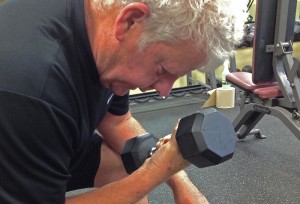
Light weights are good for bone density and muscle mass preservation.
Credit: SeniorsSkiing.com

Resistance training for seniors is a case of make haste slowly. There is potential for injury and an untrained individual needs to be careful. Proper form is absolutely critical for injury prevention and instruction by a professional is required, either at certified trainer at a gym or a physical therapist.

Medicare covers about 20 physical therapy visits a year. Get a referral from your primary care provider. Medicare with a United Healthcare supplement (AARP) has the Silver Sneakers Program which allows you unlimited visits to a gym on the program.

If you do have some resistance training experience but have been lax for a while, start off slow.  Start with a lower body workout—squats, lunges—that use your body weight only for four weeks.  Then add light dumbbells. A weight which allows you to complete three sets of 10 reps without undue exertion is the signal to increase the load, never more than about 10 percent.

Don’t forget your upper body. Most gyms have an array of weight machines which reduce balance issues.  Once again, find a personal trainer for a couple of visits to learn the form and reduce the chance of injury.

Follow your program three times a week.  You will feel stronger in a month, see results in two months and by the third month you will have developed a life-long habit.

As with all exercise programs, seek the advice of your medical professional and get expert help in starting out.


John Henry Auran: Ski Journalist Extraordinaire, Dies At 90

The Creative, Intense, Funny, Unique Journalist Will Be Remembered As One-Of-A-Kind.

John Henry Auran, journalist, raconteur, skier, sailor, innovator, enthusiast.

Ski journalist John Henry Auran was the kind of person you could never forget. I worked for John Henry, or JHA, as he was known to some, in the early 70s at SKIING Magazine, then located at One Park Avenue in New York City. Despite different life paths since then, we kept in touch, even as his declining health brought him farther and farther away from the sports he loved.

John Henry was always interested in delving into new products, new racing results, new personalities on the ski scene, new ideas for connecting the reading public with the outdoor winter sports industry. His enthusiasm was uncontainable for finding, thinking, analyzing, reporting, and watching the world for news.

I will never forget when he and I went to a ski boot manufacturer somewhere in New Jersey who promised to show us a then new development in boot fitting. This was the first foam-fitting demonstration ever, as far as I know, in the business. Since John Henry was SKIING’s boot expert, he went for a sneak preview, and I tagged along to take pictures.

At the manufacturer’s “plant”, John Henry was seated in a high chair, like the shoe polishing chairs you see at airports or train stations.  His foot was placed in a plastic bladder which was gradually filled with foam and placed in a boot shell. I distinctly recall him reporting all the sensations that involved: “It’s getting warmer, I feel some pressure,” while a big smile crossed his face. “I’m getting foamed!”

After that, John Henry couldn’t resist asking people if they’ve been “foamed”.  Since no one had, that gave him license to launch into describing the experience complete with gestures and enthusiastic and dramatic commentary. “Everyone should try it.”

He was also an innovator in what created a new genre: the industry show newsletter. At the time, the ski business had three regional shows for equipment and clothing manufacturers and wholesalers to meet retailers run by Ski Industries America. John Henry had a terrific idea: Publish a daily newsletter at each show that reported news, gossip, personnel moves and the like every morning of the show. Sounded like a great idea.

JHA enlisted the staff of SKIING to do some reporting, bring it to us in our editorial corner where he and I would create columns by typing copy into an IBM Selectric. We then pasted the columns to a piece of oaktag with a pre-designed masthead and logo and brought it to a printer where we waited until the job was done. We picked up the edition and distributed it throughout the show venue. Did I mention this process took almost all day AND all night? Trial and error was the name of the game. Despite being exhausted, we knew we had a hit when we saw the show people reading the Show News over coffee. That was true journalism.

John Henry always had a story ready whenever we talked over the years. One of his favorites was about his hometown where he was born in Germany. As a young boy, he was a witness to Kristallnacht in November 1938.  A few years ago, the town government had a commemorative event marking that dark past and invited JHA to come back to join the few other surviving town residents to bear witness and tell their stories of what happened.  Despite his disability, he went all the way back to Germany with a companion, all sponsored by the town. It was a remarkable and touching journey.

John Henry was also an enthusiastic member of SeniorsSkiing.com’s Advisory Board.

John Henry lived in a nursing home in upstate New York for the past decade or so. When I called, the nursing staff would chat while John got to the phone. They would tell me he enjoyed being taken to nearby Hunter Mountain where he would sit in the base lodge watching the skiers and the lift traffic. I can see him there, in my mind’s eye, reminiscing to himself about the equipment, the racers, the dramatic places, the deadlines, and the great writers he knew. Watching the lift go around and around.

Rest in peace, John Henry.

This Week In SeniorsSkiing.com (April 20)

Discount Reminders, Season Thanks, Washing Down, Stowing Gear, Abandoned Ski Area Movie, -30-

Killington is still open. Also Sugarloaf, Sunday River, Wildcat, Jay Peak, Okemo, Mt. Snow, Sugarbush. May is possible! Credit: Jamie Frankel

This amazing season hangs on. Even as we write this on April 19 snow is falling in New England, in fact, right outside our window on Boston’s North Shore. We know that the Sierras and Rockies are also seeing spring snowfalls. It will be the last weekend for some, but it’s been years since we even contemplated skiing in May in Maine.

Fourth Season Into The Archives

With this week’s edition, the fourth publishing season of SeniorsSkiing.com is fading into the archives. We will be shifting gears in the next month, bringing articles that reflect our readers’ non-snow season activities on a less frequent basis. We’ll be picking up the pace with new ideas, articles, and offers on the other side of summer.

Bear in mind, the almost 900 articles that we’ve been publishing since 2014 are still and will always be available.  Just check the drop down menus in the blue bar above.

Our Publishing Season In Retrospect

Looking back, we’ve accomplished a lot and worked hard to create value for our leaders. Those initiatives marked SOC can be found under Subscriber-Only Content in the top menu bar. The initiatives we’ve developed in partnership with others include:

  • Mystery Glimpse photos from US ski museums
  • Our Donations to Defray Expenses Campaign
  • Making available 60s Ski Songs from Ray Conrad
  • Arranging exclusive Discounts For Seniors from 20 vendors
  • Publishing Best Skis For Seniors and Best Boots For Seniors (SOC)
  • Creating a directory of  resorts Where Seniors Ski Free (or almost free) (SOC)
  • Offering a free subscription to SKI magazine (SOC)
  • Making available a free digital subscription to Ski History magazine

We also have available on under Subscriber Only Content our first information asset we developed for our readers, complied with the cooperation of the International Ski History Association.

  • Free eBook Collection Historic Ski Posters (SOC)

Early Survey Results: We DO Have Lists Of Discounts.

A quick glance at the survey responses currently rolling in reveals that some readers are wondering when and if we will be offering advice where to get discounts on skiing. We’ve already got you covered.

One of our major early season efforts for the past couple of years has been to identify those ski areas which offer free skiing, or nearly free skiing, for seniors.  We want to point out that information is available under the Subscriber-Only Content menu that is above the blue menu bar. If you are already a subscriber, you will have to confirm your name and email address to get access to that directory. We think confirming your email address is much better alternative than having you create a username and password. We hope you agree.

Spring Survey 2018 Is Still Open.

Responses to our Spring Survey 2018 are still coming in. Thanks to those who have taken the time to give us some valuable input. If you haven’t taken our survey, just click here.  It will take you three minutes, and your advice is important to making SeniorsSkiing.com work for you.

https://www.surveymonkey.com/r/G7YBNCK

Thanks To Our Correspondents: You Are The Best.

SeniorsSkiing.com can’t publish every week during the season without articles submitted by our stalwart correspondents.  You should be familiar with their names by now. Each is a professional, some are active journalists, and each “gets” what SeniorsSkiing.com’s mission is all about: Promoting the interests of senior snow sport enthusiasts.

A tip of the ski pole to:

  • Jan Brunvand
  • Don Burch
  • Yvette Cardozo
  • Rose Marie Cleese
  • Val E.
  • Steve Hines
  • Marc Liebman
  • Roger Lohr (SeniorsSkiing.com XC editor)
  • Pat McCloskey
  • John Nelson
  • Tamsin Venn
  • Joan Wallen
  • Harriet Wallis
  • Jonathan Wiesel

And Thanks To Our Reader Opinion Writers.

This year, our readers have submitted more articles to us for publication than ever. We’d like to acknowledge those who were inspired to put pen to paper to write something for our readers. They made an effort to share their opinions, humor, stories, memories, and advice with you.  Thank you to all.

  • Torry Hack
  • John Farley
  • Bill Emerson
  • Brad Noren
  • Roger Monty
  • Bernie Weichsel

Paying Attention to Gear.

With the season winding down, it’s time to clean and stow your gear. We have two articles with advice for doing same. Val E. gives us 10 steps to cleaning that funky down jacket. And, we reprise Don Burch’s article from last year on putting away your equipment.

Flipping out at the US Ski & Snowboard Hall of Fame Induction Ceremony at Squaw Valley. Credit: Charlie Shaeffer.

US Ski & Snowboard Hall Of Fame 2018 Inductees

The US Ski & Snowboard Association has just inducted its 2018 class of new members at Squaw Valley.  We salute the following ski celebrities:  Airborne Eddie Ferguson, Hermann Gollner, Marty Hall, Mike and Steve Marolt, Thom Weisel, Steve McKinney, and Shaun Palmer.

Abandoned Ski Areas In Colorado Documentary

Here’s a short documentary from a production company called The Road West Traveled about ski areas that disappeared from the Colorado landscape. In the 60s and 70s at the height of the ski craze, there were 200 ski areas in the state.  There are currently 30. “Abandoned” tells the story of just one, Geneva Basin, which closed in 1984 with some nice drone shots. But what’s with the dog running down the piste with the skiers?  Thanks to Outside magazine for sharing this.

CLICK THE IMAGE TO SEE THE DOCUMENTARY

Or, Click Here for “Abandoned”. 

Look For Us This Summer And Fall.

We’ll be publishing articles on fitness, summer sports, fun things, and skiing in the Southern Hemisphere all with a senior slant for the next few months. Please tell your friends, and remember, there are more of us every day, and we aren’t going away.

-30-

Mystery Glimpse: First US Winter Olympic Medalist Was A Ski Jumper

Only Two Guesses, One Was Correct.

Apparently, our last Mystery Glimpse of the season was fairly esoteric. We salute reader Patricia Gottshalk for identifying Anders Olsen Haugen, the US Ski Team member who was the first American to win a Winter Olympics medal. He won medals in the 1924 Olympics in Chamonix and the 1928 games in St. Moritz. In fact, he remains the only American to ever win an Olympic medal in ski jumping. But there is much more to Anders’s story.
It seems that he originally came in fourth in the 1924 Olympics.  The third place went to a Norwegian, Thorleif Haug, who had already won a gold and a silver. However, in 1974, Norway held a 50th anniversary of the games. A ski history buff had scrutinized the scores from those long ago games and determined there was an arithmetic error in adding the results.  Anders had actually won the Bronze by several hundredths of a point. So, at 83 years old, Anders Olsen Haugen, a long-retired brick layer, was awarded the medal by Haug’s daughter at a special ceremony sanctioned by the IOC.

Here’s a snapshot of Anders and Haug’s daughter.  Quite a story, eh?

And with that, we are pausing our Mystery Glimpse series for the non-snow season. This feature could not have been possible without the incredible cooperation of several ski museums across the country. Each museum mentioned below contributed more than one photo from their archives. We thank them for their support and willingness to participate.

Ski museums are quite precious to us. They are typically small, even tiny, with exhibits made from contributions by skiing enthusiasts who want their souvenirs and memorabilia to live on. If you have some interesting relics from the early days of skiing, considering making a donation to a museum near you.  Here are the museums that participated in this year’s Mystery Glimpse. Thanks to all.

Colorado Ski and Snowboard Museum

Vermont Ski and Snowboard Museum

Ski Museum of Maine

New England Ski Museum

US Ski and Snowboard Hall of Fame and Museum

Alf Engen Ski Museum

Museum of Sierra Ski History


Down Care

How To Wash Your Down Jacket At Home

Season’s Over; Isn’t It About Time You Get That Puffy Back To Clean?

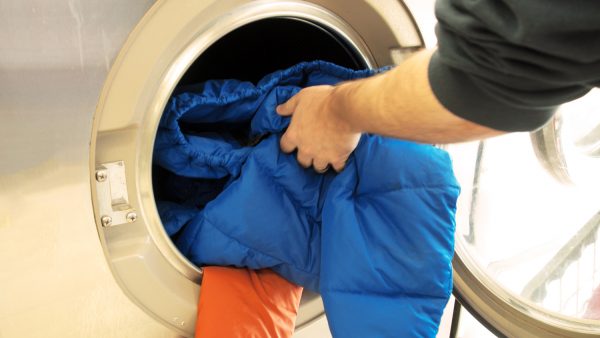
Front loader needed for washing down. Credit: REI

Not only are your season-dirty down jackets, vests, and even sleeping bag dirty and smelly, if you left them that way, they would lose their heat-insulating properties. It is easy to destroy your down gear if you don’t follow some basic rules when washing them at home. It’s not difficult, but it does take some time and know-how.

You will need:

  •  a front load washing machine and a dryer (Top load machines are not recommended.)
  • a bucket
  • special down liquid detergent
  • three-four new tennis balls or reusable drying balls
  • a new sponge (for washing dishes)
  • a clean toothbrush (or something similar)
  • three hours of free time.

10 How To Steps

  1. Purchase a liquid detergent specially designed for down.  Try either Granger’s or Nikwax. You will need about a cap (50 ml) for a jacket.
  2. Inspect the jacket and find especially dirty spots. A bright light really helps. Close all pockets, velcro, and zippers. Turn your jacket inside out.
  3. Soak your jacket in cold water in a clean bucket. Drip a bit of detergent on a sponge and create some foam. Apply foam on wet, dirty areas. Let foam to penetrate the fabric for five to 10 minutes. Brush the really dirty areas with toothbrush. Let it soak for 20 more minutes.
  4. Pull out the detergent dispensing tray of your washing machine, clean it thoroughly. Even a small amount of a wrong detergent or a softener can negatively affect the condition of the down.
  5. Tennis Balls or Dryer Balls are needed to keep the fluff up. Credit: REI

    Take the bucket right next to the washer and gently dump your jacket inside the washer. Add three-four new tennis balls or reusable drying balls. Hint: no balls, no worries. Roll balls out of your heavy cotton socks, wet them, and throw into the washer.

  6. Fill one cap of the detergent, (or the recommended amount in the instructions), into the receiver for the liquid medium. All washers are different, so ideally you need the lowest temperature, the slowest speed, and the longest time —one hour or more. Press the button and…take a break: have a cup of coffee or mow the lawn.
  7. After the machine stops, look at the contaminated zones. Again, a bright light is your friend.  If you still see dirt, repeat step three to five. Check again.
  8. Now, On to your dryer. Set the lowest temperature, the lowest speed, and the longest time . One and a half hours or more would be fine. Click the button and…take another break.

Pull out your clean, dry jacket and hang it on a wide hanger. Regardless of the price and the country of origin (China, Canada, Hungary) of a jacket, feathers may come out.  It is just a question of when. This is a natural process, don’t be surprised if it happens to you. Do not pull out the protruding feather because you will create a larger hole in the fabric and way more feathers will follow. Try to push the feather back inside.

9. Almost all down jackets are only water-repellent and not water-resistant (unless they have membrane fabric like Gore-tex). A few percent of all down jackets do not even have water repellent properties. Those are designed to be a mid layer, which goes under a water resistant shell jacket. All the rest have a water-repellent coating. A smart user should restore this coating after washing, otherwise the fabric will absorb and even let moisture go through in case of rain or wet snow. And water is bad for down. Use a product for water-repellent restoration, typically in a spray. Again Granger’s and Nikwax are very reliable. Apply it according to the instructions. Let it dry.

10. Done! It is time to use your downy friend.

Nixwax and Grangers are specially formulated for Down. Credit: Mountain Equipment Coop


This Week In SeniorsSkiing.com (April 13)

Looking Back, Mystery Glimpse, Spring XC Skiing, Riding With The Cats.

Spring in Appleton Farms, Ipswich, MA. Credit: Mike Maginn

It’s hard not to get a bit philosophical at the end of a season. And yes, we know that there are those who are still finding newly fallen snow out there, but we are done. Highlights for us: We re-discovered our interest in ski history, launching the Mystery Glimpse series this year with the cooperation and contributions of many fantastic ski museums around the country. And re-publishing Ray Conrad’s collection of ski songs from the 60s, a technical challenge, but we hope it is worth it for our readers.

We managed to become comfortable with our emerging carved turn, not yet there, but closer than before. We also realized that skiing on broad, green trails was perfect for us, even skiing the same damn trail all day long was okay.  Such is the lesson from listening to your body. We have new-found Alpine skiing enjoyment by approaching the hills with a whole new mindset. In a nutshell: Slow, poised and in control.

We also revived much appreciation for the joys of cross country skiing and the pleasure it brings on a beautiful, blue-sky, brilliantly cold day with new fallen snow. Nothing can beat the silence of the woods with the only sound your breath and perhaps your heart beating in your ears. Stopping and listening. Even better in your knickers and on your wooden skis. Perhaps a can of beer in your knapsack. Good for what ails you.

We loved mid-week discounts for seniors are major resorts, we loved the empty lift lines, the pleasant cashiers in the cafeteria, the pretzels in the bar apres-ski, the hot tubs at hotels.  And of course, the snow that finally showed up in earnest here in New England just a month or so ago.

As we said, there is still skiing out there, some of the best we are told. But now, we find ourselves heading to the boat store for bottom paint and sandpaper. Weekends have suddenly become nautically oriented. Happy Spring.

Please BOLO For Our Spring Survey. COMING SOON.

Our survey will be heading your way very shortly. We’ve had impressive response rates in our past surveys, and we really hope our readers respond like that again.  This time, we’re trying to pin down the role grandparents have in introducing snow sports to their grandkids. We’re also trying to find this year’s collection of Trail Master, those skiers who have skied the equivalent of their age in days. We know you are out there.

PLEASE RESPOND TO OUR SURVEY WHEN YOU SEE IT IN YOUR INBOX.


Mysterious Pics

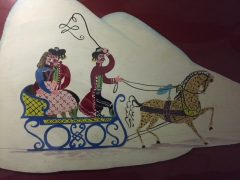
In February, we found a curious set of pictures on the walls at the Mittersill Mountain Inn in Franconia, NH, an iconic, venerable hotel with roots going back the the 40s. The staff did not know the provenance, but these are so idiosyncratic and distinctive, we thought one of our readers might know where these came from.  Of the dozen or so, here is a sample:

Exquisite, aren’t they?  Anyone know the story behind these?

This Week

We reveal the identity of the Mystery Glimpse ski train, its history, and its recent fate.  And we introduce another ski hero we bet very few people will know but should.  Check it out there.

We hear from our cross-country ski editor Roger Lohr, who also publishes XCSkiResorts.com, on spring XC skiing.  It’s out there, and it is glorious. Yvette Cardozo, our correspondent in the Northwest, managed to get herself booked on a ride in a grooming cat at Sun Peaks Resort, BC. She has a really interesting report on how they do it and what it’s like to be on a massive steep in a boxed-in machine.

Onwards

Thanks for reading SeniorsSkiing.com. Remember there are more of us every day and we aren’t going away.

Enjoy Spring Skiing when you can.


Mystery Glimpse: He Was The First

This Well-Dressed Athlete Was The First Of Many.

Thanks to the Colorado Ski And Snowboard Museum for sending this picture along. We’re reaching deep here, dear readers, and if you can get this one, we will be really impressed.  Who is he and what did he do that gave him a place in ski history?

Last Week

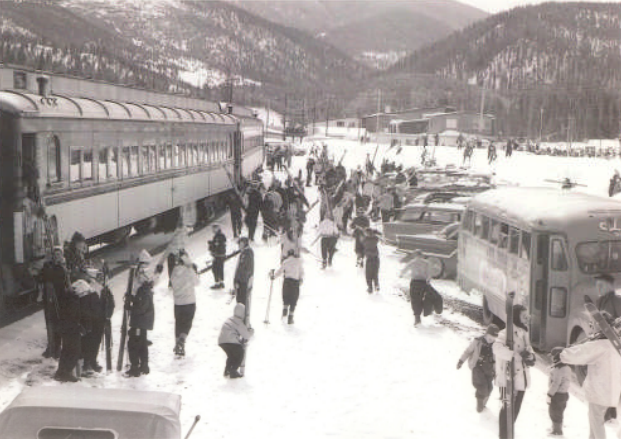
This is a glimpse of the famous Winter Park ski train that has recently shut down after 69 years of service.  Ski trains were very popular with skiers from metropolitan areas on both coasts and the Rockies during the 30s and 40s.  But, with roads and interstates, the trains became unprofitable. According to the Colorado Ski and Snowboard Museum, the ski train that brought Denver citizens to the mountains was one of the few that survived.
You can only now imagine how convenient and almost luxurious it must have been to take a train to a station near a ski area and get picked up by a bus or horse-drawn sleigh to be taken to a mountain hotel or base lodge. Must have been some fun times on those trains going back and forth.

Anyone remember taking a ski train to and from the mountains?  What was it like?

To read more about the history of the Winter Park ski train, click here.

Visit A Ski Museum

SeniorsSkiing.com salutes the many ski museums who have contributed to the Mystery Glimpse series this season. Our readers should be aware that these often very small museum carry the stories and pictures of the past years of snow sports, going back to the early renderings of hunters and warriors on skis and ski-like gear. If you have a ski history museum near you, visit and support their efforts.

Colorado Ski and Snowboard Museum

Vermont Ski and Snowboard Museum

Ski Museum of Maine

New England Ski Museum

National Ski and Snowboard Hall of Fame

Alf Engen Ski Museum

Museum of Sierra Ski History

We very much appreciate the contributions these ski museums made to SeniorsSkiing.com’s Mystery Glimpse.  It was our way of keeping ski history and heroes alive and in front of an audience who appreciates the value of nostalgia. Next season, we hope to expand our list of contributors.


Ridin’ With The Cats

What’s It Like To Groom Trails At Night?

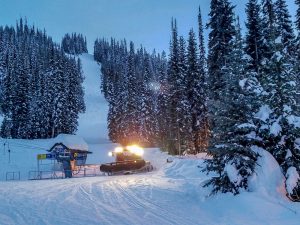
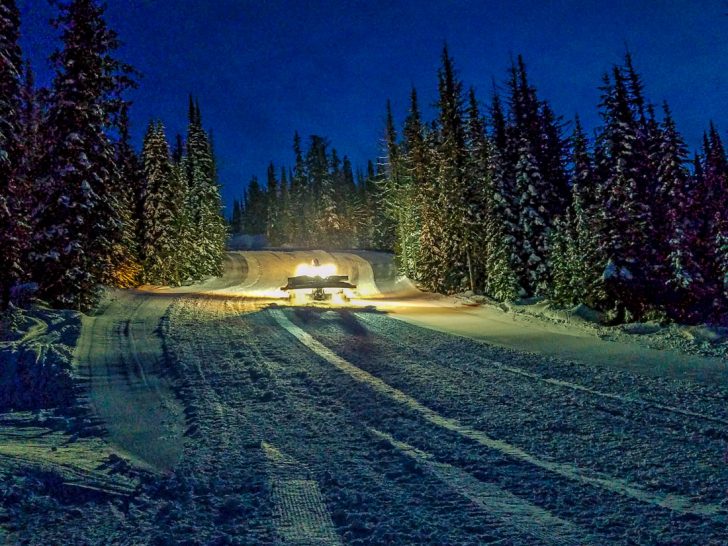
Snow cat groomer making the ski run smooth for skiers the next day. Sun Peaks Resort, BC.

They come out at night and do their job. You can see their lights progressing across the ski slope and occasionally hear their roar. And the next morning, they’ve left this delicious set of corduroy tracks across the ski hill.

I’d always wanted to go on-slope with a snowcat groomer. And so, at Sun Peaks Resort in British Columbia, Canada, I did. And it’s a tour anyone can sign up for.

Snow cat groomer makes its way down a ski slope at Sun Peaks Resort, BC.

It’s astonishing how much damage skiers can do to a run in a single day. If the snow is soft, bumps form, and the middle gets dug out because that’s where folks prefer to ski.

Enter the snowcat groomers. These are powerful cabs—Piston Bully 400s with 320 hp diesel engines— atop tank treads with a blade on front and a tiller on the back. The blade knocks down bumps and that nasty looking tiller, which rotates at over 1,000 rpm, can turn even ice into something resembling powder, which is then smoothed flat into that hero corduroy.

Of Sun Peaks’ 24 operators, two are women.

“Honestly, the women do a better job. They are more detail oriented,” admitted my guide for the night, Leo.

It takes three years for a groomer to really learn how to do this well, he added.

It was one of the women running the winch cat that night. Picture eight tons of growling machine attached by a line to a tree to keep from sliding downslope uncontrollably. This is how the really steep runs get groomed. Back in the day, these runs got so bumped and carved out, they were barely skiable.

It takes three years to become an expert groomer. Sun Peaks, BC.

Rob Gayman, grooming manager at Mt. Hood Meadows resort in Oregon, once described operating a winch cat this way: “It’s somewhat like dropping off a cliff. At the top break-over as the machine teeters above the brink, your heart starts to palpitate, and your natural survival instinct pushes you back into your seat.

“As the machine creeps forward and the operator adjusts the winch tension, the cat tilts forward into the darkness. The cat’s lights don’t shine down low enough; you can’t see what lies below. It tilts more and more. You start to fall forward out of your seat. Now you’re standing on the floor; surely this can’t be right? But then the cat finishes its forward tilt and the ground below you comes back into sight. It wasn’t a cliff after all. Snow rolls and tumbles down in front of the cat as the operator blades and tills his way downhill.”

For me, as dusk fell, the whole scene took on a surreal feel. Our headlights shining on the ridges of snow, leaving them glowing with weird shadows, along with the blinding headlights of an oncoming behemoth.

On an average night, more than a third of Sun Peaks Resort’s ski runs will be groomed. But among those, will be every green (beginner) trail.

And if you are lucky, your favorite black run will have been groomed early, then covered with ankle deep powder overnight, making for a run that feels, well, like skiing a glacier.

There are two women groomers at Sun Peak, BC, said to be more detail-oriented than the men.

This Week In SeniorsSkiing.com (April 6)

Season Hangs On, Cross-Country Lessons, Apex Boot Highlights, Bob Beattie, Fun & Games, Mystery Train.

Where it snowed in 2017-18 and how much. Snow accumulation data from the National Operational Hydrologic Remote Sensing Center. NOAA GOES-16 satellite imagery via the University of Chicago Research Computing Center

Click Here To See Where Snow Fell Day By Day From Oct 5th to March 26th. 

A glance at the map shows where the season’s snow accumulated and where it didn’t. Clearly, the Far West, Upper Rockies, (and Canadian Rockies not shown), parts of the Wasatch, and the Northeast received more than enough snow this season. Midwest, mid-Atlantic and Arizona resorts not so much.

The incredible graphic produced by the NOAA Goes-16 satellite of daily snowfall accumulation reveals most of heavy snow came sometime in March. So now we have spring skiing breaking out and ski resorts extending their seasons to make up for the phlegmatic January and February.

We have friends who have skied in the rain at Stowe this weekend and others who are planning to keep it up until Memorial Day and beyond out in Mammoth Mountain. This might be dubbed the “shifted season” where winter was re-set a month into the year. In any case, the challenge for resorts is to keep customers coming when most folks are taking boat covers off, spending Spring Break in the sun, or otherwise moving on from snow sports. Owning a ski resort is not for the faint of heart.

Mammoth Mountain extended the season after 16 FEET of snow in March. Credit: Unofficial Networks

This Week

This week’s Mystery Glimpse may be tough, showing a train somewhere out in the mountains. See if you can guess what’s going on.  On the other hand, we’ve been surprised by the depth of knowledge and history that comes out of our reader base. Last week’s handsome, California-stylin’ ski instructor’s identity is revealed along with a video clip of this charming gentleman.

We also have some advice on taking Cross-Country lessons from correspondent Jonathan Wiesel, insights into the growingly popular and “disruptive” Apex boot by Marc Liebman, a new game to play this spring with skiing friends by Harriet Wallis, and industry news and comments by co-publisher Jon in Short Swings. And there’s an interesting piece about the patron saint of skiers, mountaineers, and climbers. Do you know who that might be? Hint: Big dog.

This week’s was also marked by the passing of Bob Beattie, a popular, creative, entrepreneurial competitor, and television commentator. You can link to his obituary here.

The SeniorsSkiing.com Spring Survey Is Coming Soon

Please be on the look out for our Spring Survey. You will receive it as an email, and we promise it will take very few moments to complete. The purpose of these surveys is to understand your needs and to get to know who you are. We have had extraordinarily high response rates in the past which makes us think our readers are engaged and interested in supporting the our mission of boosting the profile of the senior snow sport enthusiast to the outdoor recreation community. So, BOLO.
Ski Songs Available

The response from our readers to Ray Conrad’s album of ski songs from the 60s has been remarkable.  It’s easy to download from CDBaby. If in doubt, ask your grandchild. You can go here to listen to some song snippets. Wonder why no one writes ski songs these days?  Or do they?  Know any “modern” ski songs?

Thanks for reading SeniorsSkiing.com.  Tell your friends to tell their friends.  Remember, there are more of us every day, and we aren’t going away.


sa;das


Mystery Glimpse: Choo-Choo!

Where Are We And What’s Happening?

Thanks to the Colorado Ski & Snowboard Museum for providing this picture from ski history.  The CS&SM is in the process of undergoing a $2.4 million renovation. The first of several exhibits, “Climb To Glory”, featuring the story of the 10th Mountain Division is now open. Other exhibits will be open at the end of April this year.  The museum is located in Vail Village, CO.

Last Week

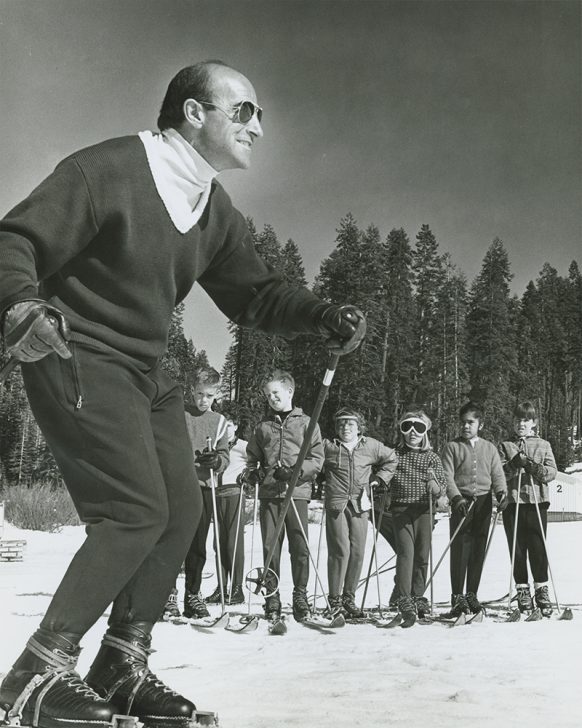
This is another ski history legend.  Nic Fiore was an influential ski instructor and director of the ski school at Yosemite’s Badger Pass for 50 years. His friendly smile and charming French-Canadian accent attracted skiers who came to Badger Pass every year to learn from and ski with Nic.

He was an early member of the California Ski Instructors Association in the late 40s. At the time, he was concerned about the quality and consistency of ski instruction, becoming a voice for a national ski instruction organization. When the Professional Ski Instructors of America was founded in 1961, Nic remained committed to high standards for instructor certification.

Nic Fiore was an active skier well into his 80s. He continued to hit the slopes nearly every day and teach an occasional ski lesson into the 2003-04 season. Nic passed away at 88 in 2009.

Here’s Nic on the lift at Badger Pass. Note his enthusiasm and magnetic personality.

https://vimeo.com/3111117

Thanks again to the Museum of  Sierra Ski History for sending Nic’s photo.  The MSSH is located at the Gateway Museum at Lake Tahoe, CA.

Cross-Country: Lessons Are The Best Way To Out-Think Your Feet

To Make The Switch To Cross-Country, Please Start With A Lesson And These Tips.

In the early 1970s, in a visionary but totally wrong-headed move, the fledgling Nordic ski industry declared that, “If you can walk, you can cross-country ski.”

It would have been a lot more helpful to say, “If you can walk, you can learn to cross-country ski. And it takes only one lesson from a professional to learn how to glide.”

Those were times when an alpine resort manager pigeonholed skinny skiers as, “Guys who head into the woods Friday night, and come out Sunday without having changed either their underwear or their $5 bill.” We were on the defensive—and dang, it’s tough to fight clever stereotypes!

Those were also the days that New Englander John Frado, who designed a lot of the best trails in North America, coined the hilarious phrase that’s the title of this article. And boy, was he right, because you’re going to become a better skier, use less energy, go further faster, and have more fun sooner if you start the sport with instruction. (And by that I mean ideally not just a single lesson, but one, followed by practice, then another lesson. And so on.)

Cross-country can be filled with grace—not just the dynamism, self-discipline, and athleticism you see at the Olympics, but true beauty. Or it can be an awkward downer.

So here are half-a-dozen tips to make skiing euphoric, quickly.

Credit: Ski Museum Of Maine

First, please do something the Nordic business has never been able to and come up with more endearing descriptions than “lesson,” “instruction,” “teaching,” and “ski school.” Who wants to go back to studies when you’re out to have winter fun?

Next, don’t even think of learning from a loved one—instead, learn from a ski professional. There’s always an uncomfortable level of stress and self-consciousness if your instructor is also a relative, or your sweetie. Too distracting; and incidentally, your kids or grandkids are likely to absorb everything depressingly faster than us oldies. But once you can glide, that’s the moment you discover that cross-country is incredibly social, skiing side by side with friends and family.

Third, learn to ski at a cross-country area or club with machinegroomed trails, where the compressed tracks will guide your skis. (More on this in a future article—promise!) A good resource on places to go is www.xcski.org and  www.xcskiresorts.com.

Fourth, your ski pro needs to explain, early-on, how and why to hold your poles properly (my cliché: reach for the sky along the shaft, then shake hands through the grip). Grabbing the poles tightly means you’ll be upright, stiff, walking rather than gliding, and a lot more fall-prone.

Fifth, if you’re renting equipment, check to see if your instructor uses the same skis you do. It kinda levels the playing field.

And finally, think about a second lesson—or a private lesson—that concentrates on the whole range of descent techniques on these narrow skis that don’t have metal edges or heels held down, while you’re using footwear akin to sneakers. Wedge turns, step and skate turns, parallels, telemarking, traversing with kick turns, side stepping—they’ll all get you down that hill.

And as I found even in my prideful youth, sometimes you just have to take your skis off and walk down. It’s all legit!

Spring Is The Time To Play Games

Try This New Game: It’s A Cross Between Where’s Waldo And A Scavenger Hunt.

Find the Bear. Credit: Harriet Wallis

I was skiing at Deer Valley, and I was taking photos. I’m always taking photos. It’s what I do. I never know when I’ll need a certain shot to illustrate a story.

Find the flamingo (?!) Credit: Harriet Wallis

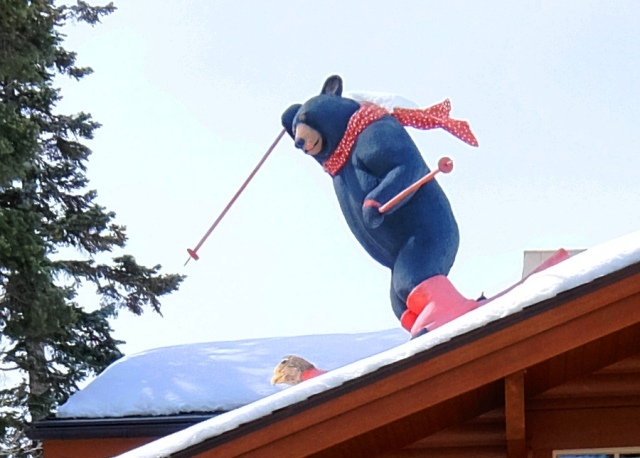
The next time I skied Deer Valley, I was with a friend. I showed her eight photos including the carved bear skiing on a roof, a flamingo wearing a white cross outside one of the ski patrol buildings, and a bronze Native American sculpture. I challenged her to find the real things as we skied around the mountain.

We covered a lot of trails that day. Deer Valley has more than 2,000 acres of skiing, six bowls and 101 ski runs. The hunt forced us to ski a trail once, so she could look for an item, and then move on rather than sticking to one trail over and over. It was a whole new angle on having fun.

Bingo! She found everything shown in my photos. And we were thoroughly tuckered out.

Find the mountain goat. Credit: Harriet Wallis

How To Play

If you are used to taking photos only at scenic spots, try snapping photos of things you see around your favorite mountain, such as a certain trail sign or an unusual weathered tree. Then show the photos to your friends (if they’re whacky enough) or to your grandkids. Challenge them to find those things. You can even offer rewards.

If the springtime slopes start to become ho hum, silliness will add new zest.

To read more from Harriet click here for her stories on SkiUtah.


Find the warrior. Credit: Harriet Wallis

Mystery Glimpse: Who, Where, And What?

Here’s A Classic-Looking Skier In A Classic Pose.

Looks like an instructor demonstrating to a kids’ class. Check the straps around his boots, and you will get a hint about the era depicted here. Don’t you love that turtleneck? No, parka, hmmm. Looks a little like California-stylin’.  That’s enough of a hint for this one. Who is he, where did he hang out, and what’s his claim to fame?

Thanks to the Museum Of Sierra Ski History and 1960 Winter Olympics for contributing this.

Last Week

Mystery Glimpse has stumped the collective hive mind for the first time.  No, not Stein Eriksen’s older brother, but good guess.
The handsome, young skier is Dick Buek, an extreme skier before there was extreme skiing.  Here’s John Jerome, the noted ski writer, talking about Dick back in the January, 1970 issue of SKIING magazine.

“To Dick Buek, the human body was a device with a certain potential, and the only sensible course for the intelligence which guided that body was to find out what that potential was….Collecting Dick Buek stories is an exercise in the suppression of disbelief.  Shussing Exhibition the first time he saw it. Winning a ski jump the first time—maybe the only time—he ever went down an in-run. Sky-diving with a parachute he found in a scrap heap. Diving off cliffs in Acapulco to win a bet for gas money. Piloting a light plane over a slalom course around lift towers at Squaw Valley, beneath  the cables. And so on. The stories are legend.”

He won the 1952 National Downhill Championship. Then, severe injuries from a near fatal motorcycle accident left him in really tough shape. Despite his knee and shoulder being held together by pins and plates, his leg only able to extend to 60 degrees, he entered and managed to win the Downhill at the 1954 Nationals at Aspen. He was passed over for the 1954 FIS World Championships because he was “a basket case.”

Dick Buek, 1929-1957

There are other stories, like watching Stein Eriksen do his famous flip at Sun Valley and immediately trying it himself, crashing spectacularly, catching a ski in the face, getting up, skiing down the rest of the run on one ski, handing the broken one to Ed Scott (Scott Poles) and telling him to fix it. Reports were he was trying a double flip.

Dick was a daredevil stunt pilot and managed to crash twice into Lake Tahoe, the first time when he was towing water skiers. In the second crash, he was actually giving a flying lesson to a friend, the wings froze up, and the plane went straight down.  He was just short of his 28th birthday.

He was inducted into the National Ski Hall of Fame in 1974.

You can read more about Dick Buek here.


It’s Birthday Party Time at Alta.

Hip, Hip, Hooray! Skier Bob Turns 94!

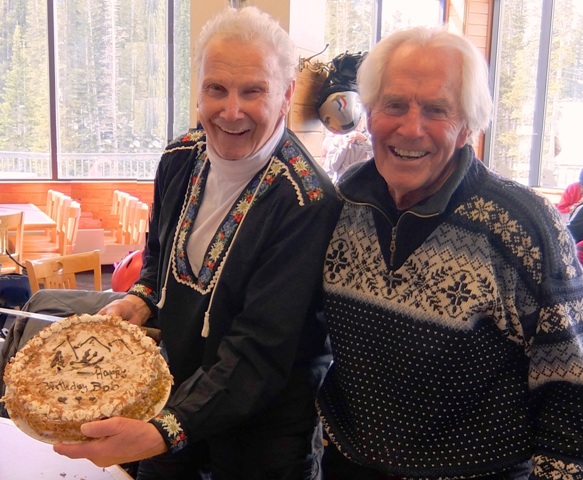
Bob Murdoch celebrates his 94th on skis at Alta. Credit: Harriet Wallis

You might say that 94-year-old Bob Murdoch is a “senior’s senior” skier. He represents many skiers across the country who are skiing into their 90s and enjoying their mountain friendships as much as the slopes.

Ski friends matter. Skiers gave Bob a birthday card that said: Count your age in how many friends you have, not in years.

Bob’s pal, Nick Looser, baked two special cakes
for the party at Alta. Credit: Harriet Wallis

At Alta, Bob is following in the footsteps—in the ski tracks—of 100 year old George Jedenoff who celebrated his milestone birthday on skis in July. Alta’s snow had melted by July, but its neighbor, Snowbird, gathered enough snow to groom a long swath so George could ski on his 100th birthday.

Next to George, Bob is the oldest skiing member of Alta’s senior group, the Wild Old Bunch—and the Wild Old Bunch threw an on-mountain party to honor him. And what a party it was!

Age has its rewards.

Bob, a retired hydro engineer, skis with his good friend Nick Looser, a retired culinary artist, who baked two specialty cakes for the event. He knew there would be a big crowd to celebrate Bob’s 94th birthday.

Bob currently skis three days every week, and his love affair with Alta goes back a long way. He skied the mountain in the 1930s before it was a resort and before it had lifts. He hiked up to ski down.

Skiing has changed a lot since the days of ungroomed snow and long uphill hikes, but we’re lucky we can celebrate with those hardy, early skiers, and we hope we can grow up to be like them.

To read more from Harriet click here for her stories on SkiUtah.

Kingdom-Trails-Fatbike

This Week In SeniorsSkiing.com (March 23)

60s Ski Songs Available Now, More Pass Wars Comments, Ski New Zealand Soon, Fat Bikes, And More.

Back in the early 60s, folk music was just beginning to become popular. Colleges, concert halls, and coffee houses were hosting a wide variety bands like The Kingston Trio and The Weavers with stringed instruments singing old time music as well as newly written tunes. One sub-genre soon emerged in parallel to the growth of the fast-growing sport of skiing. Oscar Brand, Bob Gibson, and a Navy vet named Ray Conrad created their own skiing songs which spread like an avalanche through the growing, ardent band of skiers.

Ray had a knack for composing clever, funny songs about the new world of the skier and skier wanna-bes. His tunes contain a full cast of caricatures like egotistical ski instructors, skiing cowboys, skiing Casanovas, skiing drinkers, you get the idea.  For years, these songs were out of print and only available to those who had saved their decades-old vinyl albums. Now, SeniorsSkiing.com has worked with Ray to make these songs available again.

You can download Ray’s 16-song album, The Cotton-Lickin’ Lift Tower and Other Songs, for $20 from CDBaby. This is a download only. You can listen to short clips on the CDBaby site. Seniorsskiing.com is sharing the proceeds with Ray, who, at 95 years old, is ecstatic people are still interested in his music.

For an earlier article on famous skiing songs of the 60s, click here.

More Season Pass War Puzzlements

Yes, the new editions of season passes and their features are confusing. We are hearing complaints from SeniorsSkiing.com readers about feeling left out by these passes. In this week’s edition, Co-Publisher Jon Weisberg opines on who wins and who loses in the season pass lottery.

And here’s a link to The Ski Diva, our friend and colleague, who writes a somewhat tongue-in-cheek advice column on how to choose between Mountain Collective, IKON, Epic and the rest.

Please let us know how you are navigating these choices.  Are you happy? Unhappy? If unhappy, have you complained to the pass vendors to let them know how you feel?  Remember, there are lots and lots of senior skiers affected by these pass changes. When we shout together, it’s pretty loud.

Think More Skiing In New Zealand

March has brought extraordinary, mind-bending, other-worldly snow conditions to the Sierras, the Northwest, parts of the northern Rockiers, and, thankfully, New England. Spring snow sports should be over the top. If, however, that isn’t enough for you, and you have the time and curiosity, you can always go to New Zealand, where the ski season will soon be “cooling up.”  Here’s a promo video from The Remarkables near the recreation city of Queenstown.  You should recognize The Remarkables from Lord of The Rings.

For another review of En Zed skiing, check out last September’s report from SeniorsSkiing.com advisory council member Bernie Weichsel here.

Ski The Remarkables, Queenstown, NZ

This Week

Check out our new Mystery Glimpse. It’s a dashing ski personality who left us too early.  Do you know who he is and what he was known for?

Correspondent Tamsin Venn reports on the first annual Ski Museum of Maine Senior Legends Race. This looks like a lot of fun, and congratulations to the competitors, most of whom were north of 70.

Correspondent Jonathan Wiesel has an interesting question: Better to cross-country ski on groomed trails or au naturel? Each has its unique qualities.  Your thoughts?

Fat biking is a new-to-us snow country activity although we hear its been around since 2007, starting in Alaska and working into the western US. XCSkiResorts.com publisher Roger Lohr introduces us to fat biking on snow with a visit to Kingdom Trails in northern Vermont.  For course, people also fat bike on beaches and mountain trails in the summer, but snow country is an interesting idea.

Discounts For Seniors

Two interesting vendors on our Discounts For Seniors page for this week’s highlight:

FitterFirst, exercise equipment emphasizing balance and coordination, and Injinji, compression socks that also accommodate individual toes.

Please visit all our Discounts For Seniors vendors. There are some interesting deals in gear, clothing, and gifts you should check out.

Thanks for reading SeniorsSkiing.com.  Tell your friends about us and remember, there are more of us every day, and we aren’t going away.

60s Ski Songs Now AVAILABLE!

You Can Now Download Ray Conrad’s Classic Collection Of Ski Songs.

After many delays, procrastinations, and technical ups and downs, SeniorsSkiing.com is happy to announce that Ray Conrad’s The Cotton-Pickin’ Lift Tower And Other Ski Songs, is now available for download from CDBaby. CLICK HERE.

Ray has kindly agreed to exclusively offer his songs recorded back in the 60s to readers of SeniorsSkiing.com. The music is download only and costs $20. SeniorsSkiing.com is sharing the proceeds with Ray who, at 95 years old, is ecstatic that people are still interested in his music.

In the early 60s, Ray Conrad wrote and performed skiing songs in a folk music style that was gaining popularity in cafes, clubs and college campuses. His songs are satirical, silly, clever, and funny, spoofing the people who ski or want to look like skiers. You can listen to clips of the songs on CDBaby.

Here are the songs from The Cotton-Pickin’ Lift Tower And Other Ski Songs:

  • The Cotton-Pickin’ Lift Tower
  • Snowdrift Saloon
  • The Flatlander
  • Three-Pin Bill
  • Two Cubes and a Slug of VO
  • Mogul Mouse
  • A Skier’s Daydream
  • The Big Downhill Skis
  • Marie
  • Number One Fun
  • The Ski Instructor
  • La La
  • Skier’s Bible School
  • Nastar
  • Round-Bottomed Bogners
  • An Ounce of Prevention

Remember, this is download-only from CDBaby. Once downloaded and on your hard drive, you can play these songs through your iTunes or  music player, transfer them to your Smartphone, listen at the gym or heading up to snow country in your car.

Let us know what you think about this little bit of ski history on SeniorsSkiing.com.