Tag Archive for: senior skier

Skiing In Literature: Knees

A Street Poet In Denver Writes An Impromptu Poem For SeniorsSkiing.com.

[Editor Note: SeniorsSkiing.com’s publishers visited the Outdoor Retailers/Snowsports Industries America Show in Denver last week.  Walking down 14th Street, we noticed a small hut lit by a lantern. Inside was a young man—D. M. Kingsford— sitting with a typewriter and a sign that said, “Pick A Topic, Get A Poem”. Our topic was “Senior Skiers”. Here’s the poem he tapped out in about two minutes:]

Poet D.Michael Kingsford receiving the muse.

Knees

By D.Michael Kingsford

Velocity doesn’t think in

Years, doesn’t

Edge towards stopping because

Decades have been stacked,

And snow

Is blind to

The candles perched solemn as a new

Bride the second time

Around:


You might ski

Thinking about wear and tear,

You might slope, but the

Mountain won’t mind:


You’re old enough to remember

Torn ACL’s and

Broken bones, but speed

And gravity

Have no memory for such things.


Breathe, and forget your age

Breathe

And count your age

In trees, whizzing by, instead of years.


This Week In SeniorsSkiing.com (Jan. 26)

Off To The OR/SIA Show, Mystery Tennis Player, Questions To Find The Right Instructor, Pat’s Peak For Hobbits, A Very Successful Senior Ski Club.

SeniorsSkiing.com co-publishers are heading out from various starting points to the great, big Outdoor Retailer and Snow Show in Denver’s gigantic Colorado Convention Center. We will be there to look for stories, product ideas for our readers, and to meet and schmooze with some industry friends. Our objective is to embed the message that the senior snow sports demographic is an unpolished jewel and to promote our growing online magazine.

This trade show combines the OR Show with Ski Industries America (SIA), and it looks like a mammoth undertaking. The list of exhibitors goes from Adventure Travel to Yoga/Pilates with just about every other outdoor activity to can think of in between. This promises to be a learning experience for us with demos, educational seminars, fashion shows, and special exhibits all revolving around active life style products and services.  It’s a chance for vendors to show off their new products to buyers from retail organizations of all kinds and sizes.

We are extremely impressed with the level of planning and tools provided to exhibitors, buyers and media. There are tools to help filter exhibitors whose products/services you want to see, maps which plot those interest points, direct email channels to vendors and lots and lots of public relations communications from the thousands of vendors and show promoters.

The whole industry has come a long way from the crowded hotel corridors we remember from the venerable Doc Desroches SIA shows of yore. In fact, we remember meeting the great mountain climber Jim Whittaker, the first American to climb Mount Everest, at the SIA Show in Chicago in 1970. Yes, it was a narrow, crowded corridor, so narrow in fact that Jim decided to proceed down the passageway with his hands on one wall and his feet on the other. True story.  We also shook hands with a very sun tanned Stein Erickson at the Chicago show.  SIA was the ski industry trade show that rotated through New York, Chicago and LA shows for many years.

So, we are ready, we’ve planned who we want to see and what we’re looking for.  So wish us luck, and we’ll report on progress next week.

Ski The World: Audi Hires Candide Thovex To Ski On Anything

Here’s a commercial from Audi  Quattro that will get your attention.  The “Flying Frenchman” Candide Thovex, extreme athlete, stuntman, adventurer, completely rips it up on grass, sand, rock, you name it.  This is for those of you who are still awaiting a decent base out there. It’s worth the five minutes.

This Week

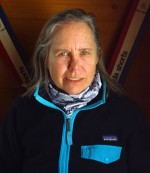
A new Mystery Glimpse appears with a challenging photo of a ski racing notable from yesteryear. Can you guess who she is? Thanks to the United States Ski & Snowboard Hall of Fame for contributing this week’s picture.

Only a few readers rose to last week’s stuffed animal challenge. See what significant event the rabbit, bear, and coyote represented.

Marc Liebman continues his advice on taking a ski lesson.  This week, he gives us five questions to ask an instructor before you sign up.  You may not be surprised to learn there is no universal, system-wide, standardized PSIA curriculum for teaching seniors. We know there are people who are very much interested in creating and promoting this idea. Seems like a long time coming.  If there was a senior-focused curriculum, we bet there would be more lapsed senior skiers coming back to snowsports of all kinds, not just Alpine skiing.

Sk clubs are a mecca for senior skiers.  In fact, you can find a ski club to join just by clicking through to the National Ski Council Federation.  Just click Find Ski Buddies Near You on the top menu box.  Correspondent John Farley brings us a report of a mountain-based ski club that sounds like it has a hardy mix of skiing and socializing.  They call themselves the Gray Wolves Ski Club, and they are based at Wolf Creek Ski Area in Colorado.  If you are looking for a model ski club to emulate, there are some ideas here for you.

Finally, correspondent Tamsin Venn shows us a really fine family-oriented ski area in New Hampshire that is the archetype senior-friendly area. Moderate-sized and modest facilities, Pat’s Peak has been a landmark since the early 60s.  And check out the retro-style base lodge.  What more do you really need, anyway?

That’s it.  We’re off to Denver. In fact, we’ll be there when you read this!  Thank you for reading SeniorsSkiing.com, and you know there are more of us every day, and we aren’t going away.


Five Questions To Ask Before Taking A Lesson

If You Haven’t Taken A Lesson In A While, These Questions Can Reassure You Are Getting What You Need.

Last week, we listed five scenarios when you should consider taking a lesson. The next logical question is how do I figure out whether or not the ski school and/or the instructor can help me? The bad news is that there is not really a good answer. However, any senior skier considering taking a lesson should try to find the answers to the following five questions that are listed in no particular order. And, the great thing about being a senior skier is that we have the experience to evaluate the answers and separate the truth from the B.S.

  1. Are you certified? Right answer: Yes, I’m level 2 or Level 3.
  2. Have you taken a clinic on teaching senior skiers? Right answer: Yes. Here’s the caveat. The Professional Ski Instructors Association (PSIA) and the American Association of Snowboard Instructors (AASI) has not come out with a standard nationwide framework for teaching. Some of the PSIA/AASI regions have their own certification programs but most don’t. Among those that do, the content and rigor varies a lot.
  3. Does your ski school offer special instruction for senior skiers? Right answer: Yes. The problem is that there are precious few ski areas which do. There is a greater likelihood that you’ll find instructors who are senior skiers who have experience teaching their peers than ski areas who have specialized programs for seniors.
  4. How old are you (the instructor)? Right answer: I’m 50+. You want someone who can relate to you and who may share the same physical limitations and challenges facing all senior skiers. There are many instructors who have retired from the business world and work as ski instructors to stay active in the sport. Find them!
  5. How often do you teach senior skiers? Right answer: The best possible answer is, “I teach seniors all the time” or “I only teach seniors.” This is where your instinct comes in. If you get a BS answer, then you have a decision to make.

So those are the questions I suggest you ask. What else you can do in the way of due diligence and how you evaluate your answers is up to you.


This Club Oriented to Senior Skiers is Thriving

Seniors Want To Get In Touch With Other Senior Skiers. A Club Is The Answer. Here’s One That Skis And Socializes.

[Editor Note: This article was written by John Farley, a Gray Wolf Ski Club member.  If you have any news about your ski club or advice to others about how to make ski clubs successful, please let us know.]

Red Solo Cup Day at the Gray Wolf Ski Club. Why not wear one or two on your helmut?
Credit: Gray Wolf SC.Some clubs catering to senior skiers are growing mightily. One great example of that is Colorado’s Gray Wolf Ski Club, whose membership has been steadily rising for a number of years and is now nearing 900 strong.

The Gray Wolf Ski Club is centered around the Wolf Creek Ski Area in the San Juans. Although the majority of the club’s members live in the Pagosa Springs, CO area, there are also quite a few members from communities such as South Fork on the opposite side of Wolf Creek Pass, and also a fair number of members from all over the country who vacation or have second homes near Wolf Creek.

The club’s mission is simple—to ski and socialize. And the club does a lot of both. Over the course of the ski season, members enjoy several club luncheons at Wolf Creek, each with a distinctive theme that members dress up for, like Red Solo Cup Day. Silly and fun.

To become a Gray Wolf, you must be 50 years old or better. Some are a lot “better” than 50, including Colorado Ski Hall of Fame member Charles Elliott who celebrated his 100th birthday by skiing.

Charlie Elliott celebrating his 100th birthday by skiing down an honor guard of club members.
Credit: John Farley  

Here’s Charles skiing, while Gray Wolves line both sides of the run: An interesting club tradition is that, once a year, members who turned 80 that year, and anyone else who wants to go along hike to the top of Alberta Peak (hike-to terrain within the Wolf Creek Ski Area) and ski down.

Members enjoy discounts on season passes at Wolf Creek Ski Area, and also at various businesses in the Pagosa Springs and South Forks areas. They also gather each Tuesday for a happy hour, which is particularly well-attended during the ski season but runs all year. That is but one of the many kinds of social events the club sponsors through the year, including an annual holiday dinner and dance and a pig roast during the summer. .

For more information about the Gray Wolf Ski Club click here.

SeniorsSkiing.com has partnered with the National Ski Council Federation to provide access to ski clubs across the US. To find ski clubs near you, click here.

SeniorsSkiing Guide: Pat’s Peak With Little Hobbits

And Grandparent Hobbitts, Too.

Hobbitts can be found at Pat’s Peak, New Hampshire
Credit: Tamsin Venn

Skiing with grandchildren is one of grandparents’ great joys and comes with perks: easier slopes, hot chocolate breaks, and slower (maybe) pace. Some ski areas are more finely tuned to multi-generational skiing than others, based not just on the amenities but the spirit of the area.

Pat’s Peak in Henniker, southern N.H., is one such place. The old-time vibe of this popular area is the first clue things are going to be fun. Tyrolean-style architecture harkens back to the days when Austria set the scene with boiled wool jackets and “bending the knees”. Greeters stand by with signs that say, “May I Help You?” which avoids the usual stumbling search for the lunch area and ticket booth. Free or low-cost tickets take the bite out of days shortened by tired or cold grandkids.

Three beginner areas sit apart from the main slopes so no one crashes into the grandchildren under your watch. One is located in a hobbit-like stand of trees with a carpet lift free to everyone. Another beginners’ slope has a handle tow, and the third features the Bluster Carpet, the longest magic carpet in New Hampshire. Older grandchildren will enjoy catching air in the three terrain parks. Grandparents, if you’re brave, try a Snowbike lesson/rental. You get to sit down while you’re skiing.

The base lodge harkens back to the early 60s, nostalgia for many seniors.
Credit: Tamsin Venn

A spirit of sustainability has guided Pat’s Peak development since the four Patenaude brothers, seeking an area closer to home, built the base lodge out of local timber and opened the area in 1963. That spirit continued this year when Pat’s Peak replaced the old Peak Double Chair with a triple bought from Vermont’s Ascutney Mountain and refurbished, doubling lift capacity from 800 to 1,600 people an hour.

Two interconnected lodges spread the crowds. Signs encourage you to share the long tables and benches. A blazing stone fireplace warms the toes. Food is homemade daily, and the grandkids like the M&M cookies the size of small Frisbees.

Sometimes it just comes down to the vibe of the place. Pat’s Peak feels like an area where you can let the kids loose to ski on their own while you attack the serious expert terrain.

More Perks:

Ski New Hampshire’s 4th and 5th Grade Passport: Children from any state in these grades ski for a day at 34 Alpine and XC ski areas across N.H.

January’s Learn to Ski and Snowboard month: $39 beginner special, including group lesson, rentals, lift ticket.

Pat’s Peak

Henniker, N.H.

Vertical: 770 feet

Skiable acres: 103

Runs: 28. Novice 50 %, Intermediate 21 %, Advanced 12 %, Expert 17 %

4 triple chairs, 2 double chairs, 1 J-bar, 1 beginner handle tow, 1 park handle tow, 2 carpet lifts

100 percent snowmaking

Children five and under ski free with a ticketed adult. Day tickets are discounted for ages 6-17 and over 65, only $49 on weekdays. The beginner lift is $26 a day. Saturday night POP (Pay One Price) of $49 includes skiing, snowboarding, snowtubing, rentals, lesson tips, and entertainment.

Click here for Pat’s Peak Trail Map

www.patspeak.com

Pat’s Peak Update Video


This Week In SeniorsSkiing.com (Jan. 19)

Book Review, Why Take A Lesson, Mystery Glimpse, 12 Tips and Tricks.

First, let’s look at what’s going on in Zermatt.

Zermatt has beaucoup de neige.

Yessir, folks.  If you want to find snow so far this winter, we suggest you head to 1) The Alps, 2) New England, 3) Canadian Rockies. Perhaps a handful of other places.  We know that Vail and Aspen are producing disappointing financial results, and Utah is depending on the snowmaking arts to add to the stingiest base in 30 years.  However, it is still early days and white winter can roll in any time, despite the odd profile of weather’s happenings, like snow in Florida. We will be watching.

Reminder: 2017-18 Ski and Boots For Seniors, 115 Ski Resorts Where Seniors Ski Free*

If you are a subscriber, you can access our ski and boot recommendations for seniors.  Just look under the Subscriber-Only Content box in the top menu OR under COMMUNITY in the blue menu.  Both resources are free to subscribers.  You’ll also find our book of Historic Ski Posters to download, including 115 ski resorts where seniors can ski for free (or almost free). Some resorts give such big discounts on senior tickets, (i.e., $15 for mid-week), they might as well be free. You can also sign up for a free subscription to SKI Magazine and a free online subscription to Ski History. 

Coming Soon: We Are Re-Releasing Ray Conrad’s Collection Of Ski Songs.

It has taken a while, but we are in the final stages of preparing to re-release Ray Conrad’s amusing and clever “The Cotton-Pickin’ Lift Tower And Other Ski Songs.”  Originally released in the 60s in LP form and again the 90s as a CD, these songs are hard to find these days.  They will be available for download purchase very soon.  Details to follow.

Why Do I Have To Re-enter My Name And Email?

Every so often, we get complaints from readers who have to re-enter their names and emails when they visit SeniorsSkiing.com.  The reason is often that the reader has disabled cookies on their browser.  Think of a cookie is a little automatic log on tool; it stores your log on information for specific sites.  If you disable it, no log on information.  Hence, you get the pop-up. Solution: Enable cookies on your browser.

You also might be trying to access SeniorsSkiing.com on a device that is different from the one you used to originally sign on with.  Again, that different device might not have the cookie that the log on is looking for.  Just sign on again and, if the browser is enabled for cookies, you are good to go.

This Week.

We have two articles that refer to technique and ski lessons.  Jan Brunvand offers a book review of Soft Skiing, by Lito Tejada-Flores, which explains the ski turn in simplest terms. As a senior skier, it is encouraging and clarifying to read his description of what the skis do to make a turn and how to initiate it. If you haven’t skied in a while or are much delayed in this particularly odd snow season, it might be a very refreshing view to take on board before you head out.

Meanwhile, correspondent Marc Liebman has been busy gathering the answer to the question posed to seniors: Why take a lesson?  We know that almost 30 percent of our readers do take a lesson during the season. Marc was curious as to why.  Here are the five big reasons he uncovered in his research.

Turns out our new Mystery Glimpse feature is quite popular.  Lots of readers took a shot at identifying the hot dog skier who was noodling on the slopes.  It shows how knowledgeable and experienced our readers are.  Even the wrong guesses were kind of interesting.  Check out this week’s MG.  Be advised: We think it’s not that easy.

Finally, correspondent Don Burch offers some life hack tips and tricks for skiing. Here’s one: Wipe silicone on your tips and boots to keep the snow off. We are sure our readers also have a collection of clever ideas for making the experience easier, safer, more fun.  Let us know.

OR SIA Show In Denver.

The publishers of SeniorsSkiing.com are heading to Denver next week to attend the combined Outdoor Recreation and Snowsports Industries America show.  We’ve been planning to visit specific vendors who have products our readers might find valuable.  If you have any recommendations about who to look up, please let us know.  It seems the entire outdoor activities world will be there.  The only thing missing is a company selling 40 foot sailboats.

Thanks for reading SeniorsSkiing.com.  We really are growing every day and we are not going away.

Mystery Glimpse: Name That Turn

Not Easy, Nor Healthy, This Was The Turn Of The Early 70s.

Thank goodness, this fad turn didn’t last long.  This week’s Mystery Glimpse: What was it called? If you think you know, note in the COMMENTS below.

Last Week’s Glimpse

Okay, okay, it was Jean-Claude Killy, the famous French celebrity ski racer of the 60s and 70s.  Many of you got it. We remember meeting JCK at the offices of SKIING Magazine on Park Avenue around 1971 or so. He was a compact, wiry, with angular, athletic features with a firm handshake.

Jean-Claude was a triple Olympic champion, winning the three alpine events at the 1968 Winter Olympics, becoming the most successful athlete there. He also won the first two World Cup titles, in 1967 and 1968Later in the 70s, he became a race car driver, and a notable spokesperson for a sporty brand of Chevrolet. (“Camaro, eet iz my kind of car.”

Here’s the rest of his story on Wikipedia.  Check it out to see who his very famous head of state friend is.


How Wheaties Affected The 1936 Olympics

The Breakfast of Champions Kept Champion Ski Jumper Alf Engen From Competing.

Wheaties Ad 1936, Courtesy of Alan Engen

Legendary extreme athlete Alf Engen, known as the greatest all-around skier ever, was a champion soccer player, skier and ski jumper. During the 1930s, he set ski jumping world records. He helped design and establish more than 30 ski areas in the western United States. And he’s fondly remembered for pioneering deep powder skiing techniques and for his ski school at Alta.

But world champion Alf Engen was banned from competing in the 1936 Olympics because of a Wheaties breakfast cereal box.

It was just the fourth time that countries faced off against each other in wintertime Olympics. Competition included just four sports: bobsleigh, ice hockey, skating, and skiing. Twenty eight countries sent their best athletes to the IV Olympic Winter Games.

As background, Engen came from Norway to the United States in the 1920s, and he played professional soccer. By the 1930s, he was acclaimed for his ski jumping feats, he joined a ski jumping team, and he soon won 16 national ski jumping titles. And his jumps set world records. He also won national titles in all four ski disciplines: ski jumping, cross country, downhill, and slalom skiing.

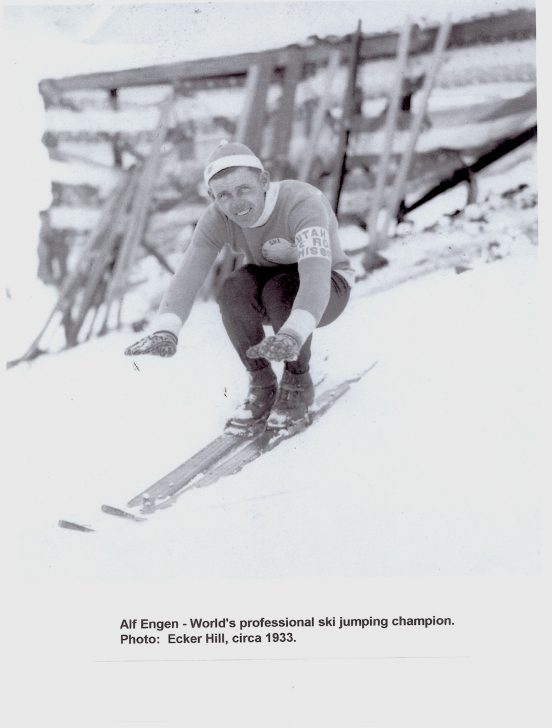
Alf circa 1933, Courtesy of Alan Engen

Also in the 1930s, radio was the mass media communication method of the era. There was no television. People used their imaginations to create pictures from the words they heard.

But another form of mass media was taking hold: cereal boxes. Until then, breakfast cereal had to be cooked, but when food manufacturers invented cereal that could be eaten right from the box, they faced a marketing dilemma. How could they convince families to switch from cooked cereal to this newfangled ready-to-eat cereal? A cereal box sitting on the breakfast table with pictures of all-star athletes would be the marketing device. And unlike radio, the images were right there on the box.

Four athletes appeared on the Wheaties box—Bob Kessler, basketball star; Mike Karakas, champion hockey player with the Chicago Blackhawks; women’s speed skating champion Kit Klein; and famed skier Alf Engen.

Meanwhile, Engen became an American citizen. In 1935, at the U. S. Olympic Ski Jumping Finals held at classic Ecker Hill, he out-jumped everyone. He was immediately named as a member of the U.S. Winter Olympic Ski Jumping Team which would compete in the 1936 Winter Games in Garmisch-Partenkirchen, Germany.

But just before he was scheduled to leave, Avery Brundage, president of the International Olympic Committee and a zealous supporter of amateurism, ousted Engen from the team because his picture had appeared on the Wheaties box. He declared that Engen’s image on the cereal box made him a professional, not an amateur athlete.

“Engen said he didn’t remember getting any money from the cereal company, ‘Just a lot of Wheaties. I think I gave everyone in Salt Lake City free Wheaties.'”

Alf with trophies, courtesy of Alan Engen

Ironically, shortly after the Olympics, Engen jumped against—and he beat—both the gold and silver medalists from the Olympic Games, Norwegian gold medalist Birger Ruud and Swedish silver medalist Sven Eriksson.

The remarkable skiing Engen family is the only family to have four family member in the U.S. Ski and Snowboard Hall of Fame: Alf, his two brothers Sverre and Corey, and his son Alan.

Alan lives on in his father’s tradition. He’s a champion skier and athlete as well as an accomplished scholar, author, and historian. He carries on the Engen tradition of serving the skiing community.

Alan dreamed of displaying hundreds of Alf’s ski trophies and memorabilia for the public. The dream grew into the $10.5 million Alf Engen Ski Museum at the Olympic Park in Park City, Utah. Visitors can also learn about avalanches, sit in a real bobsled, try their knack at interactive ski jumping, and more. The museum was funded entirely by private donations, including donations from Utah’s famed and philanthropic Quinney and Eccles families. Visit and enjoy the museum when you’re in Utah.

To read more from Harriet, click here for her stories on SkiUtah.

Alf in flight, circa 1936, courtesy Alan Engen


Skiing In Literature: The Snow Man

The Snow Man By Wallace Stevens

One must have a mind of winter
To regard the frost and the boughs
Of the pine-trees crusted in snow;
And have been cold a long time
To behold the junipers shagged with ices,
The spruces rough in the distant glitter
Of the January sun; and not to think
Of any misery in the sound of the wind,
In the sound of a few leaves,
Which is the sound of the land
Full of the same wind
That is blowing in the same bare place
For the listener, who listens in the snow,
And, nothing himself, beholds
Nothing that is not there and nothing that is.

Mystery Glimpse: Who’s This Unhappy Fella?

Our Next Mystery Photo Is Someone Who Became A Ski Celebrity.

If you think you know who you think this guy is, write your guess in COMMENTS below, just scoll down. We’ll reveal the answer next week.

Credit: SKIING Magazine

Last Week’s Mystery Glimpse 

This is Olympian Picabo Street as a young racer.  Thanks to the Alf Engen Ski Museum in Ogden, UT, for picking this out of its archives for us.

Picabo Street is an American former World Cup alpine ski racer and Olympic gold medalist. She won the super G at the 1998 Winter Olympics in Nagano and the downhill at the 1996 World Championships, along with three other Olympic and World Championship medals.  She was also a heart throb for a lot of men and boys who followed her during her competition. [Wikipedia]

We remember a news clip from coverage of one of her Olympic races. It said that in the midst of a medal run, she gave herself some encouragement by saying,”Come on, come on, come on.” That mantra stuck with us as a useful way to kick oneself into another gear whenever circumstances seem to warrant. She became an inspiration to hundreds of young women ski racers. Thanks, Picabo.

Gone Skiing

We’re taking the week off.  Have a Happy and Safe New Year.

See you in 2018.

This Week In SeniorsSkiing.com: Dec. 22

Mystery Glimpse, Reasons For Nordic Skiing, Test Your Ski Knowledge, SnowSport Leader Alan Engen.

Where’s the snow, you may wonder? If you’re in the Northeast, you’ve got cold and snow, and many areas have been open since Thanksgiving. If you’re in the Rockies, you’re still looking upward, although we hear its coming this weekend. If you’re in Alaska, you’re wondering what hit you.

Alaska has been hit by humongous snowfall earlier this month, and the beat goes on.  The Washington Post reports that 10 inches of snow has fallen in one hour—that’s one hour—in parts of Alaska.  In all, 40 inches of wet snow fell in 12 hours from that particular storm.  That is one of the most intense, all-time snowfalls on record.

Here’s where La Nina comes in.  The La Nina condition, the cooling of sea water in the Eastern Pacific, interacts with the atmosphere, bringing moisture-laden air into the jet stream and focusing it in the Alaska-Yukon area. Perhaps you’ve heard of the Atmospheric River, streaming from the Pacific into the Northwest?  This amazing snowfall is in line with the winter prediction from NOAA.  That prediction includes moisture for the Northern latitudes and dryness for Southern latitudes across North America.

The good news for Western skiers is that this La Nina condition resembles what happened last year.  And you remember what snow conditions were like in the Sierra, right? Awesomely amazing. Keep those skis and snowshoes ready.

Reminder: FREE Subscriptions

Did you get your FREE subscription to SKI magazine yet?  If you’re a SeniorsSkiing.com reader, you can sign up by clicking on the SUBSCRIBER-ONLY CONTENT box or look under the COMMUNITY menu for SUBSCRIBER-ONLY CONTENT. [Note: US residents only.]

You can also get a FREE online subscription to SKI HISTORY, the publication of the International Ski History Association.  Just click SUBSCRIBER-ONLY CONTENT.

Mystery Glimpse: New SeniorsSkiing.com Feature

This week, we’re launching a new feature, Mystery Glimpse.  We’ll publish a picture from a museum’s archive, a private collection, or from a news source, and you guess who it is, where it was taken, or what its significance is.  Just reply in the COMMENTS box under the photo.  This week’s inaugural photos is a famous ski racer.  Let’s see who gets it right.

Also This Week

Alf Engen and Alan Engen jumping at Alta, circa 1949.

We are putting the spotlight on Alan Engen, a snow sports leader whose career as ski jumper and industry executive started the moment he was born.  Find out how that happened by clicking here. SeniorsSkiing.com is proud to have Alan on our Advisory Board.

XCSkiResorts.com publisher Roger Lohr responded to last week’s Top Reasons for Being A Senior Skier with his list of Top Reasons For Being A NORDIC Senior Skier. We love Nordic skiing and agree with the benefits of being outdoors in the quiet woods on a brilliantly cold winter day.  Thanks Roger.

In another first, we have a test-your-knowledge quiz about the sport of skiing from Correspondent Don Burch.  It’s a challenge; we didn’t fare very well.  Perhaps you can score a 10.

SeniorsSkiing.com Assets For Subscribers

Another reminder to our readers.  We have some incredibly useful resources for our readers. These include:

  • Where seniors can ski for free (or almost free)
  • Boot recommendations for seniors
  • Ski recommendations for seniors
  • Free Historic Ski Poster Booklet
  • Discounts from Experticity for those who are eligible
  • Ski Younger Now tips every senior skier should know

And we point you to where you can find ski buddies from the club listings of the National Ski Council Federation.  Note: Ski clubs can be accessed by clicking the Find Ski Buddies Box on the top menu.

THESE RESOURCES CAN BE ACCESS UNDER THE SUBSCRIBER-ONLY CONTENT MENU IN TO TOP BOX OR UNDER THE COMMUNITY TAB.


Quote of the Week:

“How Old Would You Be If You Didn’t Know How Old You Were?”

K2 Ski Ad Circa 1970s


Have a Happy Holiday and a Happy New Year.  Remember, there are more of us every day and we aren’t going away!

SeniorsSkiing.com will be taking next week off for the holidays.

Top Reasons I Enjoy Being A Senior Nordic Skier

In Response To Last Week’s “Top Reasons I Enjoy Being A Senior Skier”, We Hear From A Nordic-Loving Senior.

Credit: Dawn Green

Editor Note: Roger Lohr is publisher of XCSkiResorts.com, a top guide and center for cross-country news and destination information.

It seems the older I get, the more I enjoy Nordic (XC) skiing. It probably has something to do with being out in nature and also being confident on the skinny skis.

Roger Lohr is publisher of XCSkiResorts.com.

Nothing to Prove

There is nothing to prove but so much to enjoy going along a trail, whether going uphill or downhill. Well, truth be told, I enjoy the downhills much more than the uphills. Frankly, I completely endorse the two-car experience, where one car is left at the bottom of a trail and the other is taken to the top. Is this cheating? Maybe, but I am a senior XC skier; that’s my prerogative.

What A Feeling

It has always been enjoyable to help others with technique tips, but I’d be lying if I didn’t admit to really like when people appreciate my XC ski skills. Much of the enjoyment depends on having the right equipment and, with XC skiing, that is a very important factor. Narrow, fast, waxless skis for the tracks at a groomed XC ski area are great to enjoy the gliding sensation. Whether hearing the nearby brook bubbling, the fragrance of the pine or balsam trees, or stopping along the river to watch the water pass over ice-covered rocks, you find nature is at its transcendent best.

Downhill in the Forest

I also love using wider XC skis (either steel-edged or not) and a little more supportive boot with a wider binding system to go downhill in untracked snow on trails or off trails. Meandering and finding a way down in deep snow is what I call a good time, and the lightweight equipment makes it manageable. I often earn my turns by skiing up a hillside trail on waxless skis to capture some thrills on the slide back down.

The Mountain Road

I especially like taking the lift at Bretton Woods in New Hampshire’s White Mountains to ski back down on the Mountain Road trail whether it is groomed in a corduroy lane, roller coaster tracked, or is sporting a coat of any depth of new snow. That Mountain Road has never disappointed when I’ve taken friends on it.

Snowsport Brethren

My love of XC skiing includes no “attitudes” about my snow sport cousins on alpine skis, telemark or AT skis, snowboards, or snowshoes. We all can enjoy nature in winter and we all can enjoy mastering the snow for memories of the experience. In fact, on powder days I can think of nothing better than donning my snowboard hitting the slopes and floating down the powder paths to the lift to do it again.

Meeting on the Trail

I love to meet others upon the trail and chat about the trails, XC skiing, the equipment, and clothing. Sharing the outdoors with other active folks is great, and it always adds something to the outing.

Ski Anytime

With XC skiing, there is no midweek issue because you can ski anywhere there is snow and on any trail that has enough snow cover to support sliding and turning. Any day can be a great day XC skiing whether at the commercial XC ski area or up the street on a local trail network.

Ready for Anything

Being prepared helps, so on my outings I bring a small pack to carry water and other things that I might need such as dry gloves, a hat, compass, a scraper and spray to handle icing on the skis, and so on. In the old days, I’d carry a spare tip in case the ski broke, but that is a rare instance now as the skis are so well made. And speaking of the equipment, XC ski boots are so comfortable with the right sock set. It seems I’m out there in my bedroom slippers or barefoot.  Light, layered clothing works perfectly to keep me dry and warm. There’s no need for bulky insulation because XC skiing creates heat to ward off cold temperatures.

No Discounts Needed

When I get back home, I enjoy the feeling of accomplishment and respect for nature. I’m not concerned with senior discounts because XC skiing is inexpensive at commercial areas where a trail pass is less than $20-30, or it is free on any other trail that you may find around town or in the local park. Either way, XC skiing keeps you active, feeling great, and in touch with nature, and that’s a triumphant triplet.


The Ultimate SeniorsSkiing Ski Quiz

You’ve Think You’ve Been Around Snow Sports For A While?  Okay, Test Your Knowledge.

I know what you’re thinking; “Ultimate, I doubt it.” You’re a really good skier, you’ve been skiing for years and you’ve skied just about everywhere. “There’s no quiz about skiing that’s going to humble me.” Let’s see…

  1. As of the 2016-17 ski season, what state has the most operating ski areas?
  2. What state or province has the longest ski lift?
  3. What is the oldest operating ski lift in North America?
  4. What ski resort in the East has the greatest true vertical drop (lift-served, continuous fall-line runs)?
  5. Season pass holders account for what percent of all ski area visits?
  6. How long is the longest trail in the East?
  7. What ski area in North America has the greatest lift-served continuous vertical drop?
  8. In mph, how fast is the average detachable lift?
  9. In mph, how fast is the typical fixed-grip lift?
  10. What is the largest ski area in North America (as defined by lift accessible terrain).

Answers:

  1. This one surprises most of us: New York has the most with 48 followed by Michigan with 42, Wisconsin and Colorado tie with 30 each, California has 29, Pennsylvania and New Hampshire tie with 26 each and Vermont has 24 (Source: SnowBrains).
  2. Vermont’s Sugarbush has the longest lift, Slide Brook Express at 11,012 feet (just over two miles). The Slide Brook Express connects Lincoln Peak with Mt. Ellen and carries skiers in both directions (Source: Peter Landsman author of LiftBlog).
  3. The Single Chair at Mad River Glen (VT) is the oldest operating lift having been constructed in 1948. In 2007 it was been extensively renovated and updated (Source: Peter Landsman).
  4. According to the folks at MountainVertical.com, Whiteface in NY has the greatest true vertical drop at 3,216 feet. They define true vertical drop (or True-Up Vertical Drop as they call it) as “the most vertical distance at a resort that can be achieved on commonly skied, lift-served, continuous fall-line runs”.
  5. According to SAM (Ski Area Management) passholders now account for 40 percent of ski area visits.
  6. According to Wikipedia, Juggernaut at Killington (VT) is the longest trail in the East at 6.2 miles.
  7. Revelstoke (BC) with 5,620 feet has the most vertical drop (Source: MountainVertical.com).
  8. The average detachable lift moves at 12mph (Source: Peter Landsman).
  9. The typical fixed-grip lift travels at 5.6mph (Source: Peter Landsman).
  10. Whistler Blackcomb (BC) is the largest with 8,171 acres (Source: Liftopia The Blog).

In the comments section, let us know how you did. Were there any surprises? Are the any answers you’d like to contest?

Going Retro

If You’ve Been Into Snow Sports For A While, You’re Gonna Have Retro Clothes. Find Them, Take A Pic, And Send To Us.

We have hats from the 60s, sweaters from the 70s, boots from the first time we went cross-country skiing, knickers, lots of old stuff we could never toss.  Well, we’re having a bit of fun wearing them around the various snow fields (slopes, trails) that we habituate, now that snow is on the ground.

Send us a picture of you in your vintage togs, we’ll publish it and put them all together on a special page.  Will be fun to see what you’ve got in the back of your closet. Just send a JPEG or PNG to info@seniorsskiing.com

Even retro ski poles…Skiing at Appleton Farms, Ipswich, MA.
Credit: A. Maginn

Here’s a pic of yours truly in a 1966 Moriarty hat (bought at Mrs. Moriarty’s shop on the Stowe Mountain Road, by the way), a US Ski Team sweater by Montant from about 1972, and Mother Karen’s knickers circa 1970. (Props for still being able to squeeze into them.) Taken last weekend after Saturday’s snowstorm in the Boston Area.

Correspondent Jan Brunvand sent two pics.

Jan’s been wearing this jacket since high school.
Credit: Jan Brunvand

The first shows him wearing a nylon unlined jacket covered with ski patches, posing at main entrance of the Peruvian Lodge at Alta. This was taken on his 84th birthday, March 23, 2016. He’s had this jacket since high school and wore it through college over a heavy sweater on a regular basis. He’s added patches over the years, and is about to start putting them on the back. The label identifies the brand as “Ski Trail Sportswear” with the same name printed on the leather zipper pull.

The picture below shows Jan’s wife Judy wearing a wool Demetre sweater with a sleeve logo alluding to Spider Sabich (1945-1976), who was a participant in the 1968 Winter Olympics. She had it on at the mid mountain restaurant at Vail in 2013 when Jan spotted a young man wearing an orange, black and yellow version of the same sweater. He said his father had let him borrow the sweater for the trip west. Demetre also made a black, white and red version of this sweater, although I have never seen one, only pictures. 

Spider Sabich logo sweaters from the late 60s.
Still work.
Credit: Jan Brunvand

Finally, correspondent Tamsin Venn found a picture of real people in long ago outfits from a gathering of the Ski History folks a couple of years ago at Stowe.

More than retro, these outfits are just old-fashioned.
Credit: Tamsin Venn

Send yours in and we’ll see what senior skiers have been sequestering for decades.

In Praise Of Urban Wilderness

Find Winter Activity Opportunities Close To Home.

Let’s define what we mean by Urban Wilderness:

  • Open space – wetland, meadow, and/or forested land.
  • Owned by a public entity
  • No parking or entrance fees
  • No visual pollution
  • Offers “peace and quiet”
  • Accessible by either car or public transportation from the nearby urban center
  • Offers a variety of activities (year-round)

Urban Wildernesses can be found in or close to many city centers. The point is that you don’t have to venture into the mountains to find winter recreation; it’s often just a short ride away. All you have to do is find them.

Here are two examples, one from the Boston Area, the other from Portland, OR.  What are your favorite Urban Wildernesses?

Around Boston

Hard to believe this view of Middlesex Fells Reservation is only a few miles from downtown Boston.
Credit: Commonwealth of Mass

Near Boston, MA is the Middlesex Fells Reservation. “The Fells” has borders in four near Boston suburbs; Medford, Winchester, Stoneham and Melrose. It’s 2,575 acres bisected by Interstate I-93. The east side of I-93 is more developed. The west side of I-93 is less developed with a border road and some homes along the road on the opposite side from the Fells. Nevertheless, the west side provides more of a wilderness feel.

Several ponds act as a water supply to the town of Winchester. The Fells have a good number of trails for mountain biking, hiking, snowshoeing, x-c skiing (ungroomed) and trail running including:

Skyline Trail

The 6.9 mile Skyline Trail follows the outer perimeter of the western Fells. There are spectacular views of Boston and the surrounding area. Most of the Skyline trail is in wooded landscape, with several steep ascents to rocky outcrops.

Reservoir Trail

The 5.2 mile Reservoir Trail encircles the north, middle and south reservoirs, and the open water can be seen from many sites (the reservoirs are for drinking water, so access to them is prohibited).

Cross Fells Trail

Beginning in the western Fells near the Medford High School, the 4.5 mile Cross Fells Trail gives a good sampling of the features of the Reservation, from wetlands at Whitmore Brook to open water at Quarter Mile Pond in the eastern Fells, to views at Cairn Hill. Use caution crossing South Border Road, Route 28, Woodland Road and the Fellsway.

For more information about Middlesex Fells Reservation, click here.

In the Boston area, there’s also Walden Pond, site of Thoreau’s cabin, in Concord, and Appleton Farms, a 900 plus acre working farm established in 1638, in Ipswich.

Here’s a brief description of a ski tour around Walden Pond.

And here’s what it’s like cross-country skiing at Appleton Farms.

Around Portland, OR

Forest Park is practically in downtown Portland, OR.
Credit: Forest Park Conservancy

At 5,157 acres, Forest Park in Portland, Oregon is one of the largest urban forests in the United States. With more than 80 miles of trails, Forest Park stretches for more than seven miles along the eastern slope of the Tualatin Mountains, at the convergence of the Columbia and Willamette Rivers. As stated in the park’s website, “Forest Park offers an unparalleled opportunity for visitors to experience a true Northwest forest without leaving the Portland city limits.” Forest Park immediately came to mind as an archetypical urban wilderness.

Activities along the 80 miles of trails include:

  • Horseback riding
  • Hiking
  • Cycling/mountain biking
  • Running – trail and road
  • X-C Skiing, Snow Shoeing (when and if it snows)*

Among the park’s trails are:

Ridge Trail

Trailhead access for the Ridge Trail, which is only open to pedestrian use. To find the trailhead, park at the obvious pullout on the way down Bridge Ave (heading toward Portland). You will then need to walk back up Bridge Ave roughly .2 mile to find the actual trailhead.

The Wildwood Trail

30.2 breathtaking miles, from the southern end of the trail at the Vietnam Veterans Memorial in Washington Park to the Northwest terminus of the trail at Newberry Road.

*The city of Portland averages only 4.3 inches of snow a year, so winter activities are the often same as activities the rest of the year. But, what a place to get you in shape for skiing on Mt. Hood only 50 miles from downtown Portland!

For more information about Forest Park, click here:

Please tell us your favorite urban wilderness. What makes it special to you?

This Week In SeniorsSkiing.Com (Dec. 8)

Free Magazine Subscriptions For Readers, Tale Of The Yellow Suit, Choosing A Condo Rental, More Gifts For Seniors, A Funny Remembered Incident.

Alberto Varagas illustration from WWII honoring ski troops.

This week is a special time of the year for those of us who are Baby Boomers or, more likely, pre-Baby Boomers. When we were growing up, Pearl Harbor Day was more than a mention in the newspapers. Like the attacks on Sept. 11, Pearl Harbor Day was a day of remembering how everything changed.

To commemorate this auspicious date, we’re publishing this voluptuous image from Alberto Varagas, honoring ski troops from WWII. This appeared some time during the war. You don’t see booties like those much anymore. Thanks, Cathy.

We have some more good news for our subscribers this week.  We are always looking for ways to bring value to our readers.  We’ve worked with two magazine publishers to bring free subscriptions to you guys.  You can get a one-year free subscription to both SKI magazine and SKI HISTORY magazine just by following the links in Jon’s article.

These two benefits add to the list of free skiing for seniors, the ski recommendations, Experticity discounts for those who qualify, and free historic ski posters.  All of these are available for subscribers only.  Look under the Subscribers-Only Content box at the top or under the COMMUNITY > Subscriber-Only Content pics.

Bill skiing Park City on his 80th.

Reader Bill Emerson submitted a nice story about his yellow ski suit which has been with him for quite a while. We’re collecting stories about retro clothing, parkas, hats, sweaters, etc., from yesteryear that are still useful.  If you have something really old that you are still using, send us a picture of you with your relic. We’ll assemble a bunch of these and see what happens.

Correspondent and real estate agent Joan Wallen offers some advice on how to rent a condo that fits your needs.  This is the first part of a two-part article; next time, she’ll be talking about how to buy a ski condo.

Correspondent Don Burch read Harriet Wallis’ article on Lift Maintenance 101 which triggered the memory of a funny incident when he was a young man working lifts.  Here’s his story.

Speaking of Harriet, this week she offers some accessible, sensible, and really desirable gift ideas for seniors.  Plenty of time for shopping, right?

Finally, we have to send our best wishes and hopes to those friends and folks in the LA area who are dealing with wildfires and Santa Ana winds. Wide awake out there.

Next week, we should have some news about boot recommendations for seniors, another value-add feature of SeniorsSkiing.com.  Please tell your friends about our online magazine.  There are more of us every day, and we aren’t going away.


Commute, Rent, Or Buy?

The Best Way To Enjoy Your Ski Time.

Choose a small chalet…

While some snowsports enthusiasts are fortunate enough to live and work in ski country, most skiers and riders have to commute from their homes, often two, three or more hours from their favorite mountain. For the frequent skier—those who want to spend every weekend, plus vacation weeks on the slopes—their commute can become very tiresome.

This can be especially true for families with young kids. Parents, and grandparents, have to get the kids organized every morning to get in the car at an early hour so as to be at the slopes for the start of the day. If the kids are in some kind of racing program or weekend recreational class, hitting the road in a timely fashion becomes even more important. “Did you remember your gloves, goggles, hat”, even “your boots”, is sometimes heard as the car heads out the driveway.

…or a luxury, slope side condo. It all depends…
Credit: Steamboat Springs

Many families opt out of this weekly hassle by renting a house or condo near their favorite resort or perhaps in close proximity to several areas so they have a choice throughout the season. Ski gear and clothing can be left there, they can drive up on Friday evening, relax and be ready to go on Saturday morning without the stress of an early morning drive, and return after a day on the slopes for a relaxing evening.

What should you look for when renting a property in ski country?

Well, that depends a bit on your lifestyle and the resort where you want to spend your time. If very young grandchildren children are part of the mix, you might want to find something slope side or very close to the mountain so one family member can take a child home when he tires out. A ski in, ski out unit is best for this, but even a house or condo a mile or two from the area will let someone be delivered home easily without disrupting the entire family’s day.

Another thing to consider is what you like to do in the evening. If you’re content to return to your rental after the lifts close, have dinner in, watch tv or movies or play games, then you might look for something out of town in a quiet, country setting. But if you want entertainment, like to eat dinner out frequently, sample the nightlife, then perhaps a house in a town or around the base area (depending on the resort you choose) is a better option.

As far as the actual property goes, you need to again examine your lifestyle as well as your budget. How many bedrooms do you need? Will you or your children or grand children be bringing guests? Is one living space, whether large or cozy, where you can all be together preferable? Or would separate spaces for relaxation work better for the family? Do you prefer something upscale, in a condo community with amenities such as a spa, swimming pool, workout equipment? Or will a simple house work fine for your group?

Budget is an obvious important consideration. If you rent a single family house, in addition to the rent, you will likely be responsible for paying utilities including cable and wifi as well as plowing costs. Be sure to ask about the type of heat the house has and how efficient it is. Fuel costs over the course of a winter can sometimes come as a big, surprising shock, and you want to be prepared.

When searching for a seasonal rental property, it is a wise idea to use a real estate rental agent. These folks know the properties and, by asking a few questions, can often direct you to something you might not find on your own. They will have a handle on expenses for the winter, condition of the property and lots of tips on location relative to the mountain and other activities that may be of interest to you. There are plenty of ways to book lodging on line, but if you go this route be sure to use reputable web sites and ask a lot of questions.

Another option is purchasing a home in ski country, clearly a more complicated process which will be addressed in a future article.

A Wad of Tobacco, A Chairlift, And A Ford Maverick

A Long Forgotten Incident Comes Rushing Back.

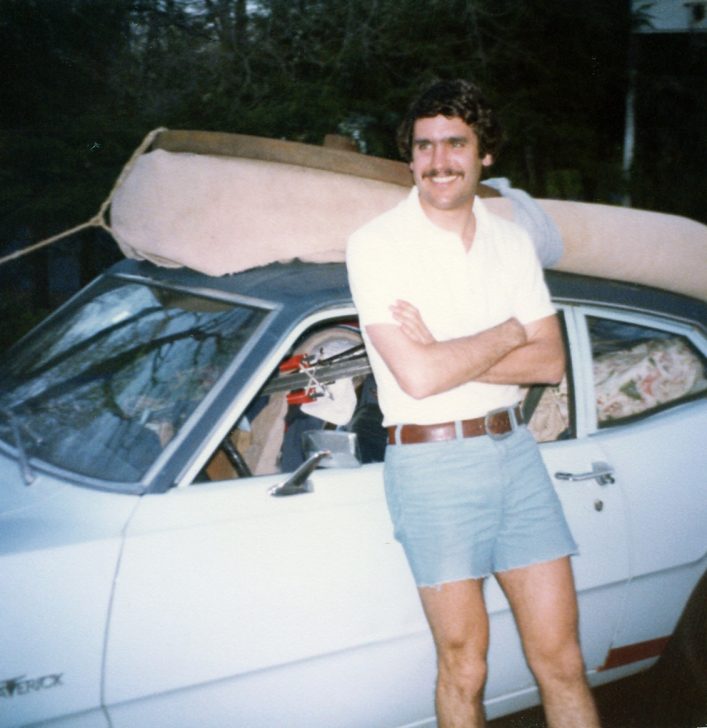
Don Burch, circa, 1970, with the infamous Ford.

In the late 70s, I was working at a ski resort and poor as could be. When the Head Maintenance Engineer asked around for someone to pick up a part for one of the chairlifts, I quickly volunteered. He probably figured I knew what I was volunteering for and wouldn’t have done so without a pickup truck or some other appropriate vehicle.

It was after hours, and we needed the part in order to run the lift in the morning. The supplier agreed to stay open until I arrived.

As a twenty-one-year-old male, there may have been some other decisions I made without much forethought. In my mind, the part was a few bolts or something like that.

Though I was to drive 90 minutes in the dark on country roads, I had confidence in my mature Ford Maverick (Yes, the photo is of the car I used). It was starting to snow, but I knew my new retread snow tires were up to the task. Using the finest workmanship I could muster, I had recently jury-rigged an eight-track tape player under the dashboard so I knew the trip wouldn’t be totally devoid of entertainment.

When I arrived later than promised, the supplier was grumpy as hell. He spat a wad of tobacco into the snow, pointed to large gear laying against a fence post and grumbled, “How the hell are you gonna get that in there?”

Sliding the front passenger seat all the way back, it looked like the gear might just fit. With the grizzly old guy providing special lubricant in the form of sub-vocalized mutterings, we managed to get it in. The car listed unnervingly to starboard.

With no more words spoken, the receipt was tossed in the car, and the parking lot lights were off before I was out the driveway.

On the return trip,  the crown of the road, under slippery conditions and tilt of the car, overcame my ability to keep the old Maverick on the road. Into the ditch I went.

To my great relief, a pickup truck pulled over just minutes after the mishap. With the sweet smell of liquor wafting from their breaths, two good Samaritans offered to pull me out. One attached a chain to their hitch, and the other hooked up somewhere under my car. I took a moment to look under the car, saw the hook on the steering rod and moved it to the frame.

I profusely thanked my new best friends, made it back to the mountain, the chairlift was operational by morning, and I had a windfall of $22.00 bonus.

Thanks to Harriet Wallis whose recent article entitled Lift Maintenance 101 sparked this long forgotten memory.

Another Unique Gift: Buffalo Down Socks

We Took The Challenge And Wore Them For Five Days.  Here’s What Happened.

Bison down and Merino wool make a warm and durable combination.

We love buffalo, the distinctly American creature who has been denizen of the Great Plains since pre-history, who was deified by native Americans, who has captured our imagination in countless legends, songs, stories, novels, and movies, who has shown up in hamburgers, (bison burgers) and who now contributes to keeping our feet warm. Such a versatile critter, we hardly imagined that they had enough…what, fur?…to make things out of.

Apparently so. An enterprising company out of Kennedale, TX, makes a variety of clothing and accessory items from what they call “Bison Down”. Come to think of it, have you ever seen a buffalo shivering? Their undercoat of thick down is the insulating mechanism that keeps these huge mammals warm. Ron and Theresa Miskin, the good folks at The Buffalo Wool Co., were kind to send us a couple of pairs of buffalo down socks for testing.

In the letter accompanying the socks, they wrote: “If you’re feeling brave, wear them for two, three even four days…We think you’ll be impressed at how they hold up, keep your feet dry. and don’t get ‘stinky’ like cotton or synthetic socks.”

Well, we went for five days.  We were impressed with how they held up and how warm they were. We hiked in our hiking boots, sat through Thanksgiving, went to the store, and, truth be told, even slept in them on a couple of particularly cold nights. All for the sake of not exactly science but an honest product review for our readers.

At the end of five days, we gave them our personal sniff test. Not bad, we thought, but we need a second opinion to be statistically correct.  So, when our grown up son visiting for Thanksgiving was sitting on the couch one evening, focused on a football game, we asked him to do a sniff test.  In honesty, we didn’t really ask him. Rather we shoved our five-day ripe socks into his schnozola and said, “Smell this”. After an awkward discussion, he agreed they didn’t have the aroma of the bottom of long-abandoned gym locker.

And they really didn’t.  They were terrific.  We noticed these socks were nice and thick, the kind that is really comfy for hiking, cross-country skiing, snow-shoeing and outdoor activities in the cold weather whatever those might be.  The model we tested was made of 40 percent Bison Down, 40 percent Merino wool, 18 percent Nylon and two percent Spandex.  When we first opened the package, we noticed they were quite silky smooth and soft feeling.  They remained what way for the entire test period.

On the other hand, such thick socks might not be a choice for ski socks. SeniorsSkiing.com co-publisher Jon Weisberg, who also is testing a pair, says that some ski boots are so fitted to the foot that thick socks might get in the way, make the boots to tight and the feet too cold.

In any case, you can find a wide variety of different socks, hats, gloves, and even yarn at the Buffalo Wool Company site.  The model socks we tested were the Trekker Buffalo/Merino Wool for $38.  Other socks were as low as $32. Other products included different combos of Bison down with either silk or Merino wool.

And think of the fun you can have challenging your family members to a game of “how long can you wear your socks”.

The American Bison never shivers.
Credit: Brittanica

Holiday Gift Suggestion: DeBooter Easy-Off Ski Boot Jack

Other Than A Book, A Bottle, Or Some Meaningless Gewgaw, It’s Not Easy To Find A Reasonably Priced And Relevant Gift For The Older Skier.

DeBooter: Easy-to-use ski boot jack. Credit: OutDoor Logic Solutions

DeBooter solves that dilemma. It’s a clever ski boot jack that makes boot removal fast and easy.

SeniorsSkiing.com readers can purchase DeBooter for less than $32, a 20% discount from the $39.95 retail. (Enter SeniorsSkiing at checkout.)

It’s simple. Loosen your buckles (obviously!). Place DeBooter on a flat surface. Anchor it with the toe of one foot and place the other heel in the jack. Lift your foot, and you’re painlessly free!!!

Full disclosure: DeBooter is an advertiser, and I’ve written about the product in the past. But many of you are gift shopping, and I’d be remiss not remind you of this perfectly designed device.

On several occasions, I’ve shared my DeBooter with others in the parking lot. Some of them contemporaries, some older, some younger. The reaction to having their ski boots pop off painlessly is universally positive.

David Johnson, who invented and manufactures the product, reports that most of his sales are in the US, and that they are increasing abroad.

If you’re looking for the right gift for the skiers on your list, look at DeBooter.


Becoming A Ski Instructor At An Advanced Age

Consider A Second Career For Fun, Fitness, Fulfillment.

Mick O’Gara, PSIA Alpine Examiner Emeritus, leads the crew, at Waterville Valley, NH. Credit: Tamsin Venn

Many SeniorsSkiing.com readers are seriously committed to skiing, and many have the experience, time and skills to actually teach skiing.

Here are ten good reasons you should consider working as a ski instructor.

  1. Plenty of other advanced age ski instructors are doing the same thing. You are in good company.
  2. You are needed, especially on weekends and over vacation weeks, February in particular. It’s often all-instructors-on-slope at these times. In down times, which can be frustrating, free skiing with like-minded instructors is a great chance to have fun and parse technique on the lift.
  3. Contagious youthful energy. We old folks get to mix with high school students who have skied at the area since they were Mitey-Mites, those taking a winter off from college or to reset career priorities, and foreign students here for a winter in the U.S.

    How many silly ski instructors does it take to change a ski’s load capacity?
    Credit: Tamsin Venn

  4. Camaraderie. You will find your fellow instructors are a great group of folks, supportive, funny, professional, many life long skiers, who love skiing and are dedicated to teaching.
  5. Training. Ski areas provide on-snow instruction for newbies so no need to fear you’ll be sent out to cluelessly teach beginners. Trainers offer regular clinics throughout the season for newbies and veterans alike. You are encouraged to go through PSIA-AASI (Professional Ski Instructors of America/American Assn. of Snowboard Instructors) certifications, and resort trainers offer instruction for that as well.
  6. PSIA is a great organization to join with many clinics and division events throughout the season. It offers Level I, II, and III certifications not only in Alpine and Snowboard teaching, but in Adaptive, Adaptive Snowboard, Cross Country, and Telemark. Level III is very challenging. If you meet an instructor and he or she says Level III, give them cuts in line. PSIA is good for goal setting. You have access to a slew of great trainers, examiners, plus educational material, manuals for teaching different levels of skiers, videos, newsletters, and magazines. You also receive pro discounts of 40 percent or more from major ski gear companies. (You can never have enough Patagonia Nano Puff jackets.)
  7. Perks? Parties. Plus season pass. Locker, so you don’t have to schlep your gear to the mountain every day. Uniform, probably cooler than your own ski jacket. Discounts on gear and burgers. Free skiing at other mountains with letter of intro from your ski school director.
  8. One of the best bosses you may have ever had (at least, that was true in my case).
  9. Incredible sense of accomplishment when a lesson goes well.
  10. It’s easy to get started. Go to jobs page at a ski area that interests you—or more importantly where you have a place to stay—and follow instructions for hiring. Good luck.

    Tamsin says: “I wish I could still do this.” Not required for instructor certification though.
    Credit: Tamsin Venn


Fast Freddie

Blind Skier Inspired All Who Knew Him.

Fast Fred Siget on the left with Pat McCloskey, center, and friend at a long ago National Blind Skiing Championships.


The first time I skied with Fred Siget was in Snowshoe, WV, with Larry Walsh of the Pittsburgh Post Gazette. This was my maiden voyage guiding a visually impaired skier. I had Fred, the first blind skier in our area, in front of me. Right turn, left turn, right turn, stay, stay. All of a sudden the only tree around popped up right in front of us as I yelled “Crash,” and Fred sat down as he ran into it.  I felt so bad, but Fred dusted himself off with a smile and said, “Pat, don’t worry about it at all. This will be one of many.” And we continued down the slope. This began a 40-year friendship with the one and only Fast Freddie Siget.

Fred lost his vision as a result of an accident with a high pressure hose when he was a volunteer fireman. As devastating as this injury was, he was undaunted. He became the first visually impaired computer programmer for Koppers Corporation. He continued dancing, and he learned to ski with guys like Larry Walsh, Jim Conley, Lynne (Kravetz) Hartnett, Shorty Leco and Micky Hutchko.

Fred always had ideas on how to make things easier for blind skiers and how to improve guiding techniques. He had a transmitter rig where the guide used a microphone and Freddie had an ear piece which made calling out commands easier and more understandable.

Once I used the transmitter while standing on top of a slope, calling commands to Fred as he skied by himself down to the chairlift. With his “Blind Skier” jacket on, people were shocked viewing his run. In the bar afterwards, we had some fun with Herman Dupre the owner of Seven Springs Mountain Resort. I put the microphone on and guided Fred over in front of Herman and told him to tell Herman how much he admired his red flannel shirt. Herman was stunned and later remarked to me laughing that he was starting to “get hot thinking about all the free passes I gave to Fred and now he is telling me how much he likes my shirt!” Hilarious.

Fred was always anxious to help new guides. He put himself at risk during the training but always felt that it was worth it not only to train guides that could assist him, but to help the other visually impaired skiers who were beginning to show up at BOLD (Blind Outdoor Leisure Development) outings at Seven Springs.

Perhaps the most compelling thing about Fred was his kindness and appreciation for his fellow skiers and guides. He always remembered your birthday and when he called me, he sang, “Happy Birthday to you, Happy Birthday to you, get plastered, you bastard, Happy Birthday to you.”

He was popular for his skiing for sure, but as a person, you could not get a better guy who was always interested in others and never talked much about himself.

We lost Fred this fall at 94 years of age. He had an amazing life, and we will miss him. Fred never let his accident slow him down. He always said that he did more as a visually impaired individual than he ever did before losing his sight. He took a perceived bad thing and turned it into opportunity. Shouldn’t we all learn from that lesson?

Wonderful Winter Walk With Wolves

Why Wait When Wolves Want Wise Well-Wishers.

Wolves walk with visitors during a guided wolf walk in the forest and play in the snow near Golden BC. Credit: Yvette Cardozo

Okay, in the picture, it looks like she’s being licked by a dog. But trust me, that’s NO dog. It’s a real grey wolf. In the woods. Walking with my friends and me.

Woman meets Scrappy Dave, one of the wolves on a guided wolf walk through the forest with Northern Lights Wolf Centre, a wolf rescue and education center in Golden, BC.
Credit: Yvette Cardozo

It was part of our morning at Northern Lights Wolf Centre just outside Golden, BC, Canada, where we learned about wolves and definitely got close and personal.

Shelley Black and her husband Casey have been raising wolves for nearly two decades. Their aim is not only rescuing abandoned wolf cubs but educating the public.

“There’s so many misconceptions about wolves,” Casey told us.

For one, they really don’t lurk around woods just waiting to eat people. They’d rather avoid people. But thanks to a lot of fiction where hapless folk are forever being devoured or myths that are really morality tales warning women of attacks by men (Little Red Riding Hood, for one), there is an ingrained public fear of wolves.

There are many wolf rescue/education centers around North America but only a handful that let you actually walk with the wolves and interact with them.

And so, we gathered one late winter morning at Northern Lights Wildlife Wolf Centre to learn, prepare, and walk.

The wolves have been exposed to people from birth and are used to walking with visitors.
Credit: Yvette Cardozo

Scrappy Dave and Flora, our wolves that day, had come from a zoo that had too many wolves. They were brought to the center in Golden when only a few days old. So, like all the wolves here, they are totally used to people.

“They lived in the house with us for the first several months,” said Shelley. “We treated them like human babies, fed them and slept with them.”

When not out in the woods on wolf walks, the wolves live in acre enclosures, two each to an enclosure.

But these ARE wild animals. For that reason, Shelley and Casey explained, the walk is totally on the wolf’s terms.

“We don’t approach them but if they come up to you, you can touch them.” (um, more about that later).

More Wolf Walk Rules:

  • If you don’t want the wolf to jump up on you like a friendly dog, hold your hands together and down in front of you, push him down and say “Stop!”
  • Don’t spin away because they see that as a game.
  • Don’t kneel down. Kneeling is a sign of aggressive behavior in the Canidae family.
  • Keep your hat on and if you take your gloves off don’t think you can just hold them. Scrappy Dave will grab them. And they’re gone, lost in the woods. Forever. Best to just keep them on.

One of the more interesting facts is that wolves don’t need to run; they aren’t sled dogs. They’re actually quite lazy, which in the wild is a survival tactic to conserve energy.

With all this in mind, we headed for the woods.

We walked down a logging road a few hundred yards when suddenly, Flora, all 60 pounds of her, trotted up to me and raised up on her hind legs. She was almost as tall as me as she leaned in, put her huge, muddy paws on my shoulders and sniffed my face.

She was saying hello in wolf talk. She did that to one of my friends, though on her back, leaving muddy paw prints that looked like a painted design. And I’ve got the pictures to prove it.

At this point, it was time for our “wolf moment,” which involved standing next to a tree stump while Scrappy came up from behind and did his best to lick us into oblivion. All I can say is, who knew wolf tongues were soooo soft and warm.

One could point out that this whole adventure was staged and quite artificial. But the purpose, Casey and Shelley said, is to let people know the wolfs’ place in the environment and, especially, to let people know wolves don’t have to be universally feared.

Northern Lights Wildlife Wolf Centre is a 15 minute drive from Golden, BC. The programs are open year round. There’s a talk led by a guide where people walk around the edge of a fenced wolf enclosure. It is open to all ages.

The Wolf Walk age limit is 16 and above, lasts most of a morning or afternoon and costs $335 CDN for two people. The interpretive talk at the center is $12 CDN for adults, $35 CDN for a family of four.

The wolves have been socialized to people from birth and are used to walking with visitors
Credit: Yvette Cardozo


This Week In SeniorsSkiing.com (Nov. 24)

Happy Thanksgiving, La Nina Delivers, Reader Input Needed, Great Gift Idea, Funny Urban Legend, Lift Maintenance, Birthday For 98 Year Old Olympian, Experticity Reminder.

Fun Thanksgiving? Not for all.
Credit: SnoCountry

Happy Thanksgiving to all our readers! We know you are happier than the poor turkey to the left.

In many places, this weekend marks the official start of the snow sports season. In fact, Killington is hosting the Audi FIS Women’s World Cup starting Nov. 24 and going through the weekend. Snow guns are taking advantage of every drop in temperature, and trails will be ready for the world’s fastest women. Join the crowds!

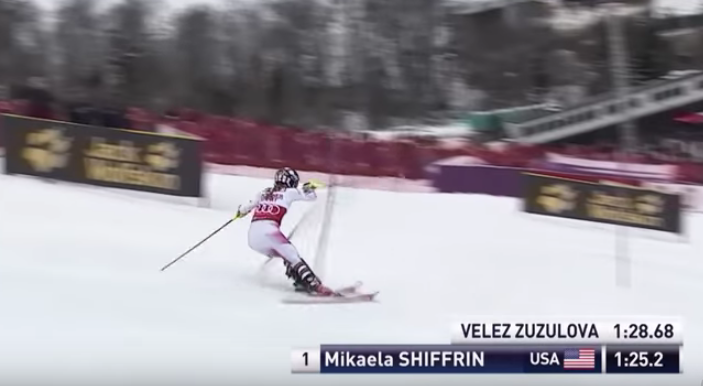
Here’s a short video clip from last year’s race at Killington. Pretty exciting profile of Mikaela Shiffrin, 21-year-old winner of the slalom event.

La Nina Brings Snow

NOAA’s Climate Prediction Center reports that a weak La Nina condition exists in the eastern Pacific off the coast of Peru.  That means surface sea water temperatures are cooler than normal having the ultimate effect of retracting the jet stream that flows over North America.  The connection with snowfall is shown on the map below which is a summary of several years of snow accumulation during La Nina winters. Note the blue is above average snowfall, the brown below average.  You can easily see where the snow will be. Remember, this doesn’t guarantee massive snow, but it is certainly a positive development for those in the blue areas.

Reader Stories and Videos Welcome

We were very pleased to see how many readers wrote in to correct and update our original list of where seniors can ski for free. (Note: You can find the list under the COMMUNITY menu pick, select SUBSCRIBER-ONLY CONTENT.)

That enthusiasm led us to think that many of our readers might have interesting stories that other readers might be interested in reading. Or video clips.  If you have something to share, please write us at info@seniorsskiing.com.  Keep your copy to 500 words. Pictures are really important, too.  JPEGs or PNGs are ideal.  If you have brief videos, post them on YouTube and send us the link with your story.

An Appropriate Gift For Seniors

We tested a device for locating lost objects using a small, bluetooth-based chip called Tile. We were very impressed and suggest you take a look.  It is one of those inventions which can be truly life-changing. And for the better.

Skiing Urban Legend

We have a funny story which has taken on the status of urban legend about a novice skier.  Correspondent Jan Brunvand coined the term “urban legend” when he was in academia and was asked to report on any legends related to the snow sports world. Here’s the story.

Keep Lifts Spinning

SLC Correspondent Harriet Wallis has a story about lift maintenance, a months-long, complex process that most of us never think about but which has to be done just right to ensure a trouble-free, safe season.  Harriet profiles the lift crew at Deer Valley.

Happy Birthday To 98 Year-Old Olympian

The Ski Museum of Maine has saluted Chummy Broomhall, a two-time Olympian cross-country skier who is celebrating his 98th birthday.  The Museum is asking people to send Chummy a card. Last year, he received 150 cards; let’s beat that this year. Find out where to write.

Experticity Reminder

Several readers have found that when trying to re-register for Experticity, they are faced with a questionnaire asking them for their connection to the ski business.  We explained the change a few editions ago, but it’s worth repeating. What happened was that our original discount relationship was with Promotive.  That company was merged with Experticity early last spring.  They scrubbed their list of subscribers and informed us that only those readers who had a legitimate connect to the ski industry could qualify. We asked them to change their verification process to make it a little less constrictive, and Experticity did take our recommendations.  So, it wasn’t an open door like it used to be, but some readers can probably still qualify.

Next Week

On we go into the early season.  Our correspondents are all working on stories for you.  Gift ideas, tips for renting condos, profiles, and lots of other topics.  Also in the story bin is our list of ski recommendations for seniors.  And boot recommendations.  Stay tuned.

Remember, tell your friends about SeniorsSkiing.com.  There are more of us every day and we aren’t going away.