Tag Archive for: senior skier

Mystery Glimpse: Straight Down

Who Is This And What Is He Best Known For?

Let’s see if you can identify this skier who blazed some very impressive trails back in the 40s and 50s.

Hint: He was also a pilot.


Last Week

We are frequently impressed by the deep knowledge our readers have on the personalities and history of snow sports.  This week, we were blown away by the several contributors who absolutely nailed the story behind this famous picture.  Well done, readers.

Here’s the story: In 1206 AD, a Norwegian king died and left his baby son, Hakon Hakonsson, as heir to the throne. To protect the infant from enemies, two skiers carried him through treacherous winter terrain to safety in Lillehammer. Their rescue is commemorated every year in the 54=kilometer Birkebeiner race, named for the birch bark gaiter they wore to protect their legs.

Thanks again to the New England Ski Museum for the painting and caption. Congratulations to NESM for opening its new facility in North Conway, NH.

Cross-Country: Tracks vs Touring

Groomed XC Trails Are Becoming More Prevalent; Does That Ruin The Aesthetics Of The Sport?

The “natural” experience, just like it was meant to be…Or…

For the past 50 years or so, there’s been a generally amicable debate whether cross-country skiing on machine-groomed trails is preferable to making your own way over the fields and through the woods. The argument has a lot of angles, including “Free vs. Fee” and “Pristine, Silent, and Serene vs. Speedy, Social, Service-based, and Secure”.

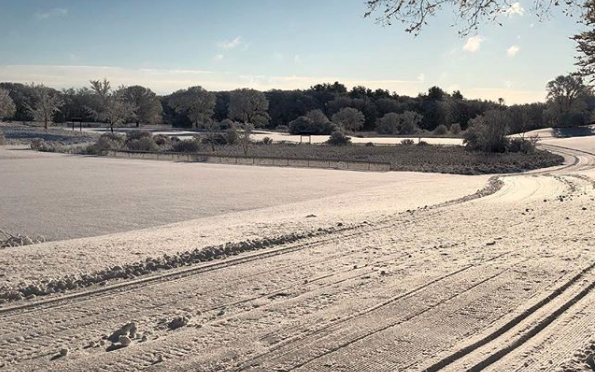
…Groomed trails at Appleton Farms, Ipswich, MA, easier and less tiring.
Credit: NS Nordic Assn

Clearly, you don’t have to choose one over the other – they’re both delights (and the world’s best exercise), in somewhat different ways. The thing is, as my increasingly complaining bones and joints frequently announce, groomed trails for classic and skate techniques have more and more going for them.

One huge differentiator is that if you want to take up the sport, you’ll be smart to start with one or two lessons from a professional instructor at a cross-country ski area, learning and practicing efficient movement. Undesirable options are learning by yourself off-track (I know someone who tried to do that while consulting a printed manual – results weren’t pretty) or getting often-incoherent suggestions from a friend while floundering in unpacked snow (‘nuff said).

Whether you’re a long-time practitioner or a newcomer, groomed trails make things easier, faster. For classic style, you’re riding on a consistent, packed surface, with your skis guided forward in compressed tracks. (It takes some effort to get lost that way too; whereas I’ve been known to ski in circles in fresh snow, totally convinced I was moving in linear fashion.) Gotta love it, especially if you have balance or vision issues, as I do.

Almost as important, your pole tips are digging into packed snow and no further; while breaking your own trail, the entire basket may sink, throwing off your balance and helping you to get up close and personal to the snowpack. And as many of us have discovered, getting up in deep snow is challenging.

Skate skiers need a packed surface even more than diagonal striders. Two or three inches of fresh snow even on a groomed trail are enough to grab an edge. It’s nearly impossible to skate in ungroomed snow except for spring crust-cruising (not the same as skiing on ice – you can set your edges), which is a joy – crust lets you go almost anywhere, speedily zipping along. Euphoria!

One of the delights of cross-country is that you can evolve from a groomed trail skier to a tourer, if you wish. You’ve developed good classic technique in the tracks; you know how to make your legs do the work and your arms help out – now you can apply those skills in a quieter setting, with shorter strides but still good balance.

Cross-country areas have services – anything from plowed parking to lodges with food and drink, heated bathrooms (also heaven on a brisk day!), rental, retail, even overnight accommodations. Also, groomed trails may have signs, maps, possibly ski patrol, probably snowshoeing – and if you’re wild for something different, increasingly there’s fat biking available.

If you’re taken by the charms of overnight tours, there may be Forest Service cabins in your area (bring your own food, clothing, sleeping bag…). (Editor Note: See Steve Hines’ article on skiing to the AMC Little Lyford Pond Camp in Maine.) And finally, for true adventure, there’s snow camping (bring your own stove, too). Touring with a pack in fresh snow is truly character-building (been there, done that, I happily leave it to today’s kids).


This Week In SeniorsSkiing.com (March 16)

St. Patrick Brings Snow To (Much Of) Ski Country, Mystery Myth, The Snow Song, Bundled Pass Impact On Seniors, Maine AMC XC Lodge, Friendly Little Mountain In Idaho.

Brodie Mtn, MA, ground zero for St. Patrick festivities, circa 1970.
Credit: NewEnglandSkiHistory.com

The good St. Patrick might have driven the snakes from all of Ireland, but his advent this year has brought late winter snow into the resorts of the West and Northeast which have all been waiting patiently all season for some healthy depth. If you’ve been praying for snow, you got it.  Now also buy a lottery ticket.

Please Give Our Discounts For Seniors Page A Visit 

This week we’d like to feature two vendors who have joined our Discounts For Seniors page, where you can find a collection of offers of interesting products at steep discounts.

The Tea Spot, a purveyor of specialty-artisan teas and infusers, may seem like an unlikely participant for senior outdoor enthusiasts. But think about. The Tea Spot’s products are not just Lipton look a likes. Tea Spot’s products are loose-leaf teas and its innovative Steepware, designed to extract the full health benefits of tea. The company’s founder, Maria Upsenski, is a cancer survivor who was drawn to the health benefits of tea during her recovery. With a steadfast mission to foster health and wellness through tea, The Tea Spot donates ten percent of all sales in-kind to cancer and community wellness programs. To date, they have supported over 100 organizations and touched more than 10,000 lives. The Tea Spot is a Colorado-based, woman-owned and operated philanthropic business. So, that’s why they are with SeniorsSkiing.com.

Another terrific vendor we discovered at the OR show is OS1st which offers medical grade supportive compression sleeves for knees, feet, arms, elbows, and wrists. OS1st’s compression technology is designed to basically hold joints, muscles, ligaments, and tendons in the right anatomically place. That supports and stabilizes the underlying anatomy is either speeds recovery or prevents common injuries.  Currently on the Discounts For Seniors page is a KS7 Knee Compression Sleeve Brace which we think many readers will find useful to relieve or a least mitigate knee pain.

Another product is the FS6 Foot Brace Compression Sock that is designed to prevent PF pain. If you’re an active senior who runs, hikes, skis, plays tennis, golfs, you know that Plantar Fasciitis can create foot pain that ranges from uncomfortable to miserable.  Here’s a product that might be helpful.

All these products are currently being or will soon be reviewed by readers and correspondents.  We’ll let you know their impressions.

This Week

After missing our deadline last week because of a power outage, we have a very challenging Mystery Glimpse this week. Readers who are steeped into the deep history of skiing might get it. Check it out here.

With all the snow in the East (and West) this week, we couldn’t help passing along a really funny song by a Maine journalist aimed at the perpetual grouches who think snow is the enemy. The production is fun, too.  Watch it here.

Correspondent Steve Hines visits a remote AMC hut deep in Maine via cross-country skis with a small crew of friends who have been heading into the woods annually for many years.  Here’s his report on the Little Lyford Pond Camp.

Co-Publisher Jon Weisberg reports on his visit to Pommerelle—no, not a wine. Pommerelle is a small area east of Twin Falls, ID, the kind of area that is a magnet for seniors. Gentle terrain, accessible, not expense.  Read his dispatch from a great off-the-beaten track resort.

Next Week

Thanks for reading SeniorsSkiing.com.  And thanks for the contributions you’ve made that are really helpful in defraying expenses. It is gratifying to see the support we’ve received.

Visit our Discounts For Seniors page, tell your friends, and watch for a very special surprise next week having to do with ski songs!

Remember, dear readers, there are more of us every day, and we aren’t going away.

Short Swings!

We need to adjust our skiing to our age.

Some readers will probably react with a “Mind your own business,” and that’s fine.

But I keep running into too many people beating themselves up on skis: either forcing old bodies to ski like they did when they were young, or not knowing how to adjust to a more age-appropriate technique.

Several years back I was skiing with a contemporary in her sixties. She skied like she did as a college racer. Impressive, but way to fast for my taste. I waited a long time at the bottom of a bumpy Snowbird trail where her husband met me after patrol had put her into the sled. Broken leg.

I tell everyone I ski with that I ski slowly. I turn a lot, aspiring to graceful form. There are two downsides: it can be tiring, and it makes me vulnerable to being struck by a speed demon. I frequently glance uphill. A few weeks ago while linking tight turns at trail’s edge, I glanced back and saw a youngish boarder on my tail. “Thanks,” she called out. “I enjoyed following your turns.”

Epic Pass Additions

The Vail-owned bundled pass has added Crested Butte, Okemo, and Mount Sunapee for next season.

Boyne Aquiring 6 Areas

They are: Brighton (UT), Cypress Mountain (BC), Loon (NH), Sugarloaf (ME), Sunday River (ME), and The Summit at Snoqualmie (WA).

Harlem Globetrotter on Skis

Globetrotter, Bucket Blakes took a lesson at Arapahoe Basin to promote the team’s March 16 – March 18 Colorado tour. The resulting short video is a refreshing treat.

Colorado

Copper Mountain will upgrade two of its Center Village lifts. American Eagle will become a combination gondola/chairlift. American Flyer will become 6-passenger high-speed bubble chair.

Winter Park will replace its Zephyr Express quad with a gondola.

Montana

Big Sky will replace its Ramcharger quad with North America’s first eight-passenger chair. The new lift, to be ready for next season, will have heated seats and blue bubbles. The older, high-speed Ramcharger will replace the much slower Shedhord double chair.

Quebec

Mont Tremblant will replace its Lowell Thomas chair with a detachable quad. Its main summit lodge, Le Grand Manitou, will be expanded.

 Vermont

Snow gods seem to be favoring the Green Mountain State. Six to seven feet have fallen since beginning of the month. Great time to plan a Spring Skiing trip. This weekend will be filled with green snow and green beer as Vermont areas celebrate St Patrick’s Day.

Killington, part of the IKON pass, will continue to offer discounts on its season pass for seniors, 65-79. The pass for 80+ is essentially free (nominal processing fee required).

Stratton will replace its Snowbowl chair with a high-speed detachable.

High Fives Foundation

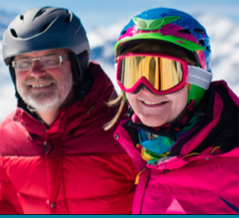
Jan and Judy Brunvand with their special edition Parlor Skis

Frequent contributor Jan Brunvand sent in this photo with his wife, Judy, holding her special edition High Fives Foundation Parlor Skis. Parlor gives 15% of its High Fives design sales to the non-profit which helps injured athletes reach their recovery goals. Jan is holding the trout skis Parlor made for the American Museum of Fly Fishing.

Mystery Glimpse: What’s The Story?

Dire Straits Require Heroic Acts.

Credit: New England Ski Museum

This week, a historic event for Mystery Glimpse.  Can you identify the characters involved in the above picture? What’s going on? Where are they headed? Why? And yes, they are skiing.

Thanks to the New England Ski Museum, Franconia, NH, for hosting this jewel. Congratulations to NESM for opening its new branch in North Conway!

Last Week

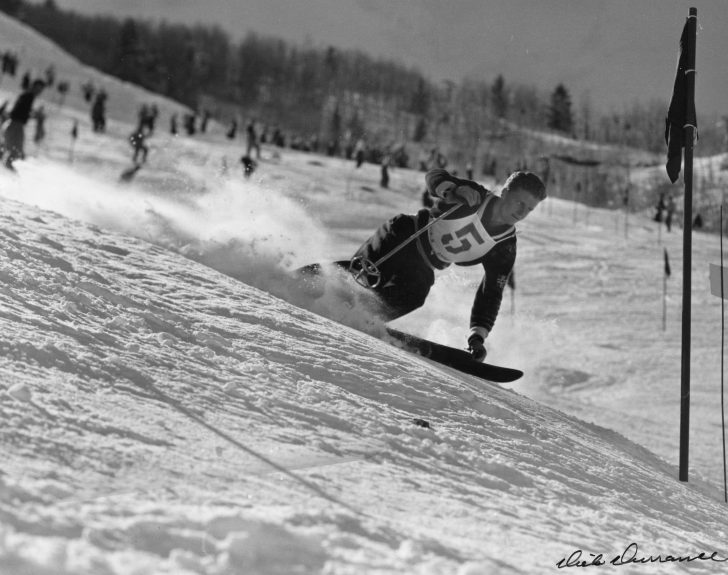
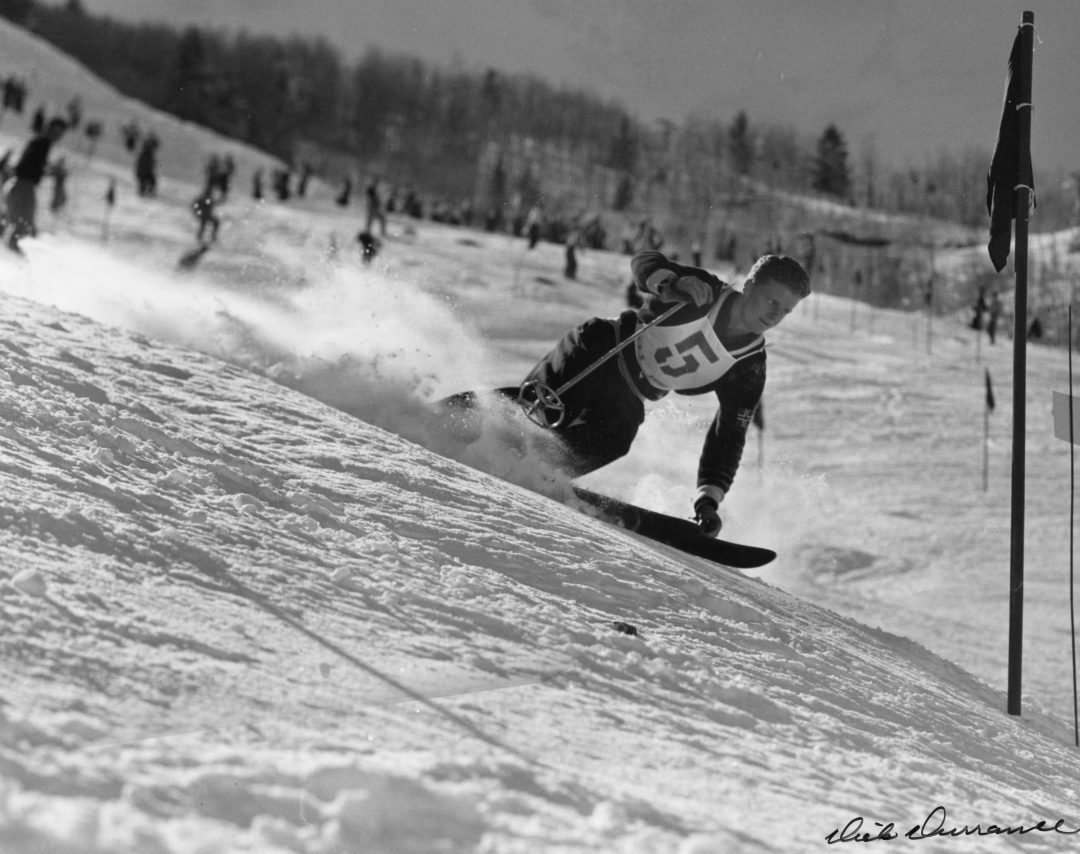
Who, where, 1950.

Yes, Stein Eriksen is the racer and the event is the FIS World Championships at Aspen in 1950. This was the first FIS event held outside Europe when Aspen was open for only four seasons. Italy’s Zeno Colo missed sweeping all three events by losing the slalom by 0.03 seconds. Stein Eriksen placed third in the slalom.


There’s Silver In Them Thar Hills!

Park City: Visit Silver Mining Museum Sites On Skis.

California-Comstock mine shaft entrance
is on the tour. Credit: Tamsin Venn

Led by Utah’s Park City Mountain Resort guides, the new Silver to Slopes tour skis you to various relics of the mining history scattered throughout beautiful scenery. More than 1,000 miles of tunnels lie beneath the slopes here.

We ride up the McConkey Express with our amiable guide Jim Brown. He notes the tunnels buried beneath the lift once served to drain water from mining operations. Yikes.

“There are some things that can go wrong when you are skiing Park City, Utah, but falling down a mine shaft is not one of them,” says Jim reassuringly. (They are all capped. EPA tests the tailings every summer.)

Brown, an effortless skier and keen historian, has brought along a briefcase of old photos to further illustrate the tour. He is one of those transplants (from Florida) who skied Park City on vacay and never left. Ditto our sweep, Debrinne Ferguson from Los Gatos, Calif.,

In 1963, United Park City Mines, the last active operation in Park City, opened Treasure Mountain Resort on the 3,700 acres it owned. Relying on mining engineering know-how, it put up J-bars, a gondola, and even a Skier’s Subway. The segue from silver mining to ski mecca is evident all around you.

First stop is the Silver King Mine’s Head Frame Building, at the base of the Bonanza Express, closed in only 1953. Miners started digging the 1,450-foot-deep shaft in 1890. The only female mine owner, socialite Susanna Bransford, alias the Silver Queen, made her fortune here. You can ski her nearby namesake trail.

Next stop the King Con Mine Ore Bin sitting to one side of Claimjumper. The Silver King Consolidated Mine, not to be confused with Silver King Mine, built the 1,800-foot deep Bogan Shaft here. The nearby King Con lift serves an intermediate’s paradise and is named for the mining company, not the giant gorilla, as many think.

We ride the Silverlode Express past the Quicksilver Gondola, which has linked Park City to The Canyons as part of Vail Resort’s recent $57 million upgrade. At the new Miner’s Camp restaurant here, The Pickaxe Pub displays authentic ore picks, in keeping with the general theme.

Next we ride McConkey’s Express to access the Georgeanna trail that follows the ridge past one of the best views on the mountain: Mt. Timpanogos (11,753 feet), Heber Valley, the town of Park City, the Uinta Mountains, and the top of Deer Valley’s Lady Morgan chairlift.

Mid-Mountain Lodge was once a boarding house for miners (1897) and relocated from the bottom of the mountain to save it from demolition.
Credit: Tamsin Venn

We stop at Mid Mountain Lodge, once a boarding house for Silver King miners (1897), next used by the U.S. Ski Team (1973-75), now a popular lunch spot. Scheduled for demolition, a group of locals had it hauled up the mountain to this spot in 1987. Hurray for recycling.

At the bottom of Thaynes lift is the famous California-Comstock Mine and 1,700 feet below via the Thaynes Shaft is the West End Tunnel where skiers used to ride the Skier Subway to access the Thaynes lift in the early days of Treasure Mountain. The ride took about 25 minutes. Most skiers did it once for the novelty, once for the kids, and that was it, notes Brown. Here’s a video of what has to have been the most unusual lift in ski country.

https://www.youtube.com/watch?v=K1aUSYfvehE

The two-hour tour takes place on intermediate trails and departs daily from the Eagle statue in Park City Mountain Village at 10 a.m. and from the Bonanza Summit trail map at 1 p.m. Just show up. The tour also helps you get oriented at this mega resort. Donate to preservation efforts at  Friends of Ski Mining History.

For more information, ParkCityMountain.com

The Pickaxe Pub with display of vintage tools is a good place to wrap up the tour.
Credit: Tamsin Venn


Seriously Injured? High Fives Has A Program For You

A Community That Can Help You To Get Back To Athleticism.

What if you suffer a life altering brain, spinal or physically limiting injury and want to ski again? Where do you turn? One place is the High Fives Foundation started by Ray Tuscany who was a ski racer who broke his back.

After his injury, he founded High Fives to help create a community to get a skier (but it could be anyone or any athlete) through the recovery process. Tuscany is emphatic when he says High Fives doesn’t have clients or customers, they have athletes!

According to Tuscany, once you have clearance from your doctor and are in the best shape possible, they will help find the funding to get you back on the slopes. The foundation works with the rehab staff to create a plan and a budget for each athlete. To help achieve the athlete’s goals, it provides the financial support—typical grants average around $5,000—to help cover the expenses for adaptive equipment, training, and other bits and pieces to get you skiing again. The foundation pays the providers directly so they can accurately track and report back to their donors where and how the money was spent.

The organization is certified to operate in all fifty states and is headquartered in Truckee, CA. It has offices in Reno and Sugarbush, VT as well.

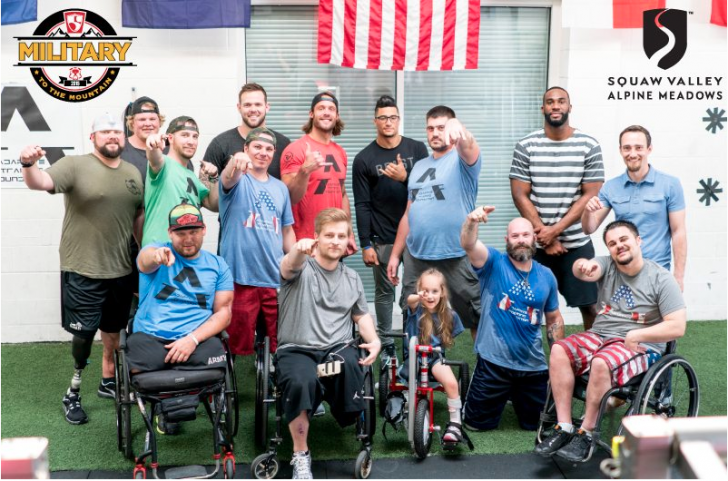
High Fives also has another program to help disabled vets learn to ski. Through its Military to the Mountains program, each year twenty-two injured veterans are selected by the Adaptive Training Foundation in Dallas and taken through a nine-week program to restore, recalibrate and re-deploy these injured warriors. Many become Paralympians.

For more information, contact Roy Tuscany at the High Fives Foundation at www.highfivesfoundation.org or at (530) 562 4270.

For vets who are interested in what the Adaptive Training Foundation has to offer, their web site is www.adaptivetrainingfoundation.org or you can call them at 214.432.1070.

Military To Mountains participants are ramped up for event at Squaw Valley.
Credit: HighFive

Seniors Skiing

This Week In SeniorsSkiing.com (March 2)

Introducing NEW DISCOUNTS FOR SENIORS, Mystery Pic, Smuggs Resort Review, Injury Lesson, Women XC Gold.

This week, SeniorsSkiing.com is very happy to introduce Discounts For Seniors, a new feature that brings real savings to our readers.  All our research surveys have revealed a constant finding: Senior snow sports enthusiasts—our readers—are looking for discounts. Knowing that, we have curated a number of vendors who have agreed to offer interesting products at 15-20% and more discounts to our readers.

From the beginning of SeniorsSkiing.com, we have recognized that our readers are not just winter sport participants; our readers are active all year round—hiking, kayaking, sailing and lots of other sports in non-snow months.  You also have grandchildren.  So our select collection of vendors is eclectic, presenting ideas for products you can use as well as for gifts you can buy for friends and families.

To access our Discounts For Seniors page, click here.  Note the discount code on the ad and click through to the vendor’s site to order.

We are quite excited about this new offering to our readers.  Please let us know what you think.

CLICK HERE TO ACCESS DISCOUNTS FOR SENIORS

This Week

Big, high, dry, up in the sky: That’s Taos. Credit: Val E.

Another Mystery Glimpse to puzzle over. This has proven to be a popular feature, highlighting historical photos from ski museums across the country. However, for the first time, we had a submission of a mystery photo from a reader.  Perhaps you have a curious old picture from the past or about ski lore you might want to post.  Let us know.

Correspondent Val E. reports on Taos, the high country ski area in New Mexico which seems to cast a spell on people who ski and live there.  Perhaps it’s the altitude. Click here to read his Taos review.

In another Resort Review, correspondent Tamsin Venn tells us about Smuggler’s Notch, way up in Vermont, next to Stowe. She reports on intermediate trails that range from mountain top to bottom which offer seniors a chance to ski confidently. At the same time, did you know that Smuggler’s has the only triple black diamond in the Eastern US? Lots of variation for families.

Unfortunately, correspondent Yvette Cardozo had a “routine” fall that turned into a significant injury.  She opines on recovery and reflects on lessons learned.

Finally, XCSkiResorts.com publisher Roger Lohr offers his thoughts on the amazing first gold Cross Country Olympic medal for the women’s team sprint.  His prediction: Cross Country racing is going to get a big boost from this historic victory.

Thanks to all readers who have offered to financially support SeniorsSkiing.com. Your response is gratifying; we very much appreciate your help in defraying costs.

On to March. We hear the Sierras are getting big snow at last; let’s hope the crowds come out.

Meanwhile, tell your friends about us.  There are more of us every day, and we aren’t going away.

There are lots of blues at Smuggler’s for cruising seniors.
Credit: Tamsin Venn

New Discounts For Senior Skiers!

Select Vendors Are Offering Special Savings 15-20% Or More Off.

Starting now, you can access special deals just for SeniorsSkiing.com readers on our new Discounts For Seniors page.

From our surveys of our readers, we’ve learned that senior snow sports enthusiasts are interested in discounts.  We’ve shown you where you can ski for free or almost free at 115 ski resorts in the US.  That directory is available for free for subscribers-only. We’ve also created a group on Experticity for qualified subscribers which offer discount deals on gear and clothing. Also free to readers.

Now, we are working with a group of vendors who have interesting and relevant products to offer our readership and at a discount. There are deals for you, your significant other, your grandchildren, all with impressive 15 to 20% or more dollars off.

These deals can be accessed by clicking on the ad you’re interested in on our Discounts For Seniors page.  Note the discount code, click through, and order directly from the vendors’ website.

Over the next two months, we’ll be spotlighting our Discounts For Seniors vendors. We are really interested in hearing from you about how you like the deals and the products.

This is just the start. We will enlist even more vendors for you.

Here are the vendors who are participating:

  • After Shokz Headphones: Wireless and wired bone conduction headphones and accessories
  • Apex Boots: Comfortable ski boot without sacrificing performance
  • Brilliant Tape: Reflective iron-on, stick-on reflective tape
  • CP Helmet: Elegant, built-in visor helmets
  • Epic Water Filters: Water bottles, pitchers, jugs with filtration system
  • Hemp Honey: Combines honey, whole-plant hemp extracts (Hemp Cannabinoid Oil Extract), herbs, spices
  • Know Brainer: Ketogenic creamers, coffee, teas, hot chocolate, convenient, sugarless, good fat powered
  • L-Bow: Family-owned mittens, hats, gloves for adults and (grand)children
  • Omeals: Self-heating, fully cooked meals for outdoorsy folks
  • Orsden: High performance snow and ski wear at affordable prices
  • OS1st Compression Sleeves and Braces: Relieve knee and plantar fasciitis pain, medical grade quality
  • Parakito: Innovative mosquito repellant with active, natural ingredients, DEET free
  • Stabil: Traction footwear for ice, hiking, golf, running, kids
  • The Tea Spot: Handcrafted loose leaf teas and creator of Steepware®  tea infusers
  • Tipsy Elves: Outrageous clothes to make life fun, St. Patrick’s Day, Patriotic, Ugly Christmas sweaters, more
  • Wild West Jerky: Utah-based, family-run jerky snacks with wide variety of flavors and meat options

CLICK HERE FOR DISCOUNTS FOR SENIORS

SeniorsSkiing Guide: Taos—High, Dry, And Full Of Culture

Some People Say The Best Four Letter Word About Skiing Is “Taos.”
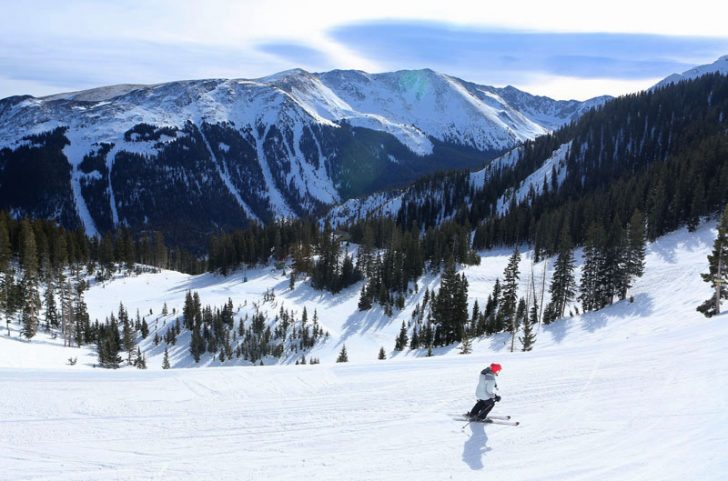
Big, high, dry, up in the sky: That’s Taos. Credit: Val E.

When I looked up at the main slope, I was speechless, then the words came—steep, moguls, trees. Wow. At 12,000 ft, Taos’ Mt. Kachina is close to the top of the World.

The resort is located in northern New Mexico, which one seasoned skier described as “a mix of a desert and mountains, unusual and beautiful.” The Blake family discovered, founded, developed, and an Taos Ski Resort since the mid fifties.

In 2013, new management built new lifts, hotels, and other facilities. The result is a cute, small, Euro-style village with an obvious French-Swiss touch and a huge mountain with well groomed slopes, moguls, cornices, glades, and trees almost up to the very top. Snow is quite dry there because of the altitude. Taos is a breathtaking resort in more ways than one; the town is the highest municipality in the US.

Secret Knowledge

Note single chair on left. Credit: Val E.

Kachina Peak is the highest peak reachable by a triple chair in the North American Continent.

Resort lodging options include hotels, condominiums, and bed and breakfasts. The new jewel of Taos is the luxury Hotel Blake, named for the resort founders. The interior is elegant, the restaurant is high-end, and the rental area looks like a high tech lab.

The Ernie Blake Snowsports School is one of the highest rated ski schools in North America. Ski instructing services for groups, especially for ski clubs, were quite reasonably priced.

One of the best parts, besides the slopes and snow, is super friendly employees. Ski lift operators and ski patrol people were waving and smiling like old friends. One ski resort host kindly ride with me just to introduce to the mountain.

Community

During my week stay at the resort, I talked to a few local skiers, some of them were from the 50+ category.

Here is what an expert skier, originally from Hollywood, said: “I moved to Taos after 16 years in Los Angeles in the film business. Taos is a ski town which has world class skiing and an ancient cultural heritage—one of the oldest in the US. It’s also an artist’s town and has dozens of galleries. Taos gives you access to a wider choice of restaurants and apres ski activities. It is great for couples where one doesn’t ski or who like cultural activities.”

A very confident female skier shared: “We came to live in Taos from NYC after years of skiing here. My husband doesn’t ski anymore. He wanted to retire in a friendly community with a synagogue. Now I ski Kachina peak almost every day.”

Another young looking retiree told me: “I am from St. Louis, flat country. I ski in winter and hike in summer. People come to Taos because you can be whoever you want to be, and nobody is asking questions here.”

Taos Ski Valley is a rugged mountain, pioneered by people who put skiing first and all else second. If Virginia is for lovers, then Taos is for skiers!

Taos By The Numbers

2.5 hours by car/bus from Albuquerque International airport

4 espresso bars, including one ski in, ski out

15 lifts

25 miles to Colorado

$105—one day adult ski ticket (18-64); $85—one day senior ski ticket (65-79); 80+ year old – ski free

$408 ski pass for 6 days (65-79); shorter day pass combinations are available

110 trails 55 for beginner/intermediate and 55 for advanced/expert skiers.

305 in—average annual snowfall

7,000 ft—Taos city altitude

9,207 ft—Taos Ski Resort

12,481 ft—Kachina Peak

Click here for Trail Map

Click here for Taos Ski Resort Website

Trees up to the top are a trademark of Taos. Credit: Val E.


 

Mystery Glimpse: Who And Where?

Hint: 1950

Can you spot who this is dashing through the poles? Might be easy. But where and what event and what’s the significance? That’s the challenge. Note your replies in Comments, just scroll down.

Thanks to the Colorado Ski and Snowboard Museum for contributing this photo.

Who, where, 1950. Credit: Colorado Ski and Snowboard Museum

Last Week

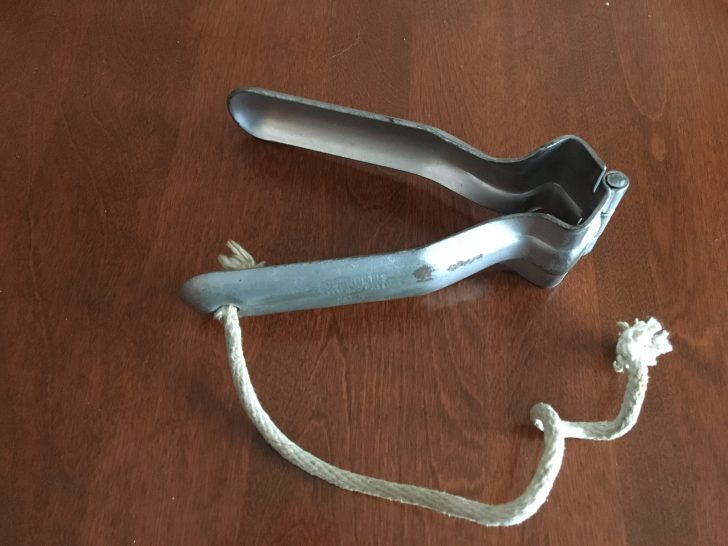
Credit: John Emery

Yes, a rope tow gripper. We’ve never used one, we just grabbed the twirling rope. But, many readers certainly have. It is significant that memories of using this device—from the 60s!—are so clear to our respondents.  John Emery, a reader who submitted this picture, says, “There used to be a heavy belt which the clamp was attached to via the short rope. It had a pouch that the clamp fit into when not in use. You would grab the tow rope with one hand and close the two halves of the clamp over the tow rope. The clamp was attached to the belt, and you would just lean back and enjoy the ride—one-handed even.”

Using this device took a bit of concentration.  From what we’ve read in the Comments section, it was getting it off at the top that was tricky.  It is a long way from a rope tow gripper to quadruple, high-speed chairs, and an impressive number of our readers have seen the transition from one to the other.


SeniorsSkiing Guide: Smuggs Not Just For Kids

Smuggler’s Notch Feels Like Way-Back-When But With Up-To-Date Conveniences.

There are lots of blues at Smuggler’s for cruising seniors. That’s Stowe in the distance.
Credit: Tamsin Venn

Smugglers’ Notch is the well-known kid-friendly ski area in northern Vermont. That same dedication to fun also makes it a good area for seniors.

Start with the intermediate trails winding off the two upper Mountains—Madonna, 3,640 feet, and Sterling, 3,040 feet. They urge your skis to turn as they follow the mountain’s contours in delightful turns and drops.

Smuggs has the only triple black trail in the East—Black Hole— with a 53 degree slope angle.  But there are also many ego-boost blues like Madonna’s Upper Chilcoot and Drifter, where you turn where the trail turns, and Sterling’s Thomke’s, Rumrunner, Hangman’s, Treasure, FIS, and Black Snake.

Doable glades include Red Fox, Three Mtn., and several “variations” of the trail you are on. The goal here is to always let you have access to the woods should you so desire. Bring them on!

Glade skiing is well known here. When you ride up Sterling, you see Madonna’s wooded flank dropping into the ravine below. All those glades are skiable or snowboardable, says Public Relations Director Mike Chait enthusiastically.

Furthermore, all trails are well defined from top to bottom so no worry about ending up on a black diamond trail by accident and all trails funnel to their respective base areas for pro-choice group skiing.

Meanwhile, The Village Center at Morse Mountain is served by four lifts and 99 percent beginner terrain where you can ski at a peaceful pace.

Views? From the Catwalk, you can look across the Notch to Mt. Mansfield’s trails at Stowe. Remember when these two resorts were connected?

The experiences kindle feelings of New England skiing way back when, but with all the up-to-date conveniences. By not being overdeveloped, Smuggs maintains a nostalgic feel.

Somewhat remote (although only 30 miles from Burlington), midweek is quiet, and the powder stashes linger.

Seniors are looked after. The Smugglers’ Notch 55+ Club is a 26-year-old club that meets every Wednesday for skiing and camaraderie. It has more than 100 members, and about 30 to 35 skiers show up each week. Coffee at 9 a.m., followed by Alpine or Nordic skiing and snowshoeing, then a 1 p.m. program. Membership is $30 for the season, which includes continental breakfast, 50 percent discount off lift tickets, and other discounts.

Most members are Vermonters who live within an hour radius of Smuggs with a wide range of skiing ability, including ex ski patrollers and instructors. Guests and new members are warmly welcomed, says Deborah Pomeroy, club president.

New this winter is FunZone 2.0, a 26,000 square foot indoor playground, a $4.2 million investment reflecting the area’s decades-long focus on family fun. Laser tag anyone?

The Facts

Vertical Drop: 2,620 feet.

Total Trails: 78. 300 acres of marked and patrolled terrain. Plus 700 acres of unmarked and unpatrolled terrain. 19% easier, 56% intermediate, 20% expert, and 5% extreme.

Snowmaking: 62 percent

Total lifts: 8.

Longest run: 3 miles, from the Madonna summit to the Village.

Places to eat: Village Center, Morse Mountain Grille & Pub for salads, soups and burgers. Music: The Friendly Pirate

Lift tickets: Senior 65 and older, $58 day, $64 holiday. Season Pass: (ages 70+) $70

Click here for Trail Map

Click here for Smuggler’s Notch website


Learning From Injury

Correspondent Ends Her Season In “Routine” Fall, Provides Us With Lessons Learned.

[Editor Note: We’ve heard correspondent Yvette Cardozo’s story numerous times, especially the part about immediate post-incident denial. Perhaps there is some biological reaction, perhaps a form of shock, that masks the pain of more serious injury.  In any case, her advice is well worth heeding.]

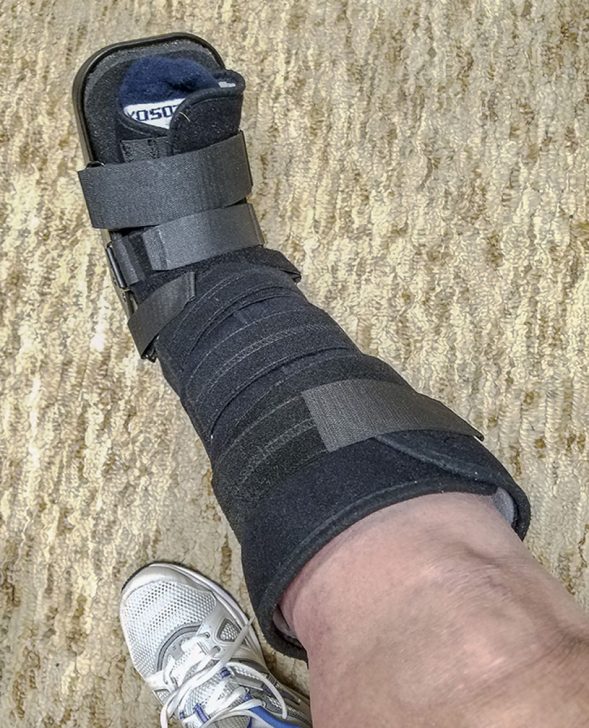
Igor, the medical boot, keeps the broken ankle stable.
Credit: Yvette Cardozo

I don’t remember exactly how it happened. It was the bottom of the last run. I was tired.  The snow had devolved into slick slush, and it was snowing and foggy. I caught an edge and before I knew it, I was on my back, one ski released, the other leg bent awkwardly. A few more turns on the trail, and I would have been within sight of the lodge.

A ski cliche if there ever was one.

My ski buddy came up and got my left ski off. I was sure that was an injury down there and knew enough not to try and stand. So we called the patrol. They came, strapped me into a toboggan and down we went.

Me, head first, on my back. If I could have gotten to my cell phone, I would have videoed the trip down. The view was like being in a soupy blender.

At the lodge, we got my boots off and decided the injury was to my right ankle—probably a bad sprain. I went home, actually driving myself. And went to a business event in downtown Seattle that night. Driving. In the rain. I still thought it was just a sprain.

Two days later, I gave up and went to a doctor. Indeed, it was not a sprain. It was a break. He called it a distal fracture. All these years skiing, all these crashes and I had never broken anything before. And this was an ankle. I didn’t know that was even possible with modern ski boot tech. Ankle breaks are the stuff of 1950’s ski lodge pictures —a guy in front of the fireplace with his leg in a cast, resting on a pillow.

But, I had just left a message for my boot fitter days before, saying my boots were getting loose. He came back into town and said, “Yup”. And also, yup, you certainly can break an ankle today skiing. He’s got three pins and a plate in his ankle to prove it.

The good news is I’m not in a cast, not on crutches, didn’t need surgery. I’m just wearing a medical boot (I’ve named it Igor) for six weeks. The bad news— my ski season was over three days after it began.

Yeah, at age 73 I don’t bounce like I used to. And yeah, I’m grateful it wasn’t a knee. Ankles heal. Knees are another matter.

I canceled one ski trip but am doing another where I will be writing about all kinds of non-ski activities as a non-skier and trying out something called a “snow limo” that gets non-skiers up on the hill, and also down, via a run at Sun Peaks Resort in British Columbia, Canada.

So there are a few lessons learned:

1. Don’t get sloppy about your gear. If you think your boots need re-fitting or your bindings need a check or your skis need tuning, do it NOW.

2. If you just want to do “one more run” and you are tired, DON’T.

3. Don’t assume you know what the injury is. If it’s swollen and getting black and blue, it may very well be a break. SEE A DOCTOR.

4. And don’t grind your teeth too much or overthink this. Get back into the gym or on your bike or walking or whatever when you can and get back into shape.

Snow Limo: Non skiers get up the mountain and down a ski trail.
Credit: Sun Peaks Snow Limo Tours.

This Week In SeniorsSkiing.com (Feb. 23)

Losing The Mind Game: Confidence Versus Competence, Mystery Device, SLC As Ground Zero, Buying Mountain Home Advice, History Ski Poster Explainer.

Thanks to those who have offered financial support to SeniorsSkiing.com. We very much appreciate it.

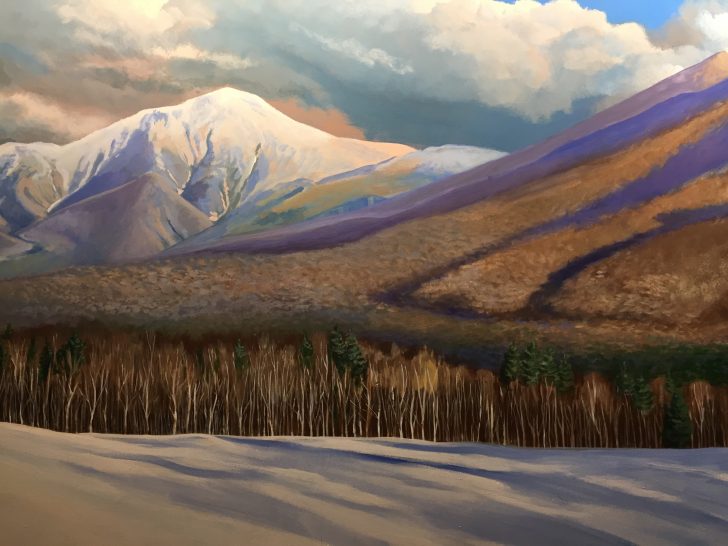
White Mountains, Franconia Notch, Cannon Mountain?
Artist unknown

Like you, we’ve been checking into the Pyeong Chang Olympics, watching the Alpine, Nordic and various snowboarding events with considerable admiration. Some performances were nothing short of heroic, and, in the case of US Womens’ Cross Country and Hockey medals, historic. We were in awe of the skill and grit these competitors showed the world.

We remember in the “old days” when we used to sit on our couch watching those Olympic events, the slalom, the giant slalom, and others, thinking to ourselves, “With a little practice, I could do this.” Well, maybe not the downhill. Admit it, you thought so, too, didn’t you?

In those days, we had confidence in our competence.  Of course, it was a bit of hubris, but we felt we could handle it. That was then.

We got into a discussion last week at the base lodge of a classic New Hampshire ski hill with an 80 year old gent who was skiing his first day of the season.  To many of us in New England, the late start was not unusual; the weather has been saw-toothed, up and down in temperature and mixed luck with precipitation.  Regardless, this man was a good skier, but he had some doubt about going out and that doubt cracked his confidence. He stuck to the Learning Zone, tight, apprehensive, reluctant to head up to the most gentle of greens that started at the top of the mountain.

Losing the mind game may be one of the biggest reasons seniors drop out of winter sports. Fear of injury, susceptible to cold, fed up with lousy conditions all contribute to wondering if you still had the chops to “do it”, leading to perhaps sitting out a season and then dropping out.

But this doesn’t have to be so. Perhaps the answer is to recognize that doubt is changing your attitude about snow sports, then return to the basics by taking a lesson, focusing on technique by practicing a lot on simple trails, and then practicing again. Performance research going back to psychologists Skinner and Thorndike show that good performance adds to confidence. Starting small, practicing skills over and over and then over again, builds confidence.

There are some implications here about how well ski instructors are prepared to deal with seniors who are tentative about their competence. We wonder if anyone has really designed a lesson in confidence and taught it throughout the PSIA.

Have you ever had doubt about your competence? Perhaps at the beginning of the season, perhaps after an injury, perhaps after a particularly bad set of days on the snow?  How did you deal with getting back? Or did you? We have an intuitive feeling this is a phenomenon many seniors experience but don’t talk about.

Share your story with us, please.

This Week

Co-Publisher Jon Weisberg looks at Salt Lake City as base camp for exploring the Wasatch, rich with diverse snow sports opportunities. He also has a really interesting interview with Nicholas Lowry, president and principal auctioneer of Swann Auction Galleries, about vintage ski posters. Contributor Joan Wallen, a veteran real estate broker, offers advice on buying a mountain home.  Finally our Mystery Glimpse reveals whose medals were at the New England Ski Museum and challenges you to identify a strange device.

Consider supporting SeniorsSkiing.com by clicking the banner above.  You can also support us by telling your friends about us.  And remember, there are more of us every day, and we aren’t going away.


Mystery Glimpse: Hold On

You Have To Be A Certain Age To Have Used This.

Credit: John Emery

Thanks to reader John Emery, 65, from Meridian, ID, who skis as regularly as possible at Bogus Basin.  He sent in this memory from yesteryear.  Do you know what it was used for? By the way, John has been skiing since age 4 when he started back in Connecticut. There’s a bit of a nuanced hint in that last sentence.  Scroll down and write your guess in COMMENTS below.

If you have any “guess who/what this is”, let us know.  We are running these archival pictures in partnership with some outstanding ski museums sprinkled across the US and Canada.  However, if readers have a puzzler, we’ll consider it.

Last Week

Medals. Whose?

Yes, these are Bode Miller’s medals at the New England Ski Museum in Franconia, NH, at the base of the Cannon Mountain tram. Incidentally the new branch of the New England Ski Museum opens in North Conway this Saturday, Feb. 24, with a ribbon cutting.

These five medals represent Bode’s victories in the Olympics at Salt Lake City (2002) and Vancouver (2010).  Bode also won three other medals at the Olympics, presumably they are in a vault somewhere. (Source: Wikipedia)

  • Sochi 2014, bronze (super combined), bronze (super-G)
  • Vancouver 2010, gold (combined), silver (super-G), bronze (downhill),
  • Torino 2006, gold (giant slalom)
  • Salt Lake City 2002, silver (giant slalom, combined)

Bode can well be said to be the most successful American male Alpine ski racer of all time with eight Olympic and five World Cup medals over a 17 year career.

Despite his somewhat controversial start at NBC offering color commentary for the Alpine events at Pyeong Chang, we think Bode adds a level of expertise that is rare. He’s also into ski fashion and horse racing.  Interesting lifestyle for an ex-ski racer.

Buying A Mountain Home? Ponder This.

A Veteran Real Estate Agent Shares Tips You Might Not Have Thought Of.

[Editor Note: See Joan Wallen’s earlier article: Commute, Rent, Or Buy? for advice on renting.]

Condo on the mountain?

Want to buy a home in snow country? Perhaps you’ve rented and now decide that a second home is right for you. Or maybe you’re ready to take a leap of faith and go directly into ownership. What are some of the considerations you should take in to account?

Location is key. You may already have a favorite mountain or region that you like to ski. This makes it easier. If you don’t have a preferred area, think about what’s right for you and your family. Do you want to ski one mountain all the time or be in a location where you can reach several resorts? Will a specific resort be good for your family for future years? You don’t want to end up at an area that the kids will outgrow. Do you want to be slope side, in town or out in the countryside? Condo or single family home?

If you decide on a condo, investigate before buying. Is it a new development or an established community? If the development is older you would want to know the history of upgrades to the buildings and grounds, roofs, building siding, roads, etc? If there are amenities like a swimming pool or fitness room, what’s their condition? Are condo fees reasonable or so high as to feel like a second mortgage? Carefully review the condo association documents to be informed not only of their rules and regulations but also their financial status. The capital reserve fund should be adequate for both planned and unexpected maintenance costs so you don’t get hit with a special assessment.

House in the country?

Consider usage of the condo in the off season. If you won’t be coming to the mountains in the summer you may want to rent out the unit. Some associations enforce minimum rental periods of anywhere from two weeks to two months or more. This could impact your ability to secure a tenant. And if you want, or need, to rent it out, be sure it’s in a location where there’s a demand for summer activity.

Although condo fees add to the cost of ownership, there are advantages also. Outside maintenance fees cover snow removal, shoveling, lawn mowing and trash pickup.

Condo living is not for everyone, however. You may prefer the privacy of a single family home either close to town or in the country. But, you’ll have to arrange for plowing, perhaps someone to check on the house after a power outage and of course maintenance will be your responsibility. The advantages are privacy, perhaps a more tranquil setting and if you’re in the country you can likely cross country ski or snowshoe right out your front door. If you wish to rent it,  you’ll be your own boss, no association restrictions. And, more responsibility also. If something goes wrong, you can’t just call the office, you’re on your own to find a repair person.

Finally, does owning make financial sense? What will you do with the property in the off season? Is it in a location where you and your family will use it both in the summer and winter?

Buying a home in ski country is a big commitment but also can bring big rewards. As a gathering place for family and friends to enjoy the outdoors together, many lasting memories will be created. Family members who may not ski will still have a base from which to enjoy other outdoor activities, or to just hang out by the fire and read. And you don’t have to worry about making reservations, finding a place to stay after that two foot snowfall or lugging your gear and clothing back and forth. The home and your belongings are right there waiting for you.


Mystery Glimpse: Whose Olympic Medals?

[Many expenses for technicians, designers, and others are associated with delivering SeniorsSkiing.com free each week and developing and publishing Subscriber-Only content. Please help by making a modest donation by clicking here.]

Silver And Gold Belongs To…

We stopped at the wonderful New England Ski Museum in Franconia, NH, the other day to check out their current exhibit on the 10th Mountain Division and the veterans who contributed to the ski industry.  Another small exhibit contained the medals of a famous Olympian, and since we are currently in the midst of the Pyeong Chang games, we thought we’d carry the Olympic theme forward and ask you to identify who these belong to and the events they represent. Please place comments below. Note the New England Ski Museum is about to open a brand new branch in North Conway on Feb 26. Keep growing NESM.

Medals. Whose?

Last Week

Thanks Vermont Ski And Snowboard Museum

Yes, indeed a hand warmer powered by lighter fluid. And as a commenter pointed out, put a flaming gizmo in our pockets to keep us warm? Ahhh, sure.

And yes, Zippo still sells a version of this. An original is considered a collectible to some.

What made reading the replies interesting was how many commenters noted they remember their fathers using this unusual device.  In fact, I remember my dad using this to keep his hands warm at Aqueduct race track where he played the ponies in the middle of winter back in the 50s.  I remember the little flannel bag and the draw string it came in.  Since I was a kid at the time, it was off limits for me.

According to Google, this was called a Peacock Hand Warmer that was made in Occupied Japan circa late 1940s to 1952.  Apparently, some GIs brought these home with them and others turned up in Army-Navy stores.

Many thanks to the Vermont Ski and Snowboard Museum for contributing this memory.


100 Year Old Skier Inspires Us To Become Our Better Selves

[Many expenses for technicians, designers, and others are associated with delivering SeniorsSkiing.com free each week and developing and publishing Subscriber-Only content. Please help by making a modest donation by clicking here.]

George Jedenoff, 100, Is In Love With The Mountains, The Snow, And Life. Everyone Who Meets Him Says, “I Want To Be Like George.”

The paparazzi chase George while trying to keep up.
Credit: Harriet Wallis

“Age is just a number,” he says adding: Don’t let age be a barrier. Do your best. Become your best. And keep on going. He’s a living legend at Alta.

He’s also quite a super skier who skis like a kid. He swings his feet on the chairlift. He cruises down steep trails. And when jumps into patches of powder he shouts with glee.

Two moguls meet. Alta’s new General Manager Mike Maughan welcomes George.
Credit: Harriet Wallis

To maintain his fitness, he works out every day for 45 minutes before breakfast. The workouts toughen him mentally and physically to keep him going even when life is unkind.

“Never give up,” is his motto.

On a chairlift ride, he leaned over to me and said: “People come up to me — sometimes with tears in their eyes — and tell me that I’ve inspired them to keep going and never give up. Of all the things to be remembered for, I’m so surprised that I’m being remembered for my skiing.”

But it’s more than just about skiing. It’s about life.

George stirs others to become their better selves — to try harder, to reach higher, and to never give up. While others are revered for their academic achievements, business success or community service, George is loved because he touches people’s souls.

Age is just a number even when it’s 100.
Credit: Harriet Wallis

Back in 1960, George was transferred to Utah to be the general manager of the Geneva Steel Plant. He was athletic, and he learned skiing from the best: Alta’s legendary Alf Engen, Snowbird’s iconic Junior Bonous, and Earl Miller, the granddaddy of release bindings.

George grew to love Alta’s powder, and when he was transferred away in 1967, community leaders honored him with a gift that was sure to lure him back: a lifetime season pass to Alta. He’s still using it! He now lives in California but he returns annually to ski Alta.

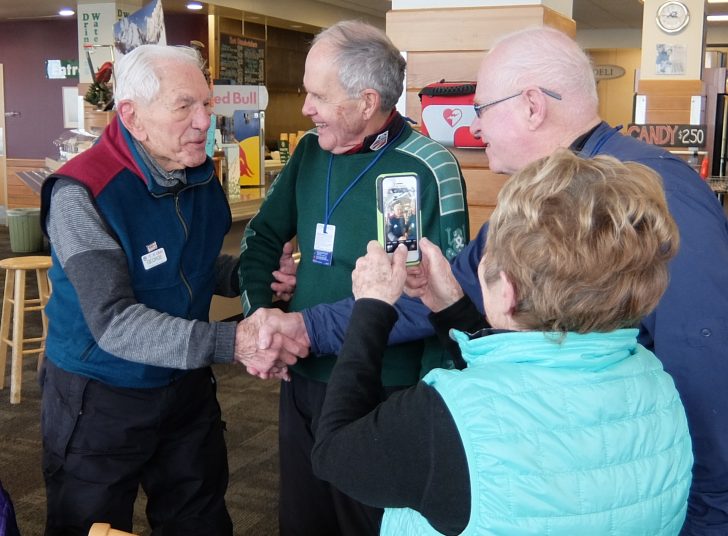
He’s a celebrity and a living legend. Skiers cluster around him to have their photos taken with him. The digital images become reminders to reach higher, try harder, and keep going — just like George.

Ski Utah has produced annual videos of George. The very first one, when he was 95, is still my favorite. Enjoy!

https://www.youtube.com/watch?v=KoQ5IEUpKEA

http://www.skiutah.com/explore/videos/george-jedenoff-97-year-old-utah

https://www.skiutah.com/blog/authors/yeti/98-year-old-skier-george-the-powder

https://www.youtube.com/watch?v=Bb23maq0rtQ

To read more from Harriet click here for her stories on SkiUtah.


The Back Story: Skiing With 100 Year Old George

[Many expenses for technicians, designers, and others are associated with delivering SeniorsSkiing.com free each week and developing and publishing Subscriber-Only content. Please help by making a modest donation by clicking here.]

Missed Turns, A Slipping Helmet, And Being In The Wrong Place. It’s All In A Day’s Work.

Hey, George, wait up!
Credit: Harriet Wallis

Covering a ski race is easy. Racers will be on the course.

But shadowing 100 year old George Jedenoff on Alta’s ski runs had challenges. Furthermore, we had two different genres going: A Ski Utah crew was videoing him, and I was shooting still photos I needed to stay out of the way of their cameras. It’s already getting complicated.

Here are some of the funny things that happened to me on the slopes with George for two days.

Can’t outski a 100 year old. We started from the top of a lift and George was in the lead. When he paused, I bulleted ahead to position myself at the side of the trail to snap photos as he’d ski by.

I yanked off my gloves and grabbed my camera. But before I could point it … there goes George… and he was gone. Repeat. Repeat.

When you come to a fork, take it. Skiers love George. They see him on the slopes and gather around him to talk and take photos. He is so gracious.

While Ski Utah videoed an impromptu trailside gathering, I knew I had lead time. I left the group, skied ahead, and chose the perfect spot to get my photos. I was on a steep slope under a chairlift.. My camera was ready. I waited and waited, but no George.

Then the group called down to me from the lift overhead. I looked up — and my helmet fell down over my eyes. I was stuck in my helmet and could see nothing. I felt really stupid.

I pushed my helmet back into place and wondered how George got past me. The main trail had a fork, and he opted for the side trail. Missed him again.

Deep powder, but over there. Another wrong guess. This time, we separated on purpose. George and the video crew took the high road to video him skiing deep powder. I took the low road and positioned myself for the best still shots.

But George didn’t appear on the most likely open slope. He found the snow up there was worn out, so he moved on down the ridge — out of sight behind dense evergreen trees — in search of fresher powder.

He found the fresh snow he wanted. But I couldn’t find George. Missed him again. But George had a wonderful time. That’s what really counts.

To read more from Harriet click here for her stories on SkiUtah.

Mystery Glimpse: Shiny Gizmo

Whatizzit?

This beautifully designed object comes from the Vermont Ski and Snowboard Museum. What’s it for? Have you used one? When was that, by the way? Let us know.  Scroll down to add your COMMENTS below.

Credit: Vermont Ski And Snowboard Museum

Last Week

Once again, it is clear there are some sharp-eyed ski historians out there in reader-land.  There were lots of very astute comments.

This photo comes from a SKIING Magazine Oct 1969 story by John Jerome.  His article reports on the revival of New Hampshire’s legendary Inferno Race on Mt. Washington’s Tuckerman Ravine in the spring of 1969, the event pictured here. Unfortunately, the article didn’t report the name of the racer in the picture.

According to Jerome, the last previous Inferno race was in 1939 when Toni Matt scared himself silly by schussing the headwall. Numerous debates have ensued about whether his run was a mistake or intentional. Regardless, Toni found himself deeply rooted in ski history lore.

Thirty years later, in 1969, the race was held as a “loosely controlled Giant Slalom”, hence the gate you see in the picture. [Dave Irons, you got that right!]  The idea was to prevent anyone from doing a Toni on the headwall which, by the way, has a 55 degree pitch.  The weather was miserable, temp rising from 13 degrees to mid 20s at race time with a wind blowing at 75.  For the record, here were the winners:  Veteran’s Category—George Macomber, Junior Category—Duncan Cullman of Franconia, NH.  But, Jerome reports, the bravest of all was 55 year old Adams Carter who, in honor of his participation in the three original Infernos in the 30s, foreran the course.


The Archetype Senior Skier? This Guy Sure Looks The Part

74 Year Old Long Time Ski Host Books 120 Ski Days A Year At Big White. Jealous?

Ski Host Carlan Silha is fit and fortunate to ski so many days at 74.
Credit: John Nelson

It might seem strange that an American from the Spokane area knows this sprawling British Columbia ski resort better than just about anyone.

Carlan Silha has been serving as a snow host at Big White for 20 years, longer than anyone at the resort. The lanky 74-year-old still skis like a 24-year-old, kicking his heels when he takes a jump and issuing a frequent “Woo-hoo!” as he turns in powder.

The story of how Silha got to Big White starts in 1992, when he was a Boeing executive working in Europe. He and his wife Lin were looking for a condo at a ski resort, and a friend suggested Big White.

“We ended up buying because it was a great price,” Silha said. “Then we got here, and realized we really liked it.”

Silha eventually retired, moved from Seattle to the Spokane area, and then began spending every winter at Big White, where he became a snow host, showing visitors the ropes. Now he logs 120 ski days a year and relishes every minute.

“Let’s ski the Rat Trees,” Silha said as he showed around another visitor recently. The trees are so named because regulars have been hanging toy rats from a particular tree deep in the forest near Big White’s Powder Chair.

If you were Carlan, you’d have a big grin, too.
Credit: John Nelson

Silha then shot off, cranking precise turns through the trees in four inches of new snow. “Woo-hoo!” he shouted for perhaps the millionth time of doing this.

“Being outdoors keeps you young,” he said.

During summers, the Silhas spend their time fishing and camping, using Spokane as home base. They like to travel around the West, and Silha keeps fit by hiking and biking.

In winter, they hang out with ski friends who own condos at Big White, a large collection that includes Australians, Brits, Kiwis and, of course, Canadians. The snow host job—showing visitors around Big White’s 7,355 acres—keeps him busy and provides its own rewards.

“The main attraction is meeting people from all over the world,” he said. “And it makes you feel good to show people this mountain.”

What Else Should You Have In Your Car?

Don’t Get Stuck Without This Extra Safety Gear.

Stuff happens. Be ready.
Credit: The Press Christchurch

Now that you have “The Box in the Back,” (see previous article) what else do you need to carry in your car? The list, strangely enough is short, but the items are necessary. The first four should be in your car all year round, not just the winter. So, without further ado, here they are with the rationale:

  1. Flashlight. It should be in the glove box, always. I suggest a Maglite (or equivalent) type flashlight that takes three D cells, not one that is rechargeable. Why? Cold is the enemy of battery life, and if a rechargeable one isn’t kept charged, you could turn it on and find you have little or no juice left. Then what? I’m so paranoid that I carry a spare set of batteries. But, if you don’t carry spares, keep them out of the flashlight and tape them together side-by-side with electrical tape and then wrap a second piece of electrical tape around the ends to protect the contacts. If you have to peel off the tape, do it carefully because it may come in handy during your emergency!
  2. Jumper cables. Car and truck batteries fail at odd times and Murphy’s law applies, i.e. they die at the worst possible time. Those of us who live in the southwest know that heat is also the enemy of batteries. Heat causes the fluid to evaporate and the battery won’t hold a charge. If it isn’t your battery that dies, it will happen to someone nearby.
  3. Chock or 2. Think about it. You’re going into the mountains and that means if you have a flat or need to jack up your car to put on chains, you need to chock two of the wheels that are not being jacked up. Ski boots work as chocks, but do you want to risk using them?
  4. Warning triangle, not flares. If something bad happens, you want to put this out a few hundred feet behind your car to warn on-coming motorists. Flares are pyrotechnics that age with heat and cold. Plus, once they burn out, then what do you use? Carry a triangle or two and forget the flares!
  5. Kitty litter. Some people prefer sand, I like kitty litter. If you need to spread some out for additional traction, you have it. Two reasons, one, it is lighter to haul around than sand, two, it is easier to find.
  6. Sections of two by fours. If you get stuck or need to put something down to distribute the weight of your car in the soft snow, three foot sections of ten inch wide planks or two by fours work well. They don’t take up much space and can, with a little kitty litter (or sand) on top, get you moving again.

None of these items, except for the kitty-litter take up much space. They’re million dollar items because you’d pay a million when one is needed and you don’t have it. Enjoy skiing and pray for snow!

SeniorsSkiing Guide: Beaver Mountain—Utah’s Least Known Is A Delightful Surprise

The “Beav” Has All The Goods But No Crowds And No Fanfare.

Cozy lodge is friendly and down home. Look elsewhere for fancy.
Credit: Harriet Wallis

For most vacation-seekers, Beaver Mountain falls off the radar because it’s farther than the 10 resorts that are within an hour’s drive from the Salt Lake City International Airport. Beaver is about 100 miles—less than 2 hours from the airport.

Nobody knows about Beaver Mountain. Actually, lots of people know about Beaver Mountain, but they aren’t telling. They enjoy having the 8,600 foot high mountain with its 400 inches of average snowfall. Its skiers and snowboarders come mostly from nearby Logan and the Utah State University.

I’ve lived here for 25 years, and I’m embarrassed to admit I’d never skied Beaver until last week. A day there shattered all my stereotypes about it. Now I know it’s a gem of a mountain, and it’s very uncrowded. Repeat: Beaver is uncrowded.

And it’s an easy shot to get there: Take I-15 north, turn right to Logan, turn right up Logan Canyon, and you’re at Beaver Mountain.

What’s more, it has a friendly, down-home feel. For example: The sunny base lodge has a roaring fire stove and easy chairs for the ski-weary. That’s a touch that’s disappeared from most mega-resorts.

The cafeteria cooks up very good food at very reasonable prices. I loved the Reuben. But it was hard to resist the finger-likin’ ribs.

Corduroy courtesy of veteran grooming crew.
Credit: Beaver Mountain.

The mountain has a northeast exposure and gets the warming morning sun. Grooming is superb. I learned that the grooming crew is seasoned veterans who have groomed the mountain for years. It has plenty of challenging pitch. There’s an equal dose of mogul fields and off-piste tree skiing, a terrain park, and a magic carpet. The longest runs are 2 miles long. An adult day ticket is $50, seniors (70+) are $40. Seniors can also get a half-day ticket for $35.

I chatted with a couple that I presumed were locals. They weren’t. They live in Florida and travel and ski extensively. They’ve done the big name resorts and were thoroughly enjoying Beaver for the week.

I rode up the lift with Mountain Operations Manager Travis Seeholzer. He pointed to the ridgeline and said: “That’s the Idaho border.” Beaver is high in the northern-most corner of the Wasatch Mountain Range.

Because of its location, Beaver has a marketing problem. Lodging and big city amenities are 27 miles back to Logan or 13 miles ahead in Garden City, a popular summer destination on the shore of Bear Lake.

The flatlands surrounding the mountains are known as Cache Valley because mountain men and trappers cached their furs in secret places. Beaver Mountain is also a secret. Discover the secret mountain for yourself. Do what the locals do. Go “Ski the Beav.”

Other things you should know:

  • There’s no cell phone service at Beaver. People actually talk with each other.
  • Logan has tons of restaurants, car dealers, theaters, shopping, grocery stores, two hospitals, and more.
  • Garden City is primarily a summer resort area and has very little open in winter. There are several time share facilities, and that’s where the couple I talked with was staying. They bought their groceries in Logan as they passed through, and that’s what they recommend.

Click here for Trail Map.

Click here for Webcams.

To read more from Harriet click here for her stories on SkiUtah.

This is uncrowded. Nice.
Credit: Harriet Wallis


This Week In SeniorsSkiing.com (Feb. 2)

Mid-Winter Is Here, Re-Discover Snowshoes, New Mystery Glimpse, Steamboat Museum, SeniorsSkiing.com’s Own Poem, Tribute To Warren Miller.

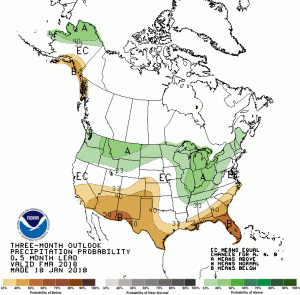
By Ground Hog’s Day, winter is half over. As we have noted before, you’d better have at least half your woodpile left.  At least that’s if the Ground Hog sees another six weeks of winter ahead.  It could be another six weeks of blah which is what we are wondering when we saw the latest Climate Prediction Center’s projection for February, March, and April. Precipitation chart (left) shows above average of water falling in the upper midwest and west and a drier band along the southern border. Temperature chart (right) shows below average temps in the upper midwest and west and not so much along the southern border and New England. Bottom line: Canadian Rockies, Montana, parts of Idaho, Washington are looking good. As with most predictions, don’t bet your 401k on the outcome. [Click on maps for more detail.]


This Week

We returned from the Outdoor Retailers and Ski Industries America combined trade show in Denver with lots of ideas for SeniorsSkiing.com.  The vendors and retailers we met knew about our online magazine for senior snowssport enthusiasts and were very supportive of what we are trying to do for our readers. That felt very rewarding, indeed.
While at the show, we happened to meet a young poet selling poetry from a little hut on 14th in downtown Denver.  Here’s the story and “Knees”, the poem he wrote for senior skiers.

We noticed that snowshoes and snowshoeing had a noticeably big presence at the show. So, the article about snowshoes from correspondent Jonathan Wiesel is timely.  Snowshoes have indeed come a long way, and snowshoeing is a very spouse-friendly way to enjoy the winter.

Our Mystery Glimpse this week asks you to identify an event rather than a person.  There were fewer guesses about the previous week’s tennis playing ski racer.  Turns out, she was not only an Olympian, but a great humanitarian as well.

We love museums that celebrate snow sports.  Correspondent Tamsin Venn stopped by a classic in Steamboat Springs on a recent trip. Here’s her report on the unusually named Thread Of Pioneers Museum with some interesting archival pictures.

Finally, we found a fitting tribute to Warren Miller, who left us last week. There isn’t a person we know of a certain age who hasn’t been affected by Warren Miller’s films.

Coming Up

Next week, we’ll be exploring why you should consider taking XC lessons, more about what to put in the box in the back of your car, and other news.  Please note: We are working hard on our release of Ray Conrad’s The Cotton-Pickin’ Lift Tower.  We should be making that available to you very soon.

Thanks for reading SeniorsSkiing.com.  Tell your friends, and remember, there are more of us everyday and we aren’t going away.

Ski resort version of Ground Hog Day? Is the moose trying to tell us something?


Lovin’ Snowshoes

‘Shoes Have Come A Long Way.  Have You Looked Lately?

Old: Good for decorating rustic cabins.

Back in 1971, when I transferred winter affections from downhill to Nordic skiing (due to a spectacular fall in Austria that racked up one knee and stripped off my ski suit—but that’s another story), I also tried snowshoeing. After all, cross-country skis and snowshoes were both made of wood and quite beautiful; they’re both ways to travel over snow rather than wade through it; they’re both very low-impact sports.

But cross-country evolved into my lifelong true love, while snowshoeing became merely the affably boring cousin you contact every few years. Too much work; bindings were crappy (now you’re in, now you’re not—and your fingers are gonna freeze putting the damn things back on); ‘shoes didn’t slide like skis, except sideways downhill on crust; wood frames cracked; rodents enjoyed chewing the rawhide webbing in summer storage.

Modern snowshoes confirm the theory of evolution. They’re clearly descendants of the woodies but virtually a new species in design, materials, flotation, and fun.

I found this out one January about a dozen years ago, laying out ski trails at a resort in Montana. (Sadly, I hadn’t visited that cousin in almost 30 years.) The snow was too deep, buried underbrush and deadfall too catchy to use Nordic skis. So since slogging through waist-deep powder on foot was out of the question, what to do? Happily, intuition had suggested bring my new aluminum snowshoes along to test the frozen waters. They behaved magnificently, though I dumped a couple of times trying to back up, sinking the tails of the ‘shoes. (My style of absorbing knowledge always seems to be “education through error.”)

Modern: Light, durable, inexpensive. Credit: Tubbs

So what’s new about this next generation (or two – more on that shortly) of snowshoes? It may seem minor at first, but bindings have improved incredibly; they’re easy to use, they stay on, and they don’t stretch. The ‘shoes themselves are durable and have no food value to rodents, since they’re generally made with aluminum frames and synthetic decking that’s durable and gives great flotation.  That combination is light weight, so there’s less effort. The addition of bottom cleats gives you much better grip on crust and even side-hills, though it’s still smart to avoid those when possible.

What else? Modern models definitely aren’t as pretty, but it’s a trade off of aesthetics for dependability, longevity, and convenience.

Snowshoes are nowhere near as pricey as Alpine or even Nordic gear, but it’s still smart to rent before you buy to see if you like the sport. You can use hiking or snow boots with today’s adjustable bindings, or even sneakers with neoprene booties.

There’s a new kind of ‘shoe that came on the market this fall ago from Crescent Moon Snowshoes, a Colorado company. They’re made of foam (!) but from my destructive testing are not just light but also sturdy, incredibly maneuverable.  I backed up in them, did a 180 degree jump-turn for no good reason.  They have great binding and are setting the snowshoe industry on its butt.

There are a thousand more subtleties to fun snowshoeing—using poles, running vs. walking, clothing, etiquette, and the like. They’re mostly unimportant. Snowshoeing has become easy, and easy on your bones and joints. And even if you don’t glide, just repeat too yourself, “600+ calories per hour!”, enjoy the burn, and head for the dessert tray.

Most Modern: Foam ‘shoes from Crescent Moon.