Hydration Chronicles: An Easy Way To Keep Drinking

Carry Water On Your Back Like A Camel.

In my younger days, my friends and I launched our adventures without giving a thought to proper nutrition, hydration and so on. On one fondly remembered camping trip, provisions were down to shredded wheat, peanut butter and warm beer, and we still had fun.

Dehydration is pretty common and may be the reason for low energy.

Dehydration is pretty common and may be the reason for low energy.  Benefits of drinking water are many. No joke.

Now we have the benefit of decades of research in sports medicine, nutrition and physiology. When planning my slope time, I try to take advantage of this knowledge to give myself any boost I can, whether it’s diet, exercise or technique. Proper hydration, while an often-discussed topic, is easy to overlook when it comes to winter sports yet surprisingly easy to maintain.

Easy to overlook, because, well, it’s cold out! Cold, dry air and modern technical clothing which so effectively manages perspiration combine to mask how much you may be sweating even on the most frigid day. The “start/stop” exertion common to skiing, where you do a run then relax on the chair, can further hide the amount of water you may be losing through sweat. Medium intensity steady exercise can cause you to lose an average of two liters of water an hour; even if you halve that because the exertion in skiing isn’t steady, it’s still a significant loss. If you get cold, you can still lose through “cold dieresis”, where the body loses water through increased urine production.

The benefits of staying well hydrated are many: You avoid fatigue, confusion, irritability, dizziness. Your joints function better. When dehydrated, the body will draw water from the blood; decreased blood volume leads to colder extremities and greater susceptibility to hypothermia and frostbite. As dehydration increases the heart rate can rise as blood pressure drops.

For my water supply, I like to wear a hydration pack. I prefer a simple, minimal design like the CamelBak Bootlegger ($55) which is made to be worn under your jacket. This keeps the drinking tube from freezing and keeps the pack from shifting around as I ski, or snagging on a chairlift. It’s a simple matter to unzip my jacket a bit & pull out the tube to take a sip every 15 minutes or so,

Camelbak Bootlegger carries the right joy juice to keep hydrated. Credit: Camelbak

Camelbak Bootlegger carries the joy juice to keep you hydrated.
Credit: Camelbak

whether stopping for a breather on a run or while sitting on a lift. The Bootlegger holds 1.5 liters; usually I’ll only fill it halfway and press all the air out to keep it as flat as possible. It’s easy to refill when stopping for a break or lunch. The bulk is barely noticeable, and the water bladder is sturdy enough that I can lean back on the chair lift without fear of bursting it.

I use plain water, which makes keeping the bladder and tube clean very easy. Sports drinks like Gatorade aren’t necessary; they all contain some form of sugar, and some contain up to 150 mg of sodium per cup, which may be an issue if you need to watch sodium intake. I think electrolyte loss in skiing is minimal; it’s more an issue when hot-weather exertion causes copious sweating.

A hydration pack is a much more comfortable way to carry water than having a big bottle banging around in your pocket. Making access easy and convenient means you’re more likely to stay well-hydrated and keep the fun going!


Sound Like A Local

Here’s How To Talk The Talk.

Every region has its own pronunciations, so if you take a western ski trip you might want to brush up on a few words and say them the way the local say them.

Word 1: Alta. This popular ski-only resort in Utah is the granddaddy of powder skiing. It averages 500 inches of snow a year, yet it’s just 25 miles from Salt Lake International Airport. How to say it like a local? Use this as a guideline. “My PAL AL skis at ALta.”

Word 2. Nevada. If you go a littler further west you’ll ski in Nevada at resorts around Lake Tahoe such as Kirkwood and Heavenly. But the state’s name often gets clobbered by visitors. Try saying this: “I’m GLAD not MAD to ski NEVADa.

BLIZZard, no longer BlizzARD.  Talk like a native. Credit: Harriet Wallis

BLIZZard, no longer BlizzARD. Talk like a native.
Credit: Harriet Wallis

Word 3. Blizzard. That’s a snowy weather condition. It’s also a brand of skis that’s popular out west. The Lift House, a full service ski shop at the base of Big Cottonwood Canyon in Utah, says that the brand is modernizing and Americanizing its name. No more “BlizzARD”, rhymes with “yard.”

Now you’re in the know. You can pronounce BLIZzard skis just the way you’d speak of a big snowstorm – a blizzard.

Does your region have some words that get mispronounced by out-of-staters?

Contemplative Ski Tour Around Appleton Farms

The Road Not Taken By Robert Frost

Two roads diverged in a yellow wood,
And sorry I could not travel both
And be one traveler, long I stood
And looked down one as far as I could
To where it bent in the undergrowth;
Appleton Farms, Ipswich, MA. Credit: SeniorsSkiing

Appleton Farms, Ipswich, MA.
Credit: SeniorsSkiing

Then took the other, as just as fair,
And having perhaps the better claim,
Because it was grassy and wanted wear;
Though as for that the passing there
Had worn them really about the same,
And both that morning equally lay
In leaves no step had trodden black.
Oh, I kept the first for another day!
Yet knowing how way leads on to way,
I doubted if I should ever come back.
I shall be telling this with a sigh
Somewhere ages and ages hence:
Two roads diverged in a wood, and I—
I took the one less traveled by,
And that has made all the difference.
Appleton Farms is a 900-acre property owned by the Trustees of Reservations on Boston’s North Shore in the historic town of Ipswich.  The farm had been the Appleton family since 1636, granted to them by Charles I.  It was deeded to the TOR in 1998. Many of the buildings have been restored, and the farm is producing crops for the local community.  The cross country skiing is magnificent, parking is plentiful, and the quiet is most welcome.
Great Pasture, Appleton Farms, Ipswich, MA. Credit: SeniorsSkiing

Great Pasture, Appleton Farms, Ipswich, MA.
Credit: SeniorsSkiing

Ski Industry Remembers: Scenes From 60 Years Ago

A Blizzard Of Memories From Ski Industry Association Video.

SnowSports Industries America (SIA) is the ski trade association of suppliers to consumers.  Think equipment manufacturers, clothing designers and providers, retailers, reps and media, everyone who gets the skier, boarder, X-Cer, backcountry adventurers and snowshoer out on the snow. SIA puts on global trade shows, publishes extraordinary research on market trends, advocates for the industry with government regulators and provides a platform for networking and  Founded in May, 1954 as the National Ski Equipment and Apparel Association, the organization is proudly celebrating its 60th year. Here’s a tribute SIA produced with scenes from the by-gone snow sports of the 50s and 60s to present day.  It’s an anniversary present from SIA to snow sport enthusiasts everywhere.


Is This Guy For Real? Amazing Candide Thovex In The Alps

Daredevil is becoming an -ism.  Here’s yet another impossible run.

We wonder if videos like this help recruit people to skiing or turn them off.  It sure looks, um, well, risky.  What do you think? Professional skiers Candide Thovex totally shreds Val Blanc.

Silver Streaks: A Model For How Ski Areas Can Serve Seniors

You Always Have Someone to Ski With at the Waterville Valley Program.

Gold_Waterville_Valley_Resort[Editor Note:  Waterville Valley’s Silver Streak Program was a Gold Senior Friendly Award Winner, based on SeniorsSkiing.com’s First Ski Area and Resort Survey.  Silver Streaks is the oldest senior ski program in the US.  We hope that other ski areas can start “Thinking Seniors” like Waterville.]

“I’m so excited, I just turned 65,” says Anne Pelletier, booster for the Silver Streaks, a program for the 50-plus set at Waterville Valley, N.H.

Silver Streakers Mike and Anne Pelletier totally enjoy the benefits of the Waterville Valley program. Credit: Tamsin Vinn

Silver Streakers Mike and Anne Pelletier totally enjoy the benefits of the Waterville Valley program.
Credit: Tamsin Venn

Nearly 30 years old, it was one of the first senior ski programs in the country to cater those 50 and over, a demographic astutely valued by Waterville’s founder ex-Olympian Tom Corcoran.

Pelletier, a lively woman in fire-red ski pants and state-of-the-art heated jacket, has reason to be happy. At age 65, the Waterville season pass benefits kick in: $379 for non-holiday midweek skiing.

For much longer, though, she has been with the Silver Streaks.

For the $95 joining fee, senior skiers get:

  • Reserved area in Parking Lot # 1 (one 90-year-old joined for that reason alone).
  • Complimentary coffee and pastries in the Base Lodge from 8:30-10 a.m. in special meeting area.
  • Complimentary Snowsports clinics for seniors only.
  • Après-ski party every Wednesday at rotating venues.
  • Banquets and other special events throughout the season.
  • Reduced price NASTAR every Wednesday.
  • Nordic program every Wednesday for two hours of Nordic skiing with professional guides, followed by lunch at the Nordic Center.

The program runs Monday-Thursday, non-holiday, early December to mid-March.

Also every Monday night the Coyote Grill at the White Mountain Athletic Center offers a $12 dinner; après-ski two times a month. (unfortunately $5 martini night was retired for reasons easy to imagine).

Other events: a Memorial ski run from the top in single file to remember those who have died in the past year.

The Pelletiers like the friendships, but they have an ulterior motive.

Says Anne, a platinum (top) NASTAR racer, “We have a need for speed.” Husband Michael, 72, is a top-ranked marathon runner in New England.

Silver Streakers Randy and Reggie Breeckner moved full time to Waterville 15 years ago from their home in the Litchfield Hills in northwestern Connecticut where they raised seven children.

Reggie notes, “I’m going to try snowshoeing when I get old.”

“You develop strategies not to get hurt,” adds Randy, a six-decades-long New England skier. Those include not skiing when it’s icy, foggy, or on busy weekends.

What about snowboarding?

“We know only one person in the group who snowboards,” he says.

Albert and Kristina Ruehli from southern New Hampshire are also on board. Albert learned to ski at age six in his native Switzerland.

Says Albert, “the mountains, the view, it’s a beautiful sport, plus you’re expressing yourself on the hill.”

“I went to a meeting and one of members said, ‘You’re too young to join,’ so of course I joined immediately,” says Kristina, 71.

 “We figure when we can’t ski anymore, we should just let an avalanche take us,” adds Kristina philosophically

Julius Feinleib from Thornton, N.H, has grandchildren ages seven and nine who now whiz by him on the trail. His reasons for joining are simple. “Just being with people I recognize.” He also likes the cup of coffee and doughnuts.

For more on Silver Streaks, click here.


A Much Better Way To Boot-Up

Taking The Pull Out Of Pulling On Boots.

Every now and then I come across a product that makes a big difference in the comfort of older skiers. I’ll explain in a minute.

No more wrestling with boots. Ski Boot Horn makes a BIG difference. Credit: Ski Boot Horn

No more wrestling with boots. Ski Boot Horn makes a BIG difference.
Credit: Ski Boot Horn

I always boot-up in the parking lot. The difficulty of that process advances with age. Over the years, I’ve found that using boot warmers on the way to the mountain makes it easier to get boots on — especially on very cold days, when the shells are stiff and resistant. Because I find it easier to be seated, I carry a folding chair in the car.

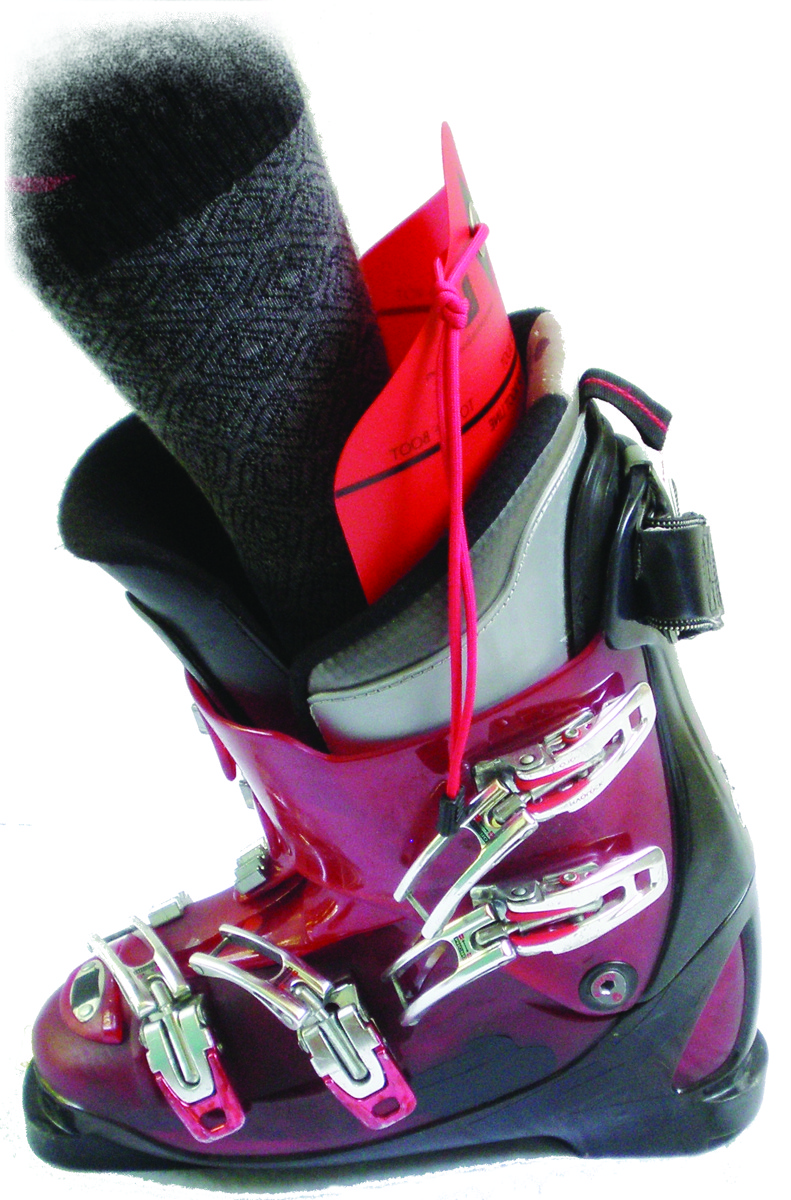
Recently I learned about the Ski and Snowboard Boot Horn, and, WOW, does it make a difference! This specially-designed sheet of flexible and slippery plastic is placed in the boot and helps your foot slip into place. It is simple, effective, and costs less that $10, when purchased online.

In addition to letting your feet slip in easily, the boot horn helps avoid foot and ankle pain from earlier injuries, while putting on boots. It also protects hand and finger injury and discomfort that can occur in the frustration of trying to get boots on in very cold conditions.

The ski boot horn website features a few useful videos about ways to improve getting your boots on, including useful tips about boot liner care. For reasons I don’t understand, there’s even a video of a group of skiers dropping into Jackson Hole’s iconic Corbet’s Couloir. I checked that one off on a deep powder day almost 25 years ago.

I haven’t tried the boot horn with cowboy boots, fishing waders, skates, etc., but the makers claim it works well for them and for all types of shoes. I’ll try those as the seasons change, but for now, I treat my Ski and Snowboard Boot Horn like I treat my AMEX card. I don’t leave home without it.

We’ll Have What They’re Having

Skiing En Masse Down A Mountain In The Buff Must Have Seemed Like A Good Idea At The Time.

We’d like to have at the conference table when the idea for this video came to up.  Not sure where or when this took place, but thanks to Mountain Life magazine for bringing it the world and for Sweetgrass Productions for the flick.  It is from their feature-length film, Valhalla.  If you took part, tell us what possessed you.  Thanks anyway to the, ahem, streaking skiers.  Probably NSFW.

“Road Scholars” Flock To Winter Learning Programs

XC Skiers mug it up at Craftsbury VT's Outdoor Center. Programs include Yoga, Film, Music & Dance, Credit: Roger Lohr

XC Skiers mug it up at Craftsbury VT’s Outdoor Center. Programs include Yoga, Film, Music & Dance,
Credit: Roger Lohr

XC and Snowshoeing Plus Study Opportunities From Lapland to Oregon.

From Roger Lohr, founder and editor at XCSkiResorts.com:

The Road Scholar program is a brand within the Elderhostel program intended for adults who want to travel and learn and stimulate discourse and friendship among other people for whom learning is the journey of a lifetime. This is an institution that attracts 97,000 participants on multiple-day travel programs enjoying a wide variety of subjects while providing comfortable and inexpensive lodging. This year there are 17 different winter outdoor adventure programs (Nordic and alpine skiing, snowshoeing, dog sledding, etc.) and participants can select from among domestic and international travel and scores of dates from January and March.

The Minnesota Winter Sampler (6 nights, $776, program #7933) has dog sledding, snowshoeing, and XC skiing, learning about the dynamics of wolf packs at the International Wolf Center and an overnight in a yurt.

The Trees For Tomorrow program (Road Scholar program #7310) has been offering natural resources education workshops to students, teachers, adults, and others in Wisconsin’s Northwoods in Eagle River, WI since 1944. Participants stay in rustic dormitories that have comfortable bedrooms, central bathroom facilities and a lounge with a fireplace.

This is a week of XC skiing and snowshoeing on trails, and ski instruction is provided for all skill levels. Naturalists will talk about how animals and plants adapt to the difficult northern winter conditions. Participants will visit a waterfall and learn orienteering skills on snowshoes. They’ll also visit the Kovac Planetarium, the world’s largest rotating mechanical globe-style planetarium.

Classic New England XC scene at Craftsbury Outdoor Center. Credit: Road Scholars

Classic New England XC scene at Craftsbury Outdoor Center.
Credit: Road Scholars

Annually there are many Road Scholar programs in Yellowstone National Park but the variety of Road Scholar programming is best exemplified at the Craftsbury Outdoor Center in Vermont (program # 20276). They’ve got three yoga programs (in January, February, and March) that incorporate daily outdoor activities such as XC skiing and snowshoeing. A program for Film & Fiction is scheduled with participants viewing a variety of film genres with a North Country theme and discussions following each film. The group will also read short fiction set in northern settings by contemporary authors ranging from contemplative to humorous with following discussions. A New England Music & Dance program is scheduled for early February to learn the history of traditional country dance and song from New England, the Canadian Maritimes and beyond with live music and a contra dance, too.

Road Scholars can visit Lapland where Auroras live. Credit: Road Scholars

Road Scholars can visit Lapland where Auroras live.
Credit: Road Scholars

There are winter trips to Colorado, Alaska, and Oregon but if you want to discover your inner Arctic explorer, there’s a trip to Finnish Lapland (11 nights, $6,500, program #21695) where reindeer outnumber the indigenous people by 10-1. You’ll drive your own dog sled team, spend a night in a glass igloo to bask in the aurora borealis show, and join the crew aboard an icebreaker.

Participant surveys show that 92 percent of the individuals on a Road Scholar trip learned something new and 20 percent fulfilled a lifelong dream. For more information about Road Scholar programs, call 800-454-5768, or visit www.roadscholar.org to view a myriad of programs to select among hundreds of national and international regions.

Knee Replacement—What Do I Do Now? Part 5

If you want to get back to skiing, learn to love your physical therapy.

It took my expert knee replacement surgeon one hour to cut, saw, hammer and install each new knee. It took me a year to rehab them. I was astounded by how long it took.

Correspondent Harriet Wallis works it. The key to recovery is following through with your  physical therapy regimen. Credit: Harriet Wallis

Laurie O’Connor, friend of correspondent Harriet Wallis, works it. The key to recovery is following through with your physical therapy regimen.
Credit: Harriet Wallis

I was in good physical condition before surgery, and I had the mind set that I would bounce right back. I’m strong. I’m tough. I thought that a set of new knees would be something like taking my car in for an oil change. Drive in with old oil. Drive out with new oil and keep on rolling. I was incredibly wrong. The analogy didn’t work. Healing and rehab take time

The good news is: The body is a healing machine.

The bad news is: Lots of people slack off their physical therapy exercises as soon as they can get into the car and do their grocery shopping. They lose their motivation and unfortunately they don’t get full benefit of their new knees. They probably aren’t skiers. We skiers are motivated to get back to the sport we love.

Eight months after surgery I was back on the slopes – starting on the opening day of the season. I skied 93 days that year. EEEhaw! (During the winter before knee replacement, all I could do was skid down a bunny slope.)

Friends asked: “How long did it take to get used to artificial knees?

My response: “About six turns.” My new knees worked wonderfully.

Skiing is good exercise, but it’s not focused physical therapy. Continuing the prescribed exercises was vital. Now, two years later, I still do certain exercises. I believe that maintaining artificial knees is an ongoing process.

My new knees do have some minor disadvantages. I cannot squat with my butt down to my heels. Artificial knees aren’t designed to bend that far. Therefore I sit on a low stool while weeding the garden. And swimming laps confounded me because it took more strokes to get across the pool. I think that’s because metal is heavier than bone, so my legs are lower in the water. I had to find a new balance point for swimming.

The bottom line is this: When the surgeon is done, your work is just beginning. Do your rehab exercises with gusto – and I’ll see you on the slopes.

Note: This is a five-part series in which SeniorsSkiing.com’s correspondent Harriet Wallis describes her knee replacement journey with tips to guide you if you’re anticipating knee replacement. Part 1: Inspired by a ski patroller with artificial knees. Part 2: Research 101 – why and how to do it. Part 3: Interviewing surgeons and questions to ask. Part 4: How I found the right doctor for me. This is Part 5, the final segment of the series.