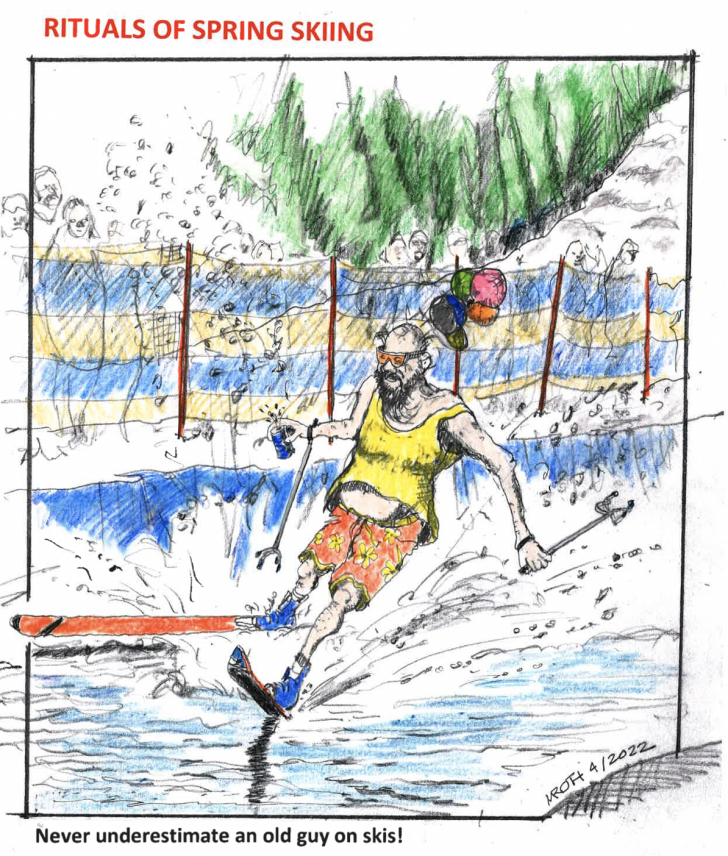
As demonstrated throughout the season, Mike Roth is a master at capturing those funny and fearful moments on skis. Here he combines several end-of-season rituals in one cartoon: the pond skim; the shorts; the funny costume, can of beer in one hand; BBQ fork in the other…all centered on one gnarly senior skier. Thanks, Mike!!!!
https://seniorsskiing.com/wp-content/uploads/2022/04/Screen-Shot-2022-04-13-at-10.56.28-AM-e1649876285929.png856728seniorsskiing/wp-content/uploads/2014/04/Seniors-Skiing-since2013-Logo@2x-300x68.pngseniorsskiing2022-04-14 18:40:532024-08-15 14:42:35Mike Roth’s Take on Spring Rituals
The ski license plate gallery continues to grow. Art Sexauer, whose ARTSKI plate is part of the gallery, sent in this SKI plate on his son’s car. And longtime contributor, Jan Brunvand, caught ALTADAB on his camera. Then he asked around for the meaning of “DAB”. His son explained that “DAB” can be either a form of greeting or a form of marijuana.
If you spot a candidate for the LUV2SKI license plate gallery, please email a picture to jon@seniorsskiing.com.
Seniors Skiing’s creator, co-founder, and main contributor passed away on Friday, June 3, 2022.
Jon Weisberg, 78, died June 3 peacefully at home, following a 15-month fight against bladder cancer. An avid skier, he created and co-founded SeniorsSkiing.com, the global online magazine for older skiers. As an executive with Bristol-Myers Squibb, responsible for international public affairs, he promoted and defended the company’s interests across the globe. Earlier, in PR agencies, he represented major consumer brands, trade associations, and other well-known interests. Jon received a BA (’65) from Syracuse University and an MA (’68) from its Newhouse School of Public Communications. Upon retirement in 2000, he and his wife, Pam, moved to Utah to be closer to world-class skiing. He became an adjunct professor in a graduate program of Westminster College, taught in the Deer Valley Ski School, and skied deep powder. For the next 17 years, he provided public relations and crisis and issues management consulting to organizations throughout the country. He served on the boards of the Utah Humanities Council, including as Chair, of the Living Planet Aquarium, and The Mesa, an Artist in Residency program at Zion National Park. Jon is survived by Pam (Crowe), his wife of 50 years, daughters Zoe Weisberg Coady (Chris, Valentino, Scarlett) of Narraganset, RI, and Dr. Amanda Lucero and family (estranged) of Salt Lake City. Donations in his memory may be made to Huntsman Cancer Institute and/or to the International Skiing History Association.
Jon with Klaus Obermeyer, founder of Sport Obermeyer.
Jon skiing in the Dolomites
Jon skiing at Powder Mountain, Utah, 2022.
We thank all of you for being subscribers and readers of SeniorsSkiing.com. In honor and remembrance of Jon, please leave your comments below.
https://seniorsskiing.com/wp-content/uploads/2022/06/Jon-Feature.jpg571800Pamela Weisburg/wp-content/uploads/2014/04/Seniors-Skiing-since2013-Logo@2x-300x68.pngPamela Weisburg2022-04-08 13:54:052022-10-21 16:46:10Remembering Jon Weisberg
The outdoor industry is big business: 57 million Americans engage in outdoor activities, generating an estimated $887 billion in revenue and creating about 7.6 million jobs.
Wind turbine at Jimmy Peak, MA
Snowsports, which account for about $20 billion in annual revenue in 38 states, rely on Mother Nature for cold and snow. A study conducted ten years ago by Protect Our Winters (POW), the Natural Resources Defense Council (NRDC), and University of New Hampshire scientists, links specific climate data to projected business losses for the snow sports industry and the U.S. economy.
Porter Fox, author, and Columbia University professor, writes about climate change and snow sports. He draws a relationship between the decline of the number of annual ski days and the ski industry’s light support of advocacy efforts. He lists 13 national legislators from ski states (CA, OR, UT and WA) who have voted against proposed environmental climate legislation; half of them voting against all the bills.
According to one Aspen Skiing Company executive, “The industry hasn’t done a good job educating leaders on the raw science and hasn’t made enough of a public statement on climate.”
Solar panels at Mt Abram, ME
That said, many ski areas are addressing global warming by taking local action in the form of wind turbines and solar tracking systems. LED lighting is another investment reducing power use. More specifically, Aspen has LEED buildings, a coal methane capture facility, and solar and hydro energy. On the other side of the country, Killington is engaged in a program that purchases electricity generated by cow dung. The area also encourages use of electric vehicles by installing about 50 EV charging stations.
These are just a few of the many examples of ski areas taking action to address climate change and, frankly, do what they can to survive the warming conditions threatening their long-term survival.
Yes, it’s good for business. And it’s good for all of us who love to play in the snow. It’s also good for our future generations.
For a summary of how ski areas around the world are becoming sustainable, click here.
https://seniorsskiing.com/wp-content/uploads/2022/04/Screen-Shot-2022-04-12-at-5.42.12-PM.png486720Roger Lohr/wp-content/uploads/2014/04/Seniors-Skiing-since2013-Logo@2x-300x68.pngRoger Lohr2022-04-01 19:20:072022-11-02 20:51:52Sustainability: Snow Sports Depend on It
Short productions by ski videographer, Don Burch, have been gracing these pages for a few seasons.
Each one is a personal perspective on the joys of skiing; quite different from what the ski and clothing companies have been sponsoring. Funkadelic Skiing – a compilation from the 2021-22 season — is yet another take on Don’s unique view of the sport. Enjoy!
The season’s beginning to wind down. Area closing dates have been arriving by email, and wherever I look here in Salt Lake City, flowers are springing from the ground and golfers are swinging away on the fairways. For skiers it’s a bittersweet time of year. Patches of brown on the slopes signal it’s coming to an end. But there’re always plans and visions for the coming season. April 15 will be our final full issue for the 2021-22 season.
Short Swings! has some surprises in store. Herb Stevens’ weather report mixes good news and less than good news for the coming weeks.
Jon describes an upcoming guided ebike tour of the Umbria region of Italy. The electric-assisted bikes will carry the small group through gorgeous countryside as they visit wineries, ancient villages, and luxurious small hotels.
Dave Irons draws on his rich experience heading patrol at Sunday Mountain to share thoughts on why some skiers are, literally, out of control, and what can be done to reduce this growing problem.
Tamsin Venn explores Park City’s minimg history and how, in the early days of the resort, subways delivered skier to the slopes.
Mike Roth illustrates a reader’s 1982 experience in Tuckerman Ravine, and Don Burch presents his newest; a video account of his recent visit to several Colorado resorts. His take on the ski video is entertaining and refreshing.
Be sure to check out Test Your Skiing Knowledge and the answer to last issue’s challenge. And visit the growing LUV2SKI vanity license plate gallery.
Enjoy the issue. Enjoy these last weeks of skiing. See you again on April 15.
https://seniorsskiing.com/wp-content/uploads/2014/03/cropped-seniors-skiing-final-small.jpg2761016seniorsskiing/wp-content/uploads/2014/04/Seniors-Skiing-since2013-Logo@2x-300x68.pngseniorsskiing2022-03-31 20:00:002024-08-15 14:44:39This Issue: April 1, 2022
The Skiing Weatherman 4/1 West favored for snow…East hangs on
In my last installment, I discussed the extreme back and forth nature of the winter in much of the country, as well as the transition of the upper air pattern to a typical springtime short wavelength configuration that helps to sustain a rapid back and forth sequence of weather systems. For the next 10 days or so, we are looking at pretty much a “rinse and repeat” scenario from coast to coast. Cold air is still quite plentiful across Canada, but it is more difficult at this time of year to break off a big chunk that descends into the lower 48 for an extended period of time. We will have to make do with smaller shots of cold air that fuel and sustain transient upper level troughs, but we’ll also have to accept the short wavelength ridges that move from west to east that lead to milder weather and spring surface conditions. By the middle of the month, I do see signs of a colder pattern setting up in the West, with a mild ridge popping up in the East, one that will likely be the knockout punch for the season at most of that region’s resorts. Here is a look at the jet stream next Thursday…
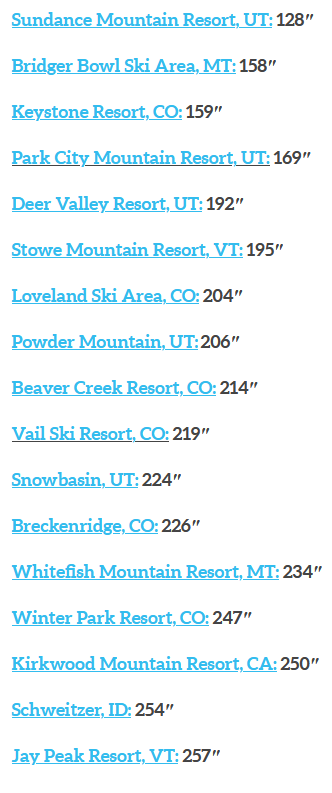
A deep trough will be located over the middle of the country, with ridging dominating the West with a spell of dry, mild weather. It will also be mild in the East…after a chilly start to the week…as a ridge also pops up along the Atlantic seaboard. The trough will send yet another surface low-pressure center along an unfavorable path for eastern resorts through the eastern Great Lakes and into the St. Lawrence Valley. That track will generate rain and some higher elevation snow in New York and New England. While eastern skiers and riders have cursed the numerous “cutter” lows this season, the far northern Great Lakes resorts have been on the snowy side of that storm track and have enjoyed a banner season. Mount Bohemia in the Upper Peninsula of Michigan is a natural snow, ungroomed, advanced skier-only powder magnet in the Lake Superior snowbelt. They average about 270 inches of snow a year and have received 280 inches as of 3/24. As this list illustrates, Bohemia has racked up more snowfall than many more famous resorts, east, and west.
With the potential for additional snowfall looking pretty solid across the northern Lakes, Bohemia could very well stretch their lead on the snowfall scoreboard through mid-April.
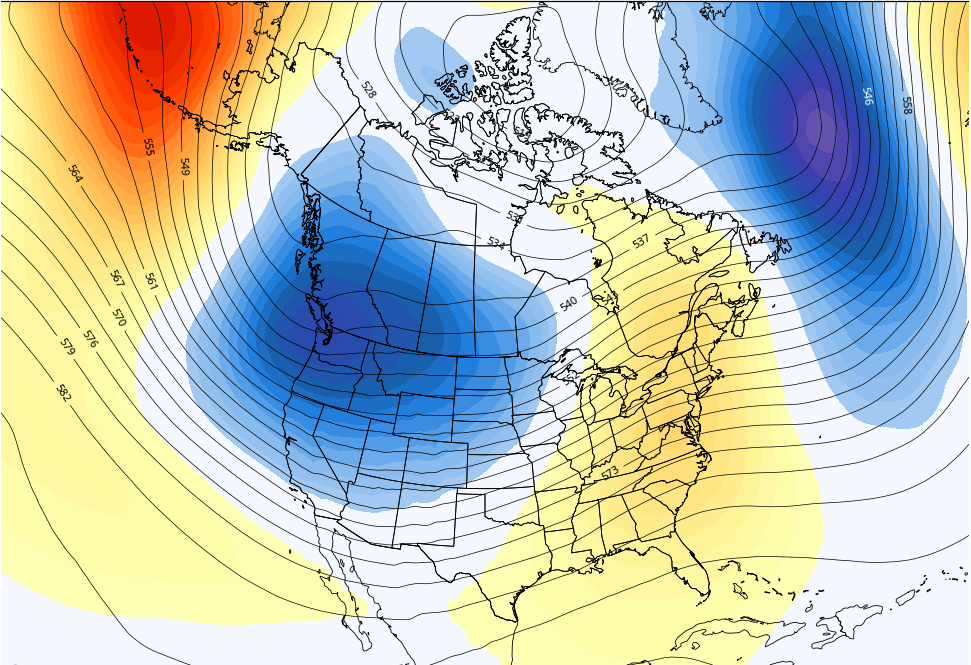
Out west, snow levels have been on the high side of late, with spring conditions quite common, even into parts of the northern Rockies. The relatively mild pattern will remain in place for the next week, but by about the 10th, a significant trough will move in from the Pacific, and colder air will flow into that trough from western Canada. That will lead to a period of at least several days with enhanced prospects for late snow from the Cascades down through the Sierras and eastward to the Rockies. At the same time a mild ridge will build in the East, and with rather a skimpy base snow in place, the end of the season will arrive at many resorts. Here is a jet stream forecast for 4/13 that displays the pattern change.
Regional details…
Northwest U.S./Western Canada: Some light snow early next week, then mild and dry. Turns snowy from the 10th onward.
Sierra: Spring conditions rule for another 10 days before mid-month pattern change delivers snow.
Rockies: Weak system brings light snows early next week then ridge rules for a while. Pattern favorable for late snow after the 11th or so.
Midwest: Many resorts have closed. Snow still in the cards across the northern Lakes for the next couple of weeks.
Mid Atlantic/Southeast: Boom-boom, out go the lights. The season is over.
Northeast/QB: Chilly weekend sustains snow cover. First ten days of April hold hope for high elevation snow at northern resorts.
https://seniorsskiing.com/wp-content/uploads/2022/03/seniorsskiing1-1-1.png636943Herb Stevens/wp-content/uploads/2014/04/Seniors-Skiing-since2013-Logo@2x-300x68.pngHerb Stevens2022-03-31 19:50:432022-04-04 15:00:13The Sking Weatherman April 1, 2022
The way skiers and boarders enter the sport determines their behavior on the hill. Years ago, many were introduced to skiing by their parents; skiers who knew the commonsense safety rules and made sure their children knew them, as well. For decades, those entering the sport through ski school have been exposed to the Skier’s Responsibility Code during lessons, their instructors citing examples in real time:
Looking up the hill when entering a trail is pointed out each time an instructor takes his or her class onto a new run.
Stopping at the edge of a trail and not obstructing traffic is taught by example as instructors always pull to the side when talking to the class.
Unlike driving there’s no requirement for beginning skiers to pass a test before taking to the trail. They simply show up, usually with a friend who attempts to teach them; a friend who may not know the safety basics himself.
Riding the rope. Harriet’s daughter Alison, 5, in leather boots and wooden skis on Jiminy Peak’s rope tow. Credit: Harriet Wallis
There can be serious consequences. Eight years ago at Cranmore Mountain I was struck and seriously injured by a boarder who was uphill from me. As the uphill rider, it was her responsibility to avoid anyone below. She knowingly entered a populated slow-skiing area without slowing down. Had we been in Colorado, she would have been held liable for my injury.
Over my years patrolling at Sunday River, I always pointed out, “If you’re good enough to overtake another skier, you had better be good enough to avoid them.” Skiers have don’t have rearview mirrors or turn signals. If one turns into your path, it’s up to you to change your path to avoid her. The responsibility code calls this skiing under control.
Source: The New York Times
Another frequent safety violation is skiing closed trails and out-of-bounds terrain. Trails are closed for a reason, and that reason could be hazardous conditions. Years ago, a skier at Loon Mountain fell on an intermediate cross trail and slid under a rope onto a closed steep and icy run. His companions had to work their way through the trees to reach their injured friend. It even was difficult for patrol to reach the injured skier, who eventually died. The double lesson here: 1.Stay off closed trails. 2.If terrain and conditions between you and the injured skier are beyond your ability, wait for patrol.
Know how to report an accident. The key is to know where you are on the mountain. You can always go to the bottom of a lift, where the accident will be called in. Most areas have a number to call for ski patrol. Make sure it’s in your cell.
Out of bounds is another issue. There is no grooming, and unless your skills are up to handling all conditions, stick to the groomed runs. These areas are not patrolled and not swept at the end of the day. Never ski these areas alone. Three or more is preferred. If someone is in trouble, one can stay with the injured party while the other goes for help. If you choose to ski out-of-bounds, think of the sign at the top of Killington: The mountains will be just as cold and lonely tonight as they were 200 years ago.
/wp-content/uploads/2014/04/Seniors-Skiing-since2013-Logo@2x-300x68.png00Dave Irons/wp-content/uploads/2014/04/Seniors-Skiing-since2013-Logo@2x-300x68.pngDave Irons2022-03-31 19:45:072022-04-04 15:02:07An Old Pro Shares Thoughts on Staying Safe on the Hill
Park City, Utah started as a mining camp in the 19th century, transferred business from silver mining to skiing in the early 1960s and never looked back. These days Park City Mountain Resort, owned by Vail Resorts, has about 1,200 miles of underground tunnels and shafts and mining structures all over the mountain that you ski by and over along 348 trails.
In 1963 United Park City Mines, the last active operation in Park City, opened Treasure Mountain Resort on the 3,700 acres it owned. Relying on mining engineering know-how, it put up J-bars, a gondola, and a Skier’s Subway.
Now in the Park City Museum, this “subway” car used to transport skiers into the mountain, where they would enter an elevator and travel to the base of the Thayne’s chair.
In what has to be the most unusual lift in skidom, the Skier’s Subway ran from January 1965 to July 1967, starting near the spot where the Silver Star chair is now located. Skiers rode more than three miles through the west end of the Spiro Tunnel on repurposed mining carts, water dripping onto their parkas, to the Thaynes Shaft where they got hoisted 1,700 feet up to the Thaynes chair lift. From out of the dark depths…Voila!, the slopes. The ride took about 25 minutes. Most skiers did it once for the novelty, once for the kids, and that was enough.
Early March, I skied to the Silver Star base area and discovered this bit of mining history: In 1917, owner Solon Spiro built a tunnel 21,675 feet into the mountain to draw excess water down and away from mining operations above.
The town now uses the tunnel to provide about a quarter of its water for drinking, snowmaking, and golf course irrigation. To protect this resource, a few years ago the town removed debris and shored up the first 400 feet of the tunnel to prevent cave-ins.
On a guided skiing tour of Park City’s mining history. Photo: Tamsin Venn
The very active Friends of Ski Mountain Mining History collaborated with the town to open a commemorative plaza in the fall of 2021 with signage at the fenced-off tunnel entry at Silver Star Village. It’s a delightful starting point to the day, away from the crowded Park City Mountain Resort’s nearby free parking area. The Silver Star chair gives easy access to King Con chair. The village has a small lift ticket booth, friendly lift attendants, the well-equipped Silver Star Ski & Sport, located in an old mining building, and the Silver Star Café that transforms from skier-patio-lunch-spot to award winning restaurant at night.
For a fuller view of Park City’s mining history spread throughout the mountain, take the Silver to Slopes Historic Tour, a complimentary two-hour visit led by PC’s mountain services guide (See SeniorsSkiing article: There’s Silver in Them Thar Hills!).
https://seniorsskiing.com/wp-content/uploads/2022/03/Screen-Shot-2022-03-31-at-1.33.17-PM-e1648755971383.png433728Tamsin Venn/wp-content/uploads/2014/04/Seniors-Skiing-since2013-Logo@2x-300x68.pngTamsin Venn2022-03-31 19:35:422023-05-20 19:54:04The Skier’s Subway: Most Unusual Lift in Skidom
Don Burch recently returned from his first ski trip to Colorado in almost 50 years. He titled this video summary of his time at Beaver Creek, Copper, Keystone, Breckenridge and Vail,“Come Ski With Me.” It’s another fine example of Don’s refreshing new genre of ski video: brief, graphically interesting, and easy to watch.
https://seniorsskiing.com/wp-content/uploads/2022/03/come-ski-with-me.jpg6101200Don Burch/wp-content/uploads/2014/04/Seniors-Skiing-since2013-Logo@2x-300x68.pngDon Burch2022-03-31 19:30:262022-04-04 15:04:08“Come Ski With Me”: A New Don Burch Video
In the last issue of SeniorsSkiing.com, author/cartoonist, Mike Roth, gave his account of a loooong slide he took in Val d’Isere in 1988. That inspired reader Bob Strum to write in about his 1982 yard sale at Tuckerman Ravine. Mike’s illustration captures the moment!
In 1982, skis strapped to shoulders, I was climbing the main bowl at Tuckerman Ravine on Mount Washington in New Hampshire. At one point, it was too hard to go higher. My body was pressed against the icy snow, supported by boot tips and ski poles. Trying to reach where I could get skis on, I lost grip and slid about 650 vertical feet. Skis, gloves, poles, goggles and glasses scattered everywhere. People on Lunch Rocks applauded. I broke a rib, tore an MCL in my knee, tore my calf muscle, and bruised my arm. It hurt too much to ski. The hardest part was hiking to the bottom carrying 50 pounds on a slippery trail. Fortunately, I didn’t hit Lunch Rocks. If I had, I wouldn’t be telling this tale.
Have a ski story of your own? Send it to jon@seniorsskiing.com. We’ll select the most entertaining to be published, along with an original Mike Roth illustration!
https://seniorsskiing.com/wp-content/uploads/2022/03/Screen-Shot-2022-03-31-at-2.52.41-PM-e1648760002580.png810728Mike Roth/wp-content/uploads/2014/04/Seniors-Skiing-since2013-Logo@2x-300x68.pngMike Roth2022-03-31 19:25:032022-04-04 15:05:30OMG!!!! A 1982 Near Disaster at Tuckerman
This is the final Test Your Skiing Knowledge feature of the 2021-22 season.
Each issue of SeniorsSkiing.com has a picture to help test your skiing knowledge. Generally, the pictures are from collections in a variety of participating ski museums, which we encourage readers to visit.
This test has one simple answer: Name the only female skier to win three Olympic gold medals in alpine skiing in a single Olympics. The first reader to correctly identify her will win the new “Licensed to Ski” poster with photos of ski-themed vanity license plates. Only responses sent to jon@seniorsskiing.com will be considered.
The person pictured in the last Test Your Skiing Knowledge is Sir Arnold Lund (1888-1974), skier, mountaineer and writer, knighted in 1952 for “services to British Skiing…” He introduced the racing concept that speed should be the only determinant to test the skier’s ability to turn securely and rapidly on steep Alpine terrain. He established numerous ski organizations and race events and was influential in introducing ski events to the Olympics. The first reader to correctly identify him was Enzo Falco of Belmont, MA. He once had the privilege of meeting Lund in person.
https://seniorsskiing.com/wp-content/uploads/2022/03/Screen-Shot-2022-03-31-at-4.42.37-PM.png498706seniorsskiing/wp-content/uploads/2014/04/Seniors-Skiing-since2013-Logo@2x-300x68.pngseniorsskiing2022-03-31 19:20:412024-08-15 14:46:14Test Your Skiing Knowledge
The Skiing Weatherman 3/18 One step forward, one step back…
While Upper Midwestern and western U.S. resorts have seen some meaningful snowfall at times the past 2-3 weeks, areas in the East have battled the back and forth pattern that has been dominant much of this winter. La Ninas typically produce enhanced variability in the winter, and this winter has been a very dramatic example. Significant snowfalls have often been followed by a system that tracked through the eastern Great Lakes into the St. Lawrence Valley, leading to a warmer outcome and rain not long after newly minted snow. Sleet, freezing rain, and strong winds are also eastern hallmarks of La Ninas and we have seen more than enough of all three this season. The result of the changeable weather has been to limit the growth of base snow, and many areas are now in need of fresh snow to ensure that they can stretch their seasons as far as they had planned.
Transition months like March and April are a challenge for forecasters, in large part because the wavelengths between troughs and ridges shorten. The pools of cold air that are available to dynamically support the troughs start to shrink as the hemisphere heads into spring, and more storms become events with marginal temperatures for snow. In addition, the contrast between lingering cold across the north and advancing warmth to the south makes the flow across the country speed up, so changes tend to come often. The following jet stream map, valid on 3/22, illustrates the busy state of the upper levels of the atmosphere…
You can see the trough over the Maritimes, which will help to keep it cool over the Northeast next week, helping to preserve the modest bases. A mild ridge will cover the Midwest, but bases depths there are more substantial. Then you have another trough that will have just produced snow in the central and southern Rockies, with a ridge blanketing the west coast. Gone are the midwinter days of western ridge/eastern trough or vice versa.
This second map shows the pooling of the cold and mild air masses at 5,000 feet associated with the ridges and troughs. The 5,00 foot level is a proxy for surface temperatures.
The fast flow across the country will make it very difficult for either air mass to remain in control at a given location. However, during the week of the 28th, the pattern will slow down somewhat, with a trough favored in the East and a weak ridge in the West, as you can tell from the 5,000 foot temp anomalies on the 29th.
What does this mean? Well, it means some snow will fall in the West, starting this weekend in coastal ranges, and early next week in Colorado. And it suggests that help is on the way to the northern mid-Atlantic and Northeast (next week), where base snow is going to have to fight off some rain this weekend. In the Great Lakes, fresh snow will provide reinforcements for the stretch run, pretty much ensuring a season that will carry on into April. Here’s a map of potential snowfall for the next two weeks…
Regional details…
Northwest U.S./Western Canada: Snowy pattern this weekend into next week, especially in B.C. Snow levels rise thereafter.
Sierra: Light snow this weekend…mild and dry next week. Next snow around the 28th.
Rockies: Substantial snowfall for Colorado late weekend/early next week. Lighter snows northern and southern Rockies.
Midwest: Several snowfalls in the next ten days in the central and northern Great Lakes. Excellent prospects for skiing/riding in early April.
Mid Atlantic/Southeast: Central and northern resorts…at elevation…looking okay for the next 10-14 days. Potential for some snow there late next week. Southern resorts will have to stretch the snow they have on the hill.
Northeast/QB: Some rain will fall this Saturday, ending as snow far north. Cooler next week. Potential for snowfall late next week. The final week of the month looks promising.
The Skiing Weatherman 3/18 One step forward, one step back…
While Upper Midwestern and western U.S. resorts have seen some meaningful snowfall at times the past 2-3 weeks, areas in the East have battled the back and forth pattern that has been dominant much of this winter. La Ninas typically produce enhanced variability in the winter, and this winter has been a very dramatic example. Significant snowfalls have often been followed by a system that tracked through the eastern Great Lakes into the St. Lawrence Valley, leading to a warmer outcome and rain not long after newly minted snow. Sleet, freezing rain, and strong winds are also eastern hallmarks of La Ninas and we have seen more than enough of all three this season. The result of the changeable weather has been to limit the growth of base snow, and many areas are now in need of fresh snow to ensure that they can stretch their seasons as far as they had planned.
Transition months like March and April are a challenge for forecasters, in large part because the wavelengths between troughs and ridges shorten. The pools of cold air that are available to dynamically support the troughs start to shrink as the hemisphere heads into spring, and more storms become events with marginal temperatures for snow. In addition, the contrast between lingering cold across the north and advancing warmth to the south makes the flow across the country speed up, so changes tend to come often. The following jet stream map, valid on 3/22, illustrates the busy state of the upper levels of the atmosphere…
Insert Seniorsskiing1
You can see the trough over the Maritimes, which will help to keep it cool over the Northeast next week, helping to preserve the modest bases. A mild ridge will cover the Midwest, but bases depths there are more substantial. Then you have another trough that will have just produced snow in the central and southern Rockies, with a ridge blanketing the west coast. Gone are the midwinter days of western ridge/eastern trough or vice versa.
This second map shows the pooling of the cold and mild air masses at 5,000 feet associated with the ridges and troughs. The 5,00 foot level is a proxy for surface temperatures.
Insert Seniorsskiing2
The fast flow across the country will make it very difficult for either air mass to remain in control at a given location. However, during the week of the 28th, the pattern will slow down somewhat, with a trough favored in the East and a weak ridge in the West, as you can tell from the 5,000 foot temp anomalies on the 29th.
Insert Seniorsskiing3
What does this mean? Well, it means some snow will fall in the West, starting this weekend in coastal ranges, and early next week in Colorado. And it suggests that help is on the way to the northern mid-Atlantic and Northeast (next week), where base snow is going to have to fight off some rain this weekend. In the Great Lakes, fresh snow will provide reinforcements for the stretch run, pretty much ensuring a season that will carry on into April. Here’s a map of potential snowfall for the next two weeks…
Insert seniorsskiing4
Regional details…
Northwest U.S./Western Canada: Snowy pattern this weekend into next week, especially in B.C. Snow levels rise thereafter.
Sierra: Light snow this weekend…mild and dry next week. Next snow around the 28th.
Rockies: Substantial snowfall for Colorado late weekend/early next week. Lighter snows northern and southern Rockies.
Midwest: Several snowfalls in the next ten days in the central and northern Great Lakes. Excellent prospects for skiing/riding in early April.
Mid Atlantic/Southeast: Central and northern resorts…at elevation…looking okay for the next 10-14 days. Potential for some snow there late next week. Southern resorts will have to stretch the snow they have on the hill.
Northeast/QB: Some rain will fall this Saturday, ending as snow far north. Cooler next week. Potential for snowfall late next week. The final week of the month looks promising.
https://seniorsskiing.com/wp-content/uploads/2022/03/seniorsskiing1-.png573938Herb Stevens/wp-content/uploads/2014/04/Seniors-Skiing-since2013-Logo@2x-300x68.pngHerb Stevens2022-03-17 19:50:522022-03-17 23:39:33The Skiing Weatherman March 18, 2022
Editor’s Note: TheSkiDiva.com is an online community of women skiers without the male orientation. The forum’s founder, Wendy Clinch, recently posted this report, comprised, in part, of comments by forum participants.
Source: #RideAnotherDay
In the past few weeks, there have been at least 10 deaths at North American ski resorts. While one death is way too many,The NationalSki Areas Association says ski fatalities are pretty rare: as low as one for every one million visitors to a ski resort. (It’s also noted that more men are victims of skiing accident deaths than women).
Despite this, many participants on TheSkiDiva forum believe that resort skiing has become increasingly dangerous.
This season, stories of near misses, collisions, and risky behavior are all too common. And while I don’t have the data, it seems like the situation is getting increasingly worse.
What’s the cause? Some say the slopes are more crowded because of multi-resort passes and the ability of high-speed chairs to get more people on the hill. Some believe the problem is caused by ski movies and social media glorifying risky, extreme behavior, treating it as though it’s part of the norm. Others believe skiers and riders are distracted by music, texting, and selfies. And some feel that equipment has evolved to the point where people are skiing beyond their abilities.
HERE ARE A FEW EDITED COMMENTS POSTED BY FORUM MEMBERS:
I’ve been quitting earlier these days because I’m concerned that someone will hit me. It’s not fun when the slopes are crowded with hotshots or folks who are skiing beyond their abilities. We avoid weekends when we can.
As someone who only skis weekends, it seems the mountains are more crowded, and people aren’t being mindful of those around them. I’ve noticed many near collisions and had a few incidents where someone got way too close while trying to pass me. In two cases they whizzed right over the tips of my skis causing me to lose my balance.
Cheap season passes have resulted in dangerous slopes on busy days, primarily Saturdays. Way too many people I know have been hit by others. The way the terrain parks are laid out where I ski adds greatly to the kamikaze attitude, ineptitude, and general disregard for anyone else on the mountain. I am sad to say that all I hear are excuses. I’m pretty over it. The perspective definitely changes when you have a child out there.
I quit skiing at our local bump because of crowds and out of control skiers. It’s been a zoo. I was working with a friend on the long beginner run when an out of control kid scared the sh*t out of her, causing her to fall and break her wrist. I was done after that; it could have been me.
I was hit hard enough to be knocked out of my bindings. Ski patrol did notpull the person’s pass even though he had been straight lining down the mountain while I stood stopped in plain view with other skiers at the bottom
There’s no question that ski safety is an important issue that needs to be addressed. Here are a feww suggestions from forum members about what can be done:
Limit ticket sales:Crowded slopes are more dangerous slopes. Require skiers to go online and reserve their spots at least 24 hours in advance. This might help reduce overcrowding.
Require everyone who buys a pass to go through interactive safety presentation. Make it mandatory for those under 18; give everyone else an incentive (e.g. $10. off or special lift access for completing training.
Hold people accountable. Don’t tolerate unsafe behavior.This requires policing from resort personnel. Mammoth patrollers take photos of violators’ passes. Guests with a second speeding offense are required to screen the “Ride Another Day” video and take a quiz before their pass is reactivated.
Better regulate/police alcohol and marijuana use.Many on the forum believe that the mix of skiing or riding with alcohol and/or weed, particularly among minors, results in alarming behavior. No one should be allowed to ski or ride under the influence.
See something, say something.Let resort personnel know when you see unsafe behavior, and make it clear that this is something you will not tolerate. The more we make our feelings known about this, the better.
WHAT CAN YOU DO TO IMPROVE YOUR OWN SAFETY?
Wear a helmet. This can reduce can reduce the risk of sustaining a head injury by as much as 29 to 56%.
Make sure your bindings have the proper DIN setting for your size and ability.
Always look uphill before taking off, and always be aware of your surroundings.
Give the downhill skier the right of way.
Always ski in control.
Don’t ski alone in the trees or backcountry.
Avoid tree wells.
Stay safe out there, everyone.
https://seniorsskiing.com/wp-content/uploads/2022/01/Screen-Shot-2022-01-30-at-12.48.23-PM-e1643572176385.png971728Wendy Clinch/wp-content/uploads/2014/04/Seniors-Skiing-since2013-Logo@2x-300x68.pngWendy Clinch2022-03-17 19:45:052022-03-17 23:23:32IS RESORT SKIING GETTING MORE DANGEROUS?
If you’re a cross country skier in the U.S. snowbelt states or any Canadian province, you may well have enjoyed a golf course offering XC skiing – not surprising, since there are more than 250 in North America, from Halifax to Whistler, Boston to Lake Tahoe.
In my admittedly biased opinion, this isn’t nearly enough.
So I suggest that if there’s a golf course near you that has 60 days of snow cover (or managers have the vision and resources to add snowmaking and lights), you should propose that they open for skiing and snowshoeing. XC operators have learned a lot during two COVID Winters, and XC is clearly growing as a sport and business.
Simply put, we need more places to ski that are close to home – ideally places with professional-quality grooming and XC and snowshoe rental equipment, useful stuff to sell (sunglasses, gloves…), at least minor food service, and instruction. Golf course roughs and fairways can provide great sliding surfaces, while there may also be a clubhouse and pro shop that can be converted for winter. As we seem to be getting in the habit of traveling shorter distances for everything from daily recreation to vacations, having groomed trails in the neighborhood can be a huge stimulus for the sport.
Right now, many golf courses are groomed by dedicated volunteers who may personally provide snowmobiles (or ATVs or UTVs) and grooming implements. These tend to be situations with minimal services, though most have plowed parking and,often, a portable toilet.
Approach local courses to encourage winter XC operations
This concept of approaching a local golf course isn’t the result of a recent revelation. I know of dozens of courses in different regions that have opened for XC at the suggestion of neighbors, golf club members, ski clubs, or community-minded groups.
There are numerous good business reasons for courses to operate in winter. Among them: XC generates cash flow through trail fees, dining, retail, accommodations, instruction, events, club memberships, equipment rental, and more. And land values tend to increase when recreational opportunities are nearby.
There are golf courses that offer XC just to keep key staff employed; or to protect delicate grasses from skiing/snowshoeing/walking; and probably most often to serve the community – providing healthy, low-risk, inexpensive, convenient recreation and social contact.
P.S. Cross Country Ski Areas Association is a great resource on the sport and business (https://xcski.org for consumers,https://ccsaa.org for industry) – lots of persuasive research on the nature and growth of XC skiing in North America.
https://seniorsskiing.com/wp-content/uploads/2022/03/Teton-Pines-Golf-Clubhouse-Jackson-Hole-WY-JH-Nordic-3-scaled-e1647298770182.jpg654728Jonathan Wiesel/wp-content/uploads/2014/04/Seniors-Skiing-since2013-Logo@2x-300x68.pngJonathan Wiesel2022-03-17 19:30:452022-03-17 23:17:35Encourage Your Local Golf Course to Become a XC Skiing Center
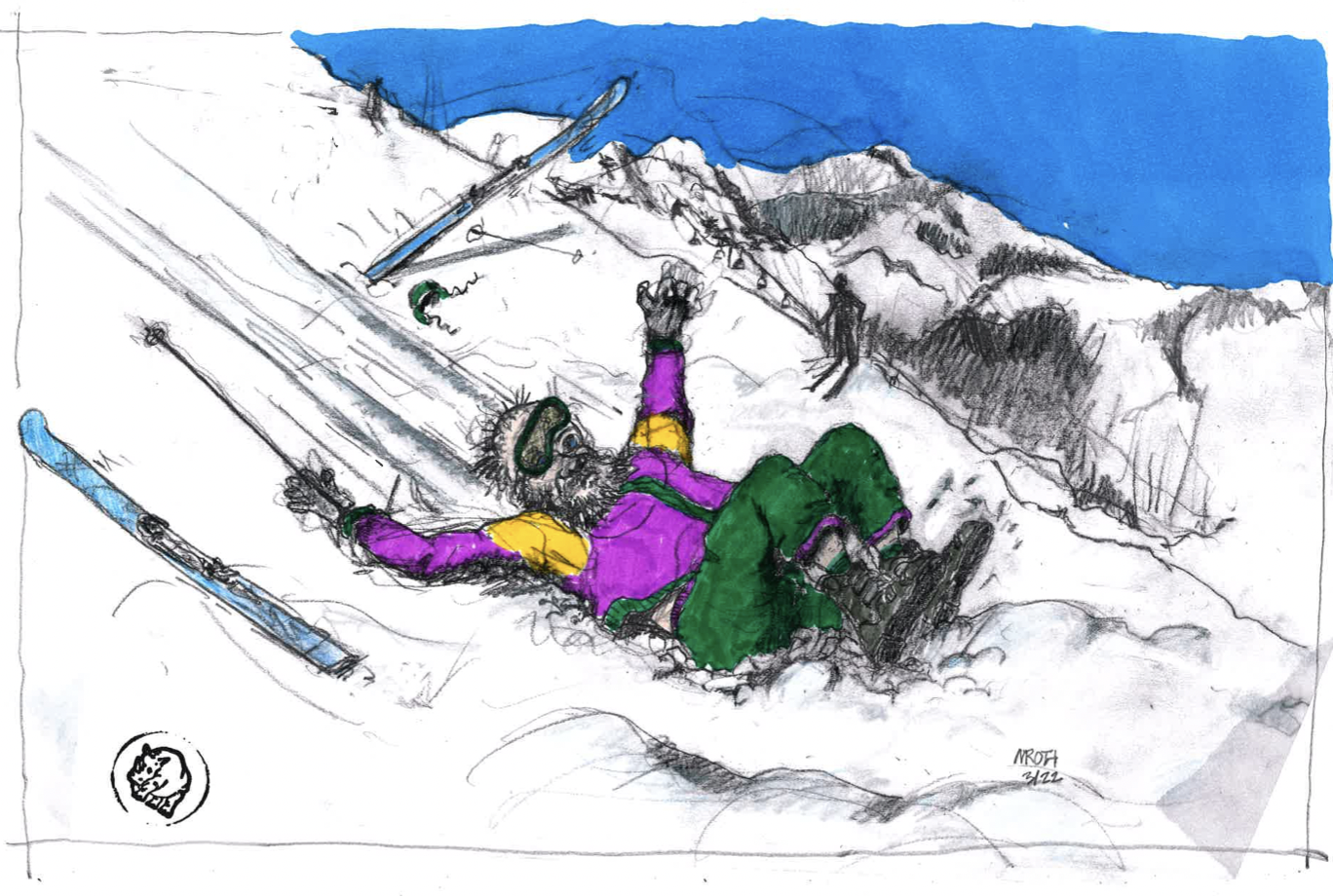
After a terrific lunch, my friends and I returned to an off-piste area we had skied that morning. On a traverse across the steep slope, I slipped, lost my skis and couldn’t stop sliding. Digging my heels into the snow launched me into a forward somersault. FINALLY, I came to a stop, only to start sliding again! In all, I slid about 350 yards. Nothing broken but lots of black and blue. It was 1988, and I was much younger. Had it happened in 2022, I’m not sure I’d have survived the slide of my life.
Have a ski story of your own? Send it to jon@seniorsskiing.com. We’ll select the most entertaining to be published, along with an original Mike Roth illustration!
https://seniorsskiing.com/wp-content/uploads/2022/03/Screen-Shot-2022-03-15-at-3.37.41-PM.png9201368Mike Roth/wp-content/uploads/2014/04/Seniors-Skiing-since2013-Logo@2x-300x68.pngMike Roth2022-03-17 19:25:412024-08-15 14:47:34The Slide of My Life
This past week brought several rounds of fresh snow from Alberta Clipper systems to the northern Lakes and the higher peaks of the Northeast and as this weekend unfolds, new snow will fall over much of the West. I spent a couple of days at Stowe, where several inches of powder piled up both Tuesday and Wednesday nights. Conditions were outstanding, and I am happy to report that at least this Vail resort had its act together, as both lift ops and food service were close to normal.
The overall pattern has become very active the past couple of weeks, with a fight between Canadian cold and southeastern warmth causing numerous storms to rapidly cross the middle and eastern parts of the country. The West is still quiet overall, as following the record December snowfalls have been followed by two very dry months. But now that we have moved into March, the wavelengths of troughs and ridges tend to slowly shrink(shorten), which makes it possible for both the East and the West to be stormy at the same time.
The first 4-5 days of this discussion period will see an upper trough dominant in the West, with a milder ridge calling the shots over the east half of the country. Here is a jet stream forecast for Monday the 7th that illustrates…
With a strong ridge sitting just off the coast of the Pac NW, there will be a good supply of cold delivered into the West. A storm earlier this week brought moisture to the NW, but it wasn’t cold enough to fend off relatively high snow levels…that will not be an issue this weekend. The weekend storm will have energy in both the northern and southern branches of the jet stream, so new snow is in the cards from the Oregon Cascades all the way down to New Mexico. This won’t be a blockbuster, but it will be most welcome, I am sure.
If you take another look at the jet stream map, you will see a broad southwesterly flow aloft from west Texas to the St. Lawrence Valley. That is roughly the track that a low pressure center will take late this weekend, but a low that follows a couple of days later will track further south, so weekend mixed precip in the Lakes and Northeast will be followed by a round of snow about Tuesday or so.
Longer term, the WPO and EPO indices that I discussed in my last installment are both headed for negative territory very soon, signaling a return to an upper trough and colder pattern dominating the eastern half of the country. Here are Exhibits A and B…
Exhibit A is the likely jet stream setup on the Ides of March, when a deep, chilly trough will cover the country from the Plains to the east coast. Exhibit B is a map of the 5,000 foot temperature anomalies at that time…a proxy for surface temps. It looks colder than normal from the Lakes to the Northeast…the southern Appalachians, too. Right now, it looks to me that the cold pattern will hang on through the rest of March and on into April…more on that next
Northwest U.S./Western Canada: After some early weekend snow, much of next week looks quiet, aside from a round of light snow around Wednesday. Week Two looks active, but snow levels will be elevated.
Sierra: Southern branch of jet brings moderate snowfall Saturday…hard to get snow into this region thereafter.
Rockies: Light snow this weekend in the north. Higher amounts in UT, CO, and northern NM into next week. Quiet until the following week after that.
Midwest: Snow this weekend in far north. Colder pattern evolves midweek onward next week.
Mid Atlantic/Southeast: Warm week has been rough south of the M/D line. Turn to colder next week should help sustain the season.
Northeast/QB: Messy system Sunday. Colder system Tuesday. Colder again by later next week…prospects for snow improve after that.
https://seniorsskiing.com/wp-content/uploads/2022/03/seniorsskiing1-1.png518848Herb Stevens/wp-content/uploads/2014/04/Seniors-Skiing-since2013-Logo@2x-300x68.pngHerb Stevens2022-03-03 18:50:102022-03-03 21:37:57The Skiing Weatherman March 4, 2022
No matter where you ski or ride, historic ski country lodging may not be far away. One of the most offbeat indicators of that is how many Southern Appalachian ski accommodations compare to the coolest historic places skiers check into up North and out West. A stay at the fanciest won’t be cheap, but it won’t be ordinary either.
Just take North Carolina’s High Country ski region, for instance, where the East’s highest peaks ripple the skyline and spectacular Grandfather Mountain signals an orographic uplift sufficient to net neighboring peaks 130”+ annual accumulations. Three major ski areas (Sugar Mountain Resort, Beech Mountain Resort, and Appalachian Ski Mountain) draw skiers from all over the nation’s most populous region and, surprising to many, help the South mint an abundance of new skiers.
Green Park Inn— Blowing Rock, North Carolina’s historic, rambling landmark is the contemporary of many Green and White Mountain hotels. Photo courtesy Green Park Inn.
Blowing Rock’s Green Park Inn is an Historic Hotel of America monument to the rarefied summer climate that sparked early mountain tourism in the 1880s. The first folks fleeing baking lowland heat found summer weather comparable to New England’s cool. In 2021 the Green Park celebrated 130 years. It’s just minutes from Appalachian Ski Mountain (which offers Green Park “Ski and Stay” lodging packages).
The rambling white landmark was honored with the HHA’s 2015 Best Small Hotel Award. Its refurbished rooms, great atmosphere, and dining “represent the pinnacle in historic hotel achievements.” The Green Park’s Divide lounge (literally astride the Eastern Continental Divide) is a popular apres-ski watering hole.
Southerners who may never have stayed in a New England inn get a similar experience at the Mast Farm Inn in Valle Crucis (pron: croo-sis), close to Beech and Sugar Mountain. This is the state’s first rural National Historic District and includes the Mast Store, a sagging 1882 country store that Charles Kuralt called an American classic.
Sugar Mountain Summit – Grandfather Mountain stands out dramatically from Sugar Mountain’s mile-high summit. Photo by Randy Johnson.
Mast Farm Inn, a hostelry 100-plus years ago, features an immaculate 1880s farmhouse, ancient log cabins and quaint guest houses dating back to the 1790s. Nearby Over Yonder is a gourmet southern eatery housed in a Civil War–era structure.
Historic lodging is found coming and going to ski country. Some folks pick Asheville, North Carolina as an urban base with two ski areas within an hour. The city’s 1913 Grove Park Inn has a fireplace you’ll want to sleep in.
Virginia’s Homestead, 255 years old in 2021, is itself a ski area noted for the South’s first complete-coverage snowmaking system, an accomplishment that put Southern ski pioneer Sepp Kober in the National Ski and Snowboard Hall of Fame.
Historic ski lodging exists all over ski country. Durango, Colorado has the 1887 Strater Hotel.Jackson, Wyoming’s historic Wort Hotel wasn’t built till 1941. One of my favorite ski town hostelries is the 1889 Jerome in Aspen. And Oregon’s Timberline Lodge is both hotel and all-encompassing ski history experience.
Almost anywhere you go in America’s ski regions, time-transcending ski memories can be yours. Just pick the right place to hang your helmet.
https://seniorsskiing.com/wp-content/uploads/2022/02/GreenParkInn.BlowingRockNC-e1646093213238.jpg274728Randy Johnson/wp-content/uploads/2014/04/Seniors-Skiing-since2013-Logo@2x-300x68.pngRandy Johnson2022-03-03 18:45:142022-03-03 21:36:19History Awaits Your Next Ski Trip (Part 2)
When’s the last time you screened a short, professional video of ski friends?Ski Buddies is the newest entry into the unique canon of ski videos being developed by Don Burch. At 82-seconds, it explores an aspect of skiing life overlooked by many.
I was skiing with three friends at Lake Louise in 1995. We were heading over to “Rock Garden” on the far side of the mountain. On the way, we took a tree run. Only three of the four of us made it out. Where was Dick? We waited a while before trudging up into the woods to find him. It didn’t take long: In attempting to ski across a small creek, he had broken through the ice and was hanging by his armpits! It took a while to fish him out. If you ever doubt the wisdom of carrying a loud whistle, remember this incident. We went back and skied Rock Garden the next day.
https://seniorsskiing.com/wp-content/uploads/2022/03/Screen-Shot-2022-03-03-at-4.50.48-PM-e1646351486912.png996728Mike Roth/wp-content/uploads/2014/04/Seniors-Skiing-since2013-Logo@2x-300x68.pngMike Roth2022-03-03 18:25:312022-03-03 21:28:05Ice Fishing With Skis?
Short Swings! starts with some contrarian thoughts about the Beijing Olympics. It’ll be interesting to see if you agree with Jon’s observations. They’re followed by news and other curiosities related to the world of skiing.
Herb Stevens, the Skiing Weatherman,explains why snow is happening in some sections of mountain country and what to expect, weather-wise, over the coming weeks.
Randy Johnson, who writes extensively about skiing south of the Mason-Dixon Line, recommends that overnighting at ski areas is better when staying at an historic inn or hotel. In this installment, he identifies several in New England. His recommendations for other parts of the country will appear in the next issue.
Don Burch’s most recent video production delivers a fast-paced artistic impression of his most recent ski outings. It’s another Winter winner.
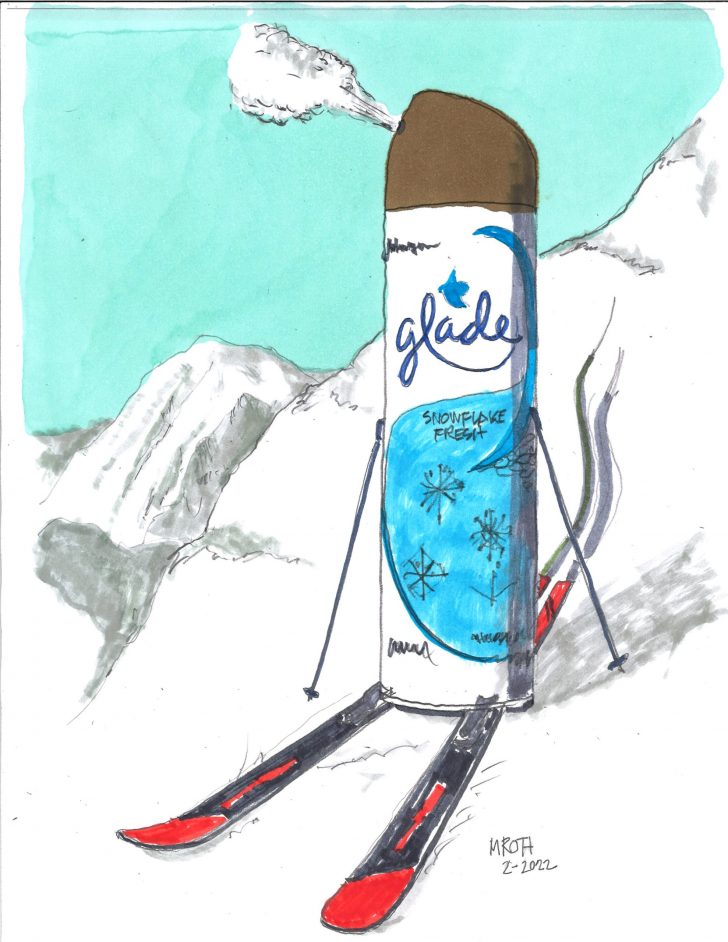
Writer/cartoonist, Mike Roth, provide some thoughts and guidance about skiing in the trees. Be sure to check out his funny Glade Skiing illustration. His cartoon depicting a ski story sent in by Carole Gray of the U.K., captures the nightmarish scenario perfectly!
Check out the summary of the March-April issue of Skiing History magazine, the new Test Your Skiing Knowledge challenge, and the ski-themed license plates added to our growing gallery.
https://seniorsskiing.com/wp-content/uploads/2022/04/Screen-Shot-2022-04-13-at-5.13.53-PM.png86556seniorsskiing/wp-content/uploads/2014/04/Seniors-Skiing-since2013-Logo@2x-300x68.pngseniorsskiing2022-02-17 20:00:152024-08-15 14:51:20This Issue: February 18, 2022
The Skiing Weatherman 2/18 Pattern in flux means some snow for much of the U.S.
Since my last posting, I have only managed a couple of days on snow. One at Sugarloaf after an 8 inch overnight and then a brisk day at Killington earlier this week on some of that cold, styrofoam that the NBC announcers have been referring to in the Olympic alpine events. After a superb tuning at the outstanding shop at West Mountain in Glens Falls, New York the day before, that stiff snow at Killington was very playable.
As I look down the road at the evolving weather pattern to close out February and start March, I see a changeable landscape. After a dominant western ridge/eastern trough couplet from mid-January until just recently, the pattern will be more changeable for the next week to ten days, but signs point to a return to the trough favoring the eastern half of the country early next month. The changeable nature of things will allow a meaningful snowfall to impact much of the west later this weekend into early next week, as suggested by this jet stream map for President’s Day…
With a ridge poking up into Alaska, very cold air will flow into the western trough and while this doesn’t look like a blockbuster due to the lack of a direct influx of deep Pacific moisture, it should generate moderate to heavy amounts from the Cascades all the way down to the southern Rockies as it slowly pivots southeast and then east Sunday through Wednesday. With the core of the trough heading down the spine of the central and southern Rockies, the Sierra will pick up light to moderate amounts south to around Tahoe from this system.
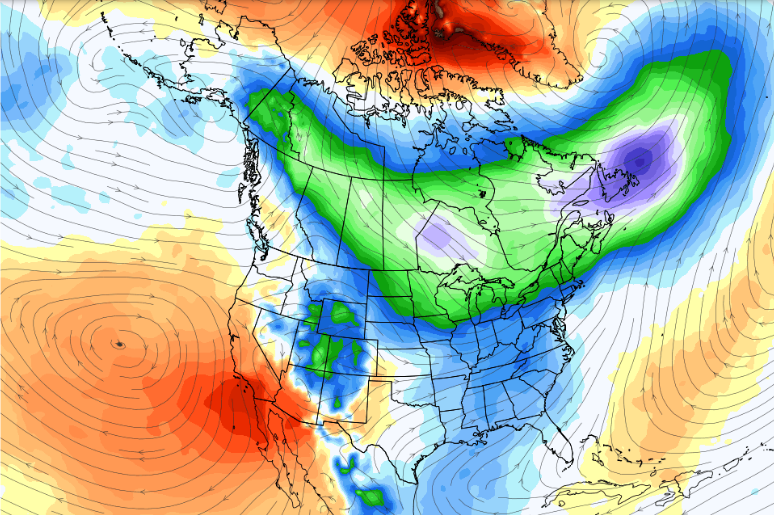
In the eastern half of the country, milder air will spread north in advance of the western trough, but not until after a seasonably cold holiday weekend. By late next week, the trough will start to favor the Midwest and East, a development tipped off by the trend of both the WPO (Western Pacific Oscillation) and EPO (Eastern Pacific Oscillation). These two indices are based on the relative positions of upper air troughs and ridges over the waters of the north Pacific. Here is an illustration of a negative WPO…
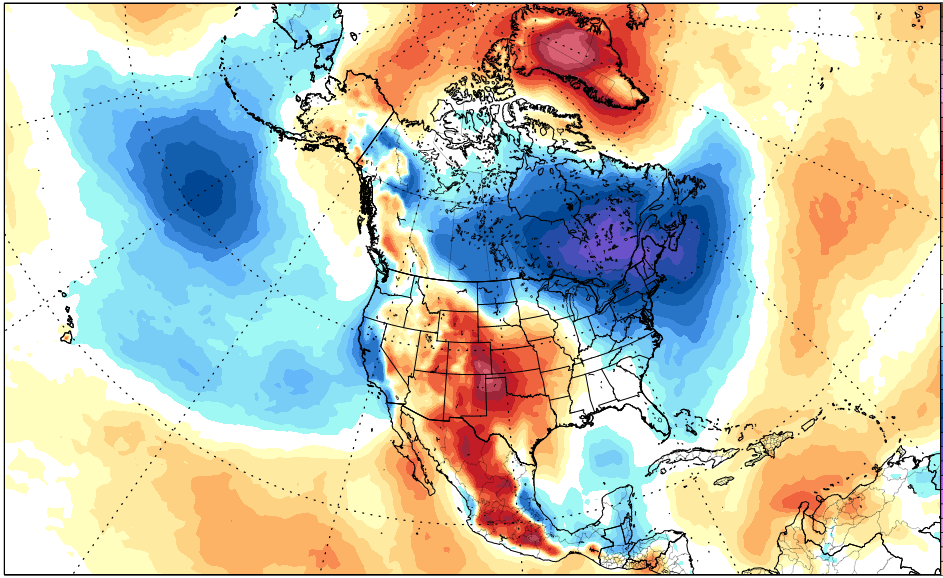
The orange indicates an upper air ridge, and the blue areas an upper trough. The clockwise circulation around the ridge helps to access cold air from the northwestern corner of the continent. It works in tandem with a downstream trough, as suggested by the pale blue over the center of the country. A negative EPO is similar. Here is a forecast for the WPO for the next couple of weeks…
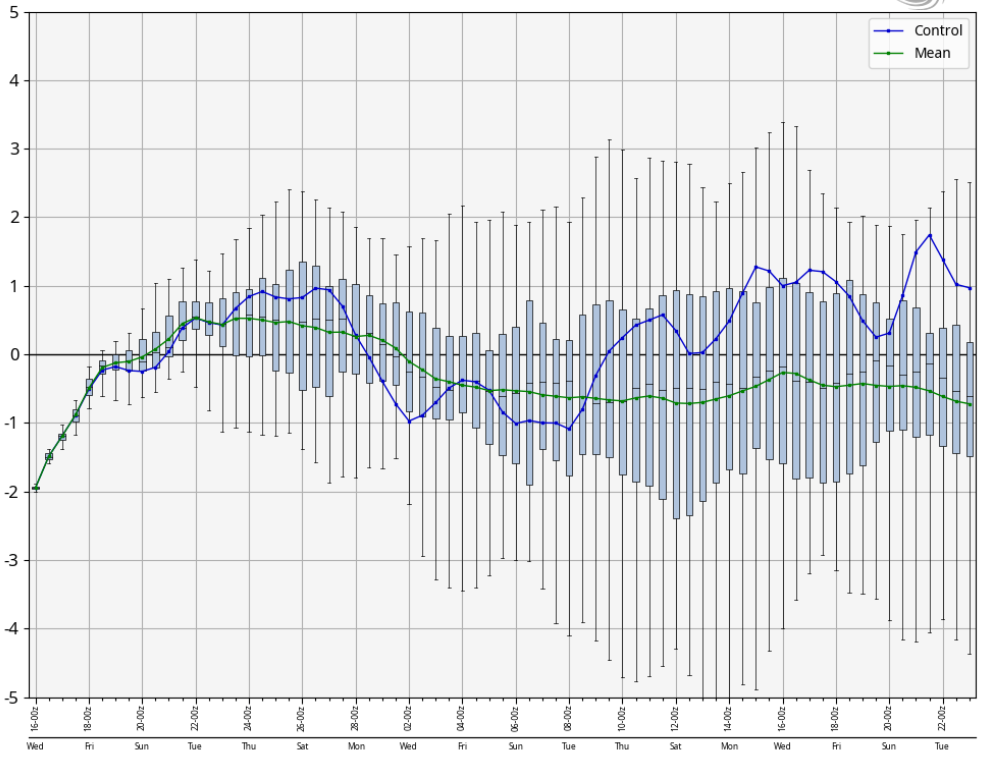
The green line is the one to follow and after running in positive territory, which infers a trough over the northern Pacific waters, it switches to negative around the 1st of March, at which time I think we will see a trough start to strengthen over the eastern half of the country while a ridge returns to the West. Colder air will populate that trough, and the first part of next month should turn stormy over the Midwest and East. With the WPO remaining in negative territory well into March, the prospects are solid for late-season snow. In my next installment, I will explain why March could bring snowy weather to the East AND the West.
Regional details…
Northwest U.S./Western Canada: Nice shot of snow late this weekend/early next week. Next event about a week later.
Sierra: Late weekend light to moderate snow…another round next weekend.
Rockies: Moderate snowfall early next week into midweek. Next potential snowfall about 5 days later.
Midwest: Fresh snowfall early next week. Pattern remains loaded with potential snowfalls for the foreseeable future.
Mid Atlantic/Southeast: Mid Atlantic snow on the table for late next week. Southeast chances enhanced in early March.
Northeast/QB: Clipper snow this weekend in the Northeast. Late next week looks quite promising for more substantial snowfall. March shaping up nicely.
https://seniorsskiing.com/wp-content/uploads/2022/02/senior-ski1-1.png576941Herb Stevens/wp-content/uploads/2014/04/Seniors-Skiing-since2013-Logo@2x-300x68.pngHerb Stevens2022-02-17 19:35:192022-02-17 22:48:20The Skiing Weatherman February 18, 2022
For many of us, skiing through the aging process means no longer going places we once skied without thinking twice. Now, approaching my 80’s, my mantra is never to overstep my capabilities and always watch out for the other guy!
Anticipate turns when skiing the trees! Illustration: Mike Roth
I’ve always loved skiing in the trees and still do on occasions when conditions are right, and I’m feeling up to the task. I enjoy the silence, the natural snow, and the general absence of other skiers. But I’m always on guard avoiding the trees and their branches.
My Favorite Eastern Glades
Some of my memorable tree runs have been in the East, where I do most of my skiing.
Mount Snow’s North Face tree runs are challenging. However, the tree run on the main face to the left of “One More Time“ is a delightful intermediate. Also, at Carinthia, the trees between Mineshaft and Nitro are fun.
Killington offers plenty of tree runs, for skiers of all ages and abilities. A favorite of mine is Squeeze Play, to the right of Ramshead’s Timberline trail. It is easily handled.
My favorite at Gore Mountain is Twister Glade. Like many other gladed runs, it needs a certain amount of natural snow.
Bromley’s Avalanche Glades are fun. The area’s Everglade to the Glade is a bit easier.
The south face of Okemo is where you’ll find Forrest Bump (cute name), Double Diamond, Outrage, and Loose Spruce. It’s on the latter that a snow snake twisted my leg.
A different take on Glade Skiing. Illustration: Mike Roth
Glade Skiing Rules
Here are rules I follow when skiing glades:
Never Ski Alone. It’s best to ski with 3 others. If one person is hurt, another can remain, while the third gets ski patrol.
Don’t Use Pole Straps. Catching a pole on a branch can damage arm and/or shoulder. The release mechanism on some Leki poles helps avoid the potential problem.
Wear Goggles and Helmet. They are essential protection when skiing trees
Carry a Loud Whistle. It’s advisable wherever you ski. If you get hurt or lost, a series of loud blasts will attract help.
Ski Within Your Ability
And a few pointers for tree-skiing:
Anticipate turns: Look to where you want to go between the trees and try to anticipate your next two turns
Make smooth rounded turns: In the woods, bumps tend to be soft, with plenty of places to set an edge
We skiers may be getting older, but, with the right attitude and a good dose of caution, we can still enjoy skiing in the trees.
https://seniorsskiing.com/wp-content/uploads/2022/02/20220202085906_00001-1-scaled-e1644855297714.jpg942728Mike Roth/wp-content/uploads/2014/04/Seniors-Skiing-since2013-Logo@2x-300x68.pngMike Roth2022-02-17 19:25:422022-02-17 22:48:48Branching Out: Skiing the Trees
This fast-paced, short video from Don Burch combines several artistic techniques, including some fleeting Mondrian-like moments. I think it’s fair to say that Don is developing a new genre of ski video. Watching it evolve is a treat.
https://seniorsskiing.com/wp-content/uploads/2022/02/things-I-see.jpg6381200Don Burch/wp-content/uploads/2014/04/Seniors-Skiing-since2013-Logo@2x-300x68.pngDon Burch2022-02-17 19:20:002022-02-17 22:56:51Don Burch: Things I See While Skiing
Editor’s note: Virtually all of us have amusing or near-miss skiing stories. Send in your stories and we’ll publish the most interesting…along with an original Mike Roth cartoon depicting the event.
This story is from Carole Gray of the United Kingdom:
Just under twenty years ago we invited our friend Kath on a ski holiday to La Plagne, France. In her late 50s, she had never skied before but loved it from the first. One memorable day, she lost control on a green slope. Gathering more and more speed, Kath was heading straight for a wooden hut at the bottom of the run. Poor Kath was panicking and totally unable to stop. Another friend, who had taught British soldiers to ski and survive in winter conditions, leapt into action. She was on snowblades and managed to intercept Kath just before she collided with the hut. Scary at the time, but we all laughed about it later. Remarkably this didn’t put Kath off. she decided that “at my age I don’t have enough years left to just go skiing once a year.” So she worked as a chalet maid for two seasons in order to learn to ski as quickly as possible. Now 76, she’s a really good skier and goes 3 or 4 weeks a year.
Have a ski story of your own? Send it to jon@seniorsskiing.com. We’ll select the most entertaining to be published, along with an original Mike Roth illustration!
https://seniorsskiing.com/wp-content/uploads/2022/02/Screen-Shot-2022-02-16-at-8.05.41-PM-e1645067181268.png654728Mike Roth/wp-content/uploads/2014/04/Seniors-Skiing-since2013-Logo@2x-300x68.pngMike Roth2022-02-17 19:10:272022-02-17 22:47:10Losing Control on the Green!!!!!!!











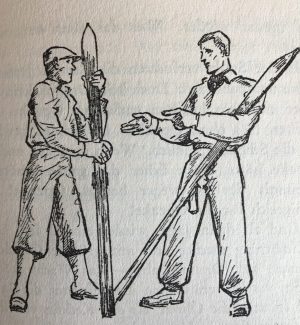







 The person pictured in the last Test Your Skiing Knowledge is Sir Arnold Lund (1888-1974), skier, mountaineer and writer, knighted in 1952 for “services to British Skiing…” He introduced the racing concept that speed should be the only determinant to test the skier’s ability to turn securely and rapidly on steep Alpine terrain. He established numerous ski organizations and race events and was influential in introducing ski events to the Olympics. The first reader to correctly identify him was Enzo Falco of Belmont, MA. He once had the privilege of meeting Lund in person.