Tag Archive for: 50+

Incidents & Accidents: 7

Safety Is Up To All Of Us.

[Editor Note: Dave Irons contributed this article on skiing safety which first appeared in the Lewiston Sun Journal. Dave is a veteran ski journalist and ski patroller.  SeniorsSkiing.com is collecting stories from readers about incidents and accidents that they have experienced. We intend to review these for patterns and themes and use that data to influence the safety policies of resorts and other stakeholders. ]

Each ski season the issue of safety comes up. Some years it’s a fatality at one of our ski areas. It might be a famous person, like Sonny Bono who died while tree skiing at Heavenly Valley on the California/Nevada line.  One year it was a couple of teenagers who left the trail at Sunday River and had to be rescued at night.  Whatever the trigger we all need to be reminded at times of the need for safety while skiing.  I remember years ago when I walked into Tom Reynolds classroom at UMF.  On the board was the saying, “If it is to be, it’s up to me”.

That pretty much describes safety on the ski slopes.  How often have we heard someone say about a particular situation, “There oughta be a law!”?   You might be surprised to know that there are some laws when it comes to skier safety.  Mostly we are not restricted in our skiing, but there are certain activities that are limited, most not by law but by ski area policy. One example is skiing too fast in an area posted, “SLOW SKIING”.  Skiing fast in an area set aside for beginners or approaching lifts can bring about a warning from the ski patrol. It will usually be nothing but a warning. Some ski patrols will mark the lift ticket either with a marker or by punching a hole in the ticket.  Stopped by a second patroller who spots the mark will result in loss of ticket.

But that’s not law.  When are skiers likely to be subject to law?  Unlike on the highway, there are no radar guns on the ski slopes, but if there is a collision and injury, the law can be involved.  The Colorado Skier Safety Law states clearly, “The person higher on the hill has the responsibility to avoid people below and if something happens that skier or boarder is at fault”.  Notice that there is no mention of the ski area being responsible.  As a ski patrolman, I used to sum it up this way, “If you are good enough to overtake another skier, you should be good enough to avoid them.”

We often hear, “He cut me off” from skiers who hit someone while passing them.  I would make the point that the skier downhill from us cannot be expected to look up the hill before making a turn, especially if that downhill skier is a lower level skier.  The better skier has to be aware that he is sharing the slopes with skiers of all ability levels. And we should all know the Colorado law.  It may not be the law in Maine, but we can be sure it will cited by an attorney representing a skier who has been hit from above.    

This should be all we need to know about avoiding collisions on the hill. Add the common sense parts of the Skiers’ Code Of Responsibility such as slowing down and looking up hill when entering a trail intersection, looking uphill before entering a trail and always stopping on the edge of the trail.

The next area is skiing closed trails and out of bounds. I can tell from years of experience that no ski patroller wants to close a trail.  If it’s closed it’s because the ski patrol judged it to be unsafe.  Also, no ski patroller wants to have to explain to management why they closed a trail if it was skiable.  I would also point out that if any of those skiers who patrolled for me felt uncomfortable on a run, you probably don’t want to ski it, and the average skier certainly doesn’t belong on it. Trails are closed for our safety. Stick to the runs that are open. And to those that are within your ability. 

Out of bounds is another issue.  This is not to be confused with skiing in glades within the area, but this skiing also calls for special precautions.  Sonny Bono lost his life within bounds, but he was skiing alone in the trees. We don’t know if he died instantly or if he might have lived had rescuers reached him quickly. His body was found the next morning. Never ski in the trees alone. It should be a group of three or more, one to stay with the injured skier while another goes for help.  Cellphones help, but if you don’t know where you are on the mountain it can still be a long time before rescue. 

Leaving the ski area boundaries is taking an extreme risk, not only to the skier, but to those who will be involved in the rescue.  If you survive a problem even if it’s no more than getting lost and having to be led out, this can involve the law. In these cases it’s not uncommon for a number of services to be involved such as warden services and police. For this you could receive a bill, and it could be quite large. Just figure the hourly pay for dozens of searchers for a full night, along with the equipment. Do you know what it costs an hour to keep a helicopter in the air? The next time you consider skiing out of bounds remember this sign at the top of Killington, “The mountains will be just as cold and lonely tonight as they were 200 years ago”. 
Skiing Weatherman: For The East, Enter Winter

A Comeback For The East And Midwest, More Pow For The West.

I spent the first two days of this week with fellow members of the North American Snowsports Journalists Association at Windham Mountain,  NY, where the crew did an outstanding job of providing a fun surface in the wake of a mid-season meltdown last Sunday. One of the presentations was by Masterfit University, an outfit that boasts having the best boot fitters in the world. It was a fascinating seminar, and after spending a couple of hours one on one with Windham’s Masterfit representative, I came away convinced that if you want to maximize your skiing, you absolutely should find a Masterfit shop in your area.

While this week started on an unseasonably mild note in the East, the skies kept unloading in parts of the West. A persistent series of low pressure centers loaded with Pacific moisture has utterly buried resorts in Washington, Oregon, northern Idaho, the Tetons, and northern Wasatch in the past week with anywhere from three to six feet of new snow. Lookout Pass in Idaho checked in with a 101 inch storm total! Lighter snows fell elsewhere in the West, and if you are heading in that direction, you can’t make a bad choice right now.

In the Midwest and East, a major pattern change is getting underway, one that delivered some fresh snow in the mountains of the Northeast late this week, with another round coming this weekend. For the first time in weeks, once the low pressure center moves through the Great Lakes and East, a bonafide cold air mass will follow in its wake, leading to great snowmaking conditions and productive lake effect snow in favored snowbelt areas, especially the upper peninsula of Michigan.

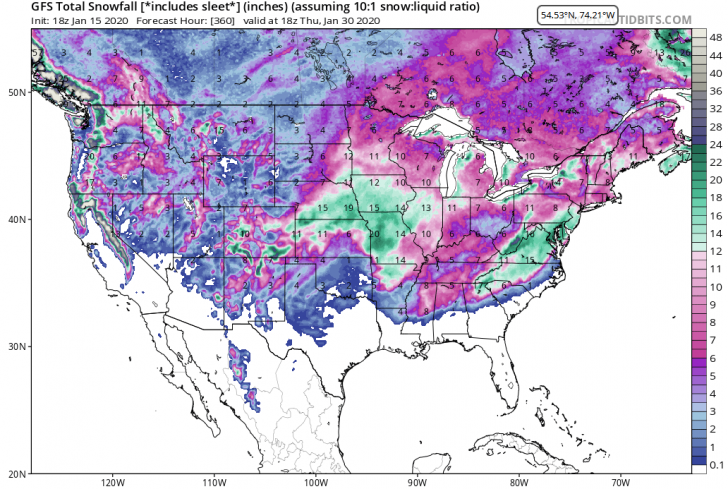
Over the next 10 to 14 days, temperatures will be stepping down over the eastern half of the country as an upper level trough becomes the dominant jet stream feature. At the same time, an upper level ridge will be found more of the time in the Northwest, so the “snow hose” that has been pointed at that region lately will back off quite a bit. The southern Sierra and southern Rockies could see periodic snows as disturbances in the southern branch of the jet move through that part of the country. If a southern branch disturbance manages to phase with energy in the eastern trough, we could see a major storm in the East before too long. The pieces will all be there soon and hopefully they will come together. For your viewing pleasure, here is a forecast map of snowfall for the next 15 days. Don’t focus on one specific spot as much as take note of the breadth of the area, particularly over the eastern half of the country, where significant snow is forecast. The pattern is rounding into shape for meaningful snow events, but the devil will be in the details.

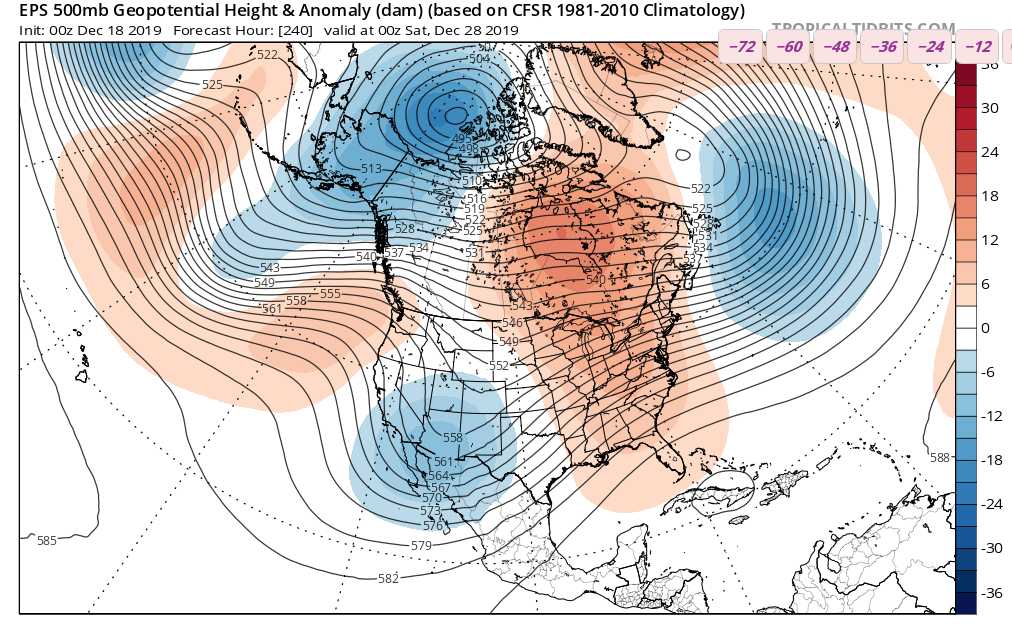
There is reason to believe that once the colder pattern gets established in the Midwest and East, it will remain in control much of the time going forward. My analog years suggest it, as does this jet stream map for two weeks from now:


The broad trough that you see for late this month looks cold and stormy to me.

Here AreThe Regional Details

Northwest U.S./Western Canada: Another rather snowy week coming up, but the recent amazing rate of snowfall will start to back down as an upper ridge takes up residence.

Cascades and Sierra:  Snowy (Cascades) into the middle of next week, although snow levels will be a little high late this weekend before settling back down. Lighter snows Tahoe area. Snowfalls back off late this month as ridging develops.

Rockies: Dry weekend into midweek when a new trough will bring some light snow. Longer term, central and southern Rockies favored for snow thanks to disturbances in the southern branch of the jet stream

Midwest: Arctic air dominates for the foreseeable future. Each frontal passage sets off lake effect snow. Great spell of snowmaking temps underway and conditionS.  Trail counts will be improving.

Northeast/QB: Moderate snow event this weekend (north of I-80) starts the comeback. Great snowmaking temps for several days in the wake of the storm. Another sizeable snow threat next weekend. Conditions and trail counts will be getting better each day until further notice.


Hip Hip Hooray! I Turned 80 Today!

Harriet Hits The Big Eight-O.

[Editor Note: A big hug and salute to Harriet Wallis, snow sports journalist, who has written dozens of interesting and useful articles of these pages since SeniorsSkiing.com began in 2014. Happy Birthday, Harriet.  Many more and have a great year ahead!]

Harriet’s daughter bought her a cupcake helmet cover. Seriously, there are such things. Credit: Alta

I planned to celebrate my landmark 80th birthday by taking cookies to my aerobics class. Instead, I skied with a cupcake on my head and a ribboned badge with “80” in big numbers. It was a hoot. Here’s some insight in case you’ll turn 80 soon.

The pink cupcake helmet cover came with a flashing LED candle on top. My daughter gave it to me, so I couldn’t say no. I timidly stretched the cupcake over my helmet, turned on the candle, pinned on the 80 badge, and braced to look absolutely silly on the slopes.

My get-up drew attention, and everyone laughed at lot. A pack of skiers burst into singing Happy Birthday, and Alta sent a photographer to capture the event. I was skiing with my son and daughter and they enjoyed seeing their mom have a big day. It was a lot more fun than taking cookies to my aerobics class.

Skiers’ reactions were surprising.

To younger skiers, I’m a fossil, and they insisted on taking selfies with me. They had never seen anyone “that old” still skiing.

However, skiers in their 80s and 90s—skiers I’ve never met—gave me a hug and welcomed me to the vintage group. To them, I’m just a youngster.

I Want To Share The Fun.

When I went to the party store, I found their birthday badges only went up to 60 years. Dang. I decided that with some office white out and a marker I could turn 60 into 80. It worked. My doctored-up badge is unique.

Harriet will pass this badge on to someone turning 80 before April. Credit: Harriet Wallis

If you’re turning 80 before April and want to ski wearing the badge on your birthday, please post a comment to this article.

Please say where you’ll be skiing and a little bit about why you’d like to have the badge. Unfortunately, I have only one badge, so I’ll chose someone at random, contact you for your address, and mail the badge to you. Then you can pass it on.


But I’m keeping the pink cupcake to wear on my birthday next year!

This Week In SeniorsSkiing.com (Jan.10)

Where The Snow Is In The East, A Ski Learning Tool, Grandparents Teach Munchkins, Weather Coming, Apres Fire-ish Cocktail.

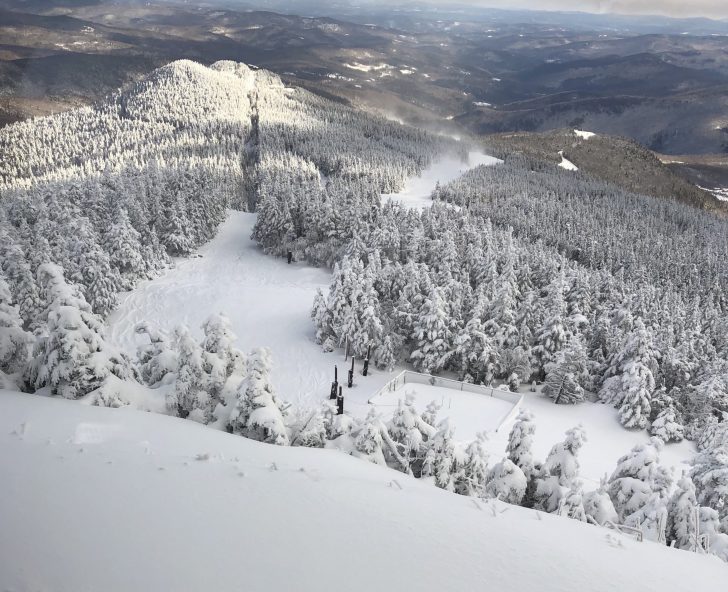
Lots of snow in view from Peak Lodge, Killington (4,236 feet). Credit: Roger Lohr

Sounds as if the West is off to an incredible season. Snow packs in Colorado and Utah are already over normal amounts, the Northwest and Western Canada is getting more new snow.  So there’s lots of visitor activity.  A quick scan shows most Colorado resorts have 100 percent of their lifts spinning.  A number of our skier friends here in New England are leaving for the West this week or next.

Meanwhile, in the East, the season is emerging.  The higher altitude resorts in New Hampshire, Maine, and Vermont are making or collecting snow very nicely; lower level areas are, as of this writing, making the most of machine grooming.  Obviously, tall mountain resorts have an advantage in quixotic winters like the one we experiencing here. How much advantage?

Temperature cools with elevation. In fact, for every 1,000 feet in altitude, the temperature drops 5.4 degrees F (9.8 degrees C for 1,000 meters). For example, the top of Mt. Mansfield in Vermont is 4, 395 feet (1,340 meters), and Mt. Sunapee in mid New Hampshire is 2,726 feet (831 meters). That’s a difference of 1,669 feet (508 meters), for a more than nine degree difference in temperature between the two at the top.  The base can be another 1,500 or more feet under that. As of this writing, Stowe has 80 percent of its trails open, Mt. Sunapee has 56 percent.  Ideal snow-making temperature is 28 degrees F (-2-2 C). Clearly, marginally cold days like those we’ve been experiencing in New England are going to favor high resorts.

Last August, we surveyed the usual forecasters for their views of the 2019-2020 winter.  For the most part, the consensus was a frosty and snowy West and a “mixed, wet and wild” East. The Boston Globe published NOAA’s winter outlook in October which seems to be squaring with what we are seeing. These predictions point to warmer than average temps in the East. It appears that prediction is coming to pass. So far, lower altitude resorts are impacted more than the higher ones.

The point: The resorts at lower elevations have to, no, must do a fantastic job at snowmaking whenever it gets cold enough. If it gets cold enough.  It is a key survival objective, and the path to a successful season and future.  No wonder we’ve been seeing major investments in snowmaking in New England in the past few years.

This Week

How do you learn to improve? We’ve had our own experiences in physical skill learning, from taking horse riding lessons to playing music (more physical than most non-musicians realize). What we have found is that two factors make a huge difference in efficiency of learning.  The first is clear intellectual understanding of the concepts involved.  What do we mean by edging, for example? Boot pressure? A clear mental model of what has to happen and how comes first.  Then, we need to practice and get feedback, the second major factor.  Feedback from both others and our own senses.  In his story on the Intention/Attention Feedback Loop, ski coach Bob Trueman explains how these concepts are included in a simple model for improvement.

We reprise Harriet Wallis’ story on advice for grandparents who want to teach their grandchildren. Check out her “non-obvious” tips for getting your munchkins on the snow.

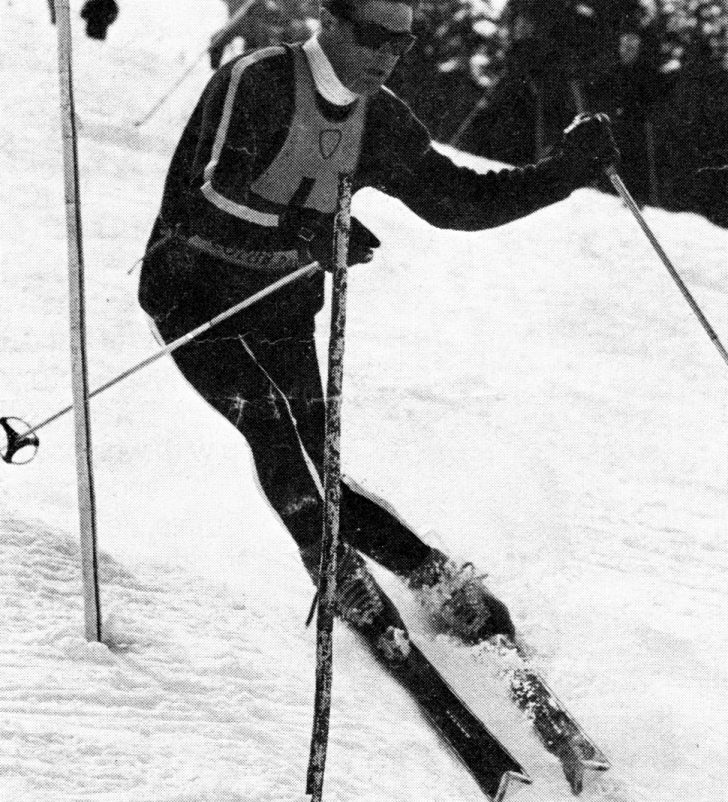
This week’s Mystery Glimpse shows two racers, one a junior, the other a senior veteran. Guess who’s who. Thanks to the Thread of Pioneers Museum, Steamboat Springs, for the pic.  We reveal the story behind last week’s picture of the bronze sculpture from the Colorado Snowsports Museum and why it is a significant embodiment of ski history.

Yes, apres-ski can be interesting, too. Here’s a story from Yvette Cardozo about a fiery, smokey cocktail from a clever bartender, hanging out in Den Bar and Bistro in Silver Star, BC. Creative, artisanal libations might be perfect for the end of a perfect day.

Along those lines, below you can find “Two Cubes And A Slug of VO” from Ray Conrad’s album The Cotton-Pickin’ Lift Tower, a 60s collection of skiing songs available through SeniorsSkiing.com.  Click here to purchase and download the whole album.

Finally, Herb Stevens, the Skiing Weatherman, sums up the next week’s weather across North America.

Thanks again for reading SeniorsSkiing.com. Please tell your friends.  Remember, there are more of us every day and we aren’t going away.


The Skiing Weatherman: Changeable East, Snowy West and Mid-West

The West Continues To Luck Out, Cold Coming East By Month End.

Despite a wildly changeable run of weather in the East recently, I managed to get two days of wonderful winter turns in early this week. It snowed on Monday at Sugarbush as I skied packed powder with my son. Wednesday at Killington surfaces were just about perfect packed powder early on and then an arctic cold front arrived. It brought fresh snow: three inches in 30 minutes! An absolute whiteout that gave me a chance to focus on my toes with each turn, a method I was taught decades ago to deal with low visibility. It still works!

Changeable weather will continue to rule short term in the East while much of the West continues snowy, but that imbalance will be changing in the near future. The past couple of weeks, the jet stream maps across the continent have featured a trough centered over the West and a ridge over the East. The trough has produced tons of snow, particularly in the Northwest and coastal ranges of British Columbia.

As this week comes to a close, another storm will cut southeast from the Gulf of Alaska and dump on B.C. as well as the WA and OR Cascades. Lighter snows will reach down to Tahoe as well as the northern and central Rockies. Over the eastern half of the country, a low will cut northeastward through the Great Lakes and into Ontario and Quebec.  That’s great news for the resorts of Michigan, where significant snow will result. Further east, the northern track forced by the strength of the southeast ridge means another mild, wet event this weekend before colder air returns Monday. The “cutter” track is consistent with the current warm state of the MJO, as discussed last week.

Changes are coming, though, and by the final week of the month, the changes will be dramatic across the country. A pool of very cold air has been building in central and western Canada and due to the density of that air mass, it will start to spread southward and eastward. Here is a look at a forecast for the 5,000 foot temperature anomalies for ten days from now that I agree with.

The 5,000 foot level is a forecasting proxy for surface temps, and you can see that a large mass of colder than normal air will cover much of the eastern half of the country by 19th or so. Meanwhile, the West will turn a little warmer than normal, but not until after some of the arctic air descends through the Rockies later next week. At the jet stream level, the setup will flip, and we will find a trough in the East and a flat ridge out west.  Here is a reasonable jet stream forecast for the same time.

Now, any change in air masses and jet stream features of this magnitude will come with a stormy transition, so there is reason for optimism for eastern snow, at least north of the Mason Dixon line, from late next week onward. Once the new pattern settles in, I expect it to dominate through the bulk of rest of the winter, due to the anticipated influence of the warm water pool in the northeast Pacific Ocean.

Here are the regional details.

Northwest U.S./Western Canada: Another heavy snowfall is coming this weekend, light snow in AB.

Periodic lighter snows will continue next week as arctic air presses southward.

Cascades and Sierra: Snowy weekend with heavy amounts in OR, tapering down further south in CA.

Lighter snow continues next week as it turns windy and colder.

Rockies: Northern Rockies catch light snow this weekend but as several upper level short wavelength disturbances move through the first half of next week, persistent light to moderate snow will provide daily “refills”. Each successive trough will draw arctic air further south, reaching the Tetons by mid-week. Light snow in central Rockies first half of next week.

Midwest: Messy weekend storm lower Lakes, snowy in northern Lakes, narrow ice storm in the middle.

Some light snow northern Lakes from a Clipper or two next week.

Northeast/QB: Another cutter brings wet and icy weather to the northern mountains of NY/New England this weekend, snow up in Quebec. Renewed snowmaking and light Clipper snow next week, with bigger storm threat late. Pattern will look much better a week from now.


Out Of Control

Int/Att Loop: A Technique Improvement Tool

After So Many Years, Can You Improve? Here’s A Way.

Time to improve? You can do it with the Int/Att Feedback Loop. Read on.

First, do you want to improve your skiing?  If you don’t care that much, read no further.  If instead you still have a hankering for greater skill and more satisfaction, then the good news is “Yes, you can”.

The “Int/Att Loop”© gives you the tools to do it.

But improvement doesn’t come by doing what you’ve already been doing for years.  If you always do what you’ve always done, you’ll always get what you always got.  If your choice is to become more skillful, then your choice is to change.  To change, you need to:

  • Know what to change—should you do something different, or something differently?
  • How to change it
  • Have a set of tools to do it with.

You will also need one other commodity—persistence.  The great joy that comes from going on such a journey is that it’s an adventure that delivers huge satisfaction.

What is the Int/Att Loop©?

Back in the 70’s and 80’s two of Britain’s top coaches uncovered how humans learn to do physical things.   Through considerable research, they identified a process that is simple to understand and use. 

This process is not how to ski, nor how to have a skiing vacation, it is how to effect the kind of performance changes you desire.  It has to to do with two completely separate nervous systems we have:

  • the Efferent system
  • the Afferent system.

Let’s say, you make a decision to do something.  This is your INTENTION.  The message from your brain to your muscles is carried by the Efferent system.  But your brain needs to gather information from your senses to know that the instruction was carried out and what the effect was.

That information sent back to the brain via the Afferent nerves. Now, you are paying ATTENTION to those sensors.  With that information, your brain can modify the next actionable decision to slowly bring your performance to where you want it to be.

Intention/Attention forms a feedback loop.

It is explained much more fully in many of the instructional videos you can find via www.bobski.com.

Your Action Plan For Better Skiing.

So, how do you use this dual nervous system concept?

Say you’re on a gentle bit of piste.  You intend to work on some aspect of technique.  You will only ski in very short sections—no more than 100 yards at a time.  Here’s how it goes  

  1. Choose a task – something simple such as “link two arcs together seamlessly”.
  2. Decide on one very small element of behavior—something simple such as “flex my ankle ALL the time”.  That message will be sent by your Efferent system.
  3. This is important: You must then decide beforehand which of your senses you will pay heed to that will constitute a message back to your brain via the Afferent nerves.  Most likely, in this case, it will be a feeling of constant pressure between your shin and the front of your boot.  But for some other task it might be what you hear or see.
  4. If you were working with a coach, you would stop after the very short distance and report to her what you felt.  Not how you felt.  Not what you “thought”.  This is not about thinking.

What you are attempting to do is to develop within yourself the ability at all times to be aware of what you sense, within the context of a simple and very powerful, plan.

This works.  Watching someone else ski doesn’t work.   “Getting the miles in” doesn’t either.   If you find this interesting and have specific questions, don’t hesitate to send me them at bobski@bobski.com 

Mystery Glimpse: Two Racers

One Very Young, The Other A Successful Competitor.

Many thanks to the Tread Of Pioneers Museum, Steamboat Springs, for this photo. Visit their online collection by clicking here.

Last Week

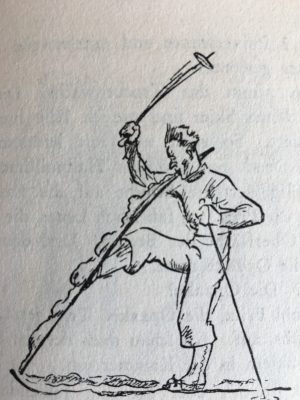
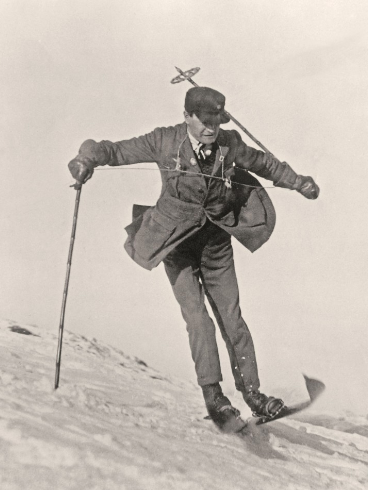
This is George Lundeen’s bronze statue, The End of An Era,  circa 1960. Why is it significant? Here’s what Dana Mathios, Curator and Director of Collections, Colorado Snowsports Museum, has to say:

This sculpture depicts a sport poised at a turning point on the edge of change. Soon, metal and synthetics would become standard in ski construction in place of wood that had been in use for more than 4,000 years. Pioneering skiers used a single wooden pole. By the early 1900s, two poles were in fashion. The shafts were often made from bamboo until superior poles of a light metal alloy were developed. Higher, plastic ski boots featuring buckles marked the passing of lace-up leather boots.
Also depicted in the sculpture is an early version of a safety binding designed to release the toe of the boot in a fall. A leather thong anchored the heel to the ski. More advanced safety bindings that released both the toe and the heel of the boot followed.

Early in the development of Colorado’s ski industry, the Pikes Peak region offered a number of small ski areas. Nearby slopes at The Broadmoor Hotel and others on Pikes Peak at Glen Cove, Elk Park, and Holiday Hills were popular. The region also included Tenderfoot Hill at Cripple Creek and the Edlowe ski jumping hill at Divide. In time, large corporate-managed ski areas further to the West replaced the small, locally owned ski facilities in the region.

Many thanks to  curator Dana Mathios and the Colorado Snowsports Museum for their many contributions to SeniorsSkiing.com’s Mystery Glimpse feature. Visit the museum’s website to browse its collection and do consider making an audition.

Apres Ski: Artisanal Cocktails At Silver Star

Smoky Cocktail Better Than A Beer And Chips?

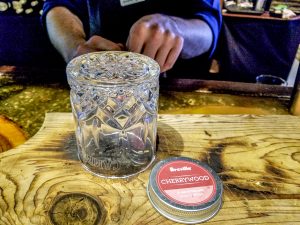
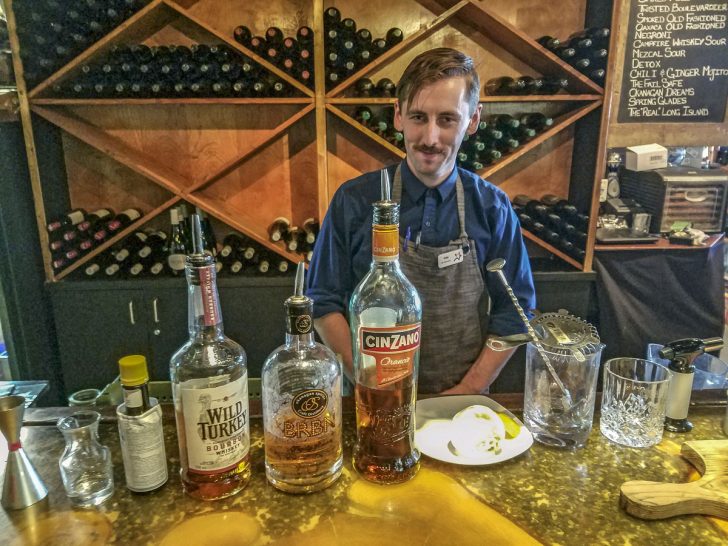
Bar Supervisor Tom Falland creating his signature Smoked Old Fashioned drink at the Den Bar and Bistro in Silver Star Mountain, BC. Credit: Yvette Cardozo

The food and beverage manager over at the Den calls it classic cocktails “with a twist.”

And, indeed, these are not your usual Old Fashioneds or mojitos in the Den & Bar Bistro at Silver Star Mountain in British Columbia, Canada.

Downstairs in the basement, below Coffee+ cafe, along Silver Star’s main street, the Den is doing its own thing with alcohol.

Manager Mark Lehmann has turned his bar supervisor, Tom Falland, loose.

What resulted, among others, was the Smoked Old Fashioned. Yes, it’s a show. Yes, it’s delish. 

“Sometimes less is more,” Lehmann said. “I think gone are the days of sweet hyper-colored drinks, saturated with artificial flavors and so much sugar. In the Den, we have taken to infusing our own tinctures and flavorings using all natural ingredients to develop a unique taste and profile. We have also found in doing so we are using some older style spirits that have been collecting dust for an age. Aperitifs are heavily used in our lineup, as are spirits like Campari, Aperol and gin.”

So, of course, I wanted to watch Tom make his Smoked Old Fashioned.

Infusing the glass with wood chip smoke while making the Smoked Old Fashioned. Credit: Yvette Cardozo

Originally, they used a smoker, trapping smoke in a huge beaker, then pouring it into the drink. But the smoker is now broken, so Tom torches wood chips.  Honestly, a better show.

First, he lined up his ingredients along the bar: a couple of bourbons, vermouth, bitters, a ball of ice in a glass, orange rind, cherry wood chips, and a beaker with a strainer.

Then, he torched the wood chips on a cutting board, and, when the smoke got going, set an upside down glass over the smoke. This lets the smoke flavor adhere to the sides of the glass.

Next he mixed the alcohols, bitters and sugar syrup. All this was shaken with ice cubes. He put the ice ball into the smoke infused glass, then poured the alcohol mix (minus the cubes) over the ice ball in the glass, finally adding a slice of orange rind. The ice ball, rather than cubes, keeps the drink cold without melting and diluting it, he explained.

 The result is a smooth taste that rolls gently around your tongue. There’s a hint of whiskey, a hint of orange, and the barest hint of smoke.

Ok, if this isn’t smoky enough, Tom has his Campfire Sour. It’s made with two bourbons and a single malt Scotch whiskey Laphroaig, then topped with frothed egg whites, a slice of dehydrated lemon and two charred cinnamon sticks. All this is to make it look like a campfire. The cinnamon plays the charred logs.

Be warned, though, Laphroaig is a very special taste. It’s a single malt whisky from Scotland infused with enough peat smoke flavor to bring tears to your eyes. I once hiked a multi-day coastal trail in Canada and after a week, everything I owned including my skin smelled of campfire smoke. This drink is that campfire smoke on steroids.

My favorite drink at the Den, honestly, was Tom’s Chili & Ginger Mojito. This is more than your usual by-the-pool mojito. It has the lime taste, to be sure, but there’s also ginger and, to wake you up, red chillies. A mojito with a kick. Perfect after a day of skiing and before you tuck into the Den’s BBQ ribs. 

Enjoying drinks at Den Bar and Bistro, Silver Star, BC. Credit: Den Bar and Bistro.


This Week In SeniorsSkiing.com (Jan. 3)

The Top 10 SeniorsSkiing.com Articles Of 2019.

Here are our readers favorite articles from the past year, deducted by looking at the number of comments, clicks, and the help of Google Analytics. It is certainly a diverse collection of pieces, ranging from our very popular Mystery Glimpse feature fueled by historic photographs from ski museums around the country, to a variety of advice stories, our directory of senior-friendly ski resorts, and, emerging this year, a series of articles about on-slope collisions, a major source of concern to readers.

All links will bring you to the original article.  These are listed in reverse rank order.

Enjoy all of them. Share with friends.  Thanks for all your support in 2019.

10. Mystery Glimpse: Who’s This Unhappy Fella? This popular feature asks readers to guess the person, place, or thing in a photo, usually submitted by a ski museum. This one features a candid shot of a very famous racer.

9. First Ever List of 145 US/Canadian Resorts Where Seniors Ski Free. Or almost free.  SeniorsSkiing.com has an exclusive listing of these resorts. Very popular and located in Subscriber-Only content.

8. Coping With Flat Light. Advice on dealing with bad visibility, so vexing that it can ruin a day’s outing.

7. Season Ending: The Last Perfect Turn. A lyrical view of the end of what was a record-breaking season in many places. From last spring.

6. Ask The Expert: Ski Boot Advice. Basic advice from MasterFit’s Steve Cohen on how a 65 year old can buy his/her first ski boot.

5. Incidents & Accidents 1. As our Spring Survey revealed, out of control skiers is the number one aspect of skiing that upsets our readers. This is the first of our ongoing series of reader reports about collisions and accidents on ski slopes.  We are collecting this portfolio of these to see if we can identify a common thread to use in influencing

4. Putting Away Your Skis And Stuff. Practical advice for caring for your gear at the end of the season.

3. My Knee Replacement Story. A full recounting of the process, from initial onset of painful symptoms to rehab.

2. Gone In a Flash.   Advice on not taking any season for granted, especially poignant when you are physically barred from participating.

1. Blind-Sided & Body-Slammed. A personal account of a bad collision and its consequences started our reader-written series of Incidents & Accidents. This was the inaugural story from SeniorsSkiing.com correspondent Roger Lohr that created a huge amount of attention.  This issue is serious and important to continue to understand.  We hope that eventually the data we collect will be useful in influencing ski patrol and area management safety practices.

This Week.

Our Mystery Glimpse looks at a statute that has meaning for a special museum.  The location and back story of the Fountain Mountain is revealed.

Harriet Wallis reminds us that five simple words can mean a world of difference to people skiing alone.

Start at the top at Snowshoe Mountain Resort, WV, Credit: Snowshoe Mountain

As we learned last month, the mid-Atlantic states have high mountains, higher, in fact, than New England.  So, here’s a resort review from Snowshoe Mountain Resort in West Virginia. It’s an “upside down” resort with lodge and parking at the top.

Herb Stevens, the Skiing Weatherman, explains how a weather pattern that evolves over the Indian Ocean and gradually moves east can impact temperatures in North America. Regional forecasts for the week also included.  Fascinating stuff.

We are happy to answer our reader’s technical questions.  This week, a reader asks about whether old bindings can be used on new skis. Find out what realskier’s Jackson Hogen says.

Our Incidents & Accidents feature this week is by an individual who was severely injured in a collision at Steamboat Springs, but was never able to successfully track down the person who hit him. Lots of lessons learned here.

Thanks again for reading SeniorsSkiing.com. We are looking forward to a wonderful 2020. Please tell your friends about us, and, remember, there are more of us every day, and we aren’t going away.


Skiing Weatherman: Global Pattern Bringing Warmth Then Cold Mid-Month

Happy New Year To All Of My Fellow Senior Sliders!

In the two weeks since my last post, the western slopes of the U.S. and Canada have been the unquestioned winners in terms of fresh snow. Just prior to Christmas, the trail counts from British Columbia south to the Sangre de Cristos of New Mexico were on the lean side, but a persistent parade of moist troughs started marching ashore from the Pacific. Those systems produced an overall snowy pattern that jacked up those trail counts dramatically. There are a few resorts here and there that got slighted by Mother Nature, but by and large, it is hard to make a bad choice out west.

While troughs produced the goods on one side of the country, flat ridging at the jet stream level have made fresh snow rather scarce in the Midwest and East. Fresh shots of cold air have been more of a glancing blow, but resorts in the northern Great Lakes eastward through the mountains of northern New York and New England have maintained their trail counts for the most part through the holiday period.

So, where are we headed from here? Well, a pattern that can best be described as changeable will unfold during the first half of January. As such, I think that there will be opportunities for resorts all across the country to enjoy some fresh snow. I still believe that we will eventually see a western ridge/eastern trough couplet become more favored, but there are too many conflicting signals coming from the Pacific for the jet stream to settle into that set up just yet.

The factor that seems to have the most impact on our weather right now is the MJO, or Madden Julian Oscillation. The MJO is all about convection that forms in the Indian Ocean and tracks eastward into the southwest Pacific. Madden and Julian divided the track into eight sectors and noticed that there were significant correlations with weather over North America, with a lag of 7-10 days, depending on where the thunderstorms were clustered.   Right now, the convection is fired up north/northwest of Australia, as you can see in this infrared satellite picture.

If you follow the green line in the chart below—each black dot is one day—you will see the MJO making a move into octants 4 and 5 in about a week. [Editor Note: octants 4 and 5 represent continental North and South America.]

Using the temperature correlation maps below, you can clearly see that octants 4 and 5 are warm over much of the country, and I believe a warmup will occur mid-month before the pattern turns colder again.

Before any warmth reaches the East, though, Midwest and Eastern resorts—north of the Mason Dixon line—will pick up fresh snow at least a couple of times. The first event will be this weekend as a storm cuts southeastward to the mid-Atlantic coast before turning up toward New England, with an Alberta Clipper sliding through the East a couple of days later. Big winners in the snow derby the next week or so in the West will be the Cascades, northern Rockies, and the resorts of B.C.

Here are the regional details.

Northwest U.S./Western Canada: Healthy storm nails B.C. this weekend, with another system arriving later next week.

Cascades and Sierra:  Light to moderate snow in the Cascades this weekend. Northern system late next week looks productive in WA/OR, but the Sierra will only receive lighter amounts.

Rockies: Late this weekend/early next week the Rockies will pick up light to moderate snow (north) and generally light amounts south of I-70. The Tetons and Wasatch are in line for moderate to heavy snow late next week.

Midwest: Early week Clipper system will deliver light to locally moderate snow, with the best snowmaking temps in a while following. That cold air will also support lake effect snow in northern parts of the lower peninsula of MI.

Northeast/QB: A system this weekend will turn into a moderate to locally heavy snow producer from WV northeast into New England and southern QB. A Clipper system will follow in the middle of next week with the potential for additional light to moderate snow.


Skiing Single: Five Best Words To Hear On The Slope

Life Happens. We Get Older And Our Spouses Pass Away. That’s When We Ski Alone, Often Really Alone.

“Take some runs with us,” say Howard and Naimi. Credit: Harriet Wallis

This is a true story, and a sad story. It’s just one of many similar stories. It might sound like sour grapes, but the goal is to offer a perspective on what it’s like to ski as a widow. The story has a perfect ending because of five great words.

It’s a beautiful day. The sun is shining. The road is clear and dry as I head up the canyon. The radio keeps me company until the signal fades into hissing static. I shut it off and drive the rest of the way in silence.

Whether you’re widowed or single by choice, there’s often a lot of silence. Skiing can offer camaraderie.

The mountain comes into view. It sparkles with fresh snow. What a great day to be alive and to ski.

The lodge is filling up with skiers. Sue and John tap me on my shoulder from behind, and we greet each other with hugs. As we gear up and stuff our feet into ski boots, I hear about their summer, their travels, and their projects. They’re having a great time.

But as we finish gearing up, Sue looks across the lodge and abruptly says: “Our friends are here. Bye!”

Those are not the best five words to hear.

Widows and singles are often cast off because we’re not a couple. We’re misfits. But we shouldn’t have to go two-by-two to qualify. It’s not Noah’s Ark. It’s the ski slopes!

I ski alone.

But then the day takes a turn.

It’s bitter cold on the mountain. Skiers pour into the mid-mountain lodge to thaw out. On the way to get a hot chocolate, I encounter Naomi and Howard. They’re hard core skiers with lots of enthusiasm.

Howard sees there’s no one with me and says: “Are you skiing by yourself? Take some runs with us.”

“Take some runs with us” are the five best words to hear when you’re skiing alone. They’re magic words. They reach out with camaraderie and kindness. “Take some runs with us” are five words that anyone can say to make someone’s day brighter.

Many ski areas have senior groups that ski together. But you don’t have to be part of any group to say: “Take some runs with us.” Seniors who are skiing alone will appreciate your kindness.

Camaraderie is the key. At Alta, the senior group is the Wild Old Bunch, and they can be identified by the large smiley-face patch on their jackets.

The 70+ Ski Club is a nationwide ski club that offers a variety of week long ski trips. Upcoming trips include skiing in the U.S., Canada and France. And the club is an advertiser in SeniorsSkiing.com.

[Editor Note: Some resorts sponsor and/or support senior clubs. Waterville Valley has its Silver Streaks, for example.  Other resorts, like Dodge Ridge, offer senior week specials including lessons, races, and gatherings.  Ski clubs are a sure place to ski with other seniors. These communities offer a chance to meet new friends and share the experience of snow sports.]

This Week In SeniorsSkiing.com (Dec. 20)

Happy Holidays, Injury Brings Insight, Gifts, Ski The Cone, Ski Forecasts.

As a holiday gift from SeniorsSkiing.com to you, here’s a poem celebrating the Winter Solstice and this special celebratory time of year welcoming Yuletide. The Shortest Day was written by Susan Cooper for the Christmas Revels, a wonderful show with music, dance, and poetry reflecting different cultures and styles of art.

The narration and video is by our friend and colleague Barry O’Brien, a videographer who has captured some special images to accompany the verse.

The Shortest Day By Susan Cooper

So the shortest day came, and the year died,

And everywhere down the centuries of the snow-white world

Came people singing, dancing,

To drive the dark away.

They lighted candles in the winter trees;

They hung their homes with evergreen,

They burned beseeching fires all night long

To keep the year alive.

And when the new year’s sunshine blazed awake

They shouted, revelling.

Through all the frosty ages you can hear them

Echoing, behind us — listen!

All the long echoes sing the same delight

This shortest day

As promise wakens in the sleeping land.

They carol, feast, give thanks,

And dearly love their friends, and hope for peace.

And so do we, here, now,

This year, and every year.

Welcome Yule!

___________________________________________________________

This Week

Correspondent Marc Liebman recounts a chronic, stubborn condition that threatens his ski season. He has a lesson for all of us about not being able to make it this year.

Cartoonist and ski journalist Mike Roth offers a fun view of the Millennial snow sport enthusiast to accompany our Incidents and Accidents series.

We have a new Mystery Glimpse photo to guess.  This should be easy.  Also we reveal the identities of the seven Hall of Fame ski jumpers who appeared last week.

If you’re stuck for a gift, check our Very Last Minute gift suggestions. Do not delay!

Finally, Herb Stevens, the Skiing Weatherman, offers his view of what will be happening next week.  By the way, his forecast for last week was spot on.  This week coming up? All is calm, except for the West.

Next week, SeniorsSkiing.com will be taking a break. Have a wonderful holiday season, be safe, and we’ll see you next year.

And remember, there are more of us every day, and we aren’t going away.


Short Swings!

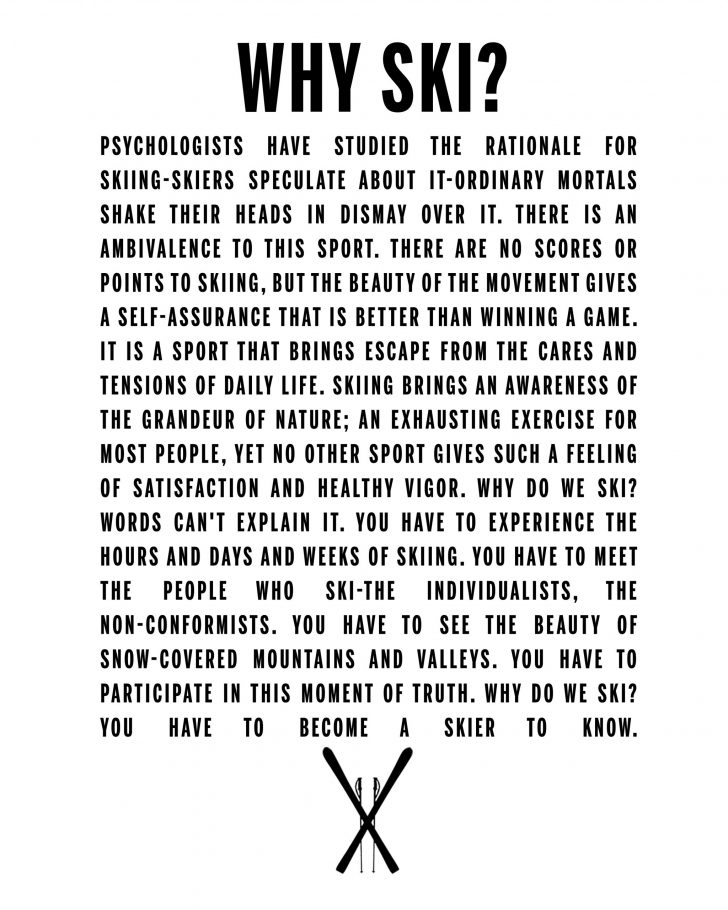
Away this week through the New Year, so no fully-developed column. But thought you’d enjoy this statement explaining what it is about skiing that is so inexplicably wonderful.

It’s available as a poster in a variety of sizes. Click here for specific sizes and (very reasonable) prices.

_____________________________________________________________________


Ski Instruction

Gone In A Flash

What Happened To Me And WhyYou Should Treasure Your Health And Fitness.

As I get older, each ski season is more precious than the one before.  I’m pushing 60+ years of skiing, and early in my life, I learned never to take one for granted.  Except for being deployed overseas during Vietnam and Desert Shield and Storm, I haven’t missed a ski season in decades.
There is a rhythm to my ski year.  After the ski season, I change my conditioning routine and start ramping back up after Labor Day up so that by December, I’m ready to ski my usual 25,000+ vertical feet.  Yes, at my age I’m bragging!

On August 23rd, my routine changed thanks to a bacterial infection in my right elbow.  During the bursectomy, the surgeon found an infected ulna bone, tendons and muscles in my forearm.  Aaaaaaarrrrggggghhhh!

Samples were sent to a lab to grow cultures and find out what the bug was.  Over the next four weeks, the four drains were slowly removed.  Exercise was not possible because dirt in the sweat could lead to a staph or other type infection, and I had very limited use of my right arm.

Eleven weeks later, the culture and susceptibility tests told the doctors that the infection was a hard to kill avian acid fast bacilli.  It takes a combination of three powerful antibiotics taken daily over eight to 12 months to kill it. It gets worse because this is one of the bug that often develops immunity to antibiotics so sometimes in the middle of the treatment, one has to start over.

As luck would have it, I had an allergic reaction to the antibiotic that was the most effective against the avian bacilli that sent me to the emergency room having difficulty breathing, a 102 degree fever, rashes and hives all over my body.  I was off everything other than steroids and antihistamines to get my system back to normal.

The bug and the toll the antibiotics were taking on my body sapped my stamina.  I’d work on a book for four to five hours in the morning and after lunch, I was exhausted and it was nap time.  By nine at night, I was ready for bed!

Exercise, you have to be kidding!  Go skiing?  No way.

So now in early December, two MRIs and two sets of x-rays later, I’ve started walking again and am up to about four miles every day.  By the time this is published, hopefully I’d daily sessions on an elliptical or a stationary bike.

Next major checkpoint is another MRI and x-rays in early January to see if my ulna bone is continuing to heal.  Blood work every other week gives an indication the drugs are working.  My goal is to ski late in late March but its 50-50.

The point of this piece is simple.  Don’t take any ski season for granted.  Each season, each trip, each run is precious, and they could be taken away from you in a flash.  Just ask!

Skiing Weatherman: All Is Calm

Except The West Coast.

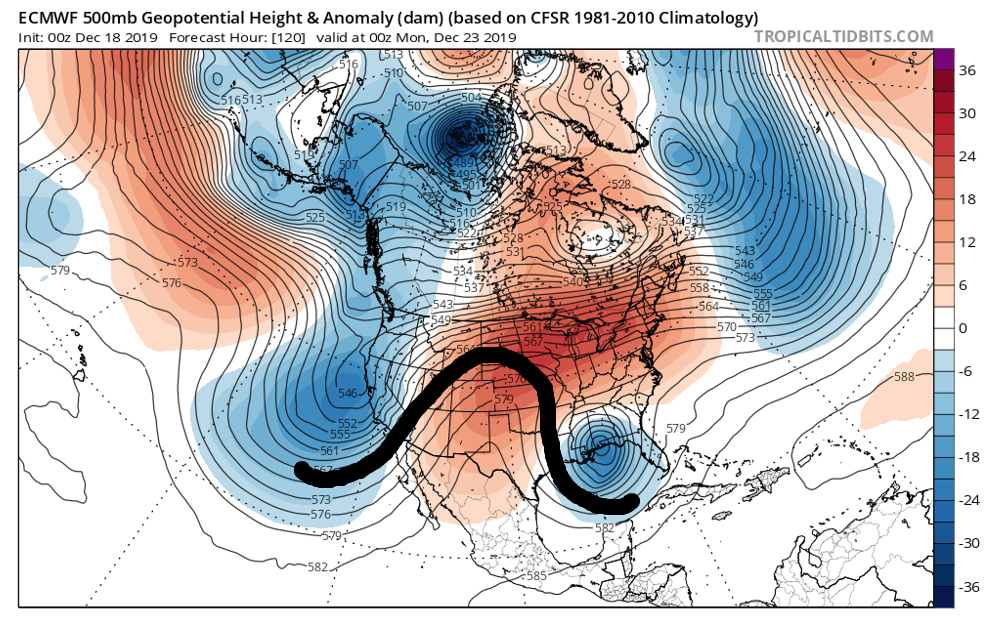
Last week I discussed the role of upper level troughs as they relate to our insatiable appetite for fresh snow, both natural and machine made. Most of the time, troughs are indeed our friends but that doesn’t necessarily mean that upper level ridges are the enemy. The influence of ridge is just like the old cliche about real estate: location, location, location. Troughs often look like the letter “U” on a map while ridges tend to take on the shape of the Greek letter Omega. I have used a jet stream forecast map for Sunday the 22nd to illustrate this common configuration.

Now, in order to take on the Omega shape, you can see that the two ends of the line are wrapped around adjacent troughs, and that is where the location piece comes into the equation. You see, ridges are areas where overall, the air is sinking. Sinking air limits cloud cover and precip, and it also warms up as it sinks, consistent with the laws of physics. So, if you find your favorite resort under a ridge, your odds of seeing snow are greatly reduced. But, if that same ridge is off to the west of the resort by several hundred miles or more, the clockwise flow around the ridge will work together with the counterclockwise flow around a downstream trough to the east to tap cold air from the north. At that point, the ridge becomes your ally. As I have expressed in earlier posts, I am confident that a western ridge/eastern trough couplet is going to be the favored setup as we head through this winter, but in the shorter run, the ridge is going to spread out and cover much of the eastern two thirds of the country as we head through the holidays. Overall, Pacific systems will bring seasonable cold and some snow to the west while it is milder than normal east of the Mississippi.

Here Are The Regional Details.      

Northwest U.S./Western Canada: A very juicy storm will be in progress into this weekend. Whistler finally gets tagged. Cascades get healthier trail counts. Pattern more benign next week.

Cascades and Sierra:  The same storm will nail the Cascades. Snow levels will be rising through the storm, so only count on “all snow” above 6K feet. Amounts will be 2-3 feet WA and OR. CA Sierra pick up moderate snow Sunday. The pattern will turn quieter through most of Christmas Week.  

Rockies: The coastal storm will slow coming inland due to the spreading of the upper ridge further east, so any snow that makes it out of the Cascades will be spotty and light late this weekend/early next week. No big storms next week by the looks.

Midwest: Late week lake effect will help set up this weekend. Milder temps develop into next week, which limits snowmaking windows. The good news is, it looks rather dry, under the ridge, Christmas week.   Colder air returns after the 29th or so.

Northeast: Late week shot of Arctic air will allow snowmakers to get busy 24/7 in most spots. It will turn milder next week and snowmaking will be feasible in the mountains. The lower elevation areas should have some windows, too. With the ridge axis fairly far to the west next week, some colder air will filter into the region at times. No significant snow events appear to be in the cards through the end of next week.  

Overall, after a major “Cascade Cement” storm in the NW at the outset, the holiday period looks rather dull from a forecaster’s perspective. Some lighter snow will fall in the west…the milder temps will keep it comfortable on the slopes for skiers and riders in the Midwest and East.       

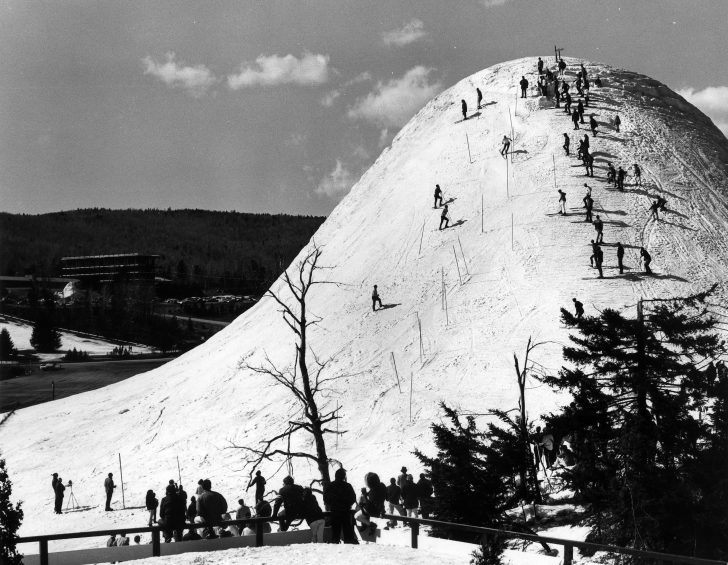
Mystery Glimpse: Ski The Cone

This Should Be Easy.

If you’ve skied this…structure, tell us your story. Where, why?

Last Week

Feb 1941. Ski Jumpers.

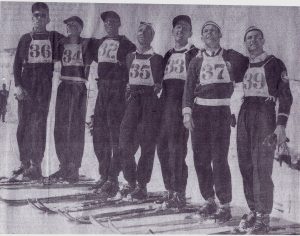
This iconic image is of seven great ski champions from the past.  All have been inducted into the U.S. Ski and Snowboard Hall of Fame and are regarded as SkiSport Legends.  The image comes from a early 1940s clipping Alan Engen included in his donated ski history, four volume scrapbook series, The Engen Skiing Dynasty.  The books currently reside in the University of Utah J.Willard Marriott Library Utah Ski Archives. 

The photo was taken in Sun Valley, ID at the base of the old Ruud Mountain Ski Jumping Hill in February 1941.  In the photo are, left to right:  Corey Engen, Barney McClean, Sverre Engen, Gordon Wren, Alf Engen, Torger Tokle, and Art Devlin.  Not long after this photo was taken, the great ski jumper, Torger Tokle, went into the military service, joining the 10th Mountain Division at Camp Hale and ultimately lost his life in combat during WWII.  Torger and Alf father were two of the greatest U.S. ski jumpers of that time period.


This Week In SeniorsSkiing.com (Dec. 13)

Nordic Volunteers, Poutine For Calories, Exoskeleton Helps Legs, More Incidents & Accidents, Southern Skiing, Mystery Team, Weather Report.

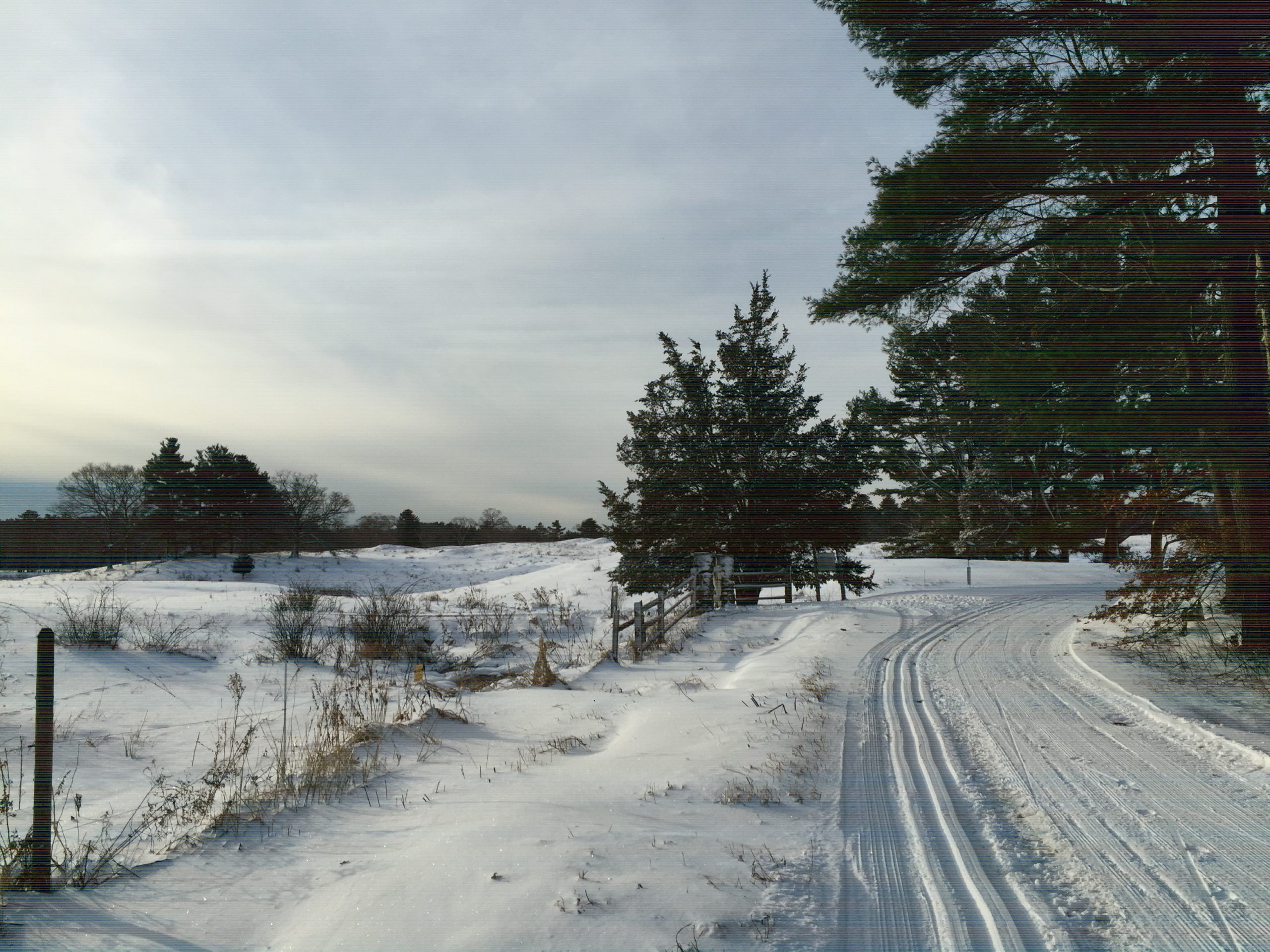
Early morning finds a groomed trail ready to go. Credit: MDM

This co-publisher of SeniorsSkiing.com loves to cross-country ski. Since we live directly across the street from a 900-acre tract of conservation land, owned and managed by the Trustees of Reservations, we head over the stone wall whenever there is decent coverage.

In former days, we bushwhacked our own trail through the woods until we connected with the network of tracks made by the early birds. (There are always earlier early bird tracks.) And we followed the early bird trail loops until we decided to bushwhack again back to home base.  Fun, but kind of tough for a seventy-five year old, especially at the beginning of the season and deep-ish snow.

NSNA Crew grooms all night for a wonderful trail in the morning. Credit: NSNA

Enter the North Shore Nordic Association. This is an all-volunteer, non-profit, community-based group which forms alliances with large landowners, most of whom are also non-profit organizations or municipalities, to maintain and groom existing hiking and biking trails for cross-country skiing, snowshoeing, and snow skating. For the past four years, NSNA has bought and maintained a collection of equipment through donations from local people and businesses.  Every time it snows, the groomers are out there, usually right after the snow stops falling, often in the middle of the night or early morning.

Your retro-attired co-publisher at the Farms. Credit: AAM

The grooming machines create two ski tracks, one a broad corduroy for skating and two pairs of grooved classic tracks on each side. There are many benefits to having these ready and waiting for a senior skier. It is obviously easier to ski, for both beginners and, well, everyone. The packed snow also lasts longer. The machines also loosen up hard pack to extend whatever snow is down.

The NSNA uses social media to alert folks about conditions every day. The group also maintains trail maps on a Smartphone app.  When we encountered a grooming crew on the trail one morning, the young man took our picture and immediately posted it on the group’s Facebook page.

All this is free for the skier. Enthusiasts and occasional visitors can donate to the NSNA to keep the machines turning. The group is well-run, organized, and community-focused. In the long term, they hope to create a racing league, offer lessons, and run a rental program.

The Point: If you don’t live near a cross-country ski area or resort where trails are groomed and maintained and rental equipment is available, consider forming a group like NSNA. All it takes are people who love to cross-country ski or snowshoe, some willing land organizations or town governments, and some energy to get all this organized.

Trail Masters Update

We have mailed out over 150 Trail Master patches to readers who responded to our Spring Survey as having skied more days than their age.  Most were sent to US and Canadian readers, but there were also numerous addresses in Sweden, Finland, England, and Australia.  Please note because some addresses were not completely filled out in our survey form, we were not able to send patches to all qualified readers.

This Week

Poutine, a Frency Canadian comfort food dish. Credit:Yvette Cardoao

SeniorsSkiing.com Northwest correspondent Yvette Cardozo  reports on a Canadian cuisine specialty at Silver Star Resort in BC. Ever have Poutaine? It’s a hearty meal designed to replace calories lost to a heavy day of skiing.  There’s more.  Ever had a Caesar? Not a salad.  Find out here.

We have a contributor review of the skiing assist aid Againer Exoskeleton.  This device can actually extend your skiing career by supporting your legs and back. Consider our reviewer’s experience here.

What’s the highest mountain on the East coast of the US? If you said Mt. Washington, you’d be wrong.  Mt. Washington tops off at 6,288 feet, but Mt. Mitchell reaches up 6,684. Where is Mt. Mitchell? North Carolina. Surprise.  Co-publisher Jon Weisberg reveals more secrets about Southern geography and skiing in his book review of Southern Snow: The New Guide To Winter Sports From Maryland To The Southern Appalachians. Read more here.

Correspondent Jan Brunvand reports an Incident & Accident that he actually filmed taking place.  His on-scene photos and report are astonishing.  As readers know, we are collecting a portfolio of collisions to see if there are comment threads.  With that information, we hope to influence ski industry practices and policies on managing unruly and dangerous skiers.

Correspondent Jan Brunvand captured an incident in action.

Last week’s Mystery Glimpse photo was Rip McManus in action. We provide a capsule profile of Rip and his impactful but all too short career in the skiing world.  This week’s Mystery presents a jumping team from long ago from Alan Engen’s collection of historic ski photos.

Finally,  Herb Stevens, the Skiing Weatherman, gives us a round up of regional forecasts as well as a tutorial on what a “trough” is. Here’s his story.

Thanks for reading SeniorsSkiing.com.  Tell your friends and remember, there are more of us every day and we aren’t going away.

Feb 1941. Ski Jumper. Can you name them? Credit: Alan Engen Collection


Can You Do This?

Another Caption Contest.

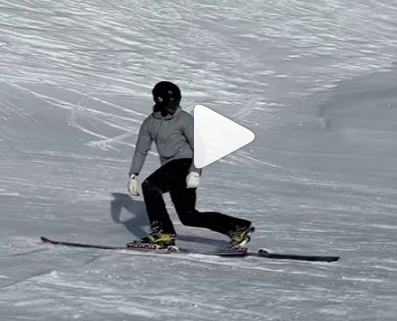
This is Tobi Heinle, ski guide, Voekyl-Marker-Dalbello pro athlete, doing his thing on Zugspitze Mountain, Garmisch-Partenkirchen. More on Tobi, click here.

Click on arrow to see video. And try to caption it. Write your entry below.

[Editor Note: Thanks to Snowbrains.com for originally posting this.]

https://www.instagram.com/p/B5Vri8QFra2/?utm_source=ig_web_button_share_sheet

Canadian Cuisine? Sun Peaks, BC, Has Poutine Plus

Poutine Is A Huge Comfort Food. Add That To A Mighty Bloody Mary And You Have Dinner At A Cozy BC Resort.

Yes, poutine is one of those things that requires an excuse to eat.

Poutine, a Frency Canadian comfort food dish. French fries are covered in tasty gravy and cheese curds. Next to the dish is a model of an historic birch bark canoe. Served in the Voyageur Bistro at Sun Peaks Resort, BC, Canada

We’re talking the massively popular comfort food that is Canada’s answer to Mac and Cheese. There isn’t an easy way to rationalize a dish that includes french fries, gravy, and cheese curds.

Unless, maybe, you’ve been skiing all day.

Bear in mind, poutine comes from Quebec, a scarf-culture place that has yet to embrace the idea of full face covering against the cold, a place where minus 30 degree temperatures in winter are a way of life. You NEED fuel in those conditions. Or anyplace else with that kind of weather.

So, enter Voyageur Bistro at Sun Peaks Resort in British Columbia, Canada. It’s a tiny cafe with hardly a dozen tables but if  you’re looking to bolster your inner heat lamp when it’s freezing outside, you can hardly do better.

A former river rafting guide, owner Kevin Tessier started adding authentic Voyageur cuisine to his tours. It was all based on what folks ate during fur trading days (bison, berries, cedar plank salmon, lots of maple syrup). His meals were wildly popular, and this whole concept found a home in his restaurant, which he co-owns with his wife Diane Larsen.

There’s Elk Wellington, Bison Burgers and, in the past, a Mac and Cheese that included Tenderloin Steak.

As for poutine, one often-cited tale is that of Fernand Lachance, from Warwick, Quebec, which claims poutine was invented there in 1957. Lachance is said to have exclaimed, ” Ça va faire une maudite poutine” (“It will make a damn mess” in French slang), hence the name. The sauce was allegedly added later to keep the fries warm longer. Over time, the dish’s popularity spread across the province and later throughout Canada.

Well, of course, then, I had to try Kevin and Diane’s poutine, which is made with real (they stressed that point) locally made cheese curds and fries, topped with their own special gravy which includes drippings from beef, pork and turkey. The secret ingredient is apple cider vinaigrette.

The final extra yummy product—mind you, I had skied 25,000 vertical feet that day and was truly READY—was a mouth wateringly hearty dish, rich with a hint of sweet from vinaigrette and interspersed with chewy, tangy cheese.

I was forking my way through when a local sat down on the bar stool next to me.

“Caesar,” he said, ordering from Diane, the bar keep.

 I started to pay attention when the drink took its final form and immediately ordered one for myself.

Canada’s classic Caesar drink. This is an upscale version made with salmon infused vodka, the usual tabasco, and Worcestershire sauces and Clamato juice.Cheese curds, salmon and pickled vegetables are included. Served in the Voyageur Bistro at Sun Peaks Resort, BC, Canada

A Caesar is basically a bloody Mary with an attitude but Voyageur’s Caesar is something very special: first into a tall glass rimmed with celery salt, the barman put the ice, then two shots of smoked salmon-infused vodka (“We don’t skimp,” Diane added about the vodka they make themselves), followed by squirts of tabasco sauce, Worcestershire sauce, a touch of horseradish and finally Clamato juice. This is topped with a skewer of assorted pickled or roasted vegetables, a chunk of First Nations-caught sockeye salmon, sometimes a chunk of cheese curd and maybe bison or elk sausage.

Yes, this was dinner.

Againer Exoskeleton Supports Legs, Relieves Muscle Fatigue

SeniorsSkiing.com’s Reviewer Tried Againer Exoskeleton On His Second Day On Snow. Find Out How It Worked For Him.

I am a 75-year old, advanced intermediate skier with 10 years experience as a PSIA instructor in the East and mild osteoarthritis in my left knee.  I currently ski at Alta; that’s where I recently tested the Againer Exoskeleton.

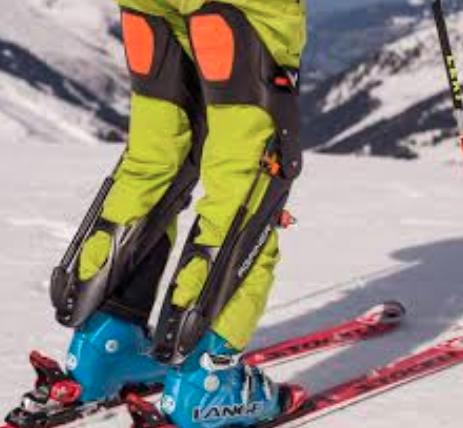
Againer Exoskeleton attaches to thigh and boot, using a gas piston as a shock absorber.

The Againer consists of a hinged plastic frame which runs from the upper thigh to the lower calf and is held in place by two straps.  The key to the Againer system is a gas cylinder attached at the top to the upper section of the frame and at the bottom to a bracket on the rear of the ski boot.  When the gas cylinder is engaged, it works like a shock absorber when flexing the knees and provides upward lift at the end of each turn. 

The Againer helped me ski one of my favorite runs at Alta, Devil’s Elbow, a long intermediate run with a fairly gentle lower half.  On my run, I made as many short radius turns as I could—probably 50 or 60 in a row—in the lower half .  When I stopped, my legs were not tired, as they often are at the end of this drill, especially considering that this was only my second day on snow this season.

I can also see two advantages of wearing the Againer in case of a fall, which can be especially damaging to senior skiers.  First, the Againer would prevent any lateral movement in the knee, reducing chances of ligament damage.  Second, when I fall in powder, I often find one of my knees (usually my weaker left one) flexed underneath me.  The Againer system would eliminate that problem and, of course, protect against the opposite occurrence, hyperextension.

The Againer was easy to use, thanks mainly to a well-illustrated and detailed instruction manual.  I attached the brackets to my ski boots in about five minutes and put on the frames in another five to 10 minutes.  The repetition of daily use would, I’m sure, reduce the time needed to get into the frames, and the brackets would stay on the boots all season.

For more information about the Againer Exoskeleton, check out the website at againer-ski.com.

[Editor Note: Below is a product demo video from Againer Ski.]

Incidents And Accidents: 4

Things Get Rocky On Bullwinkle

[Editor note: SeniorsSkiing.com is collecting stories from readers about incidents and accidents that they have experienced. We intend to review these for patterns and themes and use that data to influence the safety policies of resorts and other stakeholders. The following is the fourth article submitted by a reader in our new feature “Incidents and Accidents”. If you have a story to tell, please follow the format used below and send to INFO@seniorsskiing.com]

Jan Brunvand, Snowbasin, UT

What Happened

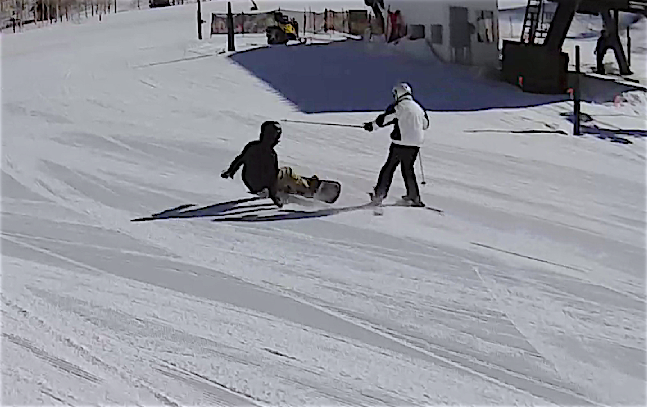
My wife Judy and I, both octogenarians, were skiing a blue run called Bullwinkle at Snowbasin, UT, on a nice clear midweek day with smooth groomed snow and few other skiers or riders. I had my helmet cam turned on, and I skied down first in order to get a video of Judy’s run. Looking back up the slope I noticed a skier and two snowboarders entering the run at the top, but Judy was on skier’s right, and they were on the left. What could possibly go wrong?

Skier veers toward Judy. Credit: Jan Brunvand

When Judy was about three quarters of the way down, suddenly the skier veered towards her and barely missed cutting her off. Then, just as she reached the run-out at the bottom, one of the boarder dudes cut straight across the hill towards her and ran over the back of her skis. The kid toppled, but Judy managed to stay upright by waving her poles to offset the collision.

Boarder crosses Judy’s skis. Credit: Jan Brunvand

The boarder, probably noting Judy’s white hair sticking out from under her helmet, apologized profusely. Judy checked her skis, and they had remained solidly attached. We proceeded to the base, keeping careful eyes on the others around us.

Boards goes down, Judy is waving her pole for balance, not repelling boarders. Credit Jan Brunvand

Back home I checked the video and saw again what close calls these had been. I took screen shots of three frames showing the two near misses plus the aftermath. In the last one it looks like Judy is poking the boarder dude with her ski pole—fighting him off. Not true, but it all happened too fast for us to realize how it might have appeared to a bystander.

Role of the Ski Patrol

No patrollers in sight

Lessons Learned

Danger can come from anywhere, no matter how much you try to stay in your lane and watch out for others on the hill. Not all skiers and riders are out of control or aggressive, but neither are they necessarily aware of their surroundings, so YOU have to be the aware one.

Advice

As in photo 3 above: Don’t Mess With Grandma!

This Week In SeniorsSkiing.com (Dec. 6)

There Is A LOT Of Snow Out There. Have You Made Your First Run?

Snow Across North America this week. Time to get out there.

It has started. It’s official. It’s on. Go. 2019-2020 is happening. Now.

We are watching the post-Thanksgiving double-whammy snow storm fall here in New England and contemplating getting out on our xc skis this morning. We know our local ski shop has been jammed this whole past week with people collecting new or newly-tuned skis. There’s a lot of snow up country, and resorts are opening or have been open.

Open for skiing since Nov. 3 this year, the Killington snow making crew pulled off a minor miracle when the resort got ready to hold the Women’s World Cup over the Thanksgiving weekend. Mikaela Shiffrin handily won the slalom and Italy’s Federica Brignone received first place in giant slalom in front of 39,000 spectators, a record breaking crowd. Enthusiasm, much?

This week, we hear from SeniorsSkiing.com correspondent Marc Liebman on his routine for making the first runs of the season. Marc is an analytical guy, and his account of the initial moves are interesting in their focus on his tracks as an assessment of his early-season technique.

PSIA Instructor Pat McCloskey also offers his advice on making those first turns on scraped off, icy conditions.

Some of us are about to make our first turns of this new season very soon, perhaps this weekend. Many probably already have been out and about. What was special about your first outing? What was new? Different? Better?

Seriously folks, the very first turns. What do you do? Do you have a mental picture of yourself or your skis carving through a turn? Do you talk to yourself, give yourself instructions or reminders? (We do. We think, “Athletic Stance” which has meaning for us.) Are you self-conscious? Uncomfortable? Cautious?

We’re curious how you approach the first of thousands and thousands of turns extending far into the spring. Let us know. Add a comment to the Leave A Reply box below.

This Week

Fun at the Boston Ski and Snowboard Expo. Credit: Don Burch

Correspondent Don Burch has produced a short video on the recent Boston Ski and Snowboard Expo. Check out the enthusiastic faces and the energy of the crowd in what might be dubbed the official kick-off of the season around New England. FYI, this is the last year the Expo will be held at Boston’s World Trade Center and produced by Bernie Weichsel’s BEWI Productions. Next year, the show will be at the Hynes Auditorium and SIA will manage the whole show. Thanks to Bernie for decades of hosting what has become a national tradition.

Parking Lots Closed!

Salt Lake City correspondent Harriet Wallis reports on last season’s monster traffic jams in Little Cottonwood Canyon, a two-lane road leading to four prominent resorts. This season, the problem has been recognized and solutions are being implemented. The jams seem to correlate with the flood of multi-resort passes that everyone seems to be using. Cause and effect?

Our Mystery Glimpse this week is a racer who became an emerging ski industry notable. We reveal the location of the “first T-bar” in a New England state.

Finally, Herb Stevens, the Skiing Weatherman, brings us regional forecasts, based on his analysis of this week’s weather picture.

Occasionally, we publish a “Snow In Literature” piece to remind our readers there is more to winter than snow sports. This week, we offer Robert Frost’s classic “Stopping By Woods On A Snow Evening”. So, why does the person in the sleigh have miles to go before he sleeps?

Thanks for reading SeniorsSkiing.com, the only online magazine for senior snow sports enthusiasts. Please tell your friends. Remember, there are more of us every day, and we aren’t going away.

Appleton Farm, Ipswich, MA, trails are groomed by North Shore Nordic, a volunteer organization. Credit: MDM
historic6

Incidents And Accidents:3

Confronting The Offender.

[Editor note: SeniorsSkiing.com is collecting stories from readers about incidents and accidents that they have experienced. We intend to review these for patterns and themes and use that data to influence the safety policies of resorts and other stakeholders. The following is the second article submitted by a reader in our new feature “Incidents and Accidents”. If you have a story to tell, please follow the format used below and send to INFO@seniorsskiing.com]

Jon Weisberg, Teasdale, UT.

Where: Deer Valley, Park City, UT

What Happened: I was skiing the left edge of a wide slope, about three quarters of the way down. The bottom of the lift was visible. A skier in a green parka came from behind and passed within an inch or two. His skis crossed mine. I stopped and watched as the ugly green parka made its way clumsily to the bottom. Taking chase, I caught up with him and his friend in the lift line and confronted him. He was in his late teens or early 20s and denied that he was the skier in question. I pressed the issue. “You’re the only person wearing that ugly green jacket.” He still didn’t admit that he skied so close and almost knocked me down. “You did it, and you know you did,” I persisted. His buddy then spoke up  and admitted that his friend had done it. They were about to get on the chair. I gave him a short lecture. “If you got hit at your age, you’d get up or spend a few days sidelined and be back on the hill. I’m in my seventies, and you almost knocked me down. I’ve been skiing more than 60 years. If you hit me, I might have been out for the season or for the rest of my life.” Maybe it registered, maybe not. He got on the chair and, fortunately, I never saw the twerp again.

Role of the Ski Patrol: Had Patrol been nearby, I would have reported the kid. They were not, and I did not.

Lessons Learned: I like to ski the fall line which is what I was doing when this happened. I deliberately ski slowly and in control. But many others don’t ski with the same level of control. It’s important to redouble looking around and upslope when skiing.

Advice: The incident made me realize that regardless of how well I conduct myself on the hill, I need to expect the unexpected.

Opening Day Cranmore

First Turn, Icy Snow Advice

Instructor Pat McCloskey Recommends An Approach To Early Days.

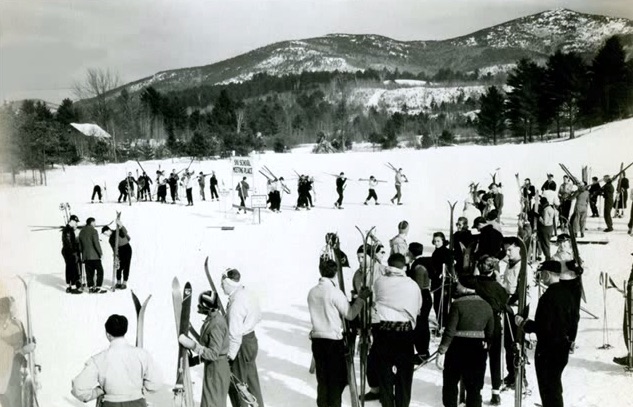
Opening Day, Cranmore, NH, 1938.

I had an interesting discussion with my lift mate this weekend at our local ski area. 

I asked the fellow beside me how his day was going. He remarked, “Well, the hill is fighting me back a little today.”  I chuckled because the guy was a certified PSIA instructor but was feeling a little uneasy with the current conditions.  After all, it is early days for the season, and the snowmaking can bring terrain to life but can also provide less than adequate conditions if you are not prepared.

What did he mean the hill was fighting him back?  As I exited the chair, I began to think about how to tackle ice, scraped snow, and the inevitable sand-like conditions that occur with a big crowd on not so big terrain.  If you started out too fast, you ended up defensive in your stance, and the timing of turns was compromised by too much speed too early, resulting in a skid for life. 

So, my recommendation to anyone starting out on their first run on limited terrain and icy conditions is to begin slowly and finish your turns.  Make a series of turns by finishing them and reducing your speed by the radius of your turn.  Your timing will come back to you and you can eventually increase your speed. 

If you start out slowly and allow the cadence of finished turns to happen at a lower speed, you can eventually ski with a faster cadence once a comfortable series of turns are made.  Be aware of your ankles and make them flex in the bottom of the turn to assist the ski in making a finished, rounded turn. 

I did this for a while and really concentrated on rounded turns and feeling my edges grip the ice.  Then I became more aggressive and said, “Come on Pat, you’ve got this”  and increased my cadence and speed but didn’t compromise my turn.  I was able to do this because of starting the run conservatively and making rounded turns. 

I end up doing this all season long. If you can start slowly and make the first couple of turns correctly and rounded, you can ski any terrain anywhere. 


Mystery Glimpse: Racer R.

This Is A Challenge. Hints Below.

He was on Bob Beattie’s 1964 US Ski Team. He later worked for Head Ski and Lange Boots. Do you know who he is? Put your guess in the comment box below.

Last Week

Thanks to ski correspondent Dave Irons for supplying last week’s picture and this description:

“John and Joe Luc Roy Jr. got it right away.  Pleasant Mountain in Bridgton (now Shawnee Peak) is Maine’s oldest continuously operated ski area starting with rope tows in 1938.  In 1951 they built Maine’s first T-bar which is in the picture. The T-bar is long gone, but you can still ski the lift line, a narrow run lined by trees. The base lodge has expanded and is more than triple the original size. The lake in the picture is the real give away. Moose Pond is 13 miles long and provides the area with unlimited water for snowmaking, something many areas envy. 

Sorry Marilyn, although my association with Sunday River is well known, we skied Pleasant Mountain in the fifties before Sunday River opened in 1959. We switched to Sunday River because as we were living in South Paris it was an easier drive, and Pleasant Mountain had become known for lift lines.  That’s no longer the case, with two top to bottom triples, a quad and another triple for beginners.  For more on the area, my book, Shawnee Peak at Pleasant Mountain is available on Amazon, and at Shawnee Peak. How’s that for a shameless plug?  I’ll try to answer any questions about the area.”