Tag Archive for: Harriet Wallis

Spring Is The Time To Play Games

Try This New Game: It’s A Cross Between Where’s Waldo And A Scavenger Hunt.

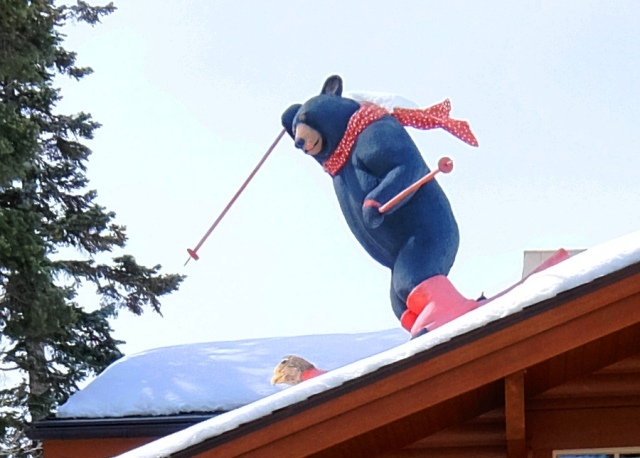
Find the Bear. Credit: Harriet Wallis

I was skiing at Deer Valley, and I was taking photos. I’m always taking photos. It’s what I do. I never know when I’ll need a certain shot to illustrate a story.

Find the flamingo (?!) Credit: Harriet Wallis

The next time I skied Deer Valley, I was with a friend. I showed her eight photos including the carved bear skiing on a roof, a flamingo wearing a white cross outside one of the ski patrol buildings, and a bronze Native American sculpture. I challenged her to find the real things as we skied around the mountain.

We covered a lot of trails that day. Deer Valley has more than 2,000 acres of skiing, six bowls and 101 ski runs. The hunt forced us to ski a trail once, so she could look for an item, and then move on rather than sticking to one trail over and over. It was a whole new angle on having fun.

Bingo! She found everything shown in my photos. And we were thoroughly tuckered out.

Find the mountain goat. Credit: Harriet Wallis

How To Play

If you are used to taking photos only at scenic spots, try snapping photos of things you see around your favorite mountain, such as a certain trail sign or an unusual weathered tree. Then show the photos to your friends (if they’re whacky enough) or to your grandkids. Challenge them to find those things. You can even offer rewards.

If the springtime slopes start to become ho hum, silliness will add new zest.

To read more from Harriet click here for her stories on SkiUtah.


Find the warrior. Credit: Harriet Wallis

It’s Birthday Party Time at Alta.

Hip, Hip, Hooray! Skier Bob Turns 94!

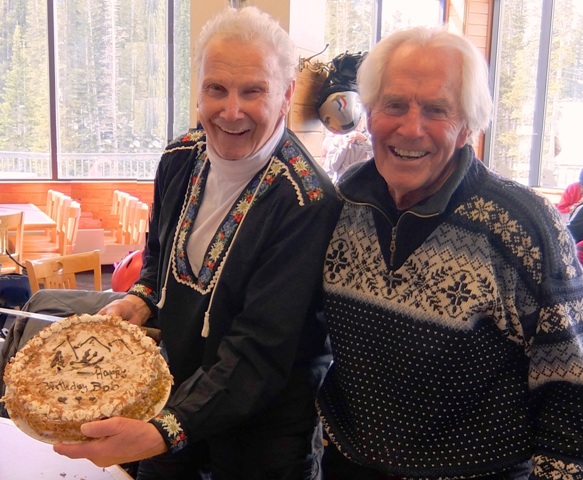
Bob Murdoch celebrates his 94th on skis at Alta. Credit: Harriet Wallis

You might say that 94-year-old Bob Murdoch is a “senior’s senior” skier. He represents many skiers across the country who are skiing into their 90s and enjoying their mountain friendships as much as the slopes.

Ski friends matter. Skiers gave Bob a birthday card that said: Count your age in how many friends you have, not in years.

Bob’s pal, Nick Looser, baked two special cakes
for the party at Alta. Credit: Harriet Wallis

At Alta, Bob is following in the footsteps—in the ski tracks—of 100 year old George Jedenoff who celebrated his milestone birthday on skis in July. Alta’s snow had melted by July, but its neighbor, Snowbird, gathered enough snow to groom a long swath so George could ski on his 100th birthday.

Next to George, Bob is the oldest skiing member of Alta’s senior group, the Wild Old Bunch—and the Wild Old Bunch threw an on-mountain party to honor him. And what a party it was!

Age has its rewards.

Bob, a retired hydro engineer, skis with his good friend Nick Looser, a retired culinary artist, who baked two specialty cakes for the event. He knew there would be a big crowd to celebrate Bob’s 94th birthday.

Bob currently skis three days every week, and his love affair with Alta goes back a long way. He skied the mountain in the 1930s before it was a resort and before it had lifts. He hiked up to ski down.

Skiing has changed a lot since the days of ungroomed snow and long uphill hikes, but we’re lucky we can celebrate with those hardy, early skiers, and we hope we can grow up to be like them.

To read more from Harriet click here for her stories on SkiUtah.

Barbara Stewart Anderson

Barbara Stewart Anderson: A Woman Ahead Of Her Time

At Age 82, She’s Athletic And Adventuresome. And She’s The Legacy Of Her Ski Pioneer Father Founder Of Utah’s Sundance Resort.

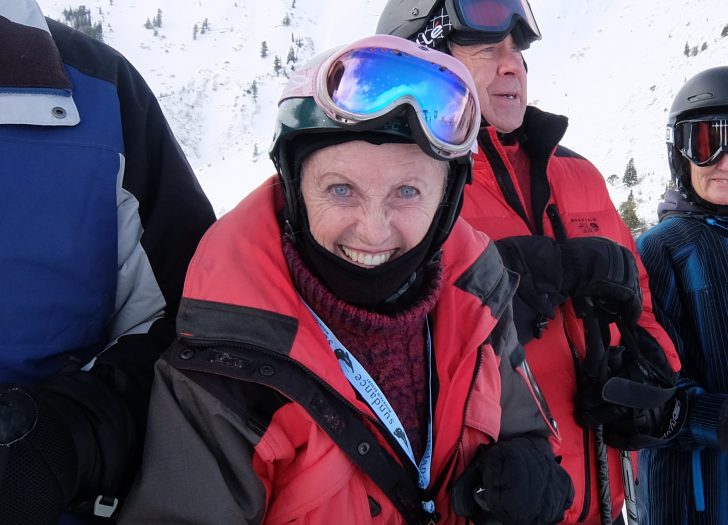
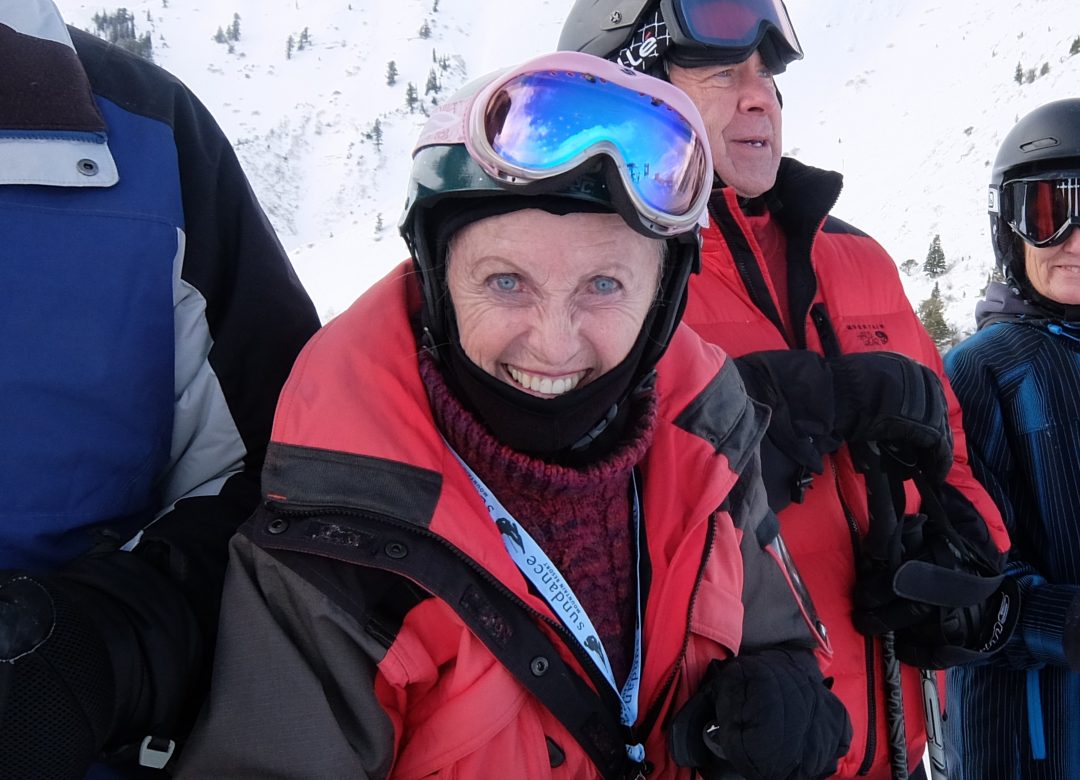
Barbara Stewart Anderson keeps going at 83.
Credit: Harriet Wallis

Barbara Stewart Anderson is like the pink Duracell bunny. She keeps going and going. She lives by her philosophy: “If I can do it today, then why not? I may not be able to do it tomorrow.”

Her accomplishments prove her philosophy. She scuba dived the Great Barrier Reef, completed seven treks in Nepal, rode a yak in Tibet, heli-hiked in British Columbia, and reached the summit of 13,679 foot high Mona Loa in Hawaii. What makes it remarkable—she did it in her 60s.

Looking back, Barbara grew up in the era of the 1930s, 40s, and 50s when women observed strict gender roles. But she was never strapped by the expectations of society. Instead of feeling suppressed or confined, she picked up speed. She has always been a woman ahead of the time.

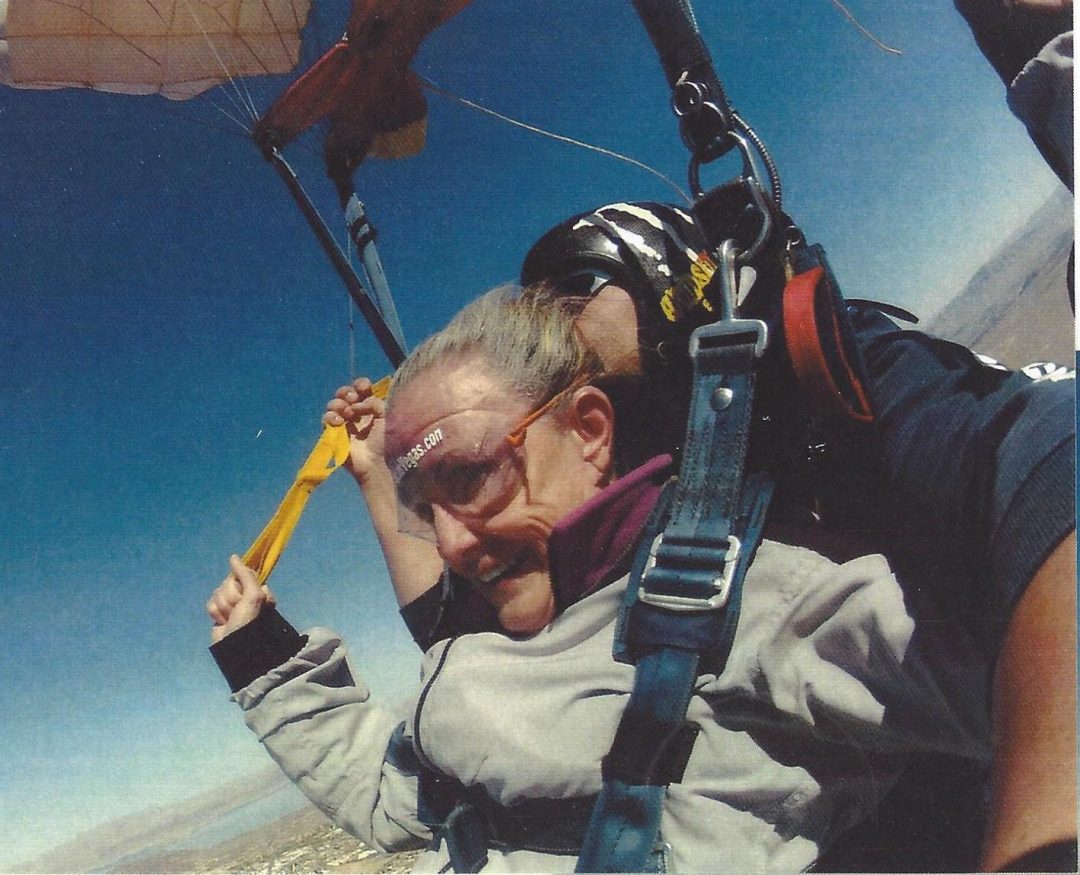
Her list of accomplishments keeps growing. Just 5 years ago, she sky dived, and she also summited 19,341 foot high Mt. Kilimanjaro, the highest point on the African continent. She was 76.

Growing up loving the outdoors

Her passion for unbridled outdoor adventures began when she was a youngster.

Her family homesteaded in the beautiful North Fork of Provo Canyon. Her dad, Ray Stewart, built a little cabin near the base of Mt. Timpanogos. During the summers, Barbara and her siblings roamed the hills and hiked to the waterfalls. It inspired Barbara to a life of over-the-top outdoor adventures that continues to this day.

WWII changed the course of lives and skiing

During WWII, the little Stewart cabin became headquarters for training the Civilian Defense Ski and Mountain Corps—sort of a civilian version of the military’s 10th Mountain Division. In addition to first aid and other skills, ski pioneer Stewart taught the recruits how to ski. And that fanned their enthusiasm to continue skiing after the war.

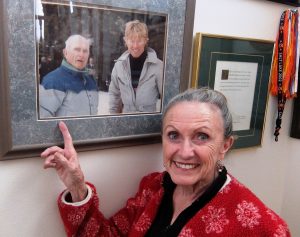
Barbara with photo of dad Ray and Robert Redford.
Credit: Harriet Wallis

When the war ended, Stewart, along with legendary skier Junior Bounous and others from the Defense Corps, cobbled together a rope tow. Stewart bought 1,200 feet of new manila rope for $61 and an old truck for $125 to power the tow. Using written instructions, he learned how to splice the rope into a loop — and it worked. It was the first ski tow in the area.

The tow created new challenges for the whole family. As the oldest child, Barbara was often called on for help. The tow was powered by car batteries, and nine-year-old Barbara helped her dad the lug heavy batteries on and off the mountain so they wouldn’t freeze at night and lose their charge. She also learned to run the snack bar, punch ski tickets and help skiers onto the tow. It was all part of growing up in a ski pioneering family.

As skiing quickly became popular, they built a 50-meter ski jump and raced on the Mt. Timpanogos glacier in the summer. In 1948, famed skier and Olympic coach Alf Engen set the Giant Slalom course on the Timpanogos glacier. The event drew notable racers including Jack Reddish, Dev Jennings, Corey Engen, and Olympian Suzy Harris.

Ray Stewart modified skis so young, energetic Barbara could ski on the glacier too. By the time she was 12, she was winning junior ski tournaments in Downhill, Slalom and Cross Country.

The burgeoning little ski area grew, and it was named Timp Haven. Years later Robert Redford bought it, and it became Sundance.

Stewart was inventive and creative with a passion for tackling the difficult and never giving up. Today, ski pioneer Ray Stewart’s name lives on at Sundance. The main lift is named for him: Ray’s Lift.

Now at 82, Barbara is an icon of taking on challenges and achieving results much like her dad did. She skis regularly with the Sundance Seniors, walks three miles a day, works out at the gym, took first place in a 5K race, and is active in her church and community. Nothing stops her. Many would be exhausted trying to keep up with her.

Over the years, Barbara built a collection of more than 600 miniature skier figurines that are on a rotating exhibit at the Alf Engen Ski Museum at the Olympic Park in Park City. Visitors can also learn about avalanches, sit in a real bobsled, try their knack at interactive ski jumping, and more.

The $10.5 million museum was funded entirely by private donations, including donations from Utah’s famed and philanthropic Quinney and Eccles families. There is no admission charge. Visit and enjoy the museum.

To read more from Harriet click here for her stories on SkiUtah. 

Barbara sky diving. Quite a selfie.
Credit: Barbara Anderson


100 Year Old Skier Inspires Us To Become Our Better Selves

[Many expenses for technicians, designers, and others are associated with delivering SeniorsSkiing.com free each week and developing and publishing Subscriber-Only content. Please help by making a modest donation by clicking here.]

George Jedenoff, 100, Is In Love With The Mountains, The Snow, And Life. Everyone Who Meets Him Says, “I Want To Be Like George.”

The paparazzi chase George while trying to keep up.
Credit: Harriet Wallis

“Age is just a number,” he says adding: Don’t let age be a barrier. Do your best. Become your best. And keep on going. He’s a living legend at Alta.

He’s also quite a super skier who skis like a kid. He swings his feet on the chairlift. He cruises down steep trails. And when jumps into patches of powder he shouts with glee.

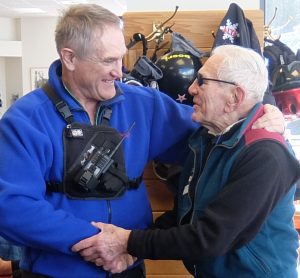
Two moguls meet. Alta’s new General Manager Mike Maughan welcomes George.
Credit: Harriet Wallis

To maintain his fitness, he works out every day for 45 minutes before breakfast. The workouts toughen him mentally and physically to keep him going even when life is unkind.

“Never give up,” is his motto.

On a chairlift ride, he leaned over to me and said: “People come up to me — sometimes with tears in their eyes — and tell me that I’ve inspired them to keep going and never give up. Of all the things to be remembered for, I’m so surprised that I’m being remembered for my skiing.”

But it’s more than just about skiing. It’s about life.

George stirs others to become their better selves — to try harder, to reach higher, and to never give up. While others are revered for their academic achievements, business success or community service, George is loved because he touches people’s souls.

Age is just a number even when it’s 100.
Credit: Harriet Wallis

Back in 1960, George was transferred to Utah to be the general manager of the Geneva Steel Plant. He was athletic, and he learned skiing from the best: Alta’s legendary Alf Engen, Snowbird’s iconic Junior Bonous, and Earl Miller, the granddaddy of release bindings.

George grew to love Alta’s powder, and when he was transferred away in 1967, community leaders honored him with a gift that was sure to lure him back: a lifetime season pass to Alta. He’s still using it! He now lives in California but he returns annually to ski Alta.

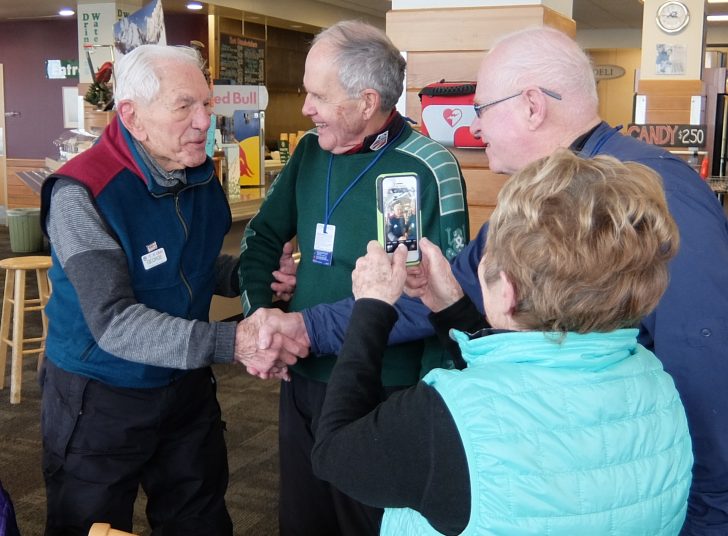
He’s a celebrity and a living legend. Skiers cluster around him to have their photos taken with him. The digital images become reminders to reach higher, try harder, and keep going — just like George.

Ski Utah has produced annual videos of George. The very first one, when he was 95, is still my favorite. Enjoy!

https://www.youtube.com/watch?v=KoQ5IEUpKEA

http://www.skiutah.com/explore/videos/george-jedenoff-97-year-old-utah

https://www.skiutah.com/blog/authors/yeti/98-year-old-skier-george-the-powder

https://www.youtube.com/watch?v=Bb23maq0rtQ

To read more from Harriet click here for her stories on SkiUtah.


The Back Story: Skiing With 100 Year Old George

[Many expenses for technicians, designers, and others are associated with delivering SeniorsSkiing.com free each week and developing and publishing Subscriber-Only content. Please help by making a modest donation by clicking here.]

Missed Turns, A Slipping Helmet, And Being In The Wrong Place. It’s All In A Day’s Work.

Hey, George, wait up!
Credit: Harriet Wallis

Covering a ski race is easy. Racers will be on the course.

But shadowing 100 year old George Jedenoff on Alta’s ski runs had challenges. Furthermore, we had two different genres going: A Ski Utah crew was videoing him, and I was shooting still photos I needed to stay out of the way of their cameras. It’s already getting complicated.

Here are some of the funny things that happened to me on the slopes with George for two days.

Can’t outski a 100 year old. We started from the top of a lift and George was in the lead. When he paused, I bulleted ahead to position myself at the side of the trail to snap photos as he’d ski by.

I yanked off my gloves and grabbed my camera. But before I could point it … there goes George… and he was gone. Repeat. Repeat.

When you come to a fork, take it. Skiers love George. They see him on the slopes and gather around him to talk and take photos. He is so gracious.

While Ski Utah videoed an impromptu trailside gathering, I knew I had lead time. I left the group, skied ahead, and chose the perfect spot to get my photos. I was on a steep slope under a chairlift.. My camera was ready. I waited and waited, but no George.

Then the group called down to me from the lift overhead. I looked up — and my helmet fell down over my eyes. I was stuck in my helmet and could see nothing. I felt really stupid.

I pushed my helmet back into place and wondered how George got past me. The main trail had a fork, and he opted for the side trail. Missed him again.

Deep powder, but over there. Another wrong guess. This time, we separated on purpose. George and the video crew took the high road to video him skiing deep powder. I took the low road and positioned myself for the best still shots.

But George didn’t appear on the most likely open slope. He found the snow up there was worn out, so he moved on down the ridge — out of sight behind dense evergreen trees — in search of fresher powder.

He found the fresh snow he wanted. But I couldn’t find George. Missed him again. But George had a wonderful time. That’s what really counts.

To read more from Harriet click here for her stories on SkiUtah.

Butternut Buys Blandford Ski Area; Rushes To Upgrade For New Season

Family-friendly Blandford in southern Massachusetts was poised for extinction or development, but Ski Butternut and its owner Jeffrey Murdock bought it Sept. 1 and saved it.

Here comes the snow making. Blandford’s lodges get facelifts and the slopes get upgrades in grooming and snow making.

It’s a rescue mission of historic proportions. Right now, crews are working furiously to renovate Blandford’s base lodges, upgrade the grooming equipment, and install new snowmaking to help smooth out fickle weather cycles that have troubled the family-style ski area in the Berkshire Mountains.

The timing is tight. Renovations couldn’t start until Sept. 1 when the purchase was finalized.

“We’re putting a lot of resources into Blandford,” said Dick McCann, general manager of Ski Butternut. “We want to build the skier base back up. And we care very much about making skiing affordable.”

“We think the ski industry is better for having these small ski areas,” McCann said.

In reality, no one needs a mega resort to learn to ski and have family fun. Yet mega resorts across the country are gobbling up smaller areas.

Historically, Blandford Ski Area was founded in 1936 by members of the Springfield Ski Club, and it was owned by the members. At that time, hardy skiers drove to the end of the road and then hiked to ski the rolling hills.

It’s surmised that Blandford might be the oldest member-owned ski area in North America. It’s located about 20 miles west of Springfield, Mass.

By the 1970s, the popular day ski area had many rope tows and one double chair lift. Families loved the area and spent many volunteer hours doing maintenance and especially picking up stones from the slopes and tossing them into the woods. That made the slopes skiable even if natural snowfall was skimpy.

That’s where I learned to ski and I loved the place. The snow was often thin, but it was groomed to perfection with no stones poking through.

Today, it has 25 trails, three double chairlifts and two base lodges. But snowfall became erratic during recent years and families drifted off to do other things in winter. Blandford was on the brink of extinction.

Ski Butternut’s owner Jeffrey Murdock now owns three ski areas in the Berkshires: Ski Butternut, Otis Ridge, and now Blandford Ski Area.

Ski area management runs in his family, and it started with Butternut. Its first trails were cut by the Civilian Conservation Corp (CCC) in the late 1930s, but that was followed by many rocky years. Finally in 1962, Channing and Jane Murdock, Jeffrey Murdock’s parents, bought the state-of-the-art chairlift and the ski area that went with it.

Ski Butternut now has one of the largest uphill capacities in Southern New England.

As to Blandford Ski Area, Murdock is breathing new life into it. Massive renovations are underway and they’ll be ready for this winter. A season pass is $199 for adults, $169 for kids 7 to 13, and $79 for kids 6 and under.

To read more from Harriet click here for her stories on SkiUtah.


Cycling Series: Update On “Arthritis Proof” Never Flat Bicycle Tires

I’ve Learned A Lot And Here Are The Lessons.

Find out what Harriet thought about these tubeless, foam-filled tires. Credit: Harriet Wallis

If your hands are arthritic, you know how hard it is get a tire back on the rim after fixing a flat. Lightweight Tannus tubeless foam tires were recently introduced into the U.S., and I was quick to buy a set. They don’t take a tube, and since they are filled with foam, they can never get a flat. Never. And they’re good for 5,000 miles. That seemed to be the perfect solution for my hands.

I had them installed just before a charity ride in the cool weather of early June. They rode wonderfully. They were the cat’s meow.

But as summer temperatures heated the road surface, the road softened the tires, and they became sluggish. The hotter the day, the slower they rode. Hot weather riding and hill climbing became work. Dang!

I think the lightweight, solid foam, Tannus tubeless tires live up to their reputation that they can never get a flat. My tires picked up several of those dreaded goat head thorns. I pulled them out and rode on. No problem. No flat. I think casual riders and commuters who face road debris will enjoy them. And they come in 12 lively colors.

But for me, it was time to move on and find another “arthritis proof” bicycle tire. Stay tuned for my review of the Bontrager brand tubeless tire-wheel system.

To read more from Harriet click here for her stories on SkiUtah.


Senior Skier Profiles: Two Kings Of The Hill

These Octogenarians Are High Spirited Role Models.

Some skiers slow down as they get older. But Bud Temple (84) and Paul Jacobsen (89) pick up steam. Each has skied for more than 70 years. They each learned on primitive equipment in a city park.

Meet Bud Temple

Bud’s been skiing for 70 years.
Credit: Harriet Wallis

Bud launched into skiing in an unusual way. While a student at the University of Utah, he took a ski course offered by Bill Lash, a founder of PSIA (Professional Ski Instructors of America). Bud excelled, and he earned a ski teaching certificate—one of the very earliest. But then he was drafted.

No problem. He entered the U.S. Army with two unusual documents: his ski teaching certificate and a personal letter from Bill Lash to the Commandant at Camp Carson where special troops were trained.

After basic training when assignments were made, Bud presented his two documents to the assignment officials.

“The Army didn’t know what to do with me,” Bud said. “They’d never seen such documents.”

So the officials left the room, called the Commandant, and returned saying: “The Commandant is expecting you.”

Bud taught special troops how to ski, and he also taught survival, mountaineering, and climbing to special forces in all branches of the military.

Bud showing a some form.
Credit: Harriet Wallis

And then he continued to teach and coach. He coached World Cup alpine champion Tamara McKinney, created a ski school at a small mountain that didn’t have a ski school, and taught internationally at eight resorts.

Last year, Bud was clocked at 48 mph.

On land, Bud hobbles because of chronic leg problems. But skis give flight to this retired mining and metals professional. He swoops smoothly down the slopes.

Bud’s advice for older skiers:

“Accept that you’re not as agile as you once were. Slow down,” says speedster Bud. Then he adds: “I guess I should take my own advice!”

Meet Paul Jacobsen

So has Paul.
Credit: Harriet Wallis

Paul holds a 25 year record for skiing every day of the season at Brighton. He’s known as First Chair Paul because he’s always first in line when the lifts open.

Agile and mobile at 89, this retired architect skis daily. Then, for après ski, he goes to most of the University of Utah’s home football and basketball games

Skiing has always meant freedom for him. As a kid he skied for the first time when someone brought a simple pair of slats to the sledding hill. He was hooked.

As a teen he worked in his dad’s grocery store, and he drove to the wholesale produce market daily to buy fresh produce for the store. When his job was done, he was free to ski.

For years, Paul skied with a Japanese fish kite flying from his helmet. But it blew away this winter, and everyone misses seeing it. When skiers dress silly in spring, he wears a tutu.

Paul’s advice for older skiers:

“Enjoy what you’re doing,” says Paul. “Don’t be a couch potato.”

Paul in his tutu. He skis every day, but not always in a tutu. Sometimes he tows a kite from his helmet.
Credit: Harriet Wallis

Alta’s GM Onno Wieringa Retires

He’s Loved And Will Be Missed.

Credit: Harriet Wallis

Onno Wieringa has a passion for snow and for the soul of Alta. They have been his love and his career for 45 years.

He arrived at Alta Ski Area in 1972 and landed a job as ski patroller. That was his day job. At night, he was a bartender at Rustler Lodge.

After five years on patrol, Onno was promoted to snow safety director and served under Alta’s second GM, Chic Morton. In 1988 Chic was ready to retire and called on Onno to take the reins. Onno leaves a legacy for Alta to emulate for years to come.

Click for videos of Alta and Onno. http://www.alta.com/snow-and#

To read more from Harriet click here for her stories on SkiUtah.

Mt Snow CROP Harriet puddle skimming

Favorite Memories Of Skiing New England In Spring

Back Road Scenery And Ski Slope Puddles Formed Indelible Pictures.

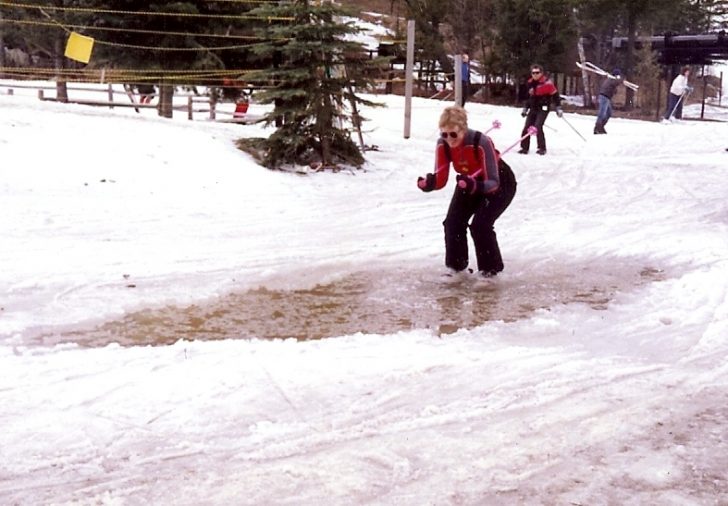
Author Harriet Wallis tries out a puddle at Mt. Snow, Vermont, back in the 80s.
Credit: Harriet Wallis

I loved the scenic springtime drive to the slopes. Steam rose from little sugar shacks as the golden syrup was simmering inside. Horses stood motionless in frozen pastures and breathed clouds of fog into the frosty morning air. Christmas tree farms had fallen silent.

Lichen-covered stone walls divided the winter-flattened landscape into a patchwork quilt. Farmhouse porches that had been stacked solid with fire wood were now nearly empty. What remained was a littering of chips and bark. Frozen laundry flapped on a few clotheslines.

And then there was mud. Road shoulders were rutted. Unpaved roads were impossible, and some parking lots were a quagmire.

Above all else, I loved New England’s ski slopes in spring. When it rained, we put on garbage bags. Those were the days before Gore tex. The bags rattled in the wind. Rain ran down the bags and soaked the legs of our ski pants. Then it wicked into everything we were wearing. We were soaked inside and out.

But the rain also softened the ice, and the ice became slush. It slid downhill like a glacier and melted into puddles. The base area became puddles. A maze of puddles. Many puddles. Deep puddles. Normal skiers went around them. But I loved skiing through those puddles—spraying water everywhere and hoping I could dry my boots by morning. And hoping there would be big puddles the next day.

If you see a puddle at the base of your ski area, please ski it for me—or send me some vibes that springtime puddles still exist at ski areas.

To read more from Harriet click here for her stories on SkiUtah.


George Jedenoff, 99-1/2, Skis Like A Teenager

Powder Is His Passion, And His Daily Workout Keeps Him Fit. Let’s Grow Up Like Him.

George at Alta this February. He’s an inspiration to us all.
Credit: Harriet Wallis

George is an inspiration. Watch him ski and you’d never know he’s over 99. He skis Alta or Snowbird every day when he’s in Utah, and he has a knack for finding patches of untracked powder days after a storm.

George came to Utah in 1960 to be the general manager of the thriving Geneva Steel Plant. He was athletic, and he thought he should take up skiing. He learned from the best: Alta’s legendary Alf Engen, Snowbird’s iconic Junior Bonous, and Earl Miller, the granddaddy of release bindings.

“While buying my first pair of skis, I met Earl Miller who offered to teach me how to ski. Of course, I used Miller bindings—the only safe bindings available at that time. We used the rope tow at Alta Lodge for my first lesson.”

Miller demonstrated how his bindings released by showing photos of himself making some sensational falls. But George’s falls were even more spectacular, and Miller complimented him saying: “You know, George, you’ve made some falls that I’ve never seen before!”

George grew to love Alta’s powder with and without falls.

When he was transferred to Indiana in 1967, community leaders honored him for his community service and gave him a gift to lure him back.

“They presented me with a Lifetime Season Pass to Alta,” George said. “I have made good use of this wonderful present.”

But how does a 99 year old stay in shape? He has five fitness machines in his home’s basement, and he works out every morning before breakfast. He’s motivated by his love of skiing.

“I know I’ve got to stay in shape, or I won’t be able to ski,” he says.

He calls it his philosophy of powder: Stay strong, never give up, enjoy whatever the snow conditions are, and, above all appreciate, every day to the fullest.

Ski Utah, the state’s ski industry organization, has produced a video of George skiing for each of the last 5 years. Click here to see my favorite video when he was 95.

He’s the oldest skiing member among Alta’s Wild Old Bunch, the group of senior skiers who enjoys skiing and socializing together.

To read more from Harriet click here for her stories on SkiUtah.

George Jedenoff still shredding at 99 1/2 at Alta this February.
Credit: Harriet Wallis

How To Get Several Days From Your Shake-Em-Up Hand Warmers

Use These Two Sneaky Tips.

The air-activated hand warmers keep your fingers toasty while you ski. Even when your legs fall off, your hand warmers keep going.

Then what do you do with them? They have a lot of heat left.

I used to give them away in the locker room. People would snap them up for themselves or their kids.

Tip #1. Here’s how to save them.

Mummified hand warmers can be revived for another day.
Credit: Harriet Wallis

I discovered I can keep them until the next day and sometimes several days by wrapping them tightly in Saran wrap or other generic plastic wrap.

Mummy them up tightly in about 2 feet of plastic wrap until you can no longer feel the heat coming through.

The wrap cuts off the air, and they go dormant. Reactivate them by unwrapping them and shaking as usual. Roll the plastic wrap onto a tube and reuse it another day.

The up side is you can save and reuse hand warmers for several days. The down side is that sometimes it just doesn’t work.

Experiments 101

Plastic baggies don’t work. Even if you squish really well, there’s still too much air left inside. Aluminum foil doesn’t seem to work, but I don’t know why. Use plastic wrap.

Tip #2. Before you buy.

Check that expiration date. It should be several years out, not soon.
Credit: Harriet Wallis

Before you buy a stockpile of hand warmers, check the expiration date. It should be several years into the future—not next year. Hand warmers close to their expiration date often have less oomph.

On the other hand, you might discover hand warmers long past their expiration date that have been buried in your ski bag for years. And they might work very well. Just don’t count on it on a sub-zero day.

To read more from Harriet click here for her stories on SkiUtah.


Solitude Hosts Major FIS, NorAm Snowboardcross, Skicross Races

Jan. 19-22 Races Are A First For This Resort Located In Twisty, Winding Big Cottonwood Canyon.

Groomers finalize the steep course with its finish line right at the base of the mountain just a few steps beyond Solitude’s Village.
Credit: Harriet Wallis

It’s a test event for the FIS Freestyle, Snowboard and Freeski World Championships scheduled two years from now in 2019.

So what? Don’t yawn.

When Salt Lake City was chosen as the site of the 2002 Winter Olympics, the four resorts in Big and Little Cottonwood Canyons—Alta, Snowbird, Brighton and Solitude—were overlooked as possible venues partly because of the road. It’s one way in and one way out of each narrow canyon that was carved by glaciers eons ago.

However, professional and amateur races are frequently held in the two canyons, but this is the first time such a major event is scheduled there.

To paint the big picture, Deer Valley, located in Park City, bought the smaller Solitude Resort two years ago making Solitude part of Deer Valley’s family.

As to Deer Valley, this marks the 18th year that the resort will host international and world aerial and mogul competitions. It was a venue for the 2002 Winter Olympic Games, two World Championships and 15 World Cups. It’s had lots of practice hosting major events and the resort is an esteemed venue.

So Solitude is not just jumping into big time races. It has the expertise of its parent, Deer Valley.

The races are high adrenaline, high action events. A detailed schedule for the Toyota U.S. Grand Prix at Solitude Mountain Resort can be found here.

Boardercross is a snowboard competition in which a four to six snowboarders race down a course that’s typically narrow and includes banked turns, various jumps, rollers and drops designed to challenge each rider’s ability to stay in control while maintaining maximum speed. Mid-course collisions are common.

Skicross is a timed race event and with big-air jumps and high-banked turns. What sets skicross apart from other alpine skiing is that four skiers start simultaneously and attempt to reach the end of the course.

To read more from Harriet click here for her stories on SkiUtah.

Here’s a short video that previews the Snowboard Cross course at Solitude.

Hot Finds For Seniors At The Winter Outdoor Show

The Innovations Are Amazing. Here Are Three Top Picks For Seniors.

Vibram’s Arctic Grip soles won’t slip on ice no matter how hard you try.
Credit: Harriet Wallis

Vibram – the company known for its hiking boot soles – has a new sole material it calls “Arctic Grip.” You can walk on solid ice and not slip. Really! To prove it, Vibram demonstrated on blocks of ice at its show booth.

Arctic Grip is used by six shoe companies on dress shoes to work boots: CAT, Hush Puppies, Saucony, Merrell, Sperry and Wolverine.

Stay toasty with heated ComfortWear in many styles.
Credit: Harriet Wallis

ComfortWear hooked up with Heat Factory which is known for its hand warmer packets. Now you can keep your entire body warm with clothing that’s designed with heat coils that are battery operated. Stay toasty as you ski, hunt or sit through a game in an outdoor stadium.

The most popular item is the heated neck scarf, said ComfortWear President Charles Hollcroft who owns the technology.

High tech Finbulvetr snowshoes have a funky egg-crate look, but they are made from a thermoplastic with flex underfoot and in the right places for steep uphill climbs or tough downhill descents. They’re designed and made in Norway where they really know their snow. They flex and move like no other snowshoe.

They were originally designed for the Norwegian military to carry heavy loads in the backcountry, said Christian Brunsvig, chief executive officer. Then the company created an additional model to suit a professional snowboarder who needed light weight but extreme performance for his uphill climbs. The long model is for long haul expeditions.

Norwegian snowshoes are lightweight and efficient.
Credit: Harriet Wallis


The Outdoor Retailers show is the largest product show of its kind in the US, and it’s staged in Salt Lake City. It brings product manufacturers from all over the world together with retail buyers who can see, touch and try new products and then place orders for the coming season. A few passes are issued to media writers and photographers – such as SeniorSkiing.com. That’s how I got in.

To read more from Harriet click here for her stories on SkiUtah.


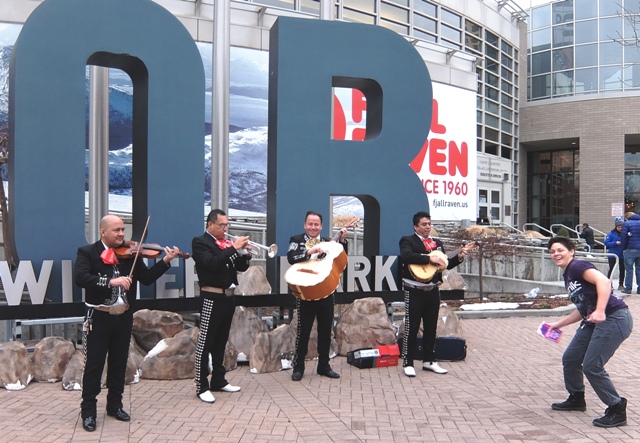
A mariachi band gets people dancing before the Outdoor Retailers show opens.
Credit: Harriet Wallis

Whisper Ridge: 100 Square Miles Of Snowcat Skiing In Utah

It’s New This Year And Something To Shout About.

Helo to cat, cat to snow fields, skiing and glamorous camping, aka “glamping”.
Credit: Whisper Ridge

It’s the largest backcountry resort in the country: 3,300 feet vertical, 300+ average inches of snow, and luxury yurt “glamping.”

Check your bucket list. Better add Whisper Ridge. Peace, quiet, the hush of snow, make your own tracks, and the vastness of mountain ranges virtually to yourself.

Are you drooling?

Whisper Ridge is located about 60 miles north of Salt Lake City and close to Ogden, Utah. More specifically, this heavenly skiing is between towns appropriately named Eden and Paradise – names given by early settlers.

The area is so remote that Whisper Ridge flies its guests by helicopter to the cat base and from there it’s cat skiing from eight custom PistenBullys until your legs fall off. Then it’s overnight glamping in well appointed yurts.

Roughing it in a Whisper Ridge yurt. Yes, it’s a yurt.
Credit: Whisper Ridge

But how did 100 square miles of skiing go unnoticed until now? It began with owner Dan Lockwood’s vision. His environmental education and life-long career of land management on several continents was the spark. Locally, he was saddened that ranches that have been in families for eons were being chopped up and sold to developers. He wanted to make an impact.

Lockwood owns a portion of the land, and with the cooperation of adjoining landowners, he put together the 100 square mile tract of ridges, forests and meadows.

One day several years ago, Lockwood was skiing fresh, untracked snow with his son Cort. They stopped for a rest, and Lockwood asked: “Do you know what’s wrong with this?”

“There’s nothing wrong with this,” Cort told his dad. “This is perfect.”

But Lockwood continued. What’s wrong is that we aren’t sharing this with anyone, he said.

And thus Whisper Ridge was born from Lockwood’s passion to preserve the land and share the untouched wilderness experience with others. Last year was a test season. This is its first year of operation.

Check the video below or click here to whet your back country appetite.

For more information and reservations, click here. 

To read more from Harriet click here for her stories on SkiUtah.

Whisper Ridge Cat Skiing from Whisper Ridge Cat Skiing on Vimeo.

New England Ski Museum Tells 3,000 Years Of Ski History

From The Stone Age To Today.

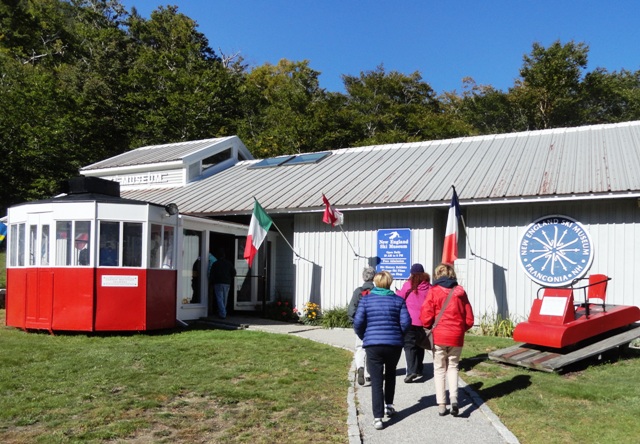
The tiny museum in Franconia, New Hampshire is located next to Cannon Mountain’s gondola base, and it’s a wonderland. Even before you enter, you’re intrigued by what you see just outside the door and you ask yourself: “What’s that thing?”

New England Ski Museum is located at the base of Cannon Mt., NH. Credit: Harriet Wallis

New England Ski Museum is located at the base of Cannon Mt., NH. Antique gondola car guards entrance. Credit: Harriet Wallis

The big red boxy thing is one of Cannon’s original tram cars from 1938. “Eeegads,” you say. “They went up the mountain in that?”

2-alg-skisThe sled-looking thing was Cranmore Mountain’s idea of an uphill lift. Skiers sat in the sleigh, and it was hauled uphill on a trestle.

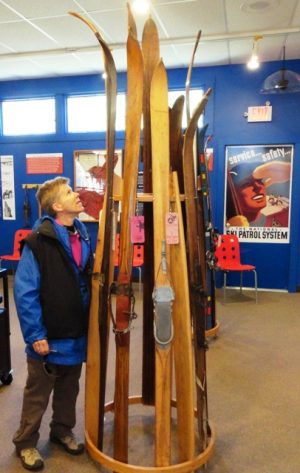
Inside the museum, “We show how skis evolved from the stone age — to a slab of wood with a leather strap — to modern skis,” said Executive Director Jeff Leich.

And exhibits show milestones: the 10th Mountain Division, the founding of the National Ski Patrol, and a display of the funky clothes we wore not so long ago.

The museum’s name is misleading. This wonderful Ski Museum happens to be located in New England, but it covers skiing across the country.

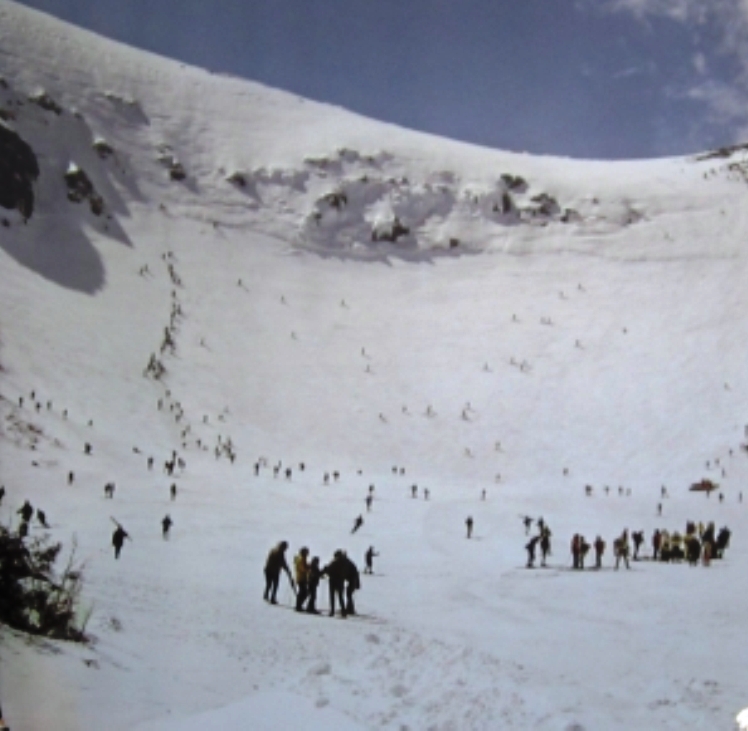
And when you’re all revved up, you come face to face with skiing Mt. Washington’s Tuckerman’s Ravine. It’s New England’s highest peak and is known for having the world’s worst weather. Actually, it’s a photo that covers an entire wall, and you feel like you’re right there. It stirs memories of hiking up the trail for hours. Lugging your skis all the way. Then clobbering up the steep slope to make a run for bragging rights.

This museum is a “must see.”

This photo of Tuckerman's Ravine on Mt Washington occupies an entire wall. Credit: NESM

This photo of Tuckerman’s Ravine on Mt Washington occupies an entire wall.
Credit: NESM

Ski Gifts and Collectibles

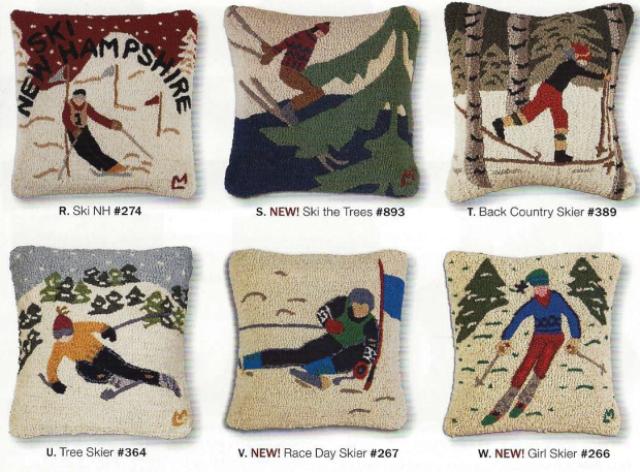
The NESM online catalog has something for everyone on your gift list. There are books and posters, jewelry, pottery, pillows, belts, children’s gifts and much more. Images are taken from history and will satisfy any skier’s wish list.

These beautiful pillows are

These beautiful pillows capture the spirit of the sport.  There are many other gift ideas in the NESM catalogue.  Credit: New England Ski Museum

Consider membership

Even if you can’t get to the museum, membership brings you a beefy, quarterly, 24-32 page journal full of archaic photos and stories that will keep you inspired and informed. An individual membership is $35 a year.

For more information and to shop the catalog online, check here.

To read more from Harriet click here for her stories on SkiUtah.


Can Alternative Medicine Help You?

A Tragic Accident Turns A Ski Racer Into A Believer And A Healer.

Siri says alternative medicine returned her to real life. Credit: Harriet Wallis

Siri says alternative medicine returned her to real life.
Credit: Harriet Wallis

Siri Wieringa was born into a skiing family. It’s in her genes. By college she was an accomplished ski racer. But a horrific on-course accident tossed her down the hill, flipping her over and over, breaking up one side of her body and terrorizing her brain. When she regained consciousness, life as she knew it was gone.

Doctors fixed her broken bones. But they were baffled about her brain which, even though she wore a helmet, was slammed again and again against her skull. Perhaps she should drop out of college, they said. Perhaps she should just rest.

Cancelling life did not suit Siri.

“I needed Western medicine,” she said. For example, “they Life Flighted me to the hospital.” But rather than letting her just rest and stagnate, her mom sought alternative healing methods.

Siri believes alternative healing returned her to real life. “I was in a fog,” she said. “I had to learn to walk and talk and then learn to ski again.”

She finished college with a masters degree, coaches a freestyle ski team, and is so passionate about alternative healing she has studied several healing arts and is a practicing healer.

I met the vivacious, energetic 26-year-old when I went to Alta to get my season pass. She’s the daughter of Alta’s revered, long-time General Manager Onno Wieringa.

Trauma, illness, emotions and the rigors of every day life can stress the body and cause bottlenecks that derail the body’s energy and its ability to heal itself. The body is a closed eco system designed to nurture itself, Siri said. You just have to give it a chance.

Most alternative healing methods were developed by ancient cultures centuries ago. Several are modern combinations. Some you might recognize, such as: acupuncture, crystals, quantum, cupping, Reiki, Accunect, Tibetan cranial and chiropractic. And there are others—all geared to heal the body, mind and spirit.

Siri is now a Reiki and a Accunect healer. Both methods use a light touch and are non-invasive. The effectiveness cannot be measured by traditional techniques. Non-believers call such healing methods nonsense. Others believe that alternative healing saved their lives. Alternative healing worked for Siri.

Might alternative healing be right for you?

To read more from Harriet go to  https://www.skiutah.com

Snowy Winter Ahead? Ask A Wooly Bear

Some Say It’s Folklore. Some Say It’s Real.

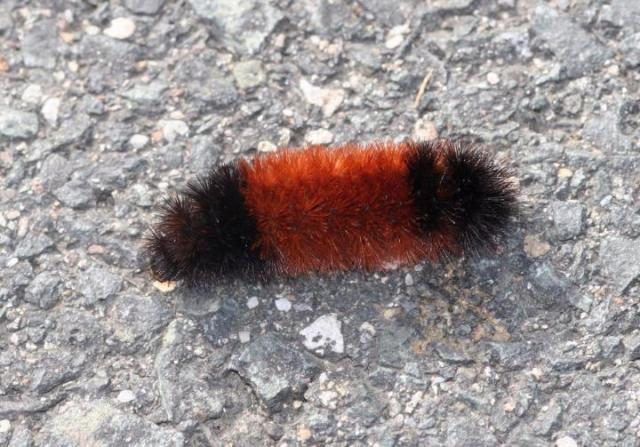
Wooly Bear caterpillar may predict snow. Then again, they may not. Credit: Harriet Wallis

Wooly Bear caterpillar may predict snow. How do they do that?
Credit: Harriet Wallis

Wooly Bear caterpillars are cool dudes. Their fuzzy bodies are black at both ends and orangish in the middle.

Winter enthusiasts examine that orangish band to learn what the coming winter will bring. A narrow band predicts a cold winter with precipitation. A broad band foretells a warm winter.

The bug’s celebrity status began in 1948 when Dr. C. H. Curran, a curator of insects at the American Museum of Natural History in New York City, gathered the critters and took measurements trying to correlate the width of the band to the weather.

He did this for eight years. Perhaps Wooly Bears were a good excuse to get out of the city in the name of science.

Wooly Bears are found throughout the country, but they’re more prevalent in the eastern states.

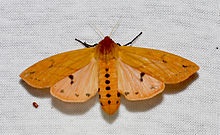
Wooly Bear produces Tiger Moth which predicts weather, maybe. Credit: Harriet Wallis

Winter forecaster Wooly Bear produces a Tiger Moth. Credit: Harriet Wallis

The caterpillar is the larval from of the rather bland Tiger Moth (Pyrrharctia Isabella).

I know old time Vermonters who use a different method to predict the winter. They sit on the porch and count how many loads of firewood go by.

There are other folklore methods. If the weeds grew extra tall in summer, it means a snowy winter. And ample acorns and apples with thick skins predict a cold, snowy winter.

Please excuse me now. I’m going to look for some Wooly Bears and bite into an apple.

Read more about skiing and from Harriet Wallis at www.skiutah.com

Retail Drop In: Three Shops Make Recommendations For Seniors

[Editor Note: It’s buying season, and we know from our reader surveys that many senior snow enthusiasts are looking for new gear and clothing.  We decided to do an experiment and drop into three different ski shops in three different parts of the country to ask, “What’s hot for seniors?”  That means, what stands out this year for seniors that’s comfortable, safe, and convenient?  Here’s what we found shop owners recommending. Thanks to our participating shops for talking with our correspondents Harriet Wallis, Yvette Cardozo, and Mike Maginn.]

FROM THE ROCKIES: Two Innovative Boots Rock The Scene With Features Seniors Want.

Correspondent Harriet Wallis visited Lift House Ski Shop near Big Cottonwood Canyon in Salt Lake City.
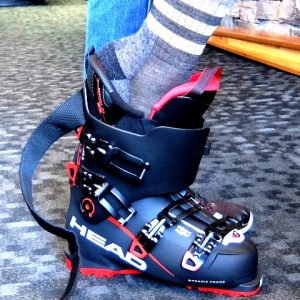
Head's Easy On boot. Credit: Harriet Wallis

Head’s Easy On Boot. Credit: Harriet Wallis

Look ma, no hands!

Head made a slight change in the inner cuff of the Head Vector 110. Skiers can easily slip into the boot—no contortions or yanking needed. You can even push your foot in while standing.

“I skied the boot and had good control even though it’s softer than a race boot,” said Luke Larsen, a ski racer and owner of SLC’s Lift House. Price: about $499.
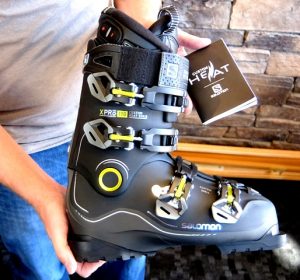


Salomon Boot With Heat. Credit: Harriet Wallis

Salomon Boot With Heat. Credit: Harriet Wallis

Toast your tootsies.

At last, integrated boot heaters make their debut in Salomon Custom Heat. Until now, boot heaters had to be retrofitted into boots, and the bulky battery packs clipped onto the shell.

“This makes the heated boot less expensive than buying boot and buying heaters separately,” said Larsen.

Price: Boot with integrated heat about $749.


FROM NEW ENGLAND: Bindings, Heaters And Snowshoe Bindings

Correspondent and co-publisher Mike Maginn spoke with shop owner Matt Thibeault and manager Chris Woods at Sports Stop Wenham on Boston’s North Shore.
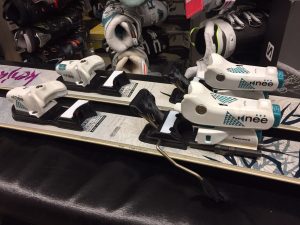
The Knee binding releases at the heel as well as the toe. Credit: Mike Maginn

The Knee binding releases at the heel as well as the toe. Credit: Mike Maginn

“Seniors Are Searching Out This Binding.”

Matt said the Knee binding is being sought by seniors. “It is designed to release laterally at the toe and the heel,” an important safety feature for many seniors. “The binding doesn’t sacrifice performance either,” said Matt, “but you do have to designate a right and left ski.” The Knee binding retails for about $379.
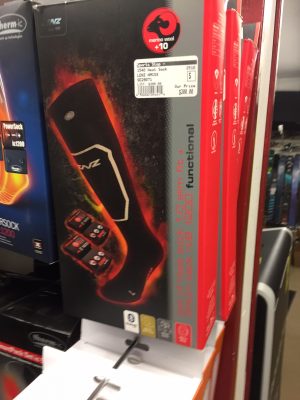


The world needs a Bluetooth-controlled heated ski sock. No? Credit: Mike Maginn

The world needs a Bluetooth-controlled heated ski sock. No? Credit: Mike Maginn

Heated Socks Are Getting Smart.

We know that heated socks are, mmm, cool, but when Matt and Chris showed us two different approaches to keeping toesies warm, we were impressed.  Lenz has a battery-powered, heated sock that, get this, is Bluetooth-controlled by a Smartphone app.  Turn the temp up or down by flicking the screen. Knee high, these socks are $300.

Therm-Ic Supermax Set has a different approach with an thin insert that slips into your boot sole and a connection to a battery pack with three heat settings.  It’s a real plus for seniors with circulation issues.  Retail price is about $220.
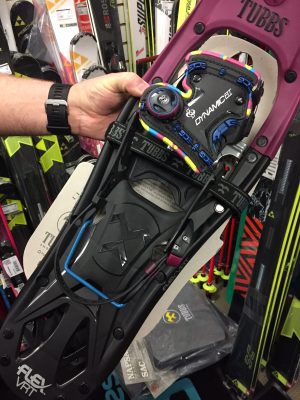


Boa closure system: Turn the dial, tighten up. Credit: Mike Maginn

Boa closure system: Turn the dial, tighten up. Credit: Mike Maginn

Finally, An Easy On-Off Snowshoe Binding.

We are so happy that snowshoe binding designers have come up with this one.  The new Boa system binding is much easier to use than the old tug-the-ties models.  You just put your foot in the toe and turn the Boa binding knob. To get out, you twist it the other way.  This example is on a Tubbs snowshoe model.  At last. Various models, starting at $189.


FROM THE PACIFIC NORTHWEST: Pin Tail Skis For Seniors And More Heat

Correspondent Yvette Cardozo talked to Kevin Dreher, ski shop manager at Gerk’s, a ski chain in western Washington.
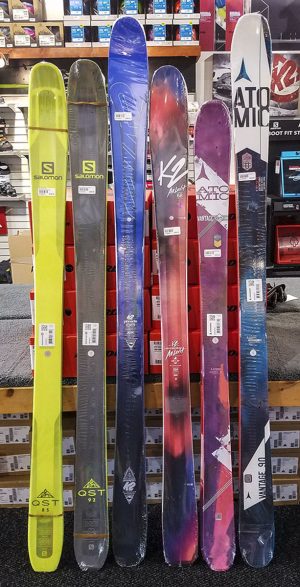
Examples of tapered tail skis. Wide shovels, slightly narrow waists but tails that don't flare out as much as classic shaped skis do. Credit: Yvette Cardozo

Examples of tapered tail skis. Wide shovels, slightly narrow waists but tails that don’t flare out as much as classic shaped skis do. Credit: Yvette Cardozo

Compromise Ski Shape

A lot of older skiers grew up skiing on skinny skis with their feet close together (picture Stein Erickson), Dreher said.

For some, learning to break that habit has been hard.  Still, modern tech in the form of shaped skis has made the sport so much easier.

So enter the compromise, the pin tail shape ski.

It still has a wide shovel and a more narrow waist but the tail tapers, so it’s not quite so wide, not so much an hourglass shape.

This, said Dreher, does two things: allows a skier to keep his/her feet closer together and also, if they are tired, to slightly skid the turn. But it also has all the easy skiing benefits of shaped ski tech.

It’s not brand new technology but seems to be getting more popular lately, perhaps as a segment of the ski population has gotten older.

Dreher mentioned two brands in his shop that have tapered tails, Salomon and Atomic. Salomon’s QST 85 and 92 run $400 and $500 respectively. The more expensive ski is aimed at a more aggressive skier.

Atomic’s Vantage also has two models, the 85 and 95, again $400 and $500 retail.

[Editor Note: These skis are on SeniorsSkiing.com /realskiers.com’s list of ski recommended for seniors.]
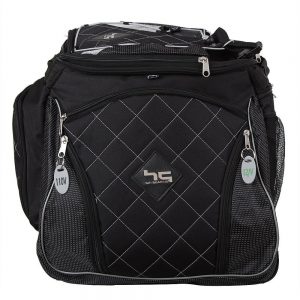
 

Better shop now for this. They sell out pretty quickly.

Better shop now for this. They sell out pretty quickly.

And More Heaters

Then, we get to my favorite: the heated (yes, heated) boot bag.

Don’t you just love driving hours to the hill and then trying to wrench stone cold boots on?  Now, there’s a boot bag with a cord that works on either AC (house) current or DC (your car).

One version of this bag is made by “Hot Gear,” but appears to be sold as Zip Fit through Amazon.com for about $200. Another version, Transpack, is sold for about $180 through Amazon and REI.

But honestly, you can also get those disposable foot warmer packs and do as the patrollers do, put them ON TOP of your toes instead of under them. Take it from one with chronically cold toes, that works.


Top Picks From The Outdoor Retailers Show

Improve Your Balance, Wear The Newest Fabric And Protect From The Sun.

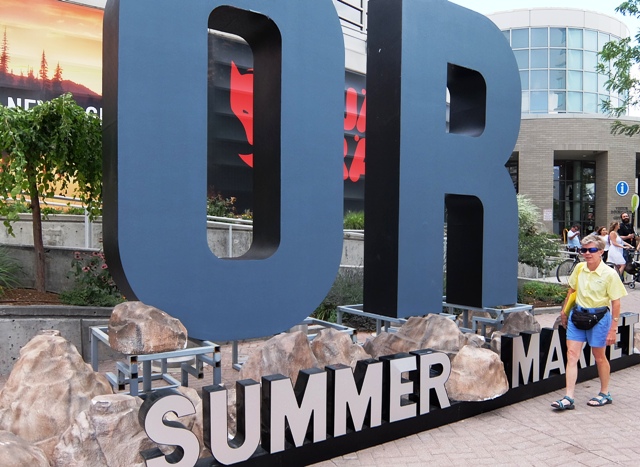
Outdoor Retailers Summer Market is a huge trade show in SLC. Credit: Harriet Wallis

Outdoor Retailers Summer Market is a huge trade show in SLC.
Credit: Harriet Wallis

Outdoor Retailers Summer Market Tradeshow is the largest show of its kind in the U.S. where manufacturers strut their products and retailers place orders for next year. The massive show has over 1,500 exhibitors, and it covers acres within Salt Lake City’s convention center.

A few passes are issued to media writers and photographers—such as SeniorSkiing.com. That’s how I got in.  Here are some of the most interesting senior-oriented products I discovered.

Get balanced. Take it from Louis Stack, you can age gracefully if you keep your body’s balance. This former Canadian speed

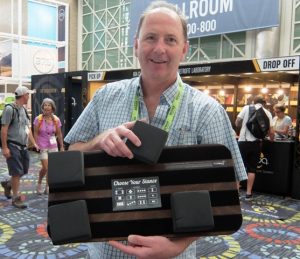
Stack with his stand up desk trainer. Credit: Harriet Wallis

Stack with his stand up desk trainer.
Credit: Harriet Wallis

ski champion—clocked at 127.33 mph—crashed at a pinnacle of his career, and it destroyed his knee and both feet. In the pits of his adversity, he was determined to restore his health, his balance and his race career.

And so he invented the first ski cross trainer which he lugged from race to race around the world, using it to fine tune his balance and stay fit. Athletes loved it. Physical therapists loved it. So this racer-turned-inventor went on to create the “wobble disc” trainers and other balance boards for all levels of athletes. He now has gentle balance trainers for those who stand at workplace desks. Check Stack’s website Fitter1.com here.

“Maintain your balance and you’ll age gracefully,” he says. “It’s like brushing your teeth. You have to do it to prevent problems.”

My chiropractor has Stack’s “wobble disc” and I love using it. I teeter on it and sharpen my skiing balance. But until the recent Outdoor Retailers show I had no clue who invented the disc or why. Now we know.

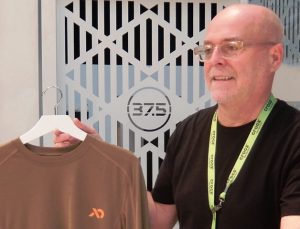
37.5 VP Tim Rogers describes the new high-tech yarn. Credit: Harriet Wallis

37.5 VP Tim Rogers describes the new high-tech yarn.
Credit: Harriet Wallis

Newest fabric technology. Another top find at the show is a thermo-regulating high tech yarn/thread called 37.5. Instead of wicking away moisture after you sweat, it carries away vapor before you sweat. By regulating the body’s temperature, elite athletes’ performance increases as much as 26 percent.

“It’s in the DNA of the yarn,” says Tim Rogers, a company VP. 37.5 is being woven into high end athletic wear as well as Kenneth Cole men’s business suits. Nobody wants to sweat during an important business meeting.  Click here for more on the 37.5 technology.

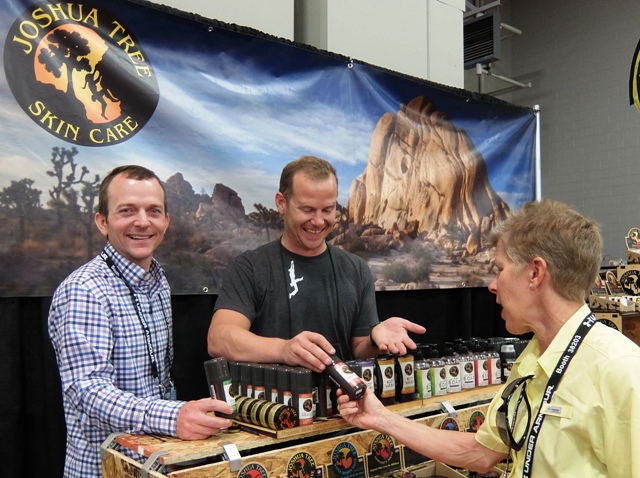
Sun protection. Joshua Tree sunscreen isn’t new, but its zinc content makes it work really well, and it doesn’t feel gooey. It doesn’t advertise and it’s not sold in mass market retailers, so you’ll find it in specialty shops such as Christy

Joshua Tree products now include sun and "after-sun", and arthritis creams. Credit: Harriet Wallis

Joshua Tree products now include sun and “after-sun”, and arthritis creams.
Credit: Harriet Wallis

Sports. In addition, it has branched out into after-sun care and also arthritis cream.  Click here for a store locator.

Nifty Back Stories:

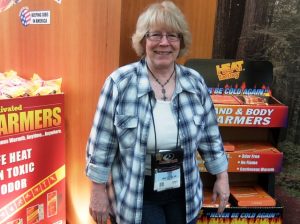
Heat Factory founder Chris Treplow at the show. Credit: Harriet Wallis

Heat Factory founder Chris Treplow at the show.
Credit: Harriet Wallis

Stay warm. Chris Treptow grew up in Wisconsin and knew what cold weather was. When she attended Badger football games, she and other fans would stuff newspaper into large trash bags, step into them and pull them up around their waists to fend off the brutal cold. She went on to found Heat Factory, the air activated hand and body warmers company.

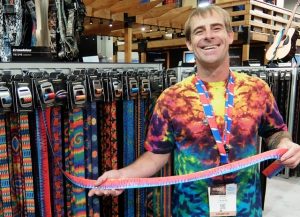
Belts, dogs, guitars. Croakies woven belts include hundreds of designs for all

Tie-dye artist Jeremy Strebel displays a Croakie belt. Credit: Harriet Wallis

Tie-dye artist Jeremy Strebel displays a Croakie belt.
Credit: Harriet Wallis

sports. As a fisherman, I love the trout designs. It also has dog collars and guitar straps. The company hired tie-dye artist Jeremy Strebel to design that line of colorful belts.

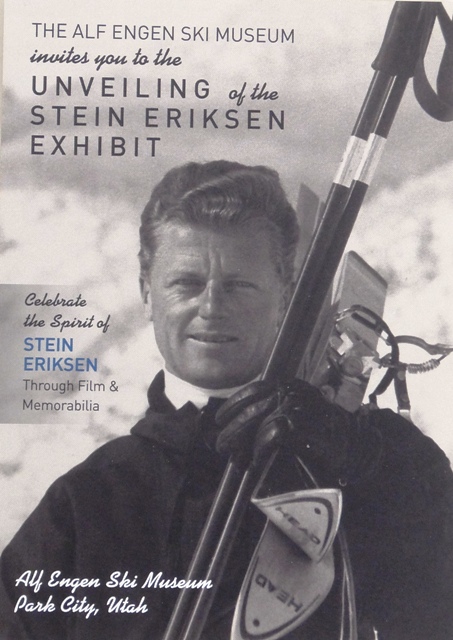
Stein Eriksen: Secret Tales Of His Life

The Ski Industry Remembers His Humor And Tenderness.

Iconic Stein Eriksen was famous for his stylish and graceful ski turns. Generation of skiers tried to mimic him. “Stein made the turns we all wish we could make,” said Tom Kelly, vice president of communications for the United States Ski and Snowboard Association. “Everyone who met him came away with a life-long experience.” He passed away in December, 2015.

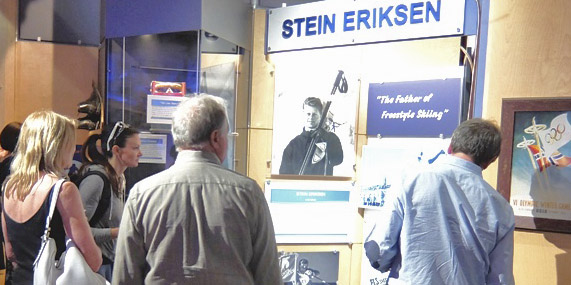
The Alf Engen Ski Museum in Park City opened the Stein Eriksen exhibit this month. Credit: Harriet Wallis

The Alf Engen Ski Museum in Park City opened the Stein Eriksen exhibit this month.
Credit: Harriet Wallis

Stein was honored by ski industry leaders on Wednesday at the unveiling of the Stein Eriksen exhibit at the Alf Engen Ski Museum in Park City, Utah. And they told secret tales of his life.

Stein was dedicated to his family and to the community, said Bob Wheaton, president and CEO of Deer Valley Resort. “If you needed a hand, Stein was right there.” And he had a whacky sense of humor.

We were at a party that was a bit stale, Wheaton said. Stein went to the food table, scooped up a dollop of whipped cream and put it on his nose. Then he went around the room meeting people – with the glop of white on his nose.

Wheaton recalls more of Stein’s humor. He would often introduce himself saying, “Hi. I’m Stein. It’s so nice for You to meet Me!”

Russ Olsen, CEO of the five-star Stein Eriksen Lodge, recalled Stein. “I skied with Stein once. Actually, I rode up the lift with him.” We got off the lift, he took off, and I never saw him again the whole day. He could ski anything at 90 miles per hour, without a hat, and when it was 40 below.

And he really could ski anything. With his athleticism to spun and flip, he became a father of freestyle skiing.

Stein's skis and and racing bibs from the 1954 Olympics are on exhibit. Credit: Harriet Wallis

Stein’s skis and and racing bibs from the 1954 Olympics are on exhibit.
Credit: Harriet Wallis

Stein enjoyed the meeting the guests at the Stein Eriksen Lodge, which was also his home. He would go from table to table in the dining room and personally welcome the guests. He loved doing that. Solemnly, near the end of his life, Stein had hopes of returning to the Lodge and told Olsen to let guests know he would be back.

The exhibit includes a video of Stein skiing and his skis and bibs from the 1954 Winter Olympics where he earned three medals. His trophies and medals are on exhibit in the lobby of the Stein Eriksen Lodge.

………………………………..

About the Alf Engen Ski Museum. It’s an interactive museum where you can take a selfie in a bobsled, try your luck in a slalom race game, learn about snow and avalanches, see ancient skis and glimpse ski pioneers. The museum is free, and there are free self guided tours of the Olympic Park.

The Olympic Park was the 2002 Winter Olympics venue for ski jumping and it continues as a premier training facility. During the summer there are youth camps and you can watch kids learn the sport. They soar off the actual Olympic jumps and land in a pool of bubbling water to soften the impact.

In addition, for a fee, there are freestyle shows, bobsled rides, extreme summer tubing, an alpine slide, a zip line, and a ropes and adventure course and so much more.

The Olympic Park and the Alf Engen Ski Museum are “must sees” when you’re in Park City.

Stein was a graceful athlete throughout his life and the father of Freestyle Skiing. Credit: Harriet Wallis

Stein was a graceful athlete throughout his life and the father of Freestyle Skiing.
Credit: Harriet Wallis

Holy Cow! Harriet’s Got Two New Hips!

How To Be A Good Friend While Your Friend Heals.

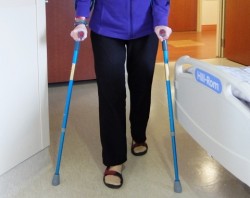
Harriet is getting back in shape after hip surgery

Harriet is getting back in shape after hip surgery. Harriet Wallis

Like many seniors, I’m rebuilt with mechanical parts. For me it was two knees and now it’s two new hips. I’m a heap of stainless steel.

While my hips learn what they’re supposed to do, I’m mostly stranded at home with a lot of pain, inability to do what I usually do, and boredom.

People good-naturedly say: “If you need something, call me.” But you can go one step further in being a good friend to someone who just had a joint replaced.

Give help.

I grew up as a New England Yankee – self sufficient and self reliant. I just won’t call somebody for help. Your friend might have a similar outlook.

Call your new-joint friend and announce.

Don’t ask – just announce that you’re coming on Wednesday to do a useful task such as: run the sweeper, move a chair onto the patio, or clean a bathroom. New joints don’t bend, stoop or swivel very well. And they’re quick to swell up. Some tasks are really hard for us to do.

Create an outing.

Another option is to call your new-joint friend and announce that on Wednesday you’ll drive him/her out for coffee, go to the park for some sunshine, or go to the grocery store.

For me, just because people see that I can walk, talk and smile does not mean that I’m back to normal. Not by a long shot. We who have new joints can use some acts of kindness and help even though we don’t ask for them.

Editor’s Note: SeniorsSkiing.com’s long time correspondent, Harriet Wallis has written about many topics since this online magazine started. She’s just won the SkiUtah Journalist of the Year Award for the second time. She wrote about her decision to replace her knees and documented her recovery in a series of articles that are a “must read” for anyone contemplating this operation. Now with two new hips, we know she will be working back to top shape with the same courageous vigor she demonstrated before so she she can enjoy the outdoors again

Harriet Wallis Hailed As Ski Utah’s Journalist Of Year

It’s The Second Time Harriet Has Won This Award!

Harriet Wallis is a veteran journalist who regularly skis the resorts around Salt Lake City. She is a long-time corresponent for SeniorsSkiing.com.

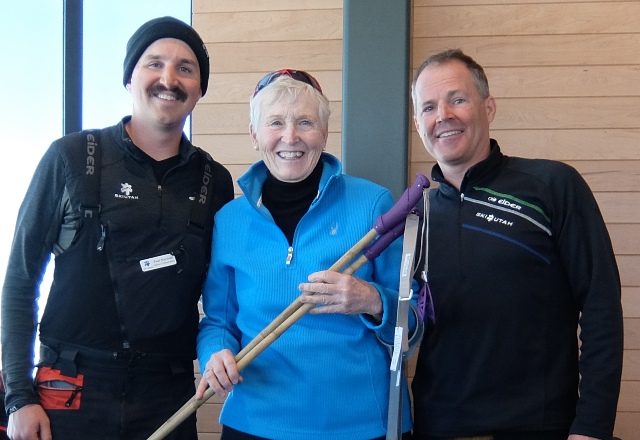
Ski Utah Communications Director Paul Marshall (left), Harriet Wallis, Ski Utah Director Nathan Rafferty. Harriet is a veteran journalist who regularly skis the resorts around Salt Lake City. She is a long-time correspondent for SeniorsSkiing.com, and we are so proud of her accomplishment. Credit: Pam Weisberg

Harriet Wallis earned Ski Utah’s top award – Journalist of the Year – for outstanding and consistent ski stories and photos about skiing in Utah.  She’s had 64 stories and 71 photos published this year in a variety of publications, including SeniorsSkiing.com.

It’s the second time she’s earned the award. The first time was for the 2010-11 ski season. This award is for the current 2015-16 season.

Journalists from magazines, newspapers and TV were also nominated. Harriet is a freelance writer and photographer. The award was announced at Snowbird on Friday.

Stretching vs Dynamic Warm-Ups

Are you tuning or terrifying your body?

Correspondent Harriet Wallis bribed son Cal, daughter Alison, and best ski buddy Laurie to demonstrate warm ups at the top of a Deer Valley lift. Credit: Harriet Wallis

Correspondent Harriet Wallis bribed son Craig, daughter Alison, and best ski buddy Laurie to demonstrate warm ups at the top of a Deer Valley lift.
Credit: Harriet Wallis

Some experts say stretching before exercise helps performance and lessens injuries. Others say stretching can cause damage.

So what should you do?

“Skiers who stretch at the top of a lift are crazy!” says Jo Garuccio, a PSIA Examiner, Snowbird ski instructor and Triathlon World Champion. “They’ve been on a cold lift and then they’re going to stretch? That’s absolutely nuts!” she exclaims.

Really good warm ups in ski boots include swinging arms, swinging legs and marching in place, Garuccio says. Get the blood flowing.

Recent studies concur. Static stretching done cold without a warm up hurts the performance of weight lifters and competitive athletes.

Okay. Case closed. Warm up at the top of the lift before you even think about doing something else.

But when I Googled “dynamic stretching” and also “dynamic warm ups” I found – ironically – that the images were virtually the same for both. So it seems it’s your responsibility to ask your body: “Am I getting juices going, or am I straining cold muscles?”

On a humorous personal note, my best ski buddy would stand at the top of the lift and wiggle this way and that. I don’t know if she was warming up or stretching. Nevertheless, she was glued in place until she finished her routine. If it was a powder day I was frantic. “Hurry up. We’re wasting fresh snow,” I’d grumble. She finally learned that fresh powder trumps wiggles.

[Editor Note: Our recent poll revealed 60 percent of our respondents did some kind of stretching, 40 percent didn’t.  Here is an LA Times article on stretching that amplifies Harriet’s point about getting the blood flowing through an “active warm-up”, i.e., moving around a lot.  Short duration, static stretches are just an add on to the moving around part.  But experts certainly haven’t reached consensus.  For a collection of short, light stretches, look here.]


SeniorsSkiing Guide: Deer Valley Sets The Gold Standard

It’s the Deer Valley Difference.

Deer Valley at the top with a view of Jordanelle Reservoir. Credit: Harriet Wallis

Deer Valley at the top with a view of Jordanelle Reservoir.
Credit: Harriet Wallis

When Deer Valley opened 35 years ago, it was a novel concept to commit to top notch service in skiing, dining and lodging. Today it’s the gold standard.

The resort is known for its impeccable grooming, incredible dining and attention to every detail. Senior skiers really like that.

How to start your day right. Uniformed valets will unload your equipment at slope side. No need to schlep it.

Ride the open air shuttle to the day lodge. Save your energy for the slopes.

Enjoy secure basket checking with unlimited access so you can change layers throughout the day.

You’ve been pampered, and you haven’t even reached the slopes yet. Little things really do mean a lot.

“We’re committed to excellence in everything we do,” says Bob Wheaton, resort president and general manager.

Where should I start? It’s a big resort with four peaks and 101 trails. If you’re an intermediate or advanced skier, you can take a complimentary ski tour with a Mountain Host and find new runs and learn about the resort’s history. You’ll discover powder stashes that you’d never find on your own.

Outdoor patio dining in high altitude sunshine at one of 12 DR restaurants. Credit: Harriet Wallis

Outdoor patio dining in high altitude sunshine at one of 12 DR restaurants.
Credit: Harriet Wallis

Lunch time. Deer Valley has 12 restaurants, including outdoor dining patios, plus five evening restaurants right at the resort. A lunch favorite is the signature Deer Valley turkey chili. I especially love the Natural Buffet with its exotic salads and hearty breads.

Terrain. Deer Valley’s manicures more than 60 trails nightly from gentle slopes to its long steep runs. But it also has gnarly mogul fields, glades and ungroomed powder. Take your pick.

When your legs fall off, check your skis at a complimentary ski check station. Then relax in a beach chair on McHenry’s sunny “beach”.

Don’t miss this. When you’re ready to wind down the day, take the Last Chance beginner trail to the base and enjoy the trailside sculptures at homes along the way. They’re absolute must-sees.

One of the many raccoon sculptures along the trail side houses near the base run out. Credit: Harriet Wallis

One of the many raccoon sculptures along the trail side houses near the base run out.
Credit: Harriet Wallis

One home is plagued by mischievous raccoons. They ski off the roof, snooze on the railing and look uphill through binoculars. My favorite skiing raccoon is the one that went splat when he hit the house.

A family of life-size bronze elk stand trailside at another home. There’s also a bear house, a totem pole house and a mountain goat house. The charming critters add a bonus to a great day on Deer Valley’s slopes.

Just the facts

  1. Easy access. Just 40 minutes from Salt Lake International Airport.
  2. Skiers only. Deer Valley is for skiers only. It does not allow snowboards.
  3. Dining: 12 restaurants including five evening restaurants right at the resort. My favorite is the Seafood Buffet.
  4. Limited lift tickets. To enhance your experience, Deer Valley caps lift ticket sales to limit lift lines and lodge lunch lines ,and it opens up lunch seating.
  5. Grooming. The resort has 101 runs from four mountain peaks. Over 60 runs are groomed nightly.

2015-16 Bottom Line

A day ticket is $85 for those 65+, but on holidays it’s $92. A season pass is $1,195 for those 65-71, and it’s $1,085 for those 72+. However, mid week season passes are $1,085 for all who are 65+. There’s a pre-season discount for those who buy season passes early. And locals are eligible for reduced prices. Click here for more Deer Valley information.

Trail Map

Web Cam

McHenry's sunny "beach", absorbing the bennies and waiting for the surf to come up. Credit: Harriet Wallis

McHenry’s sunny “beach”, absorbing the bennies and waiting for the surf to come up.
Credit: Harriet Wallis