Tag Archive for: SeniorsSkiing.com

Group Or Private XC Lesson?

Here’s What The Experts Say.

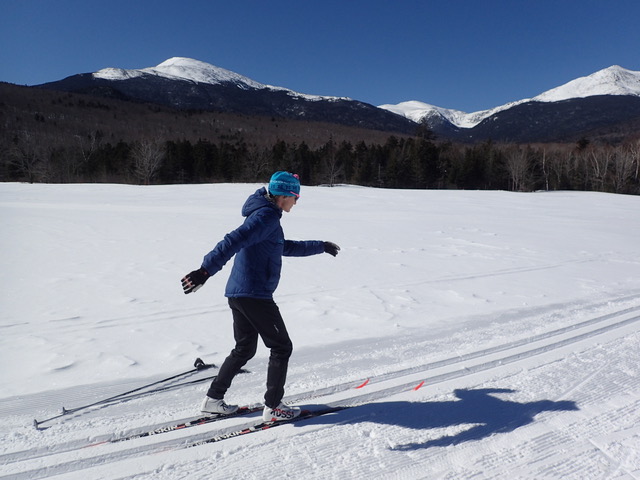
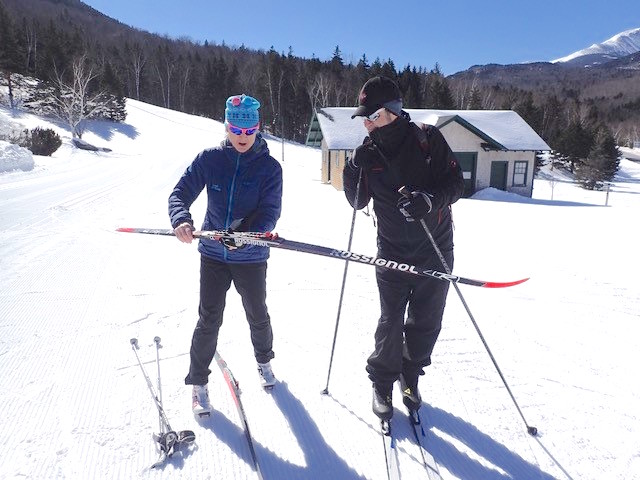
Olympian Sue Wemyss, instructor at Great Glen Trails, NH, gives a student some tips on adjusting bindings. Credit: Roger Lohr

Let’s say you want to learn how to cross-country ski relatively quickly and easily: How to move with grace and minimal effort, develop endurance, and enjoy what you’re doing from the git-go.

Well, it’s going to take time on skis to develop that self-assurance, balance, and muscle memory (though kids can do a lot of that with amazing ease); but the surest shortcut to becoming a good xc skier is to take several lessons or clinics – not just one – with a professional instructor.

I’ve wondered for years what’s the simplest way to speed up the learning-and-fun process for people of any age, not just us perennials: group lessons or private instruction. Figuring that it would help to ask the pros, I contacted three renowned Nordic instructors/coaches/ski school directors. They all have long strings of credentials, but a quick overview: Emily Lovett is co-director of the famous West Yellowstone Ski Festival’s XC Ski Camp in Montana;and Scott McGee is a celebrated cross country, telemark, and alpine instructor, trainer, and examiner in Jackson Hole, Wyoming; JoJo Toeppner has run two XC areas in California at Royal Gorge and Tahoe Donner. They’re experts not just at technique but also at communication and accelerating the learning curve.

They explain that there can be a bunch of factors involved in your choice, ranging from expense to self-consciousness.

All three experts agree that cost can be a factor. Emily makes the point that group lessons can be really fun and meaningful as you learn from each other and bond through a shared experience. She adds, “I think taking a private sometimes depends on if you like having more of a one-on-one experience and attention.” She adds that a group lesson involves some willingness to be open to others’ abilities, questions, and learning styles, which can be fun and interesting.

In a group lesson, you learn from other students and through repetition. Credit: Jonathan Wiesel

Scott comments, “When your goals are specific enough, or if the price difference isn’t an issue, private lessons give you the tailored experience that is most likely to meet your goals and be targeted at your abilities.” JoJo feels that “It’s much more expensive to take a one-hour private where everything is charged separately (ticket, rental, lesson, as opposed to a 75-minute discounted package). But privates can be customized to what the student wants if there’s a specific need, such as mastering hills, corners, or stopping, while groups cover a little of everything.”

Scott feels that a group lesson is a great way for new skiers to meet people, plus they’re easier to book than privates. He says, “Nordic centers most likely have a beginner lesson once or twice a day. As skiers progress, up through intermediate level, there are many undiscovered breakthroughs waiting to happen. Small improvements to efficiency and effectiveness take time to integrate into technique. So multiple group lessons at a beginner-ish level can provide great value as long as repetition (“Here’s how you put a ski on”) is not an issue.”

It sounds like above intermediate level, the likelihood that a group lesson will meet your goals decreases. One great exception to this is the fall “camps” with multiple groups for different ability levels, like the West Yellowstone Ski Festival or Silver Star Mountain Resort in BC, which see dozens of senior skiers among participants each November.

Fast and happy trails to you!

Miss Tweedie Goes Skiing In Norway

Was ever anything so vexatious?”

One of the most enthusiastic English Victorian tourists who made a ski trip to Norway was Mrs. Alec Tweedie, author of A Winter Jaunt to Norway (1893). Not only did she sketch a vivid picture of Norwegian skiing equipment, technique, and terrain, but she also reported on the second-ever Holmenkollen Day events.

Mrs. Tweedie, then a young widow, travelled with her sister to Christiania (now Oslo) where they were met by her brother and a friend, then joined by “Herr Schmelck, one of the best skiløbers in Norway.”

Never having skied before, she decided to try it. As it turned out she loved skiing, which she described as “one of the most exhilarating and enchanting sports in the world . . . [which] bids fair to become a fashionable winter amusement for English people.”

Her description of the gear used at the time:

“An ordinary-sized man’s ski are eight or nine feet long. They are about four and a half inches wide and an inch at the thickest part, immediately under the foot, but towards either end they taper to half this thickness. . . . In the middle the toes are fastened by a leather strap. Another strap goes round the heel in a sort of loop fashion, securing the foot, but at the same time giving the heel full play.

Although Mrs. Tweedie’s description of her “ski costume” included “short skirts, reaching but little below the knee . .  .[worn over] thickly lined black knickerbockers,” the commercial photo used as a frontispiece in the book shows her skirt going right down to the ankles. The photo also reveals that the skiers used just one pole for control and balance.

Their first attempt at skiing was frustrating:

“We struggled on to the incline of the hill. Hardly had we arrived there, when off started the ski, taking us unexpectedly along on them. The pace increased each yard of the way, until over we went, dejected bundles, into several feet of snow. Was ever anything so vexatious?”

As the English tourists gained more confidence, they took a ski tour to a saeter [mountain pasture], staying in a log cabin, and working on their form, assuring the reader that “No amount of tumbling in Norwegian snow would ever give as much as a bruise. It is like falling into sand or flour, and one has only to have a shake to be as dry as if nothing had happened.”

On their last day in the mountains the determined Brits even organized races:

“We tried who could steer most equally between two given posts with only a few inches to spare on either side of the ski. Then we raced in couples, which nearly always ended in some frantic spill. Oh, how we fell over, and how we laughed and enjoyed ourselves, while the way we improved was marvelous!”

Herr Schmelck remarked, “Why, there is nothing you English ladies will not dare,” a kind observation considering that the local expert had surely seen many Norwegian ladies expertly skiing since their childhood.

A Banner Winter Through The Camera Of An Average Skier

Harriet’s Album Of Deep, Deep Snow Pics At Brighton.

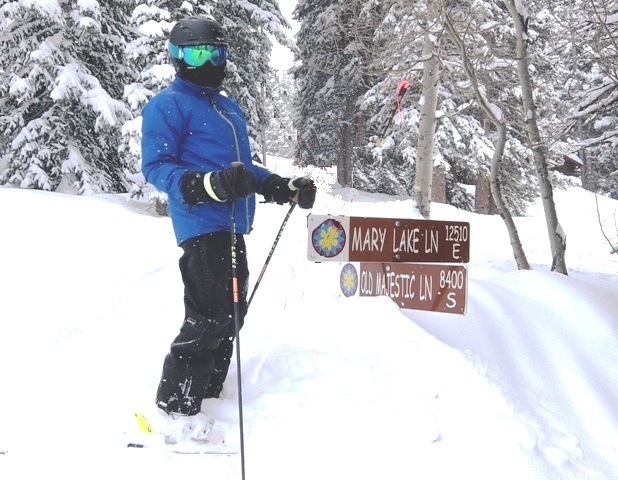
Beware of the buried street signs at the corner of Mary Lake Lane and Old Majestic Lane. The summer road became a deep snow ski trail. Credit: Harriet Wallis

At my home resort Brighton, the snowfall has topped 500 inches—about 41 feet—and the snow keeps coming. Brighton is a down home, low key resort near Salt Lake City that’s favored by families and snowboarders.

This two-story trailside cabin has an access problem. Must dig down deep to find the door. Credit: Harriet Wallis

One more snowstorm and this cabin will disappear. Bamboo poles and a rope line keep skiers off the roof. Credit: Harriet Wallis

Plentiful snow is crucial because It’s our drinking water supply, and there have been several years of low snowfall. When Spring runoff starts, every drop of melting mountain snow is captured. It takes just 24 hours from stream to faucet. Dogs are banned from the canyon watersheds to help keep the pure water free from transmittable diseases.

Just before one of those plentiful snowstorms, my friend and I booked a room at the slope-side Brighton Lodge so we could be first on the mountain in the morning.

Inside the cozy Brighton Lodge. Credit: Harriet Wallis

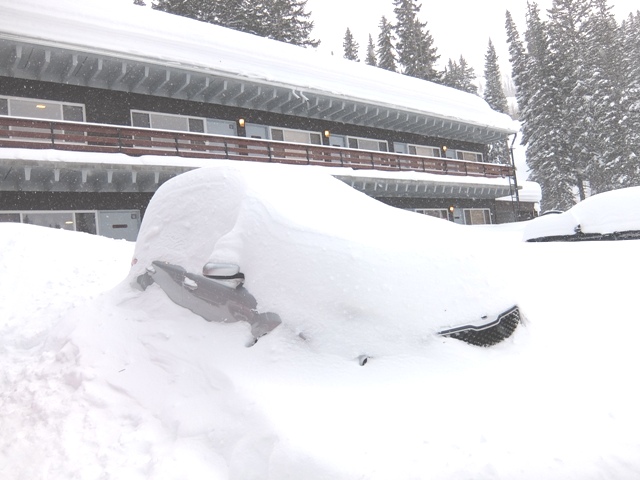
It snowed all night. We skied all day. Then we had to cope with the car.

Outside the Brighton Lodge. Deep snow is fun until it buries the car. Credit: Harriet Wallis


Snowboarders dug it out. Credit: Harriet Wallis

The ample winter also creates some other quirks at Brighton.

While the snow keeps falling, these father and son skiers pitch in to help dig out the gates. Credit: Harriet Wallis


The children’s warming yurt looks more like an igloo. Credit: Harriet Wallis


The parking lot is walled by snow. Where will they put the next storm’s dump? Credit: Harriet Wallis 

Even the ride down the canyon toward home has rewards. Deep snow drives the peak-loving mountain goats down to lower elevations. It’s a treat to see them so close.

Shaggy coats and quizzical looks. Credit: Harriet Wallis

To read more from Harriet click here for her stories on SkiUtah.

SeniorsSkiing Guide: Sunapee Goes Epic

Seniors Can Still Get A Mid-Week Pass At A Big Discount Before April 14.

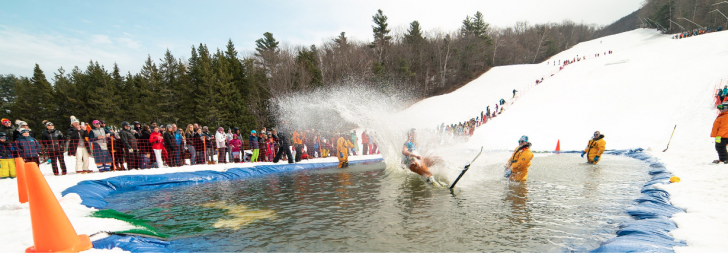
Skier falling into slush cup

It’s that time of the year. Sunapee celebrates spring with a splash. Credit: Sunapee

Sunapee in New Hampshire went Epic this past winter, joining Stowe and Okemo, Vt., as Vail Resort’s three footholds in the East.

Sunapee draws many locals from neighboring towns plus a hefty day crowd from the Boston area. Parking lots fill up early on weekends. Midweek warriors descend on discounted Wicked Wednesdays. Many get there early, lap the Sunapee Express Quad, and leave by lunch.

Skiers disperse to two base lodges—the older, funkier Spruce Lodge (no stairs to reach it) with wood cubbies stuffed with lunch coolers, and the roomier Sunapee Lodge at the Sunapee Express Quad. A shuttle truck precludes schlepping from one to the other, connected by The Beach—a popular spring picnic spot.

Sunapee got jolted out of state-strapped limbo when the Mueller family took over operations in 1998 and worked the same wonders here as they had at nearby Okemo. Robust snowmaking (97 percent) and grooming make Sunapee a reliable area even when snow in the woods is sparse.

Off the South Peak learning area is where the Muellers secured rights to build the West Bowl Expansion, and Vail may or may not follow through. Locals are happy about more trails but skeptical of condos and some dead set against disturbing the old growth forest here.

As a mid-sized area, Sunapee has 66 trails that are varied and full of character. For scenery, ski down the Skyway overlooking a snow-covered Lake Sunapee for one of the best views in New England. Follow the woods down the ungroomed Williamson Trail, or skip through the trees in Sunrise Glades. Get an adrenaline kick down Blast Off and bounce off the moguls on Upper Flying Goose. The terrain park attracts a group of kids who grew up there together. Epic or not, Sunapee will always be Sunapee.

The Muellers’ parting gift to skiers was a high-speed quad commandeered from Okemo in the Sun Bowl. Previously one had to think twice before shooting down here knowing one was facing a slow ride back up, especially in a blizzard.

Although many people ski here for the convenience, less than two hours from Boston, the area truly is a place to stay awhile. Long a summer haven with its many lakes, the Sunapee area has a happy sense of continuity. Skiing segues into swimming and sailing. The ski area has zip lining, mountain biking, adventure course, and summer camps. The satellites tend to stick around—Bob Skinner’s ski shop at the Rotary, Bubba’s Bar & Grille in Newbury, Peter Christian’s Tavern, New London Inn, Dexter’s Inn, Colby-Sawyer College, familiar spots all.

Ticket buyers this year buy an EpicDay pass, a direct-to-lift card that they can reload on line. Until mid-April closing, a day ticket cost counts in the purchase of next year’s Epic Pass.

Epic Local Pass for $699 (19 plus) accesses 30 resorts and is unrestricted at Mt. Sunapee and Okemo. Epic Pass for $939 (ages 13 up) has access to 65 resorts including Europe and Japan. Buy at the Epic Pass site.

For its loyal seniors, Sunapee still offers a midweek pass. Seniors (65-69) is $429 and Super Senior (70 plus) is $279, if bought before April 14. Those prices increased slightly but now include ten discount buddy and six ski-with-a-friend passes. Call or stop at Guest Services (603) 763-3576.

Click here for Sunapee Webcams

Click here for Sunapee Trail Map


A less-than two-hour drive from Metro Boston, Sunapee has beautiful blues, views, and lots to choose. Credit: Sunapee

This Week In SeniorsSkiing.com (Mar.22)

Odds & Ends, W.S. Merwin, Ski For Light Part 2, Schneider Cup, Resort Reviews, BC Resorts Love Seniors, Mystery Smithy, Crazy Ski Ads.

Spring Arrives Tonight.

This week, there’s yet more snow in The Sierra, and a Nor’Easter in the East, leaving piles of it everywhere. There are clearly opportunities for extending the season well into the summer. The question is: When do you put away the boards? When you have to switch to rock skis? When you have to take the cover off your boat? When tennis brackets are formed? When you’ve had quite enough of skiing, and it’s getting a bit old? If when to call it a season is a decision point for you, imagine what resort managers go through.

The dilemma for ski resorts everywhere is when to close for the season. As long as the demand is there, then why not keep the lifts spinning, the trails groomed, the burgers flipping? But what if the vast majority of late season skiers are pass holders, that is, not paying for tickets, rather flashing an RFID? Hmmm. Ultimately, there is a cross-over point between income, cash flow, and expenses that will form the basis for the decision. Or, do some resort managers keep a perhaps scaled-down operation going to serve those few ardent customers who keep coming, despite an almost empty parking lot?  We’re curious how the closing-day decision is made. Is it different between mom-and-pop local areas and corporate properties? Any thoughts?

As for SeniorsSkiing.com, we will continue publishing into the Spring, for sure.  However, next week, we are taking our Spring Break, a week off for travel, vacation, and a change of pace.  Our regular next edition will be published on April 8; individual articles will be available earlier that week.

Ski For Light.

This week, we are publishing Part 2 of a series on Ski For Light, the non-profit, all-volunteer organization that conducts a week-long cross-country ski experience for blind, visually- and mobility-impaired people. Part 1 is a skier’s story, describing what one blind skier’s experience is. In Part 2, a 25-year veteran guide explains why he keeps coming back.

Perhaps you have some time on your hands as a retired person, or you know someone who is visually-impaired and want to support them. Volunteering, donating, or becoming a SFL guide are worthy, soul-expanding opportunities. We’ve met a couple of SFL participants—skiers and volunteers—and can testify that it can be a transformative experience. Think about it. Click here to find out more. 

Find A NGS Benchmark: Another Outdoor Activity You Can Do With Your Grandkids.

A National Geodetic Survey benchmark. There are 400,000 scattered across the country. Credit: NOAA

Here’s an idea for those spring hikes with your grandkids, fat bike rides in the woods,  or last-gasp cross-country ski outings. NOAA’s National Geodetic Survey is encouraging people to head to the local hinterlands to find “benchmarks”, collect data, and send on to NOAA. It’s called the GPS on Benchmark project. If you bring your grandkids, you will be teaching how data is collected in the scientific world. For a podcast on the GPS on Benchmark project click here.

A benchmark is a permanent mark or disk that is embedded in the ground or attached to a structure. Each benchmark has a known elevation and location that is used as a reference for maps,  charts, and surveying.  There are over 400,000 benchmarks located in all areas of the country, installed over the past 200 years.  Anyone can visit the bench mark of their choice, record field notes, take digital photos, and collect GPS observations or coordinates and then use online tools to send the information to NOAA.

Remember geocaching? This is the same idea, except your target is a benchmark, and your role is to collect data. You can find benchmarks in your local area by heading to the National Geodetic Survey Data Explorer and entering your zip code.  We were surprised to find NGS benchmarks scattered throughout our neighborhood.

Click here for instructions on how to participate in the process, what equipment you can bring, and where to send your data. 

Whiskey In A Ski Pole. What A Novel Idea.

From the world of inspired ideas turned into unusual products comes the WhiSki pole for your consideration.  This product is a ski pole that is also an eight-ounce flask for a liquid. From the name, you’d assume whiskey. Think of the whiskey pole as serving the same function as that brandy barrel around the neck of the classic St. Bernard.  We would have surely loved to have been at the time and place where this idea came out of the firmament. Must have been a fun time. The WhiSki pole has a screw-top in the handle where your choice of beverage is poured in as well as where you, um, drink from. There is a clear warning label in fluorescent orange that admonishes you not to drink and ski, but there are other times when the WhiSki Pole comes in handy.  See the video below for examples. For the skiing friend who has everything, click here for more information.

This Week

Co-Publisher Jon Weisberg continues his reports from the Italian Alps with this update on his week skiing with our advertiser AlpSkiTour in the Aosta Valley.

We honor the passing of American poet and conservationist W.S. Merwin this week with his poem, A Contemporary.

This mystery skier is finally identified after 50 years.

A new Mystery Glimpse comes from the New England Ski Museum. Guess who this Smithy lady is.  Last week’s photo of the helmeted ski racer on the cover of Sports Illustrated is revealed, and we share another photo taken at the same time.

Correspondent Don Burch has some fun with ski advertising, Tamsin Venn reports on the Hannes Schneider Cup, held at Cranmore Mt, NH, Yvette Cardozo describes how BC ski resorts show their love of senior skiers, and Marc Liebman praises a favorite, Utah’s Solitude Mt. Pat McCloskey takes a side trip to June Mt, CA, and is pleasantly surprised.

Thanks again for supporting SeniorsSkiing.com and please tell your friends. There are more of us everyday and we aren’t going away. See you in a couple of weeks.


Ski For Light: Why A Guide Keeps Coming Back

[Editor Note: This article was written by Robert Civiak, a 25-year Ski For Light volunteer guide. It previously appeared in the Ski For Light Bulletin, Summer, 2018. For Part 1: A Skier’s Experience. click here.]

Start of the end-of-week race at Ski For Light.

Part 2: A Guide’s Story.

In 1992, after several years of bad snow in the mid- Atlantic region, I signed up to go to Colorado for a week to be a guide for Ski For Light. At least I would get to ski on some good snow. Well, I have missed only two years of guiding since then. The reason is simple. I like it. No, that is wrong—I love it.

Why do I love it? It took me some soul searching to figure that out. I have to admit that it does feel good to help other people, but most of my reasons are more selfish. Of course, even feeling good about yourself for helping people is selfish, but here are the real selfish reasons why I love being a guide.

Volunteer SFL guide Bob Civiak has been helping blind XC skiers for 25 years.

First and foremost, I love cross country skiing. Going to Ski for Light forces me to make time in my life for a full week of skiing no matter what. But I could go skiing for a week without being a guide, so there must be something else. A major reason at the beginning was that I liked racing. I was never a successful competitive racer and when I started SFL, I was already in my mid 40’s and so my prospects for winning races did not look good. However, in my first year, I guided Janice Newman, and she was the first woman finisher in the 10K race. Boy, was that a rush. My second year was even better, I guided Laura Oftedahl to first place overall, finishing ahead of several Norwegian men. That was my peak success as a racing guide. I was hooked.

I am no longer able to guide the fastest skiers at SFL, but still thoroughly enjoy guiding and take great pride in doing it well. Now my competitive juices are stoked by helping skiers who want to ski better than they have before. In 2017, I helped Ron Baron, who had never skied 10K, reach that milestone on Thursday. The next day, race day, he did it again, but was 30 minutes faster. I vicariously shared Ron’s sense of accomplishment and took pleasure in the look on his face when we finished, but I can’t deny how much I enjoy the personal triumph of being a good teacher and spurring him on to do his best.

Is there something more at SFL? We all know there is. The atmosphere at our events is totally unique. I have never been in a more supportive and positive environment. For 51 weeks a year, I tend to be a little cynical, to see the glass as half empty, and to fret about where the world is heading. I simply can’t do that at SFL. I get caught up in the passion of everyone helping everyone else, hugging, and spreading positive cheer. All of the glasses at SFL are at least half full, if not brimming over. People are there to have a good time and won’t let anything spoil that. As I’ve heard from SFL leaders, “If you cut through it all, SFL is just one big party.” What’s not to like about a big party.

After 25 times at SFL, I have made dozens (if not hundreds) of good friends. By now, I would be going if for no other reason than to have a good time with my friends. On top of that, I get a new person to guide and to bond with each year and form a new friendship.

Blind skier Chris Leghorn (l) and her guide. Chris has been attending SFL for 19 years. Credit: Pam Owen

But there are even more things I love about SFL. Before I came, I never could have imagined the personal inspiration I would get from spending time with people who refuse to let their disabilities keep them from achieving remarkable things. I am not only talking about skiing. There’s also sit skiing, traveling, finding their way around hotels, running meetings, and organizing the event. I am amazed at the lawyers, scientists, business owners, consultants, entrepreneurs, judges, teachers, bankers, and high level government workers I have met at SFL. If even a tiny amount of SFL’s motto— “if I can do this, I can do anything”—has found its way to me, I am a winner. SFL blind people take minor adversities completely in stride. Bump into a pillar—don’t complain—that just becomes a reference for future navigation.

I have left my most selfish and embarrassing reason for last. Of course I have learned that every blind person is unique and has their own mind, wants, and desires. As a guide, I respect and support that; however, when we are walking and they are holding my arm, or when we are skiing and I am guiding, they depend upon me, and I am leading the way. I never had children, and the idea that someone would rely on me and allow me to make decisions about their safety and well-being is something that I revel in. I have several other reasons I like being with blind people. They tend to be open, honest, unpretentious, vulnerable, free to ask for help, appreciative of things that I can do easily, and willing to help me when they can.

There you have it. I don’t consider myself a do-gooder. Rather, I like skiing, I take pride in being a good guide, and I like to be in charge. I also like being appreciated and hugged, getting a vicarious thrill from other people’s achievements, and getting caught up in the magical positive spirit of SFL. All of that, and seeing my good friends, is why I keep coming back.

Click here to donate, volunteer, or become a guide at Ski For Light.


Mystery Glimpse: This Lady Created The First…

…What?

Hints:  New Hampshire. She went to Smith. Her husband’s last name was the name of the creation.

Credit: New England Ski Museum archive

Many thanks to the New England Ski Museum, now with an Eastern Slope branch in North Conway, NH, in addition to their home base at the foot of the Cannon Mountain gondola, Franconia.

Last Week

Lots of clues here. Who’s in the speed suit?

Yes, Buddy Werner is the skier on the cover of the January 27, 1964 edition of Sports Illustrated, harkening the Winter Olympics, held that year in Innsbruck, Austria.  At the time, Werner was a vibrant, new personality in the ski world, a Steamboat native, and a persistent competitor. Werner, as many senior snow sports people know, went to the 1964 Winter Olympics with Billy Kidd and Jimmie Heuga, but never placed. It was just after the Olympics that Buddy joined other athletes filming a movie in Switzerland, produced by Willy Bogner, the fashion designer. He and German racer Barbi Henneberger were lost in an avalanche during the production.  He was only 28.

What makes this photo so interesting to me is that I had a similar photo tacked above my desk at SKIING Magazine, One Park Avenue, NY, NY. That was in 1970. The photo which you can see below, you have to agree, is pretty dramatic, an airborne downhill racer coming full on, in helmet and speed suit. There was no identification on the print as to who it was or when it was taken. I always wondered.

Last week’s photograph from the Tread of Pioneers Museum archive, triggered a response. I rifled through several old files, and there it was. That old picture matched the cover shot of Sports Illustrated, but obviously a different frame from the shoot.  It been taken at the same on-hill session as the cover photo, and somehow a print made its way to SKIING magazine’s offices, where I commandeered it, and pinned it to the wall. When I went on to other things, I took it with me, and it’s been around ever since.  And here it is.

After almost 50 years, we now know this is Buddy Werner.

Selling Skis: 50 Years Of Gibberish

Remember Lange’s “Soft Inside”?

Now this ad turned a few heads back in 1969. Credit: Lange

I get it. It’s not easy to sell skis. With so many advances in ski design, there are tons of great skis out there. So how does a brand differentiate their products from others? Just like they always have, advertising and marketing. This means slogans, endorsements, performance claims, use of exotic materials and “systems” and of course, transference (associating the product with being sexy, unique, rugged…See Lange boot ad above.)

Sprinkled in among the gibberish is useful information such as amount of rocker, turning radius, profile, and such. But most of it is nonsensical, indecipherable, and unintentionally amusing.

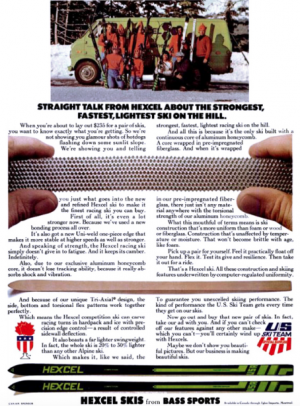
Back in the 1970s, some Fischer skis had wooden cores “made up of finely-cut laminations of lightweight African Okoume”. Rossignol skis were touted as “the greatest moment-makers that ever smoked the slopes”. Regarding one of their skis, Hart stated, “If you’re a swinger who skis for the sheer fun of it, Jubilee is your baby”.

Hexcel had a honeycomb metal core. Credit: Pugski

In the 1980s, Hexcel skis had an “aerospace-proven honeycomb/prepeg technology”. Atomic advertised that their skis had a new “Hy-Vitronic System” and Dynastar skis had a “metal ‘omega’ rib for torsional stiffness”. Not to be outdone, Molnar skis had a “unique Prismatic construction consisting of two channeled fiberglass blanks mated along the ski’s neutral axis”.

In the 1990s, Tyrolia urged buyers to go with Tyrolia skis because you’ll be with a “fast and smooth crowd.” Rossignol asserted that their skis are “limited only by your courage”. Meanwhile K2 had a ski with “TRIXIAL SYSTEM 3” which “balances flex, torsion and lateral deflection”.

In the 2000s, Salomon skis had “hard elastomer transmitters”.  Atomic had skis that had “the reviewers drooling, so if you want a pair, you’d better jump”, and Rossingnol had the “Powerpulson System”.

In the 2010s, Head race skis only began “to work at speeds that would get your ticket pulled.” Volkl hawked a ski that was “just a little piece of heaven in the big scheme of things, but heaven nonetheless”. Atomic promoted a ski with “double-deck construction”. The two decks were “joined by rubbery fasteners.”

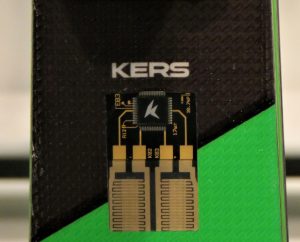
And, nowadays, little has changed. Some Volkl skis have “Multi Layer reinforced wood core, powered by titanium and UVO (Ultimate Vibration Object)”, and high-end Head skis have KERS. This “technology works like a turbo charger that provides additional power and acceleration by stiffening the tail of the ski in out turns. The effect: a boost, catapulting the rider into the next turn. Just like when Formula 1 pilots push a button for that extra notch of speed.”

Kers, whatever that is. Credit: Don Burch

I have a pair of Head skis with KERS, and I love them. Of course, I have no idea whether KERS has anything to do with my liking the skis, but I’m hoping next year they’ll have a button I can push for that speed boost!

History Lives At Cranmore Mountain

Celebrating Hannes Schneider, A Pioneer Of Alpine Skiing In North America.

Jubilation at the vintage fashion show at the Hannes Schneider Meister Cup. Credit: Tamsin Venn

Every year, the Hannes Schneider Meister Cup Race, sponsored by the New England Ski Museum and Cranmore Mountain, NH, celebrates the legacy of the venerable Austrian ski instructor. For 23 years, the Cup has drawn people to Cranmore from all over to race or just cruise on this low angle dual slalom course on the Alley, where the old Skimobile ran up.

Schneider and his wife arrive via train at North Conway, greeted by his new employer banker Henry Gibson, owner of Cranmore. Credit: NE Ski Museum

This year’s March event poignantly marked the 80th anniversary of Schneider’s arrival via the Eastern Slope Express 7 a.m. Feb. 11, 1939 at the railroad station that still sits in downtown North Conway.

Any major ski resort in the US would have been thrilled to hire Schneider as ski school director, but he chose to make Cranmore his home. His family followed him into the ski business and now four generations of Schneiders are part of the family narrative.

At the recent festivities, great grandson Hannes Schneider dedicated a plaque to his grandfather, Herbert Schneider (Hannes senior’s son), who served in the 10th Mountain Division and also owned Cranmore from 1963-84. His goal had been to make sure every kid in the valley had a chance to learn to ski.

Instructors from Army’s Mountain Warfare School stand to attention at beginning of festivities. Credit: David Eden

The organizers went all out. The weekend started with a reception and hearty dinner at Zip’s (Hannes’ nickname) Pub & Grill and torchlight parade. It continued Saturday morning at Cranmore’s base with dedication ceremonies, a vintage ski fashion show (one winner rifled through her mother’s closet for an award-winning outfit), silent auction, awards ceremony, bratwurst and beer, all serenaded nonstop by the oompah music of the Bavarian Brothers Band. One felt quite transferred to Austria, instead of a quaint  North Conway. All proceeds went the New England Museum, the goal being to preserve the rich ski history in this region.

Schneider’s story is an intersection of politics and skiing. Here’s the short version.

Hannes Schneider ran a ski school in St. Anton Austria, where he promoted the new Arlberg technique and helped bring important tourism business to the region. As a high-profile critic of Hitler, he drew ire from the Nazi party who threw him into prison. With the intervention of a German skier friend who was also an attorney, and Harvey Gibson, an influential American banker, Hannes eventually found refuge in the US where Gibson set him up as ski school director at the new snow-train-served resort Gibson opened in North Conway.

For competing in the Ski Meister Cup, or any ski race, here’s general advice for seniors. If it’s a fundraiser for a worthy cause, it’s easier to justify having more youthful competitors heartlessly whiz by you on a parallel GS course.

In North Conway, visit the Eastern Slope Branch of the New England Ski Museum, opened only a year ago, a companion to the one in Franconia.

Click here for more on skiing at Cranmore Mountain.

Click here for Cranmore’s website.


SeniorsSkiing Guide: June Is A Pleasant Surprise

In The Shadow Of Mammoth, June Mt. Features Dramatic Views.

June Mt has the views, plenty of groomed blues, and lots to choose. Credit: June Mt.

One of the most beautiful drives in ski country is from Carson City, NV down Rt 395 to Mammoth Lakes, CA.  Passing Mono Lake and making your way through the passes that are open in the winter yields some of the most breathtaking views in the country. 

As we made our way down 395 this year, we called an audible to swing on to the June Lake Loop on Highway 158 through June Lake to the June Mountain Ski Resort owned by Mammoth Mountain.

We had never skied June before, and stopping there gave me my 110th different area on my list. Providing  wide open, groomed  intermediate terrain with some nice glade skiing due to ample snow fall this season in the Sierras, it was a delightful pause to our tour of Tahoe ski areas, finishing at Mammoth Mountain.  Not every day needs to be a hammer fest with maximum vertical feet quests and skiing the tough chutes and cornice drops that are typical with our hard charging senior group.  The day at June was a welcome break to ski some delightfully groomed runs with low angle glade skiing mixed in.  

June has a seven lifts, 41 trails, and about half are rated advanced, the other half blues and greens. The resort boasts 70 percent sunny days during the season. Rainbow Summit is at 10,ooo feet and views are spectacular. From there, you can run down Silverado, June’s longest run (two miles), to the mid-mountain chalet.

June has a mid-mountain “base” chalet as well as a base at the base. Credit: June Mt.

Perhaps the most visible benefit of  the visit to June was the incredible scenery.  Sitting at the enclosed deck for lunch, we were treated to vistas that reminded me of the great views of the Alps.  The sharpness of the clear day vistas were enhanced by what seemed to be a close up and personal look at the most dramatic mountain peaks  in the Sierras.  As beautiful as the Minarets are from the top of Mammoth, the vistas from the top of June rivaled their big brother.  Although there are no senior lift ticket discounts per se, the schedule of ticket rates are similar to Mammoth with a base price of 119.00 per day at June versus the 182.00 tab at Mammoth.  If you order on line, you can receive up to 20% off for one day tickets and as much as 40% off for visits and purchases of 5 days or more. June and Mammoth are also on the Ikon Pass. 

The town of June Lake is a little sleepy in the winter with the exception of the June Lake Brewing Company on main drag of Crawford Ave. Exceptional IPAs and other selections that are a staple for the outdoor set in the June Lake area. During the week, you basically have the place to yourself with no lift lines and quiet, scenic relaxing runs.  We always make the Mammoth Lakes area a staple on our visits to the Sierras and the detour to June Mountain should not be missed by any skier venturing down 395. 

Click here for June Mt. trail map.

Click here for June Mt. webcam.

June Lake provides a view as well as plenty of summer activities. Credit: June Mt.

Snow In Literature: A Contemporary

By W.S. Merwin (1927-2019)

What if I came down now out of these
solid dark clouds that build up against the mountain
day after day with no rain in them
and lived as one blade of grass
in a garden in the south when the clouds part in winter
from the beginning I would be older than all the animals
and to the last I would be simpler
frost would design me and dew would disappear on me
sun would shine through me
I would be green with white roots
feel worms touch my feet as a bounty
have no name and no fear
turn naturally to the light
know how to spend the day and night
climbing out of myself
all my life

SeniorsSkiing Guide: Solitude

New England Trails With Western Snow.

Solitude management loves seniors as reflected in ticket prices and lodge access.

I love skiing Solitude Mountain Resort for its wide range of trails for all levels and ages of skiers ranging from wide-open trails to steep, narrow trails that remind me of skiing Stowe, Mad River Glen, and Sugarbush. All the parking is right out front of the Moonbeam Lodge or Solitude Village.

Management loves senior skiers, and it starts with when you arrive. Mid-week senior lift tickets are $75 and much cheaper if you buy on-line.

Solitude opened in 1957 and is roughly 30 miles up Big Cottonwood Canyon from the heart of Salt Lake City. Like many ski areas, it has had its share of ownership changes. Deer Valley bought it in 2014 and in 2017, Deer Valley and Solitude were acquired by Alterra Mountain Company. Alterra owns 14 resorts including Aspen/Snowmass, Mammoth, Tremblant, Snowshoe, Steamboat, Stratton, and Squaw Valley.

Nice blue groomers as well as steep glades. Credit: Solitude

Mother Nature dumps 500 inches of snow on its 79 named runs on 1,200 skiable acres. The top is 10,488 feet and the base is 7,994 which give one 2,494 vertical feet accessible by 10 lifts. It is easy to find your way around the mountain, and you never have to climb or walk between lifts. Forty percent of the terrain is intermediate and 50 percent is rated for experts. There are two base areas—Solitude Village and Moonbeam—and, if you are a day skier, park at Moonbeam so you can walk up about twenty-five easy steps or take an elevator in the lodge.

From the Moonbeam lift, you can yo-yo off on beginner and intermediate trails or ski to Eagle Express. It opens up glades that take you to the Powderhorn lift. Or, you can ski Inspiration, Rumble, Grumble, Stumble, Serenity, and Challenger and enjoy the steep rolling contours that both challenge and keep you smiling all the way down. I’ve skied all of them in knee-deep powder and frozen granular. No matter the conditions, after each run down you want to hurry up for more.

If you like steep slopes through the trees, take Summit Express to the top. It gives you access to the far side of Honeycomb Canyon as well as a long, wonderful combination of intermediate runs called Dynamite and Mine. Or, you can traverse along the ridge and ski Parachute (you may think you need one, but you don’t) and Milk Run (i’ts not).

On the mountain, the Roundhouse has a restaurant and bathrooms on entry level and upstairs. accessed by elevator. No stairs! The same for the Moonbeam base area. The menu at both Roundhouse and Moonbeam is typical ski area fare, reasonably priced (for a ski area) and tasty (trust me, I’m picky). There are restaurants in the small Solitude Village along with condos to rent.

So let me repeat what I said in the beginning, I love Solitude. Every time I ski in the Salt Lake area, I spend at least two or three days there.

Click Here For Solitude Trail Map

Click Here For Solitude Webcam

Author Marc Liebman makes Solitude a regular stop when in Utah. Credit: Solitude

This Week In SeniorsSkiing.com (Mar. 15)

Italian Alps, Ski For Light Skier, Mystery Irishman, Great Glen, Personal Knee Story, Winter’s Spring.

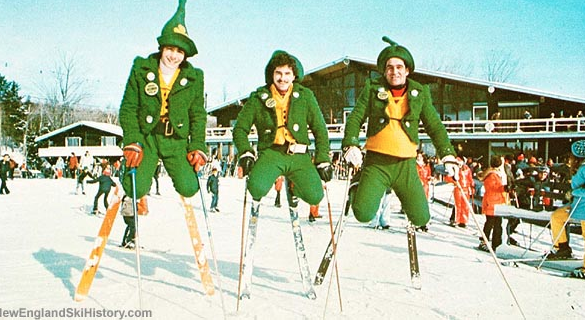
Brodie Mt, home of “Kelly’s Irish Alps” was where St. Patrick skied in Western Massachusetts. Credit: New Ski History.

Happy St. Patrick’s Day, formerly the unofficial beginning of spring skiing.  But this year we aren’t so sure. Winter isn’t going anywhere.

This week’s Mystery Glimpse reveals the story behind the Hard Pak Puliverizer, the ingenious ice grinder machine invented by Jim Kelly, owner-operator of Brodie Mt.  From the mid-60s to the end of the 90s, the resort was celebrated as having the longest vertical in Southern New England and as headquarters of Kelly’s Irish Alps. The Celtic-themed resort hosted robust St. Patrick’s Days each year as this picture shows. Today, you can find green eggs and Guinness at Mt. Snow, $17 lift tickets at Waterville Valley, pot-of-gold treasure hunting at Alpine Meadows, bagpipers at Breckenridge, and fun everywhere. It used to be that St. Patrick’s Day signaled the start of spring skiing. But this year, winter is certainly going on. And on. Read on.

Guaranteed Snow Till Summer For Some Resorts.

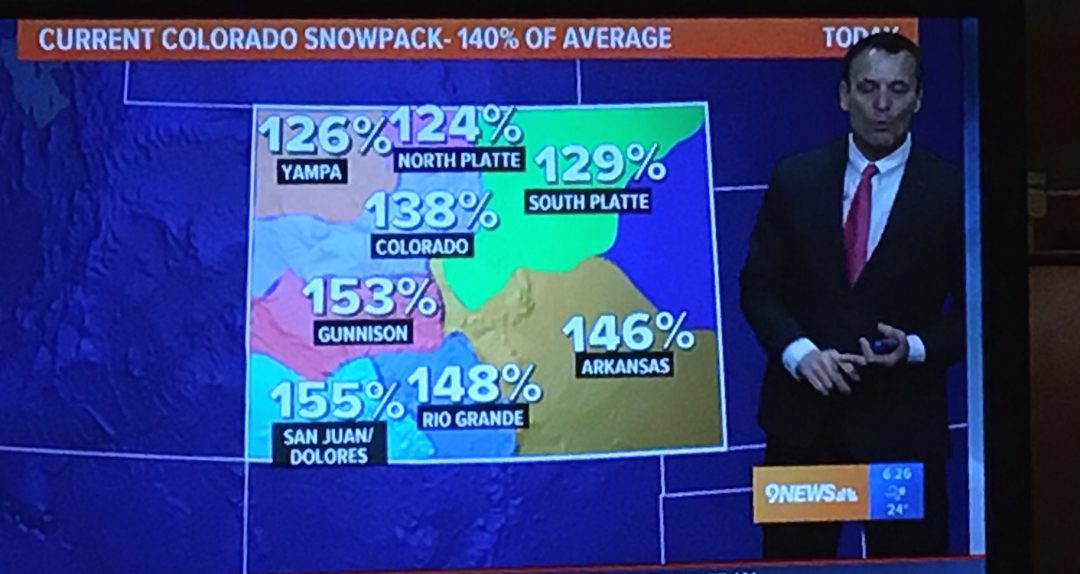
In case, you missed it, there is a snowagedden in Colorado. Credit: Joe Durzo

Indeed, the snow just keeps coming, despite the start of spring. In the Sierra, in the Wasatch, in the Rockies, there are biblical levels that haven’t been seen in decades. An “atmospheric river” is loading moisture-rich air from the Pacific to dump on Tahoe, Mammoth, and the other Sierra resorts. As you can see, the Rockies are full up and overflowing. So much snow in the mountains has caused deadly avalanches; 18 skiers have died so far this year. The snow that fell in the Rockies in October—that early snow—has provided a slippery base for new layers to fall on and eventually slide from. You’ve probably read about I-70 being closed by “natural” avalanches. As we write this, a “bomb cyclone” blizzard is smacking Colorado with even more and moving east.

Skiers will remember this year as an exception. Or is it? Perhaps the climate change is really changing winter. The amount of moisture in the atmosphere from overheated oceans seems to the engine driving these phenomena.

As we mentioned a couple of weeks ago, there is something happening here. Enjoy the snow and the elongated season. But, paradoxically, remember that the ski industry is working hard to develop green energy and sustainable resources.

bThis Week.

Jon with world speed ski champ, Simone Origone and Andrea Jory, Alpskitour

Co-Publisher Jon Weisberg reports from the Italian Alps. His story shows us a snapshot of the Aosta Valley, where he is skiing with Alpskitour, local guide service and SeniorsSkiing.com advertiser.

We are starting an inspiring story about Ski For Light, a program for blind, visually- and mobility-impaired people who cross-country ski with guides. This week, we learn what a skier has learned about herself in taking part in the SFL events for the past 19 years.  Next week, we’ll hear from a volunteer guide who spends a week working with a non-sighted partner.

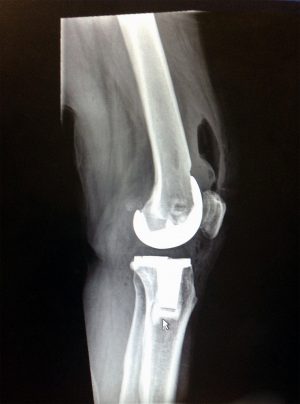
What a new knee looks like when it is all over. Credit: Bob Nesoff

Correspondent Tamsin Venn shows us another view of Great Glen Trails and the Glen House Hotel, NH. There is more to do at a winter resort than ski.  Find out by clicking here.

Veteran journalist and SeniorsSkiing.com correspondent Bob Nesoff gives us his personal knee replacement story.  He explains the importance of conditioning before the operation and the need to be rigorous about physical therapy after.  His story will undoubtedly create a lot of interest among readers.

Finally, we have published The Winter’s Spring, a poem by 19th century poet John Clare.  He doesn’t want spring to come, either.

Thanks for reading SeniorsSkiing.com. Tell your friends and remember, there are more of us every day, and we aren’t going away.


Jon and I are very grateful for the support we have received in our recent fund-raiser. All the premiums have been sent to donors, except for a small number of hats. We ran out!  More are coming soon.

Reporting From the Italian Alps

Italy’s Aosta Valley: Gateway to great skiing

Italy’s Aosta Valley is rich with history; even richer with places to ski. The Romans used the valley as a route to Gaul. In the intervening centuries, more than 100 castles were built. Starting in the early 1930’s, the Italians, the Swiss and the French started building ski lifts. They haven’t stopped.

The valley provides easy access to some of the world’s greatest ski resorts. At one end is Courmayer on Mont Blanc. Drive up a side canyon and you’re in Cervinia, on your way by lift and ski to Zermatt. Another short drive, and you’re at Monterosa.

We’re in centrally located Saint Vincent, a scenic and charming walking town, where every day we journey through scenic alpine villages to a different resort. 

Centrally located Saint Vincent

It’s only the second week of March, and Saint Vincent is beginning to bloom. We’re staying in the aptly named Hotel Bijou, a gem of a hotel overlooking the town’s central plaza. The main street is lined with colorful three and four story buildings housing attractive stores and restaurants specializing in Aosta’s regional cuisine. Just a few blocks in either direction are an elaborate mineral bath complex reached by funicular and a sizeable casino.

After a full day of skiing, we don’t have energy for either.

We’re here with the owners of Alpskitour, a local guide service and SeniorsSkiing.com advertiser. Mauro Cevolo has taught and coached skiing in Italy, Austria, France, New Zealand and the US (Mammoth). Andrea Jory teaches mostly at Cervinia and Champoluc. He was on Italy’s national bobsled team and competed in the 1980 Lake Placid Olympics. Both are magnificent skiers and highly enjoyable companions. They’re intimately familiar with the many resorts in and around the Aosta Valley, including the best places to ski and where to stop for a gourmet lunch in an authentic surrounding.

The author with world speed ski champ, Simone Origone and Andrea Jory, Alpskitour

Wherever  you go with them they’re warmly greeted. At lunch the other day, they bumped into Simone Origone who for 12+ years held the record for the world’s fastest man on skis (about 157 mph!).

An important benefit of staying in Saint Vincent over one of the resorts is the ability to decide, last minute, where to ski. The other day, when high winds had forced many of the resorts to shut down, we drove to the city of Aosta, boarded a gondola and climbed the mountain into magnificent mid-winter conditions at the Pila resort. Accustomed to Rocky Mountain resorts, Pila was a big surprise…emphasis on big. But it is small, relative to where we’d be going over the coming days.

La Thuile in Aosta Valley

The next day we drove past high-perched castles, ancient stone villages, and up a series of hairpin turns to reach Espace San Bernardo. We started at La Thuile, and after a gondola and a chair entered a landscape of endless peaks and glaciers. Following several long runs and more lifts, we crossed into France and descended to La Rosiere, another sizeable resort. After a few hours of skiing, we rode two long Pomas, crossed back into Italy and skied to Maison Carrel, where we lunched on regional cuisine in a modernized 19thCentury stone barn. I had cabbage soup topped with a thick layer of Fontina cheese, one of many Aosta Valley products exported across the globe.

Combined, La Thuile and La Rosiere have 39 lifts servicing something like 7800 acres of terrain, mid-sized for the Alps. Nonetheless, it’s size is slightly less than Whistler Blackcomb, North America’s largest.

Monterosa’s Champoluc-Frachey

The story gets better. Yesterday we drove to Monterosa’s Champoluc-Frachey and skied two of its three massive valleys. We started on a super-steep, rail funicular and throughout the day used cable cars, gondolas, and a variety of open and bubble chairlifts. This place is humongous. Looking up into remote snow fields were tiny specks skiing gondola-accessed backcountry. We stayed on trail, at one point dropping down a long and steep sun-drenched trail…my kind of skiing.

The West won this season’s snow lottery. Last year, that prize went to the Alps. Coverage is adequate at the moment and skiing is a lot of fun. If it were deep powder, I’d be able to enjoy a handful of runs before calling it a day. We’re probably skiing 15,000 – 20,000 vertical.

Today is a self-imposed rest day. We’ll visit some of Saint Vincent’s treasures and drive into the city of Aosta to see its Roman ruins. Tomorrow we’ll be back on another mountain. Which one is a decision Mauro and Andrea will make in the morning. One thing I know: it will be big, beautiful, and interesting. That’s what defines skiing in and around the Aosta Valley.

More on this fantastic ski experience next week.  

Ski For Light: A Blind Skier’s Experience

Part 1: The Skier

[Editor Note: We met Chris Leghorn in a local North Shore community acoustic music jam. She sang and played her Martin HD 28 with both gusto and gentleness, depending on the song. In talking with her, we learned she had taken part in 19 Ski For Light events since 2001 as a cross country skier.  She started going to Ski For Light just as she was starting to experience adult onset blindness. Her story is inspirational and certainly worth hearing. In Part 1, we will tell Chris’ story; in Part 2, we will hear from a volunteer guide. We interviewed Chris after she returned from the Ski For Light 2019 gathering which took place this year in Granby, CO.]

Ski For Light is an all-volunteer, non-profit organization founded in the US in 1975 and modeled after the Norwegian Ridderrenn, a program that teaches blind, visually-, and mobility impaired people to cross-country ski. Each year, the US-based organization holds a week-long cross-country event at a different host resort. About 240-280 people attend, 100 or so blind or visually-impaired, another 12-15 mobility impaired, and the rest volunteer guides and organizers, some of whom travel from Norway, the UK, China, and even Barbados for the event. Many of the attendees return to SFL year after year. Aside from coming to learn or just enjoy cross-country skiing and to grow in independence, the SFL gives blind or mobility-challenged attendees a chance to not think much about being disabled for the week. They are just another participant at the event. The motto of SFL is “If I can do this, I can do anything” describes the attitude that drives the organization’s mission.

Chris with her guide at Ski For Light. Credit: Pam Owen

SeniorsSkiing.com: Chris, how did you get involved with Ski For Light?

Chris: I had heard of Ski For Light in 2001 when my eyesight was getting worse. I read some inspiring articles about the event that motivated me to try it out.  I knew I needed to find a way to do things I loved with assistance.  So, I went to my first SFL that year when I still had some vision.

SeniorsSkiing.com: What attracted you to SFL?

Chris: To my knowledge, SFL is the only event of its kind in the US. Many Alpine ski resorts have programs for blind skiers, but SFL is unique in what it offers.  The program was imported to the US from Norway where the Ridderrenn provided an opportunity for blind people to enjoy the winter. [Note: The Ridderrenn or “Knight’s Race” was started in 1964 by Erling Stordahl, who is blind, when he found he could ski with confidence in the tracks of army trucks without being afraid of bumping into anything. That basic idea formed a framework for Ski For Light.]

I had skied in my college years and had lived on a farm where there was a lot of opportunity to be on skis and outdoors in the winter.  But, before SFL, I hadn’t skied in 25 years. I was always athletic and loved the outdoors, and I needed to find a way to do activities in a different way. I still am very active, despite my blindness. I also do long-distance cycling, hiking, and kayaking.  I have completed three Blackburn Challenges in my double sea kayak. I am always looking for people to participate in these activities with me. [Note: The Blackburn Challenge is a 20-plus mile, arduous ocean rowing race around Cape Ann, MA.]

SeniorsSkiing.com: What is it like to ski with a guide?

Chris and Guide placed in end-of-week race. Credit: Pam Owen

Chris: It is awesome. We are paired with a guide for the whole week. New guides are given some training before the event. Everyone learns a common language to use like “half-track right”, “tips left”, and things like that. But we also talk about how we like certain directions. For example, if we are turning, does the skier prefer degrees or hands of a clock for reference.  Or does the skier want constant feedback or just some communication before a big turn or terrain change. I like to rank hills according to steepness from 1-5 and also length from short to long, i.e., a “long three”.  This communication helps me accurately determine what’s ahead.

The skier and the guide ski side-by-side in parallel tracks about four to six feet apart. Some skiers, however. prefer the guide to be ahead of them, others behind.  Again, it’s a preference you have to work out together. Once you work out the communications, it’s a matter of just heading out and doing it.

Every year, I try to express the depth of my gratitude to my guides for giving so much of themselves so that I can have a beautiful week of feeling free on the snow. Their response to my gratitude is always, “We are the winners here.”

Skiers and Guide ski in parallel tracks. Credit: Pam Owen

SeniorsSkiing.com: What have you learned about yourself through SFL?

Chris: I’ve learned that I take my attitude about my blindness too seriously, or rather my fear of how I am being judged about my blindness. There are many amazing sight-impaired people at SFL, and, in their presence, I have learned to be more relaxed about who I am as a person with failing eye sight. There is an incredible spirit of positivity that words can’t explain at Ski For Light.

When I am cross-country skiing beside my guide, I feel so free because I am not attached to my [guide] dog or holding onto someone’s arm. It’s a freedom I don’t feel much anymore, and it’s very special.


For more information about Ski For Light, donating, volunteering, or becoming a guide, click here for the SFL website.


Mystery Glimpse: 1964 Racer

Who Do We Have In The Tucked Position?

Lots of clues here. Who’s in the speed suit?

Thanks again to the Tread of Pioneers Museum, Steamboat Springs, CO, for contributing this picture from its archives.

Last Week

If you recall, Brodie Mt was nicknamed “The Irish Alps”, because on St. Paddy’s Day it was definitely the place for skiers to be. It was also the domain of a creative, ingenious, leprechaun-like operator who invented a why-didn’t-I-think-of-that machine.

This is the famous ice grinder designed and manufactured by Brodie Mt.’s Jim Kelly in 1970.  The Ashford, MA ski area operator was a true entrepreneur, inventor, and eternal optimist.  When the winter delivered scarce snowfalls that turned whatever hard pack was left to block solid ice, Jim Brodie figured out a way to keep people skiing.  It was simple: Grind it.  That resulted, said Brodie at the time, in what was good enough to call “powder”. We have a feeling there was a bit of the Blarney stone stuck out there in the Berkshires.

Jim Kelly with a working Hard Pak Pulverizer which made “powder” from ice, according to him.

Brodie built what he called a Hard Pak Pulverizer, based on a debarking machine used at this dad’s lumber company. The heart of the concept was a rotating cyclinder with projecting metal teeth. After several failures over three years of experiments, Kelly found that a 100-horsepower Deutz diesel could handle the torque needed to make the cylinder turn hard pack ice into a skiable surface.

Ever the inventor, Kelly even came up with a home-grown snowmaking idea. When it was really cold, his crew would shoot water on the slopes, wait for it to cool, and give it the once over with the pulverizer.

Jim Kelly marketed the Hard Pak Pulverizer to other ski resorts.  Ed Herte, the then owner-operator of Little Switzerland, Slinger, WI, bought one of Kelly’s devices.  His assessment: “The snow the machine makes is better than the best man-made snow I’ve ever seen.” Has someone else been kissing that magical stone?

Jim Kelly’s story of the Hard Pak Pulverizer was first reported in Skiing Area News, Winter, 1970.

At Great Glen Trails, Nordic Skiing and Activities for Everyone

New NH Cross-Country Resort Offers Winter Sports Alternatives.

Olympian Sue Long Wymess demonstrates “Gorilla Arms” technique at Great Glens Trails. Credit: Tamsin Venn

Great Glen Trails Outdoor Center just past Wildcat on Route 16 in New Hampshire, sits at the base of the towering Mt. Washington. At 1,600 feet in an area known as the Glen, the snow is plentiful, and the managers cut Nordic trails to perfection daily for both classic and skate.

Cruise around a 45-km network of groomed and backcountry trails. Most trails are double tracked, for two-way traffic.

“Great Glen has some of the finest designed trails for cross country skiing in the world. The late John Frado is famous for designing them for quality and whimsy that the Great Glen trails beautifully convey,” says Roger Lohr, SeniorsSkiing.com cross-country editor and publisher of XCSkiResorts.com. 

“The Meister program at Great Glen may be the most successful in the country with a fat bike component, too,” he adds of the weekly locals’ race series.

Learn from the best. Ski School Director Sue Long Wemyss, a U.S. Ski Team member from 1983-86, competed in all four of the XC races in the 1984 Olympics in Sarajevo. She offers a lesson package of three one-hour private lessons.

Heads up. Nordic equipment has changed radically in the past decade. You can rent or buy skis that are waxable, waxless, or skinned. A new adjustable binding system lets you move your weight forward or backward with the turn of a dial. The new skin skis are much faster than the old mohairs (“slohairs”). Music to our ears: “You can enjoy skiing more with the new gear,” says Great Glen XC shop director Nate Harvey.

A scavenger hunt for grandkids will keep them searching for forest friends. Credit: Tamsin Venn

Take the grandkids out on the green trails and let them spot all their furry friends at animal cartoon stations. Punch all the holes on the map and they earn an official Trails Tracker button.

Come and stay awhile trailside. Just opened in September, The Glen House is the fifth hotel on this site (four others burned down). It’s an airy building that manages to be both rustic and sleek. Thanks to the efforts of Great Glen Trails General Manager Howie Wemyss (Sue’s husband), the hotel uses state-of-the art green technology to harness geothermal for heating and cooling and eventually solar and hydro. Half the hotel’s 68 rooms have balconies facing the Northern Presidential mountains and the Carter Moriah range. The Notch Grille and indoor heated saltwater make après ski relaxing. In the great room, two story windows face the peaks of Mt. Washington, Jefferson, Adams, and Madison, and Architectural Digest recently named it “The Most Beautiful Bar in New Hampshire.”

Great Glen is a good spot to try a new activity or for everyone in the family to enjoy themselves. Choose fat biking, snowshoeing, tubing, or taking the SnowCoach up Mt. Washington to timberline into an Arctic winter wonderland. Ski and stay packages are reasonable. Summer brings a whole other basket of activities.

The Glen House hotel has a truly beautiful bar with dramatic artwork. Credit Tamsin Venn

Nordic Rates: Season Pass Seniors $100 (62 Plus), $75 if bought by Dec. 1. Day pass Senior (62 Plus) $12. Two for 1 Mondays and Fridays (non holidays).

Trails are groomed to perfection at Great Glen. Credit: Tamsin Venn


My Knee Replacement Story

Conditioning Makes A Huge Difference To This Skier’s Post-Op Experience.

A lifetime of abusing my body never really bothered me until it did. Coming down a blue trail five miles long at Park City, UT, one of my all time favorites because of the killer views, suddenly posed a problem.

My knees were killing me. The pain traveled into my hips and the last three miles of the slope seemed to be as long as a trip around the world. It was never going to end. My knees seemed to be grinding into each other.

What a new knee looks like when it is all over. Credit: Bob Nesoff

At the base, the skis came off, and I used them as crutches on the way to the lodge. With some help, I made it back to our accommodations and iced my knees. Walking they felt as though the bones were rubbing against each other. Fortunately, this was the last day of the trip, and before the flight home, I called and made an appointment with my orthopedist.

The day after arriving home, he x-rayed my knees and, as I feared, was told my ski season was over. The bones in the joint were actually rubbing against each other and the only realistic course of action was a replacement. The question then became one knee or both at the same time.

The skier’s mind went to work. I’m 80 years old and not getting any younger. The surgery won’t be any easier when I’m 81 and why do one at a time and then have to come back and rehab all over again.

With a recommendation from my doctor, I made an appointment with Dr. Gregg Klein of the Hartzband Center for Hip & Knee Replacement, Paramus, NJ.  Doing due diligence, I looked them up and found out that they arguably do more knees and hips than any other medical facility in the country. That gave me some comfort.

Meeting Dr, Klein for the first time I was pleasantly surprised to learn that he too was a skier and was able to not only answer my questions, but had an understanding of my special desire with regard to skiing.

“Age is not a problem in knee replacement surgery,” Dr. Klein said. As long as the candidate is in relatively good health, there is no adverse problem.

“However,” he said with a smile on his face, “you won’t be doing moguls any more. You’ll be able to ski more comfortably, but stay away from high impact slopes.”

Physical conditioning is one of the most important factors both prior to and following the surgery. Dr. Klein prescribed six weeks of physical therapy, three times weekly, both prior to and following the operation. I added another two days of workout at my home gym. That, I was told later, made the operation and recovery go faster.

Three hours after the surgery I was up, standing and walking. No great distance, but there was far less pain that I anticipated. That, according to the nurses was due to my pre-op workout regimen.

After only two nights in the hospital, I was released and the following week a therapist visited daily for two weeks. He called my recovery “absolutely amazing,” again due to the workout I had done before surgery.

The two weeks at home were followed up by six weeks of outpatient physical therapy three times a week. Here I threatened the life of my therapist when he bent my legs into positions God never intended them to go.

Less than three weeks following surgery, I was walking without a walker. For jaunts outside of the house I used a cane but was able to walk comfortably without one at home. Another couple of weeks and things returned to normal.

There is some debate as to whether holding the prosthesis in place with special cement or using one that adheres to the bone is better for sports such as skiing. The cement holds and heals more quickly. Waiting for the bone to adhere to the replacement will take longer. The opinion appears to be that one is not better than the other.

“If you are a good skier and enjoy the sport,” Dr. Klein commented, “keep on doing it.”

There are a couple of long scars on my knees but they’ll fade with time. I won’t be doing moguls or extreme blacks, but I don’t care. I’m working out on a regular basis and by the time of the first decent snowfall in the fall of 2019, I’ll be waxing my boards and heading for the hills. As a prelude to the ski season, I’m also planning on making a parachute jump this summer. Hey, George H.W. Bush ain’t the only one who can do that kind of stuff.

Snow In Literature: The Winter’s Spring

By John Clare (1793-1864)

Appleton Farms, Ipswich/Hamilton, MA. Credit: Mike Maginn

The winter comes; I walk alone,

I want no bird to sing;

Tho those who keep their hearts their own

The winter is the spring.

No flowers to please—no bees to hum—

The coming spring’s already come.


I never want the Christmas rose

To come before its time;

The season, each as God bestows,

Are simple and sublime.

I love to see the snowstorm hing’

‘Tis but the winter garb of spring,


I never want the grass to bloom:

The snowstorms’ best in white.

I love to see the tempest come

And love its piercing light.

The dazzled eyes that love to cling

O’er snow-white meadows sees this spring.


I love the snow, the crumpling snow

That hands on everything,

It covers everything below

Like white dove’s drooding wind,

A landscape to the aching sight,

A vast expanse of dazzling light.


It is the foliage of the woods

That winters bring—the dress,

White Easter of the year in bud,

That makes the winter Spring.

The frost and snow his posies bring,

Nature’s white spurts of the spring.

Appleton Farms, Ipswich/Hamilton, MA. Credit: Mike Maginn

This Week In SeniorsSkiing.com (Mar.8)

[Editor Note: We sent packages and envelopes to readers who donated in our recent fund-raising campaign this week. Jon and I are truly gratified by your support. Thank you. If you haven’t received your premium, please be patient. More patches and stickers are being shipped to us.]

Vasaloppett And Memories Of The Great Washington Birthday Race, Fat Bike Amateur, Mystery Grinder, Knee Replacement Expert Question, Powderhorn Resort Review.

On March 3, the Vasaloppett, the oldest and biggest cross-country ski race in the world, stepped off, heading 90 km (55 or miles) from Salen to Mora, Sweden. That’s the equivalent to two back-to-back marathons, but on skis. Click on the video above, and you will see that this isn’t just a race of college kids and professional athletes. It’s a community experience with plenty of fit looking senior men and women in the crowd of 15,000 plus entrants. That’s 15,000 people coming out for an historic, 55 mile ski race, fueled along the way by hot blueberry soup. The winners come in about four-and-a-half hours after the start. Others are still “racing” 10 plus hours later.  Registration opens for the 2020 race on March 15, if you’re curious.

The US almost-equivalent is the American Birkebeiner, held in Hayward, WI, in mid-January. About 10,000 skiers race 50 km or 30 miles. In Canada, the Gatineau Loppet outside Montreal attracts 2,500 racers who have the option of skiing, snowshoeing or fat biking on different courses.
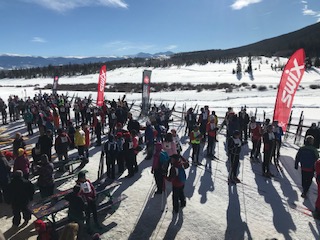
If you’ve never participated in a mass start, large field, cross-country race, you might have to review your bucket list. Thinking about these huge races reminded us of the Great Washington Birthday Race that used to be held in Putney, VT, and other places in Southern Vermont back in the 1970s  It was our first outing ever on cross-country skis, and there we were, competing with college teams, Olympians, ordinary citizens, and plenty of seniors on a modest 20 km (12 mile) course. Those days, you either got your wax right, or you didn’t.  We didn’t, but we laughed our way around the course, coming in dead last, but enthusiastic about the newly-discovered mystique of this ancient sport—the smell of pine tar, the arcane waxes, the simplicity of technique, and the thorough work out we got. Of course, equipment has evolved, but the aura of Nordic skiing is still magnetic.

Here’s the point: Most of SeniorsSkiing.com readers are Alpine skiers. We urge you to try cross-country to give yourself a break and change your perspective. Like the new skis for Alpine, there’s innovative new skis, bindings, and boots that makes x-c more efficient. We also encourage corporations, resorts, equipment, and clothing vendors to think about a Vasa-like race—smaller scale, local, a people’s race—in different regions.  We know there are plenty of folks who would love to participate. Build it, and they will come.

Start of Sweden’s Vasaloppett March 3, 2019. 15,000 racers head out to Mora, 90 km away.

This Week

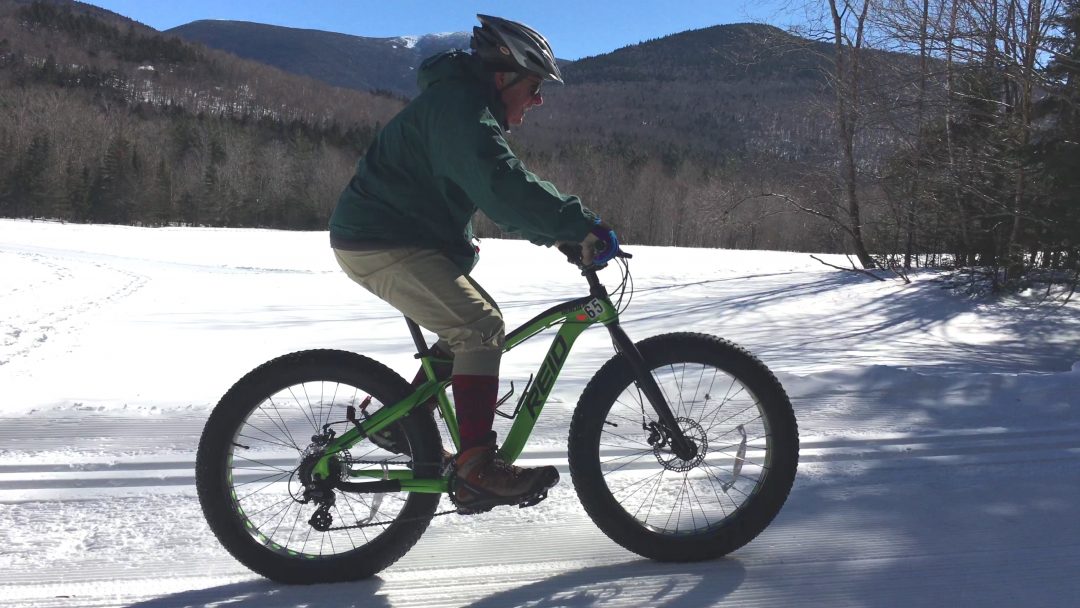
Mike riding the Fat Bike. Knickers are just for fun. Credit: Don Burch

Last week, we went on an expedition to the Great Glen Trails Outdoor Center in Pinkham Notch, NH, with a group of ski writers to try some alternative snow sports in a beautiful setting at the base of Mt. Washington. We had heard about fat biking as a new winter option, and so off we went.  Here’s a report of what we learned.

Our Mystery Glimpse this week has a tenuous connection to St. Patrick’s Day coming up next week. If you get this one, you’ve clearly been around the sport for a while. And we reveal the previous week’s picture as Al Johnson, a legend of the Rockies who started the first races in silver mining country.

This week’s Ask The Expert has a question about knee replacement answered by an orthopedic physician. We know a lot of readers will find this helpful.

Co-publisher Jon Weisberg reviews a number of ski-assist devices. These tools can help you extend your sporting life and are worth exploring. Click here for his story.

Finally, Jon also visited Powderhorn Mt. in western Colorado. Powderhorn is another of those off-the-beaten track areas that offer value to senior skiers.  There’s even a weekly Young-At-Heart program for 50-plus that offers guided skiing, lunch, and apres ski. Click here for the Resort Review.

Thanks again for supporting SeniorsSkiing.com. Tell your friends and remember, there are more of us every day and we aren’t going away.


Short Swings!


Older skiers have older eyes, and all skiers eventually experience decrease in snow contrast sensitivity. The most common culprit is cataracts, the cloudiness that forms on our lenses, causing the eyes to lose clarity and decreasing the quality of light focused on the retina. Cataracts can start forming when we’re in our 40s and 50s, though they’re more commonplace in our 60s and 70s.

Less common are processing issues related to diseases such as glaucoma and macular degeneration. They decrease the quality of the signal transmitted to the brain.

Many of you ski with contacts. I never figured out how to get them in and out without struggling. It was especially frustrating on powder days.

Arctic region snow goggles

Early snow goggles


For years I simply wore glasses. Then I used the OTG goggles. OTG stands for Over The Glasses. There was a lot of fogging. Next step was the battery operated fan goggle. When they worked, they worked well. When they didn’t – which was frequently – AAARGH! 

A-BOM makes a goggle that works like an electrified windshield. I used it for a few years. As I recall, it works.


My go-to solution is a prescription insert. It fits into goggles designed to accommodate inserts. Smith, Oakley, and Anon are among the companies that offer them.

Finding an optometrist that understands how to make a good insert may be a challenge. The last time I had an insert made was at a prominent optometric shop in Salt Lake City. I thought that being so close to the resorts, shops in SLC would have the know-how. I was wrong. The place I selected couldn’t get one of the lenses to stop falling out of the frame. It required multiple return visits.

I carry my specs in a hard shell case for use in the lodge or if conditions are such that I don’t want to wear goggles.

Another alternative is laser surgery. Some people I know swear by it. A few have developed complications. 

For the time being, I’m sticking with inserts.

Alterra To Invest $181 Million in Resort Improvements

Alterra Mountain Company, which owns ski resorts and the IKON pass, announced it will invest $181 million in capital improvements across its 14 North American mountain destinations. Major 2019/2020 projects include new high-speed lifts at Squaw Valley Alpine Meadows and Winter Park, RFID lift access at Deer Valley Resort, an expansive renovation of the Bobbie Burns lodge at CMH Heli-Skiing & Summer Adventures, and an upgrade of Steamboat’s gondola.

US Ski and Snowboard Hall of Fame Dinner Discounted for SeniorsSkiing.com Subscribers

The US Ski and Snowboard Hall of Fame’s annual induction ceremony is April 6 in Salt Lake City. The ceremony will culminate Snowsport History Celebration, a gathering in Park City of International Skiing History Association, US Ski and Snowboard Hall of Fame, and North American Snowsports Journalists Association. The ceremony will be at Salt Lake’s Little America Hotel. SeniorsSkiing.com subscribers may purchase tickets to the gala at a $100 discount ($239) through March 15 by entering SENIORS2019 when purchasing. If you live in the area or are visiting, this should be a terrific evening. This year’s inductees include racers Bode Miller, Kristin Ulmer, Hilary Engisch, and Andrew Weibrecht.

Tickets: https://skihall.com/induction/tickets/

Full event details: https://skihall.com/induction/schedule/

Lodging: https://skihall.com/induction/lodging/

George Jedenoff, 101 1/2 and Still Skiing

George Jedenoff, 101 1/2 and still skiing!

This video issued by Ski Utah is titled The Optimist. It shows George skiing with his son at Alta. George explains his philosophy of optimism and staying fit so he can continue to enjoy life on snow. An added bonus are some brief comments from Harriet Wallis, frequent SeniorsSkiing.com contributor. The video is 5 minutes long. It will bring you joy.

ORSDEN Parka and Pants SALE


Orsden makes good-looking, functional, ski parkas and pants. Because they sell directly to consumers online, the products cost about half of what they would in a shop. The company just announced a 50% off end of season sale for its products. Parkas are $165; pants, $100. When I looked there was a full selection of sizes and colors. This is one terrific bargain.

Short Swings! Hiatus

Over the next four weeks, Short Swings! may be really short or nonexistent, while I’m skiing  in the Aosta Valley and the Dolomites. Will report on the adventure from time to time and when I’m back in early April.

Mike On A Fat Bike On Snow

A Fat Bike Neophyte Takes To The Trails. Here’s What’s Different.

Correspondent Don Burch (l) and Co-Publisher Mike Maginn pose before heading out. Credit: Tamsin Venn

Exploring alternative snow sports always interests us.  We like snowshoeing around the woods when the snow is too deep for cross-country skiing. We go ice-skating on the pond behind the house when it gets cold enough and there’s no snow cover, an uncommon combination. We even tried snow camping, and we are researching ways to build an igloo or a snow tepee for our grandson in the backyard. So, when the opportunity to go fat biking in the New Hampshire winter mountains came around, we saddled up.

A group of ski journalists were given a chance to explore the Great Glen Trails Outdoor Center in Pinkham Notch, just up the road from Wildcat Mt.  The center with its base lodge, store, cafe, and rental shop is just across the road from the brand new Glen House Hotel, on the exact site of four previous hotels dating back to the mid-19th century at the entrance to the famous Mt. Washington Auto Road.  The spacious Outdoor Center has 45 km of groomed trails for xc, snowshoeing, and fat biking as well as tubing.  Another fantastic activity is riding the Snow Coach up the Auto Road to the 4,200 foot tree line on Mt. Washington. There’s a whole other slate of activities for summer, too.  Only a half hour or so from North Conway, this resort is an historic, ultra family-friendly, non-skier welcoming, Nordic-focused, relatively undeveloped area, and we predict it is going to be growing like a snowball.

Don whisking along on the flat. It helps to have a groomed trail. Credit: Mike Maginn

But we came to try fat bikes because we heard they had become a new winter thing to do. See Pat McCloskey’s recent story on biking in the winter. We’ve seen fat bikes on sandy beaches, on trails in the woods, but we’ve never been on one, let alone riding one on the snow. We’re not new to cycling, that’s for sure.  We’ve been on two Boston-New York AIDS Rides, a Pan-Mass Challenge, and numerous local charity rides. We are happy on road bikes and a rail-trail hybrid. So, not a newbie.

A fat bike has gigantic balloon tires, a triple chain ring in the front with a tiny granny gear, and a frame that looks like beach cruiser. SeniorsSkiing correspondent Don Burch and I started off from the Outdoor Center with a little downhill run to the trail. So far, so good.

To bike at Great Glens, you follow the ski trail, riding in the center of the groomed corduroy, keeping away from the classic cross-country tracks. Right away, you notice the differences.

Rolling resistance is noticeable. With a five inch tire width, you’d expect that. But wow, it is different. We decided that hammering for speed was not our game, instead going slow was good. Finally finding the right gear combination made pedaling easier  Those adjustments helped.

Soft snow acted like a brake. When we hit a soft patch, we felt the wheels sink, and we had to power out. Harder snow is much better. Look for hard snow in the woods; open field snow gets soft first on a sunny day.

Bouncy, bouncy can happen. Somewhere along the way, those big balloon tires made us feel as if we were bouncing up and down along with our pedaling. Perhaps it happened on an uphill where we tended to half-stand on our pedals. Kinda fun, but obviously not very efficient.

For a first outing, it was fun and challenging. Like all new things, now we know what to expect. Give fat bikes a try on a nice, cold, sunny day. You will have a thorough workout, learn some new cycling techniques, and have another way to enjoy the winter.

Mike riding the Fat Bike. Knickers are just for fun. Credit: Don Burch


Mystery Glimpse: Erin Go Grind

Read The Hints, Connect The Dots.

Boiler plate, locally manufactured, Happy St. Patrick’s Day, Irish-tinged ski area. Got it? What is this? Who invented it?

Last Week

This is the famous Al Johnson, ski legend of the Rockies.  According to the Colorado Snowsports Museum, which contributed this picture, Al was a superb skier before he came to Crystal, CO, from Canada in 1880 to prospect for silver. He became the legendary skier of the “Snowshoe Express.” He was Crystal’s first postmaster and carried the weekly mail and supplies between the mining communities of Crystal and Crested Butte on eleven foot long skis. His mail run was a dangerous trek through the narrow Crystal Canyon. During his twenty year career, he became a living legend. He was involved in starting a series of races between the miners in 1886, the “first one down buys cigars and oysters” for the other competitors. Just think, Al Johnson, a postman, store owner, outdoorsman, inaugurated the first ever ski races in the Rockies. That was a lot of races ago.

Thanks to the Colorado Snowsports Museum for this great picture.  Check out the Museum’s collection by clicking here.

And for more on Al Johnson, click here for a story from the Aspen Times.

Ask An Expert: Knee Replacement

Advice From An Orthopedic Physician.

A reader asks:

I need a knee replacement. Is there one implant (Zimmer, Depuy, Stryker, etc.) that is better for returning to skiing?

Here’s the reply from Dr. Peter Schmaus, Orthopedic Spine and Sports, Paramus, NJ:

Thank you for that interesting and timely question. There are nearly 700,000 knee replacements done in the United States annually and that number is increasing. Many  of these adults participate in snow sports and wish to continue skiing. More conservative  orthopedists in the past have advised against skiing with a total knee replacement and especially with a total hip replacement. However there is no clear evidence that  when skiing within limits, a total knee replacement presents a problem. Logically, experienced skiers in good physical condition should fare better.  A novice skier may however present more risk. Reducing impact , perhaps avoiding the bumps and limiting significant knee flexion would be prudent. Cross country skiing should present no problem at all.  Advances in equipment have also contributed to reduced risk.
There is no academic work showing  disproportionate loosening or wear and tear of the prosthesis, and no one brand  of prosthesis to my knowledge is superior to another.
There may be extenuating circumstances in regard to other coexisting orthopedic conditions and participants should asses the risks and benefits with their orthopedist and ideally, work with a physical therapist experienced in snow sports.

Have a question about technique, gear, destinations, travel, or any other aspect of winter sports? Send it to mike@seniorsskiing.com, and we’ll do our best to find an expert to respond.

Sometimes Our Bodies Need Help

There are times when we can benefit from some extra help, especially as we age or develop chronic medical conditions. 

Nick Manley, a remarkable athlete with a degenerative neurological condition, swears by the Ski-Mojo knee bracing system. The product’s shock absorbing springs reduce the load on his knees, allowing him to continue to race and ski for the entire day without tiring. 

I haven’t used it, but I have talked with Nick and at least a dozen other older skiers who tell me that it has made a profound difference in their skiing experiences. Ski-Mojo also helps maintain correct posture while skiing and makes it easier to ski longer.

If you feel you could benefit from some assistance, my strong suggestion is to visit Ski-Mojo’s site.


Now, on a limited basis, there’s another innovative approach to helping your knees. I wrote briefly about it a few months ago, when the company started advertising. The product, being developed by Roam Robotics, is called Elevate. It is a computer-influenced soft exoskeleton that utilizes pneumatics to assist movement in your legs and knees.

It may sound sci-fi, but it’s for real. Starting March 9, the company is making Elevate available on a unique demo basis in three locations: two in Lake Tahoe; one in Park City

Rent the device, and Roam will arrange for one of its trained ski hosts to accompany you for a few runs or for the entire day, based on your preference. If you’re staying within a certain radius of their facilities, the company will deliver the device to you the night before and provide enough orientation so you’ll be good to go the next morning when you meet your ski host on the hill.

If this sounds a little protective, it is. As a product, Elevate is ready for prime time, but the concept is so new that the company wants to provide hands-on education about its use. It also wants to collect information about customers’ experience to improve future versions. All of this is to assure a smooth roll-out when it ramps up production and makes Elevate available more broadly in seasons to come.

The cost for a one-day demo is $109, which includes drop-off and ski host services. If you are in the Tahoe or Park City neighborhoods and want to try an entirely different approach to protecting your knees and getting more out of your ski day, this is your opportunity. To reserve a demo, click here.